Search Results: "ghe"

22 December 2016

Shirish Agarwal: The wine and dine at debconf16

For the wine connoisseur

FOR the Wine Connoisseur

All photos courtesy KK . If any deviations, would put up labels sharing whose copyright it is. Before I get into all of that, I was curious about Canada and taking the opportunity of debconf happening there in a few months, asked few people what they thought of digital payments, fees and expenses in their country and if plastic cash is indeed used therein. The first to answer was Tyler McDonald (no idea if he is anyway related to the fast-food chain McDonalds which is a worldwide operation.) This is what he had to say/share
You can use credit / debit cards almost everywhere. Restaurant waiters also usually have wireless credit / debit terminals that they will bring to your table for you to settle your bill. How much your bank charges depends on your Canadian bank and the banking plan you are on. For instance, on my plan through the Bank Of Montreal, I get (I think) 20 free transactions a month and then after that I m charged $0.50CDN/piece. However, if I go to a Bank Of Montreal ATM and withdraw cash, there is no service fee for that. There is no service fee for using *credit* cards, only *debit* cards tend to have the fee. I live in a really rural area so I can t always get to a Bank Of Montreal machine for cash. So what I usually end up doing, is either pay by credit and then pay of the balance right away so I don t have to pay interest, or when I do use my bank card to pay for something, I ask if I can get cash back as well. Yes, Canada converted to plastic notes a few years ago. We ve also eliminated the penny. For cashless transactions, you pay the exact amount billed. If you re paying somebody in cash, it is rounded up or down to the nearest 5 cents. And for $1 or $2, instead of notes, we ve moved over to coins. I personally like the plastic notes. They re smoother and feel more durable than the paper notes. I ve had one go through a laundry load by accident and it came out the other side fine.
Another gentleman responded with slightly more information which probably would interest travellers from around the world, not just Indians
Quebec has its own interbank system called Interac (https://interac.ca/en/about/our-company.html). Quebec is a very proud and independent region and for many historical reasons they want to stand on their own, which is why they support their local systems. Some vendors will support only Interac for debit card transactions (at least this was the case when I stayed there the beginning of this decade, it might have changed a bit). *Most* vendors (including supermarkets like Provigo, Metro, etc) will accept major credit and debit cards, although MasterCard isn t accepted as widely there as Visa is. So, if you have one of both, load up your Visa card instead of your MasterCard or get a prepaid Visa card from your bank. They support chip cards everywhere so don t worry about that. If you have a 5 digit pin on any of your cards and a vendor asks you for a 4 digit pin, it will work 90%+ of the times if you just enter the first 4 digits, but it s usually a good idea to go change your pin to a 4 digit just to be safe.
From the Indian perspective all of the above fits pretty neat as we also have Pin and Chip cards (domestically though most ATMs still use the magnetic strip and is suspected that the POS terminals aren t any better.) That would be a whole different story so probably left for another day. I do like the bit about pocketing the change tip. As far as number of free transactions go, it was pretty limited in India for few years before the demonetization happening now. Few years before, I do remember doing as many transactions on the ATM as I please but then ATM s have seen a downward spiral in terms of technology upgradation, maintenance etc. There is no penalty to the bank if the ATM is out-of-order. If there was significant penalty then we probably would have seen banks taking more care of ATM s. It is a slightly more complex topic hence would take a stab at it some other day. Do hope though that the terms for ATM usage for bank customers become lenient similar to Canada otherwise it would be difficult for Indians to jump on the digital band-wagon as you cannot function without cheap, user-friendly technology. Cash machines: Uneven spread, slowing growth - Copyright Indian Express The image has been taken from this fascinating article which appeared in Indian Express couple of days back. Coming back to the cheese and wine in the evening. I think we started coming back from Eagle Encounters around 16:30/17:00 hrs Cape Town time. Somehow the ride back was much more faster and we played some Bollywood party music while coming back (all cool). Suddenly remembered that I had to buy some cheese as I hadn t bought any from India. There is quite a bit of a post where I m trying to know/understand if spices can be smuggled (which much later I learnt I didn t need to but that s a different story altogether), I also had off-list conversations with people about cheese as well but wasn t able to get any good recommendations. Then saw that KK bought Mysore Pak (apparently she took a chance not declaring it) which while not being exactly cheese fit right into things. In her own words a South Indian ghee sweet fondly nicknamed the blocks of cholesterol and reason #3 for bypass surgery . KK So with Leonard s help we stopped at a place where it looked like a chain of stores. Each store was selling something. Seeing that, I was immediately transported to Connaught Place, Delhi Connaught Place, Delhi The image comes from http://planetden.com/food/roundabout-world-connaught-place-delhi which attempts to explain Connaught Place. While the article is okish, it lacks soul and not written like a Delhite would write or anybody who has spent a chunk having spent holidays at CP. Another day, another story, sorry. What I found interesting about the stores while they were next to each other, I also eyed an alcohol shop as well as an Adult/Sex shop. I asked Leonard as to how far we were from UCT and he replied hardly 5 minutes by car and was shocked to see both alcohol and a sex shop. While an alcohol shop some distance away from a college is understandable, there are few and far around Colleges all over India, but adult shops are a rarity. Unfortunately, none of us have any photos of the place as till that time everybody s phone was dead or just going to be dead and nobody had thought to bring a portable power pack to juice our mobile devices. A part of me was curious to see what the sex shop would have and look from inside, but as was with younger people didn t think it was appropriate. All of us except Jaminy and someone else (besides Leonard) decided to stay back, while the rest of us went inside to explore the stores. It took me sometime to make my way to the cheese corner and had no idea which was good and which wasn t. So with no idea of brands therein, the only way to figure out was the pricing. So bought two, one a larger 500 gm cheap piece and a smaller slightly more expensive one just to make sure that the Debian cheese team would be happy. We did have a mini-adventure as for sometime Jaminy was missing, apparently she went goofing off or went to freshen up or something and we were unable to connect with her as all our phones were dead or dying. Eventually we came back to UCT, barely freshened up when it was decided by our group to go and give our share of goodies to the cheese and wine party. When I went up to the room to share the cheese, came to know they needed a volunteer for cutting veggies etc. Having spent years seeing Yan Can Cook and having practised quite a bit tried to do some fancy decoration and some julian cutting but as we got dull knives and not much time, just did some plain old cutting
The salads

The Salads, partly done by me.

I have to share I had a fascinating discussion about cooking in Pressure Cookers. I was under the assumption that everybody knows how to use Pressure Cookers as they are one of the simplest ways to cook food without letting go of all the nutrients. At least, I believe this to be predominant in the Asian subcontinent and even the chinese have similar vessels for cooking. I use what is called the first generation Pressure Cooker. I have been using a 1.5 l Prestige Pressure Cooker over half a decade, almost used daily without issues. http://www.amazon.in/Prestige-Nakshatra-Aluminium-Pressure-Cooker/dp/B00CB7U1OU
Prestige 1.5 L Pressure Cooker

1.5 Litre Pressure Cooker with gasket and everything.

There are also induction pressure cookers nowadays in the Indian market and this model https://www.amazon.in/Prestige-Deluxe-Induction-Aluminum-Pressure/dp/B01KZVPNGE/ref=sr_1_2
Induction base cooking for basmati rice

Best cooker for doing Basmati Biryanis and things like that.

Basmati is long-grain, aromatic rice which most families used in very special occasions such as festivals, marriages, anything good and pure is associated with the rice. I had also shared my lack of knowledge of industrial Microwave Ovens. While I do get most small Microwave Ovens like these , cooking in industrial ovens I simply have no clue. Anyways, after that conversation I went back, freshened up a bit and sometime later found myself in the middle of this
Collection of Wine Bottles

Random selection of wine bottles from all over the world.

Also at times found myself in middle of this
Chocolates all around me.

CHOCOLATES

I tried quite a few chocolates but the best one I liked (don t remember the name) was a white caramel chocolate which literally melted into my mouth. Got the whole died and went to heaven experience . Who said gluttony is bad Or this
French Bread, Wine and chaos

French Bread, Wine and chaos

As can be seen the French really enjoy their bread. I do remember a story vaguely (don t remember if it was a children s fairy tale or something) about how the French won a war through their french bread. Or this
Juices for those who love their health

Juices for those who love their health

We also had juices for the teetotaller or who can t handle drinks. Unsurprisingly perhaps, by the end of the session, almost all the different wines were finito while there was still some juices left to go around. From the Indian perspective, it wasn t at all exciting, there were no brawls, everybody was too civilized and everybody staggered off when they met their quota. As I was in holiday spirit, stayed up late, staggered to my room, blissed out and woke up without any headache. Pro tip Drink lots and lots and lots of water especially if you are drinking. It flushes out most of the toxins and also helps in not having after-morning headaches. If I m going drinking, I usually drown myself in at least a litre or two of water, even if I had to the bathroom couple of times before going to bed. All in all, a perfect evening. I was able to connect/talk with some of the gods whom I had wanted to for a long time and they actually listened. Don t remember if I mumbled something or made some sense in small-talk or whatever I did. But as shared, a perfect evening
Filed under: Miscellenous Tagged: #ATM usage, #Canada, #Cheese and Wine party, #Cheese shopping, #Connaught Place Delhi, #Debconf16, #Debit card, #French bread, #Julian cutting, #Mysore Pak, #white caramel chocolate

18 December 2016

Iustin Pop: Printer fun

Had some printer fun this week. It was fun in the sense that failure modes are interesting, not that there was much joy in the process. My current document printer is an HP that I bought back in early 2008; soon 9 years old, that is. When I got the printer I was quite happy: it supports Postscript, it supports memory extension (which allowed me to go from the built-in 64MB to a whopping 320MB), it is networked and has automatic duplex. Not good for much more than document printing, but that it did well. I didn't print a lot on it (averaged it was well below the recommended monthly limit), which might explain the total trouble-free operation, but I did change the toner cartridges a couple of times. The current cartridges were running low for a while, but I didn't need to change them yet. As I printed a user manual at the beginning of the week (~300+ pages in total), I ran out of the black half-way through. Bought a new cartridge, installed it, and the first strange thing was that it still showed Black empty - please replace . I powered the printer off and turned it on again (the miracle cure for all IT-related things), and things seemed OK, so I restarted printing. However, this time, the printer was going through 20-30 pages, and then was getting stuck in "Printing document" with green led blinking. Waited for 20 minutes, nothing. So cancel the job (from the printer), restart printing, all fine. The next day I wanted to print a single page, and didn't manage to. Checked that the PDF is normal, checked an older PDF which I printed successfully before, nothing worked. Changed drivers, unseated & re-seated the extra memory, changed operating systems, nothing. Not even the built-in printer diagnostic pages were printing. The internet was all over with "HP formatter issues"; apparently some HP printers had "green" (i.e. low-quality) soldering, and were failing after a while. But people were complaining about 1-2-4 years, not 9 that my printer worked, and it was very suspicious that all troubles started after my cartridge replacement. Or, more likely, due to the recent sudden increase in printing. Given that formatter board fixes (bake in the oven for N minutes at a specific temperature to reflow the soldering) are temporary and that you can't find replacement parts for this printer, I started looking for a new printer. To my surprise (and dismay at the waste that capitalism produces), a new printer from a higher class was cheaper than replacing all 4 cartridges in my printer. So I had a 90% full black cartridge that I couldn't reuse, but I'd get a new printer for not much more. Interestingly, in 9 years, the development was: I was however happy that one can still get OS-independent (Postscript), networked printers that are small enough for home use and don't (necessarily) come with WiFi. However, one thing still bothered me: did I have such problems because the printer died of overwork at old age, or was it related to the cartridge change? So I start searching again, and I find a post on a forum (oh Google, why did you remove "forum search" and replaced it with "language level"?) that details a hidden procedure to format the internal storage of the printer, exactly for my printer model, exactly for my symptoms. Huh, I will lose page count, but this is worth a try So I do press the required keys, I see the printer booting and saying "erasing ", then asking for language, which makes me happy because it seems the forum post was correct in one regard. I confirm English, the printer reboots once more, and then when it comes up it warns me: "Yellow cartridge is a non-HP original, please confirm". I get confused, and re-seat all cartridges, to no avail. Yellow is non-HP. Sigh, maybe that cartridge had something that confused the printer? When I visit its web page however, all cartridges except the newly installed black one are marked as Non-HP; this only means that I can't see their remaining toner level, but otherwise the printer is restored back to life. I take the opportunity to also perform a firmware upgrade (only five years newer firmware, but still quite old), but this doesn't solve the Non-HP message. The printer works now, and I'm left wondering: was this all a DRM-related failure, something like new cartridge chip which had some new code that confused the printer so bad it needed reformatting, at which point the old cartridge code is no longer supported (for whatever reason)? Was it just a fluke, unrelated to DRM? Was the problem that I powered off the printer soon after replacing the cartridge, while it was still doing something (e.g. preparing to do a calibration after the change)? And another, more practical question: I have 3 cartridges to replace still; they were at 10% before this entire saga, and I'm not able to see their level anymore, but they'll get down to empty soon. The black cartridge in the printer is already at 77%, which is surprising as I didn't print that much. So should I replace the cartridges on what is a possibly fully functional, but also possibly a dying printer? Or buy a new one for slightly more, throwing out possibly good hardware? Even though I understand the business reason behind it, I hate the whole concept of "the printer is free, you pay for the ink". Though in my case "free" didn't mean bad, as a lifetime of 9 years is good enough for a printer.

17 December 2016

Shirish Agarwal: Demonetisation, Indian state and world

Queues get longer, patience runs out- Copyright Indian Express Group.

Queues get longer, patience runs out- Copyright Indian Express Group.

I dunno if people heard or didn t hear about the demonetisation of INR 500 and INR 1000 which happened in India on 8th November 2016 with new currency designed in India of INR 2000 and INR 500. What they did was from that moment onwards, paper currency of INR 500 and INR 1000 notes were declared invalid except few places (Government Hospitals, Petrol Pumps, Booking of Air and Train tickets) . The reasons given were as a. End of corruption There is/was suspicion that there are people who have loads of unaccounted wealth which they keep in the form of Cash in hand, b. Charge against fake/duplicate currency There is/was suspicion that quite a bit of the money esp, high value notes such as INR 500 and INR 1000, so having made them illegal, people had to hand over cash to banks and fake money would go outside the system. c. Terror funding This is related with the above point. There is a popular theory/myth/fact that terrorists use fake money to buy people, arms and ammunition while further devaluing the value of INR against dollar and basket of other high-value currencies that Indian currency follows/bases itself on. Each of these theories/myths/facts has been contested. Every day we are seeing and reading reports of people being caught with new currency in absurd numbers while RBI , our central bank and Lender of Last Resort has had to play multiple roles such as policing along with the country s Income Tax Department as well as pumping in new notes of the NEW INR 2000/- and INR 500/- into ATM s and Bank branches around the country. Now while the above may seem to be reasonable, there have been multiple factors which has made the whole exercise less effective while implementing a. Banking reach While India does and can boast of somewhat good indicators of banking reach . But Quarter of these accounts were opened only in the last couple of years under the Pradhan Mantri Jan Dhana Yojana . There are quite a few limitations of such accounts. It is a good scheme as if you develop a good rapport with a bank and show good credit/debit understanding then there is possibility to move to normal full-fledged bank account. Almost all of these accounts had zero-balances till the demonetization move. Many of these accounts are suspected to have been conduits to convert black money to white as the Govt. had said it will not scrutinize small savings bank accounts. Also many bank accounts historically have laid dormant over the years. One of my first jobs was of a data entry operator in a bank and I used to see hundreds of bank accounts lying dormant for years together. This was in bank digitization in early 90s. Small Savings accounts would not be scrutinized if they bring upto INR 250000 while Jan Dhan accounts have an upper limit of only INR 50000 . Even then, it has lead to a huge surge in balances specifically in Zero balances account. What begs the question is if it is their hard-earned money why hadn t they deposited money before 8th November 2016. While I can t speak about them, I can certainly speak about myself. I hardly keep at the most INR INR 5/10K for medical emergencies in-house for number of years. Unless you are a businessman who has need of cash or have some function, nobody that I know would keep such amounts in their homes, simply for the possibility of theft in homes. So how did such people who are not able to open a full-fledged saving account get access to such large amounts? In most public sector banks, to have a full-fledged savings account the only requirements are a. Have INR 500 to 1000 as balance at all times.
b. Have permanent identity and residential proof
c. Two photographs
d. 2-3 people who are account holders who can act as guarantor. Of the above, b. and d. are probably sticking points for most migrants, while d. may be a sticking point for labourers, craftsman etc. hence the need for that specific scheme. Which leads to the natural suspicion that they may have been white-washing somebody s untaxed, unaccounted money which is being put into bank and made into legitimate white money. People do not have to file an Income Tax Return (ITR) unless they earn more than 250,000 in a single financial year. One good off-shot of the scheme though is the transparency gained about Bank Mitras b. Number of banks, quality of Bank services, number of people per bank at least in Nationalized Banks leaves much to be desired. We can t even try to compare with other BRIC countries, leave alone Germany.
Mobile ATM - Copyright - PTI

Mobile ATM Copyright PTI

One another positive off-shoot has been the introduction of Mobile ATM Vans around the country. I had experienced such vans in Mumbai since ages, but not anywhere else. I do hope that both Bank Mitras as well as such Van Mobile ATMs happen more. There are huge swathes of people who are currently unbanked. Getting them into the banking infrastructure, getting them to *think* about taking rational financial decisions, i.e. saving and spending, different types of saving etc. should not make citizens and the banking systems more productive and efficient, but hopefully improves our GDP and make it more resilient to any outside financial shocks. c. Many bank websites have everything in English. That norm needs to change. I do have few queries though, one of the countries who is supposed to be a prominent supporter and user of cashless society is supposed to be Canada. Could any Canadians (also because debconf is going to happen in Canada in 2017) share how and if they had seen the Canadian banking system evolve in their country ? Also how much of Canada s economy is cashless i.e used to Electronic Money Transfer and other means (but not cash) and how much is cash, more in day-to-day usage and transactions. I am trying to get people s perspective rather than some website which may serve only raw numbers, although even that would be appreciable. Also what, if any charges/commission are paid to a Canadian bank for paying via card/electronic money transfer. I ask as India has reduced charges overall to 1% from 2% for making transactions upto INR 2000 in a day. There has also been recent talk of plastic notes instead of paper currency. Plastic notes are supposed to be more copy-proof and also will work for much longer time. They will not soil as paper notes do. How have countries been looking at Plastic currencies. I do suspect there would be issues while destroying plastic money vis-a-vis paper currencies. A sort of interesting discussion that I had with Bernelle before venturing into South Africa was asking her about monetary transactions in SA. She had replied that the highest denomination notes was 200 ZAR which is roughly equal to ( ZAR 200 x 5 = INR 1000) . What is/was interesting that Bernelle told me to be careful and as far as possible not to show 200 ZAR note, whereas in India, even the cheapest worker I have met, they have seen and used INR 1000 note. The context of the discussion was being safe in South Africa and doing transactions with people around as to what works. It would be curiouser to know how things work in Canada for instance ? Also has Canada or any other country have experimented with plastic notes. If yes, how has the experience been ? I would have to say this is in no way a definitive guide of the different impressions and repercussion that the decision and the way it s playing out even now. Another thing, while researching for the article there were lots of interesting knowledge, for e.g. the Big Mac Index and it s limitations which I didn t know how to integrate into the decision and Policy taken. I also came to know/saw that lots of Policy initiatives being taken by the current (NDA)Government is similar to initiatives taken elsewhere in the world.. Whether the Policy would be fruitful in getting the desired outcome or would it lead to more chaos and down-turn will know in next quarter only. It would be nice and interesting if people have observed something similar in their country s economic policies as well.
Filed under: Miscellenous Tagged: #Bank Mitra, #Bank reach, #blackmoney, #debconf17, #Demonetisation, #fake currencies, #full-fledged savings account, #Jan Dhan scheme, #Moile ATM Van, #Plastic money, #Public Sector Banks (PSB), #Reserve Bank of India, Big Mac Index

13 December 2016

Shirish Agarwal: Eagle Encounters, pier Stellenbosch

Before starting, have to say hindsight as they say is always 20/20. I was moaning about my 6/7 hour trip few blog posts back but now came to know about the 17.5 hr. flights (17.5x800km/hr=14000 km.) which are happening around me. I would say I was whining about nothing seeing those flights. I can t even imagine how people would feel in those flights. Six hours were too much in the tin-can, thankfully though I was in the aisle seat. In 14 hours most people would probably give to Air rage . I just saw an excellent article on the subject. I also came to know that seat-selection and food on a long-haul flights are a luxury, hence that changes the equation quite a bit as well. So on these facts, it seems Qatar Airways treated me quite well as I was able to use both those options. Disclaimer My knowledge about birds/avian is almost non-existent, Hence feel free to correct me if I do go wrong anywhere. Coming back to earth literally , I will have to share a bit of South Africa as that is part and parcel of what I m going to share next. Also many of the pictures shared in this particular blog post belong to KK who has shared them with me with permission to share it with the rest of the world. When I was in South Africa, in the first couple of days as well as what little reading of South African History I had read before travelling, had known that the Europeans, specifically the Dutch ruled on South Africa for many years. What was shared to me in the first day or two that Afrikaans is mostly spoken by Europeans still living in South Africa, some spoken by the coloured people as well. This tied in with the literature I had already read. The Wikipedia page shares which language is spoken by whom and how the demographics play out if people are interested to know that. One of the words or part of the word for places we came to know is bosch as is used in many a places. Bosch means wood or forest. After this we came to know about many places which were known as somethingbosch which signified to us that area is or was a forest. On the second/third day Chirayu (pictured, extreme left) shared the idea of going to Eagle Encounters. Other people pictured in the picture are yours truly, some of the people from GSOC, KK is in the middle, the driver Leonard something who took us to Eagle Encounters on the right (pictured extreme right). Update I was informed that it was a joint plan between Chirayu and KK. They also had some other options planned which later got dropped by the wayside. The whole gang/group along with Leonard coming from eagle encounters It was supposed to be somewhat near, (Spier, Stellenbosch). While I was not able to able to see/figure out where Eagle Encounters is on Openstreetmap, somebody named Firefishy added Spier to OSM few years back. So thank you for that Firefishy so I can at least pin-point a closer place. I didn t see/know/try to figure out about the place as Chirayu said it s a zoo . I wasn t enthusiastic as much as I had been depressed by most zoos in India, while you do have national reserves/Parks in India where you see animals in their full glory. I have been lucky to been able to seen Tadoba and Ranthambore National parks and spend some quality time (about a week) to have some idea as to what can/happens in forests and people living in the buffer-zones but those stories are for a different day altogether. I have to say I do hope to be part of the Ranthambore experience again somewhere in the future, it really is a beautiful place for flora and fauna and fortunately or unfortunately this is the best time apart from spring, as you have the game of mist/fog and animals . North India this time of the year is something to be experienced. I wasn t much enthused as zoos in India are claustrophobic for animals and people both. There are small cages and you see and smell the shit/piss of the animals, generally not a good feeling. Chirayu shared with us also the possibility of being able to ride of Segways and range of bicycles which relieved me so that in case we didn t enjoy the zoo we would enjoy the Segway at least and have a good time (although it would have different expenses than the ones at Eagle Encounters). My whole education about what a zoo could be was turned around at Eagle Encounters as it seems to be somewhere between a zoo and what I know as national parks where animals roam free. We purchased the tickets and went in, the first event/happening was Eagle Encounters itself. One of the families at Eagle Encounter handling a snowy eagle Our introduction to the place started by two beautiful volunteer/trainers who were in charge of all the birds in the Eagle Encounters vicinity. The introduction started by every one of us who came for the Eagle Encounter show to wear a glove and to have/hold one of the pair of snowy owls to sit on the glove. That picture is of a family who was part of our show. Before my turn came, I was a little apprehensive/worried about holding a Owl -period. To my surprise, they were so soft and easy-going, I could hardly feel the weight on my hand. While the trainer/volunteers were constantly feeding them earthworm-bits (I didn t ask, just guessing) and we were all happy as they along with the visitors were constantly playing and interacting with the birds, sharing with us the life-cycle of the snowy Owl. It s only then I understood why in the Harry Potter Universe, the owl plays such an important part. They seem to be a nice, curious, easy-going, proud creatures which fits perfectly in the HP Universe. In hind-sight I should have videod the whole experience as the trainer/volunteer showed a battery of owls, eagles, vultures, Hawks (different birds of prey) what have you. I have to confess my knowledge of birds is and was non-existent. Vulture at the Eagle Encounters show Vulture, One of the larger birds we saw at the Eagle Encounters show. Some of the birds could be dangerous, especially in the wild. The other trainer showing off a Black Eagle at Eagle Encounters That was the other Volunteer-Trainer who was showing off the birds. I especially liked the t-shirt she was wearing. The shop at Eagle Encounters had whole lot of them, they were a bit expensive and just not my size Tidbit Just a few years ago, it was a shocker to me to know/realize that what commonly goes/known in the country as a parrot by most people is actually a Parakeet. As can be seen in the article linked, they are widely distributed in India. While I was young, I used to see the rose-ringed parakeets quite a bit around but nowadays due to probably pollution and other factors, they are noticeably less. They are popular as pets in India. I don t know what Pollito would think about that, don t think he would think good. Trainer showing off a Hawk at Eagle Encounters As I cannot differentiate between Hawk, Vulture, Eagle, etc. I would safely say a Bird of Prey as that was what he was holding. This photo was taken after the event was over where we all were curious to know about the volunteer/trainer, their day job and what it meant for them to be taking care of these birds. Update KK has shared with me what those specific birds are called, so in case the names or species are wrong, please take the truck with her and not me. While I don t remember the name of the trainer/volunteer, among other things it was shared that the volunteers/trainers aren t paid enough and they never have enough funds to take care of all the birds who come to them. Trainer showing Hawk and background chart Where the picture was shot (both this and earlier) was sort of open-office. If you look closely, you will see that there are names of the birds, for instance, people who loved LOTR would easily see Gandalf . that board lists how much food (probably in grams) did the bird eat in a day and week. While it was not shared, I m sure there would be a lot of paperwork, studies to get the birds as well as possible. From a computer science perspective, there seemed to be lot of potential for avian and big-data professionals to do lot of computer modelling and analysis and give more insight into the rehabilitation efforts so the process could be more fine-tuned, efficient and economic perhaps. Hawk on stand This is how we saw the majority of the birds. Most of them had a metal/plastic string which was tied to small artificial branches as the one above. I forgot to share a very important point. Eagle Encounters is not a zoo but a Rehabilitation Centre. While the cynic/skeptic part of me tried to not feel or see the before and after pictures of the birds bought to the rehabilitation centre, the caring part was moved to see most of the birds being treated with love and affection. From our conversations with the Volunteer-Trainer it emerged that every week they had to turn away lots of birds due to space constraints. It is only the most serious/life-threatening cases for which they could provide care in a sustainable way they would keep. Some of the birds who were in the cages were large, airy. I wouldn t say clean as what little I read before as well later is that birds shit enormously so cleaning cages is quite an effort. Most of the cages and near those artificial branches there were placards of people who were sponsoring a bird or two to look after them. From what was shared, many of the birds who came had been abused in many ways. Some of them had their bones crushed or/and other cruel ways. As I had shared that I had been wonderfully surprised by seeing birds come so close to me and most of my friends, I felt rage about those who had treated the birds in such evil, bad ways. What was shared with us that while they try to heal the birds as much as possible, it is always suspect how well the birds would survive on their own in nature, hence many of these birds would go to the sponsor or to some other place when they are well. The Secretary birds - cage- sponsors-adopted If you look at the picture closely, maybe look at the higher resolution photo in the gallery, you will see that both the birds have been adopted by two different couples. The birds as the name tag shows are called Secretaries . The Secretaries make a typical sound which is similar to the sound made by old typewriters. Just as woodpeckers make Morse Code noises when they are pecking with their beaks on trees, something similar to the sound of keys emitted by Old Remington typewriters when clicked on was done by the Secretaries. One of the birds in the cage, This is one of the birds in one of the few cages. If you see a higher-resolution picture of the earlier picture, the one which has Secretaries . Also as can be seen in the picture, there is wood-working happening and they are trying to expand the Rehabilitation Centre. All in all, an excursion which was supposed to be for just an hour, extended to something like 3 odd hours. KK shot more than a 1000 odd pictures while trying to teach/converse in Malyalam to some of the birds. She shot well over 1000 photos which would have filled something like 30 odd traditional photo albums. Jaminy (KK s partner-in-crime) used her selfie stick to desired effect, taking pictures with most of the birds as one does with celebrities. I had also taken some but most of them were over-exposed as was new to mobile photography at that time, still am but mostly it works. Lake with Barn Owls near Eagle Encounters That is the lake we discovered/saw after coming back from Eagle Encounters. We had good times. Lastly, a virtual prize distribution ceremony a. Chirayu and KK A platinum trophy for actually thinking and pitching the place in the first place. b. Shirish and Deven Bansod Metal cups for not taking more than 10 minutes to freshen up and be back after hearing the plan to go to Eagle Encounters. c. All the girls/women Spoons for actually making it to the day. All the girls took quite sometime to freshen up, otherwise it might have been possible to also experience the Segways, who knows. All-in-all an enjoyable day spent in being part of Eagle Encounters .
Filed under: Miscellenous Tagged: #Birds of Prey, #Debconf16, #Eagle Encounters, #Rehabilitation, #South African History, #Stellenbosch

11 December 2016

Colin Watson: The sad tale of CVE-2015-1336

Today I released man-db 2.7.6 (announcement, NEWS, git log), and uploaded it to Debian unstable. The major change in this release was a set of fixes for two security vulnerabilities, one of which affected all man-db installations since 2.3.12 (or 2.3.10-66 in Debian), and the other of which was specific to Debian and its derivatives. It s probably obvious from the dates here that this has not been my finest hour in terms of responding to security issues in a timely fashion, and I apologise for that. Some of this is just the usual life reasons, which I shan t bore you by reciting, but some of it has been that fixing this properly in man-db was genuinely rather complicated and delicate. Since I ve previously advocated man-db over some of its competitors on the basis of a better security posture, I think it behooves me to write up a longer description. I took over maintaining man-db over fifteen years ago in slightly unexpected circumstances (I got annoyed with its bug list and made a couple of non-maintainer uploads, and then the previous maintainer died, so I ended up taking over both in Debian and upstream). I was a fairly new developer at the time, and there weren t a lot of people I could ask questions of, but I did my best to recover as much of the history as I could and learn from it. One thing that became clear very quickly, both from my own inspection and from the bug list, was that most of the code had been written in a rather more innocent time. It was absolutely riddled with dangerous uses of the shell, poor temporary file handling, buffer overruns, and various common-or-garden deficiencies of that kind. I spent several years reworking large swathes of the codebase to be more robust against those kinds of bugs by design, and for example libpipeline came out of that effort. The most subtle and risky set of problems came from the fact that the man and mandb programs were installed set-user-id to the man user. Part of this was so that man could maintain preformatted cat pages , and part of it was so that users could run mandb if the system databases were out of date (this is now much less useful since most package managers, including dpkg, support some kind of trigger mechanism that can run mandb whenever new system-level manual pages are installed). One of the first things I did was to make this optional, and this has been a disabled-by-default debconf option in Debian for a long time now. But it s still a supported option and is enabled by default upstream, and when running setuid man and mandb need to take care to drop privileges when dealing with user-controlled data and to write files with the appropriate ownership and permissions. My predecessor had problems related to this such as Debian #26002, and one of the ways they dealt with them was to make /var/cache/man/ set-group-id root, in order that files written to that directory would have consistent group ownership. This always struck me as rather strange and I meant to do something about it at some point, but until the first vulnerability report above I regarded it as mainly a curiosity, since nothing in there was group-writeable anyway. As a result, with the more immediate aim of making the system behave consistently and dealing with bug reports, various bits of code had accreted that assumed that /var/cache/man/ would be man:root 2755, and not all of it was immediately obvious. This interacted with the second vulnerability report in two ways. Firstly, at some level it caused it because I was dealing with the day-to-day problems rather than thinking at a higher level: a series of bugs led me down the path of whacking problems over the head with a recursive chown of /var/cache/man/ from cron, rather than working out why things got that way in the first place. Secondly, once I d done that, I couldn t remove the chown without a much more extensive excursion into all the code that dealt with cache files, for fear of reintroducing those bugs. So although the fix for the second vulnerability is very simple in itself, I couldn t get there without dealing with the first vulnerability. In some ways, of course, cat pages are a bit of an anachronism. Most modern systems can format pages quickly enough that it s not much of an issue. However, I m loath to drop the feature entirely: I m generally wary of assuming that just because I have a fast system that everyone does. So, instead, I did what I should have done years ago: make man and mandb set-group-id man as well as set-user-id man, at which point we can simply make all the cache files and directories be owned by man:man and drop the setgid bit on cache directories. This should be simpler and less prone to difficult-to-understand problems. I expect that my next substantial upstream release will switch to --disable-setuid by default to reduce exposure, though, and distributions can start thinking about whether they want to follow that (Fedora already does, for example). If this becomes widely disabled without complaints then that would be good evidence that it s reasonable to drop the feature entirely. I m not in a rush, but if you do need cat pages then now is a good time to write to me and tell me why. This is the fiddliest set of vulnerabilities I ve dealt with in man-db for quite some time, so I hope that if there are more then I can get back to my previous quick response time.

4 December 2016

Ben Hutchings: Linux Kernel Summit 2016, part 2

I attended this year's Linux Kernel Summit in Santa Fe, NM, USA and made notes on some of the sessions that were relevant to Debian. LWN also reported many of the discussions. This is the second and last part of my notes; part 1 is here. Kernel Hardening Kees Cook presented the ongoing work on upstream kernel hardening, also known as the Kernel Self-Protection Project or KSPP. GCC plugins The kernel build system can now build and use GCC plugins to implement some protections. This requires gcc 4.5 and the plugin headers installed. It has been tested on x86, arm, and arm64. It is disabled by CONFIG_COMPILE_TEST because CI systems using allmodconfig/allyesconfig probably don't have those installed, but this ought to be changed at some point. There was a question as to how plugin headers should be installed for cross-compilers or custom compilers, but I didn't hear a clear answer to this. Kees has been prodding distribution gcc maintainers to package them. Mark Brown mentioned the Linaro toolchain being widely used; Kees has not talked to its maintainers yet. Probabilistic protections These protections are based on hidden state that an attacker will need to discover in order to make an effective attack; they reduce the probability of success but don't prevent it entirely. Kernel address space layout randomisation (KASLR) has now been implemented on x86, arm64, and mips for the kernel image. (Debian enables this.) However there are still lots of information leaks that defeat this. This could theoretically be improved by relocating different sections or smaller parts of the kernel independently, but this requires re-linking at boot. Aside from software information leaks, the branch target predictor on (common implementations of) x86 provides a side channel to find addresses of branches in the kernel. Page and heap allocation, etc., is still quite predictable. struct randomisation (RANDSTRUCT plugin from grsecurity) reorders members in (a) structures containing only function pointers (b) explicitly marked structures. This makes it very hard to attack custom kernels where the kernel image is not readable. But even for distribution kernels, it increases the maintenance burden for attackers. Deterministic protections These protections block a class of attacks completely. Read-only protection of kernel memory is either mandatory or enabled by default on x86, arm, and arm64. (Debian enables this.) Protections against execution of user memory in kernel mode are now implemented in hardware on x86 (SMEP, in Intel processors from Skylake onward) and on arm64 (PXN, from ARMv8.1). But Skylake is not available for servers and ARMv8.1 is not yet implemented at all! s390 always had this protection. It may be possible to 'emulate' this using other hardware protections. arm (v7) and arm64 now have this, but x86 doesn't. Linus doesn't like the overhead of previously proposed implementations for x86. It is possible to do this using PCID (in Intel processors from Sandy Bridge onward), which has already been done in PaX - and this should be fast enough. Virtually mapped stacks protect against stack overflow attacks. They were implemented as an option for x86 only in 4.9. (Debian enables this.) Copies to or from user memory sometimes use a user-controlled size that is not properly bounded. Hardened usercopy, implemented as an option in 4.8 for many architectures, protects against this. (Debian enables this.) Memory wiping (zero on free) protects against some information leaks and use-after-free bugs. It was already implemented as debug feature with non-zero poison value, but at some performance cost. Zeroing can be cheaper since it allows allocator to skip zeroing on reallocation. That was implemented as an option in 4.6. (Debian does not currently enable this but we might do if the performance cost is low enough.) Constification (with the CONSTIFY gcc plugin) reduces the amount of static data that can be written to. As with RANDSTRUCT, this is applied to function pointer tables and explicitly marked structures. Instances of some types need to be modified very occasionally. In PaX/Grsecurity this is done with pax_ open,close _kernel() which globally disable write protection temporarily. It would be preferable to override write protection in a more directed way, so that the permission to write doesn't leak into any other code that interrupts this process. The feature is not in mainline yet. Atomic wrap detction protects against reference-counting bugs which can result in a use-after-free. Overflow and underflow are trapped and result in an 'oops'. There is no measurable performance impact. It would be applied to all operations on the atomic_t type, but there needs to be an opt-out for atomics that are not ref-counters - probably by adding an atomic_wrap_t type for them. This has been implemented for x86, arm, and arm64 but is not in mainline yet. Kernel Freezer Hell For the second year running, Jiri Kosina raised the problem of 'freezing' kthreads (kernel-mode threads) in preparation for system suspend (suspend to RAM, or hibernation). What are the semantics? What invariants should be met when a kthread gets frozen? They are not defined anywhere. Most freezable threads don't actually need to be quiesced. Also many non-freezable threads are pointlessly calling try_to_freeze() (probably due to copying code without understanding it)). At a system level, what we actually need is I/O and filesystem consistency. This should be achieved by: The system suspend code should not need to directly freeze threads. Kernel Documentation Jon Corbet and Mauro Carvalho presented the recent work on kernel documentation. The kernel's documentation system was a house of cards involving DocBook and a lot of custom scripting. Both the DocBook templates and plain text files are gradually being converted to reStructuredText format, processed by Sphinx. However, manual page generation is currently 'broken' for documents processed by Sphinx. There are about 150 files at the top level of the documentation tree, that are being gradually moved into subdirectories. The most popular files, that are likely to be referenced in external documentation, have been replaced by placeholders. Sphinx is highly extensible and this has been used to integrate kernel-doc. It would be possible to add extensions that parse and include the MAINTAINERS file and Documentation/ABI/ files, which have their own formats, but the documentation maintainers would prefer not to add extensions that can't be pushed to Sphinx upstream. There is lots of obsolete documentation, and patches to remove those would be welcome. Linus objected to PDF files recently added under the Documentation/media directory - they are not the source format so should not be there! They should be generated from the corresponding SVG or image files at build time. Issues around Tracepoints Steve Rostedt and Shuah Khan led a discussion about tracepoints. Currently each maintainer decides which tracepoints to create. The cost of each added tracepoint is minimal, but the cost of very many tracepoints is more substantial. So there is such a thing as too many tracepoints, and we need a policy to decide when they are justified. They advised not to create tracepoints just in case, since kprobes can be used for tracing (almost) anywhere dynamically. There was some support for requiring documentation of each new tracepoint. That may dissuade introduction of obscure tracepoints, but also creates a higher expectation of stability. Tools such as bcc and IOVisor are now being created that depend on specific tracepoints or even function names (through kprobes). Should we care about breaking them? Linus said that we should strive to be polite to developers and users relying on tracepoints, but if it's too painful to maintain a tracepoint then we should go ahead and change it. Where the end users of the tool are themselves developers it's more reasonable to expect them to upgrade the tool and we should care less about changing it. In some cases tracepoints could provide dummy data for compatibility (as is done in some places in procfs).

23 November 2016

Tanguy Ortolo: Generate man pages for awscli

No man pages, but almost The AWS Command Line Interface, which is available in Debian, provides no man page. Instead, that tool has an integrated help system, which allows you to run commands such as aws rds help, that, for what I have seen, generates some reStructuredText, then converts it to a man page in troff format, then calls troff to convert it to text with basic formatting, and eventually passes it to a pager. Since this is close to what man does, the result looks like a degraded man page, with some features missing such as the adaptation to the terminal width. Well, this is better than nothing, and better than what many under-documented tools can offer, but for several reasons, it still sucks: most importantly, it does not respect administrators' habits and it does not integrate with the system man database. You it does not allow you to use commands such as apropos, and you will get no man page name auto-completion from your shell since there is no man page.Generate the man pages Now, since the integrated help system does generate a man page internally, we can hack it to output it, and save it to a file:
Description: Enable a mode to generate troff man pages
 The awscli help system internally uses man pages, but only to convert
 them to text and show them with the pager. This patch enables a mode
 that prints the troff code so the user can save the man page.
 .
 To use that mode, run the help commands with an environment variable
 OUTPUT set to 'troff', for instance:
     OUTPUT='troff' aws rds help
Forwarded: no
Author: Tanguy Ortolo <tanguy+debian@ortolo.eu>
Last-Update: 2016-11-22
Index: /usr/lib/python3/dist-packages/awscli/help.py
===================================================================
--- /usr/lib/python3/dist-packages/awscli/help.py       2016-11-21 12:14:22.236254730 +0100
+++ /usr/lib/python3/dist-packages/awscli/help.py       2016-11-21 12:14:22.236254730 +0100
@@ -49,6 +49,8 @@
     Return the appropriate HelpRenderer implementation for the
     current platform.
     """
+    if 'OUTPUT' in os.environ and os.environ['OUTPUT'] == 'troff':
+        return TroffHelpRenderer()
     if platform.system() == 'Windows':
         return WindowsHelpRenderer()
     else:
@@ -97,6 +99,15 @@
         return contents
+class TroffHelpRenderer(object):
+    """
+    Render help content as troff code.
+    """
+
+    def render(self, contents):
+        sys.stdout.buffer.write(publish_string(contents, writer=manpage.Writer()))
+
+
 class PosixHelpRenderer(PagingHelpRenderer):
     """
     Render help content on a Posix-like system.  This includes
This patch must be applied from the root directory with patch -p0, otherwise GNU patch will not accept to work on files with absolute names. With that patch, you can run help commands with an environment variable OUTPUT='troff' to get the man page to use it as you like, for instance:
% OUTPUT='troff' aws rds help > aws_rds.1
% man -lt aws_rds.1   lp
Generate all the man pages Now that we are able to generate the man page of any aws command, all we need to generate all of them is a list of all the available commands. This is not that easy, because the commands are somehow derived from functions provided by a Python library named botocore, which are derived from a bunch of configuration files, and some of them are added, removed or renamed. Anyway, I have been able to write a Python script that does that, but it includes a static list of these modifications:
#! /usr/bin/python3
import subprocess
import awscli.clidriver
def write_manpage(command):
    manpage = open('%s.1' % '_'.join(command), 'w')
    command.append('help')
    process = subprocess.Popen(command,
            env= 'OUTPUT': 'troff' ,
            stdout=manpage)
    process.wait()
    manpage.close()
driver = awscli.clidriver.CLIDriver()
command_table = driver._get_command_table()
renamed_commands = \
     
        'config': 'configservice',
        'codedeploy': 'deploy',
        's3': 's3api'
     
added_commands = \
     
        's3': ['cp', 'ls', 'mb', 'mv', 'presign', 'rb', 'rm', 'sync',
               'website']
     
removed_subcommands = \
     
        'ses': ['delete-verified-email-address',
                'list-verified-email-addresses',
                'verify-email-address'],
        'ec2': ['import-instance', 'import-volume'],
        'emr': ['run-job-flow', 'describe-job-flows',
                'add-job-flow-steps', 'terminate-job-flows',
                'list-bootstrap-actions', 'list-instance-groups',
                'set-termination-protection',
                'set-visible-to-all-users'],
        'rds': ['modify-option-group']
     
added_subcommands = \
     
        'rds': ['add-option-to-option-group',
                'remove-option-from-option-group']
     
# Build a dictionary of real commands, including renames, additions and
# removals.
real_commands =  
for command in command_table:
    subcommands = []
    subcommand_table = command_table[command]._get_command_table()
    for subcommand in subcommand_table:
        # Skip removed subcommands
        if command in removed_subcommands \
                and subcommand in removed_subcommands[command]:
            continue
        subcommands.append(subcommand)
    # Add added subcommands
    if command in added_subcommands:
        for subcommand in added_subcommands[command]:
            subcommands.append(subcommand)
    # Directly add non-renamed commands
    if command not in renamed_commands:
        real_commands[command] = subcommands
    # Add renamed commands
    else:
        real_commands[renamed_commands[command]] = subcommands
# Add added commands
for command in added_commands:
    real_commands[command] = added_commands[command]
# For each real command and subcommand, generate a manpage
write_manpage(['aws'])
for command in real_commands:
    write_manpage(['aws', command])
    for subcommand in real_commands[command]:
        write_manpage(['aws', command, subcommand])
                         'sync', 'website'] 
This script will generate more than 2,000 man page files in the current directory; you will then be able to move them to /usr/local/share/man/man1. Since this is a lot of man pages, it may be appropriate to concatenate them by major command, for instance all the aws rds together

19 November 2016

Keith Packard: AltOS-Lisp-2

Updates to Altos Lisp I wrote a few days ago about a tiny lisp interpreter I wrote for AltOS Really, it's almost "done" now, I just wanted to make a few improvements Incremental Collection I was on a walk on Wednesday when I figured out that I didn't need to do a full collection every time; a partial collection that only scanned the upper portion of memory would often find plenty of free space to keep working for a while. To recap, the heap is in two pieces; the ROM piece and the RAM piece. The ROM piece is generated during the build process and never changes afterwards (hence the name), so the only piece which is collected is the RAM piece. Collection works like:
chunk_low = heap base
new_top = heap base
For all of the heap
    Find the first 64 live objects above chunk_low
    Compact them all to new_top
    Rewrite references in the whole heap for them
    Set new_top above the new locations
    Set chunk_low above the old locations
top = new_top
The trick is to realize that there's really no need to start at the bottom of the heap; you can start anywhere you like and compact stuff, possibly leaving holes below that location in the heap. As the heap tends to have long-lived objects slowly sift down to the beginning, it's useful to compact objects higher than that, skipping the compaction process for the more stable area in memory. Each time the whole heap is scanned, the top location is recorded. After that, incremental collects happen starting at that location, and when that doesn't produce enough free space, a full collect is done. The collector now runs a bunch faster on average now. Binary Searches I stuck some linear searches in a few places in the code, the first was in the collector when looking to see where an object had moved to. As there are 64 entries, the search is reduced from 32 to 6 compares on average. The second place was in the frame objects, which hold the list of atom/value bindings for each lexical scope (including the global scope). These aren't terribly large, but a binary search is still a fine plan. I wanted to write down here the basic pattern I'm using for binary searches these days, which avoids some of the boundary conditions I've managed to generate in the past:
int find (needle)  
    int l = 0;
    int r = count - 1;
    while (l <= r)  
        int m = (l + r) >> 1;
        if (haystack[m] < needle)
            l = m + 1;
        else
            r = m - 1;
     
    return l;
 
With this version, the caller can then check to see if there's an exact match, and if not, then the returned value is the location in the array where the value should be inserted. If the needle is known to not be in the haystack, and if the haystack is large enough to accept the new value:
void insert(needle)  
    int l = find(needle);
    memmove(&haystack[l+1],
        &haystack[l],
        (num - l) * sizeof (haystack[0]));
    haystack[l] = needle;
 
Similarly, if the caller just wants to know if the value is in the array:
bool exists(needle)  
    int l = find(needle);
    return (l < count && haystack[l] == needle);
 
Call with Current Continuation Because the execution stack is managed on the heap, it's completely trivial to provide the scheme-like call with current continuation, which constructs an object which can be 'called' to transfer control to a saved location:
> (+ "hello " (call/cc (lambda (return) (setq boo return) (return "foo "))) "world")
"hello foo world"
> (boo "bar ")
"hello bar world"
> (boo "yikes ")
"hello yikes world"
One thing I'd done previously is dump the entire state of the interpreter on any error, and that included a full stack trace. I adopted that code for printing of these continuation objects:
boo
[
    expr:   (call/cc (lambda (return) (set (quote boo) return) (return "foo ")))
    state:  val
    values: (call/cc
             [recurse...]
             )
    sexprs: ()
    frame:   
]
[
    expr:   (+ "hello " (call/cc (lambda (return) (set (quote boo) return) (return "foo "))) "world")
    state:  formal
    values: (+
             "hello "
             )
    sexprs: ((call/cc (lambda (return) (set (quote boo) return) (return "foo ")))
             "world"
             )
    frame:   
]
The top stack frame is about to return from the call/cc spot with a value; supply a value to 'boo' and that's where you start. The next frame is in the middle of computing formals for the + s-expression. It's found the + function, and the "hello " string and has yet to get the value from call/cc or the value of the "world" string. Once the call/cc "returns", that value will get moved to the values list and the sexpr list will move forward one spot to compute the "world" value. Implementing this whole mechanism took only a few dozen lines of code as the existing stack contexts were already a continuation in effect. The hardest piece was figuring out that I needed to copy the entire stack each time the continuation was created or executed as it is effectively destroyed in the process of evaluation. I haven't implemented dynamic-wind yet; when I did that for nickle, it was a bit of a pain threading execution through the unwind paths. Re-using Frames I decided to try and re-use frames (those objects which hold atom/value bindings for each lexical scope). It wasn't that hard; the only trick was to mark frames which have been referenced from elsewhere as not-for-reuse and then avoid sticking those in the re-use queue. This reduced allocations even further so that for simple looping or tail-calling code, the allocator may never end up being called. How Big Is It? I've managed to squeeze the interpreter and all of the rest of the AltOS system into 25kB of Cortex-M0 code. That leaves space for the 4kB boot loader and 3kB of flash to save/restore the 3kB heap across resets. Adding builtins to control timers and GPIOs would make this a reasonable software load for an Arduino; offering a rather different programming model for those with a taste for adventure. Modern ARM-based Arduino boards have plenty of flash and ram for this. It might be interesting to get this running on the Arduino Zero; there's no real reason to replace the OS either; porting the lisp interpreter into the bare Arduino environment wouldn't take long.

15 November 2016

Antoine Beaupr : The Turris Omnia router: help for the IoT mess?

The Turris Omnia router is not the first FLOSS router out there, but it could well be one of the first open hardware routers to be available. As the crowdfunding campaign is coming to a close, it is worth reflecting on the place of the project in the ecosystem. Beyond that, I got my hardware recently, so I was able to give it a try.

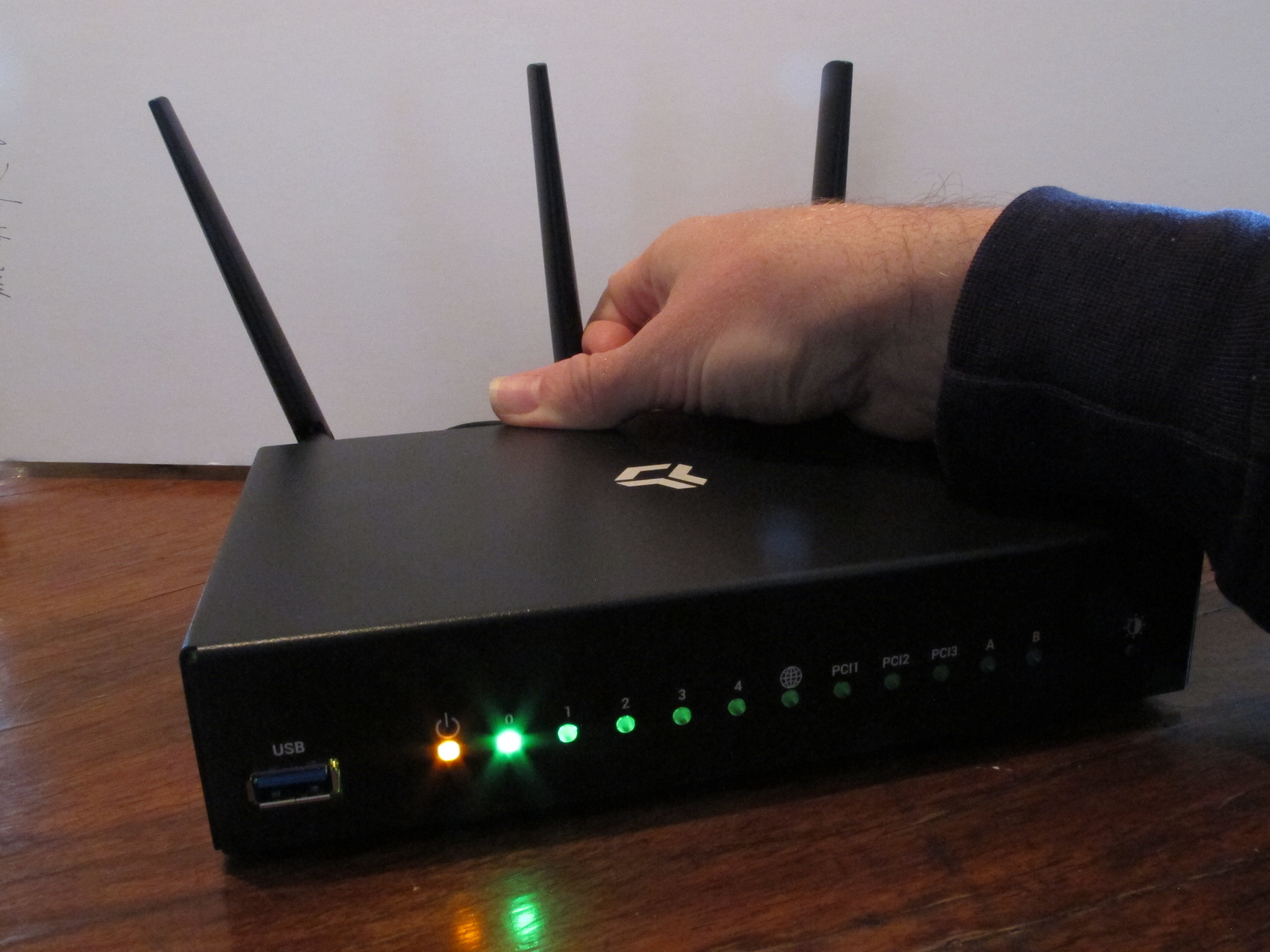
A short introduction to the Omnia project The Turris Omnia Router The Omnia router is a followup project on CZ.NIC's original research project, the Turris. The goal of the project was to identify hostile traffic on end-user networks and develop global responses to those attacks across every monitored device. The Omnia is an extension of the original project: more features were added and data collection is now opt-in. Whereas the original Turris was simply a home router, the new Omnia router includes:
  • 1.6GHz ARM CPU
  • 1-2GB RAM
  • 8GB flash storage
  • 6 Gbit Ethernet ports
  • SFP fiber port
  • 2 Mini-PCI express ports
  • mSATA port
  • 3 MIMO 802.11ac and 2 MIMO 802.11bgn radios and antennas
  • SIM card support for backup connectivity
Some models sold had a larger case to accommodate extra hard drives, turning the Omnia router into a NAS device that could actually serve as a multi-purpose home server. Indeed, it is one of the objectives of the project to make "more than just a router". The NAS model is not currently on sale anymore, but there are plans to bring it back along with LTE modem options and new accessories "to expand Omnia towards home automation". Omnia runs a fork of the OpenWRT distribution called TurrisOS that has been customized to support automated live updates, a simpler web interface, and other extra features. The fork also has patches to the Linux kernel, which is based on Linux 4.4.13 (according to uname -a). It is unclear why those patches are necessary since the ARMv7 Armada 385 CPU has been supported in Linux since at least 4.2-rc1, but it is common for OpenWRT ports to ship patches to the kernel, either to backport missing functionality or perform some optimization. There has been some pressure from backers to petition Turris to "speedup the process of upstreaming Omnia support to OpenWrt". It could be that the team is too busy with delivering the devices already ordered to complete that process at this point. The software is available on the CZ-NIC GitHub repository and the actual Linux patches can be found here and here. CZ.NIC also operates a private GitLab instance where more software is available. There is technically no reason why you wouldn't be able to run your own distribution on the Omnia router: OpenWRT development snapshots should be able to run on the Omnia hardware and some people have installed Debian on Omnia. It may require some customization (e.g. the kernel) to make sure the Omnia hardware is correctly supported. Most people seem to prefer to run TurrisOS because of the extra features. The hardware itself is also free and open for the most part. There is a binary blob needed for the 5GHz wireless card, which seems to be the only proprietary component on the board. The schematics of the device are available through the Omnia wiki, but oddly not in the GitHub repository like the rest of the software.

Hands on I received my own router last week, which is about six months late from the original April 2016 delivery date; it allowed me to do some hands-on testing of the device. The first thing I noticed was a known problem with the antenna connectors: I had to open up the case to screw the fittings tight, otherwise the antennas wouldn't screw in correctly. Once that was done, I simply had to go through the usual process of setting up the router, which consisted of connecting the Omnia to my laptop with an Ethernet cable, connecting the Omnia to an uplink (I hooked it into my existing network), and go through a web wizard. I was pleasantly surprised with the interface: it was smooth and easy to use, but at the same time imposed good security practices on the user. Install wizard performing automatic updates For example, the wizard, once connected to the network, goes through a full system upgrade and will, by default, automatically upgrade itself (including reboots) when new updates become available. Users have to opt-in to the automatic updates, and can chose to automate only the downloading and installation of the updates without having the device reboot on its own. Reboots are also performed during user-specified time frames (by default, Omnia applies kernel updates during the night). I also liked the "skip" button that allowed me to completely bypass the wizard and configure the device myself, through the regular OpenWRT systems (like LuCI or SSH) if I needed to. The Omnia router about to rollback to latest snapshot Notwithstanding the antenna connectors themselves, the hardware is nice. I ordered the black metal case, and I must admit I love the many LED lights in the front. It is especially useful to have color changes in the reset procedure: no more guessing what state the device is in or if I pressed the reset button long enough. The LEDs can also be dimmed to reduce the glare that our electronic devices produce. All this comes at a price, however: at \$250 USD, it is a much higher price tag than common home routers, which typically go for around \$50. Furthermore, it may be difficult to actually get the device, because no orders are being accepted on the Indiegogo site after October 31. The Turris team doesn't actually want to deal with retail sales and has now delegated retail sales to other stores, which are currently limited to European deliveries.

A nice device to help fight off the IoT apocalypse It seems there isn't a week that goes by these days without a record-breaking distributed denial-of-service (DDoS) attack. Those attacks are more and more caused by home routers, webcams, and "Internet of Things" (IoT) devices. In that context, the Omnia sets a high bar for how devices should be built but also how they should be operated. Omnia routers are automatically upgraded on a nightly basis and, by default, do not provide telnet or SSH ports to run arbitrary code. There is the password-less wizard that starts up on install, but it forces the user to chose a password in order to complete the configuration. Both the hardware and software of the Omnia are free and open. The automatic update's EULA explicitly states that the software provided by CZ.NIC "will be released under a free software licence" (and it has been, as mentioned earlier). This makes the machine much easier to audit by someone looking for possible flaws, say for example a customs official looking to approve the import in the eventual case where IoT devices end up being regulated. But it also makes the device itself more secure. One of the problems with these kinds of devices is "bit rot": they have known vulnerabilities that are not fixed in a timely manner, if at all. While it would be trivial for an attacker to disable the Omnia's auto-update mechanisms, the point is not to counterattack, but to prevent attacks on known vulnerabilities. The CZ.NIC folks take it a step further and encourage users to actively participate in a monitoring effort to document such attacks. For example, the Omnia can run a honeypot to lure attackers into divulging their presence. The Omnia also runs an elaborate data collection program, where routers report malicious activity to a central server that collects information about traffic flows, blocked packets, bandwidth usage, and activity from a predefined list of malicious addresses. The exact data collected is specified in another EULA that is currently only available to users logged in at the Turris web site. That data can then be turned into tweaked firewall rules to protect the overall network, which the Turris project calls a distributed adaptive firewall. Users need to explicitly opt-in to the monitoring system by registering on a portal using their email address. Turris devices also feature the Majordomo software (not to be confused with the venerable mailing list software) that can also monitor devices in your home and identify hostile traffic, potentially leading users to take responsibility over the actions of their own devices. This, in turn, could lead users to trickle complaints back up to the manufacturers that could change their behavior. It turns out that some companies do care about their reputations and will issue recalls if their devices have significant enough issues. It remains to be seen how effective the latter approach will be, however. In the meantime, the Omnia seems to be an excellent all-around server and router for even the most demanding home or small-office environments that is a great example for future competitors.
Note: this article first appeared in the Linux Weekly News.

13 November 2016

Dirk Eddelbuettel: pkgKitten 0.1.4: Creating R Packages that purr

kitten A new minor release 0.1.4 of pkgKitten just hit on CRAN this morning. One small change is that the package manual page it creates now makes use of the (still new-ish and under-documented and under-used) Rd macros described at the end of Section 2.13 of Writing R Extensions:
See the system.Rd file in share/Rd/macros for more details and macro definitions, including macros \packageTitle, \packageDescription, \packageAuthor, \packageMaintainer, \packageDESCRIPTION and \packageIndices.
By using these macros, and referencing them from the DESCRIPTION file, we can avoid redundancy, or worse, inconsitency, between both files. Or just be plain lazy and describe things just once in the higher-level file: A good thing! Otherwise we fixed a URL to the manual thanks to a PR, and just added some of the regular polish to some of the corners which R CMD check --as-cran is looking into:

Changes in version 0.1.4 (2016-11-13)
  • Utilize newer R macros in package-default manual page.
  • Repair a link to Wrting R Extensions (PR #7 by Josh O'Brien)

More details about the package are at the pkgKitten webpage and the pkgKitten GitHub repo. Courtesy of CRANberries, there is also a diffstat report for this release

This post by Dirk Eddelbuettel originated on his Thinking inside the box blog. Please report excessive re-aggregation in third-party for-profit settings.

Daniel Pocock: Are all victims of French terrorism equal?

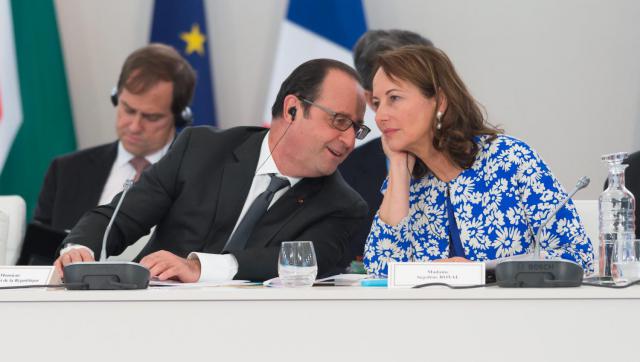
Some personal observations about the terrorist atrocities around the world based on evidence from Wikipedia and other sources The year 2015 saw a series of distressing terrorist attacks in France. 2015 was also the 30th anniversary of the French Government's bombing of a civilian ship at port in New Zealand, murdering a photographer who was on board at the time. This horrendous crime has been chronicled in various movies including The Rainbow Warrior Conspiracy (1989) and The Rainbow Warrior (1993). The Paris attacks are a source of great anxiety for the people of France but they are also an attack on Europe and all civilized humanity as well. Rather than using them to channel more anger towards Muslims and Arabs with another extended (yet ineffective) state of emergency, isn't it about time that France moved on from the evils of its colonial past and "drains the swamp" where unrepentant villains are thriving in its security services? Fran ois Hollande and S gol ne Royal. Royal's brother G rard Royal allegedly planted the bomb in the terrorist mission to New Zealand. It is ironic that Royal is now Minister for Ecology while her brother sank the Greenpeace flagship. If Fran ois and S gol ne had married (they have four children together), would G rard be the president's brother-in-law or terrorist-in-law? The question has to be asked: if it looks like terrorism, if it smells like terrorism, if the victim of that French Government attrocity is as dead as the victims of Islamic militants littered across the floor of the Bataclan, shouldn't it also be considered an act of terrorism? If it was not an act of terrorism, then what is it that makes it differ? Why do French officials refer to it as nothing more than "a serious error", the term used by Prime Minister Manuel Valls during a recent visit to New Zealand in 2016? Was it that the French officials felt it was necessary for Libert , galit , fraternit ? Or is it just a limitation of the English language that we only have one word for terrorism, while French officials have a different word for such acts carried out by those who serve their flag? If the French government are sincere in their apology, why have they avoided releasing key facts about the atrocity, like who thought up this plot and who gave the orders? Did the soldiers involved volunteer for a mission with the code name Op ration Satanique, or did any other members of their unit quit rather than have such a horrendous crime on their conscience? What does that say about the people who carried out the orders? If somebody apprehended one of these rogue employees of the French Government today, would they be rewarded with France's highest honour, like those tourists who recently apprehended an Islamic terrorist on a high-speed train? If terrorism is such an absolute evil, why was it so easy for the officials involved to progress with their careers? Would an ex-member of an Islamic terrorist group be able to subsequently obtain US residence and employment as easily as the French terror squad's commander Louis-Pierre Dillais? When you consider the comments made by Donald Trump recently, the threats of violence and physical aggression against just about anybody he doesn't agree with, is this the type of diplomacy that the US will practice under his rule commencing in 2017? Are people like this motivated by a genuine concern for peace and security, or are these simply criminal acts of vengence backed by political leaders with the maturity of schoolyard bullies?

12 November 2016

Wouter Verhelst: New Toy: Nikon D7200

Last month, I was abroad with my trusty old camera, but without its SD cards. Since the old camera has an SD only slot, which does not accept SDHC (let alone SDXC) cards, I cannot use it with cards larger than 2GiB. Today, such cards are not being manufactured anymore. So, I found myself with a few options:
  1. Forget about the camera, just don't take any photos. Given the nature of the trip, I did not fancy this option.
  2. Go on eBay or some such, and find a second-hand 2GiB card.
  3. Find a local shop, and buy a new camera body.
While option 2 would have worked, the lack of certain features on my old camera had meant that I'd been wanting to buy a new camera body for a while, but it just hadn't happened yet; so I decided to go with option 3. The Nikon D7200 is the latest model in the Nikon D7xxx series of cameras, a DX-format ("APS-C") camera that is still fairly advanced. Slightly cheaper than the D610, the cheapest full-frame Nikon camera (which I considered for a moment until I realized that two of my three lenses are DX-only lenses), it is packed with a similar amount of features. It can shoot photos at shutter speeds of 1/8000th of a second (twice as fast as my old camera), and its sensor can be set to ISO speeds of up to 102400 (64 times as much as the old one) -- although for the two modes beyond 25600, the sensor is switched to black-and-white only, since the amount of color available in such lighting conditions is very very low already. A camera which is not only ten years more recent than the older one, but also is targeted at a more advanced user profile, took some getting used to at first. For instance, it took a few days until I had tamed the camera's autofocus system, which is much more advanced than the older one, so that it would focus on the things I wanted it to focus on, rather than just whatever object happens to be closest. The camera shoots photos at up to twice the resolution in both dimensions (which combines to it having four times the amount of megapixels as the old body), which is not something I'm unhappy about. Also, it does turn out that a DX camera with a 24 megapixel sensor ends up taking photos with a digital resolution that is much higher than the optical resolution of my lenses, so I don't think more than 24 megapixels is going to be all that useful. The builtin WiFi and NFC communication options are a nice touch, allowing me to use Nikon's app to take photos remotely, and see what's going through the lens while doing so. Additionally, the time-lapse functionality is something I've used already, and which I'm sure I'll be using again in the future. The new camera is definitely a huge step forward from the old one, and while the price over there was a few hundred euros higher than it would have been here, I don't regret buying the new camera. The result is nice, too: DSC_1012 All in all, I'm definitely happy with it.

11 November 2016

Jonathan Dowland: Vinyl is killing Vinyl (but that's ok)

I started buying vinyl records about 16 years ago, but recently I've become a bit uncomfortable being identified as a "vinyl lover". The market is ascendant, with vinyl album sales growing for 8 consecutive years, at least in the UK. So why am I uncomfortable about it? A quick word about audio fidelity/quality here. I don't subscribe to the school of thought that audio on vinyl is inherently better than digital audio, far from it. I'm aware of its limitations. For recordings that I love, I try to seek out the best quality version available, which is almost always digital. Some believe that vinyl is immune to the "loudness war" brickwall mastering plaguing some modern releases, but for some of the worst offenders (Depeche Mode's Playing The Angel; Red Hot Chili Pepper's Californication) I haven't found the vinyl masterings to sound any different. 16 years ago Let's go back to why I started buying vinyl. Back when I started, the world was a very different place to what it is today. You could not buy most music in a digital form: it was 3 more years before the iTunes Store was opened, and it was Mac-only at first, and the music it sold was DRM-crippled for the first 5 or so years afterwards. The iPod had not been invented yet and there was no real market for personal music players. Minidiscs were still around, but Net-MD (the only sanctioned way to get digital music onto them from a computer) was terrible.
old-ish LPs old-ish LPs
Buying vinyl 16 years ago was a way to access music that was otherwise much harder to reach. There were still plenty of albums, originally recorded and released before CDs, which either had not been re-issued digitally at all, or had been done so early, and badly. Since vinyl was not fashionable, the second hand market was pretty cheap. I bought quite a lot of stuff for pennies at markets and car boot sales. Some music such as b-sides and 12" mixes and other mixes prepared especially for the format remains unavailable and uncollected on CD. (I'm a big fan of the B-side culture that existed prior to CDs. I might write more about that one day.) 10 years ago
modern-ish 7 inches modern-ish 7 inches
Fast forward to around 10 years ago. Ephemeral digital music is now much more common, the iPod and PMPs are well established. High-street music stores start to close down, including large chains like MOS, Our Price, and Virgin. Streaming hasn't particularly taken off yet, attempts to set up digital radio stations are fought by the large copyright owners. Vinyl is still not particularly fashionable, but it is still being produced, in particular for singles for up-and-coming bands in 7" format. You can buy a 7" single for between 1 and 4, getting the b-side with it. The b-side is often exclusive to the 7" release as an incentive to collectors. I was very prepared to punt 1-2 on a single from a group I was not particularly familiar with just to see what they were like. I discovered quite a lot of artists this way. One of the songs we played at our wedding was such an exclusive: a recording of the Zutons' covering Jackie Wilson's "Higher and Higher", originally broadcast once on Colin Murray's Evening Session radio show. Now
Vangelis - Blade Runner OST An indulgence
So, where are we now? Vinyl album sales are a huge growth market. They are very fashionable. Many purchasers are younger people who are new to the format; it's believed many don't have the means to play the music on the discs. Many (most?) albums are now issued as 12" vinyl in parallel with digital releases. These are usually exactly the same product (track listing, mixes, etc.) and usually priced at exactly twice that of the CD (with digital prices normally a fraction under that). The second hand market for 12" albums has inflated enormously. Gone are the bargains that could be had, a typical second hand LP is now priced quite close to the digital price for a popular/common album in most places. The popularity of vinyl has caused a huge inflation in the price of most 7" singles, which average somewhere between 8- 10 each, often without any b-side whatsoever. The good news is from my observations the 2nd hand market for 7" singles hasn't been affected quite as much. I guess they are not as desirable to buyers. The less said about Record Store Day, the better. So, that's all quite frustrating. But most of the reasons I used to buy vinyl have gone away anyway. Many of the rushed-to-market CD masterings have been reworked and reissued, correcting the earlier problems. B-side compilations are much more common so there are far fewer obscure tracks or mixes, and when the transfer has been done right, you're getting those previously-obscure tracks in a much higher quality. Several businesses exist to sell 2nd hand CDs for rock bottom prices, so it's still possible to get popular music very cheaply. The next thing to worry about is probably streaming services.

6 November 2016

Russell Coker: Is a Thinkpad Still Like a Rolls-Royce

For a long time the Thinkpad has been widely regarded as the Rolls-Royce of laptops . Since 2003 one could argue that Rolls-Royce is no longer the Rolls-Royce of cars [1]. The way that IBM sold the Think business unit to Lenovo and the way that Lenovo is producing both Thinkpads and cheaper Ideapads is somewhat similar to the way the Rolls-Royce trademark and car company were separately sold to companies that are known for making cheaper cars. Sam Varghese has written about his experience with Thinkpads and how he thinks it s no longer the Rolls-Royce of laptops [2]. Sam makes some reasonable points to support this claim (one of which only applies to touchpad users not people like me who prefer the Trackpoint), but I think that the real issue is whether it s desirable to have a laptop that could be compared to a Rolls-Royce nowadays. Support The Rolls-Royce car company is known for great reliability and support as well as features that other cars lack (mostly luxury features). The Thinkpad marque (both before and after it was sold to Lenovo) was also known for great support. You could take a Thinkpad to any service center anywhere in the world and if the serial number indicated that it was within the warranty period it would be repaired without any need for paperwork. The Thinkpad service centers never had any issue with repairing a Thinkpad that lacked a hard drive just as long as the problem could be demonstrated. It was also possible to purchase an extended support contract at any time which covered all repairs including motherboard replacement. I know that not everyone had as good an experience as I had with Thinkpad support, but I ve been using them since 1998 without problems which is more than I can say for most hardware. Do we really need great reliability from laptops nowadays? When I first got a laptop hardly anyone I knew owned one. Nowadays laptops are common. Having a copy of important documents on a USB stick is often a good substitute for a reliable laptop, when you are in an environment where most people own laptops it s usually not difficult to find someone who will let you use theirs for a while. I think that there is a place for a laptop with RAID-1 and ECC RAM, it s a little known fact that Thinkpads have a long history of supporting the replacement of a CD/DVD drive with a second hard drive (I don t know if this is still supported) but AFAIK they have never supported ECC RAM. My first Thinkpad cost $3,800. In modern money that would be something like $7,000 or more. For that price you really want something that s well supported to protect the valuable asset. Sam complains about his new Thinkpad costing more than $1000 and needing to be replaced after 2.5 years. Mobile phones start at about $600 for the more desirable models (IE anything that runs Pokemon Go) and the new Google Pixel phones range from $1079 to $1,419. Phones aren t really expected to be used for more than 2.5 years. Phones are usually impractical to service in any way so for most of the people who read my blog (who tend to buy the more expensive hardware) they are pretty much a disposable item costing $600+. I previously wrote about a failed Nexus 5 and the financial calculations for self-insuring an expensive phone [3]. I think there s no way that a company can provide extended support/warranty while making a profit and offering a deal that s good value to customers who can afford to self-insure. The same applies for the $499 Lenovo Ideapad 310 and other cheaper Lenovo products. Thinkpads (the higher end of the Lenovo laptop range) are slightly more expensive than the most expensive phones but they also offer more potential for the user to service them. Features My first Thinkpad was quite underpowered when compared to desktop PCs, it had 32M of RAM and could only be expanded to 96M at a time when desktop PCs could be expanded to 128M easily and 256M with some expense. It had a 800*600 display when my desktop display was 1280*1024 (37% of the pixels). Nowadays laptops usually start at about 8G of RAM (with a small minority that have 4G) and laptop displays start at about 1366*768 resolution (51% of the pixels in a FullHD display). That compares well to desktop systems and also is capable of running most things well. My current Thinkpad is a T420 with 8G of RAM and a 1600*900 display (69% of FullHD), it would be nice to have higher resolution but this works well and it was going cheap when I needed a new laptop. Modern Thinkpads don t have some of the significant features that older ones had. The legendary Butterfly Keyboard is long gone, killed by the wide displays that economies of scale and 16:9 movies have forced upon us. It s been a long time since Thinkpads had some of the highest resolution displays and since anyone really cared about it (you only need pixels to be small enough that you can t see them). For me one of the noteworthy features of the Thinkpads has been the great keyboard. Mechanical keys that feel like a desktop keyboard. It seems that most Thinkpads are getting the rubbery keyboard design made popular by Apple. I guess this is due to engineering factors in designing thin laptops and the fact that most users don t care. Matthew Garrett has blogged about the issue of Thinkpad storage configured as RAID mode without any option to disable it [4]. This is an annoyance (which incidentally has been worked around) and there are probably other annoyances like it. Designing hardware and an OS are both complex tasks. The interaction between Windows and the hardware is difficult to get right from both sides and the people who design the hardware often don t think much about Linux support. It has always been this way, the early Thinkpads had no Linux support for special IBM features (like fan control) and support for ISA-PnP was patchy. It is disappointing that Lenovo doesn t put a little extra effort into making sure that Linux works well on their hardware and this might be a reason for considering another brand. Service Life I bought my curent Thinkpad T420 in October 2013 [5] It s more than 3 years old and has no problems even though I bought it refurbished with a reduced warranty. This is probably the longest I ve had a Thinkpad working well, which seems to be a data point against the case that modern Thinkpads aren t as good. I bought a T61 in February 2010 [6], it started working again (after mysteriously not working for a month in late 2013) and apart from the battery lasting 5 minutes and a CPU cooling problem it still works well. If that Thinkpad had cost $3,800 then I would have got it repaired, but as it cost $796 (plus the cost of a RAM upgrade) and a better one was available for $300 it wasn t worth repairing. In the period 1998 to 2010 I bought a 385XD, a 600E, a T21, a T43, and a T61 [6]. During that time I upgraded laptops 4 times in 12 years (I don t have good records of when I bought each one). So my average Thinkpad has lasted 3 years. The first 2 were replaced to get better performance, the 3rd was replaced when an employer assigned me a Thinkpad (and sold it to be when I left), and 4 and 5 were replaced due to hardware problems that could not be fixed economically given the low cost of replacement. Conclusion Thinkpads possibly don t have the benefits over other brands that they used to have. But in terms of providing value for the users it seems that they are much better than they used to be. Until I wrote this post I didn t realise that I ve broken a personal record for owning a laptop. It just keeps working and I hadn t even bothered looking into the issue. For some devices I track how long I ve owned them while thinking can I justify replacing it yet , but the T420 just does everything I want. The battery still lasts 2+ hours which is a new record too, with every other Thinkpad I ve owned the battery life has dropped to well under an hour within a year of purchase. If I replaced this Thinkpad T420 now it will have cost me less than $100 per year (or $140 per year including the new SSD I installed this year), that s about 3 times better than any previous laptop! I wouldn t feel bad about replacing it as I ve definitely got great value for money from it. But I won t replace it as it s doing everything I want. I ve just realised that by every measure (price, reliability, and ability to run all software I want to run) I ve got the best Thinkpad I ve ever had. Maybe it s not like a Rolls-Royce, but I d much rather drive a 2016 Tesla than a 1980 Rolls-Royce anyway.

3 November 2016

Simon Josefsson: Why I don t Use 2048 or 4096 RSA Key Sizes

I have used non-standard RSA key size for maybe 15 years. For example, my old OpenPGP key created in 2002. With non-standard key sizes, I mean a RSA key size that is not 2048 or 4096. I do this when I generate OpenPGP/SSH keys (using GnuPG with a smartcard like this) and PKIX certificates (using GnuTLS or OpenSSL, e.g. for XMPP or for HTTPS). People sometimes ask me why. I haven t seen anyone talk about this, or provide a writeup, that is consistent with my views. So I wanted to write about my motivation, so that it is easy for me to refer to, and hopefully to inspire others to think similarily. Or to provoke discussion and disagreement that s fine, and hopefully I will learn something. Before proceeding, here is some context: When building new things, it is usually better to use the Elliptic Curve technology algorithm Ed25519 instead of RSA. There is also ECDSA which has had a comparatively slow uptake, for a number of reasons that is widely available and is a reasonable choice when Ed25519 is not available. There are also post-quantum algorithms, but they are newer and adopting them today requires a careful cost-benefit analysis. First some background. RSA is an asymmetric public-key scheme, and relies on generating private keys which are the product of distinct prime numbers (typically two). The size of the resulting product, called the modulus n, is usually expressed in bit length and forms the key size. Historically RSA key sizes used to be a couple of hundred bits, then 512 bits settled as a commonly used size. With better understanding of RSA security levels, the common key size evolved into 768, 1024, and later 2048. Today s recommendations (see keylength.com) suggest that 2048 is on the weak side for long-term keys (5+ years), so there has been a trend to jump to 4096. The performance of RSA private-key operations starts to suffer at 4096, and the bandwidth requirements is causing issues in some protocols. Today 2048 and 4096 are the most common choices. My preference for non-2048/4096 RSA key sizes is based on the simple and na ve observation that if I would build a RSA key cracker, there is some likelihood that I would need to optimize the implementation for a particular key size in order to get good performance. Since 2048 and 4096 are dominant today, and 1024 were dominent some years ago, it may be feasible to build optimized versions for these three key sizes. My observation is a conservative decision based on speculation, and speculation on several levels. First I assume that there is an attack on RSA that we don t know about. Then I assume that this attack is not as efficient for some key sizes than others, either on a theoretical level, at implementation level (optimized libraries for certain characteristics), or at an economic/human level (decision to focus on common key sizes). Then I assume that by avoiding the efficient key sizes I can increase the difficulty to a sufficient level. Before analyzing whether those assumptions even remotely may make sense, it is useful to understand what is lost by selecting uncommon key sizes. This is to understand the cost of the trade-off. A significant burden would be if implementations didn t allow selecting unusual key sizes. In my experience, enough common applications support uncommon key sizes, for example GnuPG, OpenSSL, OpenSSH, FireFox, and Chrome. Some applications limit the permitted choices; this appears to be rare, but I have encountered it once. Some environments also restrict permitted choices, for example I have experienced that LetsEncrypt has introduced a requirement for RSA key sizes to be a multiples of 8. I noticed this since I chose a RSA key size of 3925 for my blog and received a certificate from LetsEncrypt in December 2015 however during renewal in 2016 it lead to an error message about the RSA key size. Some commercial CAs that I have used before restrict the RSA key size to one of 1024, 2048 or 4096 only. Some smart-cards also restrict the key sizes, sadly the YubiKey has this limitation. So it is not always possible, but possible often enough for me to be worthwhile. Another cost is that RSA signature operations are slowed down. This is because the exponentiation function is faster than multiplication, and if the bit pattern of the RSA key is a 1 followed by several 0 s, it is quicker to compute. I have not done benchmarks, but I have not experienced that this is a practical problem for me. I don t notice RSA operations in the flurry of all of other operations (network, IO) that is usually involved in my daily life. Deploying this on a large scale may have effects, of course, so benchmarks would be interesting. Back to the speculation that leads me to this choice. The first assumption is that there is an attack on RSA that we don t know about. In my mind, until there are proofs that the currently known attacks (GNFS-based attacks) are the best that can be found, or at least some heuristic argument that we can t do better than the current attacks, the probability for an unknown RSA attack is therefor, as strange as it may sound, 100%. The second assumption is that the unknown attack(s) are not as efficient for some key sizes than others. That statement can also be expressed like this: the cost to mount the attack is higher for some key sizes compared to others. At the implementation level, it seems reasonable to assume that implementing a RSA cracker for arbitrary key sizes could be more difficult and costlier than focusing on particular key sizes. Focusing on some key sizes allows optimization and less complex code. At the mathematical level, the assumption that the attack would be costlier for certain types of RSA key sizes appears dubious. It depends on the kind of algorithm the unknown attack is. For something similar to GNFS attacks, I believe the same algorithm applies equally for a RSA key size of 2048, 2730 and 4096 and that the running time depends mostly on the key size. Other algorithms that could crack RSA, such as some approximation algorithms, does not seem likely to be thwarted by using non-standard RSA key sizes either. I am not a mathematician though. At the economical or human level, it seems reasonable to say that if you can crack 95% of all keys out there (sizes 1024, 2048, 4096) then that is good enough and cracking the last 5% is just diminishing returns of the investment. Here I am making up the 95% number. Currently, I would guess that more than 95% of all RSA key sizes on the Internet are 1024, 2048 or 4096 though. So this aspect holds as long as people behave as they have done. The final assumption is that by using non-standard key sizes I raise the bar sufficiently high to make an attack impossible. To be honest, this scenario appears unlikely. However it might increase the cost somewhat, by a factor or two or five. Which might make someone target a lower hanging fruit instead. Putting my argument together, I have 1) identified some downsides of using non-standard RSA Key sizes and discussed their costs and implications, and 2) mentioned some speculative upsides of using non-standard key sizes. I am not aware of any argument that the odds of my speculation is 0% likely to be true. It appears there is some remote chance, higher than 0%, that my speculation is true. Therefor, my personal conservative approach is to hedge against this unlikely, but still possible, attack scenario by paying the moderate cost to use non-standard RSA key sizes. Of course, the QA engineer in me also likes to break things by not doing what everyone else does, so I end this with an ObXKCD.
Jan Wagner: Container Orchestration Thoughts

Container Orchestration ThoughtsSince some time everybody (read developer) want to run his new microservice stacks in containers. I can understand that building and testing an application is important for developers.
One of the benefits of containers is, that developer (in theory) can put their new version of applications into production on their own. This is the point where operations is affected and operations needs to evaluate, if that might evolve into better workflow. For yolo^WdevOps people there are some challenges that needs to be solved, or at least mitigated, when things needs to be done in large(r) scale.

Orchestration Engine Running Docker, which is actual the most preferred container solution, on a single host with docker command line client is something you can do, but there you leave the gap between dev and ops.

UI For Docker Since some time there is UI For Docker available for visualizing and managing containers on a single docker node. It's pretty awesome and the best feature so far is the Container Network view, which also shows the linked container. Container Orchestration Thoughts

Portainer Portainer is pretty new and it can be deployed as easy as UI For Docker. But the (first) great advantage: it can handle Docker Swarm. Beside that it has many other great features. Container Orchestration Thoughts

Rancher Rancher describes themselves as 'container management platform' that 'supports and manages all of your Kubernetes, Mesos, and Swarm clusters'. This is great because this are all of the relevant docker cluster orchestrations at the market actually. Container Orchestration Thoughts For the use cases, we are facing, Kubernetes and Mesos seems both like bloated beasts. Usman Ismail has written a really good comparison of Orchestration Engine options which goes into details. Container Orchestration Thoughts

Docker Swarm As there is actually no clear defacto standard/winner of the (container) orchestration wars, I would prevent to be in a vendor lock-in situation (yet). Docker swarm seems to be evolving and is getting more nice features other competitors doesn't provide.
Due the native integration into the docker framework and great community I believe Docker Swarm will be the Docker Orchestration of the choice on the long run. This should be supported by Rancher 1.2 which is not released yet.
From this point of view it looks very reasonable that Docker Swarm in combination with Rancher (1.2) might be a good strategy to maintain your container farms in the future. If you think to put Docker Swarm into production in the actual state, I recommend to read Docker swarm mode: What to know before going live on production by Panjamapong Sermsawatsri.

Persistent Storage While it is a best practice to use data volume container these days, providing persistent storage across multiple hosts for shared volumes seems to be tricky. In theory you can mount a shared-storage volume as a data volume and there are several volume plugins which supports shared storage. For example you can use the convoy plugin which gives you:
  • thin provisioned volumes
  • snapshots of volumes
  • backup of snapshots
  • restore volumes
As backend you can use:
  • Device Mapper
  • Virtual File System(VFS)/Network File System(NFS)
  • Amazon Elastic Block Store(EBS)
The good thing is, that convoy is integrated into Rancher. For more information I suggest to read Setting Up Shared Volumes with Convoy-NFS, which also mentions some limitations. If you want test Persistent Storage Service, Rancher provides some documentation. Actually I did not evaluate shared-storage volumes yet, but I don't see a solution I would love to use in production (at least on-premise) without strong downsides. But maybe things will go further and there might be a great solution for this caveats in the future.

Keeping base images up-to-date Since some time there are many projects that tries to detect security problems in your container images in several ways.
Beside general security considerations you need to deal somehow with issues in your base images that you build your applications on. Of course, even if you know you have a security issue in your application image, you need to fix it, which depends on the way how you based your application upon.

Ways to base your application image
  • You can build your application image entire from scratch, which leaves all the work to your development team and I wouldn't recommend it that way.
  • You also can create one (or more) intermediate image(s) that will be used by your development team.
  • The development team might ground their work on images in public available or private (for example the one bundled to your gitlab CI/CD solution) registries.

Whats the struggle with the base image? If you are using images being not (well) maintained by other people, you have to wait for them to fix your base image. Using external images might also lead into trust problems (can you trust those people in general?).
In an ideal world, your developers have always fresh base images with fixed security issues. This can probably be done by rebuilding every intermediate image periodically or when the base image changes.

Paradigm change Anyway, if you have a new application image available (with no known security issues), you need to deploy it to production. This is summarized by Jason McKay in his article Docker Security: How to Monitor and Patch Containers in the Cloud:
To implement a patch, update the base image and then rebuild the application image. This will require systems and development teams to work closely together.
So patching security issues in the container world changes workflow significant. In the old world operation teams mostly rolled security fixes for the base systems independent from development teams.
Now hitting containers the production area this might change things significant.

Bringing updated images to production Imagine your development team doesn't work steady on a project, cause the product owner consider it feature complete. The base image is provided (in some way) consistently without security issues. The application image is build on top of that automatically on every update of the base image.
How do you push in such a scenario the security fixes to production? From my point of view you have two choices:
  • Let the development team require to test the resulting application image and put it into production
  • Push the new application image without review by the development team into production
The first scenario might lead into a significant delay until the fixes hit production created by the probably infrequent work of the development team. The latter one brings your security fixes early to production by the notable higher risk to break your application. This risk can be reduced by implementing massive tests into CI/CD pipelines by the development team. Rolling updates provided by Docker Swarm might also reduce the risk of ending with a broken application. When you are implementing an update process of your (application) images to production, you should consider Watchtower that provides Automatic Updates for Docker Containers.

Conclusion Not being a product owner or the operations part of an application that is facing a widely adopted usage that would compensate the actual tradeoffs we are still facing I tend not to move large scale production projects into a container environment.
This means not that this might be a bad idea for others, but I'd like to sort out some of the caveats before. I'm still interested to put smaller projects into production, being not scared to reimplement or move them on a new stack.
For smaller projects with a small number of hosts Portainer looks not bad as well as Rancher with the Cattle orchestration engine if you just want to manage a couple of nodes. Things are going to be interesting if Rancher 1.2 supports Docker swarm cluster out of the box. Let's see what the future will bring us to the container world and how to make a great stack out of it.

Update I suggest to read Docker in Production: A History of Failure and the answer Docker in Production: A retort to understand the actual challenges when running Docker in larger scale production environments.

29 October 2016

Jaldhar Vyas: Dawkins Weasel

Happy Dhanteras from Bappy Lahiri
It's already Dhan Terash so I better pick up the pace if I want to beat my blogging challenge before Diwali so in this post I'll discuss a program I wrote earlier this year.
I dread to look up anything on Wikipedia because I always end up going down a rabbit hole and surfacing hours later on a totally unrelated topic. Case in point, some months ago, I ended up on the page of the title. This is an interesting little experiment illustrating how random selection can result in the evolution of a specific form. The algorithm is:

  1. Start with a random string of 28 characters.
  2. Make 100 copies of this string, with a 5% chance per character of that character being replaced with a random character.
  3. Compare each new string with "METHINKS IT IS LIKE A WEASEL", and give each a score (the number of letters in the string that are correct and in the correct position).
  4. If any of the new strings has a perfect score (== 28), halt.
  5. Otherwise, take the highest scoring string, and go to step 2.
I had to try this myself so I wrote a little implementation in C++. A sample run looks like this:
  
$ ./weasel
0000 DNCFICBLUZVC JF KKNVJJASCJRW (0)
0001 DNIFICOLUZVC JFLIKNVAJASCJEW (6)
0002 DNNWICKSUZVCRSFLIKNVA ASCJEL (11)
0003 DNNWICKSUZVCRSFLIKNVA ASCJEL (11)
0004 MNNVICKSQZVCRSFLIKNVA WSCJEL (13)
0005 MENVICKSQZVCRSFLIKNVA WSCJEL (14)
0006 MENVISKS ZTCRSFLIKNVA WLCJEL (16)
0007 MENVISKS ZTCRSFLIKNVA WLCJEL (16)
0008 MEDHISKS ZTCISFLIKNVA WLCJEL (18)
0009 MEDHISKS ZTCISFLIKNVA WLCJEL (18)
0010 MEDHISKS ZTCISFLIKNVA WLCJEL (18)
0011 MEDHISKS ZTCIS LIKTKA WLCZEL (19)
0012 MEDHISKS ZTCIS LIKTKA WLCZEL (19)
0013 MEDHISKS ZTCIS LIKT A WLCZEL (20)
0014 MEDHISKS ZTCIS LIKT A WLCZEL (20)
0015 MEDHISKS ZTCIS LIKE A WLAZEL (22)
0016 MEDHIGKS ITCIS LIKE A WLAZEL (23)
0017 MEDHIGKS ITCIS LIKE A WLAZEL (23)
0018 MEDHIGKS ITCIS LIKE A WLAZEL (23)
0019 MEDHIGKS ITCIS LIKE A WLAZEL (23)
0020 MEDHIGKS ITCIS LIKE A WLAZEL (23)
0021 MEDHIGKS ITCIS LIKE A WLAZEL (23)
0022 METHINKS ITCIS LIKE A WLASEL (26)
0023 METHINKS ITCIS LIKE A WLASEL (26)
0024 METHINKS ITCIS LIKE A WLASEL (26)
0025 METHINKS ITCIS LIKE A WEASEL (27)
0026 METHINKS ITCIS LIKE A WEASEL (27)
0027 METHINKS ITCIS LIKE A WEASEL (27)
0028 METHINKS ITCIS LIKE A WEASEL (27)
0029 METHINKS ITCIS LIKE A WEASEL (27)
0030 METHINKS ITCIS LIKE A WEASEL (27)
0031 METHINKS ITCIS LIKE A WEASEL (27)
0032 METHINKS ITCIS LIKE A WEASEL (27)
0033 METHINKS ITCIS LIKE A WEASEL (27)
0034 METHINKS ITCIS LIKE A WEASEL (27)
0035 METHINKS ITCIS LIKE A WEASEL (27)
0036 METHINKS ITCIS LIKE A WEASEL (27)
0037 METHINKS ITCIS LIKE A WEASEL (27)
0038 METHINKS ITCIS LIKE A WEASEL (27)
0039 METHINKS ITCIS LIKE A WEASEL (27)
0040 METHINKS ITCIS LIKE A WEASEL (27)
0041 METHINKS ITCIS LIKE A WEASEL (27)
0042 METHINKS ITCIS LIKE A WEASEL (27)
0043 METHINKS ITCIS LIKE A WEASEL (27)
0044 METHINKS ITCIS LIKE A WEASEL (27)
0045 METHINKS ITCIS LIKE A WEASEL (27)
0046 METHINKS ITCIS LIKE A WEASEL (27)
0047 METHINKS ITCIS LIKE A WEASEL (27)
0048 METHINKS ITCIS LIKE A WEASEL (27)
0049 METHINKS ITCIS LIKE A WEASEL (27)
0050 METHINKS ITCIS LIKE A WEASEL (27)
0051 METHINKS ITCIS LIKE A WEASEL (27)
0052 METHINKS ITCIS LIKE A WEASEL (27)
0053 METHINKS ITCIS LIKE A WEASEL (27)
0054 METHINKS IT IS LIKE A WEASEL (28)

My program lets you adjust the input string, the number of copies, and the mutation threshold. I also thought it might be interesting to implement the Generator design pattern. In C++ this is done by making a class which implements begin() and end() methods and atleast a forward iterator. You can find the source code on Github.

28 October 2016

Jaldhar Vyas: Get Ready For Bikini Season With These n Weird Tricks

It all started last June when my son had his Janoi (Yagnopavita) ceremony -- the ritual by which a Brahmana boy becomes "twice-born" and eligible to study the Vedas. As well as a profound religious experience, it is also an important social occasion with a reception for as many friends and family as can attend. (I think our final guest total was ~250.) This meant new outfits for everyone which might be exciting for some people but not me. I still don't know why I couldn't just keep wearing the khes and pitambar from the puja but no, apparently that's a faux pas. So I relented and agreed to wear my "darbari" suit from my wedding. And it didn't fit. I knew I had gained some weight in the intermediate 17 years but the thing was sitcom levels of too small. I ended up having to purchase a new one, a snazzy (and shiny!) maroon number with gold stripes (or were they black stripes?) Problem having been solved, much was eaten, more weight was gained and then I forgot about the whole thing. Tip 1: Actually Do Something. I have over the years tried to improve my physical condition but it has never gotten very far. For instance I have a treadmill/coatrack and a couple of years ago I began using it in earnest. I got to the point where I actually ran a 10K race without dying. But I did not train systematically and I ended up in some pain which caused me to stop working out for a while and then I never got around to restarting. Diets have also failed because I don't have a clear idea of what and how much I am eating. All I know is that women go into the kitchen and when they come out they have food. By what eldritch process this occurs is a mystery, I just eat whats given to me thankful that the magic happens. Once I was moved to try and help but quickly fell afoul of the lack of well-defined algorithms in Gujarati home cooking.
"How much saffron should I add?"
"this much."
"How much is this much in SI units?"
"You're annoying me. Get out."
Fast forward to March of this year. For my birthday, my wife got me a Fitbit fitness tracker. This is what I had needed all this time. It measure heart rate, distance travelled, time slept and several other pieces of info you can use to really plan a fitness regimen rationally. For example, I was chagrined to learn that sometimes when I'm at the computer, I am so immobile that the fitbit thought I was asleep. So I started planning to taken more frequent breaks. (A recent firmware upgrade has added the ability to nudge to walk atleast 250 paces each daytime hour which is handy for this.) Also by checking my heart rate I discovered that I went on the treadmill I ran too fast thereby stressing my body for little gain and ending up going too slow to get much aerobic effect. Now I can pace myself appropriately for maximum cardiac efficiency without ending up injuring myself and giving up. I also get a little more activity each day by simple changes such as taking the stairs instead of the lift and instead of getting off at the 14th street PATH I go all the way to 34th street and walk down. Tip 2: You must have data in order to see what you did right or wrong and to plan what you need to do moving forward. One caveat about these fitness trackers. They are not anywhere as accurate as a proper checkup from a doctor who specializes in such things. If you want to do any kind of pro or amateur athletics you probably should not rely on them but for the average shlub who just wants to avoid appearing on the news being winched off his sofa by the fire brigade they are good enough. Another practice I began was keeping a food diary. It can be a real eye-opener to see how much you are actually eating. It is probably much more than you thought. I am fortunate that my diet is pretty good to begin with. Vegetarian, (not vegan, Hindus eat dairy products,) mostly home-cooked with fresh ingredients, not fried or processed, and I don't drink alcohol. However there were a few optimizations I could make. I drink a lot of soda; atleast two cans a day. I really ought to stop altogether but in lieu of that I have atleast switched from Coke to Coke Zero thereby saving a lot of empty calories. I now eat 4 rotlis with my dinner instead of six. We as a family eat more green vegetables instead of potatos, skim milk instead of whole fat, canola oil instead of corn oil, and less rice and don't slather ghee on everything quite so much. One entirely new practice I've adopted that may seem faddish but works for me is intermittent fasting. The idea is to steadily train your body to need less food by eating all your days allowed amount pf calories during a 6-8 hour window and not eating at all during the remaining time. It's hard to get used to for many people but I fast atleast 2-3 times a month for religious reasons anyway so I adapted pretty quickly. The fitbit tells me how many calories I am expending and how many I can eat to maintain a healthy level of weight loss but other than that I don't bother with "food groups" or specific diets such as paleo, or low-carb etc. As long as what you eat is reasonably balanced and you are burning more calories than you are adding, it should be enough for weight loss. Indeed from the end of March to now, I've lost 3 stones (20Kg) even with the occasional "cheat" day. Tip 3: All published diets are bullshit without scientifically proven efficacy. Don't bother with them. Experiment instead and see what works for you and your metabolism. As long as you are getting all the proper nutrients (you shouldn't need a supplement unless you have an actual medical condition.) and you have a net calorie deficit, it's all good. If you eat food you enjoy, you are more likely to stick to your diet. The proper amount of sleep is one area of a healthy lifestyle I am still doing poorly in and the reasons are not all raven-related. I have always had problems with insomnia and was once actually diagnosed with sleep apnea. Losing weight has helped a lot but the fitbit is still reporting that I toss and turn a lot during the night. And that's when I'm in bed in the first place. I stay up much too late which can also lead to subsidiary bad behaviours such as midnight snacking. It's something I need to work on. Tip 4: Stop blogging at all hours of the night, It's not doing you any good. So that's what I'm doing. Moving forward, I need to deal with the sleep thing and I would also like to start some program of strength-training, I'm doing ok in terms of aerobic exercise but from what I've read, you also have to build up muscles to keep weight loss permanent. The difficulty is that it would involve joining a gym and then actually going to that gym so I've put it off for now. The immediate threat is Diwali (and Thanksgiving and Christmas...) My wife bought 4 lbs of sweets today and I can feel their presence in the fridge calling to me.

26 October 2016

Steinar H. Gunderson: Why does software development take so long?

Nageru 1.4.0 is out (and on its way through the Debian upload process right now), so now you can do live video mixing with multichannel audio to your heart's content. I've already blogged about most of the interesting new features, so instead, I'm trying to answer a question: What took so long? To be clear, I'm not saying 1.4.0 took more time than I really anticipated (on the contrary, I pretty much understood the scope from the beginning, and there was a reason why I didn't go for building this stuff into 1.0.0); but if you just look at the changelog from the outside, it's not immediately obvious why multichannel audio support should take the better part of three months of develoment. What I'm going to say is of course going to be obvious to most software developers, but not everyone is one, and perhaps my experiences will be illuminating. Let's first look at some obvious things that isn't the case: First of all, development is not primarily limited by typing speed. There are about 9,000 lines of new code in 1.4.0 (depending a bit on how you count), and if it was just about typing them in, I would be done in a day or two. On a good keyboard, I can type plain text at more than 800 characters per minute but you hardly ever write code for even a single minute at that speed. Just as when writing a novel, most time is spent thinking, not typing. I also didn't spend a lot of time backtracking; most code I wrote actually ended up in the finished product as opposed to being thrown away. (I'm not as lucky in all of my projects.) It's pretty common to do so if you're in an exploratory phase, but in this case, I had a pretty good idea of what I wanted to do right from the start, and that plan seemed to work. This wasn't a difficult project per se; it just needed to be done (which, in a sense, just increases the mystery). However, even if this isn't at the forefront of science in any way (most code in the world is pretty pedestrian, after all), there's still a lot of decisions to make, on several levels of abstraction. And a lot of those decisions depend on information gathering beforehand. Let's take a look at an example from late in the development cycle, namely support for using MIDI controllers instead of the mouse to control the various widgets. I've kept a pretty meticulous TODO list; it's just a text file on my laptop, but it serves the purpose of a ghetto bugtracker. For 1.4.0, it contains 83 work items (a single-digit number is not ticked off, mostly because I decided not to do those things), which corresponds roughly 1:2 to the number of commits. So let's have a look at what the ~20 MIDI controller items went into. First of all, to allow MIDI controllers to influence the UI, we need a way of getting to it. Since Nageru is single-platform on Linux, ALSA is the obvious choice (if not, I'd probably have to look for a library to put in-between), but seemingly, ALSA has two interfaces (raw MIDI and sequencer). Which one do you want? It sounds like raw MIDI is what we want, but actually, it's the sequencer interface (it does more of the MIDI parsing for you, and generally is friendlier). The first question is where to start picking events from. I went the simplest path and just said I wanted all events anything else would necessitate a UI, a command-line flag, figuring out if we wanted to distinguish between different devices with the same name (and not all devices potentially even have names), and so on. But how do you enumerate devices? (Relatively simple, thankfully.) What do you do if the user inserts a new one while Nageru is running? (Turns out there's a special device you can subscribe to that will tell you about new devices.) What if you get an error on subscription? (Just print a warning and ignore it; it's legitimate not to have access to all devices on the system. By the way, for PCM devices, all of these answers are different.) So now we have a sequencer device, how do we get events from it? Can we do it in the main loop? Turns out it probably doesn't integrate too well with Qt, but it's easy enough to put it in a thread. The class dealing with the MIDI handling now needs locking; what mutex granularity do we want? (Experience will tell you that you nearly always just want one mutex. Two mutexes give you all sorts of headaches with ordering them, and nearly never gives any gain.) ALSA expects us to poll() a given set of descriptors for data, but on shutdown, how do you break out of that poll to tell the thread to go away? (The simplest way on Linux is using an eventfd.) There's a quirk where if you get two or more MIDI messages right after each other and only read one, poll() won't trigger to alert you there are more left. Did you know that? (I didn't. I also can't find it documented. Perhaps it's a bug?) It took me some looking into sample code to find it. Oh, and ALSA uses POSIX error codes to signal errors (like nothing more is available ), but it doesn't use errno. OK, so you have events (like controller 3 was set to value 47 ); what do you do about them? The meaning of the controller numbers is different from device to device, and there's no open format for describing them. So I had to make a format describing the mapping; I used protobuf (I have lots of experience with it) to make a simple text-based format, but it's obviously a nightmare to set up 50+ controllers by hand in a text file, so I had to make an UI for this. My initial thought was making a grid of spinners (similar to how the input mapping dialog already worked), but then I realized that there isn't an easy way to make headlines in Qt's grid. (You can substitute a label widget for a single cell, but not for an entire row. Who knew?) So after some searching, I found out that it would be better to have a tree view (Qt Creator does this), and then you can treat that more-or-less as a table for the rows that should be editable. Of course, guessing controller numbers is impossible even in an editor, so I wanted it to respond to MIDI events. This means the editor needs to take over the role as MIDI receiver from the main UI. How you do that in a thread-safe way? (Reuse the existing mutex; you don't generally want to use atomics for complicated things.) Thinking about it, shouldn't the MIDI mapper just support multiple receivers at a time? (Doubtful; you don't want your random controller fiddling during setup to actually influence the audio on a running stream. And would you use the old or the new mapping?) And do you really need to set up every single controller for each bus, given that the mapping is pretty much guaranteed to be similar for them? Making a guess bus button doesn't seem too difficult, where if you have one correctly set up controller on the bus, it can guess from a neighboring bus (assuming a static offset). But what if there's conflicting information? OK; then you should disable the button. So now the enable/disable status of that button depends on which cell in your grid has the focus; how do you get at those events? (Install an event filter, or subclass the spinner.) And so on, and so on, and so on. You could argue that most of these questions go away with experience; if you're an expert in a given API, you can answer most of these questions in a minute or two even if you haven't heard the exact question before. But you can't expect even experienced developers to be an expert in all possible libraries; if you know everything there is to know about Qt, ALSA, x264, ffmpeg, OpenGL, VA-API, libusb, microhttpd and Lua (in addition to C++11, of course), I'm sure you'd be a great fit for Nageru, but I'd wager that pretty few developers fit that bill. I've written C++ for almost 20 years now (almost ten of them professionally), and that experience certainly helps boosting productivity, but I can't say I expect a 10x reduction in my own development time at any point. You could also argue, of course, that spending so much time on the editor is wasted, since most users will only ever see it once. But here's the point; it's not actually a lot of time. The only reason why it seems like so much is that I bothered to write two paragraphs about it; it's not a particular pain point, it just adds to the total. Also, the first impression matters a lot if the user can't get the editor to work, they also can't get the MIDI controller to work, and is likely to just go do something else. A common misconception is that just switching languages or using libraries will help you a lot. (Witness the never-ending stream of software that advertises written in Foo or uses Bar as if it were a feature.) For the former, note that nothing I've said so far is specific to my choice of language (C++), and I've certainly avoided a bunch of battles by making that specific choice over, say, Python. For the latter, note that most of these problems are actually related to library use libraries are great, and they solve a bunch of problems I'm really glad I didn't have to worry about (how should each button look?), but they still give their own interaction problems. And even when you're a master of your chosen programming environment, things still take time, because you have all those decisions to make on top of your libraries. Of course, there are cases where libraries really solve your entire problem and your code gets reduced to 100 trivial lines, but that's really only when you're solving a problem that's been solved a million times before. Congrats on making that blog in Rails; I'm sure you're advancing the world. (To make things worse, usually this breaks down when you want to stray ever so slightly from what was intended by the library or framework author. What seems like a perfect match can suddenly become a development trap where you spend more of your time trying to become an expert in working around the given library than actually doing any development.) The entire thing reminds me of the famous essay No Silver Bullet by Fred Brooks, but perhaps even more so, this quote from John Carmack's .plan has struck with me (incidentally about mobile game development in 2006, but the basic story still rings true):
To some degree this is already the case on high end BREW phones today. I have a pretty clear idea what a maxed out software renderer would look like for that class of phones, and it wouldn't be the PlayStation-esq 3D graphics that seems to be the standard direction. When I was doing the graphics engine upgrades for BREW, I started along those lines, but after putting in a couple days at it I realized that I just couldn't afford to spend the time to finish the work. "A clear vision" doesn't mean I can necessarily implement it in a very small integral number of days.
In a sense, programming is all about what your program should do in the first place. The how question is just the what , moved down the chain of abstractions until it ends up where a computer can understand it, and at that point, the three words multichannel audio support have become those 9,000 lines that describe in perfect detail what's going on.

25 October 2016

Gunnar Wolf: On the results of vote "gr_private2"

Given that I started the GR process, and that I called for discussion and votes, I feel somehow as my duty to also put a simple wrap-around to this process. Of course, I'll say many things already well-known to my fellow Debian people, but also non-debianers read this. So, for further context, if you need to, please read my previous blog post, where I was about to send a call for votes. It summarizes the situation and proposals; you will find we had a nice set of messages in debian-vote@lists.debian.org during September; I have to thank all the involved parties, much specially to Ian Jackson, who spent a lot of energy summing up the situation and clarifying the different bits to everyone involved. So, we held the vote; you can be interested in looking at the detailed vote statistics for the 235 correctly received votes, and most importantly, the results: Results for gr_private2 First of all, I'll say I'm actually surprised at the results, as I expected Ian's proposal (acknowledge difficulty; I actually voted this proposal as my top option) to win and mine (repeal previous GR) to be last; turns out, the winner option was Iain's (remain private). But all in all, I am happy with the results: As I said during the discussion, I was much disappointed with the results to the previous GR on this topic And, yes, it seems the breaking point was when many people thought the privacy status of posted messages was in jeopardy; we cannot really compare what I would have liked to have in said vote if we had followed the strategy of leaving the original resolution text instead of replacing it, but I believe it would have passed. In fact, one more surprise of this iteration was that I expected Further Discussion to be ranked higher, somewhere between the three explicit options. I am happy, of course, we got such an overwhelming clarity of what does the project as a whole prefer. And what was gained or lost with this whole excercise? Well, if nothing else, we gain to stop lying. For over ten years, we have had an accepted resolution binding us to release the messages sent to debian-private given such-and-such-conditions... But never got around to implement it. We now know that debian-private will remain private... But we should keep reminding ourselves to use the list as little as possible. For a project such as Debian, which is often seen as a beacon of doing the right thing no matter what, I feel being explicit about not lying to ourselves of great importance. Yes, we have the principle of not hiding our problems, but it has long been argued that the use of this list is not hiding or problems. Private communication can happen whenever you have humans involved, even if administratively we tried to avoid it. Any of the three running options could have won, and I'd be happy. My #1 didn't win, but my #2 did. And, I am sure, it's for the best of the project as a whole.
Next.

Previous.