Search Results: "edd"

1 November 2023

Dirk Eddelbuettel: RcppArmadillo 0.12.6.6.0 on CRAN: Bugfix, Thread Throttling

armadillo image Armadillo is a powerful and expressive C++ template library for linear algebra and scientific computing. It aims towards a good balance between speed and ease of use, has a syntax deliberately close to Matlab, and is useful for algorithm development directly in C++, or quick conversion of research code into production environments. RcppArmadillo integrates this library with the R environment and language and is widely used by (currently) 1110 other packages on CRAN, downloaded 31.2 million times (per the partial logs from the cloud mirrors of CRAN), and the CSDA paper (preprint / vignette) by Conrad and myself has been cited 563 times according to Google Scholar. This release brings upstream bugfix releases 12.6.5 (sparse matrix corner case) and 12.6.6 with an ARPACK correction. Conrad released it this this morning, I had been running reverse dependency checks anyway and knew we were in good shape so for once I did not await a full run against the now over 1100 (!!) packages using RcppArmadillo. This release also contains a change I prepared on Sunday and which helps with much-criticized (and rightly I may add) insistence by CRAN concerning throttling . The motivation is understandable: CRAN tests many packages at once on beefy servers and can ill afford tests going off and requesting numerous cores. But rather than providing a global setting at their end, CRAN insists that each package (!!) deals with this. The recent traffic on the helpful-as-ever r-pkg-devel mailing clearly shows that this confuses quite a few package developers. Some have admitted to simply turning examples and tests off: a net loss for all of us. Now, Armadillo defaults to using up to eight cores (which is enough to upset CRAN) when running with OpenMP (which is generally only on Linux for reasons I rather not get into ). With this release I expose a helper functions (from OpenMP) to limit this. I also set up an example package and repo RcppArmadilloOpenMPEx detailing this, and added a demonstration of how to use the new throttlers to the fastLm example. I hope this proves useful to users of the package. The set of changes since the last CRAN release follows.

Changes in RcppArmadillo version 0.12.6.6.0 (2023-10-31)
  • Upgraded to Armadillo release 12.6.6 (Cortisol Retox)
    • Fix eigs_sym(), eigs_gen() and svds() to generate deterministic results in ARPACK mode
  • Add helper functions to set and get the number of OpenMP threads
  • Store initial thread count at package load and use in thread-throttling helper (and resetter) suitable for CRAN constraints

Changes in RcppArmadillo version 0.12.6.5.0 (2023-10-14)
  • Upgraded to Armadillo release 12.6.5 (Cortisol Retox)
    • Fix for corner-case bug in handling sparse matrices with no non-zero elements

Courtesy of my CRANberries, there is a diffstat report relative to previous release. More detailed information is on the RcppArmadillo page. Questions, comments etc should go to the rcpp-devel mailing list off the Rcpp R-Forge page. If you like this or other open-source work I do, you can sponsor me at GitHub.

This post by Dirk Eddelbuettel originated on his Thinking inside the box blog. Please report excessive re-aggregation in third-party for-profit settings.

25 October 2023

Russ Allbery: Review: Going Infinite

Review: Going Infinite, by Michael Lewis
Publisher: W.W. Norton & Company
Copyright: 2023
ISBN: 1-324-07434-5
Format: Kindle
Pages: 255
My first reaction when I heard that Michael Lewis had been embedded with Sam Bankman-Fried working on a book when Bankman-Fried's cryptocurrency exchange FTX collapsed into bankruptcy after losing billions of dollars of customer deposits was "holy shit, why would you talk to Michael Lewis about your dodgy cryptocurrency company?" Followed immediately by "I have to read this book." This is that book. I wasn't sure how Lewis would approach this topic. His normal (although not exclusive) area of interest is financial systems and crises, and there is lots of room for multiple books about cryptocurrency fiascoes using someone like Bankman-Fried as a pivot. But Going Infinite is not like The Big Short or Lewis's other financial industry books. It's a nearly straight biography of Sam Bankman-Fried, with just enough context for the reader to follow his life. To understand what you're getting in Going Infinite, I think it's important to understand what sort of book Lewis likes to write. Lewis is not exactly a reporter, although he does explain complicated things for a mass audience. He's primarily a storyteller who collects people he finds fascinating. This book was therefore never going to be like, say, Carreyrou's Bad Blood or Isaac's Super Pumped. Lewis's interest is not in a forensic account of how FTX or Alameda Research were structured. His interest is in what makes Sam Bankman-Fried tick, what's going on inside his head. That's not a question Lewis directly answers, though. Instead, he shows you Bankman-Fried as Lewis saw him and was able to reconstruct from interviews and sources and lets you draw your own conclusions. Boy did I ever draw a lot of conclusions, most of which were highly unflattering. However, one conclusion I didn't draw, and had been dubious about even before reading this book, was that Sam Bankman-Fried was some sort of criminal mastermind who intentionally plotted to steal customer money. Lewis clearly doesn't believe this is the case, and with the caveat that my study of the evidence outside of this book has been spotty and intermittent, I think Lewis has the better of the argument. I am utterly fascinated by this, and I'm afraid this review is going to turn into a long summary of my take on the argument, so here's the capsule review before you get bored and wander off: This is a highly entertaining book written by an excellent storyteller. I am also inclined to believe most of it is true, but given that I'm not on the jury, I'm not that invested in whether Lewis is too credulous towards the explanations of the people involved. What I do know is that it's a fantastic yarn with characters who are too wild to put in fiction, and I thoroughly enjoyed it. There are a few things that everyone involved appears to agree on, and therefore I think we can take as settled. One is that Bankman-Fried, and most of the rest of FTX and Alameda Research, never clearly distinguished between customer money and all of the other money. It's not obvious that their home-grown accounting software (written entirely by one person! who never spoke to other people! in code that no one else could understand!) was even capable of clearly delineating between their piles of money. Another is that FTX and Alameda Research were thoroughly intermingled. There was no official reporting structure and possibly not even a coherent list of employees. The environment was so chaotic that lots of people, including Bankman-Fried, could have stolen millions of dollars without anyone noticing. But it was also so chaotic that they could, and did, literally misplace millions of dollars by accident, or because Bankman-Fried had problems with object permanence. Something that was previously less obvious from news coverage but that comes through very clearly in this book is that Bankman-Fried seriously struggled with normal interpersonal and societal interactions. We know from multiple sources that he was diagnosed with ADHD and depression (Lewis describes it specifically as anhedonia, the inability to feel pleasure). The ADHD in Lewis's account is quite severe and does not sound controlled, despite medication; for example, Bankman-Fried routinely played timed video games while he was having important meetings, forgot things the moment he stopped dealing with them, was constantly on his phone or seeking out some other distraction, and often stimmed (by bouncing his leg) to a degree that other people found it distracting. Perhaps more tellingly, Bankman-Fried repeatedly describes himself in diary entries and correspondence to other people (particularly Caroline Ellison, his employee and on-and-off secret girlfriend) as being devoid of empathy and unable to access his own emotions, which Lewis supports with stories from former co-workers. I'm very hesitant to diagnose someone via a book, but, at least in Lewis's account, Bankman-Fried nearly walks down the symptom list of antisocial personality disorder in his own description of himself to other people. (The one exception is around physical violence; there is nothing in this book or in any of the other reporting that I've seen to indicate that Bankman-Fried was violent or physically abusive.) One of the recurrent themes of this book is that Bankman-Fried never saw the point in following rules that didn't make sense to him or worrying about things he thought weren't important, and therefore simply didn't. By about a third of the way into this book, before FTX is even properly started, very little about its eventual downfall will seem that surprising. There was no way that Sam Bankman-Fried was going to be able to run a successful business over time. He was extremely good at probabilistic trading and spotting exploitable market inefficiencies, and extremely bad at essentially every other aspect of living in a society with other people, other than a hit-or-miss ability to charm that worked much better with large audiences than one-on-one. The real question was why anyone would ever entrust this man with millions of dollars or decide to work for him for longer than two weeks. The answer to those questions changes over the course of this story. Later on, it was timing. Sam Bankman-Fried took the techniques of high frequency trading he learned at Jane Street Capital and applied them to exploiting cryptocurrency markets at precisely the right time in the cryptocurrency bubble. There was far more money than sense, the most ruthless financial players were still too leery to get involved, and a rising tide was lifting all boats, even the ones that were piles of driftwood. When cryptocurrency inevitably collapsed, so did his businesses. In retrospect, that seems inevitable. The early answer, though, was effective altruism. A full discussion of effective altruism is beyond the scope of this review, although Lewis offers a decent introduction in the book. The short version is that a sensible and defensible desire to use stronger standards of evidence in evaluating charitable giving turned into a bizarre navel-gazing exercise in making up statistical risks to hypothetical future people and treating those made-up numbers as if they should be the bedrock of one's personal ethics. One of the people most responsible for this turn is an Oxford philosopher named Will MacAskill. Sam Bankman-Fried was already obsessed with utilitarianism, in part due to his parents' philosophical beliefs, and it was a presentation by Will MacAskill that converted him to the effective altruism variant of extreme utilitarianism. In Lewis's presentation, this was like joining a cult. The impression I came away with feels like something out of a science fiction novel: Bankman-Fried knew there was some serious gap in his thought processes where most people had empathy, was deeply troubled by this, and latched on to effective altruism as the ethical framework to plug into that hole. So much of effective altruism sounds like a con game that it's easy to think the participants are lying, but Lewis clearly believes Bankman-Fried is a true believer. He appeared to be sincerely trying to make money in order to use it to solve existential threats to society, he does not appear to be motivated by money apart from that goal, and he was following through (in bizarre and mostly ineffective ways). I find this particularly believable because effective altruism as a belief system seems designed to fit Bankman-Fried's personality and justify the things he wanted to do anyway. Effective altruism says that empathy is meaningless, emotion is meaningless, and ethical decisions should be made solely on the basis of expected value: how much return (usually in safety) does society get for your investment. Effective altruism says that all the things that Sam Bankman-Fried was bad at were useless and unimportant, so he could stop feeling bad about his apparent lack of normal human morality. The only thing that mattered was the thing that he was exceptionally good at: probabilistic reasoning under uncertainty. And, critically to the foundation of his business career, effective altruism gave him access to investors and a recruiting pool of employees, things he was entirely unsuited to acquiring the normal way. There's a ton more of this book that I haven't touched on, but this review is already quite long, so I'll leave you with one more point. I don't know how true Lewis's portrayal is in all the details. He took the approach of getting very close to most of the major players in this drama and largely believing what they said happened, supplemented by startling access to sources like Bankman-Fried's personal diary and Caroline Ellis's personal diary. (He also seems to have gotten extensive information from the personal psychiatrist of most of the people involved; I'm not sure if there's some reasonable explanation for this, but based solely on the material in this book, it seems to be a shocking breach of medical ethics.) But Lewis is a storyteller more than he's a reporter, and his bias is for telling a great story. It's entirely possible that the events related here are not entirely true, or are skewed in favor of making a better story. It's certainly true that they're not the complete story. But, that said, I think a book like this is a useful counterweight to the human tendency to believe in moral villains. This is, frustratingly, a counterweight extended almost exclusively to higher-class white people like Bankman-Fried. This is infuriating, but that doesn't make it wrong. It means we should extend that analysis to more people. Once FTX collapsed, a lot of people became very invested in the idea that Bankman-Fried was a straightforward embezzler. Either he intended from the start to steal everyone's money or, more likely, he started losing money, panicked, and stole customer money to cover the hole. Lots of people in history have done exactly that, and lots of people involved in cryptocurrency have tenuous attachments to ethics, so this is a believable story. But people are complicated, and there's also truth in the maxim that every villain is the hero of their own story. Lewis is after a less boring story than "the crook stole everyone's money," and that leads to some bias. But sometimes the less boring story is also true. Here's the thing: even if Sam Bankman-Fried never intended to take any money, he clearly did intend to mix customer money with Alameda Research funds. In Lewis's account, he never truly believed in them as separate things. He didn't care about following accounting or reporting rules; he thought they were boring nonsense that got in his way. There is obvious criminal intent here in any reading of the story, so I don't think Lewis's more complex story would let him escape prosecution. He refused to follow the rules, and as a result a lot of people lost a lot of money. I think it's a useful exercise to leave mental space for the possibility that he had far less obvious reasons for those actions than that he was a simple thief, while still enforcing the laws that he quite obviously violated. This book was great. If you like Lewis's style, this was some of the best entertainment I've read in a while. Highly recommended; if you are at all interested in this saga, I think this is a must-read. Rating: 9 out of 10

22 October 2023

Ian Jackson: DigiSpark (ATTiny85) - Arduino, C, Rust, build systems

Recently I completed a small project, including an embedded microcontroller. For me, using the popular Arduino IDE, and C, was a mistake. The experience with Rust was better, but still very exciting, and not in a good way. Here follows the rant. Introduction In a recent project (I ll write about the purpose, and the hardware in another post) I chose to use a DigiSpark board. This is a small board with a USB-A tongue (but not a proper plug), and an ATTiny85 microcontroller, This chip has 8 pins and is quite small really, but it was plenty for my application. By choosing something popular, I hoped for convenient hardware, and an uncomplicated experience. Convenient hardware, I got. Arduino IDE The usual way to program these boards is via an IDE. I thought I d go with the flow and try that. I knew these were closely related to actual Arduinos and saw that the IDE package arduino was in Debian. But it turns out that the Debian package s version doesn t support the DigiSpark. (AFAICT from the list it offered me, I m not sure it supports any ATTiny85 board.) Also, disturbingly, its board manager seemed to be offering to install board support, suggesting it would download stuff from the internet and run it. That wouldn t be acceptable for my main laptop. I didn t expect to be doing much programming or debugging, and the project didn t have significant security requirements: the chip, in my circuit, has only a very narrow ability do anything to the real world, and no network connection of any kind. So I thought it would be tolerable to do the project on my low-security video laptop . That s the machine where I m prepared to say yes to installing random software off the internet. So I went to the upstream Arduino site and downloaded a tarball containing the Arduino IDE. After unpacking that in /opt it ran and produced a pointy-clicky IDE, as expected. I had already found a 3rd-party tutorial saying I needed to add a magic URL (from the DigiSpark s vendor) in the preferences. That indeed allowed it to download a whole pile of stuff. Compilers, bootloader clients, god knows what. However, my tiny test program didn t make it to the board. Half-buried in a too-small window was an error message about the board s bootloader ( Micronucleus ) being too new. The boards I had came pre-flashed with micronucleus 2.2. Which is hardly new, But even so the official Arduino IDE (or maybe the DigiSpark s board package?) still contains an old version. So now we have all the downsides of curl bash-ware, but we re lacking the it s up to date and it just works upsides. Further digging found some random forum posts which suggested simply downloading a newer micronucleus and manually stuffing it into the right place: one overwrites a specific file, in the middle the heaps of stuff that the Arduino IDE s board support downloader squirrels away in your home directory. (In my case, the home directory of the untrusted shared user on the video laptop,) So, whatever . I did that. And it worked! Having demo d my ability to run code on the board, I set about writing my program. Writing C again The programming language offered via the Arduino IDE is C. It s been a little while since I started a new thing in C. After having spent so much of the last several years writing Rust. C s primitiveness quickly started to grate, and the program couldn t easily be as DRY as I wanted (Don t Repeat Yourself, see Wilson et al, 2012, 4, p.6). But, I carried on; after all, this was going to be quite a small job. Soon enough I had a program that looked right and compiled. Before testing it in circuit, I wanted to do some QA. So I wrote a simulator harness that #included my Arduino source file, and provided imitations of the few Arduino library calls my program used. As an side advantage, I could build and run the simulation on my main machine, in my normal development environment (Emacs, make, etc.). The simulator runs confirmed the correct behaviour. (Perhaps there would have been some more faithful simulation tool, but the Arduino IDE didn t seem to offer it, and I wasn t inclined to go further down that kind of path.) So I got the video laptop out, and used the Arduino IDE to flash the program. It didn t run properly. It hung almost immediately. Some very ad-hoc debugging via led-blinking (like printf debugging, only much worse) convinced me that my problem was as follows: Arduino C has 16-bit ints. My test harness was on my 64-bit Linux machine. C was autoconverting things (when building for the micrcocontroller). The way the Arduino IDE ran the compiler didn t pass the warning options necessary to spot narrowing implicit conversions. Those warnings aren t the default in C in general because C compilers hate us all for compatibility reasons. I don t know why those warnings are not the default in the Arduino IDE, but my guess is that they didn t want to bother poor novice programmers with messages from the compiler explaining how their program is quite possibly wrong. After all, users don t like error messages so we shouldn t report errors. And novice programmers are especially fazed by error messages so it s better to just let them struggle themselves with the arcane mysteries of undefined behaviour in C? The Arduino IDE does offer a dropdown for compiler warnings . The default is None. Setting it to All didn t produce anything about my integer overflow bugs. And, the output was very hard to find anyway because the log window has a constant stream of strange messages from javax.jmdns, with hex DNS packet dumps. WTF. Other things that were vexing about the Arduino IDE: it has fairly fixed notions (which don t seem to be documented) about how your files and directories ought to be laid out, and magical machinery for finding things you put nearby its sketch (as it calls them) and sticking them in its ear, causing lossage. It has a tendency to become confused if you edit files under its feet (e.g. with git checkout). It wasn t really very suited to a workflow where principal development occurs elsewhere. And, important settings such as the project s clock speed, or even the target board, or the compiler warning settings to use weren t stored in the project directory along with the actual code. I didn t look too hard, but I presume they must be in a dotfile somewhere. This is madness. Apparently there is an Arduino CLI too. But I was already quite exasperated, and I didn t like the idea of going so far off the beaten path, when the whole point of using all this was to stay with popular tooling and share fate with others. (How do these others cope? I have no idea.) As for the integer overflow bug: I didn t seriously consider trying to figure out how to control in detail the C compiler options passed by the Arduino IDE. (Perhaps this is possible, but not really documented?) I did consider trying to run a cross-compiler myself from the command line, with appropriate warning options, but that would have involved providing (or stubbing, again) the Arduino/DigiSpark libraries (and bugs could easily lurk at that interface). Instead, I thought, if only I had written the thing in Rust . But that wasn t possible, was it? Does Rust even support this board? Rust on the DigiSpark I did a cursory web search and found a very useful blog post by Dylan Garrett. This encouraged me to think it might be a workable strategy. I looked at the instructions there. It seemed like I could run them via the privsep arrangement I use to protect myself when developing using upstream cargo packages from crates.io. I got surprisingly far surprisingly quickly. It did, rather startlingly, cause my rustup to download a random recent Nightly Rust, but I have six of those already for other Reasons. Very quickly I got the trinket LED blink example, referenced by Dylan s blog post, to compile. Manually copying the file to the video laptop allowed me to run the previously-downloaded micronucleus executable and successfully run the blink example on my board! I thought a more principled approach to the bootloader client might allow a more convenient workflow. I found the upstream Micronucleus git releases and tags, and had a look over its source code, release dates, etc. It seemed plausible, so I compiled v2.6 from source. That was a success: now I could build and install a Rust program onto my board, from the command line, on my main machine. No more pratting about with the video laptop. I had got further, more quickly, with Rust, than with the Arduino IDE, and the outcome and workflow was superior. So, basking in my success, I copied the directory containing the example into my own project, renamed it, and adjusted the path references. That didn t work. Now it didn t build. Even after I copied about .cargo/config.toml and rust-toolchain.toml it didn t build, producing a variety of exciting messages, depending what precisely I tried. I don t have detailed logs of my flailing: the instructions say to build it by cd ing to the subdirectory, and, given that what I was trying to do was to not follow those instructions, it didn t seem sensible to try to prepare a proper repro so I could file a ticket. I wasn t optimistic about investigating it more deeply myself: I have some experience of fighting cargo, and it s not usually fun. Looking at some of the build control files, things seemed quite complicated. Additionally, not all of the crates are on crates.io. I have no idea why not. So, I would need to supply local copies of them anyway. I decided to just git subtree add the avr-hal git tree. (That seemed better than the approach taken by the avr-hal project s cargo template, since that template involve a cargo dependency on a foreign git repository. Perhaps it would be possible to turn them into path dependencies, but given that I had evidence of file-location-sensitive behaviour, which I didn t feel like I wanted to spend time investigating, using that seems like it would possibly have invited more trouble. Also, I don t like package templates very much. They re a form of clone-and-hack: you end up stuck with whatever bugs or oddities exist in the version of the template which was current when you started.) Since I couldn t get things to build outside avr-hal, I edited the example, within avr-hal, to refer to my (one) program.rs file outside avr-hal, with a #[path] instruction. That s not pretty, but it worked. I also had to write a nasty shell script to work around the lack of good support in my nailing-cargo privsep tool for builds where cargo must be invoked in a deep subdirectory, and/or Cargo.lock isn t where it expects, and/or the target directory containing build products is in a weird place. It also has to filter the output from cargo to adjust the pathnames in the error messages. Otherwise, running both cd A; cargo build and cd B; cargo build from a Makefile produces confusing sets of error messages, some of which contain filenames relative to A and some relative to B, making it impossible for my Emacs to reliably find the right file. RIIR (Rewrite It In Rust) Having got my build tooling sorted out I could go back to my actual program. I translated the main program, and the simulator, from C to Rust, more or less line-by-line. I made the Rust version of the simulator produce the same output format as the C one. That let me check that the two programs had the same (simulated) behaviour. Which they did (after fixing a few glitches in the simulator log formatting). Emboldened, I flashed the Rust version of my program to the DigiSpark. It worked right away! RIIR had caused the bug to vanish. Of course, to rewrite the program in Rust, and get it to compile, it was necessary to be careful about the types of all the various integers, so that s not so surprising. Indeed, it was the point. I was then able to refactor the program to be a bit more natural and DRY, and improve some internal interfaces. Rust s greater power, compared to C, made those cleanups easier, so making them worthwhile. However, when doing real-world testing I found a weird problem: my timings were off. Measured, the real program was too fast by a factor of slightly more than 2. A bit of searching (and searching my memory) revealed the cause: I was using a board template for an Adafruit Trinket. The Trinket has a clock speed of 8MHz. But the DigiSpark runs at 16.5MHz. (This is discussed in a ticket against one of the C/C++ libraries supporting the ATTiny85 chip.) The Arduino IDE had offered me a choice of clock speeds. I have no idea how that dropdown menu took effect; I suspect it was adding prelude code to adjust the clock prescaler. But my attempts to mess with the CPU clock prescaler register by hand at the start of my Rust program didn t bear fruit. So instead, I adopted a bodge: since my code has (for code structure reasons, amongst others) only one place where it dealt with the underlying hardware s notion of time, I simply changed my delay function to adjust the passed-in delay values, compensating for the wrong clock speed. There was probably a more principled way. For example I could have (re)based my work on either of the two unmerged open MRs which added proper support for the DigiSpark board, rather than abusing the Adafruit Trinket definition. But, having a nearly-working setup, and an explanation for the behaviour, I preferred the narrower fix to reopening any cans of worms. An offer of help As will be obvious from this posting, I m not an expert in dev tools for embedded systems. Far from it. This area seems like quite a deep swamp, and I m probably not the person to help drain it. (Frankly, much of the improvement work ought to be done, and paid for, by hardware vendors.) But, as a full Member of the Debian Project, I have considerable gatekeeping authority there. I also have much experience of software packaging, build systems, and release management. If anyone wants to try to improve the situation with embedded tooling in Debian, and is willing to do the actual packaging work. I would be happy to advise, and to review and sponsor your contributions. An obvious candidate: it seems to me that micronucleus could easily be in Debian. Possibly a DigiSpark board definition could be provided to go with the arduino package. Unfortunately, IMO Debian s Rust packaging tooling and workflows are very poor, and the first of my suggestions for improvement wasn t well received. So if you need help with improving Rust packages in Debian, please talk to the Debian Rust Team yourself. Conclusions Embedded programming is still rather a mess and probably always will be. Embedded build systems can be bizarre. Documentation is scant. You re often expected to download board support packages full of mystery binaries, from the board vendor (or others). Dev tooling is maddening, especially if aimed at novice programmers. You want version control? Hermetic tracking of your project s build and install configuration? Actually to be told by the compiler when you write obvious bugs? You re way off the beaten track. As ever, Free Software is under-resourced and the maintainers are often busy, or (reasonably) have other things to do with their lives. All is not lost Rust can be a significantly better bet than C for embedded software: The Rust compiler will catch a good proportion of programming errors, and an experienced Rust programmer can arrange (by suitable internal architecture) to catch nearly all of them. When writing for a chip in the middle of some circuit, where debugging involves staring an LED or a multimeter, that s precisely what you want. Rust embedded dev tooling was, in this case, considerably better. Still quite chaotic and strange, and less mature, perhaps. But: significantly fewer mystery downloads, and significantly less crazy deviations from the language s normal build system. Overall, less bad software supply chain integrity. The ATTiny85 chip, and the DigiSpark board, served my hardware needs very well. (More about the hardware aspects of this project in a future posting.)

comment count unavailable comments

21 October 2023

Dirk Eddelbuettel: qlcal 0.0.8 on CRAN: QuantLib 1.32 Updates

The eighth release of the still fairly new qlcal package arrivied at CRAN today. qlcal delivers the calendaring parts of QuantLib. It is provided (for the R package) as a set of included files, so the package is self-contained and does not depend on an external QuantLib library (which can be demanding to build). qlcal covers over sixty country / market calendars and can compute holiday lists, its complement (i.e. business day lists) and much more. This release brings updates from the just-released QuantLib 1.32 version. It also avoids a nag from R during build ( only specify C++14 if you really need it ) but switching to a versioned depends on R 4.2.0 or later. This implies C++14 or later as the default. If you need qlcal on an older R, grab the sources, edit DESCRIPTION to remove this constraint and set the standard as before in src/Makevars (or src/Makevars.win).

Changes in version 0.0.8 (2023-10-21)
  • A small set of updates from QuantLib 1.32 have been applied
  • The explicit C++14 compilation standard has been replaced with an implicit one by relying on R (>= 4.2.0)

Courtesy of my CRANberries, there is a diffstat report for this release. See the project page and package documentation for more details, and more examples. If you like this or other open-source work I do, you can now sponsor me at GitHub.

This post by Dirk Eddelbuettel originated on his Thinking inside the box blog. Please report excessive re-aggregation in third-party for-profit settings.

Russell Coker: More About the PineTime

Since my initial review of the PineTime 10 days ago [1] I ve used it in more situations. My initial tests were done connecting to a Huawei Nova 7i [2], I am now using it with a Huawei Mate 10 Pro. I ve also upgraded the PineTime from version 1.11 (from memory) of the Infinitime software that runs on the watch to version 1.13 [3]. To upgrade it I had to download the file pinetime-mcuboot-app-dfu-1.13.0.zip to the Android phone and then use the File Installer option of the GadgetBridge Android app to upload it. The zip file does NOT need to be extracted first, I don t know if GadgetBridge extracts it before upload or if the PineTime firmware has a copy of unzip, but it just works. Version 1.13 is purported to take less battery, I haven t directly verified this as I turned on the new feature of measuring my pulse 24*7 which significantly increases battery use. The end result is that the battery is being used up at about the same rate as before, overall adding a new battery-hungry feature while reducing battery use for other things to compensate is a good thing and strongly suggests that battery use has decreased overall. I have noticed that now with a different phone and different version of the firmware it doesn t reconnect as reliably. Sometimes I need to turn bluetooth on the watch off and on before it works (which indicates an issue with the firmware) and sometimes I need to turn bluetooth off and on on the phone which indicates a phone issue. Also I often unlock my phone to find the GadgetBridge notification saying that it s disconnected and it usually connects fine, but I get the impression it s often disconnected. Does the Mate 10 Pro have a problem that triggers a bug in the PineTime? Does the 1.13 version of InfiniTime have a problem that triggers a bug in the Mate 10 Pro? Are they both independently buggy? Is the new version of InfiniTime just disconnecting when it s not doing stuff to save battery and triggering bugs that weren t obvious before? I ve tested the media control which basically works, sometimes it gets out of sync and displays the name of the previous track which is annoying. The PineTime is IP67 rated and there are reports on Reddit of people wearing it in the shower and swimming pool. I wouldn t recommend those things although it should work OK. It might be an option for controlling music when in the bath or when having a pool party. When the watch is running normally and displays a new notification it s not possible to swipe it away. You have to go to the notifications menu afterwards to swipe them which I find annoying. Also the notification of an inbound call remains in the notification list indefinitely while I think a more appropriate action is to have it disappear in an amount of time where it s already been answered or gone to voicemail. Voicemail timeouts are as low as 15 seconds so having the notification disappear after 1 minute would be reasonable. I have configured my PineTime to take 2 taps on the screen to wake up. I previously had it set to 1 tap and had problems with accidentally doing something it registered as a tap while in bed and waking me up. Also I found that if I want to turn the screen on when my hands are dirty so I don t want to touch it with a finger then tapping it on my nose works well. Apparently it is programmed to ignore taps on large areas so I can t wake it with my elbow. I ve setup a PineTime for an elderly relative who is greatly enjoying it. I don t expect them to flash new firmware or do any other complex things, but they are doing well with using the device. They are considering getting a different band as they don t like rubber. I m sure their local jeweler has some leather and metal bands that could fit. There is a design on Thiniverse for a PineTime case [4], this could be used for making an adaptor to fit a PineTime to a greatly different type of band, an instrument console, etc. Generally I think the PineTime is an OK smart watch for someone who s not into FOSS for it s own sake. My relative could have been happy with a slightly cheaper watch, but it s still significantly cheaper than the Samsung and Apple options so it s not particularly expensive. A benefit for them is that having the same type of SmartWatch as me they will get better tech support.

12 October 2023

Reproducible Builds: Reproducible Builds in September 2023

Welcome to the September 2023 report from the Reproducible Builds project In these reports, we outline the most important things that we have been up to over the past month. As a quick recap, whilst anyone may inspect the source code of free software for malicious flaws, almost all software is distributed to end users as pre-compiled binaries.
Andreas Herrmann gave a talk at All Systems Go 2023 titled Fast, correct, reproducible builds with Nix and Bazel . Quoting from the talk description:

You will be introduced to Google s open source build system Bazel, and will learn how it provides fast builds, how correctness and reproducibility is relevant, and how Bazel tries to ensure correctness. But, we will also see where Bazel falls short in ensuring correctness and reproducibility. You will [also] learn about the purely functional package manager Nix and how it approaches correctness and build isolation. And we will see where Bazel has an advantage over Nix when it comes to providing fast feedback during development.
Andreas also shows how you can get the best of both worlds and combine Nix and Bazel, too. A video of the talk is available.
diffoscope is our in-depth and content-aware diff utility that can locate and diagnose reproducibility issues. This month, Chris Lamb fixed compatibility with file(1) version 5.45 [ ] and updated some documentation [ ]. In addition, Vagrant Cascadian extended support for GNU Guix [ ][ ] and updated the version in that distribution as well. [ ].
Yet another reminder that our upcoming Reproducible Builds Summit is set to take place from October 31st November 2nd 2023 in Hamburg, Germany. If you haven t been before, our summits are a unique gathering that brings together attendees from diverse projects, united by a shared vision of advancing the Reproducible Builds effort. During this enriching event, participants will have the opportunity to engage in discussions, establish connections and exchange ideas to drive progress in this vital field. If you re interested in joining us this year, please make sure to read the event page, the news item, or the invitation email that Mattia Rizzolo sent out recently, all of which have more details about the event and location. We are also still looking for sponsors to support the event, so please reach out to the organising team if you are able to help. Also note that PackagingCon 2023 is taking place in Berlin just before our summit.
On the Reproducible Builds website, Greg Chabala updated the JVM-related documentation to update a link to the BUILDSPEC.md file. [ ] And Fay Stegerman fixed the builds failing because of a YAML syntax error.

Distribution work In Debian, this month: September saw F-Droid add ten new reproducible apps, and one existing app switched to reproducible builds. In addition, two reproducible apps were archived and one was disabled for a current total of 199 apps published with Reproducible Builds and using the upstream developer s signature. [ ] In addition, an extensive blog post was posted on f-droid.org titled Reproducible builds, signing keys, and binary repos .

Upstream patches The Reproducible Builds project detects, dissects and attempts to fix as many currently-unreproducible packages as possible. We endeavour to send all of our patches upstream where appropriate. This month, we wrote a large number of such patches, including:

Testing framework The Reproducible Builds project operates a comprehensive testing framework (available at tests.reproducible-builds.org) in order to check packages and other artifacts for reproducibility. In August, a number of changes were made by Holger Levsen:
  • Disable armhf and i386 builds due to Debian bug #1052257. [ ][ ][ ][ ]
  • Run diffoscope with a lower ionice priority. [ ]
  • Log every build in a simple text file [ ] and create persistent stamp files when running diffoscope to ease debugging [ ].
  • Run schedulers one hour after dinstall again. [ ]
  • Temporarily use diffoscope from the host, and not from a schroot running the tested suite. [ ][ ]
  • Fail the diffoscope distribution test if the diffoscope version cannot be determined. [ ]
  • Fix a spelling error in the email to IRC gateway. [ ]
  • Force (and document) the reconfiguration of all jobs, due to the recent rise of zombies. [ ][ ][ ][ ]
  • Deal with a rare condition when killing processes which should not be there. [ ]
  • Install the Debian backports kernel in an attempt to address Debian bug #1052257. [ ][ ]
In addition, Mattia Rizzolo fixed a call to diffoscope --version (as suggested by Fay Stegerman on our mailing list) [ ], worked on an openQA credential issue [ ] and also made some changes to the machine-readable reproducible metadata, reproducible-tracker.json [ ]. Lastly, Roland Clobus added instructions for manual configuration of the openQA secrets [ ].

If you are interested in contributing to the Reproducible Builds project, please visit our Contribute page on our website. However, you can get in touch with us via:

10 October 2023

Dirk Eddelbuettel: drat 0.2.4 on CRAN: Improved macOS Support, General Updates

drat user A new minor release of the drat package arrived on CRAN today making it the first release in one and a half years. drat stands for drat R Archive Template, and helps with easy-to-create and easy-to-use repositories for R packages. Since its inception in early 2015 it has found reasonably widespread adoption among R users because repositories with marked releases is the better way to distribute code. Because for once it really is as your mother told you: Friends don t let friends install random git commit snapshots. Properly rolled-up releases it is. Just how CRAN shows us: a model that has demonstrated for two-plus decades how to do this. And you can too: drat is easy to use, documented by six vignettes and just works. Detailed information about drat is at its documentation site. Two more blog posts using drat from GitHub Actions were just added today showing, respectively, how to add to a drat repo in either push or pull mode. This release contains two extended PRs contributed by drat users! Both extended support for macOS: Joey Reid extended M1 support to pruning and archival, and Arne Johannes added bug-sur support. I polished a few more things around the edges, mostly documentation or continuos-integrations related. The NEWS file summarises the release as follows:

Changes in drat version 0.2.4 (2023-10-09)
  • macOS Arm M1 repos are now also supported in pruning and archival (Joey Reid in #135 fixing #134)
  • A minor vignette typo was fixed (Dirk)
  • A small error with setwd() in insertPackage() was corrected (Dirk)
  • macOS x86_64 repos (on big-sur) are now supported too (Arne Johannes Holmin in #139 fixing #138)
  • A few small maintenance tweaks were applied to the CI setup, and to the main README.md

Courtesy of my CRANberries, there is a comparison to the previous release. More detailed information is on the drat page as well as at the documentation site. If you like this or other open-source work I do, you can sponsor me at GitHub.

This post by Dirk Eddelbuettel originated on his Thinking inside the box blog. Please report excessive re-aggregation in third-party for-profit settings.

28 September 2023

Lisandro Dami n Nicanor P rez Meyer: sd-mux-ctrl in Debian

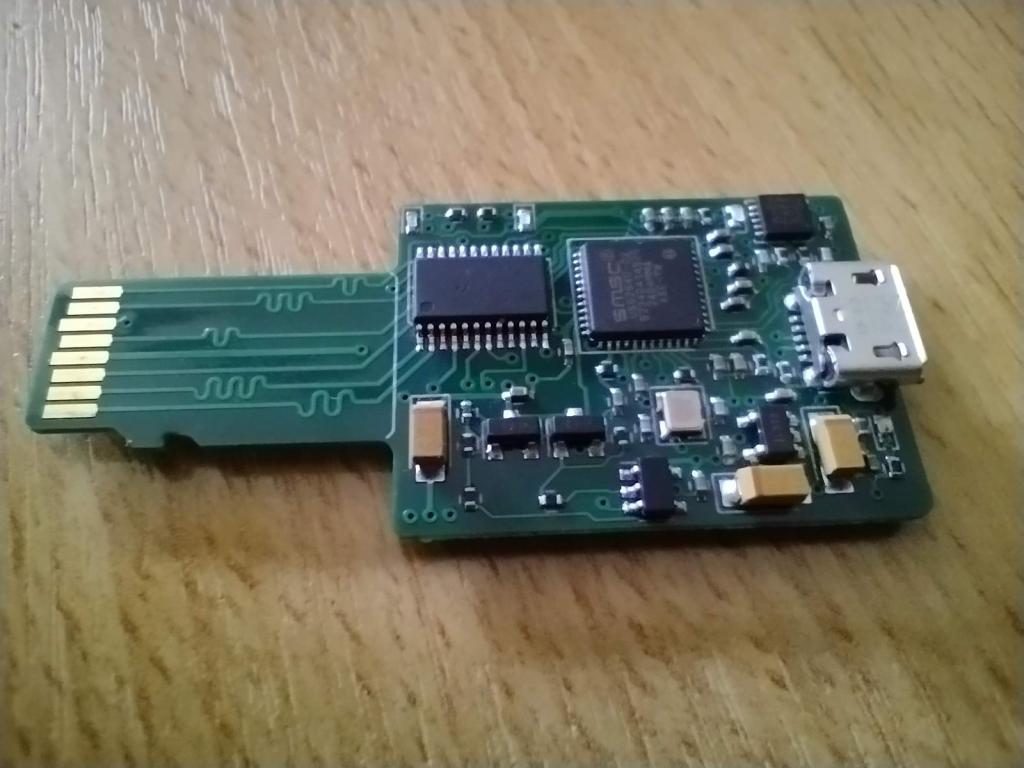
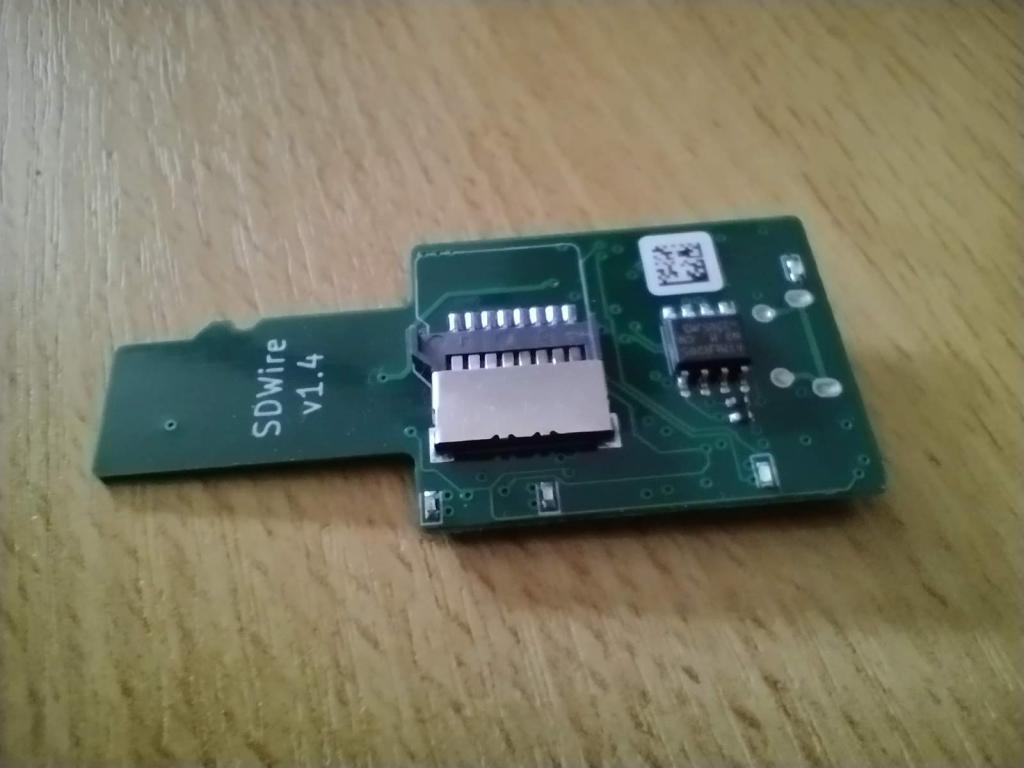
Part of what I love to do is to play with embedded devices running Linux. And many times I need to juggle with an SD card in order to copy a filesystem to a board... until I found SDWire. SDWire v1.4, top view SDWire v1.4, bottom view This little gadget is an SD muxer: it allows you to use it as a "normal" card reader or switch the SD card to the SD card slot. So next time I need to copy contents to a SD card and then push it to a board I can just do it from the command line. Now the software to control this device was not in Debian, so I fixed that. I am keeping the code and the packaging on GitLab, as "The Tizen project is not anymore really active". At the time of writing the package was just accepted, so it might take a couple of hours to be available on the archive. Enjoy!

27 September 2023

Jonathan McDowell: onak 0.6.3 released

Yesterday I tagged a new version of onak, my OpenPGP compatible keyserver. I d spent a bit of time during DebConf doing some minor cleanups, in particular an annoying systemd socket activation issue I d been seeing. That turned out to be due completely failing to compile in the systemd support, even when it was detected. There was also a signature verification issue with certain Ed225519 signatures (thanks Antoine Beaupr for making me dig into that one), along with various code cleanups. I also worked on Stateless OpenPGP CLI support, which is something I talked about when I released 0.6.2. It isn t something that s suitable for release, but it is sufficient to allow running the OpenPGP interoperability test suite verification tests, which I m pleased to say all now pass. For the next release I m hoping the OpenPGP crypto refresh process will have completed, which at the very least will mean adding support for v6 packet types and fingerprints. The PostgreSQL DB backend could also use some love, and I might see if performance with SQLite3 has improved any. Anyway. Available locally or via GitHub.
0.6.3 - 26th September 2023
  • Fix systemd detection + socket activation
  • Add CMake checking for Berkeley DB
  • Minor improvements to keyd logging
  • Fix decoding of signature creation time
  • Relax version check on parsing signature + key packets
  • Improve HTML escaping
  • Handle failed database initialisation more gracefully
  • Fix bug with EDDSA signatures with top 8+ bits unset

23 September 2023

Sergio Talens-Oliag: GitLab CI/CD Tips: Using Rule Templates

This post describes how to define and use rule templates with semantic names using extends or !reference tags, how to define manual jobs using the same templates and how to use gitlab-ci inputs as macros to give names to regular expressions used by rules.

Basic rule templatesI keep my templates in a rules.yml file stored on a common repository used from different projects as I mentioned on my previous post, but they can be defined anywhere, the important thing is that the files that need them include their definition somehow. The first version of my rules.yml file was as follows:
.rules_common:
  # Common rules; we include them from others instead of forcing a workflow
  rules:
    # Disable branch pipelines while there is an open merge request from it
    - if: >-
        $CI_COMMIT_BRANCH &&
        $CI_OPEN_MERGE_REQUESTS &&
        $CI_PIPELINE_SOURCE != "merge_request_event"
      when: never
.rules_default:
  # Default rules, we need to add the when: on_success to make things work
  rules:
    - !reference [.rules_common, rules]
    - when: on_success
The main idea is that .rules_common defines a rule section to disable jobs as we can do on a workflow definition; in our case common rules only have if rules that apply to all jobs and are used to disable them. The example includes one that avoids creating duplicated jobs when we push to a branch that is the source of an open MR as explained here. To use the rules in a job we have two options, use the extends keyword (we do that when we want to use the rule as is) or declare a rules section and add a !reference to the template we want to use as described here (we do that when we want to add additional rules to disable a job before evaluating the template conditions). As an example, with the following definitions both jobs use the same rules:
job_1:
  extends:
    - .rules_default
  [...]
job_2:
  rules:
    - !reference [.rules_default, rules]
  [...]

Manual jobs and rule templatesTo make the jobs manual we have two options, create a version of the job that includes when: manual and defines if we want it to be optional or not (allow_failure: true makes the job optional, if we don t add that to the rule the job is blocking) or add the when: manual and the allow_failure value to the job (if we work at the job level the default value for allow_failure is false for when: manual, so it is optional by default, we have to add an explicit allow_failure = true it to make it blocking). The following example shows how we define blocking or optional manual jobs using rules with when conditions:
.rules_default_manual_blocking:
  # Default rules for optional manual jobs
  rules:
    - !reference [.rules_common, rules]
    - when: manual
      # allow_failure: false is implicit
.rules_default_manual_optional:
  # Default rules for optional manual jobs
  rules:
    - !reference [.rules_common, rules]
    - when: manual
      allow_failure: true
manual_blocking_job:
  extends:
    - .rules_default_manual_blocking
  [...]
manual_optional_job:
  extends:
    - .rules_default_manual_optional
  [...]
The problem here is that we have to create new versions of the same rule template to add the conditions, but we can avoid it using the keywords at the job level with the original rules to get the same effect; the following definitions create jobs equivalent to the ones defined earlier without creating additional templates:
manual_blocking_job:
  extends:
    - .rules_default
  when: manual
  allow_failure: false
  [...]
manual_optional_job:
  extends:
    - .rules_default
  when: manual
  # allow_failure: true is implicit
  [...]
As you can imagine, that is my preferred way of doing it, as it keeps the rules.yml file smaller and I see that the job is manual in its definition without problem.

Rules with allow_failure, changes, exists, needs or variablesUnluckily for us, for now there is no way to avoid creating additional templates as we did on the when: manual case when a rule is similar to an existing one but adds changes, exists, needs or variables to it. So, for now, if a rule needs to add any of those fields we have to copy the original rule and add the keyword section. Some notes, though:
  • we only need to add allow_failure if we want to change its value for a given condition, in other cases we can set the value at the job level.
  • if we are adding changes to the rule it is important to make sure that they are going to be evaluated as explained here.
  • when we add a needs value to a rule for a specific condition and it matches it replaces the job needs section; when using templates I would use two different job names with different conditions instead of adding a needs on a single job.

Defining rule templates with semantic namesI started to use rule templates to avoid repetition when defining jobs that needed the same rules and soon I noticed that giving them names with a semantic meaning they where easier to use and understand (we provide a name that tells us when we are going to execute the job, while the details of the variables names or values used on the rules are an implementation detail of the templates). We are not going to define real jobs on this post, but as an example we are going to define a set of rules that can be useful if we plan to follow a scaled trunk based development workflow when developing, that is, we are going to put the releasable code on the main branch and use short-lived branches to test and complete changes before pushing things to main. Using this approach we can define an initial set of rule templates with semantic names:
.rules_mr_to_main:
  rules:
    - !reference [.rules_common, rules]
    - if: $CI_MERGE_REQUEST_TARGET_BRANCH_NAME == 'main'
.rules_mr_or_push_to_main:
  rules:
    - !reference [.rules_common, rules]
    - if: $CI_MERGE_REQUEST_TARGET_BRANCH_NAME == 'main'
    - if: >-
        $CI_COMMIT_BRANCH == 'main'
        &&
        $CI_PIPELINE_SOURCE != 'merge_request_event'
.rules_push_to_main:
  rules:
    - !reference [.rules_common, rules]
    - if: >-
        $CI_COMMIT_BRANCH == 'main'
        &&
        $CI_PIPELINE_SOURCE != 'merge_request_event'
.rules_push_to_branch:
  rules:
    - !reference [.rules_common, rules]
    - if: >-
        $CI_COMMIT_BRANCH != 'main'
        &&
        $CI_PIPELINE_SOURCE != 'merge_request_event'
.rules_push_to_branch_or_mr_to_main:
  rules:
    - !reference [.rules_push_to_branch, rules]
    - if: >-
         $CI_MERGE_REQUEST_SOURCE_BRANCH_NAME != 'main'
         &&
         $CI_MERGE_REQUEST_TARGET_BRANCH_NAME == 'main'
.rules_release_tag:
  rules:
    - !reference [.rules_common, rules]
    - if: $CI_COMMIT_TAG =~ /^([0-9a-zA-Z_.-]+-)?v\d+.\d+.\d+$/
.rules_non_release_tag:
  rules:
    - !reference [.rules_common, rules]
    - if: $CI_COMMIT_TAG !~ /^([0-9a-zA-Z_.-]+-)?v\d+.\d+.\d+$/
With those names it is clear when a job is going to be executed and when using the templates on real jobs we can add additional restrictions and make the execution manual if needed as described earlier.

Using inputs as macrosOn the previous rules we have used a regular expression to identify the release tag format and assumed that the general branches are the ones with a name different than main; if we want to force a format for those branch names we can replace the condition != 'main' by a regex comparison (=~ if we look for matches, !~ if we want to define valid branch names removing the invalid ones). When testing the new gitlab-ci inputs my colleague Jorge noticed that if you keep their default value they basically work as macros. The variables declared as inputs can t hold YAML values, the truth is that their value is always a string that is replaced by the value assigned to them when including the file (if given) or by their default value, if defined. If you don t assign a value to an input variable when including the file that declares it its occurrences are replaced by its default value, making them work basically as macros; this is useful for us when working with strings that can t managed as variables, like the regular expressions used inside if conditions. With those two ideas we can add the following prefix to the rules.yaml defining inputs for both regular expressions and replace the rules that can use them by the ones shown here:
spec:
  inputs:
    # Regular expression for branches; the prefix matches the type of changes
    # we plan to work on inside the branch (we use conventional commit types as
    # the branch prefix)
    branch_regex:
      default: '/^(build ci chore docs feat fix perf refactor style test)\/.+$/'
    # Regular expression for tags
    release_tag_regex:
      default: '/^([0-9a-zA-Z_.-]+-)?v\d+.\d+.\d+$/'
---
[...]
.rules_push_to_changes_branch:
  rules:
    - !reference [.rules_common, rules]
    - if: >-
        $CI_COMMIT_BRANCH =~ $[[ inputs.branch_regex ]]
        &&
        $CI_PIPELINE_SOURCE != 'merge_request_event'
.rules_push_to_branch_or_mr_to_main:
  rules:
    - !reference [.rules_push_to_branch, rules]
    - if: >-
         $CI_MERGE_REQUEST_SOURCE_BRANCH_NAME =~ $[[ inputs.branch_regex ]]
         &&
         $CI_MERGE_REQUEST_TARGET_BRANCH_NAME == 'main'
.rules_release_tag:
  rules:
    - !reference [.rules_common, rules]
    - if: $CI_COMMIT_TAG =~ $[[ inputs.release_tag_regex ]]
.rules_non_release_tag:
  rules:
    - !reference [.rules_common, rules]
    - if: $CI_COMMIT_TAG !~ $[[ inputs.release_tag_regex ]]

Creating rules reusing existing onesI m going to finish this post with a comment about how I avoid defining extra rule templates in some common cases. The idea is simple, we can use !reference tags to fine tune rules when we need to add conditions to disable them simply adding conditions with when: never before referencing the template. As an example, in some projects I m using different job definitions depending on the DEPLOY_ENVIRONMENT value to make the job manual or automatic; as we just said we can define different jobs referencing the same rule adding a condition to check if the environment is the one we are interested in:
deploy_job_auto:
  rules:
    # Only deploy automatically if the environment is 'dev' by skipping this job
    # for other values of the DEPLOY_ENVIRONMENT variable
    - if: $DEPLOY_ENVIRONMENT != "dev"
      when: never
    - !reference [.rules_release_tag, rules]
  [...]
deploy_job_manually:
  rules:
    # Disable this job if the environment is 'dev'
    - if: $DEPLOY_ENVIRONMENT == "dev"
      when: never
    - !reference [.rules_release_tag, rules]
  when: manual
  # Change this to  false  to make the deployment job blocking
  allow_failure: true
  [...]
If you think about it the idea of adding negative conditions is what we do with the .rules_common template; we add conditions to disable the job before evaluating the real rules. The difference in that case is that we reference them at the beginning because we want those negative conditions on all jobs and that is also why we have a .rules_default condition with an when: on_success for the jobs that only need to respect the default workflow (we need the last condition to make sure that they are executed if the negative rules don t match).

20 September 2023

Dirk Eddelbuettel: RcppInt64 0.0.3 on CRAN: Now with nanotime Support

The still new package RcppInt64 (announced two weeks ago in this post, with this followup last week) arrived on CRAN earlier today in its second update and relase 0.0.3. RcppInt64 collects some of the previous conversions between 64-bit integer values in R and C++, and regroups them in a single package by providing a single header. It offers two interfaces: both a more standard as<>() converter from R values along with its companions wrap() to return to R, as well as more dedicated functions from and to . This release adds support for the corresponding nanotime conversion between R and C++. nanotime is leveraging the same bit64-based reprensentation of 64-bit integers for nanosecond resolution timestamps. A thorough S4 wrapping the offers R based access for convenient and powerful operations at nanosecond resolution. And as tweeted (here and here), tooted (here and here), and skeeted (here and here) in a quick preview last Sunday, it makes for easy and expressive code. The brief NEWS entry follows:

Changes in version 0.0.3 (2023-09-19)
  • The as<>() and wrap() converters are now declared inline.
  • Conversion to and from nanotime has been added.

Courtesy of my CRANberries, there is a diffstat report relative to previous release. If you like this or other open-source work I do, you can sponsor me at GitHub.

This post by Dirk Eddelbuettel originated on his Thinking inside the box blog. Please report excessive re-aggregation in third-party for-profit settings.

19 September 2023

Valhalla's Things: Installing minidlna

Posted on September 19, 2023
I ve found the draft of this article I almost completely wrote (checks) more than 3 months ago, and I guess it s time to finish and publish it. The very first A10 based device that entered our home, before they started to use it for SBCs, was a Chinese media server with a slot for a 3.5" hard disk and a few analogue audio outputs. Of course from the time it entered our home it has always been running Debian. Now that we may have a few, more powerful, A20 SBCs available, it has been fully dedicated to music: it is connected to the stereo, the hard disk has a clone of the git-annex repository where I ve ripped all of my CDs1 and is played by connecting via ssh and running alsaplayer. It s simple (for my tastes). it works. Unless you re in a different room than the one with the stereo. And then I read this post on the fediverse that suggested installing minidlna on an old Raspberry Pi, and on a whim I decided I needed it. I installed the package from Debian, set a few easy settings in the configuration file (such as which directories to serve), restarted the service. And that s it, it just worked. The only thing I had to take care about is that to use git-annex repositories as the source of media files either the root of the repository should be used as media-dir, or the wide_links options should be set to yes, otherwise the symbolic links that point outside of the media-dir won t be served. As a client I used VLC (note for myself in case I ever forget, it s under View Playlist and then Local Network Universal Plug n Play), mostly because I already had it around. Now that I ve used it for a few months I have to say that it isn t a perfect solution: the main format I store my music in is in flac 2, which isn t supported by dlna; for a significant part of it I ve also already generated single-song ogg files for convenience 3, and at least it works for those. I don t store (yet?) my video collection on the A10 device, but I did a quick test, and no, of course a raw dump of a DVD as generated by dvdbackup isn t supported, so I would have to convert those too. And there is some support for subtitles as a separate file (which is something else I tend to have around), but only one file, with strict requirements for the name, which is a bit restrictive. On the other hand, the hassle to set this up was so low that the functionality / hassle ratio is most definitely worth, and I m quite happy I did and plan to continue using it.

  1. (yes, I m still using CDs, I have objections to those newfangled streaming services)
  2. full CD rip in a single file, with an embedded cuesheet, to preserve as much as possible of the original disc.
  3. in theory the flac was supposed to be future-proof storage, with the ogg files for actual use, but then I always listen to full albums, so the flac just work, and I only tend to bother generating the ogg when I m already generating mp3 for the car.

12 September 2023

Dirk Eddelbuettel: RcppInt64 0.0.2 on CRAN: Small Update

The still very new package RcppInt64 (announced a week ago in this post) arrived on CRAN earlier today in its first update, now at 0.0.2. RcppInt64 collects some of the previous conversions between 64-bit integer values in R and C++, and regroups them in a single package by providing a single header. It offers two interfaces: both a more standard as<>() converter from R values along with its companions wrap() to return to R, as well as more dedicated functions from and to . The package by now has its first user as we rearranged RcppFarmHash to use it. The change today makes bit64 a weak rather than strong dependency as we use it only for tests and illustrations. We also added two missing fields to DESCRIPTION and added badges to README.md. The brief NEWS entry follows:

Changes in version 0.0.2 (2023-09-12)
  • DESCRIPTION has been extended, badges have been added to README.md
  • Package bit64 is now a Suggests:

Courtesy of my CRANberries, there is a [diffstat report relative to previous release][this release]. If you like this or other open-source work I do, you can sponsor me at GitHub.

This post by Dirk Eddelbuettel originated on his Thinking inside the box blog. Please report excessive re-aggregation in third-party for-profit settings.

Jo Shields: Building a NAS

The status quo Back in 2015, I bought an off-the-shelf NAS, a QNAP TS-453mini, to act as my file store and Plex server. I had previously owned a Synology box, and whilst I liked the Synology OS and experience, the hardware was underwhelming. I loaded up the successor QNAP with four 5TB drives in RAID10, and moved all my files over (after some initial DoA drive issues were handled).
QNAP TS-453mini product photoQNAP TS-453mini product photo
That thing has been in service for about 8 years now, and it s been a mixed bag. It was definitely more powerful than the predecessor system, but it was clear that QNAP s OS was not up to the same standard as Synology s perhaps best exemplified by HappyGet 2 , the QNAP webapp for downloading videos from streaming services like YouTube, whose icon is a straight rip-off of StarCraft 2. On its own, meaningless but a bad omen for overall software quality
The logo for QNAP HappyGet 2 and Blizzard's Starcraft 2 side by sideThe logo for QNAP HappyGet 2 and Blizzard s StarCraft 2 side by side
Additionally, the embedded Celeron processor in the NAS turned out to be an issue for some cases. It turns out, when playing back videos with subtitles, most Plex clients do not support subtitles properly instead they rely on the Plex server doing JIT transcoding to bake the subtitles directly into the video stream. I discovered this with some Blu-Ray rips of Game of Thrones some episodes would play back fine on my smart TV, but episodes with subtitled Dothraki speech would play at only 2 or 3 frames per second. The final straw was a ransomware attack, which went through all my data and locked every file below a 60MiB threshold. Practically all my music gone. A substantial collection of downloaded files, all gone. Some of these files had been carried around since my college days digital rarities, or at least digital detritus I felt a real sense of loss at having to replace. This episode was caused by a ransomware targeting specific vulnerabilities in the QNAP OS, not an error on my part. So, I decided to start planning a replacement with:
  • A non-garbage OS, whilst still being a NAS-appliance type offering (not an off-the-shelf Linux server distro)
  • Full remote management capabilities
  • A small form factor comparable to off-the-shelf NAS
  • A powerful modern CPU capable of transcoding high resolution video
  • All flash storage, no spinning rust
At the time, no consumer NAS offered everything (The Asustor FS6712X exists now, but didn t when this project started), so I opted to go for a full DIY rather than an appliance not the first time I ve jumped between appliances and DIY for home storage.

Selecting the core of the system There aren t many companies which will sell you a small motherboard with IPMI. Supermicro is a bust, so is Tyan. But ASRock Rack, the server division of third-tier motherboard vendor ASRock, delivers. Most of their boards aren t actually compliant Mini-ITX size, they re a proprietary Deep Mini-ITX with the regular screw holes, but 40mm of extra length (and a commensurately small list of compatible cases). But, thankfully, they do have a tiny selection of boards without the extra size, and I stumbled onto the X570D4I-2T, a board with an AMD AM4 socket and the mature X570 chipset. This board can use any AMD Ryzen chip (before the latest-gen Ryzen 7000 series); has built in dual 10 gigabit ethernet; IPMI; four (laptop-sized) RAM slots with full ECC support; one M.2 slot for NVMe SSD storage; a PCIe 16x slot (generally for graphics cards, but we live in a world of possibilities); and up to 8 SATA drives OR a couple more NVMe SSDs. It s astonishingly well featured, just a shame it costs about $450 compared to a good consumer-grade Mini ITX AM4 board costing less than half that. I was so impressed with the offering, in fact, that I crowed about it on Mastodon and ended up securing ASRock another sale, with someone else looking into a very similar project to mine around the same timespan. The next question was the CPU. An important feature of a system expected to run 24/7 is low power, and AM4 chips can consume as much as 130W under load, out of the box. At the other end, some models can require as little as 35W under load the OEM-only GE suffix chips, which are readily found for import on eBay. In their PRO variant, they also support ECC (all non-G Ryzen chips support ECC, but only Pro G chips do). The top of the range 8 core Ryzen 7 PRO 5750GE is prohibitively expensive, but the slightly weaker 6 core Ryzen 5 PRO 5650GE was affordable, and one arrived quickly from Hong Kong. Supplemented with a couple of cheap 16 GiB SODIMM sticks of DDR4 PC-3200 direct from Micron for under $50 a piece, that left only cooling as an unsolved problem to get a bootable test system. The official support list for the X570D4I-2T only includes two rackmount coolers, both expensive and hard to source. The reason for such a small list is the non standard cooling layout of the board instead of an AM4 hole pattern with the standard plastic AM4 retaining clips, it has an Intel 115x hole pattern with a non-standard backplate (Intel 115x boards have no backplate, the stock Intel 115x cooler attaches to the holes with push pins). As such every single cooler compatibility list excludes this motherboard. However, the backplate is only secured with a mild glue with minimal pressure and a plastic prying tool it can be removed, giving compatibility with any 115x cooler (which is basically any CPU cooler for more than a decade). I picked an oversized low profile Thermalright AXP120-X67 hoping that its 120mm fan would cool the nearby MOSFETs and X570 chipset too.
Thermalright AXP120-X67, AMD Ryzen 5 PRO 5650GE, ASRock Rack X570D4I-2T, all assembled and running on a flat surface

Testing up to this point Using a spare ATX power supply, I had enough of a system built to explore the IPMI and UEFI instances, and run MemTest86 to validate my progress. The memory test ran without a hitch and confirmed the ECC was working, although it also showed that the memory was only running at 2933 MT/s instead of the rated 3200 MT/s (a limit imposed by the motherboard, as higher speeds are considered overclocking). The IPMI interface isn t the best I ve ever used by a long shot, but it s minimum viable and allowed me to configure the basics and boot from media entirely via a Web browser.
Memtest86 showing test progress, taken from IPMI remote control window
One sad discovery, however, which I ve never seen documented before, on PCIe bifurcation. With PCI Express, you have a number of lanes which are allocated in groups by the motherboard and CPU manufacturer. For Ryzen prior to Ryzen 7000, that s 16 lanes in one slot for the graphics card; 4 lanes in one M.2 connector for an SSD; then 4 lanes connecting the CPU to the chipset, which can offer whatever it likes for peripherals or extra lanes (bottlenecked by that shared 4x link to the CPU, if it comes down to it). It s possible, with motherboard and CPU support, to split PCIe groups up for example an 8x slot could be split into two 4x slots (eg allowing two NVMe drives in an adapter card NVME drives these days all use 4x). However with a Cezanne Ryzen with integrated graphics, the 16x graphics card slot cannot be split into four 4x slots (ie used for for NVMe drives) the most bifurcation it allows is 8x4x4x, which is useless in a NAS.
Screenshot of PCIe 16x slot bifurcation options in UEFI settings, taken from IPMI remote control window
As such, I had to abandon any ideas of an all-NVMe NAS I was considering: the 16x slot split into four 4x, combined with two 4x connectors fed by the X570 chipset, to a total of 6 NVMe drives. 7.6TB U.2 enterprise disks are remarkably affordable (cheaper than consumer SATA 8TB drives), but alas, I was locked out by my 5650GE. Thankfully I found out before spending hundreds on a U.2 hot swap bay. The NVMe setup would be nearly 10x as fast as SATA SSDs, but at least the SATA SSD route would still outperform any spinning rust choice on the market (including the fastest 10K RPM SAS drives)

Containing the core The next step was to pick a case and power supply. A lot of NAS cases require an SFX (rather than ATX) size supply, so I ordered a modular SX500 unit from Silverstone. Even if I ended up with a case requiring ATX, it s easy to turn an SFX power supply into ATX, and the worst result is you have less space taken up in your case, hardly the worst problem to have. That said, on to picking a case. There s only one brand with any cachet making ITX NAS cases, Silverstone. They have three choices in an appropriate size: CS01-HS, CS280, and DS380. The problem is, these cases are all badly designed garbage. Take the CS280 as an example, the case with the most space for a CPU cooler. Here s how close together the hotswap bay (right) and power supply (left) are:
Internal image of Silverstone CS280 NAS build. Image stolen from ServeTheHome
With actual cables connected, the cable clearance problem is even worse:
Internal image of Silverstone CS280 NAS build. Image stolen from ServeTheHome
Remember, this is the best of the three cases for internal layout, the one with the least restriction on CPU cooler height. And it s garbage! Total hot garbage! I decided therefore to completely skip the NAS case market, and instead purchase a 5.25 -to-2.5 hot swap bay adapter from Icy Dock, and put it in an ITX gamer case with a 5.25 bay. This is no longer a served market 5.25 bays are extinct since nobody uses CD/DVD drives anymore. The ones on the market are really new old stock from 2014-2017: The Fractal Design Core 500, Cooler Master Elite 130, and Silverstone SUGO 14. Of the three, the Fractal is the best rated so I opted to get that one however it seems the global supply of new old stock fully dried up in the two weeks between me making a decision and placing an order leaving only the Silverstone case. Icy Dock have a selection of 8-bay 2.5 SATA 5.25 hot swap chassis choices in their ToughArmor MB998 series. I opted for the ToughArmor MB998IP-B, to reduce cable clutter it requires only two SFF-8611-to-SF-8643 cables from the motherboard to serve all eight bays, which should make airflow less of a mess. The X570D4I-2T doesn t have any SATA ports on board, instead it has two SFF-8611 OCuLink ports, each supporting 4 PCI Express lanes OR 4 SATA connectors via a breakout cable. I had hoped to get the ToughArmor MB118VP-B and run six U.2 drives, but as I said, the PCIe bifurcation issue with Ryzen G chips meant I wouldn t be able to run all six bays successfully.
NAS build in Silverstone SUGO 14, mid build, panels removed
Silverstone SUGO 14 from the front, with hot swap bay installed

Actual storage for the storage server My concept for the system always involved a fast boot/cache drive in the motherboard s M.2 slot, non-redundant (just backups of the config if the worst were to happen) and separate storage drives somewhere between 3.8 and 8 TB each (somewhere from $200-$350). As a boot drive, I selected the Intel Optane SSD P1600X 58G, available for under $35 and rated for 228 years between failures (or 11,000 complete drive rewrite cycles). So, on to the big expensive choice: storage drives. I narrowed it down to two contenders: new-old-stock Intel D3-S4510 3.84TB enterprise drives, at about $200, or Samsung 870 QVO 8TB consumer drives, at about $375. I did spend a long time agonizing over the specification differences, the ZFS usage reports, the expected lifetime endurance figures, but in reality, it came down to price $1600 of expensive drives vs $3200 of even more expensive drives. That s 27TB of usable capacity in RAID-Z1, or 23TB in RAID-Z2. For comparison, I m using about 5TB of the old NAS, so that s a LOT of overhead for expansion.
Storage SSD loaded into hot swap sled

Booting up Bringing it all together is the OS. I wanted an appliance NAS OS rather than self-administering a Linux distribution, and after looking into the surrounding ecosystems, decided on TrueNAS Scale (the beta of the 2023 release, based on Debian 12).
TrueNAS Dashboard screenshot in browser window
I set up RAID-Z1, and with zero tuning (other than enabling auto-TRIM), got the following performance numbers:
IOPSBandwidth
4k random writes19.3k75.6 MiB/s
4k random reads36.1k141 MiB/s
Sequential writes 2300 MiB/s
Sequential reads 3800 MiB/s
Results using fio parameters suggested by Huawei
And for comparison, the maximum theoretical numbers quoted by Intel for a single drive:
IOPSBandwidth
4k random writes16k?
4k random reads90k?
Sequential writes 280 MiB/s
Sequential reads 560 MiB/s
Numbers quoted by Intel SSD successors Solidigm.
Finally, the numbers reported on the old NAS with four 7200 RPM hard disks in RAID 10:
IOPSBandwidth
4k random writes4301.7 MiB/s
4k random reads800632 MiB/s
Sequential writes 311 MiB/s
Sequential reads 566 MiB/s
Performance seems pretty OK. There s always going to be an overhead to RAID. I ll settle for the 45x improvement on random writes vs. its predecessor, and 4.5x improvement on random reads. The sequential write numbers are gonna be impacted by the size of the ZFS cache (50% of RAM, so 16 GiB), but the rest should be a reasonable indication of true performance. It took me a little while to fully understand the TrueNAS permissions model, but I finally got Plex configured to access data from the same place as my SMB shares, which have anonymous read-only access or authenticated write access for myself and my wife, working fine via both Linux and Windows. And that s it! I built a NAS. I intend to add some fans and more RAM, but that s the build. Total spent: about $3000, which sounds like an unreasonable amount, but it s actually less than a comparable Synology DiskStation DS1823xs+ which has 4 cores instead of 6, first-generation AMD Zen instead of Zen 3, 8 GiB RAM instead of 32 GiB, no hardware-accelerated video transcoding, etc. And it would have been a whole lot less fun!
The final system, powered up
(Also posted on PCPartPicker)

11 September 2023

Dirk Eddelbuettel: RcppArmadillo 0.12.6.4.0 on CRAN: Another Upstream Bugfix

armadillo image Armadillo is a powerful and expressive C++ template library for linear algebra and scientific computing. It aims towards a good balance between speed and ease of use, has a syntax deliberately close to Matlab, and is useful for algorithm development directly in C++, or quick conversion of research code into production environments. RcppArmadillo integrates this library with the R environment and language and is widely used by (currently) 1096 other packages on CRAN, downloaded 30.5 million times (per the partial logs from the cloud mirrors of CRAN), and the CSDA paper (preprint / vignette) by Conrad and myself has been cited 552 times according to Google Scholar. This release brings bugfix upstream release 12.6.4. Conrad prepared this a few days ago; it takes me the usual day or so to run reverse-dependency check against the by-now almost 1100 CRAN packages using RcppArmadillo. And this time, CRAN thought it had found two issues when I submitted and it took two more days til we were all clear about those two being false positives (as can, and does, happen). So today it reached CRAN. The set of changes follows.

Changes in RcppArmadillo version 0.12.6.4.0 (2023-09-06)
  • Upgraded to Armadillo release 12.6.4 (Cortisol Retox)
    • Workarounds for bugs in Apple accelerate framework
    • Fix incorrect calculation of rcond for band matrices in solve()
    • Remove expensive and seldom used optimisations, leading to faster compilation times

Courtesy of my CRANberries, there is a diffstat report relative to previous release. More detailed information is on the RcppArmadillo page. Questions, comments etc should go to the rcpp-devel mailing list off the Rcpp R-Forge page. If you like this or other open-source work I do, you can sponsor me at GitHub.

This post by Dirk Eddelbuettel originated on his Thinking inside the box blog. Please report excessive re-aggregation in third-party for-profit settings.

9 September 2023

Dirk Eddelbuettel: Carmageddon by Daniel Knowles: A Brief Review

Carmageddon Daniel Knowles Carmageddon: How Cars Make Life Worse and What to Do About It is an entertaining, lucid, and well-written manifesto (to borrow a term from the author) aiming to get us all thinking a bit more about what cars do to society, and how to move on to a better outcome for all. The book alternates between historical context and background, lived experience (as the author is a foreign correspondent who had the opportunity to travel), and researched content. It is refreshingly free of formalities (no endless footnotes or endnotes with references, though I would have liked occassional references but hey we all went to school long enough to do a bit of research given a pointer or two). I learned or relearned a few things as I was for example somewhat unaware of the air pollution (micro-particle) impact stemming from tires and brake abrasions for which electronic vehicles do zilch, and for which the auto-obesity of ever larger and heavier cars is making things much worse. And some terms (even when re-used by Knowles) are clever such bionic duckweed. But now you need to read the book to catch up on it. Overall, the book argues its case rather well. The author brings sufficient evidence to make the formal guilty charge quite convincing. It is also recent having come out just months ago, making current figures even more relevant. I forget the exact circumstance but I think I came across the author in the context of our joint obsession with both Chicago and cycling (as there may have been a link from a related social media post) and/or the fact that I followed some of his colleagues at The Economist on social media. Either way, the number of Chicago and MidWest references made for some additional fun when reading the book over a the last few days. And for me another highlight was the ode to Tokyo which I wholeheartedly agree with: on my second trip to Japan I spent a spare day cycling across the city as the AirBnB host kindly gave me access to his bicycles. Great weather, polite drivers, moderate traffic, and just wicked good infrastructure made me wonder why I did not see more cyclists. I have little to criticize beyond the lack of any references. The repeated insistence on reminding us that Knowles comes from Birmingham gets a little old by the fifth or sixth repetition. It is all a wee bit anglo- or UK-centric. It obviously has a bit on France, Paris, and all the recent success of Anne Hidalgo (who, when I was in graduate school in France, was still a TV person rather than the very successful mayor she is now) but then does not mention the immense (and well known) success of the French train system which lead to a recent dictum to no longer allow intra-Frace air travel if train rides of under 2 1/2 hours are available which is rather remarkable. (Though in fairness that may have been enacted once the book was finished.) Lastly, the book appears to have a few sections available via Google Books. My copy will good back from one near-west suburban library to the neighbouring one. Overall a strong recommendation for a very good and timely book.

Dirk Eddelbuettel: RcppFarmHash 0.0.3 on CRAN: Small Update

A minor maintenance release of the RcppFarmHash package is now on CRAN as version 0.0.3. RcppFarmHash wraps the Google FarmHash family of hash functions (written by Geoff Pike and contributors) that are used for example by Google BigQuery for the FARM_FINGERPRINT digest. This releases farms out the conversion to the integer64 add-on type in R to the new package RcppInt64 released a few days ago and adds some minor maintenance on continuous integration and alike. The brief NEWS entry follows:

Changes in version 0.0.3 (2023-09-09)
  • Rely on new RcppInt64 package and its header for conversion
  • Minor updates to continuous integration and README.md

If you like this or other open-source work I do, you can sponsor me at GitHub.

This post by Dirk Eddelbuettel originated on his Thinking inside the box blog. Please report excessive re-aggregation in third-party for-profit settings.

Bits from Debian: DebianDay Celebrations and comments

Debian Celebrates 30 years! We celebrated our birthday this year and we had a great time with new friends, new members welcomed to the community, and the world. We have collected a few comments, videos, and discussions from around the Internet, and some images from some of the DebianDay2023 events. We hope that you enjoyed the day(s) as much as we did! Maqsuel Maqson

"Debian 30 years of collective intelligence" -Maqsuel Maqson Brazil Thiago Pezzo

Pouso Alegre, Brazil Daniel Pimentel

Macei , Brazil Daniel Lenharo

Curitiba, Brazil Daniel Lenharo

The cake is there. :) phls Honorary Debian Developers: Buzz, Jessie, and Woody welcome guests to this amazing party. Carlos Melara Sao Carlos, state of Sao Paulo, Brazil Carlos Melara Stickers, and Fliers, and Laptops, oh my! phls Belo Horizonte, Brazil sergiosacj Bras lia, Brazil sergiosacj Bras lia, Brazil Mexico Jathan 30 a os! Jathan A quick Selfie Jathan We do not encourage beverages on computing hardware, but this one is okay by us. Germany h01ger

30 years of love h01ger

The German Delegation is also looking for this dog who footed the bill for the party, then left mysteriously. h01ger

We took the party outside Stefano Rivera

We brought the party back inside at CCCamp Belgium Stefano Rivera

Cake and Diversity in Belgium El Salvador Gato Barato Canel n Pulgosky

Food and Fellowship in El Salvador South Africa highvoltage

Debian is also very delicious! highvoltage

All smiles waiting to eat the cake Reports Debian Day 30 years in Macei - Brazil Debian Day 30 years in S o Carlos - Brazil Debian Day 30 years in Pouso Alegre - Brazil Debian Day 30 years in Belo Horizonte - Brazil Debian Day 30 years in Curitiba - Brazil Debian Day 30 years in Bras lia - Brazil Debian Day 30 years online in Brazil Articles & Blogs Happy Debian Day - going 30 years strong - Liam Dawe Debian Turns 30 Years Old, Happy Birthday! - Marius Nestor 30 Years of Stability, Security, and Freedom: Celebrating Debian s Birthday - Bobby Borisov Happy 30th Birthday, Debian! - Claudio Kuenzier Debian is 30 and Sgt Pepper Is at Least Ninetysomething - Christine Hall Debian turns 30! -Corbet Thirty years of Debian! - Lennart Hengstmengel Debian marks three decades as 'Universal Operating System' - Sam Varghese Debian Linux Celebrates 30 Years Milestone - Joshua James 30 years on, Debian is at the heart of the world's most successful Linux distros - Liam Proven Looking Back on 30 Years of Debian - Maya Posch Cheers to 30 Years of Debian: A Journey of Open Source Excellence - arindam Discussions and Social Media Debian Celebrates 30 Years - Source: News YCombinator Brand-new Linux release, which I'm calling the Debian ... Source: News YCombinator Comment: Congrats @debian !!! Happy Birthday! Thank you for becoming a cornerstone of the #opensource world. Here's to decades of collaboration, stability & #software #freedom -openSUSELinux via X (formerly Twitter) Comment: Today we #celebrate the 30th birthday of #Debian, one of the largest and most important cornerstones of the #opensourcecommunity. For this we would like to thank you very much and wish you the best for the next 30 years! Source: X (Formerly Twitter -TUXEDOComputers via X (formerly Twitter) Happy Debian Day! - Source: Reddit.com Video The History of Debian The Beginning - Source: Linux User Space Debian Celebrates 30 years -Source: Lobste.rs Video Debian At 30 and No More Distro Hopping! - LWDW388 - Source: LinuxGameCast Debian Celebrates 30 years! - Source: Debian User Forums Debian Celebrates 30 years! - Source: Linux.org

7 September 2023

Dirk Eddelbuettel: x13binary 1.1.57-4 on CRAN: Minor Update

Release 1.1.57-4 of the x13binary package providing the X-13ARIMA-SEATS program by the US Census Bureau arrived earlier on CRAN. This release sets an explicit download timeout option value at the request of CRAN who, just like everybody else, were bitten a little by the instability at GitHub this week. Courtesy of my CRANberries, there is also a diffstat report for this release showing changes to the previous release. If you like this or other open-source work I do, you can sponsor me at GitHub.

This post by Dirk Eddelbuettel originated on his Thinking inside the box blog. Please report excessive re-aggregation in third-party for-profit settings.

6 September 2023

Dirk Eddelbuettel: RcppInt64 0.0.1 on CRAN: New Package!

Happy to share that a new package RcppInt64 arrived on CRAN earlier today after a brief one-day inspection round. RcppInt64 collects some of the previous conversions between 64-bit integer values in R and C++, and regroups them in a single package. A single header is provided. It actually offers two interfaces: both a more standard as<>() converter from R values along with its companions wrap() to return to R, as well as more dedicated functions from and to . A key difficulty faced when supporting 64 bit integer payloads is that R has no proper type for it so the standard template-based approaches use by Rcpp do not apply. To carry 64 bit integers, the clever approach by Jens Oehlschl gel and his bit64 package is used. However, its use of a double to transport the int64 payload means we must take care to not uninentionally interpret the double variables as, well, double. So we use an simple S3 class in R, and check for it. With some care (as provided by these helper functions) this works well. The RcppInt64 packages contains both an example function, as well as an entire example package to demonstrate how to use these facilities in your package. We hope others will find this useful. If you like this or other open-source work I do, you can sponsor me at GitHub.

This post by Dirk Eddelbuettel originated on his Thinking inside the box blog. Please report excessive re-aggregation in third-party for-profit settings.

Next.

Previous.