Search Results: "don"

28 September 2025

Russ Allbery: Review: Echoes of the Imperium

Review: Echoes of the Imperium, by Nicholas & Olivia Atwater
Series: Tales of the Iron Rose #1
Publisher: Starwatch Press
Copyright: 2024
ISBN: 1-998257-04-5
Format: Kindle
Pages: 547
Echoes of the Imperium is a steampunk fantasy adventure novel, the first of a projected series. There is another novella in the series, A Matter of Execution, that takes place chronologically before this novel, but which I am told that you should read afterwards. (I have not yet read it.) If Olivia Atwater's name sounds familiar, it's probably for the romantic fantasy Half a Soul. Nicholas Atwater is her husband. William Blair, a goblin, was a child sailor on the airship HMS Caliban during the final battle that ended the Imperium, and an eyewitness to the destruction of the capital. Like every imperial solider, that loss made him an Oathbreaker; the fae Oath that he swore to defend the Imperium did not care that nothing a twelve-year-old boy could have done would have changed the result of the battle. He failed to kill himself with most of the rest of the crew, and thus was taken captive by the Coalition. Twenty years later, William Blair is the goblin captain of the airship Iron Rose. It's an independent transport ship that takes various somewhat-dodgy contracts and has to avoid or fight through pirates. The crew comes from both sides of the war and has built their own working truce. Blair himself is a somewhat manic but earnest captain who doesn't entirely believe he deserves that role, one who tends more towards wildly risky plans and improvisation than considered and sober decisions. The rest of the crew are the sort of wild mix of larger-than-life personality quirks that populate swashbuckling adventure books but leave me dubious that stuffing that many high-maintenance people into one ship would go as well as it does. I did appreciate the gunnery knitting circle, though. Echoes of the Imperium is told in the first person from Blair's perspective in two timelines. One follows Blair in the immediate aftermath of the war, tracing his path to becoming an airship captain and meeting some of the people who will later be part of his crew. The other is the current timeline, in which Blair gets deeper and deeper into danger by accepting a risky contract with unexpected complications. Neither of these timelines are in any great hurry to arrive at some destination, and that's the largest problem with this book. Echoes of the Imperium is long, sprawling, and unwilling to get anywhere near any sort of a point until the reader is deeply familiar with the horrific aftermath of the war, the mountains guilt and trauma many of the characters carry around, and Blair's impostor syndrome and feelings of inadequacy. For the first half of this book, I was so bored. I almost bailed out; only a few flashes of interesting character interactions and hints of world-building helped me drag myself through all of the tedious setup. What saves this book is that the world-building is a delight. Once the characters finally started engaging with it in earnest, I could not put it down. Present-time Blair is no longer an Oathbreaker because he was forgiven by a fairy; this will become important later. The sites of great battles are haunted by ghostly echoes of the last moments of the lives of those who died (hence the title); this will become very important later. Blair has a policy of asking no questions about people's pasts if they're willing to commit to working with the rest of the crew; this, also, will become important later. All of these tidbits the authors drop into the story and then ignore for hundreds of pages do have a payoff if you're willing to wait for it. As the reader (too) slowly discovers, the Atwaters' world is set in a war of containment by light fae against dark fae. Instead of being inscrutable and separate, the fae use humans and human empires as tools in that war. The fallen Imperium was a bastion of fae defense, and the war that led to the fall of that Imperium was triggered by the price its citizens paid for that defense, one that the fae could not possibly care less about. The creatures may be out of epic fantasy and the technology from the imagined future of Victorian steampunk, but the politics are that of the Cold War and containment strategies. This book has a lot to say about colonialism and empire, but it says those things subtly and from a fantasy slant, in a world with magical Oaths and direct contact with powers that are both far beyond the capabilities of the main characters and woefully deficient in in humanity and empathy. It has a bit of the feel of Greek mythology if the gods believed in an icy realpolitik rather than embodying the excesses of human emotion. The second half of this book was fantastic. The found-family vibe among a crew of high-maintenance misfits that completely failed to cohere for me in the first half of the book, while Blair was wallowing in his feelings and none of the events seemed to matter, came together brilliantly as soon as the crew had a real problem and some meaty world-building and plot to sink their teeth into. There is a delightfully competent teenager, some satisfying competence porn that Blair finally stops undermining, and a sharp political conflict that felt emotionally satisfying, if perhaps not that intellectually profound. In short, it turns into the fun, adventurous romp of larger-than-life characters that the setting promises. Even the somewhat predictable mid-book reveal worked for me, in part because the emotions of the characters around that reveal sold its impact. If you're going to write a book with a bad half and a good half, it's always better to put the good half second. I came away with very positive feelings about Echoes of the Imperium and a tentative willingness to watch for the sequel. (It reaches a fairly satisfying conclusion, but there are a lot of unresolved plot hooks.) I'm a bit hesitant to recommend it, though, because the first half was not very fun. I want to say that about 75% of the first half of the book could have been cut and the book would have been stronger for it. I'm not completely sure I'm right, since the Atwaters were laying the groundwork for a lot of payoff, but I wish that groundwork hadn't been as much of a slog. Tentatively recommended, particularly if you're in the mood for steampunk fae mythology, but know that this book requires some investment. Technically, A Matter of Execution comes first, but I plan to read it as a sequel. Rating: 8 out of 10

27 September 2025

Julian Andres Klode: Dependency Tries

As I was shopping groceries I had a shocking realization: The active dependencies of packages in a solver actually form a trie (a dependency A B - A or B - of a package X is considered active if we marked X for install). Consider the dependencies A B C, A B, B X. In most package managers these just express alternatives, that is, the or relationship, but in Debian packages, it also expresses a preference relationship between its operands, so in A B C, A is preferred over B and B over C (and A transitively over C). This means that we can convert the three dependencies into a trie as follows: Dependency trie of the three dependencies Solving the dependency here becomes a matter of trying to install the package referenced by the first edge of the root, and seeing if that sticks. In this case, that would be a . Let s assume that a failed to install, the next step is to remove the empty node of a, and merging its children into the root. Reduced dependency trie with  not A  containing b, b c, b x For ease of visualisation, we remove a from the dependency nodes as well, leading us to a trie of the dependencies b , b c , and b x . Presenting the Debian dependency problem, or the positive part of it as a trie allows us for a great visualization of the problem but it may not proof to be an effective implementation choice. In the real world we may actually store this as a priority queue that we can delete from. Since we don t actually want to delete from the queue for real, our queue items are pairs of a pointer to dependency and an activitity level, say A B@1. Whenever a variable is assigned false, we look at its reverse dependencies and bump their activity, and reinsert them (the priority of the item being determined by the leftmost solution still possible, it has now changed). When we iterate the queue, we remove items with a lower activity level:
  1. Our queue is A B@1, A B C@1, B X@1
  2. Rejecting A bump the activity for its reverse dependencies and reinset them: Our queue is A B@1, A B C@1, (A )B@2, (A )B C@2, B X@1
  3. We visit A B@1 but see the activity of the underlying dependency is now 2 and remove it Our queue is A B C@1, (A )B@2, (A )B C@2, B X@1
  4. We visit A B C@1 but see the activity of the underlying dependency is now 2 and remove it Our queue is (A )B@2, (A )B C@2, B X@1
  5. We visit A B@2, see the activity matches and find B is the solution.

24 September 2025

Matthew Garrett: Investigating a forged PDF

I had to rent a house for a couple of months recently, which is long enough in California that it pushes you into proper tenant protection law. As landlords tend to do, they failed to return my security deposit within the 21 days required by law, having already failed to provide the required notification that I was entitled to an inspection before moving out. Cue some tedious argumentation with the letting agency, and eventually me threatening to take them to small claims court.

This post is not about that.

Now, under Californian law, the onus is on the landlord to hold and return the security deposit - the agency has no role in this. The only reason I was talking to them is that my lease didn't mention the name or address of the landlord (another legal violation, but the outcome is just that you get to serve the landlord via the agency). So it was a bit surprising when I received an email from the owner of the agency informing me that they did not hold the deposit and so were not liable - I already knew this.

The odd bit about this, though, is that they sent me another copy of the contract, asserting that it made it clear that the landlord held the deposit. I read it, and instead found a clause reading SECURITY: The security deposit will secure the performance of Tenant s obligations. IER may, but will not be obligated to, apply all portions of said deposit on account of Tenant s obligations. Any balance remaining upon termination will be returned to Tenant. Tenant will not have the right to apply the security deposit in payment of the last month s rent. Security deposit held at IER Trust Account., where IER is International Executive Rentals, the agency in question. Why send me a contract that says you hold the money while you're telling me you don't? And then I read further down and found this:

Text reading ENTIRE AGREEMENT: The foregoing constitutes the entire agreement between the parties and may bemodified only in writing signed by all parties. This agreement and any modifications, including anyphotocopy or facsimile, may be signed in one or more counterparts, each of which will be deemed anoriginal and all of which taken together will constitute one and the same instrument. The followingexhibits, if checked, have been made a part of this Agreement before the parties  execution: Exhibit 1:Lead-Based Paint Disclosure (Required by Law for Rental Property Built Prior to 1978) Addendum 1 The security deposit will be held by (name removed) and applied, refunded, or forfeited in accordance with the terms of this lease agreement.
Ok, fair enough, there's an addendum that says the landlord has it (I've removed the landlord's name, it's present in the original).

Except. I had no recollection of that addendum. I went back to the copy of the contract I had and discovered:

The same text as the previous picture, but addendum 1 is empty
Huh! But obviously I could just have edited that to remove it (there's no obvious reason for me to, but whatever), and then it'd be my word against theirs. However, I'd been sent the document via RightSignature, an online document signing platform, and they'd added a certification page that looked like this:
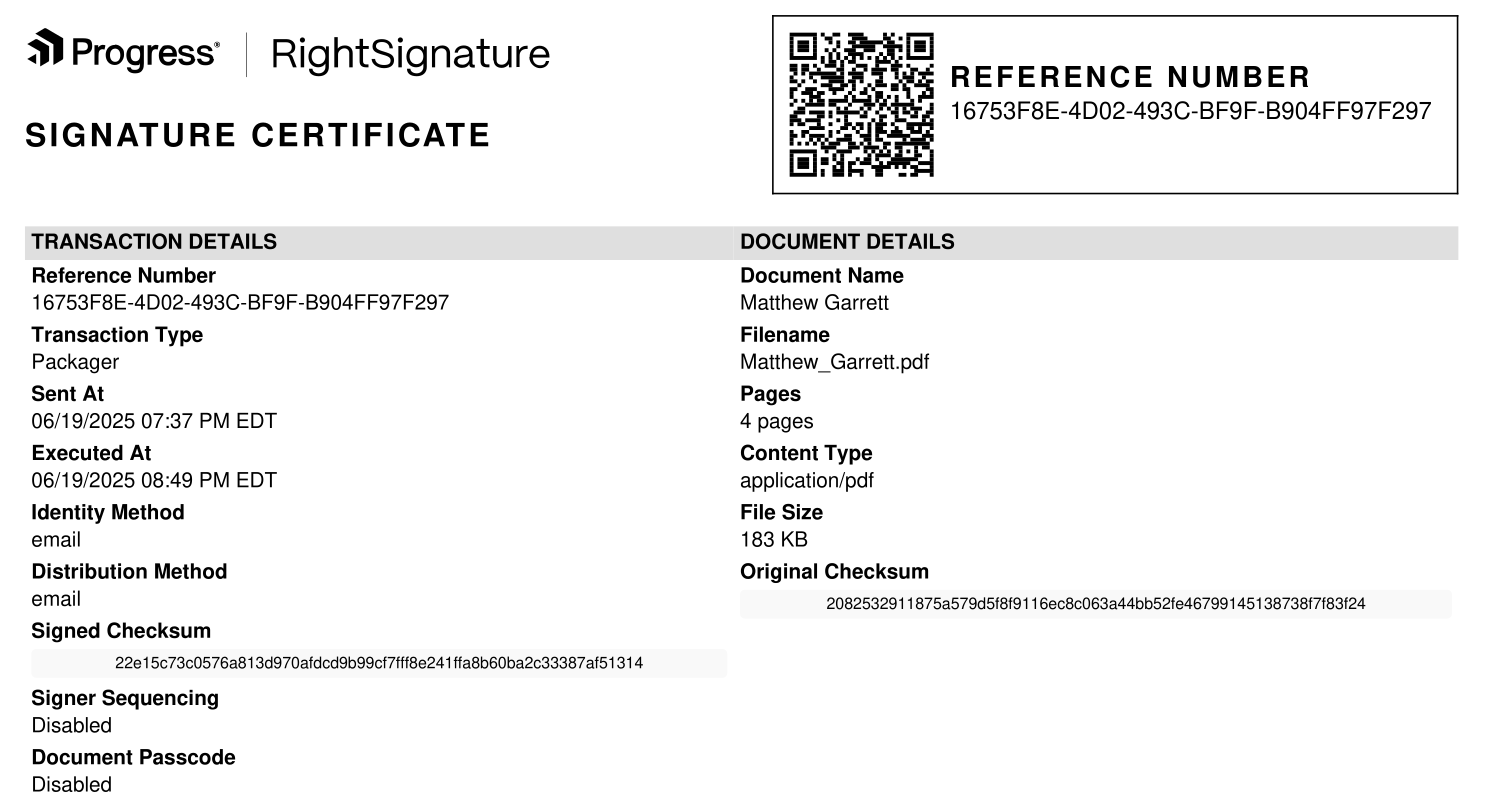
A Signature Certificate, containing a bunch of data about the document including a checksum or the original
Interestingly, the certificate page was identical in both documents, including the checksums, despite the content being different. So, how do I show which one is legitimate? You'd think given this certificate page this would be trivial, but RightSignature provides no documented mechanism whatsoever for anyone to verify any of the fields in the certificate, which is annoying but let's see what we can do anyway.

First up, let's look at the PDF metadata. pdftk has a dump_data command that dumps the metadata in the document, including the creation date and the modification date. My file had both set to identical timestamps in June, both listed in UTC, corresponding to the time I'd signed the document. The file containing the addendum? The same creation time, but a modification time of this Monday, shortly before it was sent to me. This time, the modification timestamp was in Pacific Daylight Time, the timezone currently observed in California. In addition, the data included two ID fields, ID0 and ID1. In my document both were identical, in the one with the addendum ID0 matched mine but ID1 was different.

These ID tags are intended to be some form of representation (such as a hash) of the document. ID0 is set when the document is created and should not be modified afterwards - ID1 initially identical to ID0, but changes when the document is modified. This is intended to allow tooling to identify whether two documents are modified versions of the same document. The identical ID0 indicated that the document with the addendum was originally identical to mine, and the different ID1 that it had been modified.

Well, ok, that seems like a pretty strong demonstration. I had the "I have a very particular set of skills" conversation with the agency and pointed these facts out, that they were an extremely strong indication that my copy was authentic and their one wasn't, and they responded that the document was "re-sealed" every time it was downloaded from RightSignature and that would explain the modifications. This doesn't seem plausible, but it's an argument. Let's go further.

My next move was pdfalyzer, which allows you to pull a PDF apart into its component pieces. This revealed that the documents were identical, other than page 3, the one with the addendum. This page included tags entitled "touchUp_TextEdit", evidence that the page had been modified using Acrobat. But in itself, that doesn't prove anything - obviously it had been edited at some point to insert the landlord's name, it doesn't prove whether it happened before or after the signing.

But in the process of editing, Acrobat appeared to have renamed all the font references on that page into a different format. Every other page had a consistent naming scheme for the fonts, and they matched the scheme in the page 3 I had. Again, that doesn't tell us whether the renaming happened before or after the signing. Or does it?

You see, when I completed my signing, RightSignature inserted my name into the document, and did so using a font that wasn't otherwise present in the document (Courier, in this case). That font was named identically throughout the document, except on page 3, where it was named in the same manner as every other font that Acrobat had renamed. Given the font wasn't present in the document until after I'd signed it, this is proof that the page was edited after signing.

But eh this is all very convoluted. Surely there's an easier way? Thankfully yes, although I hate it. RightSignature had sent me a link to view my signed copy of the document. When I went there it presented it to me as the original PDF with my signature overlaid on top. Hitting F12 gave me the network tab, and I could see a reference to a base.pdf. Downloading that gave me the original PDF, pre-signature. Running sha256sum on it gave me an identical hash to the "Original checksum" field. Needless to say, it did not contain the addendum.

Why do this? The only explanation I can come up with (and I am obviously guessing here, I may be incorrect!) is that International Executive Rentals realised that they'd sent me a contract which could mean that they were liable for the return of my deposit, even though they'd already given it to my landlord, and after realising this added the addendum, sent it to me, and assumed that I just wouldn't notice (or that, if I did, I wouldn't be able to prove anything). In the process they went from an extremely unlikely possibility of having civil liability for a few thousand dollars (even if they were holding the deposit it's still the landlord's legal duty to return it, as far as I can tell) to doing something that looks extremely like forgery.

There's a hilarious followup. After this happened, the agency offered to do a screenshare with me showing them logging into RightSignature and showing the signed file with the addendum, and then proceeded to do so. One minor problem - the "Send for signature" button was still there, just below a field saying "Uploaded: 09/22/25". I asked them to search for my name, and it popped up two hits - one marked draft, one marked completed. The one marked completed? Didn't contain the addendum.

comment count unavailable comments

23 September 2025

Ravi Dwivedi: Singapore Trip

In December 2024, I went on a trip through four countries - Singapore, Malaysia, Brunei, and Vietnam - with my friend Badri. This post covers our experiences in Singapore. I took an IndiGo flight from Delhi to Singapore, with a layover in Chennai. At the Chennai airport, I was joined by Badri. We had an early morning flight from Chennai that would land in Singapore in the afternoon. Within 48 hours of our scheduled arrival in Singapore, we submitted an arrival card online. At immigration, we simply needed to scan our passports at the gates, which opened automatically to let us through, and then give our address to an official nearby. The process was quick and smooth, but it unfortunately meant that we didn t get our passports stamped by Singapore. Before I left the airport, I wanted to visit the nature-themed park with a fountain I saw in pictures online. It is called Jewel Changi, and it took quite some walking to get there. After reaching the park, we saw a fountain that could be seen from all the levels. We roamed around for a couple of hours, then proceeded to the airport metro station to get to our hotel.
Jewel Changi A shot of Jewel Changi. Photo by Ravi Dwivedi. Released under the CC-BY-SA 4.0.

There were four ATMs on the way to the metro station, but none of them provided us with any cash. This was the first country (outside India, of course!) where my card didn t work at ATMs. To use the metro, one can tap the EZ-Link card or bank cards at the AFC gates to get in. You cannot buy tickets using cash. Before boarding the metro, I used my credit card to get Badri an EZ-Link card from a vending machine. It was 10 Singapore dollars ( 630) - 5 for the card, and 5 for the balance. I had planned to use my Visa credit card to pay for my own fare. I was relieved to see that my card worked, and I passed through the AFC gates. We had booked our stay at a hostel named Campbell s Inn, which was the cheapest we could find in Singapore. It was 1500 per night for dorm beds. The hostel was located in Little India. While Little India has an eponymous metro station, the one closest to our hostel was Rochor. On the way to the hostel, we found out that our booking had been canceled. We had booked from the Hostelworld website, opting to pay the deposit in advance and to pay the balance amount in person upon reaching. However, Hostelworld still tried to charge Badri s card again before our arrival. When the unauthorized charge failed, they sent an automatic message saying we tried to charge and to contact them soon to avoid cancellation, which we couldn t do as we were in the plane. Despite this, we went to the hostel to check the status of our booking. The trip from the airport to Rochor required a couple of transfers. It was 2 Singapore dollars (approx. 130) and took approximately an hour. Upon reaching the hostel, we were informed that our booking had indeed been canceled, and were not given any reason for the cancelation. Furthermore, no beds were available at the hostel for us to book on the spot. We decided to roam around and look for accommodation at other hostels in the area. Soon, we found a hostel by the name of Snooze Inn, which had two beds available. It was 36 Singapore dollars per person (around 2300) for a dormitory bed. Snooze Inn advertised supporting RuPay cards and UPI. Some other places in that area did the same. We paid using my card. We checked in and slept for a couple of hours after taking a shower. By the time we woke up, it was dark. We met Praveen s friend Sabeel to get my FLX1 phone. We also went to Mustafa Center nearby to exchange Indian rupees for Singapore dollars. Mustafa Center also had a shopping center with shops selling electronic items and souvenirs, among other things. When we were dropping off Sabeel at a bus stop, we discovered that the bus stops in Singapore had a digital board mentioning the bus routes for the stop and the number of minutes each bus was going to take. In addition to an organized bus system, Singapore had good pedestrian infrastructure. There were traffic lights and zebra crossings for pedestrians to cross the roads. Unlike in Indian cities, rules were being followed. Cars would stop for pedestrians at unmanaged zebra crossings; pedestrians would in turn wait for their crossing signal to turn green before attempting to walk across. Therefore, walking in Singapore was easy. Traffic rules were taken so seriously in Singapore I (as a pedestrian) was afraid of unintentionally breaking them, which could get me in trouble, as breaking rules is dealt with heavy fines in the country. For example, crossing roads without using a marked crossing (while being within 50 meters of it) - also known as jaywalking - is an offence in Singapore. Moreover, the streets were litter-free, and cleanliness seemed like an obsession. After exploring Mustafa Center, we went to a nearby 7-Eleven to top up Badri s EZ-Link card. He gave 20 Singapore dollars for the recharge, which credited the card by 19.40 Singapore dollars (0.6 dollars being the recharge fee). When I was planning this trip, I discovered that the World Chess Championship match was being held in Singapore. I seized the opportunity and bought a ticket in advance. The next day - the 5th of December - I went to watch the 9th game between Gukesh Dommaraju of India and Ding Liren of China. The venue was a hotel on Sentosa Island, and the ticket was 70 Singapore dollars, which was around 4000 at the time. We checked out from our hostel in the morning, as we were planning to stay with Badri s aunt that night. We had breakfast at a place in Little India. Then we took a couple of buses, followed by a walk to Sentosa Island. Paying the fare for the buses was similar to the metro - I tapped my credit card in the bus, while Badri tapped his EZ-Link card. We also had to tap it while getting off. If you are tapping your credit card to use public transport in Singapore, keep in mind that the total amount of all the trips taken on a day is deducted at the end. This makes it hard to determine the cost of individual trips. For example, I could take a bus and get off after tapping my card, but I would have no way to determine how much this journey cost. When you tap in, the maximum fare amount gets deducted. When you tap out, the balance amount gets refunded (if it s a shorter journey than the maximum fare one). So, there is incentive for passengers not to get off without tapping out. Going by your card statement, it looks like all that happens virtually, and only one statement comes in at the end. Maybe this combining only happens for international cards. We got off the bus a kilometer away from Sentosa Island and walked the rest of the way. We went on the Sentosa Boardwalk, which is itself a tourist attraction. I was using Organic Maps to navigate to the hotel Resorts World Sentosa, but Organic Maps route led us through an amusement park. I tried asking the locals (people working in shops) for directions, but it was a Chinese-speaking region, and they didn t understand English. Fortunately, we managed to find a local who helped us with the directions.
Sentosa Boardwalk A shot of Sentosa Boardwalk. Photo by Ravi Dwivedi. Released under the CC-BY-SA 4.0.
Following the directions, we somehow ended up having to walk on a road which did not have pedestrian paths. Singapore is a country with strict laws, so we did not want to walk on that road. Avoiding that road led us to the Michael Hotel. There was a person standing at the entrance, and I asked him for directions to Resorts World Sentosa. The person told me that the bus (which was standing at the entrance) would drop me there! The bus was a free service for getting to Resorts World Sentosa. Here I parted ways with Badri, who went to his aunt s place. I got to the Resorts Sentosa and showed my ticket to get in. There were two zones inside - the first was a room with a glass wall separating the audience and the players. This was the room to watch the game physically, and resembled a zoo or an aquarium. :) The room was also a silent room, which means talking or making noise was prohibited. Audiences were only allowed to have mobile phones for the first 30 minutes of the game - since I arrived late, I could not bring my phone inside that room. The other zone was outside this room. It had a big TV on which the game was being broadcast along with commentary by David Howell and Jovanka Houska - the official FIDE commentators for the event. If you don t already know, FIDE is the authoritative international chess body. I spent most of the time outside that silent room, giving me an opportunity to socialize. A lot of people were from Singapore. I saw there were many Indians there as well. Moreover, I had a good time with Vasudevan, a journalist from Tamil Nadu who was covering the match. He also asked questions to Gukesh during the post-match conference. His questions were in Tamil to lift Gukesh s spirits, as Gukesh is a Tamil speaker. Tea and coffee were free for the audience. I also bought a T-shirt from their stall as a souvenir. After the game, I took a shuttle bus from Resorts World Sentosa to a metro station, then travelled to Pasir Ris by metro, where Badri was staying with his aunt. I thought of getting something to eat, but could not find any caf s or restaurants while I was walking from the Pasir Ris metro station to my destination, and was positively starving when I got there. Badri s aunt s place was an apartment in a gated community. On the gate was a security guard who asked me the address of the apartment. Upon entering, there were many buildings. To enter the building, you need to dial the number of the apartment you want to go to and speak to them. I had seen that in the TV show Seinfeld, where Jerry s friends used to dial Jerry to get into his building. I was afraid they might not have anything to eat because I told them I was planning to get something on the way. This was fortunately not the case, and I was relieved to not have to sleep with an empty stomach. Badri s uncle gave us an idea of how safe Singapore is. He said that even if you forget your laptop in a public space, you can go back the next day to find it right there in the same spot. I also learned that owning cars was discouraged in Singapore - the government imposes a high registration fee on them, while also making public transport easy to use and affordable. I also found out that 7-Eleven was not that popular among residents in Singapore, unlike in Malaysia or Thailand. The next day was our third and final day in Singapore. We had a bus in the evening to Johor Bahru in Malaysia. We got up early, had breakfast, and checked out from Badri s aunt s home. A store by the name of Cat Socrates was our first stop for the day, as Badri wanted to buy some stationery. The plan was to take the metro, followed by the bus. So we got to Pasir Ris metro station. Next to the metro station was a mall. In the mall, Badri found an ATM where our cards worked, and we got some Singapore dollars. It was noon when we reached the stationery shop mentioned above. We had to walk a kilometer from the place where the bus dropped us. It was a hot, sunny day in Singapore, so walking was not comfortable. We had to go through residential areas in Singapore. We saw some non-touristy parts of Singapore. After we were done with the stationery shop, we went to a hawker center to get lunch. Hawker centers are unique to Singapore. They have a lot of shops that sell local food at cheap prices. It is similar to a food court. However, unlike the food courts in malls, hawker centers are open-air and can get quite hot.
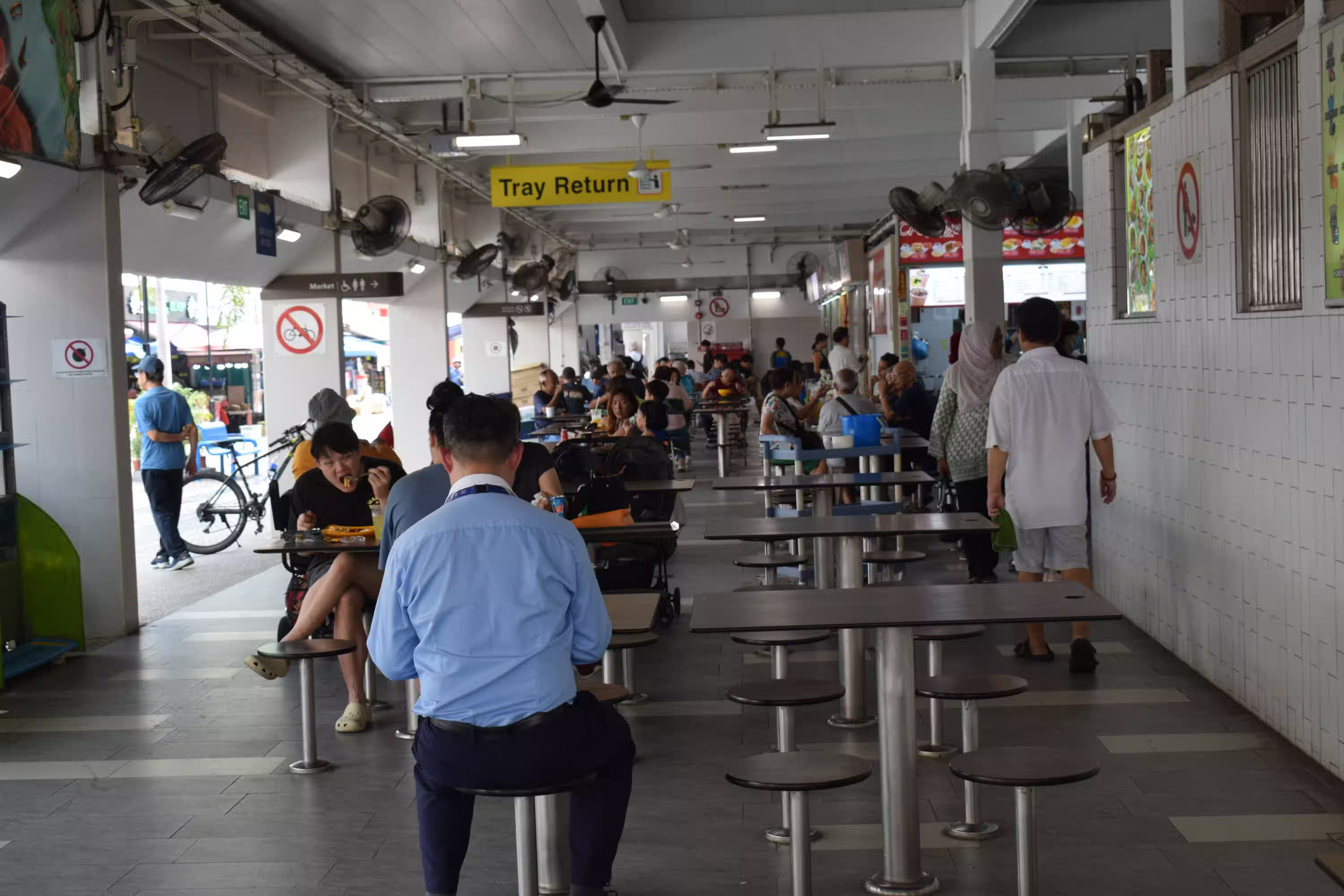
Jewel Changi This is the hawker center we went to. Photo by Ravi Dwivedi. Released under the CC-BY-SA 4.0.

To have something, you just need to buy it from one of the shops and find a table. After you are done, you need to put your tray in the tray-collecting spots. I had a kaya toast with chai, since there weren t many vegetarian options. I also bought a persimmon from a nearby fruit vendor. On the other hand, Badri sampled some local non-vegetarian dishes.
A sign saying, 'No table littering, by law.' Table littering at the hawker center was prohibited by law. Photo by Ravi Dwivedi. Released under the CC-BY-SA 4.0.

Next, we took a metro to Raffles Place, as we wanted to visit Merlion, the icon of Singapore. It is a statue having the head of a lion and the body of a fish. While getting through the AFC gates, my card was declined. Therefore, I had to buy an EZ-Link card, which I had been avoiding because the card itself costs 5 Singapore dollars. From the Raffles Place metro station, we walked to Merlion. The place also gave a nice view of Marina Bay Sands. It was filled with tourists clicking pictures, and we also did the same.
Merlion from behind Merlion from behind, giving a good view of Marina Bay Sands. Photo by Ravi Dwivedi. Released under the CC-BY-SA 4.0.
After this, we went to the bus stop to catch our bus to the border city of Johor Bahru, Malaysia. The bus was more than an hour late, and we worried that we had missed the bus. I asked an Indian woman at the stop who also planned to take the same bus, and she told us that the bus was late. Finally, our bus arrived, and we set off for Johor Bahru. Before I finish, let me give you an idea of my expenditure. Singapore is an expensive country, and I realized that expenses could go up pretty quickly. Overall, my stay in Singapore for 3 days and 2 nights was approx. 5500 rupees. That too, when we stayed one night at Badri s aunt s place (so we didn t have to pay for accomodation for one of the nights) and didn t have to pay for a couple of meals. This amount doesn t include the ticket for the chess game, but includes the costs of getting there. If you are in Singapore, it is likely you will pay a visit to Sentosa Island anyway. Stay tuned for our experiences in Malaysia! Credits: Thanks to Dione, Sahil, Badri and Contrapunctus for reviewing the draft. Thanks to Bhe for spotting a duplicate sentence.

22 September 2025

Russell Coker: More About the Colmi P80

The FOSS Android program for communicating with smart watches is Gadget Bridge which now has support for the Colmi P80 [1]. I first blogged about the Colmi P80 just over a month ago [2]. Now I have a couple of relatives using it happily on Android with the proprietary app. I couldn t use it myself because I require more control over which apps have their notifications go to the watch than the Colmi app offers. Also I m trying to move away from non-free software. Yesterday the f-droid repository informed me that there was a new version of Gadget Bridge and the changelog indicated support for the Colmi P80 so I connected the P80 and disconnected the PineTime. The first problem I noticed is that the vibrator on the P80 when on it s maximum setting is much weaker than that on the PineTime, so weak that I often didn t notice it. Maybe if I wore it for a few weeks I would teach myself to notice it but it should just be able to work with me on this. If it could be set to have multiple bursts of vibrating then that would work. The next problem is that the P80 by default does not turn the screen on when there s a notification and there seems to be no way to configure it to do so. I configured it to turn on when I raise my arm which can mostly work but that still relies on me noticing the vibration. Vibration and the screen light turning on would be harder to miss than vibration on it s own. I don t recall seeing any review of smart watches ever that stated whether the screen would turn on when there s a notification or whether the vibration was easy to notice. One problem with both the PineTime (running InfiniTime) and the P80 is that when the screen is turned on (through gesture, pushing the button, or a notification in the case of the Pinetime) it is active for swiping to change the settings. I would like to have some other action required before settings can be changed so that if the screen turns on when I m asleep my watch won t brush against something and change it s settings (which has happened). It s neat how Gadget Bridge supports talking to multiple smart watches at the same time. One useful feature for that would be to have different notification settings for each watch. I can imagine someone changing between a watch for jogging and a watch for work and wanting different settings. Colmi P80 Problems No authentication for Bluetooth connections. Runs non-free software so no chance to fix things. Battery life worse than PineTime (but not really bad). Vibration weak. Screen doesn t turn on when notification is sent. Conclusion I m using the PineTime as my daily driver again. While it works well enough for some people (even with the Colmi proprietary app) it doesn t do what I want. It is however a good test device for FOSS work on the phone side, it has a decent feature set and is cheap. Apart from lack of authentication and running non-free software the problems are mostly a matter of taste. Some people might think it s great the way it works.

Vincent Bernat: Akvorado release 2.0

Akvorado 2.0 was released today! Akvorado collects network flows with IPFIX and sFlow. It enriches flows and stores them in a ClickHouse database. Users can browse the data through a web console. This release introduces an important architectural change and other smaller improvements. Let s dive in!
$ git diff --shortstat v1.11.5
 493 files changed, 25015 insertions(+), 21135 deletions(-)

New outlet service The major change in Akvorado 2.0 is splitting the inlet service into two parts: the inlet and the outlet. Previously, the inlet handled all flow processing: receiving, decoding, and enrichment. Flows were then sent to Kafka for storage in ClickHouse:
Akvorado flow processing before the change: flows are received and processed by the inlet, sent to Kafka and stored in ClickHouse
Akvorado flow processing before the introduction of the outlet service
Network flows reach the inlet service using UDP, an unreliable protocol. The inlet must process them fast enough to avoid losing packets. To handle a high number of flows, the inlet spawns several sets of workers to receive flows, fetch metadata, and assemble enriched flows for Kafka. Many configuration options existed for scaling, which increased complexity for users. The code needed to avoid blocking at any cost, making the processing pipeline complex and sometimes unreliable, particularly the BMP receiver.1 Adding new features became difficult without making the problem worse.2 In Akvorado 2.0, the inlet receives flows and pushes them to Kafka without decoding them. The new outlet service handles the remaining tasks:
Akvorado flow processing after the change: flows are received by the inlet, sent to Kafka, processed by the outlet and inserted in ClickHouse
Akvorado flow processing after the introduction of the outlet service
This change goes beyond a simple split:3 the outlet now reads flows from Kafka and pushes them to ClickHouse, two tasks that Akvorado did not handle before. Flows are heavily batched to increase efficiency and reduce the load on ClickHouse using ch-go, a low-level Go client for ClickHouse. When batches are too small, asynchronous inserts are used (e20645). The number of outlet workers scales dynamically (e5a625) based on the target batch size and latency (50,000 flows and 5 seconds by default). This new architecture also allows us to simplify and optimize the code. The outlet fetches metadata synchronously (e20645). The BMP component becomes simpler by removing cooperative multitasking (3b9486). Reusing the same RawFlow object to decode protobuf-encoded flows from Kafka reduces pressure on the garbage collector (8b580f). The effect on Akvorado s overall performance was somewhat uncertain, but a user reported 35% lower CPU usage after migrating from the previous version, plus resolution of the long-standing BMP component issue.

Other changes This new version includes many miscellaneous changes, such as completion for source and destination ports (f92d2e), and automatic restart of the orchestrator service (0f72ff) when configuration changes to avoid a common pitfall for newcomers. Let s focus on some key areas for this release: observability, documentation, CI, Docker, Go, and JavaScript.

Observability Akvorado exposes metrics to provide visibility into the processing pipeline and help troubleshoot issues. These are available through Prometheus HTTP metrics endpoints, such as /api/v0/inlet/metrics. With the introduction of the outlet, many metrics moved. Some were also renamed (4c0b15) to match Prometheus best practices. Kafka consumer lag was added as a new metric (e3a778). If you do not have your own observability stack, the Docker Compose setup shipped with Akvorado provides one. You can enable it by activating the profiles introduced for this purpose (529a8f). The prometheus profile ships Prometheus to store metrics and Alloy to collect them (2b3c46, f81299, and 8eb7cd). Redis and Kafka metrics are collected through the exporter bundled with Alloy (560113). Other metrics are exposed using Prometheus metrics endpoints and are automatically fetched by Alloy with the help of some Docker labels, similar to what is done to configure Traefik. cAdvisor was also added (83d855) to provide some container-related metrics. The loki profile ships Loki to store logs (45c684). While Alloy can collect and ship logs to Loki, its parsing abilities are limited: I could not find a way to preserve all metadata associated with structured logs produced by many applications, including Akvorado. Vector replaces Alloy (95e201) and features a domain-specific language, VRL, to transform logs. Annoyingly, Vector currently cannot retrieve Docker logs from before it was started. Finally, the grafana profile ships Grafana, but the shipped dashboards are broken. This is planned for a future version.

Documentation The Docker Compose setup provided by Akvorado makes it easy to get the web interface up and running quickly. However, Akvorado requires a few mandatory steps to be functional. It ships with comprehensive documentation, including a chapter about troubleshooting problems. I hoped this documentation would reduce the support burden. It is difficult to know if it works. Happy users rarely report their success, while some users open discussions asking for help without reading much of the documentation. In this release, the documentation was significantly improved.
$ git diff --shortstat v1.11.5 -- console/data/docs
 10 files changed, 1873 insertions(+), 1203 deletions(-)
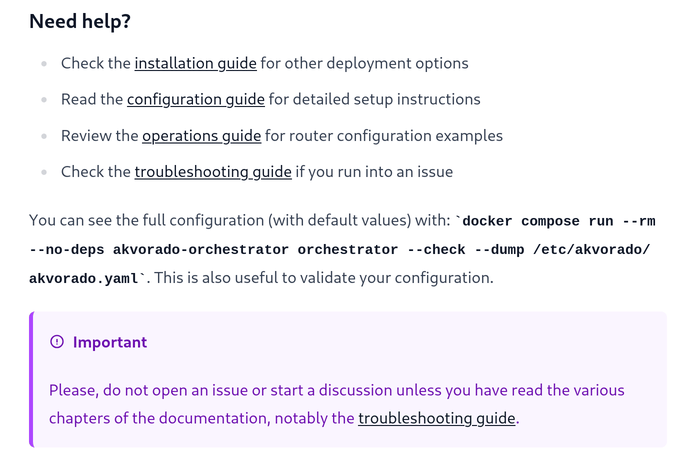
The documentation was updated (fc1028) to match Akvorado s new architecture. The troubleshooting section was rewritten (17a272). Instructions on how to improve ClickHouse performance when upgrading from versions earlier than 1.10.0 was added (5f1e9a). An LLM proofread the entire content (06e3f3). Developer-focused documentation was also improved (548bbb, e41bae, and 871fc5). From a usability perspective, table of content sections are now collapsable (c142e5). Admonitions help draw user attention to important points (8ac894).
Admonition in Akvorado documentation to ask a user not to open an issue or start a discussion before reading the documentation
Example of use of admonitions in Akvorado's documentation

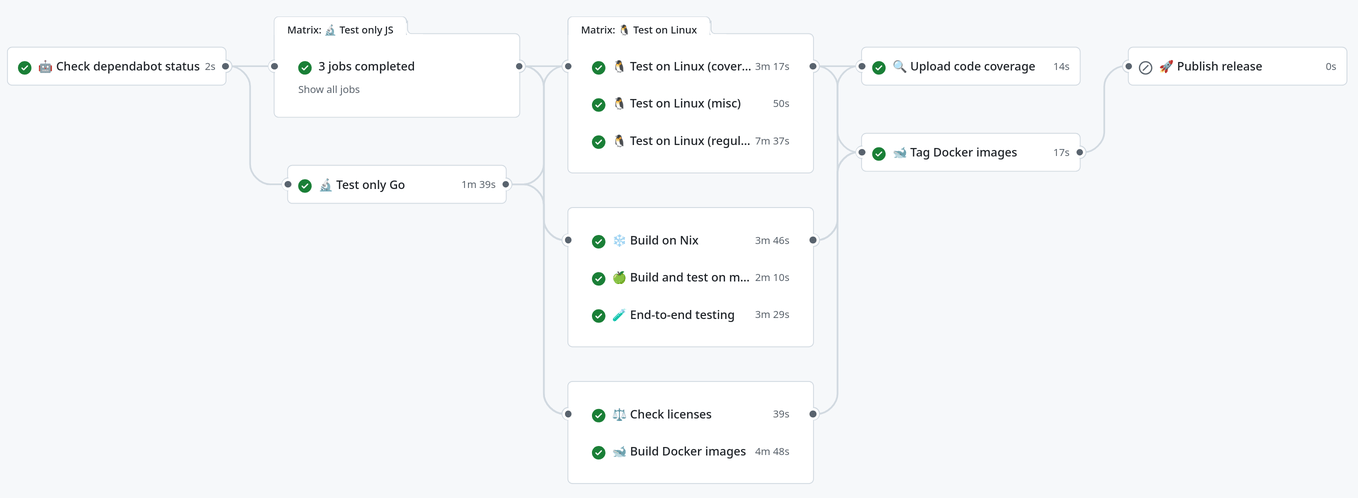
Continuous integration This release includes efforts to speed up continuous integration on GitHub. Coverage and race tests run in parallel (6af216 and fa9e48). The Docker image builds during the tests but gets tagged only after they succeed (8b0dce).
GitHub workflow for CI with many jobs, some of them running in parallel, some not
GitHub workflow to test and build Akvorado
End-to-end tests (883e19) ensure the shipped Docker Compose setup works as expected. Hurl runs tests on various HTTP endpoints, particularly to verify metrics (42679b and 169fa9). For example:
## Test inlet has received NetFlow flows
GET http://127.0.0.1:8080/prometheus/api/v1/query
[Query]
query: sum(akvorado_inlet_flow_input_udp_packets_total job="akvorado-inlet",listener=":2055" )
HTTP 200
[Captures]
inlet_receivedflows: jsonpath "$.data.result[0].value[1]" toInt
[Asserts]
variable "inlet_receivedflows" > 10
## Test inlet has sent them to Kafka
GET http://127.0.0.1:8080/prometheus/api/v1/query
[Query]
query: sum(akvorado_inlet_kafka_sent_messages_total job="akvorado-inlet" )
HTTP 200
[Captures]
inlet_sentflows: jsonpath "$.data.result[0].value[1]" toInt
[Asserts]
variable "inlet_sentflows" >=   inlet_receivedflows  

Docker Akvorado ships with a comprehensive Docker Compose setup to help users get started quickly. It ensures a consistent deployment, eliminating many configuration-related issues. It also serves as a living documentation of the complete architecture. This release brings some small enhancements around Docker: Previously, many Docker images were pulled from the Bitnami Containers library. However, VMWare acquired Bitnami in 2019 and Broadcom acquired VMWare in 2023. As a result, Bitnami images were deprecated in less than a month. This was not really a surprise4. Previous versions of Akvorado had already started moving away from them. In this release, the Apache project s Kafka image replaces the Bitnami one (1eb382). Thanks to the switch to KRaft mode, Zookeeper is no longer needed (0a2ea1, 8a49ca, and f65d20). Akvorado s Docker images were previously compiled with Nix. However, building AArch64 images on x86-64 is slow because it relies on QEMU userland emulation. The updated Dockerfile uses multi-stage and multi-platform builds: one stage builds the JavaScript part on the host platform, one stage builds the Go part cross-compiled on the host platform, and the final stage assembles the image on top of a slim distroless image (268e95 and d526ca).
# This is a simplified version
FROM --platform=$BUILDPLATFORM node:20-alpine AS build-js
RUN apk add --no-cache make
WORKDIR /build
COPY console/frontend console/frontend
COPY Makefile .
RUN make console/data/frontend
FROM --platform=$BUILDPLATFORM golang:alpine AS build-go
RUN apk add --no-cache make curl zip
WORKDIR /build
COPY . .
COPY --from=build-js /build/console/data/frontend console/data/frontend
RUN go mod download
RUN make all-indep
ARG TARGETOS TARGETARCH TARGETVARIANT VERSION
RUN make
FROM gcr.io/distroless/static:latest
COPY --from=build-go /build/bin/akvorado /usr/local/bin/akvorado
ENTRYPOINT [ "/usr/local/bin/akvorado" ]
When building for multiple platforms with --platform linux/amd64,linux/arm64,linux/arm/v7, the build steps until the highlighted line execute only once for all platforms. This significantly speeds up the build. Akvorado now ships Docker images for these platforms: linux/amd64, linux/amd64/v3, linux/arm64, and linux/arm/v7. When requesting ghcr.io/akvorado/akvorado, Docker selects the best image for the current CPU. On x86-64, there are two choices. If your CPU is recent enough, Docker downloads linux/amd64/v3. This version contains additional optimizations and should run faster than the linux/amd64 version. It would be interesting to ship an image for linux/arm64/v8.2, but Docker does not support the same mechanism for AArch64 yet (792808).

Go This release includes many changes related to Go but not visible to the users.

Toolchain In the past, Akvorado supported the two latest Go versions, preventing immediate use of the latest enhancements. The goal was to allow users of stable distributions to use Go versions shipped with their distribution to compile Akvorado. However, this became frustrating when interesting features, like go tool, were released. Akvorado 2.0 requires Go 1.25 (77306d) but can be compiled with older toolchains by automatically downloading a newer one (94fb1c).5 Users can still override GOTOOLCHAIN to revert this decision. The recommended toolchain updates weekly through CI to ensure we get the latest minor release (5b11ec). This change also simplifies updates to newer versions: only go.mod needs updating. Thanks to this change, Akvorado now uses wg.Go() (77306d) and I have started converting some unit tests to the new test/synctest package (bd787e, 7016d8, and 159085).

Testing When testing equality, I use a helper function Diff() to display the differences when it fails:
got := input.Keys()
expected := []int 1, 2, 3 
if diff := helpers.Diff(got, expected); diff != ""  
    t.Fatalf("Keys() (-got, +want):\n%s", diff)
 
This function uses kylelemons/godebug. This package is no longer maintained and has some shortcomings: for example, by default, it does not compare struct private fields, which may cause unexpectedly successful tests. I replaced it with google/go-cmp, which is stricter and has better output (e2f1df).

Another package for Kafka Another change is the switch from Sarama to franz-go to interact with Kafka (756e4a and 2d26c5). The main motivation for this change is to get a better concurrency model. Sarama heavily relies on channels and it is difficult to understand the lifecycle of an object handed to this package. franz-go uses a more modern approach with callbacks6 that is both more performant and easier to understand. It also ships with a package to spawn fake Kafka broker clusters, which is more convenient than the mocking functions provided by Sarama.

Improved routing table for BMP To store its routing table, the BMP component used kentik/patricia, an implementation of a patricia tree focused on reducing garbage collection pressure. gaissmai/bart is a more recent alternative using an adaptation of [Donald Knuth s ART algorithm][] that promises better performance and delivers it: 90% faster lookups and 27% faster insertions (92ee2e and fdb65c). Unlike kentik/patricia, gaissmai/bart does not help efficiently store values attached to each prefix. I adapted the same approach as kentik/patricia to store route lists for each prefix: store a 32-bit index for each prefix, and use it to build a 64-bit index for looking up routes in a map. This leverages Go s efficient map structure. gaissmai/bart also supports a lockless routing table version, but this is not simple because we would need to extend this to the map storing the routes and to the interning mechanism. I also attempted to use Go s new unique package to replace the intern package included in Akvorado, but performance was worse.7

Miscellaneous Previous versions of Akvorado were using a custom Protobuf encoder for performance and flexibility. With the introduction of the outlet service, Akvorado only needs a simple static schema, so this code was removed. However, it is possible to enhance performance with planetscale/vtprotobuf (e49a74, and 8b580f). Moreover, the dependency on protoc, a C++ program, was somewhat annoying. Therefore, Akvorado now uses buf, written in Go, to convert a Protobuf schema into Go code (f4c879). Another small optimization to reduce the size of the Akvorado binary by 10 MB was to compress the static assets embedded in Akvorado in a ZIP file. It includes the ASN database, as well as the SVG images for the documentation. A small layer of code makes this change transparent (b1d638 and e69b91).

JavaScript Recently, two large supply-chain attacks hit the JavaScript ecosystem: one affecting the popular packages chalk and debug and another impacting the popular package @ctrl/tinycolor. These attacks also exist in other ecosystems, but JavaScript is a prime target due to heavy use of small third-party dependencies. The previous version of Akvorado relied on 653 dependencies. npm-run-all was removed (3424e8, 132 dependencies). patch-package was removed (625805 and e85ff0, 69 dependencies) by moving missing TypeScript definitions to env.d.ts. eslint was replaced with oxlint, a linter written in Rust (97fd8c, 125 dependencies, including the plugins). I switched from npm to Pnpm, an alternative package manager (fce383). Pnpm does not run install scripts by default8 and prevents installing packages that are too recent. It is also significantly faster.9 Node.js does not ship Pnpm but it ships Corepack, which allows us to use Pnpm without installing it. Pnpm can also list licenses used by each dependency, removing the need for license-compliance (a35ca8, 42 dependencies). For additional speed improvements, beyond switching to Pnpm and Oxlint, Vite was replaced with its faster Rolldown version (463827). After these changes, Akvorado only pulls 225 dependencies.

Next steps I would like to land three features in the next version of Akvorado:
  • Add Grafana dashboards to complete the observability stack. See issue #1906 for details.
  • Integrate OVH s Grafana plugin by providing a stable API for such integrations. Akvorado s web console would still be useful for browsing results, but if you want to build and share dashboards, you should switch to Grafana. See issue #1895.
  • Move some work currently done in ClickHouse (custom dictionaries, GeoIP and IP enrichment) back into the outlet service. This should give more flexibility for adding features like the one requested in issue #1030. See issue #2006.

I started working on splitting the inlet into two parts more than one year ago. I found more motivation in recent months, partly thanks to Claude Code, which I used as a rubber duck. Almost none of the produced code was kept:10 it is like an intern who does not learn.

  1. Many attempts were made to make the BMP component both performant and not blocking. See for example PR #254, PR #255, and PR #278. Despite these efforts, this component remained problematic for most users. See issue #1461 as an example.
  2. Some features have been pushed to ClickHouse to avoid the processing cost in the inlet. See for example PR #1059.
  3. This is the biggest commit:
    $ git show --shortstat ac68c5970e2c   tail -1
    231 files changed, 6474 insertions(+), 3877 deletions(-)
    
  4. Broadcom is known for its user-hostile moves. Look at what happened with VMWare.
  5. As a Debian developer, I dislike these mechanisms that circumvent the distribution package manager. The final straw came when Go 1.25 spent one month in the Debian NEW queue, an arbitrary mechanism I don t like at all.
  6. In the early years of Go, channels were heavily promoted. Sarama was designed during this period. A few years later, a more nuanced approach emerged. See notably Go channels are bad and you should feel bad.
  7. This should be investigated further, but my theory is that the intern package uses 32-bit integers, while unique uses 64-bit pointers. See commit 74e5ac.
  8. This is also possible with npm. See commit dab2f7.
  9. An even faster alternative is Bun, but it is less available.
  10. The exceptions are part of the code for the admonition blocks, the code for collapsing the table of content, and part of the documentation.

21 September 2025

Gunnar Wolf: We, Programmers A Chronicle of Coders from Ada to AI

This post is a review for Computing Reviews for We, Programmers A Chronicle of Coders from Ada to AI , a book published in Addison-Wesley
When this book was presented as available for review, I jumped on it. After all, who doesn t love reading a nice bit of computing history, as told by a well-known author (affectionaly known as Uncle Bob ), one who has been immersed in computing since forever? What s not to like there? Reading on, the book does not disappoint. Much to the contrary, it digs into details absent in most computer history books that, being an operating systems and computer architecture geek, I absolutely enjoyed. But let me first address the book s organization. The book is split into four parts. Part 1, Setting the Stage, is a short introduction, answering the question Who are we? ( we being the programmers, of course). It describes the fascination many of us felt when we realized that the computer was there to obey us, to do our bidding, and we could absolutely control it. Part 2 talks about the giants of the computing world, on whose shoulders we stand. It digs in with a level of detail I have never seen before, discussing their personal lives and technical contributions (as well as the hoops they had to jump through to get their work done). Nine chapters cover these giants, ranging chronologically from Charles Babbage and Ada Lovelace to Ken Thompson, Dennis Richie, and Brian Kernighan (understandably, giants who worked together are grouped in the same chapter). This is the part with the most historically overlooked technical details. For example, what was the word size in the first computers, before even the concept of a byte had been brought into regular use? What was the register structure of early central processing units (CPUs), and why did it lead to requiring self-modifying code to be able to execute loops? Then, just as Unix and C get invented, Part 3 skips to computer history as seen through the eyes of Uncle Bob. I must admit, while the change of rhythm initially startled me, it ends up working quite well. The focus is no longer on the giants of the field, but on one particular person (who casts a very long shadow). The narrative follows the author s life: a boy with access to electronics due to his father s line of work; a computing industry leader, in the early 2000s, with extreme programming; one of the first producers of training materials in video format a role that today might be recognized as an influencer. This first-person narrative reaches year 2023. But the book is not just a historical overview of the computing world, of course. Uncle Bob includes a final section with his thoughts on the future of computing. As this is a book for programmers, it is fitting to start with the changes in programming languages that we should expect to see and where such changes are likely to take place. The unavoidable topic of artificial intelligence is presented next: What is it and what does it spell for computing, and in particular for programming? Interesting (and sometimes surprising) questions follow: What does the future of hardware development look like? What is prone to be the evolution of the World Wide Web? What is the future of programming and programmers? At just under 500 pages, the book is a volume to be taken seriously. But space is very well used with this text. The material is easy to read, often funny and always informative. If you enjoy computer history and understanding the little details in the implementations, it might very well be the book you want.

19 September 2025

Dirk Eddelbuettel: RcppArmadillo 15.0.2-2 on CRAN: Transition to Armadillo 15

armadillo image Armadillo is a powerful and expressive C++ template library for linear algebra and scientific computing. It aims towards a good balance between speed and ease of use, has a syntax deliberately close to Matlab, and is useful for algorithm development directly in C++, or quick conversion of research code into production environments. RcppArmadillo integrates this library with the R environment and language and is widely used by (currently) 1261 other packages on CRAN, downloaded 41.4 million times (per the partial logs from the cloud mirrors of CRAN), and the CSDA paper (preprint / vignette) by Conrad and myself has been cited 647 times according to Google Scholar. This versions updates the 15.0.2-1 release from last week. Following fairly extensive email discussions with CRAN, we are now accelerating the transition to Armadillo. When C++14 or newer is used (which after all is the default since R 4.1.0 released May 2021, see WRE Section 1.2.4), or when opted into, the newer Armadillo is selected. If on the other hand either C++11 is still forced, or the legacy version is explicitly selected (which currently one package at CRAN does), then Armadillo 14.6.3 is selected. Most packages will not see a difference and automatically switch to the newer Armadillo. However, some packages will see one or two types of warning. First, if C++11 is still actively selected via for examples CXX_STD then CRAN will nudge a change to a newer compilation standard (as they have been doing for some time already). Preferably the change should be to simply remove the constraint and let R pick the standard based on its version and compiler availability. These days that gives us C++17 in most cases; see WRE Section 1.2.4 for details. (Some packages may need C++14 or C++17 or C++20 explicitly and can also do so.) Second, some packages may see a deprecation warning. Up until Armadillo 14.6.3, the package suppressed these and you can still get that effect by opting into that version by setting -DARMA_USE_LEGACY. (However this route will be sunset eventually too.) But one really should update the code to the non-deprecated version. In a large number of cases this simply means switching from using arma::is_finite() (typically called on a scalar double) to calling std::isfinite(). But there are some other cases, and we will help as needed. If you maintain a package showing deprecation warnings, and are lost here and cannot workout the conversion to current coding styles, please open an issue at the RcppArmadillo repository (i.e. here) or in your own repository and tag me. I will also reach out to the maintainers of a smaller set of packages with more than one reverse dependency. A few small changes have been made internal packaging and documentation, a small synchronization with upstream for two commits since the 15.0.2 release, as well as a link to the ldlasb2 repository and its demonstration regarding some ill-stated benchmarks done elsewhere. The detailed changes since the last CRAN release follow.

Changes in RcppArmadillo version 15.0.2-2 (2025-09-18)
  • Minor update to skeleton Makevars,Makevars.win
  • Update README.md to mention ldlasb2 repository
  • Minor documentation update (#487)
  • Synchronized with Armadillo upstream (#488)
  • Refine Armadillo version selection in coordination with CRAN maintainers to support transition towards Armadillo 15.0.*

Courtesy of my CRANberries, there is a diffstat report relative to previous release. More detailed information is on the RcppArmadillo page. Questions, comments etc should go to the rcpp-devel mailing list off the Rcpp R-Forge page.

This post by Dirk Eddelbuettel originated on his Thinking inside the box blog. If you like this or other open-source work I do, you can sponsor me at GitHub.

16 September 2025

Raju Devidas: Building Debian 13 Trixie Vagrant Image

I sometimes use Vagrant to deploy my VM&aposs and recently when I tried to deploy one for Trixie, I could see one available. So I checked the official Debian images on Vagrant cloud at https://portal.cloud.hashicorp.com/vagrant/discover/debian and could not find an image for trixie on Vagrant cloud. Also looked at other cloud image sources like Docker hub, and I could see an image their for Trixie. So I looked into how I can generate a Vagrant image locally for Debian to use.
make install-build-deps


Searched on Salsa and stumbled upon https://salsa.debian.org/cloud-team/debian-vagrant-imagesCloned the repo from salsa
$ git clone https://salsa.debian.org/cloud-team/debian-vagrant-images.git
Install the build dependencies
$ make install-build-deps
this will install some dependency packages, will ask for sudo password if need to install something not already installed. Let&aposs call make help
$ make help
To run this makefile, run:
   make <DIST>-<CLOUD>-<ARCH>
  WHERE <DIST> is bullseye, buster, stretch, sid or testing
    And <CLOUD> is azure, ec2, gce, generic, genericcloud, nocloud, vagrant, vagrantcontrib
    And <ARCH> is amd64, arm64, ppc64el
Set DESTDIR= to write images to given directory.
$ make trixie-vagrant-amd64
umask 022; \
./bin/debian-cloud-images build \
  trixie vagrant amd64 \
  --build-id vagrant-cloud-images-master \
  --build-type official
usage: debian-cloud-images build
debian-cloud-images build: error: argument RELEASE: invalid value: trixie
make: *** [Makefile:22: trixie-vagrant-amd64] Error 2
As you can see, trixie is not even in the available options and it is not building as well. Before trying to look at updating the codebase, I looked at the pending MR&aposs on Salsa and found Michael Ablassmeier&aposs pending merge request at https://salsa.debian.org/cloud-team/debian-vagrant-images/-/merge_requests/18So let me test that commit and see if I can build trixie locally from Michael&aposs MR
$ git clone https://salsa.debian.org/debian/debian-vagrant-images.git
Cloning into &aposdebian-vagrant-images&apos...
remote: Enumerating objects: 5310, done.
remote: Counting objects: 100% (256/256), done.
remote: Compressing objects: 100% (96/96), done.
remote: Total 5310 (delta 141), reused 241 (delta 135), pack-reused 5054 (from 1)
Receiving objects: 100% (5310/5310), 629.81 KiB   548.00 KiB/s, done.
Resolving deltas: 100% (2875/2875), done.
$ cd debian-vagrant-images/
$ git checkout 8975eb0 #the commit id of MR 
Now let&aposs see if we can build trixie now
$ make help
To run this makefile, run:
   make <DIST>-<CLOUD>-<ARCH>
  WHERE <DIST> is bullseye, buster, stretch, sid or testing
    And <CLOUD> is azure, ec2, gce, generic, genericcloud, nocloud, vagrant, vagrantcontrib
    And <ARCH> is amd64, arm64, ppc64el
Set DESTDIR= to write images to given directory.
$ make trixie-vagrant-amd64
umask 022; \
./bin/debian-cloud-images build \
  trixie vagrant amd64 \
  --build-id vagrant-cloud-images-master \
  --build-type official
2025-09-17 00:36:25,919 INFO Adding class DEBIAN
2025-09-17 00:36:25,919 INFO Adding class CLOUD
2025-09-17 00:36:25,919 INFO Adding class TRIXIE
2025-09-17 00:36:25,920 INFO Adding class VAGRANT
2025-09-17 00:36:25,920 INFO Adding class AMD64
2025-09-17 00:36:25,920 INFO Adding class LINUX_IMAGE_BASE
2025-09-17 00:36:25,920 INFO Adding class GRUB_PC
2025-09-17 00:36:25,920 INFO Adding class LAST
2025-09-17 00:36:25,921 INFO Running FAI: sudo env PYTHONPATH=/home/rajudev/dev/salsa/michael/debian-vagrant-images/src/debian_cloud_images/build/../.. CLOUD_BUILD_DATA=/home/rajudev/dev/salsa/michael/debian-vagrant-images/src/debian_cloud_images/data CLOUD_BUILD_INFO= "type": "official", "release": "trixie", "release_id": "13", "release_baseid": "13", "vendor": "vagrant", "arch": "amd64", "build_id": "vagrant-cloud-images-master", "version": "20250917-1"  CLOUD_BUILD_NAME=debian-trixie-vagrant-amd64-official-20250917-1 CLOUD_BUILD_OUTPUT_DIR=/home/rajudev/dev/salsa/michael/debian-vagrant-images CLOUD_RELEASE_ID=vagrant CLOUD_RELEASE_VERSION=20250917-1 fai-diskimage --verbose --hostname debian --class DEBIAN,CLOUD,TRIXIE,VAGRANT,AMD64,LINUX_IMAGE_BASE,GRUB_PC,LAST --size 100G --cspace /home/rajudev/dev/salsa/michael/debian-vagrant-images/src/debian_cloud_images/build/fai_config debian-trixie-vagrant-amd64-official-20250917-1.raw
..... continued
Although we can now build the images, we just don&apost see an option for it in the help text, not even for bookworm. Just the text in Makefile is outdated, but I can build and trixie Vagrant box now. Thanks to Michael for the fix.

John Goerzen: I just want an 80 25 console, but that s no longer possible

Update 2025-09-18: I figured out how to do this, at least for many non-laptop screens. This post still contains a lot of good background detail, however. Somehow along the way, a feature that I ve had across DOS, OS/2, FreeBSD, and Linux and has been present on PCs for more than 40 years is gone. That feature, of course, is the 80 25 text console. Linux has, for awhile now, rendered its text console using graphic modes. You can read all about it here. This has been necessary because only PCs really had the 80 25 text mode (Raspberry Pis, for instance, never did), and even they don t have it when booted with UEFI. I ve lately been annoyed that: And, I wanted to run some software on the console that was designed with 80 25 in mind. And I d like to be able to plug in an old VGA monitor and have it just work if I want to do that. That shouldn t be so hard, right? Well, the old vga= option that you are used to doesn t work when you booted from UEFI or on non-x86 platforms. Most of the tricks you see online for changing resolutions, etc., are no longer relevant. And things like setting a resolution with GRUB are useless for systems that don t use GRUB (including ARM). VGA text mode uses 8 16 glyphs in 9 16 cells, where the pixels are non-square, giving a native resolution of 720 400 (which historically ran at 70Hz), which should have streched pixels to make a 4:3 image. While it is possible to select a console font, and 8 16 fonts are present and supported in Linux, it appears to be impossible to have a standard way to set 720 400 so that they present in a reasonable size, at the correct aspect ratio, with 80 25. Tricks like nomodeset no longer work on UEFI or ARM systems. It s possible that kmscon or something like it may help, but I m not even certain of that (video=eDP1:720 400 produced an error saying that 720 400 wasn t a supported mode, so I m unsure kmscon would be any better.) Not that it matters; all the kmscon options to select a font or zoom are broken, and it doesn t offer mode selection anyhow. I think I m going to have to track down an old machine. Sigh.

14 September 2025

Ian Jackson: tag2upload in the first month of forky

tl;dr: tag2upload (beta) is going well so far, and is already handling around one in 13 uploads to Debian. Introduction and some stats We announced tag2upload s open beta in mid-July. That was in the middle of the the freeze for trixie, so usage was fairly light until the forky floodgates opened. Since then the service has successfully performed 637 uploads, of which 420 were in the last 32 days. That s an average of about 13 per day. For comparison, during the first half of September up to today there have been 2475 uploads to unstable. That s about 176/day. So, tag2upload is already handling around 7.5% of uploads. This is very gratifying for a service which is advertised as still being in beta! Sean and I are very pleased both with the uptake, and with the way the system has been performing. Recent UI/UX improvements During this open beta period we have been hard at work. We have made many improvements to the user experience. Current git-debpush in forky, or trixie-backports, is much better at detecting various problems ahead of time. When uploads do fail on the service the emailed error reports are now more informative. For example, anomalies involving orig tarballs, which by definition can t be detected locally (since one point of tag2upload is not to have tarballs locally) now generally result in failure reports containing a diffstat, and instructions for a local repro. Why we are still in beta There are a few outstanding work items that we currently want to complete before we declare the end of the beta. Retrying on Salsa-side failures The biggest of these is that the service should be able to retry when Salsa fails. Sadly, Salsa isn t wholly reliable, and right now if it breaks when the service is trying to handle your tag, your upload can fail. We think most of these failures could be avoided. Implementing retries is a fairly substantial task, but doesn t pose any fundamental difficulties. We re working on this right now. Other notable ongoing work We want to support pristine-tar, so that pristine-tar users can do a new upstream release. Andrea Pappacoda is working on that with us. See #1106071. (Note that we would generally recommend against use of pristine-tar within Debian. But we want to support it.) We have been having conversations with Debusine folks about what integration between tag2upload and Debusine would look like. We re making some progress there, but a lot is still up in the air. We are considering how best to provide tag2upload pre-checks as part of Salsa CI. There are several problems detected by the tag2upload service that could be detected by Salsa CI too, but which can t be detected by git-debpush. Common problems We ve been monitoring the service and until very recently we have investigated every service-side failure, to understand the root causes. This has given us insight into the kinds of things our users want, and the kinds of packaging and git practices that are common. We ve been able to improve the system s handling of various anomalies and also improved the documentation. Right now our failure rate is still rather high, at around 7%. Partly this is because people are trying out the system on packages that haven t ever seen git tooling with such a level of rigour. There are two classes of problem that are responsible for the vast majority of the failures that we re still seeing: Reuse of version numbers, and attempts to re-tag tag2upload, like git (and like dgit), hates it when you reuse a version number, or try to pretend that a (perhaps busted) release never happened. git tags aren t namespaced, and tend to spread about promiscuously. So replacing a signed git tag, with a different tag of the same name, is a bad idea. More generally, reusing the same version number for a different (signed!) package is poor practice. Likewise, it s usually a bad idea to remove changelog entries for versions which were actually released, just because they were later deemed improper. We understand that many Debian contributors have gotten used to this kind of thing. Indeed, tools like dcut encourage it. It does allow you to make things neat-looking, even if you ve made mistakes - but really it does so by covering up those mistakes! The bottom line is that tag2upload can t support such history-rewriting. If you discover a mistake after you ve signed the tag, please just burn the version number and add a new changelog stanza. One bonus of tag2upload s approach is that it will discover if you are accidentally overwriting an NMU, and report that as an error. Discrepancies between git and orig tarballs tag2upload promises that the source package that it generates corresponds precisely to the git tree you tag and sign. Orig tarballs make this complicated. They aren t present on your laptop when you git-debpush. When you re not uploading a new upstream version, the tag2upload service reuses existing orig tarballs from the archive. If your git and the archive s orig don t agree, the tag2upload service will report an error, rather than upload a package with contents that differ from your git tag. With the most common Debian workflows, everything is fine: If you base everything on upstream git, and make your orig tarballs with git archive (or git deborig), your orig tarballs are the same as the git, by construction. We recommend usually ignoring upstream tarballs: most upstreams work in git, and their tarballs can contain weirdness that we don t want. (At worst, the tarball can contain an attack that isn t visible in git, as with xz!) Alternatively, if you use gbp import-orig, the differences (including an attack like Jia Tan s) are imported into git for you. Then, once again, your git and the orig tarball will correspond. But there are other workflows where this correspondence may not hold. Those workflows are hazardous, because the thing you re probably working with locally for your routine development is the git view. Then, when you upload, your work is transplanted onto the orig tarball, which might be quite different - so what you upload isn t what you ve been working on! This situation is detected by tag2upload, precisely because tag2upload checks that it s keeping its promise: the source package is identical to the git view. (dgit push makes the same promise.) Get involved Of course the easiest way to get involved is to start using tag2upload. We would love to have more contributors. There are some easy tasks to get started with, in bugs we ve tagged newcomer mostly UX improvements such as detecting certain problems earlier, in git-debpush. More substantially, we are looking for help with sbuild: we d like it to be able to work directly from git, rather than needing to build source packages: #868527.

comment count unavailable comments

Otto Kek l inen: Zero-configuration TLS and password management best practices in MariaDB 11.8

Featured image of post Zero-configuration TLS and password management best practices in MariaDB 11.8Locking down database access is probably the single most important thing for a system administrator or software developer to prevent their application from leaking its data. As MariaDB 11.8 is the first long-term supported version with a few new key security features, let s recap what the most important things are every DBA should know about MariaDB in 2025. Back in the old days, MySQL administrators had a habit of running the clumsy mysql-secure-installation script, but it has long been obsolete. A modern MariaDB database server is already secure by default and locked down out of the box, and no such extra scripts are needed. On the contrary, the database administrator is expected to open up access to MariaDB according to the specific needs of each server. Therefore, it is important that the DBA can understand and correctly configure three things:

  1. Separate application-specific users with granular permissions allowing only necessary access and no more.
  2. Distributing and storing passwords and credentials securely
  3. Ensuring all remote connections are properly encrypted
For holistic security, one should also consider proper auditing, logging, backups, regular security updates and more, but in this post we will focus only on the above aspects related to securing database access.

How encrypting database connections with TLS differs from web server HTTP(S) Even though MariaDB (and other databases) use the same SSL/TLS protocol for encrypting remote connections as web servers and HTTPS, the way it is implemented is significantly different, and the different security assumptions are important for a database administrator to grasp. Firstly, most HTTP requests to a web server are unauthenticated, meaning the web server serves public web pages and does not require users to log in. Traditionally, when a user logs in over a HTTP connection, the username and password were transmitted in plaintext as a HTTP POST request. Modern TLS, which was previously called SSL, does not change how HTTP works but simply encapsulates it. When using HTTPS, a web browser and a web server will start an encrypted TLS connection as the very first thing, and only once established, do they send HTTP requests and responses inside it. There are no passwords or other shared secrets needed to form the TLS connection. Instead, the web server relies on a trusted third party, a Certificate Authority (CA), to vet that the TLS certificate offered by the web server can be trusted by the web browser. For a database server like MariaDB, the situation is quite different. All users need to first authenticate and log in to the server before getting being allowed to run any SQL and getting any data out of the server. The database server and client programs have built-in authentication methods, and passwords are not, and have never been, sent in plaintext. Over the years, MySQL and its successor, MariaDB, have had multiple password authentication methods: the original SHA-1-based hashing, later double SHA-1-based mysql_native_password, followed by sha256_password and caching_sha256_password in MySQL and ed25519 in MariaDB. The MariaDB.org blog post by Sergei Golubchik recaps the history of these well. Even though most modern MariaDB installations should be using TLS to encrypt all remote connections in 2025, having the authentication method be as secure as possible still matters, because authentication is done before the TLS connection is fully established. To further harden the authentication agains man-in-the-middle attacks, a new password the authentication method PARSEC was introduced in MariaDB 11.8, which builds upon the previous ed25519 public-key-based verification (similar to how modern SSH does), and also combines key derivation with PBKDF2 with hash functions (SHA512,SHA256) and a high iteration count. At first it may seem like a disadvantage to not wrap all connections in a TLS tunnel like HTTPS does, but actually not having the authentication done in a MitM resistant way regardless of the connection encryption status allows a clever extra capability that is now available in MariaDB: as the database server and client already have a shared secret that is being used by the server to authenticate the user, it can also be used by the client to validate the server s TLS certificate and no third parties like CAs or root certificates are needed. MariaDB 11.8 was the first LTS version to ship with this capability for zero-configuration TLS. Note that the zero-configuration TLS also works on older password authentication methods and does not require users to have PARSEC enabled. As PARSEC is not yet the default authentication method in MariaDB, it is recommended to enable it in installations that use zero-configuration TLS encryption to maximize the security of the TLS certificate validation.

Why the root user in MariaDB has no password and how it makes the database more secure Relying on passwords for security is problematic, as there is always a risk that they could leak, and a malicious user could access the system using the leaked password. It is unfortunately far too common for database passwords to be stored in plaintext in configuration files that are accidentally committed into version control and published on GitHub and similar platforms. Every application or administrative password that exists should be tracked to ensure only people who need it know it, and rotated at regular intervals to ensure old employees etc won t be able to use old passwords. This password management is complex and error-prone. Replacing passwords with other authentication methods is always advisable when possible. On a database server, whoever installed the database by running e.g. apt install mariadb-server, and configured it with e.g. nano /etc/mysql/mariadb.cnf, already has full root access to the operating system, and asking them for a password to access the MariaDB database shell is moot, since they could circumvent any checks by directly accessing the files on the system anyway. Therefore, MariaDB, since version 10.4 stopped requiring the root user to enter a password when connecting locally, and instead checks using socket authentication whether the user is the operating-system root user or equivalent (e.g. running sudo). This is an elegant way to get rid of a password that was actually unnecessary to begin with. As there is no root password anymore, the risk of an external user accessing the database as root with a leaked password is fully eliminated. Note that socket authentication only works for local connections on the same server. If you want to access a MariaDB server remotely as the root user, you would need to configure a password for it first. This is not generally recommended, as explained in the next section.

Create separate database users for normal use and keep root for administrative use only Out of the box a MariaDB installation is already secure by default, and only the local root user can connect to it. This account is intended for administrative use only, and for regular daily use you should create separate database users with access limited to the databases they need and the permissions required. The most typical commands needed to create a new database for an app and a user the app can use to connect to the database would be the following:
sql
CREATE DATABASE app_db;
CREATE USER 'app_user'@'%' IDENTIFIED BY 'your_secure_password';
GRANT ALL PRIVILEGES ON app_db.* TO 'app_user'@'%';
FLUSH PRIVILEGES;
Alternatively, if you want to use the parsec authentication method, run this to create the user:
sql
CREATE OR REPLACE USER 'app_user'@'%'
 IDENTIFIED VIA parsec
 USING PASSWORD('your_secure_password');
Note that the plugin auth_parsec is not enabled by default. If you see the error message ERROR 1524 (HY000): Plugin 'parsec' is not loaded fix this by running INSTALL SONAME 'auth_parsec';. In the CREATE USER statements, the @'%' means that the user is allowed to connect from any host. This needs to be defined, as MariaDB always checks permissions based on both the username and the remote IP address or hostname of the user, combined with the authentication method. Note that it is possible to have multiple user@remote combinations, and they can have different authentication methods. A user could, for example, be allowed to log in locally using the socket authentication and over the network using a password. If you are running a custom application and you know exactly what permissions are sufficient for the database users, replace the ALL PRIVILEGES with a subset of privileges listed in the MariaDB documentation. For new permissions to take effect, restart the database or run FLUSH PRIVILEGES.

Allow MariaDB to accept remote connections and enforce TLS Using the above 'app_user'@'%' is not enough on its own to allow remote connections to MariaDB. The MariaDB server also needs to be configured to listen on a network interface to accept remote connections. As MariaDB is secure by default, it only accepts connections from localhost until the administrator updates its configuration. On a typical Debian/Ubuntu system, the recommended way is to drop a new custom config in e.g. /etc/mysql/mariadb.conf.d/99-server-customizations.cnf, with the contents:
[mariadbd]
# Listen for connections from anywhere
bind-address = 0.0.0.0
# Only allow TLS encrypted connections
require-secure-transport = on
For settings to take effect, restart the server with systemctl restart mariadb. After this, the server will accept connections on any network interface. If the system is using a firewall, the port 3306 would additionally need to be allow-listed. To confirm that the settings took effect, run e.g. mariadb -e "SHOW VARIABLES LIKE 'bind_address';" , which should now show 0.0.0.0. When allowing remote connections, it is important to also always define require-secure-transport = on to enforce that only TLS-encrypted connections are allowed. If the server is running MariaDB 11.8 and the clients are also MariaDB 11.8 or newer, no additional configuration is needed thanks to MariaDB automatically providing TLS certificates and appropriate certificate validation in recent versions. On older long-term-supported versions of the MariaDB server one would have had to manually create the certificates and configure the ssl_key, ssl_cert and ssl_ca values on the server, and distribute the certificate to the clients as well, which was cumbersome, so good it is not required anymore. In MariaDB 11.8 the only additional related config that might still be worth setting is tls_version = TLSv1.3 to ensure only the latest TLS protocol version is used. Finally, test connections to ensure they work and to confirm that TLS is used by running e.g.:
shell
mariadb --user=app_user --password=your_secure_password \
 --host=192.168.1.66 -e '\s'
The result should show something along:
--------------
mariadb from 11.8.3-MariaDB, client 15.2 for debian-linux-gnu (x86_64)
...
Current user: app_user@192.168.1.66
SSL: Cipher in use is TLS_AES_256_GCM_SHA384, cert is OK
...
If running a Debian/Ubuntu system, see the bundled README with zcat /usr/share/doc/mariadb-server/README.Debian.gz to read more configuration tips.

Should TLS encryption be used also on internal networks? If a database server and app are running on the same private network, the chances that the connection gets eavesdropped on or man-in-the-middle attacked by a malicious user are low. However, it is not zero, and if it happens, it can be difficult to detect or prove that it didn t happen. The benefit of using end-to-end encryption is that both the database server and the client can validate the certificates and keys used, log it, and later have logs audited to prove that connections were indeed encrypted and show how they were encrypted. If all the computers on an internal network already have centralized user account management and centralized log collection that includes all database sessions, reusing existing SSH connections, SOCKS proxies, dedicated HTTPS tunnels, point-to-point VPNs, or similar solutions might also be a practical option. Note that the zero-configuration TLS only works with password validation methods. This means that systems configured to use PAM or Kerberos/GSSAPI can t use it, but again those systems are typically part of a centrally configured network anyway and are likely to have certificate authorities and key distribution or network encryption facilities already set up. In a typical software app stac however, the simplest solution is often the best and I recommend DBAs use the end-to-end TLS encryption in MariaDB 11.8 in most cases. Hopefully with these tips you can enjoy having your MariaDB deployments both simpler and more secure than before!

12 September 2025

Freexian Collaborators: Using JavaScript in Debusine without depending on JavaScript (by Enrico Zini)

Debusine is a tool designed for Debian developers and Operating System developers in general. This posts describes our approach to the use of JavaScript, and some practical designs we came up with to integrate it with Django with minimal effort.

Debusine web UI and JavaScript Debusine currently has 3 user interfaces: a client on the command line, a RESTful API, and a Django-based Web UI. Debusine s web UI is a tool to interact with the system, and we want to spend most of our efforts in creating a system that works and works well, rather than chasing the latest and hippest of the frontend frameworks for the web. Also, Debian as a community has an aversion to having parts of the JavaScript ecosystem in the critical path of its core infrastructure, and in our professional experience this aversion is not at all unreasonable. This leads to having some interesting requirements for the web UI, that (rather surprisingly, one would think) one doesn t usually find advertised in many projects:
  • Straightforward to create and maintain.
  • Well integrated with Django.
  • Easy to package in Debian, with as little vendoring as possible, which helps mitigate supply chain attacks
  • Usable without JavaScript whenever possible, for progressive enhancement rather than core functionality.
The idea is to avoid growing the technical complexity and requirements of the web UI, both server-side and client-side, for functionality that is not needed for this kind of project, with tools that do not fit well in our ecosystem. Also, to limit the complexity of the JavaScript portions that we do develop, we choose to limit our JavaScript browser supports to the main browser versions packaged in Debian Stable, plus recent oldstable. This makes JavaScript easier to write and maintain, and it also makes it less needed, as modern HTML plus modern CSS interfaces can go a long way with less scripting interventions. We recently encoded JavaScript practices and tradeoffs in a JavaScript Practices chapter of Debusine s documentation.

How we use JavaScript From the start we built the UI using Bootstrap, which helps in having responsive layouts that can also work on mobile devices. When we started having large select fields, we introduced Select2 to make interaction more efficient, and which degrades gracefully to working HTML. Both Bootstrap and Select2 are packaged in Debian. Form validation is done server-side by Django, and we do not reimplement it client-side in JavaScript, as we prefer the extra round trip through a form submission to the risk of mismatches between the two validations. In those cases where a UI task is not at all possible without JavaScript, we can make its support mandatory as long as the same goal can be otherwise achieved using the debusine client command.

Django messages as Bootstrap toasts Django has a Messages framework that allows different parts of a view to push messages to the user, and it is useful to signal things like a successful form submission, or warnings on unexpected conditions. Django messages integrate well with Bootstrap toasts, which use a recognisable notification language, are nicely dismissible and do not invade the rest of the page layout. Since toasts require JavaScript to work, we added graceful degradation. to Bootstrap alerts Doing so was surprisingly simple: we handle the toasts as usual, and also render the plain alerts inside a <noscript> tag. This is precisely the intended usage of the <noscript> tag, and it works perfectly: toasts are displayed by JavaScript when it s available, or rendered as alerts when not. The resulting Django template is something like this:
<div aria-live="polite" aria-atomic="true" class="position-relative">
    <div class="toast-container position-absolute top-0 end-0 p-3">
     % for message in messages % 
        <div class="toast" role="alert" aria-live="assertive" aria-atomic="true">
            <div class="toast-header">
                <strong class="me-auto">  message.level_tag capfirst  </strong>
                <button type="button"
                        class="btn-close"
                        data-bs-dismiss="toast"
                        aria-label="Close"></button>
            </div>
            <div class="toast-body">  message  </div>
        </div>
     % endfor % 
    </div>
</div>
<!--   -->
 % if messages % 
<noscript>
     % for message in messages % 
        <div class="alert alert-primary" role="alert">
              message  
        </div>
     % endfor % 
</noscript>
 % endif % 
We have a webpage to test the result.

JavaScript incremental improvement of formsets Debusine is built around workspaces, which are, among other things, containers for resources. Workspaces can inherit from other workspaces, which act as fallback lookups for resources. This allows, for example, to maintain an experimental package to be built on Debian Unstable, without the need to copy the whole Debian Unstable workspace. A workspace can inherit from multiple others, which are looked up in order. When adding UI to configure workspace inheritance, we faced the issue that plain HTML forms do not have a convenient way to perform data entry of an ordered list. We initially built the data entry around Django formsets, which support ordering using an extra integer input field to enter the ordering position. This works, and it s good as a fallback, but we wanted something more appropriate, like dragging and dropping items to reorder them, as the main method of interaction. Our final approach renders the plain formset inside a <noscript> tag, and the JavaScript widget inside a display: none element, which is later shown by JavaScript code. As the workspace inheritance is edited, JavaScript serializes its state into <form type='hidden'> fields that match the structure used by the formset, so that when the form is submitted, the view performs validation and updates the server state as usual without any extra maintenance burden. Serializing state as hidden form fields looks a bit vintage, but it is an effective way of preserving the established data entry protocol between the server and the browser, allowing us to do incremental improvement of the UI while minimizing the maintenance effort.

More to come Debusine is now gaining significant adoption and is still under active development, with new features like personal archives coming soon. This will likely mean more user stories for the UI, so this is a design space that we are going to explore again and again in the coming future. Meanwhile, you can try out Debusine on debusine.debian.net, and follow its development on salsa.debian.org!

11 September 2025

John Goerzen: Performant Full-Disk Encryption on a Raspberry Pi, but Foiled by Twisty UARTs

In my post yesterday, ARM is great, ARM is terrible (and so is RISC-V), I described my desire to find ARM hardware with AES instructions to support full-disk encryption, and the poor state of the OS ecosystem around the newer ARM boards. I was anticipating buying either a newer ARM SBC or an x86 mini PC of some sort. More-efficient AES alternatives Always one to think, what if I didn t have to actually buy something , I decided to research whether it was possible to use encryption algorithms that are more performant on the Raspberry Pi 4 I already have. The answer was yes. From cryptsetup benchmark:
root@mccoy:~# cryptsetup benchmark --cipher=xchacha12,aes-adiantum-plain64 
# Tests are approximate using memory only (no storage IO).
#            Algorithm         Key        Encryption        Decryption
xchacha12,aes-adiantum        256b       159.7 MiB/s       160.0 MiB/s
xchacha20,aes-adiantum        256b       116.7 MiB/s       169.1 MiB/s
    aes-xts                   256b        52.5 MiB/s        52.6 MiB/s
With best-case reads from my SD card at 45MB/s (with dd if=/dev/mmcblk0 of=/dev/null bs=1048576 status=progress), either of the ChaCha-based algorithms will be fast enough. Great, I thought. Now I can just solve this problem without spending a dollar. But not so fast. Serial terminals vs. serial consoles My primary use case for this device is to drive my actual old DEC vt510 terminal. I have long been able to do that by running a getty for my FTDI-based USB-to-serial converter on /dev/ttyUSB0. This gets me a login prompt, and I can do whatever I need from there. This does not get me a serial console, however. The serial console would show kernel messages and could be used to interact with the pre-multiuser stages of the system that is, everything before the loging prompt. You can use it to access an emergency shell for repair, etc. Although I have long booted that kernel with console=tty0 console=ttyUSB0,57600, the serial console has never worked but I d never bothered investigating because the text terminal was sufficient. You might be seeing where this is going: to have root on an encrypted LUKS volume, you have to enter the decryption password in the pre-multiuser environment (which happens to be on the initramfs). So I started looking. First, I extracted the initrd with cpio and noticed that the ftdi_sio and usbserial modules weren t present. Added them to /etc/initramfs-tools/modules and rebooted; no better. So I found the kernel s serial console guide, which explicitly notes To use a serial port as console you need to compile the support into your kernel . Well, I have no desire to custom-build a kernel on a Raspberry Pi with MicroSD storage every time a new kernel comes out. I thought well I don t stricly need the kernel to know about the console on /dev/ttyUSB0 for this; I just need the password prompt which comes from userspace to know about it. So I looked at the initramfs code, and wouldn t you know it, it uses /dev/console. Looking at /proc/consoles on that system, indeed it doesn t show ttyUSB0. So even though it is possible to load the USB serial driver in the initramfs, there is no way to make the initramfs use it, because it only uses whatever the kernel recognizes as a console, and the kernel won t recognize this. So there is no way to use a USB-to-serial adapter to enter a password for an encrypted root filesystem. Drat. The on-board UARTs? I can hear you know: The Pi already has on-board serial support! Why not use that? Ah yes, the reason I don t want to use that is because it is difficult to use that, particularly if you want to have RTS/CTS hardware flow control (or DTR/DSR on these old terminals, but that s another story, and I built a custom cable to map it to RTS/CTS anyhow). Since you asked, I ll take you down this unpleasant path. The GPIO typically has only 2 pins for serial communication: 8 and 10, for TX and RX, respectively. But dive in and you get into a confusing maze of UARTs. The mini UART , the one we are mostly familiar with on the Pi, does not support hardware flow control. The PL011 does. So the natural question is: how do we switch to the PL011, and what pins does it use? Great questions, and the answer is undocumented, at least for the Pi 4. According to that page, for the Pi 4, the primary UART is UART1, UART1 is the mini UART, the secondary UART is not normally present on the GPIO connector and might be used by Bluetooth anyway, and there is no documented pin for RTS/CTS anyhow. (Let alone some of the other lines modems use) There are supposed to be /dev/ttyAMA* devices, but I don t have those. There s an enable_uart kernel parameter, which does things like stop the mini UART from changing baud rates every time the VPU changes clock frequency (I am not making this up!), but doesn t seem to control the PL011 UART selection. This page has a program to do it, and map some GPIO pins to RTS/CTS, in theory. Even if you get all that working, you still have the problem that the Pi UARTs (all of them of every type) is 3.3V and RS-232 is 5V, so unless you get a converter, you will fry your Pi the moment you connect it to something useful. So, you re probably looking at some soldering and such just to build a cable that will work with an iffy stack. So, I could probably make it work given enough time, but I don t have that time to spare working with weird Pi serial problems, so I have always used USB converters when I need serial from a Pi. Conclusion I bought a fanless x86 micro PC with a N100 chip and all the ports I might want: a couple of DB-9 serial ports, some Ethernet ports, HDMI and VGA ports, and built-in wifi. Done.

Christoph Berg: A Trip To Vienna With Surprises

My trip to pgday.at started Wednesday at the airport in D sseldorf. I was there on time, and the plane started with an estimated flight time of about 90 minutes. About half an hour into the flight, the captain announced that we would be landing in 30 minutes - in D sseldorf, because of some unspecified technical problems. Three hours after the original departure time, the plane made another attempt, and we made it to Vienna.
On the plane I had already met Dirk Krautschick who had the great honor of bringing Slonik (in the form of a big extra bag) to the conference, and we took a taxi to the hotel. On the taxi, the next surprise happened: Hans-J rgen Sch nig unfortunately couldn't make it to the conference, and his talks had to be replaced. I had submitted a talk to the conference, but it was not accepted, and neither queued on the reserve list. But two speakers on the reserve list had cancelled, and another was already giving a talk in parallel to the slot that had to be filled, so Pavlo messaged me if I could hold the talk - well of course I could. Before, I didn't have any specific plans for the evening yet, but suddenly I was a speaker, so I joined the folks going to the speakers dinner at the Wiener Grill Haus two corners from the hotel. It was a very nice evening, chatting with a lot of folks from the PostgreSQL community that I had not seen for a while. Thursday was the conference day. The hotel was a short walk from the venue, the Apothekertrakt in Vienna's Schloss Sch nbrunn. The courtyard was already filled with visitors registering for the conference. Since I originally didn't have a talk scheduled, I had signed up to volunteer for a shift as room host. We got our badge and swag bag, and I changed into the "crew" T-shirt. The opening and sponsor keynotes took place in the main room, the Orangerie. We were over 100 people in the room, but apparently still not enough to really fill it, so the acoustics with some echo made it a bit difficult to understand everything. I hope that part can be improved for next time (which is planned to happen!). I was host for the Maximilian room, where the sponsor sessions were scheduled in the morning. The first talk was by our Peter Hofer, also replacing the absent Hans. He had only joined the company at the beginning of the same week, and was already tasked to give Hans' talk on PostgreSQL as Open Source. Of course he did well.
Next was Tanmay Sinha from Readyset. They are building a system that caches expensive SQL queries and selectively invalidates the cache whenever any data used by these queries changes. Whenever actually fixing the application isn't feasible, that system looks like an interesting alternative to manually maintaining materialized views, or perhaps using pg_ivm. After lunch, I went to Federico Campoli's Mastering Index Performance, but really spent the time polishing the slides for my talk. I had given the original version at pgconf.de in Berlin in May, and the slides were still in German, so I had to do some translating. Luckily, most slides are just git commit messages, so the effort was manageable. The next slot was mine, talking about Modern VACUUM. I started with a recap of MVCC, vacuum and freezing in PostgreSQL, and then showed how over the past years, the system was updated to be more focused (the PostgreSQL 8.4 visibility map tells vacuum which pages to visit), faster (12 made autovacuum run 10 times faster by default), less scary (14 has an emergency mode where freezing switches to maximum speed if it runs out of time; 16 makes freezing create much less WAL) and more performant (17 makes vacuum use much less memory). In summary, there is still room for the DBA to tune some knobs (for example, the default autovacuum_max_workers=3 isn't much), but the vacuum default settings are pretty much okay these days for average workloads. Specific workloads still have a whopping 31 postgresql.conf settings at their disposal just for vacuum.
Right after my talk, there was another vacuum talk: When Autovacuum Met FinOps by Mayuresh Bagayatkar. He added practical advice on tuning the performance in cloud environments. Luckily, our contents did not overlap. After the coffee break, I was again room host, now for Floor Drees and Contributing to Postgres beyond code. She presented the various ways in which PostgreSQL is more than just the code in the Git repository: translators, web site, system administration, conference organizers, speakers, bloggers, advocates. As a member of the PostgreSQL Contributors Committee, I could only approve and we should closer cooperate in the future to make people's contributions to PostgreSQL more visible and give them the recognition they deserve.
That was already the end of the main talks and everyone rushed to the Orangerie for the lightning talks. My highlight was the Sheldrick Wildlife Trust. Tickets for the conference had included the option to donate for the elephants in Kenya, and the talk presented the trust's work in the elephant orphanage there. After the conference had officially closed, there was a bonus track: the Celebrity DB Deathmatch, aptly presented by Boriss Mejias. PostgreSQL, MongoDB, CloudDB and Oracle were competing for the grace of a developer. MongoDB couldn't stand the JSON workload, CloudDB was dismissed for handing out new invoices all the time, and Oracle had even brought a lawyer to the stage, but then lost control over a literally 10 meter long contract with too much fine print. In the end, PostgreSQL (played by Floor) won the love of the developer (played by our Svitlana Lytvynenko).
The day closed with a gathering at the Brandauer Schlossbr u - just at the other end of the castle ground, but still a 15min walk away. We enjoyed good beer and Kaiserschmarrn. I went back to the hotel a bit before midnight, but some extended that time quite some bit more. On Friday, my flight back was only in the afternoon, so I spent some time in morning in the Technikmuseum just next to the hotel, enjoying some old steam engines and a live demonstration of Tesla coils. This time, the flight actually went to the destination, and I was back in D sseldorf in the late afternoon.
In summary, pgday.at was a very nice event in a classy location. Thanks to the organizers for putting in all the work - and next year, Hans will hopefully be present in person! The post A Trip To Vienna With Surprises appeared first on CYBERTEC PostgreSQL Services & Support.

Freexian Collaborators: Debian Contributions: Preparing for setup.py install deprecation, Salsa CI, Debian 13 "trixie" release and more! (by Anupa Ann Joseph)

Debian Contributions: 2025-08 Contributing to Debian is part of Freexian s mission. This article covers the latest achievements of Freexian and their collaborators. All of this is made possible by organizations subscribing to our Long Term Support contracts and consulting services.

Preparing for setup.py install deprecation, by Colin Watson setuptools upstream will be removing the setup.py install command on 31 October. While this may not trickle down immediately into Debian, it does mean that in the near future nearly all Python packages will have to use pybuild-plugin-pyproject (though they don t necessarily have to use pyproject.toml; this is just a question of how the packaging runs the build system). Some of the Python team talked about this a bit at DebConf, and Colin volunteered to write up some notes on cases where this isn t straightforward. This page will likely grow as the team works on this problem.

Salsa CI, by Santiago Ruano Rinc n Santiago fixed some pending issues in the MR that moves the pipeline to sbuild+unshare, and after several months, Santiago was able to mark the MR as ready. Part of the recent fixes include handling external repositories, honoring the RELEASE autodetection from d/changelog (thanks to Ahmed Siam for spotting the main reason of the issue), and fixing a regression about the apt resolver for *-backports releases. Santiago is currently waiting for a final review and approval from other members of the Salsa CI team, and being able to merge it. Thanks to all the folks who have helped testing the changes or provided feedback so far. If you want to test the current MR, you need to include the following pipeline definition in your project s CI config file:
---
include:
  - https://salsa.debian.org/santiago/pipeline/raw/sbuild-unshare-02-salsa-ci/salsa-ci.yml
  - https://salsa.debian.org/santiago/pipeline/raw/sbuild-unshare-02-salsa-ci/pipeline-jobs.yml
As a reminder, this MR will make the Salsa CI pipeline build the packages more similar to how it s built by the Debian official builders. This will also save some resources, since the default pipeline will have one stage less (the provisioning) stage, and will make it possible for more projects to be built on salsa.debian.org (including large projects and those from the OCaml ecosystem), etc. See the different issues being fixed in the MR description.

Debian 13 trixie release, by Emilio Pozuelo Monfort On August 9th, Debian 13 trixie was released, building on two years worth of updates and bug fixes from hundreds of developers. Emilio helped coordinate the release, communicating with several teams involved in the process.

DebConf 26 Site Visit, by Stefano Rivera Stefano visited Santa Fe, Argentina, the site for DebConf 26 next year. The aim of the visit was to help build a local team and see the conference venue first-hand. Stefano and Nattie represented the DebConf Committee. The local team organized Debian meetups in Buenos Aires and Santa Fe, where Stefano presented a talk on Debian and DebConf. Venues were scouted and the team met with the university management and local authorities.

Miscellaneous contributions
  • Rapha l updated tracker.debian.org after the trixie release to add the new forky release in the set of monitored distributions. He also reviewed and deployed the work of Scott Talbert showing open merge requests from salsa in the action needed panel.
  • Rapha l reviewed some DEP-3 changes to modernize the embedded examples in light of the broad git adoption.
  • Rapha l configured new workflows on debusine.debian.net to upload to trixie and trixie-security, and officially announced the service on debian-devel-announce, inviting Debian developers to try the service for their next upload to unstable.
  • Carles created a merge request for django-compressor upstream to fix an error when concurrent node processing happened. This will allow removing a workaround added in openstack-dashboard and avoid the same bug in other projects that use django-compressor.
  • Carles prepared a system to detect packages that Recommends packages which don t exist in unstable. Processed (either reported or ignored due to mis-detected problems or temporary problems) 16% of the reports. Will continue next month.
  • Carles got familiar and gave feedback for the freedict-wikdict package. Planned contributions with the maintainer to improve the package.
  • Helmut responded to queries related to /usr-move.
  • Helmut adapted crossqa.d.n to the release of trixie .
  • Helmut diagnosed sufficient failures in rebootstrap to make it work with gcc-15.
  • Helmut fixed the CI pipeline of debvm.
  • Helmut sent patches for 19 cross build problems.
  • Faidon discovered that the Multi-Arch hinter would emit confusing hints about :any annotations. Helmut identified the root cause to be the handling of virtual packages and fixed it.
  • Enrico took some dust off python-debiancontributors and prototyped a receiving end for salsa webpings, to start followup work to contributors.debian.org discussions at DebConf25.
  • Colin upgraded about 70 Python packages to new upstream versions, which is around 10% of the backlog; this included a complicated Pydantic upgrade in collaboration with the Rust team.
  • Colin fixed a bug in debbugs that caused incoming emails to bugs.debian.org with certain header contents to go missing.
  • Thorsten uploaded sane-airscan, which was already in experimental, to unstable.
  • Thorsten created a script to automate the upload of new upstream versions of foomatic-db. The database contains information about printers and regularly gets an update. Now it is possible to keep the package more up to date in Debian.
  • Stefano prepared updates to almost all of his packages that had new versions waiting to upload to unstable. (beautifulsoup4, hatch-vcs, mkdocs-macros-plugin, pypy3, python-authlib, python-cffi, python-mitogen, python-pip, python-pipx, python-progress, python-truststore, python-virtualenv, re2, snowball, soupsieve).
  • Stefano uploaded two new python3.13 point releases to unstable.
  • Stefano updated distro-info-data in stable releases, to document the trixie release and expected EoL dates.
  • Stefano did some debian.social sysadmin work (keeping up quotas with growing databases and filesystems).
  • Stefano supported the Debian treasurers in processing some of the DebConf 25 reimbursements.
  • Lucas uploaded ruby3.4 to experimental. It was already approved by FTP masters.
  • Lucas uploaded ruby-defaults to experimental to add support for ruby3.4. It will allow us to start triggering test rebuilds and catch any FTBFS with ruby3.4.
  • Lucas did some administrative work for Google Summer of Code (GSoC) and replied to some queries from mentors and students.
  • Anupa helped to organize release parties for Debian 13 and Debian Day events.
  • Anupa did the live coverage for the Debian 13 release and prepared the Bits post for the release announcement and 32nd Debian Day as part of the Debian Publicity team.
  • Anupa attended a Debian Day event organized by FOSS club SSET as a speaker.

10 September 2025

John Goerzen: ARM is great, ARM is terrible (and so is RISC-V)

I ve long been interested in new and different platforms. I ran Debian on an Alpha back in the late 1990s and was part of the Alpha port team; then I helped bootstrap Debian on amd64. I ve got somewhere around 8 Raspberry Pi devices in active use right now, and the free NNCPNET Internet email service I manage runs on an ARM instance at a cloud provider. ARM-based devices are cheap in a lot of ways: they use little power and there are many single-board computers based on them that are inexpensive. My 8-year-old s computer is a Raspberry Pi 400, in fact. So I like ARM. I ve been looking for ARM devices that have accelerated AES (Raspberry Pi 4 doesn t) so I can use full-disk encryption with them. There are a number of options, since ARM devices are starting to go more mid-range. Radxa s ROCK 5 series of SBCs goes up to 32GB RAM. The Orange Pi 5 Max and Ultra have up to 16GB RAM, as does the Raspberry Pi 5. Pine64 s Quartz64 has up to 8GB of RAM. I believe all of these have the ARM cryptographic extensions. They re all small and most are economical. But I also dislike ARM. There is a terrible lack of standardization in the ARM community. They say their devices run Linux, but the default there is that every vendor has their own custom Debian fork, and quite likely kernel fork as well. Most don t maintain them very well. Imagine if you were buying x86 hardware. You might have to manage AcerOS, Dellbian, HPian, etc. Most of them have no security support (particularly for the kernel). Some are based on Debian 11 (released in 2021), some Debian 12 (released in 2023), and none on Debian 13 (released a month ago). That is exactly the situation we have on ARM. While Raspberry Pi 4 and below can run Debian trixie directly, Raspberry Pi has not bothered to upstream support for the Pi 5 yet, and Raspberry Pi OS is only based on Debian bookworm (released in 2023) and very explicitly does not support a key Debian feature: you can t upgrade from one Raspberry Pi OS release to the next, so it s a complete reinstall every 2 years instead of just an upgrade. OrangePiOS only supports Debian bookworm but notably, their kernel is mostly stuck at 5.10 for every image they have (bookworm shipped with 6.1 and bookworm-backports supports 6.12). Radxa has a page on running Debian on one specific board, they seem to actually not support Debian directly, but rather their fork Radxa OS. There s a different installer for every board; for instance, this one for the Rock 4D. Looking at it, I can see that it uses files from here and here, with custom kernel, gstreamer, u-boot, and they put zfs in main for some reason. From Pine64, the Quartz64 seems to be based on an ancient 4.6 or 4.19 kernel. Perhaps, though, one might be able to use Debian s Pine A64+ instructions on it. Trixie doesn t have a u-boot image for the Quartz64 but it does have device tree files for it. RISC-V seems to be even worse; not only do we have this same issue there, but support in trixie is more limited and so is performance among the supported boards. The alternative is x86-based mini PCs. There are a bunch based on the N100, N150, or Celeron. Many of them support AES-NI and the prices are roughly in line with the higher-end ARM units. There are some interesting items out there; for instance, the Radxa X4 SBC features both an N100 and a RP2040. Fanless mini PCs are available from a number of vendors. Companies like ZimaBoard have interesting options like the ZimaBlade also. The difference in power is becoming less significant; it seems the newer ARM boards need 20W or 30W power supplies, and that may put them in the range of the mini PCs. As for cost, the newer ARM boards need a heat sink and fan, so by the time you add SBC, fan, storage, etc. you re starting to get into the price range of the mini PCs. It is great to see all the options of small SBCs with ARM and RISC-V processors, but at some point you ve got to throw up your hands and go this ecosystem has a lot of problems and consider just going back to x86. I m not sure if I m quite there yet, but I m getting close. Update 2025-09-11: I found a performant encryption option for the Pi 4, but was stymied by serial console problems; see the update post.

8 September 2025

Michael Ablassmeier: Vagrant images for trixie

It s no news that the vagrant license has changed while ago, which resulted in less motivation to maintain it in Debian (understandably). Unfortunately this means there are currently no official vagrant images for Debian trixie, for reasons Of course there are various boxes floating around on hashicorp s vagrant cloud, but either they do not fit my needs (too big) or i don t consider them trustworthy enough Building the images using the existing toolset is quite straight forward. The required scripts are maintained in the Debian Vagrant images repository. With a few additional changes applied and following the instructions of the README, you can build the images yourself. For me, the built images work like expected.

6 September 2025

John Goerzen: Dreams of Late Summer

Here on a summer night in the grass and lilac smell
Drunk on the crickets and the starry sky,
Oh what fine stories we could tell
With this moonlight to tell them by. A summer night, and you, and paradise,
So lovely and so filled with grace,
Above your head, the universe has hung its lights,
And I reach out my hand and touch your face.
I sit outside today, at the picnic table on our side porch. I was called out here; in late summer, the cicadas and insects of the plains are so loud that I can hear them from inside our old farmhouse. I sit and hear the call and response of buzzing cicadas, the chirp of crickets during their intermission. The wind rustles off and on through the treetops. And now our old cat has heard me, and she comes over, spreading tan cat hair across my screen. But I don t mind; I hear her purr as she comes over to relax nearby. Aside from the gentle clack of my keyboard as I type, I hear no sounds of humans. Occasionally I hear the distant drone of a small piston airplane, and sometimes the faint horn of a train, 6 miles away. As I look up, I see grass, the harvested wheat field, the trees, and our gravel driveway. Our road is on the other side of a hill. I see no evidence of it from here, but I know it s there. Maybe 2 or 3 vehicles will pass on a day like today; if they re tall delivery trucks, I ll see their roof glide silently down the road, and know the road is there. The nearest paved road is several miles away, so not much comes out here. I reflect of those times years ago, when this was grandpa s house, and the family would gather on Easter. Grandpa hid not just Easter eggs, but Easter bags all over the yard. This yard. Here s the tree that had a nice V-shaped spot to hide things in; there s the other hiding spot. I reflect on the wildlife. This afternoon, it s the insects that I hear. On a foggy, cool, damp morning, the birds will be singing from all the trees, the fog enveloping me with unseen musical joy. On a quiet evening, the crickets chirp and the coyotes howl in the distance. Now the old cat has found my lap. She sits there purring, tail swishing. 12 years ago when she was a kitten, our daughter hadn t yet been born. She is old and limps, and is blind in one eye, but beloved by all. Perfectly content with life, she stretches and relaxes. I have visited many wonderful cities in this world. I ve seen Aida at the Metropolitan Opera, taken trains all over Europe, wandered the streets of San Francisco and Brussels and Lindos, visited the Christmas markets in the lightly-snowy evenings in Regensburg, felt the rumble of the Underground beneath me in London. But rarely do the city people come here. Oh, some of them think they ve visited the country. But no, my friends, no; if you don t venture beyond the blacktop roads, you ve not experienced it yet. You ve not gone to a restaurant in town , recognized by several old friends. You ve not stopped by the mechanic the third generation of that family fixing cars that belong to yours who more often than not tells you that you don t need to fix that something just yet. You ve not sat outside, in this land where regular people each live in their own quiet Central Park. You ve not seen the sunset, with is majestic reds and oranges and purples and blues and grays, stretching across the giant iMax dome of the troposphere, suspended above the hills and trees to the west. You ve not visited the grocery store, with your car unlocked and keys in the ignition, unconcerned about vehicle theft. You ve not struggled with words when someone asks what city are you from and you lack the vocabulary to help them understand what it means when you say none . Out there in the land of paved roads and bright lights, the problems of the world churn. The problems near and far: a physical and mental health challenges with people we know, global problems with politics and climate. But here, this lazy summer afternoon, I forget about the land of the paved roads and bright lights. As it should be; they ve forgotten the land of the buzzing cicadas and muddy roads.
I believe in impulse, in all that is green,
In the foolish vision that comes out true.
I believe that all that is essential is unseen,
And for this lifetime, I believe in you. All of the lovers and the love they made:
Nothing that was between them was a mistake.
All that we did for love s sake,
Was not wasted and will never fade. All who have loved will be forever young
And walk in grandeur on a summer night
Along the avenue. They live in every song that is sung,
In every painting of pure light,
In every pas de deux. O love that shines from every star,
Love reflected in the silver moon;
It is not here, but it is not far.
Not yet, but it will be here soon.
No two days are alike. But this day comes whenever I pause to let it. May you find the buzzing cicadas and muddy roads near you, wherever you may be. Poetry from A Summer Night by Garrison Keillor

Reproducible Builds: Reproducible Builds in August 2025

Welcome to the August 2025 report from the Reproducible Builds project! Welcome to the latest report from the Reproducible Builds project for August 2025. These monthly reports outline what we ve been up to over the past month, and highlight items of news from elsewhere in the increasingly-important area of software supply-chain security. If you are interested in contributing to the Reproducible Builds project, please see the Contribute page on our website. In this report:

  1. Reproducible Builds Summit 2025
  2. Reproducible Builds and live-bootstrap at WHY2025
  3. DALEQ Explainable Equivalence for Java Bytecode
  4. Reproducibility regression identifies issue with AppArmor security policies
  5. Rust toolchain fixes
  6. Distribution work
  7. diffoscope
  8. Website updates
  9. Reproducibility testing framework
  10. Upstream patches

Reproducible Builds Summit 2025 Please join us at the upcoming Reproducible Builds Summit, set to take place from October 28th 30th 2025 in Vienna, Austria!** We are thrilled to host the eighth edition of this exciting event, following the success of previous summits in various iconic locations around the world, including Venice, Marrakesh, Paris, Berlin, Hamburg and Athens. Our summits are a unique gathering that brings together attendees from diverse projects, united by a shared vision of advancing the Reproducible Builds effort. During this enriching event, participants will have the opportunity to engage in discussions, establish connections and exchange ideas to drive progress in this vital field. Our aim is to create an inclusive space that fosters collaboration, innovation and problem-solving. If you re interesting in joining us this year, please make sure to read the event page which has more details about the event and location. Registration is open until 20th September 2025, and we are very much looking forward to seeing many readers of these reports there!

Reproducible Builds and live-bootstrap at WHY2025 WHY2025 (What Hackers Yearn) is a nonprofit outdoors hacker camp that takes place in Geestmerambacht in the Netherlands (approximately 40km north of Amsterdam). The event is organised for and by volunteers from the worldwide hacker community, and knowledge sharing, technological advancement, experimentation, connecting with your hacker peers, forging friendships and hacking are at the core of this event . At this year s event, Frans Faase gave a talk on live-bootstrap, an attempt to provide a reproducible, automatic, complete end-to-end bootstrap from a minimal number of binary seeds to a supported fully functioning operating system . Frans talk is available to watch on video and his slides are available as well.

DALEQ Explainable Equivalence for Java Bytecode Jens Dietrich of the Victoria University of Wellington, New Zealand and Behnaz Hassanshahi of Oracle Labs, Australia published an article this month entitled DALEQ Explainable Equivalence for Java Bytecode which explores the options and difficulties when Java binaries are not identical despite being from the same sources, and what avenues are available for proving equivalence despite the lack of bitwise correlation:
[Java] binaries are often not bitwise identical; however, in most cases, the differences can be attributed to variations in the build environment, and the binaries can still be considered equivalent. Establishing such equivalence, however, is a labor-intensive and error-prone process.
Jens and Behnaz therefore propose a tool called DALEQ, which:
disassembles Java byte code into a relational database, and can normalise this database by applying Datalog rules. Those databases can then be used to infer equivalence between two classes. Notably, equivalence statements are accompanied with Datalog proofs recording the normalisation process. We demonstrate the impact of DALEQ in an industrial context through a large-scale evaluation involving 2,714 pairs of jars, comprising 265,690 class pairs. In this evaluation, DALEQ is compared to two existing bytecode transformation tools. Our findings reveal a significant reduction in the manual effort required to assess non-bitwise equivalent artifacts, which would otherwise demand intensive human inspection. Furthermore, the results show that DALEQ outperforms existing tools by identifying more artifacts rebuilt from the same code as equivalent, even when no behavioral differences are present.
Jens also posted this news to our mailing list.

Reproducibility regression identifies issue with AppArmor security policies Tails developer intrigeri has tracked and followed a reproducibility regression in the generation of AppArmor policy caches, and has identified an issue with the 4.1.0 version of AppArmor. Although initially tracked on the Tails issue tracker, intrigeri filed an issue on the upstream bug tracker. AppArmor developer John Johansen replied, confirming that they can reproduce the issue and went to work on a draft patch. Through this, John revealed that it was caused by an actual underlying security bug in AppArmor that is to say, it resulted in permissions not (always) matching what the policy intends and, crucially, not merely a cache reproducibility issue. Work on the fix is ongoing at time of writing.

Rust toolchain fixes Rust Clippy is a linting tool for the Rust programming language. It provides a collection of lints (rules) designed to identify common mistakes, stylistic issues, potential performance problems and unidiomatic code patterns in Rust projects. This month, however, Sosth ne Gu don filed a new issue in the GitHub requesting a new check that would lint against non deterministic operations in proc-macros, such as iterating over a HashMap .

Distribution work In Debian this month: Lastly, Bernhard M. Wiedemann posted another openSUSE monthly update for their work there.

diffoscope diffoscope is our in-depth and content-aware diff utility that can locate and diagnose reproducibility issues. This month, Chris Lamb made the following changes, including preparing and uploading versions, 303, 304 and 305 to Debian:
  • Improvements:
    • Use sed(1) backreferences when generating debian/tests/control to avoid duplicating ourselves. [ ]
    • Move from a mono-utils dependency to versioned mono-devel mono-utils dependency, taking care to maintain the [!riscv64] architecture restriction. [ ]
    • Use sed over awk to avoid mangling dependency lines containing = (equals) symbols such as version restrictions. [ ]
  • Bug fixes:
    • Fix a test after the upload of systemd-ukify version 258~rc3. [ ]
    • Ensure that Java class files are named .class on the filesystem before passing them to javap(1). [ ]
    • Do not run jsondiff on files over 100KiB as the algorithm runs in O(n^2) time. [ ]
    • Don t check for PyPDF version 3 specifically; check for >= 3. [ ]
  • Misc:
    • Update copyright years. [ ][ ]
In addition, Martin Joerg fixed an issue with the HTML presenter to avoid crash when page limit is None [ ] and Zbigniew J drzejewski-Szmek fixed compatibility with RPM 6 [ ]. Lastly, John Sirois fixed a missing requests dependency in the trydiffoscope tool. [ ]

Website updates Once again, there were a number of improvements made to our website this month including:

Reproducibility testing framework The Reproducible Builds project operates a comprehensive testing framework running primarily at tests.reproducible-builds.org in order to check packages and other artifacts for reproducibility. In August, however, a number of changes were made by Holger Levsen, including:
  • reproduce.debian.net-related:
    • Run 4 workers on the o4 node again in order to speed up testing. [ ][ ][ ][ ]
    • Also test trixie-proposed-updates and trixie-updates etc. [ ][ ]
    • Gather seperate statistics for each tested release. [ ]
    • Support sources from all Debian suites. [ ]
    • Run new code from the prototype database rework branch for the amd64-pull184 pseudo-architecture. [ ][ ]
    • Add a number of helpful links. [ ][ ][ ][ ][ ][ ][ ][ ][ ]
    • Temporarily call debrebuild without the --cache argument to experiment with a new version of devscripts. [ ][ ][ ]
    • Update public TODO. [ ]
  • Installation tests:
    • Add comments to explain structure. [ ]
    • Mark more old jobs as old or dead . [ ][ ][ ]
    • Turn the maintenance job into a no-op. [ ]
  • Jenkins node maintenance:
    • Increase penalties if the osuosl5 or ionos7 nodes are down. [ ]
    • Stop trying to fix network automatically. [ ]
    • Correctly mark ppc64el architecture nodes when down. [ ]
    • Upgrade the remaining arm64 nodes to Debian trixie in anticipation of the release. [ ][ ]
    • Allow higher SSD temperatures on the riscv64 architecture. [ ]
  • Debian-related:
    • Drop the armhf architecture; many thanks to Vagrant for physically hosting the nodes for ten years. [ ][ ]
    • Add Debian forky, and archive bullseye. [ ][ ][ ][ ][ ][ ][ ]
    • Document the filesystem space savings from dropping the armhf architecture. [ ]
    • Exclude i386 and armhfr from JSON results. [ ]
    • Update TODOs for when Debian trixie and forky have been released. [ ][ ]
  • tests.reproducible-builds.org-related:
  • Misc:
    • Detect errors with openQA erroring out. [ ]
    • Drop the long-disabled openwrt_rebuilder jobs. [ ]
    • Use qa-jenkins-dev@alioth-lists.debian.net as the contact for jenkins.debian.net. [ ]
    • Redirect reproducible-builds.org/vienna25 to reproducible-builds.org/vienna2025. [ ]
    • Disable all OpenWrt reproducible CI jobs, in coordination with the OpenWrt community. [ ][ ]
    • Make reproduce.debian.net accessable via IPv6. [ ]
    • Ignore that the megacli RAID controller requires packages from Debian bookworm. [ ]
In addition,
  • James Addison migrated away from deprecated toplevel deb822 Python module in favour of debian.deb822 in the bin/reproducible_scheduler.py script [ ] and removed a note on reproduce.debian.net note after the release of Debian trixie [ ].
  • Jochen Sprickerhof made a huge number of improvements to the reproduce.debian.net statistics calculation [ ][ ][ ][ ][ ][ ] as well as to the reproduce.debian.net service more generally [ ][ ][ ][ ][ ][ ][ ][ ].
  • Mattia Rizzolo performed a lot of work migrating scripts to SQLAlchemy version 2.0 [ ][ ][ ][ ][ ][ ] in addition to making some changes to the way openSUSE reproducibility tests are handled internally. [ ]
  • Lastly, Roland Clobus updated the Debian Live packages after the release of Debian trixie. [ ][ ]

Upstream patches The Reproducible Builds project detects, dissects and attempts to fix as many currently-unreproducible packages as possible. We endeavour to send all of our patches upstream where appropriate. This month, we wrote a large number of such patches, including:

Finally, if you are interested in contributing to the Reproducible Builds project, please visit our Contribute page on our website. However, you can get in touch with us via:

Next.

Previous.