Search Results: "agi"

10 November 2024

Dirk Eddelbuettel: inline 0.3.20: Mostly Maintenance

A new release of the inline package got to CRAN today marking the first release in three and half years. inline facilitates writing code in-line in simple string expressions or short files. The package was used quite extensively by Rcpp in the very early days before Rcpp Attributes arrived on the scene providing an even better alternative for its use cases. inline is still used by rstan and a number of other packages. This release was tickled by changing in r-devel just this week, and the corresponding please fix or else email I received this morning. R_NO_REMAP is now the default in r-devel, and while we had already converted most (old-style) calls into the API to using the now mandatory Rf_ prefix, the package contained few remaining cases in examples as well as one in code generation. The release also contains a helpful contributed PR making an error message a little clearer, plus several small and common maintenance changed around continuous integration, package layout and the repository. The NEWS extract follows and details the changes some more.

Changes in inline version 0.3.20 (2024-11-10)
  • Error message formatting is improved for compileCode (Alexis Derumigny in #25)
  • Switch to using Authors@R, other general packaging maintenance for continuous integration and repository
  • Use Rf_ in a handful of cases as R-devel now mandates it

Thanks to my CRANberries, you can also look at a diff to the previous release Questions, comments etc should go to the rcpp-devel mailing list off the R-Forge page. Bugs reports are welcome at the GitHub issue tracker as well (where one can also search among open or closed issues). If you like this or other open-source work I do, you can sponsor me at GitHub.

This post by Dirk Eddelbuettel originated on his Thinking inside the box blog. Please report excessive re-aggregation in third-party for-profit settings.

Thorsten Alteholz: My Debian Activities in October 2024

FTP master This month I accepted 398 and rejected 22 packages. The overall number of packages that got accepted was 441. In case your RM bug is not closed within a month, you can assume that either the conversion of the subject of the bug email to the corresponding dak command did not work or you still need to take care of reverse dependencies. The dak command related to your removal bug can be found here. Unfortunately the bahavior of some project members caused a decline of motivation of team members to work on these bugs. When I look at these bugs, I just copy and paste the above mentioned dak commands. If they don t work, I don t have the time to debug what is going wrong. So please read the docs and take care of it yourself. Please also keep in mind that you need to close the bug or set a moreinfo tag if you don t want anybody to act on your removal bug. Debian LTS This was my hundred-twenty-fourth month that I did some work for the Debian LTS initiative, started by Raphael Hertzog at Freexian. During my allocated time I uploaded or worked on: Last but not least I did a week of FD this month and attended the monthly LTS/ELTS meeting. Debian ELTS This month was the seventy-fifth ELTS month. During my allocated time I uploaded or worked on: I also did a week of FD and attended the monthly LTS/ELTS meeting. Debian Printing Unfortunately I didn t found any time to work on this topic. Debian Matomo Unfortunately I didn t found any time to work on this topic. Debian Astro Unfortunately I didn t found any time to work on this topic. Debian IoT This month I uploaded new upstream or bugfix versions of: Debian Mobcom This month I uploaded new packages or new upstream or bugfix versions of: misc This month I uploaded new upstream or bugfix versions of:

8 November 2024

Freexian Collaborators: Debian Contributions: October s report (by Anupa Ann Joseph)

Debian Contributions: 2024-10 Contributing to Debian is part of Freexian s mission. This article covers the latest achievements of Freexian and their collaborators. All of this is made possible by organizations subscribing to our Long Term Support contracts and consulting services.

rebootstrap, by Helmut Grohne After significant changes earlier this year, the state of architecture cross bootstrap is normalizing again. More and more architectures manage to complete rebootstrap testing successfully again. Here are two examples of what kind of issues the bootstrap testing identifies. At some point, libpng1.6 would fail to cross build on musl architectures whereas it would succeed on other ones failing to locate zlib. Adding --debug-find to the cmake invocation eventually revealed that it would fail to search in /usr/lib/<triplet>, which is the default library path. This turned out to be a bug in cmake assuming that all linux systems use glibc. libpng1.6 also gained a baseline violation for powerpc and ppc64 by enabling the use of AltiVec there. The newt package would fail to cross build for many 32-bit architectures whereas it would succeed for armel and armhf due to -Wincompatible-pointer-types. It turns out that this flag was turned into -Werror and it was compiling with a warning earlier. The actual problem is a difference in signedness between wchar_t and FriBidChar (aka uint32_t) and actually affects native building on i386.

Miscellaneous contributions
  • Helmut sent 35 patches for cross build failures.
  • Stefano Rivera uploaded the Python 3.13.0 final release.
  • Stefano continued to rebuild Python packages with C extensions using Python 3.13, to catch compatibility issues before the 3.13-add transition starts.
  • Stefano uploaded new versions of a handful of Python packages, including: dh-python, objgraph, python-mitogen, python-truststore, and python-virtualenv.
  • Stefano packaged a new release of mkdocs-macros-plugin, which required packaging a new Python package for Debian, python-super-collections (now in NEW review).
  • Stefano helped the mini-DebConf Online Brazil get video infrastructure up and running for the event. Unfortunately, Debian s online-DebConf setup has bitrotted over the last couple of years, and it eventually required new temporary Jitsi and Jibri instances.
  • Colin Watson fixed a number of autopkgtest failures to get ansible back into testing.
  • Colin fixed an ssh client failure in certain cases when using GSS-API key exchange, and added an integration test to ensure this doesn t regress in future.
  • Colin worked on the Python 3.13 transition, fixing problems related to it in 15 packages. This included upstream work in a number of packages (postgresfixture, python-asyncssh, python-wadllib).
  • Colin upgraded 41 Python packages to new upstream versions.
  • Carles improved po-debconf-manager: now it can create merge requests to Salsa automatically (created 17, new batch coming this month), imported almost all the packages with debconf translation templates whose VCS is Salsa (currently 449 imported), added statistics per package and language, improved command line interface options. Performed user support fixing different issues. Also prepared an abstract for the talk at MiniDebConf Toulouse.
  • Santiago Ruano Rinc n continued the organization work for the DebConf 25 conference, to be held in Brest, France. Part of the work relates to the initial edits of the sponsoring brochure. Thanks to Benjamin Somers who finalized the French and English versions.
  • Rapha l forwarded a couple of zim and hamster bugs to the upstream developers, and tried to diagnose a delayed startup of gdm on his laptop (cf #1085633).
  • On behalf of the Debian Publicity Team, Anupa interviewed 7 women from the Debian community, old and new contributors. The interview was published in Bits from Debian.

6 November 2024

Bits from Debian: Bits from the DPL

Dear Debian community, this is Bits from DPL for October. In addition to a summary of my recent activities, I aim to include newsworthy developments within Debian that might be of interest to the broader community. I believe this provides valuable insights and foster a sense of connection across our diverse projects. Also, I welcome your feedback on the format and focus of these Bits, as community input helps shape their value. Ada Lovelace Day 2024 As outlined in my platform, I'm committed to increasing the diversity of Debian developers. I hope the recent article celebrating Ada Lovelace Day 2024 featuring interviews with women in Debian will serve as an inspiring motivation for more women to join our community. MiniDebConf Cambridge This was my first time attending the MiniDebConf in Cambridge, hosted at the ARM building. I thoroughly enjoyed the welcoming atmosphere of both MiniDebCamp and MiniDebConf. It was wonderful to reconnect with people who hadn't made it to the last two DebConfs, and, as always, there was plenty of hacking, insightful discussions, and valuable learning. If you missed the recent MiniDebConf, there's a great opportunity to attend the next one in Toulouse. It was recently decided to include a MiniDebCamp beforehand as well. FTPmaster accepts MRs for DAK At the recent MiniDebConf in Cambridge, I discussed potential enhancements for DAK to make life easier for both FTP Team members and developers. For those interested, the document "Hacking on DAK" provides guidance on setting up a local DAK instance and developing patches, which can be submitted as MRs. As a perfectly random example of such improvements some older MR, "Add commands to accept/reject updates from a policy queue" might give you some inspiration. At MiniDebConf, we compiled an initial list of features that could benefit both the FTP Team and the developer community. While I had preliminary discussions with the FTP Team about these items, not all ideas had consensus. I aim to open a detailed, public discussion to gather broader feedback and reach a consensus on which features to prioritize. Sometimes, packages are rejected not because of DFSG-incompatible licenses but due to other issues that could be resolved within an existing package (as discussed in my DebConf23 BoF, "Chatting with ftpmasters"[1]). During the "Meet the ftpteam" BoF (Log/transcription of the BoF can be found here), for the moment until the MR gets accepted, a new option was proposed for FTP Team members reviewing packages in NEW:

Accept + Bug Report This option would allow a package to enter Debian (in unstable or experimental) with an automatically filed RC bug report. The RC bug would prevent the package from migrating to testing until the issues are addressed. To ensure compatibility with the BTS, which only accepts bug reports for existing packages, a delayed job (24 hours post-acceptance) would file the bug.

When binary package names change, currently the package must go through the NEW queue, which can delay the availability of updated libraries. Allowing such packages to bypass the queue could expedite this process. A configuration option to enable this bypass specifically for uploads to experimental may be useful, as it avoids requiring additional technical review for experimental uploads. Previously, I believed the requirement for binary name changes to pass through NEW was due to a missing feature in DAK, possibly addressable via an MR. However, in discussions with the FTP Team, I learned this is a matter of team policy rather than technical limitation. I haven't found this policy documented, so it may be worth having a community discussion to clarify and reach consensus on how we want to handle binary name changes to get the MR sensibly designed. When a developer requests the removal of a package whether entirely or for specific architectures RM bugs must be filed for the package itself as well as for each package depending on it. It would be beneficial if the dependency tree could be automatically resolved, allowing either:
a) the DAK removal tooling to remove the entire dependency tree
   after prompting the bug report author for confirmation, or
b) the system to auto-generate corresponding bug reports for all
   packages in the dependency tree.
The latter option might be better suited for implementation in an MR for reportbug. However, given the possibility of large-scale removals (for example, targeting specific architectures), having appropriate tooling for this would be very beneficial. In my opinion the proposed DAK enhancements aim to support both FTP Team members and uploading developers. I'd be very pleased if these ideas spark constructive discussion and inspire volunteers to start working on them--possibly even preparing to join the FTP Team. On the topic of ftpmasters: an ongoing discussion with SPI lawyers is currently reviewing the non-US agreement established 22 years ago. Ideally, this review will lead to a streamlined workflow for ftpmasters, removing certain hurdles that were originally put in place due to legal requirements, which were updated in 2021. Contacting teams My outreach efforts to Debian teams have slowed somewhat recently. However, I want to emphasize that anyone from a packaging team is more than welcome to reach out to me directly. My outreach emails aren't following any specific orders--just my own somewhat na ve view of Debian, which I'm eager to make more informed. Recently, I received two very informative responses: one from the Qt/KDE Team, which thoughtfully compiled input from several team members into a shared document. The other was from the Rust Team, where I received three quick, helpful replies one of which included an invitation to their upcoming team meeting. Interesting readings on our mailing lists I consider the following threads on our mailing list some interesting reading and would like to add some comments. Sensible languages for younger contributors Though the discussion on debian-devel about programming languages took place in September, I recently caught up with it. I strongly believe Debian must continue evolving to stay relevant for the future. "Everything must change, so that everything can stay the same." -- Giuseppe Tomasi di Lampedusa, The Leopard I encourage constructive discussions on integrating programming languages in our toolchain that support this evolution. Concerns regarding the "Open Source AI Definition" A recent thread on the debian-project list discussed the "Open Source AI Definition". This topic will impact Debian in the future, and we need to reach an informed decision. I'd be glad to see more perspectives in the discussions particularly on finding a sensible consensus, understanding how FTP Team members view their delegated role, and considering whether their delegation might need adjustments for clarity on this issue. Kind regards Andreas.

1 November 2024

Colin Watson: Free software activity in October 2024

Almost all of my Debian contributions this month were sponsored by Freexian. You can also support my work directly via Liberapay. Ansible I noticed that Ansible had fallen out of Debian testing due to autopkgtest failures. This seemed like a problem worth fixing: in common with many other people, we use Ansible for configuration management at Freexian, and it probably wouldn t make our sysadmins too happy if they upgraded to trixie after its release and found that Ansible was gone. The problems here were really just slogging through test failures in both the ansible-core and ansible packages, but their test suites are large and take a while to run so this took some time. I was able to contribute a few small fixes to various upstreams in the process: This should now get back into testing tomorrow. OpenSSH Martin- ric Racine reported that ssh-audit didn t list the ext-info-s feature as being available in Debian s OpenSSH 9.2 packaging in bookworm, contrary to what OpenSSH upstream said on their specifications page at the time. I spent some time looking into this and realized that upstream was mistakenly saying that implementations of ext-info-c and ext-info-s were added at the same time, while in fact ext-info-s was added rather later. ssh-audit now has clearer output, and the OpenSSH maintainers have corrected their specifications page. I looked into a report of an ssh failure in certain cases when using GSS-API key exchange (which is a Debian patch). Once again, having integration tests was a huge win here: the affected scenario is quite a fiddly one, but I was able to set it up in the test, and thereby make sure it doesn t regress in future. It still took me a couple of hours to get all the details right, but in the past this sort of thing took me much longer with a much lower degree of confidence that the fix was correct. On upstream s advice, I cherry-picked some key exchange fixes needed for big-endian architectures. Python team I packaged python-evalidate, needed for a new upstream version of buildbot. The Python 3.13 transition rolls on. I fixed problems related to it in htmlmin, humanfriendly, postgresfixture (contributed upstream), pylint, python-asyncssh (contributed upstream), python-oauthlib, python3-simpletal, quodlibet, zope.exceptions, and zope.interface. A trickier Python 3.13 issue involved the cgi module. Years ago I ported zope.publisher to the multipart module because cgi.FieldStorage was broken in some situations, and as a result I got a recommendation into Python s dead batteries PEP 594. Unfortunately there turns out to be a name conflict between multipart and python-multipart on PyPI; python-multipart upstream has been working to disentangle this, though we still need to work out what to do in Debian. All the same, I needed to fix python-wadllib and multipart seemed like the best fit; I contributed a port upstream and temporarily copied multipart into Debian s python-wadllib source package to allow its tests to pass. I ll come back and fix this properly once we sort out the multipart vs. python-multipart packaging. tzdata moved some timezone definitions to tzdata-legacy, which has broken a number of packages. I added tzdata-legacy build-dependencies to alembic and python-icalendar to deal with this in those packages, though there are still some other instances of this left. I tracked down an nltk regression that caused build failures in many other packages. I fixed Rust crate versioning issues in pydantic-core, python-bcrypt, and python-maturin (mostly fixed by Peter Michael Green and Jelmer Vernoo , but it needed a little extra work). I fixed other build failures in entrypoints, mayavi2, python-pyvmomi (mostly fixed by Alexandre Detiste, but it needed a little extra work), and python-testing.postgresql (ditto). I fixed python3-simpletal to tolerate future versions of dh-python that will drop their dependency on python3-setuptools. I fixed broken symlinks in python-treq. I removed (build-)depends on python3-pkg-resources from alembic, autopep8, buildbot, celery, flufl.enum, flufl.lock, python-public, python-wadllib (contributed upstream), pyvisa, routes, vulture, and zodbpickle (contributed upstream). I upgraded astroid, asyncpg (fixing a Python 3.13 failure and a build failure), buildbot (noticing an upstream test bug in the process), dnsdiag, frozenlist, netmiko (fixing a Python 3.13 failure), psycopg3, pydantic-settings, pylint, python-asyncssh, python-bleach, python-btrees, python-cytoolz, python-django-pgtrigger, python-django-test-migrations, python-gssapi, python-icalendar, python-json-log-formatter, python-pgbouncer, python-pkginfo, python-plumbum, python-stdlib-list, python-tokenize-rt, python-treq (fixing a Python 3.13 failure), python-typeguard, python-webargs (fixing a build failure), pyupgrade, pyvisa, pyvisa-py (fixing a Python 3.13 failure), toolz, twisted, vulture, waitress (fixing CVE-2024-49768 and CVE-2024-49769), wtf-peewee, wtforms, zodbpickle, zope.exceptions, zope.interface, zope.proxy, zope.security, and zope.testrunner to new upstream versions. I tried to fix a regression in python-scruffy, but I need testing feedback. I requested removal of python-testing.mysqld.

Russ Allbery: Review: Overdue and Returns

Review: Overdue and Returns, by Mark Lawrence
Publisher: Mark Lawrence
Copyright: June 2023
Copyright: February 2024
ASIN: B0C9N51M6Y
ASIN: B0CTYNQGBX
Format: Kindle
Pages: 99
Overdue is a stand-alone novelette in the Library Trilogy universe. Returns is a collection of two stories, the novelette "Returns" and the short story "About Pain." All of them together are about the length of a novella, so I'm combining them into a single review. These are ancillary stories in the same universe as the novels, but not necessarily in the same timeline. (Trying to fit "About Pain" into the novel timeline will give you a headache and I am choosing to read it as author's fan fiction.) I'm guessing they're part of the new fad for releasing short fiction on Amazon to tide readers over and maintain interest between books in a series, a fad about which I have mixed feelings. Given the total lack of publisher metadata in either the stories or on Amazon, I'm assuming they were self-published even though the novels are published by Ace, but I don't know that for certain. There are spoilers for The Book That Wouldn't Burn, so don't read these before that novel. There are no spoilers for The Book That Broke the World, and I don't think the reading order would matter. I found all three of these stories irritating and thuddingly trite. "Returns" is probably the best of the lot in terms of quality of storytelling, but I intensely dislike the structural implications of the nature of the book at its center and am therefore hoping that it's non-canonical. I would not waste your time with these even if you are enjoying the novels. "Overdue": Three owners of the same bookstore at different points in time have encounters with an albino man named Yute who is on a quest. One of the owners is trying to write a book, one of them is older, depressed, and closed off, and one of them has regular conversations with her sister's ghost. The nature of the relationship between the three is too much of a spoiler, but it involves similar shenanigans as The Book That Wouldn't Burn. Lawrence uses my least favorite resolution of benign ghost stories. The story tries very hard to sell it as a good thing, but I thought it was cruel and prefer fantasy that rejects both branches of that dilemma. Other than that, it was fine, I guess, although the moral was delivered with all of the subtlety of the last two minutes of a Saturday morning cartoon. (5) "Returns": Livira returns a book deep inside the library and finds that she can decipher it, which leads her to a story about Yute going on a trip to recover another library book. This had a lot of great Yute lines, plus I always like seeing Livira in exploration mode. The book itself is paradoxical in a causality-destroying way, which is handwaved away as literal magic. I liked this one the best of the three stories, but I hope the world-building of the main series does not go in this direction and I'm a little afraid it might. (6) "About Pain": A man named Holden runs into a woman named Clovis at the gym while carrying a book titled Catcher that his dog found and that he's returning to the library. I thoroughly enjoy Clovis and was happy to read a few more scenes about her. Other than that, this was fine, I guess, although it is a story designed to deliver a point and that point is one that appears in every discussion of classics and re-reading that has ever happened on the Internet. Also, I know I'm being grumpy, but Lawrence's puns with authors and character names are chapter-epigraph amusing but not short-story-length funny. Yes, yes, his name is Holden, we get it. (5) Rating: 5 out of 10

27 October 2024

Enrico Zini: Typing decorators for class members with optional arguments

This looks straightforward and is far from it. I expect tool support will improve in the future. Meanwhile, this blog post serves as a step by step explanation for what is going on in code that I'm about to push to my team.
Let's take this relatively straightforward python code. It has a function printing an int, and a decorator that makes it argument optional, taking it from a global default if missing:
from unittest import mock
default = 42
def with_default(f):
    def wrapped(self, value=None):
        if value is None:
            value = default
        return f(self, value)
    return wrapped
class Fiddle:
    @with_default
    def print(self, value):
        print("Answer:", value)
fiddle = Fiddle()
fiddle.print(12)
fiddle.print()
def mocked(self, value=None):
    print("Mocked answer:", value)
with mock.patch.object(Fiddle, "print", autospec=True, side_effect=mocked):
    fiddle.print(12)
    fiddle.print()
It works nicely as expected:
$ python3 test0.py
Answer: 12
Answer: 42
Mocked answer: 12
Mocked answer: None
It lacks functools.wraps and typing, though. Let's add them. Adding functools.wraps Adding a simple @functools.wraps, mock unexpectedly stops working:
# python3 test1.py
Answer: 12
Answer: 42
Mocked answer: 12
Traceback (most recent call last):
  File "/home/enrico/lavori/freexian/tt/test1.py", line 42, in <module>
    fiddle.print()
  File "<string>", line 2, in print
  File "/usr/lib/python3.11/unittest/mock.py", line 186, in checksig
    sig.bind(*args, **kwargs)
  File "/usr/lib/python3.11/inspect.py", line 3211, in bind
    return self._bind(args, kwargs)
           ^^^^^^^^^^^^^^^^^^^^^^^^
  File "/usr/lib/python3.11/inspect.py", line 3126, in _bind
    raise TypeError(msg) from None
TypeError: missing a required argument: 'value'
This is the new code, with explanations and a fix:
# Introduce functools
import functools
from unittest import mock
default = 42
def with_default(f):
    @functools.wraps(f)
    def wrapped(self, value=None):
        if value is None:
            value = default
        return f(self, value)
    # Fix:
    # del wrapped.__wrapped__
    return wrapped
class Fiddle:
    @with_default
    def print(self, value):
        assert value is not None
        print("Answer:", value)
fiddle = Fiddle()
fiddle.print(12)
fiddle.print()
def mocked(self, value=None):
    print("Mocked answer:", value)
with mock.patch.object(Fiddle, "print", autospec=True, side_effect=mocked):
    fiddle.print(12)
    # mock's autospec uses inspect.getsignature, which follows __wrapped__ set
    # by functools.wraps, which points to a wrong signature: the idea that
    # value is optional is now lost
    fiddle.print()
Adding typing For simplicity, from now on let's change Fiddle.print to match its wrapped signature:
      # Give up with making value not optional, to simplify things :(
      def print(self, value: int   None = None) -> None:
          assert value is not None
          print("Answer:", value)
Typing with ParamSpec
# Introduce typing, try with ParamSpec
import functools
from typing import TYPE_CHECKING, ParamSpec, Callable
from unittest import mock
default = 42
P = ParamSpec("P")
def with_default(f: Callable[P, None]) -> Callable[P, None]:
    # Using ParamSpec we forward arguments, but we cannot use them!
    @functools.wraps(f)
    def wrapped(self, value: int   None = None) -> None:
        if value is None:
            value = default
        return f(self, value)
    return wrapped
class Fiddle:
    @with_default
    def print(self, value: int   None = None) -> None:
        assert value is not None
        print("Answer:", value)
mypy complains inside the wrapper, because while we forward arguments we don't constrain them, so we can't be sure there is a value in there:
test2.py:17: error: Argument 2 has incompatible type "int"; expected "P.args"  [arg-type]
test2.py:19: error: Incompatible return value type (got "_Wrapped[P, None, [Any, int   None], None]", expected "Callable[P, None]")  [return-value]
test2.py:19: note: "_Wrapped[P, None, [Any, int   None], None].__call__" has type "Callable[[Arg(Any, 'self'), DefaultArg(int   None, 'value')], None]"
Typing with Callable We can use explicit Callable argument lists:
# Introduce typing, try with Callable
import functools
from typing import TYPE_CHECKING, Callable, TypeVar
from unittest import mock
default = 42
A = TypeVar("A")
# Callable cannot represent the fact that the argument is optional, so now mypy
# complains if we try to omit it
def with_default(f: Callable[[A, int   None], None]) -> Callable[[A, int   None], None]:
    @functools.wraps(f)
    def wrapped(self: A, value: int   None = None) -> None:
        if value is None:
            value = default
        return f(self, value)
    return wrapped
class Fiddle:
    @with_default
    def print(self, value: int   None = None) -> None:
        assert value is not None
        print("Answer:", value)
if TYPE_CHECKING:
    reveal_type(Fiddle.print)
fiddle = Fiddle()
fiddle.print(12)
# !! Too few arguments for "print" of "Fiddle"  [call-arg]
fiddle.print()
def mocked(self, value=None):
    print("Mocked answer:", value)
with mock.patch.object(Fiddle, "print", autospec=True, side_effect=mocked):
    fiddle.print(12)
    fiddle.print()
Now mypy complains when we try to omit the optional argument, because Callable cannot represent optional arguments:
test3.py:32: note: Revealed type is "def (test3.Fiddle, Union[builtins.int, None])"
test3.py:37: error: Too few arguments for "print" of "Fiddle"  [call-arg]
test3.py:46: error: Too few arguments for "print" of "Fiddle"  [call-arg]
typing's documentation says:
Callable cannot express complex signatures such as functions that take a variadic number of arguments, overloaded functions, or functions that have keyword-only parameters. However, these signatures can be expressed by defining a Protocol class with a call() method:
Let's do that! Typing with Protocol, take 1
# Introduce typing, try with Protocol
import functools
from typing import TYPE_CHECKING, Protocol, TypeVar, Generic, cast
from unittest import mock
default = 42
A = TypeVar("A", contravariant=True)
class Printer(Protocol, Generic[A]):
    def __call__(_, self: A, value: int   None = None) -> None:
        ...
def with_default(f: Printer[A]) -> Printer[A]:
    @functools.wraps(f)
    def wrapped(self: A, value: int   None = None) -> None:
        if value is None:
            value = default
        return f(self, value)
    return cast(Printer, wrapped)
class Fiddle:
    # function has a __get__ method to generated bound versions of itself
    # the Printer protocol does not define it, so mypy is now unable to type
    # the bound method correctly
    @with_default
    def print(self, value: int   None = None) -> None:
        assert value is not None
        print("Answer:", value)
if TYPE_CHECKING:
    reveal_type(Fiddle.print)
fiddle = Fiddle()
# !! Argument 1 to "__call__" of "Printer" has incompatible type "int"; expected "Fiddle"
fiddle.print(12)
fiddle.print()
def mocked(self, value=None):
    print("Mocked answer:", value)
with mock.patch.object(Fiddle, "print", autospec=True, side_effect=mocked):
    fiddle.print(12)
    fiddle.print()
New mypy complaints:
test4.py:41: error: Argument 1 to "__call__" of "Printer" has incompatible type "int"; expected "Fiddle"  [arg-type]
test4.py:42: error: Missing positional argument "self" in call to "__call__" of "Printer"  [call-arg]
test4.py:50: error: Argument 1 to "__call__" of "Printer" has incompatible type "int"; expected "Fiddle"  [arg-type]
test4.py:51: error: Missing positional argument "self" in call to "__call__" of "Printer"  [call-arg]
What happens with class methods, is that the function object has a __get__ method that generates a bound versions of itself. Our Printer protocol does not define it, so mypy is now unable to type the bound method correctly. Typing with Protocol, take 2 So... we add the function descriptor methos to our Protocol! A lot of this is taken from this discussion.
# Introduce typing, try with Protocol, harder!
import functools
from typing import TYPE_CHECKING, Protocol, TypeVar, Generic, cast, overload, Union
from unittest import mock
default = 42
A = TypeVar("A", contravariant=True)
# We now produce typing for the whole function descriptor protocol
#
# See https://github.com/python/typing/discussions/1040
class BoundPrinter(Protocol):
    """Protocol typing for bound printer methods."""
    def __call__(_, value: int   None = None) -> None:
        """Bound signature."""
class Printer(Protocol, Generic[A]):
    """Protocol typing for printer methods."""
    # noqa annotations are overrides for flake8 being confused, giving either D418:
    # Function/ Method decorated with @overload shouldn't contain a docstring
    # or D105:
    # Missing docstring in magic method
    #
    # F841 is for vulture being confused:
    #   unused variable 'objtype' (100% confidence)
    @overload
    def __get__(  # noqa: D105
        self, obj: A, objtype: type[A]   None = None  # noqa: F841
    ) -> BoundPrinter:
        ...
    @overload
    def __get__(  # noqa: D105
        self, obj: None, objtype: type[A]   None = None  # noqa: F841
    ) -> "Printer[A]":
        ...
    def __get__(
        self, obj: A   None, objtype: type[A]   None = None  # noqa: F841
    ) -> Union[BoundPrinter, "Printer[A]"]:
        """Implement function descriptor protocol for class methods."""
    def __call__(_, self: A, value: int   None = None) -> None:
        """Unbound signature."""
def with_default(f: Printer[A]) -> Printer[A]:
    @functools.wraps(f)
    def wrapped(self: A, value: int   None = None) -> None:
        if value is None:
            value = default
        return f(self, value)
    return cast(Printer, wrapped)
class Fiddle:
    # function has a __get__ method to generated bound versions of itself
    # the Printer protocol does not define it, so mypy is now unable to type
    # the bound method correctly
    @with_default
    def print(self, value: int   None = None) -> None:
        assert value is not None
        print("Answer:", value)
fiddle = Fiddle()
fiddle.print(12)
fiddle.print()
def mocked(self, value=None):
    print("Mocked answer:", value)
with mock.patch.object(Fiddle, "print", autospec=True, side_effect=mocked):
    fiddle.print(12)
    fiddle.print()
It works! It's typed! And mypy is happy!

24 October 2024

Emmanuel Kasper: back to blogging and running a feed reader as a containerized systemd service

After reading about Jonathan McDowell feed reader install and the back to blogging initiative, I decided to install a feed reader to follow all those nice blog posts. With a feed reader you can compose your own feed of news based on blog posts, websites, mastodon toots. And then you are independant from ad oriented ranking algorithms of social networks. Since Jonathan used FreshRSS as a feed reader, I started with the same software. On a quick glance on its github page, it sounded like a good project:
  • active contributions
  • different channels for stable and latest version of the software
  • container images pointing to the stable release
  • support multiple databases for storage, including PostgreSQL
  • correct documentation mentioning security caveats
I prefer to do the container image installation using podman since:
  • upgrades from FreshRSS are easy to do and can be done separately from operating system upgrades
  • I do not mess my based operating system with php (subjective) and in case of a compromized freshrss, the freshrss/apache install would be still restrained to its own Linux namespaces, separated from the rest of the system.
Podman is image compatible with Docker as they both implement the OCI runtime specification, and have a nearly identical command line interface. This installation will be done on a Debian server, but should work too on any Linux distribution. Initial setup
  • start a container image based on the start command provided by the FreshRSS project. The podman command line is nearly identical to the docker command line, excepts that podman expects the fully qualified domain name associated with the container image, and I chose to run the freshrss container on the localhost interface only. I also use a defined version tag, because using the latest tag makes it complicated to track which exact ersion I have installed.
# podman pull docker.io/freshrss/freshrss:1.20.1
# podman run --detach --restart unless-stopped --log-opt max-size=10m \
  --publish 127.0.0.1:8081:80 \
  --env TZ=Europe/Paris \
  --env 'CRON_MIN=1,31' \
  --volume freshrss_data:/var/www/FreshRSS/data \
  --volume freshrss_extensions:/var/www/FreshRSS/extensions \
  --name freshrss \
  docker.io/freshrss/freshrss:1.20.1
  • verify where the podman volumes have been created. This is where the user data of freshrss will be stored.
# podman volume ls
# podman volume inspect freshrss_data
  • now that freshrss is installed, you can start its configuration wizard at localhost:8081. You should keep the default sqlite choice
  • finally after running the wizard, you can login again and add some feeds
  • verify that your config has been stored outside the container, and inside the volume (so that it will not be erased in case of upgrages)
# ls -l /var/lib/containers/storage/volumes/freshrss_data/_data/users/
  • verify the state of sqlite database
echo '.tables'  sqlite3  /var/lib/containers/storage/volumes/freshrss_data/_data/users/<your freshrss user>/db.sqlite 
category  entry     entrytag  entrytmp  feed      tag
Going with FreshRSS in Production Podman has this very nice feature that it can generate a systemd unit from a running container, and use systemd to start a container on boot. This is in contrary to docker where the docker daemon does the stop/start of containers on boot. I prefer the systemd approach as it treats containers the same way as other system services. Once the freshrss container is running we can generate a systemd unit of it with:
# podman generate systemd --new --name freshrss   tee /etc/systemd/system/container-freshrss.service
Let s stop the container we started previously, and use systemd to manage it:
# podman stop freshrss
# systemctl enable --now container-freshrss.service
We can verify that we have a listening socket on the localhost interface, on the source port 8081
# systemctl status container-freshrss.service
  ...
# ss --listening --numeric --process '( sport = 8081 )'
Netid         State           Recv-Q          Send-Q                   Local Address:Port                   Peer Address:Port         Process         
tcp           LISTEN          0               4096                         127.0.0.1:8081                        0.0.0.0:*             users:(("conmon",pid=4464,fd=5))
Nota Bene: conmon (8) is the process managing the network namespace in which fresh-rss is running, hence it is displayed as the process owning the listening socket Exposing FreshRSS to the external world We have now a running service, but we need to make it reachable from the internet. The simplest, classical way, is to create a subdomain and a VirtualHost configured as a reverse proxy to access the service at 127.0.0.1:8081. Fortunately the FreshRSS authors have documented this setup in https://github.com/FreshRSS/FreshRSS/tree/edge/Docker#alternative-reverse-proxy-using-apache and those steps are no different from a standard application behind a web reverse proxy. Upgrading freshrss container to a newer version A documentation showing how to install a piece of software is nothing when it does not show how to upgrade that said software. Installing is easy, upgrading is where the challenge is. Fortunately to the good stateless design of freshrss (everything is in the sqlite database, which is backed by a non-epheremal volume in our setup), switchting versions is a peace of cake.
# podman pull docker.io/freshrss/freshrss:1.20.2
# systemctl stop container-freshrss.service
# sed -i 's,docker.io/freshrss/freshrss:1.20.1,docker.io/freshrss/freshrss:1.20.2,' /etc/systemd/system/container-freshrss.service
# systemctl daemon-reload
# systemctl start container-freshrss.service
If you need to rollback, you just need to revert version numbers in the instruction above. Enjoy your own reader feed ! I will add the following feeds of blogs I like, let us see if I follow them better with a feed reader !

22 October 2024

Dirk Eddelbuettel: drat 0.2.5 on CRAN: Small Updates

drat user A new minor release of the drat package arrived on CRAN today, which is just over a year since the previous release. drat stands for drat R Archive Template, and helps with easy-to-create and easy-to-use repositories for R packages. Since its inception in early 2015 it has found reasonably widespread adoption among R users because repositories with marked releases is the better way to distribute code. Because for once it really is as your mother told you: Friends don t let friends install random git commit snapshots. Properly rolled-up releases it is. Just how CRAN shows us: a model that has demonstrated for over two-and-a-half decades how to do this. And you can too: drat is easy to use, documented by six vignettes and just works. Detailed information about drat is at its documentation site. That said, and these days , if you mainly care about github code then r-universe is there too, also offering binaries its makes and all that jazz. But sometimes you just want to, or need to, roll a local repository and drat can help you there. This release contains a small PR (made by Arne Holmin just after the previous release) adding support for an OSflacour variable (helpful for macOS). We also corrected an issue with one test file being insufficiently careful of using git2r only when installed, and as usual did a round of maintenance for the package concerning both continuous integration and documentation. The NEWS file summarises the release as follows:

Changes in drat version 0.2.5 (2024-10-21)
  • Function insertPackage has a new optional argument OSflavour (Arne Holmin in #142)
  • A test file conditions correctly about git2r being present (Dirk)
  • Several smaller packaging updates and enhancements to continuous integration and documentation have been added (Dirk)

Courtesy of my CRANberries, there is a comparison to the previous release. More detailed information is on the drat page as well as at the documentation site. If you like this or other open-source work I do, you can sponsor me at GitHub.

This post by Dirk Eddelbuettel originated on his Thinking inside the box blog. Please report excessive re-aggregation in third-party for-profit settings.

21 October 2024

Russ Allbery: California general election

As usual with these every-two-year posts, probably of direct interest only to California residents. Maybe the more obscure things we're voting on will be a minor curiosity to people elsewhere. I'm a bit late this year, although not as late as last year, so a lot of people may have already voted, but I've been doing this for a while and wanted to keep it up. This post will only be about the ballot propositions. I don't have anything useful to say about the candidates that isn't hyper-local. I doubt anyone who has read my posts will be surprised by which candidates I'm voting for. As always with Calfornia ballot propositions, it's worth paying close attention to which propositions were put on the ballot by the legislature, usually because there's some state law requirement (often that I disagree with) that they be voted on by the public, and propositions that were put on the ballot by voter petition. The latter are often poorly written and have hidden problems. As a general rule of thumb, I tend to default to voting against propositions added by petition. This year, one can conveniently distinguish by number: the single-digit propositions were added by the legislature, and the two-digit ones were added by petition. Proposition 2: YES. Issue $10 billion in bonds for public school infrastructure improvements. I generally vote in favor of spending measures like this unless they have some obvious problem. The opposition argument is a deranged rant against immigrants and government debt and fails to point out actual problems. The opposition argument also claims this will result in higher property taxes and, seriously, if only that were true. That would make me even more strongly in favor of it. Proposition 3: YES. Enshrines the right to marriage without regard to sex or race into the California state constitution. This is already the law given US Supreme Court decisions, but fixing California state law is a long-overdue and obvious cleanup step. One of the quixotic things I would do if I were ever in government, which I will never be, would be to try to clean up the laws to make them match reality, repealing all of the dead clauses that were overturned by court decisions or are never enforced. I am in favor of all measures in this direction even when I don't agree with the direction of the change; here, as a bonus, I also strongly agree with the change. Proposition 4: YES. Issue $10 billion in bonds for infrastructure improvements to mitigate climate risk. This is basically the same argument as Proposition 2. The one drawback of this measure is that it's kind of a mixed grab bag of stuff and probably some of it should be supported out of the general budget rather than bonds, but I consider this a minor problem. We definitely need to ramp up climate risk mitigation efforts. Proposition 5: YES. Reduces the required super-majority to pass local bond measures for affordable housing from 67% to 55%. The fact that this requires a supermajority at all is absurd, California desperately needs to build more housing of any kind however we can, and publicly funded housing is an excellent idea. Proposition 6: YES. Eliminates "involuntary servitude" (in other words, "temporary" slavery) as a legally permissible punishment for crimes in the state of California. I'm one of the people who think the 13th Amendment to the US Constitution shouldn't have an exception for punishment for crimes, so obviously I'm in favor of this. This is one very, very tiny step towards improving the absolutely atrocious prison conditions in the state. Proposition 32: YES. Raises the minimum wage to $18 per hour from the current $16 per hour, over two years, and ties it to inflation. This is one of the rare petition-based propositions that I will vote in favor of because it's very straightforward, we clearly should be raising the minimum wage, and living in California is absurdly expensive because we refuse to build more housing (see Propositions 5 and 33). The opposition argument is the standard lie that a higher minimum wage will increase unemployment, which we know from numerous other natural experiments is simply not true. Proposition 33: NO. Repeals Costa-Hawkins, which prohibits local municipalities from enacting rent control on properties built after 1995. This one is going to split the progressive vote rather badly, I suspect. California has a housing crisis caused by not enough housing supply. It is not due to vacant housing, as much as some people would like you to believe that; the numbers just don't add up. There are way more people living here and wanting to live here than there is housing, so we need to build more housing. Rent control serves a valuable social function of providing stability to people who already have housing, but it doesn't help, and can hurt, the project of meeting actual housing demand. Rent control alone creates a two-tier system where people who have housing are protected but people who don't have housing have an even harder time getting housing than they do today. It's therefore quite consistent with the general NIMBY playbook of trying to protect the people who already have housing by making life harder for the people who do not, while keeping the housing supply essentially static. I am in favor of rent control in conjunction with real measures to increase the housing supply. I am therefore opposed to this proposition, which allows rent control without any effort to increase housing supply. I am quite certain that, if this passes, some municipalities will use it to make constructing new high-density housing incredibly difficult by requiring it all be rent-controlled low-income housing, thus cutting off the supply of multi-tenant market-rate housing entirely. This is already a common political goal in the part of California where I live. Local neighborhood groups advocate for exactly this routinely in local political fights. Give me a mandate for new construction that breaks local zoning obstructionism, including new market-rate housing to maintain a healthy lifecycle of housing aging into affordable housing as wealthy people move into new market-rate housing, and I will gladly support rent control measures as part of that package. But rent control on its own just allocates winners and losers without addressing the underlying problem. Proposition 34: NO. This is an excellent example of why I vote against petition propositions by default. This is a law designed to affect exactly one organization in the state of California: the AIDS Healthcare Foundation. The reason for this targeting is disputed; one side claims it's because of the AHF support for Proposition 33, and another side claims it's because AHF is a slumlord abusing California state funding. I have no idea which side of this is true. I also don't care, because I am fundamentally opposed to writing laws this way. Laws should establish general, fair principles that are broadly applicable, not be written with bizarrely specific conditions (health care providers that operate multifamily housing) that will only be met by a single organization. This kind of nonsense creates bad legal codes and the legal equivalent of technical debt. Just don't do this. Proposition 35: YES. I am, reluctantly, voting in favor of this even though it is a petition proposition because it looks like a useful simplification and cleanup of state health care funding, makes an expiring tax permanent, and is supported by a very wide range of organizations that I generally trust to know what they're talking about. No opposition argument was filed, which I think is telling. Proposition 36: NO. I am resigned to voting down attempts to start new "war on drugs" nonsense for the rest of my life because the people who believe in this crap will never, ever, ever stop. This one has bonus shoplifting fear-mongering attached, something that touches on nasty local politics that have included large retail chains manipulating crime report statistics to give the impression that shoplifting is up dramatically. It's yet another round of the truly horrific California "three strikes" criminal penalty obsession, which completely misunderstands both the causes of crime and the (almost nonexistent) effectiveness of harsh punishment as deterrence.

20 October 2024

Bits from Debian: Ada Lovelace Day 2024 - Interview with some Women in Debian

Alt Ada Lovelace portrait Ada Lovelace Day was celebrated on October 8 in 2024, and on this occasion, to celebrate and raise awareness of the contributions of women to the STEM fields we interviewed some of the women in Debian. Here we share their thoughts, comments, and concerns with the hope of inspiring more women to become part of the Sciences, and of course, to work inside of Debian. This article was simulcasted to the debian-women mail list. Beatrice Torracca 1. Who are you? I am Beatrice, I am Italian. Internet technology and everything computer-related is just a hobby for me, not my line of work or the subject of my academic studies. I have too many interests and too little time. I would like to do lots of things and at the same time I am too Oblomovian to do any. 2. How did you get introduced to Debian? As a user I started using newsgroups when I had my first dialup connection and there was always talk about this strange thing called Linux. Since moving from DR DOS to Windows was a shock for me, feeling like I lost the control of my machine, I tried Linux with Debian Potato and I never strayed away from Debian since then for my personal equipment. 3. How long have you been into Debian? Define "into". As a user... since Potato, too many years to count. As a contributor, a similar amount of time, since early 2000 I think. My first archived email about contributing to the translation of the description of Debian packages dates 2001. 4. Are you using Debian in your daily life? If yes, how? Yes!! I use testing. I have it on my desktop PC at home and I have it on my laptop. The desktop is where I have a local IMAP server that fetches all the mails of my email accounts, and where I sync and back up all my data. On both I do day-to-day stuff (from email to online banking, from shopping to taxes), all forms of entertainment, a bit of work if I have to work from home (GNU R for statistics, LibreOffice... the usual suspects). At work I am required to have another OS, sadly, but I am working on setting up a Debian Live system to use there too. Plus if at work we start doing bioinformatics there might be a Linux machine in our future... I will of course suggest and hope for a Debian system. 5. Do you have any suggestions to improve women's participation in Debian? This is a tough one. I am not sure. Maybe, more visibility for the women already in the Debian Project, and make the newcomers feel seen, valued and welcomed. A respectful and safe environment is key too, of course, but I think Debian made huge progress in that aspect with the Code of Conduct. I am a big fan of promoting diversity and inclusion; there is always room for improvement. Ileana Dumitrescu (ildumi) 1. Who are you? I am just a girl in the world who likes cats and packaging Free Software. 2. How did you get introduced to Debian? I was tinkering with a computer running Debian a few years ago, and I decided to learn more about Free Software. After a search or two, I found Debian Women. 3. How long have you been into Debian? I started looking into contributing to Debian in 2021. After contacting Debian Women, I received a lot of information and helpful advice on different ways I could contribute, and I decided package maintenance was the best fit for me. I eventually became a Debian Maintainer in 2023, and I continue to maintain a few packages in my spare time. 4. Are you using Debian in your daily life? If yes, how? Yes, it is my favourite GNU/Linux operating system! I use it for email, chatting, browsing, packaging, etc. 5. Do you have any suggestions to improve women's participation in Debian? The mailing list for Debian Women may attract more participation if it is utilized more. It is where I started, and I imagine participation would increase if it is more engaging. Kathara Sasikumar (kathara) 1. Who are you? I'm Kathara Sasikumar, 22 years old and a recent Debian user turned Maintainer from India. I try to become a creative person through sketching or playing guitar chords, but it doesn't work! xD 2. How did you get introduced to Debian? When I first started college, I was that overly enthusiastic student who signed up for every club and volunteered for anything that crossed my path just like every other fresher. But then, the pandemic hit, and like many, I hit a low point. COVID depression was real, and I was feeling pretty down. Around this time, the FOSS Club at my college suddenly became more active. My friends, knowing I had a love for free software, pushed me to join the club. They thought it might help me lift my spirits and get out of the slump I was in. At first, I joined only out of peer pressure, but once I got involved, the club really took off. FOSS Club became more and more active during the pandemic, and I found myself spending more and more time with it. A year later, we had the opportunity to host a MiniDebConf at our college. Where I got to meet a lot of Debian developers and maintainers, attending their talks and talking with them gave me a wider perspective on Debian, and I loved the Debian philosophy. At that time, I had been distro hopping but never quite settled down. I occasionally used Debian but never stuck around. However, after the MiniDebConf, I found myself using Debian more consistently, and it truly connected with me. The community was incredibly warm and welcoming, which made all the difference. 3. How long have you been into Debian? Now, I've been using Debian as my daily driver for about a year. 4. Are you using Debian in your daily life? If yes, how? It has become my primary distro, and I use it every day for continuous learning and working on various software projects with free and open-source tools. Plus, I've recently become a Debian Maintainer (DM) and have taken on the responsibility of maintaining a few packages. I'm looking forward to contributing more to the Debian community Rhonda D'Vine (rhonda) 1. Who are you? My name is Rhonda, my pronouns are she/her, or per/pers. I'm 51 years old, working in IT. 2. How did you get introduced to Debian? I was already looking into Linux because of university, first it was SuSE. And people played around with gtk. But when they packaged GNOME and it just didn't even install I looked for alternatives. A working colleague from back then gave me a CD of Debian. Though I couldn't install from it because Slink didn't recognize the pcmcia drive. I had to install it via floppy disks, but apart from that it was quite well done. And the early GNOME was working, so I never looked back. 3. How long have you been into Debian? Even before I was more involved, a colleague asked me whether I could help with translating the release documentation. That was my first contribution to Debian, for the slink release in early 1999. And I was using some other software before on my SuSE systems, and I wanted to continue to use them on Debian obviously. So that's how I got involved with packaging in Debian. But I continued to help with translation work, for a long period of time I was almost the only person active for the German part of the website. 4. Are you using Debian in your daily life? If yes, how? Being involved with Debian was a big part of the reason I got into my jobs since a long time now. I always worked with maintaining Debian (or Ubuntu) systems. Privately I run Debian on my laptop, with occasionally switching to Windows in dual boot when (rarely) needed. 5. Do you have any suggestions to improve women's participation in Debian? There are factors that we can't influence, like that a lot of women are pushed into care work because patriarchal structures work that way, and don't have the time nor energy to invest a lot into other things. But we could learn to appreciate smaller contributions better, and not focus so much on the quantity of contributions. When we look at longer discussions on mailing lists, those that write more mails actually don't contribute more to the discussion, they often repeat themselves without adding more substance. Through working on our own discussion patterns this could create a more welcoming environment for a lot of people. Sophie Brun (sophieb) 1. Who are you? I'm a 44 years old French woman. I'm married and I have 2 sons. 2. How did you get introduced to Debian? In 2004 my boyfriend (now my husband) installed Debian on my personal computer to introduce me to Debian. I knew almost nothing about Open Source. During my engineering studies, a professor mentioned the existence of Linux, Red Hat in particular, but without giving any details. I learnt Debian by using and reading (in advance) The Debian Administrator's Handbook. 3. How long have you been into Debian? I've been a user since 2004. But I only started contributing to Debian in 2015: I had quit my job and I wanted to work on something more meaningful. That's why I joined my husband in Freexian, his company. Unlike most people I think, I started contributing to Debian for my work. I only became a DD in 2021 under gentle social pressure and when I felt confident enough. 4. Are you using Debian in your daily life? If yes, how? Of course I use Debian in my professional life for almost all the tasks: from administrative tasks to Debian packaging. I also use Debian in my personal life. I have very basic needs: Firefox, LibreOffice, GnuCash and Rhythmbox are the main applications I need. Sruthi Chandran (srud) 1. Who are you? A feminist, a librarian turned Free Software advocate and a Debian Developer. Part of Debian Outreach team and DebConf Committee. 2. How did you get introduced to Debian? I got introduced to the free software world and Debian through my husband. I attended many Debian events with him. During one such event, out of curiosity, I participated in a Debian packaging workshop. Just after that I visited a Tibetan community in India and they mentioned that there was no proper Tibetan font in GNU/Linux. Tibetan font was my first package in Debian. 3. How long have you been into Debian? I have been contributing to Debian since 2016 and Debian Developer since 2019. 4. Are you using Debian in your daily life? If yes, how? I haven't used any other distro on my laptop since I got introduced to Debian. 5. Do you have any suggestions to improve women's participation in Debian? I was involved with actively mentoring newcomers to Debian since I started contributing myself. I specially work towards reducing the gender gap inside the Debian and Free Software community in general. In my experience, I believe that visibility of already existing women in the community will encourage more women to participate. Also I think we should reintroduce mentoring through debian-women. T ssia Cam es Ara jo (tassia) 1. Who are you? T ssia Cam es Ara jo, a Brazilian living in Canada. I'm a passionate learner who tries to push myself out of my comfort zone and always find something new to learn. I also love to mentor people on their learning journey. But I don't consider myself a typical geek. My challenge has always been to not get distracted by the next project before I finish the one I have in my hands. That said, I love being part of a community of geeks and feel empowered by it. I love Debian for its technical excellence, and it's always reassuring to know that someone is taking care of the things I don't like or can't do. When I'm not around computers, one of my favorite things is to feel the wind on my cheeks, usually while skating or riding a bike; I also love music, and I'm always singing a melody in my head. 2. How did you get introduced to Debian? As a student, I was privileged to be introduced to FLOSS at the same time I was introduced to computer programming. My university could not afford to have labs in the usual proprietary software model, and what seemed like a limitation at the time turned out to be a great learning opportunity for me and my colleagues. I joined this student-led initiative to "liberate" our servers and build LTSP-based labs - where a single powerful computer could power a few dozen diskless thin clients. How revolutionary it was at the time! And what an achievement! From students to students, all using Debian. Most of that group became close friends; I've married one of them, and a few of them also found their way to Debian. 3. How long have you been into Debian? I first used Debian in 2001, but my first real connection with the community was attending DebConf 2004. Since then, going to DebConfs has become a habit. It is that moment in the year when I reconnect with the global community and my motivation to contribute is boosted. And you know, in 20 years I've seen people become parents, grandparents, children grow up; we've had our own child and had the pleasure of introducing him to the community; we've mourned the loss of friends and healed together. I'd say Debian is like family, but not the kind you get at random once you're born, Debian is my family by choice. 4. Are you using Debian in your daily life? If yes, how? These days I teach at Vanier College in Montr al. My favorite course to teach is UNIX, which I have the pleasure of teaching mostly using Debian. I try to inspire my students to discover Debian and other FLOSS projects, and we are happy to run a FLOSS club with participation from students, staff and alumni. I love to see these curious young minds put to the service of FLOSS. It is like recruiting soldiers for a good battle, and one that can change their lives, as it certainly did mine. 5. Do you have any suggestions to improve women's participation in Debian? I think the most effective way to inspire other women is to give visibility to active women in our community. Speaking at conferences, publishing content, being vocal about what we do so that other women can see us and see themselves in those positions in the future. It's not easy, and I don't like being in the spotlight. It took me a long time to get comfortable with public speaking, so I can understand the struggle of those who don't want to expose themselves. But I believe that this space of vulnerability can open the way to new connections. It can inspire trust and ultimately motivate our next generation. It's with this in mind that I publish these lines. Another point we can't neglect is that in Debian we work on a volunteer basis, and this in itself puts us at a great disadvantage. In our societies, women usually take a heavier load than their partners in terms of caretaking and other invisible tasks, so it is hard to afford the free time needed to volunteer. This is one of the reasons why I bring my son to the conferences I attend, and so far I have received all the support I need to attend DebConfs with him. It is a way to share the caregiving burden with our community - it takes a village to raise a child. Besides allowing us to participate, it also serves to show other women (and men) that you can have a family life and still contribute to Debian. My feeling is that we are not doing super well in terms of diversity in Debian at the moment, but that should not discourage us at all. That's the way it is now, but that doesn't mean it will always be that way. I feel like we go through cycles. I remember times when we had many more active female contributors, and I'm confident that we can improve our ratio again in the future. In the meantime, I just try to keep going, do my part, attract those I can, reassure those who are too scared to come closer. Debian is a wonderful community, it is a family, and of course a family cannot do without us, the women. These interviews were conducted via email exchanges in October, 2024. Thanks to all the wonderful women who participated in this interview. We really appreciate your contributions in Debian and to Free/Libre software.

14 October 2024

Dirk Eddelbuettel: RcppDate 0.0.4: New Upstream Minor

RcppDate wraps the featureful date library written by Howard Hinnant for use with R. This header-only modern C++ library has been in pretty wide-spread use for a while now, and adds to C++11/C++14/C++17 what will be (with minor modifications) the date library in C++20. This release, the first in 3 1/2 years, syncs the code with the recent date 3.0.2 release from a few days ago. It also updates a few packaging details such as URLs, badges or continuous integration.

Changes in version 0.0.4 (2024-10-14)
  • Updated to upstream version 3.0.2 (and adjusting one pragma)
  • Several small updates to overall packaging and testing

Courtesy of my CRANberries, there is also a diffstat report for the most recent release. More information is available at the repository or the package page. If you like this or other open-source work I do, you can sponsor me at GitHub.

This post by Dirk Eddelbuettel originated on his Thinking inside the box blog. Please report excessive re-aggregation in third-party for-profit settings.

Scarlett Gately Moore: Kubuntu 24.10 Released, KDE Snaps at 24.08.2, and I lived to tell you about it!

Happy 28th birthday KDE!Happy 28th Birthday KDE!
Sorry my blog updates have been MIA. Let me tell you a story As some of you know, 3 months ago I was in a no fault car accident. Thankfully, the only injury was I ended up with a broken arm. ER sends me home in a sling and tells me it was a clean break and it will mend itself in no time. After a week of excruciating pain I went to my follow up doctor appointment, and with my x-rays in hand, the doc tells me it was far from a clean break and needs surgery. So after a week of my shattered bone scraping my nerves and causing pain I have never felt before, I finally go in for surgery! They put in a metal plate with screws to hold the bone in place so it can properly heal. The nerve pain was gone, so I thought I was on the mend. Some time goes by and the swelling still has not subsided, the doctors are not as concerned about this as I am, so I carry on until it becomes really inflamed and developed fever blisters. After no success in reaching the doctors office my husband borrows the neighbors car and rushes me to the ER. Good thing too, I had an infection. So after a 5 day stay in the hospital, they sent us home loaded with antibiotics and trained my husband in wound packing. We did everything right, kept the place immaculate, followed orders with the wound care, took my antibiotics, yet when they ran out there was still no sign of relief, or healing. Went to doctors and they gave me another month supply of antibiotics. Two days after my final dose my arm becomes inflamed again and with extra spectacular levels of pain to go with it. I call the doctor office They said to come in on my appointment day ( 4 days away ). I asked, You aren t concerned with this inflammation? , to which they replied, No. . Ok, maybe I am over reacting and it s all in my head, I can power through 4 more days. The following morning my husband observed fever blisters and the wound site was clearly not right, so once again off we go to the ER. Well thankfully we did. I was in Sepsis and could have died After deliberating with the doctor on the course of action for treatment, the doctor accepted our plea to remove the plate, rather than tighten screws and have me drive 100 miles to hospital everyday for iv antibiotics (Umm I don t have a car!?) So after another 4 day stay I am released into the world, alive and well. I am happy to report, the swelling is almost gone, the pain is minimal, and I am finally healing nicely. I am still in a sling and I have to be super careful and my arm was not fully knitted. So with that I am bummed to say, no traveling for me, no Ubuntu Summit  I still need help with that car, if it weren t for our neighbor, this story would have ended much differently. https://gofund.me/00942f47 Despite my tragic few months for my right arm, my left arm has been quite busy. Thankfully I am a lefty! On to my work progress report. Kubuntu:
With Plasma 6! A big thank you to the Debian KDE/QT team and Rik Mills, could not have done it without you!
KDE Snaps: All release service snaps are done! Save a few problematic ones still WIP.. I have released 24.08.2 which you can find here: https://snapcraft.io/publisher/kde I completed the qt6 and KDE frameworks 6 content packs for core24 Snapcraft: I have a PR in for kde-neon-6 extension core24 support. That s all for now. Thanks for stopping by!

13 October 2024

Andy Simpkins: The state of the art

A long time ago . A long time ago a computer was a woman (I think almost exclusively a women, not a man) who was employed to do a lot of repetitive mathematics typically for accounting and stock / order processing. Then along came Lyons, who deployed an artificial computer to perform the same task, only with fewer errors in less time. Modern day computing was born we had entered the age of the Digital Computer. These computers were large, consumed huge amounts of power but were precise, and gave repeatable, verifiable results. Over time the huge mainframe digital computers have shrunk in size, increased in performance, and consume far less power so much so that they often didn t need the specialist CFC based, refrigerated liquid cooling systems of their bigger mainframe counterparts, only requiring forced air flow, and occasionally just convection cooling. They shrank so far and became cheep enough that the Personal Computer became to be, replacing the mainframe with its time shared resources with a machine per user. Desktop or even portable laptop computers were everywhere. We networked them together, so now we can share information around the office, a few computers were given specialist tasks of being available all the time so we could share documents, or host databases these servers were basically PCs designed to operate 24 7, usually more powerful than their desktop counterparts (or at least with faster storage and networking). Next we joined these networks together and the internet was born. The dream of a paperless office might actually become realised we can now send email (and documents) from one organisation (or individual) to another via email. We can make our specialist computers applications available outside just the office and web servers / web apps come of age. Fast forward a few years and all of a sudden we need huge data-halls filled with Rack scale machines augmented with exotic GPUs and NPUs again with refrigerated liquid cooling, all to do the same task that we were doing previously without the magical buzzword that has been named AI; because we all need another dot com bubble or block chain band waggon to jump aboard. Our AI enabled searches take slightly longer, consume magnitudes more power, and best of all the results we are given may or may not be correct . Progress, less precise answers, taking longer, consuming more power, without any verification and often giving a different result if you repeat your question AND we still need a personal computing device to access this wondrous thing. Remind me again why we are here? (time lines and huge swaves of history simply ignored to make an attempted comic point this is intended to make a point and not be scholarly work)

Taavi V n nen: Bulk downloading Wikimedia Commons categories

Wikimedia Commons, the Wikimedia project for freely licensed media files, also contains a bunch of photos by me and photos of me at various events. While I don't think Commons is going away anytime soon, I would still like to have a local copy of those images available on my own storage hardware. Obviously this requires some way to query for photos you want to download. I'm using Commons categories for this, since that's easy to implement and works for both use cases. The Commons community tends to come up with very specific categories that you can use, and if not, you can usually categorize the files yourself.
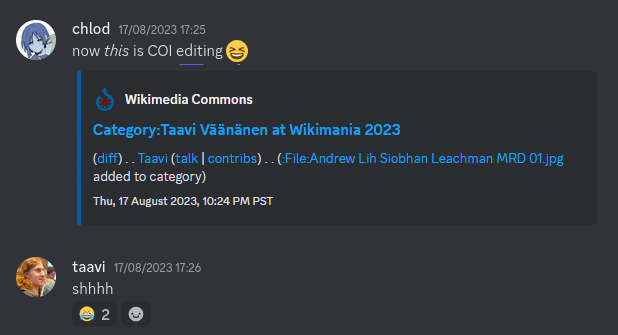
Me replying 'shh' to a Discord message showing myself categorizing photos about me and accusing me of COI editing
thankfully Commons has no such thing as a Conflict of interest (COI) policy
There is almost an existing tool for this: Sam Wilson's mwcli project has support for exporting images one has uploaded to Commons. However I couldn't use that to upload photos of me others have uploaded, plus it's written in PHP and I don't exactly want to deal with the problem of figuring out how to package it in a way I could neatly install it on my NAS. So I wrote my own tool for it, called comload. It's written in Python because Python is easy to deploy (I can just throw it in a .deb and upload it to my internal repository), and because I did not find a Go library to handle Action API pagination for me. The basic usage is like this:
$ comload --subcats "Taavi V n nen"
This will download any files in Category:Taavi V n nen and its sub-categories to the current directory. Former image versions, as well as the image description and SDC data, if any, is also included. And it's smart enough to not download any files that are already there on future runs, so you can just throw it in a systemd timer to get any future files. I'd still like it to handle moved files without creating a duplicate copy, but otherwise I'm really happy with the current state. comload is available from PyPI and from my Git server directly, and is licensed under the GPLv3.

11 October 2024

Freexian Collaborators: Monthly report about Debian Long Term Support, September 2024 (by Roberto C. S nchez)

Like each month, have a look at the work funded by Freexian s Debian LTS offering.

Debian LTS contributors In September, 18 contributors have been paid to work on Debian LTS, their reports are available:
  • Abhijith PA did 7.0h (out of 0.0h assigned and 14.0h from previous period), thus carrying over 7.0h to the next month.
  • Adrian Bunk did 51.75h (out of 9.25h assigned and 55.5h from previous period), thus carrying over 13.0h to the next month.
  • Arturo Borrero Gonzalez did 10.0h (out of 0.0h assigned and 10.0h from previous period).
  • Bastien Roucari s did 20.0h (out of 20.0h assigned).
  • Ben Hutchings did 20.0h (out of 12.0h assigned and 12.0h from previous period), thus carrying over 4.0h to the next month.
  • Chris Lamb did 18.0h (out of 18.0h assigned).
  • Daniel Leidert did 23.0h (out of 26.0h assigned), thus carrying over 3.0h to the next month.
  • Emilio Pozuelo Monfort did 23.5h (out of 22.25h assigned and 37.75h from previous period), thus carrying over 36.5h to the next month.
  • Guilhem Moulin did 22.25h (out of 20.0h assigned and 2.5h from previous period), thus carrying over 0.25h to the next month.
  • Lucas Kanashiro did 10.0h (out of 5.0h assigned and 15.0h from previous period), thus carrying over 10.0h to the next month.
  • Markus Koschany did 40.0h (out of 40.0h assigned).
  • Ola Lundqvist did 6.5h (out of 14.5h assigned and 9.5h from previous period), thus carrying over 17.5h to the next month.
  • Roberto C. S nchez did 24.75h (out of 21.0h assigned and 3.75h from previous period).
  • Santiago Ruano Rinc n did 19.0h (out of 19.0h assigned).
  • Sean Whitton did 0.75h (out of 4.0h assigned and 2.0h from previous period), thus carrying over 5.25h to the next month.
  • Sylvain Beucler did 16.0h (out of 42.0h assigned and 18.0h from previous period), thus carrying over 44.0h to the next month.
  • Thorsten Alteholz did 11.0h (out of 11.0h assigned).
  • Tobias Frost did 17.0h (out of 7.5h assigned and 9.5h from previous period).

Evolution of the situation In September, we have released 52 DLAs. September marked the first full month of Debian 11 bullseye under the responsibility of the LTS Team and the team immediately got to work, publishing more than 4 dozen updates. Some notable updates include ruby2.7 (denial-of-service, information leak, and remote code execution), git (various arbitrary code execution vulnerabilities), firefox-esr (multiple issues), gnutls28 (information disclosure), thunderbird (multiple issues), cacti (cross site scripting and SQL injection), redis (unauthorized access, denial of service, and remote code execution), mariadb-10.5 (arbitrary code execution), cups (arbitrary code execution). Several LTS contributors have also contributed package updates which either resulted in a DSA (a Debian Security Announcement, which applies to Debian 12 bookworm) or in an upload that will be published at the next stable point release of Debian 12 bookworm. This list of packages includes cups, cups-filters, booth, nghttp2, puredata, python3.11, sqlite3, and wireshark. This sort of work, contributing fixes to newer Debian releases (and sometimes even to unstable), helps to ensure that upgrades from a release in the LTS phase of its lifecycle to a newer release do not expose users to vulnerabilities which have been closed in the older release. Looking beyond Debian, LTS contributor Bastien Roucari s has worked with the upstream developers of apache2 to address regressions introduced upstream by some recent vulnerability fixes and he has also reached out to the community regarding a newly discovered security issue in the dompurify package. LTS contributor Santiago Ruano Rinc n has undertaken the work of triaging and reproducing nearly 4 dozen CVEs potentially affecting the freeimage package. The upstream development of freeimage appears to be dormant and some of the issues have languished for more than 5 years. It is unclear how much can be done without the aid of upstream, but we will do our best to provide as much help to the community as we can feasibly manage. Finally, it is sometimes necessary to limit or discontinue support for certain packages. The transition of a release from being under the responsibility of the Debian Security Team to that of the LTS Team is an occasion where we assess any pending decisions in this area and formalize them. Please see the announcement for a complete list of packages which have been designated as unsupported.

Thanks to our sponsors Sponsors that joined recently are in bold.

10 October 2024

Freexian Collaborators: Debian Contributions: Packaging Pydantic v2, Reworking of glib2.0 for cross bootstrap, Python archive rebuilds and more! (by Anupa Ann Joseph)

Debian Contributions: 2024-09 Contributing to Debian is part of Freexian s mission. This article covers the latest achievements of Freexian and their collaborators. All of this is made possible by organizations subscribing to our Long Term Support contracts and consulting services.

Pydantic v2, by Colin Watson Pydantic is a useful library for validating data in Python using type hints: Freexian uses it in a number of projects, including Debusine. Its Debian packaging had been stalled at 1.10.17 in testing for some time, partly due to needing to make sure everything else could cope with the breaking changes introduced in 2.x, but mostly due to needing to sort out packaging of its new Rust dependencies. Several other people (notably Alexandre Detiste, Andreas Tille, Drew Parsons, and Timo R hling) had made some good progress on this, but nobody had quite got it over the line and it seemed a bit stuck. Colin upgraded a few Rust libraries to new upstream versions, packaged rust-jiter, and chased various failures in other packages. This eventually allowed getting current versions of both pydantic-core and pydantic into testing. It should now be much easier for us to stay up to date routinely.

Reworking of glib2.0 for cross bootstrap, by Helmut Grohne Simon McVittie (not affiliated with Freexian) earlier restructured the libglib2.0-dev such that it would absorb more functionality and in particular provide tools for working with .gir files. Those tools practically require being run for their host architecture (practically this means running under qemu-user) which is at odds with the requirements of architecture cross bootstrap. The qemu requirement was expressed in package dependencies and also made people unhappy attempting to use libglib2.0-dev for i386 on amd64 without resorting to qemu. The use of qemu in architecture bootstrap is particularly problematic as it tends to not be ready at the time bootstrapping is needed. As a result, Simon proposed and implemented the introduction of a libgio-2.0-dev package providing a subset of libglib2.0-dev that does not require qemu. Packages should continue to use libglib2.0-dev in their Build-Depends unless involved in architecture bootstrap. Helmut reviewed and tested the implementation and integrated the necessary changes into rebootstrap. He also prepared a patch for libverto to use the new package and proposed adding forward compatibility to glib2.0. Helmut continued working on adding cross-exe-wrapper to architecture-properties and implemented autopkgtests later improved by Simon. The cross-exe-wrapper package now provides a generic mechanism to a program on a different architecture by using qemu when needed only. For instance, a dependency on cross-exe-wrapper:i386 provides a i686-linux-gnu-cross-exe-wrapper program that can be used to wrap an ELF executable for the i386 architecture. When installed on amd64 or i386 it will skip installing or running qemu, but for other architectures qemu will be used automatically. This facility can be used to support cross building with targeted use of qemu in cases where running host code is unavoidable as is the case for GObject introspection. This concludes the joint work with Simon and Niels Thykier on glib2.0 and architecture-properties resolving known architecture bootstrap regressions arising from the glib2.0 refactoring earlier this year.

Analyzing binary package metadata, by Helmut Grohne As Guillem Jover (not affiliated with Freexian) continues to work on adding metadata tracking to dpkg, the question arises how this affects existing packages. The dedup.debian.net infrastructure provides an easy playground to answer such questions, so Helmut gathered file metadata from all binary packages in unstable and performed an explorative analysis. Some results include: Guillem also performed a cursory analysis and reported other problem categories such as mismatching directory permissions for directories installed by multiple packages and thus gained a better understanding of what consistency checks dpkg can enforce.

Python archive rebuilds, by Stefano Rivera Last month Stefano started to write some tooling to do large-scale rebuilds in debusine, starting with finding packages that had already started to fail to build from source (FTBFS) due to the removal of setup.py test. This month, Stefano did some more rebuilds, starting with experimental versions of dh-python. During the Python 3.12 transition, we had added a dependency on python3-setuptools to dh-python, to ease the transition. Python 3.12 removed distutils from the stdlib, but many packages were expecting it to still be available. Setuptools contains a version of distutils, and dh-python was a convenient place to depend on setuptools for most package builds. This dependency was never meant to be permanent. A rebuild without it resulted in mass-filing about 340 bugs (and around 80 more by mistake). A new feature in Python 3.12, was to have unittest s test runner exit with a non-zero return code, if no tests were run. We added this feature, to be able to detect tests that are not being discovered, by mistake. We are ignoring this failure, as we wouldn t want to suddenly cause hundreds of packages to fail to build, if they have no tests. Stefano did a rebuild to see how many packages were affected, and found that around 1000 were. The Debian Python community has not come to a conclusion on how to move forward with this. As soon as Python 3.13 release candidate 2 was available, Stefano did a rebuild of the Python packages in the archive against it. This was a more complex rebuild than the others, as it had to be done in stages. Many packages need other Python packages at build time, typically to run tests. So transitions like this involve some manual bootstrapping, followed by several rounds of builds. Not all packages could be tested, as not all their dependencies support 3.13 yet. The result was around 100 bugs in packages that need work to support Python 3.13. Many other packages will need additional work to properly support Python 3.13, but being able to build (and run tests) is an important first step.

Miscellaneous contributions
  • Carles prepared the update of python-pyaarlo package to a new upstream release.
  • Carles worked on updating python-ring-doorbell to a new upstream release. Unfinished, pending to package a new dependency python3-firebase-messaging RFP #1082958 and its dependency python3-http-ece RFP #1083020.
  • Carles improved po-debconf-manager. Main new feature is that it can open Salsa merge requests. Aiming for a lightning talk in MiniDebConf Toulouse (November) to be functional end to end and get feedback from the wider public for this proof of concept.
  • Carles helped one translator to use po-debconf-manager (added compatibility for bullseye, fixed other issues) and reviewed 17 package templates.
  • Colin upgraded the OpenSSH packaging to 9.9p1.
  • Colin upgraded the various YubiHSM packages to new upstream versions, enabled more tests, fixed yubihsm-shell build failures on some 32-bit architectures, made yubihsm-shell build reproducibly, and fixed yubihsm-connector to apply udev rules to existing devices when the package is installed. As usual, bookworm-backports is up to date with all these changes.
  • Colin fixed quite a bit of fallout from setuptools 72.0.0 removing setup.py test, backported a large upstream patch set to make buildbot work with SQLAlchemy 2.0, and upgraded 25 other Python packages to new upstream versions.
  • Enrico worked with Jakob Haufe to get him up to speed for managing sso.debian.org
  • Rapha l did remove spam entries in the list of teams on tracker.debian.org (see #1080446), and he applied a few external contributions, fixing a rendering issue and replacing the DDPO link with a more useful alternative. He also gave feedback on a couple of merge requests that required more work. As part of the analysis of the underlying problem, he suggested to the ftpmasters (via #1083068) to auto-reject packages having the too-many-contacts lintian error, and he raised the severity of #1076048 to serious to actually have that 4 year old bug fixed.
  • Rapha l uploaded zim and hamster-time-tracker to fix issues with Python 3.12 getting rid of setuptools. He also uploaded a new gnome-shell-extension-hamster to cope with the upcoming transition to GNOME 47.
  • Helmut sent seven patches and sponsored one upload for cross build failures.
  • Helmut uploaded a Nagios/Icinga plugin check-smart-attributes for monitoring the health of physical disks.
  • Helmut collaborated on sbuild reviewing and improving a MR for refactoring the unshare backend.
  • Helmut sent a patch fixing coinstallability of gcc-defaults.
  • Helmut continued to monitor the evolution of the /usr-move. With more and more key packages such as libvirt or fuse3 fixed. We re moving into the boring long-tail of the transition.
  • Helmut proposed updating the meson buildsystem in debhelper to use env2mfile.
  • Helmut continued to update patches maintained in rebootstrap. Due to the work on glib2.0 above, rebootstrap moves a lot further, but still fails for any architecture.
  • Santiago reviewed some Merge Request in Salsa CI, such as: !478, proposed by Otto to extend the information about how to use additional runners in the pipeline and !518, proposed by Ahmed to add support for Ubuntu images, that will help to test how some debian packages, including the complex MariaDB are built on Ubuntu. Santiago also prepared !545, which will make the reprotest job more consistent with the result seen on reproducible-builds.
  • Santiago worked on different tasks related to DebConf 25. Especially he drafted the fundraising brochure (which is almost ready).
  • Thorsten Alteholz uploaded package libcupsfilter to fix the autopkgtest and a dependency problem of this package. After package splix was abandoned by upstream and OpenPrinting.org adopted its maintenance, Thorsten uploaded their first release.
  • Anupa published posts on the Debian Administrators group in LinkedIn and moderated the group, one of the tasks of the Debian Publicity Team.
  • Anupa helped organize DebUtsav 2024. It had over 100 attendees with hand-on sessions on making initial contributions to Linux Kernel, Debian packaging, submitting documentation to Debian wiki and assisting Debian Installations.

7 October 2024

Reproducible Builds: Reproducible Builds in September 2024

Welcome to the September 2024 report from the Reproducible Builds project! Our reports attempt to outline what we ve been up to over the past month, highlighting news items from elsewhere in tech where they are related. As ever, if you are interested in contributing to the project, please visit our Contribute page on our website. Table of contents:
  1. New binsider tool to analyse ELF binaries
  2. Unreproducibility of GHC Haskell compiler 95% fixed
  3. Mailing list summary
  4. Towards a 100% bit-for-bit reproducible OS
  5. Two new reproducibility-related academic papers
  6. Distribution work
  7. diffoscope
  8. Other software development
  9. Android toolchain core count issue reported
  10. New Gradle plugin for reproducibility
  11. Website updates
  12. Upstream patches
  13. Reproducibility testing framework

New binsider tool to analyse ELF binaries Reproducible Builds developer Orhun Parmaks z has announced a fantastic new tool to analyse the contents of ELF binaries. According to the project s README page:
Binsider can perform static and dynamic analysis, inspect strings, examine linked libraries, and perform hexdumps, all within a user-friendly terminal user interface!
More information about Binsider s features and how it works can be found within Binsider s documentation pages.

Unreproducibility of GHC Haskell compiler 95% fixed A seven-year-old bug about the nondeterminism of object code generated by the Glasgow Haskell Compiler (GHC) received a recent update, consisting of Rodrigo Mesquita noting that the issue is:
95% fixed by [merge request] !12680 when -fobject-determinism is enabled. [ ]
The linked merge request has since been merged, and Rodrigo goes on to say that:
After that patch is merged, there are some rarer bugs in both interface file determinism (eg. #25170) and in object determinism (eg. #25269) that need to be taken care of, but the great majority of the work needed to get there should have been merged already. When merged, I think we should close this one in favour of the more specific determinism issues like the two linked above.

Mailing list summary On our mailing list this month:
  • Fay Stegerman let everyone know that she started a thread on the Fediverse about the problems caused by unreproducible zlib/deflate compression in .zip and .apk files and later followed up with the results of her subsequent investigation.
  • Long-time developer kpcyrd wrote that there has been a recent public discussion on the Arch Linux GitLab [instance] about the challenges and possible opportunities for making the Linux kernel package reproducible , all relating to the CONFIG_MODULE_SIG flag. [ ]
  • Bernhard M. Wiedemann followed-up to an in-person conversation at our recent Hamburg 2024 summit on the potential presence for Reproducible Builds in recognised standards. [ ]
  • Fay Stegerman also wrote about her worry about the possible repercussions for RB tooling of Debian migrating from zlib to zlib-ng as reproducibility requires identical compressed data streams. [ ]
  • Martin Monperrus wrote the list announcing the latest release of maven-lockfile that is designed aid building Maven projects with integrity . [ ]
  • Lastly, Bernhard M. Wiedemann wrote about potential role of reproducible builds in combatting silent data corruption, as detailed in a recent Tweet and scholarly paper on faulty CPU cores. [ ]

Towards a 100% bit-for-bit reproducible OS Bernhard M. Wiedemann began writing on journey towards a 100% bit-for-bit reproducible operating system on the openSUSE wiki:
This is a report of Part 1 of my journey: building 100% bit-reproducible packages for every package that makes up [openSUSE s] minimalVM image. This target was chosen as the smallest useful result/artifact. The larger package-sets get, the more disk-space and build-power is required to build/verify all of them.
This work was sponsored by NLnet s NGI Zero fund.

Distribution work In Debian this month, 14 reviews of Debian packages were added, 12 were updated and 20 were removed, all adding to our knowledge about identified issues. A number of issue types were updated as well. [ ][ ] In addition, Holger opened 4 bugs against the debrebuild component of the devscripts suite of tools. In particular:
  • #1081047: Fails to download .dsc file.
  • #1081048: Does not work with a proxy.
  • #1081050: Fails to create a debrebuild.tar.
  • #1081839: Fails with E: mmdebstrap failed to run error.
Last month, an issue was filed to update the Salsa CI pipeline (used by 1,000s of Debian packages) to no longer test for reproducibility with reprotest s build_path variation. Holger Levsen provided a rationale for this change in the issue, which has already been made to the tests being performed by tests.reproducible-builds.org. This month, this issue was closed by Santiago R. R., nicely explaining that build path variation is no longer the default, and, if desired, how developers may enable it again. In openSUSE news, Bernhard M. Wiedemann published another report for that distribution.

diffoscope diffoscope is our in-depth and content-aware diff utility that can locate and diagnose reproducibility issues. This month, Chris Lamb made the following changes, including preparing and uploading version 278 to Debian:
  • New features:
    • Add a helpful contextual message to the output if comparing Debian .orig tarballs within .dsc files without the ability to fuzzy-match away the leading directory. [ ]
  • Bug fixes:
    • Drop removal of calculated os.path.basename from GNU readelf output. [ ]
    • Correctly invert X% similar value and do not emit 100% similar . [ ]
  • Misc:
    • Temporarily remove procyon-decompiler from Build-Depends as it was removed from testing (via #1057532). (#1082636)
    • Update copyright years. [ ]
For trydiffoscope, the command-line client for the web-based version of diffoscope, Chris Lamb also:
  • Added an explicit python3-setuptools dependency. (#1080825)
  • Bumped the Standards-Version to 4.7.0. [ ]

Other software development disorderfs is our FUSE-based filesystem that deliberately introduces non-determinism into system calls to reliably flush out reproducibility issues. This month, version 0.5.11-4 was uploaded to Debian unstable by Holger Levsen making the following changes:
  • Replace build-dependency on the obsolete pkg-config package with one on pkgconf, following a Lintian check. [ ]
  • Bump Standards-Version field to 4.7.0, with no related changes needed. [ ]

In addition, reprotest is our tool for building the same source code twice in different environments and then checking the binaries produced by each build for any differences. This month, version 0.7.28 was uploaded to Debian unstable by Holger Levsen including a change by Jelle van der Waa to move away from the pipes Python module to shlex, as the former will be removed in Python version 3.13 [ ].

Android toolchain core count issue reported Fay Stegerman reported an issue with the Android toolchain where a part of the build system generates a different classes.dex file (and thus a different .apk) depending on the number of cores available during the build, thereby breaking Reproducible Builds:
We ve rebuilt [tag v3.6.1] multiple times (each time in a fresh container): with 2, 4, 6, 8, and 16 cores available, respectively:
  • With 2 and 4 cores we always get an unsigned APK with SHA-256 14763d682c9286ef .
  • With 6, 8, and 16 cores we get an unsigned APK with SHA-256 35324ba4c492760 instead.

New Gradle plugin for reproducibility A new plugin for the Gradle build tool for Java has been released. This easily-enabled plugin results in:
reproducibility settings [being] applied to some of Gradle s built-in tasks that should really be the default. Compatible with Java 8 and Gradle 8.3 or later.

Website updates There were a rather substantial number of improvements made to our website this month, including:

Upstream patches The Reproducible Builds project detects, dissects and attempts to fix as many currently-unreproducible packages as possible. We endeavour to send all of our patches upstream where appropriate. This month, we wrote a large number of such patches, including:

Reproducibility testing framework The Reproducible Builds project operates a comprehensive testing framework running primarily at tests.reproducible-builds.org in order to check packages and other artifacts for reproducibility. In September, a number of changes were made by Holger Levsen, including:
  • Debian-related changes:
    • Upgrade the osuosl4 node to Debian trixie in anticipation of running debrebuild and rebuilderd there. [ ][ ][ ]
    • Temporarily mark the osuosl4 node as offline due to ongoing xfs_repair filesystem maintenance. [ ][ ]
    • Do not warn about (very old) broken nodes. [ ]
    • Add the risc64 architecture to the multiarch version skew tests for Debian trixie and sid. [ ][ ][ ]
    • Mark the virt 32,64 b nodes as down. [ ]
  • Misc changes:
    • Add support for powercycling OpenStack instances. [ ]
    • Update the fail2ban to ban hosts for 4 weeks in total [ ][ ] and take care to never ban our own Jenkins instance. [ ]
In addition, Vagrant Cascadian recorded a disk failure for the virt32b and virt64b nodes [ ], performed some maintenance of the cbxi4a node [ ][ ] and marked most armhf architecture systems as being back online.

Finally, If you are interested in contributing to the Reproducible Builds project, please visit our Contribute page on our website. However, you can get in touch with us via:

4 October 2024

Bits from Debian: Debian welcomes Freexian as our newest partner!

Freexian logo We are excited to announce and welcome Freexian into Debian Partners. Freexian specializes in Free Software with a particular focus on Debian GNU/Linux. Freexian can assist with consulting, training, technical support, packaging, or software development on projects involving use or development of Free software. All of Freexian's employees and partners are well-known contributors in the Free Software community, a choice that is integral to Freexian's business model. About the Debian Partners Program The Debian Partners Program was created to recognize companies and organizations that help and provide continuous support to the project with services, finances, equipment, vendor support, and a slew of other technical and non-technical services. Partners provide critical assistance, help, and support which has advanced and continues to further our work in providing the 'Universal Operating System' to the world. Thank you Freexian!

1 October 2024

Colin Watson: Free software activity in September 2024

Almost all of my Debian contributions this month were sponsored by Freexian. You can also support my work directly via Liberapay. Pydantic My main Debian project for the month turned out to be getting Pydantic back into a good state in Debian testing. I ve used Pydantic quite a bit in various projects, most recently in Debusine, so I have an interest in making sure it works well in Debian. However, it had been stalled on 1.10.17 for quite a while due to the complexities of getting 2.x packaged. This was partly making sure everything else could cope with the transition, but in practice mostly sorting out packaging of its new Rust dependencies. Several other people (notably Alexandre Detiste, Andreas Tille, Drew Parsons, and Timo R hling) had made some good progress on this, but nobody had quite got it over the line and it seemed a bit stuck. Learning Rust is on my to-do list, but merely not knowing a language hasn t stopped me before. So I learned how the Debian Rust team s packaging works, upgraded a few packages to new upstream versions (including rust-half and upstream rust-idna test fixes), and packaged rust-jiter. After a lot of waiting around for various things and chasing some failures in other packages I was eventually able to get current versions of both pydantic-core and pydantic into testing. I m looking forward to being able to drop our clunky v1 compatibility code once debusine can rely on running on trixie! OpenSSH I upgraded the Debian packaging to OpenSSH 9.9p1. YubiHSM I upgraded python-yubihsm, yubihsm-connector, and yubihsm-shell to new upstream versions. I noticed that I could enable some tests in python-yubihsm and yubihsm-shell; I d previously thought the whole test suite required a real YubiHSM device, but when I looked closer it turned out that this was only true for some tests. I fixed yubihsm-shell build failures on some 32-bit architectures (upstream PRs #431, #432), and also made it build reproducibly. Thanks to Helmut Grohne, I fixed yubihsm-connector to apply udev rules to existing devices when the package is installed. As usual, bookworm-backports is up to date with all these changes. Python team setuptools 72.0.0 removed the venerable setup.py test command. This caused some fallout in Debian, some of which was quite non-obvious as packaging helpers sometimes fell back to different ways of running test suites that didn t quite work. I fixed django-guardian, manuel, python-autopage, python-flask-seeder, python-pgpdump, python-potr, python-precis-i18n, python-stopit, serpent, straight.plugin, supervisor, and zope.i18nmessageid. As usual for new language versions, the addition of Python 3.13 caused some problems. I fixed psycopg2, python-time-machine, and python-traits. I fixed build/autopkgtest failures in keymapper, python-django-test-migrations, python-rosettasciio, routes, transmissionrpc, and twisted. buildbot was in a bit of a mess due to being incompatible with SQLAlchemy 2.0. Fortunately by the time I got to it upstream had committed a workable set of patches, and the main difficulty was figuring out what to cherry-pick since they haven t made a new upstream release with all of that yet. I figured this out and got us up to 4.0.3. Adrian Bunk asked whether python-zipp should be removed from trixie. I spent some time investigating this and concluded that the answer was no, but looking into it was an interesting exercise anyway. On the other hand, I looked into flask-appbuilder, concluded that it should be removed, and filed a removal request. I upgraded some embedded CSS files in nbconvert. I upgraded importlib-resources, ipywidgets, jsonpickle, pydantic-settings, pylint (fixing a test failure), python-aiohttp-session, python-apptools, python-asyncssh, python-django-celery-beat, python-django-rules, python-limits, python-multidict, python-persistent, python-pkginfo, python-rt, python-spur, python-zipp, stravalib, transmissionrpc, vulture, zodbpickle, zope.exceptions (adopting it), zope.i18nmessageid, zope.proxy, and zope.security to new upstream versions. debmirror The experimental and *-proposed-updates suites used to not have Contents-* files, and a long time ago debmirror was changed to just skip those files in those suites. They were added to the Debian archive some time ago, but debmirror carried on skipping them anyway. Once I realized what was going on, I removed these unnecessary special cases (#819925, #1080168).

Next.

Previous.