Search Results: "ag"

16 March 2026

Dimitri John Ledkov: Security-only OpenSSL tarball releases for CVE-2026-2673

On Friday May the 13th OpenSSL project has published advisory details for CVE-2026-2673. The CVE is treated as non-important by the project. The patches are only provided as commits on the stable branches. No git tag, no precise fixed version, and no source tarballs provided.The patches that were merged to openssl-3.5 and openssl-3.6 branches were not based on top of the last stable point release and did not split code changes & documentation updates. It means that cherry-picking the commits referenced in the advisory will always lead to conflicts requiring manual resolution. It is not clear if support is provided for snapshot builds off the openssl-3.5 and openssl-3.6 branches. As the builds from the stable branches declare themselves as dev builds of the next unreleased point release. For example, in contrast to projects such as vim and glibc, with every commit to stable branches explicitly recommended for distributors to ship and is supported.I have requested OpenSSL upstream in the past for the security fixes to branch off the last point release, commit code changes separate from the NEWS.md / CHANGES.md updates, and then merge that into the stable branches. This way the advisory that recommends cherry-picking individual commits, would actually apply conflict free - at no additional maintenance burden to the OpenSSL project and everyone who has to cherry-pick these updates. There is a wide support voiced for such strategy by the OpenSSL distributors and the OpenSSL Corporation. But this is not something that OpenSSL Project is yet choosing to provide.To avoid duplication of work, I am starting to provide stable OpenSSL re-releases of the last upstream tagged stable point release with security only patches split into code-change only; documentation update; version update to create security only source tarball releases that are easy to build; easy to identify by the security scanners; and which cherry-pick changes without conflicts. The first two releases are published on GitHub as immutable releases with attestations:
If there are any other branches, CVEs, point releases that would be useful for similar style releases, do open discussion on the GitHub Project.

If you find these releases useful, do star the project and download these releases. If this project gets popular, I hope that OpenSSL upstream will reconsider their releases strategy for all security releases. If you have support contracts with OpenSSL - please request OpenSSL corporation to release tagged releases and versioned tarballs.

Freexian Collaborators: Monthly report about Debian Long Term Support, February 2026 (by Thorsten Alteholz)

The Debian LTS Team, funded by [Freexian s Debian LTS offering] (https://www.freexian.com/lts/debian/), is pleased to report its activities for February.

Activity summary During the month of February, 20 contributors have been paid to work on Debian LTS (links to individual contributor reports are located below). The team released 35 DLAs fixing 527 CVEs. We also welcomed Arnaud Rebillout to the team and had to say farewell to Roberto, who left the team after more than nine years as part of it. The team continued preparing security updates in its usual rhythm. Beyond the updates targeting Debian 11 ( bullseye ), which is the current release under LTS, the team also proposed updates for more recent releases (Debian 12 ( bookworm ) and Debian 13 ( trixie )), including Debian unstable. Notable security updates:
  • Guilhem Moulin prepared DLA 4492-1 for gnutls28 to fix vulnerabilities which may lead to Denial of Service.
  • Utkarsh Gupta prepared DLA 4464-1 for xrdp, to fix a a vulnerability that could allow remote attackers to execute arbitrary code on the target system.
  • Emilio Pozuelo Monfort prepared DLA-4465-1 to replace ClamAV 1.0 with ClamAV 1.4. This latter is the current LTS version supported by upstream.
  • Markus Koschany prepared DLA 4468-1 for tomcat9, to fix a vulnerability that can be used to bypass security constraints.
  • Santiago Ruano Rinc n prepared DLA 4471-1 to update package debian-security-support, the Debian security coverage checker.
  • Bastien Roucari s prepared DLA 4473-1 for zabbix, to fix a potential remote code execution vulnerability.
  • Paride Legovini prepared DLA 4478-1 for tcpflow, to fix a vulnerability that might result in DoS and potentially code execution.
  • Thorsten Alteholz prepared DLA 4477-1 for munge, to fix a vulnerability which may allow local users to leak the MUNGE cryptographic key and forge arbitrary credentials.
  • Ben Hutchings prepared DLA 4475-1 and DLA 4476-1 for Linux kernel updates.
  • Chris Lamb prepared DLA 4482-1 for ceph, to fix SSL certificate checking in the Python bindings.
  • Andreas Henriksson prepared DLA 4491-1 to fix vulnerabilities in glib2.0, which could result in denial of service, memory corruption or potentially arbitrary code execution.
Contributions from outside the LTS Team:
  • The update of nova was prepared by the maintainer, Thomas Goirand. The corresponding DLA 4486-1 was published by Carlos Henrique Lima Melara.
  • The updates of thunderbird were prepared by the maintainer Christoph Goehre. The corresponding DLA 4466-1 and DLA 4495-1 was published by Emilio Pozuelo Monfort.
The LTS Team has also contributed with updates to the latest Debian releases:
  • Jochen prepared a point update of wireshark for bookworm (#1127945).
  • Jochen prepared point updates of erlang for trixie (#1127606) and bookworm (#1127607).
  • Bastien helped preparing DSA 6160-1 for netty and uploaded a fixed package to unstable.
  • Bastien prepared a point update of zabbix for trixie (#1127437).
  • Tobias prepared a point update of modsecurity-crs for bookworm (#1128655).
  • Tobias prepared a point update of busybox for bookworm (#1129503).
  • Tobias helped preparing DSA 6138-1 for libpng1.6.
  • Daniel prepared point updates of python-authlib for trixie (#1129477) and bookworm (#1129246).
  • Ben uploaded several Linux kernel packages to trixie-backports and bookworm-backports.
  • Ben prepared point updates of wireless-regdb for trixie and bookworm.
Other than the work related to updates, Sylvain made several improvements to the documentation and tooling used by the team. Some milestones in the lifecycle of two Debian releases are just around the corner. The support of Debian 12 will be handed over to the LTS team on June 11th 2026. After August 31st, support for Debian 11 will move from Debian LTS to ELTS managed by Freexian.

Individual Debian LTS contributor reports

Thanks to our sponsors Sponsors that joined recently are in bold.

Freexian Collaborators: Regression Tracking in Debusine (by Stefano Rivera)

Regression Tracking Debusine is a tool designed for Debian developers and Operating System developers in general. Debusine can run QA pipelines to check that Debian packages are ready to upload. This blog post describes the regression tracking mechanism that s recently become available in Debusine QA pipelines. The debian_pipeline workflow in Debusine can build, test, and upload a package to the Debian archive (or any other repository, such as a native Debusine APT repository). The QA tests involve running the standard Debian QA utilities (lintian, autopkgtest, piuparts, blhc) on the built artifacts. In addition we can run the autopkgtests of every other package in the archive that depends on the built package, like britney does for testing migration in Debian. Some of these other packages may have currently-failing autopkgtests that have nothing to do with the changes in the upload under test. For example: A Pipeline Figuring out which of these failures are new (and thus worth investigating) has been a manual process in Debusine until now. We have just completed the basic functionality of the regression_tracking=true feature, and have enabled it in the upload-to-* workflows on debusine.debian.net. With this enabled, you ll get a new QA tab on your debian_pipeline workflows that shows the trend of each test: QA Results This is determined by looking at recent task history for each task in the debian:qa-results collection. If there is no recent result for a given <package, version, architecture>, then tasks are queued under the reference tests qa workflow tree on the pipeline. These reference tests are run by using the same tasks as the main qa workflow, but without the addition of the package under test. In fact, it uses the same qa workflow that we use to check the package, but with a few different parameters to populate the regression tracking results collection. The debian:qa-results collection used for analyzing regressions is specified to the debian_pipeline with the regression_tracking_qa_results lookup parameter. On debusine.debian.net we have configured a debian:qa-results collection for sid that can be referenced and added to by tasks in any workspace. Regressions can be more subtle than a simple Success Failure. If the number of autopkgtests that fail increases, or the number of lintian tags emitted increases, those are also considered a regressions.

Using regression tracking now It s enabled by default on most of the upload-to-* workflows on debusine.debian.net. To disable, pass -O debusine_workflow_data.enable_regression_tracking=false when you dput an upload to debusine. To use the regression-tracking in your own workflows, use a debian_pipeline workflow that is configured with enable_regression_tracking=true. This will require a qa_suite to be specified, pointing to the baseline suite. We hope this will make it easier to check QA results for packages tested on debusine.debian.net.

15 March 2026

Phil Hands: Mathilda Hands: lost Lenovo X230 Laptop

On our way to Austria last week, on March 6th, we left my daughter's laptop on a train: ICE 1201 (Hamburg-Harburg to Bludenz). The laptop is a Lenovo X230 notebook. The most obvious distinguishing feature is a Mathilda Hands sticker in the middle of the lid: Mathilda Hands sticker I seem to remember that it also has some hexagonal stickers, one probably being one of these: hexagonal, black and white, Phosh sticker The keyboard layout is British (with a above the 3). It was left in coach 24 of ICE 1201, next to seats 51-54, in the luggage gap between the seats, on the floor. My hope is that whoever found it will end up searching for Mathilda Hands and see this. If that's how you got here, please email me: phil-lostlaptop2026@hands.com - doing so will make Mathilda (and me) most cheerful.

Dirk Eddelbuettel: RcppClassic 0.9.14 on CRAN: Minor Update

A maintenance release 0.9.14 of the RcppClassic package arrived earlier today on CRAN, and has been built for r2u. This package provides a maintained version of the otherwise deprecated initial Rcpp API which no new projects should use as the normal and current Rcpp API is so much better. A few changes had cumulated up since the last release in late 2022. We updated continuous integration scripts a few times, switched to Authors@R in DESCRIPTION, and rejigged build scripts a little to accommodate both possible build architectures for macOS. We also updated the vignette by updating all reference and switching the new asis vignette builder now available in Rcpp. CRANberries also reports the changes relative to the previous release from 3 1/2 years ago. Questions, comments etc should go to the rcpp-devel mailing list off the R-Forge page.

This post by Dirk Eddelbuettel originated on his Thinking inside the box blog. If you like this or other open-source work I do, you can now sponsor me at GitHub.

Christian Kastner: Radxa Orion O6 - finally an arm64 board I'm happy with

The Radxa Orion O6 seems to be the arm64 device I've always wanted. Finally! Because it supports UEFI boot, Debian can be installed with the vanilla installation media. Neither custom images, nor additional firmware, nor any other tricks were required on my end. In fact, the entire process was indistinguishable from the amd64 installations I've been accustomed to for two decades: just plug in a USB flash drive, boot, and install. The system's specs are pretty neat. The CPU is ARMv9.2, though without SME, which would have been useful for debugging packages that use it in some way. It's also rich in interfaces, including a Gen4 PCIe x16 slot (with 8 lanes), which enables me to run tests utilizing GPUs. The BIOS version the board came with had a bug where WiFi was permanently disabled, but this has been fixed in the meantime. The only odd thing was the socket for the RTC battery: the CR1220 it requires seems to be rather niche: none of the hardware stores I visited carried it, so I had to order one online. I installed Debian trixie to a NVMe drive, and for 6 months now, it has been running flawlessly. I've been using this board as a development and debugging system for arm64 optimizations, in particular for ggml's feature-specific arm64 backends which are hard to debug on our porterboxes. However, the host will soon transition to a general CI worker for AI/ML related packages, similar to the ROCm CI we've built for testing packages utilizing AMD GPUs. I'll post more about this new CI soon. Purchase of this board was funded by the Debian Project, and was thus enabled through your donations.

Dirk Eddelbuettel: tidyCpp 0.0.10 on CRAN: Even More Maintenance

Yet another maintenance release of the tidyCpp package arrived on CRAN this morning, a mere week and a half after the previous release. It has been built for r2u as well. The package offers a clean C++ layer (as well as one small C++ helper class) on top of the C API for R which aims to make use of this robust (if awkward) C API a little easier and more consistent. See the vignette for motivating examples. This release, just like the preceding one less than two weeks ago, had its hand forced by an overnight change in R-devel. The breakage this created has since been reverted in R-devel but as the writing is on the wall are now removing the definition involving these accessors preemptively. We were also missing version checks for two newly added alternates. Changes are summarized in the NEWS entry that follows.

Changes in tidyCpp version 0.0.10 (2026-03-15)
  • Hide five accessors as underlying macros removed from Rinternals
  • Preemptively hide another accessor
  • Ensure two definitions are conditional on R 4.5.0 or later

Thanks to my CRANberries, there is also a diffstat report for this release. For questions, suggestions, or issues please use the issue tracker at the GitHub repo.

This post by Dirk Eddelbuettel originated on his Thinking inside the box blog. If you like this or other open-source work I do, you can now sponsor me at GitHub.

Marco d'Itri: Bypassing deep packet inspection with socat and HTTPS tunnels

Recently I found myself with a few hours to kill, but with the only available connectivity provided by an annoying firewall which would normally allow requests only to a few very specific web sites. This post shows how to work around this kind of restrictions by hiding SSH in an HTTPS connection, which then can be used as a SOCKS proxy to allow general connectivity. socat does all the hard work. First, create two self-signed RSA keys pairs, one for the client (bongo) and one for the server (attila):
domain=bongo.example.net
openssl req -x509 -newkey rsa:2048 -days 7300 \
  -subj /CN=$domain -addext "subjectAltName = DNS:$domain" \
  -keyout socat.key -nodes \
  -out socat.pem
Then, concatenate the public and private keys to create the file provided to the cert option, and use the public key as the file for the cafile option on the other side. On the client side, if you normally would connect to attila.example.net then you can add something like this to ~/.ssh/config:
Host httpstunnel-attila.example.net
 ProxyCommand socat --statistics STDIO OPENSSL:attila.example.net:443, 
   cert=$HOME/.ssh/socat-bongo.pem,cafile=$HOME/.ssh/socat-attila.pem, 
   snihost=$ SOCAT_SNI:-x.com 
 DynamicForward 1080
 Compression yes
 HostKeyAlias attila.example.net
 ControlMaster yes
 ControlPath ~/.ssh/.control_attila.example.net_22_%r
The ProxyCommand directive uses socat to provide the connectivity which ssh will use over stdio instead of connecting to port 22 of the server. The snihost option is enough to make many firewalls believe that this is an authorized HTTPS request. On the server side we use a simple systemd unit to start a forking instance of socat, which will accept and process requests from the client (and from random crawlers on the Internet: expect a lot of cruft in that log...):
[Unit]
Description=socat tunnel
After=network.target
[Service]
Type=exec
ExecStart=socat -ly OPENSSL-LISTEN:443,fork,reuseaddr, 
  cert=%d/tlskey,cafile=%d/tlsca TCP:localhost:22
SuccessExitStatus=143
LoadCredential=tlskey:/etc/ssh/socat-attila.pem
LoadCredential=tlsca:/etc/ssh/socat-bongo.pem
Restart=on-abnormal
RestartSec=5s
DynamicUser=yes
PrivateDevices=yes
PrivateTmp=yes
ProtectClock=yes
ProtectControlGroups=yes
ProtectHome=yes
ProtectHostname=yes
ProtectKernelLogs=yes
ProtectKernelModules=yes
ProtectKernelTunables=yes
ProtectProc=invisible
ProtectSystem=strict
RestrictAddressFamilies=AF_INET AF_INET6 AF_UNIX
RestrictNamespaces=yes
RestrictRealtime=yes
RestrictSUIDSGID=yes
LockPersonality=yes
MemoryDenyWriteExecute=yes
NoNewPrivileges=yes
AmbientCapabilities=CAP_NET_BIND_SERVICE
CapabilityBoundingSet=CAP_NET_BIND_SERVICE
SystemCallArchitectures=native
SystemCallErrorNumber=EPERM
SystemCallFilter=@system-service
SystemCallFilter=~@resources
SystemCallFilter=~@privileged
[Install]
WantedBy=multi-user.target
Strong sandboxing is enabled, so the socat instance is confined with very limited privileges. An interesting point is the use of systemd credentials to provide the cryptographic keys, since it allows to store them in a part of the file system which would not be accessible to the program. Advanced users can use this method to provide the keys from secure storage.

Russell Coker: The Difference Between Email and Instant Messaging

Introduction With various forms of IM becoming so prevalent and a lot of communication that used to be via email happening via IM I ve been thinking about the differences between Email and IM. I think it s worth comparing them not for the purpose of convincing people to use one or the other (most people will use whatever is necessary to communicate with the people who are important to them) but for the purpose of considering ways to improve them and use them more effectively. Also I don t think that users of various electronic communications systems have had a free choice in what to use for at least 25 years and possibly much longer depending on how you define a free choice. What you use is determined by who you want to communicate with and by what systems are available in your region. So there s no possibility of an analysis of this issue giving a result of let s all change what we use as almost everyone lacks the ability to make a choice. What the Difference is Not The name Instant Messaging implies that it is fast, and probably faster than other options. This isn t necessarily the case, when using a federated IM system such as Matrix or Jabber there can be delays while the servers communicate with each other. Email used to be a slow communication method, in the times of UUCP and Fidonet email there could be multiple days of delay in sending email. In recent times it s expected that email is quite fast, many web sites have options for authenticating an email address which have to be done within 5 minutes so the common expectation seems to be that all email is delivered to the end user in less than 5 minutes. When an organisation has a mail server on site (which is a common configuration choice for a small company) the mail delivery can be faster than common IM implementations. The Wikipedia page about Instant Messaging [1] links to the Wikipedia page about Real Time Computing [2] which is incorrect. Most IM systems are obviously designed for minimum average delays at best. For most software it s not a bad thing to design for the highest performance on average and just let users exercise patience when they get an unusual corner case that takes much longer than expected. If an IM message takes a few minutes to arrive then that s life on the Internet which was the catchphrase of an Australian Internet entrepreneur in the 90s that infuriated some of his customers. Protocol and Data Format Differences Data Formats Email data contains the sender, one or more recipients, some other metadata (time, subject, etc), and the message body. The recipients are typically an arbitrary list of addresses which can only be validated by the destination mail servers. The sender addresses weren t validated in any way and are now only minimally validated as part of anti-spam measures. IM data is sent through predefined connections called rooms or channels. When an IM message is sent to a room it can tag one or more members of the room to indicate that they may receive a special notification of the message. In many implementations it s possible to tag a user who isn t in the room which may result in them being invited to the room. But in IM there is no possibility to add a user to the CC list for part of a discussion and then just stop CCing messages to them later on in the discussion. Protocols Internet email is a well established system with an extensive user base. Adding new mandatory features to the protocols isn t viable because many old systems won t be updated any time soon. So while it is possible to send mail that s SSL encrypted and has a variety of authentication mechanisms that isn t something that can be mandatory for all email. Most mail servers are configured to use the SSL option if it s available but send in cleartext otherwise, so a hostile party could launch a Man In the Middle (MITM) attack and pretend to be the mail server in question but without SSL support. Modern IM protocols tend to be based on encryption, even XMPP (Jabber) which is quite an old IM protocol can easily be configured to only support encrypted messaging and it s reasonable to expect that all other servers that will talk to you will at least support SSL. Even for an IM system that is run by a single company the fact that communication with the servers is encrypted by SSL makes it safer than most email. A security model of this can only be read by you, me, and the staff at an American corporation isn t the worst type of Internet security. The Internet mail infrastructure makes no attempt to send mail in order and the design of the Simple Mail Transfer Protocol (SMTP) means that a network problem after a message has been sent but before the recipient has confirmed receipt will mean that the message is duplicated and this is not considered to be a problem. The IM protocols are designed to support reliable ordered transfer of messages and Matrix (the most recently designed IM protocol) has cryptographic connections between users. Forgery For most email systems there is no common implementation that prevents forging email. For Internet email transferred via SMTP it s possible to use technologies like SPF and DKIM/DMARC to make recipients aware of attempts at forgery, but many recipient systems will still allow email that fails such checks to be delivered. The default configuration tends to be permitting everything and all of the measures to prevent forgery require extra configuration work and often trade-offs as some users desire features that go against security. The default configuration of most mail servers doesn t even prevent trivial forgeries of email from the domain(s) owned by that server. For evidence check the SPF records of some domains that you communicate with and see if they end with -all (to block email from bad sources), ~all (to allow email from bad sources through after possibly logging an error), ?all (to be neutral on mail from unknown sources, or just lack a SPF record entirely. The below shows that of the the top four mail servers in the world only outlook.com has a policy to reject mail from bad sources.
# dig -t txt _spf.google.com grep spf1
_spf.google.com.	300	IN	TXT	"v=spf1 ip4:74.125.0.0/16 ip4:209.85.128.0/17 ip6:2001:4860:4864::/56 ip6:2404:6800:4864::/56 ip6:2607:f8b0:4000::/36 ip6:2800:3f0:4000::/36 ip6:2a00:1450:4000::/36 ip6:2c0f:fb50:4000::/36 ~all"
# dig -t txt outlook.com grep spf1
outlook.com.		126	IN	TXT	"v=spf1 include:spf2.outlook.com -all"
# dig -t txt _spf.mail.yahoo.com grep spf1
_spf.mail.yahoo.com.	1800	IN	TXT	"v=spf1 ptr:yahoo.com ptr:yahoo.net ip4:34.2.71.64/26 ip4:34.2.75.0/26 ip4:34.2.84.64/26 ip4:34.2.85.64/26 ip4:34.2.64.0/22 ip4:34.2.68.0/23 ip4:34.2.70.0/23 ip4:34.2.72.0/22 ip4:34.2.78.0/23 ip4:34.2.80.0/23 ip4:34.2.82.0/23 ip4:34.2.84.0/24 ip4:34.2.86.0" "/23 ip4:34.2.88.0/23 ip4:34.2.90.0/23 ip4:34.2.92.0/23 ip4:34.2.85.0/24 ip4:34.2.94.0/23 ?all"
# dig -t txt icloud.com grep spf1
icloud.com.		3586	IN	TXT	"v=spf1 ip4:17.41.0.0/16 ip4:17.58.0.0/16 ip4:17.142.0.0/15 ip4:17.57.155.0/24 ip4:17.57.156.0/24 ip4:144.178.36.0/24 ip4:144.178.38.0/24 ip4:112.19.199.64/29 ip4:112.19.242.64/29 ip4:222.73.195.64/29 ip4:157.255.1.64/29" " ip4:106.39.212.64/29 ip4:123.126.78.64/29 ip4:183.240.219.64/29 ip4:39.156.163.64/29 ip4:57.103.64.0/18" " ip6:2a01:b747:3000:200::/56 ip6:2a01:b747:3001:200::/56 ip6:2a01:b747:3002:200::/56 ip6:2a01:b747:3003:200::/56 ip6:2a01:b747:3004:200::/56 ip6:2a01:b747:3005:200::/56 ip6:2a01:b747:3006:200::/56 ~all"
In most IM systems there is a strong connection between people who communicate. If I send you two direct messages they will appear in the same room, and if someone else tries forging messages from me (EG by replacing the c and e letters in my address with Cyrillic letters that look like them or by mis-spelling my name) a separate room will be created and it will be obvious that something unexpected is happening. Protecting against the same attacks in email requires the user carefully reading the message, given that it s not uncommon for someone to start a message to me with Hi Russel (being unable to correctly copy my name from the To: field of the message they are writing) it s obvious that any security measure relying on such careful reading will fail. The IM protections against casual forgery also apply to rooms with multiple users, a new user can join a room for the purpose of spamming but they can t send a casual message impersonating a member of the room. A user can join a Matrix room I m in with the name Russell from another server but the potential for confusion will be minimised by a message notifying everyone that another Russell has joined the room and the list of users will show two Russells. For email the protections against forgery when sending to a list server are no different than those when sending to an individual directly which means very weak protections. Authenticating the conversation context once as done with IM is easier and more reliable than authenticating each message independently. Is Email Sucking the Main Technical Difference? It seems that the problems with forgery, spam, and general confusion when using email are a large part of the difference between email and IM. But in terms of technical issues the fact that email has significantly more users (if only because you need an email account to sign up for an IM system) is a major difference. Internet email is currently a universal system (apart from when it breaks from spam) and it has historically been used to gateway to other email systems like Fidonet, Uucp, and others. The lack of tight connection between parties that exchange messages in email makes it easier to bridge between protocols but harder to authenticate communication. Most of the problems with Internet email are not problems for everyone at all times, they are technical trade-offs that work well for some situations and for some times. Unfortunately many of those trade-offs are for things that worked well 25+ years ago. The GUI From a user perspective there doesn t have to be a great difference between email and IM. Email is usually delivered quickly enough to be in the same range as IM. The differences in layout between IM client software and email client software is cosmetic, someone could write an email client that organises messages in the same way as Slack or another popular IM system such that the less technical users wouldn t necessarily know the difference. The significant difference in the GUI for email and IM software was a design choice. Conversation Organisation The most significant difference in the operation of email and IM at the transport level is the establishment of connections in IM. Another difference is the fact that there are no standards implemented for the common IM implementations to interoperate which is an issue of big corporations creating IM systems and deliberately making them incompatible. The methods for managing email need to be improved. Having an inbox that s an unsorted mess of mail isn t useful if you want to track one discussion, breaking it out into different sub folders for common senders (similar to IM folders for DMs) as a standard feature without having to setup rules for each sender would be nice. Someone could design an email program with multiple layouts, one being the traditional form (which seems to be copied from Eudora [3]) and one with the inbox (or other folders) split up into conversations. There are email clients that support managing email threads which can be handy in some situations but often isn t the best option for quickly responding to messages that arrived recently. Archiving Most IM systems have no method for selectively archiving messages, there s a request open for a bookmark function in Matrix and there s nothing stopping a user from manually copying a message. But there s nothing like the convenient ability to move email to an archive folder in most IM systems. Without good archiving IM is a transient medium. This is OK for conversations but not good for determining the solutions to technical problems unless there is a Wiki or other result which can be used without relying on archives. Composing Messages In a modern email client when sending a message it prompts you for things that it considers complete, so if you don t enter a Subject or have the word attached in the message body but no file is attached to the message then it will prompt you to confirm that you aren t making a mistake. In an IM client the default is usually that pressing ENTER sends the message so every paragraph is a new message. IM clients are programmed to encourage lots of short messages while email clients are programmed to encourage more complete messages. Social Issues Quality The way people think about IM and email is very different, as one example there was never a need for a site like nohello.net for email. The idea that it s acceptable to use even lower quality writing in IM than people tend to use in email seems to be a major difference between the communication systems. It can be a good thing to have a chatty environment with messages that are regarded as transient for socialising, but that doesn t seem ideal for business use. Ownership Email is generally regarded as being comparable to physical letters. It is illegal and widely considered to be socially wrong to steal a letter from someone s letterbox if you regret sending it. In email the only unsend function I m aware of is that in Microsoft software which is documented to only work within the same organisation, and that only works if the recipient hasn t read the message. The message is considered to be owned by the recipient. But for IM it s a widely supported and socially acceptable function to delete or edit messages that have been sent. The message is regarded as permanently the property of the sender. What Should We Do? Community Creators When creating a community (and I use this in the broadest sense including companies) you should consider what types of communication will work well. When I started the Flounder group [4] I made a deliberate decision that non-free communication systems go against the aim of the group, I started it with a mailing list and then created a Matrix room which became very popular. Now the list hardly gets any use. It seems that most of the communication in the group is fairly informal and works better with IM. Does it make sense to use both? Should IM systems be supplemented with other systems that facilitate more detail such as a Wiki or a Lemmy room/instance [5] to cover the lack of long form communication? I have created a Lemmy room for Flounder but it hasn t got much interest so far. It seems that almost no-one makes a strategic decision about such issues. Software Developers It would be good to have the same options for archiving IM as there are for email. Also some options to encourage quality in IM communication similar to the way email clients want confirmation before sending messages without a subject or that might be missing an attachment. It would also be good to have better options for managing conversations in email. The Inbox as currently used is good for some things but a button to switch between that and a conversation view would be good. There are email clients that allow selecting message sort order and aggregation (kmail has a good selection of options) but they are designed for choosing a single setup that you like not between multiple views based on the task you are doing. It would be good to have links between different communication systems, if users had the option of putting their email address in their IM profile it would make things much easier. Having entirely separate systems for email and IM isn t good for users. Users The overall communications infrastructure could be improved if more people made tactical decisions about where and how to communicate. Keep the long messages to email and the chatty things to IM. Also for IM just do the communication not start with hello . To discourage wasting time I generally don t reply to messages that just say hello unless it s the first ever IM from someone. Conclusion A large part of the inefficiencies in electronic communication are due to platforms and usage patterns evolving with little strategic thought. The only apparent strategic thought is coming from corporations that provide IM services and have customer lock in at the core of their strategies. Free software developers have done great work in developing software to solve tactical problems but the strategies of large scale communications aren t being addressed. Email is loosely coupled and universal while IM is tightly coupled, authenticated, and often siloed. This makes email a good option for initial contact but a risk for ongoing discussions. There is no great solution to these issues as they are largely a problem due to the installed user base. But I think we can mitigate things with some GUI design changes and strategic planning of communication.


Vasudev Kamath: Using Gemini CLI to Configure the Hyprland Window Manager

What led to this experiment? Well, for one, Well, for one, there was a thought shared by Andrej Karpathy regarding the shift towards "Agentic" workflows.

"The future of software is not just 'tools', but 'agents' that can navigate complex tasks on your behalf."

Andrej Karpathy

Recently, I spoke with Ritesh, who mentioned his success using the Gemini CLI to debug an idle power drain issue on his laptop. I wanted to experiment with this myself, and I had the perfect use case: configuring the Hyprland Window Manager on my aging laptop. The machine is nearly eight years old with 12GB of RAM (upgraded from the original 4GB). I found that GNOME and KDE were becoming overkill, often leading to system freezes when running multiple AI-powered IDEs like Antigravity and VS Code with Co-pilot. Coincidentally, I noticed my Jio number had a "Google One 2TB" and "Google AI Premium" plan available to claim. I claimed it, and now here I am, experimenting with the Gemini CLI.
Getting Started First, you need to install geminicli. It is an open-source project, and currently, the easiest way to install it is via the Node Package Manager (npm):
npm install -g @google/gemini-cli
Next, we need to create a context for Gemini a set of instructions for it to follow throughout the project. This is managed via a GEMINI.md file. I went to Google Gemini, explained my requirements, and asked it to generate one for me. My requirements were:
  1. A minimalist but fully functional session, comparable to my existing GNOME setup.
  2. Basic functionalities including wallpaper, screen locks, and a status bar with system icons.
  3. Swapping Control and Caps Lock (a must for Emacs users).
  4. Mandatory permission prompts for privileged operations; otherwise, it can work freely within a specified directory.
  5. Persistent memory/artifacts for the session.
  6. Permission to inspect my current session to understand the existing hardware and software configuration.
The goal was to reduce bloat and reclaim memory for heavy applications like Antigravity and VS Code. Gemini provided the following GEMINI.md file:
# Role: Hyprland Configuration Specialist (Minimalist & High-Performance)
You are a Linux Systems Engineer specializing in migrating users from heavy
Desktop Environments to minimalist, tiling-based Wayland sessions on Debian.
Your goal is to maximize available RAM for heavy applications while maintaining
essential desktop features.
## 1. Environment & Persona
- **Target OS:** Debian (Linux)
- **Target WM:** Hyprland
- **Hardware:** ThinkPad E470 (i5-7th Gen, 12GB RAM)
- **User Profile:** Emacs user, prioritizes "anti-gravity" (zero bloat).
- **Tone:** Technical, concise, and security-conscious.
## 2. Core Functional Requirements
- **Status Bar:**  waybar  (with CPU, RAM, Network, and Battery icons).
- **Wallpaper:**  swww  or  hyprpaper .
- **Screen Lock:**  hyprlock  +  hypridle .
- **Input Mapping:** Swap Control and Caps Lock ( kb_options = ctrl:nocaps ).
## 3. Operational Constraints
- **Permission First:** Ask before using  sudo  or writing outside the work directory.
- **Inspection:** Use  hyprctl ,  lsmod , or  gsettings  for compatibility checks.
- **Artifact Management:** Update  MEMORY.md  after every major step.
Gemini also recommended creating a MEMORY.md file to track progress. Interestingly, Gemini remembered that I had previously shared dmidecode output, so it already knew my exact laptop specs. (Though it did include a note about me being a "daily rice eater" I assume it meant Linux 'ricing,' though I actually use Debian Unstable, not Stable!). The AI suggested starting with this prompt:
Read MEMORY.md and GEMINI.md. Based on my hardware, give me a shell script to inspect my current GNOME environment so we can start replicating the session basics.
How Did It Go? I initialized a git repository for these files and instructed the Gemini CLI to update GEMINI.md and commit changes after every major step so I could track the progress. The workflow looked like this:
  1. Inspection: It created a script to extract my GNOME settings.
  2. Configuration: Once I provided the output, it began configuring Hyprland.
  3. Utilities: It generated an installation script for all required Wayland utilities.
  4. Validation: All changes were staged in a hypr-config-draft folder. I had Gemini verify them using hyprland --verify-config before moving them to ~/.config/hypr.
Most things worked immediately, but I hit a snag with the wallpaper. Even after generating the config, hyprpaper failed to display anything. The AI got stuck in a loop trying to debug it. I eventually spawned a second Gemini CLI instance to review the code and logs. The debug log showed: 'DEBUG ]: Monitor eDP-1 has no target: no wp will be created'. It turns out the configuration format was outdated. By feeding the Hyprpaper Wiki into the AI, it finally corrected the config, and the wallpaper appeared. After that, it successfully fixed an ssh-agent issue and configured a clipboard manager with custom keybindings.
Learnings I have used window managers for a long time because my hardware was rarely top-of-the-line. However, I had moved back to KDE/GNOME with the arrival of Wayland because most of my preferred WMs were X11-based. Manually configuring a window manager is a painful, time-consuming process involving endless wiki-trawling and trial-and-error. What usually takes weeks took only a few hours with the Gemini CLI. AI isn't perfect I still had to step in and guide it when it hit a wall but the efficiency gain is undeniable. If you're interested in the configuration or the history of the session, you can find the repository here. I still have a few pending items in MEMORY.md, but I'll tackle those next time!

13 March 2026

Dirk Eddelbuettel: RcppCNPy 0.2.15 on CRAN: Maintenance

Another maintenance release of the RcppCNPy package arrived on CRAN today, and has already been built as an r2u binary. RcppCNPy provides R with read and write access to NumPy files thanks to the cnpy library by Carl Rogers along with Rcpp for the glue to R. The changes are minor and similar to other recent changes. We aid Rcpp in the transition away from calling Rf_error() by relying in Rcpp::stop() which has better behaviour and unwinding when errors or exceptions are encountered. So once again no user-facing changes. Full details are below.

Changes in version 0.2.15 (2026-03-13)
  • Replaced Rf_error with Rcpp::stop in three files
  • Maintenance updates to continuous integration

CRANberries also provides a diffstat report for the latest release. As always, feedback is welcome and the best place to start a discussion may be the GitHub issue tickets page. If you like this or other open-source work I do, you can now sponsor me at GitHub.

This post by Dirk Eddelbuettel originated on his Thinking inside the box blog. Please report excessive re-aggregation in third-party for-profit settings.

Sven Hoexter: container image with ECH enabled curl

As an opportunity to rewire my brain from "docker" to "podman" and "buildah" I started to create an image build with an ECH enabled curl at https://gitlab.com/hoexter/ech. Not sure if it helps anyone, but setup should be like this:
git clone https://gitlab.com/hoexter-experiments/ech
cd ech
buildah build --layers -f Dockerfile -t echtest
podman run -ti echtest /usr/local/bin/curl \
  --ech true --doh-url https://one.one.one.one/dns-query \
  https://crypto.cloudflare.com/cdn-cgi/trace.cgi
fl=48f121
h=crypto.cloudflare.com
ip=2.205.251.187
ts=1773410985.168
visit_scheme=https
uag=curl/8.19.0
colo=DUS
sliver=none
http=http/2
loc=DE
tls=TLSv1.3
sni=encrypted
warp=off
gateway=off
rbi=off
kex=X25519
It also builds nginx and you can use that for a local test within the image. More details in the README.

Hellen Chemtai: One week later after the Outreachy internship: Managing Work-Life Balance

Hello world. I have been doing a lot after my internship with Outreachy. We are still working on some tasks :

  1. I am working on running locales for my native language in live images.
  2. I am also working on points to add to talk proposals for a Debian conference.

As I am moving around constantly, there are problems I had encountered when changing my networks. I had to connect my virtual machine to different networks and the network would not reflect within the machine. From terminal I edited the virtual machine XML settings:

su -
// input password
sudo virsh edit <machine_name> #its openqa for me
// Look for the interface within devices and replace this:
<interface type=&aposnetwork&apos>
<source network=&aposdefault&apos/>
#some other code in here
</interface>
// With just this then restart your machine:
<interface type=&aposuser&apos>
<model type=&aposvirtio&apos/>
</interface>

Hopefully the above will help someone out there. I am still working on a lot of tasks regarding the conference, so much to do and so little time. I am hoping I won t get any burnout during this period. I won t be updating much further till the conference. Have a nice time

Reproducible Builds (diffoscope): diffoscope 314 released

The diffoscope maintainers are pleased to announce the release of diffoscope version 314. This version includes the following changes:
[ Chris Lamb ]
* Don't run "test_code_is_black_clean" test in autopkgtests.
  (Closes: #1130402)
[ Michael R. Crusoe ]
* Reformat using Black 26.1.0. (Closes: #1130073)
You find out more by visiting the project homepage.

12 March 2026

Reproducible Builds: Reproducible Builds in February 2026

Welcome to the February 2026 report from the Reproducible Builds project! These reports outline what we ve been up to over the past month, highlighting items of news from elsewhere in the increasingly-important area of software supply-chain security. As ever, if you are interested in contributing to the Reproducible Builds project, please see the Contribute page on our website.

  1. reproduce.debian.net
  2. Tool development
  3. Distribution work
  4. Miscellaneous news
  5. Upstream patches
  6. Documentation updates
  7. Four new academic papers

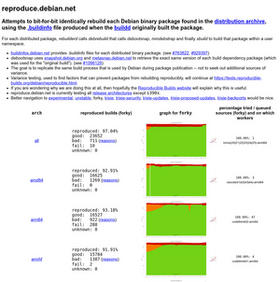
reproduce.debian.net The last year has seen the introduction, development and deployment of reproduce.debian.net. In technical terms, this is an instance of rebuilderd, our server designed monitor the official package repositories of Linux distributions and attempt to reproduce the observed results there. This month, however, Holger Levsen added suite-based navigation (eg. Debian trixie vs forky) to the service (in addition to the already existing architecture based navigation) which can be observed on, for instance, the Debian trixie-backports or trixie-security pages.

Tool development diffoscope is our in-depth and content-aware diff utility that can locate and diagnose reproducibility issues. This month, Chris Lamb made a number of changes, including preparing and uploading versions, 312 and 313 to Debian. In particular, Chris updated the post-release deployment pipeline to ensure that the pipeline does not fail if the automatic deployment to PyPI fails [ ]. In addition, Vagrant Cascadian updated an external reference for the 7z tool for GNU Guix. [ ]. Vagrant Cascadian also updated diffoscope in GNU Guix to version 312 and 313.

Distribution work In Debian this month:
  • 26 reviews of Debian packages were added, 5 were updated and 19 were removed this month adding to our extensive knowledge about identified issues.
  • A new debsbom package was uploaded to unstable. According to the package description, this package generates SBOMs (Software Bill of Materials) for distributions based on Debian in the two standard formats, SPDX and CycloneDX. The generated SBOM includes all installed binary packages and also contains Debian Source packages.
  • In addition, a sbom-toolkit package was uploaded, which provides a collection of scripts for generating SBOM. This is the tooling used in Apertis to generate the Licenses SBOM and the Build Dependency SBOM. It also includes dh-setup-copyright, a Debhelper addon to generate SBOMs from DWARF debug information, which are extracted from DWARF debug information by running dwarf2sources on every ELF binaries in the package and saving the output.
Lastly, Bernhard M. Wiedemann posted another openSUSE monthly update for their work there.

Miscellaneous news

Upstream patches The Reproducible Builds project detects, dissects and attempts to fix as many currently-unreproducible packages as possible. We endeavour to send all of our patches upstream where appropriate. This month, we wrote a large number of such patches, including:

Documentation updates Once again, there were a number of improvements made to our website this month including:

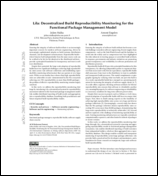
Four new academic papers Julien Malka and Arnout Engelen published a paper titled Lila: Decentralized Build Reproducibility Monitoring for the Functional Package Management Model:
[While] recent studies have shown that high reproducibility rates are achievable at scale demonstrated by the Nix ecosystem achieving over 90% reproducibility on more than 80,000 packages the problem of effective reproducibility monitoring remains largely unsolved. In this work, we address the reproducibility monitoring challenge by introducing Lila, a decentralized system for reproducibility assessment tailored to the functional package management model. Lila enables distributed reporting of build results and aggregation into a reproducibility database [ ].
A PDF of their paper is available online.
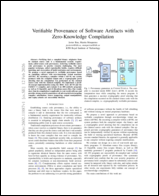
Javier Ron and Martin Monperrus of KTH Royal Institute of Technology, Sweden, also published a paper, titled Verifiable Provenance of Software Artifacts with Zero-Knowledge Compilation:
Verifying that a compiled binary originates from its claimed source code is a fundamental security requirement, called source code provenance. Achieving verifiable source code provenance in practice remains challenging. The most popular technique, called reproducible builds, requires difficult matching and reexecution of build toolchains and environments. We propose a novel approach to verifiable provenance based on compiling software with zero-knowledge virtual machines (zkVMs). By executing a compiler within a zkVM, our system produces both the compiled output and a cryptographic proof attesting that the compilation was performed on the claimed source code with the claimed compiler. [ ]
A PDF of the paper is available online.
Oreofe Solarin of Department of Computer and Data Sciences, Case Western Reserve University, Cleveland, Ohio, USA, published It s Not Just Timestamps: A Study on Docker Reproducibility:
Reproducible container builds promise a simple integrity check for software supply chains: rebuild an image from its Dockerfile and compare hashes. We built a Docker measurement pipeline and apply it to a stratified sample of 2,000 GitHub repositories that contained a Dockerfile. We found that only 56% produce any buildable image, and just 2.7% of those are bitwise reproducible without any infrastructure configurations. After modifying infrastructure configurations, we raise bitwise reproducibility by 18.6%, but 78.7% of buildable Dockerfiles remain non-reproducible.
A PDF of Oreofe s paper is available online.
Lastly, Jens Dietrich and Behnaz Hassanshahi published On the Variability of Source Code in Maven Package Rebuilds:
[In] this paper we test the assumption that the same source code is being used [by] alternative builds. To study this, we compare the sources released with packages on Maven Central, with the sources associated with independently built packages from Google s Assured Open Source and Oracle s Build-from-Source projects. [ ]
A PDF of their paper is available online.

Finally, if you are interested in contributing to the Reproducible Builds project, please visit our Contribute page on our website. However, you can get in touch with us via:

Dirk Eddelbuettel: RcppBDT 0.2.8 on CRAN: Maintenance

Another minor maintenance release for the RcppBDT package is now on CRAN, and had been built as binary for r2u. The RcppBDT package is an early adopter of Rcpp and was one of the first packages utilizing Boost and its Date_Time library. The now more widely-used package anytime is a direct descentant of RcppBDT. This release is again primarily maintenance. We aid Rcpp in the transition away from calling Rf_error() by relying in Rcpp::stop() which has better behaviour and unwinding when errors or exceptions are encountered. No feature or interface changes. The NEWS entry follows:

Changes in version 0.2.8 (2026-03-12)
  • Replaced Rf_error with Rcpp::stop in three files
  • Maintenance updates to continuous integration

Courtesy of my CRANberries, there is also a diffstat report for this release. For questions, suggestions, or issues please use the issue tracker at the GitHub repo.

This post by Dirk Eddelbuettel originated on his Thinking inside the box blog. If you like this or other open-source work I do, you can now sponsor me at GitHub.

Mike Gabriel: Debian Lomiri Tablets 2025-2027 - Project Report (Q4/2025)

On 25th Oct 2025, I announced via my personal blog and on Mastodon that Fre(i)e Software GmbH was hiring. The hiring process was a mix of asking developers I know and waiting for new people to apply. At the beginning of November 2025 / in mid November 2025, we started with 13 developers (all part-time) to work on various topics around Lomiri (upstream and downstream). Note that the below achievements don't document the overall activity in the Lomiri project, but that part that our team at Fre(i)e Software GmbH contributed to. Organizational Achievements Maintenance Development Qt6 Porting Feature Development Research [1] https://gitlab.com/groups/ubports/development/-/boards/9895029?label_name%5B%5D=Topic%3A%20Qt%206
[2] https://gitlab.com/groups/ubports/development/-/boards/10037876?label_name[]=Topic%3A%20salsa2ubports%20DEB%20syncing

11 March 2026

Sven Hoexter: RFC 9849 - Encrypted Client Hello

Now that ECH is standardized I started to look into it to understand what's coming. While generally desirable to not leak the SNI information, I'm not sure if it will ever make it to the masses of (web)servers outside of big CDNs. Beside of the extension of the TLS protocol to have an inner and outer ClientHello, you also need (frequent) updates to your HTTPS/SVCB DNS records. The idea is to rotate the key quickly, the OpenSSL APIs document talks about hourly rotation. Which means you've to have encrypted DNS in place (I guess these days DNSoverHTTPS is the most common case), and you need to be able to distribute the private key between all involved hosts + update DNS records in time. In addition to that you can also use a "shared mode" where you handle the outer ClientHello (the one using the public key from DNS) centrally and the inner ClientHello on your backend servers. I'm not yet sure if that makes it easier or even harder to get it right. That all makes sense, and is feasible for setups like those at Cloudflare where the common case is that they provide you NS servers for your domain, and terminate your HTTPS connections. But for the average webserver setup I guess we will not see a huge adoption rate. Or we soon see something like a Caddy webserver on steroids which integrates a DNS server for DoH with not only automatic certificate renewal build in, but also automatic ECHConfig updates. If you want to read up yourself here are my starting points: RFC 9849 TLS Encrypted Client Hello RFC 9848 Bootstrapping TLS Encrypted ClientHello with DNS Service Bindings RFC 9934 Privacy-Enhanced Mail (PEM) File Format for Encrypted ClientHello (ECH) OpenSSL 4.0 ECH APIs curl ECH Support nginx ECH Support Cloudflare Good-bye ESNI, hello ECH! If you're looking for a test endpoint, I see one hosted by Cloudflare:
$ dig +short IN HTTPS cloudflare-ech.com
1 . alpn="h3,h2" ipv4hint=104.18.10.118,104.18.11.118 ech=AEX+DQBBFQAgACDBFqmr34YRf/8Ymf+N5ZJCtNkLm3qnjylCCLZc8rUZcwAEAAEAAQASY2xvdWRmbGFyZS1lY2guY29tAAA= ipv6hint=2606:4700::6812:a76,2606:4700::6812:b76

Dirk Eddelbuettel: RcppDE 0.1.9 on CRAN: Maintenance

Another maintenance release of our RcppDE package arrived at CRAN, and has been built for r2u. RcppDE is a port of DEoptim, a package for derivative-free optimisation using differential evolution, from plain C to C++. By using RcppArmadillo the code became a lot shorter and more legible. Our other main contribution is to leverage some of the excellence we get for free from using Rcpp, in particular the ability to optimise user-supplied compiled objective functions which can make things a lot faster than repeatedly evaluating interpreted objective functions as DEoptim does (and which, in fairness, most other optimisers do too). The gains can be quite substantial. This release is again maintenance. We aid Rcpp in the transition away from calling Rf_error() by relying in Rcpp::stop() which has better behaviour and unwinding when errors or exceptions are encountered. We also overhauled the references in the vignette, added an Armadillo version getter and made the regular updates to continuous integration. Courtesy of my CRANberries, there is also a diffstat report. More detailed information is on the RcppDE page, or the repository.

This post by Dirk Eddelbuettel originated on his Thinking inside the box blog. If you like this or other open-source work I do, you can sponsor me at GitHub.

Bits from Debian: Infomaniak Platinum Sponsor of DebConf26

infomaniak-logo We are pleased to announce that Infomaniak has committed to sponsor DebConf26 as a Platinum Sponsor. Infomaniak is an independent, employee-owned Swiss technology company that designs, develops, and operates its own cloud infrastructure and digital services entirely in Switzerland. With over 300 employees more than 70% engineers and developers the company reinvests all profits into R&D. Its public cloud is built on OpenStack, with managed Kubernetes, Database as a Service, object storage, and sovereign AI services accessible via OpenAI- compatible APIs, all running on its own Swiss infrastructure. Infomaniak also develops a sovereign collaborative suite messaging, email, storage, online office tools, videoconferencing, and a built-in AI assistant developed in- house and as a privacy-respecting solution to proprietary platforms. Open source is central to how Infomaniak operates. Its latest data center (D4) runs on 100% renewable energy and uses no traditional cooling: all the heat generated by its servers is captured and fed into Geneva's district heating network, supplying up to 6,000 homes in winter and hot water year-round. The entire project has been documented and open-sourced at d4project.org. With this commitment as Platinum Sponsor, Infomaniak is contributing to the Debian annual Developers' conference, directly supporting the progress of Debian and Free Software. Infomaniak contributes to strengthen the community that collaborates on Debian projects from all around the world throughout all of the year. Thank you very much, Infomaniak, for your support of DebConf26! Become a sponsor too! DebConf26 will take place from 20th to July 25th 2026 in Santa Fe, Argentina, and will be preceded by DebCamp, from 13th to 19th July 2026. DebConf26 is accepting sponsors! Interested companies and organizations may contact the DebConf team through sponsors@debconf.org, and visit the DebConf26 website at https://debconf26.debconf.org/sponsors/become-a-sponsor/.

Next.

Previous.