Search Results: "tb"

19 March 2009

Kartik Mistry: Debian Bug Reporting and More For Dummies


* It looks like people don t know how and when to report bugs to Debian BTS. Following are some steps for them: 1. Fire terminal, type reportbug . Follow instructions. Use reportbug-ng if needed! If you are not comfortable with terminal, firing a mail to submit@bugs.d.o with proper subject is fine. Look at example of any bugs. Its very easy. 2. If you are using Sid . Don t forget to report bug when they are encounters. 3. File a bug, rather than crying about maintainer not responding and blah blah. 4. While updating system to Lenny, Keep such documents handy. 5. Ask :)

18 March 2009

Biella Coleman: Hyperparenting: The Ethnography

I have a long list (it exists only in my head unfortunately) of various ethnographic projects I would like to conduct. I might start the real list soon but in the meantime, I will just through the half-baked ideas here and perhaps it will inspire others to take it on. I am currently reading a fantastic book, The Case Against Perfection, and am on a section on hyperparenting and well, while I think at a common sense level we know what psychological havoc such controlled parenting can cause, I think an ethnography of some of the practices and institutions of hyperparenting would, nonetheless, make for a fascinating read. If anyone knows of anything that even resembles this, do drop me a line. Update: Not exactly an ethnography but certainly fun to read.

Muammar El Khatib: Chris Cornell?

I just stumble into this:

http://www.youtube.com/watch?v=eyOtb136n6g

My first impression was: WTF???!!!! I was used to listening to Cornell in Sound Garden, Audioslave or in his Album Euphoria Morning, but this is the shittest change that I have seen ever. I was told to visit his web page, a request made from Gerardo Curiel, maybe with the hope that that had been a joke, but When I went there... it was real... Chris Cornell had become in a kind of Justin Timberlake :S

What should I expect now? Deftones doing something like this?:

http://www.youtube.com/watch?v=IKrq_7ROcpY

Russell Coker: Hyperthermia and Children in Cars

Bruce Schneier writes about the risks involving children abandoned in cars and cites an article about the tragic deaths of children in hot cars [1]. One unfortunate error that he made was to not cite the following from the end of the last page of the Washington post article he cited [2]:
In hyperthermia cases, he believes, the parents are demonized for much the same reasons. We are vulnerable, but we don t want to be reminded of that. We want to believe that the world is understandable and controllable and unthreatening, that if we follow the rules, we ll be okay. So, when this kind of thing happens to other people, we need to put them in a different category from us. We don t want to resemble them, and the fact that we might is too terrifying to deal with. So, they have to be monsters. I believe that similar thought processes are used in relation to many other situations, and that such thought processes prevent people from taking appropriate actions to minimise the risk. If someone considers that forgetting a child in the back seat to be an accident that could happen to anyone then they would be inclined to take action to minimise the risk (such as spending some money on a sensor). If however they consider such forgetfulness to be proof of being a bad parent , then as they are a good parent they would have to avoid buying a monitor. I m surprised that Bruce didn t draw an analogy between this and the forgetful losses of laptops and guns by people who work for law enforcement agencies (which he has written about before). I wonder how expensive it would be to make a sensor for heart-rate, breathing, and temperature integrated with a GSM modem and a GPS? If it could be small enough to be attached to clothes then the child could wear it at all times. If such a sensor was to detect a sign of a problem it wouldn t matter whether the child was forgotten in a car, at day-care, or even being actively supervised. The data would be sent to the monitoring agency along with GPS data. The monitoring agency could then phone the parents. If the parents don t answer or don t know where the child is then the police could track down the GPS location. Probably most calls would be due to parents leaving a child too close to an air-conditioner or playing outside in the sun in summer which are unlikely to give a fatal result and a phone call would get a quick fix for what would only be a minor health problem. If the device was marketed as monitoring for sleep apnia then parents could buy it without admitting to the possibility that they might do anything wrong. The causes of SIDS are a topic of ongoing research and parents can admit to being worried about their children suffering from it without admitting any possibility that they might make a mistake.

17 March 2009

Martin Michlmayr: Power consumption of the SheevaPlug

Various people were wondering how much power the SheevaPlug consumes exactly. Laurent Guerby, who runs the GCC Compile Farm, posted some data today. According to his measurements with an Energy Monitor 3000, the SheevaPlug uses:
3.1Wjust on, Linux booted
3.3Wserial
4.3Wserial + Ethernet
5.4Wserial + Ethernet + 100% CPU
6.0Wserial + Ethernet + USB disk
7.0Wserial + Ethernet + USB disk + 100% CPU
However, these figures should be seen as preliminary and relatively high values since power management for Kirkwood has not been implemented in the kernel yet. In particular, the Kirkwood chip has SATA and PCI-E but they could be turned off since they're not used by the SheevaPlug. This is currently not done in the kernel, so you can expect some improvements in this area.

Russell Coker: Lobbying for Free Software

I am not aware of any Linux Users Group (LUG) being active in informing it s members of how the policies of the various political parties compare with regard to free software and the other issues that are of interest to most members. I believe that this is a grave mistake. Shortly before an election there are many social groups that send lists of questions to all the parties. They ask about the policies the parties have in regard to the issues that they care about, and helpfully mention the number of members that will receive the response. This of course doesn t mean that every member of the group in question will cast their vote in the same way, merely that they will take note of the answers. The committee members of the parties in question will then decide how to answer the questions and whether policy should be tweaked to allow answers that the lobby groups will like. So this process not only helps members of a group make informed voting decisions related to issues that they care about, but it also helps political parties choose policies that are least offensive to the group in question. Here is a draft of a list of questions that I think should be asked of all political parties on behalf of Linux users:

  1. It is important for all citizens to access all government data without being forced to buy new software or hardware, open standards allow everyone to access the data with free software. Do you support the use of open standards for data on government web sites and other forms of electronic communication between government agencies and citizens?

  2. For long term archival of records it is important that file formats remain readable. The only effective way of doing this is to use open file formats that are implemented in free software. Do you support mandating that all data submitted to government agencies (by citizens or corporations) be in open file formats wherever possible?

  3. In these difficult economic times there is a great interest in keeping jobs in the country instead of sending money overseas. To what extent do you support the use of free software that is installed and managed by locals (keeping the money in the economy) instead of importing software at great taxpayer expense?

  4. Commercial software has a limited support period, after that time has elapsed there is no further support and systems become increasingly unreliable. Do you support mandating that all systems relating to the emergency services run on free software to allow quality long-term support by local citizens?

  5. There has been a lot of concern recently about the spread of child-porn. The best available evidence shows that insecure home PCs that run Trojan Horse programs are a key part of distributing it and other illegal material. Do you support the introduction of government programs to train parents in installing one of the more secure free operating systems on their home PC to protect their children?

This is just a rough draft. Obviously there needs to be local differences (EG don t use point 3 in the US because MS brings money into the US economy). Does anyone have any suggestions for other questions?

16 March 2009

Kartik Mistry: LA22A450C1LXL


* Finally, we got our idiot box!

15 March 2009

Joerg Jaspert: Section changes, Content Files and some more

And there we have done it - new sections in the archive. Read more about it in my d-d-a post and the whole set of affected packages is also available - and updated slightly, as some small things slipped through. The whole process was less painful than feared. After some discussion, started a few weeks ago we finally went and coordinated the change today. There was no reliable and good way for changes that large, so we had to create our own way. (The last section changes had been done ages ago). Mike provided a little python script which was able to parse our input file with the section matches against our database, so we ended up with a list we could possibly feed back into the database. Except, not really. Thanks to various things the list generated needed some manual work (which I also managed to fuck up a little), but after that was done we were ready to go. And while Mark told the wanna-build admins about the new sections (for some reason our buildd network cares about sections) and prepared a patch for our policy, I prepared the mail for the d-d-a list. Then we all had a break, as a dinstall was still running, and we did not want to break that. The actual changes then took only a few seconds, sending the mail to d-d-a took longer, thankyou gnupg. :) I wonder how much afterwork this will generate. There are at least the policy changes, lintian, the packages control files to adjust. Also some websites, where Frank already changed packages.debian.org to know about the new names. (Before he fixed up me forgetting some PHP packages to move. This way all of the active ftpteam members did something in it :) ).
In other news, we are currently stress-testing our ftp-master host a little. Well, not really, it could take more, but right now we are scanning the full archive once, importing all filenames from all our Debian packages. The goal is to get projectb larger. Err, no, actually we do want to get rid of apt-ftparchive, as that is one of the worst tools in our dinstall runs. It is slow as hell in the mode it has to run for us, making up a large part of our runtime. Step 1 to get rid of it is to generate the content files on our own, and before we can do that we have to import them all Which means we have to unpack every binary package once, reading in all filenames to store them in our database. Thats a lot of data. Currently the associations table, which is nothing more than 4 integers per row, takes up 972MB, and import is still running. (The index on the binary pkg id in this table alone has 700MB). And this table does nothing more than linking the binary package to the filename and filepath. Which are two extra tables, with the filenames having only 87MB, the path entries only taking up 30MB. Yes, anyone using databases will tell me thats not much, and it really isn t that much. It s just that the largest table before this import had 120MB in it. And some of the others used more space for their indexes than for the actual data. :) Anyway, this is only step one on our way to get rid of the slowness apt-ftparchive is. When the contents all work as we want them, the next step will be to get rid of it generating Packages/Sources files. Which means we have some more data to store in projectb. And after that - we also intend to do a Contents file for our source. Each and every source file listed. Guess we really will end up with some more large tables. :) The final goal and main reason why we do this is to save us at least 60 minutes runtime per dinstall run. My own guess is that Contents alone will get us about 20 minutes down. No, before someone wants to yell at me - apt-ftparchive can t be changed as much to make this possible and keep using it. Not in the way the generate option works. It has the disadvantage that it scans the files after they are installed in their pool/ location and stores that in its own database . This approach has to negative points:
The title says some more, so here is some more: We aren t only working on what I wrote above. There is also work on changing our database access. Historically dak used the pg module to do database work. While the module itself does work, the way its used isn t really the best one. Way too much groundwork everywhere. Not nearly as much of the nice things used people say python could have. So another largish work area is getting rid of pg. Migrating to psycopg2. And putting a proper OO class around it, which in the end hopefully hides those dark details from the application. And to achieve even more sanity, we (well, honestly, Mark) are looking into SQL Alchemy usage. (We also considered storm from Canonical, but that sucks when you take a look at its documentation. (Which documentation?). SQLA won there easily.) While I m ranting: WTF are people neglecting their docs that much? Ever tried looking at the documentation for psycopg2? Forget it. No, a db api compliance test suite is NOT documentation. If there would be any better python module to connect to postgres, I would veto the usage of psycopg2, but there doesn t seem to be one. Sucks.

Russell Coker: Question about a Secure Filesystem

I have just been asked for advice about secure filesystem and decided to blog my answers. The first issue is what is meant by secure filesystem, that could either mean the ability to restrict file access (EG by supporting SE Linux security contexts and using SE Linux for file access control) or the ability to encrypt data in case the machine is stolen. For access control I recommend SE Linux of course. For encryption on a local machine I mostly use dm-crypt which is configured with the cryptsetup utility. I encrypt at the LVM logical volume level as it is common that there are some LVs that don t need to be encrypted. For files that need extra encryption or files that are shared between machines I use GPG. A question was asked about kernel vs user-space filesystem encryption. AES is in the kernel so there is no lack in terms of strong encryption there. Also performance is pretty good (in most cases the CPU is fast enough that the hard drive is the bottleneck). For fine grained encryption (such as some of the experimental filesystems that encrypt data separately for each user) user-space is probably the only way to go. If you want servers to be high-security level and protected from hackers or unauthorised people then it s difficult to offer any advice that is smaller than a text book. I suggest that if you have such questions then you should do one of two things. If you are running a corporate IT department then hire an expert who can help with determine your specific requirements and meet them. If you want to learn about computer security and run your own systems in the best way possible then read as much from the experts as possible. If you are looking for a project to contribute to related to security then if you choose SE Linux I could offer some specific advice on things that need work. I suggest not deciding on whether to do kernel level or user level work up front, but decide first which area of security you want to work on and then select a project which fits - then you should be able to determine whether your skills are best suited to kernel or user space coding. As for whether developing a new filesystem is necessary, I will note that SE Linux works well on Ext3 and XFS, it has just become usable on JFFS2, and it will work on other newer filesystems in the near future. Adding SE Linux support to a filesystem is not a difficult task if the filesystem supports XATTRs. I believe that there is a lot of scope for other access control systems to be developed which use XATTRs for security labels. I can t advise on e-books. I generally don t read books, I read blogs and papers. Anything that I read which I consider to be worth recommending will probably have a link from my blog.

Martin Michlmayr: SheevaPlug: the NSLU2 killer

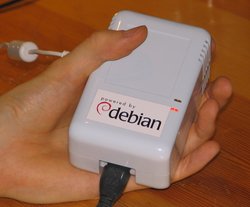
SheevaPlug in my hand I received a SheevaPlug this week, an intriguing device that packs incredible power and functionality into a tiny package. As many of you know, I've been doing a lot of work on Debian for the Linksys NSLU2 in the last few years. The NSLU2 is a key reason why ARM has become the third most popular architecture in Debian (after 32 and 64 bit x86), and I believe a main reason is that the NSLU2 is so incredibly cheap. At a price under $100, most people don't think too long and simply buy a device and do something cool with it. The SheevaPlug is being offered at the same price range but offers considerably more. Riku Voipio asked the right question: "What would you do with something approximately 10x more powerful with same prize/size range?" I believe the SheevaPlug is a killer replacement for the NSLU2 and here's why: I'm incredibly excited about the SheevaPlug and the first thing I did was to take the device apart and look at the inside. The results can be found in the SheevaPlug image gallery. My next project will be slightly more productive: porting Debian. As I see it, we should support the following three installation variants for the SheevaPlug: The first two should be relatively straight forward, but of course installing to the internal flash memory is particularly interesting given that 512 MB (plus compression) is enough for a basic installation of Debian. Unfortunately, installations to MTD flash are currently not supported in the Debian installer but I hope we can find a volunteer who wants to implement this functionality. My next steps are to put a kernel for the SheevaPlug into the archive and to get a basic installation going. From there we can look at more sophisticated installation options and other functionality.

Steve Kemp: Is my personal life of interest to you?

This weekend I mostly fiddled around migrating machines from Xen hosting to KVM hosting. Ultimately it was largely a waste of time, due to various other factors. Still with a bit of luck it will be possible to move the machiens next week. That aside I spent a while updating my blogspam detection site. As a brief recap this site offers a simple XML-RPC service which allows you to test whether incoming blog comments are spam or not. Originally this was put together to fight an invasion of comments submited to the Debian Administration website: The site currently shows:
SiteSpamNon-Spam% spam
debian-administration.org 238 372 60.98% spam
Depressing. But not as depressing as the real live stats which show since I last reset the counters 36,995 spam comments vs. 1,206 non-spam comments. (live updating counters here) Anyway I updated the service today to add two new plugins, both of which are a little reactionary. The first new plugin is called "multilink" and is based upon the observation that spammers rarely know the markup of the site they are submitting comments to. This means you can frequently see submitted comments like this:
 <a href="http://spam.com">buy viagra</a>
 [url=http://spam.com]buy viagra[/url]
 [link=http://spam.com]buy me[/link]
Here we have three different styles of links - "a href", "link=", and "url=". I figure this is a clear indicator of a confused mind, or more likely a spammer. The second new plugin is designed to stop people who enter "<strong>" words. It is a little coarse but actuall zero false positives in the real world so I'm going to leave it live to see how it works out. In happier news I'm just back from a trip to the beach. Sand rocks. Even if it wasn't windy enough for my kite .. ObFilm: Dracula ("Bram Stoker's Dracula" - 1992)

Russell Coker: Why Cyrus Sucks

I m in the middle of migrating a mail server away from the Cyrus mail store [1]. Cyrus provides a POP and IMAP server, a local delivery agent (accepting mail via LMTP). It is widely believed that Cyrus will give better performance than other mail stores, but according to a review by linux-magazin.de Dovecot and Courier deliver comparable (and sometimes better) performance [2]. The biggest problem with Cyrus is that it is totally incompatible with the Unix way. This wouldn t be a problem if it would just work and if it would display reasonable error messages when it failed, but it doesn t. It often refuses to work as desired, gives no good explanation, and it s data structures can t be easily manipulated. Dovecot [3] and Courier [4] use the Maildir++ format [5] (as well as many other programs). I have set up a system with Courier Maildrop and Dovecot for the IMAP server [6] and it works well - it s good to have a choice! But also Maildir++ is reasonably well documented and is an extension to the well known Maildir format. This means that it s easy to manipulate things if necessary, I can use mv to rename folders and rm to remove them. Cyrus starts with a database (Berkeley DB file) of all folders in all mailboxes. Therefore it is not possible to move a user from one back-end server to another by merely copying all the files across and changing the LDAP (or whatever else contains the primary authentication data) to point to the new one. It also makes it impossible to add or remove folders by using maildirmake or rm -rf. The defined way of creating, deleting, and modifying mailboxes is through IMAP. One of the problems with this is that copying a mailbox from one server to another requires writing a program to open IMAP connections to both servers at once (tar piped through netcat is much faster and easier). Also if you need to rename a mailbox that contains many gigabytes of mail then it will be a time consuming process (as opposed to a fraction of a second for mv). Cyrus has a tendency to break while Dovecot is documented as being self-healing and Cyrus also seems to cope well in the fact of a corrupted mail store. Even manually repairing problems with Cyrus is a painful exercise. The Cyrus mail store is also badly designed - and it s design was worse for older filesystems (which were common when it was first released) than it is for modern ones. The top level of a Cyrus maildir contains all the messages in the INBOX stored one per file, as well as three files containing Cyrus indexes and sub-directories for each of the sub-folders. So if I want to discover what sub-folders a mailbox has then I can run ls and wait for it to stat every file in the directory or I can use an IMAP client (which takes more configuration time). As opposed to a Maildir++ store where every file that contains a message is stored in a folder subdirectory named new , cur , or tmp which means that I can run ls on the main directory of the mail store and get a short (and quick) result. Using tools such as ls to investigate the operation of a server is standard practice for a sysadmin, it should work well! A finall disadvantage of Cyrus seems to have many small and annoying bugs (such as the reconstruct program not correctly recursing the sub folders). I guess it s because not many people use Cyrus that such things don t get fixed. One trivial advantage of Cyrus is that by default it splits users into different sub-directories for the first letter of the account name. Dovecot supports using a hash of the user-name this is better than splitting by first-letter for performance (it gives a more equal distribution) but will make it slightly more difficult to manipulate the mail store by script. Ext3 can give decent performance without a two level directory structure for as many as 31,998 sub-directories (the maximum that it will support) due to directory indexing and Linux caching of dentries. There may be some other advantages of Cyrus, but I can t think of them at the moment. Here is a script I wrote to convert Cyrus mail boxes to Maildir++. To make this usable for a different site would require substituting a different domain name for example.com (or writing extra code to handle multiple domains) and inserting commands to modify a database or directory with the new server name. There is no chance of directly using this script on another system, but it should give some ideas for people performing similar tasks.

#!/bin/bash -e
# $1 is the user to move # BASEDIR is the directory for temporary files
BASEDIR=/mail/new
rm -rf $BASEDIR/$1 archive.tgz archive2.tgz ORIGSRV=$(echo "MYSQL_COMMAND_TO_GET_SERVER" mysql dbname)
echo "original server was $ORIGSRV" if [ "$ORIGSRV" = "" ]; then
echo "No server for account, strange error."
exit 1
fi ORIGPARENT="/mail/domain/e/example.com/$(echo $1 cut -c1)/user" # copy the data to a local archive
# USERDIR is for using ^ instead of . as Cyrus does.
mkdir -p $BASEDIR
cd $BASEDIR
USERDIR=$(echo $1 sed -e "s/\./^/g")
ssh cyrus@$ORIGSRV "(cd $ORIGPARENT ; tar czf - $USERDIR)" > archive.tgz
tar xzf archive.tgz
if [ "$USERDIR" != "$1" ]; then
mv $USERDIR $1
fi DEPTH=$(find . -mindepth 3 -type d wc -l)
if [ "$DEPTH" != "0" ]; then
echo "too deep"
exit 1
fi # remove cyrus index files
find $1 -name "cyrus.*" -exec rm \;
cd $1 # "mail" is a directory with sub-folders, every other name starting with
# [a-zA-Z] is a regular folder that needs to become a Maildir
for n in [a-zA-Z]* ; do
if [ "$n" != "mail" ]; then
cd "$n" ; mkdir new cur tmp ; touch maildirfolder
mv [0-9]* new true
cd .. ; mv "$n" ".$n"
fi
done # move the inbox files to Maildir storage
mkdir new cur tmp
mv [0-9]* new true
mv mail/[0-9]* cur true # move sub-folders of "mail/" and merge ones with duplicate names
cd mail
for n in * ; do
if [ -e "../.$n" ]; then
cd "$n"
mv [0-9]* "../../.$n/cur" true
cd .. ; rmdir "$n"
else
cd "$n" ; mkdir new cur tmp ; touch maildirfolder
mv [0-9]* new true
cd .. ; mv "$n" "../.$n"
fi
done
cd ..
rmdir mail # get a list of all names so we can recognise duplicates
find . -type d egrep -v "new cur tmp" cd $BASEDIR ssh root@localhost "mv /mail/new/$1 /mail/example.com ; chown -R mail:mail /mail/example.com/$1"
echo "MYSQL_COMMAND_TO_SET_SERVER" mysql dbname

14 March 2009

David Pashley: Fast Servlet development with Maven and Jetty

On off the biggest problems with developing servlets under a container like Tomcat is the amount of time taken to build your code, deploy it to the container and restart it to pick up any changes. Maven and the Jetty plugin allow you to cut down on this cycle considerably. The first step is to allow you to start your application in maven by running:
mvn jetty:run
We do this by configuring the jetty plugin inside our pom.xml:
<plugin>
   <groupId>org.mortbay.jetty</groupId>
   <artifactId>maven-jetty-plugin</artifactId>
   <version>6.1.10</version>
</plugin>
Now when you run mvn jetty:run your application will start up. But we can improve on this. The Jetty plugin can be configured to scan your project every so often and rebuild it and reload it if anything changes. We do this by changing our pom.xml to read:
<plugin>
   <groupId>org.mortbay.jetty</groupId>
   <artifactId>maven-jetty-plugin</artifactId>
   <version>6.1.10</version>
   <configuration>
      <scanIntervalSeconds>10</scanIntervalSeconds>
   </configuration>
</plugin>
Now when you save a file in your IDE, by the time you've switched to your web browser, Jetty is already running your updated code. Your development cycle is almost up to the same speed as Perl or PHP. You can find more information at the plugin page.
Read Comments (1)

12 March 2009

Martin Michlmayr: Debian support for QNAP TS-119 and TS-219 Turbo NAS coming

TS-219 on top of TS-209 I received a sample of QNAP's new TS-219 Turbo NAS today. The TS-119 and TS-219 devices are an upgrade to QNAP's TS-109 and TS-209 devices and were announced earlier this month at CeBIT. The new TS-219 uses the same robust case as the TS-209 but offers much more performance: The numbers I've seen about the Kirkwood CPU suggest that the TS-219 will indeed give a very significant performance boost. So far, the TS-219 looks very nice. My only complaint is that QNAP didn't export the second Ethernet port the Kirkwood chip offers, but I suspect this is because they wanted to stay as close to the original design of the TS-209 as possible. In any case, the TS-219 is a nice machine and I look forward to porting Debian to it. As a first step, this means getting the mainline kernel to run on the device and adding a kernel for Kirkwood to the archive (the latter is needed for a number of other devices based on Kirkwood anyway). Hopefully, the remaining porting work and integration into the Debian installer should be fairly straightforward given that the TS-209 is already supported in Debian. I'm sure I'll find out as I dig into the details... I'll give periodic updates of my progress. In the meantime, I've created an image gallery of the TS-219.

11 March 2009

Joey Hess: unstable

Things are feeling unstable around here. That's mostly a good thing, but ... Switching to ext4 seemed like a good idea since I was resizing my file server's filesystem anyway. And I'd used ext4 on my laptop for a while, with no problems. But, I ran into a bug that causes ext4 to hang. So I'm left with my main server at home piling up hundreds of processes in uninterruptible sleep when this breaks. And, eventually running out of memory and dying. There's a fix, in newer -pre kernels, but so far I have not had luck getting those kernels to work with my Thecus. There's a regression in those kernels that breaks the NIC, and my attempt at backing that changeset out still left it unable to get on the net. Did I mention that I don't even have a serial console on this machine? That natively building a kernel on armel takes about 12 hours? Makes this sort of thing much fun. Need to find the right header and spend some time with a soldering iron one day. Converting back to ext3 would mean resizing a 2 TB array, which ran resize2fs out of memory when I tried it. It looks like I will have to leave /home unmounted while I'm on my trip, to keep the rest of the server up. When I get back, I've ordered a third terabyte drive, and will use it to switch back to ext3. Having these silly amounts of storage is fun, until you have to admin it. The other fun I've run into is that a new version of mpd has horrible performance on arm. Max Kellermann was very helpful in tracking down the issues involved, and helping me get a version that has at least reasonable performance again. Oh, and if someone could tell me why gnome terminal 2.24.3 can't open links anymore, I'd appreaciate it.

Wouter Verhelst: Debconf9 by train

With Debconf9 being on the european mainland this year, a plane flight isn't necessary. Since flying in cattle class isn't my idea of 'fun', I had been planning to take the train to Caceres this year. So, with the public announcement of debconf registration being open, I thought I'd look at train options. Short version: I think I'll be going to the train station and ask them there, rather than looking something up on the NMBS website. Long version:
TrajectoryDateDepartureArrivalTrain
Mechelen -> Brussels North2009-07-1307:0207:18IR 3128
Brussels North ->K ln Hbf2009-07-1307:2709:15ICE 11
K ln Hbf ->Mannheim Hbf2009-07-1309:5411:24ICE 515
Mannheim Hbf ->Basel SBB2009-07-1311:3613:47ICE 375
Basel SBB ->Arth-Goldau2009-07-1314:0315:45IR 2177
Arth-Goldau -> Milano Centrale2009-07-1315:5018:50CIS 21
Milano Centrale ->Barcelone Estacion de Franca2009-07-13/1419:4009:43EN 11274
Barcelona Estacion de Franca -> Barcelona Sants2009-07-1409:4310:28Transfer
Barcelona Sants -> Madrid-Puerta de Atocha2009-07-1412:0015:23AVE 3122
Madrid-Puerta de Atocha2009-07-1416:4020:02TLG 194
And that's after asking to arrive 'around' noon on the 15th. Although I'd love to combine ICE ('Intercity Express', German high-speed trains), CIS ('Cisalpino', Italian high-speed trains), EN ('EuroNight', pretty much what the name says), and AVE ('Alta Velocidad Espa a', Spanish high-speed trains) in a single trip, I think I'll pass for this particular suggestion. And that's ignoring the fact that 5 minutes for a transfer in Arth-Goldau (a place I've never heard of before, let alone been in that train station) is rather tight, and that I don't know whether I'll be able to make it in 45 minutes from one train station to another in Barcelona without actually knowing the city. More soon.

10 March 2009

Julien Valroff: On the essential role of translations in free software - GCompris in Portugal

The recent problem of the Portuguese translation of GCompris shows how important a good translation is, especially as far as free software are concerned.
I have not been able to find any news in English relating this story, and think it is essential to spread it so that people better appreciate the role translators play in the free software development process. The Portuguese Magalh es Project lead to provide 300,000 netbooks to Portuguese children aged of 6 to 10, for a fee varying from 0 to 50 , depending on the earnings of the family. These netbooks have a dual boot, with Windows and Linux (a distribution based on Mandriva called Caixa M gica - Magic Box in English).

The problem has begun when some opponents to this project pointed out that the Portuguese translation of GCompris, a free educational software for children from 2 to 10, contained some grammar, syntax and spelling faults, and did not reach the level of quality expected to be distributed to Portuguese children. This story was even published by some major Portuguese newspaper, which is a very bad publicity not only for GCompris, but also for free software in general. Caixa M gica Software have also published a press release explaining the situation. The Portuguese Government have even published a document explaining how to uninstall GCompris, whereas work for correcting the translation was running, and automatic updates being set up on all Magalh es netbooks. The GNOME Portuguese translation team have made some hard work during the week-end to review and correct the existing translation, following to a call for help raised by GCompris lead developer. The new version released yesterday already include an updated Portuguese translation. I have noticed that this problem was already reported on launchpad 2 years ago, but people got lost as the translation was not made through Rosetta (a closed source platform for open source application translation). This should have been reported upstream or at least to the main translator! I take the occasion to thank all translators, l10n and i18n coordinators of the various free software projects I enjoy using in French!

9 March 2009

Russell Coker: Maildrop, IMAP, and Postfixadmin

I have recently configured my mail server to use IMAP. I started doing this when I was attending Linux.conf.au so that I could read urgent mail using my EeePC while at the conference and then be able to deal with the more complex stuff using my laptop later on. The next logical step is to have mail delivered to different folders in the IMAP account. While there are ways of doing this via the Subject and other header fields, my needs are not that great. All I need to do is to support user+extension@example.com going to a folder named extension in the user s mail store. While changing my mail server I decided to install Postfixadmin at the same time. My first attempt to use Maildrop was to put the following in the /etc/postfix/main.cf file:
mailbox_command = /usr/bin/maildrop -d mail -f $SENDER $DOMAIN $USER $EXTENSION That seems to only work when you have local accounts, so I ended up setting fallback_transport = maildrop and then putting the following in /etc/postfix/master.cf: maildrop unix - n n - - pipe flags=DRhu user=vmail argv=/usr/bin/maildrop -d vmail $ nexthop $ user $ extension Where vmail is a Unix account I created for storing mail. Then I added the following to /etc/postfix/main.cf. Some of these are probably redundant (such as the virtual_mailbox_base). The recipient limit is set to 1 because there are no command-line parameters for maildrop to support two recipients for the same message.
virtual_alias_maps = mysql:/etc/postfix/mysql_virtual_alias_maps.cf
virtual_mailbox_domains = mysql:/etc/postfix/mysql_virtual_domains_maps.cf
virtual_mailbox_maps = mysql:/etc/postfix/mysql_virtual_mailbox_maps.cf
virtual_gid_maps = static:2000
virtual_uid_maps = static:2000
virtual_mailbox_base = /mail
vmaildir_destination_recipient_limit = 1
virtual_transport = maildrop
maildrop_destination_recipient_limit = 1
The files /etc/postfix/mysql* all have fields user=, password=, hosts=, and dbname=. The queries in each of the files are as follows:
mysql_virtual_alias_maps.cf:query = SELECT goto FROM alias WHERE address='%s' AND active = 1
mysql_virtual_domains_maps.cf:query = SELECT domain FROM domain WHERE domain='%s'
mysql_virtual_mailbox_maps.cf:query = SELECT maildir FROM mailbox WHERE username='%s' AND active = 1 The /etc/courier/maildroprc file has the following contents: # log the maildrop actions
logfile "/var/log/maildrop.log" # parameters 1, 2, and 3 are the domain, user, and extension
DOMAIN=tolower("$1")
USER=tolower("$2")
EXTENSION=tolower("$3")
DEFAULT="/mail/$DOMAIN/$USER" # try making a backup (cc) copy of the mail but do not abort if it fails
exception
cc "$DEFAULT/.backup/"
# try delivering to the extension folder but do not abort if it fails
exception
if(length("$EXTENSION") != 0 && "$EXTENSION" ne "backup")

to "$DEFAULT/.$EXTENSION/"

# deliver to the main inbox if there is no folder matching the extension or if no extension is specified
to "$DEFAULT/"
Installing Postfixadmin [1] was another challenge entirely. One of the complications of this is that there is no Debian package for Lenny (it seems that there will be one in Squeeze - Lenny+1). I found David Goodwin s tutorial on installing Postfixadmin and lots of other things on Debian/Etch [2] to be a very useful resource. I look forward to seeing a Lenny version of that document. Please let me know if you can think of any way to improve this.

Russell Coker: I need an LMTP server

I am working on a system where a front-end mail server sends mail to what it considers to be a LDA (Local Delivery Agent) which actually sends mail to a back-end server via LMTP. I can t remove that fake LDA from the design because it does a bunch of business specific processing along the way. I am working on changing the back-end from Cyrus to Dovecot. Currently the mail goes from the fake LDA to the Cyrus LMTP server. What I would like to do is to have an LMTP server run on the back-end machine that launches the Dovecot deliver program immediately and then returns an appropriate code. So far I have been experimenting with having Postfix run on the back-end to use deliver as the real LDA. The first problem with this is that the mail will be written to the Postfix queue and then written to the mail store. Doubling the number of writes is a real problem for a system that is going to be write-bottlenecked - it would significantly increase the hardware costs. The second problem is that when an account goes over quota the back-end server would be generating a bounce message. I would prefer the front-end server to generate the bounce on an un-munged message. Basically all I need is a simple daemon (which could even be launched from inetd) that talks LMTP (a very simple cut-down version of SMTP) and executes a single command to receive the data. It might be necessary to serialise running the delivery process, in which case the mail data would have to be stored in memory and there would need to be a semaphore around executing the delivery program. Does anyone know of such a program? If not then I ll have to write it myself (which shouldn t be difficult) and GPL it. If I have to do that then I need a suitable name for it. Any suggestions would be appreciated.

Next.

Previous.