
Search Results: "az"

11 January 2008

Anthony Towns: LCA Sponsors

An article by Sam Varghese appeared on ITwire today, entitled linux.conf.au: What is Novell doing here?:
A GNU/Linux system does not normally load modules that are not released under an approved licence. So why should Australia’s national Linux conference take on board a sponsor who engages in practices that are at odds with the community? What am I talking about? A company which should not be in the picture has poked its nose in as a sponsor. Novell, which indicated the level of its commitment to FOSS by signing a deal with Microsoft in November 2006, will be one of the supporting sponsors for the conference.
Novell was also a minor sponsor of the 2007 conference, and Sam wrote an article in January expressing similar thoughts, which included this quote from Bruce Perens:
“I’d rather they hadn’t accepted a Novell sponsorship. It wasn’t very clueful of them, given Novell’s recent collaboration with Microsoft in spreading fear and doubt about Linux and software patents,” Perens said.
Ultimately, I think that’s a mistaken view. Linux.conf.au is what it is thanks to the contributions of four groups:
the organisers
who create the conference, get a venue, organise a schedule of events, help the speakers and attendees to get there, and generally make it easy for everyone to just get immersed in cool Linux stuff
the speakers
who provide the core of the schedule, the reason for attendees to go, and a core depth of awesome technical knowledge and ideas
the attendees
who fill in the organisational/content gaps that the organisers and speakers miss, who make for fascinating corridor and dinner conversations, who make side events like the miniconfs, the hackfest or open day interesting, and who pay the rego fees that lets the conference happen
the sponsors
who provide a chunk of money to fill out the conference budget letting us commit to venues and events earlier (when we might otherwise have to wait to see how many people come), and let us do extra things that registration fees alone wouldn’t cover
Obviously sometimes you have to exclude people from participating, but that’s mostly only if they’re actually causing trouble for the event. For sponsors, that pretty much means trying to interfere in the conference itself, or not paying on time. Otherwise, if you’re contributing to the conference, and not causing problems, you certainly should be recognised for that, as far as I can see. For me, the same thing would apply if Microsoft was offering to sponsor the conference – if they’re willing to contribute, and not cause problems, I’m all for it. If they happen to not be doing anything constructive in Linux-space anywhere else, well, it seems perfectly fine to me to start contributing by helping make linux.conf.au awesome. In Microsoft’s case that would be hard, because all the people going “oh my gosh, Microsoft, Linux! Wolves, sheeps! Hell, snow!” along with possible mixed messages from Microsoft and our long-term major sponsors HP and IBM about the future of Linux and whatnot could really distract us from all the cool technical stuff the conference is fundamentally about. I don’t think there’s anything Microsoft could offer to justify that much disruption, but having more of the world’s software companies involved in free software would probably be worth a bit of hassle, if the disruption could be minimised. Ultimately, I guess my disagreement comes down to these couple of comments from Sam’s article:
Asked whether it was right that Novell should be allowed to be a sponsor for a conference such as this - which, in my view, is a privilege - […] […] Novell, obviously, is hoping that, as public memory is woefully short, it will be able to wriggle its way back into the community. Providing such leeway is, in my opinion, a big mistake.
In my opinion, the ability to contribute to open source isn’t a privelege, it’s something that should be open to everyone, including people who’ve made mistakes in the past: and that’s precisely what the “free” in free software is all about. OTOH, if you want to see who’s been participating most in the Linux world lately, you’re much better off looking at the list of speakers than sponsors. Novell (or at least SuSE) folks giving talks in the main conference this year seem to include John Johansen and Nick Piggin. Interestingly, the count of HP folks seems a bit low this year, with only two that I can see, which leaves them not only merely equalling Novell/SuSE, but beaten by both Intel and Catalyst. Tsk! I guess we’ll have to wait and see if that changes when we can see the list of attendees’ companies in the booklet this year…

10 January 2008

Robert Collins: 11 Jan 2008

thank you lazyweb; A number of folk have written to me pointing out Netem. One in particular, Yusuf Goolamabbas even provided a set of wrapper scripts for Netem that I'm going to be digging into next week. Netem is built around various lower level tools like tc, which is good (tc is what I was using year ago). I'm hopeful it will be really easy to use, and will blog something when I've used it in anger :)

Christine Spang: MIT Athena: Not Dead Yet

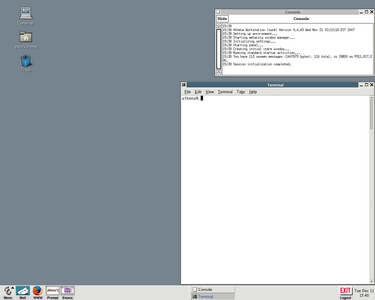
(Disclaimer: I work for MIT Information Services & Technology blah blah blah I am a student blah blah these are only my words and do not represent the opinion(s) of my employer.) Way back in the day in 1983, MIT started something it called Project Athena, which had the goal of investigating how computers could be used to enhance education at MIT. This project became the origin of such pieces of software as the X Window System and Kerberos, as well as a campus-wide network of workstations all running similar software. In 1991, Project Athena ended, but the Athena system continued on, taken over by MIT Information Systems. It’s 2008, and Athena still exists at MIT—walk into a computing cluster, and chances are all the machines will be running Athena software. (Unless that particular cluster has been taken over be Athena’s evil sibling, often referenced as “WinAthena”, which often seems to be maintained by no one, and whose existence is sometimes denied by those who maintain and support Real Athena. Not many machines have suffered this agonizing fate, luckily.) Unfortunately, as the years have progressed recently, fewer and fewer resources have been put into the development of Athena. In many ways it is no longer on the cutting edge of things as it has been in the past, though it is certainly still useful. Some students these days, however, even think of Athena as only “their MIT email” or maybe use it occasionally to print something in a cluster on the way to class. I’ve seen people grow frustrated and storm out of a cluster due to things like instructions for using a flash drive that involve more steps than just plugging it in. While on the one hand it’s easy to laugh at people for a lack of patience or being open to a computing system that is not either Windows or Mac and perhaps a bit more complicated on the surface, on the other hand, some of these things really should just work by now, and on other UNIX-based systems they do—but Athena has lagged behind. When you log into an Athena workstation for the first time, you are confronted with what looks like this: Clean MIT Athena login That’s GNOME 2.8, and it looks kind of like the GNOME 2.8 default but uglier. When you look under the hood, there are pieces of the system that obviously originated in a time where nothing better existed and so something new had to be created—the “xlogin” login system doesn’t support PAM, and the login path involves a hairy maze of scripts that perform various tasks. Under the hood, the base OS is currently RHEL 4 or Solaris 10. I still can’t remember what the right options are to feed RPM whenever I need some information that I think I should be able to get from it. These things were once necessary but today just look crufty. Some people have tossed around the idea that everyone has a laptop these days and thus clusters are uselessly expensive, but it’s been met with a lot of resistance. I’m all for progress, but I use clusters all the time! They’re one thing that makes it an easy choice for me to have a really portable laptop, because when I really need computing power or screen space on campus away from my room, there is always a cluster nearby. They’re also nice isolated places that can be associated with “work mode”, which is good for productivity. Beyond all this, Athena provides a common platform that all technical classes can depend on, from providing standard and specialized academic software to standing as a baseline of “make sure your code works on this before handing it in because that is how it will be graded”. At any rate, things are finally happening on this front. Athena can’t stay RHEL 4 forever—while AFS allows non-system software to be easily updated for all machines without requiring any OS release, hardware moves on and compatibility is lost, and the rest of the world is coming up with new awesome things that Athena machines are missing out on. A student group that I am vaguely involved with, SIPB, took the early initiative with this and created DebAthena, which takes stock Debian and Ubuntu and allows it to closely resemble an Athena environment. We even run a campus Linux dialup using the packages. (I won’t claim to have done much work on DebAthena myself because, well, I didn’t.) Amazingly, the Athena release team has decided to work with the SIPB on the next release of Athena. So, what I really just wasted over 600 words prepping for is to say that Athena 10 will be based on Ubuntu. This is only relatively new news, but I am lame about finishing blog posts. There are a variety of reasons why Ubuntu was chosen over Debian. Some of them are lame and some of them are not. Even so, I am excited about this prospect—and it should be possible to peripherally support Debian in such a way that was not possible with Athena 9.4. I really like Athena. Even coming to MIT with a background in Linux there has been a steep learning curve, though, and I think that things could be better. Lots of people here have their first encounter with a ‘nix system in the form of Athena, and we should strive to make that experience as good as possible. I’m kind of skeptical on the expected release date of this upcoming summer, but as long as it happens soon it will be a big step forward. In some ways it’s kind of sad that I’m excited about a big part of a research institution catching up with others—but inertia is a strong force, and dealing with thousands of workstations is no trivial task. I kind of long for the exciting days of creating new big pieces of free software like X. I bet I imagine those days as being better than they actually were.
9 January 2008

Robert Collins: 10 Jan 2008

Dear lazyweb, In bzr development we are now working primarily on network performance. One of the key things about being sure we have improved things is automated, repeatable benchmarks. And for that to be useful in networking environments we need to control latency and bandwidth and packet loss. I know this isn't a new problem, but it was about 5 years ago that I last did this sort of thing. What are the best tools today (for linux :)). Ideally I'd be able to bring up a bunch of local addresses like 127.0.1.1 or 127.0.0.2, with different properties - such that traffic from 127.0.0.1 to 127.0.0.2 will simulate being uploaded over adsl, and 127.0.0.2 to 127.0.0.1 will simulate being downloaded over adsl.

Andrew Pollock: [life] Post-op, Day 6

Discharged! Sarah was discharged almost bang on 11am, the advertised discharge time, which is less than 6 full days after she got out of surgery. Pretty amazing stuff, and not a moment too soon, if you ask Sarah. She had a final chest x-ray this morning, and that was about it. We took a non-highway route home, and stopped via the supermarket to get a few things and get her prescriptions filled, so we got home at about 12:20pm. The rest of her recovery can be followed on her blog. We both feel forever indebted to the wonderful doctors and nursing staff at Stanford Hospital. Being in a hospital is certainly a lot better when you're not grieving, and the outcome is positive.

Eddy Petrișor: Updates: NSLU2, Andrew S. Tanenbaum in .ro

Last weekend was as hectic as my life has been lately: I have been trying to restore sanity into my NSLU2, I went to a lecture from Andrew S. Tanenbaum and I made a 2.5 hours drive to my parents in about 4 hours because of the fog.

First, my slug:
Since the USB NIC works on my laptop, I suspect a hardware problem with the slug. Bummer!

Dear no-so-lazyweb, is there a way to install Debian on an ASUS WL-500G Premium router without loosing wireless ability? Or, is there a way to make use of my USB NIC with the ASUS router?


Second, Andrew S. Tanenbaum visited Romania and lectured Friday at the University Politehnica Bucharest.

He presented Minix3's architecture and the advantages it has over monolithic OSes. I attended the lecture (although I am not a student anymore) and found it quite nice and well prepared, but I had the feeling that sometimes he was trying to avoid or to bash topics that were not putting Minix into a good light or challenged its title of being the first open[0] OS based on a micro-kernel architecture[1]. In spite of that, I found him to be a really good speaker and I liked the overall presentation, although, I also expected some on the spot demos or at least some recordings.

The things that I remember:
I also got a Minix live CD (which is more like the Gentoo Linux install CD - just console in the live system) and made an installation of Minix in a qemu machine[2]. Unfortunately, I don't think I'll have the time to dwell into the source.

I was thinking, would it worth the effort to try to make a GNU/Hurd/Minix system (i.e. replace Mach with Minix's micro-kernel)? BTW, is Debian GNU/Hurd now based on L4 or does it still uses Mach?


Note: Some of my work colleagues suggested that the presentation was the same as one he made at linux.conf.au last year, but I can't confirm/infirm that since I didn't saw the recording.


I won't write about the "fog drive", but I'll just say it wasn't pleasant at all, and I felt I was in driving in The Twilight Zone for the whole Friday evening.


[0] he gave credit to QNX
[1] For instance, I tried to ask him twice if he felt that GNU Hurd was violating the micro-kernel paradigm or if he can compare it to Minix' architecture. I had the impression that both times he avoided to answer and started the usual Hurd bashing, "they have been developing it for 20+ years, but got nothing working", meanwhile "Minix is here". After the lecture/presentation somebody told me that AST shortly said that they "were similar, but different". I didn't catch that line.
[2] thanks to qemu-launcher it is trivial to create and manage multiple qemu virtual machines

Simon Richter: Magic versus more magic

At casa Geier, there is a slightly broken Asus A3G laptop, formerly known as salmiakki. The symptom is that upon pressing the power button, the machine ponders for a few seconds, then decides to turn off again. Since these laptops come with CD playback function keys on the outside, I think this is the safety feature against accidentally powering on; it just turns off again when the lid is closed. Which makes me suspect that only the lid switch is broken. Trouble is, there is no switch. This thing uses black magic to find out if it's open. There are no wires going to the hinges, there is no magnet either, or anything else that looks like it could be used in this way. So dear lazyweb, I'm interested in any hints how this might work. Pure speculation is also fine.

David Welton: Nefarious Network Solutions

  1. Go to http://www.networksolutions.com/
  2. Type in a silly domain name (not something you actually care about!).
  3. In a few minutes, they will have registered that domain themselves, locking you into buying it from them if you actually want it.
They're overpriced anyway, but that's really sleazy.

8 January 2008

Simon Huggins: Books (part 2)

[ Apologies for Debian planet readers expecting something pithy and Debian related. This isn't. But then pkg-xfce packaging just continues. We get more bugs, we fix some of them (if you have a dual-headed setup and want to help us fix or reproduce more we'd love to hear from you). Corsac became a DD at last and has made me more or less redundant in a good way. I should probably investigate libburnia again and prod George Danchev about #450873 since basically it seems to just need the ubuntu packaging brought across into Debian to replace libburn etc. But anyway, on with the irrelevant stuff... ] Books part 1 was back in April and I've since found myself with some time on my hands before I get a new job so here we go again.
Making Money - Terry Pratchett
This was a Christmas present and I quite enjoyed it and enjoyed the character but didn't really think it lived up to the laugh a minute Pratchett books that I remembered from the good old days.
The Lovely Bones - Alice Seebold
This is quite a weird concept for a book given that it's from the point of view of a dead girl in heaven but it seems to work. It's very well done and I enjoyed it.
Alex Rider series - Anthony Horowitz
I had seen Stormbreaker and wanted to read some more of these as light holiday reading. They work well for that. There's enough plot to keep me interested but not enough to make them at all hard to read. I read a couple of them in French when I was in France (in between traipsing between different bits of Paris since the m tro workers were on strike). I wish they'd been around when I was younger.
My Sister's Keeper - Jodi Picoult
Ooh this is a really, really good book. I loved it except perhaps for the very end but I can forgive it that. The idea is that she's suing her parents for the rights to her own body because she was conceived as a donor for her sister to fight off her sister's leukaemia. It's a very thought provoking read with several interesting characters with their own stories woven together.
The Language Instinct - Steven Pinker
This book is fascinating to me. It takes ideas mainly from linguistics, evolution and psychology and explains a theory that seems to hold together and is well illustrated and explained. The central point is that we all are born with the ability to develop a universal grammar from an early age which can be adapted to any human language and which sticks around in the young child and then disappears. If you have any interest in language at all read this book.
A Spot of Bother - Mark Haddon
I found this a bit hard to get into as essentially it's about the normal lives of a family (albeit quite a special family). It doesn't really grab you. Towards the end though I was interested to find out how it would all unravel and was pleased with it.
The Mephisto Club - Tess Gerritsen
This is a nice, honest thriller that does what you expect. It keeps you flicking the pages wanting to know what happens next.
The God Delusion - Richard Dawkins
I quite enjoyed this and did find new arguments against religion but I don't think he's going to convert anyone with this book. Of course I'd recommend anyone read it because it raises lots of interesting points but it's polemic essentially.
The Blind Watchmaker - Richard Dawkins
I enjoyed this though it builds on previous work I'd read. I guess if you're just interested in evolution then read this and not the God Delusion.
The Raw Shark Texts - Steven Hall
I was recommended this by a friend. It's very surreal possibly a bit too surreal for me but I enjoyed it nonetheless.
Do Androids Dream of Electric Sheep? - Philip K Dick
I hadn't read the book and saw it at a friend's and borrowed it. You probably all know what it's like. I'm glad I read it because of the references to it but it's not my normal reading material.
Harry Potter and the Deathly Hallows - J K Rowling
I had to read this of course to finish off the series but I thought it was a lot better than some of the others. I think I enjoyed the first, the one with the tri-wizarding championship and this one the most.
Love in Idleness - Charlotte Mendelson
This is well written and you really get into the character that's painted for you. I really liked some of the descriptions of justifying things to yourself and coping with boredom.
Blood, Sweat & Tea - Tom Reynolds
This was an interesting look at the life of a paramedic and if you don't already read Random acts of reality then read the book first and start reading the blog.
Telling Lies - Paul Ekman
This came from my Blink/Tipping Point reading and I found it hard going. It was interesting but quite detailed and not really a book for late night reading. The theories in it are very interesting though and explain why you probably aren't as good at detecting things as you think you might be and how to look for factors that will help you.
The Man Who Mistook His Wife for a Hat - Oliver Sacks
I read this ages ago and it was fascinating. It's about a number of different cases of problems with the brain. Often physical defects in various areas of the brain that cause odd problems and how it sheds light on how things relate. I really enjoyed it.
As always, do please punt your own recommendations at me.

7 January 2008

Anthony Towns: Baby Got Bloat

With the whole incipient git obsession I’ve been cleaning out some of my scratch dirs. In one, last touched in mid-2006, I found:
Oh. My. God.
Becky, look at that bloat!
It's so big...
It looks like one of those Microsoft products...
Who understands those Microsoft guys anyway?
They only code that crap because they're paid by the line...
I mean the bloat...
It's just so slow...
I can't believe it's so laggy...
It's just bloated...
I mean, gross...
Look, that just ain't a Hack.
I like big apps and I cannot lie.
You other bruthas can't deny,
That when some perl comes by, not a symbol to waste
Like line-noise, cut and paste --
You're bewitched;
But now my context's switched,
Coz I notice that glest's got glitz.
Oh BABY! I wanna apt-get ya,
Coz you got pictures,
Those hackers tried to warn me,
But the bling you got
/Make me so horny/
Oooo, app fantastic,
You say you wanna fill up my drive?
Well, use me, use me, coz you ain't that average GUI.
I've seen them typing,
To hell with reciting,
I point, and click, and never miss a single trick.
I'm tired of tech websites,
Sayin' command lines are the thing.
Ask the average power user what makes them tick --
You gotta point and click.
So hackers! (Yeah!) Hackers! (Yeah!)
Has your UI got the G? (Hell Yeah!)
Well click it (click it), click it (click it), and use that healthy glitz,
Baby got bloat.
(vi code with a KDE UI...)
And before you ask, no, I don’t know what I was drinking…

Andrew Pollock: [life] Post-op, Day 4

Sarah slept better overnight, but still not great. She was certainly more lively this morning when I got in, than yesterday. She's resigned to the fact that you don't come to a hospital to get rest, which is kind of ironic. She did need to get put back on the oxygen overnight because her O2 saturation dropped. She was off it again by the time I got in. Today's big achievement was getting the external pacing wires removed. They were put in during the procedure as a precaution, I think because if her heart played up, they didn't want to have to use defibrillator paddles, and because they'd cracked her chest open, manual CPR wasn't an option. The wires could be attached to an external pacemaker if necessary (but it never was). I watched the removal quite closely, as I was pretty curious. Basically the physician's assistant just came in and yanked them out. Judging from the look on Sarah's face, it was an interesting sensation. We were both amazed at how long the wires were. There was probably 30 centimetres of wire under the skin. The last bit was loosely spiralled. I was just really surprised, because the PA's hand started off at Sarah's chest, and ended up at the PA's shoulder. It was just a lot longer than we both expected. All the extra length was because the wires wrap around the heart. The wires came out at about 2:30pm. Sarah had another chest x-ray and a CT scan today. The CT scan looked good. The x-ray showed some fluid in her lungs, and her lung capacity is still sub-par. It seems when she's fully horizontal, her breathing isn't so crash hot, but it's fine when she's sitting up or walking around. All Sarah's got left is one peripheral line now. There was some talk of her possibly going home on Wednesday. She has an echocardiogram tomorrow, and I guess it'll all hinge on how her lungs are going.

James Morrison: Silly movie reviews

So I seem to watch a lot of movies now. First is the Abigail Breslin trio. First, No Reservations & the Ultimate Gift. I watch these on airplanes between Brazil and Canada. In both Abigail plays some disadvantaged girl who hooks up her mother figure with a random guy who shows up in the mother figures life. The Ultimate Gift is more about teaching us good values in life than the mother figure getting laid. So given this caveat, let's compare the box office revenues. No Reservations: $92,572,766; Ultimate Gift: $3,438,735. Oh, I also saw Little Miss Sunshine. It was cute, but I don't think I appreciated as much as the people who recommended it to me.

Next up is The Golden Compass and The Big Hit. The Golden Compass had a horribly done evil mother character and watched like someone playing an RPG where they don't screw up and you don't have to think. So, don't both. As for The Big Hit, it is cheesy, but it is supposed to be. Grab some guys, grab some beers and sit back and enjoy.

6 January 2008

Christoph Berg: mutt-patched

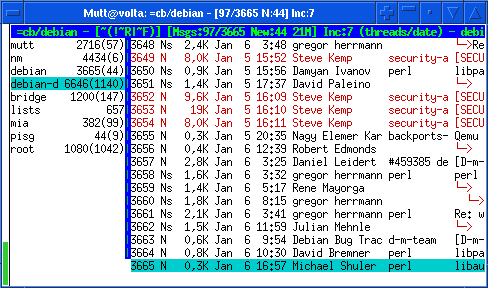
There have been several long-term wishlist bugs on Mutt to include the (in?)famous "sidebar" patch. It adds a panel on the left side of the screen to list mailboxes with message counts. We do ship several patches with Debian's Mutt package that are not considered for inclusion by the upstream authors, but this one is different. It touches the core of the UI renderer and adds extensive counting of messages. There's been quite a hype about the patch, it was even included in the (now discontinued [1]) mutt-ng fork. Unfortunately, the patch was technically questionable, it was written for the Mutt tarballs and didn't easily apply to CVS, and most versions floating around contained lots of cruft like backup files and temporary editor files. Furthermore, it is far from bug-free and even segfaults occasionally. Some months ago we decided we would build a second binary package to put the patch in so we don't destabilize the standard package. Thanks Dann Frazier, we got a clean patch, Adeodato had the right idea on how to build two binaries from the same, differently-patched source (make install would run havoc, the trick was to build the patched version before the regular one), and I resolved some more involved conflicts with the maildir-mtime patch. So, finally, there it is: mutt-patched. Disclaimer: As said, there are bugs. YMMV. On related news, there's now also a -dbg package now for the victims of the IMAP and header cache segfaults that we still see sometimes. Update: The sidebar patch was not the reason for the creation of mutt-ng, but many mutt-ng users were using it because of this patch. Update 2008-01-08: [1] mutt-ng used to be a Mutt fork. It is now maintained as a patch collection for Mutt.

4 January 2008

Christian Perrier: Das Leben der Anderen

I don't often blog about movies we watch, but if you have the opportunity to see that one by Florian Henckel von Donnersmarck, just go ("The lives of Others" in en and "La vie des autres" in fr). It's been ranked as "2007 movie" in many occasions and I'd vote for it as well even though, technically, I watched it only yesterday. Again, just go and watch it (if not done already, of course: you've maybe been less lazy than we were....or you're German..:-)).

Sven Mueller: User configuration

Anthony Towns wrote about user configuration (i.e. ~/.foo) and the XDG spec/proposal versus his own (and according to him) simpler version. The main goal of all this is to get rid of all the ~/.foo directories and files in a users home directory. Apart from technically minor differences, I don’t see why AJs proposal would be simpler than the XDG approach. All it does is hardcoding the values which are adjustable in XDG via XDG_*_DIRS. There is one notable difference though: AJ proposes fallback values which are compatible with existing application paths (i.e. HOME_ETC/XDG_CONFIG_HOME should default to ~/ - resulting in ~/.foo files/dirs). This is a good proposal in a way: If you patch an existing application to strictly follow the proposal made by AJ, it still finds its old configuration (and other files) if the new environment variables are not set. No need to move anything around. However, I think the XDG approach is better since it makes sure that compliant applications don’t clutter ~/ anymore. They do need some mechanism to move existing configurations and data around though if the XDG-compliant stuff isn’t already there, but an old style config exists. All in all, I think it is worth following the XDG spec, even if it is slightly more complex than AJs proposal. For one, it already exists for a while and I think that some applications already started following that spec. It also makes slightly more sense to me to have the system fully configurable as to where the apps store data as opposed to the hardcoded fallback/default values AJ proposes (even if we would change AJs proposal to use “$HOME-cleaning” default values).

Anthony Towns: User configuration

Inspired mostly by Joey’s nonchalant way of dealing with the death of his laptop…
This seems less of a disaster than other times a laptop’s disk has died on me. When did it start to become routine? […] My mr and etckeeper setup made it easy to check everything back out from revision control. […]
…I’ve been looking at getting all my stuff version controlled too. I’ve just gotten round to checking all my dotfiles into git, and it crossed my mind that it’d be nice if I could just set an environment variable to tell apps to create their random new dot-files directly in my “.etc-garbage” repo. I figured using “$USER_ETC/foo” instead of “$HOME/.foo” would be pretty easy, and might be a fun release goal that other Debian folks might be interested in, so I did a quick google to see if something similar had already been suggested. The first thing I stumbled upon was a mail from the PLD Linux folks who apparently were using $HOME_ETC at one time which sounded pretty good, though it doesn’t seem to have gotten anywhere. That thread included a pointer to the system that has gotten somewhere which is the XDG spec. It’s actually pretty good, if you don’t mind it being ugly as all hell. They define three classes of directory – configuration stuff, non-essential/cached data, and other data. That more or less matches the /etc, /var/cache and /var/lib directories for the system-wide equivalents, though if the “other data” is stuff that can be distributed by the OS vendor it might go in /usr/lib or /usr/share (or the /usr/local/ equivalents) too. Which is all well and good. Where it gets ugly is the naming. For the “/etc” configuration stuff, we have the environment variable $XDG_CONFIG_HOME, which defaults to ~/.config, and has a backup path defined by $XDG_CONFIG_DIRS, which defaults to /etc/xdg. For the “/var/lib” other data stuff, we have the environment variable $XDG_DATA_HOME, which defaults to ~/.local/share, and has a backup path defined by $XDG_DATA_DIRS, which defaults to /usr/local/share:/usr/share. (Though if you’re using gdm, it’ll get set for you to also include /usr/share/gdm) And for the “/var/cache” stuff, we have the environment variable $XDG_CACHE_HOME, which defaults to ~/.cache. That seems to me like exactly the right idea, with way too much crap on it. If you simplify it obsessively – using existing names, dropping the desktop-centrism, you end up with: Put configuration files in $HOME_ETC/foo or $HOME/.foo. For shared/fallback configuration, search $PATH_ETC if it’s set, or just /etc if it’s not. Put data files in $HOME_LIB/foo or $HOME/.foo. For shared data, search $PATH_LIB if it’s set, or look through /var/lib, /usr/local/ lib,share and /usr/ lib,share if it’s not. Put caches in $HOME_CACHE/foo or $HOME/.foo. For shared caches, search $PATH_CACHE if it’s set, or just look in /var/cache if it’s not. That seems much simpler to me to the point of being self-explanatory, and much more in keeping with traditional Unix style. It’s also backwards compatabile if you use both old and new versions of a program with the same home directory (or you happen to like dotfiles). And having the XDG variables set based on the above seems pretty easy too. I wonder what other people think – does HOME,PATH _ ETC,LIB,CACHE seem sensible, or is XDG_ CONFIG,DATA,CACHE _ HOME,DIRS already entrenched enough that it’s best just to accept what’s fated?

Adrian von Bidder: Aggressive Java

Happy new year etc. Dear Lazyweb, how do I set up java so that it either uses arts or properly uses software mixing so that I can have sound in parallel between Java and other applications? (At least, I assume that Java is the culprit, because I can have parallel sound between flash within firefox, which I assume not to use arts, and arts based stuff. I could be wrong on this, though, so the question might be how to set up arts to not lock sound exclusively...) (Yes, the blog doesn't take comments. Drop me an email and I'll update this entry.)

Russell Coker: No more War On Terror in the UK

Military.com reports that the UK government will no longer use the term War On Terror [1]. Sir Ken Macdonald (the UK’s chief prosecutor) said that “terrorists” are criminals and need to be responded to in that way. This of course is the only logical and sensible thing to do. Soldiers who are taken prisoner are released when the war ends, if members of al Quaeda are considered to be soldiers then they would have to be treated in the same manner. The next logical step is to persue criminals who are members of al Quaeda in the same way that other criminals are persued. As far as I am aware there is no country where the majority of murderers are members of al Quaeda. Other suspected murderers have the right to a fair trial and people accused of al Quaeda membership deserve the same. Another interesting statement is that “The term “Islamic terrorist” will also no longer be used. Officials believe it is unhelpful because it appears to directly link the religion to terrorist atrocities“. Finally they realise that there is a huge number of Muslims who want nothing to do with terrorism and that such people are the best potential source of leads when it comes to tracking down criminals associated with al Quaeda. Thanks to Bruce Schneier for blogging about this [2]. Bruce’s blog post has some interesting comments, one is “you can’t make “War” on “Terrorism”. “Terrorism” is a tactic, not an enemy. To declare war on Terrorism is about as confused as declaring war on Blitzkrieg” by Carlo Graziani. Carlo also writes “It’s stupid to declare a “war” if you have no idea of when and how the war will end, and no clue about how to bring it to an end. If there is no real prospect for declaring “victory”, the “war” will go on for ever. This is tantamount to saying that insofar as we take the rhetoric of war seriously, we are agreeing to live under what is essentially martial law, in perpetuity. We are stipulating that the sort of emergency measures that a nation might consider taking in time of war — suspension of civil rights for certain suspect groups, suspension of laws limiting government surveillance powers, etc. — may be only a decree or a vote away, forever. There can be no more corrosive climate to liberty than war. If we really allow this idiotic rhetoric to be taken seriously, our polity is doomed.“. A particularly insightful comment from umacf24 is “How did the early 20th century Anarchists stop? Well, one of the attacks precipitated an unprecedentedly bloody and catastrophic war in which both sides used WMD. Military setbacks caused revolutions in the Russian and German empires which led in turn to most of misery of the rest of that century. Not a happy parallel“.

3 January 2008

Andrew Pollock: [life] Post-op, Day 0

I'm exhausted, but very relieved. The important news: the operation was a success, the surgeon, Dr D. Craig Miller, bless his cowboy boots, managed to spare the aortic valve (he'd given us a 99% probability of being able to do so beforehand), so we don't have to be concerned about pig/cow valves for now, and mechanical valves later. He was reluctant to say that her own valve will last her the rest of her life, but it should last a "long time, long enough to have a family". When I left the hospital, Sarah was in intensive care, extubated, conscious, and talking to me, but very very tired. She's got a daunting array of things coming out of her at the moment (a lot of which I couldn't see because she had blankets over her). It's been a long day, so I decided to head home, rather than potentially keeping her awake for the next two ICU visiting times tonight. Here's the time line that I recorded: 05:15 - Arrive at the hospital to go through the admissions process 06:35 - I leave Sarah shortly before they're going to wheel her off to the operating room (I'll get into my fun at the end). 09:30 - I ask for an update, and they tell me she's going on bypass 10:30 - It looks like they can save the aortic valve 12:25 - Still doing the valve stuff, making a new sinus of Valsalva 14:15 - I ask for another update, everything is going okay, someone will come out to talk to me 14:55 - Still going, at least another hour until they start to close up 15:15 - Closing up, surgeon will be out to talk to me 16:10 - Surgeon comes out to talk to me about how the operation went 16:50 - I got to see Sarah briefly in the ICU, she was still intubated, but conscious and seemed to respond to my voice ~18:15 - Extubated. Spoke with her briefly. She was very tired, and I decided to let her rest for the remaining visiting times and go home and get some rest myself So what the surgeon had to say for himself was very interesting indeed. He didn't end up doing exactly what he'd said previously, based on how things looked once he actually got in there. He said that the sinuses of Valsalva were paper thin. So thin, you could see the blood flowing through them. They were about 0.5mm thick, rather than the normal 1.5mm thick. Sounds a bit like a disaster waiting to happen. Apparently it's not possible to detect this with imaging, you have to get in there and see it for yourself. He didn't end up removing as much of the aorta as previously planned (specifically the part around the transcending arch) as whilst the diameter was a bit bigger, the tissue apparently looked healthy. He said the part of the aorta he did remove (preceding where the braciocephalic, left common carotid and left subclavian arteries branch off) was "cheesy" in consistency, so it's not like she just happened to have an enlarged aorta, no aneurysm, and way too thin sinuses of Valsalva. There was definitely some unhealthiness to the aortic tissue, just not as bad as thought from the imaging. So it's all good. I think she'll spend a day or two more in the ICU before getting moved to a normal ward, but it's too soon to say what's going on with all of that. There's some elevated risk of stroke due to blood clots for the next 24-48 hours, but she's on blood thinners, so it shouldn't be a problem. The day was pretty crazy for me. I'm not sure if it was stress, or the stomach bug that's been doing the rounds of Central Park Apartments, but I went to bed last night at 11pm, was up again at 1am, with shall we say, a gastrointestinal upset, and up again at 3am, throwing up. We got up at 4:15am to get to the hospital. I felt really nauseous all morning, and was an absolute wreck while I was in with Sarah when they were putting a peripheral line in her before they wheeled her off to the OR, so I bailed about 5 minutes early and just made it to the bathroom in time to throw up again. I haven't eaten all day, just tried to keep the fluids up. I'm debating having some plain boiled rice for dinner, or waiting until tomorrow to have something easy on the stomach. I definitely felt a lot better as the day progressed, but my stomach is still pretty tender. Sarah and I ate pretty much the same stuff yesterday, so I don't think it can be food poisoning. She tends to have a very sensitive stomach at the best of times, so I'd expect her to be showing problems before me if it was food poisoning. But enough about me, I'll live. I hope it's not a stomach bug, as I don't want Sarah to come down with it as well, now that she's on the road to recovery from this surgery. Many thanks to Shona, Briana, Laura, and Christina for spending time with me throughout the day to keep me occupied. ICU visiting hours are every even hour between 10am and 10pm, for thirty minutes at a time, so I plan on spending all day at the hospital tomorrow. Hopefully I can find a good spot to get some EVDO coverage, so I can update things as the day goes along, rather than at the end of the day when I get home, like I had to today. Hopefully I'll sleep better tonight than I did last night.

Steve Kemp: Its a lot like life

Assume for a moment that you have 148 hosts logging, via syslog-ng, to a central host. That host is recording all log entries into an MySQL database. Assume that each of these machines is producing a total of 4698816 lines per day. (Crazy random numbers pulled from thin air; globviously). Now the question: How do you process, read, or pay attention to those logs? Here is what we've done so far:
syslog-ng
All the syslog-ng client machines are logging to a central machine, which inserts the records into a database. This database may be queried using the php-syslog-ng script. Unfortunately this search is relatively slow, and also the user-interface is appallingly bad. Allowing only searches, not a view of most recent logs, auto-refreshing via AJAX etc.
rss feeds
To remedy the slowness, and poor usability of the PHP front-end to the database I wrote a quick hack which produces RSS feeds via queries, against that same database, accessed via URIs such as:
  • http://example.com/feeds/DriveReady
  • http://example.com/feeds/host/host1
The first query returns and RSS feed of log entries containing the given term. The second shows all recent entries from the machine host1. That works nicely for a fixed set of patterns, but the problem with this approach, and that of php-syslog-ng in general, is that it will only show you things that you look for - it won't volunteer trends, patterns, or news.
The fundamental problem is a lack of notion in either system of "recent messages worth reading" (on a global or per-machine basis). To put that into perspective given a logfile from one host containing, say, 3740 lines there are only approximately 814 unique lines if you ignore the date + timestamp. Reducing logentries by that amount (78% decrease) is a significant saving, but even so you wouldn't want to read 22% of our original 4698816 lines of logs as that is still over a million log-entries. I guess we could trim the results down further via a pipe through logcheck or similar, but I can't help thinking that still isn't going to give us enough interesting things to view. To reiterate I would like to see: To that end I've been working on something, but I'm not too sure yet if it will go anywhere... In brief you take the logfiles and tokenize, then you record the token frequencies as groups within a given host's prior records. Unique pairings == logs you want to see. (i.e. token frequency analysis on things like "<auth.info> yuling.example.com sshd[28427]: Did not receive identification string from 1.3.3.4" What do other people do? There must be a huge market for this? Even amongst people who don't have more than 20 machines!

Next.

Previous.
