Search Results: "nate"

8 February 2011

Lars Wirzenius: Growing the Debian development community

In an article about gender issues among American atheists, Sharon Moss and Lyz Liddell give a list of things to consider to be better community, not just for women:
  • Be a leader. Take responsibility for the tone of your group. If potential new members are being made to feel uncomfortable and aren t coming back, you re doing it wrong. As a leader, it is your job to prioritize the comfort of your attendees in programs, group dynamics, and communications. Try to put yourself in other members shoes and also ask for feedback.
  • Promote a sense of community. Take the time to socialize and get to know each other. If you re group isn t primarily a social group, thinking about adding some social time. Go to breakfast before the protest, compose your letters to the editor over coffee, or grab a pizza and beer after that lecture. When you know each other, you have each others backs. Being a jerk isn t tolerated.
  • Moderate discussions. Make sure everyone has the opportunity to participate- new people, quiet people, etc. Don t let conversation be dominated by one or two people who must win.
  • Embrace and accept different ways of communicating. Whether someone is an aggressive debater or not, make sure they re still welcome. The other atheist in the room isn t your enemy.
  • Encourage subgroups. Every event your group hosts doesn t need to appeal to your entire membership. Many women appreciate women-only space to express their nonbelief and to connect with other atheist women. Here at the Humanist Community of Central Ohio, we started a subgroup book club called Reasonable Women. When it grew to have about 25 regular members and was beginning to be a little too large and unwieldy to function as a book club, we created a second group, Heathen Chicks, which is just a social group that meets at a local cafe. It isn t just about creating women only space, for us, this has been a way to draw more women into other events our group hosts.
  • Foster women in leadership. Groups with women in leadership positions tend to have more women. Encourage women in your group to be visible in leadership.
These should work pretty well for Debian as well. I mean for the project in general, for getting all kinds of new people in, and getting them to stay, not just women, even if the gender imbalance is perhaps the biggest glaring problem we have. As a concrete suggestion, maybe it would be a good idea to continue the Debian party line that Joey set up for the squeeze release. We already have IRC, but having an audio chat with your Debian peers might be a nice addition. Specifically a social one, instead of something intended to boost productivity.

7 February 2011

Vincent Sanders: It is a bit breezy

The weather has been a bit odd round here for a while now. The snow storms in December and early January were a mild inconvenience for me but as I work from home the advice not to travel was not too much of a problem.

It seems however that now February is here and the snow is gone we are in for some pretty strong storms. This actually affected me today when my neighbours garden wall was blown over!

As you can see my nice new IP camera captured the event, well OK the frame before and after but you get the idea. Unfortunately for my neighbour the wall collapsed onto his pickup causing extensive damage.

A short time later when my weather station was recording gusts well over 50mph nearby drains started flowing the wrong way and it became a case of water, water everywhere!

It seems that when the new buildings were erected a few years ago that the architect while maximising used space on the building plot may have inadvertently created something of a wind tunnel.

The Gap between our properties is on a parallel (north to south) to the valley below. The wind seems to travel along the crest of the valley and be funnelled through any spaces between the houses. Fortunately the rest of the properties on green lane are pretty old and the spacing between is very generous and the funnelling effect is minimal.

I wonder if we could fit a wind turbine in there? Alas it was too much for my secondary anemometer which is now smashed in three parts.

Also gaining access to the gable end wall of my property has become somewhat perilous (Hence the wonky APT antenna I cannot get fixed). Yes that really is a guy balancing on a ladder 10m high in a strong wind. And indeed the platform the ladder is resting on is built from scaffolding board wedged between the houses.

I guess the hospital emergency room being 300m away means medical assistance is on hand, even so he is braver than I am. So my weather satellite imagery will just have to come from the internet like everyone else's for a while.

Pau Garcia i Quiles: Luggage and RyanAir

FOSDEM ended yesterday and here I am sitting at Charleroi Airport (also known as Brussels South , quite a misleading name given that it s 80 Km from Brussels). I have already passed all controls, check-in and everything. While I wait for boarding, I am watching the shameful spectacle of airport personnel (let me reiterate that: airport personnel, not Ryanair s) enforcing RyanAir s 10 Kg cabin baggage limit. According to RyanAir, they want to minimize the weight the plane carries to use less fuel. So far, so good. Here is what I have seen: people who do not carry any baggage (very few, they have probably checked it in because it exceeded size or weight), people who are below the 10 Kg limit and people who are way over it (and have been told to check luggage in). I am OK with those cases. There is still a fourth case: people who are slightly over 10 Kg. I ve seen a woman whose bag was 10.15 Kg to be told to pay 20 EUR to check her bag, or go back to the RyanAir desk to check-in the bag. She opened her bag, took a scarf, put it on and now the bag matched the weight limit. Yes, RyanAir is charging 20 EUR/Kg for hand baggage from 10 Kg on. What a rip-off. A couple of East-European girls were about 1 Kg in excess each. They put a couple of extra jumpers on and now baggage was under 10 Kg. Many people were about 1 Kg in excess. When they were told their suitcase better got lighter or pay 20 to 40 EUR. Most of them just took something (camera, food, slippers, whatever) and put in the pockets of their coats. Fortunately, RyanAir is not charging for body and clothes weight (yet?). In all those cases the plane will end up transporting the same weight and RyanAir won t get one more dime, so why RyanAir? Why are you such a shameful company? Why are you enforcing ludicrous and pointless policies? Don t you know after passing the control everybody just put everything back into the suitcase? Of course you do. So after watching this ridiculous spectacle go on for a while, I had a devious idea: let s organize a fat people conference and fly them all over to and from using RyanAir. Further, all of them should carry exactly 10 Kg hand baggage.

6 February 2011

Benjamin Mako Hill: Editor-to-Reader Ratios on Wikipedia

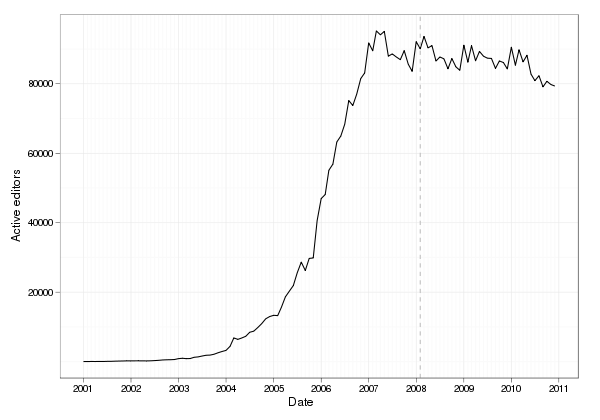
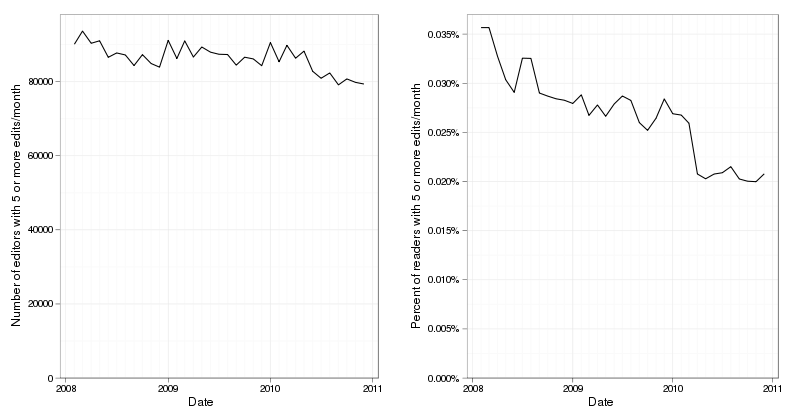
It's been reported for some time now that the number of active editors on Wikipedia (usually defined as people who have edited at least 5 times in a given month) peaked in 2007 and has been mostly stable since then. A graph of the total number of active editors in every month since Wikipedia's founding is shown below. The graph shows the aggregate numbers for all language Wikipedias. English Wikipedia is the largest component of this and is generally more variable. That said, very similar patterns exist for most larger languages. /copyrighteous/images/active_editors_all_wikpiedia.png Felipe Ortega, who has provided many of these statistics, has warned against fatalist claims. Although there seems to be a decrease in the total number of active editors over the last two years, the situation seems to have somewhat stabilized in most languages. New editors in Wikipedia are replacing folks at almost the rate that they are leaving. It is also widely known that the number of readers of Wikipedia has been increasing during this period. According to the report cards released by the foundation using comScore data, the number of unique visitors to Wikipedia each month has increased by 61 million people in the last year -- over 17%. This discrepancy between rising readership and stable or sinking editorship should raise major concern. After all, the Wikimedia Foundation's mission is two part: (1) to empower and engage people around the world to collect and develop educational content and (2) to disseminate it effectively and globally. Although the Foundation report cards include measures of raw levels of editorship, a better metric of engagement and empowerment might be the proportion of readers who engage in editing. I could not find reliable data on the number of unique readers reached each month for more than a few months in the last year. What is available, however, is wonderful data on page views each month going back to 2008. Analysis of the data from available report cards show that, at least during the last year, there is a very stable ratio of 35 page views per unique visitor, as estimated by comScore. Using that measure, we can do a back of the envelope estimation on the proportion of users that are editors for the period where page view data is available, dating back from February 2008 ( marked with the grey dashed lined above). The graphs below show the very different results you get when you consider the change in the number of Wikipedia editors and the change in the editor-to-reader ratio. Once again, these data are combined data for all language Wikipedias although graphs look very similar for most larger languages. The results are striking. Although there has been a 12% decrease between February 2008 and December 2010 in the number of active editors, there is a 42% decrease in the proportion of readers who edit at least five times a month. We can see that fulfilling the first half of the Wikimedia mission remains a struggle. /copyrighteous/images/wikipedia_editors_combined_graph.png Although the graphs above do not say anything directly about the most active core contributors to Wikipedia, the fact that Wikipedia is being maintained by a tiny -- and shrinking -- proportion of its readership does mean that the idea behind Wikipedia is under threat. Although none are as big as Wikipedia, there are lots of good encyclopedias out there. The reason Wikipedia is different, interesting, and important is because -- unlike all those others -- Wikipedia is the encyclopedia that anyone can edit. Wikipedia is powerful because it allow its users to transcend their role as consumers of the information they use to understand the world. Wikipedia allows users to define the reference works that define their understanding of the their environment and each other. But 99.98% of the time, readers do not transcend that role. I think that's a problem. Worse, that the number is growing. The Wikimedia Foundation recently ran a major successful effort to attract donations in its annual fundraiser. Jimmy Wales' smiling mug is apparently enough in the way of motivation to get something like 1% of its readers to donate money to support the project. I think that's very good news. If the Wikimedia community can entice even half of those people to contribute through an increased involvement in the projects themselves, they might do more than ensure Wikipedia's continued growth. They would help take a step toward the empowerment and engagement of those users in sharing their own knowledge, and the continued fulfillment of a critically important mission.

Meike Reichle: Squeeze Release Live Dent Finished

That's it! Squeeze is released and the website's new design is in place. What a great day! In addition to the usual announcements on the website and mailing lists we decided to also do a live coverage of the whole process using identi.ca this time! Alex and me have been doing a live coverage of Debian's release process for almost 19 hours straight and, although we're dead beat now, I think it was well worth it! People seemed to enjoy being included in the process and many expressed their admiration for Debian's well-coordinated and purposeful proceedings. Congratulations to all involved: the FTP team, the release team, the CD team, the www team and the publicity team! Great work everyone!

5 February 2011

Joerg Jaspert: Squeeze Release

So after quite a while I again had the opportunity to do the ftpmaster works of a Debian release. Not quite my first and hopefully not my last one, lets see. And, like last time, Mark joined to help with the work. Again, a few moments and not a detailed log (times in UTC): Right now (that is, 21:38 UTC) I am mosty waiting for the rest of the people working on the release (CD builders, press, website, ) to finish their task (building hundreds of images just takes ages). When that is done we can then do a coordinated push to the world. Last plans for that would mean in about an hour . Lets see, Mr. Murphy sure can be around. Thanks go out to everyone involved in preparing this release, be it in the past by fixing bugs, uploading packages, doing whatever was needed, as well as doing the work today. Update: If you miss us setting the new testing AKA wheezy to something inside there - there is no need to. It is simply the continutation of testing with just another name, which did not get changed contents, so nothing done for that. :)

Craig Small: JFFNMS and IPv6

ipv6-google-rrt.png One of the many Free Software projects I work on is JFFNMS, which is a network management system written in PHP. In light that the last IPv4 address blocks have now been allocated to APNIC it s probably timely to look at how to manage network devices in a new IPv6 world. First you need to get the basics sorted out and for that it is best to use the net-snmp command line utilities to check all is well. Then its onto what to do in JFFNMS itself. Now fixed with proper markup, I hope.
    strlcpy(hostname, a1, sizeof(hostname));
        if ((pptr = strchr (hostname, ':')))  
            remote_port = strtol (pptr + 1, NULL, 0);
         
Special Agent 6 All devices that are capable of being managed with SNMP have an agent. It s basically the SNMP server on the router, switch or server. The first step is to make sure it can accept and send traffic using IPv6. Depending on what the device is, it can be real simple. For example, my little Juniper router its a matter of setting the community and access control, just like IPv4 settings:
csmall@juniper1# set snmp community public clients 2001:db8:62:d0::/64
And then run snmpget on the command line to check
csmall@elmo$ snmpget -v 1 -c public udp6:2001:44b8:62:d0::4 system.sysObjectID.0
SNMPv2-MIB::sysObjectID.0 = OID: SNMPv2-SMI::enterprises.2636.1.1.1.2.41
We have success! For Linux systems that use net-snmp you will need to make the snmp daemon listen on UDPv6 ports as well as adjusting the access control. Access control is a matter of adding com2sec6 lines to /etc/snmp/snmpd.conf They are the same format as com2sec lines and are reasonably straight forward. Next, get the daemon to listen to requests on the IPv6 ports as well. The snmpd(8) man page says:
By default, snmpd listens for incoming SNMP requests on UDP port 161 on all IPv4 interfaces. However, it is possible to modify this behaviour by specifying one or more listening addresses as arguments to snmpd.
It wouldn t of killed them to put comma separated list somewhere, now would it? My /etc/default/snmpd file now looks like:
SNMPDOPTS= -Lf /dev/null -u snmp -g snmp -I -smux -p /var/run/snmpd.pid udp:127.0.0.1,udp6:[::1]:161
The bits in bold are the changes. Then its a quick check:
csmall@elmo$ snmpget -v 1 -c public udp6:[::1] system.sysObjectID.0
SNMPv2-MIB::sysObjectID.0 = OID: NET-SNMP-MIB::netSnmpAgentOIDs.10
And we have working agents! JFFNMS Changes OK, we have a working IPv6 network and snmp works across our network so we can query devices. JFFNMS uses PHP so all should be well, shouldn t it? Database Tables This is an almost classic problem with converting IPv4 to IPv6. You have 15 bytes for a IP address string 111.222.333.444 . Ipv6 can be much larger than that. JFFNMS has things like
  CREATE TABLE  hosts (
    [...]
   ip  char(20) NOT NULL default '',
A simple fix to use a char(39) or varchar(39) will do the trick. Fixing the JFFNMS code One of the most troubling problems with the host entries is that the values entered by a user can be a hostname, IP address or IP address and port separated by a colon. There are lots of bits of code that separate out the port or address by just finding the colon or use non-IPv6 aware functions like gethostbyname() that will need to be fixed. I ve got a function to check for an IPv6 address, using the inet_pton() function.
  function is_ipv6($addr)
 
  $net_addr = @inet_pton($addr);
  if ($net_addr === FALSE   strlen($net_addr) < 16)
    return FALSE;
  return TRUE;
 
PHP functions PHP still has the old IPv4 only functions, but unlike libc does not have the Address Family independent functions. The most significant absence is the replacement functions for gethostbyname(). There is dnsgetrecord() but it is quite low-level (it won t recurse lookups if you get alias or CNAME results). It s a little hit and miss in PHP-land with what functions work with IPv6 addresses and what ones do not. fsockopen() and file() do work with IPv6. PHP and SNMP To query remote devices using SNMP, JFFNMS uses the PHP SNMP functions. Unfortunately, while there is some IPv6 support in PHP, it doesn t extend to the SNMP functions. The library does it, as the net-snmp command lines use the same library, it is just that the small shim between the script and net-snmp that is PHP gets in the way. Looking at the PHP code itself you find things like
    strlcpy(hostname, a1, sizeof(hostname));
        if ((pptr = strchr (hostname, ':')))  
            remote_port = strtol (pptr + 1, NULL, 0);
         
which definitely need to be fixed for IPv6. There is also some simple address lookup going on somewhere as well which will also need to fixed. In short, JFFNMS won t be doing SNMP based queries over IPv6 until php5-snmp can do it. Reachability JFFNMS also has a different sort of query called a reachability type. It s essentially a ping from the server running JFFNMS out to the device being managed. It uses fping to do this work, but there is also a program called fping6. It s a simple matter of checking the address type and then selecting fping or fping6 to do the reachability work. The JFFNMS code soon to be pushed into git has this change in it now. Anything Else? The next stage is to find anything else that will work with IPv6. A likely candidate is the TCP and UDP port types as they use nmap to discover the ports and the fsockopen() function call to poll it. fsockopen() does handle IPv6 addresses if you escape them in square brackets.

3 February 2011

Rapha&#235;l Hertzog: People behind Debian: Mike Hommey, Firefox/Iceweasel maintainer

Mike Hommey, our Iceweasel maintainer

For as long as I have known Mike, he s been maintaining one of the largest (and most widely used) package: Iceweasel, Debian s default web browser. It s effectively Mozilla s Firefox although it has been renamed to avoid some rules enforced by Mozilla s trademark policy. But we might see Firefox back in Debian read on to know Mike s plans. His story is also very interesting in that he went from simple user to Iceweasel maintainer, and now he s working for Mozilla Corporation. But you already knew that contributing to free software is a good way to grow skills and gain experience that are valuable on the job market, right? ;-) My questions are in bold, the rest is by Mike. Who are you? I am Mike Hommey. I am French, even if my name doesn t sound so. I have been a GNU/Linux user since 1995, using Debian since 1999, and started packaging in 2003. After a long time in the NM queue, I became a DD in 2005. The main reason I started being actively involved is quite selfish: I wanted some things done, and I just did them. My first packages were extensions for the Mozilla Suite, the old one that directly inherited from Netscape Communicator. Later on, I wanted some of these extensions to work with the new kid on the block: Phoenix; or maybe it was already Firebird. By then, integrating extensions was a hassle, and the mozilla-browser maintainer had come up with a script that would make it easier for extension packages. So I ported that script for use with Phoenix/Firebird and sent it to the BTS. Then Phoenix/Firebird became Firefox, and it grew a real extension manager. Except that is was entirely not suited for extensions installed by the packaging system. So I made it work better. And made a few more changes to make Firefox work better. All through patches or NMUs. Then I became co-maintainer, then Firefox couldn t keep its name and became Iceweasel, and, fast-forward until today, I m now taking care of Iceweasel/Xulrunner and Iceape in stable, unstable, experimental and an external repository. This 8 years-long story (wow, I hadn t even realized it had been that long until I wrote it) tells you something: newcomers shouldn t be afraid to stick their hands anywhere, even in big packages. I was only a Mozilla and Phoenix end-user when I started. Apart from Mozilla-related packaging, I also happen to (co-)maintain some other packages in Debian, most notably webkit, though I haven t been very active in the pkg-webkit team recently. There are several reasons for that, the main one being that there are other team members getting the job done. And I can t say that much about the pkg-mozilla team, since there are effectively no other team members. What s your biggest achievement within Debian? I am quite proud that Squeeze will be the first Debian release where Iceweasel works on all supported architectures. Previously, we only knew the package compiled on all these architectures. Starting with Squeeze, we know it passes several of the test suites coming with the source code. This ensures most of the browser is functional. It was actually far from being the case before, as it appeared when the test suites were first enabled. I think it is very important to have properly working packages on all our supported architectures. The current evolution of hardware shows how important it still is. Who would have thought a few years back that we would see ARM or MIPS based netbooks today ? What are your plans for Debian Wheezy? For Debian Wheezy, I would like to improve Iceweasel/Icedove/Iceape integration with the packaging system. Something that would allow to use the apt database to find extensions or plugins, on top of the current behaviour. I also want to improve desktop integration, most notably for KDE. Another thing I d like to see happen is to package google breakpad independently (its source code is currently embedded in chromium and iceweasel, though not built, as far as I know), and have our Mozilla products builds be able to send their crash reports upstream. It is very important that upstream gets direct visibility over what crashes on GNU/Linux systems. It helps making them aware of issues that would otherwise probably remain unnoticed, as there are much more users using distributions packages than upstream tarballs. And not all Debian users report crashes to the BTS. I know at least Fedora and SuSE are already doing it. More importantly, I want to avoid the sad situation we got with Squeeze, where we re going to release a 18 months old Iceweasel. We got there for a combination of reasons, one being that I was preparing for a freeze in December 2009 and focusing on getting 3.5 in shape instead of the then upcoming 3.6. The result was that we didn t get 3.6 packages before upstream released 3.6.3 in April 2010. By then it was too late, considering the uncertainty of the release schedule, to update reverse dependencies and get 3.6 ready for Squeeze. Things are different for 4.0. I m already getting ahead of things, and while reverse dependencies haven t been taken care of, all beta releases have been made available through http://mozilla.debian.net/, usually within hours after upstream release (sometimes even a few hours before official announcement, but always after availability on ftp.mozilla.org). A great share of our patches were also pushed upstream. Several things made that possible: There will be a couple major upstream releases until Wheezy comes along, and I want to make them available early in unstable, even if that means breaking reverse dependencies until they are fixed. Finally, I would like to get other people involved, starting with the Icedove maintainer. Volunteers are very much welcome, for any kind of involvement: bug triaging, documentation (which we are deeply lacking), testing, code People interested can contact the pkg-mozilla team list. As the Debian packaging gets less time consuming, I should be able to spend more time mentoring, which should help. If you could spend all your time on Debian, what would you work on? I actually have been working almost full time on Debian for a few months during a more-or-less purposeful unemployment period. That s when I attempted to add an alert popup when Iceweasel or extensions are upgraded (which was eventually removed because not working very effectively). That s when I worked on Iceweasel 3.6 and the first 4.0 betas. That s when I pushed more than 70 patches upstream, and got upstream commit access. I know for a fact that keeping up with upstream and answering bug reports is already time consuming, and time comes in finite quantity. Working full time on Debian allows to do more than that, as I ve been able to experience first hand. Unfortunately, that doesn t help pay the bills, so it would be best if time could be shared with other persons. Like, actual members in the pkg-mozilla team. ;) Anyways, if I were to work full time on Debian again, I d like to do more than packaging, and help improve some of our infrastructure, most notably the buildd network, to grow some automated way to get packages built on all or some of our architectures. Call that PPA if you want, though I don t think we need something exactly like PPA. We sure do have porter boxes, but there is a huge overhead to get packages built there: you need to first try, then see you lack build dependencies, then wait for admins to install them, then come back and launch your build, and finally come back again much later to see how it went. And that s when it goes smoothly. Repeat for each architecture. It s already cumbersome when it s a small package, so imagine when it s Iceweasel. I d like to be able to push a (signed) .dsc somewhere, say I want it built on that and that architecture, and get binary packages and logs back. It could then be up to developers to distribute them, or not. Sometimes, you re just interested in test suite results. Another related wish would be a way to access build trees of failed builds, possibly on the buildd where it failed. What s the biggest problem of Debian? Lack of contributors, lack of contributors, and lack of contributors. It can sound weird to say that in a community of 1000+ people. But the sad reality is that we ve seen, repeatedly, calls for help in various places from various understaffed teams (most often of effectively one member) for years. So there is obviously a problem getting people to invest time in these teams either on the long term, or at all. I know this is not a very significant metric, but it already should say a lot: I wouldn t be surprised if more than 2/3 of the number of source lines of code in Debian come from less than 5% of the number of packages in the archive, and see less than 5% of the DD/DM population involved. If someone feels like doing the actual math, I m curious to know how far I m from reality, and in what direction. We also lack manpower to be able to make our release development smoother. In a perfect world where manpower is not a scarce resource, we should work on $release+1 when $release is being frozen. Said otherwise, we should have been able to start working on Wheezy in August 2010, or even earlier. You ve been working for Mozilla Corporation for a few months. How does the work look like and what are you working on? I am actually not working full time for MoCo; I am only contracting for 4 days a week. That was a request I made to keep having enough spare time for Debian or other activities. I am working from home, and am pretty much free about when I work, as long as I work long enough. I take advantage of this freedom and the saved commuting time to live a healthier life by doing some sports in the daytime (which also happens to be cheaper). I mostly work with Taras Glek and other people on various aspects of Firefox startup performance. This involves pretty interesting low-level stuff, in which I actually got involved before being contracted. This work has nothing to do with packaging Iceweasel, though I can have a few opportunities to do things somehow related. You told in your blog that you were discussing with Mozilla how Debian could use the Firefox trademark. Can you tell us a bit about the progress you made? I have got an informal approval of the patches we are applying to the Iceweasel 4.0 beta packages. There are a few concerns about using the system cairo library, and the embedded copy of libpng needs to be used to have support for the animated PNGs that are used in the user interface and that are required in Firefox feature-set. Other than that, there are pretty much no objection on the technical side. We managed to get to some common ground as to how to manage stable updates and more generally, changes to our packages, but I m still waiting for an actual agreement draft. While I, as the maintainer, am fine with the way it should look according to my discussions with the people involved at Mozilla, I ll seek review from my fellow Debian Developers when I ll have something to show. I haven t decided yet how this will reflect on the Debian packages, though. For example, would Iceweasel stay? But I do hope Wheezy will get Firefox back. Is there someone in Debian that you admire for their contributions? Not someone, but all past, present and future release team members. This is a team that receives a lot of critics (and I indirectly gave one a few paragraphs ago), yet manages to keep doing an amazing job and its members are very committed to their task. I admire their dedication.
Thank you to Mike for the time spent answering my questions. I hope you enjoyed reading his answers as I did. Subscribe to my newsletter to get my monthly summary of the Debian/Ubuntu news and to not miss further interviews. You can also follow along on Identi.ca, Twitter and Facebook.

8 comments Liked this article? Click here. My blog is Flattr-enabled.

2 February 2011

Enrico Zini: Gzip streaming in Python (or lack thereof)

Gzip streaming in Python (or lack thereof) Consider this simple Python snippet:
#!/usr/bin/python
import gzip
from urllib import urlopen
zfd = urlopen("http://ftp.debian.org/debian/dists/sid/Contents-udeb.gz")
fd = gzip.GzipFile(fileobj=zfd, mode="r")
for line in fd:
    foobar(line)
It does not work: it turns out GzipFile wants to seek() and tell() on its file object:
$ /tmp/z.py 
Traceback (most recent call last):
  File "/tmp/z.py", line 8, in <module>
    for line in fd:
  File "/usr/lib/python2.6/gzip.py", line 438, in next
    line = self.readline()
  File "/usr/lib/python2.6/gzip.py", line 393, in readline
    c = self.read(readsize)
  File "/usr/lib/python2.6/gzip.py", line 219, in read
    self._read(readsize)
  File "/usr/lib/python2.6/gzip.py", line 247, in _read
    pos = self.fileobj.tell()   # Save current position
AttributeError: addinfourl instance has no attribute 'tell'
Oh dear... this really shouldn't be. Let's look around the internet for details:
Since opener.open returns a file-like object, and you know from the headers that when you read it, you're going to get gzip-compressed data, why not simply pass that file-like object directly to GzipFile? As you read from the GzipFile instance, it will read compressed data from the remote HTTP server and decompress it on the fly. It's a good idea, but unfortunately it doesn't work. Because of the way gzip compression works, GzipFile needs to save its position and move forwards and backwards through the compressed file. This doesn't work when the file is a stream of bytes coming from a remote server; all you can do with it is retrieve bytes one at a time, not move back and forth through the data stream. So the inelegant hack of using StringIO is the best solution: download the compressed data, create a file-like object out of it with StringIO, and then decompress the data from that.
Oh really, so it's a limitation of "the way gzip compression works", and the only way to work around this fundamental design flaw of gzip is to buffer the lot in memory or to a temporary file? [facepalm]
# Apparently, this is not how gzip compression works:
curl http://ftp.debian.org/debian/dists/sid/Contents-udeb.gz   zcat
This is not the first time that, after finding a frustrating spot in core Python things, looking around the internet for extra information has the effect of amplifying my frustration by destroying my expectations of common sense. What is the gzip module doing anyway?
    if self._new_member:
        # If the _new_member flag is set, we have to
        # jump to the next member, if there is one.
        #
        # First, check if we're at the end of the file;
        # if so, it's time to stop; no more members to read.
        pos = self.fileobj.tell()   # Save current position
        self.fileobj.seek(0, 2)     # Seek to end of file
        if pos == self.fileobj.tell():
            raise EOFError, "Reached EOF"
        else:
            self.fileobj.seek( pos ) # Return to original position
        self._init_read()
        self._read_gzip_header()
        self.decompress = zlib.decompressobj(-zlib.MAX_WBITS)
        self._new_member = False
Right, tell() and seek() in order to check if it's reached end of file. Oh dear... So, there's a flaw in the Python standard library, and: I wish core Python documentation started properly documenting Python flaws so that one can code with language limitations in mind, insted of having to rediscover them and their work arounds every time.

1 February 2011

Marco Silva: A Super Vaca for DebConf11

In Portuguese we use the word vaquinha, which means little cow, to refer to a group of people contributing money for some common goal. In a meeting of the organization of the DebConf12 BID of Belo Horizonte, I, Rafael, R gis and Samuel decided to create a vaquinha to become a sponsor of DebConf11. With the help of Amazing Val ssio, we created a website and we are collecting donations. The idea is simple: people donate and their name is shown on the website. If they give more than R$50,00, they also receive an exclusive T-shirt. We mixed the idea of vaquinha with the Super Cow Powers from APT. The site is only in Portuguese, since our main focus is to ask for donations from brazilians, but nothing stops foreigns from donating. Our plan is to become Bronze Sponsors, but if we can't all that money, we'll just give to DebConf11 whatever we have. I hope you like the idea, and maybe have a similar initative in your country.

28 January 2011

Amaya Rodrigo: Indignez Vous!

If There is any sort of food for thought worth reading, this is it.
INDIGNEZ-VOUS! GET ANGRY! CRY OUT by St phane Hessel


St phane Hessel, author of Indignez-vous!
After 93 years, it is almost the final act. The end for me is not very far off any more. But it still leaves me a chance to be able to remind others of what acted as the basis of my political engagement. It was the years of resistance to the Nazi occupation -- and the program of social rights worked out 66 years ago by the National Council of the Resistance!

It is to Jean Moulin [murdered founder of the Council] that we owe, as part of this Council, the uniting of all elements of occupied France -- the movements, the parties, the labor unions -- to proclaim their membership in Fighting France, and we owe this to the only leader that it acknowledged, General de Gaulle. From London, where I had joined de Gaulle in March 1941, I learned that this Council had completed a program and adopted it on March 15th, 1944, that offered for liberated France a group of principles and values on which would rest the modern democracy of our country.

These principles and these values, we need today more than ever. It is up to us to see to it, all together, that our society becomes a society of which we are proud, not this society of immigrants without papers -- expulsions, suspicion regarding the immigrants. Not this society where they call into question social security and national retirement and health plans. Not this society where mass media are in the hands of the rich. These are things that we would have refused to give in to if we had been the true heirs of the National Council of the Resistance.


From 1945, after a dreadful drama [WWII], it was an ambitious
resurrection of society to which the remaining contingent of the Council
of the Resistance devoted itself. Let us remember them while creating
national health and pensions plans such as the Resistance wished, as its
program stipulated, "a full plan of French national health and social
security, aimed at assuring all citizens the means of existence whenever
they are unable to obtain them by a job; a retirement allowing the old
workers to finish their days with dignity."

The sources of energy, electricity, and gas, mines, the big banks, were
nationalized. Now this was as the program recommended: "... the return
to the nation of big monopolized means of production, fruits of common
labor, sources of energy, wealth from the mines, from insurance
companies and from big banks; the institution of a true economic and
social democracy involving the ousting of the big economic and financial
fiefdoms from the direction of the economy."

General interest must dominate over special interest. The just man
believes that wealth created in the realm of labor should dominate over
the power of money.

The Resistance proposed, "a rational organization of the economy
assuring the subordination of special interests to general interest, and
the emancipation of 'slaves' of the professional dictatorship that was
instituted just as in the fascist states," which had used the interim
[for two years after the war] government of the Republic as an agent.

A true democracy needs an independent press, and the Resistance
acknowledged it, demanded it, by defending "the freedom of the press,
its honor, and its independence from the State, the power of money and
foreign influence." This is what relieved restrictions on the press from
1944 on. And press freedom is definitely what is in danger today.

The Resistance called for a "real possibility for all French children to
benefit from the most advanced education," without discrimination.
Reforms offered in 2008 go contrary to this plan. Young teachers, whose
actions I support, went so far as refusing to apply them, and they saw
their salaries cut by way of punishment. They were indignant,
"disobeyed," judging these reforms too far from the ideal of the
democratic school, too much in the service of a society of commerce and
not developing the inventive and critical mind enough. 2

All the foundations of the social conquests of the Resistance are
threatened today.

The motive of the Resistance: indignation (Indignez-vous!)

Some dare to say to us that the State cannot afford the expenses of
these measures for citizens any more. But how can there be today a lack
of money to support and extend these conquests while the production of
wealth has been considerably augmented since the Liberation period when
Europe was in ruins? On the contrary, the problem is the power of money,
so much opposed by the Resistance, and of the big, boldfaced, selfish
man, with his own servants in the highest spheres of the State.

Banks, since privatized again, have proved to be concerned foremost for
their dividends and for the very high salaries of their leaders, not the
general interest. The disparity between the poorest and the richest has
never been so great, and amassing money, competition, so encouraged.

The basic motive of the Resistance was indignation!

We, the veterans of the resistance movements and combat forces of Free
France, we call on the young generation to live by, to transmit, the
legacy of the Resistance and its ideals. We say to them: Take our place,
"Indignez-vous!" [Get angry! or Cry out!].

The political, economic, intellectual leaders, and the whole society do
not have to give in, nor allow oppression by an actual international
dictatorship of the financial markets, which threatens peace and
democracy.

I wish for you all, each of you, to have your own motive for
indignation. It is precious. When something outrages you as I was
outraged by Nazism, then people become militant, strong, and engaged.
They join this current of history, and the great current of history must
continue thanks to each individual. And this current goes towards more
justice, more freedom, but not this unbridled freedom of the fox in the
henhouse. The rights contained in the UN Universal Declaration of Human
Rights of 1948 are just that, universal.

If you meet somebody who does not benefit from it, feel sorry for them
but help them to win their rights.

Two visions of history

When I try to understand what caused fascism, what made it so we were
overcome by Hitler and the Vichy [French government that collaborated
with Hitler], I tell myself that the propertied, with their selfishness,
were terrifically afraid of Bolshevik revolution. They were allowed to
lead with their fear.

But if, today as then, an active minority stands up, it will be enough;
we shall be the leavening that makes the bread rise. Certainly, the
experience of a very old person like me, born in 1917, is different from
the experience of the today's young persons. I often ask professors for
the opportunity to interact with their students, and I say to them: You
don't have the same obvious reasons to engage you. For us, to resist was
not to accept German occupation, defeat. It was comparatively simple.
Simple as what followed, decolonization. Then the war in Algeria.

It was necessary that Algeria become independent, it was obvious. As for
Stalin, we all applauded the victory of the Red Army against the Nazis
in 1943. But already we had known about the big Stalinist trials of
1935, and even if it was necessary to keep an ear open towards communism
to compensate against American capitalism, the necessity to oppose this
unbearable form of totalitarianism had established itself as an
obviousness. My long life presented a succession of reasons to outrage
me.

These reasons were born less from an emotion than a deliberate
commitment. As a young student at normal school [teachers college] I was
very influenced by Sartre, a fellow student. His "Nausea" [a novel],
"The Wall," [play], and "The Being and Nothingness" [essay] were very
important in the training of my thought. Sartre taught us, "You are
responsible as individuals." It was a libertarian message. The
responsibility of a person can not be assigned by a power or an
authority. On the contrary, it is necessary to get involved in the name
of one's responsibility as a human being.

When I entered the French Ecole Normale Superieure, Ulm Street, in Paris
in 1939, I entered it as a fervent adherent of the philosopher Hegel,
and I adhered to the thought of Maurice Merleau-Ponty. His teaching
explored concrete experience, that of the body and of its relations with
the senses, one big singular sense faced with a plurality of senses. But
my natural optimism, which wants all that is desirable to be possible,
carried me rather towards Hegel. Hegelism interprets the long history of
humanity as having a meaning: It is the freedom of man progressing step
by step. History is made of successive shocks, and the taking into
account of challenges. The history of societies thus advances; and in
the end, man having attained his full freedom, we have the democratic
state in its ideal form.

There is certainly another understanding of history. It says progress is
made by "freedom" of competition, striving for "always more"; it can be
as if living in a devastating hurricane. That's what it represented to a
friend of my father, the man who shared with him an effort to translate
into German "The Search for Time Lost" [novel] by Marcel Proust.

That was the German philosopher Walter Benjamin. He had drawn a
pessimistic view from a painting by the Swiss painter Paul Klee,
"Angelus Novus," where the face of the angel opens arms as if to contain
and push back a tempest, which he identifies with progress. For
Benjamin, who would commit suicide in September 1940 to escape Nazism,
the sense of history is the overpowering progression of disaster upon
disaster.

Indifference: the worst of attitudes

It is true the reasons to be indignant can seem today less clearly
related or the world too complex. Who's doing the ordering, who decides?
It is not always easy to differentiate between all the currents that
govern us. We are not any more dealing with a small elite whose joint
activities can be clearly seen. It is a vast world, of which we have a
feeling of interdependence.

We live in an interconnectivity as never before. But in this world there
still are intolerable things. To see them, it is well and necessary to
look, to search. I say to the young people, Search little, and that is
what you are going to find. The worst of attitudes is indifference, to
say "I can do nothing there, I'll just manage to get by." By including
yourself in that, you lose one of the essential elements that makes the
human being: the faculty of indignation and the commitment that is a
consequence of it.

They [young people] can already identify two big new challenges:

1. The huge gap which exists between the very poor and the very rich and
that does not cease increasing. It is an innovation of the 20th and 21st
centuries. The very poor in the today's world earn barely two dollars a
day. The new generation cannot let this gap become even greater. The
official reports alone should provoke a commitment.

2. Human rights and state of the planet: I had the chance after the
Liberation to join in the writing of the Universal Declaration of Human
Rights, adopted by the United Nations organization, on December 10th,
1948, in Paris at the palace of Chaillot. It was as principal private
secretary of Henry Laugier, the adjunct general-secretary of the UN, and
as and secretary of the Commission on Human Rights that I with others
was led to participate in the writing of this statement. I wouldn't know
how to forget the role in its elaboration of Ren Cassin, who was
national commissioner of justice and education in the government of Free
France in London in 1941 and won the Nobel peace prize in 1968, nor that
of Pierre Mend s-France in the Economic and Social Council, to whom the
text drafts we worked out were submitted before being considered by the
Third Committee (Social, Humanitarian and Cultural) of the General
Assembly. It was ratified by the 54 member states in session of the
United Nations, and I certified it as secretary.

It is to Ren Cassin that we owe the term "universal rights" instead of
"international rights" as offered by our American and British friends.
This [universal versus international] was key because, at the end of the
Second World War, what was at stake was to becomeereignty," which a
nation can emphasize while it devotes itself to crimes against humanity
on its own soil. Such was the case of Hitler, who felt himself supreme
and authorized to carry out a genocide. This universal statement owed
much to universal revulsion towards Nazism, fascism, and totalitarianism
-- and owes a lot, in our minds, to the spirit of the Resistance.

I had a feeling that it was necessary to move quickly so as not to be
dupes of the hypocrisy that there was in the UN membership, some whom
claimed these values already won but had no intention at all to promote
them faithfully -- claimed that we were trying to impose values on them.

I can not resist the desire to quote Article 15 of the Universal
Declaration of Human Rights (1948): "Everyone has the right to a
nationality." Article 22 says, "Everyone, as a member of society, has
the right to social security and is entitled to realization, through
national effort and international cooperation and in accordance with the
organization and resources of each State, of the economic, social and
cultural rights indispensable for his dignity and the free development
of his personality." And if this statement has a declarative scope, and
not statutory, the Declaration nevertheless has played a powerful role
since 1948. It saw colonized people take it up in their fight for
independence; it sowed minds in a battle for freedom.

I note with pleasure that in the course of last decades there has been
an increase in nongovernmental organizations (NGOs) and social movements
such as ATTAC (Association for the Taxation of Financial Transactions);

also FIDH (International Federation for Human Rights) and Amnesty
International, which are active and competitive. It is obvious that to
be effective today it is necessary to act in a network, to use all
modern means of communication.

To the young people, I say: Look around you, you will find topics that
justify your indignation facts about treatment of immigrants, of
"illegal" immigrants, of the Roma [aka Gypsies]. You will find concrete
situations that lead you to strong citizen action. Search and you shall
find!

My indignation regarding Palestine outrages by Israel [Indignez-vous!]

Today, my main indignation concerns Palestine, the Gaza Strip, and the
West Bank of Jordan. This conflict is outrageous. It is absolutely
essential to read the report by Richard Goldstone, of September 2009, on
Gaza, in which this South African, Jewish judge, who claims even to be a
Zionist, accuses the Israeli army of having committed "acts comparable
to war crimes and perhaps, in certain circumstances, crimes against
humanity" during its "Operation Cast Lead," which lasted three weeks.

I went back to Gaza in 2009 myself, when I was able to enter with my
wife thanks to our diplomatic passports, to study first-hand what this
report said. People who accompanied us were not authorized to enter the
Gaza Strip. There and in the West Bank of Jordan. We also visited the
Palestinian refugee camps set up from 1948 by the United Nations agency
UNRWA, where more than three million Palestinians expelled off their
lands by Israel wait even yet for a more and more problematical return.

As for Gaza, it is a roofless prison for one and a half million
Palestinians. A prison where people get organized just to survive.
Despite material destruction such as that of the Red Crescent hospital
by Operation Cast Lead, it is the behavior of the Gazans, their
patriotism, their love of the sea and beaches, their constant
preoccupation for the welfare of their children, who are innumerable and
cheerful, that haunt our memory. We were impressed by how ingeniously
they face up to all the scarcities that are imposed on them. We saw them
making bricks, for lack of cement, to rebuild the thousands of houses
destroyed by tanks. They confirmed to us that there had been 1400 deaths
including women, children, and oldsters in the Palestinian camp
during this Operation Cast Lead led by the Israeli army, compared to
only 50 injured men on the Israeli side. I share conclusions of the
South African judge. That Jews can, themselves, perpetrate war crimes is
unbearable. Alas, history does not give enough examples of people who
draw lessons from their own history. [The author, St phane Hessel, had
a Jewish father.]

Terrorism, or exasperation?

I know that Hamas [party of Palestine freedom fighters], which had won
the last legislative elections, could not help it that rockets were
launched on Israeli cities in response to the situation of isolation and
blockade in which Gazans exist. I think, naturally, that terrorism is
unacceptable; but it is necessary to acknowledge (from experience in
France) that when people are occupied by forces immensely superior to
their own, popular reaction cannot be altogether bloodless.

Does it serve Hamas to send rockets onto the town of Sd rot [Israeli
town across the border from Gaza]?

The answer is no. This does not serve their purpose, but they can
explain this gesture by the exasperation of Gazans. In the notion of
exasperation, it is necessary to understand violence as the regrettable
conclusion of situations not acceptable to those who are subjected them.

Thus, they can tell themselves, terrorism is a form of exasperation. And
that this "terrorism" is a misnomer. One should not have to resort to
this exasperation, but it is necessary to have hope. Exasperation is a
denial of hope. It is comprehensible, I would say almost natural, but it
still is not acceptable. Because it does not allow one to acquire
results that hope can possibly, eventually produce.

Nonviolence: the way we must learn to follow

I am persuaded that the future belongs to nonviolence, to reconciliation
of different cultures. It is by this way that humanity will have to
enter its next stage. But on this I agree with Sartre: We cannot excuse
the terrorists who throw bombs, but we can understand them. Sartre wrote
in 1947: "I recognize that violence in whatever form it may manifest
itself is a setback. But it is an inevitable setback because we are in a
world of violence. And if it is true that recourse to violence risks
perpetuating it, it is also true it is the sure means to make it stop."

To that I would add that nonviolence is a surer means of making violence
stop. One can not condone the terrorism, using Sartre or in the name of
this principle, during the war of Algeria, nor during the Munich Games
of 1972 the murder attempt made against Israeli athletes. Terrorism is
not productive, and Sartre himself would end up wondering at the end of
his life about the sense of violence and doubt its reason for being.

However, to proclaim "violence is not effective" is more important than
to know whether one must condemn or not those who devote themselves to
it. Terrorism is not effective. In the notion of effectiveness, a
bloodless hope is needed. If there is a violent hope, it is in the poem
of William Apollinaire "that hope is violent," and not in policy.

Sartre, in March 1980, within three weeks of his death, declared: "It is
necessary to try to explain why the world of today, which is horrible,
is only an instant in a long historical development, that hope always
has been one of the dominant forces in revolutions and insurrections,
and how I still feel hope as my conception of the future." [Note 5]

It is necessary to understand that violence turns its back on hope. It
is necessary to prefer to it hope, hope over violence. Nonviolence is
the way that we must learn to follow. So must the oppressors.
10

It is necessary to arrive at negotiations to remove oppression; it is
what will allow you to have no more terrorist violence. That's why you
should not let too much hate pile up.

The message of Mandela and Martin Luther King finds all its pertinence
in the world that overcame the confrontation of ideologies [e.g.,
Nazism] and conquered totalitarianism [e.g.,Hitler]. It is also a
message of hope in the capacity of modern societies to overcome
conflicts by a mutual understanding and a vigilant patience. To reach
that point is necessarily based on rights, against es, such as the
military intervention in Iraq.

We had this economic crisis, but we still did not initiate a new policy
of development. Also, the summit of Copenhagen against climatic warming
did not bring about a true policy for the preservation of the planet.

We are on a threshold between the terror of the first decade and the
possibilities of following decades. But it is necessary to hope, it is
always necessary to hope. The previous decade, that of 1990s, had been a
time of great progress. The United Nations had enough wisdom to call
conferences such as those of Rio on environment, in 1992, and that of
Beijing on women, in 1995. In September 2000, on the initiative of the
general secretary of United Nations, Kofi Annan, the 191 member
countries adopted a statement on the "eight objectives of the millennium
for development," by which they notably promised to reduce poverty in
the world by half before 2015.

My big regret is that neither Obama nor the European Union has yet
committed themselves to what should be the provision for a useful forum
bearing on the fundamental values.

Conclusion

How to conclude this call to be indignant? By saying still what, on the
occasion of the sixtieth anniversary of the program of the National
Council of the Resistance, we said on March 8th, 2004 -- we veterans of
the resistance movements and combat forces of Free France (1940-1945) --
that certainly "Nazism was conquered, thanks to the sacrifice of our
brothers and sisters of the Resistance and United Nations against
fascist barbarism. But this threat did not completely disappear, and our
anger against injustice is ever intact." [Note 6] Also, let us always be
called in "a truly peaceful insurrection against means of mass
communication that offer as a vista for our youth only the consumption
of mass trivia, contempt of the weakest and the culture, a generalized
amnesia, and the hard competition of all against all."

To those who will make the 21st century, we say with our affection:

TO CREATE IS TO RESIST; TO RESIST IS TO CREATE.

26 January 2011

Rapha&#235;l Hertzog: My Debian related goals for 2011

Like last year, here s a list of Debian related projects that I d like to tackle this year. I might not do them all, but I like to write them down, I am more productive when I have concrete objectives.
  1. Translate my Debian book into English.
    I will run a fundraising campaign with Ulule.com and if enough people are interested, I will spend a few months with Roland Mas to translate the book. Hopefully this project can be completed until the summer.
  2. Finish multiarch support in dpkg.
    I m working on this with Guillem Jover right now, thanks to Linaro who is sponsoring my work.
  3. Make deb files use XZ compression by default.
    It s a simple change in dpkg-deb and it would literally save gigabytes of space on mirrors. It s particularly important so that single CD/DVD can have a more complete set of software. #556407 (on DAK) needs to be fixed first though and a project-wide discussion is in order. Some archs might want to have a different default.
  4. Be more reactive to review/merge dpkg patches.
    While we welcome help, we have a backlog of patches sitting in the BTS and it happened several times that we failed to review/merge submitted branches in a decent time. It s very frustrating for the contributor. I already tried to improve the situation by creating the Review/Merge Queue but nobody stepped up to help review and update the patches.
    As I am getting more familiar with the C part of dpkg, I hope to be able to jump in when Guillem doesn t have the time or the interest.
  5. Implement the rolling distribution proposed as part of the CUT project and try to improve the release process.
    I really want the new rolling distribution but it will inevitably have an impact on the release process. It can t be done as a standalone project. I would also like to see progress in the way we deal with transitions (see discussion here).
  6. Work more regularly on the developers-reference.
    Hopefully I will be able to combine this with my blog writing activities, i.e. write blog articles on the topics that the developers-reference shall cover and then adapt my articles with some docbook markup.
To the above list, I shall add a few supplementary goals related to funding my Debian work:
  1. Write a 10-lesson course called Smart Package Management .
    It will delivered by email to my newsletter subscribers.
  2. Create an information product (most likely an ebook or an online training) and sell it on my blog.
    The precise topic has not yet been defined although I have a few ideas. Is there something that you would like me to teach you? Leave your suggestions in a comment.
  3. By the end of the year, have at least 1/3 of my time funded by donations and/or earnings of my information products.
    More concretely it means 700 each month or a 9-fold increase compared to the current income level (around 80 /month mostly via Flattr).
That makes up lots of challenges for this year. You can help me reach those goals, join my Debian Supporters Guild and you ll be informed every time that I start something new or when you can help in specific ways.

6 comments Liked this article? Click here. My blog is Flattr-enabled.

25 January 2011

Paul van Tilburg: Also Giving up on Ruby Packaging

I have just sent a mail to the Debian/Ruby Extras mailing list stating that I will also give up most of my Ruby packaging efforts and reduce my involvement in the team. I am following Lucas Nussbaum in his decision. Although our reasons are slightly different, I subscribe most of what he says in his blog post. Besides that, I haven t done much Ruby programming in the past years, making me lose the motivation for the huge load of packages I am responsible for and thus subconsciously perceive that as a burden, as I feel guilty not having/making time to work on them. So, what does this mean? I will handover (co)maintainership of over 50 libraries. Many of which have dead upstream, unfortunately. Also will I be looking for someone to take over the administrative tasks of heading the team such as mailing list moderation and Alioth repository access. I will keep maintaining some programs that I still use, such as Camping, and am approachable for (mentor) uploads. Meanwhile I will continue my work on my PhD thesis, which is progressing well and should lead to my defence (hopefully) somewhere around September this year. That said, I will try to keep tinkering with Ruby and other F/OSS projects. Oh, and also to get more motivated and some inspiration

Benjamin Mako Hill: Annual Free Software Foundation Fundraiser

<script type="text/javascript"> var fsf_widget_text = "Help protect your freedom!"; var fsf_widget_d_btn = "Donate"; var fsf_widget_share = "Share this widget."; var fsf_widget_size = "normal"; var fsf_associate_id = "3427"; </script> <script src="http://gplv3.fsf.org/static/widget/widget.js" type="text/javascript"></script>
The Free Software Foundation is in the last week of its annual fundraiser and has still has a bit of ground to make up. The FSF needs members and donations to merely sustain its basic activity protecting free software and engaging in minimal outreach. So as I've done in the last couple years, I've written a fundraising appeal for the organization. That why today my face is plastered, Jimmy Wales style, all over the FSF website. (For the record, the last bit was not my idea and I find it a little embarrassing.) My appeal this year begins with my feeling that as our lives become increasingly mediated by technology, the question of who controls technology becomes another way of asking "Who controls us?" Read the appeal for more. That statement, like much of the FSF's work, is not going to get very far with most users today. Most people don't think of technology as the source of control, power, or autonomy. They don't understand why software should be free or even what that might mean. Making this argument widely is something the FSF works hard to do. But supporting this work is a bit of a chicken-egg problem. The users we most need to reach have never heard our message and it can take some time to turn even the most receptive into supporters. For those of us that do care about technology and the power it has over its users, it's hugely important that we take action to support software freedom and organizations like the FSF that play a key place in this struggle. If we don't, nobody else will. The pool of people who might support the FSF today is small -- there are currently about 3,000 members -- but the stakes are huge: A choice between a world of DRM, locked down mobile phones, and non-free network services on one hand, and the possibility of a world where there are free alternatives on the other. The FSF won't win this fight alone, but it plays a critical role in it. The FSF is a small, humble, and responsible non-profit and a little money can have a big impact. If you are not an FSF associate member, now would be a great time to join. Membership is $120 per year ($60 for students) and payable monthly. In preparing this appeal, I realized that my membership had lapsed a couple months ago and that my partner Mika was still donating at the reduced student price. We've personally fixed both these things and made an addition donation. If you are a member, you can check your status or make a donation. If you are not yet, Please consider joining us.

23 January 2011

Joachim Breitner: A Mistake in Church s Paper

For a course at the IIT Bombay on functional programing, I was preparing a presentation on Alonzo Church s theorem, based on his original 1936 paper An Unsolvable Problem of Elementary Number Theory where he first showed that the Entscheidungsproblem is not solvable. In that paper, he states a theorem (Theorem II) If a formula has a normal form [ ] any sequence of reductions of the formula must (if continued) terminate in the normal form . This seems to be wrong. Consider the lambda expression KI , where K=( xy.x), I=( x.x) and =( x.xx)( x.xx). This has a normal form I. But because reduces to , there is a non-terminating sequence KI KI , in contradiction to Church s claim. The same example contradicts his Theorem III: If a formula has a normal form, every well-formed part of it has a normal form. , which is used in the very proof of his main result, Theorem XVIII. There is no proof for Theorem II in this paper. He cites it from the then forthcoming paper Some properties of Conversion by him and J. B. Rosser. There, proofs are given (see Theorem 2 and its Corollary) but they are quite impenetrable to me. So I was searching for some correction paper, or any other discussion of this issue, but could not find any. Does any reader of this blog know more? What happened in that times when a paper had an error in some proof? What would happen now? Or is this not an error after all, but just a subtle difference between the definitions of -calculus as we know and as they introduced it? Unrelated to this question: The professor asked me to write down a summary of (my interpretation of) the importance and impact of Church s paper with regard to G del and Hilbert s program, and how that relates to B hm s theorem. In the spirit of sharing, I have uploaded my thoughts on Church and B hm, comments are welcome. Update: Christian von Essen solved the riddle in a comment to this post: Church only considers lambda abstractions as well-formed when the bound variable actually occurs (freely) in the abstracted term. This does not allow for the K combinator and thus there is no problem.

Russell Coker: Autism, Food, etc

James Purser wrote Stop Using Autism to Push Your Own Brand of Lunacy about the organisations that use Autism for their own political agenda [1]. He references the ongoing vaccine issue (which didn t even stop when Andrew Wakefield was proven to have engaged in fraudulent research) and a campaign of PETA.PETA s ClaimsPETA claims that many autistic kids improve dramatically when put on a diet free of dairy foods [2]. They also speculate about the possibility of Autism being caused by dairy.One thing that confuses the issue is the impact of stress on people with Autism Spectrum Disorders (ASDs). Whatever you are trying to do you will probably do it less effectively if under an excessive amount of stress, and the background stress levels of people on the Autism Spectrum tend to be quite high at the best of times. So add in some extra stress from a food allergy and the ability to emulate an NT can decrease a lot.There are people who make credible claims about significant behavior improvements in Autistic children after changing their diet. Eliminate foods that trigger a minor allergic response and the behavior of NT kids will improve too.I m sure that there are some Autistic kids who have a minor intolerance to lactose or casein who s behavior would improve if they had no dairy products. There are probably just as many Autistic kids who have a minor allergy to peanuts who would get the same benefit from avoiding peanut butter. It s not inconceivable that some Autistic people may be allergic to soy or wheat and find that they can cope better if their consume more milk, cheese, and steak and less vegetables!Also some people on the Autism Spectrum have a better sense of smell than NTs, and it s fairly common to be more fussy about the appearance of food. Force children to eat food that smells bad and their behavior might deteriorate.The issues of diet and Autism are more difficult than those of vaccines because while people just imagine the vaccines to have a bad affect, there are people who are proven to get a bad affect from certain foods.Some Ideas for ResearchI think that the biggest problem with PETA s research in this regard is citing a study of only 20 individuals and only testing the removal of milk. A proper study would involve more subjects (maybe 100) and separate tests of removing milk, eggs, wheat, rice, seeds, nuts, soy, fish, spices, and food colorings and additives.It would also test various methods of reducing stress, having a more quiet environment etc.PETA do deserve some credit for leaving this URL in the comments [3], it s a study that disproves the link between milk and Autism. But it s still a small sample size of 14.Why They Target AutismIn spite of psychologists moving to define Asperger Syndrome and Autism as the same thing, the people who make such claims aren t talking about people like me. They want to make claims about people who can t refute them, such as people who fit the Rain Man stereotype. The Low Functioning Autistic (LFA) people have less ability to communicate and are easier to ignore, so if you want to make some stuff up about a group of people then they are an easy target.Parents of LFA kids are often desperate and will latch on to any idea that seems to help. They can imagine that things have improved in spite of a lack of evidence and also fail to realise that children can improve rapidly just due to their natural development, 1 month is not much time for an adult but for a 4yo it s 2% of their life!Also any supposed research that includes testimony of parents should be regarded as rubbish. If you talk to any child psychologist they will tell you about how difficult it is to convince parents that their child is on the Autism Spectrum, a Google search for autism + denial also brings up plenty of hits. Parental denial doesn t stop at refusing to accept a diagnosis, it includes wanting to reject it at any later time based on any shred of evidence that may be available. So when there is a diet change or some other supposed cause followed by some apparently better behavior they want to claim that Autism is cured.I ve written a document titled Some Suggestions for Parents of Aspies [4] which is largely based on the childhood memories and adult experiences of various Aspies. My document covers many issues and few kids on the Spectrum will benefit from all of them, but I think that there is something there that can benefit every child on the Spectrum and probably a lot of geeky NT kids too. It seems to me that when dealing with Autistic kids it s a lot better to seek advice from adults on the Autism Spectrum than from random Neuro-Typical people (NTs), particularly if those NTs happen to have an agenda to push. The sensible parents are the ones who seek advice from psychologists and people like me rather than from random unqualified NTs.

21 January 2011

Cyril Brulebois: Debian XSF News #2

Time for a second Debian XSF News issue! I ll skip stuff related to the new katamari since I wrote about that already.

19 January 2011

Gunnar Wolf: Mandate for what?

I lived in Israel between 1994 and 1996 This was just after the signature of the Oslo agreements, the Rabin-Arafat signature. 1994-95 was a beautiful time to be in Israel; there was the excitement of a prospect of real peace with the Palestinians, something that had been just seen as unattainable for the past 50 years. But we also saw the buildup of a huge tension, of real hatred. And the dream of the end of the conflict, of two people living in peace side by side was heavily shattered on November 4 1995, when prime minister Rabin was assassinated. But for the sake of where I'm trying to get to (this post is meant to be about current Mexico, not of Israel 15 years ago), lets go a couple of months back. The Israeli society is a deeply democratic one (although I understand many people feel it is losing that trait). Lots of political propaganda of all sorts, many of it very creative, are posted on the streets And not by the government or by political parties, but by citizen movements. I tried to follow it... I remember a particular sticker that I started seeing very often: Rabin has no mandate over the Golan . At first, I understod that the Golan residents rejected Rabin's authority (but, why was it posted all over the country? And what specifically was it about?), until a friend explained to me that it meant that it rather meant that the right wing all over the country felt that Rabin had no right to push for negotiations involving in any way the Golan heights return to Syria because that was not his electoral platform. So, fast-forward in time, and 12500Km to the west. If you have followed my ramblings for the past ~five years, you are aware of what I think about Mexico's government It is an illegitimate government, which got the power thanks to a dirty and illegal (as per Mexico's legal system) campaign and to voting fraud. And, according to what I have read, around 30% of the population still believe firmly the elections were stolen. But even if they were legal, valid and legitimate What has happened since 2006 should not be seen as valid. In Mexico, we don't have such a democratic culture. The society is not used to demanding anything from the politicians. We often see, as an example, that when talking about political organs, there is a divide everybody understands although makes no sense: We talk about citizens as people unaffiliated to political parties (v.gr. the 1996 Federal Electoral Institute was very well regarded as it was "el IFE ciudadano", and has since then been overtaken by the parties). Why are the parties' members not seen as citizens? Well, maybe because of the same distortion field that makes us believe our de-facto president when he stated that, from the (then) over 28000 people killed in the war campaign against crime (he oficially declared he never used the term war... Of course, he was proved wrong), only ~10% were civilians. In my book, that would mean that ~25000 soldiers have been killed But no, he means mostly drug trafficants. So, as they are not innocent bystanders, they somehow stopped being civilians? But again, I'm straying off the topic. Let us assume for a minute that the 2006 elections were clean legal, and that the campaigns were not diffamatory, and all that. And tha we had a modern government, with the stated separation between the three powers and all that. By today, the Legislative power would have surely called for the government's disolution. Why? Again, we Mexicans are not used to what a democratic system means. We can see over and over examples of people who have been voted to power and forgot/betrayed everything they campaigned for. And we are used to that being... Normal. But, who did we vote for? Given the suposition of this last paragraphs (clean elections led to our current government), did the majority of the population vote for Felipe Calder n, the person? Or did it vote for Partido Acci n Nacional, the abstract entity organized as a party? No. The vote was (should have been) for the political campaign, for the things he promised he would work for, the priorities in the direction he would give the nation. Not too long ago, we took pride of living in a peaceful country. Yes, everybody feared the crime rate in the streets, everybody knew big cities such as the one I live in (and love living in) have deep problems. But the country had good relations and good respect from the international players, and it was mostly safe. And, I don't think any of the few readers that have read this far (regardless of where they live or how much they know me) has that opinion of Mexico anymore. What is now heard inside and outside is that we have a huge organized crime (mostly due to drug traffic), and that it's taking over the country. Why did this happen? The fact is, Calder n lacked legitimacy when he reached the presidency in December 2006. And although his campaign was centered on pushing work generation (his slogan was El presidente del empleo, The president of the jobs), lifting restrictions to entreprises, opening borders, getting more money in our economy... He knew he had to please the people that would protect him from any (then, probable) insurrection: Military and police. Our army has always been more a joke than an army... But they still have their guns. So, contrary to everything he promised, the first things he signed was a salary increase to all order-keeping forces in the country, and an all-out attack against drug traffic cartels. He had to make the order-keeping forces protagonist, useful and loyal. Now, fast-forward again to 2011. The country is living the worst violence since the end of the 1910-1920 revolution. Over 30,000 people have been killed. Economy has fallen as it had not for many years (this was the worst-performing country in America in 2009). Work generation was said to be high, but then corrected to indicate it was mediocre (just about the baseline of population growth). So, the balance so far of four years of... Government? Economic disaster. Social disaster. Promises unachieved. Starting actions he had no mandate to do. Felipe Calder n has no mandate to get us in this war. Even if he had been democratically elected, he would have to step down.

Evgeni Golov: funny spam

yes, I do collect funny spam ;)Today I will present you some spammy funny comments I got on my (wordpress-powered) blog in the last months.
  1. 2010/09/24 at 03:08
    I cant believe, Facebook is currently down with a DNS failure. I guess Facebook having some issues. Businesses are reporting a near impossible 480% increase in productivity
  2. 2010/10/25 at 11:07
    Not quite on topic BUT really important: Please guys, donate something for Haiti! I just came back from a trip down there and I have to say the situation is really terrible! It s soon christmas time, so please be so kind and do something good! Thanks
  3. 2010/10/27 at 11:07
    Hey, I can t view your site properly within Opera, I actually hope you look into fixing this.
  4. 2010/11/18 at 12:26
    Are you watch Sarah Palin s TV show? I saw the trailer & wtf? -__- She s like, This is so much better than being in politics. It s like she s doing this just because she is losser. o.O What do you think? Do you believe she can be the next american presiden? ..
  5. 2010/11/30 at 15:40
    Wende im Proze gegen J rg Kachelmann. Die des Publikumslieblings haben ihr Mandat niederlegt. Der Proze in Mannheim soll dennoch planm ig fortgesetzt werden. Es werde keinen Antrag auf Aussetzung des Prozesses geben, f gte Rechtsanwalt Ralf Hoecker hinzu. Der neue Strafverteidiger Johann Schwenn (Hamburg) und die seit Verfahrensbeginn anwesende Pflichtverteidigerin Andrea Comb werden top vorbereitet sein, sagte er weiter.
  6. 2010/12/09 at 17:31
    How I can download documents from WikiLeaks?
    Thanks
  7. 2010/12/10 at 10:09
    Hi, you should check out http://www.voteonwikileaks.com. It s sort of like a crowdsourced collection of arguments against Wikileaks. Considering you re a blogger, i think you d find it to be an interesting read
  8. 2010/12/16 at 18:38
    It appears as though Julian Assange will at least be out on bail any minute but what about Bradley Manning? Solitary confinement for seven months so far without being convicted of anything, without a trial, even. That s bad!
  9. 2010/12/24 at 09:03
    Gibt es ein Jailbreakme f r Nerdomaten? Gen gend Bugs sollte es im IE6 geben :D
  10. 2010/12/29 at 13:22
    Der hammer bei den dingern ist aber eigentlich, dass sie nicht mit win7 laufen sondern mit: XP!!!!!!! Das ist doch der Hammer oder? hab auch ein Beweisvideo vom Hochfahren des Teils
  11. 2010/12/30 at 05:03
    Widespread criticism of RealVNC vulnerability is fixed
    A security report claimed that RealVNC software virtual network a high-risk vulnerability could allow a malicious attacker does not need a password to login to a remote system
  12. 2011/01/05 at 18:10
    is it true that it is not possible to use that sky thing with verizon?
Sorry, some are in German ;)What s so funny about them you ask? Well, the do contain actual content (even if not always matching to the posts they were attached to), they look relevant to the time they were posted and still are spam: the links in the homepage field of the comment led to spamsites. Numbers 9 and 10 even funnier: they are exact copies of already present comments to the same post.And oh, I think WikiLeaks should leak a cable about downloading stuff from WikiLeaks ;)

Russell Coker: Free Amazon EC2 Servers

Amazon is providing free EC2 access for new customers (who have never been customers before) for one year [1]. It is 750 hours per month (enough to run non-stop for an entire month) of access to a Linux micro instance which has 613M of RAM and the ability to burst to two ECUs of compute power. The main EC2 web page [2] describes an ECU as the equivalent CPU capacity of a 1.0-1.2 GHz 2007 Opteron or 2007 Xeon processor and they also describe a single core of a modern CPU as having 3.5 ECUs. So a micro instance could burst to half the CPU power of a single core. The DomU that runs my blog (as well as some web sites for friends) has been averaging less than 1% use of a CPU core over the last few months, so the CPU capacity of a micro instance should be more than adequate for most things that run on the net.The free offering only provides 15G of free data transmission and 15G of free data reception per month. For my blog server that would be more than adequate as it has sent 24.5G and received 14G over the last 75 days.The Cost of Disk IOThe offer requires that you sign up with a credit card so if you use more than the free capacity then you have to start paying. It seems that the main issue in this regard is disk IO.The only storage that is available for a micro instance is the Elastic Block Store (EBS) [3]. The main way that EC2 operates is that when you create a new virtual machine it copies the data from an existing image so you can easily create dozens or hundreds of virtual machines with local disk performance and the data is removed when the instance is shut down. EBS is essentially SAN based storage, it s persistent and operates like a regular disk.The pricing for EBS is $0.10 per allocated GB per month plus $0.10 per million IOs. Unfortunately they don t define what an IO is apart from mentioning that you can use IOSTAT to measure them. According to iostat the server running my blog is doing 0.99 tps, so that means in a 30 day month I would expect 30*24*3600*0.99 = 2.56M transactions. Iostat also tells me that my blog server has read 62075330 blocks and written 91683344 blocks over the last 75 days 16 hours of uptime, that means it would do about (62075330+91683344)/75.66*30 = 61M block transfers in a 30 day month. So if I was to run my blog server on EC2 I could be spending either $0.15 or $6.00 per month on disk IO depending on how they count it (or maybe something in between, something larger than a 512 byte block but smaller than a transaction as reported by iostat could be used). Given that the last time I checked the prices one could rent a DomU for less than $6 per month [4] the difference in possible ways of measuring IOs is very significant!The MySQL server that is the backend to my blog (as well as a few other things) seems to be averaging about 3 writes per second (and no reads during operation because the databases are small). So it might be another 5 million IOs per month for the database.It s unfortunate that Amazon haven t clearly specified what they mean when measuring IO for billing purposes. Some aspects of measurement such as whether the bills for bandwidth include Ethernet headers can be ignored as a 26 byte Ethernet header won t make much difference to the bill when the average packet size is around 400 bytes or more (from ifconfig output it seems that my blog server sends packets of an average size of 459 bytes and receives packets of an average size of 1250 bytes). But the methods of measuring disk IO could give a factor of 20 difference in the bill.Optimising for EC2If I was going to put my blog on EC2 then I would start by configuring Apache to log to a fifo and then write a daemon that stores the log data and allows my home server to poll it and get the log data. As the filesystem is already mounted with noatime it seems that writing logs is the cause of all the disk writes so if they were stored in RAM (which shouldn t be a problem with 4M of logs per day) then all those writes could be avoided. Another possible solution to this would be to make /var/log be a tmpfs and then rsync the files periodically to my home server. I don t really need to have all the logs remain on the server I just need them to remain somewhere.Amazon also offers 100,000 messages on their Simple Queue Service (SQS) for free [5]. The messages can be up to 8K in size and are stored for up to 4 days. So it seems possible to put Apache logs into SQS messages in bundles of less than 8K and then get them out later for transfer to a server outside EC2.If I was able to get my disk writes to almost zero then there s a good chance that I could get into the free zone for one year.ConclusionWould I use this service? If I was looking for new hosting for my blog then I would seriously consider it. EC2 is quite fast and well connected and depending on how they work out the billing for disk IO I could probably keep the cost close to zero.EC2 is a different way of running things so you can t just have a virtual server running and expect it to automatically restart if it goes down for any reason (a standard feature of virtual hosting companies). Amazon does have a range of tools for managing EC2 instances and they all seem to be available in the free trial. So after spending the time to learn those tools the result should be good.I think that there are two groups of people who could benefit from using this. One is hobbyists, this is a great way to learn some skills related to high-end server stuff and EC2 experience should look good on a CV. The other is companies who want to use EC2 anyway and who will just save some money that they would otherwise pay. I ve seen someone recommend the free offering from EC2 for a company that needed a small server, I think that isn t a good option as a company that only wants a single small server will be better off paying something between $5 and $20 per month for a DomU from one of the virtual hosting providers.After a year you have to pay regular prices. A micro instance costs $0.02 per hour which is $14.40 per month, SQS costs $0.10 per month for sending up to 1G of data in and at $0.01 per 10,000 SQS requests would costs $0.03 (the 4M of log data I generate per day would be 1000 requests to write and read it which would be 30,000 requests per month), the EBS for MySQL would cost $0.10 for 1G of storage and maybe $0.50 for IOs. That means $15.13 before counting bandwidth.My blog server averages just under 10G of transmitted data per month, the first Gig is free so that would cost $0.15 for each subsequent Gig which is $1.35 per month. It receives just under 6G per month which at $0.10 per gig would be $0.60. So including data transfer it would be about $17.08 per month.This is a lot more expensive than some of the cheaper virtual server offerings but admittedly the cheaper virtual offerings don t have as much RAM. Also with a blog instance running on EC2 I could easily configure it so that I could create some big instances that use the same MySQL database if a lot of extra traffic suddenly started arriving. A micro instance running MySQL on it s own could cope with a heap of load a lot more easily than the PHP code for my blog. So using bigger servers to run the PHP code while running MySQL on the same server would be a good option particularly if the bigger servers use caching.Finally if you want to run an EC2 instance for a year then you can get a reserved instance, you pay $54 per annum and the cost drops to $0.007 per hour instead of $0.02 per hour. Using a reserved instance for my blog would give a cost of $54+365*24*0.007+12*(0.10+0.03+0.10+0.50) or about $124.08 per annum. $10 per month isn t too bad. So if I migrated my blog to EC2 then I would probably keep it there after the free period expired. The ability to expand rapidly when necessary is worth paying extra. Of course I am making some assumptions such as that the performance of a micro instance doesn t totally suck as Amazon don t specify what bursting to 2ECU really means it could have some performance problems.Note that all prices in this post are in US Dollars.

Next.

Previous.