Search Results: "ms"

9 January 2017

Sean Whitton: jan17vcspkg

There have been a two long threads on the debian-devel mailing list about the representation of the changes to upstream source code made by Debian maintainers. Here are a few notes for my own reference. I spent a lot of time defending the workflow I described in dgit-maint-merge(7) (which was inspired by this blog post). However, I came to be convinced that there is a case for a manually curated series of patches for certain classes of package. It will depend on how upstream uses git (rebasing or merging) and on whether the Debian delta from upstream is significant and/or long-standing. I still think that we should be using dgit-maint-merge(7) for leaf or near-leaf packages, because it saves so much volunteer time that can be better spent on other things. When upstream does use a merging workflow, one advantage of the dgit-maint-merge(7) workflow is that Debian s packaging is just another branch of development. Now consider packages where we do want a manually curated patch series. It is very hard to represent such a series in git. The only natural way to do it is to continually rebase the patch series against an upstream branch, but public branches that get rebased are not a good idea. The solution that many people have adopted is to represent their patch series as a folder full of .diff files, and then use gbp pq to convert this into a rebasing branch. This branch is not shared. It is edited, rebased, and then converted back to the folder of .diff files, the changes to which are then committed to git. One of the advantages of dgit is that there now exists an official, non-rebasing git history of uploads to the archive. It would be nice if we could represent curated patch series as branches in the dgit repos, rather than as folders full of .diff files. But as I just described, this is very hard. However, Ian Jackson has the beginnings of a workflow that just might fit the bill.

Shirish Agarwal: The Great Indian Digital Tamasha

Indian Railways This is an extension to last month s article/sharing where I had shared the changes that had transpired in the last 2-3 months. Now am in a position to share the kind of issues a user can go through in case he is looking for support from IRCTC to help him/her go cashless. If you a new user to use IRCTC services you wouldn t go through this trouble. For those who might have TL;DR issues it s about how hard it can become to get digital credentials fixed in IRCTC (Indian Railway Catering and Tourism Corporation) a. 2 months back Indian Prime Minister gave a call incentivizing people to use digital means to do any commercial activities. One of the big organizations which took/takes part is IRCTC which handles the responsibility for e-ticketing millions of Rail tickets for common people. In India, a massive percentage moves by train as it s cheaper than going by Air. A typical fare from say Pune Delhi (capital of India) by second class sleeper would be INR 645/- for a distance of roughly 1600 odd kms and these are monopoly rates, there are no private trains and I m not suggesting anything of that sort, just making sure that people know. An economy class ticket by Air for the same distance would be anywhere between INR 2500-3500/- for a 2 hour flight between different airlines. Last I checked there are around 8 mainstream airlines including flag-carrier Air India. About 30% of the population live on less than a dollar and a half a day which would come around INR 100/-. There was a comment some six months back on getting more people out of the poverty line. But as there are lots of manipulations in numbers for who and what denotes above poor and below poor in India and lot of it has to do with politics it s not something which would be easily fixable. There are lots to be said in that arena but this article is not an appropriate blog-post for that. All in all, it s only 3-5% of the population at the most who can travel via Air if situation demands and around 1-2% who might be frequent, business or leisure travellers. Now while I can thankfully afford an Air Ticket if the situation so demands, my mother gets motion sickness so while together we can only travel by train. b. With the above background, I had registered with IRCTC few years ago with another number (dual-SIM) I had purchased and was thinking that I would be using this long-term (seems to my first big mistake, hindsight 50:50) . This was somewhere in 2006/2007. c. Few months later I found that the other service provider wasn t giving good service or was not upto mark. I was using IDEA (the main mobile operator) throughout those times. d. As I didn t need the service that much, didn t think to inform them that I want to change to another service provider at that point in time (possibly the biggest mistake, hindsight 50:50) e. In July 2016 itself IRCTC cut service fees, f. This was shared as a NEW news item/policy decision at November-end 2016 . g. While I have done all that has been asked by irctc-care haven t still got the issues resolved  IRCTC s e-mail id care@irctc.co.in Now in detail This is my first e-mail sent to IRCTC in June 2016
Dear Customer care, I had applied and got username and password sometime back . The
number I had used to register with IRCTC was xxxxxxxxxx (BSNL mobile number not used anymore) . My mobile was lost and along with that the number was also lost. I had filed a complaint with the police and stopped that number as well. Now I have an another mobile number but have forgotten both the password and the security answer that I had given when I had registered . I do have all the conversations I had both with the ticketadmn@irctc.co.in as well as care@irctc.co.in if needed to prove my identity. The new number I want to tie it with is xxxxxxxxxx (IDEA number in-use for last 10 years) I see two options :- a. Tie the other number with my e-mail address b. Take out the e-mail address from the database so that I can fill in
as a new applicant. Looking forward to hear from you.
There was lot of back and forth with various individuals on IRCTC and after a lot of back and forth, this is the final e-mail I got from them somewhere in August 2016, he writes
Dear Customer, We request you to send mobile bill of your mobile number if it is post paid or if it is prepaid then contact to your service provider and they will give you valid proof of your mobile number or they will give you in written on company head letter so that we may update your mobile number to update so that you may reset your password through mobile OTP.
and Kindly inform you that you can update your profile by yourself also. 1.login on IRCTC website
2.after login successfully move courser on my profile tab.
3.then click on update profile
4.re-enter your password then you can update your profile
5.click on user-profile then email id.
6. click on update. Still you face any problem related to update profile please revert to us with the screen shots of error message which you will get at the time of update profile . Thanks & Regards Parivesh Patel
Executive, Customer Care
care@irctc.co.in
http://www.irctc.co.in
[#3730034]
IRCTC s response seemed responsible, valid and thought it would be a cake-walk as private providers are supposed to be much more efficient than public ones. The experience proved how wrong was I trust them with doing the right thing 1. First I tried the twitter handle to see how IDEA uses their twitter handle. 2. The idea customer care twitter handle was mild in its response. 3. After sometime I realized that the only way out of this quagmire would perhaps be to go to a brick-mortar shop and get it resolved face-to-face. I went twice or thrice but each time something or the other would happen. On the fourth and final time, I was able to get to the big Official shop only to be told they can t do anything about this and I would have to the appellate body to get the reply. The e-mail address which they shared (and I found it later) was wrong. I sent a somewhat longish e-mail sharing all the details and got bounce-backs. The correct e-mail address for the IDEA Maharashtra appellate body is appellette.mh@idea.aditybirla.com I searched online and after a bit of hit and miss finally got the relevant address. Then finally on 30th December, 2016 wrote a short email to the service provider as follows
Dear Sir,
I have been using prepaid mobile connection number xxxxxxx taken from IDEA for last 10 odd years. I want to register myself with IRCTC for online railway booking using
my IDEA mobile number. Earlier, I was having a BSNL connection which I discontinued 4 years back, For re-registering myself with IRCTC, I have to fulfill their latest
requirements as shown in the email below . It is requested that I please be issued a letter confirming my
credentials with your esteemed firm. I contacted your local office at corner of Law College Road and
Bhandarkar Road, Pune (reference number Q1 84786060793) who
refused to provide me any letter and have advised me to contact on the
above e-mail address, hence this request is being forwarded to you. Please do the needful at your earliest.
Few days later I got this short e-mail from them
Dear Customer, Greetings for the day! This is with reference to your email regarding services. Please accept our apologies for the inconvenience caused to you and delay in response. We regret to inform you that we are unable to provide demographic details from our end as provision for same is not available with us. Should you need any further assistance, please call our Customer Service help line number 9822012345 or email us at customercare@idea.adityabirla.com by mentioning ten digit Idea mobile number in subject line. Thanks & Regards, Javed Khan Customer Service Team IDEA Cellular Limited- Maharashtra & Goa Circle.
Now I was at almost my wit s end. Few days before, I had re-affirmed my e-mail address to IDEA . I went to the IDEA care site, registered with my credentials. While the https connection to the page is weak, but let s not dwell on that atm. I logged into the site, I went through all the drop-down menus and came across My Account > Raise a request link which I clicked on . This came to a page where I could raise requests for various things. One of the options given there was Bill Delivery. As I wasn t a postpaid user but a prepaid user didn t know if that would work or not I still clicked on it. It said it would take 4 days for that to happen. I absently filed it away as I was somewhat sure that nothing would happen from my previous experience with IDEA. But this time the IDEA support staff came through and shared a toll-free SMS number and message format that I could use to generate call details from the last 6 months. The toll-free number from IDEA is 12345 and the message format is EBILL MON (short-form for month so if it s January would be jan, so on and so forth). After gathering all the required credentials, sent my last mail to IRCTC about a week, 10 days back
Dear Mr. Parivesh Patel, I was out-of-town and couldn t do the needful so sorry for the delay.
Now that I m back in town, I have been able to put together my prepaid
bills of last 6 months which should make it easy to establish my
identity. As had shared before, I don t remember my old password and the old
mobile number (BSNL number) is no longer accessible so can t go
through that route. Please let me know the next steps in correcting the existing IRCTC
account (which I haven t operated ever) so I can start using it to
book my tickets. Look forward to hearing from you.
Haven t heard anything them from them, apart from a generated token number, each time you send a reply happens. This time it was #4763548 The whole sequence of events throws a lot of troubling questions a. Could IRCTC done a better job of articulating their need to me instead of the run-around I was given ? b. Shouldn t there be a time limit to accounts from which no transactions have been done ? I hadn t done a single transaction since registering. When cell service providers including BSNL takes number out after a year of not using a number, why is that account active for so long ? c. As that account didn t have OTP at registration, dunno if it s being used for illegal activities or something. Update This doesn t seem to be a unique thing at all. Just sampling some of the tweets by people at @IRCTC_LTD https://twitter.com/praveen4al/status/775614978258718721 https://twitter.com/vis_nov25/status/786062572390932480 https://twitter.com/ShubhamDevadiya/status/794241443950948352 https://twitter.com/rajeshhindustan/status/798028633759584256 https://twitter.com/ameetsangita/status/810081624343908352 https://twitter.com/grkisback/status/813733835213078528 https://twitter.com/gbalaji_/status/804230235625394177 https://twitter.com/chandhu_nr/status/800675627384721409 , all of this just goes to show how un-unique the situation really is.
Filed under: Miscellenous Tagged: #customer-service, #demonetization, #IDEA-aditya birla, #IRCTC, #web-services, rant

Petter Reinholdtsen: Where did that package go? geolocated IP traceroute

Did you ever wonder where the web trafic really flow to reach the web servers, and who own the network equipment it is flowing through? It is possible to get a glimpse of this from using traceroute, but it is hard to find all the details. Many years ago, I wrote a system to map the Norwegian Internet (trying to figure out if our plans for a network game service would get low enough latency, and who we needed to talk to about setting up game servers close to the users. Back then I used traceroute output from many locations (I asked my friends to run a script and send me their traceroute output) to create the graph and the map. The output from traceroute typically look like this:
traceroute to www.stortinget.no (85.88.67.10), 30 hops max, 60 byte packets
 1  uio-gw10.uio.no (129.240.202.1)  0.447 ms  0.486 ms  0.621 ms
 2  uio-gw8.uio.no (129.240.24.229)  0.467 ms  0.578 ms  0.675 ms
 3  oslo-gw1.uninett.no (128.39.65.17)  0.385 ms  0.373 ms  0.358 ms
 4  te3-1-2.br1.fn3.as2116.net (193.156.90.3)  1.174 ms  1.172 ms  1.153 ms
 5  he16-1-1.cr1.san110.as2116.net (195.0.244.234)  2.627 ms he16-1-1.cr2.oslosda310.as2116.net (195.0.244.48)  3.172 ms he16-1-1.cr1.san110.as2116.net (195.0.244.234)  2.857 ms
 6  ae1.ar8.oslosda310.as2116.net (195.0.242.39)  0.662 ms  0.637 ms ae0.ar8.oslosda310.as2116.net (195.0.242.23)  0.622 ms
 7  89.191.10.146 (89.191.10.146)  0.931 ms  0.917 ms  0.955 ms
 8  * * *
 9  * * *
[...]
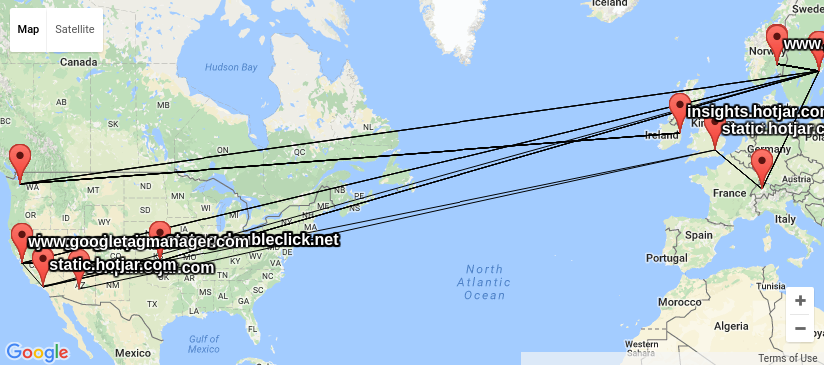
This show the DNS names and IP addresses of (at least some of the) network equipment involved in getting the data traffic from me to the www.stortinget.no server, and how long it took in milliseconds for a package to reach the equipment and return to me. Three packages are sent, and some times the packages do not follow the same path. This is shown for hop 5, where three different IP addresses replied to the traceroute request. There are many ways to measure trace routes. Other good traceroute implementations I use are traceroute (using ICMP packages) mtr (can do both ICMP, UDP and TCP) and scapy (python library with ICMP, UDP, TCP traceroute and a lot of other capabilities). All of them are easily available in Debian. This time around, I wanted to know the geographic location of different route points, to visualize how visiting a web page spread information about the visit to a lot of servers around the globe. The background is that a web site today often will ask the browser to get from many servers the parts (for example HTML, JSON, fonts, JavaScript, CSS, video) required to display the content. This will leak information about the visit to those controlling these servers and anyone able to peek at the data traffic passing by (like your ISP, the ISPs backbone provider, FRA, GCHQ, NSA and others). Lets pick an example, the Norwegian parliament web site www.stortinget.no. It is read daily by all members of parliament and their staff, as well as political journalists, activits and many other citizens of Norway. A visit to the www.stortinget.no web site will ask your browser to contact 8 other servers: ajax.googleapis.com, insights.hotjar.com, script.hotjar.com, static.hotjar.com, stats.g.doubleclick.net, www.google-analytics.com, www.googletagmanager.com and www.netigate.se. I extracted this by asking PhantomJS to visit the Stortinget web page and tell me all the URLs PhantomJS downloaded to render the page (in HAR format using their netsniff example. I am very grateful to Gorm for showing me how to do this). My goal is to visualize network traces to all IP addresses behind these DNS names, do show where visitors personal information is spread when visiting the page.

map of combined traces for URLs used by www.stortinget.no using GeoIP When I had a look around for options, I could not find any good free software tools to do this, and decided I needed my own traceroute wrapper outputting KML based on locations looked up using GeoIP. KML is easy to work with and easy to generate, and understood by several of the GIS tools I have available. I got good help from by NUUG colleague Anders Einar with this, and the result can be seen in my kmltraceroute git repository. Unfortunately, the quality of the free GeoIP databases I could find (and the for-pay databases my friends had access to) is not up to the task. The IP addresses of central Internet infrastructure would typically be placed near the controlling companies main office, and not where the router is really located, as you can see from the KML file I created using the GeoLite City dataset from MaxMind.

scapy traceroute graph for URLs used by www.stortinget.no I also had a look at the visual traceroute graph created by the scrapy project, showing IP network ownership (aka AS owner) for the IP address in question. The graph display a lot of useful information about the traceroute in SVG format, and give a good indication on who control the network equipment involved, but it do not include geolocation. This graph make it possible to see the information is made available at least for UNINETT, Catchcom, Stortinget, Nordunet, Google, Amazon, Telia, Level 3 Communications and NetDNA.

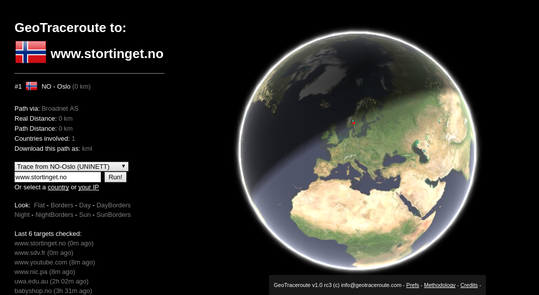
example geotraceroute view for www.stortinget.no In the process, I came across the web service GeoTraceroute by Salim Gasmi. Its methology of combining guesses based on DNS names, various location databases and finally use latecy times to rule out candidate locations seemed to do a very good job of guessing correct geolocation. But it could only do one trace at the time, did not have a sensor in Norway and did not make the geolocations easily available for postprocessing. So I contacted the developer and asked if he would be willing to share the code (he refused until he had time to clean it up), but he was interested in providing the geolocations in a machine readable format, and willing to set up a sensor in Norway. So since yesterday, it is possible to run traces from Norway in this service thanks to a sensor node set up by the NUUG assosiation, and get the trace in KML format for further processing.

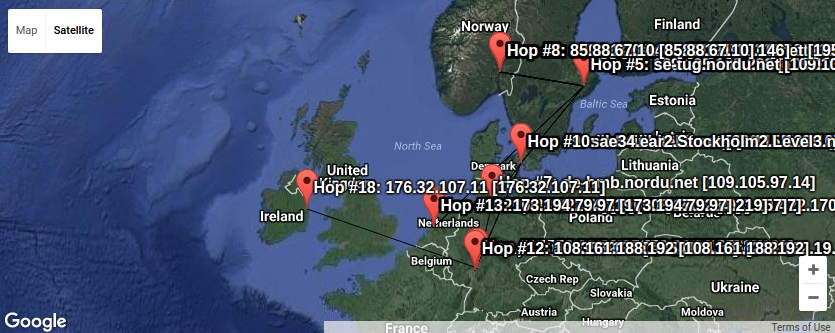
map of combined traces for URLs used by www.stortinget.no using geotraceroute Here we can see a lot of trafic passes Sweden on its way to Denmark, Germany, Holland and Ireland. Plenty of places where the Snowden confirmations verified the traffic is read by various actors without your best interest as their top priority. Combining KML files is trivial using a text editor, so I could loop over all the hosts behind the urls imported by www.stortinget.no and ask for the KML file from GeoTraceroute, and create a combined KML file with all the traces (unfortunately only one of the IP addresses behind the DNS name is traced this time. To get them all, one would have to request traces using IP number instead of DNS names from GeoTraceroute). That might be the next step in this project. Armed with these tools, I find it a lot easier to figure out where the IP traffic moves and who control the boxes involved in moving it. And every time the link crosses for example the Swedish border, we can be sure Swedish Signal Intelligence (FRA) is listening, as GCHQ do in Britain and NSA in USA and cables around the globe. (Hm, what should we tell them? :) Keep that in mind if you ever send anything unencrypted over the Internet. PS: KML files are drawn using the KML viewer from Ivan Rublev, as it was less cluttered than the local Linux application Marble. There are heaps of other options too. As usual, if you use Bitcoin and want to show your support of my activities, please send Bitcoin donations to my address 15oWEoG9dUPovwmUL9KWAnYRtNJEkP1u1b.

8 January 2017

Jonas Meurer: debian lts report 2016.12

Debian LTS report for December 2016 December 2016 was my fourth month as a Debian LTS team member. I was allocated 12 hours. Unfortunately I turned out to have way less time for Debian and LTS work than expected, so I only spent 5,25 hours of them for the following tasks:

Jonas Meurer: debian lts report 2016 12

Debian LTS report for December 2016 December 2016 was my fourth month as a Debian LTS team member. I was allocated 12 hours. Unfortunately I turned out to have way less time for Debian and LTS work than expected, so I only spent 5,25 hours of them for the following tasks:

Keith Packard: embedded-arm-libc

Finding a Libc for tiny embedded ARM systems You'd think this problem would have been solved a long time ago. All I wanted was a C library to use in small embedded systems -- those with a few kB of flash and even fewer kB of RAM. Small system requirements A small embedded system has a different balance of needs: Available small C libraries I've looked at: Current AltOS C library We've been using pdclib for a couple of years. It was easy to get running, but it really doesn't match what we need. In particular, it uses a lot of stack space in the stdio implementation as there's an additional layer of abstraction that isn't necessary. In addition, pdclib doesn't include a math library, so I've had to 'borrow' code from other places where necessary. I've wanted to switch for a while, but there didn't seem to be a great alternative. What's wrong with newlib? The "obvious" embedded C library is newlib. Designed for embedded systems with a nice way to avoid needing a 'real' kernel underneath, newlib has a lot going for it. Most of the functions have a good balance between speed and size, and many of them even offer two implementations depending on what trade-off you need. Plus, the build system 'just works' on multi-lib targets like the family of cortex-m parts. The big problem with newlib is the stdio code. It absolutely requires dynamic memory allocation and the amount of code necessary for 'printf' is larger than the flash space on many of our devices. I was able to get a cortex-m3 application compiled in 41kB of code, and that used a smattering of string/memory functions and printf. How about avr libc? The Atmel world has it pretty good -- avr-libc is small and highly optimized for atmel's 8-bit avr processors. I've used this library with success in a number of projects, although nothing we've ever sold through Altus Metrum. In particular, the stdio implementation is quite nice -- a 'FILE' is effectively a struct containing pointers to putc/getc functions. The library does no buffering at all. And it's tiny -- the printf code lacks a lot of the fancy new stuff, which saves a pile of space. However, much of the places where performance is critical are written in assembly language, making it pretty darn hard to port to another processor. Mixing code together for fun and profit! Today, I decided to try an experiment to see what would happen if I used the avr-libc stdio bits within the newlib environment. There were only three functions written in assembly language, two of them were just stubs while the third was a simple ultoa function with a weird interface. With those coded up in C, I managed to get them wedged into newlib. Figuring out the newlib build system was the only real challenge; it's pretty awful having generated files in the repository and a mix of autoconf 2.64 and 2.68 version dependencies. The result is pretty usable though; my STM 32L discovery board demo application is only 14kB of flash while the original newlib stdio bits needed 42kB and that was still missing all of the 'syscalls', like read, write and sbrk. Here's gitweb pointing at the top of the tiny-stdio tree: gitweb And, of course you can check out the whole thing
git clone git://keithp.com/git/newlib
'master' remains a plain upstream tree, although I do have a fix on that branch. The new code is all on the tiny-stdio branch. I'll post a note on the newlib mailing list once I've managed to subscribe and see if there is interest in making this option available in the upstream newlib releases. If so, I'll see what might make sense for the Debian libnewlib-arm-none-eabi packages.

7 January 2017

Thorsten Alteholz: My Debian Activities in December 2016

FTP assistant This month I marked 367 packages for accept and rejected 45 packages. This time I only sent 10 emails to maintainers asking questions. Debian LTS This was my thirtieth month that I did some work for the Debian LTS initiative, started by Raphael Hertzog at Freexian. This month my all in all workload has been 13.50h. During that time I did uploads of Other stuff The Debian Med Advent Calendar was really successful this year. As announced in [1] this year the second highest number of bugs has been closed during tht bug squashing:
year number of bugs closed
2011 63
2012 28
2013 73
2014 5
2015 150
2016 95
Well done everybody who participated! In December I also uploaded new upstream versions of duktape, fixed bugs in openzwave, did a binary upload for mpb on mipsel, sponsored openzwave-controlpanel, sidedoor and printrun.
Thanks to lamby that openzwave-controlpanel and sidedoor even made it into Stretch. Last but not least I want to wish everybody a Happy New Year. [1] https://lists.debian.org/debian-med/2016/12/msg00180.html

6 January 2017

Vincent Fourmond: RFH: screen that hurts my eyes

Short summary:My eyes hurt when I use my home desktop computer - but only with this computer. This has been very long and frustrating for me, so if you think you can help, read the whole story just below, or skip to what I've tried and what I suspect might be the problem, and post comments below, or send me a mail (my adress should be quite obvious in this page).

Whole story:Two years ago, I bought myself a new fancy motherboard (a Asus B85M-G C2) with a new fancy Intel-based processor with built-in graphics (an Intel Core i7-4770) and memory to go with it. I installed it in the place of my old AMD-based motherboard, keeping everything else (my hoard of hard drives and such) excepted the graphics card, which was not needed anymore. I immediately noticed my eyes were aching when using the computer. I was quite surprised since I had been using the screen very heavily for almost 10 years before that, without any problems. I attributed that to Intel Graphics, so I tried putting back the old graphics card, but it did not help. The situation was very frustrating, since working on the computer for an hour or so was making my eyes hurt for several days. This problem was specific to this computer, I could keep on using my computer at work and my laptop without problems.I could use the computer using SSH from my laptop, so I could profit from the faster processor, but, hey, that wasn't how it was meant to happen. I bought another screen, also tried with one from the work, without any change. I tried using two screens at the same time (this is what I have at work), also without success, so I just kept not using the computer directly. I moved recently to a new place and tried to get that working back again, but didn't get any luck. Frustrated, I got another desktop computer and another screen, and I still have the same problem ! I also tried remounting the old motherboard with the AMD processor and the old graphics card, but that didn't bring any improvement. I just don't get it. This situation is rather frustrating for me, and it's been holding me back in my software projects for two years now (which partly explains my lack of involvement in Debian over the past few years). This post is here in the hope someone will have a idea, but also for me to keep track of what I've done and what I should.

What is puzzling me is that the computer I had before was perfectly fine, and that I have a very very similar setup at work (also with a NVIDIA graphics card) that doesn't hurt my eyes at all.

What I've tried:Here is what I tried, you need to keep in mind that when a trial fails, my eyes keep on hurting for several days, and might trigger false positives.
  • putting back the old (NVIDIA) graphics card, buying a new one (NVIDIA as well);
  • putting back the old motherboard (but with a new OS, but maybe my eyes were too sore for a clean test);
  • using another screen (a new one from the same brand, Samsung), a Dell and a HP from my work, and a brand new Phillips;
  • using two screens at the same time;
  • using a completely different (new, based on Xeon processors and a NVIDIA graphics card) computer (with new mouse, keyboard, hard drives and so on);
  • changing house, including changing the lighting conditions, the desk, the internet provider (no, I didn't do that just because of my computer problems !);
  • changing the way I drive the screens between VGA, DVI and HDMI;
  • copying the system I have in my workplace to the new computer and booting from that system (after a few adaptations, though).

As you can guess, none of those brought any improvement.

Wild hypotheses:
  • Is that a software thing ? Is there something wrong for me in the versions of Debian dating from August 2014 and after ?
  • Is that a BIOS problem with recent computers ?
  • Is that linked to some waves (bluetooth shoudln't be on, but maybe I didn't check well enough ?)
  • Is that linked to EFI (but I also have the problems when I use legacy BIOS for booting)
  • Something weird in my home ?
  • Anything else ?

Any help will be greatly appreciated, but please don't advise going to see a doctor, I don't see how this could be a medical condition specific to my home desktop computer, unless this is a very specific psychosomatic problem.

Elena 'valhalla' Grandi: Candy from Strangers

Candy from Strangers

A few days ago I gave a talk at ESC https://www.endsummercamp.org/ about some reasons why I think that using software and especially libraries from the packages of a community managed distribution is important and much better than alternatives such as pypi, nmp etc. This article is a translation of what I planned to say before forgetting bits of it and luckily adding it back as an answer to a question :)

When I was young, my parents taught me not to accept candy from strangers, unless they were present and approved of it, because there was a small risk of very bad things happening. It was of course a simplistic rule, but it had to be easy enough to follow for somebody who wasn't proficient (yet) in the subtleties of social interactions.

One of the reasons why it worked well was that following it wasn't a big burden: at home candy was plenty and actual offers were rare: I only remember missing one piece of candy because of it, and while it may have been a great one, the ones I could have at home were also good.

Contrary to candy, offers of gratis software from random strangers are quite common: from suspicious looking websites to legit and professional looking ones, to platforms that are explicitly designed to allow developers to publish their own software with little or no checks.

Just like candy, there is also a source of trusted software in the Linux distributions, especially those lead by a community: I mention mostly Debian because it's the one I know best, but the same principles apply to Fedora and, to some measure, to most of the other distributions. Like good parents, distributions can be wrong, and they do leave room for older children (and proficient users) to make their own choices, but still provide a safe default.

Among the unsafe sources there are many different cases and while they do share some of the risks, they have different targets with different issues; for brevity the scope of this article is limited to the ones that mostly concern software developers: language specific package managers and software distribution platforms like PyPi, npm and rubygems etc.

These platforms are extremely convenient both for the writers of libraries, who are enabled to publish their work with minor hassles, and for the people who use such libraries, because they provide an easy way to install and use an huge amount of code. They are of course also an excellent place for distributions to find new libraries to package and distribute, and this I agree is a good thing.

What I however believe is that getting code from such sources and using it without carefully checking it is even more risky than accepting candy from a random stranger on the street in an unfamiliar neighbourhood.

The risk aren't trivial: while you probably won't be taken as an hostage for ransom, your data could be, or your devices and the ones who run your programs could be used in some criminal act causing at least some monetary damage both to yourself and to society at large.

If you're writing code that should be maintained in time there are also other risks even when no malice is involved, because each package on these platform has a different policy with regards to updates, their backwards compatibility and what can be expected in case an old version is found to have security issues.

The very fact that everybody can publish anything on such platforms is both their biggest strength and their main source of vulnerability: while most of the people who publish their libraries do so with good intentions, attacks have been described and publicly tested, such as the fun typo-squatting http://incolumitas.com/2016/06/08/typosquatting-package-managers/ one (archived on http://web.archive.org/web/20160801161807/http://incolumitas.com/2016/06/08/typosquatting-package-managers) that published harmless malicious code under common typos for famous libraries.

Contrast this with Debian, where everybody can contribute, but before they are allowed full unsupervised access to the archive they have to establish a relationship with the rest of the community, which includes meeting other developers in real life, at the very least to get their gpg keys signed.

This doesn't prevent malicious people from introducing software, but raises significantly the effort required to do so, and once caught people can usually be much more effectively prevented from repeating it than a simple ban on an online-only account can do.

It is true that not every Debian maintainer actually does a full code review of everything that they allow in the archive, and in some cases it would be unreasonable to expect it, but in most cases they are at least reasonably familiar with the code to do at least bug triage, and most importantly they are in an excellent position to establish a relationship of mutual trust with the upstream authors.

Additionally, package maintainers don't work in isolation: a growing number of packages are being maintained by a team of people, and most importantly there are aspects that involve potentially the whole community, from the fact that new packages that enter the distribution are publicity announced on a mailing list to the various distribution-wide QA efforts.

Going back to the language specific distribution platforms, sometimes even the people who manage the platform themselves can't be fully trusted to do the right thing: I believe everybody in the field remembers the npm fiasco https://lwn.net/Articles/681410/ where a lawyer letter requesting the removal of a package started a series of events that resulted in potentially breaking a huge amount of automated build systems.

Here some of the problems were caused by some technical policies that caused the whole ecosystem to be especially vulnerable, but one big issue was the fact that the managers of the npm platform are a private entity with no oversight from the user community.

Here not all distributions are equal, but contrast this with Debian, where the distribution is managed by a community that is based on a social contract https://www.debian.org/social_contract and is governed via democratic procedures established in its https://www.debian.org/devel/constitution.

Additionally, the long history of the distribution model means that many issues have already been met, the errors have already been done, and there are established technical procedures to deal with them in a better way.

So, shouldn't we use language specific distribution platforms at all? No! As developers we aren't children, we are adults who have the skills to distinguish between safe and unsafe libraries just as well as the average distribution maintainer can do. What I believe we should do is stop treating them as a safe source that can be used blindly and reserve that status to actual trustful sources like Debian, falling back to the language specific platforms only when strictly needed, and in that case:

actually check carefully what we are using, both by reading the code and by analysing the development and community practices of the authors;
if possible, share that work by becoming ourselves maintainers of that library in our favourite distribution, to prevent duplication of effort and to give back to the community whose work we get advantage from.

Edit: fixed broken typosquatting url

Joachim Breitner: TikZ aesthetics

Every year since 2012, I typeset the problems and solutions for the German math event Tag der Mathematik, which is organized by the Zentrum f r Mathematik and reaches 1600 students from various parts of Germany. For that, I often reach to the LaTeX drawing package TikZ, and I really like the sober aesthetics of a nicely done TikZ drawing. So mostly for my own enjoyment, I collect the prettiest here. On a global scale they are still rather mundane, and for really impressive and educating examples, I recommend the TikZ Gallery.

Mark Brown: OpenTAC sprint

This weekend Toby Churchill kindly hosted a hacking weekend for OpenTAC myself, Michael Grzeschik, Steve McIntyre and Andy Simpkins got together to bring up the remaining bits of the hardware on the current board revision and get some of the low level tooling like production flashing for the FTDI serial ports on the board up and running. It was a very productive weekend, we verified that everything was working with only few small mods needed for the board . Personally the main thing I worked on was getting most of an initial driver for the EMC1701 written. That was the one component without Linux support and allowed us to verify that the power switching and measurement for the systems under test was working well. There s still at least one more board revision and quite a bit of software work to do (I m hoping to get the EMC1701 upstream for v4.8) but it was great to finally see all the physical components of the system working well and see it managing a system under test, this board revision should support all the software development that s going to be needed for the final board. Thanks to all who attended, Pengutronix for sponsoring Michael s attendance and Toby Churchill for hosting! Team at work
Group photo

5 January 2017

Jamie McClelland: End-to-End Encrypted group chats via XMPP

It's been over a year since my colleagues and I at the Progressive Technology Project abandoned Skype, first for IRC and soon after for XMPP. Thanks to the talented folks maintaining conversations.im it's been a breeze to get everyone setup with accounts (8 Euros/year is quite worth it) and a group chat going. However, our group chats have not been using end-to-end encryption... until now. It wasn't exactly painless, so I'm sharing some tips and tricks. Anyone interested in secure XMPP may also find the Riseup XMPP page useful.

Michal Čihař: Gammu 1.38.1

Today Gammu 1.38.1 has been released. This is bugfix release fixing several minor bugs which were discovered in 1.38.0. The Windows binaries will be available shortly. These are built using AppVeyor and will help bring Windows users back to latest versions. Full list of changes and new features can be found on Gammu 1.38.1 release page. Would you like to see more features in Gammu? You an support further Gammu development at Bountysource salt or by direct donation.

Filed under: Debian English Gammu 0 comments

4 January 2017

Michal Čihař: Seven tools that help us develop Weblate

Weblate probably would not exist (or at least would be much harder to manage) without several services that help us to develop, improve and fix bugs in our code base. Over the time the development world has become very relying on cloud services. As every change this has both sides - you don't have to run the service, but you also don't have control on the service. Personally I'd prefer to use more free software services, on the other side I really love this comfort and I'm lazy to setup things which I can get for free. The list was written down mostly for showing up how we work and the services are not listed in any particular order. All of the services provide free offerings for free software projects or for limited usage. GitHub I guess there is not much to say here, it has become standard place to develop software - it has Git repositories, issue tracker, pull requests and several other features. Travis CI Running tests on every commit is something what will make you feel confident that you didn't break anything. Of course you still need to write the tests, but having them run automatically is really great help. Especially great for automatically checking pull requests. AppVeyor Continuous integration on Windows - it's still widely used platform with it's quirks, so it's really good idea to test there as well. With AppVeyor you can do that and it works pretty nicely. Codecov When running tests it's good to know how much of your code is covered by them. Codecov is one of the best interfaces I've seen for this. They are also able to merge coverage reports from multiple builds and platforms (for example for wlc we have combined coverage for Linux, OSX and Windows coming from Travis CI and AppVeyor builds). SauceLabs Unit testing is good, but the frontend testing in browser is also important. We run Selenium tests in several browsers in SauceLabs to verify that we haven't screwed up something from the user interface. Read the Docs Documentation is necessary for every project and having it built automatically is nice bonus. Landscape Doing code analysis is a way to avoid some problems which are not spot during testing. These can be code paths not covered by test or simply coding style issues. There are several such services, but Landscape is my favorite one right now.

Filed under: Debian English phpMyAdmin SUSE Weblate 0 comments

Dominique Dumont: New with cme: a GUI to configure Systemd services

Hello Systemd is powerful, but creating a new service is a task that require creating several files in non obvious location (like /etc/systemd/system or ~/.local/share/systemd/user/). Each file features 2 or more sections (e.g. [Unit], [Service]). And each section supports a lot of parameters. Creating such Systemd configuration files can be seen as a daunting task for beginners. cme project aims to make this task easier by providing a GUI that: For instance, on my laptop, the command cme edit systemd-user shows 2 custom services ( free-imap-tunnel@ and gmail-imap-tunnel@ ) with: cme_edit_systemd_001 The GUI above shows the units for my custom systemd files:
$ ls ~/.config/systemd/user/
free-imap-tunnel@.service
free-imap-tunnel.socket
gmail-imap-tunnel@.service
gmail-imap-tunnel.socket
sockets.target.wants
and the units installed by Debian packages:
$ find /usr/lib/systemd/user/ -maxdepth 1 \
  '(' -name '*.service' -o -name '*.socket' ')' \
  -printf '%f\n'  sort  head -15
at-spi-dbus-bus.service
colord-session.service
dbus.service
dbus.socket
dirmngr.service
dirmngr.socket
glib-pacrunner.service
gpg-agent-browser.socket
gpg-agent-extra.socket
gpg-agent.service
gpg-agent.socket
gpg-agent-ssh.socket
obex.service
pulseaudio.service
pulseaudio.socket
The screenshot above shows the content of the service defined by the following file:
$ cat ~/.config/systemd/user/free-imap-tunnel@.service
[Unit]
Description=Tunnel IMAPS connections to Free with Systemd
[Service]
StandardInput=socket
# no need to install corkscrew
ExecStart=-/usr/bin/socat - PROXY:127.0.0.1:imap.free.fr:993,proxyport=8888
Note that empty parameters are not shown because the hide empty value checkbox on top right is enabled. Likewise, cme is able to edit system files like user files with sudo cme edit systemd: cme_edit_systemd_001 For more details on how to use the GUI to edit systemd files, please see: Using a GUI may not be your cup of tea. cme can also be used as a validation tool. Let s add a parameter with an excessive value to my service:
$ echo "CPUShares = 1000000" >> ~/.local/share/systemd/user/free-imap-tunnel@.service
And check the file with cme:
$ cme check systemd-user 
cme: using Systemd model
loading data
Configuration item 'service:"free-imap-tunnel@" Service CPUShares' has a wrong value:
        value 1000000 > max limit 262144
ok, let s fix this with cme. The wrong value can either be deleted:
$ cme modify systemd-user 'service:"free-imap-tunnel@" Service CPUShares~'
cme: using Systemd model
Changes applied to systemd-user configuration:
- service:"free-imap-tunnel@" Service CPUShares: '1000000' -> ''
Or modified:
$ cme modify systemd-user 'service:"free-imap-tunnel@" Service CPUShares=2048'
cme: using Systemd model
Changes applied to systemd-user configuration:
- service:"free-imap-tunnel@" Service CPUShares: '1000000' -> '2048'
You can also view the specification of a service using cme:
$ cme dump systemd-user 'service:"free-imap-tunnel@"'---
Service:
  CPUShares: 2048
  ExecStart:
    - '-/usr/bin/socat -  PROXY:127.0.0.1:imap.free.fr:993,proxyport=8888'
  StandardInput: socket
Unit:
  Description: Tunnel IMAPS connections to Free with Systemd
The output above matches the content of the service configuration file:
$ cat ~/.local/share/systemd/user/free-imap-tunnel@.service
## This file was written by cme command.
## You can run 'cme edit systemd-user' to modify this file.
## You may also modify the content of this file with your favorite editor.
[Unit]
Description=Tunnel IMAPS connections to Free with Systemd
[Service]
StartupCPUWeight=100
CPUShares=2048
StartupCPUShares=1024
StandardInput=socket
# no need to install corkscrew now
ExecStart=-/usr/bin/socat -  PROXY:127.0.0.1:imap.free.fr:993,proxyport=8888
Last but not least, you can use cme shell if you want an interactive ui but cannot use a graphical interface:
$ cme shell systemd-user 
cme: using Systemd model
 >:$ cd service:"free-imap-tunnel@"  Service  
 >: service:"free-imap-tunnel@" Service $ ll -nz Exec*
name        type   value                                                             
 
ExecStart   list   -/usr/bin/socat -  PROXY:127.0.0.1:imap.free.fr:993,proxyport=8888
 >: service:"free-imap-tunnel@" Service $ ll -nz
name               type      value                                                             
 
StartupCPUWeight   integer   100                                                               
CPUShares          integer   2048                                                              
StartupCPUShares   integer   1024                                                              
StandardInput      enum      socket                                                            
ExecStart          list      -/usr/bin/socat -  PROXY:127.0.0.1:imap.free.fr:993,proxyport=8888
 >: service:"free-imap-tunnel@" Service $ set CPUShares=1024
 >: service:"free-imap-tunnel@" Service $ ll -nz CPUShares 
name        type      value
 
CPUShares   integer   1024 
 >: service:"free-imap-tunnel@" Service $ quit
Changes applied to systemd-user configuration:
- service:"free-imap-tunnel@" Service CPUShares: '2048' -> '1024'
write back data before exit ? (Y/n)
Currently, only service, socket and timer units are supported. Please create a bug report on github if you need more. Installation instructions are detailed at the beginning of Managing Systemd configuration with cme wiki page. As all softwares, cme probably has bugs. Please report any issue you might have with it. For more information: All in all, systemd is quite complex to setup. I hope I made a little bit easier to deal with. All the best
Tagged: config-model, configuration, Perl, systemd

Raphaël Hertzog: My Free Software Activities in December 2016

My monthly report covers a large part of what I have been doing in the free software world. I write it for my donors (thanks to them!) but also for the wider Debian community because it can give ideas to newcomers and it s one of the best ways to find volunteers to work with me on projects that matter to me. Debian LTS I was allocated 10 hours to work on security updates for Debian 7 Wheezy. During this time I did the following: Misc packaging With the strong freeze approaching, I had some customer requests to push packages into Debian and/or to fix packages that were in danger of being removed from stretch. While trying to bring back uwsgi into testing I filed #847095 (libmongoclient-dev: Should not conflict with transitional mongodb-dev) and #847207 (uwsgi: FTBFS on multiple architectures with undefined references to uwsgi_* symbols) and interacted on some of the RC bugs that were keeping the package out of testing. I also worked on a few new packages (lua-trink-cjson, lua-inotify, lua-sandbox-extensions) that enhance hindsight in some use cases and sponsored a rozofs update in experimental to fix a file conflict with inn2 (#846571). Misc Debian work Debian Live. I released two live-build updates. The second update added more options to customize the grub configuration (we use it in Kali to override the theme and add more menu entries) both for EFI boot and normal boot. Misc bugreports. #846569 on libsnmp-dev to accomodate the libssl transition (I noticed the package was not maintained, I asked for new maintainers on debian-devel). #847168 on devscripts for debuild that started failing when lintian was failing (unexpected regression). #847318 on lintian to not emit spurious errors for kali packages (which was annoying with the debuild regression above). #847436 for an upgrade problem I got with tryton-server. #847223 on firefoxdriver as it was still depending on iceweasel instead of firefox. Sponsorship. I sponsored a new version of asciidoc (#831965) and of ssldump 0.9b3-6 (for libssl transition). I also uploaded a new version of mutter to fix #846898 (it was ready in SVN already). Distro Tracker Not much happening, I fixed #814315 by switching a few remaining URLs to https. I merged patches from efkin to fix the functional test suite (#814315), that was a really useful contribution! The same contributer started to tackle another ticket (#824912) about adding an API to retrieve action items. This is a larger project and needs some thoughts. I still have to respond to him on his latest patches (after two rounds already). Misc stuff I updated the letsencrypt-sh salt formula for version 0.3.0 and added the possibility to customize the hook script to reload the webserver. The @planetdebian twitter account is no longer working since twitterfeed.com closed doors and the replacement (dlvr.it) is unhappy about the RSS feed of planet.debian.org. I filed bug #848123 against planet-venus since it does not preserve the isPermalink attribute in the guid tag Thanks See you next month for a new summary of my activities.

No comment Liked this article? Click here. My blog is Flattr-enabled.

3 January 2017

Russ Allbery: Review: Castle of Wizardry

Review: Castle of Wizardry, by David Eddings
Series: The Belgariad #4
Publisher: Del Rey
Copyright: May 1984
Printing: September 1991
ISBN: 0-345-33570-8
Format: Mass market
Pages: 373
Castle of Wizardry is the fourth book of the Belgariad and very much the middle of the story. Despite coming after an intermediate climax, this isn't the sort of series you can start in the middle. The problem with intermediate climaxes in a long series is that the next book can be a bit of a let-down as the characters do the necessary regrouping and reorienting and determine next steps. I think that hurts Castle of Wizardry quite a lot. The best bits are at the beginning, as the party escapes the consequences of Magician's Gambit, collects one more party member, shows us a lot more of Errand (who is always delightful), and confounds Relg's life and world view considerably. (Although there's a good bit of authorial fiat in the last.) This builds into a major story event, which would normally help avoid the let-down after the climax, but it's the major story event that is so frequently and obviously foreshadowed that you'd have to be as dumb as, well, Garion to not know what's coming. That gives a certain "yes, yes, we know already" tone to proceedings that robs it of its ability to rebuild tension. That said, the appeal of this series continues to be in the small details. While the first major event of this book goes pretty much as expected (including Ce'Nedra's reaction, which is just as irritating as you might be expecting), my favorite part was the endless, bubbly enthusiasm of the incredibly powerful artifact that features heavily. Usually epic fantasy will treat such world-breaking objects with seriousness and awe, as treasures to be admired and sacred (or terrifying) great works. See, for instance, the ur-example of Tolkien's rings, both the One Ring and the elven rings of power. Eddings manages a mix of awe and bemusement that doesn't undermine their power but that adds a delightful human element. This series pulls off treating a powerful magical artifact like an over-enthusiastic puppy without making it feel any less dangerous. It's a very neat, and I think underappreciated, trick to pull off. Another part of this book I liked, if a more stock one, is Garion's reactions after the big story event. This isn't the first book to portray basic decency and thoughtfulness as a major feature in people from humble backgrounds elevated to great power, but I always enjoy seeing that. Garion stops whining (mostly) and starts acting like a decent, level-headed person who doesn't assume he has the right to arrange other people's lives, and is rewarded for it. Real life is often not that fair or ethical, but that's why one reads wish-fulfillment fantasy like this: for a world in which being a good person is rewarded. However, Eddings does have some structural issues here. The narrative arc of this book, as a stand-alone entity, is odd. Its most dramatic event is in the middle, and then has a long traveling section that's, by comparison, much less exciting. The events of that section feel more like random encounters than a coherent part of the story, and are preceded by the most utterly ridiculous temper tantrums. I think the tantrums were meant to be pure humor, but my reaction was primarily eye-rolling. I have a hard time reconciling a screaming fit and breaking furniture with the long life experience and thoughtful planning of the character in question. And then there is the Ce'Nedra section that closes this book, and Ce'Nedra in this book more generally. To be fair, Castle of Wizardry is clearly intended to be Ce'Nedra's moment to grow as a person and stop being a childish brat. This does happen somewhat, and there are moments in the last section of the book where she does admirable things. But I couldn't quite believe in the mechanism, and it doesn't help that it's one of the most ham-handed bits of pre-ordained success in a book that has a tendency towards them. That undermines the real attempts Eddings makes to ground that success in Ce'Nedra's actual skills. Also undermining this is that those skills are manipulating people shamelessly, which Eddings seems to think is charming and attractive and I... don't. But the real problem is that I flatly disbelieve in Ce'Nedra as a character, or, given the apparent existence of such a creature, the level of tolerance that other characters show her. If I'd been Polgara, within fifteen minutes of meeting her I would have been seriously debating whether the destruction of the world might be a small price to pay for the satisfaction of dumping her down the nearest well. And not only is she awful by herself but Garion also descends to the same level whenever he's around her, until both of them are behaving like blithering idiots. I suspect part of my issue is that, to the extent that she is realistic at all, Ce'Nedra is the sort of intensely high-drama person who I have some amount of life experience with, and that life experience says "do not let this person anywhere near your life." Red flags all over everything. Garion needs to nope the hell out, because this will not end well. (Except, of course, it will, because it's that sort of series and the power of the author is strong.) I want female characters with real agency in my fantasy, and I want a female protagonist who is doing things of equal importance as the male protagonist (not that Eddings attempts to go that far). But Ce'Nedra reads like a fictional character written by someone who had never met a woman, but has extensively studied female supporting characters in books about junior-high social cliques and then tried to reconcile that research with the stereotype of women as manipulative seductresses. Yes, this series is full of stereotypes and characters painted in broad strokes, but Ce'Nedra is several tiers below every other supporting character in the book in both believability and in my desire to read about her. It's not that Eddings doesn't know how to write women at all. Polgara still falls into a few stereotyped categories, but she's sensible, opinionated, and has clear agency throughout the story. Taiba is delightful, if minor here. Poledra is absolutely wonderful whenever she appears. Some of the queens are obviously practical and sensible. And this book features a surprisingly good resolution to the subplot around Barak's wife, although the mechanism is a bit eye-rollingly cliched. Ce'Nedra's character is unusual for the series and almost certainly a deliberate authorial choice, and this book is supposed to be her coming of age. But I am baffled by that choice, and there's very little about it that I enjoyed reading. One more minor complaint: Silk gets a "tragic secret" in this book, and I really wish he hadn't. More time with Silk is always a feature, and I still love the character, but his oddities were already adequately explained by both his innate character and his way of dealing with a particularly awkward court situation. (One that ties into Eddings's habit of using some bad relationship stereotypes, but that's a rant for another day.) I think this additional tragic secret was gratuitous and really unnecessary, not to mention weirdly implausible and oddly cruel towards the other character involved. I was hoping that Magician's Gambit had turned a corner for the series, but Castle of Wizardry, despite having some neat moments, has some serious flaws. One more book to go, in which we learn that some of the eastern races have redeeming qualities! Followed by Enchanter's End Game. Rating: 6 out of 10

Elizabeth Ferdman: 4 Week Progress Update for PGP Clean Room

Happy New Year Everyone! Aside from taking some time off for the holidays, I set up a Debian-Sid USB stick in order to test gnupg version 2.1.16-3, the version to be included in Debian Stretch. For now, I m using the package rng-tools to speed up the key creation for the purpose of testing gpg commands. By running sudo rngd -r /dev/urandom before the gpg command, you can create the keys in about a second. Here are some of the sources that I ve been using that inform the workflow and secure practices for gpg that we ll be including in the Clean Room: Some feature suggestions that were made by Neal Walfield that could be included in the workflow:
  1. Use a smartcard for the primary key and a smartcard for the subkeys
  2. Support subkey rotation the creation of new subkeys
  3. Upon finishing a session, write a script to the USB that sends mails with the signed keys and imports the user s public keys.

Maria Glukhova: Getting to know diffoscope better

I apologize to all potential readers of this blog for not writing a comprehensive Introduction post with details of the project I am taking part in during my internship, as well as some story about how I ended up there. Let me just say that I was a Debian user for years when I discovered it is taking part in Outreachy as one of organisations. Their Reproducible Builds effort has a noble goal and a bunch of great people behind it - I had no chances not to get excited by it. Looking for a place where my skills could be of any use, I discovered diffoscope - the tool for in-depth comparassion of files, archives etc. My mentor, Mattia Rizzolo, supported my decision to work on it, so now I am concentrating my efforts on improving diffoscope. As my first steps, I am doing small (but hopefully still somewhat important) job of fixing existing bugs. It helps me to better understand how diffoscope works, as well as introduces me to the workflow of opensource development. During December, I have done several small contributions, mostly fixing bugs.

Test data and jessie-backports First of them could be somewhat called cleaning up after my own mistake, although that mistake wasn t trivial. During the application period, I have fixed a bug with diffoscope failing while comparing symlinks to directory. That was a small change, but I included some tests for that case anyway. And that actually caused problems. With these tests, I included test data: two folders with symlinks. All was good in unstable version of Debian, but in jessie-backports, that commit caused build to fail. After some digging, I discovered the problem was caused by build process including copying that data. That was done using shutils Python module, and older version of that module, included in jessie, could not handle copying symlinks to directory properly. Thanks to my mentor for giving me a hint on how to resolve this: using temporary folders and creating these symlinks at runtime. That way, we ensured tests run without problems during build process on jessie. What have I learned: A great deal, actually. I spent too much time on that one, but I learned how to build packages, what happens during dpkg-buildpackage run and what debhelper tools are for. I also learned a bit about what chroot is and how to use it for testing.

ICC profile files and file type recognizing regexp Another one was also about failing tests and, therefore, failing build. Failing tests were all due to ICC files were not recognized by diffoscope. Turned out libmagic got an update which changed the description of ICC profile files. Diffoscope was relying on regexp applied to file type description to recognize the file, so I changed regexp to reflect the changes in libmagic. What have I learned: How diffoscope recognizes file types. Got me thinking: maybe there is a better way? That regexp-based approach is doomed to cause problems with every file type description change. I have this question still lingering in my mind - maybe I will come up with an idea later.

Order-like difference in text files Next, I decided to do something a bit bigger and fullfilled a feature request. That request was for detecting order-like difference in text files (when files has the same lines, but in different order). I did it by collecting added and removed lines in diff output in lists, sorting and then comparing them. Sadly, I forgot about one particular case - when one of the files is missing the newline at the end of file. I was kindly reminded of that quite soon in comments on the bug-tracker (thanks danielsh!) and have already fixed that. I also recieved feedback on how better implement it deeper in the diffoscope - not using the results of diff, but rather comparing sum of hashes of the lines directly in the difference module. I am yet to try that. What have I learned: That a call to diff is actually the slowest part of the diffoscope run when done on two big text files. Could it help somehow in speeding it up? I don t know yet. I also learned to comment on bugs in Debian bugtracker and was surprised by how much feedback I got. Thanks to my mentor for pushing me to do that - I definetely need to overcome my fear of communications to be more effective!

Random FTBFS There was also a very nasty bug that caused diffoscope to fail to be built from source randomly, failing with non-informative Fatal Python error: deallocated None. It already seemed strange when it was first reported; It got only more strange when suddenly that bug ceased to be reproducible. We hoped that would mean that bug was caused by some external tool, and was fixed there. Turns out it was not that easy. I tested this on two separate computers and on virtual machine; I used different versions of diffoscope. Well. Seems like that bug is still somehow tied to diffoscope version and not some external tool version - I still can do git checkout 64 and be able to reproduce the bug (still randomly, though). Although I spent quite a lot of time on that one, the only result was the information about connection between bug apperances and diffoscope version. I still wasn t able to get to the root of the problem - hopefully, someone else will be able to, given the information I found. What have I learned: git-bisect! Thanks to my friend for pointing me to it, that tool came handy in that situation. Also, got some experience in catching nasty bugs like that (pity that no experience in squashing them). I had some extra time commitements in December, one of them (Reproducible Builds Summit II) connected to my internship and one (my exam session in university) not. In January, I should be able to allocate more time to that work - I hope it will help me achieve more significant results. Many thanks to Mattia Rizzolo, Chris Lamb, Holger Levsen and all other folks of Reproducible Builds project - I cannot stress enough how important your support is to me. Wish you all a great 2017!

2 January 2017

Shirish Agarwal: India Tourism, E-Visa and Hong Kong

A Safe and Happy New Year to all. While Debconf India is still a pipe-dream as of now, did see that India has been gradually doing it easier for tourists and casual business visitors to come visit India. This I take as very positive development for India itself. The 1st condition is itself good for anybody visiting India
Eligibility International Travellers whose sole objective of visiting India is recreation , sight-seeing , casual visit to meet friends or relatives, short duration medical treatment or casual business visit.
https://indianvisaonline.gov.in/visa/tvoa.html That this facility is being given to 130 odd countries is better still
Albania, Andorra, Anguilla, Antigua & Barbuda, Argentina, Armenia, Aruba, Australia, Austria, Bahamas, Barbados, Belgium, Belize, Bolivia, Bosnia & Herzegovina, Botswana, Brazil, Brunei, Bulgaria, Cambodia, Canada, Cape Verde, Cayman Island, Chile, China, China- SAR Hong-Kong, China- SAR Macau, Colombia, Comoros, Cook Islands, Costa Rica, Cote d lvoire, Croatia, Cuba, Czech Republic, Denmark, Djibouti, Dominica, Dominican Republic, East Timor, Ecuador, El Salvador, Eritrea, Estonia, Fiji, Finland, France, Gabon, Gambia, Georgia, Germany, Ghana, Greece, Grenada, Guatemala, Guinea, Guyana, Haiti, Honduras, Hungary, Iceland, Indonesia, Ireland, Israel, Jamaica, Japan, Jordan, Kenya, Kiribati, Laos, Latvia, Lesotho, Liberia, Liechtenstein, Lithuania, Luxembourg, Madagascar, Malawi, Malaysia, Malta, Marshall Islands, Mauritius, Mexico, Micronesia, Moldova, Monaco, Mongolia, Montenegro, Montserrat, Mozambique, Myanmar, Namibia, Nauru, Netherlands, New Zealand, Nicaragua, Niue Island, Norway, Oman, Palau, Palestine, Panama, Papua New Guinea, Paraguay, Peru, Philippines, Poland, Portugal, Republic of Korea, Republic of Macedonia, Romania, Russia, Saint Christopher and Nevis, Saint Lucia, Saint Vincent & the Grenadines, Samoa, San Marino, Senegal, Serbia, Seychelles, Singapore, Slovakia, Slovenia, Solomon Islands, South Africa, Spain, Sri Lanka, Suriname, Swaziland, Sweden, Switzerland, Taiwan, Tajikistan, Tanzania, Thailand, Tonga, Trinidad & Tobago, Turks & Caicos Island, Tuvalu, UAE, Ukraine, United Kingdom, Uruguay, USA, Vanuatu, Vatican City-Holy See, Venezuela, Vietnam, Zambia and Zimbabwe.
This should make it somewhat easier for any Indian organizer as well as any participants from any of the member countries shared. There is possibility that this list would even get longer, provided we are able to scale our airports and all and any necessary infrastructure that would be needed for International Visitors to have a good experience. What has been particularly interesting is to know which ports of call are being used by International Visitors as well as overall growth rate
The Percentage share of Foreign Tourist Arrivals (FTAs) in India during November, 2016 among the top 15 source countries was highest from USA (15.53%) followed by UK (11.21%), Bangladesh (10.72%), Canada (4.66%), Russian Fed (4.53%), Australia (4.04%), Malaysia (3.65%), Germany (3.53%), China (3.14%), France (2.88%), Sri Lanka (2.49%), Japan (2.49%), Singapore (2.16%), Nepal (1.46%) and Thailand (1.37%).
And port of call
The Percentage share of Foreign Tourist Arrivals (FTAs) in India during November 2016 among the top 15 ports was highest at Delhi Airport (32.71%) followed by Mumbai Airport (18.51%), Chennai Airport (6.83%), Bengaluru Airport (5.89%), Haridaspur Land check post (5.87%), Goa Airport (5.63%), Kolkata Airport (3.90%), Cochin Airport (3.29%), Hyderabad Airport (3.14%), Ahmadabad Airport (2.76%), Trivandrum Airport (1.54%), Trichy Airport (1.53%), Gede Rail (1.16%), Amritsar Airport (1.15%), and Ghojadanga land check post (0.82%) .
The Ghojadanga land check post seems to be between West Bengal, India and Bangladesh. Gede Railway Station is also in West Bengal as well. So all and any overlanders could take any of those ways.Even Hardispur Land Check post comes in the Bengal-Bangladesh border only. In the airports, Delhi Airport seems to be attracting lot more business than the Mumbai Airport. Part of the reason I *think* is the direct link of Delhi Airport to NDLS via the Delhi Airport Express Line . The same when it will happen in Mumbai should be a game-changer for city too. Now if you are wondering why I have been suddenly talking about visas and airports in India, it came because Hong Kong is going to Withdraw Visa Free Entry Facility For Indians. Although, as rightly pointed out in the article doesn t make sense from economic POV and seems to be somewhat politically motivated. Not that I or anybody else can do anything about that. Seeing that, I thought it was a good opportunity to see how good/Bad our Government is and it seems to be on the right path. Although the hawks (Intelligence and Counter-Terrorist Agencies) will probably become a bit more paranoid , their work becomes tougher.
Filed under: Miscellenous Tagged: #Airport Metro Line 3, #CSIA, #Incredible India, #India, #International Tourism

Next.

Previous.