Search Results: "ana"

7 September 2013

Ben Armstrong: Wifi roaming on the move redux

It has been nearly six years with a netbook and five since I last wrote about wifi roaming from the bus to stay on irc without a costly celluar link during the daily commute. Since then, some readers have asked me to share my refinements to the method in a followup post. So here it is. The software On the server: On the client: Putting it together: on the client Make sure if you have a wireless manager installed (such as NetworkManager) it is configured to skip your wireless interface, disabled entirely, or if possible, removed. Set up /etc/wpa_supplicant/wpa_supplicant.conf and /etc/network/interfaces for roaming, as per the instructions in /usr/share/doc/wpasupplicant/README.modes.gz. Don t forget to add yourself to the netdev group if you are not in it already. In /etc/wpa_supplicant/wpa_supplicant.conf, list common names of open networks. Normally the catch-all network that associates with any essid, i.e. the first stanza below, works well. However, occasionally the strongest signal is neither one of the common networks nor an easily accessible network (e.g. web portals), so having a list of common open networks helps to quickly select from among those instead. The more you travel, the more of these will discover and add. Just use reconfigure from wpa_cli to reload your edited list each time you add a new one.
ctrl_interface=DIR=/var/run/wpa_supplicant GROUP=netdev
network= 
        key_mgmt=NONE
 
network= 
        ssid="default"
        key_mgmt=NONE
 
network= 
        ssid="linksys"
        key_mgmt=NONE
 
...
Since you ll be using ssh repeatedly to connect and it has to be fast, make sure your server is set up to accept your key and use ssh-add so that you only have to enter your ssh key password once. You can tweak isc-dhcp-client to make connections faster. In /etc/dhcp/dhclient.conf, use:
backoff-cutoff 1;
initial-interval 1;
Here are a few scripts I wrote to facilitate quick roaming from one open AP to another and reconnect to irssi running in screen, to break a connection and try the next one, and to recover from occasional lockups (more about that later). ~/bin/screen_reconnect This is a script to reconnect continuously via ssh to a screen session:
#!/bin/sh
reset
while ! ssh -t 10.9.8.7 'screen -UDr' 2>/dev/null ; do echo -n "." ; sleep .1 ; done
Just substitute the IP of your own server here. Using an IP instead of domain name makes the connection faster because a DNS lookup is not required. ~/bin/wifi_reassociate This script closes any open ssh sessions and informs wpa_supplicant to attempt to connect again.
#/bin/sh
/sbin/wpa_cli rea
killall ssh >/dev/null 2>&1
~/bin/wifi_killall This optional, somewhat ugly script addresses an issue I hope you never have. On my ASUS Eee PC 1001PX, occasionally scanning stops. When this happens, and I have never figured out why, apparently ACPI events are blocked. At this point wifi becomes unusable and ACPI sleep is inhibited. By trial and error I found that if you bring down the interface, kill all network-related processes, and bring it up again, ACPI events are unblocked and wifi is usable once more (and any pending request to sleep will finally happen). The script requires sudo, and to use the openbox key binding, gksudo.
#/bin/sh
sudo ifdown wlan0
# in case any of these are hung
sudo killall dhclient3
sudo killall wpa_cli
sudo killall wpa_action
sudo killall wpa_supplicant
# in case any of these are *really* hung
sleep 1
sudo killall -9 dhclient3
sudo killall -9 wpa_cli
sudo killall -9 wpa_action
sudo killall -9 wpa_supplicant
sudo dhclient -r
sudo ifup wlan0
Openbox Since certain actions need to be performed repeatedly and quickly, it is useful to have hotkeys bound in your window manager to the scripts. In ~/.config/openbox/rc.xml, key bindings for <alt>-r to reassociate and <alt>-d to disconnect a hung connection would look like:
  
<keyboard>
  <!-- My keybindings -->
  <keybind key="A-R">
    <action name="Execute">
        <execute>/home/synrg/bin/wifi_reassociate</execute>
    </action>
  </keybind>
  <keybind key="A-D">
    <action name="Execute">
        <execute>gksudo /home/synrg/bin/wifi_killall</execute>
    </action>
  </keybind>
</keyboard>
Putting it together: on the server There is very little to do here. Just start screen, and start irssi in screen. Running screen on the client as well as the server means you should either bind the screen meta keys to a different key sequence on each system, or else learn to press meta twice to pass through meta to the server screen as needed. I use the latter approach. Alternatively, you could use a tabbed terminal on the client, or separate terminals per client process instead of screen. This is a matter of personal taste. Ready to roam Here is a typical setup for roaming on the bus: In a terminal (I use urxvt), first ssh-add, then start screen with these three processes running in separate virtual terminals: March of the dots Most of the commute, just enjoy watching the dots march by, waiting for a new connection. If you estimate a connection is unusable, press <alt>-r to reassociate immediately, giving the next network a chance. If the connection is already firmly established, this might not work on the first try. If the dots don t resume immediately, wait a bit and press it again. This might take a few tries. Changing selected networks on the fly Use wpa_cli when you need to do some fine-tuning of network selections on the fly. While normally you can just watch the march of the dots until a connection is acquired, sometimes you can improve your chances of connecting to a good network by manually controlling the selected candidate networks here. For example, by watching the speed of the bus relative to known good APs, you can predict which networks are more likely to succeed. Rather than connect to any arbitrary network, you might select a specific one by id, and then later when it goes out of range, revert to the original configuration, e.g.
> select_network 5
...
> reconfigure
You can use tab-completion in wpa_cli to type these commands quickly or else just abbreviate the commands. Another common scenario is when you pass through a business area with many captive portal hotspots. These rarely make good choices because they either require a password not known to you or else you can t click through I agree in time before the bus moves on. In this case, you might just disable the catch-all stanza and let the common open network stanzas you listed ( default , linksys , etc.) do the work:
> disable_network 1
Become a type ahead wizard While running, a continuous stream of periods fills the screen, which provides you with a highly visible cue that no available APs are in range. When the movement stops, you know a connection is being attempted. While waiting to connect, you can type ahead any comments you want to make in the current irssi window (taking care to remember which one you are in!) While having periods interspersed in what you type may be disorienting at first, you get used to it. There is a point when a connection is first established and ssh is accepting input, but anything you type can no longer be seen while you re typing. Depending on whether the connection was completely successful or not, what you type now may or may not finally be sent. For best results, only type ahead before the dots stop moving. Eventually you can become skilled enough at this to type ahead a comment in one channel, switch channels with /win # and continue typing ahead in the new channel, all buffered until the next few seconds (or even fraction of a second) of connection time. Fine-tune antenna direction with wavemon When the bus has come to a standstill, you may find wavemon useful to pull in a weak signal. Because wavemon has continuously updated signal level and link quality bars, you can use it to fine-tune the antenna position. Just turn your laptop until the bars are at their maximum. Captive portals I have not figured out how to do any automation for this, so it really is a crapshoot, as it is likely the bus has moved on by the time you ve managed to manually navigate the login through a captive portal. But in rush hour, you may have the luxury of time to connect to these as you pass them. I have recently learned about the CoovaFX Firefox plugin which automates logins to captive portals. I m going to give it a try to see if it helps. Update: I can t recommend this plugin, as it is not compatible with Iceweasel >= 23.0. Also, the standard it is based on, WISPr, appears to have an uncertain future. That, coupled with the fact that the plugin appears to not be open source means I m still looking for alternatives. Summary If all of this sounds a bit nuts to you, well, it probably is. But after half a decade enjoying free access to irc from the bus, it all seems perfectly natural to me! If you try this method and like it, please let me know in the comments. Likewise, if you have any improvements to the process or scripts, please share them!

6 September 2013

Daniel Pocock: Latest NSA revelations no surprise, but...

The latest NSA revelations confirm the systematic manner in which the NSA exploits known and potentially unknown backdoors to work around cryptography. This is not surprising, I speculated briefly about the OpenBSD and Windows NSA key incidents when Snowden originally came into view. Even two days ago, a detailed piece in Wired Magazine predicted many of the things that are in today's headlines., although Schneier indicates in The Guardian he had seen some of the material before publication. What we really need to know If the NSA and CIA have had these capabilities, just how much did they really know before and during the financial crisis that kicked off in 2007? Could the crisis have been averted? It was already known that the Greek parliament was wired, was the NSA involved in similar shenanigans? This could well be part of the Snowden revelations that we are yet to see. In fact, it is this last issue that could be the most damaging for "US interests". If countries (or their citizens) receive such undeniable evidence of a CIA conspiracy exposed by Snowden in broad daylight and they refuse to pay debts then it could lead to major re-alignment of international politics, alliances and treaties. Syria would be just the tip of the iceberg.

Sylvestre Ledru: About optimization flags in software

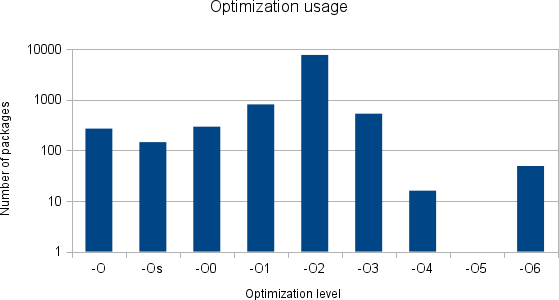
Following a thread on the Clang mailing list, I did a quick analysis of the optimization flags used to build C or C++ code. I used a rebuild result from last mid July of all Debian native packages (meaning that I don't have the log of full Java, Python or other packages without native code) and wrote a small script to count all their occurrences.
By default, deb packages uses the command "dpkg-buildflags --get CFLAGS" which will set the optimization level to -O2. However, many packages and upstream build systems do not respect such flags. On 10320 binary-only packages (in total, Debian has around 19000), the results are the following:
Optimization levelNumber of occurrencesNumber of packages
-O35597269
-Os30849145
-O013993294
-O125494809
-O29958037685
-O3106048531
-O4140216
-O500
-O6693549
Since a graphic talks more than numbers (note that the Y axis is logarithmic):
Disclaimer:
Some packages are using several optimization flags during the same build.
Some packages are not showing the full command line (see jessie release goal: verbose build logs)
The results might be approximate since I am basically grepping "-OX " on the log files.

Vincent Bernat: High availability with ExaBGP

When it comes to provide redundant services, several options are available: A common setup is a combination of those solutions: web servers are behind a couple of load-balancers achieving both redundancy and load-balancing. The load-balancers use VRRP to ensure redundancy. The whole setup is replicated to another datacenter and round-robin DNS is used to ensure both redundancy and load-balacing of the datacenters. There is a fourth option which is similar to VRRP but relies on dynamic routing and therefore is not limited to nodes in the same subnet: We will explore how to implement this fourth option using ExaBGP, the BGP swiss army knife of networking, in a small lab based on KVM. You can grab the complete lab from GitHub. ExaBGP 3.2.5 is needed to run this lab.

Environment We will be working in the following (IPv6-only) environment: Lab with three web nodes

BGP configuration BGP is enabled on ER2 and ER3 to exchange routes with peers and transits (only R1 for this lab). BIRD is used as a BGP daemon. Its configuration is pretty basic. Here is a fragment:
router id 1.1.1.2;
protocol static NETS   #  
  import all;
  export none;
  route 2001:db8::/40 reject;
 
protocol bgp R1   #  
  import all;
  export where proto = "NETS";
  local as 64496;
  neighbor 2001:db8:1000::1 as 64511;
 
protocol bgp ER3   #  
  import all;
  export all;
  next hop self;
  local as 64496;
  neighbor 2001:db8:1::3 as 64496;
 
First, in , we declare the routes that we want to export to our peers. We don t try to summarize them from the IGP. We just unconditonnaly export the networks that we own. Then, in , R1 is defined as a neighbor and we export the static route we declared previously. We import any route that R1 is willing to send us. In , we share everything we know with our pal, ER3, using internal BGP.

OSPF configuration OSPF will distribute routes inside the AS. It is enabled on ER2, ER3, DR6, DR7 and DR8. For example, here is the relevant part of the configuration of DR6:
router id 1.1.1.6;
protocol kernel  
   persist;
   import none;
   export all;
 
protocol ospf INTERNAL  
  import all;
  export none;
  area 0.0.0.0  
    networks  
      2001:db8:1::/64;
      2001:db8:6::/64;
     ;
    interface "eth0";
    interface "eth1"   stub yes;  ;
   ;
 
ER2 and ER3 inject a default route into OSPF:
protocol static DEFAULT  
  import all;
  export none;
  route ::/0 via 2001:db8:1000::1;
 
filter default_route  
  if proto = "DEFAULT" then accept;
  reject;
 
protocol ospf INTERNAL  
  import all;
  export filter default_route;
  area 0.0.0.0  
    networks  
      2001:db8:1::/64;
     ;
    interface "eth1";
   ;
 

Web nodes The web nodes are pretty basic. They have a default static route to the nearest router and that s all. The interesting thing here is that they are each on a separate IP subnet: we cannot share an IP using VRRP2. Why are those web servers on different subnets? Maybe they are not in the same datacenter or maybe your network architecture is using a routed access layer. Let s see how to use BGP to enable redundancy of those web nodes.

Redundancy with ExaBGP ExaBGP is a convenient tool to plug scripts into BGP. They can then receive and advertise routes. ExaBGP does the hard work of speaking BGP with your routers. The scripts just have to read routes from standard input or advertise them on standard output.

The big picture Here is the big picture: Using ExaBGP to advertise web services Let s explain it step by step:
  1. Three IP addresses will be allocated for our web service: 2001:db8:30::1, 2001:db8:30::2 and 2001:db8:30::3. Those are distinct from the real IP addresses of W1, W2 and W3.
  2. Each web node will advertise all of them to the route servers we added in the network. I will talk more about those route servers later.
  3. Each route comes with a metric to help the route server choose where it should be routed. We choose the metrics such that each IP address will be routed to a distinct web node (unless there is a problem).
  4. The route servers (which are not routers) will then advertise the best routes they learned to all the routers in our network. This is still done using BGP.
  5. Now, for a given IP address, each router knows to which web node the traffic should be directed.
Here are the respective metrics announced routes for W1, W2 and W3 when everything works as expected:
Route W1 W2 W3 Best Backup
2001:db8:30::1 102 101 100 W3 W2
2001:db8:30::2 101 100 102 W2 W1
2001:db8:30::3 100 102 101 W1 W3

ExaBGP configuration The configuration of ExaBGP is quite simple:
group rs  
  neighbor 2001:db8:1::4  
    router-id 1.1.1.11;
    local-address 2001:db8:6::11;
    local-as 65001;
    peer-as 65002;
   
  neighbor 2001:db8:8::5  
    router-id 1.1.1.11;
    local-address 2001:db8:6::11;
    local-as 65001;
    peer-as 65002;
   
  process watch-nginx  
      run /usr/bin/python /lab/healthcheck.py -s --config /lab/healthcheck-nginx.conf --start-ip 0;
   
 
A script is entailed to check if the service (an nginx web server) is up and running and advertise the appropriate IP addresses to the two declared route servers. If we run the script manually, we can see the advertised routes:
$ python /lab/healthcheck.py --config /lab/healthcheck-nginx.conf --start-ip 0
INFO[healthcheck] send announces for UP state to ExaBGP
announce route 2001:db8:30::3/128 next-hop self med 100
announce route 2001:db8:30::2/128 next-hop self med 101
announce route 2001:db8:30::1/128 next-hop self med 102
[...]
WARNING[healthcheck] Check command was unsuccessful: 7
INFO[healthcheck] Output of check command:  curl: (7) Failed connect to ip6-localhost:80; Connection refused
WARNING[healthcheck] Check command was unsuccessful: 7
INFO[healthcheck] Output of check command:  curl: (7) Failed connect to ip6-localhost:80; Connection refused
WARNING[healthcheck] Check command was unsuccessful: 7
INFO[healthcheck] Output of check command:  curl: (7) Failed connect to ip6-localhost:80; Connection refused
INFO[healthcheck] send announces for DOWN state to ExaBGP
announce route 2001:db8:30::3/128 next-hop self med 1000
announce route 2001:db8:30::2/128 next-hop self med 1001
announce route 2001:db8:30::1/128 next-hop self med 1002
When the service becomes unresponsive, the healthcheck script detect the situation and retry several times before acknowledging that the service is dead. Then, the IP addresses are advertised with higher metrics and the service will be routed to another node (the one advertising 2001:db8:30::3/128 with metric 101). This healthcheck script is now part of ExaBGP.

Route servers We could have connected our ExaBGP servers directly to each router. However, if you have 20 routers and 10 web servers, you now have to manage a mesh of 200 sessions. The route servers are here for three purposes:
  1. Reduce the number of BGP sessions (from 200 to 60) between equipments (less configuration, less errors).
  2. Avoid modifying the configuration on routers each time a new service is added.
  3. Separate the routing decision (the route servers) from the routing process (the routers).
You may also ask yourself: why not use OSPF? . Good question!
  • OSPF could be enabled on each web node and the IP addresses advertised using this protocol. However, OSPF has several drawbacks: it does not scale, there are restrictions on the allowed topologies, it is difficult to filter routes inside OSPF and a misconfiguration will likely impact the whole network. Therefore, it is considered a good practice to limit OSPF to network equipments.
  • The routes learned by the route servers could be injected into OSPF. On paper, OSPF has a next-hop field to provide an explicit next-hop. This would be handy as we wouldn t have to configure adjacencies with each router. However, I have absolutely no idea how to inject BGP next-hop into OSPF next-hop. What happens is that BGP next-hop is resolved locally using OSPF routes. For example, if we inject BGP routes into OSPF from RS4, RS4 will know the appropriate next-hop but other routers will route the traffic to RS4.
Let s look at how to configure our route servers. RS4 will use BIRD while RS5 will use Quagga. Using two different implementations will help with resiliency by avoiding a bug to hit the two route servers at the same time.

Bird configuration There are two sides for BGP configuration: the BGP sessions with the ExaBGP nodes and the ones with the routers. Here is the configuration for the later:
template bgp INFRABGP  
  export all;
  import none;
  local as 65002;
  rs client;
 
protocol bgp ER2 from INFRABGP  
  neighbor 2001:db8:1::2 as 65003;
 
protocol bgp ER3 from INFRABGP  
  neighbor 2001:db8:1::3 as 65003;
 
protocol bgp DR6 from INFRABGP  
  neighbor 2001:db8:1::6 as 65003;
 
protocol bgp DR7 from INFRABGP  
  neighbor 2001:db8:1::7 as 65003;
 
protocol bgp DR8 from INFRABGP  
  neighbor 2001:db8:1::8 as 65003;
 
The AS number used by our route server is 65002 while the AS number used for routers is 65003 (the AS numbers for web nodes will be 65001). They are reserved for private use by RFC 6996. All routes known by the route server are exported to the routers but no routes are accepted from them. Let s have a look at the other side:
# Only import loopback IPs
filter only_loopbacks   #  
  if net ~ [ 2001:db8:30::/64 128,128  ] then accept;
  reject;
 
# General template for an EXABGP node
template bgp EXABGP  
  local as 65002;
  import filter only_loopbacks; #  
  export none;
  route limit 10; #  
  rs client;
  hold time 6; #  
  multihop 10;
  igp table internal;
 
protocol bgp W1 from EXABGP  
  neighbor 2001:db8:6::11 as 65001;
 
protocol bgp W2 from EXABGP  
  neighbor 2001:db8:7::12 as 65001;
 
protocol bgp W3 from EXABGP  
  neighbor 2001:db8:8::13 as 65001;
 
To ensure separation of concerns, we are being a bit more picky. With and , we only accept loopback addresses and only if they are contained in the subnet that we reserved for this use. No server should be able to inject arbitrary addresses into our network. With , we also limit the number of routes that a server can advertise. With , we reduce the hold time from 240 to 6. It means that after 6 seconds, the peer is considered dead. This is quite important to be able to recover quickly from a dead machine. The minimal value is 3. We could have use a similar setting with the session with the routers.

Quagga configuration Quagga s configuration is a bit more verbose but should be strictly equivalent:
router bgp 65002 view EXABGP
 bgp router-id 1.1.1.5
 bgp log-neighbor-changes
 no bgp default ipv4-unicast
 neighbor R peer-group
 neighbor R remote-as 65003
 neighbor R ebgp-multihop 10
 neighbor EXABGP peer-group
 neighbor EXABGP remote-as 65001
 neighbor EXABGP ebgp-multihop 10
 neighbor EXABGP timers 2 6
!
 address-family ipv6
 neighbor R activate
 neighbor R soft-reconfiguration inbound
 neighbor R route-server-client
 neighbor R route-map R-IMPORT import
 neighbor R route-map R-EXPORT export
 neighbor 2001:db8:1::2 peer-group R
 neighbor 2001:db8:1::3 peer-group R
 neighbor 2001:db8:1::6 peer-group R
 neighbor 2001:db8:1::7 peer-group R
 neighbor 2001:db8:1::8 peer-group R
 neighbor EXABGP activate
 neighbor EXABGP soft-reconfiguration inbound
 neighbor EXABGP maximum-prefix 10
 neighbor EXABGP route-server-client
 neighbor EXABGP route-map RSCLIENT-IMPORT import
 neighbor EXABGP route-map RSCLIENT-EXPORT export
 neighbor 2001:db8:6::11 peer-group EXABGP
 neighbor 2001:db8:7::12 peer-group EXABGP
 neighbor 2001:db8:8::13 peer-group EXABGP
 exit-address-family
!
ipv6 prefix-list LOOPBACKS seq 5 permit 2001:db8:30::/64 ge 128 le 128
ipv6 prefix-list LOOPBACKS seq 10 deny any
!
route-map RSCLIENT-IMPORT deny 10
!
route-map RSCLIENT-EXPORT permit 10
  match ipv6 address prefix-list LOOPBACKS
!
route-map R-IMPORT permit 10
!
route-map R-EXPORT deny 10
!
The view is here to not install routes in the kernel3.

Routers Configuring BIRD to receive routes from route servers is straightforward:
# BGP with route servers
protocol bgp RS4  
  import all;
  export none;
  local as 65003;
  neighbor 2001:db8:1::4 as 65002;
  gateway recursive;
 
protocol bgp RS5  
  import all;
  export none;
  local as 65003;
  neighbor 2001:db8:8::5 as 65002;
  multihop 4;
  gateway recursive;
 
It is important to set gateway recursive because most of the time, the next-hop is not reachable directly. In this case, by default, BIRD will use the IP address of the advertising router (the route servers).

Testing Let s check that everything works as expected. Here is the view from RS5:
# show ipv6  bgp  
BGP table version is 0, local router ID is 1.1.1.5
Status codes: s suppressed, d damped, h history, * valid, > best, i - internal,
              r RIB-failure, S Stale, R Removed
Origin codes: i - IGP, e - EGP, ? - incomplete
   Network          Next Hop            Metric LocPrf Weight Path
*  2001:db8:30::1/128
                    2001:db8:6::11         102             0 65001 i
*>                  2001:db8:8::13         100             0 65001 i
*                   2001:db8:7::12         101             0 65001 i
*  2001:db8:30::2/128
                    2001:db8:6::11         101             0 65001 i
*                   2001:db8:8::13         102             0 65001 i
*>                  2001:db8:7::12         100             0 65001 i
*> 2001:db8:30::3/128
                    2001:db8:6::11         100             0 65001 i
*                   2001:db8:8::13         101             0 65001 i
*                   2001:db8:7::12         102             0 65001 i
Total number of prefixes 3
For example, traffic to 2001:db8:30::2 should be routed through 2001:db8:7::12 (which is W2). Other IP are affected to W1 and W3. RS4 should see the same thing4:
$ birdc6 show route 
BIRD 1.3.11 ready.
2001:db8:30::1/128 [W3 22:07 from 2001:db8:8::13] * (100/20) [AS65001i]
                   [W1 23:34 from 2001:db8:6::11] (100/20) [AS65001i]
                   [W2 22:07 from 2001:db8:7::12] (100/20) [AS65001i]
2001:db8:30::2/128 [W2 22:07 from 2001:db8:7::12] * (100/20) [AS65001i]
                   [W1 23:34 from 2001:db8:6::11] (100/20) [AS65001i]
                   [W3 22:07 from 2001:db8:8::13] (100/20) [AS65001i]
2001:db8:30::3/128 [W1 23:34 from 2001:db8:6::11] * (100/20) [AS65001i]
                   [W3 22:07 from 2001:db8:8::13] (100/20) [AS65001i]
                   [W2 22:07 from 2001:db8:7::12] (100/20) [AS65001i]
Let s have a look at DR6:
$ birdc6 show route
2001:db8:30::1/128 via fe80::5054:56ff:fe6e:98a6 on eth0 * (100/20) [AS65001i]
                   via fe80::5054:56ff:fe6e:98a6 on eth0 (100/20) [AS65001i]
2001:db8:30::2/128 via fe80::5054:60ff:fe02:3681 on eth0 * (100/20) [AS65001i]
                   via fe80::5054:60ff:fe02:3681 on eth0 (100/20) [AS65001i]
2001:db8:30::3/128 via 2001:db8:6::11 on eth1 * (100/10) [AS65001i]
                   via 2001:db8:6::11 on eth1 (100/10) [AS65001i]
So, 2001:db8:30::3 is owned by W1 which is behind DR6 while the two others are in another part of the network and will be reached through the appropriate link-local addresses learned by OSPF. Let s kill W1 by stopping nginx. A few seconds later, DR6 learns the new routes:
$ birdc6 show route
2001:db8:30::1/128 via fe80::5054:56ff:fe6e:98a6 on eth0 * (100/20) [AS65001i]
                   via fe80::5054:56ff:fe6e:98a6 on eth0 (100/20) [AS65001i]
2001:db8:30::2/128 via fe80::5054:60ff:fe02:3681 on eth0 * (100/20) [AS65001i]
                   via fe80::5054:60ff:fe02:3681 on eth0 (100/20) [AS65001i]
2001:db8:30::3/128 via fe80::5054:56ff:fe6e:98a6 on eth0 * (100/20) [AS65001i]
                   via fe80::5054:56ff:fe6e:98a6 on eth0 (100/20) [AS65001i]

Demo For a demo, have a look at the following video (it is also available as an Ogg Theora video).

  1. The primary target of VRRP is to make a default gateway for an IP network highly available by exposing a virtual router which is an abstract representation of multiple routers. The virtual IP address is held by the master router and any backup router can be promoted to master in case of a failure. In practice, VRRP can be used to achieve high availability of services too.
  2. However, you could deploy an L2 overlay network using, for example, VXLAN and use VRRP on it.
  3. I have been told on the Quagga mailing-list that such a setup is quite uncommon and that it would be better to not use views but use --no_kernel flag for bgpd instead. You may want to look at the whole thread for more details.
  4. The output of birdc6 shows both the next-hop as advertised in BGP and the resolved next-hop if the route have to be exported into another protocol. I have simplified the output to avoid confusion.

Marko Lalic: PTS User Accounts

PTS User AccountsDuring the last iteration, the PTS rewrite has grown user accounts! This is a major addition, which moves the GSoC project beyond a simple "rewrite".

As always, this feature is available to be tested at the running PTS demo instance found at http://pts.debian.net.

For the moment the features related to user accounts allow for Web-oriented package subscription management. This means that the user can achieve the same functionality as what is offered by the control commands accessible over the control mail interface (control@pts.debian.net).

This includes subscribing to a package directly from the package page by clicking a single button; no confirmation mail required. Users are able to see a list of all their subscriptions and associated keywords, modify their default keywords and subscription-specific keywords all through a single profile page.

Eventually, a user is going to be able to associate multiple email addresses with his account and manage subscriptions for each of them from the same central panel. Actually, all currently existing functionality has already been implemented with this in mind and is backed by extensive Selenium-driven functional tests. This story is found in the backlog and is to be worked on in the last week of GSoC.

Another interesting, albeit Debian-specific, feature that is in the pipeline is allowing Debian Developers to authenticate via sso.debian.org: no PTS-specific registration/passwords required!

Besides package subscription management, introducing user accounts to the PTS opens up interesting possibilities for future development. Perhaps things like personalized package pages, a private stream of notifications in the user's profile... Hopefully, there are members of the community interested in exploring some of them.

PTS Rename?As the scope of the project begins to encompass more and more previously nonexisting functionality and in doing so even starts engulfing some other existing services (an example is that the PTS can now automatically extract and serve some source package files, e.g. debian/copyright)., an idea has been floating around to rename it. The question becomes: what would a good name be? No decision has been made as of yet, so suggestions and opinions are welcome.

5 September 2013

Vincent Sanders: Strive for continuous improvement, instead of perfection.


Kim Collins was perhaps thinking more about physical improvement but his advice holds well for software.

A lot has been written about the problems around software engineers wanting to rewrite a codebase because of "legacy" issues. Experience has taught me that refactoring is a generally better solution than rewriting because you always have something that works and can be released if necessary.

Although that observation applies to the whole of a project, sometimes the technical debt in component modules means they need reimplementing. Within NetSurf we have historically had problems when such a change was done because of the large number of supported platforms and configurations.
HistoryA year ago I implemented a Continuous Integration (CI) solution for NetSurf which, combined with our switch to GIT for revision control, has transformed our process. Making several important refactor and rewrites possible while being confident about the overall project stability.

I know it has been a year because the VPS hosting bill from Mythic turned up and we are still a very happy customer. We have taken the opportunity to extend the infrastructure to add additional build systems which is still within the NetSurf projects means.

Over the last twelve months the CI system has attempted over 100,000 builds including the projects libraries and browser. Each commit causes an attempt to build for eight platforms, in multiple configurations with multiple compilers. Because of this the response time to a commit is dependant on the slowest build slave (the mac mini OS X leopard system).

Currently this means a browser build, not including the support libraries, completes in around 450 seconds. The eleven support libraries range from 30 to 330 seconds each. This gives a reasonable response time for most operations. The worst case involves changing the core buildsystem which causes everything to be rebuilt from scratch taking some 40 minutes.

The CI system has gained capability since it was first set up, there are now jobs that:
DownsidesIt has not all been positive though, the administration required to keep the builds running has been more than expected and it has highlighted just how costly supporting all our platforms is. When I say costly I do not just refer to the physical requirements of providing build slaves but more importantly the time required.

Some examples include:
  • Procuring the hardware, installing the operating system and configuring the build environment for the OS X slaves
  • Getting the toolchain built and installed for cross compilation
  • Dealing with software upgrades and updates on the systems
  • Solving version issues with interacting parts, especially limiting is the lack of JAVA 1.6 on PPC OS X preventing jenkins updates
This administration is not interesting to me and consumes time which could otherwise be spent improving the browser. Though the benefits of having the system are considered by the development team to outweigh the disadvantages.

The highlighting of the costs of supporting so many platforms has lead us to reevaluate their future viability. Certainly the PPC mac os X port is in gravest danger of being imminently dropped and was only saved when the build slaves drive failed because there were actual users.

There is also the question of the BeOS platform which we are currently unable to even build with the CI system at all as it cannot be targeted for cross compilation and cannot run a sufficiently complete JAVA implementation to run a jenkins slave.

An unexpected side effect of publishing every CI build has been that many non developer user are directly downloading and using these builds. In some cases we get messages to the mailing list about a specific build while the rest of the job is still ongoing.

Despite the prominent warning on the download area and clear explanation on the mailing lists we still get complaints and opinions about what we should be "allowing" in terms of stability and features with these builds. For anyone else considering allowing general access to CI builds I would recommend a very clear statement of intent and to have a policy prepared for when when users ignore the statement.
Tools
Using jenkins has also been a learning experience. It is generally great but there are some issues I have which, while not insurmountable, are troubling:
Configuration and history cannot easily be stored in a revision control system.
This means our system has to be restored from a backup in case of failure and I cannot simply redeploy it from scratch.

Job filtering, especially for matrix jobs with many combinations, is unnecessarily complicated.
This requires the use of a single text line "combination filter" which is a java expression limiting which combinations are built. An interface allowing the user to graphically select from a grid similar to the output tables showing success would be preferable. Such a tool could even generate the textural combination filter if thats easier.

This is especially problematic of the main browser job which has options for label (platform that can compile the build), javascript enablement, compiler and frontend (the windowing toolkit if you prefer e.g. linux label can build both gtk and framebuffer). The filter for this job is several kilobytes of text which due to the first issue has to be cut and pasted by hand.

Handling of simple makefile based projects is rudimentary.
This has been worked around mainly by creating shell scripts to perform the builds. These scripts are checked into the repositories so they are readily modified. Initially we had the text in each job but that quickly became unmanageable.

Output parsing is limited.
Fortunately several plugins are available which mitigate this issue but I cannot help feeling that they ought to be integrated by default.

Website output is not readily modifiable.
Instead of perhaps providing a default css file and all generated content using that styling someone with knowledge of JAVA must write a plugin to change any of the look and feel of the jenkins tool. I understand this helps all jenkins instances look like the same program but it means integrating jenkins into the rest of our projects web site is not straightforward.
ConclusionIn conclusion I think the CI system is an invaluable tool for almost any non trivial software project but the implementation costs with current tools should not be underestimated.

Keith Packard: Airfest-altimeter-testing

Altimeter Testing at Airfest Bdale and I, along with AJ Towns and Mike Beattie, spent last weekend in Argonia, Kansas, flying rockets with our Kloudbusters friends at Airfest 19. We had a great time! AJ and Mike both arrived a week early at Bdale s to build L3 project airframes, and both flew successful cert flights at Airfest! Airfest was an opportunity for us to test fly prototypes of new flight electronics Bdale and I have spent the last few weeks developing, and I thought I d take a few minutes today to write some notes about what we built and flew. TeleMega We ve been working on TeleMega for quite a while. It s a huge step up in complexity from our original TeleMetrum, as it has a raft of external sensors and six pyro circuits. Bdale flew TeleMega in his new fiberglass 4 airframe on a Loki 75mm blue M demo motor. GPS tracking was excellent; you can see here that GPS altitude tracked the barometric sensor timing exactly: GPS lost lock when the motor lit, but about 3 seconds after motor burnout, it re-acquired the satellite signals and was reporting usable altitude data right away. The GPS reported altitude was higher than the baro sensor, but that can be explained by our approximation of an atmospheric model used to convert pressure into altitude. The rest of the flight was also nominal; TeleMega deployed drogue and main chutes just fine. TeleMetrum We ve redesigned TeleMetrum. The new version uses better sensors (MS5607 baro sensor, MMA6555 accelerometer) and a higher power radio (CC1120 40mW). The board is the same size, all the connectors are in the same places so it s a drop-in replacement, and it s still got two pyro channels and USB for configuration, data download and battery charging. I loaded up my Candy-Cane airframe with a small 5 grain 38mm CTI classic: The flight computer worked perfectly, but GPS reception was not as good as we d like to see: Given how well TeleMega was receiving GPS signals, I m hopeful that we ll be able to tweak TeleMetrum to improve performance. TeleMini We ve also redesigned TeleMini. It s still a two-channel flight computer with logging and telemetry, but we ve replaced the baro sensor with the MS5607, added on-board flash for increased logging space and added on-board screw terminals for an external battery and power switch. You can still use one of our 3.7V batteries, but you can also use another battery providing from 3.7 to 15V. I was hoping to finish up the firmware and fly it, but I ran out of time before the launch. The good news is that all of the components of the board have been tested and work correctly, and the firmware is feature complete , meaning we ve gotten all of the features coded, it s just not quite working yet. EasyMini EasyMini is a new product for us. It s essentially the same as a TeleMini, but without a radio. Two channels, baro-only, with logging. Like TeleMini, it includes an on-board USB connector and can use either one of our 3.7V batteries, or an external battery from 3.7V to 15V. EasyMini and TeleMini are the same size, and have holes in the same places, so you can swap between them easily. I flew EasyMini in my Koala airframe with a 29mm 3 grain CTI blue-streak motor. EasyMini successfully deployed the main chute and logged flight data: We also sent a couple of boards home with Kevin Trojanowski and Greg Rothman for them to play with. TeleGPS TeleGPS is a GPS tracker, incorporating a u-blox Max receiver and a 70cm transmitter. It can send position information via APRS or our usual digital telemetry formats. I was also hoping to have the TeleGPS firmware working, and I spent a couple of nights in the motel coding, but didn t manage to finish up. So, no data from this board either. Production Plans Given the success of the latest TeleMega prototype, we re hoping to have it into production first. We ll do some more RF testing on the bench with the boards to make sure it meets our standards before sending it out for the first production run. The goal is to have TeleMega ready to sell by the end of October. TeleMetrum clearly needs work on the layout to improve GPS RF performance. With the testing equipment that Bdale is in the midst of re-acquiring, it should be possible to finish this up fairly soon. However, the flight firmware looks great, so we re hoping to get these done in time to sell by the end of November. TeleMini is looking great from a hardware perspective, but the firmware needs work. Once the firmware is running, we ll need to make enough test flights to shake out any remaining issues before moving forward with it. EasyMini is also looking finished; I ve got a stack of prototypes and will be getting people to fly them at my local launch in another couple of weeks. The plan here is to build a small batch by hand and get them into the store once we re finished testing, using those to gauge interest before we pay for a larger production run.

3 September 2013

Julien Danjou: Announcing The Hacker Guide to Python

I've been hacking on Python for a lot of years now, on various project. For the last two years, I've beenheavily involved in OpenStack, which makes an heavy usage of Python. Once you start working with a hundred of hackers, on several software and libraries representing more than half a million source lines of Python, things change. The scalability, testing and deployment problems inherent to a cloud platform meddle with everything in designing components. During these two years working on OpenStack development, I've learned a lot on Python from astounding Python hackers. From general architecture and design principles to various tips and tricks of the language. It seemed to me like a good opportunity to share what I learnt doing so with others so you can benefit from it in other projects. I've started working a book, entitled "The Hacker Guide to Python", where I will try to share what I learnt while working with Python. The book is still a work in progress at this stage, but if you'd like to get in touch and keep updated on its advancement, you can subscribe in the following form or from the book homepage.
The Hacker Guide to Python
A book I'm writing that will be launched soon, talking about designing Python applications, state of the art, and various Python tips. If you want to be the first to hear about the launch, subscribe now.

Clint Adams: Apropos of nothing

I might switch to a FirefoxOS phone on Wednesday.

2 September 2013

Daniel Pocock: Australia's Labor Party exposed spying on their own members

Australia's Labor Party claims to represent the little guy, advocating the interests of a wide slice of the population over the interests of those who might supposedly exploit them. In this latest blog I'll look at just how the Victorian state branch of the party is emulating the more sinister elements of monitoring and control that you would typically expect from marketers, spammers and the NSA. It makes you wonder, if they do this to their own members, how can Australia's government ever hope to rein in spammers or other undesirable practices? Europe has tried cookie laws and the right to be forgotten, while the ALP has taken these developments almost as a guide to exploiting their own most valuable resource, their membership. The email version of invisible ink Straight out of an email attempting to recruit party members to the federal election campaign, we find that the ALP's logo itself has been turned into a sinister tracking mechanism. Looking underneath the logo, there is a hidden tracking number attached to every message:
http://gallery.mailchimp.com/3021e68df9a7200135725c633/images/Email_Header_ThisisLabor.jpg
There it is, that big long code 3021e68df9a7200135725c633. On it's own, you may think this number can't do much harm. Think again. After all, as the filename says, "ThisisLabor". Reaching the grass roots by long distance email When a party member sees any of the images in the email or clicks any of the links, their email software or web browser sends a HTTP request to the ALP's outsourced tracking server in the United States. Here is an example of what that request may contain:
TCP Headers:
  SOURCE IP ADDRESS: 198.51.100.56
HTTP headers:
  GET /3021e68df9a7200135725c633/images/Email_Header_ThisisLabor.jpg
  HTTP/1.1
  Host: gallery.mailchimp.com
  User-Agent: Mozilla/5.0 (X11; Linux x86_64; rv:17.0) Gecko/20130515 Firefox/17.0 Iceweasel/17.0.6
  Accept: text/html,application/xhtml+xml,application/xml;q=0.9,*/*;q=0.8
  Accept-Language: en-US,en;q=0.5
  Accept-Encoding: gzip, deflate
  X-Forwarded-For: 192.168.1.54
  Connection: keep-alive
These codes are all transmitted from the recipient of the email back to the ALP. Notice the tracking number is in the very first line of the HTTP request? These codes send many details to the tracking server. Just what is revealed?
  • What time the message was read
  • How many times the message was opened
  • Whether the message was read on multiple computers (perhaps it was forwarded)
  • The IP addresses reveal which network was used.
    • For people reading email at work or on wifi, the IP address reveals the name of the employer, it can be easily looked up in this public database. Here is an example querying one of the ALPs own IP addresses, 203.24.72.2
    • For people using an internet connection at home, the IP address reveals the service provider. There is more to it though: if one party member regularly visits another party member and uses their wifi, they will both appear to be using the same IP address and the party will be able to deduce that there is a connection between these two people.
  • The web browser name and version and the operating system name and version.
  • The language normally used on the computer
Crunching the numbers You may think that nobody would be interested in all that data or that it is even too much data for anybody to easily study. Think again. The ALP has outsourced processing of this data to an offshore firm that specializes in bulk email, MailChimp. After lecturing everybody about the dangers of outsourcing, the ALP has literally sold the farm (their own membership data) - to a foreign marketing company. Here are some of the claims MailChimp make on their web site:
"Dig even deeper with Subscriber Activity Reports, which give you a real time report for every subscriber s email activities: when they opened, what they clicked, and when they came back for more. You can even generate a list of people who didn t open, and send them a modified campaign."
That's right: if ALP members don't read their emails fast enough, they will send even more of them. Just who has access to this data? Well, the scope is quite broad. According to these rules, it is not only the dubious officials in the party's state office, but Labor Party regulations also list a whole lot of other officials who have access to some subset of the data: branch and FEA district committees, policy committees and maybe some trade union officials too. Once you start to contemplate this, it becomes apparent that the probability of somebody profiling members at an individual level is very real. On the other hand, those rules clearly do not permit the state branch to process the member's data offshore. Double whammy In fact, even MailChimp is further outsourcing the data. When receiving an image from the booby-trapped link in the email, we receive a response like this:
HTTP/1.1 200 OK
Content-Type: image/jpeg
Content-Length: 407474
Connection: keep-alive
Date: Wed, 10 Jul 2013 06:25:55 GMT
Last-Modified: Tue,  03 Sep 2013 04:05:37 GMT
ETag: "df9a7200135725c6331369a22"
Accept-Ranges: bytes
Server: AmazonS3
Age: 62097
Via: 1.0 e71fe855f29513f54a41e213fe653fb1.cloudfront.net (CloudFront)
X-Cache: Hit from cloudfront
X-Amz-Cf-Id: S2V2aW4gUnVkZCBpcyBhIGJhZCBib3kuCg==
which contains more tracking numbers and clearly indicates that the data is being processed in the massive AmazonS3 (a.k.a Amazon online bookstore) cloud platform. Thanks to cloud computing, there is considerable scope for cross-referencing records across other web sites. The IP address becomes a magic key, allowing a range of sinister forces to join the dots at the click of a button and profile the whole private and professional identity of any individual ALP member. Googling ALP members It doesn't stop there however, after following these links a victim will eventually end up on one of the ALP's own web pages. Looking through the HTML code underneath http://www.viclabor.com.au is very easy, in most web browsers, you can just press Control-U to see what is hidden away in the shadows. Buried in the code, I found this little gem:
  var _gaq = _gaq   [];
  _gaq.push(['_setAccount', 'UA-35325645-1']);
  _gaq.push(['_trackPageview']);
  (function()  
    var ga = document.createElement('script'); ga.type = 'text/javascript'; ga.async = true;
    ga.src = ('https:' == document.location.protocol ? 'https://ssl' : 'http://www') + '.google-analytics.com/ga.js';
    var s = document.getElementsByTagName('script')[0]; s.parentNode.insertBefore(ga, s);
   )();
This may be even scarier: it's a JavaScript code that channels all access to the ALP web site into an outsourced tracking system provided by Google. Google can now cross-reference ALP members against their Gmail accounts, their friends and the topics they search for to further profile the type of advertising they should be exposed to. Google, like any private company, has a loyalty to its shareholders and the laws of the country where it is domiciled. Will that coincide with the best interests of ALP members in Victoria? Australia's other parties: samples needed Do you have similar communications from Australia's other political parties? Please send them to me and I'll be happy to examine them for similar shortcomings.

1 September 2013

Rapha&#235;l Hertzog: My Free Software Activities in August 2013

This is my monthly summary of my free software related activities. If you re among the people who made a donation to support my work (47.50 , thanks everybody!), then you can learn how I spent your money. Otherwise it s just an interesting status update on my various projects. Package Tracking System There are only 2-3 weeks left in the summer of code project dedicated to rewrite the package tracking system. We have come a long way during August check it out yourself in pts.debian.net. The rewrite doesn t have all the features of the old PTS yet, but I opted to keep some of the easy and less interesting features for others to re-implement. Instead I asked Marko to work in the coming weeks on new features that will bring more value, like the possibility to have user accounts with the possibility to easily review and tweak all your subscriptions on the web, and like the possibility to subscribe to groups of packages (i.e. those managed by a team). Our main problem right now is that exim has a pretty poor default behavior of forking hundreds of processes if you get hundreds of mails (in a batch) to an address that delivers via a pipe (postfix is saner, it serializes the deliveries on pipes). The new PTS is much more modular and its memory footprint is bigger (about 3 times more for the process that delivers mails, 30Mb instead of 10Mb), and in such a situation we managed to run out of memory for now we worked around the situation with an exim setting that queues mails once the load gets too high but it s a poor workaround IMO. We could obviously implement our own queue and a daemon but I d like to avoid this. So who knows how to tell exim to behave? :-) On the positive side, Marko has gotten some feedback from people who like the new PTS and are using it daily already. And several persons have expressed their interest to work on the new codebase already. On my side, I created a package so that it s easy to deploy for derivatives. In this process, I revamped the way we manage the Django settings (for development and for production). The package is not finished yet, but it s mostly usable already. But I still want to do some cleanup/refactoring in the models before others start deploying it. We must also enable South to make it possible to upgrade easily afterwards. DebConf 13 in Vaumarcus From August 10th to 17th, I was attending DebConf 13. It matched the only week of vacation that my wife had this summer so we went there with the whole family (that is with a 3 years old son, and 6 months old one). Thus I could not immerse myself in Debconf and missed all the nice things that happen outside of the talk rooms. I picked 3-4 interesting talks per day and I spent the rest with my family. On the positive side, I was pleased that my wife could meet (or at least see) some other Debian people. She knows quite a few (of you) by name because I have been telling her Debian stories for years now Debian France Debian France sold quite some merchandise during Debconf but I didn t take care of that. It was supervised by Sylvestre Ledru but fortunately he got the help of multiple persons, both to bring everything there, to sell it, and to bring back the rest. The good news of the month is that the upstream author of galette published a new version with all the features that we ordered him a few months ago. We send now automatic reminders to members who must renew their subscription, we have automatic update of our accounting books (in a ledger file in a git repository) when we people donate or pay their subscription via the paypal form on our website. I was so pleased to finally have this that I took some hours to finalize the packaging of galette, so that it could be uploaded to Debian. It s now waiting in the NEW queue. I also spent multiple hours to write the python script that is executed by galette and that updates the accounting files. Misc Debian stuff Debian Packaging. I did two uploads of logidee-tools to fix bugs #718671 and #718836. I created a package for Dolibarr a PHP-based CRM and ERP software (it doesn t do accounting however), it s sitting in the NEW queue for almost a month already. I forwarded #719000 to the upstream Publican developers. I filed #720393 to request a new upstream version of libphp-mailer. git-multimail. After its deployment on Alioth last month, Niels Thykier reported me a case where it lead to bounces, I filed this as a new upstream ticket and in fact I fixed it myself a few days after. I got the fixed version installed on Alioth. dpkg. I investigated why the the automatic builds of dpkg were no longer happening and asked Michael Prokop if he could install a newer version of gettext in the build chroot. He told me that he would need a backport for that so I asked Santiago Vila if he was willing to provide it and he kindly accepted. A few days after, the package was in backports and I m now again running the latest dpkg out of git thanks to the nice service provided by Michael. Misc discussions. The thread about user planets drifted into a discussion of how to avoid promotional posts on such planets and in that context someone again brought up the Debian Machine Usage Policy as a way to shut down any kind of (self-)promotional content on planet if there s money involved. This always irritates me and this time I opted to ask James Troup about the origin of that clause in the DMUP. So who is willing to work with DSA to fix the DMUP so that people stop abusing it in contexts where it doesn t make sense? I also participated in some discussions concerning dgit. I like the ideas behind the tool, but I m saddened by the behavior of Ian Jackson. I helped him to fill his gap of knowledge about new sources formats but he keeps on bashing about the 3.0 (quilt) source format both in the manual page and in the output of the program. He believes that dgit is no longer an experiment but the truth is that it s still a poorly commented Perl script doing lots of hackish things. Kali Linux Between Debconf and all, I haven t done much for Kali except a couple of fixes. There s a nice story of how I tracked a bug in live-installer on the Kali blog. That fix has been committed to Debian. I also improved live-build to include xfsprogs/jfsutils on the ISO image when you include the debian-installer (so that you don t end up in problems when you pick JFS or XFS as file systems for your installation). Thanks See you next month for a new summary of my activities.

One comment Liked this article? Click here. My blog is Flattr-enabled.

Andrew Pollock: [life] My first Bridge to Brisbane

One of the goals I set for myself on returning to Brisbane was running in the Bridge to Brisbane. The City2South run ended up being a longer distance, sooner, so I only stuck with the Bridge to Brisbane so I could say I'd done it. The added variable was I had Zoe, and I was pushing her in a jogging stroller. I did a couple of practice runs up the bridge with Zoe in the weeks leading up to the run. Mostly to get her used to it, and for me to get a feel for what the incline was like. I found I had the stamina to easily do the bridge, but ran out of steam on the return leg. No big deal, I didn't need to do that for the real run. I did a poor job of publicising that I was doing the run, so I didn't end up raising a whole lot of money for my chosen charity, beyondblue, because I had the added variable of Zoe. I knew I had to get her up early to get to the start line in time, and I wasn't sure if she was going to be cooperative or not, or whether she'd have a tantrum half way through the run and I'd have to stop, so I didn't feel good about taking money from people for running a run that I wasn't sure I could complete. My main concern had been getting to the starting line in time. I wanted to take the train from Morningside to Murarrie and then walk to the start line (about 10 minutes) because that way I could take the train back to Morningside from the finish to collect the car and not have to worry about trying to get back to the start. That meant I'd have to get Zoe up before 5am to get to the station, and if she didn't cooperate, I'd miss the train, and it'd all be over. Fortunately, my cousin Renata offered to drop us off, and we did a complicated car switcharoo, which involved her leaving my car at Morningside station for me after dropping us off at Murarrie. Now that I've seen the road closure situation, I feel pretty confident that I could have just driven to Murarrie and ditched the car somewhere there. Interestingly, a train that was packed to the rafters with people was arriving at the station at the time we arrived to leave Renata's car there. I'm not sure if it was the 5:07am train running late, or if I'd mis-interpreted the timetable and there was a later train we could have more comfortably made without Renata's assistance. Anyway, we uneventfully got to Murarrie station by about 5:40am, and walked to the start. It was ridiculously packed. People as far as the eye could see. Apparently there were 29,479 entrants and 24,596 finishers in the 10km run, so that explains it. I was seeded in the "joggers" group, which was a fair way back from the start line, and as it was, technically had to walk around some massive barrier to get in with the runners, but I snuck in the side after the pack started moving. Zoe was really, really good for the whole run. I couldn't have asked for her to be better behaved, really. She was wanting a cuddle at the top of the bridge, and claimed she wanted to go to the toilet the first time she saw some portable toilets, but easily talked out of both. My strategy of having a broad array of snacks for her to eat during the run worked well to keep her happy, and the course was heavily packed the entire way, so she had plenty to look at. It was a nice father/daughter thing to do for Fathers Day. My official time was 57:28, which I'm extremely happy with, given the conditions I ran under. I was going to be happy with anything under an hour. My personal best for 10km (not that course) is 51:52 I'm very grateful to those people who did donate some money on short notice. I've managed to raise $180, which is better than nothing. Now that I've done the run, and seen how it works, I'm game to try it again next year, and I'm game to do more 10km runs with Zoe. My running overall has been going very well, and so I think it's time to step things up a bit and I've decided to set myself a goal of running the half-marathon in the Gold Coast Marathon next year.

Russ Allbery: Review: An Artificial Night

Review: An Artificial Night, by Seanan McGuire
Series: October Daye #3
Publisher: DAW
Copyright: September 2010
ISBN: 1-101-44276-X
Format: Kindle
Pages: 368
This is the third book of the October Daye series, following A Local Habitation. It could be read out of order, as each chapter of Toby's story so far is somewhat standalone, but I wouldn't recommend it. You'd miss the character development and the background behind several friendships. As with the previous book review, a caveat: I am reviewing this book four months after finishing it, rather than the normal couple of weeks, so apologies in advance for any thinness or inaccuracies. The first sign that something is about to go seriously wrong in Toby's life this time is a visitor. She says her name is May Daye, and apparently she's Toby's Fetch: a duplicate in nearly every respect except personality, manifested to guide someone to their death. Their imminent death. The second sign is that her best friend's children are kidnapped. The children who treat her like an aunt. And the cause of that kidnapping is far, far beyond the level of power that Toby could be expected to deal with. I have profound mixed feelings about this book. On one hand, McGuire further expands Toby's web of connections and shows us more of Toby's friends and their background, and that's becoming my favorite part of this series. She introduces May, who I think is a great character: at first apparently much different than Toby, but with a similarity beneath surface impressions that one notices more over time. And I thought the climax of the story, once we finally got there, was very moving and well-done. Also, I just love the way that McGuire uses children's rhymes and doggerel throughout this series as a magical element, and that's particularly well-handled here. Due to the nature of the antagonist, McGuire has a good excuse to bring that front and center, and the process of familiar rhymes expanding into deep magical rules was a fun intellectual experience. Best of all, the Luidaeg plays a significant role in the story again. The Luidaeg is, hands down, my favorite character in McGuire's constructed universe, and she becomes even more so over the course of this story. Her complex relationship with Toby is clearly blossoming into a friendship that's surprising both of them deeply, but a friendship that has to play by an odd set of rules (like so much else in Toby's life). I loved her here. Seeing someone that difficult and abrupt show unexpected emotional depths is one of the story elements I enjoy the most. The problem, though, is that quite a lot of An Artificial Night is very, very dark. And by that, I don't mean that there is a lot of tension, or that Toby is struggling against monsterous things, although both of those statements are also true. Rather, Toby is not only out of her league but ends up in some viciously nasty situations, and they persist for rather more of this book than I would have preferred. Putting one's protagonist through hell has a long tradition in urban fantasy, but I found the level of sheer helplessness that Toby struggled through to be a bit more than I wanted to read about. It was too reminiscent of events from Toby's background (as discussed in Rosemary and Rue) that I still don't like to think about. There is, of course, an eventual payoff, as dark as the interim events seem. One knows that, given the genre and given that this is an ongoing series, and even just given the nature of stories. But as much as I like the growing cast of this series, and adored the scenes with the Luidaeg, I found parts of this journey to be deeply disturbing, and not in an enjoyable dramatic tension sort of way. I don't mind protagonists being seriously hurt (although it's not my favorite plot), or even some amount of despair, but this went beyond that. I think McGuire was going for a story about sacrifice and self-definition, about trying even when one can't possibly win, and I can appreciate the narrative arc. But parts of the book were simply awful to read for me. I'm therefore not quite sure what to say in terms of a recommendation. I'm still reading the series, and will definitely read the next book. I think my reaction is somewhat idiosyncratic; the events here will probably not bother others as much as they bothered me. And I can't disagree with their dramatic effectiveness, or with the way that McGuire builds conflict out of the rules of fairy and is building Toby into a stronger and more capable person than she ever thought she could be. But there were still spots where I wished I were reading a different book. Hopefully the next book in the series will be that book I wanted to read. Followed by Late Eclipses. Rating: 6 out of 10

31 August 2013

Christian Perrier: DebConf 13: running outcome

This DebConf has been the first one where I ran every day. That proved to be kinda hard on some mornings, but I found a way to circumvent that by proposing group runs at the end of the relevant days. In total, I managed to run 12 days in a row, for a grand total of 186.88km, in 21h22', for a total height difference of 6972m. In short, I nearly climbed Mount Aconcagua, Americas highest peak..:-) Most of these runs were quite slow ones and rather "short" ones (around 15km), because of the nature of the paths around (nearly impossible to find something flat except by running around the football field). The longest run was for the DayTrip, with about 25km in about 4 hours (including some pauses) and 1600m height difference. I'm definitely working on my moutain running skills more than marathon and other kind of "speed" races. That followed a great results for my last race, the "EDF Cenis Tour" 50km trail race in Lanslebourg, French Alps, where I completed the race in 6h38, nearly the sametime than Mont-Blanc marathon, 1 month earlier....which was 8 kilometers shorter. I'm apparently ready for very long distance mountain races, now, as it seems. Thanks you DebConf 13 organizers for choosing such a great locations for us, crazy runners. And, despite that, my next running goal is a "classical" marathon, the Toulouse marathon in late October, where I expect breaking the 3h30 barrier, that would indeed be a qualifier for the Boston Marathon, one of my dreams for the future (and, yes, it is still a dream, despite this year's events).

30 August 2013

Joey Hess: best DebConf ever

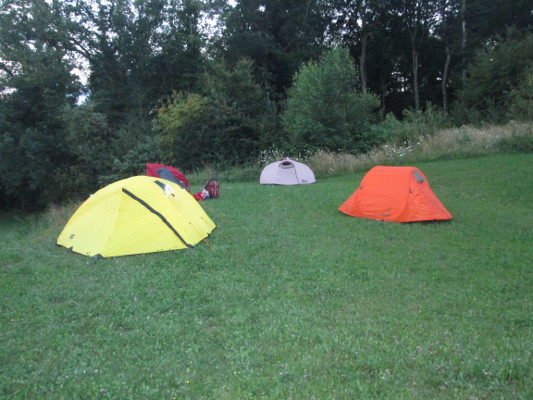
For me, DebConf13 in Switzerland was a perfect DebConf, and generally an great developer meeting and conference. I've attended several past DebConfs in Canada, Norway, Brazil, Finland, Mexico, Scotland, Spain, NYC, Bosnia, and Nicaragua. I have special memories of each. DebConf13 was ideal in every way. Let's start with the camping. Only a minority of us did it, and my campsite was located in a small field behind a bar that was often noisy late into the night, when I was trying to rest and preserve my European jetlag remedy of inverted sleeping schedule. Still, I love sleeping cocooned in a tent, and going through the routines of camping and spending time alone there was a good counterpoint to DebConf. I generally find myself retreating for a day or two in the middle of a week-long conference, burnt out with social interactions. That didn't happen this time. I need to find way to camp at future DebConfs. (Also special shout out to wonderful people who lent me a warmer sleeping bag, and bought me a pillow while on a trip to town! Upgraded my first backpacking in Europe experience's comfort level a lot!) The next perfect thing for me were the talks I gave at DebConf. I always enjoy presenting at DebConf, and barely remember when I'd get nervous doing it. But I really felt comfortable giving these talks in a way I've not before. I'm pleased with how the Debian Cosmology talk turned out; I'd worried it would be a downer talk, or too light, or not well received, and none of those problems surfaced. I was especially happy with my dh_busfactor session, which I prepared for all of 10 minutes and was structured entirely to benefit me by talking over my thoughts and getting feedback, and in which I probably drove the camerapeople crazy running my own mic into the audience. Despite all that, I think it succeeded being interesting for the participants as well as for me. Hope to follow up on it soon.. But beyond the two talks I submitted, there were a series of ad-hoc scheduled talks. It seemed that every day I spent at least an hour discussing something I'm deeply involved in. This started with the Ikiwiki bof, and then there was an epic series of (unrecorded) BoFs about git stuff, which basically turned into an unofficial git track at DebConf. Much, much discussion of git-annex and other things I'm involved in. BTW, I really like that DebConf, as well as being a formal conference on top, is really an un-conference underneath, with new BoFs and things popping up on the schedule all week long. You can even have completely unscheduled meetings that somehow get just the right mix of people to make something awesome happen.
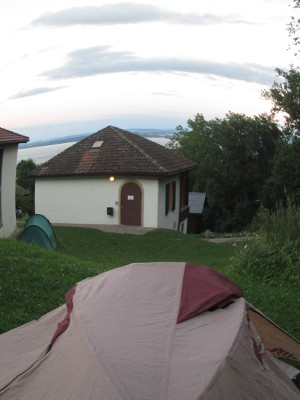
But it wasn't all about talks. Indeed, I only attended 2 or 3 sessions a day. The DebConf13 venue was controversial, but I found it excellent for getting things done. Rather than one or two massive rooms that get too noisy to think in, this venue had many little nooks and crannies suited for different types of work. There were so many I only discovered some while walking down the hill as I was leaving the venue! Anchoring it all was the excellent view, and I particularly enjoyed the "scenic hacklab". I was particularly impressed with the flexability of the venue's management. Someone asked if we could have cheese for breakfast, and every breakfast thereafter had not one but often three excellent cheeses. One day we'd be complaining that there were not enough vegetables in the food, and the next we'd be eating an excellent vegetarian Swiss lunch. They even apparently relaxed stringent Swiss rules on not allowing tents in sightlines visible from people further up the hill. They were clearly happy to welcome our crazy gathering to Le Camp. They let a DD borrow and use a chain saw and build a bonfire! The venue also encouraged getting out and exploring the surrounding countryside. Too often I end up spending the whole DebConf without seeing much of the area around. This time I at least got down the hill to see the castle in Vaumarcus a few times, and enjoyed many evening walks amoung the grape fields. The conference dinner (on a boat!) tied into this well too. And the daytrip to CERN was a great addition. We got to poke around the control center for a massive particle accellerator! My only regret is we didn't get a chance to actually go inside the LHC tunnels. Back to DebConf, another thing I really liked about this one was that its location allowed several upstream authors of software in Debian (other than the usual suspects who are both upstreams and Debian Developers) to attend. I don't know if Lennart Poettering changed any minds about systemd with his talk, but I was happy for the opportunity to buy him a beer. I didn't get to Monty's talk, but it was excellent to see him attend as well. Finally, I got to meet old friends I'd not seen in years, and new ones I've not met in real life before. We're still not sure where this whole DebConf thing is going -- will it be all about the cheese and wine party and greybeards in 20 years time? But one thing we know is we enjoy our little slice of the year where kilts and coding are equally unremarkable, where problems that seem intractable online somehow solve themselves in person, where we come away with ideas for an entire year and memories for a lifetime.

28 August 2013

Matt Zimmerman: Scaling Human Systems: Roles and Responsibilities

This is part 5 in a series on organizational design and growth. What it means

Each of us has a job to do, probably more than one, and our teammates should know what they are. Why it s important

Roles are a kind of standing commitment we make to each other. They re a way of dividing up work which is easy to understand and simple to apply. Utilizing this tool will make it easier for us to coordinate our day to day work, and manage the changes and growth we re going through. Old Status Quo

Roles are vague or nonexistent. Management roles in particular are probably not well understood. Many people juggle multiple roles, all of which are implicit. Moving to a new team means learning from scratch what other people do. People take responsibility for tasks and decisions largely on a case-by-case basis, or based on implicit knowledge of what someone does (or doesn t do). In many cases, there is only one person in the company who knows how to perform a certain function. When someone leaves or goes on vacation, gaps are left behind. New Status Quo

Each individual has a clear understanding of the scope of their job. We have a handful of well defined roles, which are used by multiple teams and have written definitions. People who are new or transfer between teams have a relatively easy time understanding what the people around them are doing. Many day to day responsibilities are defined by roles, and more than one person can fill that role. When someone leaves a team, another person can cover their critical roles. Behaviors that help

Obstacles that stand in our way

25 August 2013

Gregor Herrmann: RC bugs 2013/31-34

after a break, here's again a report about my work on RC bugs. in this case, all bugs either affect packages in the pkg-perl group and/or packages involved in the Perl 5.18 transition.

Yves-Alexis Perez: Expiration extension on PGP subkeys

So, last year I've switched to an OpenPGP smartcard setup for my whole personal/Debian PGP usage. When doing so, I've also switched to subkeys, since it's pretty natural when using a smartcard. I initially set up an expiration of one year for the subkeys, and everything seems to be running just fine for now. The expiration date was set to october 27th, and I though it'd be a good idea to renew them quite in advance, considering there's my signing key in there, which is (for example) used to sign packages. If the Debian archive considers my signature subkey expired, that means I can't upload packages anymore, which is a bit of a problem (although I think I could still upload packages signed by the main key). dak (Debian Archive Kit, the software managing the Debian archive) uses keys from the keyring provided by Debian admins, which is usually updated every month or so from the keyring.debian.org public key server, so pushing the expiration date two months before the due date seemed like a good idea. I've just did that, and it was pretty easy, actually. For those who followed my setup last year, here's how I did it: First, I needed my main smartcard (the one storing the main key), since it's the only one able to do operations on the subkeys. So I plug it, and then:

corsac@scapa: gpg --edit-key 71ef0ba8
gpg (GnuPG) 1.4.14; Copyright (C) 2013 Free Software Foundation, Inc.
This is free software: you are free to change and redistribute it.
There is NO WARRANTY, to the extent permitted by law.
Secret key is available.
pub  4096R/71EF0BA8  created: 2009-05-06  expires: never       usage: SC  
                     trust: ultimate      validity: ultimate
sub  4096g/36E31BD8  created: 2009-05-06  expires: never       usage: E   
sub  2048R/CC0E273D  created: 2012-10-17  expires: 2013-10-27  usage: A   
sub  2048R/A675C0A5  created: 2012-10-27  expires: 2013-10-27  usage: S   
sub  2048R/D98D0D9F  created: 2012-10-27  expires: 2013-10-27  usage: E   
[ultimate] (1). Yves-Alexis Perez <corsac@corsac.net>
[ultimate] (2)  Yves-Alexis Perez (Debian) <corsac@debian.org>
gpg&> key 2
pub  4096R/71EF0BA8  created: 2009-05-06  expires: never       usage: SC  
                     trust: ultimate      validity: ultimate
sub  4096g/36E31BD8  created: 2009-05-06  expires: never       usage: E   
sub* 2048R/CC0E273D  created: 2012-10-17  expires: 2013-10-27  usage: A   
sub  2048R/A675C0A5  created: 2012-10-27  expires: 2013-10-27  usage: S   
sub  2048R/D98D0D9F  created: 2012-10-27  expires: 2013-10-27  usage: E   
[ultimate] (1). Yves-Alexis Perez <corsac@corsac.net>
[ultimate] (2)  Yves-Alexis Perez (Debian) <corsac@debian.org>
gpg> expire
Changing expiration time for a subkey.
Please specify how long the key should be valid.
         0 = key does not expire
      <n>  = key expires in n days
      <n>w = key expires in n weeks
      <n>m = key expires in n months
      <n>y = key expires in n years
Key is valid for? (0) 429d
Key expires at mar. 28 oct. 2014 12:43:35 CET
Is this correct? (y/N) y
At that point, a pinentry dialog should ask you the PIN, and the smartcard will sign the subkey. Repear for all the subkeys (in my case, 3 and 4). If you ask for PIN confirmation at every signature, the pinentry dialog should reappear each time. When you're done, check that everything is ok, and save:
gpg> save
corsac@scapa: gpg --list-keys 71ef0ba8
gpg: checking the trustdb
gpg: public key of ultimately trusted key AF2195C9 not found
gpg: 3 marginal(s) needed, 1 complete(s) needed, PGP trust model
gpg: depth: 0  valid:   4  signed:   5  trust: 0-, 0q, 0n, 0m, 0f, 4u
gpg: depth: 1  valid:   5  signed:  53  trust: 5-, 0q, 0n, 0m, 0f, 0u
gpg: next trustdb check due at 2013-12-28
pub   4096R/71EF0BA8 2009-05-06
uid                  Yves-Alexis Perez <corsac@corsac.net>
uid                  Yves-Alexis Perez (Debian) <corsac@debian.org>
sub   4096g/36E31BD8 2009-05-06 [expires: 2014-10-28]
sub   2048R/CC0E273D 2012-10-17 [expires: 2014-10-28]
sub   2048R/A675C0A5 2012-10-27 [expires: 2014-10-28]
sub   2048R/D98D0D9F 2012-10-27 [expires: 2014-10-28]
Now that we have the new subkeys definition locally, we need to push it to the keyservers so other people get it too. In my case, I also need to push it to Debian keyring keyserver so it gets picked at the next update:
corsac@scapa: gpg --send-keys 71ef0ba8
gpg: sending key 71EF0BA8 to hkp server subkeys.pgp.net
corsac@scapa: gpg --keyserver keyring.debian.org --send-keys 71ef0ba8
gpg: sending key 71EF0BA8 to hkp server keyring.debian.org
Main smartcard now back in safe place. As far as I can tell, there's no operation needed on the daily smartcard (which only holds the subkeys), but you will need to refresh your public key on any machine you use it on before it gets the updated expiration date.

Matthias Klumpp: Some Tanglu updates

Tanglu Logo (big)Long time since I published the last update about Tanglu. So here is a short summary about what we did meanwhile (even if you don t hear that much, there is lots of stuff going on!) Better QA in the archive We now use a modified version of Debian s Britney tool to migrate packages from the newly-created staging suite to our current development branch aequorea . This ensures that all packages are completely built on all architectures and don t break other packages. New uploads and syncs/merges now happen through the staging area and can be tested there as well as being blocked on demand, so our current aequorea development branch stays installable and usable for development. People who want the *very* latest stuff, can embed the staging-sources into their sources.list (but we don t encourage you to do that). Improved syncs from Debian The Synchrotron toolset we use to sync packages with Debian recently gained the ability to sync packages using regular expressions. This makes it possible to sync many packages quickly which match a pattern. Tons of infrastructure bugfixes The infrastructure has been tweaked a lot to remove quirks, and it now works quite smoothly. Also, all Debian tools now work flawless in the Tanglu environment. A few issues are remaining, but nothing really important is affected anymore (and some problems are merely cosmetic). Long term we plan to replace the Jenkins build-infrastructure with the software which is running Paul Tagliamontes debuild.me (only the buildd service, the archive will still be managed by dak). This requires lots of work, but will result in software not only usable by Tanglu, but also by Debian itself and everyone who wants a build-service capable of building a Debian-distro. KDE 4.10 and GNOME 3.8 Tanglu now offers KDE 4.10 by default, a sync of GNOME 3.8 is currently in progress. The packages will be updated depending on our resources and otherwise just be synced from Debian unstable/experimental (and made working for Tanglu). systemd 204 & libudev1 Tanglu now offers systemd 204 as default init system, and we transitioned the whole distribution to the latest version of udev. This even highlighted a few issues which could be fixed before the latest systemd reached Debian experimental. The udev transition went nicely, and hopefully Debian will fix bug#717418 too, soon, so both distributions run with the same udev version (which obviously makes things easier for Tanglu ^^) Artwork We now have a plymouth-bootscreen and wallpapers and stuff is in progress :-) Alpha-release & Live-CD ? This is what we are working on we have some issues in creating a working live-cd, since live-build does have some issues with our stack. We are currently resolving issues, but because of the lack of manpower, this is progressing slowly (all contributors also work on other FLOSS projects and of course also have their work :P ) As soon as we have working live-media, we can do a first alpha release and offer installation media. You! Tanglu is a large task. And we need every help we can get, right now especially technical help from people who can build packages (Debian Developers/Maintainers, Ubuntu developers, etc.) We especially need someone to take care of the live-cd. But also the website needs some help, and we need more artwork or improved artwork ;-) In general, if you have an idea how to make Tanglu better (of course, something which matches it s goals :P ) and want to realize it, just come back to us! You can reach us on the mailiglists (tanglu-project for stuff related to the project, tanglu-devel for development of the distro) or in #tanglu / #tanglu-devel (on Freenode).

24 August 2013

Marko Lalic: PTS rewrite: Django Memory Usage


Rewriting the PTS in a fairly large Web framework such as Django is sure to cause larger memory consumption by even the more simple tasks, when compared to a couple of (loosely related) perl scripts. If anything, simply due to the fact that the entire Django machinery needs to be loaded.

However, just how large the memory consumption difference between the two can be seen in the example of the command to dispatch received package emails to users. In the new version, the command is implemented as a Django management command, whereas before it was a perl script dispatch.pl relying on the common.pl script for some additional functions.

The reason this command's memory usage is important is an incident with the current test deployment of the new PTS found at http://pts.debian.net. All package mails that the old PTS receives are also forwarded to the new instance in order to expose the new implementation to real-world mail traffic. At a certain point, over a hundred mails were received instantly causing over a hundred dispatch processes to be launched. This led to the system running out of memory and the kernel had to run the OOM Killer which brought down PostgreSQL server thereby causing the site to become unavailable.

For now, such a problem seems to have been prevented from reoccurring by setting up exim to queue messages when a certain system average load is exceeded, however it is interesting to check how large the memory consumption difference between the old and new dispatch really is.

Measurement setupIn order to measure the memory use, two messages of different sizes were used: 1KB and 1MB.

For the new PTS two cases were considered, when the database used is sqlite3 and PostgreSQL. In both cases, it was simply initialized by syncdb, meaning it contained only the default keywords found in the initial fixture and no registered users and subscriptions. The DEBUG setting was set to False.

For testing the old PTS's dispatch.pl, the database was also initialized empty.

This way, the tests should show the actual difference between the two implementations.

Since the main concern here is the maximum memory usage of the dispatch script, a simple bash script was written which takes a PID of a running process and outputs the maximum memory usage as reported by ps once the process is terminated. The script used is shown below.

#!/usr/bin/env bash

pid=$1

while ps $pid >/dev/null
do
ps -o vsz= $ pid
sleep 0.1
done sort -n tail -n1

Old PTS Measurements
The maximum memory usage of the old PTS was:
  1. 37.8 MB for the 1 KB message
  2. 38.2 MB for the 1 MB message

New PTS Measurements

sqlite3
The maximum memory usage of the new PTS using sqlite3 was:
  1. 91.77 MB for the 1 KB message
  2. 92.59 MB for the 1 MB message

PostgreSQL

The maximum memory usage of the new PTS using PostgreSQL was:
  1. 148 MB for the 1 KB message
  2. 160 MB for the 1 MB message

Comparison and DiscussionWhen comparing the memory used by the old dispatch.pl implementation and the new PTS running sqlite3, the difference does not seem to be too large and is to be expected, since, as mentioned, the whole Django framework is loaded when executing a management command.

However, the huge difference between the two versions of the new PTS: the one using sqlite3 and the one using PostgreSQL is very surprising indeed.

Another interesting measurement is the difference between running a bare Django management command: one including only a sleep statement (in order to allow enough time to measure its memory usage) on PostgreSQL and sqlite3. In both cases, the memory usage was only about 1 MB less than what the respective maximum memory usage when processing the 1 KB message.

All this considered, the logical conclusion seems to be that either psycopg2 package and/or the Django postgresql_psycopg2 database engine use a lot more memory than the corresponding sqlite3 alternatives.

Could anyone shed some more light as to what causes this stark difference between using sqlite3 and Postgres in Django? Anything that could be done to mitigate it?

Next.

Previous.