Search Results: "nic"

1 May 2014

Andrew Pollock: [life] Day 93: A whole lot of running around

This morning Zoe woke up again at around 4am and ended up in bed with me. I don't even remember why she woke up, and neither does she, but she's assuring me it won't happen tomorrow morning. We'll see. As a result of the disturbed night's sleep, we had a bit of a slow start to the day. Zoe was happy to go off and watch some TV after she woke up for the day, and that let me have a bit more of a doze before I got up, which made things vaguely better for me. ABC 4 Kids has been showing a lot of ads for Ha Ha Hairies, which airs at 10:20am, lately, and it's one of the shows that isn't available on iView. Zoe had been lamenting that she never got to see it, and asking me if she could. Today the schedule was fairly open, so I made sure we were home at 10:20am. That involved a quick dash out to Woolies first to get a few bits and pieces for Zoe's birthday party. While Zoe watched the Ha Ha Hairies, I did some bulk egg hard boiling in the oven. After the Ha Ha Hairies and a little bit of general mucking around, we drove out to Spotlight to pick up the helium tank I'd rented. Zoe nearly fell asleep on the way out there. We picked up the helium tank and headed back home. That errand alone probably took a bit over an hour all up. We got back home and had lunch, but by the time all of that was out of the way, Zoe seemed to have missed the window for her nap. She did have a bit of a rest in bed, flipping through her library books, and I got to read some of my book as well, so that was nice. During that time, I got the call from Bunkers saying they were about half an hour out with the delivery of Zoe's bunk bed (my birthday present for her). That worked out well, as it was towards the start of the two hour window they'd advised me of. The bunk bed was delivered and then we popped out to Overflow to see if they had any food covers for the party food (they did) so we picked up a few of them. Today I learned that "As Seen On TV" is trademarked, and so "Similar To As Seen On TV" is the trademark dodging thing to put on cheap knock-offs. As Overflow is two doors down from Petbarn, we stopped in there as well and grabbed some more kitty litter. One does not just pop into Petbarn with Zoe, so we spent some time there looking at the fish and assorting aquarium paraphernalia. They also had some hermit crabs now too. On the way back home, we stopped in at (a different) Woolies to pick up the half slab of chocolate mudcake that I'd ordered for Zoe's birthday cake. I'd decided that the upright Minion cake I'd initially wanted to do was just way too adventurous for my abilities and not a good use of my time (and the quotes I'd sought for outsourcing it had come in at over $300). I scaled things back to just a flat slab Minion, which may still exceed my cake decorating abilities, but we'll find out tomorrow. There'd been a miscommunication at Woolworths, and my half slab hadn't been boxed up and wasn't ready for my collection. All the bakery staff had already gone home, and I didn't really want to come back tomorrow, because I had this crazy idea of possibly starting on the cake tonight (not going to happen), so a couple of non-bakery staff had to find the cake and figure out how to extract a full slab from the baking tray and cut it in half and box it up. It provided some entertainment for Zoe and I. We finally got home, and I rehashed some frozen leftovers for dinner. I decided to try something different for the bath time and bed time routine to see if it'd reduce procrastination. I got Zoe to pick out the three books she wanted to read at bed time before we got to story time, so we'd have something concrete to negotiate with. I also threw in the possibility of a "bonus story" if she didn't muck around. It seemed to work, and we had a fairly streamlined bath time. There's no doubt she was pretty tired today, and she went to bed without any fuss, so I'm hopeful that we'll have a good night tonight.

30 April 2014

Mirco Bauer: Smuxi 0.11 "Distractions" Release

And here we go again! We're proud to announce the new version of Smuxi, release 0.11 "Distractions". During the development, 11 bug reports and 2 feature requests in 112 commits were worked on. Notable highlights in this release are:

User Interface Enhancements
  • The chat list can be shrunken. This is especially handy with XMPP/Jabber and long group chat identifiers.
  • The highlight counter is now a separate column. This enhances the vertical alignment with other highlights and guarantees to be visible even if the chat name was truncated.

Multi Identity Support Smuxi cares for user feedback. Multi identity support was the most voted feature and thus it has been implemented! Now you can please your schizo^Wdesire to use different nicks, users and real names depending on the server. Simply edit the server in preferences and change the details.

Message Patterns Everybody knows text can be boring because it is all just text. Nothing can sidetrack you except reading that bare text. Text often has recurring patterns from which something useful and interactive can be created. For example, someone writes:
Hey meebey, do you know RFC2812?
RFCs are a recurring pattern with a distinct number behind it and are real references to something in the internet (collection of protocol specifications). So I would usually fire up a browser tab, copy/paste or type RFC2812 into my favorite search engine and click the first hit. Then I'd reply to the question afterwards. But with Smuxi's message patters, it turns RFC2812 into a link on which you can simply click to launch the relevant document. Wow this is very cool, but isn't this already happening with http URLs and email addresses? Exactly! Why shouldn't more information be used to create useful things from it? Smuxi message patterns allow you to define text patterns that are transformed into clickable links. This can be used for RFCs, CVEs, bug report numbers (#XXX), git commit hashes and much more. Make good use of your creativity! By default Smuxi comes with built-in message patterns for:
  • URLs
  • heuristic URLs (not starting with http:// etc)
  • email addresses
  • RFCs
  • CVEs
  • Debian Security Advisories (DSA)
  • Many popular bug trackers (GNU, GCC, kernel, Launchpad, freedesktop, GNOME, KDE, Xfce, Debian, Redhat, Novell, Xamarin, openSUSE, Mozilla, Samba, SourceForge, CPAN, boost, Claws and Smuxi)
If you know more general patterns useful for others, please submit them. For a full list of built-in message patterns or how to add your own patterns, head over to the message pattern documentation.

Hooks Enhancements
  • A bug was fixed that prevented hooks from issuing more than one command
  • New hook points:
    • engine/session/on-group-chat-person-added
    • engine/session/on-group-chat-person-removed
    • engine/session/on-group-chat-person-updated
  • New hook variables:
    • CMD
    • CMD_PARAMETER
    • CMD_CHARACTER
    • PROTOCOL_MANAGER_PRESENCE_STATUS: Unknown, Offline, Online, Away

Twitter Enhancements As of 14 Jan 2014, Twitter disallows unencrypted HTTP requests which broke Smuxi's Twitter support. Smuxi is now making exclusively encrypted requests (HTTPS) and thus works with Twitter again.

JabbR (Beta) Enhancements
  • Messages now raise Smuxi hooks
  • The Validate certificate setting is now correctly honored.

Updated Translations Smuxi should now be in your language, including:
  • Initial complete Dutch (Jeroen Baten)

Behind the Scenes
  • New Smuxi git repository @ GNOME
  • Cleaner XMPP code (Oliver Schneider)
  • Smuxi's STFL text frontend is doing a graceful shutdown on quit (Calvin B))
  • New sexy website! We hope you like it :)

Contributors Contributors to this release are the following people:
  • Mirco Bauer (98 commits)
  • Oliver Schneider (6 commits)
  • Calvin B (6 commits)
  • Andr s G. Aragoneses (1 commit)
  • Jeroen Baten (translations)
Thank you very much for your contributions to Smuxi! Want it? Go here and grab it right now!

Posted Mon Apr 14 13:23:29 2014

29 April 2014

Guido G nther: Bits from the 7th Debian groupware meeting

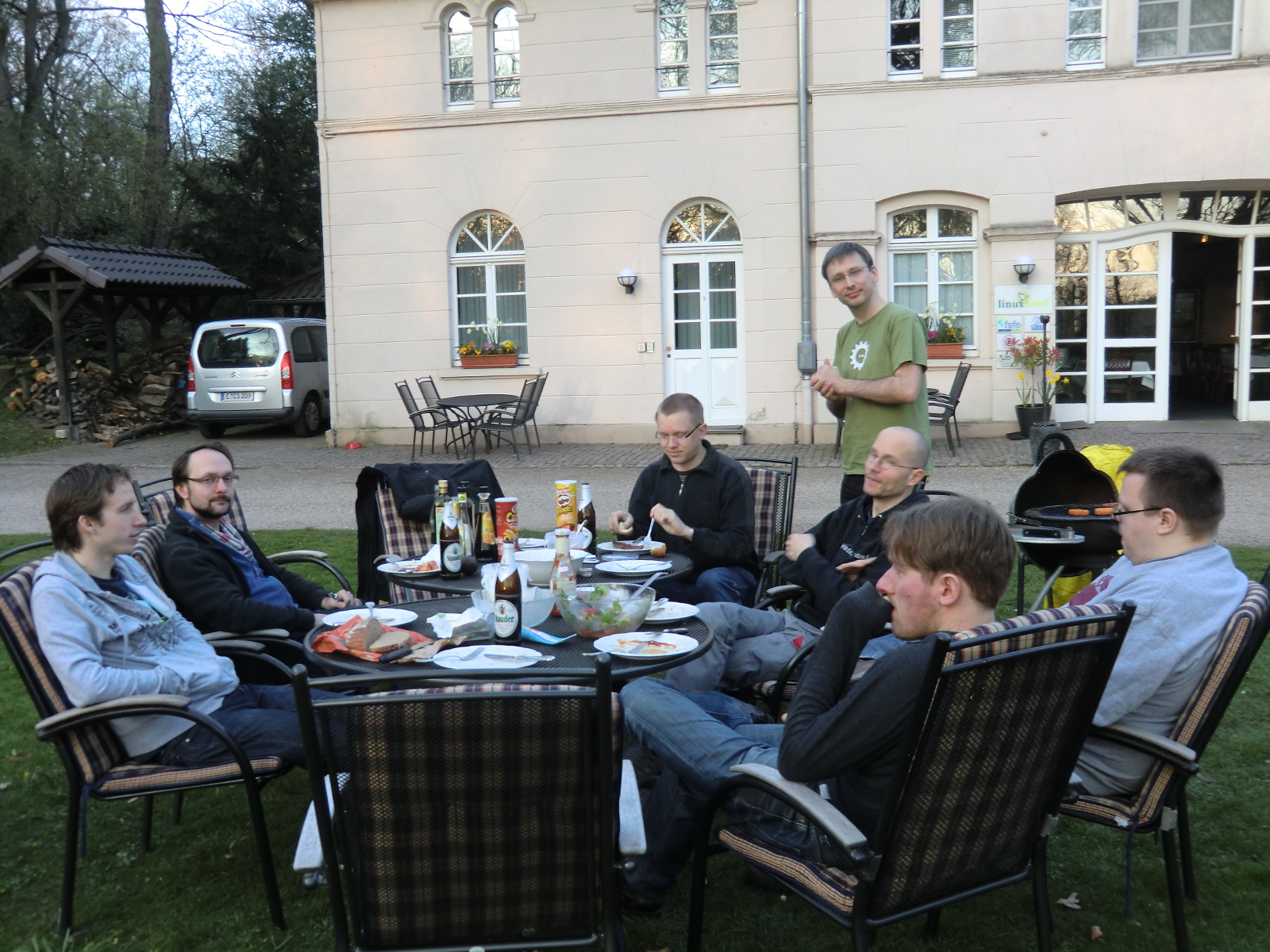
The seventh Debian Groupware Meeting was held in the LinuxHotel, Essen, Germany. We had one remote hacker from NYC which brings the number of attendants up to 9. This is a short summary of what happened during the weekend: Since we had a nice mix of first time Debian contributors, Debian Maintainers and Debian Developers we had lots of room for discussion and co-working which made this an exciting weekend. Groupphoto by Carsten Sch nert

Gunnar Wolf: Split regarding Docker

I have heard many good things about Docker, and decided to give it a spin on my systems. I think application-level virtualization has a lot to offer to my workflow... But the process to understand and later adopt it has left me somewhat heart-torn. Docker is clearly great technology, but its documentation is... Condescending and completely out of line with what I have grown used to in my years using Linux. First, there is so much simplistic self-praise sprinkled throughout it. There is almost no page I landed on that does not mention how user-friendly and user-centric Docker's commandline arguments are They let you talk in almost plain1 English. What they don't mention is that... Well, that's the way of basically every command-line tool. Of course, as soon as you start specifying details to it, the plain-Englishness starts dilluting into a more realistic English-inspiredness... Then... Things that go against our historical culture. It is often said that Windows documentation tends to be repetitive because users don't have the patience to read a full document. And our man pages are succint and to the point, because in our culture it is expected that users know how to search for the bit of information they are after. But reading documentation that's so excited with itself and praises again and again the same values and virtues, but never gets to the point I am interested in getting at (be it deployment, interoperation, description of the in-disk images+overlays layout, or anything moderately technical) never gets there... makes me quite unhappy. Last (for now)... Such a continuous sales pitch, an insistence on the good virtues, makes me wary of something they might be hiding. Anyway, at least for now, I just wanted to play a bit with it; I will wait at least until there is a backport to the stable Debian version before I consider moving my LXC VMs setup over to Docker (and a backport does not seem trivial to achieve, as Docker has several updated low-level dependencies we are unlikely to see in Wheezy). But I had to vent this. OK, now go back to your regular work ;-)

Andrew Pollock: [life] Day 91: Kindergarten, a successful assault on my to do list, haircuts and venus fly traps

I hate the days when I wake up at odd hours for no good reason. This morning I woke up at 4:30am briefly, with no idea why. It makes me wonder if there was some sort of external noise, and that's what woke Zoe up yesterday morning. I got myself going at a reasonable hour this morning, and decided to walk to the Bulimba post office to collect a package that was waiting for me. It was a nice enough morning for a walk, and I'm glad I decided to do it. Along the way, I observed multiple grandmothers walking their grandchildren to school. I've been thinking a lot about next year lately. I feel very strongly about Zoe not having to go into after school care. It seems that one of the new societal norms is the grandparents have to step in with the school transportation and after school care. That's not going to be particularly practical in our situation though, so I'm currently leaning towards seeking some sort of flexible employment next year that will allow me to be able to be available after Zoe finishes school. I was fairly motivated to get stuck into my to do list after my walk. A long standing item was to cancel one of my remaining US credit cards, and the time difference worked out well to do that, so I finally took care of that. I then realised it was a good time for the US East Coast, so I did a Hangout with one of my best friends in New York. It was great to have a catch up. After that, I finished off my US tax return, and also sorted out some other stuff that needed finishing off. I had to go to the Valley to find a FedEx location, so I drove over there, and on the way back stopped off in Bulimba to get some Mother's Day cards. By that stage it was about time to pick up Zoe from Kindergarten, so I quickly grabbed some lunch and then drove over to pick her up. She didn't nap again today, so that made our departure from Kindergarten nice and easy. I'd booked both of us in for haircuts at 3pm, so we got home with enough time for Zoe to ride her scooter to the hairdresser. We had our haircuts and Zoe had a bit of a play in the play corner, and we headed back home. I'd bought a venus fly trap from Bunnings last week while we were picking up other bits and pieces. I wanted to show Zoe how they worked, so we watched a few YouTube videos. This one was particularly good. After that, we went down to the rubbish skip with our fly trap to see if we could catch any flies in it, but Zoe quickly lost interest. So we headed back upstairs, and triggered one with a toothpick. I probably could have done this on a Friday and called it a Science Friday activity with a botany bent. After that, we just watched some TV together on the couch until Sarah arrived to pick her up.

28 April 2014

Daniel Pocock: SMS logins: an illusion of security

The IT security world is still reeling from the impact of the OpenSSL Heartbleed bug. Thanks to the bug, many experts have been reviewing other technologies to try and find similar risks. While Heartbleed was hidden away in the depths of the OpenSSL code base, another major security risk has been hiding in plain sight: SMS authentication for web site logins. Remarkably, a number of firms have started giving customers the ability to receive single-use passwords over SMS for logging into their secure web sites. Some have even insisted that customers can no longer log in without it, denying customers the right to make an important choice about their own security preferences. Unfortunately, SMS is no substitute to the one-time-passwords generated using proper authentication tokens or the use of other strong authentication schemes such as cryptographic smart cards. Even telephone companies themselves advise that SMS should not be used to secure financial transactions. Ocean's 11 in real life: exploiting the weakest link in the chain To deliver single-use SMS passwords, the SMS must travel through various networks from the firm's headquarters, to a wholesale SMS gateway, international SMS network and finally down the line of the local phone company. In comparison, properly certified token devices generate a code inside the device in the palm of your hand. The code only travels from the screen to your eyes. In a litany of frauds coming in all shapes and sizes, telephone networks have been exploited over and over again because they are almost always the weakest link in the chain. Using the mobile SMS network for authentication is not building on solid ground - some experts even feel it is downright stupidity. One of the most serious examples was the theft of $150,000,000 from a pension fund deposited with JP Morgan: it was described as a real-life case of Ocean's 11. The authentication was meant to be a phone call rather than an SMS: a phone company employee who was in on the scam duly ensured the call never reached the correct place. The insecurity of traditional telephone networks has been on display for all the world to see in the ongoing trial of News Corporation executives for phone hacking. If journalists from a tabloid newspaper can allegedly hack a dozen phones before their first cigarette of the day, is it really wise to use an insecure technology like SMS as the cornerstone of a security system for authorizing transactions? A fraud recently played out on many credit card holders in the UK exploited a low-tech feature of the phone system to trick people to believe they were safe by "calling back" to their bank. A plethora of new attack vectors The staggering reality of the situation is that attackers don't even have to directly hack their victim's phones to access SMS messages. As the Android API documentation demonstrates, SMS reception is notified to all apps in real-time. Apps can process the messages even when the phone is sleeping and the message is not read by the user. Just consider all the apps on a phone that have requested permission to read incoming messages. There was an uproar recently when a new version of the Facebook app started demanding permissions to read incoming SMS. The app can't be installed if the user doesn't agree to these new permissions. WhatsApp, another popular app that has SMS access rights, was recently exposed in a major security scandal which revealed they use a phone's IMEI number as the password. When people install an app like Tinder (which does not yet request SMS access) is the security of their bank account likely to be at the front of their mind? Even if Facebook intends no harm, they have opened the floodgates by further de-sensitizing users to the risks of giving apps un-necessary access to their data. These companies are looking for every piece of data that could give them an edge in their customer profiling and marketing programs. Having real-time access to your SMS is a powerful way for them to understand your activities and feelings at every moment in the day. To facilitate these data analysis techniques, replicating and archiving your messages into their cloud databases (whether you can see them there or not) is par for the course. The cloud, of course, has become a virtual smorgasboard for cyber-criminals, including both hackers and occasionally insiders wanting to peek at private data or harvest it en-masse. Social networking and communication sites are built on a philosophy of sharing data to create interaction and excitement. Unfortunately, this is orthogonal to the needs of security. In this context, the telephone network itself may no longer be the weakest link in the chain. The diligent attacker only needs to look for the cloud operator with an unplugged security hole and use their system as a stepping stone to read any SMS they want, when they want. Would you notice a stray SMS? Maybe you feel that you would notice a stray SMS carrying a login code for your bank account. Would you always be able to react faster than the criminal however? Thanks to social networks, or location data inadvertently leaked by other apps the attacker can easily work out whether you are on holiday, at the gym, at a party or sleeping or in some other situation where you are not likely to check messages immediately. If you receive a flood of SMS spam messages (deliberately sent by an attacker) in the middle of the night and you put your phone into silent mode and ignore it, you may well miss one message that was a login to your bank account. SMS technology was never designed for secure activities. The inconvenience of SMS While security is a headline issue these days, it is also worth reflecting on the inconvenience of SMS in some situations. Travel is at the top of the list: SMS doesn't work universally when abroad. These are usually the times when the only way to access the bank is through the web site. After dealing with the irritations of the hotel or airport wifi registration, do you really need more stress from your bank's systems too? For some networks, SMS can be delayed by hours or days, sometimes never arriving at all. Many people swap their SIM cards when travelling to avoid the excessive roaming charges and there is extra inconvenience in swapping SIM cards back again just to log in to a bank account. Worst of all, if you are tethering with a SIM card from the country you are visiting, then it is impossible for you to receive the SMS message from the bank on your regular SIM card while simultaneously maintaining the SSL connection to their web site over your new SIM card. Other problems like a flat battery, water damage or PIN permanently blocked by children playing with the phone can also leave you without access to your bank account for varying lengths of time. Is there any up-side to SMS authentication? The only potential benefit to SMS authentication is that it weeds out some of the most amateur attempts to compromise your bank account, but this is a false sense of security and it opens up new attack vectors through the cloud as we have just demonstrated. For all other purposes, it smells like a new form of security theater. A more likely reason why it has become popular amongst some firms is that many lenders want to ensure they have mobile phone numbers to contact customers when loan or credit card payments are missed. Making the mobile phone number mandatory for login ensures they almost always have the correct phone number for almost 100% of customers. It is not clear that this benefit justifies the failure to provide proper security and the inconvenience when travelling though. Opting out Next time you log in to a web site, if the firm does try to enrol you in an SMS authentication scheme, it may be a good idea to click the "No thanks" option. If you have already been registered into an SMS authentication scheme, fill out the online complaint form and inform the firm that you will only accept a proper authentication token or cryptographic smart card. These solutions are tried and tested and they are the correct tool for the job.

27 April 2014

Daniel Pocock: AirBNB hosts scanning identity documents and passports?

We recently had a vacation in Italy and used AirBNB to book our accommodation in three different cities we visited. We've used AirBNB quite a few times now but we had a new experience this time: one of the hosts told me she makes a scan of the passport of each guest. Sitting on the dinner table was a shiny new looking handheld scanner similar to this: I was tempted to ask if she also wanted my fingerprints and a DNA sample too. Not wanting to be too offensive though, I simply told her that there was no way she would be making a copy of our documents. I tried to explain it to her in terms that she would understand: that AirBNB had already verified my identity and that AirBNB automatically gives her insurance (Italy is included) and she doesn't need a copy of my passport to be eligible for the insurance. At best, I suggested, she would be welcome to look at the passport to see that the name matches the AirBNB account - but no copies under any circumstances. A common problem A quick search in Google reveals we weren't the first people to have such an experience with a host. However, the AirBNB FAQ has no definite comment on the topic. I wrote to AirBNB's safety team and explained the risks with copying documents onto home computers and they are now considering adding something about this issue to their policies and FAQ. I would suggest that anybody else who is asked for a copy of an identity document should also fill in the safety report form and ask AirBNB to publish a firm policy prohibiting hosts from demanding copies of identity documents. Just what is at risk? Just how bad could it be? Some of the following risks come to mind:
  • The host's computer is sold, sent for repair or stolen and the passport images all end up in the hands of strangers.
  • Viruses and trojans designed to search hard disks for sensitive documents can quickly recognise a passport image. Such viruses are far more likely to hit a home computer than one of those computers used by passport scanners at an airport or bank.
  • Maybe the host even has children or housemates who access the same computer.
  • The host may actually be making themself a target by keeping a cache of these documents - it would be a fairly low-tech hack for a criminal to look through AirBNB listings for hosts who explicitly mention they want to copy an identity document at check-in.
Did the world really get safer since September 2011? Ever since the horrors of 09/11/2011, many people have felt an urge to try and make the world safer. Simultaneously, the rise of cheap technology has made it easy for people to take these things way too far. Everywhere from bed and breakfasts to luggage storage companies are now trying to scan these documents at every opportunity. Having electronic copies of identity documents floating around in so many different places, many of them on poorly maintained computers that are used by staff to surf the web when they are not busy, is actually a huge increase in the risk of identity fraud. A good proportion of these companies are not even required to scan/copy identity documents - for some of them it is sufficient for them to simply look at the document, just as a train conductor looks at a ticket. Many are simply scanning the documents because management have realized this is the most efficient way to accurately build up a marketing database including customer date of birth (which is harder to ask for directly). There was significant outrage a few years ago when Mossad was accused of using passport images presumably acquired at Israeli airports to give fake identities to a hit-squad. The quality of passport images now available in the hard disk of a typical AirBNB host or bed'n'breakfast are now likely to be of a higher quality and yet available for misappropriation by a far wider proportion of (cyber-)criminals.

Daniel Pocock: AirBNB hosts scanning identity documents and passports?

We recently had a vacation in Italy and used AirBNB to book our accommodation in three different cities we visited. We've used AirBNB quite a few times now but we had a new experience this time: one of the hosts told me she makes a scan of the passport of each guest. Sitting on the dinner table was a shiny new looking handheld scanner similar to this: I was tempted to ask if she also wanted my fingerprints and a DNA sample too. Not wanting to be too offensive though, I simply told her that there was no way she would be making a copy of our documents. I tried to explain it to her from her own perspective: that AirBNB had already verified my identity and that AirBNB automatically gives her insurance (Italy is included) and she doesn't need a copy of my passport to be eligible for the insurance. At best, I suggested, she would be welcome to look at the passport to see that the name matches the AirBNB account - but no copies under any circumstances. A common problem A quick search in Google reveals we weren't the first people to have such an experience with a host. However, the AirBNB FAQ has no definite comment on the topic. I wrote to AirBNB's safety team and explained the risks with copying documents onto home computers and they are now considering adding something about this issue to their policies and FAQ. I would suggest that anybody else who is asked for a copy of an identity document should also fill in the safety report form and ask AirBNB to publish a firm policy prohibiting hosts from demanding copies of identity documents. Just what is at risk? Just how bad could it be? Some of the following risks come to mind:
  • The host's computer is sold, sent for repair or stolen and the passport images all end up in the hands of strangers.
  • Viruses and trojans designed to search hard disks for sensitive documents can quickly recognise a passport image. Such viruses are far more likely to hit a home computer than one of those computers used by passport scanners at an airport or bank.
  • Maybe the host even has children or housemates who access the same computer.
  • The host may actually be making themself a target by keeping a cache of these documents - it would be a fairly low-tech hack for a criminal to look through AirBNB listings for hosts who explicitly mention they want to copy an identity document at check-in.
Did the world really get safer since September 2001? Ever since the horrors of 09/11/2001, many people have felt an urge to try and make the world safer. Simultaneously, the rise of cheap technology has made it easy for people to take security precautions too far. Everywhere from bed and breakfasts to luggage storage companies are now trying to scan and make a rather permanent electronic copy of identity documents at each opportunity. Having electronic copies of identity documents floating around in so many different places, many of them on poorly maintained computers that are used by staff to surf the web when they are not busy, is actually a huge increase in the risk of identity fraud. A good proportion of these companies are not even required to scan/copy identity documents - for some of them it is sufficient for them to simply look at the document, just as a train conductor looks at a ticket. Many are simply scanning the documents because management have realized this is the most efficient way to accurately build up a marketing database including customer date of birth (which is harder to ask for directly). There was significant outrage a few years ago when Mossad agents were accused of using passport images presumably acquired at airports to give identities to a their operatives. The quality of passport images now available in the hard disk of a typical AirBNB host or bed'n'breakfast are now likely to be of a higher quality more easily accessible for any number of unintended uses.

25 April 2014

Daniel Pocock: Extra fuel charges when carrying passengers in your car?

Some people seem to be justifying the way mobile networks try to discriminate against tethering. One comment even suggests that multiple devices is a valid justification. Really? Isn't it just as simple as measuring the actual volume of megabytes used, regardless of how many devices are connected? Lets consider a couple of analogies:
  • A petrol station puts some fine print at the bottom of their sign in the street: cars with passengers pay an extra 0.05 per litre (or gallon). It is just a gimmick: the marketing man has worked out that he can put a lower price on his big sign this way and people with passengers may well be splitting the fuel bill between them. There is no technical reason for the charge however - the car actually uses more fuel carrying the extra weight anyway.
  • Or imagine this: the marketing man puts up small print that advises a higher charge of 0.05 per litre for fuelling an exotic car like a Ferrari. The only reason for this, of course, is that the Ferrari driver is probably busy (so he doesn't have time to shop around) and wealthy (so the extra charge won't deter him from making any purchase at all, because he has money to pay it).
Of course, these ideas sound a bit outlandish but the only difference between these crazy ideas and tethering charges is that mobile phone networks usually have the monopoly/duopoly to get away with it. Mobile networks actually dread the idea of becoming commodities like fuel. They thrive on price discrimination and they seem to have an endless number of tricks to get extra money out of people who may have it by deliberately crippling parts of the service for everybody else. This goes against the ideals of innovation and efficiency and in the most extreme cases their practices are widely recognised for the sham that they are. Revealing that you have connected a laptop to your phone may be like revealing you live in an affluent area or that you have an expensive car. Plenty of businesses try to exploit such knowledge when deciding how much they can charge you or other aspects of how they provide you with a service. This is why privacy is important in every feature of the technology we use. This rogue behaviour by "creative" marketing men also helps to understand just what would happen in the world of technology if it wasn't for the use of free licenses, open standards, accessible encryption and net neutrality.

Martín Ferrari: More DNSSEC

After quite a few hours of work, I finally switched completely to DNSSEC. Both client-side in my notebook, and in my personal tincho.org domain. The client-side was pretty easy, although something broke in dnsmasq, but I had no patience to debug it, so I have just replaced it with a stock bind9 install, which is DNSSEC-enabled by default nowadays! To complement that, I added a plugin to Firefox/Iceweasel (WNPP bug #672845 pending, downloadable from the Czech NIC) that shows me with a nice icon if the DNS is secure or not (and in the newest versions, it also shows DANE status, yay!). So, basically, if you want to have DNSSEC support in your computer, just install unbound or bind9 (maybe dnsmasq, if you don't hit the same bug as me), it is really easy to have it up and running in no time. To test if it is correctly working, apart from that nifty plugin, you can visit this funny web page from Verisign labs. On the server side, it was trickier. It involves quite a few steps, and the default tools from package dnssec-tools are pretty buggy. But it was not too bad. After moving my domain from the registrar's DNS to my own server, configuring secondaries, etc. I went ahead with the DNSSEC configuration. I used this pretty good DNSSEC howto, which made the process a lot easier. After having my DNS server ready, I added the DS records in my registrar, and voil , tincho.org is now protected by DNSSEC! There are a few web services to test your deployment, a simple one, and a more complete one with GraphViz diagrams! I felt so bold with all this, that I went ahead and created DANE and SSHFP records for my services (and had to debug issues with SSH, because the old ssh-keygen tool would not create ECDSA records). And even set Postfix to use DANE to connect to remote hosts. Let's see how many things break in the following days!

24 April 2014

Joachim Breitner: gtk-vector-screenhot screencast

I recently installed piwik on my website, to get some idea about how it is being used. Piwik is a very nice and shiny tool, although it is slightly scary to watch people walk through your website, click for click. Anyways, I now know that I get around 50 visitors per day. But I also learn where they are coming from, and this way I noticed that Shnatsel did a very nice screencast of my gtk-vector-screenshot tool if I had not created it myself I would think it was fake.

Joachim Breitner: gtk-vector-screenshot screencast

I recently installed piwik on my website, to get some idea about how it is being used. Piwik is a very nice and shiny tool, although it is slightly scary to watch people walk through your website, click for click. Anyways, I now know that I get around 50 visitors per day. But I also learn where they are coming from, and this way I noticed that Shnatsel did a very nice screencast of my gtk-vector-screenshot tool if I had not created it myself I would think it was fake.

Daniel Pocock: Android betrays tethering data

When I upgraded an Android device the other day, I found that tethering completely stopped working. The updated CyanogenMod had inherited a new bug from Android, informing the carrier that I was tethering. The carrier, Vodafone Italy, had decided to make my life miserable by blocking that traffic. I had a closer look and managed to find a workaround. There is absolutely no difference, from a technical perspective, between data transmitted from a mobile device on-screen application and data transmitted from tethering. Revealing the use of tethering to the carrier is a massive breach of privacy - yet comments in the Google bug tracker suggest it is a feature rather than a bug. This little table helps put that logic in perspective:
Product Person who carries handset
User Mobile network who wants to discriminate against some types of network traffic to squeeze more money out of the Product
Feature Revealing private information about the way the Product uses his/her Internet so the real User can profit.
It is also bad news for the environment: many people are being tricked into buying un-needed USB dongle modems that will end up in the rubbish in 1-2 years time when their contract expires and the company pushes them to upgrade to the next best thing. Behind the scenes What does it really mean in practice, how does Android tell your carrier which data is from tethering? As my device is rooted and as it is my device and I will do what I want with it, I decided to have a look inside. The ip command revealed that there are now two network devices, rmmnet_usb0 and rmmnet_usb1. The basic ip route command reveals that traffic from different source addresses is handled differently and split over the different network devices:
shell@android:/ # ip route
0.0.0.0/1 dev tun0  scope link
default via 100.66.150.89 dev rmnet_usb0
83.224.66.138 via 100.87.31.214 dev rmnet_usb1
83.224.70.94 via 100.87.31.214 dev rmnet_usb1
100.66.150.88/30 dev rmnet_usb0  proto kernel  scope link  src 100.66.150.90
100.66.150.89 dev rmnet_usb0  scope link
100.87.31.212/30 dev rmnet_usb1  proto kernel  scope link  src 100.87.31.213
100.87.31.214 dev rmnet_usb1  scope link
128.0.0.0/1 dev tun0  scope link
192.168.42.0/24 dev rndis0  proto kernel  scope link  src 192.168.42.129
I then looked more closely and found that there is also an extra routing table, it can be found with ip rule
shell@android:/ # ip rule show
0:      from all lookup local
32765:  from 192.168.42.0/24 lookup 60
32766:  from all lookup main
32767:  from all lookup default
shell@android:/ # ip route show table 60
default via 100.87.51.57 dev rmnet_usb1
100.87.51.57 dev rmnet_usb1
192.168.42.0/24 dev rndis0  scope link
In this routing table, it is obvious that data from the tethering subnet (192.168.42.0/24) is sent over the extra device rmnet_usb1. Manually cleaning it up If the phone is rooted, it is possible to very quickly change the routing table to get all the tethering traffic going through the normal rmnet_usb0 interface again. It is necessary to get rid of that alternative routing table first:
ip rule del pref 32765
and then update the iptables entries that refer to interface names:
iptables -t nat -I natctrl_nat_POSTROUTING -s 192.168.0.0/16 -o rmnet_usb0 -j MASQUERADE
iptables -I natctrl_FORWARD -i rmmnet_usb0 -j RETURN
This immediately resolved the problem for me on the Vodafone network in Italy. Conclusion If Google can be bullied into accepting this kind of discriminatory routing in the stock Android builds and it can even propagate into CyanogenMod, then I'm just glad I'm not running one of those Android builds that has been explicitly "enhanced" by a carrier. It raises big questions about who really is the owner and user of the device and who is receiving the value when a person pays money to "buy" a device.

23 April 2014

Russ Allbery: On learning, growth, and trust

Here are two separate ideas about programming, Internet security, Internet architecture, and free software. Both of them are fundamental to everything those of us who work on free software are doing.
  1. Writing secure and reliable code is a highly complex and demanding task. It's something that one has to learn, like any other skilled profession. It's not something we're very good at teaching via any mechanism other than apprenticeship and experimentation. The field is changing quickly; if you took ten years off from writing security-critical code, you would expect to have to learn multiple new tools (static analysis, testing techniques, security features), possibly new programming languages, and not infrequently new ways of thinking about threat models and vulnerabilities.
  2. Nearly every computer user trusts tens of thousands of other programmers and millions of lines of code with their day-to-day computer security and reliability, without auditing that code themselves. Even if you have the skill required to audit the code (and very, very few people have the skill to audit all of the code that they use), you do not have the time. Therefore, our computer security is built on trust. We're trusting other programmers not to be malicious, which is obvious, but we're also trusting other programmers to be highly skilled, careful, cautious (but still fast and productive, since we quickly abandon software that isn't "actively developed"), and constantly adopting new techniques and treat models.
I think both of those principles are very widely understood and widely acknowledged. And, as we all know, both of those principles have failure modes, and those failures mean that our computers are nowhere near as secure as we would like them to be. There has been quite a lot of technical discussion about both of these principles in recent days and months, ranging from better code analysis and testing through the flaws in particular programming languages to serious questions about the trust model we use for verifying the code that we're running. I'm going to switch gears away from that discussion for a moment to talk about a social aspect. When a piece of code that one is using has a security vulnerability, it is not unusual to treat that as a trust failure. In other words, technical flaws are very quickly escalated to social flaws. This is less likely among practitioners, since we're all painfully aware of how many bugs we have in our own code, but it's still not unheard of, particularly if the authors of the code do not immediately and publicly show a socially-acceptable level of humility and contrition (in the middle of what is often a horrifically stressful experience). I think this reaction comes largely from fear. Anyone who has given it a moment's thought is painfully aware of just how much code they are running on trust, and just how many ways it could be compromised, accidentally or maliciously. And how frequently that code is compromised. The less control one has over a situation, the more terrifying it is, and the cold reality is that we have very little control over our computer security. There is a natural tendency, when afraid, to look for targets for that fear. Now, go back and think about the first principle. Anyone who has ever worked on or near free software is painfully aware that we have far more good ideas about how to improve computing and security than we have skilled resources to execute on those ideas. My own backlog of things that I've already thought about, know would be good ideas, and simply have to implement is probably longer than my remaining lifespan. I suspect that's the case for nearly all of us. In other words, we have a severe shortage of programmers who care and who have skill. We desperately need more skilled programmers who can write secure and reliable code. We may (and I think do) also need better tools, techniques, languages, protocols, and all the other machinery that we, as technical people, spend most of our time thinking about. But none of that changes the fact that we need more skilled people. In fact, it makes that need more acute: in addition to skilled people to write the code we use, we need skilled people to write the tools. Skilled people are not born. They're made. And in professions where training techniques are still in their infancy and where we don't have a good formal grasp on which techniques work, those skilled people are made primarily through apprenticeship, experimentation, and learning from failure. Worse, people who were skilled do not remain skilled without continually participating in that learning process. See the above point about a fast-changing field with evolving best practices. It's not enough to know how to write secure code to the best known practices today, or even enough to retrofit all of your existing code to current knowledge (which is often so large of an effort as to be practically impossible). You have to constantly, continually learn more, for which there is no reliable formal training. We have to try, fail, try again, and fail better. But failure that leads to a security vulnerability is treated as a loss of trust. We trusted that person to write secure code that we could use. They failed. Now we can't trust them. Based on the trust model of security, we should revoke their ability to try again and instead rely on people who have not failed, since that will make us more secure. Except now we just broke the learning process. And there's no such thing as a programmer who can stop learning. So what does that do to our resource pool? It's sadly ironic, but I believe the free software community writ large has a very serious collaboration problem: we do not tolerate each other's learning processes. This leads to a wide variety of social failures around hostile communities and the failures of meritocracy that other people have talked about at much greater length. But even if you set that all aside, it threatens our security. We need secure code, a lot of it, a lot more than we have right now. To get that code, we need people who can write it. We need to grow, encourage, and support those people and enable their learning processes. Code is written by people. If we rip people apart when they write bad, insecure code, we don't get better, secure code. We get fewer people writing security code. We get far fewer people writing security code in public, since some of the people who haven't been ripped apart will look at that experience and say, "No way am I going near that problem area. It's too scary. I don't want to end up like those programmers." Fewer people writing security code means fewer people learning how to write better security code. Fewer people capable of writing good, secure code is not a solution to any of our problems. If we do not tolerate, support, and encourage the learning process required to become a skilled programmer, or maintain one's skill in programming, we are destroying our future as a community. When you find code that is broken and badly written, you have found a problem that should be reported, analyzed, and corrected. You have also found a programmer who is about to have one of two very different types of experiences. Either they are about to learn how to become a better programmer, or they are about to be publicly shamed, humiliated, and treated as untrustworthy. Which branch they take is partly up to them, but it's also heavily influenced by how all of us react socially to the discovery of bad code. One of those branches leads to more good, secure code being written in the future. The other does not.

Petter Reinholdtsen: Install hardware dependent packages using tasksel (Isenkram 0.7)

It would be nice if it was easier in Debian to get all the hardware related packages relevant for the computer installed automatically. So I implemented one, using my Isenkram package. To use it, install the tasksel and isenkram packages and run tasksel as user root. You should be presented with a new option, "Hardware specific packages (autodetected by isenkram)". When you select it, tasksel will install the packages isenkram claim is fit for the current hardware, hot pluggable or not. The implementation is in two files, one is the tasksel menu entry description, and the other is the script used to extract the list of packages to install. The first part is in /usr/share/tasksel/descs/isenkram.desc and look like this:
Task: isenkram
Section: hardware
Description: Hardware specific packages (autodetected by isenkram)
 Based on the detected hardware various hardware specific packages are
 proposed.
Test-new-install: mark show
Relevance: 8
Packages: for-current-hardware
The second part is in /usr/lib/tasksel/packages/for-current-hardware and look like this:
#!/bin/sh
#
(
    isenkram-lookup
    isenkram-autoinstall-firmware -l
)   sort -u
All in all, a very short and simple implementation making it trivial to install the hardware dependent package we all may want to have installed on our machines. I've not been able to find a way to get tasksel to tell you exactly which packages it plan to install before doing the installation. So if you are curious or careful, check the output from the isenkram-* command line tools first. The information about which packages are handling which hardware is fetched either from the isenkram package itself in /usr/share/isenkram/, from git.debian.org or from the APT package database (using the Modaliases header). The APT package database parsing have caused a nasty resource leak in the isenkram daemon (bugs #719837 and #730704). The cause is in the python-apt code (bug #745487), but using a workaround I was able to get rid of the file descriptor leak and reduce the memory leak from ~30 MiB per hardware detection down to around 2 MiB per hardware detection. It should make the desktop daemon a lot more useful. The fix is in version 0.7 uploaded to unstable today. I believe the current way of mapping hardware to packages in Isenkram is is a good draft, but in the future I expect isenkram to use the AppStream data source for this. A proposal for getting proper AppStream support into Debian is floating around as DEP-11, and GSoC project will take place this summer to improve the situation. I look forward to seeing the result, and welcome patches for isenkram to start using the information when it is ready. If you want your package to map to some specific hardware, either add a "Xb-Modaliases" header to your control file like I did in the pymissile package or submit a bug report with the details to the isenkram package. See also all my blog posts tagged isenkram for details on the notation. I expect the information will be migrated to AppStream eventually, but for the moment I got no better place to store it.

Andrew Pollock: [life] Day 85: Mostly a day off for me

Zoe slept solidly all night. She woke up a little before 6am, wanting a cuddle, but it was still dark, so she went back to sleep for another half an hour or so. It was actually nice to get that extra 30 minutes to have a leisurely wake up myself. Sarah wanted to pick up Zoe at 7:45am to get away and get a camp site, so when Zoe finally woke up for the day, we didn't muck around too much. She announced she wanted banana and oat pancakes, but we were out of bananas. I offered her the opportunity to scooter down to the Hawthorne Garage to get some if she went and got dressed. She decided that'd be good. I had a 10am appointment in the city with an intellectual property lawyer to talk about patents, so I had this grand plan of trying to squeeze in a run after Zoe was picked up and before I'd have to head into the city, so I got into my running gear, and we headed down to acquire some bananas. We whipped up the pancakes, and then after a couple of mouthfuls of hers, Zoe declared she didn't like it and wanted Cheerios instead. Oh well. It was nice to get out of the house early in the morning, and it helped get Zoe moving. Sarah ended up getting here closer to 8:30am, which made it a little too tight to go for a run, have a shower and get into the city, so I scrapped the run and pottered around at home instead for a bit, before driving into the city. My goodness casual parking in the city is exorbitant. It cost me $35 for under an hour. I got some good advice from the lawyer, so I know where to proceed from here. Next I headed down to the Valley to get my orientation at River City Labs, but had I read my email before leaving the city, I'd have discovered that the lady giving me the orientation had to leave early because her daughter was ill. It cost me $6 drive into the car park in the Valley, take the elevator down, read my email on my phone and pay my ticket and leave again. Lesson learned. I decided to do the grocery shopping that I hadn't done yesterday while I waited for Anshu to come over.

22 April 2014

C.J. Adams-Collier: AD Physical to Virtual conversion Continued!

So I wasn t able to complete the earlier attempt to boot the VM. Something to do with the SATA backplane not having enough juice to keep both my 6-disk array and the w2k8 disk online at the same time. I had to dd the contents off of the w2k8 disk and send it to the SAN via nc. And it wouldn t write at more than 5.5MB/s, so it took all day.
cjac@foxtrot:~$ sudo dd if=/dev/sdb   \
  pv -L 4M -bWearp -s 320G   \
  nc 172.16.9.80 4242
cjac@san0:~$ nc -l 4242   \
  pv -L 4M -bWearp -s 320G   \
  sudo dd of=/dev/vg0/ad0
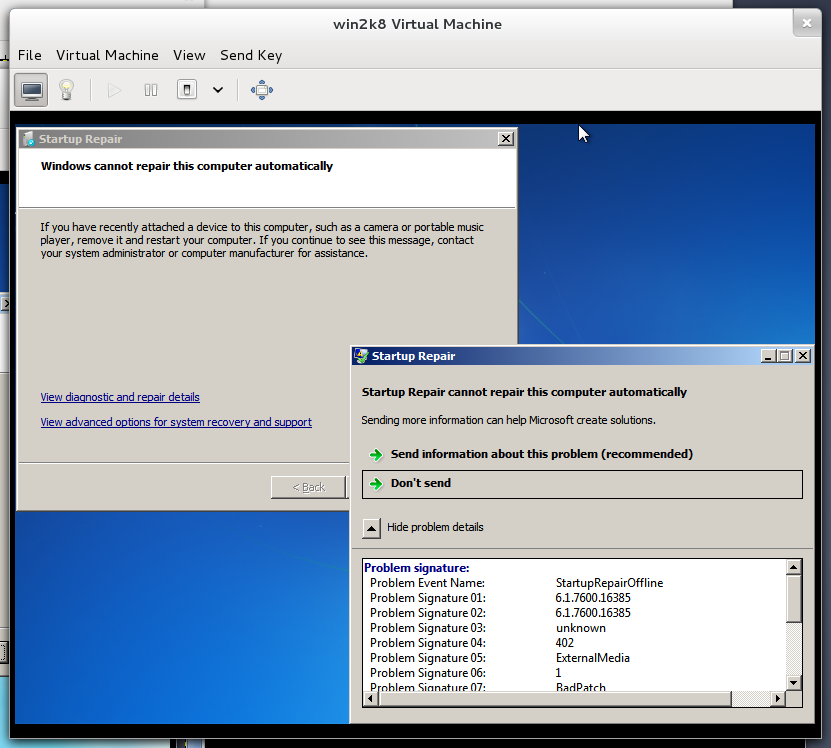
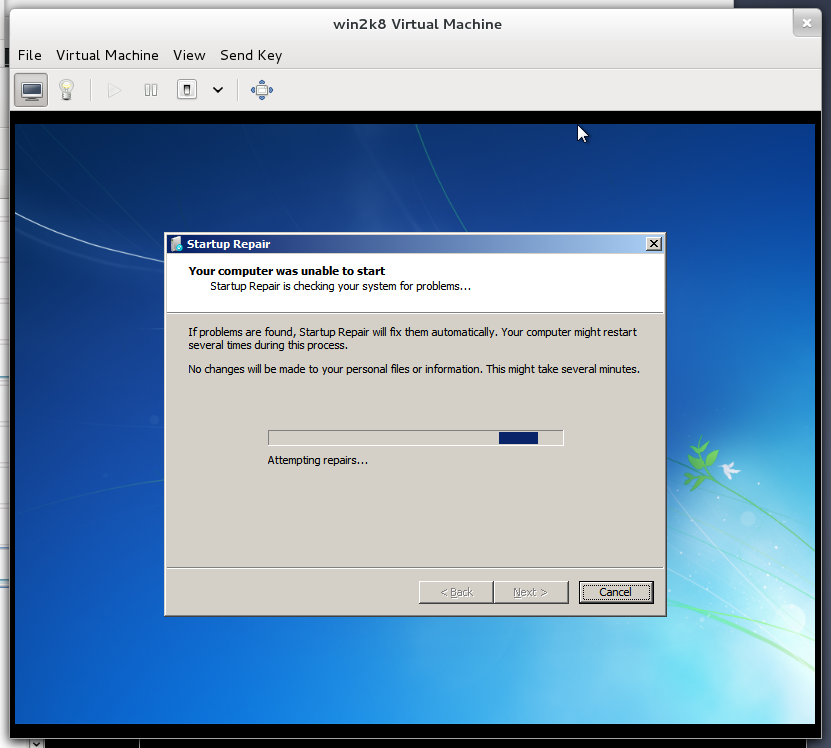
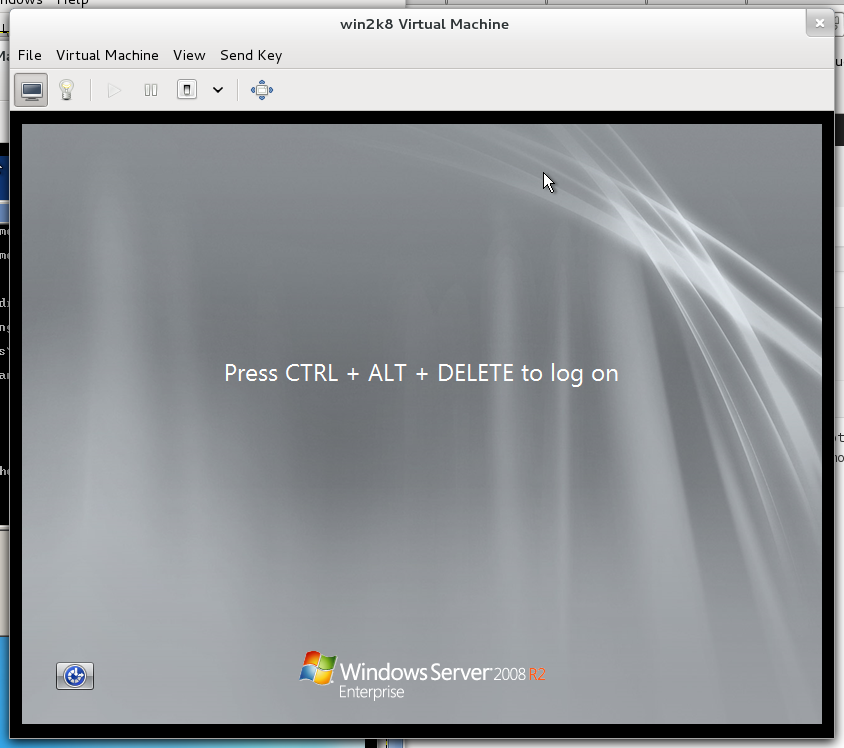
Anyway, I ve got a /dev/vg0/ad0 logical volume all set up now which I m exporting to the guest as USB. Here s the libvirt xml file: win2k8.xml No indication as to how long this will take. But I ll be patient. It will be nice to have the AD server back online. Physical_to_Virtual_Win2k8-Startup_Repair [edit 20140422T172033 -0700]
Physical_to_Virtual_Win2k8-Startup_Repair_Failure
Well, that didn t work [edit 20140422T204322 -0700]
Maybe if I use DISM ? Physical_to_Virtual_Win2k8-Startup_Repair_DISM [edit 20140422T204904 -0700] Yup. That did er!
C:\>dism /image:c:\ /add-driver /driver:d:\win7\amd64\VIOSTOR.INF
Physical_to_Virtual_Win2k8-Login

Erich Schubert: Kernel-density based outlier detection and the need for customization

Outlier detection (also: anomaly detection, change detection) is an unsupervised data mining task that tries to identify the unexpected.
Most outlier detection methods are based on some notion of density: in an appropriate data representation, "normal" data is expected to cluster, and outliers are expected to be further away from the normal data.
This intuition can be quantified in different ways. Common heuristics include kNN outlier detection and the Local Outlier Factor (which uses a density quotient). One of the directions in my dissertation was to understand (also from a statistical point of view) how the output and the formal structure of these methods can be best understood.
I will present two smaller results of this analysis at the SIAM Data Mining 2014 conference: instead of the very heuristic density estimation found in above methods, we design a method (using the same generalized pattern) that uses a best-practise from statistics: Kernel Density Estimation. We aren't the first to attempt this (c.f. LDF), but we actuall retain the properties of the kernel, whereas the authors of LDF tried to mimic the LOF method too closely, and this way damaged the kernel.
The other result presented in this work is the need to customize. When working with real data, using "library algorithms" will more often than not fail. The reason is that real data isn't as nicely behaved - it's dirty, it seldom is normal distributed. And the problem that we're trying to solve is often much narrower. For best results, we need to integrate our preexisting knowledge of the data into the algorithm. Sometimes we can do so by preprocessing and feature transformation. But sometimes, we can also customize the algorithm easily.
Outlier detection algorithms aren't black magic, or carefully adjusted. They follow a rather simple logic, and this means that we can easily take only parts of these methods, and adjust them as necessary for our problem at hand!
The article persented at SDM will demonstrate such a use case: analyzing 1.2 million traffic accidents in the UK (from data.gov.uk) we are not interested in "classic" density based outliers - this would be a rare traffic accident on a small road somewhere in Scotland. Instead, we're interested in unusual concentrations of traffic accidents, i.e. blackspots.
The generalized pattern can be easily customized for this task. While this data does not allow automatic evaluation, many outliers could be easily verified using Google Earth and search: often, historic imagery on Google Earth showed that the road layout was changed, or that there are many news reports about the dangerous road. The data can also be nicely visualized, and I'd like to share these examples with you. First, here is a screenshot from Google Earth for one of the hotspots (Cherry Lane Roundabout, North of Heathrow airport, which used to be a double cut-through roundabout - one of the cut-throughs was removed since):
Screenshot of Cherry Lane Roundabout hotspot
Google Earth is best for exploring this result, because you can hide and show the density overlay to see the crossroad below; and you can go back in time to access historic imagery. Unfortunately, KML does not allow easy interactions (at least it didn't last time I checked).
I have also put the KML file on Google Drive. It will automatically display it on Google Maps (nice feature of Drive, kudos to Google!), but it should also allow you to download it. I've also explored the data on an Android tablet (but I don't think you can hide elements there, or access historic imagery as in the desktop application).
With a classic outlier detection method, this analysis would not have been possible. However, it was easy to customize the method; and the results are actually more meaningful: instead of relying on some heuristic to choose kernel bandwidth, I opted for choosing the bandwidth by physical arguments: 50 meters is a reasonable bandwidth for a crossroad / roundabout, and for comparison a radius of 2 kilometers is used to model the typical accident density in this region (there should other crossroads within 2 km in Europe).
Since I advocate reproducible science, the source code of the basic method will be in the next ELKI release. For the customization case studies, I plan to share them as a how-to or tutorial type of document in the ELKI wiki; probably also detailing data preprocessing and visualization aspects. The code for the customizations is not really suited for direct inclusion in the ELKI framework, but can serve as an example for advanced usage.
Reference:
E. Schubert, A. Zimek, H.-P. Kriegel
Generalized Outlier Detection with Flexible Kernel Density Estimates
In Proceedings of the 14th SIAM International Conference on Data Mining (SDM), Philadelphia, PA, 2014.
So TLDR of the story: A) try to use more established statistics (such as KDE), and B) don't expect an off-the-shelf solution to do magic, but customize the method for your problem.
P.S. if you happen to know nice post-doc positions in academia:
I'm actively looking for a position to continue my research. I'm working on scaling these methods to larger data and to make them work with various real data that I can find. Open-source, modular and efficient implementations are very important to me, and one of the directions I'd like to investigate is porting these methods to a distributed setting, for example using Spark. In order to get closer to "real" data, I've started to make these approaches work e.g. on textual data, mixed type data, multimedia etc. And of course, I like teaching; which is why I would prefer a position in academia.

Andrew Pollock: [life] Day 84: Kindergarten Term 2 starts, I collapse on the couch for the day

Zoe had her first day back at Kindy this morning for Term 2. I couldn't believe how fast Term 1 flew by, and how little I felt I accomplished on a personal front. The two weeks of school holidays certainly put the brakes on trying to get anything much more done for myself, but Zoe and I had a great time. I was really happy with the variety of activities we were able to do, and it was nice that Zoe and Megan got to spend a reasonable amount of time together too. The weather cooperated for the majority of the time, which was the cherry on top. Zoe only had Kindergarten today this week, but Sarah has the week off, so she's going to be taking Zoe for the next couple of days, which is really convenient timing, as it'll give me time to recover from some minor surgery tomorrow without having to run around after her. I might also manage to finalise my US tax return. I'm hoping to catch a few movies with Anshu too, who also has the week off work. Zoe slept reasonably well last night. Two wake ups, but they were both quickly resolved, so we both got back to sleep quickly. I was absolutely exhausted last night, but felt positively chipper this morning. We biked to Kindergarten, and I decided to leave the trailer there to make things a bit easier for myself in the afternoon. I got home, and just felt like vegging on the couch. Then I remembered Anshu had the day off, so she came over and we hung out and had lunch. It was really nice to have a few hours during the day off. I biked back to Kindergarten, wondering if I'd have to deal with waking up Zoe from a nap, but she hadn't had a nap. We'd had a bit of a talk at breakfast about napping at Kindergarten, and I have no idea if it helped or not, but it meant we could make an orderly departure. Zoe wanted to participate in Megan's tennis class after Kindergarten, and they were down a kid, which made the warm up stuff not work so well, so the teacher was happy for Zoe to take part. I managed to extract her once the real nitty gritty of the class started. I did get a good opportunity to suss out place availability for term 3. We biked home, and I wanted to take my bike in for a service while I'm on lifting restrictions, so we drove over to Cannon Hill to drop it off. The Gold Cross bike shop has now merged into the Super Amart store, so Zoe wanted to look at everything on the way back out. We eventually emerged without buying anything. Next, we went over to Bunnings, because Zoe's been asking if we can grow some veggies and flowers from seed. That ended up being about an hour of trekking around the nursery section trying to find stuff. It was a good way to use up the afternoon. We made it out with a bag of potting mix and a few packets of seeds and a kit for growing stuff that requires a trellis. Unfortunately most of the climbing stuff (like tomatoes) are out of season now, so I'm not sure what we're going to be able to grow with the kit. We got back home, and I put dinner on and we watched a bit of TV together while it cooked. Bath time and bed time went really smoothly, as I think she was pretty tired. Here's hoping she sleeps well tonight.

21 April 2014

Russell Coker: Sociological Images 2014

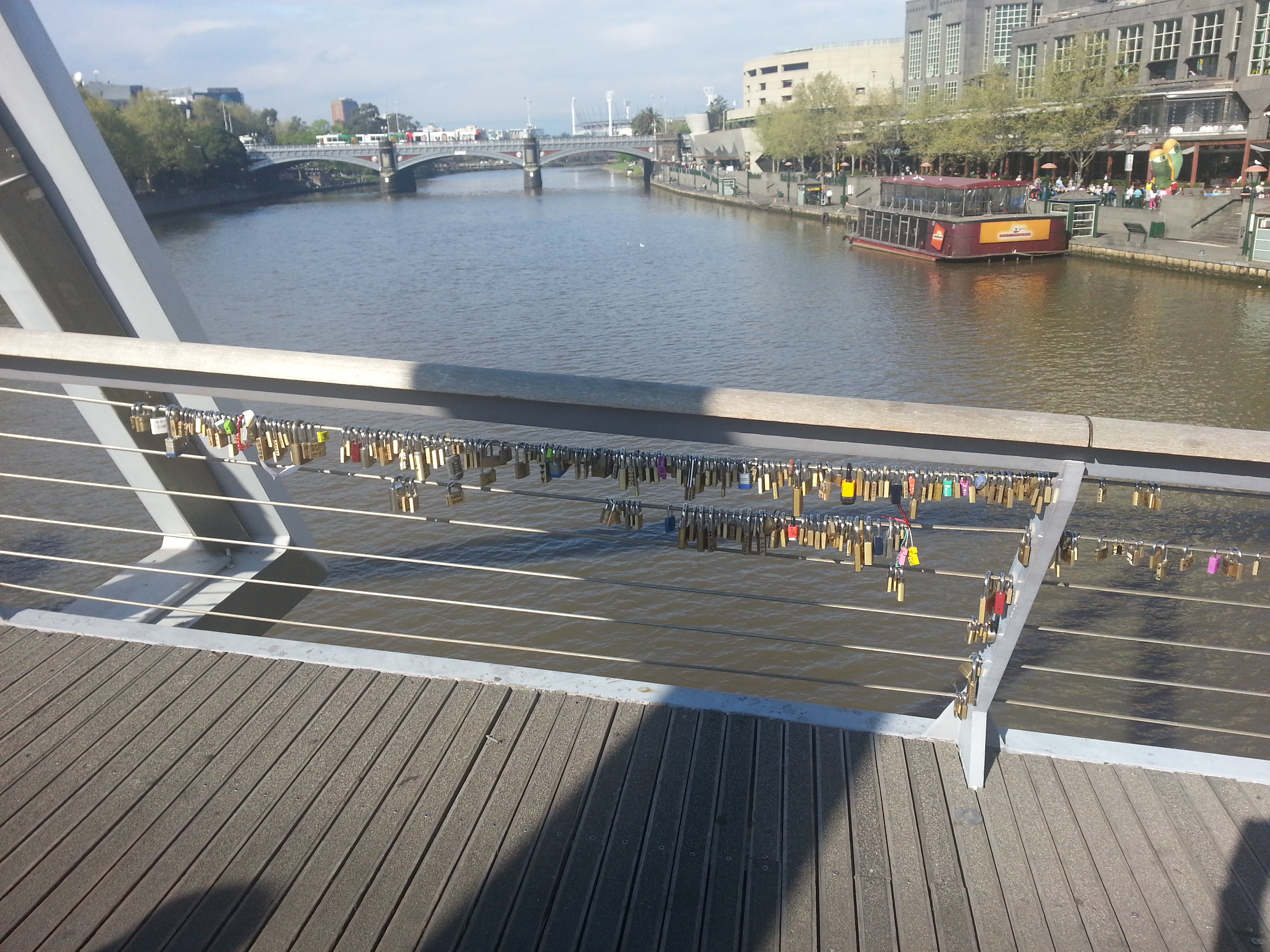
White Trash The above poster was on a bridge pylon in Flinders St in 2012. It s interesting to see what the Fringe Festival people consider to be associated with white trash . They claim homophobia is a white trash thing however lower class people have little political power and the fact that we still don t have marriage equality in Australia is clear evidence that homophobia is prevalent among powerful people. Toys vs Fairies Fairies look pretty while boys toys do things I took the above photo at Costco in 2012. I think it s worth noting the way that the Disney Fairies (all female and marketed to a female audience) are standing around looking pretty while the Toy Story characters (mostly male and marketed to a male audience) are running out to do things. Having those items side by side on the shelf was a clear example of a trend in toys towards girls being encouraged to be passive while boys are doing things. The Toy Story pack has one female character, so it could be interpreted as being aimed at both boys and girls. But even that interpretation doesn t remove the clear gender difference. It seems ironic to me that the descriptions on the boxes are Read, Play, and Listen for the Toy Story pack and Read, Play, and Colour on the Fairies pack. Colouring is more active than listening so the pictures don t match the contents. Make Up vs Tools Girls chocolate is make-up and boys chocolate is tools I took the above photo in an Aldi store in early 2013, today I was in Aldi and noticed that the same chocolate is still on sale. A clear and pointless gender difference. Rumor has it that some of the gender difference in kids clothing is so that a child can t wear the clothes of an older sibling of different gender, but chocolate only gets eaten once so there is no reason for this. Oath The above poster was inside the male toilet at Melbourne University in 2013. It would probably be good to have something like that on display all the time instead of just for one event. Locks Locks with inscriptions on a bridge on the Yarra River in Melbourne I took the above picture early this year, it shows hundreds of padlocks attached to a bridge across the Yarra River in Melbourne. Each padlock has a message written or inscribed in it, mostly declarations of love. I first noticed this last year, I m not sure how long it s been up. There was nothing formal about this (no signs about it), people just see it and decide that they want to add to it. I guess that the council cuts some of them off periodically as the number of locks doesn t seem to be increasing much in recent times. It would be interesting to do some research into how many locks are needed to start one of these. It would also be interesting to discover whether the nature of the inscriptions determines the speed at which it takes off, would a bunch of padlocks with messages like I Love Linux inspire others as well as messages declaring love for random people? All that is required is some old locks and an engraving tool. I wonder what the social norm might be regarding messing with those locks. If I was to use those padlocks to practice the sport of lock-picking (which I learned when in Amsterdam) I wonder whether random bystanders would try to discourage me. It seems likely that picking the locks and taking them away would get a negative reaction but I wonder whether picking them one at a time and replacing them (or maybe moving them to another wire) would get a reaction. Blackface for Schoolkids teachers choice blackface and yellowface masks A craft shop at the Highpoint shopping center in Melbourne is selling Teacher s Choice brand Multicultural Face Masks . Multicultural is a well regarded term in education, teaching children about other cultures is a good concept but can be implemented really badly. When I was in high school the subject Social Studies seemed to have an approach of look how weird people are in other places instead of teaching the kids anything useful. Sociological Images has an informative article on the Australian Hey Hey it s Saturday blackface incident in 2009 [1]. The idea of these masks seems to involve students dressing up as caricatures of other races. The mask which looks like someone s idea of a Geisha is an even bigger WTF, mixing what the package calls culture (really race) with sex work. When I visited Tokyo I got the impression that French maids fill a similar niche to Geisha for younger Japanese men and the maid cafe thing is really popular there. I think it s interesting to consider the way that a French maid costume is regarded differently to a Geisha costume. I expect that Teacher s Choice doesn t sell French maid costumes. Delicious Cow picture of a bovine named Delicious Usually meat is advertised in a way that minimises the connection to living animals. Often adverts just show cuts of meat and don t make any mention of animals and when animals are shown they are in the distance. The above picture was on the wall at a Grill d burger restaurant in Point Cook. It shows a bovine (looks like a bull even though I believe that cows are the ones that are usually eaten) with a name-tag identifying it as Delicious . The name tag personalises the animal which is an uncommon thing to do when parts of an animal are going to be eaten. Of the animals that are commonly eaten it seems that the general trend is to only show fish as complete live animals, presumably because people can identify with mammals such as cattle in a way that they can t identify with fish. Fish are also the only complete animals that are shown dead, adverts for fish that are sold as parts (EG salmon and tuna) often show complete dead fish. But I ve never seen a meat advert that shows a complete dead cow or sheep.

Next.

Previous.