Search Results: "ina"

19 August 2016

Eriberto Mota: Debian: GnuPG 2, chroot and debsign

Since GPG 2 was set as default for Debian (Sid, August 2016), an error message appeared inside jails triggered by chroot, when using debuild/debsign commands:
clearsign failed: Inappropriate ioctl for device
The problem is that GPG 2 uses a dialog window to ask for a passphrase. This dialog window needs a tty (from /dev/pts/ directory). To solve the problem, you can use the following command (inside the jail):
# mount devpts -t devpts /dev/pts
Alternatively, you can add to /etc/fstab file in jail:
devpts /dev/pts devpts defaults 0 0
and use the command:
# mount /dev/pts
Enjoy!

Zlatan Todori : Defcon24

I went to Defcon24 as Purism representative. It was (as usual) held in Las Vegas, the city of sin. In the same module as with DebConf, here we go with good, bad and ugly. Good Badges are really cool. You can find good hackers here and there (but very small number compared to total number). Some talks are good and workshop + village idea looks good (although I didn't manage to attend any workshop as there was place for 1100 and there were 22000 attendees). The movie night idea is cool and Arcade space (where you can play old arcade games, relax and hack and also listen to some cool music) is really lovely. Also you have a camp/village for kids learning things such as electronics, soldering etc but you need to pay attention that they don't see too much of twisted folks that also gather on this con. And that's it. Oh, yea, Dark Tangent appears actually to be cool dude. Bad One does not simply hold a so-called hacker conference in Las Vegas. Having a conference inside hotel/casino where you mix with gamblers and casino workes (for good or for bad) is simply not in hacker spirit and certainly brings all kind of people to the same place. Also, there were simply not enough space for 22000 Defcon attendees, and you don't get proud of having on average ONLY 40min lines. You get proud if you don't have lines! Organization is not the strongest part of Defcon. Huge majority of attendees are not hackers. They are script kiddies, hacker wannabes, comic con people, few totally lost souls etc etc. That simply brings the quality of a conference down. Yes it is cool to have mix of many diverse people but not for the sake of just having people. Ugly They lack Code of Conduct (everyone knows I am not in favor of any writens rules how people should behave but after Defcon I clearly see need for it). Actually, tbh, they do have it but no one gives a damn about it. And you should report to Goons, more about them below. Sexism is huge here. I remember and hear about stories of sexual harassment in IT industry, but Debian somehow mitigated that before me entering its domains, so I never experienced it. The sheer number of sexist behavior on Defcon is tremendous. It appears to me that those people had lonely childhood and now they act as a spoiled 6 year old: they're spoiled, they need to yell to show their point, they have low and stupid sexist jokes and they simply think that is cool. Majority of Goons (their coordinators or whatever) are simply idiots. I don't know do they feel they have some superpowers, or are drunk or just stupid but yelling on people, throwing low jokes on people, more yelling, cursing all the time, more yelling - simply doesn't work for me. So now you can see the irony of CoC on Defcon. They even like to say, hey we are old farts, let us our con be as we want it to be. So no real diversity there. Either it is their way, and god forsaken if you try to change something for better and make them stop cursing or throwing sexist jokes ("squeeze, people. together, touch each other, trust me it will feel good"), or highway. Also it appears that to huge number of vocal people, word "fuck" has some fetish meaning. Either it needs to show how "fucking awesome this con or they are" or to "fucking tell few things about random fucking stuff". Thank you, but no thank you. So what did I do during con. I attended few talks, had some discussion with people, went to one party (great DJs, again people doing stupid things, like breaking invertory to name just one of them) and had so much time (read "I was bored") that I bought domain, brough up server on which I configured nginx and cp'ed this blog to blog.zlatan.tech (yes, recently I added letsencrypt because it is, let me be in Defcon mood, FUCKING AWESOME GRRR UGH) and now I even made .onion domain for it. What can boredom do to people, right? So the ultimate question is - would I go again to Defcon. I am strongly leaning to no, but in my nature is to give second chance and now I have more experience (and I also have thick skin so I guess I can play calm for one more round).

18 August 2016

Simon D saulniers: [GSOC] Week 10&11&12 Report

Week 10 & 11 During these two weeks, I ve worked hard on paginating values on the DHT.

Value pagination As explained on my post on data persistence, we ve had network traffic issues. The solution we have found for this is to use the queries (see also this) to filter data on the remote peer we re communicating with. The queries let us select fields of a value instead of fetching whole values. This way, we can fetch values with unique ids. The pagination is the process of first selecting all value ids for a given hash, then making a separate get request packet for each of the values.
This feature makes the DHT more friendly with UDP. In fact, UDP packets can be dropped when of size greater than the UDP MTU. Paginating values will help this as all UDP packets will now contain only one value.

Week 12 I ve been working on making the put request lighter, again using queries. This is a key feature which will make it possible to enable data persistence. In fact, it enables us to send values to a peer only if it doesn t already have the value we re announcing. This will substantially reduce the overall traffic. This feature is still being tested. The last thing I have to do is to demonstrate the reduction of network traffic.

Zlatan Todori : DebConf16 - new age in Debian community gathering

DebConf16 Finally got some time to write this blog post. DebConf for me is always something special, a family gathering of weird combination of geeks (or is weird a default geek state?). To be honest, I finally can compare Debian as hacker conference to other so-called hacker conferences. With that hat on, I can say that Debian is by far the most organized and highest quality conference. Maybe I am biased, but I don't care too much about that. I simply love Debian and that is no secret. So lets dive into my view on DebConf16 which was held in Cape Town, South Africa. Cape Town This was the first time we had conference on African continent (and I now see for the first time DebConf bid for Asia, which leaves only Australia and beautiful Pacific islands to start a bid). Cape Town by itself, is pretty much Europe-like city. That was kinda a bum for me on first day, especially as we were hosted at University of Cape Town (which is quite beautiful uni) and the surrounding neighborhood was very European. Almost right after the first day I was fine because I started exploring the huge city. Cape Town is really huge, it has by stats ~4mil people, and unofficially it has ~6mil. Certainly a lot to explore and I hope one day to be back there (I actually hope as soon as possible). The good, bad and ugly I will start with bad and ugly as I want to finish with good notes. Racism down there is still HUGE. You don't have signs on the road saying that, but there is clearly separation between white and black people. The houses near uni all had fences on walls (most of them even electrical ones with sharp blades on it) with bars on windows. That just bring tensions and certainly doesn't improve anything. To be honest, if someone wants to break in they still can do easily so the fences maybe need to bring intimidation but they actually only bring tension (my personal view). Also many houses have sign of Armed Force Response (something in those lines) where in case someone would start breaking in, armed forces would come to protect the home. Also compared to workforce, white appear to hold most of profit/big business positions and fields, while black are street workers, bar workers etc etc. On the street you can feel from time to time the tension between people. Going out to bars also showed the separation - they were either almost exclusively white or exclusively black. Very sad state to see. Sharing love and mixing is something that pushes us forward and here I saw clear blockades for such things. The bad part of Cape Town is, and this is not only special to Cape Town but to almost all major cities, is that small crime is on wide scale. Pickpocketing here is something you must pay attention to it. To me, personally, nothing happened but I heard a lot of stories from my friends on whom were such activities attempted (although I am not sure did the criminals succeed). Enough of bad as my blog post will not change this and it is a topic for debate and active involvement which I can't unfortunately do at this moment. THE GOOD! There are so many great local people I met! As I mentioned, I want to visit that city again and again and again. If you don't fear of those bad things, this city has great local cuisine, a lot of great people, awesome art soul and they dance with heart (I guess when you live in rough times, you try to use free time at your best). There were difference between white and black bars/clubs - white were almost like standard European, a lot of drinking and not much dancing, and black were a lot of dancing and not much drinking (maybe the economical power has something to do with it but I certainly felt more love in black bars). Cape Town has awesome mountain, the Table Mountain. I went on hiking with my friends, and I must say (again to myself) - do the damn hiking as much as possible. After every hike I feel so inspired, that I will start thinking that I hate myself for not doing it more often! The view from Table mountain is just majestic (you can even see the Cape of Good Hope). The WOW moments are just firing up in you. Now lets transfer to DebConf itself. As always, organization was on quite high level. I loved the badge design, it had a map and nice amount of information on it. The place we stayed was kinda not that good but if you take it into account that those a old student dorms (in we all were in female student dorm :D ) it is pretty fancy by its own account. Talks were near which is always good. The general layout of talks and front desk position was perfect in my opinion. All in one place basically. Wine and Cheese this year was kinda funny story because of the cheese restrictions but Cheese cabal managed to pull out things. It was actually very well organized. Met some new people during the party/ceremony which always makes me grow as a person. Cultural mix on DebConf is just fantastic. Not only you learn a lot about Debian, hacking on it, but sheer cultural diversity makes this small con such a vibrant place and home to a lot. Debian Dinner happened in Aquarium were I had nice dinner and chat with my old friends. Aquarium by itself is a thing where you can visit and see a lot of strange creatures that live on this third rock from Sun. Speaking of old friends - I love that I Apollo again rejoined us (by missing the DebConf15), seeing Joel again (and he finally visited Banja Luka as aftermath!), mbiebl, ah, moray, Milan, santiago and tons of others. Of course we always miss a few such as zack and vorlon this year (but they had pretty okay-ish reasons I would say). Speaking of new friends, I made few local friends which makes me happy and at least one Indian/Hindu friend. Why did I mention this separately - well we had an accident during Group Photo (btw, where is our Lithuanian, German based nowdays, photographer?!) where 3 laptops of our GSoC students were stolen :( . I was luckily enough to, on behalf of Purism, donate Librem11 prototype to one of them, which ended up being the Indian friend. She is working on real time communications which is of interest also to Purism for our future projects. Regarding Debian Day Trip, Joel and me opted out and we went on our own adventure through Cape Town in pursue of meeting and talking to local people, finding out interesting things which proved to be a great decision. We found about their first Thursday of month festival and we found about Mama Africa restaurant. That restaurant is going into special memories (me playing drums with local band must always be a special memory, right?!). Huh, to be honest writing about DebConf would probably need a book by itself and I always try to keep my posts as short as possible so I will try to stop here (maybe I write few bits in future more about it but hardly). Now the notes. Although I saw the racial segregation, I also saw the hope. These things need time. I come from country that is torn apart in nationalism and religious hate so I understand this issues is hard and deep on so many levels. While the tensions are high, I see people try to talk about it, try to find solution and I feel it is slowly transforming into open society, where we will realize that there is only one race on this planet and it is called - HUMAN RACE. We are all earthlings, and as sooner we realize that, sooner we will be on path to really build society up and not fake things that actually are enslaving our minds. I just want in the end to say thank you DebConf, thank you Debian and everyone could learn from this community as a model (which can be improved!) for future societies.

17 August 2016

Gunnar Wolf: Talking about the Debian keyring in Investigaciones Nucleares, UNAM

For the readers of my blog that happen to be in Mexico City, I was invited to give a talk at Instituto de Ciencias Nucleares, Ciudad Universitaria, UNAM.

I will be at Auditorio Marcos Moshinsky, on August 26 starting at 13:00. Auditorio Marcos Moshinsky is where we met for the early (~1996-1997) Mexico Linux User Group meetings. And... Wow. I'm amazed to realize it's been twenty years that I arrived there, young and innocent, the newest of what looked like a sect obsessed with world domination and a penguin fetish.
AttachmentSize
llavero_chico.png220.84 KB
llavero_orig.png1.64 MB

Raphaël Hertzog: My Free Software Activities in July 2016

My monthly report covers a large part of what I have been doing in the free software world. I write it for my donators (thanks to them!) but also for the wider Debian community because it can give ideas to newcomers and it s one of the best ways to find volunteers to work with me on projects that matter to me. DebConf 16 I was in South Africa for the whole week of DebConf 16 and gave 3 talks/BoF. You can find the slides and the videos in the links of their corresponding page: I was a bit nervous about the third BoF (on using Debian money to fund Debian projects) but discussed with many persons during the week and it looks like the project evolved quite a bit in the last 10 years and while it s still a sensitive topic (and rightfully so given the possible impacts) people are willing to discuss the issues and to experiment. You can have a look at the gobby notes that resulted from the live discussion. I spent most of the time discussing with people and I did not do much technical work besides trying (and failing) to fix accessibility issues with tracker.debian.org (help from knowledgeable people is welcome, see #830213). Debian Packaging I uploaded a new version of zim to fix a reproducibility issue (and forwarded the patch upstream). I uploaded Django 1.8.14 to jessie-backports and had to fix a failing test (pull request). I uploaded python-django-jsonfield 1.0.1 a new upstream version integrating the patches I prepared in June. I managed the (small) ftplib library transition. I prepared the new version in experimental, ensured reverse build dependencies do still build and coordinated the transition with the release team. This was all triggered by a reproducible build bug that I got and that made me look at the package last time upstream had disappeared (upstream URL was even gone) but it looks like he became active again and he pushed a new release. I filed wishlist bug #832053 to request a new deblog command in devscripts. It should make it easier to display current and former build logs. Kali related Debian work I worked on many issues that were affecting Kali (and Debian Testing) users: Thanks See you next month for a new summary of my activities.

3 comments Liked this article? Click here. My blog is Flattr-enabled.

Charles Plessy: Who finished DEP 5?

Many people worked on finishing DEP 5. I think that the blog of Lars does not show enough how collective the effort was. Looking in the specification's text, one finds:
The following alphabetical list is incomplete; please suggest missing people:
Russ Allbery, Ben Finney, Sam Hocevar, Steve Langasek, Charles Plessy, Noah
Slater, Jonas Smedegaard, Lars Wirzenius.
The Policy's changelog mentions:
  * Include the new (optional) copyright format that was drafted as
    DEP-5.  This is not yet a final version; that's expected to come in
    the 3.9.3.0 release.  Thanks to all the DEP-5 contributors and to
    Lars Wirzenius and Charles Plessy for the integration into the
    Policy package.  (Closes: #609160)
 -- Russ Allbery <rra@debian.org>  Wed, 06 Apr 2011 22:48:55 -0700
and
debian-policy (3.9.3.0) unstable; urgency=low
  [ Russ Allbery ]
  * Update the copyright format document to the version of DEP-5 from the
    DEP web site and apply additional changes from subsequent discussion
    in debian-devel and debian-project.  Revise for clarity, to add more
    examples, and to update the GFDL license versions.  Thanks, Steve
    Langasek, Charles Plessy, Justin B Rye, and Jonathan Nieder.
    (Closes: #658209, #648387)
On my side, I am very grateful to Bill Alombert for having committed the document in the Git repository, which ended the debates.

16 August 2016

Lars Wirzenius: 20 years ago I became a Debian developer

Today it is 23 years ago since Ian Murdock published his intention to develop a new Linux distribution, Debian. It also about 20 years since I became a Debian developer and made my first package upload. In the time since: It's been a good twenty years. And the fun ain't over yet.

15 August 2016

Shirish Agarwal: The road to TOR

Happy Independence Day to all. I had been looking forward to this day so I can use to share with my brothers and sisters what little I know about TOR . Independence means so many things to many people. For me, it means having freedom, valuing it and using it to benefit not just to ourselves but to people at large. And for that to happen, at least on the web, it has to rise above censorship if we are to get there at all. I am 40 years old, and if I can t read whatever I want to read without asking the state-military-Corporate trinity than be damned with that. Debconf was instrumental as I was able to understand and share many of the privacy concerns that we all have. This blog post is partly a tribute to being part of a community and being part of Debconf16. So, in that search for privacy couple of years ago, I came across TOR . TOR stands for The Onion Router project. Explaining tor is simple. Let us take the standard way in which we approach the website using a browser or any other means. a. We type out a site name, say debian.org in the URL/URI bar .
b. Now the first thing the browser would do is look into its DNS Cache to see if the name/URL has been used before. If it is something like debian.org which has been used before and is *fresh* and there is content already it would serve the content from the cache there itself.
c. In case, if it s not or the content is stale or something, it would generate a DNS lookup through the various routing tables till the DNS IP Address is found and information relayed to the browser.
d. The browser takes the IP Address and opens a TCP connection to the server, you have the handshake happen and after that it s business as usual.
e. In case if it doesn t work, you could get errors like Could not connect to server xyz or some special errors with error codes. This is a much simplified version of what happens or goes through normally with most/all of the browsers. One good way to see how the whole thing happens is to use traceroute and use the whois service. For e.g. [$] traceroute debian.org and then [$] whois 5.153.231.4 grep inetnum
inetnum: 5.153.231.0 - 5.153.231.255
Just using whois IP Address gives much more. I just shared a short version because I find it interesting that Debian has booked all 255 possible IP Addresses but speculating on that would be probably be a job for a different day. Now the difference when using TOR are two things a. The conversation is encrypted (somewhat like using https but encrypted through the relays)
b. The conversation is relayed over 2-3 relays and it will give a somewhat different identification to the DNS server at the other end.
c. It is only at the end-points that the conversation will be in plain text. For e.g. the TOR connection I m using atm is from me France (relay) Switzerland (relay) Germany (relay) WordPress.com . So wordpress thinks that all the connection is happening via Germany while I m here in India. It would also tells that I m running MS-Windows some version and a different browser while I m from somewhere in India, on Debian, using another browser altogether There are various motivations for doing that. For myself, I m just a private person and do not need or want that any other person/s or even the State should be looking over my shoulder as to what I m doing. And the argument that we need to spy on citizens because Terrorists are there doesn t hold water over me. There are many ways in which they can pass messages even without tor or web. The Government-Corporate-Military just get more powerful if and when they know what common people think, do, eat etc. So the question is how does you install tor if you a private sort of person . If you are on a Debian machine, you are one step closer to doing that. So the first thing that you need to do is install the following $ sudo aptitude install ooniprobe python-certifi tor tor-geoipdb torsocks torbrowser-launcher Once the above is done, then run torbrowser-launcher. This is how it would work out the first time it is run [$] torbrowser-launcher Tor Browser Launcher
By Micah Lee, licensed under MIT
version 0.2.6
https://github.com/micahflee/torbrowser-launcher
Creating GnuPG homedir /home/shirish/.local/share/torbrowser/gnupg_homedir
Downloading and installing Tor Browser for the first time.
Downloading https://dist.torproject.org/torbrowser/update_2/release/Linux_x86_64-gcc3/x/en-US
Latest version: 6.0.3
Downloading https://dist.torproject.org/torbrowser/6.0.3/tor-browser-linux64-6.0.3_en-US.tar.xz.asc
Downloading https://dist.torproject.org/torbrowser/6.0.3/tor-browser-linux64-6.0.3_en-US.tar.xz
Verifying signature
Extracting tor-browser-linux64-6.0.3_en-US.tar.xz
Running /home/shirish/.local/share/torbrowser/tbb/x86_64/tor-browser_en-US/start-tor-browser.desktop
Launching './Browser/start-tor-browser --detach'...
As can be seen above, you basically download the tor browser remotely from the website. Obviously, for this port 80 needs to be opened. One of the more interesting things is that it tells you where it installs the browser. /home/shirish/.local/share/torbrowser/tbb/x86_64/tor-browser_en-US/Browser/start-tor-browser and then detaches. The first time the TOR browser actually runs it looks something similar to this
Torbrowser picture

Torbrowser picture

Additionally it would give you 4 choices. Depending on your need for safety, security and convenience you make a choice and live with it. Now the only thing remaining to do is have an alias for your torbrowser. So I made [$] alias tor tor=/home/shirish/.local/share/torbrowser/tbb/x86_64/tor-browser_en-US/Browser/start-tor-browser It is suggested that you do not use the same usernames on the onion network. Also apart from the regular URL addresses such as flossexperiences.wordpress.com you will also see sites such as https://www.abc12defgh3ijkl.onion.to (fictional address) Now there would be others who would want to use the same/similar settings say as there are in their Mozilla Firefox installation. To do that do the following steps a. First close down both Torbrowser and Mozilla Firefox .
b. Open your file browser and go to where your mozilla profile details are. In typical Debian installations it is at ~/.mozilla/firefox/5r7t1r92.default In the next tab, navigate to ~/.local/share/torbrowser/tbb/x86_64/tor-browser_en-US/Browser/TorBrowser/Data/Browser/profile.default c. Now copy the following files over from your mozilla profile to your tor browser profile and you can resume where you left off.
    cert8.db
    chromeappsstore.sqlite
    content-prefs.sqlite
    cookies.sqlite
    formhistory.sqlite
    key3.db
    logins.json (Firefox 32 and above)
    mimeTypes.rdf
    permissions.sqlite
    persdict.dat
    places.sqlite
    signons3.txt (if exists)
    webappsstore.sqlite
and the following folders/directories
    bookmarkbackups
    chrome (if it exists)
    searchplugins (if it exists)
Once the above is done, fire up your torbrowser with the alias shared. This is usually put it in your .bashrc file or depending on whatever terminal interpreter you use, wherever the config file will be. Welcome to the world of TOR. Now, after a time if you benefit from tor and would like to give back to the tor community, you should look up tor bridges and relay. As the blog post has become long enough, I would end it now and hopefully we can talk about tor bridges and relay some other day.
Filed under: Miscellenous Tagged: #anonymity, #Debconf16, #debian, #tor, #torbrowser, GNU, Linux, Privacy

Russ Allbery: Review: Winds of Fate

Review: Winds of Fate, by Mercedes Lackey
Series: Mage Winds #1
Publisher: DAW
Copyright: 1991
Printing: July 1992
ISBN: 0-88677-516-7
Format: Mass market
Pages: 460
As a kid working my way through nearly everything in the children's section of the library, I always loved book series, since it meant I could find a lot more of something I liked. But children's book series tended to be linear, with a well-defined order. When I moved into the adult SF section, I encountered a new type of series: one that moves backwards and forwards in time to fill in a broader story. I mention that here because Winds of Fate, although well into the linked series that make up Valdemar, was one of the first Valdemar books I read. (I think it was the first, but my memory is hazy.) Therefore, in my brain, this is where the story of Valdemar "begins": with Elspeth, a country that has other abilities but has forgotten about magic, a rich world full of various approaches to magic, and very pushy magic horses. Talia's story, and particularly Vanyel's, were always backstory, the events that laid the groundwork for Elspeth's story. (I didn't encounter Tarma and Kethry until somewhat later.) Read now in context, this is obviously not the case. The Mage Winds trilogy, of which this is the first book, are clearly sequels to the Arrows of the Queen trilogy. Valdemar was victorious in the first round of war with Ancar, but the Heralds have slowly (and with great difficulty) become aware of their weakness against magic and their surprising lack of it. Elspeth has grown into the role of heir, but she's also one of the few who find it easy to talk about and think about magic (perhaps due to her long association with Kerowyn, who came into Valdemar from the outside world in By the Sword). She therefore takes on the mission of finding an Adept who can return to Valdemar, solve the mystery of whatever is keeping magic out of the kingdom, and start training mages for the kingdom again. Meanwhile, we get the first viewpoint character from the Tayledras: the elf-inspired mages who work to cleanse the Pelagiris forests from magic left over from a long-ago war. They appeared briefly in Vanyel's story, since his aunt was friends with a farther-north tribe of them and Valdemar of the time had contact with mages. Darkwind and his people are far to the south, up against the rim of the Dhorisha crater. Something has gone horribly wrong with Heartstone of the k'Sheyna, his tribe: it cracked when being drained, killing most of the experienced mages including Darkwind's mother, and now it is subtly wrong, twisting and undermining the normal flow of magic inside their Vale. In the aftermath of that catastrophe, Darkwind has forsworn magic and become a scout, putting him sharply at odds with his father. And it's a matter of time before less savory magic users in the area realize how vulnerable k'Sheyna is. Up to this point in the Valdemar series, Lackey primarily did localized world-building to support the stories and characters she was writing about. Valdemar and its Heralds and Companions have been one of the few shared elements, and only rarely did the external magic-using world encounter them. Here, we get the first extended contact between the fairly naive Heralds and experienced mages who understand how they and their Companions fit into the broader system of magic. We also finally get the origin of the Dhorisha Plains and the Tayledras and Shin'a'in, and a much better sense of the broader history of this world. And Need, which started as Kethry's soul-bonded sword and then became Kerowyn's, joins the story in a much more active way. The world-building is a definite feature if you like this sort of thing. It doesn't withstand too much thinking about the typical sword and sorcery lack of technology, but for retroactive coherence constructed from originally scattered stories, it's pretty fun. (I suspect part of why I like the Valdemar world-building is that it feels a lot like large shared universe world-building in comics.) And Need is the high point of the story: she brings a much-needed cynical stubbornness to the cast and is my favorite character in this book. What is not a feature, unfortunately, is the characterization. Darkwind is okay but a largely unremarkable here, more another instance of the troubled but ethical Tayledras type than a clearly defined character. But Elspeth is just infuriating, repeatedly making decisions and taking hard positions that seem entirely unwarranted by the recorded events of the book. This is made worse by how frequently she's shown to be correct in ways that seem like authorial cheating. At times, it feels like she's the heroine by authorial fiat, not because she's doing a particularly good job. I can muster some sympathy for not wanting to follow the plan of the Companions when it became clear they were acting entirely out of character and actively intervening, but she expresses that with petulant, childish insistence rather than reasoned argument. And she suddenly decides Skif is in love with her and treating her like a fragile princess on the basis of absolutely no action that occurs on camera in this book so far as I can tell, and proceeds to treat him like dirt for large sections of the book. That Skif then lives down to this suddenly negative impression doesn't help. This book also has quite a lot of the U-shaped story arc in which everything gets worse and more horrific and more hopeless for the heroes over the course of the book until it turns into torture, and only then do they manage to claw their way back out. I've come to dislike this way of building tension. It's undeniably effective, but the parts of the story near the bottom of the U are difficult and painful reading. I prefer a bit more evenly-spread hurt/comfort storytelling in my popcorn fantasy reading. Winds of Fate is, sadly, not a very good book. Most of the characterization is intensely irritating, the writing is a bit uneven, and the middle section of the book is rather painful to read. For me, though, that's balanced by the world-building and the sense of broadened scope, by Need's abrasive decisiveness, and by some really entertaining reactions to the combination of Elspeth, Need, and her Companion walking naive into the broader world. I still have a fond spot in my heart for it, but I'm hoping the remaining books of the trilogy are better. Rating: 6 out of 10

14 August 2016

Russ Allbery: Summer haul

The reality is that I've just not been reading very much, as you can probably tell from the lack of reviews here. Lots of other things have been occupying my time, including rather too much on-line political reading eating into my off-line book reading. But hope springs eternal, so more books have been acquired in the interim. Since I use these posts to keep myself from buying duplicates, in the absence of a real database that I've not yet written or set up, here they are: Mishell Baker Borderline (sff)
Curtis C. Chen Waypoint Kangaroo (sff)
Mark Forster Secrets of Productive People (nonfiction)
Yoon Ha Lee Ninefox Gambit (sff)
Seanan McGuire Every Heart a Doorway (sff)
Don Norman The Design of Everyday Things (nonfiction)
Kristina Rizga Mission High (nonfiction)
John Scalzi Lock In (sff) This a pretty random collection of things from authors I know I like, non-fiction that looked really interesting from on-line reviews, the next book for book club reading for work (The Design of Everyday Things, which I've somehow never managed to read), and the first SF novel by an old college friend of mine (Waypoint Kangaroo by Curtis Chen).

Reproducible builds folks: Reproducible Builds: week 68 in Stretch cycle

What happened in the Reproducible Builds effort between Sunday August 7 and Saturday August 13 2016: GSoC and Outreachy updates Reproducible work in other projects Thomas Schmitt scdbackup@gmx.net implemented a new -as mkisofs option:
--set_all_file_dates timestring
Set mtime, atime, and ctime of all files and directories to  the
given time.
Valid  timestring  formats  are:  'Nov  8  14:51:13  CET  2007',
110814512007.13, 2007110814511300. See also --modification-date=
and man xorriso, Examples of input timestrings.
This  action  stays  delayed until mkisofs emulation ends. Up to
then it  can  be  revoked  by  --set_all_file_dates  with  empty
timestring.   In  any  case  files  which get into the ISO after
mkisofs emulation ended will not  be  affected,  unless  another
mkisofs emulation applies --set_all_file_date again.
LEDE developer Jonas Gorski submitted a patch to fix build times in their kernel:
kernel: allow reproducable builds
Similar how we fix the file times in the filesystems, fix the build time
of the kernel, and make the build number static. This should allow the
kernel build to be reproducable when combined with setting the
KERNEL\_BUILD\_USER and \_DOMAIN in case of different machines.
The reproducability only applies to non-initramfs kernels, those still
require additional changes.
Signed-off-by: Jonas Gorski <jonas.gorski@gmail.com>
Packages reviewed and fixed, and bugs filed Patches have been submitted by: Package reviews 28 reviews have been added, 4 have been updated and 7 have been removed in this week, adding to our knowledge about identified issues. Issue types have been added/updated: Weekly QA work FTBFS bugs have been reported by: diffoscope development strip-nondeterminism development tests.reproducible-builds.org Misc. Chris started to ping old bugs with patches and no maintainer reaction so far. This week's edition was written by Chris Lamb and Holger Levsen and reviewed by a bunch of Reproducible Builds folks on IRC.

Steinar H. Gunderson: Linear interpolation, source alignment, and Debian's embedding policy

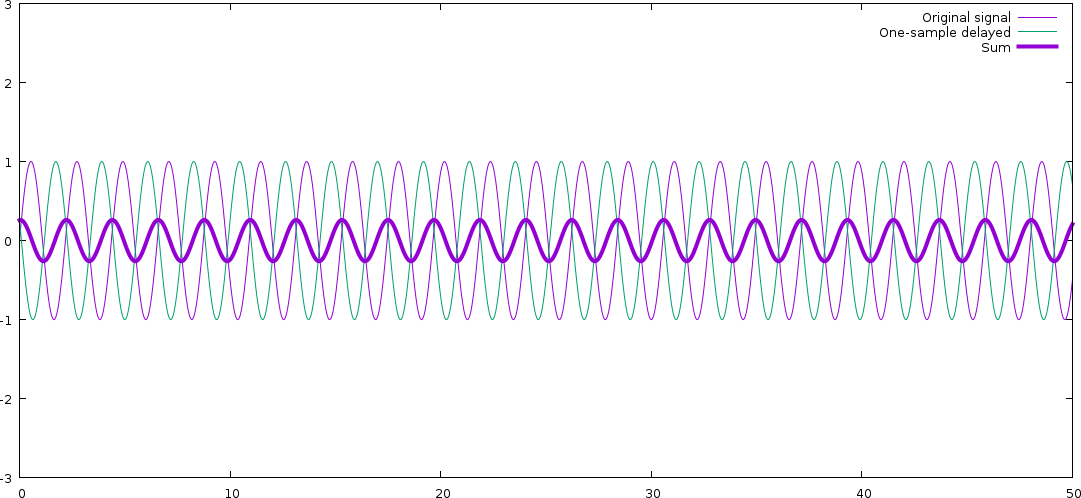
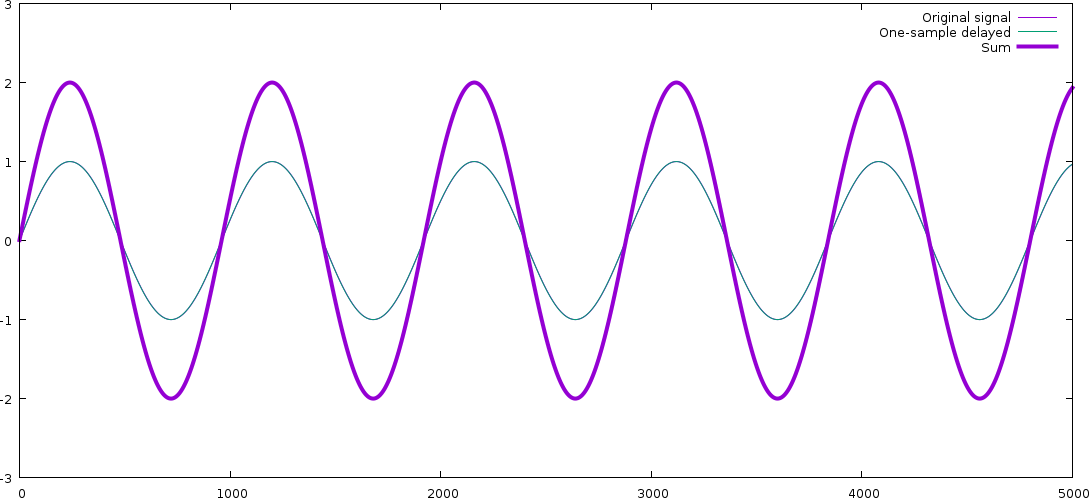
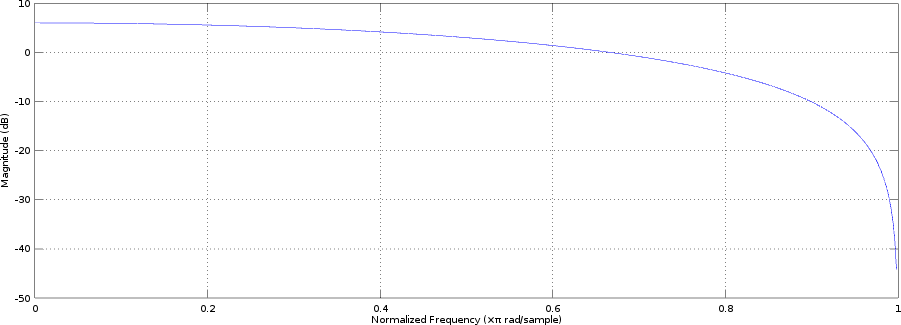
At some point back when the dinosaurs roamed the Earth and I was in high school, I borrowed my first digital signal processing book from a friend. I later went on to an engineering education and master's thesis about DSP, but the very basics of DSP never stop to fascinate me. Today, I wanted to write something about one of them and how it affects audio processing in Nageru (and finally, how Debian's policies put me in a bit of a bind on this issue). DSP texts tend to obscure profound truths with large amounts of maths, so I'll try to present a somewhat less general result that doesn't require going into the mathematical details. That rule is: Adding a signal to weighted, delayed copies of itself is a filtering operation. (It's simple, but ignoring it will have sinister effects, as we'll see later.) Let's see exactly what that means with a motivating example. Let's say that I have a signal where I want to get rid of (or rather, reduce) high frequencies. The simplest way I can think of is to add every neighboring sample; that is, set yn = xn + xn-1. For each sample, we add the previous sample, ie., the signal as it was one sample ago. (We ignore what happens at the edges; the common convention is to assume signals extend out to infinity with zeros.) What effect will this have? We can figure it out with some trigonometry, but let's just demonstrate it by plotting instead: We assume 48 kHz sample rate (which means that our one-sample delay is 20.83 s) and a 22 kHz note (definitely treble!), and plot the signal with one-sample delay (the x axis is sample number): Filtered 22 kHz As you can see, the resulting signal is a new signal of the same frequency (which is always true; linear filtering can never create new frequencies, just boost or dampen existing ones), but with much lower amplitude. The signal and the delayed version of it end up cancelling each other mostly out. Also note that there signal has changed phase; the resulting signal has been a bit delayed compared to the original. Now let's look at a 50 Hz signal (turn on your bass face). We need to zoom out a bit to see full 50 Hz cycles: Filtered 50 Hz The original signal and the delayed one overlap almost exactly! For a lower frequency, the one-sample delay means almost nothing (since the waveform is varying so slowly), and thus, in this case, the resulting signal is amplified, not dampened. (The signal has changed phase here, too actually exactly as much in terms of real time but we don't really see it, because we've zoomed out.) Real signals are not pure sines, but they can be seen as sums of many sines (another fundamental DSP result), and since filtering is a linear operation, it affects those sines independently. In other words, we now have a very simple filter that will amplify low frequencies and dampen high frequencies (and delay the entire signal a little bit). We can do this for all frequencies from 0 to 24000 Hz; let's ask Octave to do it for us: Frequency plot for simple filter (Of course, in a real filter, we'd probably multiply the result with 0.5 to leave the bass untouched instead of boosting it, but it doesn't really change anything. A real filter would have a lot more coefficients, though, and they wouldn't all be the same!) Let's now turn to a problem that will at first seem different: Combining audio from multiple different time sources. For instance, when mixing video, you could have input from two different cameras or sounds card and would want to combine them (say, a source playing music and then some audience sound from a camera). However, unless you are lucky enough to have a professional-grade setup where everything runs off the same clock (and separate clock source cables run to every device), they won't be in sync; sample clocks are good, but they are not perfect, and they have e.g. some temperature variance. Say we have really good clocks and they only differ by 0.01%; this means that after an hour of streaming, we have 360 ms delay, completely ruining lip sync! This means we'll need to resample at least one of the sources to match the other; that is, play one of them faster or slower than it came in originally. There are two problems here: How do you determine how much to resample the signals, and how do we resample them? The former is a difficult problem in its own right; about every algorithm not backed in solid control theory is doomed to fail in one way or another, and when they fail, it's extremely annoying to listen to. Nageru follows a 2012 paper by Fons Adriaensen; GStreamer does well, something else. It fails pretty badly in a number of cases; see e.g. this 2015 master's thesis that tries to patch it up. However, let's ignore this part of the problem for now and focus on the resampling. So let's look at the case where we've determined we have a signal and need to play it 0.01% faster (or slower); in a real situation, this number would vary a bit (clocks are not even consistently wrong). This means that at some point, we want to output sample number 3000 and that corresponds to input sample number 3000.3, ie., we need to figure out what's between two input samples. As with so many other things, there's a way to do this that's simple, obvious and wrong, namely linear interpolation. The basis of linear interpolation is to look at the two neighboring samples and weigh them according to the position we want. If we need sample 3000.3, we calculate y = 0.7 x3000 + 0.3 x3001 (don't switch the two coefficients!), or, if we want to save one multiplication and get better numerical behavior, we can use the equivalent y = x3000 + 0.3 (x3001 - x3000). And if we need sample 5000.5, we take y = 0.5 x5000 + 0.5 x5001. And after a while, we'll be back on integer samples; output sample 10001 corresponds to x10000 exactly. By now, I guess it should be obvious what's going on: We're creating a filter! Linear interpolation will inevitably result in high frequencies being dampened; and even worse, we are creating a time-varying filter, which means that the amount of dampening will vary over time. This manifests itself as a kind of high-frequency flutter , where the amount of flutter depends on the relative resampling frequencies. There's also cubic resampling (which can mean any of several different algorithms), but it only really reduces the problem, it doesn't really solve it. The proper way of interpolating depends a lot on exactly what you want (e.g., whether you intend to change the rate quickly or not); this paper lays out a bunch of them, and was the paper that originally made me understand why linear interpolation is so bad. Nageru outsources this problem to zita-resampler, again by Fons Adriaensen; it yields extremely high-quality resampling under controlled delay, through a relatively common technique known as polyphase filters. Unfortunately, doing this kind of calculations takes CPU. Not a lot of CPU, but Nageru runs in rather CPU-challenged environments (ultraportable laptops where the GPU wants most of the TDP, and the CPU has to go down to the lowest frequency), and it is moving in a direction where it needs to resample many more channels (more on the later), so every bit of CPU helps. So I coded up an SSE optimization of the inner loop for a particular common case (stereo signals) and sent it in for upstream inclusion. (It made the code 2.7 times as fast without any structural changes or reducing precision, which is pretty much what you can expect from SSE.) Unfortunately, after a productive discussion, suddenly upstream went silent. I tried pinging, pinging again, and after half a year pinging again, but to no avail. I filed the patch in Debian's BTS, but the maintainer understandably is reluctant to carry a delta against upstream. I also can't embed a copy; Debian policy would dictate that I build against the system's zita-resampler. I could work around it by rewriting zita-resampler until it looks nothing like the original, which might be a good idea anyway if I wanted to squeeze out the last drops of speed; there are AVX optimizations to be had in addition to SSE, and the structure as-is isn't ideal for SSE optimizations (although some of the changes I have in mind would have to be offset against increased L1 cache footprint, so careful benchmarking would be needed). But in a sense, it feels like just working around a policy that's there for good reason. So like I said, I'm in a bit of a bind. Maybe I should just buy a faster laptop. Oh, and how does GStreamer solve this? Well, it doesn't use linear interpolation. It does something even worse it uses nearest neighbor. Gah. Update: I was asked to clarify that this is about the audio resampling done by the GStreamer audio sink to sync signals, not in the audioresample element, which solves a related but different problem (static sample rate conversion). The audioresample element supports a number of different resampling methods; I haven't evaluated them.

Chris Lamb: try.diffoscope.org CLI client

One criminally-unknown new UNIX tool is diffoscope, a diff "on steroids" that will not only recursively unpack archives but will transform binary formats into human-readable forms in order to compare them instead of simply showing the raw difference in hexadecimal. In an attempt to remedy its underuse, in December 2015 I created the try.diffoscope.org service so that I and hopefully others could use diffoscope without necessarily installing the multitude of third-party tools that using it can require. It also enables trivial sharing of the HTML reports in bugs or on IRC. To make this even easier, I've now introduced a command-line client to the web service:
 $ apt-get install trydiffoscope
 [..]
 Setting up trydiffoscope (57) ...
 $ trydiffoscope /etc/hosts.allow /etc/hosts.deny
 --- a/hosts.allow
 +++ b/hosts.deny
  @@ -1,10 +1,17 @@
  -# /etc/hosts.allow: list of hosts that are allowed to access the system.
  -#                   See the manual pages hosts_access(5) and hosts_options(5).
  +# /etc/hosts.deny: list of hosts that are _not_ allowed to access the system.
  +#                  See the manual pages hosts_access(5) and hosts_options(5).
You can also install it from PyPI with:
$ pip install trydiffoscope

Mirroring the original diffoscope command, you can save the output locally in an even more-readable HTML report format by appending "--html output.html". In addition, if you specify the --webbrowser (or -w) argument:
$ trydiffoscope -w /etc/hosts.allow /etc/hosts.deny
https://try.diffoscope.org/gaauupyapzkb
... this will automatically open your default browser to view the results.

Dirk Eddelbuettel: rfoaas 1.0.0

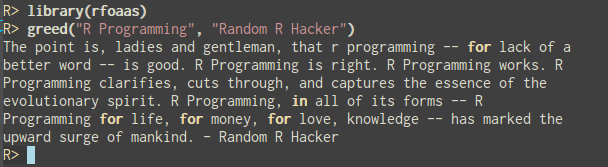
rfoaas greed example The big 1.0.0 is here! Following the unsurpassed lead of the FOAAS project, we have arrived at a milestone: Release 1.0.0 is now on CRAN. The rfoaas package provides an interface for R to the most excellent FOAAS service--which itself provides a modern, scalable and RESTful web service for the frequent need to tell someone to f$#@ off. Release 1.0.0 brings fourteen (!!) new access points: back(), bm(), gfy(), think(), keep(), single_(), look(), looking(), no(), give(), zero(), pulp(), sake(), and anyway(). All with documentation and testing. Even more neatly, thanks to a very pull request by Tyler Hunt, we can now issue random FOs via the getRandomFO() function! As usual, CRANberries provides a diff to the previous CRAN release. Questions, comments etc should go to the GitHub issue tracker. More background information is on the project page as well as on the github repo

This post by Dirk Eddelbuettel originated on his Thinking inside the box blog. Please report excessive re-aggregation in third-party for-profit settings.

David Moreno: I quit

I just recently quit my job at the startup company I had been working in for almost five years. In startup terms, such long time might be a whole lifetime, but in my case, I grew liking it more and more as the years came, I had evolved from being just another engineer, to lead a team of seven great developers, with decision-making tasks and strategy planning for our technical infrastructure. It s been such a great long teaching journey that I m nothing but pleased with my own performance, learned lessons and skills and all I provided and was provided by the project. Leaving a city like New York is not an easy task. You have it all there, you start making a life and suddenly, before you know it, you already have a bunch of ties to the place, people, leases, important dates, all kinds of shit. Seriously, all kinds of crazy ass shit start to fill up your baggage. You wake up everyday to get into the subway and commute surrounded by all of this people that are just like you: so similar yet so immensely different. No, leaving the city is not an easy task, it s not something to take lightly. You know how people just say my cycle has ended in this place as an euphemism not to end in bad terms with anyone? Well, ending a cycle is indeed a reality, I got to a point where I felt like I needed to head into a different direction, take on new challenges and overall, peace out and hope the best to everyone, specially to myself. This was me, on my last day at work, last Friday of June: (Some) people seem to be anxious to know what I m doing next, and my answer is, go mind your own fucking business. However, life is short and I would love to do any of the following: Decisions, decisions For the time being, I m chilling with my people, friends and family in beautiful Mexico City. I ve been doing so for the entire month of July and I couldn t be more content. August will see my 28th birthday and as I approach thirty, I believe I need to continue moving forward. This stupid world is a tiny place and our lives are short, I for one, will definitively try to take the bull by the horns. Thanks for reading, more updates soon. Peace.

Jaminy Prabaharan: GSoC-2016 Journey (In brief)

Three months of coding is about to end.It has officially begun on May 23rd and we are getting near to the final submission deadline on August 15th.

You can checkout my Debian wiki page to know more about myself.

I have worked on improving voice, video and chat communication (Real Time Communication) with free software, one of the RTC project for Debian.

My mentors are Iain.R.Learmonth and Daniel Pocock.Both of them were dedicative and I could learn many new things from them within these three months.I have contacted my mentors through personal mail, Debian outreach mailing lists and IRC(#debian-data and #debian-soc). They were very responsive to my queries. Thank you Iain and Daniel for improving and enlightening me.

My initial task is e-mail mining. I have to allow the client to login to the mail using IMAP, extracts the To , From and CC headers of every email message in the folder and then scan for the phone numbers, SIP addresses, XMPP addresses in the body of the message.These extracted details should be written in the CSV file also.The extracted phone numbers, SIP addresses, XMPP addresses and ham call signs should be made into a click able link using Flask.

I have also attended DebConf-16 (conference of Debian developers, contributors and users) in Cape Town in the middle of three months (Form July 2nd to July 9th).I gave a talk on my progressing GSoC project.I have learnt many new things about Debian, their projects and their packages apart form my GSoC project.I have met Debian developers, contribuors and some of the fellow GSoC students.

I have written previous blog posts related to GSoC-2016 in the following links.

GSoC-Journey till Mid term

Weekly Report for GSoC16-week 1 and week2

Weekly Report for GSoC16-Community bonding period

Weekly reports sent to Debian-outreach list.

Email-Mining is the repository I have created on GitHub to work on my project.

I have divided the tasks and coded individually to combine together.Snippet folder in the file contains the code for each tasks.

Following are the commits I have made in the repository.

https://github.com/Jaminy/Email-Mining/commits/master My tasks have been extended to add a gravatar on the page listing details for each email address, maintain a counter for each hour of the day in the scraper for each mail, show a list of other people that have been involved in email conversations and make the contact information on the detail pages machine readable. https://github.com/Jaminy/Email-Mining/issues

My mentor suggested me to work on at least three issues before final submission.I have worked on each of them individually in the snippet folder except the last one.I will be working on it after GSoC.

Mailmine.py script contains the final code which combines all snippets into one.

Three pull requests are to be merged after the confirmation from my mentor.

These are the abstract about what I have done within these three months.

It was an amazing and thrilling coding ride.

Stay tuned for the elaborated blog posts with DebConf experience and many more.

Jamie McClelland: Noam use Gnome

I don't quite remember when I read John Goerzen's post about teaching a 4 year old to use the linux command line with audio on planet Debian. According to the byline it was published nearly 2 years before Noam was born, but I seem to remember reading it in the weeks after his birth when I was both thrilled at the prospect of teaching my kid to use the command line and, in my sleepless stupor, not entirely convinced he would ever be old enough. Well, the time came this morning. He found an old USB key board and discovered that a green light came on when he plugged it in. He was happily hitting the keys when Meredith suggested we turn on the monitor and open a program so he could see the letters appear on the screen and try to spell his name. After 10 minutes in Libre Office I remembered John's blog and was inspired to start writing a bash script in my head (I would have to stop the fun with Libre Office to write it so the pressure was on...). In the end it was only a few minutes and I came up with:
#!/bin/bash
while [ 1 ]; do
  read -p "What shall I say? "
  espeak "$REPLY"
done
It was a hit. He said what he wanted to hear and hit the keys, my job was to spell for him. Noam uses Gnome Terminal to talk Oh, also: he discovered key combinations that did things that were unsurprising to me (like taking the screen grab above) and also things that I'm still scratching my head about (like causing a prompt on the screen that said: "Downloading shockwave plugin." No thanks. And, how did he do that?

13 August 2016

Russell Coker: SSD and M.2

The Need for Speed One of my clients has an important server running ZFS. They need to have a filesystem that detects corruption, while regular RAID is good for the case where a disk gives read errors it doesn t cover the case where a disk returns bad data and claims it to be good (which I ve witnessed in BTRFS and ZFS systems). BTRFS is good for the case of a single disk or a RAID-1 array but I believe that the RAID-5 code for BTRFS is not sufficiently tested for business use. ZFS doesn t perform very well due to the checksums on data and metadata requiring multiple writes for a single change which also causes more fragmentation. This isn t a criticism of ZFS, it s just an engineering trade-off for the data integrity features. ZFS supports read-caching on a SSD (the L2ARC) and write-back caching (ZIL). To get the best benefit of L2ARC and ZIL you need fast SSD storage. So now with my client investigating 10 gigabit Ethernet I have to investigate SSD. For some time SSDs have been in the same price range as hard drives, starting at prices well below $100. Now there are some SSDs on sale for as little as $50. One issue with SATA for server use is that SATA 3.0 (which was released in 2009 and is most commonly used nowadays) is limited to 600MB/s. That isn t nearly adequate if you want to serve files over 10 gigabit Ethernet. SATA 3.2 was released in 2013 and supports 1969MB/s but I doubt that there s much hardware supporting that. See the SATA Wikipedia page for more information. Another problem with SATA is getting the devices physically installed. My client has a new Dell server that has plenty of spare PCIe slots but no spare SATA connectors or SATA power connectors. I could have removed the DVD drive (as I did for some tests before deploying the server) but that s ugly and only gives 1 device while you need 2 devices in a RAID-1 configuration for ZIL. M.2 M.2 is a new standard for expansion cards, it supports SATA and PCIe interfaces (and USB but that isn t useful at this time). The wikipedia page for M.2 is interesting to read for background knowledge but isn t helpful if you are about to buy hardware. The first M.2 card I bought had a SATA interface, then I was unable to find a local company that could sell a SATA M.2 host adapter. So I bought a M.2 to SATA adapter which made it work like a regular 2.5 SATA device. That s working well in one of my home PCs but isn t what I wanted. Apparently systems that have a M.2 socket on the motherboard will usually take either SATA or NVMe devices. The most important thing I learned is to buy the SSD storage device and the host adapter from the same place then you are entitled to a refund if they don t work together. The alternative to the SATA (AHCI) interface on an M.2 device is known as NVMe (Non-Volatile Memory Express), see the Wikipedia page for NVMe for details. NVMe not only gives a higher throughput but it gives more command queues and more commands per queue which should give significant performance benefits for a device with multiple banks of NVRAM. This is what you want for server use. Eventually I got a M.2 NVMe device and a PCIe card for it. A quick test showed sustained transfer speeds of around 1500MB/s which should permit saturating a 10 gigabit Ethernet link in some situations. One annoyance is that the M.2 devices have a different naming convention to regular hard drives. I have devices /dev/nvme0n1 and /dev/nvme1n1, apparently that is to support multiple storage devices on one NVMe interface. Partitions have device names like /dev/nvme0n1p1 and /dev/nvme0n1p2. Power Use I recently upgraded my Thinkpad T420 from a 320G hard drive to a 500G SSD which made it faster but also surprisingly quieter you never realise how noisy hard drives are until they go away. My laptop seemed to feel cooler, but that might be my imagination. The i5-2520M CPU in my Thinkpad has a TDP of 35W but uses a lot less than that as I almost never have 4 cores in use. The z7k320 320G hard drive is listed as having 0.8W low power idle and 1.8W for read-write, maybe Linux wasn t putting it in the low power idle mode. The Samsung 500G 850 EVO SSD is listed as taking 0.4W when idle and up to 3.5W when active (which would not be sustained for long on a laptop). If my CPU is taking an average of 10W then replacing the hard drive with a SSD might have reduced the power use of the non-screen part by 10%, but I doubt that I could notice such a small difference. I ve read some articles about power use on the net which can be summarised as SSDs can draw more power than laptop hard drives but if you do the same amount of work then the SSD will be idle most of the time and not use much power . I wonder if the SSD being slightly thicker than the HDD it replaced has affected the airflow inside my Thinkpad. From reading some of the reviews it seems that there are M.2 storage devices drawing over 7W! That s going to create some cooling issues on desktop PCs but should be OK in a server. For laptop use they will hopefully release M.2 devices designed for low power consumption. The Future M.2 is an ideal format for laptops due to being much smaller and lighter than 2.5 SSDs. Spinning media doesn t belong in a modern laptop and using a SATA SSD is an ugly hack when compared to M.2 support on the motherboard. Intel has released the X99 chipset with M.2 support (see the Wikipedia page for Intel X99) so it should be commonly available on desktops in the near future. For most desktop systems an M.2 device would provide all the storage that is needed (or 2*M.2 in a RAID-1 configuration for a workstation). That would give all the benefits of reduced noise and increased performance that regular SSDs provide, but with better performance and fewer cables inside the PC. For a corporate desktop PC I think the ideal design would have only M.2 internal storage and no support for 3.5 disks or a DVD drive. That would allow a design that is much smaller than a current SFF PC.

12 August 2016

Jonathan Dowland: Lush (and friends)

gig poster The gig poster
On July 31st a friend and I went to see Max mo Park and support at a mini-festival day in Times Square, Newcastle. The key attraction for me to this gig was the top support band, Lush who are back after a nearly 20 year hiatus.
record Nano Kino 7"
I first heard of Lush quite recently from the excellent BBC Documentary Girl in a Band: Tales from the Rock 'n' Roll Front Line. They were excellent: the set was quite heavy on material from their more dreampop/shoegaze albums which is to my taste.
Max mo 7"s Max mo 7"s
I also particularly enjoyed Warm Digits, motorik instrumental dance stuff that reminded me of Lemon Jelly mixed with Soulwax, who had two releases very reasonably priced on the merch stand; Nano Kino in the adjacent "Other Rooms", also channelling dreampop/shoegaze; and finally Max mo Park themselves. I was there for Lush really but I still really enjoyed the headliners. I've seen them several times but I've lost track of what they've been up to in recent years. Both their earliest material and several newer songs were well received by the home crowd and atmosphere in the enclosed Times Square was excellent.

Next.

Previous.