Search Results: "ema"

4 September 2012

Gunnar Wolf: Electronic voting in Panama: Slower, more expensive, more uncertainty... Goodbye!

Panama just underwent a nasty e-voting exercise: Electronic-mediated elections were held for the committee of the PRD party. It sounds simple - Even trivial! There were only 4100 authorized voters, it was geographically trivial (all set inside a stadium)... But it blew up in smoke. I won't reiterate all what happened, I'll rather direct you to our project's (the e-voting observatorium) page: News regarding Panama (for those coming from the future, search starting at 2012-08-27 and yes, it's all in Spanish, but there are free-as-in-beer translation services. Many e-vote proponents/sellers/pushers were very eagerly waiting for this election to brag about one more success... So much that they could not just ignore it, and started rationalizing it away. Anyway, while feeding the observatorium, I came across this opinion-article in the Voto Digital website, which makes quite a bit of pro-e-voting noise. I replied to it, and I think my analysis is worth sharing also with you:
So, lets make some simple numbers, rounding the numbers: The PRD vote in Panama was done for a universe of 4100 voters. It took 10 hours (instead of the planned 4), so 410 people were processed every hour. There were 40 voting (electronic) booths, so each processed 10 people per hour. This means, each person spent 6 minutes by the booth. A manual vote in this fashion is highly parallelizable: Each of the voters can be given ballots with anticipation, or many of them cna be allowed in to be given the ballots in situ (depending on the electoral scheme employed). The contention time is the time it takes to each voter to get near the booth and deposit his ballot (either folded or in an envelope) - And it will very rarely be more than a couple of seconds. So, given that using electronic booths parallelism cannot grow (there is a fixed number of machines) and the queues grew wildly, with traditional voting it would have surely fitted in the expected four hours (they were expected, also, based on their past experiences). As for counting, that's the slowest part of manual voting, it's also highly parallelizable: If each of the 40 booths has slightly over 100 ballots, the party personnel can easily count them in under 30 minutes. Capture and aggregation for the 40 partial results would take an extra 10 minutes, even being generous. Manual voting would have saved them around five hours, without demanding additional resources (and being thus much more economical than having to buy 40 specific-purpose computers). And as an additional advantage, the physical and tangible vote proofs would remain, in case they were ever again needed.

Jon Dowland: Pretty Eight Machine

P8M CD and stickers P8M CD and stickers
Back in June or thereabouts I learned about a project to re-create Nine Inch Nails' first album "Pretty Hate Machine" as a chiptune cover/tribute project. This project is called Pretty Eight Machine. The artist InversePhase was kind enough to send me a copy of the CD as a random prize draw, so I thought I would write a few words about it. I don't know a great deal about the world of chiptunes, besides having heard a variety of "chiptune" covers of various well-known songs, some good, some bad. the backing track to this video, a cover of Tears for Fears' "Mad World", is, in my opinion, good. The front cover for P8M lovingly reflects the recent reworking of the classic PHM cover by Rob Sheridan, for the source album's recent deluxe reissue. There's a great in-depth interview with Rob about the process of reviving that cover at sleevage. That little homage is a good indication of the amount of effort and attention to detail that has gone into this project. One interesting thing about this project is that each track has been composed for a particular vintage chipset, such as the Commodore 64 in the case of the opening track "Head like I/O". InversePhase is very faithful to the original chips here, not just using their tones as part of a modern composition but constraining himself with the actual chipset limitations: for example, the number of voices that can be playing at once. (By contrast, that Tears for Fears chiptune above is the non-authentic type of chiptune). InversePhase tracks Trent's vocal lines as an instrument, so all of the notes that are heard in the original are present on this remake. It would be interesting to hear an "instrumental" mix of these tracks, and perhaps mix isolated vocal tracks from the originals on top My favourite track is probably "Kinda I Want To". I actually really like the original track, in particular the extended breakdown, where a synth noise gradually breaks down and disintegrates bar after bar. It suffered terribly from dated lyrics compared to other PHM tracks, but InversePhase's cover is saved that embarrassment. This particular track (apparently) makes use of a VCR6, a Konami chipset apparently used to supplement the hardware in the Famicom/NES. Yes, back then games came on cartidges that could supply bits of their own hardware if required. Those were the days! And yes InversePhase, you've successfully made the NES sound "dirty": and the synth breakdown sounds great. Any fan of the original album or anyone with an interest in what kind of noises vintage sound synthesis chipsets could produce are thoroughly recommended to give this album a try. You can preview all of the tracks and read per-track information on the bandcamp page.

Thomas Koch: leaving facebook

I've never really used facebook so it's not too hard for me to delete my account there. The only thing that's a pity is that I found (or others found me) many people that I once met and which I'd love to meet again once. So I'll go through my facebook contacts list and will try to copy all contact data especially the email adresses and plan to write emails to everybody every quarter or half a year about happenings in our lifes. I'd be glad to receive such emails from others too! They'll surely be read more carefully then my facebook timeline!

This gets me to another point: I still don't have a satisfying free (as in freedom) solution to manage my contacts across devices and available on my web server. The same for image galleries. So I can understand how convenient facebook for many people is. Still facebook is evil and it's an important and ongoing project to provide a better alternative.

It'll be harder for me to leave Twitter. This one comes next. If people would just switch to the free and privacy aware alternative identi.ca...

And then I've to finally provide a better alternative for my family to share baby pictures then Google Plus... Leaving Xing and Linkedin also doesn't worry me, I just have to collect the addresses of my important contacts there. Not so pressing is to leave Couchsurfing for bewelcome.org.

So if you want to hear news from me just pass by www.koch.ro from time to time or put my blogs feed into your feed reader. I'll also keep my identi.ca account.

update: One tiny example of facebooks evilness is, that they don't show me your real email address (anymore). They only show me an @facebook address. So if I don't know your real email address from any other source, I would not be able to send you messages without sending it over facebooks servers. I read that you can change the email address shown back to your real email address somewhere in the options.

Pietro Abate: Package Managers Comparison - take 2

On year ago, we (the mancoosi team) published a comparison study regarding the state of the art of dependency solving in debian. As few noticed, the data presented had few glitches that I promised to fix. So we've repeated our tests using exactly the same data we used one year ago, but now using the latest available versions of all package managers as available in debian unstable. During the last year, three out of four solver that we evaluated release a major upgrade so I expected many improvements in performances and accuracy. Mpm, our test-bench for new technologies, changed quite a bit under the wood as a consequence of the evolution of apt-cudf and the recent work done in apt-get to integrate external cudf dependency solvers. Overall the results of our study are not changed. All solvers but mpm, that is based on aspcud, are not scalable as the number of packages (and alternatives) grows. It seems that Smart is the solver that does not give up, incurring in a timeout (fixed at 60 seconds) most of the time. Aptitude is the solver that tried to give you a solution, doesn't matter what and as result providing solutions that do not satisfy the user request for one reason or the other. Apt-get does surprisingly well, but it gives up pretty often showing the incomplete nature of it's internal solver. Cupt sometimes timeout, sometimes gives up, but when it is able to provide an answer it is usually optimal and it is very fast ... Mpm consistently finds an optimal solution, but sometimes it takes really a long time to do it. Since mpm is written in python and not optimized for speed this is not a big problem for us. The technology used by mpm is now integrated in apt-get and I hope this will alleviate this problem. All the details of our study can be found one the Mancoosi Website as usual with a lot of details. For example here you can find the results when mixing four major releases : sarge-etch-lenny-squeeze. Comments are more then welcome.

3 September 2012

Gunnar Wolf: WikiLovesMonuments wants *you* (and me!)

What, haven't you heard about the WikiLovesMonuments photo contest around cultural heritage? Copying from its web page,
Wiki Loves Monuments is an international photo contest around cultural heritage monuments in September. Starting from the Netherlands in 2010 and organized on a European level in 2011, we go global in 2012!
I heard about this initiative in Iv n Mart nez's Wikimedia talk at COSIT 2012, held last week in Coatzacoalcos, Veracruz (I intend to write a bit more regarding COSIT later on). I loved the idea, and intend to participate Not because I take great pictures (I don't, and I usually take them using my aging phone, which gives decent results but nothing beyond that), but because I love to move by bike in the city, and it's one of the best ways to roll in front of some of them. But more on me later Back to the topic! WikiLovesMonuments aims to improve on Wikimedia's (the organization behind Wikipedia and several other Free Culture reference projects) coverage of important landmarks all over the world. To do so, they are offering a trip to attend WikiMania 2013 in Hong Kong to the first place winner, and other "photography-related" prizes to the other winners. So, back to me: My motivation to enter the contest is to help Wikimedia. I know my shots won't be top-notch (although they will be the best I can do). I enjoy biking in my city, and often go not too far from many of the listed monuments. I am amazed at the number of monuments still pending in my area (of course, it's not by mistake this is called "La ciudad de los palacios", The city of the palaces) Surely some of the readers of this post will have (or will find easy to take) some photos to add. Of course, I'll try to focus on the missing monuments, but if you are a good photographer, you might want to submit a better version for a monument that's already there. So, some pointers, from what's closest to what's farthest from me: At least for Mexico, the listings are taken from the National Institute for Anthropology and History (INAH)'s Public registry of archaeological zones and monuments. So, I cannot wait to start my biking session today to get some good end-of-summer evening sun and get some pictures taken! :-D

2 September 2012

Benjamin Mako Hill: Open Brands

In late July, the Awesome Foundations invited me to participate in an interesting conversation about open brands at their conference. Awesome is a young collection of organizations struggling with the idea of if, and how, they want to try to control who gets call themselves Awesome. I was asked to talk about how the free software community approaches the issue. Guidance from free software is surprisingly unclear. I have watched and participated in struggles over issues of branding in every successful free software project I've worked in. Many years ago, Greg Pomerantz and I wrote a draft trademark policy for the Debian distribution over a couple beers. Over the last year, I've been working with Debian Project Leader Stefano Zacchiroli and lawyers at the Software Freedom Law Center to help draft a trademark policy for the Debian project. Through that process, I've come up with three principles which I think lead to more clear discussion about whether a free culture or free software should register a trademark and, if they do, how they should think about licensing it. I've listed those principles below in order of importance. 1. We want people to use our brands. Conversation about trademarks seem to turn into an exercise in imagining all the horrible ways in which a brand might be misused. This is silly and wrong. It is worth being extremely clear on this point: Our problem is not that people will misuse our brands. Our problem is that not enough people will use them at all. The most important goal of a trademark policy should be to make legitimate use possible and easy. We want people to make t-shirts with our logos. We want people to write books about our products. We want people to create user groups and hold conferences. We want people to use, talk about, and promote our projects both commercially and non-commercially. Trademarks will limit the diffusion of our brand and, in that way, will hurt our projects. Sometimes, after carefully considering these drawbacks, we think the trade-off is worth making. And sometimes it is. However, projects are generally overly risk averse and, as a result, almost always err on the side of too much control. I am confident that free software and free culture projects' desire to control their brands has done more damage than all brand misuse put together. 2. We want our projects to be able to evolve. The creation of a trademark puts legal power to control a brand in the hands of an individual, firm, or a non-profit. Although it might not seem like such a big deal, this power is, fundamentally, the ability to determine what a project is and is not. By doing this, it creates a single point of failure and a new position of authority and, in that process, limits projects' ability to shift and grow organically over time. I've heard that in US politics, there is no trademark for the terms Republican or Democrat and that you do not need permission to create an organization that claims to be part of either party. And that does not mean that everybody is confused. Through social and organizational structures, it is clear who is in, who is out, and who is on the fringes. More importantly, this structure allows for new branches and groups outside of the orthodoxy to grow and develop on the margins. Both parties have been around since the nineteenth century, have swapped places on the political spectrum on a large number of issues, and have played host to major internal ideological disagreements. Almost any organization should aspire to such longevity, internal debate, and flexibility. 3. We should not confuse our communities. Although they are often abused, trademarks are fundamentally pro-consumer. The point of legally protected brands is to help consumers from being confused as the source of a product or service. Users might love software from the Debian project, or might hate it, but it's nice for them to be able to know that they're getting "Debian Quality" when they download a distribution. Of course, legally protected trademarks aren't the only way to ensure this. Domains names, internal policies, and laws against fraud and misrepresentation all serve this purpose as well. The Open Source Initiative applied for a trademark on the term open source and had their application rejected. The lack of a registered trademark has not kept folks from policing use of the term. Folks try to call their stuff "open source" when it is not and are kept in line by a community of folks who know better. And since lawyers are rarely involved, it is hardly clear that a registered trademark would help in the vast majority of these these situations. It is also the case that most free software/culture organizations lack the money, lawyers, or time, to enforce trademarks in any case. Keeping your communities of users and developers clear on what is, and what isn't, your product and your project is deeply important. But how we choose to do this is something we should never take for granted.

Emanuele Rocca: Story of a bug in Ubuntu

Some months ago I have run into a pretty interesting bug while working on a Ubuntu-based remote desktop system. The whole OS was installed on a server somewhere and users could access their desktop remotely. Some call this stuff Desktop-as-a-Service. The operating system we chose was Ubuntu Oneiric (11.10) and the remote access part was implemented with x2go, which uses nxagent to provide NX transport of X sessions. Users could access their Ubuntu machines remotely, with sound, video, youtube, and all you would expect from a desktop machine. The whole thing was working quite well. Now, as I said that was in May. Ubuntu 12.04 LTS was available, and the choice of upgrading to it sounded pretty much obvious. So we upgraded our test system to Precise and everything seemed to work smoothly. Till we tried to open a PDF document, actually. It took evince about 50 seconds to display a relatively small document. Same story with images opened with the default image viewer, eog. The fix delivered to our users was simple: we have set shotwell-viewer as the default image viewer, and epdfview as the default PDF viewer. Everybody happy. In the meantime, obviously, I was interested in this issue so I ve tried to run run evince from a terminal, getting the following output:
(evince:15833): GRIP-WARNING **: Failed to initialize gesture manager.
Funny. On another test system running Debian Sid (unstable) everything was working smoothly. The diff between Ubuntu s version of evince and Debian s is a 6MB monster. Among other changes, I noticed that Ubuntu s version build-depends on libgrip-dev, which depends on libutouch-geis. Multitouch stuff. Why should multitouch support break my remote session? So on May the 10th I filed a bug on launchpad. How this issue got handled is in my opinion one of the many fine examples of the inherent superiority of free software, coupled with a we won t hide problems mindset. For an example of how bad is the proprietary approach, just check a random bug in Adobe s bug tracking system. But let s go back to the evince bug. Other users reported that their VNC sessions were also affected by the same problem. After a few days it was clear that the culprit was utouch-geis, and a patch appeared. Unfortunately it did not actually address the issue. Somebody else reported that RDP sessions were broken too. At the beginning of June Precise was still affected. Finally, on August the 6th a working patch was submitted by Bradley M. Froehle and included by Chase Douglas (thank you guys). End of August, fixed version of geis accepted into precise-updates, case closed. Now for some considerations. The problem was clearly of a certain importance. A Long Term Support, stable version of Ubuntu shipped with broken PDF and image viewing functionalities. It got fixed properly, even though 3 good months are quite a long time for such a bug to get solved. However, the issue only affected a pretty limited number of users, also certainly not Ubuntu s main target audience. This bug never affected Debian, simply because utouch-geis has not made its way into the archive yet. It takes longer to make changes like this in Debian, but for some categories of users stability is more important than new, cool features. Choice is a good thing.

31 August 2012

Roland Mas: Integrating FWbuilder with fail2ban and port-knocking

This article documents how I'm currently building my firewalls. It builds on netfilter-based-port-knocking, and tries to integrate several components of a firewall as gracefully as possible. For some context: I'm getting involved with servers where the firewall policy goes beyond a handful of SSH from my home and my other servers rules. There are many different network streams that need to be policed, some of them are common across several (potentially many) servers, and so on. So I'm gradually giving up on my hand-made scripts, and trying out higher-level tools. I settled on FWbuilder, which seems nice. However, it only allows static policies, and I still want to keep dynamic policies such as what fail2ban provides, as well as my own port-knocking system. The problem I had was that fail2ban isn't really made to play nice as part of a complex firewalling setup, my port-knocking system was too tightly integrated within my firewall script, and FWbuilder wasn't too flexible when it came to delegating part of the firewall policy to something external. Fortunately, this was only a perceived problem (or a real problem in my understanding), because it is actually possible to have all three blocks playing nicely together. More context: as usual, I'm focusing on Debian-like systems. More precisely, on those with a Linux kernel; it may be that FreeBSD's firewalling subsystem has a feature comparable to Linux's recent module, but I don't know. Let's start with FWbuilder. This is not the place for a manual, the official documentation is rather complete. I'll assume you have defined most relevant blocks in there: firewall, hosts, IP addresses, services, and so on. You define your static policy with the standard rules. From then on, we want to integrate the external tools for dynamic rules. Step 1: Integrating fail2ban We want fail2ban to have its own playground, so that it doesn't overwrite anything in the standard policy. The trick is to define a new policy rule set named fail2ban. Leave it empty in FWbuilder. So far so good, but fail2ban (the daemon) still operates on the INPUT chain in the firewall, and could therefore still mangle the static rules. Fortunately, starting with fail2ban 0.8.5 (available from Debian Wheezy, or in the backports for Squeeze), you can define what chain to operate on: with a configuration item such as chain = fail2ban, fail2ban (the daemon) will now only add its rules to fail2ban (the firewall chain), and won't be able do damage the other chains. The missing part is to send some of the traffic to it using the standard policy: i defined a rule sending the incoming SSH connections to the fail2ban policy ( branching in FWbuilder jargon). Voil : the static policy delegates part of the decision-making to a sub-policy controlled by the fail2ban daemon. Step 2: Integrating port-knocking This is a bit trickier, but we'll use a similar method. First, the traffic used for port-knocking needs to be directed to the chain that does the listening. Define a policy rule set named portknocking, and leave it empty in FWbuilder. It'll be used by the dynamic rules to track progression of source IP addresses through the port-knocking sequence, so you'll need to send ( branch ) incoming traffic there, probably after the rules allowing incoming connections from known hosts. The dynamic part of this will only concern the refreshing of this listening chain , which we assume will do its work and mark IP addresses with PK_ESTABLISHED once the sequence is completed. What we do with these marked IP addresses will still be defined within the FWbuilder policy. We're going to need some complex rules since we want to filter according to this PK_ESTABLISHED bit and according to destination port, for instance; unfortunately FWbuilder doesn't allow combining filter criteria with and, so we define a new policy rule set called accept_if_pk_ok. This ruleset has two rules: the second is an ACCEPT and should be easy to understand. The first rule needs to ensure the ACCEPT is only reached for connections coming from PK_ESTABLISHED addresses, so it's going to be a bit tricky. (Explanation: the first rule matches packets coming from IP addresses not marked as PK_ESTABLISHED, and returns them to the calling policy. Packets remaining after this rule are those coming from the appropriate addresses, and they go on to the ACCEPT. We could have had the first rule match on IP addresses that are marked, and branch to yet another ruleset with the ACCEPT part, but that would make it harder to read, I feel.) Now let's get back to the main policy and add rules concerning what kind of traffic we want to allow once the port-knocking sequence completed. For instance, we define a rule matching on the SSH service , where the action is to branch to accept_if_pk_ok. When an incoming packet tries to establish a connection to the SSH port, it's passed to the accept_if_pk_ok ruleset. If it comes from the same IP as a recent port-knocking sequence, it goes on to be ACCEPTed. If not, it returns to the main policy. Maybe static rules further on will allow it to go through. Step 3: tying it all together Now that we have all the pieces, the rest is plumbing. With this setup, at boot time, the $hostname.fw script creates the static policy and the extra playgrounds; then the port-knocking script implements the listening for the magic sequence; then fail2ban inserts its own rules. And there we are: three different parts for the firewall policy, all integrating nicely. Mission accomplished! Note: (Mostly copy-and-pasted from the previous article) This article is deliberately short on details and ready-to-run scripts. Firstly because firewall scripts vary wildly so any script would have to be adapted anyway, but mostly because security is best handled with one's brain switched on. Fiddling with a firewall can easily open gaping holes or lock everyone out. So please make sure you understand what goes on before blindly pasting stuff into your own setup. Some bits are left as an exercise to the reader.

Russell Coker: Links August 2012

Google are providing some really good employee benefits including benefits to a life partner of a deceased employee [1]. It s not known if all those benefits are available outside the US, in any case the US is the first world country with the least social security so they need it most there. A recent Australian legal case had a father petitioning the court to have his kids take his family name [2]. According to the news report no good reason was given for renaming the kids, merely tradition. The mother won. GlassDoor.com is a site for reviewing companies [3]. It also has job adverts, it seems that they get people in to read the reviews and then advertise jobs. Sarah Resnick interviewed Jacob Appelbaum (of Tor fame) about privacy issues and published the article as Leave Your Cellphone at Home [4]. It s very interesting and references some resources such as riseup.net that I have to try using. Systemd in Fedora 17 has multi-seat support [5]. They support plugging USB terminals in at run-time to dynamically add new consoles for GNOME sessions. The Coding Horror blog has an amusing and informative post about why people shouldn t learn to code [6]. Related posts:
  1. Links June 2012 This Youtube video is an amusing satire of EULAs and...
  2. Links January 2012 Cops in Tennessee routinely steal cash from citizens [1]. They...
  3. Links August 2008 Michael Janke is writing a series of posts about estimating...

30 August 2012

Paul Wise: Ponds as time travel devices

I firmly believe that this pond is a time travel device: Space invader pond The proof is in this recording I made1. At minimum, clearly there is some sort of quantum entanglement with computer games from the 70s going on. 1. Folks may want to use this recording in free software. To the extent possible under law, I have waived all copyright and related or neighboring rights to this work. The frogs have too. An email or a link to this page would be appreciated though.

29 August 2012

Julien Danjou: Gnus notifications

Today, I've merged my Gnus notifications module inside Gnus git repository. This way, it will be available for everybody in Emacs 24.2. gnus-notifications example This module allows you to be notified via notifications-notify (the Emacs implementation of the Freedesktop desktop notifications) on new messages received in Gnus. It can also retrieves contacts photo via gravatar.el and google-contacts.el to include them in the notification. To enable it in Emacs > 24.1, you just have to add the following line to your Gnus configuration file:
(add-hook 'gnus-after-getting-new-news-hook 'gnus-notifications)
If you want to download it and use it stand-alone for a previous Emacs version, you can fetch the latest file revision and load it before adding the previously given line.

Olivier Berger: Debian Package Tracking System now produces RDF description of source packages

Here s a second post on the subject of RDF descriptions for Debian source packages (see the previous post for some context). From now on, the Debian Package Tracking System (PTS) will produce, alongside HTML pages meant for humans, RDF pages meant for Linked Data / Semantic Web aware applications. Every Debian source package, which used to have an HTML page like http://packages.qa.debian.org/packagename now has a corresponding RDF/XML document available provided that the application/rdf+xml content-type is required (the HTTP client being redirected to the proper HTML or RDF document).

The main objective is to try and produce (closest as possible from the source, at debian.org) an authoritative description of Debian s packages in an interoperable format (RDF using the ADMS.SW 1.0 ontology). Thus, each package in Debian can be identified on the Semantic Web with a unique URI like http://packages.qa.debian.org/apache2, which is dereferenceable as RDF. Here s a graph representing the resources included in http://packages.qa.debian.org/apache2 (click on the image to load it) :
You can see an example of such an RDF representation for the apache2 source package in trying (with the raptor2-utils package installed):

$ rapper -o turtle http://packages.qa.debian.org/apache2
If you prefer more visual/navigatable versions, use one of the Linked Data browsers referenced in wikipedia or see the output of the W3C RDF validator. For more details about the underlying format see a raw RDF/XML dump :

$ curl -L -v -H 'Accept: application/rdf+xml' http://packages.qa.debian.org/apache2
Any Semantic Web application can then reference that resource, which becomes part of the Linked Open Data cloud. There are probably lots of uses that could emerge from this, but the immediate I can think of is the matching of Debian packages with other packages/projects (upstream, downstream, other dists) in an interoperable way (see other projects like distromatch, etc.). At the moment, the doap:homepage of the upstream SoftwareProject resources generated by the PTS can be such a simple matching key (it s actually much more complex than that, but will be the topic of further efforts). AFAICT, this is the first large deployment of an ADMS.SW 1.0 implementation. On my machine, I ve counted almost 1.5 million triples generated. Stay tuned for more installments on similar topics.

28 August 2012

Theppitak Karoonboonyanan: Pango-HarfBuzz Merge and The Effects on Thai Module

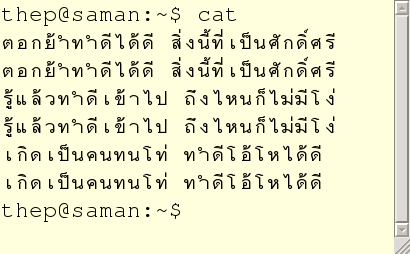
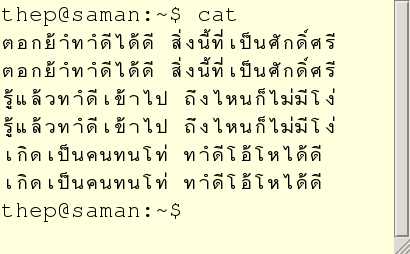
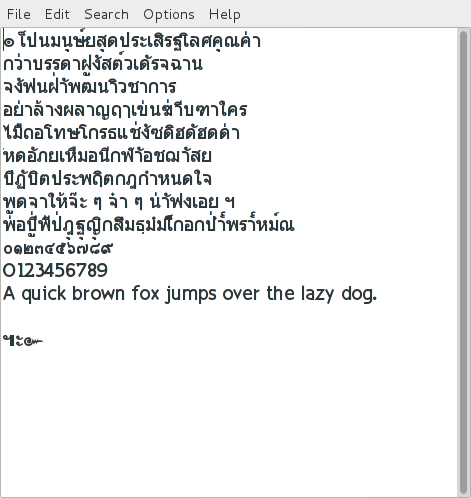
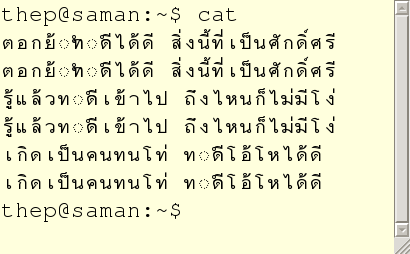
One major change in GNOME 3.6 is Pango s shaper engines replacement with HarfBuzz. Only language engines (for word break analysis, for example) are retained. So, I m checking how this affects Thai/Lao rendering and what to do next. Over all, Behdad has put a good effort to make it right. Most Uniscribe behaviors have been achieved for compatibility. He even cares enough to cover some widespread Thai fonts in which the language tag 'latn' is used instead of 'thai', as seen in Mozilla #719366. Unfortunately, this font set has been declared as standard fonts in official documents. The workaround seems inevitable. Supported Fonts In my experiments with some existing Thai OpenType fonts, the new Pango still renders well without regression. Loma font from fonts-tlwg (glyph positioning with GPOS, rearrangement with GSUB): Loma on new Pango Arundina Sans font from Fonts-SIPA-Arundina (positioning by substitution, only GSUB, no GPOS): Arundina Sans on new Pango But for legacy fonts without OpenType features, it renders badly: Non-OpenType on new Pango In addition, according to Behdad, PUA glyphs in legacy fonts are not supported yet. This means there will be regression on fonts designed for Windows XP or below. But modern fonts designed for Windows 7 should be fine. Changes on Bugs The engine replacement from scratch certainly affects existing bugs. Some become obsolete, some still remain. Here are the summary for Thai/Lao engine, as resolved upstream: Closed bugs: Questionable bugs: Remaining bugs:
27 August 2012

Andrew Cater: Ken Starks - immediate need for help is over for the moment - but

From Ken Starks, of Helios Project / Reglue

From the desk of just-so-you-know.....

Thomas Knight and I have agreed that the fund drive to aid in paying for necessary surgery for me should be halted. I will do a full blog about this entire effort this Monday but suffice it to say, you have donated more than enough to take care of my immediate needs and those down the road. Asking for anything more would be taking advantage of a loving and generous community. While it is far from adequate, the only thing I can offer you is my eternal thanks. It just seems so....small of a thing to give in return.

They will not stop the Indiegogo campaign until it reaches its time limit unfortunately so that will remain in effect for the next 30-some hours. Please do not donate anything further as I have more than enough to cover my expenses. I will explain more about that on my blog Monday.

If you helped spread the word about this campaign, please pass this posting along with the same intensity. I would deeply appreciate it.

See also now: update from Ken:

http://linuxlock.blogspot.co.uk/2012/08/of-roller-coasters-cancer-and-linux.html
==

Donations for Ken himself may be over: the work of Helios/Reglue still remains good, important and useful - the world benefits for investment in education. I would urge that this is still a worthwhile charity to contribute to as you get Linux into the hands of young people and the disadvantaged who can then USE it.

Christoph Berg: PostgreSQL in Debian Hackathon

Almost a year has passed since my talk at pgconf.eu 2011 in Amsterdam on Connecting the Debian and PostgreSQL worlds, and unfortunately little has happened on that front, mostly due to my limited spare time between family and job. pgapt.debian.net is up and running, but got few updates and is lagging behind on PostgreSQL releases. Luckily, we got the project moving. Dimitri Fontaine and Magnus Hagander suggested to do a face-to-face meeting, so we got together at my house for two days last week and discussed ideas, repository layouts, build scripts, and whatnot to get all of us aligned for pushing the project ahead. My employer sponsored my time off work for that. We almost finished moving the repository to postgresql.org infrastructure, barring some questions of how to hook the repository into the existing mirror infrastructure; this should get resolved this week. The build server running Jenkins is still located on my laptop, but moving this to a proper host will also happen really soon now. We are using Mika Prokop's jenkins-debian-glue scripts for driving the package build from Jenkins. The big plus point about Jenkins is that it makes executing jobs on different distributions and architectures in parallel much easier than a bunch of homemade shell scripts could get us with reasonable effort. Here's a list of random points we discussed: We really aim at using unmodified packages from Debian as much as possible, and in fact this project doesn't mean to replace Debian's PostgreSQL packaging work, but to extend it beyond the number of server versions (and Debian and Ubuntu versions covered) supported. The people behind the Debian and Ubuntu packages, and this repository are mostly the same, so we will claim that "our" packages will be the same quality as the "original" ones. Big thanks go to Martin Pitt for maintaining the postgresql-common testsuite that really covers every aspect of running PostgreSQL servers on Debian/Ubuntu systems. Stay tuned for updates! :)

24 August 2012

Olivier Berger: Generating RDF description of Debian package sources with ADMS.SW

Edit : I ve now managed to roll out my contribution which is now in production on packages.qa.debian.org. See a later post I ve made on the subject, and beware that the generated RDF has changed a bit also. ADMS.SW proposes specifications for description of software present in software catalogues. I ve tried and apply it to the contents of the Debian Package Tracking System (PTS), using transformation of the information known by the PTS to RDF+XML. The result is not yet in production, but here s an example of what can be done, using the Turtle syntax (more readable) :
<style type="text/css"> .T1 color:#000000; font-size:14pt; font-weight:bold; .T2 color:#000000; font-size:12pt; .T3 color:#000000; font-size:8.5pt; .T4 color:#0000ff; font-size:8.5pt; .T5 color:#a020f0; font-size:8.5pt; .T6 color:#228b22; font-size:8.5pt; .T7 color:#b22222; font-size:8.5pt; .T8 color:#008b8b; font-size:8.5pt; .T9 color:#8b2252; font-size:8.5pt; .dp1 .dp2 </style> @base <http://packages.qa.debian.org/> .
@prefix rdf: <http://www.w3.org/1999/02/22 rdf syntax ns#> .
@prefix admssw: <http://purl.org/adms/sw/> .
@prefix doap: <http://usefulinc.com/ns/doap#> .
@prefix dcterms: <http://purl.org/dc/terms/> .
@prefix rdfs: <http://www.w3.org/2000/01/rdf schema#> .
@prefix foaf: <http://xmlns.com/foaf/0.1/> .
@prefix schema: <http://schema.org/> .
@prefix spdx: <http://www.spdx.org/rdf/terms#> .
@prefix : <http://www.w3.org/1999/xhtml> .
@prefix str: <http://exslt.org/strings> . #
# First the packaging project for apache2 in Debian
#
# <http://packages.qa.debian.org/apache2> resource :
<apache2>
a admssw:SoftwareProject ;
doap:name "apache2" ;
doap:description "Debian apache2 source packaging" ;
doap:homepage "http://packages.debian.org/src:apache2" ;
schema:contributor [
a foaf:OnlineAccount ;
foaf:accountName "Debian Apache Maintainers" ;
foaf:accountServiceHomepage <http://qa.debian.org/developer.php?login=debian apache@lists.debian.org>
], [
a foaf:OnlineAccount ;
foaf:accountName "Stefan Fritsch" ;
foaf:accountServiceHomepage <http://qa.debian.org/developer.php?login=sf@debian.org>
], [
a foaf:OnlineAccount ;
foaf:accountName "Steinar H. Gunderson" ;
foaf:accountServiceHomepage <http://qa.debian.org/developer.php?login=sesse@debian.org>
], [
a foaf:OnlineAccount ;
foaf:accountName "Arno T ll" ;
foaf:accountServiceHomepage <http://qa.debian.org/developer.php?login=arno@debian.org>
] ;
# pointer to the release in the different suites :
doap:release <apache2_2.2.16 6+squeeze7>, <apache2_2.2.22 11>, <apache2_2.4.2 2>. #
# Now the different debian package source releases
#
# <http://packages.qa.debian.org/apache2_2.2.16 6+squeeze7> resource
<apache2_2.2.16 6+squeeze7>
a admssw:SoftwareRelease ;
rdfs:label "apache2 2.2.16 6+squeeze7" ;
admssw:project <apache2> ;
dcterms:description "Debian apache2 source package version 2.2.16 6+squeeze7" ;
doap:revision "2.2.16 6+squeeze7" . # This one is the reference version for the PTS as in unstable, so
# contains more details than the others
<apache2_2.2.22 11>
a admssw:SoftwareRelease ;
rdfs:label "apache2 2.2.22 11" ;
admssw:project <apache2> ;
dcterms:description "Debian apache2 source package version 2.2.22 11" ;
doap:revision "2.2.22 11" ;
# this release contains two components
admssw:includedAsset <apache2/apache2_2.2.22 11_debian>, <apache2/apache2_2.2.22_orig>
;
# this release can be downloaded as one package (with dget)
admssw:package <apache2/apache2_2.2.22 11.dsc> ;
# it also has a related release somewhere else
dcterms:relation <https://launchpad.net/ubuntu/+source/apache2/2.2.22 6ubuntu2> .
<apache2_2.4.2 2>
a admssw:SoftwareRelease ;
rdfs:label "apache2 2.4.2 2" ;
dcterms:description "Debian apache2 source package version 2.4.2 2" ; admssw:project <apache2> ;
doap:revision "2.4.2 2" . # Then the .dsc file for the current unstable version
<apache2/apache2_2.2.22 11.dsc>
a admssw:SoftwarePackage ;
dcterms:description "Debian source package descriptor file for apache2 version 2.2.22 11";
schema:downloadUrl "http://cdn.debian.net/debian/pool/main/a/apache2/apache2_2.2.22 11.dsc";
schema:fileSize "2885" ;
spdx:checksum [
a spdx:Checksum ;
spdx:algorithm <apache2#checksumAlgorithm_md5sum> ;
spdx:checksumValue "d7d03719b9f6432beeecd3aa04f7b22c"
] . #
# Then the upstream project
#
<apache2/apache2_orig>
a admssw:SoftwareProject ;
doap:description "The apache2 upstream project" ;
# either its name or homepage can be matched against other ADMS.SW
# or DOAP descriptors
doap:name "apache2" ;
doap:homepage "http://httpd.apache.org/" . # And a upstream release 2.2.22
<apache2/apache2_2.2.22_orig>
a admssw:SoftwareRelease ;
rdfs:label "Upstream apache2 release 2.2.22" ;
dcterms:description "Upstream source release for apache2 version 2.2.22" ;
doap:revision "2.2.22" ;
admssw:project <apache2/apache2_orig> ;
# and a link to the upstream source tarball s description
admssw:package <apache2/apache2_2.2.22.orig.tar.gz> . # now the (potentially re archived) upstream source archive for that release
<apache2/apache2_2.2.22.orig.tar.gz>
a admssw:SoftwarePackage ;
dcterms:description "Upstream source archive for apache2 version 2.2.22 11 (potentially re archived by Debian)";
schema:downloadUrl "http://cdn.debian.net/debian/pool/main/a/apache2/apache2_2.2.22.orig.tar.gz";
# Those 2 bits should help match packagings of the same tarball if needed
schema:fileSize "7200529" ;
spdx:checksum [
a spdx:Checksum ;
spdx:algorithm <apache2#checksumAlgorithm_md5sum> ;
spdx:checksumValue "d77fa5af23df96a8af68ea8114fa6ce1"
] . #
# Now, document specific details of the second component : Debian
# packaging files archive
#
<apache2/apache2_2.2.22 11_debian>
a admssw:SoftwareRelease ;
rdfs:label "Package sources apache2_2.2.22 11" ;
dcterms:description "Debian packaging sources for apache2 version 2.2.22 11" ;
doap:revision "2.2.22 11" ;
admssw:package <apache2/apache2_2.2.22 11.debian.tar.gz> . <apache2/apache2_2.2.22 11.debian.tar.gz>
a admssw:SoftwarePackage ;
dcterms:description "Debian source package files archive for apache2 version 2.2.22 11" ;
schema:downloadUrl "http://cdn.debian.net/debian/pool/main/a/apache2/apache2_2.2.22 11.debian.tar.gz";
schema:fileSize "195980" ;
spdx:checksum [
a spdx:Checksum ;
spdx:algorithm <apache2#checksumAlgorithm_md5sum> ;
spdx:checksumValue "d3d4146ccad51129636b7dbff284a110"
] . #
# Now, we also weave links with the Ubuntu counterparts
#
<https://launchpad.net/ubuntu/+source/apache2>
a admssw:SoftwareProject ;
doap:description "\"apache2\" source package in Ubuntu" ;
# this one promises some trolls and flames
admssw:forkOf <apache2> ;
doap:homepage "https://launchpad.net/ubuntu/+source/apache2" ;
doap:release <https://launchpad.net/ubuntu/+source/apache2/2.2.22 6ubuntu2> . # and its release known by the PTS
<https://launchpad.net/ubuntu/+source/apache2/2.2.22 6ubuntu2>
a admssw:SoftwareRelease ;
rdfs:label "apache2 2.2.22 6ubuntu2" ;
dcterms:description "\"apache2\" 2.2.22 6ubuntu2 source package in Ubuntu" ;
doap:revision "2.2.22 6ubuntu2" ;
admssw:project <https://launchpad.net/ubuntu/+source/apache2> .

23 August 2012

Gunnar Wolf: Historic airplane found, cash spammed!

Sometimes, very rarely, I am happy that the spam filters in my personal mail server are so far from perfect. Many of us were amazed, some days ago, news broke that Amelia Earhart's plane was found in the Southwestern Pacific. The news is amazing and worthy in itself. But today, I got this mail, proof that Amelia lived through all those years: (all addresses obscured, of course)
Date: Wed, 22 Aug 2012 23:38:59 -0700
From: Amelia Earhart <some-mail@gmail.com>
To: undisclosed-recipients: ;
Subject: Hello
Reply-To: some-other-mail@live.com Hello friend, With due respect to humanity, i am compelled to write to you on a humanitarian ground, however, it has been my wish to execute in life. Please, I am contacting you based on my desire to create a charitable fund in your country with this sum of EURO 3.5 Million which I inherited from my late husband (Dr. Ahrens Earhart). It is my desire to see that this money is invested in any organization of your choice in your country and distributed each year among the charity organizations, the house mother of the child, mosques, churches, schools, support for disadvantaged older men and women or in whatever way you intend helping the less privileged. I took this decision because I was raised out of the house of mother and baby at the moment, i am admitted in a hospital in London were i am taking severe treatment to my cancer illness. Please answer as soon as possible to confirm your agreement with this proposal, so I ll give you all the necessary information that will enable you to have access to this funds my personal accountant will be aware of my arrangements with you. Thank you for your attention and I hope to hear from you soon. Please contact me through my this email- some-other-mail@live.com the nurse helping me will attend to you i have been restricted from touching the computer due to my illness i will direct you through her she is a nice person. Sincerely,
Ms. Amelia Earhart.

22 August 2012

Thomas Goirand: MiniUPnP now fully in Debian

IT S FINALLY IN! With this last upload of the MiniUPnP daemon 1.7-3, I ve reached a first milestone: all of the MiniUPnP libraries, daemons and clients are finally in Debian, in a shape which I am not ashamed anymore. What is UPnP for? Back in the days (around Linux 2.0.3x), the only way to share a single Internet connection was to run a Linux box as your gateway. These days are far gone, and nearly every home connection is done through a mini home router, which also often provides a small switch and a WiFi access point. Every computer on the LAN gets its connectivity through the router thanks to NAT, and to be more accurate, masquerading. That works very well for outbound connections (browse the web, send a mail, etc.), but it is then a lot harder that something connects to a server located in the LAN. If you run a permanent server with a fixed LAN IP address, that s fine, you just configure your router to do some port forwarding, so that any inbound connection will be forwarded to the computer of your choice in the LAN. But if one application needs to listen on the public IP address just for a while (for example, IRC using DCC connection), so that something can connect to it, it becomes a way more tricky. That s when UPnP comes into play. UPnP stands for Universal Plug and Play. It s a protocol so that any application on the LAN can open ports on the public IP address of the gateway. Note that an UPnP router is also often referenced as UPnP IGD (Internet Gateway Device). Why using MiniUPnP, don t we have already linux-igd? Before my packaging work, the only UPnP server that was available in Debian was linux-igd, which has a dependency on libupnpX. That library is quite big for what it does (about 500KiB, on top of which you have to install the 200KiB daemon itself), while MiniUPnP is designed to be lightweight (only 158K, with dependencies on iptables, iproute, uuid-runtime and libc6 only). That seems ridiculous, but when you have only 8MiB of flash in your old router, saving few hundreds KiB is really important, and here, we re saving more than 500 KiB, with a full implementation of the UPnP protocol, and the Microsoft NATPmP implemented as well (yes, Microsoft decided that one protocol wasn t enough, and that they should implement their own (sic!)). Who is using MiniUPNP? Probably, you already have the libminiupnpc installed in your SID/wheezy desktop, because the transmission bittorent client which is installed with Gnome by default, depends on it, and minissdpd might be in your desktop too, if you installed the Recommends: packages as well. Which is why these are scoring quite high already in popcon. Previously, transmission was embedding its own version of the MiniUPnP client library, so it s nice to have it as a standalone shared library now. Also, because of its very light weight, and the fact that UPnP is often needed for gaming (both XBOX 360 and PSP need, and can use, the MiniUPnP daemon that runs on your IGD), many ISP who ship a router to their customer, install MiniUPnP in it. For example, at least, the 2nd and 3rd largest Internet access provider in France (Free Telecom and SFR) are shipping MiniUPnPd in their box (one of them using OpenWRT on their router). So probably as well, you are also using MiniUPnP daemon without knowing it. But isn t UPnP unsafe? To this question, I d answer that connecting to Internet is unsafe. It isn t less safe than connecting to Internet on a WiFi hotspot for example. So adding UPnP support on your gateway doesn t make it less safe, especially since MiniUPnP has some features to help with security (like an ACL with IP and port lists, or a secure mode were the router will only open ports to the client requesting it). Also, we are running a distribution where dependencies are easy to check, so it s easy for you to check if a client uses UPnP or not, and decide to trust it (or not). I personally have no issue trusting transmission, x-chat or warzone2010 (more exactly: I don t trust that incoming connectivity will make it less safe for these applications, there are so many other things that could go wrong). MiniUPnP consists of what? MiniUPnP is a set of 4 source packages to handle all of your UPnP needs: - The client library, libminiupnpc (and the corresponding -dev package), with its sidekick miniupnpc client program (you can use it to check the public IP of your gateway, or manually open ports). - The UPnP IGD daemon, miniupnpd, which just reached Debian Experimental. The latest version, 1.7-3, also includes debconf configuration so that you can choose the NIC and IP address to bind on. If you installed previous version, I strongly recommend upgrading to fix previous problems. - The libnatpmp client library (and the -dev package) for implementing the Microsoft protocol as a client (it also has a client package binary for your tests). - The minissdpd daemon to keep memory of all UPnP devices that announced themselves, and speed-up using the UPnP protocol (used by the MiniUPnP client library). A long process to have MiniUPnP in Debian All these 4 pieces of the puzzle were not as easy as it seems to be packaged in Debian. Especially, the IGD daemon, MiniUPnPd, used to depend on some header files that were not packaged in Debian. This was a decision of the iptables maintainers, which even after a long discussion, refused to add the necessary headers because it wasn t supposed to be a kernel API. While this might really be truth, the issue was that there was no public API available in the Linux kernel at all, and other distributions (Fedora, Gentoo, etc.) really did supply these needed files. As a consequence, during a very long time (years literally), shamefully, it was impossible to build the MiniUPnP daemon in Debian, while it was no problem on other distributions. Note that I do not want to start a troll discussion here, I m just stating facts, both parties have very strong and respectable arguments. Anyway, this needed API was finally embedded in MiniUPnPd itself thanks to a contributor to the project, and now it builds on both the Squeeze and the Wheezy (that is Linux 3.2) kernel without any issue. Call for testing Unfortunately, I don t have a Linux box as my Internet gateway. So I did the tests that I could: I installed MiniUPnPd on one computer on my LAN, and checked that I could open ports from another computer. So it seems to work, but I had no way to really test it live , with some real clients. So if you have an Debian SID box as your Internet gateway, feedback would be highly appreciated. What is remaining to do? A transition from libminiupnpc5 to libminiupnpc8 has to happen. Of course, this is too late for Wheezy, so this will happen right after the release. There s not so many reverse dependencies, so it should be ok, but I (yet) have zero experience with transitions. BTW, I had hard time to find out what this transition process was, and maybe some more effort for documenting it would help others (I m thinking about adding some text in the Debian wiki for that). Also, I have called for help on debian-devel, because I m currently the only one maintaining all these 4 source packages, and I m trying to have all my packages checked by others, and team maintained. So if you want to give a hand, or just declare yourself as a backup if I m busy, please raise your hand! Upstream is a friend of mine, and is very reactive to any requests (it very rarely took more than 48 hours to get a reply). Enjoy MiniUPnP and report bugs! Again, feedback would be appreciated. :)

21 August 2012

Alexander Pashaliyski: Google Summer of Code 2012 Clang support for build services in Debian Final Result

In the process of installing and configuring wanna-build, I had lots of problems. Because there was almost no documentation on the subject (and some of the existing was outdated), I had to figure out how everything works by reading the source code and asking people on IRC and mailing lists. I use the most recent version (from git) and since it s not stable, there were some problems and bugs. I fixed several bugs in order to set the system up. I also documented every step so now there s documentation on everything I have done. I uploaded the documentation on installing and configuring wanna-build [0]. I installed and configured reprepro on a local machine in order to use it with wanna-build. In the process I made step-by step setup instructions [1]. I installed and configured sbuild. The lastest version of sbuild contains filters but they don t work. Their purpose is to keep only the necessary variables in the environment, but apparenly the configuration file which should set them is never read. That leaves the filter list empty which causes the environment to be empty. I had to disable them to keep my work going. I installed buildd. I had some problems setting it up there was a bug in the scripts related to parsing the configuration file. I was pointed to a helpful bug report on the topic and with some additional changes I eventually got it working. In the process I had to read some of the source code of buildd. I made a patch that fixes a bug in the manual page of reprepro and got it approved. I contacted the Alioth admin team via the web site, requesting to use their server for my project Clang for build services . I got approved and I created a git repository where I m now uploading my work. The repository that I use to upload changes to sbuild and buildd is [2]. I add the name of the used compiler to the control file and to the name of the deb package. I wrote a function for parsing the debian/rules file looking for hard-coded compiler there. If there is such compiler, which is different from the one chosen as a default, the building proccess exits with a clear error. I made changes to wanna-build, dpkg, sbuild and buildd to fix bugs in them and make it possible to use a compiler different from gcc for the build process.
After my work a build compiler can be set easily. If a package can not be built with that compiler, the build process fails with a clear error. I also modified the pgstatus web interface to display build logs and create reports on user request. I wrote complete documentation about setting up wanna-build, reprepro and buildd ([0] and [1]). This makes a fully functional buildd infrastructure. Now we have a full step by step tutorial. Me and Sylvestre Ledru who was my great mentor, modified the buildd daemon so it will be possible to be run several instances of it for different architectures on a single physical server. I made a lot of changes to pgstatus this is a web interface to the wanna-build database. I had to add some features and fix several problems. In the process I read some of the code of pgstatus and buildd-tools. Now I have a better understanding of how they work. I added a new feature in pgstatus that allows the user to create a full report of the state of all builds. When a designated reports page is opened, a table with the current state of the builds is shown, together with a list of all the reports saved to files for the current distribution and architecture. The reports can be downloaded directly from the
interface. They are stored in JSON format. The log files were not accessible from pgstatus because of lack of implementation and bugs. I created a script that reads emails sent by wanna-build and extracts log files from them. I made changes to wanna-build so that it feeds the database with the necessary information about package history. I updated the wanna-build patch to include these changes. As a result the buildd logs can now be opened from the web interface of pgstatus. I applied a patch that fixes bug [3] so that config_schroot.sh (this script installs and sets the default compiler) starts with the necessary privileges. I added a new feature to sbuild that allows scripts to be run right after the dependencies are installed in the chroot and before the actual package starts building. Now anybody can configure sbuild to run such a script by modifying the appropriate configuration file. By adding the following lines: $external_commands =
chroot-pre-build-commands => [
['/root/purge-gcc.sh'],
],
; The script /root/purge-gcc.sh is run by sbuild in the chroot. This script can be necessary to set everything in the environment so that packages are built exactly as needed. Me and my mentor used this to replace gcc with a script that removes all gcc-specific packages so that we can be sure whether a package uses clang or not. I have a fully functional buildd infrastructure installed on my development system. In order to get it running, I made several patches: dpkg.patch The main patch with a lot of changes related to compiler support for building.
wanna_build.patch Fixes bugs and makes wanna-build feed the database with package history information.
sbuild.patch Fixes bugs and work-arounds the problem that some sbuild scripts are called without reading the configuration file of sbuild. Adds configuration option that allows scripts to be run right after the dependencies are installed in the chroot and before the actual package starts building.
pgstatus.patch Fixes bugs and adds reports page to pgstatus. Me and my mentor contacted the Debian wanna-build team to connect our new service with Debian. We explained what the current state of the project is and what we need from them. I thank my mentor Sylvestre Ledru for his presentation on DebConf 12 ([4], [5]). He showed our project and it was seen that people are interested in it. A nice resume of his talk has been made by Michael Larabel on Phoronix [6]. I tested everything thoroughly to make sure my changes don t break anything. I am happy to say that the project is now finished. ==== [0] http://wiki.debian.org/DebianWannaBuildInfrastructureOnOneServer
[1] http://wiki.debian.org/SetupBuildServiceForWanna-build
[2] http://anonscm.debian.org/gitweb/?p=pkg-llvm/clang-build.git;a=summary
[3] http://bugs.debian.org/cgi-bin/bugreport.cgi?bug=608840
[4] http://sylvestre.ledru.info/blog/media/5/rebuild-debian-presentation-clang-July-10.pdf
[5] http://meetings-archive.debian.net/pub/debian-meetings/2012/debconf12/high/884_Build_Debian_with_another_compiler.ogv
[6] http://www.phoronix.com/scan.php?page=news_item&px=MTEzODQ

Charles Plessy: Social networks and chain of trust.

It is rare that I use social networks, but usually I do not decline invitations to connect when they come from people I know. This said, I had doubts when accepting invitations from other Debian Developers, most of whom I never met in person: how can I be sure that the account really belongs to the person ? Luckily, we have a tool to solve that problem, our GPG key ring. I have signed the URLs of my pages on some networks, and from now I decided to only accept invitations to connect that are certified by this way or another, when they originate from somebody having a key. Paradoxically, although most social networks do not redistribute the source code of their systems, the only time I really used one was for Free software, by contacting a former developer whose email address was not available anymore, in order to clarify the license of one piece of code he wrote long time ago, that way saving one of my packages from being exiled in the non-free area.

Next.

Previous.