Search Results: "sf"

3 June 2008

Marc 'Zugschlus' Haber: Serial Console Server for the Poor I

The serial port is still the way to access network components out of band. It is slow, but reliable, and remarkably well standardized. It does not have technical whiz-bangs that can fail when one needs things to just work. That makes it the natural way to access critical infrastructure and still being sure that this access vector still works when most other things are down. Every communication link has two sides, so there is a market for devices with a network link and a bigger number of serial ports to connect the actual devices to. Commercial vendors have a broad choice of serial console servers. Most of them, especially the small products with five to ten ports, are quite expensive, so I have been investigating how do build a serial console server with el cheapo hardware. USB comes to mind here, of course.
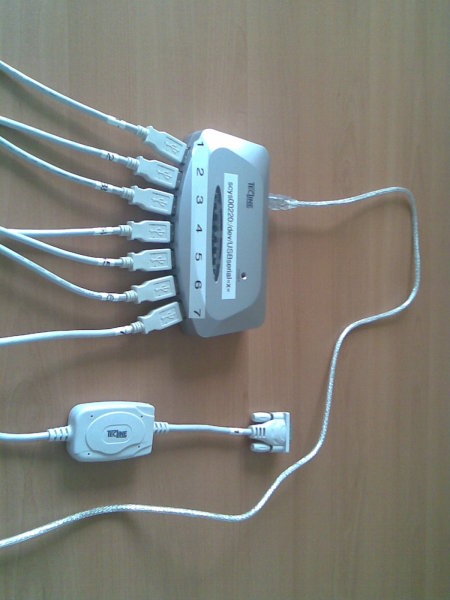
Picture of the fully equipped USB hub
The hardware side is actually quite easy: A seven-port USB hub, and seven USB-to-serial adaptors (using the widely-deployed Prolific PL2303) are easily purchased for well below a hundred Euros, and naively connected. In my test setup, connected to the hp compaq nc8000 that my blog readers should know only too well by now, the hub does not even need to have its power supply connected. The notebook can power the hub and the seven adaptors just fine. When the UMTS card is plugged in, the ttyUSBx device nodes appear in the order of plugging in the devices. When the system is booted, the order is not very predictable, so one needs - again - udev to give predictable device node names. udevinfo is an important tool to obtain the data set of an USB device which is available to match a device and to act appropriately when it is connected. udevinfo sorts the devices into a tree and shows the relationship of the devices, which device is “behind” which other device from the system’s point of view. udevinfo’s output starts at the leaf of the device tree and shows the information for each node up the tree until its root is reached. One pitfall is that one can only match against the leaf and _one_ other node more up the tree. So you cannot do matches like “the pl2303-based device connected to port 3 on hub 2-3 will be designated USBserial3”. If you try this, your rule will silently be ignored. This is a major turn-off in udev’s implementation. I didn’t try it on sid, but etch definetely shows this behavior. So one can only match like “the tty on the USB subsystem connected to port 3 on hub 2-3 will be designated USBserial3”, but that’s probably as good as it’ll get. The cause for my hub having only seven ports clearly shows itself when one looks at the udevinfo outputs of the fully equipped USB hub: The adapters are connected to ports 1, 2, 3, 4.1, 4.2, 4.3 and 4.4. The seven-port hub is actually two four-port hubs in a single case, with the second one connected to the first one’s port 4. This reflects itself, of course, in the udev rules necessary to address the adapters by the hub port they’re plugged in:
SUBSYSTEM==“tty”, SUBSYSTEMS==“usb”, DRIVERS==“usb”, \
   KERNELS==“*-*.1”, \
   SYMLINK=“USBserial1”
SUBSYSTEM==“tty”, SUBSYSTEMS==“usb”, DRIVERS==“usb”, \
   KERNELS==“*-*.2”, \
   SYMLINK=“USBserial2”
SUBSYSTEM==“tty”, SUBSYSTEMS==“usb”, DRIVERS==“usb”, \
   KERNELS==“*-*.3”, \
   SYMLINK=“USBserial3”
SUBSYSTEM==“tty”, SUBSYSTEMS==“usb”, DRIVERS==“usb”, \
   KERNELS==“*-*.4.1”, \
   SYMLINK=“USBserial4”
SUBSYSTEM==“tty”, SUBSYSTEMS==“usb”, DRIVERS==“usb”, \
   KERNELS==“*-*.4.2”, \
   SYMLINK=“USBserial5”
SUBSYSTEM==“tty”, SUBSYSTEMS==“usb”, DRIVERS==“usb”, \
   KERNELS==“*-*.4.3”, \
   SYMLINK=“USBserial6”
SUBSYSTEM==“tty”, SUBSYSTEMS==“usb”, DRIVERS==“usb”, \
   KERNELS==“*-*.4.4”, \
   SYMLINK=“USBserial7”
These rules will only work for a similary structured hub that is directly connected to the notebook. If there are more hubs in between the “final” hub and the host, the address matched against in the KERNELS matches are going to have a different structure. In the test setup, the first two parts of the address needed to be wildcarded since these addresses keep changing when the host is booted or the hub plugged out and in. So I guess that these udev rules are probably going to fail miserably when more hubs and/or USB-to-serial adaptors are connected. But if one does not do too many changes, things are just fine, and it is possible to put numbers on the USB hub ports and be sure that the USB-to-serial adaptor connected to port 4 is going to be /dev/USBserial4 in the host system. I tried plugging in and out the adaptors in random order, unplugged and plugged the hub itself, booted the host, and the relationship between the port and the device node was stable. In the test environment, I only tested one adapter at a time, but all these tests were successful as well. I guess that many more of these adaptors will eventually need a powered USB hub, but with seven adaptors on a single hub, the power from the USB host is sufficient to live without extra power on the hub. And, I guess, there is some hard limit for the number of USB adapters being used, and some soft limit when managing the ports and adapters is going to get harder. But, I think that a site in need of more than, say, sixteen serial ports on the console server can afford a “real” console server from one of the major vendors, which can be accessed via ethernet, UMTS, ISDN and whatever you can think of. This concludes the hardware part of my serial console server for the poor. Tomorrow, I’ll blog about the software side needed on the host to allow the serial ports to be accessed from the network while still being reasonably secure. The next article will involve ssh, /etc/passwd shells, /etc/shells, a small perl script, ser2net and telnet. And, shell escape is the cue word for grey hairs sprouting on my head.

2 June 2008

Russell Coker: Moving a Mail Server

Nowadays it seems that most serious mail servers (IE mail servers suitable for running an ISP) use one file per message. In the old days (before about 1996) almost all Internet email was stored in Mbox format [1]. In Mbox you have a large number of messages in a single file, most users would have a single file with all their mail and the advanced users would have multiple files for storing different categories of mail. A significant problem with Mbox is that it was necessary to read the entire file to determine how many messages were stored, as determining the number of messages was the first thing that was done in a POP connection this caused significant performance problems for POP servers. Even more serious problems occurred when messages were deleted as the Mbox file needed to be compacted. Maildir is a mail storage method developed by Dan Bernstein based around the idea of one file per message [2]. It solves the performance problems of Mbox and also solves some reliability issues (file locking is not needed). It was invented in 1996 and has since become widely used in Unix messaging systems. The Cyrus IMAP server [3] uses a format similar to Maildir. The most significant difference is that the Cyrus data is regarded as being private to the Cyrus system (IE you are not supposed to mess with it) while Maildir is designed to be used by any tools that you wish (EG my Maildir-Bulletin project [4]). One down-side to such formats that many people don’t realise (except at the worst time) is the the difficulty in performing backups. As a test I used LVM volume stored on a RAID-1 array of two 20G 7200rpm IDE disks with 343M of data used (according to “df -h” and 39358 inodes in use (as there were 5000 accounts with maildir storage that means 25,000 directories for the home directories and Maildir directories). So there were 14,358 files. To create a tar file of that (written to /dev/null via dd to avoid tar’s optimisation of /dev/null) took 230.6 seconds, 105MB of data was transferred for a transfer rate of 456KB/s. It seems that tar stores the data in a more space efficient manner than the Ext3 filesystem (105MB vs 343MB). For comparison either of the two disks can deliver 40MB/s for the inner tracks. So it seems that unless the amount of used space is less than 1% of the total disk space it will be faster to transfer a filesystem image. If you have disks that are faster than your network (EG old IDE disks can sustain 40MB/s transfer rates on machines with 100baseT networking and RAID arrays can easily sustain hundreds of megabytes a second on machines with gigabit Ethernet networking) then compression has the potential to improve the speed. Of course the fastest way of transferring such data is to connect the disks to the new machine, this is usually possible when using IDE disks but the vast number of combinations of SCSI bus, disk format, and RAID controller makes it almost impossible on systems with hardware RAID. The first test I made of compression was on a 1GHz Athlon system which could compress (via gzip -1) 100M of data with four seconds of CPU time. This means that compression has the potential to reduce the overall transfer time (the machine in question has 100baseT networking and no realistic option of adding Gig-E). The next test I made was on a 3.2GHz Pentium-4 Xeon system. It compressed 1000M of data in 77 seconds (it didn’t have the same data as the Athlon system so it can’t be directly compared), as 1000M would take something like 10 or 12 seconds to transfer at Gig-E speeds that obviously isn’t a viable option. The gzip -1 compression however compressed the data to 57% of it’s original size, the fact that it compresses so well with gzip -1 suggests to me that there might be a compression method that uses less CPU time while still getting a worth-while amount of compression. If anyone can suggest such a compression method then I would be very interested to try it out. The goal would be a program that can compress 1G of data in significantly less than 10 seconds on a 3.2GHz P4. Without compression the time taken to transfer 500G of data at Gig-E speeds will probably approach two hours. Not a good amount of down-time for a service that runs 24*7. Particularly given that some time would be spent in getting the new machine to actually use the data. As for how to design a system to not have these problems, I’ll write a future post with some ideas for how to alleviate that.

1 June 2008

Russell Coker: Shelf-life of Hardware

Recently I’ve been having some problems with hardware dying. Having one item mysteriously fail is something that happens periodically, but having multiple items fail in a small amount of time is a concern. One problem I’ve had is with CD-ROM drives. I keep a pile of known good CD-ROM drives because as they have moving parts they periodically break and I often buy second-hand PCs with broken drives. On each of the last two occasions when I needed a CD-ROM drive I had to try several drives before I found one that worked. It appears that over the course of about a year of sitting on a shelf I have had four CD-ROM drives spontaneously die. I expect drives to die if they are used a lot from mechanical wear, I also expect them to die over time as the system cooling fans suck air through them and dust gets caught. I don’t expect them to stop working when stored in a nice dry room. I wonder whether I would find more dead drives if I tested all my CD and DVD drives or whether my practice of using the oldest drives for machines that I’m going to give away caused me to select the drives that were most likely to die. Today I had a problem with hard drives. I needed to test a Xen configuration for a client so I took two 20G disks from my pile of spare disks (which were only added to the pile after being tested). Normally I wouldn’t use a RAID-1 configuration for a test machine unless I was actually testing the RAID functionality, it was only the possibility that the client might want to borrow the machine that made me do it. But it was fortunate as one of the disks died a couple of hours later (just long enough to load all the data on the machine). Yay! RAID saved me losing my work! Then I made a mistake that I wouldn’t make on a real server (I only got lazy because it was a test machine and I didn’t have much risk). I had decided to instead make it a RAID-1 of 30G disks and to save some inconvenience I transfered the LVM from the degraded RAID on the old drive to a degraded RAID on a new disk. I was using a desktop machine and it wasn’t designed for three hard disks so it was easier to transfer the data in a way that doesn’t need to have more than two disks in the machine at any time. Then the new disk died as soon as I had finished moving the LVM data. I could have probably recovered that from the LVM backup data and even if that hadn’t worked I had only created a few LVs and they were contiguous so I could have worked out where the data was. Instead however I decided to cut my losses and reinstall it all. The ironic thing is that I had planned to make a backup of the data in question (so I would have copies of it on two disks in the RAID-1 and another separate disk), but I had a disk die before I got a chance to make a backup. Having two disks out of the four I selected die today is quite a bad result. I’m sure that some people would suggest simply buying newer parts. But I’m not convinced that a disk manufactured in 2007 would survive being kept on a shelf for a year any better than a disk manufactured in 2001. In fact there is some evidence that the failure rates are highest when a disk is new. Apart from stiction I wouldn’t expect drives to cease working from not being used, I would expect drives to last longer if not used. But my rate of losing disks in running machines is minute. Does anyone know of any research into disks dying while on the shelf?

Marc 'Zugschlus' Haber: Automatic initialization of a Option 3G Datacard

For mobile UMTS/GSM, I have been using an Option 3G Data Card for two and a half years now. I blogged about getting the card to work (in German, sorry) on Linux in July 2005. I never found the time - until now - to automate the card initialization so that I had been using a horrible chat script for card initialization when the PPP connection was built. I recently took the time to automate this, so that the PIN is transmitted to the card automatically when the card is plugged in. This article documents what I did. On a side note: Unfortunately, the vendors’ attitude towards Linux hasn’t changed since 2005. Their Hotlines still deny that their products can be used with Linux at all, and they surely do not publish any documentation that can be of help. Otoh, Vodafone has published a software that supposedly aids usage of their products under Linux. I haven’t tried it yet since it is not packaged yet for Debian. Additionally, Vodafone support media and sales do not seem to know about this effort, they still deny that their products work with Linux. Windows users happily install proprietary software products that do little more than sending a handful of AT commands to the emulated USB modem and hand over the connection to Windows’ PPP Stack. A very unsatisfying situation. Just for the record: Dear Vodafone DE, a week ago you missed the sale of a new USB UMTS interface because you don’t even document it on Linux. This motivated me to look into the drawer that holds the old, non-HSDPA PC cards that have been decommissioned at the customers’ site and use an old, used device. Your fault. But now back on topic: For a data center monitoring system, I want to send out alerts as text message (for German speakers: SMS - we have a rather strange vocabulary for mobile communications), and am reluctant to do so via IP: IP is one of the things that can fail, so it is preferred to directly inject the text messages into the network of the operator that provides service to the recipients of the text messages. Fortunately, most of the recipients are in the same network. After evaluating current hardware solutions that could be plugged directly into the “real” server doing the monitoring and running into the wall of non-support provided by the network operators and hardware vendors, I decided on taking things a little further and to build an Ethernet-Connected text message device. An old hp compaq nc8000 (no, not mine, mine still works fine and is in daily use) and an old, first generation Option Datacard 3G will be mounted near the datacenter’s windows and equipped with Debian and Nagios. That way, the text message device can itself monitor the monitoring system and even send out a warning message when the data center goes out of power: It has a built-in UPS. But now back on topic: For the text messages to go out reliably, it is necessary that the UMTS card is initialized automatically when the system comes up. A great opportunity to finally address this issue for Linux, on customers’ expense **grins**. UMTS card initialization is done in two steps: First, when the card is plugged in, the virtual OHCI host port appears. Initialization of the virtual OHCI happens automatically. Most documentation on the web says that you now need to load an appropriately parametrized usbserial module, and I did it this way for years, but that’s not necessary any more. CONFIG_USB_SERIAL_OPTION is a dedicated kernel module for the Option 3G data card, which gets automatically loaded if it is available. If you don’t have the Option module for some reason, you still need the following udev rule to automatically load the generic USB serial module. I figured that out yesterday before I learned about the Option module in a comment made to the original version of this article.
SUBSYSTEM==“usb”, \
   SYSFS idProduct ==“5000”, SYSFS idVendor ==“0af0”, \
   ACTION==“add”, \
   RUN+=“/sbin/modprobe usbserial vendor=0x$attr idVendor  product=0x$attr idProduct ”
SUBSYSTEM==“usb”, \
   SYSFS idProduct ==“5000”, SYSFS idVendor ==“0af0”, \
   ACTION==“remove”, \
   RUN+=“/sbin/modprobe -r usbserial”
Unfortunately, the usbserial and option modules stay around after the card is pulled. This doesn’t hurt though. Next, we see three virtual serial interfaces, which we can detect via udev, and assign “speaking” device names and transmit the PIN. This goes into /etc/udev/rules.d/50-option3g.rules:
SUBSYSTEM==“tty”, SUBSYSTEMS==“usb”, DRIVERS==“option”, \
   ATTRS bInterfaceNumber ==“00”, \
   ATTRS modalias ==“usb:v0AF0p5000d0000dc00dsc00dp00icFFiscFFipFF”, \
   SYMLINK=“UMTS-DATA”
SUBSYSTEM==“tty”, SUBSYSTEMS==“usb”, DRIVERS==“option”, \
   ATTRS bInterfaceNumber ==“02”, \
   ATTRS modalias ==“usb:v0AF0p5000d0000dc00dsc00dp00icFFiscFFipFF”, \
   SYMLINK=“UMTS-CONTROL”, RUN+=“/usr/local/sbin/umts-pin --device %k”
I am not sure what the modalias attribute identifies, but it looks like it identifies the hardware model: An identical Option Datacard 3G, plugged into the other PC Card Slot gets properly initialized as well. These two udev stanzas do two different things: First, they make sure that the new devices are symlinked to /dev/UMTS-DATA and /dev/UMTS-CONTROL, suggesting the intended use of the interface. The second virtual interface of the 3G Data Card does not seem to be useable at all, and you cannot build an actual data connection over the third. So, we baptize the first interface /dev/UMTS-DATA and ignore the second. The third gets called /dev/UMTS-CONTROL. Now to the real magic: /usr/local/sbin/umts-pin is a perl script that sends the PIN to the Card. %k gets expanded to the device name of the device that has just been detected, so umts-pin gets called with “--device ttyUSB2”. It makes use of Cosimo Streppone’s Device::Modem module (Device::Gsm is not yet packaged for Debian and might be of better use here) to talk to the UMTS device. Unfortunately, I have not yet fully understood the logging and answer processing features of Device::Modem, so the implementation might look a little clumsy. I hope that it can be clearly understood anyway. The actual PIN is read from a configuration file in an apache-like format, which is by default looked for in /etc/umts/pin.conf:
<pin>
        <default>
                pin xyzw
        </default>
</pin>
The reason I settled for this rather complex configuration file format is that the ultimate goal is to automatically detect which of my SIMs is currently inserted in the UMTS card and to automatically send the correct PIN. I haven’t been successful in doing so since I didn’t find an AT command yet to get the UMTS card to divulge the SIM serial number or the IMSI before the PIN is transmitted to the SIM. So currently, the only things that are supported are the “default” stanza and an identically formatted “override” stanza which takes precedence over the default stanza if present. If the first attempt to send the PIN fails, the script tries again ten seconds later. On my test system, this happens about once in twenty times. That must be some weird timing issue. So, if you have the wrong PIN configured, you’ll need the PUK after plugging in the card for the second time, since the first try will eat two of your three attempts. Beware. If you feel uncomfortable with all this scripting and the “quality” of my code, you can also use gammu’s entersecuritycode function. I discovered this after my PIN script was already written, and gammu currently forces you to expose the PIN on the command line (see #484102), and of course my script’s PIN handling is vastly superior **grins**. And one end note: More current hardware, most notably the Huawei series of cards, are reported to show themselves as virtual USB storage first to allow identification and installation of Windows drivers, and need an explicit command to show their virtual USB serial side. I have read web pages where people have managed to do this in Linux, but since I use an older card and do not have a current card available (again, Vodafone, your fault!) I cannot comment about this. But there are reports that this can be done, so don’t panic if you have more recent hardware.
31 May 2008

Christian Perrier: News from samba packages development

There has been some hype around samba this week. On May 21st, the Samba Team released Samba 3.0.29, an update from their stable branch. The Debian package maintainers quickly built and uploaded a package for unstable/lenny the very same day. Then, on 27th, we got notified of CVE 2008-1005, which affects both etch, lenny and unstable (not the 3.2 versions we have in experimental). I contacted the security team and, after some brief discussions, I uploaded with their blessing, a fixed package to stable-security (3.0.24-6etch10). Then, I immediately uploaded samba 3.0.30 to unstable (1:3.0.30-1), that version being the Samba Team response to the security issue. All this lead to DSA 1590. Up to now, everything perfect. In the meantime, Karolin, the Samba Team's release manager announced the Releace Candidate 1 of Samba 3.2.0. So, yesterday (Saturday), I started building it....which succeeded. Then I started to screw up..:) Instead of uploading that version to experimental, as planned, I uploaded 1:3.2.0~rc1-1 to unstable. Yes, AGAIN (I already did that in April). There's no excuse for that, except distraction and failure to use our tools properly ("dch -r"). Thankfully, I noticed that nearly immediately, but not immediately enough. So, I had to re-upload 3.0.30 to unstable (which is urgent: that's a security fix) and increase the epoch (we already had one as this is the second identical screwage): 2:3.0.30-2. Sorry, autobuilders... Yesterday evening, I uploaded 3.2.0-rc1 again to experimental (2:3.2.0~rc1-2). Then, finally, I went on the last bit of remaining work: spend some time on Jelmer Vernooij's samba4 packages. Jelmer is one of the two lead developers of Samba 4, a huge masterpiece still under heavy delveopment. To give it more exposure, it is planned to upload it a few times in experimental, then move it to unstable, block it so that it does not enter testing, and make some noise about this. I finally uploaded samba4 this morning (triple checking that I was uploading to experimental!) and samba4 4.0.0~alpha4~20080522-1 is now waiting for NEW processing (which might take time: this is a big piece of new stuff). I'm sad for the screwage because, apart from it, that was nearly a perfect process. But, anyway, I'm still proud of the result: 4 successful uploads for samba in a little more than a week (which included 4 day away). It could even have been 5 as the samba version in sarge is affected by the security issue, but we don't support sarge anymore.

30 May 2008

Craig Sanders: I m sick of all the whinging about petrol prices

Really, who cares? 1. How much petrol do people actually use, anyway? People whinge and bitch and moan about petrol going up a few cents, and queue up for ages to try to buy petrol at the low point of the weekly price cycle - and for what? A tank will hold less than 100 litres. Typically around 50, but let’s say it’s 100 litres. That means that a price difference of 1 cent is worth a whole $1.00. A price difference of 5 cents is a measly $5.00, less than the price of a cheap bought lunch. For the average driver, they’ll buy 100 litres once or maybe twice per week. Who gives a damn? If $1.00 or even $5.00 makes such a difference to someone’s budget then they’re in serious financial trouble anyway - so much trouble that they shouldn’t even think about having a car, because they can’t afford it. Here’s a novel thought: they could drive less, make their kids walk to school, catch public transport, ride a bike, walk to the milkbar rather than drive, make sandwiches to take to work/school, and so on. They could also buy less of the worthless crap they buy (like biscuits and cakes and bottles of coke and other rubbish). There are thousands of things people could do so that they don’t have to give a damn about a few cents per litre. Even better, if people reduce demand enough, they can seriously hurt the speculator bastards who have driven oil prices up so much in recent months….at least a quarter of the current price per barrel of oil is due to commodity speculators driving the price up. Hit the bastards where it hurts, drop demand so much that they lose serious money. If the price of petrol bothers you, don’t whinge, get revenge. Actually, I’m entirely unconvinced that the general public actually care all that much about petrol prices anyway. It looks and feels much more like an astro-turfing campaign by the oil companies and petrol distributors - especially the recent crap about reducing the excise by 5c/litre, anyone can see that if the government does that the petrol companies will, within weeks, increase prices so that THEY get the 5c/litre rather than the government, resulting in yet another transfer of wealth from the public purse to private corporations. Same for all the bullshit about the fuel price watch program - it’s obvious that the opposition to that comes directly from the petrol companies who don’t want buyers to have good information to base their purchasing decisions on. It’s also a useful distraction and pretend-debate for the government and the opposition - they can rant and rave and score points over a trivial, bullshit non-issue like this, and nobody will notice that nothing of any real substance or worth ever gets debated in parliament…and the media are either colluding in this or are too stupid to avoid getting sucked in. 2. We have the fourth-cheapest petrol in the world. So all this moaning is not about petrol being more expensive than it should be, it’s about not being quite as unreasonably privileged as we were in the past. 3. Oil prices are *inevitably* going up, they’re *never* coming back down. Get used to it, it’s only going to get worse from here - much worse. Instead of endlessly whining about the inevitable, focus on alternatives - like *DEMANDING* that the government start paying more than just empty tokenistic lip-service to the idea of alternative/renewable energy sources. 4. IMO, the sooner petrol hits $5.00 per litre or more, the better. By then we’ll really have to have functional alternative energy sources in place. Because if we don’t, we’re completely screwed. Syndicated from Craig Sanders' Errata: Tech Notes and Miscellaneous Thoughts I’m sick of all the whinging about petrol prices

Russell Coker: Links May 2008

The Daily WTF has published an interesting essay on why retaining staff is not always a good thing [1]. The main point is that good people get bored and want to move on while mediocre people want to stay, but there are other points and it’s worth reading. Following the links from that article led me to an article comparing managing IT departments to managing professional sports teams [2]. They chose US football (a sport I know little about and have no interest in) so I probably missed some of the content. But they have some good points. John Goerzen gave a good presentation to the idea of increasing petrol taxes and decreasing other taxes to have a revenue neutral result while also discouraging petrol use [3]. I credit him with presenting the idea not inventing it because I have heard similar ideas several times before (but not nearly as well written and not written from a right-wing perspective). Hopefully some people who read his presentation will be more receptive than they were to the other versions of the same idea. Craig Venter spoke at TED about his work in creating artificial life [4]. He spent some time talking about the possibilities of creating artificial organisms to produce fuels directly from CO2 and sunlight. Nick Bostrom published a paper explaining why he hopes that the SETI projects find nothing [5]. His theory is that the fact that our solar system has not been colonised and that we have seen no immediate evidence of extra-terrestrial life indicates that there is a “Great Filter” which is a stage of evolution for which it is most unlikely that any species will pass. If the Great Filter is in our past (he cites the evolution of multi-celled life as one of the possibilities, and the evolution of prokaryotes into eukaryotes as another) then it means that our future might be more successful than if the Great Filter was something that tended to happen to advanced societies. Jared Diamond (the author of Collapse), has written an interesting article about vengeance [6]. He focuses on an example in New Guinea and uses it to explain why personal vendettas tend to run wildly out of control and how society is best served by having the state punish criminals.

Chris Lawrence: Nothing is ever simple

Reading CRANberries this morning I remembered that I’d never gotten around to packaging Amelia for Debian. So I dutifully filed my ITP and got to work on adapting the package to build with Debian, which thanks to Dirk’s hackery on R support in cdbs was pretty easy—copy over the debian directory from my Zelig package, update the copyright file, fix up the control file, update the Debian changelog, fix a lintian warning or two (FSF address in the copyright file), and it’s basically done. Then I discovered that Amelia also throws in a couple of Tcl/Tk libraries. One, BWidget is already packaged, so all I had to do was delete the copy that’s installed by the Amelia package and add a dependency on it. The other is Combobox, the exact license of which follows:
completely, totally, free. I retain copyright but you are free to use the code however you see fit. Don’t be mean.
Yay. I get to play license negotiator again. I really love creating extra work I really don’t need for myself…

28 May 2008

Russell Coker: Xen Hosting

I’m currently deciding where to get a Xen DomU hosted. It will be used for a new project that I’m about to start which will take more bandwidth than my current ISP is prepared to offer (or at least they would want me to start paying and serious bandwidth is expensive in Australia). Below is a table of the options I’ve seriously considered so far (I rejected Dreamhost based on their reputation and some other virtual hosts were obviously not able to compare with the prices of the ones in the table). For each ISP I listed the two cheapest options, as I want to save money I’ll probably go for the cheapest option at the ISP I choose but want the option of upgrading if I need more. I’m not sure how much storage I need, I think that 4.5G is probably not enough and even 6G might get tight. Also of course it depends on how many friends I share the server with. Quantact has a reasonable cheap option for $15, but the $25 option is expensive and has little RAM. Probably 192M of RAM would be the minimum if I’m going to share the machine with two or more friends (to share the costs). VPSland would have rated well if it wasn’t for the fact that they once unexpectedly deleted a DomU belonging to a client (they claimed that the bill wasn’t paid) and had no backups. Disabling a service when a bill is not paid is fair, charging extra for the “service” of reenabling it is acceptable, but just deleting it with no backups is unacceptable. But as I’m planning on serving mostly static data this won’t necessarily rule them out of consideration. It seems that linode and slicehost are the best options (Slicehost seems the most clueful and Linode might be the second most). Does anyone have suggestions about other Xen servers that I haven’t considered? XenEurope seems interesting. One benefit that they have is being based in the Netherlands which has a strong rule of law (unlike the increasingly corrupt US). A disadvantage is that the Euro is a strong currency and is expected to get even stronger. Services paid in Euros should be expected to cost more in future when paid in Australian dollars, while services paid in US dollars should be expected to cost less. Gandi.net has an interesting approach, they divide a server into 64 “shares” and then you can buy as many as you want (up to 16 shares for 1/4 of a server) for your server. If at any time you run out of bandwidth then you just buy more shares. They also limit bandwidth by guaranteed transfer rate (in multiples of 3Mb/s) instead of limiting the overall data transferred on a per-monthly basis (as most providers do). They don’t mention whether you can burst above that 3Mb/s limit - while 3Mb/s for 24*7 is a significant amount of data transfer it isn’t that much if you have a 200MB file that will be downloaded a few times a day while interactive tasks are also in progress (something that may be typical usage for my server). Of course other providers generally don’t provide any information on how fast data can be transferred and will often be smaller than 3Mb/s. Also if anyone who I know wants to share access to a server then please contact me via private mail.
ISPRAMDiskBandwidth (per month)Price $US
Linode360M10G200GB$20
Linode540M15G300GB$30
Slicehost256M10G100GB$20
Slicehost512M20G200GB$38
VPSLand192M6G150GB$16
VPSLand288M8G200GB$22
Quantact96M4.5G96GB$15
Quantact128M6G128GB$25
rimuhosting96M4G30G$20
XenEurope128M10G100G$16 (E10)
XenEurope256M20G150G$28 (E17.50)
Gandi.net256M5G3Mb/s$7.50 or E6

27 May 2008

Christian Perrier: Reading blog summary

During the last 4 days, I didn't read Planet. So I started an interesting exercise and wanted to comment very briefly on a few entries I just read quickly to catch up. My Planet premium, so to say..

MJ Ray: Fuel Price Bleating and Biking

[Photo of Cyclists]
England swings like a pendulum do! There's another fuel price protest and the coverage in the London press is pretty biased, with occasional balanced reports and very rare dissenting opinion. One of the favourite whines on news-and-nutters phone-ins is "waah, I live in a village, I need my car". While that's true for some people, most villagers could switch to bicycles for many journeys without problems. At the moment, the biggest problem with cycling to town is the number of cars on the small lanes, followed by the number of potholes. Switching to cycling or walking will have a triple benefit: fewer cars on the road will free up space for cycling, wear the roads out less and reduce fuel demand (so petrol should become cheaper for those who really need it). Over the last few days, I've been happy to read Bike The Drive 2008 [Dirk Eddelbuettel], Mountainbike, By Joerg Jaspert and How to Start Bicycling to Work, by John Goerzen. A couple of tweaks to that last one: in England, I don't think that a cycling helmet is necessary. I've not worn one for the last few months (it went mouldy after a rain storm) - I find I can hear traffic better and many drivers seem to give me more room on the road. I wonder if helmet-wearing "dehumanises" cyclists to drivers? The safety data seems rather confused, but it's a personal choice. If you feel safer with a helmet, wear one. I also wear ordinary business or casual clothes, relying on a good quality commuter saddle rather than cycling shorts. I suspect that drivers here are developing a sort of blindness to the "screaming yellow" hi-vis jackets, so I don't wear those - but sometimes I wear hi-vis reflective armbands if I'm wearing black in the dark. I agree completely with the comments on that page about being predictable, Cateye lights and pannier bags. Finally, Bike Week 2008 starts on 14 June, which would be an ideal time to try a group ride - or just get a free breakfast for cycling into town.

26 May 2008

Chris Lawrence: The use and abuse of technology in the classroom

Michelle’s post‡ today on laptops in the classroom (in a similar vein to this article I read last month on the suggestion of Glenn Reynolds) reminded me that I had a few items from the past few weeks still in my Google Reader queue of “things to blog about” related to Margaret Soltan’s continuing crusade against the use of PowerPoint* and its ilk, and specifically Timothy Burke’s partial rebuttal:
What’s the difference between bad usage of PowerPoint in lectures and bad lectures that involve hand-outs, overhead transparencies and writing on the chalkboard? Are we just complaining about old wine in new bottles here? Is the real culprit professorial droning at classrooms of 200+ students followed by recite-repeat-and-forget examinations? I think it’s at least plausible that the technology is just giving us a new reason to pay attention to a pedagogy whose effectiveness has been suspect for two generations.
I dare say I’m among the last doctoral students who was “trained”—and I use that word loosely—to teach prior to the widespread use of PowerPoint. Four years of full-time in-classroom experience, mostly with small lectures and seminars, has brought me basically to agreement with Burke on this point—complaints about PowerPoint essentially boil down to complaints about either instructional laziness or the whole nature of lecturing, or as a Burke commenter puts it, ”[e]xactly how does one teach even 80† students at once without succumbing to passive data transfer?” The non-use of PowerPoint or some other form of instructional technology seems to me to be a luxury confined to those who only teach small seminars and graduate students, and while my personal career aspirations lean in that direction the reality is that I’m several years away (in terms of research productivity) from being there—if I ever get there. Burke in his comments hits the nail on the head, I think, when it comes to any sort of visual presentation in class:
It seems to me that the absolutely key thing is to avoid speaking the slides literally. They’re best as definitions, key concepts, images: the kind of thing you’d stop your flow of lecturing to write on the chalkboard. They’re not the lecture itself.
I think there are three useful aspects to a lecture: what you put on the board (or slides), what you say, and the general outline. If you’re preparing a handout or something to stick on Blackboard for students, the outline or outline-plus-slides is what they need, along with space to fill in the gaps. An alternative approach is to make the slides/board material the outline; several of the more effective teachers I had (my high school history teacher and a political science professor at Rose-Hulman) took that approach. But you can’t shovel your script into PowerPoint and expect that to work well, any more than you’d expect that writing it up on the board, or for that matter reading a paper verbatim at a conference would be a good presentation, to work. All this discussion leaves aside the question of teaching anything that involves symbols (chemistry, mathematics, statistics) which I think requires a different approach than bullet-points. In class, mathematics and statistics (and, by extension, social science research methods courses) lend themselves to a combination of “passive” PowerPoint-style presentation and more spontaneous problem-solving and brainstorming; for example, one of my early activities is to have the class try to operationalize (define in terms of a measurable quantity or quality) a concept like “globalization,” which you can’t really do with a static slideshow even though you can define terms like “operationalization” that way. Similarly, while you can step through the process of solving a problem in a slideshow I think it’s more effective to demonstrate how to step through the process on the board. Unfortunately, many classrooms aren’t set up to allow you to present and use a board simultaneously; some of TAMIU‘s lecture halls have a nice design where the projection screen is above the board, so you can write on the board without having to do anything special with the slideshow, but rooms most places are designed for “either-or” which can be a real pain—fiddle with the control system to blank the screen, raise the screen, write on the board, then lower the screen, switch the screen back on. After a few iterations of that in a single class, you’ll never do it again. I freely admit I haven’t figured everything out yet; my current methods slides are pretty good lecture notes but pretty rotten for projection. One of my projects for this summer (postponed from last summer after I learned I wouldn’t be teaching any methods courses this year) is to work on my research methods lectures to incorporate advice from Andrew Gelman’s book so I can lay the groundwork for my plot to take over the world effort to produce a workable, but rigorous, methods curriculum at both the undergraduate and master’s levels for political science, sociology, and (at the grad level) public administration. More on this theme from Laura at 11D, who takes note of some of the more positive technological developments associated with academe. And, another of Burke’s commenters links this hilarious example of what not to do with your slides.

* I use “PowerPoint” as shorthand for the use of a computer-projector based slideshow-style sequential presentation of items associated with a lecture, a technique obviously made famous by the Microsoft software package but also available with many other software packages such as Apple’s Keynote, OpenOffice.org Impress, and several PDF viewers including Adobe Reader, xpdf, and GNOME‘s Evince.
† I’d put the cutoff significantly lower, at around 30–40 students. Beyond that point, one might as well just blow the cap off the class.
‡ By the way, it’s nice to see Michelle’s blog back from haïtus! (Where else would I keep up with current Mexican politics?)

25 May 2008

Axel Beckert: Google Open Source Jam and Webtuesday Hackday

I was at two geek events in Zurich this week: At the Google Open Source Jam Zurich on Thursday evening and at the first Webtuesday Hackday on Saturday. Somehow I expected both events to be quite similar, but they weren’t. Google Open Source Jam When I read “Jam” or “Jam Session” I think of Jazz musicians spontaneously playing together. So for me “Open Source Jam” sounded like a hack session where some spontaneous coding is done. But there was no spontaneous collaboration at Open Source Jam at all. It’s just (more or less spontaneous) talks about different topics and chatting. So I was quite disappointed from that event. There were though quite a lot of people I knew from e.g. Webtuesday, Chaostreff or Debian. I even met some people I just knew from IRC until then. Half of the talks were sole propaganda talks though, e.g. for Webtuesday Hackday, OpenExpo and Soaring as a geek sport. Not really wrongly placed talks, but not what I expected in talks at Open Source Jam. The few rooms and floors I saw reminded me very much to IKEA Children’s Paradies, just even more motley. Though it felt all sterile and wasn’t by far as cool as I expected after what I read elsewhere of Google offices. I also think that several of the Google employees showed some contrived friendlyness, and questions I asked e.g. why I have to give them my e-mail address and employer’s name (what do unemployed or self-employed people do?) got answered with answers I do not really believe – like “for security”. A leopard doesn’t change its spots. A data squid probably neither, even not at events labeled with OSS and said to be for the community. I suspect that finding new employees is one of the reasons behind such events at Google. But after my first visit at one of their locations, this company still makes me feel uncomfortable. And I’m even more sure than before that I wouldn’t want to work there. Not sure if I’ll attend the Google Open Source Jam a second time. Webtuesday Hackday Webtuesday Hackday also was not as I expected, but still more close to my expectations: the Webtuesday crowd gathers for hacking instead of having long talks. :-) There were surprisingly many people from outside Zurich, from Munich and Belgium, from Lake Constance and Lausaunne – not only the usual suspects (who were there anyway ;-). The event took place at Liip’s new office. They still look a little bit empty and steril, but all the toys (mini rugby balls, Wii, plush figures on floor lamps) and people around made them very alive. And they had very cool lamps in the form of their company logo in the office. They sure have a good interior designer. :-) Although most participants found time to do some hacking, many found less time than they expected so we hope that we can glue the talks a little bit more together in regards of timing to cause less interruptions of the hacking. The food was also better at Hackday, too, but mostly because we ate outside. ;-) For lunch we were at Lily’s Stomach Supply at Langstrasse (very recommendable!) and in 6he evening we were at Pizzeria Grottino 79 near Helvetiaplatz. Had a Pizza Vesuvio with Gruyère cheese there. Hackday also had a surprise for me: The IRC channel at Hackday was but when I entered the channel there were someone in I didn’t expect there: tklauser aka Tobias Klauser aka tuxedo. Even more surprising, he read about my project idea for Hackday – a semantic feed cache proxy – and liked it, so he decided to come over to Zurich and join the project. We didn’t came that far until Tobias had to leave again, but the progamming language and partially also libraries had been nailed: Ruby and it’s WEBrick framework. After the Hackday I worked on it a few more hours and it now already saves feeds to a cache. The Mercurial repository is at http://noone.org/hg/sfc-proxy. There were several reasons which spoke for using Ruby instead of Perl (my favourite progamming language and the one I’m most experienced in): Ruby brings HTTP and RSS support already in it’s standard classes and Tobias is more experienced in Ruby than Perl. I started to learn Ruby a few years ago to look beyond my own nose and to get my hands dirty on some object-oriented and nice programming language, but I hadn’t found an appropriate project until now, so this was one more reason to not do it in Perl. I also worked on my Debian package of Conkeror during Hackday. It’s already usable and I now use Conkeror as primary web browser on my EeePC, but e.g. the man page is still missing. As soon as I have the minimum in necessary documentation ready I’ll let it upload to Debian Experimental (since its dependency XULRunner 1.9 is also only in Debian Experimental yet). The Mercurial repository for the Debian packaging of Conkeror is at http://noone.org/hg/conkeror/debian Those who were still at Hackday in the evening decided that the Webtuesday Hackday should become a regular institution and should take place approximately every two months, but stay a one day event (for now). I already look forward to the next Webtuesday Hackday.
24 May 2008

Francois Marier: Encrypting your home directory using LUKS on Debian/Ubuntu

Laptops are easily lost or stolen and in order to protect your emails, web passwords, encryption keys, etc., you should really think about encrypting (at least) your home directory.

If you happen to have /home on a separate partition already (/dev/hda5 in this example), then it's a really easy process:
  1. Copy your home directory to a temporary directory on a different partition:
    mkdir /homebackup
    cp -a /home/* /homebackup
  2. Encrypt your home partition:
    umount /home
    cryptsetup -h sha256 -c aes-cbc-essiv:sha256 -s 256 luksFormat /dev/hda5
    cryptsetup luksOpen /dev/hda5 chome
    mkfs.ext3 -m 0 /dev/mapper/chome
  3. Add this line to /etc/crypttab:
    chome    /dev/hda5    none    luks,timeout=30
  4. Set the home partition to this in /etc/fstab:
    /dev/mapper/chome /home ext3 nodev,nosuid,relatime 0 2
  5. Copy your home data back into the encrypted partition:
    mount /home
    cp -a /homebackup/* /home
    rm -rf /homebackup
That's it. Now to fully secure your laptop against theft, you should think about an encrypted backup strategy for your data...

Julien Valroff: How to fix DNS zone serial numbers

A small memo in case it happens again… Maybe this can also help others… I have made a typing error when incrementing a zone serial number this morning (I though we were in year 2009!). I realized this error after the transfer was made to my secondary server, and I couldn’t figure out how I could fix this: if the serial number on the slave server is lower than the serial number on the master, the slave server will attempt to update its copy of the zone. I have read some websites explaining one should add 2147483647 (2^31-1) to the number, reload the zone, let the slave get updated and revert to the appropriate serial number. Unfortunately, this solution hasn’t worked for me. I have read in RFC 1912 (section 2.2 - SOA records), that the system was planned until year 4294. I have henced updated the number of my master server to year 4294123199 (ie. the last possible serial number), reloaded the zone. After the transfer was propagated to the slave, I could simply revert to a standard serial number.

23 May 2008

Chris Lawrence: CECB mini-review: LG/Zenith DTT900

To continue the CECB mini-review series, I picked up an LG/Zenith DTT900 at Circuit City in Southaven this evening with one of my two digital converter box coupons (and $24ish of my hard-earned money at Sam’s Town’s blackjack tables). With essentially the same setup and conditions (same television and el-cheapo VHF/UHF indoor antenna) as the RCA DTA800B tested before, the initial channel scan found the same 17 channels/sub-channels. However, the Zenith’s ability to manually add channels meant that I was able to add WMC-DT/NBC 5 (RF channel 52) and with some fiddling get a reasonably stable signal, something I was unable to accomplish with the RCA—this isn’t that surprising, since the Zenith is based on LG’s ATSC digital tuner chipset, which is known for its superior reception capabilities over most other silicon. In addition, other channels (WHBQ-DT/Fox 13, WPTY-DT/ABC 24, and WLMT-DT/CW 30) that were less-than-stable with the RCA were rock-solid with the Zenith. Bear in mind that WMC is running on a different frequency (and lower on its tower) than it will after the transition is complete in nine months, so indoor antennas in Shelby County at least should cope better with WMC when it is back on VHF channel 5. The built-in guide is a little weaker than that included on the RCA model; the Zenith’s only shows program data for one channel at a time. The Zenith, however, has more functionality accessible from the remote control, including a “favorite channels” feature that would be useful for the compulsive surfer who isn’t interested in switching past the news and weather loops on 3–2 and 5–3 when doing the Letterman/Leno (or Conan/Craig) shuffle, and a sleep button. I also thought the Zenith’s menus were a little more polished and better organized. On the antenna front, the Zenith, unlike the RCA, does not provide an attachment for digitally-steered “SmartAntennas,” which may be a consideration if you already have one of these (they are apparently uncommon at present) or have hard-to-tune channels in multiple directions which might benefit from this high-tech solution. The Zenith’s better signal-handling may reduce the need for a fancy antenna, however; either way, you should probably check out TVFool’s antenna aiming guide or the somewhat less-friendly CEA/NAB-sponsored AntennaWeb website to determine what sort of antenna solution is going to be necessary for you before spending money on one. The only real problem I encountered in testing was that the “zoom” setting seemed to behave oddly; at first, letting it decide on its own seemed to work OK on some channels, but then I ended up with some bizarre “squeezed” pictures on several HD channels. Expect to manually fiddle with the zoom setting when channels switch between showing native 16:9 and pillarboxed 4:3 programs. Those who use closed captioning will also find that it seems to forget the CC setting when you switch channels, although I think there’s a menu option to leave closed captioning on all the time. Finally, caveat emptor: many manufacturing runs of this converter, and its near twin sold by Best Buy under its Insignia house brand, apparently have an audio problem that certain TVs seem to be more susceptible to than others. The converter I purchased had a manufacturing date of April 2008, which has been reported to be the run in which this problem was fixed, and I observed no audio problems during my testing (on an admittedly low-end CRT stereo television/VCR over RCA cables). Overall, I’d assess the LG/Zenith DTT900 as a better option for those who are planning to use the converter on a regular basis; however, if you’re simply buying a converter to serve as a “lifeline” when cable or satellite television is disrupted, or if you would like to take advantage of the SmartAntenna connectivity on that unit, the RCA model is probably adequate for most needs and seems to retail for about $10 less.

Russell Coker: School Bag Weight

Matt Bottrell has written about some issues related to the acceptable weight of laptops for school use [1]. Matt cites a reference from the Victorian government stating that a school bag should not be heavier than 10% of the body weight of the child who carries it [2]. So the next thing we need to do is to calculate what a student can carry without being at risk of spinal injuries. Firstly we need to determine what children weigh, if we restrict this to the 14+ age range (the older children have more need of computers) then children are almost as heavy as they will be when they are 18 and can carry significantly heavier bags than those in the 10+ age range. Also it seems reasonable to consider the 25th percentile weight (the weight which is exceeded by 75% of children). Of course this means that 25% would be carrying overly heavy bags but it does give us a bit more weight allowance. The 25th percentile weight for white girls in the US is 48Kg [3]. The 25th percentile weight for white boys in the US is also 48Kg [4]. When considering the Australian situation it seems that white children in the US will be most similar (in terms of genetics and diet). The 25th percentile weights at age 18 are 53Kg for girls and 64Kg for boys. So the acceptable bag weights would be 4.8Kg for 14yos, 5.3Kg for 18yo girls, and 6.4Kg for 18yo boys. The next step is to determine the weight carried to school. The weight of one of my laptop bags is almost 1Kg, I think that a school-bag would have a similar weight. When I was at school I recall that the worst days for carrying baggage were when I had PE (Physical Education - sports), the weight of PE gear was a significant portion of the overall weight I carried. I tried to estimate this by weighing a track-suit top, a t-shirt, and a pair of board-shorts (the only shorts I could find at short notice), and it was almost 1Kg. While the board-shorts might weigh more than PE uniform shorts I didn’t include the weight of track-suit pants. Assuming that a female PE uniform has the same weight as a male uniform is the least of my assumptions. The weight of a good pair of sneakers (suitable for playing basketball and other school sports) that is in my size is just over 1Kg. To get a rough estimate of the weight of lunch I put six slices of bread and a small apple in a lunch box and found that it weighed 500g. A real lunch would probably include four slices of bread but the other things would weigh at least as much as the extra two slices. If a drink was included then it could be more than 500g. So the total is 3.5Kg for bare essentials (including PE gear) without including any books! It seems that it would be impossible to stick to the government recommendations for school bag weight if a full set of PE gear is included. Probably the best thing that could be done would be to make a school uniform allow wearing sneakers which removes 1Kg from the overall bag weight. So a bag with lunch and PE gear (minus sneakers) is about 2.5Kg, leaving 2.3Kg for books etc at age 14. As text books for 14yo children are considerably thinner than those for 18yo children, it seems that this might be achievable. Fitting a couple of text books and an EeePC into the 2.3Kg weight budget should be achievable. But fitting a full size laptop (which seems to start at about 1.8Kg) and some text books into a 2.3Kg budget will be a challenge - it might be possible to do that but wouldn’t leave any budget for the random junk that children tend to carry around. For an 18yo girl, the weight budget (after the basics have been deducted) is 2.8Kg, it seems likely that on occasion the weight of year-12 text books will exceed that. Therefore it seems that the only way of avoiding spinal injuries in year-12 girls would be to have text books stored in digital form on a light laptop such as an EeePC. Rather than avoiding the use of laptops because of weight (as some people suggest), laptops with electronic text books should be used to replace traditional text books! An EeePC weighing less than 1Kg will give a significant amount of extra capacity for any other things that need to be carried. If there is little other stuff to be carried then 75% of 18yo girls should be able to carry a full size laptop plus PE gear without risk of back injuries. If digital text books are used then if in any journey two text books (which according to my previous measurements can be as much as 1.6Kg [5]) can be replaced with an EeePC then overall something like 600g is saved (depending on the configuration of the EeePC, if one battery was stored at home and another at school then it could save more than that). It seems that a year 12 girl who has PE and three science subjects scheduled on the same day would be most likely to exceed the recommended weight in the current situation (even without having to carry a spare pair of shoes), and that carrying a laptop with digital text books would be the only way of avoiding back injury. For an 18yo boy the weight budget is 3.9Kg after the basics have been deducted. So if they don’t carry other random stuff in their bag (I probably had 1Kg of random junk in my bag on occasion) then they could carry PE gear, a full sized laptop, AND a full set of text books. It seems to me that there is no situation where children would be unable to have a laptop within the reasonable weight allowance if digital text books were used. The only way that the weight of a laptop could be a problem would be if it was carried in addition to all the text books. One final point, it would be good if books from the Gutenberg project were used for studying English literature, that’s one easy way of reducing weight (and cost). Also it would be good if there was an option for a non-literature based English subject. Knowledge of English literature is of no value to most students. It would be better to teach students how to write while using topics that interest them. Maybe have blogging as an English project. ;)

Romain Francoise: Embarrassing distro patches: not just Debian

CVE-2007-5962, made public yesterday:
Memory leak in a certain Red Hat patch, applied to vsftpd 2.0.5 on Red Hat Enterprise Linux (RHEL) 5 and Fedora 6 through 8, and on Foresight Linux and rPath appliances, allows remote attackers to cause a denial of service (memory consumption) via a large number of CWD commands, as demonstrated by an attack on a daemon with the deny_file configuration option.
Rather embarrassing given vsftpd's focus on security... Of course this is nowhere near the scale of last week's OpenSSL bug, but it seems to indicate that Debian is not the only distro with insufficient review processes. (The patch was added in 2006 to fix this bug.)

Biella Coleman: Women and Science Fiction

Rianna and Annalee Newitz have pretty much said what needs to be said: women do like SF.

Biella Coleman: Women and Science Fiction

Rianna and Annalee Newitz have pretty much said what needs to be said: women do like SF.

Next.

Previous.