Search Results: "ms"

29 January 2017

Margarita Manterola: Decopy - Yet another debian/copyright helper

As every responsible maintainer should know, having an updated debian/copyright file is very important but can also take a significant amount of work. A lot of copy & pasting, a lot of manual corrections, and a lot of opportunity for human errors. There are several tools that help with this, but they all have their limitations. decopy is a newly uploaded tool (unfortunately too new for stretch) that aims to: How to use it In order to run it, after apt-get installing it, just go to a source package directory and run decopy in it. Depending on the size of the package, it might take a while (the thorough processing means that a lot of checking is going on). This will show you the generated debian/copyright file in stdout. If you want to store it and diff it against your current copyright file, use decopy --output /tmp/copyright. There's more documentation in the README file. Future changes More licenses are coming, the intention is to support all licenses listed in the SPDX License List. Additionally, the analysis will be improved to prioritize looking for the most common licenses first, avoiding unnecessary delays. More modes of operation are also coming. We are planning for a diff mode that shows you only the changes between the current copyright file and what the tool thinks should be there as well as an explain mode that will let the user know what the differences are in a more verbose manner. Credits and source Decopy was mainly written by Maximiliano Curia. I've added testing, documentation and packaging. It's hosted in collab-maint, licensed under the ISC license. We would love to get more contributors for it :)

28 January 2017

Noah Meyerhans: Call for testing: Stretch cloud images on AWS

Following up on Steve McIntyre's writeup of the Debian Cloud Sprint that took place in Seattle this past November, I'm pleased to announce the availability of preliminary Debian stretch AMIs for Amazon EC2. Pre-generated images are available in all public AWS regions, or you can use FAI with the fai-cloud-images configuration tree to generate your own images. The pre-generated AMIs were created on 25 January, shortly after Linux 4.9 entered stretch, and their details follow:
ami-6d017002 ap-south-1
ami-cc5540a8 eu-west-2
ami-43401925 eu-west-1
ami-870edfe9 ap-northeast-2
ami-812266e6 ap-northeast-1
ami-932e4aff sa-east-1
ami-34ce7350 ca-central-1
ami-9f6dd8fc ap-southeast-1
ami-829295e1 ap-southeast-2
ami-42448a2d eu-central-1
ami-98c9348e us-east-1
ami-57361332 us-east-2
ami-03386563 us-west-1
ami-7a27991a us-west-2
As with the current jessie images, these use a default username of 'admin', with access controlled by the ssh key named in the ec2 run-instances invocation. They're intended to provide a reasonably complete Debian environment without too much bloat. IPv6 addressing should be supported in an appropriately configured VPC environment. These images were build using Thomas Lange's FAI, which has been used for over 15 years for provisioning all sorts of server, workstation, and VM systems, but which only recently was adapted for use generating cloud disk images. It has proven to be well suited to this task though, and image creation is straightforward and flexible. I'll describe in a followup post the steps you can follow to create and customize your own AMIs based on our recipes. In the meantime, please do test these images! You can submit bug reports to the cloud.debian.org metapackage, and feedback is welcome via the debian-cloud mailing list or #debian-cloud on IRC.

Bits from Debian: Debian at FOSDEM 2017

On February 4th and 5th, Debian will be attending FOSDEM 2017 in Brussels, Belgium; a yearly gratis event (no registration needed) run by volunteers from the Open Source and Free Software community. It's free, and it's big: more than 600 speakers, over 600 events, in 29 rooms. This year more than 45 current or past Debian contributors will speak at FOSDEM: Alexandre Viau, Bradley M. Kuhn, Daniel Pocock, Guus Sliepen, Johan Van de Wauw, John Sullivan, Josh Triplett, Julien Danjou, Keith Packard, Martin Pitt, Peter Van Eynde, Richard Hartmann, Sebastian Dr ge, Stefano Zacchiroli and Wouter Verhelst, among others. Similar to previous years, the event will be hosted at Universit libre de Bruxelles. Debian contributors and enthusiasts will be taking shifts at the Debian stand with gadgets, T-Shirts and swag. You can find us at stand number 4 in building K, 1 B; CoreOS Linux and PostgreSQL will be our neighbours. See https://wiki.debian.org/DebianEvents/be/2017/FOSDEM for more details. We are looking forward to meeting you all!

Steve Kemp: So I've been playing with hardware

At the end of December I decided I was going to do hardware "things", and so far that has worked out pretty well. One of the reasons I decided to play with Arduinos is that I assumed I could avoid all forms of soldering. I've done soldering often enough to know I can manage it, but not quite often enough that I feel comfortable doing so. Unfortunately soldering has become a part of my life once again, as too many of the things I've been playing with have required pins soldering to them before I can connect them. Soldering aside I've been having fun, and I have deployed several "real" projects in and around my flat. Perhaps the most interesting project shows the arrival time of the next tram to arrive at the end of my street: That's simple, reliable, and useful. I have another project which needs to be documented which combineds a WeMos D1 and a vibration sensor - no sniggers - to generate an alert when the washing machine is done. Having a newborn baby around the place means that we have a lot of laundry to manage, and we keep forgetting that we've turned the washing machine on. Oops. Anyway. Hardware. More fun than I expected. I've even started ordering more components for bigger projects. I'll continue to document the various projects online, mostly to make sure I remember the basics:

27 January 2017

Dirk Eddelbuettel: digest 0.6.12

A new release, now at version 0.6.12, of the digest package is now on CRAN and in Debian. The digest creates hash digests of arbitrary R objects (using the 'md5', 'sha-1', 'sha-256', 'crc32', 'xxhash' and 'murmurhash' algorithms) permitting easy comparison of R language objects. This release extends sha1 digest methods to even more types, thanks to another contribution by Thierry Onkelinx. CRANberries provides the usual summary of changes to the previous version. For questions or comments use the issue tracker off the GitHub repo.

This post by Dirk Eddelbuettel originated on his Thinking inside the box blog. Please report excessive re-aggregation in third-party for-profit settings.

Michal Čihař: stardicter 0.11

Stardicter 0.11, the set of scripts to convert some freely available dictionaries to StarDict format, has been released today. There are mostly minor changes and it's time to push them out in official release. The most important being fixed sorting of ascii dictionaries, what did break searching in some programs. Full list of changes: As usual, you can install from pip, download source or download generated dictionaries from my website.

Filed under: Debian English StarDict SUSE 0 comments

Russ Allbery: Review: Summer in Orcus

Review: Summer in Orcus, by T. Kingfisher
Publisher: Red Wombat Studio
Copyright: 2016
ASIN: B01N26G2I0
Format: Web serial
Pages: 268
In September, Ursula Vernon started posting Summer in Orcus as a web serial, funded by her Patreon supporters. The entire story is now complete and available on-line for free, which is how I read it, but it's also available as an ebook from the expected places if you prefer to read it that way. The ebook publication lists T. Kingfisher as the author, Vernon's pen name for her books for adults. While I would have been happy to read this book as a kid, it does have one fairly gruesome chapter, which is probably the reason for that choice. Summer is eleven, and her mother loves her very much. So much so that she's never allowed to do anything even slightly risky, and she spends quite a lot of her time and emotional energy reassuring her mother, dealing with the burden of that suffocating love, and helping her through her bad days. Then, one day, a house with giant chicken feet walks into the alley behind her house. Summer in Orcus is a portal fantasy. It's the story of how Summer meets Baba Yaga and asks for her heart's desire, finds herself in the magical country of Orcus, and is desperately moved by the plight of a frog tree. It has a talking weasel and a werehouse and antelope women who are not to be trusted, and it's about Summer making friends her mother would never have approved of and learning what she's capable of, and about doing what one can to put things right. Even though it may appear that way at times, Summer in Orcus is not really a book about large things. It's not a saving the world sort of portal fantasy. And it's not really a wish fulfillment portal fantasy, because heart's desires are complicated and subtle. It's a story about being scared and tired and lost, and about making friends, and doing the things one can do rather than learning how to be a completely different person. The plot itself is not particularly complex, but the joy of this story is in all the small things. Vernon's writing is an absolute delight. Summer in Orcus is packed with sentences and paragraphs that I just want to read again and again and quote at people.
Summer had never had a father, and wasn t entirely sure what you did with one, and certainly her mother never had anything good to say about the one Summer didn t have.
Or:
The house lifted its back end up and inched forward a little, like a dog wanting to play. This must have made the floors tilt inside, because Summer heard a banging and sliding of furniture and Baba Yaga yelled, "Fool house! I ll trade you in for one with turtle feet and a three-car garage!" The house sank back down, but wiggled forward a little more, until the front door was only a few feet away.
Vernon mentions in her author notes at the end that Summer in Orcus started as a place to put a whole bunch of fragmentary ideas that she'd come up with but that didn't seem to fit into other stories, and it does have a bit of a grand tour feel to it. But unlike a lot of grand tour figures, the protagonist is not at all bland. Summer is entirely believable and very sympathetic, torn between wanting a grand adventure and being afraid of circumstance and danger entirely outside of her limited experience. She channels the reader's awe and delight, but is still very much her own person, trying to figure out who she wants to be and believe in without the stifling presence of her mother. The tour nature of the story does mean that some things weren't explored as deeply as I would have liked. I would dearly love to read more about the dogs, for instance. I also have to admit that Zultan's motives never made sense to me, even after they were explained, and I found him an odd and weirdly random character to the end. But Glorious is, well, glorious, and I utterly adored the bits with the Forester. The ending is highly unusual for a story of this sort, and I thought it was wonderful, with a great symbolic tie back to the start of the story. The aftermath is even better, including Summer standing firm against one of the tropes of portal fantasies that I dislike the most. This is a great story, with some excellent writing. If you're anything like me, once you read the first chapter you won't want to stop (and since it's all available on the web for free, there's no reason to stop). Recommended. Rating: 8 out of 10

26 January 2017

John Goerzen: What is happening to America?

I still remember vividly my first visit to Europe, back in 2010. I had just barely gotten off a plane in Hamburg and on to a bus to Lubeck, and struck up a conversation with a friendly, well-educated German classical musician next to me. We soon started to discuss politics and religion. Over the course of the conversation, in response to his questions, I explained I had twice voted against George W. Bush, that I opposed the war in Iraq for many reasons, that I did thought there was an ethical imperative to work to defeat climate change, that I viewed health care as an important ethical and religious issue, that I thought evolution was well-established, and that I am a Christian. Finally, without any hint of insult intended, and rather a lot of surprise written all over his face, he said: Wow. You re an American, and a Christian, and you re so . normal! This, it seems to me, has a lot to do with Trump. Ouch It felt like a punch to the gut. The day after the election, having known that a man that appeared to stand for everything that honorable people are against won the election, like people all around the world, I was trying to make sense of how could this happen? As I ve watched since, as he stacks government with wealthy cronies with records nearly as colorful as his own, it is easy to feel even more depressed. Based on how Trump spoke and acted, it would be easy to conclude that the deplorables won the day that he was elected by a contingent of sexists or racists ascendent in power. But that would be too simple an explanation. This is, after all, the same country that elected Barack Obama twice. There are a many people that voted twice for a black man, and then for Trump. Why? Racism, while doubtless a factor, can t explain it all. How Trump could happen Russ Allbery made some excellent points recently:
[Many Americans are] hurt, and they re scared, and they feel like a lot of the United States just slammed the door in their faces. The status quo is not working for people. Technocratic government by political elites is not working for people. Business as usual is not working for people. Minor tweaks to increasingly arcane systems is not working for people. People are feeling lost in bureaucracy, disaffected by elections that do not present a clear alternate vision, and depressed by a slow slide into increasingly dismal circumstances. Government is not doing what we want it to do for us. And people are getting left behind. The left in the United States (of which I m part) has for many years been very concerned about the way blacks and other racial minorities are systematically pushed to the margins of our economy, and how women are pushed out of leadership roles. Those problems are real. But the loss of jobs in the industrial heartland, the inability of a white, rural, working-class man to support his family the way his father supported him, the collapse of once-vibrant communities into poverty and despair: those problems are real too. The status quo is not working for anyone except for a few lucky, highly-educated people on the coasts. People, honestly, like me, and like many of the other (primarily white and male) people who work in tech. We are one of the few beneficiaries of a system that is failing the vast majority of people in this country.
Russ is, of course, right. The Democrats have been either complicit in policies damaging to many, or ineffective in preventing them. They have often appeared unconcerned with the plight of people outside cities (even if that wasn t really the case). And it goes deeper. When s the last time you visited Kansas? I live in Kansas. The nearest paved road is about a 3-mile drive from my home. The nearest town, population 600, is a 6-mile drive. My governor whom I did not vote for cut taxes on the wealthy so much that our excellent local schools have been struggling for years. But my community is amazing, full of loving and caring people, the sort of people who you know you ll be living with for 40 years, and so you make sure you get along well with. I have visited tourist sites in Berlin, enjoyed an opera and a Broadway show in New York, taken a train across the country to Portland, explored San Francisco. I ve enjoyed all of them. Many rural people do get out and experience the world. I have been in so many conversations where I try to explain where I live to people that simply cannot fathom it. I have explained how the 18 acres I own is a very small amount where I am. How, yes, I do actually have electricity and Internet. How a bad traffic day is one where I have to wait for three cars to go past before turning onto the paved road. How I occasionally find a bull in my front yard, how I can walk a quarter mile and be at the creek on the edge of my property, how I can get to an airport faster than most New Yorkers and my kids can walk out the front door and play in a spot more peaceful than Central Park, and how all this is way cheaper than a studio apartment in a bad part of San Francisco. It is rare indeed to see visitors actually traveling to Kansas as a destination. People have no concept of the fact that my mechanic would drop everything and help me get my broken-down car to the shop for no charge, that any number of neighbors or uncles would bring a tractor and come plow the snow off my 1/4-mile driveway out of sheer kindness, that people around here really care for each other in a way you don t see in a city. There are people that I know see politics way differently than me, but I know them to be good people. They would also do anything for a person in need, no matter who they are. I may find the people that they vote for to be repugnant, but I cannot say I ve looked this person in the eyes and they are nothing but deplorable. And so, people in rural areas feel misunderstood. And they are right. Some perspectives on Trump As I ve said, I do find Trump to be deplorable, but not everyone that voted for him is. How, then, do people wind up voting for him? The New Yorker had an excellent story about a man named Mark Frisbie, owner of a welding and fab shop. The recession had been hard on his business. His wife s day-care center also closed. Health care was hard to find, and the long, slow decline had spanned politicians of every stripe. Mark and his wife supposedly did everything they were supposed to: they worked hard, were honest, were entrepreneurial, and yet he had lost his business, his family house, his health coverage, everything. He doesn t want a handout. He wants to be able to earn a living. Asked who he d vote for, he said, Is none of the above an option? The Washington Post had another insightful article, about a professor from Madison, WI interviewing people in rural areas. She said people would often say: All the decisions are made in Madison and Milwaukee and nobody s listening to us. Nobody s paying attention, nobody s coming out here and asking us what we think. Decisions are made in the cities, and we have to abide by them. She pushed back, hard, on the idea that Trump supporters are ignorant, and added that liberals that push that line of thinking are only making the problem worse. I would agree; seeing all the talk about universities dis-inviting speakers that don t hew to certain political views doesn t help either. A related article talks about the lack of empathy for Trump voters. And then we have a more recent CNN article: Where Tump support and Obamacare use soar together, explaining in great detail how it can be logical for someone to be on Obamacare but not like it. We can all argue that the Republicans may have as much to do with that as anything, but the problem exists. And finally, a US News article makes this point:
His supporters realize he s a joke. They do not care. They know he s authoritarian, nationalist, almost un-American, and they love him anyway, because he disrupts a broken political process and beats establishment candidates who ve long ignored their interests. When you re earning $32,000 a year and haven t had a decent vacation in over a decade, it doesn t matter who Trump appoints to the U.N., or if he poisons America s standing in the world, you just want to win again, whoever the victim, whatever the price. According to the Republican Party, the biggest threat to rural America was Islamic terrorism. According to the Democratic Party it was gun violence. In reality it was prescription drug abuse and neither party noticed until it was too late.
Are we leaving people out? All this reminded me of reading about Donald Knuth, the famous computer scientist and something of the father of modern computing, writing about his feelings of trepidation about sharing with his university colleagues that he was working on a project related to the Bible. I am concerned about the complaints about the PC culture , because I think it is good that people aren t making racist or anti-semitic jokes in public anymore. But, as some of these articles point out, in many circles, making fun of Christians and conservatives is still one of the accepted targets. Does that really help anything? (And as a Christian that is liberal, have all of you that aren t Christians so quickly forgotten how churches like the Episcopals blazed the way for marriage equality many years ago already?) But they don t get a free pass I have found a few things, however, absolutely scary. One was an article from December showing that Trump voters actually changed their views on Russia after Trump became the nominee. Another one from just today was a study on how people reacted when showed inauguration crowd photos. NPR ran a story today as well, on how Trump is treating journalists like China does. Chilling stuff indeed. Conclusion So where does this leave us? Heading into uncertain times, for sure, but perhaps just maybe with a greater understanding of our neighbors. Perhaps we will all be able to see past the rhetoric and polarization, and understand that there is something, well, normal about each other. Doing that is going to be the only way we can really take our country back.

24 January 2017

Jonathan McDowell: Experiments with 1-Wire

As previously mentioned, at the end of last year I got involved with a project involving the use of 1-Wire. In particular a DS28E15 device, intended to be used as a royalty tracker for a licensed piece of hardware IP. I d no previous experience with 1-Wire (other than knowing it s commonly used for driving temperature sensors), so I took it as an opportunity to learn a bit more about it. The primary goal was to program a suitable shared key into the DS28E15 device that would also be present in the corresponding hardware device. A Maxim programmer had been ordered, but wasn t available in stock so had to be back ordered. Of course I turned to my trusty Bus Pirate, which claimed 1-Wire support. However it failed to recognise the presence of the device at all. After much head scratching I finally listened to a co-worker who had suggested it was a clock speed issue - the absence of any option to select the 1-Wire speed in the Bus Pirate or any mention of different speeds in the documentation I had read had made me doubt it was an issue. Turns out that the Bus Pirate was talking standard 1-Wire and the DS28E15 only talks overdrive 1-Wire, to the extent that it won t even announce its presence if the reset pulse conforms to the standard, rather than overdrive, reset time period. Lesson learned: listen to your co-workers sooner. A brief period of yak shaving led to adding support to the Bus Pirate for the overdrive mode (since landed in upstream), and resulted in a search request via the BP interface correctly finding the device and displaying its ROM ID. This allowed exploration of the various commands the authenticator supports, to verify that the programming sequence operated as expected. These allow for setting the shared secret, performing a SHA256 MAC against this secret and a suitable nonce, and retrieving the result. Next problem: the retrieved SHA256 MAC did not match the locally computed value. Initially endianness issues were suspected, but trying the relevant permutations did not help. Some searching found an implementation of SHA256 for the DS28E15 that showed differences between a standard SHA256 computation and what the authenticator performs. In particular SHA256 normally adds the current working state (a-g) to the current hash value (h0-h7) at the end of every block. The authenticator does this for all but the final block, where instead the hash value is set to the working state. I haven t been able to find any documentation from Maxim that this is how things are calculated, nor have I seen any generic implementation of SHA256 which supports this mode. However rolling my own C implementation based on the code I found and using it to compare the results retrieved from the device confirms that this is what s happening. So at this point we re done, right? Wait for the proper programming hardware to turn up, write the key to the devices, profit? Well, no. There was a bit of a saga involving the programmer (actually programmers, one with at least some documentation that allowed the creation of a Python tool to allow setting the key and reading + recording the ROM ID for tracking, and one with no programming documentation that came with a fancy GUI for manually doing the programming), but more importantly it was necessary to confirm that the programmed device interacted with the hardware correctly. Initial testing with the hardware was unsuccessful. Again endianness issues were considered and permutations tried, but without success. A simple key constructed to avoid such issues was tried, and things worked fine. There was a hardware simulation of both components available, so it was decided to run that and obtain a capture of the traffic between them. As the secret key was known this would then allow the random nonce to be captured, and the corresponding (correct) hash value. Tests could then be performed in software to determine what the issue was & how to generate the same hash for verification. Two sets of analyzer software were tried, OpenBench LogicSniffer (OLS) and sigrok. As it happened both failed to correctly decode the bitstream detected as 1-Wire, but were able to show the captured data graphically, allowing for decoding by eye. A slight patch to OLS to relax the timing constraints allowed it to successfully decode the full capture and provided the appropriate data for software reproduction. The end issue? A 256 bit number (as defined in VHDL) is not the same as 32 element byte array Obvious when you know what the issue is! So? What did I learn, other than a lot about 1-Wire? Firstly, don t offhandedly discount suggestions that you don t think make sense. Secondly, having a tool (in this case the Bus Pirate) that lets you easily play with a protocol via a simple interface is invaluable in understanding it. Thirdly, don t trust manufacturers to be doing something in a normal fashion when they claim to be using a well defined technology. Fourthly, be conscious about all of the different ways bitstreams can be actually processed in memory. It s not just endianness. Finally, spending the time to actually understand what s going on up front can really help when things don t work as you d expect later on - without the yak shaving to support Overdrive on the BP I wouldn t have been able to so quickly use the simulation capture to help diagnose the issue.

Shirish Agarwal: Budget and Economics 101

The Budget The story which I wanted to share is there are few friends (from Debian as well as elsewhere) who shared that they didn t get the whole demonetisation play or what the Government is/was trying to do. As budget is just round the corner (India will be presenting its yearly budget on 1st of February), thought it is prudent to share at least some basics, ideas and theories of what goals the Finance Minister would be looking at when presenting his budget. I would NOT talk of Inflation targeting or some such exotica as those topics would require their own blog-posts altogether. I would mainly be talking a bit about Taxation and in that Personal Income Tax. I would also not use words like Receivables and like which thought bit more accurate are not used in everyday language. Just like Private Companies and increasingly public utilities, The Government of the day has two-three different aims when it is presenting a budget a. The first is to give an update about how things went last year. Did all the incomes that were projected, did it happen or was there a short-fall ? If there was a short-fall what were the reasons for the shortfall. Similarly, did all the budgeted expenditure earmarked for the year was spent and were it spent under the heads they were supposed to ? If not what went wrong there ? There is usually a tussle between Planned and Unplanned expenditure and one of the hallmarks of good governance is that unplanned expenditure is kept at minimum, while planned expenditure and projects completion or/and assets coming on-line were within the estimated time-frames. So these updates are given to the Parliament and hence public at large. The second and the more interesting part are the plans for the immediate future, 1 year down-the-line. Based on the performance last year, a bit of crystal-ball gazing of external and internal conditions of the country, the Finance Minister along with her/his colleagues of Finance Ministry. Trivia There hasn t been a female finance minister till date in India. The Finance Ministry as a whole also holds consultations with most sections of the society before sharing/putting his Fiscal Policy (Planned Expenditure) for debate and passage in form of the Budget. While the budget itself is a technical exercise, it is also a Political exercise as both the budget and the finance bill (which contains the taxation proposals) need to be passed in Lok Sabha (Lower house). After passing scrutiny of Lok Sabha (Lower House having people s representatives directly elected) and Rajya Sabha (Upper House, indirectly elected), the taxation proposals becomes the law. It isn t that simple but for our understanding, keeping it simple. This Political model of governance with two houses is modeled under the British (Westminister) model since 1947. The Government, just like any other Organization gives a similar Profit and Loss Account and a Balance Sheet.
How A country's budget is made.

How A country s budget is made. A representational and simplified version of how things flow was made using Graphviz. Click on it to see image in detail.

I am a newbie to graphviz. The graph was made like this
graph Budget
subgraph tier1
node [color="limegreen",style="filled",group="tier1"]
Country_Budget

......
Country_Budget -- Profit_and_Loss_Account [type=s];
It might be possible to make the graph much better than it is currently . The Profit and Loss Account of the Government tells what Incomes it is projected to earn in the upcoming year and whatever Expenditures it hopes to do this year. The Income and Expenditure independently can be bifurcated into two, Revenue Income and Capital Income and Revenue Expenditure and Capital Expenditure.
Indian Railways EMU local train

Indian Railways EMU local train

The simplest example of such planned expenditure which comes to my mind is the Indian Railways Budget which is all planned expenditure. As can be seen even with ample funds Railways were able to spent only 50% of the total amount disbursed last year. Similarly income generation for Railways was far below the target. Examples of Revenue Income include taxes of all sorts, while Capital Income are rare, like divestment/stake sale of a company owned by the Government. These are usually one-off events. Examples of Capital Expenditure is when the Government makes a road, makes a bridge etc. Usually large expenditures come under Capital Expenditure while salaries to Government employees and routine expenditures are known as Revenue Expenditure. There was a statement by the present Government that the last 6-7 years the budgets has been more or less static as far as numbers are concerned. This hampers Government s ability to take up any new work. The Revenue income earned by the Government can again be bifurcated primarily into two Direct Taxes and Indirect Taxes.
INR 2000 Rupees

INR 2000 Rupees

Direct Taxes are those which the Government earns through Personal Income Tax and Corporate Tax. As only 1 percent of Indians pay Personal income tax, the rest Government tries to raise by Hence the Government of the day is in fix. It needs to have more money if it wants to invest into infrastructure, defence spending, social spending such as health and education and so on and so forth. It cannot Another point is that unlike China which is a Large State-backed Enterprises Export-led Economy which has its own problems, India s economy is much more consumption-based, hence any large tinkering upwards may possibly stall whatever little spending the middle-class does, similar to the stall in consumer durables which has been happening over the last few years. There are a couple of short-term solutions that the Government may do While both seem to be attractive ways, but both have their disadvantages also, both have costs associated for them. In the first one, like any other scheme, when any scheme is launched, it needs to be underwritten by GOI which means even if it s not a success they would have to service all and any obligations towards investors. Also they have to be careful how much they are borrowing as excessive borrowing for today could lead to a Greece-like meltdown situation, whether internal or external borrowers. With external borrowers they also usually like to have a guarantee that the Rupee will not slide beyond a point otherwise the Government will have to pay all and any losses but this is going beyond what I wanted to share. Printing excess money in the system could lead to loss in the value of the money itself as well as leading to inflationary pressures which leads to more problems for the poor and greater inequality between the classes among other things. So while the Government may use all of the above ways in varying degrees, the present Government had the idea that if we were to reduce black money or hidden economy (AFAIK no country can claim to completely eliminate it) we would be able to raise the finance we need without a major cost associated to it. For instance, I was reading that even in Canada, it is expected that 20% of black money/shadow economy works and that assessment is by their own taxation authorities. So While doing demonetization, it came out with an equivalent Black Money Declaration Scheme (IDS). The idea is simple, even if 1 percent of the population comes in the traditional tax net the Government of the day would be able to enhance budgets to various expenditure. Now while the idea is good in theory, implementation has been the Achilees heel. While the Government s expected something like 15% of the whole economy was black money or shadow money, almost 95% of the money in circulation came back in Banks during demonetization ( These are unofficial figures, Finance Ministry/RBI would be disclosing the real figures on 1st of February 2017 so we will know). It is suspected that 10% of money in Banks is black money. There are considerable costs to search analyze, prove in the court of law that it is so. There are and would be considerable costs to train new officers as existing Income Tax Officers are already burdened with Advance Tax being paid by Corporates and small business-man paying round the year (every 3 months), The existing Income Tax Officers already have their hands full. Also till Governments don t fix up realty sector/real-estate sector and other places where the black money/shadow economy may prevail. Hence all the training, salary, buildings where new Income Tax Officers could work, infrastructure, new buildings where suspect cases have to be tried and lawyers for those. As have shared a few times on this blog, India has almost 29 million court cases pending in the lower judiciary alone. Unless any such cases are not successfully tried within time by the Government, it would be a waste. Now whether the Government knew of these issues or not would probably be never known. Lastly, there is a voluntary part that the Government hopes, that they will by themselves join the mainstream tax-paying public. This might happen but any such happening will happen over years. People make their own choices. And unless there are not any stick and carrot approach to the Government s Policies people will tend to go back to their old ways. I would share an example from the demonetisation process which would help prove my point During demonetization, there was a great push towards doing digital transaction either via smartphones or greater usage of debit and credit cards etc. For the first 60 days till 31st December 2016, you could do digital transactions without paying any transaction fee. During that period, I used my Debit card to shop, to eat at restaurants or/and even small shops. But come 1st January 2017, the charges for digital transactions are anything between 1.5% to 3% of transactions. Naturally, I stopped using them and use them very sparingly where cash won t work. So at the end, while the Government made the whole demonetization drive to drive out shadow economy, terror financing etc. While terror financing has been hurt quite a bit, the same cannot be said of the shadow/black economy. It seems that the Government would need to close many more doors and windows before people join the mainstream. While Politically it was risky, socially it was also a bit risky move as it was uncertain how and where things will move. Venezuela tried the same thing and fell flat on its face. All said and done, if and when people become part of the tax-paying class/people, The most optimistic idea that the Government has that everybody will go cashless and it would be far easier to find out who s not paying taxes. As shared before, I don t think this will happen unless the charges for cashless is at 0.05% or something similar. Even IF people do join the mainstream, it is very much possible that the present Govt. will not enjoy fruits of this labour as fruits might come in 2018/19 or even later even if they do come. So whether the decision had the right affect or not, we may never come to know. Governments tend to tinker around with the figures as well. But I hope some idea of how things happen is known now.
Filed under: Miscellenous Tagged: #demonetization, #Government Budget, #graphviz, #Limitations, #Profit and Loss Account, #Taxation

23 January 2017

Sam Hartman: Cudos to GDB Contributors

I recently diagnosed a problem in Debian's pam-p11 package. This package allegedly permits logging into a computer using a smart card or USB security token containing an ssh key. If you know the PIN and have the token, then your login attempt is authorized against the ssh authorized keys file. This seems like a great way to permit console logins as root to machines without having a shared password. Unfortunately, the package didn't work very well for me. It worked once, then all future attempts to use it segfaulted. I'm familiar with how PAM works. I understand the basic ideas behind PKCS11 (the API used for this type of smart card), but was completely unfamiliar with this particular PAM module and the PKCS11 library it used. The segfault was in an area of code I didn't even expect that this PAM module would ever call. Back in 1994, that would have been a painful slog. Gdb has improved significantly since then, and I'd really like to thank all the people over the years who made that possible. I was able to isolate the problem in just a couple of hours of debugging. Here are some of the cool features I used: Anyway, with just a couple of hours and no instrumentation of the code, I managed to track down how a bunch of structures were being freed as an unexpected side effect of one of the function calls. Neither I nor the author of the pam-p11 module expected that (although it is documented and does make sense in retrospect). Good tools make life easier.

Matthew Garrett: Android permissions and hypocrisy

I wrote a piece a few days ago about how the Meitu app asked for a bunch of permissions in ways that might concern people, but which were not actually any worse than many other apps. The fact that Android makes it so easy for apps to obtain data that's personally identifiable is of concern, but in the absence of another stable device identifier this is the sort of thing that capitalism is inherently going to end up making use of. Fundamentally, this is Google's problem to fix.

Around the same time, Kaspersky, the Russian anti-virus company, wrote a blog post that warned people about this specific app. It was framed somewhat misleadingly - "reading, deleting and modifying the data in your phone's memory" would probably be interpreted by most people as something other than "the ability to modify data on your phone's external storage", although it ends with some reasonable advice that users should ask why an app requires some permissions.

So, to that end, here are the permissions that Kaspersky request on Android:
Every single permission that Kaspersky mention Meitu having? They require it as well. And a lot more. Why does Kaspersky want the ability to record audio? Why does it want to be able to send SMSes? Why does it want to read my contacts? Why does it need my fine-grained location? Why is it able to modify my settings?

There's no reason to assume that they're being malicious here. The reasons that these permissions exist at all is that there are legitimate reasons to use them, and Kaspersky may well have good reason to request them. But they don't explain that, and they do literally everything that their blog post criticises (including explicitly requesting the phone's IMEI). Why should we trust a Russian company more than a Chinese one?

The moral here isn't that Kaspersky are evil or that Meitu are virtuous. It's that talking about application permissions is difficult and we don't have the language to explain to users what our apps are doing and why they're doing it, and Google are still falling far short of where they should be in terms of making this transparent to users. But the other moral is that you shouldn't complain about the permissions an app requires when you're asking for even more of them because it just makes you look stupid and bad at your job.

comment count unavailable comments

22 January 2017

Shirish Agarwal: Debian contributions and World History

Beware, this would be slightly longish. Debian Contributions In the last couple of weeks, was lucky to put up a patch against debian-policy which had been bothering me for a long-long time. The problem statement is simple, man-pages historically were made by software engineers for software-engineers. The idea, probably then was you give the user some idea of what the software does and the rest the software engineer would garner from reading the source-code. But over period of time, the audience has changed. While there are still software engineers who use GNU/Linux for the technical excellence, the man-pages have not kept up with this new audience who perhaps are either not technically so sound that or they do not want to take the trouble to reading the source-code to understand how things flow. An example or examples in a man-page gives us (the lesser mortals) some insight as how the command works, how the logic flows. A good example of a man-page is the ufw man-page
EXAMPLES
Deny all access to port 53: ufw deny 53 Allow all access to tcp port 80: ufw allow 80/tcp Allow all access from RFC1918 networks to this host: ufw allow from 10.0.0.0/8
ufw allow from 172.16.0.0/12
ufw allow from 192.168.0.0/16 Deny access to udp port 514 from host 1.2.3.4: ufw deny proto udp from 1.2.3.4 to any port 514 Allow access to udp 1.2.3.4 port 5469 from 1.2.3.5 port 5469: ufw allow proto udp from 1.2.3.5 port 5469 to 1.2.3.4 port 5469
Now if we had man-pages like the above which give examples, then the user at least can try to accomplish whatever s/he is trying to do. I truly believe not having examples in a man-page kills 50% of your audience and people who could potentially use your tool. Personal wishlist The only thing (and this might be my failure) is we need a good way to search through a man-page. The only way I know is using / and try to give a pattern. Lots of times it fails because I, the user doesn t know the exact keyword which the documenter was using. What would be nice, great if we do have some sort of parser where I tell it, $this is what I m looking for and the parser tries the pattern + all its synonyms and whatever seems to be most relevant passage from the content, in this case a manpage it tells me. It would make my life a lot easier while at the same time force people to document more and more. I dunno if there has been any research or study of the relationship between good documentation and popularity of a program. I know there are lots of different tiny bits which make or break a program, one of which would definitely be documentation and in that a man-page IF it s a command-line tool. A query on Quora gives some indication https://www.quora.com/How-comprehensible-do-you-find-Unix-Linux-Man-pages although the low response rate tells its own story. there have been projects like man2html and man2pdf and others which try to make the content more accessible to people who are not used to the man-page interface but till you don t have Examples the other things can work only so far. Also if anybody talks about X project which claims to solve this problem they will have to fight manpages who have been around like forever. As can be seen in the patch, did some rookie mistakes as can be seen. I also filed a lintian bug at the same time. Hope the patch does get merged at some point in debian-policy and then a check introduced in lintian in some future release. I do agree with anarcat s assertion that it should be at the level of the manpage missing level. I am no coder but finding 14,000 binary packages without a manpage left me both shocked and surprised. I came to know about manpage-alert from the devscripts package to know which all binary packages that have been installed but not have man-pages. I hope to contribute a manpage or two if I across a package I m somewhat comfortable with. I have made a beginning of sorts by running manpage alert and putting the output in a .txt file which I would grep through manually and see if something interesting jumps at me. The learning garnered from putting the patch to the debian package resulted in another patch but this time for an upstream project altogether. As can be seen all are just baby-steps that even a non-coder can take. Another couple of bugs I filed which were fixed were of a sim called unknown-horizons . A 2D realtime strategy simulation. I had filed three bugs, two of which were fixed in 2 days, the 3rd I hope is also fixed soonish. Lastly, I spent most of the week-end poring over packages who have left files in /etc/bash_completion.d/ . I spent almost 4-5 odd hours as each package in question as well as entries found in /etc/bash-completion.d/$filename I had to find which package it belonged to first

[$] dpkg -S /etc/bash_completion.d/git-prompt
git: /etc/bash_completion.d/git-prompt
I know that dpkg-query also does the same
[$] dpkg-query -S /etc/bash_completion.d/git-prompt
git: /etc/bash_completion.d/git-prompt
But I am used to plain dpkg although do know that dpkg-query can do lot more intimate searching in various ways than dpkg can. Once the package name was established, first simulate the purge [$] sudo aptitude -s purge git

[sudo] password for shirish:
The following packages will be REMOVED:
git p
0 packages upgraded, 0 newly installed, 1 to remove and 14 not upgraded.
Need to get 0 B of archives. After unpacking 29.5 MB will be freed.
The following packages have unmet dependencies:
libgit-wrapper-perl : Depends: git but it is not going to be installed
git-extras : Depends: git (>= 1.7.0) but it is not going to be installed
bup : Depends: git but it is not going to be installed
git-remote-gcrypt : Depends: git but it is not going to be installed
git-svn : Depends: git (> 1:2.11.0) but it is not going to be installed
Depends: git ( 1:2.11.0) but it is not going to be installed
Depends: git (= 1:1.8.1) but it is not going to be installed
git-core : Depends: git (> 1:1.7.0.2) but it is not going to be installed
The following actions will resolve these dependencies:
Remove the following packages:
1) bup [0.29-2 (now, testing, unstable)]
2) fdroidserver [0.7.0-1 (now, testing, unstable)]
3) git-annex [6.20161012-1 (now, testing)]
4) git-core [1:2.11.0-2 (now, testing, unstable)]
5) git-extras [4.2.0-1 (now, testing, unstable)]
6) git-remote-gcrypt [1.0.1-1 (now, testing, unstable)]
7) git-repair [1.20151215-1 (now, unstable)]
8) git-svn [1:2.11.0-2 (now, testing, unstable)]
9) gitk [1:2.11.0-2 (now, testing, unstable)]
10) libgit-wrapper-perl [0.047-1 (now, testing, unstable)]
11) python3-git [2.1.0-1 (now, testing, unstable)]
12) svn2git [2.4.0-1 (now, testing, unstable)] Leave the following dependencies unresolved:
13) devscripts recommends libgit-wrapper-perl
14) dh-make-perl recommends git
15) fdroidserver recommends git
16) git-annex recommends git-remote-gcrypt (>= 0.20130908-6)
17) gplaycli recommends fdroidserver
18) python-rope recommends git-core
Accept this solution? [Y/n/q/?] q
Abandoning all efforts to resolve these dependencies.
Abort.
Then I made a note of all the packages being affected, saw purging all of them wouldn t call others (the Package dependency Hell), made the purge and then reinstalled anew. The reason I did this is that many a times during upgrade, either during update/upgrade sometimes the correct action doesn t happen. To take the git s example itself, there were two files git-extras and git-prompt which were in /etc/bash_completion.d/ both of which were showing their source as git. Purging git and installing git afresh removed git-extras file and git-prompt is the only one remaining. While blogging about the package, did try to grep through changelog.Debian.gz and changelog.gz in git

[shirish@debian] - [/usr/share/doc/git] - [10046]
[$] zless changelog.gz
and similarly

[shirish@debian] - [/usr/share/doc/git] - [10046]
[$] zless changelog.Debian.gz
But failed to find any mention of the now gone git-extras. Doing this with all the packages took considerable time as didn t want to deal with any potential fallout later on. For instance, ufw (uncomplicated firewall) also had an entry in /etc/bash_completion.d/, hence before purging ufw, took backup of all the rules I have made, did a successful simulation

[$] sudo aptitude -s purge ufw gufw


The following packages will be REMOVED:
gufw p ufw p
0 packages upgraded, 0 newly installed, 2 to remove and 14 not upgraded.
Need to get 0 B of archives. After unpacking 4,224 kB will be freed.
Note: Using 'Simulate' mode.
Do you want to continue? [Y/n/?] y
Would download/install/remove packages.
purged the packages, reinstalled it and then re-added all the rules. Doing it all for various sundry packages, had to do it manually as there is no one size fits all solution. A sensitive one was grub which still has an entry in /etc/bash_completion.d/grub. Doing it wrong could have resulted in a non-bootable situation. There are workarounds for that, but it would have taken quite a bit of time, energy, notes and bit of recall factor what I did the last time something like that happened. Doing it manually, being present meant I could do it rightly the first time. So, was it worth it It would be if the package maintainers do the needful and the remaining entries are moved out of /etc/bash_completion.d/ to /usr/share/bash-completions and some to my favourite /usr/share/zsh/vendor-completions/ for instance

[shirish@debian] - [/usr/share/zsh/vendor-completions] - [10064]
[$] ll -h _youtube-dl
-rw-r--r-- 1 root root 3.2K 2016-12-01 08:48 _youtube-dl But trying to get all or even major packages to use zsh-completions would be hard work and would take oodles of time and this concerns upstream stuff, also very much outside what I was sharing. World History Before, during and even after South-African experience, I was left wondering why India and South Africa, two countries who had similar histories at least the last couple of hundred years or more, the final result of Independence was so different for both the countries. It took me quite sometime to articulate that in a form of question , while the answers were interesting, from what little I know of India itself, if I were an Englishman I would never leave Hindustan . What the people answering failed to take into account was that in that era it was Hindustan or un-divided India.
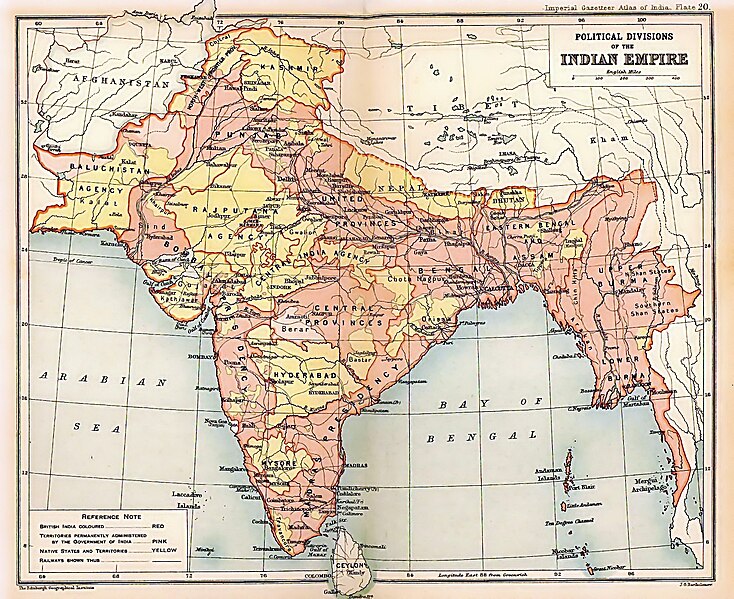
Pre-partition map of India

Pre-partition map of India

This map can be found at https://commons.wikimedia.org/wiki/File:British_Indian_Empire_1909_Imperial_Gazetteer_of_India.jpg and is part of quite a few Indian articles. I would urge people to look at the map in-depth. Except for the Central India Agency and Central India Provinces, most of the other regions were quite comfortable weather-wise. Hence I can t help but feel the assertion that Britishers didn t like India (as to live here) slightly revolting. See the excerpt/take on Dale Kennedy s The Magic Mountains: Hill Stations and the British Raj. Berkeley: University of California Press, 1996. xv + 264 pp. . A look at the list of hill stations of divided India is enough to tell that there were lot of places which either were founded by the Britishers or they chose to live there. And this is not all, there are supposed to lot of beautiful places even in Pakistan, especially in North East Frontier, Swat for instance. While today it s infamous for Taliban and Islamic Terrorism, there was a time it was known for its beauty.
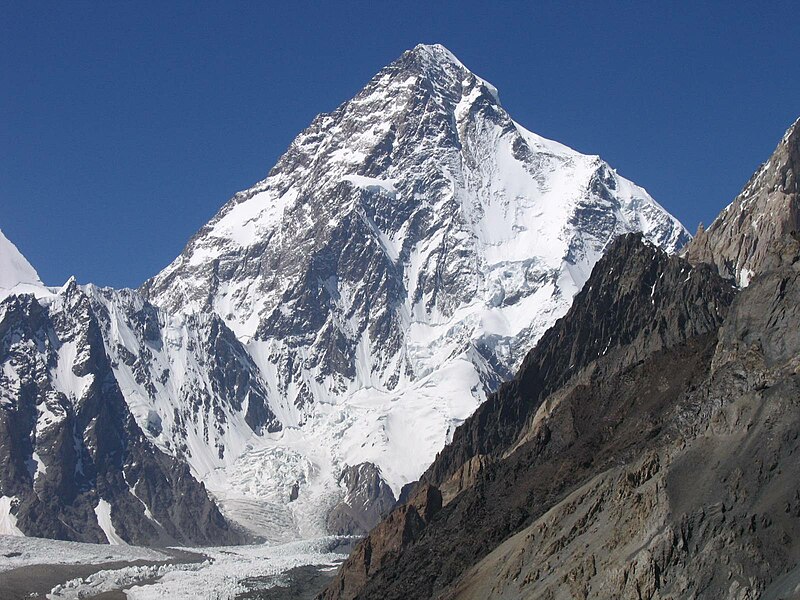
The second most difficult mountain in the world - K2, Pakistan

The second most difficult mountain in the world K2, Pakistan

Trivia After Everest, K2 is the smaller one although whatever I have read of people s accounts, most people who ascended all 14 8,000 metre peaks say K2 is technically more tougher than Everest and after Everest has the highest casualty rate. Also places like the disputed North half of Pakistan Occupied Kashmir, Gilgit Baltistan, Extreme northern Punjab of Pakistan , Northern half of Khyber-Pakhtunkhawa province and Northern Balochistan all of these places would have been more than conducive to the Britishers as it is near to the British climate (snow and pleasant weather all year round). It really is a pity that Pakistan chose to become a terrorist state where it could have become one of the more toured places of Asia. I really feel nauseous and sad at the multiple chances that Pakistan frittered away, it could have been something else.
Filed under: Miscellenous Tagged: #bash-completion, #British Raj, #contributions, #debian, #debian-policy, #Debian-QA, #Hill Stations, #India Independance Movement, #lintian, #obsolete-conffiles, #unknown-horizons, #weather, #World History, adequate, Pakistan, tourism

Steinar H. Gunderson: Nageru loopback test

Nageru, my live video mixer, is in the process of gaining HDMI/SDI output for bigscreen use, and in that process, I ran some loopback tests (connecting the output of one card into the input of another) to verify that I had all the colorspace parameters right. (This is of course trivial if you are only sending one input on bit-by-bit, but Nageru is much more flexible, so it really needs to understand what each pixel means.) It turns out that if you mess up any of these parameters ever so slightly, you end up with something like this, this or this. But thankfully, I got this instead on the very first try, so it really seems it's been right all along. :-) (There's a minor first-generation loss in that the SDI chain is 8-bit Y'CbCr instead of 10-bit, but I really can't spot it with the naked eye, and it doesn't compound through generations. I plan to fix that for those with spare GPU power at some point, possibly before 1.5.0 release.)

Lars Wirzenius: Improving debugging via email, followup

Half a year ago I wrote a blog post about debugging over email. This is a follow-up. The blog post summarised: Based on further thinking and feedback, I add: I've not written any code to help with this remote debugging, but it's something I will start experimenting with in the near future. Further ideas welcome.

21 January 2017

Clint Adams: Strangers with candy

This.
Posted on 2017-01-21
Tags: barks

19 January 2017

Matthew Garrett: Android apps, IMEIs and privacy

There's been a sudden wave of people concerned about the Meitu selfie app's use of unique phone IDs. Here's what we know: the app will transmit your phone's IMEI (a unique per-phone identifier that can't be altered under normal circumstances) to servers in China. It's able to obtain this value because it asks for a permission called READ_PHONE_STATE, which (if granted) means that the app can obtain various bits of information about your phone including those unique IDs and whether you're currently on a call.

Why would anybody want these IDs? The simple answer is that app authors mostly make money by selling advertising, and advertisers like to know who's seeing their advertisements. The more app views they can tie to a single individual, the more they can track that user's response to different kinds of adverts and the more targeted (and, they hope, more profitable) the advertising towards that user. Using the same ID between multiple apps makes this easier, and so using a device-level ID rather than an app-level one is preferred. The IMEI is the most stable ID on Android devices, persisting even across factory resets.

The downside of using a device-level ID is, well, whoever has that data knows a lot about what you're running. That lets them tailor adverts to your tastes, but there are certainly circumstances where that could be embarrassing or even compromising. Using the IMEI for this is even worse, since it's also used for fundamental telephony functions - for instance, when a phone is reported stolen, its IMEI is added to a blacklist and networks will refuse to allow it to join. A sufficiently malicious person could potentially report your phone stolen and get it blocked by providing your IMEI. And phone networks are obviously able to track devices using them, so someone with enough access could figure out who you are from your app usage and then track you via your IMEI. But realistically, anyone with that level of access to the phone network could just identify you via other means. There's no reason to believe that this is part of a nefarious Chinese plot.

Is there anything you can do about this? On Android 6 and later, yes. Go to settings, hit apps, hit the gear menu in the top right, choose "App permissions" and scroll down to phone. Under there you'll see all apps that have permission to obtain this information, and you can turn them off. Doing so may cause some apps to crash or otherwise misbehave, whereas newer apps may simply ask for you to grant the permission again and refuse to do so if you don't.

Meitu isn't especially rare in this respect. Over 50% of the Android apps I have handy request your IMEI, although I haven't tracked what they all do with it. It's certainly something to be concerned about, but Meitu isn't especially rare here - there are big-name apps that do exactly the same thing. There's a legitimate question over whether Android should be making it so easy for apps to obtain this level of identifying information without more explicit informed consent from the user, but until Google do anything to make it more difficult, apps will continue making use of this information. Let's turn this into a conversation about user privacy online rather than blaming one specific example.

comment count unavailable comments

Daniel Pocock: Which movie most accurately forecasts the Trump presidency?

Many people have been scratching their heads wondering what the new US president will really do and what he really stands for. His alternating positions on abortion, for example, suggest he may simply be telling people what he thinks is most likely to win public support from one day to the next. Will he really waste billions of dollars building a wall? Will Muslims really be banned from the US? As it turns out, several movies provide a thought-provoking insight into what could eventuate. What's more, these two have a creepy resemblance to the Trump phenomenon and many of the problems in the world today. Countdown to Looking Glass On the classic cold war theme of nuclear annihilation, Countdown to Looking Glass is probably far more scary to watch on Trump eve than in the era when it was made. Released in 1984, the movie follows a series of international crises that have all come to pass: the assassination of a US ambassador in the middle east, a banking crisis and two superpowers in an escalating conflict over territory. The movie even picked a young Republican congressman for a cameo role: he subsequently went on to become speaker of the house. To relate it to modern times, you may need to imagine it is China, not Russia, who is the adversary but then you probably won't be able to sleep after watching it. cleaning out the swamp? The Omen Another classic is The Omen. The star of this series of four horror movies, Damien Thorn, appears to have a history that is eerily reminiscent of Trump: born into a wealthy family, a series of disasters befall every honest person he comes into contact with, he comes to control a vast business empire acquired by inheritance and as he enters the world of politics in the third movie of the series, there is a scene in the Oval Office where he is flippantly advised that he shouldn't lose any sleep over any conflict of interest arising from his business holdings. Did you notice Damien Thorn and Donald Trump even share the same initials, DT?

18 January 2017

Reproducible builds folks: Reproducible Builds: week 90 in Stretch cycle

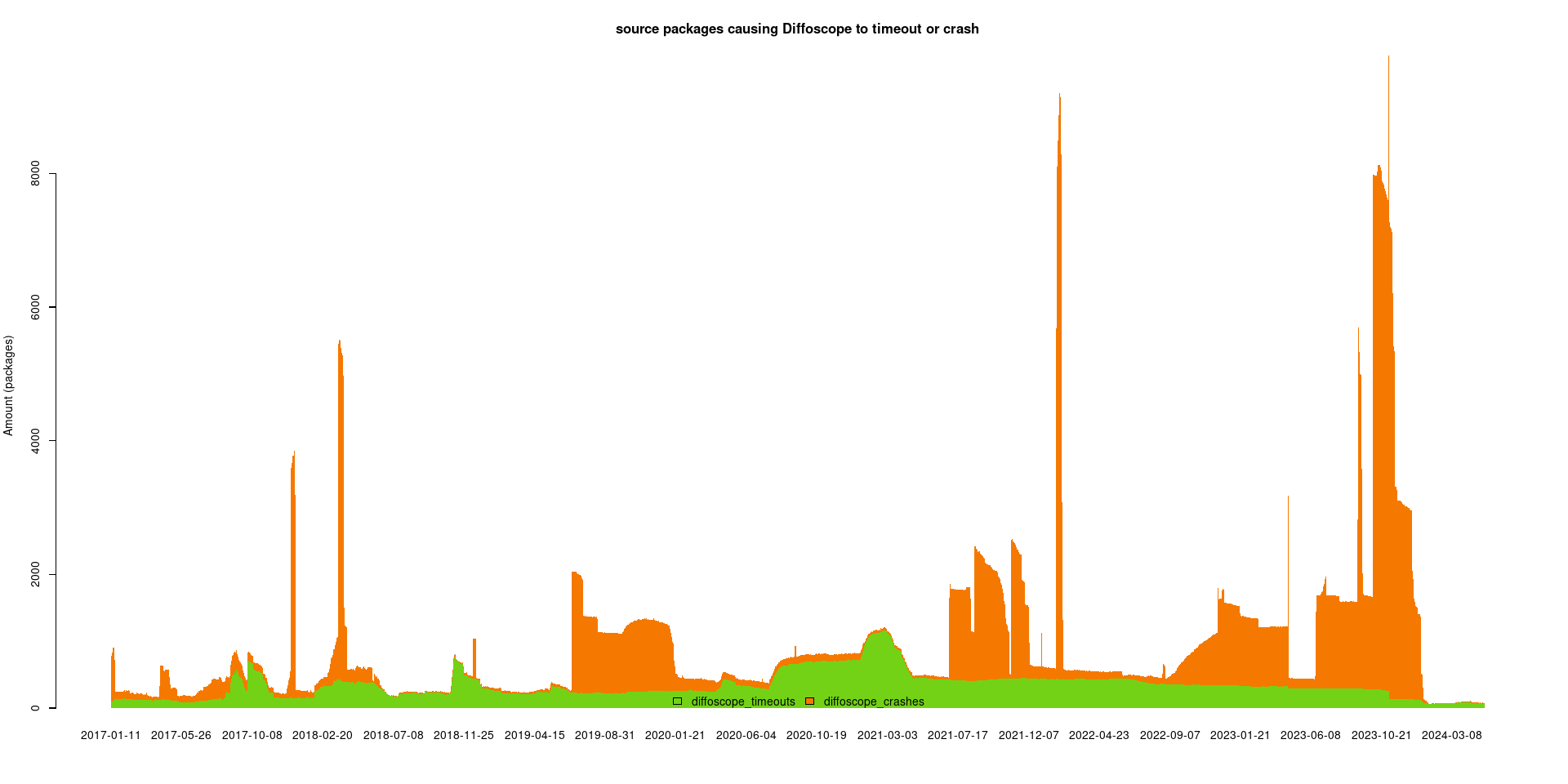
What happened in the Reproducible Builds effort between Sunday January 8 and Saturday January 14 2017: Upcoming Events Reproducible work in other projects Reproducible Builds have been mentioned in the FSF high-priority project list. The F-Droid Verification Server has been launched. It rebuilds apps from source that were built by f-droid.org and checks that the results match. Bernhard M. Wiedemann did some more work on reproducibility for openSUSE. Bootstrappable.org (unfortunately no HTTPS yet) was launched after the initial work was started at our recent summit in Berlin. This is another topic related to reproducible builds and both will be needed in order to perform "Diverse Double Compilation" in practice in the future. Toolchain development and fixes Ximin Luo researched data formats for SOURCE_PREFIX_MAP and explored different options for encoding a map data structure in a single environment variable. He also continued to talk with the rustc team on the topic. Daniel Shahaf filed #851225 ('udd: patches: index by DEP-3 "Forwarded" status') to make it easier to track our patches. Chris Lamb forwarded #849972 upstream to yard, a Ruby documentation generator. Upstream has fixed the issue as of release 0.9.6. Alexander Couzens (lynxis) has made mksquashfs reproducible and is looking for testers. It compiles on BSD systems such as FreeBSD, OpenBSD and NetBSD. Bugs filed Chris Lamb: Lucas Nussbaum: Nicola Corna: Reviews of unreproducible packages 13 package reviews have been added and 13 have been removed in this week, adding to our knowledge about identified issues. 1 issue type has been added: Weekly QA work During our reproducibility testing, the following FTBFS bugs have been detected and reported by: diffoscope development Bugs in diffoscope in the last year Many bugs were opened in diffoscope during the past few weeks, which probably is a good sign as it shows that diffoscope is much more widely used than a year ago. We have been working hard to squash many of them in time for Debian stable, though we will see how that goes in the end reproducible-website development tests.reproducible-builds.org Misc. This week's edition was written by Ximin Luo, Chris Lamb and Holger Levsen and reviewed by a bunch of Reproducible Builds folks on IRC & the mailing lists.

Mike Hommey: Announcing git-cinnabar 0.4.0

Git-cinnabar is a git remote helper to interact with mercurial repositories. It allows to clone, pull and push from/to mercurial remote repositories, using git. Get it on github. These release notes are also available on the git-cinnabar wiki. What s new since 0.3.2?

Next.

Previous.