Search Results: "dom"

25 April 2008

Theodore Ts'o: Organic vs. Non-Organic Open Source, Revisited

There’s been some controversy generated over my use of the terminology of “Organic” and “Non-Organic” Open Source. Asa Dotzler noted that it wasn’t Mozilla’s original intent to “make a distinction between how Mozilla does open source and how others do open source”. Nessance complained that he didn’t like the term “Non-Organic”, because it was “raw and vague - is it alien, poison, silicon-based?” and suggested instead the term “Synthetic Open Source”, referencing a paper by Siobh n O Mahony, ” What makes a project open source? Migrating from organic to synthetic communities”. Nessance referenced a series of questions and answers by Stephen O’ Grady from Red Monk, where he claimed the distinction between the two doesn’t matter. (Although given that Sun is a paying customer of Red Monk, Stephen admits that this might have influenced his thinking and so he might be “brainwashed” :-). So let’s take some of these issues in reverse order. Does the distinction matter? After all, if the distinction doesn’t matter, then there’s no reason to create or define specialized terminology to describe the difference. Certainly, Brian Aker, a senior technologist from MySQL, thinks it does, as do folks like me and Amanda McPherson and Mike Dolan; but does it really? Are we just saying that because we want to take a cheap shot at Sun? Well, to answer that, let’s go back and ask the question, “Why is Open Source a good thing in the first place?” It’s gotten to the point where people just assume that it’s a good thing, because everybody says it is. But if we go back to first principals maybe it will become much clearer why this dinction is so important. Consider the Apache web server; it was able to completely dominate the web server market, easily besting all of its proprietary competitors, including the super-deep-pocketed Microsoft. Why? It won because a large number of volunteers were able to collaborate together to create a very fully featured product, using a “stone soup” model where each developer “scratched their own itch”. Many, if not most, of these volunteers were compensated by their employers for their work. Since their employers were not in the web server business, but instead needed a web server as means (a critical means, to be sure) to pursue their business, there was no economic reason not to let their engineers contribute their improvements back to the Apache project. Indeed, it was cheaper to let their engineers work on Apache collaboratively than it was to purchase a product that would be less suited for their needs. In other words, it was a collective “build vs. buy” decision, with the twist that because a large number of companies were involved in the collaboration, it was far, far cheaper than the traditional “build” option. This is a powerful model, and the fact that Sun originally asked Roy Felding from the Apache Foundation to assist in forming the Solaris community indicates that at least some people in Sun appreciated why this was so important. There are other benefits of having code released under the Open Source license, such as the ability for others to see the implementation details of your operating system — but in truth, Sun had already made the Source Code for Solaris available for a nominal fee years before. And, of course, there are plenty of arguments over the exact licensing terms that should be used, such as GPLv2, GPLv3, CDDL, the CPL, MPL, etc., but sometimes those arguments can be a distraction from the central issue. While the legal issues that arise from the choice of license are important, at the end of the day, the most crucial issue is the development community. It is the strength and the diversity of the development community which is the best indicator for the health and the well-being of an Open Source project. But what about end-users, I hear people cry? End users are important, to the extent that they provide ego-strokes to the developers, and to the extent that they provide testing and bug reports to the developers, and to the extent that they provide an economic justification to companies who employ open source developers to continue to do so. But ultimately, the effects of end-users on an open source project is only in a very indirect way. Moreover, if you ask commercial end users what they value about Open Source, a survey by Computer Economics indicated that the number one reason why customers valued open source was “reduced dependence on software vendors”, which end users valued 2 to 1 over “lower total cost of ownership”. (Which is why Sun Salescritters who were sending around TCO analysis comparing 24×7 phone support form Red Hat with Support-by-email from Sun totally missed the point.) What’s important to commercial end users is that they be able to avoid the effects of vendor lock-in, which implies that if all of the developers are employed by one vendor, it doesn’t provide the value the end users were looking for. This is why whether a project’s developers are dominated by employees from a single company is so important. The license under which the code is released is merely just the outward trappings of an open source project. What’s really critical is the extent to which the development costs are shared across a vast global community of developers who have many different means of support. This saves costs to the companies who are using a product being developed in such a fashion; it gives choice to customers about whether they can get their support from company A or company B; programmers who don’t like the way things are going at one company have an easier time changing jobs while still working on the same project; it’s a win-win-win scenario. In contrast, if a project decides to release its code under an open source license, but nearly all the developers remain employed by a single company, it doesn’t really change the dynamic compared to when the project was previously under a closed-source license. It is a necessary but not sufficient step towards attracting outside contributors, and eventually migrating towards having a true open source development community. But if those further steps are not taken, the hopes that users will think that some project is “cool” because it is under an open-source license will ultimately be in vain. The “Generation Y”/Millennial Generation in particular are very sensitive indeed to Astroturfing-style marketing tactics. Ok, so this is why the distinction matters. Given that it does, what terms shall we use? I still like “Organic” vs “Non-organic”. While it may not have been intended by the Mozilla Foundation, the description in their web page, “only a small percentage of whom are actual employees [of the Mozilla Foundation]“, is very much what I and others have been trying to describe. And while I originally used the description “Projects which have an Open Source Development Community” vs “Projects with an Open Source License but which are dominated by employees from a single company”, I think we can all agree these are very awkward. We need a better shorthand. When Brian Aker from MySQL suggested “Organic” vs “Non-Organic” Open Source, and I think those terms work well. If some folks think that “Non-Organic” is somehow pejorative (hey, at least we didn’t say “genetically modified Open Source” :-), I suppose we could use Synthetic Open Source. I’m not really convinced that is any much more appetizing, myself, however. So what would be better terms to use? Please give me some suggestions, and maybe we can come up with a better set of words that everyone is happy with.

Theodore Ts'o: Organic vs. Non-Organic Open Source, Revisited

There’s been some controversy generated over my use of the terminology of “Organic” and “Non-Organic” Open Source. Asa Dotzler noted that it wasn’t Mozilla’s original intent to “make a distinction between how Mozilla does open source and how others do open source”. Nessance complained that he didn’t like the term “Non-Organic”, because it was “raw and vague - is it alien, poison, silicon-based?” and suggested instead the term “Synthetic Open Source”, referencing a paper by Siobh n O Mahony, ” What makes a project open source? Migrating from organic to synthetic communities”. Nessance referenced a series of questions and answers by Stephen O’ Grady from Red Monk, where he claimed the distinction between the two doesn’t matter. (Although given that Sun is a paying customer of Red Monk, Stephen admits that this might have influenced his thinking and so he might be “brainwashed” :-). So let’s take some of these issues in reverse order. Does the distinction matter? After all, if the distinction doesn’t matter, then there’s no reason to create or define specialized terminology to describe the difference. Certainly, Brian Aker, a senior technologist from MySQL, thinks it does, as do folks like me and Amanda McPherson and Mike Dolan; but does it really? Are we just saying that because we want to take a cheap shot at Sun? Well, to answer that, let’s go back and ask the question, “Why is Open Source a good thing in the first place?” It’s gotten to the point where people just assume that it’s a good thing, because everybody says it is. But if we go back to first principals maybe it will become much clearer why this dinction is so important. Consider the Apache web server; it was able to completely dominate the web server market, easily besting all of its proprietary competitors, including the super-deep-pocketed Microsoft. Why? It won because a large number of volunteers were able to collaborate together to create a very fully featured product, using a “stone soup” model where each developer “scratched their own itch”. Many, if not most, of these volunteers were compensated by their employers for their work. Since their employers were not in the web server business, but instead needed a web server as means (a critical means, to be sure) to pursue their business, there was no economic reason not to let their engineers contribute their improvements back to the Apache project. Indeed, it was cheaper to let their engineers work on Apache collaboratively than it was to purchase a product that would be less suited for their needs. In other words, it was a collective “build vs. buy” decision, with the twist that because a large number of companies were involved in the collaboration, it was far, far cheaper than the traditional “build” option. This is a powerful model, and the fact that Sun originally asked Roy Felding from the Apache Foundation to assist in forming the Solaris community indicates that at least some people in Sun appreciated why this was so important. There are other benefits of having code released under the Open Source license, such as the ability for others to see the implementation details of your operating system — but in truth, Sun had already made the Source Code for Solaris available for a nominal fee years before. And, of course, there are plenty of arguments over the exact licensing terms that should be used, such as GPLv2, GPLv3, CDDL, the CPL, MPL, etc., but sometimes those arguments can be a distraction from the central issue. While the legal issues that arise from the choice of license are important, at the end of the day, the most crucial issue is the development community. It is the strength and the diversity of the development community which is the best indicator for the health and the well-being of an Open Source project. But what about end-users, I hear people cry? End users are important, to the extent that they provide ego-strokes to the developers, and to the extent that they provide testing and bug reports to the developers, and to the extent that they provide an economic justification to companies who employ open source developers to continue to do so. But ultimately, the effects of end-users on an open source project is only in a very indirect way. Moreover, if you ask commercial end users what they value about Open Source, a survey by Computer Economics indicated that the number one reason why customers valued open source was “reduced dependence on software vendors”, which end users valued 2 to 1 over “lower total cost of ownership”. (Which is why Sun Salescritters who were sending around TCO analysis comparing 24×7 phone support form Red Hat with Support-by-email from Sun totally missed the point.) What’s important to commercial end users is that they be able to avoid the effects of vendor lock-in, which implies that if all of the developers are employed by one vendor, it doesn’t provide the value the end users were looking for. This is why whether a project’s developers are dominated by employees from a single company is so important. The license under which the code is released is merely just the outward trappings of an open source project. What’s really critical is the extent to which the development costs are shared across a vast global community of developers who have many different means of support. This saves costs to the companies who are using a product being developed in such a fashion; it gives choice to customers about whether they can get their support from company A or company B; programmers who don’t like the way things are going at one company have an easier time changing jobs while still working on the same project; it’s a win-win-win scenario. In contrast, if a project decides to release its code under an open source license, but nearly all the developers remain employed by a single company, it doesn’t really change the dynamic compared to when the project was previously under a closed-source license. It is a necessary but not sufficient step towards attracting outside contributors, and eventually migrating towards having a true open source development community. But if those further steps are not taken, the hopes that users will think that some project is “cool” because it is under an open-source license will ultimately be in vain. The “Generation Y”/Millennial Generation in particular are very sensitive indeed to Astroturfing-style marketing tactics. Ok, so this is why the distinction matters. Given that it does, what terms shall we use? I still like “Organic” vs “Non-organic”. While it may not have been intended by the Mozilla Foundation, the description in their web page, “only a small percentage of whom are actual employees [of the Mozilla Foundation]“, is very much what I and others have been trying to describe. And while I originally used the description “Projects which have an Open Source Development Community” vs “Projects with an Open Source License but which are dominated by employees from a single company”, I think we can all agree these are very awkward. We need a better shorthand. When Brian Aker from MySQL suggested “Organic” vs “Non-Organic” Open Source, and I think those terms work well. If some folks think that “Non-Organic” is somehow pejorative (hey, at least we didn’t say “genetically modified Open Source” :-), I suppose we could use Synthetic Open Source. I’m not really convinced that is any much more appetizing, myself, however. So what would be better terms to use? Please give me some suggestions, and maybe we can come up with a better set of words that everyone is happy with.

Jan Wagner: security: wordpress 2.5.1 which fixes CVE-2008-1930

Cause the subject, I did build a new package which can be installed on etch, lenny and of course sid. You can fetch it from http://ftp.cyconet.org/debian/archive/bpo/wordpress/2.5.1-1~bpo40+1/ or get via

deb http://ftp.cyconet.org/debian etch-backports main non-free contrib Selfnote: Dump the wordpress user into separate domU

24 April 2008

Stefano Zacchiroli: unexpected kudos from TBL

Sir Tim Berners-Lee kudos the Debian packaging system I'm currently in Beijing to deliver a talk at the WWW2008 conference, and I just came back from the usual magnificent banquet of big conferences. Before the banquet it was scheduled a keynote talk by Sir Tim Berners-Lee. What is the least thing you expect to hear from Sir Tim mouth in such a talk? I for sure hadn't expected to hear kudos to the Debian packaging system! But in fact I did hear that and apparently I was not the only one (though probably I was the only one who got excited about it, attracting the attention of my table-mates). He was talking about various shortcoming to be addressed in the future of the Web, and one was the hackish way in which Javascript/AJAX applications are deployed on the web, with no encapsulation/packaging of libraries. Well, as an example to tend to he then mentioned the packaging system of our beloved distribution. It is really the time to say: we are just one step away from the total world (wide web) domination.

Theodore Ts'o: Organic vs. Non-organic Open Source

Brian Aker dropped by and replied to my previous essay by making the following comment:
I believe you are hitting the nail on the organic vs nonorganic open source. I do not believe we have a model for going from one to the other. Linux and Apache both have very different models for contribution but I don t believe either are really optimized at this point. Optimization to me would lead to a system of less priests and more inclusion.
I made an initial reply as comment, and then decided it was so long that I should promote it to a top-level post. I assume that when Brian talks about “organic open source” what he means is what I was calling an “open source development community”. Some googling turned up the following definition from Mozilla Firefox’s organic software page: “Our most well-known product, Firefox, is created by an international movement of thousands, only a small percentage of whom are actual employees.” This puts it in contrast with “non-organic” software, where all or nearly all of the developers are employed by one company. (And anyone who proves talented at adding features to that source base soon gets a job offer by that one company. :-) By that definition we can certainly see projects like Wine, Mysql, Ghostscript (at one time), and others as fitting into that model, and being quite successful. There’s nothing really wrong with the non-organic software model, although many of them have struggled to make enough money when competing with pure proprietary softare competitors, with MySQL perhaps being the exception which proves the rule. In most of these cases, though, the project started more as an organic open source, and then transitioned into the non-organic model when there was a desire to monetize the project and/or when the open source programmers decided that it would be nice if they could turn their avocation into a vocation, and let their hobby put food on the family table. Solaris, of course, is doing something else quite different, though. They are trying to make the transition from a proprietary customer/supplier relationship to trying to develop an Open Source community and what John s candidate statement pointed out is that they weren t really interested in creating an organic open source developer community at all, but they wanted the fruits of an open source community with plenty of application developers, end-users, etc., all participating in that community. We don t have a lot of precedent for projects who try to go in this direction, but I suspect they are skipping a step when they try to go to the end step without bothering to try to make themselves open to outside developers. And by continuing to act like a corporation, they end up shooting themselves in the foot. For example, the OpenSolaris license still prohibits people from publishing benchmarks or comparisons with other operating systems. Very common in closed-source operating systems and databases, but it discourages people from even trying to make things better, both within and outside of the Open Solaris core team. Instead, they respond to posts like David Miller s with Have you ever kissed a girl? . (Thanks, Simon, for that quote; I had seen it before, but not for a while, and it pretty well sums up the sheer arrogance of the Open Solaris development team.) So while Linux may not be completely optimized in terms of less priests and more inclusion, at least over 1200 developers contributed to 2.6.25 during its development cycle. Compared to that, Open Solaris is positively dominated by high priests and with a you may not touch the holy-of-holies attitude; heck, they won t even allow you to compare them to other religions without branding you a heretic and suing you for licensing violations!

Theodore Ts'o: Organic vs. Non-organic Open Source

Brian Aker dropped by and replied to my previous essay by making the following comment:
I believe you are hitting the nail on the organic vs nonorganic open source. I do not believe we have a model for going from one to the other. Linux and Apache both have very different models for contribution but I don t believe either are really optimized at this point. Optimization to me would lead to a system of less priests and more inclusion.
I made an initial reply as comment, and then decided it was so long that I should promote it to a top-level post. I assume that when Brian talks about “organic open source” what he means is what I was calling an “open source development community”. Some googling turned up the following definition from Mozilla Firefox’s organic software page: “Our most well-known product, Firefox, is created by an international movement of thousands, only a small percentage of whom are actual employees.” This puts it in contrast with “non-organic” software, where all or nearly all of the developers are employed by one company. (And anyone who proves talented at adding features to that source base soon gets a job offer by that one company. :-) By that definition we can certainly see projects like Wine, Mysql, Ghostscript (at one time), and others as fitting into that model, and being quite successful. There’s nothing really wrong with the non-organic software model, although many of them have struggled to make enough money when competing with pure proprietary softare competitors, with MySQL perhaps being the exception which proves the rule. In most of these cases, though, the project started more as an organic open source, and then transitioned into the non-organic model when there was a desire to monetize the project and/or when the open source programmers decided that it would be nice if they could turn their avocation into a vocation, and let their hobby put food on the family table. Solaris, of course, is doing something else quite different, though. They are trying to make the transition from a proprietary customer/supplier relationship to trying to develop an Open Source community and what John s candidate statement pointed out is that they weren t really interested in creating an organic open source developer community at all, but they wanted the fruits of an open source community with plenty of application developers, end-users, etc., all participating in that community. We don t have a lot of precedent for projects who try to go in this direction, but I suspect they are skipping a step when they try to go to the end step without bothering to try to make themselves open to outside developers. And by continuing to act like a corporation, they end up shooting themselves in the foot. For example, the OpenSolaris license still prohibits people from publishing benchmarks or comparisons with other operating systems. Very common in closed-source operating systems and databases, but it discourages people from even trying to make things better, both within and outside of the Open Solaris core team. Instead, they respond to posts like David Miller s with Have you ever kissed a girl? . (Thanks, Simon, for that quote; I had seen it before, but not for a while, and it pretty well sums up the sheer arrogance of the Open Solaris development team.) So while Linux may not be completely optimized in terms of less priests and more inclusion, at least over 1200 developers contributed to 2.6.25 during its development cycle. Compared to that, Open Solaris is positively dominated by high priests and with a you may not touch the holy-of-holies attitude; heck, they won t even allow you to compare them to other religions without branding you a heretic and suing you for licensing violations!

22 April 2008

Joerg Jaspert: FTPMaster

[Warning, long post ahead. If you aren’t interested in Debian or it’s internals or my work - skip it. :) ] So as you might have read here, I got the delegation of the debadmin AKA FTPMaster group lately. I’ve got some pressure to not accept this delegation, but the response to my blog post about it had been extremely positive, everyone said I should not deny it. Knowing to have such a support within Debian is something I really appreciate, making it worth to spent time on my various jobs. Now, lets take this and write a little about what happened since I gained that extra group: Work I did since then: The above should nicely sum up my work in the past few days. Most of it pretty trivial, but still things that have to be done. I plan to keep doing things, slowly going from the trivial stuff to more complicated ones, but there is lots of stuff ahead. Some ideas, and this is a very incomplete list just from my head, there are tons of things that one could do, include Now, do you have any time to kill? Do you want to help? Some things you could do:

19 April 2008

Chris Lawrence: Principals, agents, and Debian

I’ve noted in the past that Debian has deliberately enshrined in its constitution some rather serious principal-agent problems. By and large this isn’t a bad thing, since there isn’t the consensus within the Debian community to support the “benevolent dictator for life” model of decision-making—if you want that, well that’s what Ubuntu and Daddy Warbucks is for. But it does mean that sometimes the caca hits the fan when a Debian project leader does exercise his powers, as our now-former DPL did earlier this week just before the end of his term of office (by my estimate, just over one hour and 27 minutes before). John Adams would be proud. So we have three related issues in my mind: In any event, congratulations to all the new Debian developers—and I’ll avoid pondering for too long why one person’s appointment to an unrelated group would suddenly break the logjam of developer application approvals.

18 April 2008

Amaya Rodrigo: You people break my heart

Some come, others kind of go.

I warmly welcome the new 19 developers (great female ratio there!) and humbly ask the rest of us to support the new blood carriers. If they made it through this, they are surely worthy of our cause and will probably accomplish a lot more if us, the old farts, make it easier for the ones to come in the future.

Where do I join the Debian elderly club?

Gerfried Fuchs: On freedom

One of the freedoms I value is the freedom to choose what you spend your time on and who you spend it with. And while I believe that people in key roles in Debian still have those freedoms (hey, 2.1(1), don't you know), reality these days even confirms that. So long, and thanks for the fish.

Julien Blache: Dear Jaldhar, Debian is alive and kicking asses.

Dear Jaldhar, I wrote the post you’re referring to knowing that only one person had been stupid enough to title his post “Is Debian dying?”, so before you go on writing I’m insulting a group of people (at least I’m reading your post this way), please do your research. Lucas’ post is about the worst PR we can imagine. There’s nothing more stupid to do than what he did. That’s the PR equivalent of committing suicide, mostly. It’s seriously hindering the work some of us are doing, publicizing Debian, going to trade shows, etc. It’s not only stupid, it’s hurting people who do this work. What’s worse, the post comes with comments from random nobodies, who have nothing to do with Debian, don’t have the first clue about how the Project works internally, yet they can tell that Debian is dying and grinding to a halt. Not to mention it’s been publicized yet again by some “journalist”. I’ve known Lucas for a long time now. I know where I stand. And I maintain my previous post in full, like it or not. Kthxbye.

MJ Ray: Explaining web site improvements: what's important to you?

[Photo of Some Traffic]
Is this traffic or congestion? This is one of those Friday Afternoon Projects - it's been put off all through a busy week because it's unpaid, I'm not completely sure how to approach it and now my arms hurt like hell from travel jabs which are making it hard to concentrate! So I'm going to float it on here... I've been asked to brief a meeting next week about that group's current web site and its problems. I'm not linking it yet to avoid insulting/embarrassing them. The site looks OK, but doesn't rank well on search engines and doesn't allow much member participation. I need to explain why that's a bad thing and how the site's technical choices have led to that. I'm not directly pitching for TTLLP to get any work (because I'm a member of that group, it might be a conflict of interest and we're pretty busy anyway - even our own site needs work on some of the points I'm going to mention), but I don't want to be unhappy if we're asked to implement my recommendations. I've got a usual outline that I follow, but my presentation's time is limited, so I'd like to ask you: what about this is important and what isn't? If you give me useful feedback, I'll put you in the Acknowledgements with a backlink and I hope the briefing will be shared pretty widely over the next few months. The current plan is to start with a basic explanation of how search engines rank pages, as far as we can tell, referring to PageRank Explained Correctly with Examples, by Ian Rogers as well as the shorter official summaries from the dominant search sites at Yahoo, Microsoft and Google. Then I go through a quick evaluation of the site against the basics of validation, accessibility and robot-friendliness, followed by a couple of SEO-style checks of its current rankings and inbound links. Next is a bit different because I have access to some of their web access stats: I summarise what we know and suggest some other stats they've probably not considered and why they're useful, along the lines of Dave Briggs's measures of blog success. Finally, I suggest ways to improve the site. The top tip will be to take control of the site hosting and stop using the cheap and cheerful donated server that makes all links except the front page point to another domain. I'll probably suggest a mix of free and open source software tools to power it. If they don't want to move it all yet, I'll suggest running a second site for member participation, using tools like Wordpress, NoseRub and so on. What do you think? Plan for success, am I missing some tricks, or am I setting myself up for a lynching? Let me know with a comment or email, please.

Anthony Towns: On freedom

One of the freedoms I value is the freedom to choose what you spend your time on and who you spend it with. And while I’ve spent a lot of time arguing that people in key roles in Debian still have those freedoms (hey, 2.1(1), don’t you know), reality these days seems to be otherwise. But hey, solving that quandry just requires a mail to DSA. To folks on the core teams I’ve been involved with: it’s been a pleasure and an honour working with you; if not always, at least mostly. Best of luck, and I hope y’all accept patches.

17 April 2008

Neil Williams: Data Centric programming - a new start at Alioth.

It's time for me to stop complaining about the commercialisation of SourceForge and vote with my code. I'm leaving for brighter, bluer pastures at Alioth.

Query Object Framework is first (libqof1). The others will follow. I'm leaving because of unusable mailing list archives, impossibly slow web pages and wiki and the general amount of work involved in the SF interface. I'm gaining sane mailing lists, a friendly and usable ikiwiki and a simpler (although very similar) interface.

I'm also migrating most of those packages to subversion. With so many other changes, it's not exactly a problem to add cvs2svn into the mix.

Now, of course, this does not mean that these upstream packages suddenly become Debian-only or Debian-native. It does mean that I have a chance of encouraging new developers to join the team by providing the kinds of services and support that people need when starting off with a new project. (I suppose the one thing I don't yet have is an IRC channel. Not sure if it is worthwhile but I'll see what happens.)

QOF will form the basis of the support available for each of the other projects - all will share the same low-volume QOF-devel mailing list and QOF Wiki as provided by Alioth. I'll also migrate QuickList because I'm looking at restarting development on a stalled project allied to QOF and which could provide missing functionality in QuickList. I did look at Gaby in this mix but a botched Gtk1->Gtk2 transition that ended up with two incompatible forks running different parts of the original codebase put me off completely (and neither of the forks actually worked). (Some packages deserve to be dead upstream.)

I'm looking for new blood, fresh faces and a new desire to take these projects forwards. The driving force is data freedom - creating data-driven applications that are completely agnostic to where and how the data happens to be stored. It is user data, it should be as free as the source code that wrote it. Who cares what format it is in? Let's get it into a format that some other program can use and make use of the existing data instead of duplicating it all the time. (The observant will note that my old haunt of GnuCash is stubbornly ignorant of the merits of a decent import/export implementation that actually covers more than 50% of the data in the application. No wonder I took the chance to sponsor homebank.)

DWI Data With Interaction (aka DUI -- Data Under the Interface) is what can provide the missing interfaces. It'll take a while to get it back up to date and available in Debian but it can provide the link between data and interfaces. GNU/Linux users should be able to design an interface purely on the basis of the data that it needs to handle and not care one jot about how that data comes from one free software app and goes on to the next free software app. QOF is gaining a connection to libgda which means that data can go to and fro between a whole range of databases and file formats. Homebank and pilot-qof can gain new data inputs (and possibly outputs) by utilising the existing import/export support in new ways via DWI/QOF (as libqof2). That can give a complete interface for all PIM and financial data for a typical SOHO user and all based on SQL-type queries so that every stage of the process can be tweaked and optimised according to user requirements at runtime.

(Where does Emdebian come into this? Well, many people like me need to record and process PIM/financial data on the move so Emdebian means that those users can have the same data processing on their handhelds as on the desktop. Smaller apps to capture the data quickly and efficiently whilst on the move; larger apps to refine, optimise and filter the data on the desktop entirely under user control but with a simple, scriptable, interface based on runtime queries so that the user can do exactly the same conversions tomorrow with new data but none of the configuration. Easy!)

Is this groupware ? No - it is personal, ultimately flexible and entirely customised for particular users by the users themselves. It's about small niche markets, about independent business people with bespoke and highly specialised requirements. No one is going to spend time writing their reports in Scheme or Haskell, because they are the only people who need that particular report. Instead, that individual user needs to be empowered through a simple and intuitive interface to take a piece of data from one source, correlate it with a static piece of data from individual configuration sources, calculate a result according to a third piece of data from a completely separate source and combine them all into a new set of objects that can be used in other queries. It's about preparing invoices from Palm data, it's about handling customer accounts for a one-man company or handling a stocks and shares portfolio for a partnership. Ultimately customised, ultimately flexible and completely format-agnostic.

These are the kind of applications that hold people back from GNU/Linux migrations - bespoke applications that are developed for just a few small companies or just a few situations. Free software finds it hard to provide those apps because free software depends (currently) on someone else being motivated to write a bespoke program and that person rarely understands the niche. This is a chance to put the development into the hands of those with the motivation to do the work, by making the development process more WYSIWYG.

The question is: Can we come up with a better name for DWI, dear lazyweb?

"DWI is a fairly simple environment for quickly creating data-driven applications, that is, graphical applications that manipulate and show info from a database. This environment differs from others in that it is focused on native GTK/Gnome support through the Glade GUI designer, and thus allows you to build user interfaces as elegant as you can make them in Glade."
http://dwi.sourceforge.net/

The big appeal is that DWI is database-agnostic - it only cares about the data structure, not the file format. Ally that with QOF which provides data-centric SQL-based queries and conversions between objects (including combining elements from one object into one or more other objects without having to hardcode the connection between the objects at compile time) and we have an interesting and powerful combination of engines, frontends and backends that are all data-centric.

Please, if this sparks your interest, join the QOF-devel mailing list, have a play with the ikiwiki at http://qof.alioth.debian.org/ and have a go with the code. This whole area is begging for development but it is just so far from being usable by the target audience at this stage. There is a lot of programming to be done by current developers before the principles can be let loose on the masses.
:-)

This is about working between existing projects and between distributions - no longer dedicated to a single application, platform or file format, no more tunnel vision. Work on the edges of existing applications (and indeed projects), remove the sharp edges of applications that should work together but can't. The majority of the code in these libraries and applications is already stable and mature. Like so many parts of free software, it is time, IMHO, to put aside our egotistical devotion to the one-true-executable and come up with an actual solution.

Bah! I'm beginning to sound like a PR exec instead of a dedicated geek. What does it take to motivate people and get things done around here?
:-)

MJ Ray: 21 today! MJR around the web...

Not done one of these round-ups for a while and I'm really pushed for time today, so here are some sites that I've written on:
  1. Property of a Lady Wicca on House
  2. Ross Burton: The End Of Homeopathy?
  3. Enough with the dried yoghurt covered raisins Korerorero: Just random ranting and raving
  4. How to host a free software advocacy event Free Software Magazine
  5. Raw Output: AGPL
  6. One for the Morning Glory: Facebook comments
  7. Sam Liddicott GPL3 Questions and Implications
  8. Drugs and an Election etbe
  9. New Tropicana images
  10. robmyers - Support BY-SA/SFDL Compatibility, Not BY-SA/FDL Compatibility
  11. Internet Psychology: Teenagers do not need our help online - we need them to help us oldies by Graham Jones, Internet Psychologist
  12. Wanting Your Opinions about Blog Comments and City Attorneys : David Lee King
  13. Zookoda - I Don't Recommend them Anymore
  14. Solar Water Heating :: ShowBlog
  15. Internet Psychology: Forget email - it's old hat by Graham Jones, Internet Psychologist
  16. Drake.org.uk: That's a wrap! Time to roll the end credits..
  17. Internet Psychology: Internet criminals are going to have a field day by Graham Jones, Internet Psychologist
  18. A Cambridge Co-operator: Rebranded Stores
  19. robmyers - Two Common Errors
  20. Lucas Nussbaum's Blog Blog Archive Where is the NM bottleneck?
  21. NM: FD is fixed - MadBlog

Gunnar Wolf: Dear lazyweb: Large volumes strategy?

Wouter, you seem to enjoy using huge filesystem volumes. So, dear lazyweb...
I have a 500GB disk for my users' home partitions - they mainly use it to back up their desktop data, but I do expect them to give it more usage. Anyway - I am currently using around 350GB of it, leaving the rest still unpartitioned. I have switched over to ReiserFS, as online resizing it is way faster than online resizing ext3 - it's basically instantaneous.
It seems I do belong to the old sysadmin school, and I value highly the reliability that comes from not having filesystems too large for their own good - After all, recovering from failure in 10GB is way more probable than doing the same in 100 or 1000, isn't it? But then again, it's just impractical to create /home/samba/ 1,2,3,4,5,6,7,8,9 / and randomly split users' directories inside them. Most users won't use more than a couple MB, but some users (legitimately!) back up tens of GB... It's hard for me to anticipate their needs.
Does any of you have scary stories regarding huge volumes? Or any data supporting the idea that I'm just too old fashioned and that half a TB is a good partition size?
Note that I _am_ holding full backups :)
[update]: So I'm undoubtley an old fart? Everybody seems to have partitions larger than me. Ok, I will stop crying...

Biella Coleman: Chiki-Chiki Precario,Euromayday 08

It is not the case that “copyleft” is paired with issues such as sexual freedom and immigrant rights all that often. But there are times when they are bundled together as in this video, which is advertising a Pan-Europe set of May 1st events. And even if you don’t know Spanish, you will get something out of the video given its zany aesthetics (and note that “El Copyleft” is number 1 on their list :-) )

Russell Coker: Making Linux DVDs

Anthony Towns writes about using an improved version of jigdo to download CD/DVD images [1]. His improvement is basically to pipeline operation for better performance. Jigdo (the Jigsaw download) is a tool to download a set of files and then use them to create a CD or DVD image [2]. The idea is that most web sites that have CD or DVD images also have a collection of files which comprise the DVD image available. This removes the need to store the data twice (wasting disk space on mirrors and in some situations breaking web caching). I have never used jigdo, and for all Debian installations in recent times (the last few years at least) I download a small net-inst CD image and then have it download the other files from the net. I have Squid set up to cache large objects so this doesn’t waste too much of my precious network bandwidth (which is limited and expensive in Australia). Now I’m thinking about what the optimum method for doing installs might be. One thing that would be good would be to support multiple repositories, the packages have unique file names and checksums so it should be possible to check one repository and then check another if it’s not working. I don’t mean multiple “deb” lines in the APT configuration. What I would like to do is to have an NFS file server or web server with an archive of downloaded packages and have APT check there first before downloading a file. So APT could get a list of packages from the net and then get the actual files locally if they are available. The next thing that would be good is the ability to create a CD or DVD image dynamically and to store all temporary files. So I could download files from the repository and create a DVD image with just the packages that I need. Every time I create a DVD image my sub-set of the Debian archives would increase and the number of files actually downloaded in the creation process would be reduced. The effect would be to incrementally create a local mirror of the Debian repository. Then I would like to see a two-stage DVD install process. I would like to boot from a CD or DVD and start the install and then have it give a list of files needed (which could be stored on a USB device or floppy) to create further CDs or DVDs for installation. One situation where this could have been beneficial was when I was doing an emergency install of CentOS. I did the first part of the install (selecting packages etc) to determine which CDs were needed. It turned out that almost all CDs were needed even though some of the CDs had only a few files that I was installing. If the installer could have written a list of packages to a USB device then I could have downloaded just those packages and got the install working a lot sooner. It seems to me that it’s fairly common to do one test install and then do some dozens of other installs with the same settings. So the ability to create a DVD of exactly the needed files for the other dozens of installs would be a great benefit. Now this is just random commentary, unfortunately don’t have time to do any coding on this. But it seems obvious that something has to be done to improve the situation for developers and IT staff who need some degree of mirroring of the Debian package pool but who can’t do a full mirror. Back in 1996 I was able to mirror Debian over a 28K8 modem link and fit it on what was a reasonable hard drive by the standards of the day (incredibly tiny by today’s standards). Now I can’t practically mirror Debian over an Australian cable broadband connection and even by the standards of about 4 years ago (the age of most of my hard disks) the space requirements are significant. I hope this post helps inspire some interest in developing these features. As delays in joining Debian [3] is the topic of the day it should be noted that work on preparing DVD images can easily be done by people who are not DDs. Such software should work from Debian archives without requiring any changes to them, and thus nothing special is needed from the Debian project to start work.

16 April 2008

Simon McVittie: Implementing D-Bus services with telepathy-glib

16:46 < epmf> tp-glib is made of magic

—#telepathy, 2008-04-15

Rob pointed out today that I'd been promising to blog about telepathy-glib for several months and still haven't done so. I think there's too much to cover in one blog post, so I'll start with the oldest part - implementing a service (typically a Telepathy connection manager).

While telepathy-glib is (obviously) intended for Telepathy implementors, I think the ideas we've been implementing are likely to be useful for any D-Bus API, particularly flexible/complex APIs where an object implements many interfaces.

Introduction to telepathy-glib telepathy-glib started out as a collection of code extracted from our XMPP connection manager, telepathy-gabble, but at some point it grew beyond that into a wrapper around/partial replacement for dbus-glib. We've been quite pleased with it, really :-) My first major round of work on telepathy-glib, during the first half of 2007, was to split it out from telepathy-gabble (versions up to 0.5.9 were released as part of Gabble 0.5.x tarballs, in fact), leading to the release of the 0.6.x stable branch in late September. This was very helpful for implementing connection managers - Salut, Idle and telepathy-sofiasip (our connection managers for link-local XMPP, IRC and SIP) all started off by forking/cargo-culting from Gabble, and achieved huge code reductions by porting to telepathy-glib. Also, Will Thompson used it in his Summer of Code project, telepathy-haze, to go from nothing to a working and useful Telepathy implementation based on libpurple in a matter of a few months. The second major round of work, which I'll discuss in a later article, added client code to telepathy-glib, obsoleting the older/worse libtelepathy and allowing client programs like Empathy and telepathy-stream-engine to be written using telepathy-glib. In the process, I accidentally reinvented DBusGProxy :-) More details to come later!
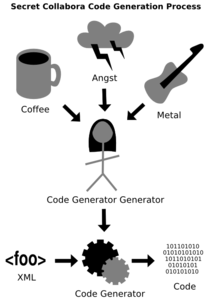
Some background: service-side code generation
The secret Collabora code-generation process

(credit: daf)

Supporting D-Bus in the GObject world has always involved quite a lot of code generation. The core API of dbus-glib is heavily reliant on varargs functions, which aren't type-safe and are easy to get wrong. dbus-glib contains a program called dbus-binding-tool, which is meant to generate reasonably sane GObject APIs for D-Bus objects. Unfortunately, it seems to be intended to generate a whole GObject at a time. Early versions of telepathy-gabble used dbus-binding-tool plus a script called gengobject.py to generate API stubs for the exported objects; developers then filled in the blanks, and hey presto, we had a GObject on D-Bus. This was fine up to a point, but had a couple of major drawbacks. Whenever we changed the D-Bus API (quite common during the early development of Telepathy), there was a very laborious and error-prone merging process. We ended up with the following process:
  • copy the D-Bus introspection XML from the telepathy-spec repository into a directory xml/pristine (actually, the canonical form for the spec was Python for a while, and we had a script that exported a contrived object onto D-Bus and introspected itself to get the XML - but that's another story!)
  • preprocess the introspection XML to add the dbus-glib CFunctionName annotation, resulting in a directory xml/modified
  • run dbus-binding-tool and a Python script gengobject.py to generate C source in xml/src
  • three-way-diff the old version of xml/src, the new version of xml/src, and the real C code in src to create a new version of src
  • pray that the diff process hadn't randomly exchanged functions' implementations
  • update the resulting code in src so it worked
  • check the whole mess back into darcs
  • hope that nobody else had made changes that would result in darcs conflicts
If you haven't yet gathered, this was a bit of a nightmare. Also, it was very easy to return the wrong thing from a method without noticing - because all the APIs were varargs, the compiler didn't notice, and the first we'd know about it was a mysterious segfault under certain circumstances.
How telepathy-glib fixes code generation telepathy-glib improves on this by taking advantage of this innocuous-looking feature in dbus-glib:
commit 355ef78d98d6fc65715845d56232199162cab12a
Author: Steve Frécinaux <steve istique net>
Date:   Thu Aug 17 11:48:20 2006 +0200
    Interface support for bindings.
Instead of running dbus-binding-tool or creating GObjects with D-Bus interfaces, we put the entire Telepathy spec through glib-ginterface-gen.py, a distant descendant of Gabble's gengobject.py. For each interface in the spec, we generate a GInterface that mirrors the D-Bus interface. Any GObject that implements the GInterface automatically gets the D-Bus interface if it's exported onto D-Bus. There are a few non-obvious refinements, though:
  • The signature of the method implementation is always in the mode that dbus-glib calls "asynchronous", where the method implementation can either send a reply message before or after it returns. For "slow" methods, this is the only thing you can do. For instance, many Telepathy D-Bus methods can't return anything until some TCP round-trips to the server have happened. This is also the only thing you can do if you want to extract extra information, like the sender's unique name, from the method-call message (dbus-glib's "synchronous" API doesn't allow this to be done). For "fast" methods, sending a reply message before returning is just as easy as using the "synchronous" API (it's just a difference of syntax), and has an API consistent with that of the "slow" methods, making it easier for service authors.

  • The layout of the GInterface vtable is private, and (auto-generated) accessor functions are used to fill in implementations. This means our ABI doesn't change just because we re-ordered functions in the spec.

  • If no implementation is provided for a method, we just raise an appropriate error (org.freedesktop.Telepathy.Errors.NotImplemented), rather than suffering an assertion failure. This means we can safely add methods to an interface.

  • While we're generating code anyway, we generate some static inline wrapper functions which wrap dbus_g_method_return(), to have type-safe method returns. You can easily check that a method replies with correct types, by checking that the implementation of Foo() replies by calling tp_svc_some_interface_return_from_foo().

  • Similarly, we generate wrapper functions to emit signals, to get type-safe signal emission.

Not all interfaces are stable enough to be included in telepathy-glib's stable API and ABI, so some of our other projects include a copy of the telepathy-glib code-generation tools, and generate their own "mini-telepathy-glib" (traditionally in a /extensions/ directory) for their implementation-specific (drafts of) interfaces. This isn't yet as polished as it ought to be (mainly because we don't want to freeze the augmented-introspection-XML format that we write the Telepathy spec in, because it's rather ad-hoc and hackish in places) but it works quite well in practice. To see what this looks like in practice, have a look at the examples in telepathy-glib, or at a Telepathy connection manager like telepathy-gabble.
Mixins and base classes Another feature of telepathy-glib which makes life easier for connection manager authors is that it provides "mixins" and base classes which implement some of the GInterfaces. There's absolutely nothing magic about the base classes - they don't have any access to private implementation details of the GInterfaces, they just implement them like everyone else does. The "mixins" are only slightly more magical - they store some extra state inside the structures representing GObjects and their classes, and use it to provide default implementations of some or all of the methods on a particular interface (or two interfaces, in the case of the new TpMessageMixin). I'll leave it up to Rob to explain those in greater detail, since I seem to remember that he invented them :-P The examples and regression tests in telepathy-glib are quite good examples of how these work in practice.

Biella Coleman: My Special Topics Course on Hacking

So I am nearly done with teaching this year, which is a relief, not because I don’t like it but because after a full year of teaching, one naturally wants a break. But before it is even over, you have to start thinking about your fall courses, mostly so you can order books in time and because developing a syllabus also requires more than a few days or weeks of work. Next fall, I am re-teaching a first year course Introduction to Human Communication and Culture as well as a new course on computer hacking. While I have an old version of the syllabus, I am going to spend the next few weeks revising, reshuffling, and updating. If there is anything you think should be included in this type of course drop me a line. Below is the new description of the course.
The Culture and Politics of Computer Hacking. This course takes as its object computer hackers to interrogate not only the ethics and practices of hacking, but to examine more broadly how hackers and hacking have transformed the politics of computing and the Internet more generally. We will examine how hacker values are realized and constituted by different legal, technical, and ethical activities of computer hacking for example, free software production, cyberactivism and hactivism, cryptography, and the pranksih games of hacker underground. We will pay close attention to how ethical principles are variably represented and thought of by hackers, journalists, and academics and will use the example of hacking to address various topics on law, order, and politics on the Internet such as: free speech and censorship, computer gaming, privacy and security, and intellectual property. This will allow us to critically 1) problematize thinking on computer hackers as a socio-cultural group guided by a singular ethic and set of practices 2) examine the multiple ways hackers draw on and reconfigure dominant ideas of property, freedom, and privacy through their diverse moral codes and technical activities 3) broaden our understanding of politics of the Internet by evaluating the various political effects and ramifications of hacking.

Next.

Previous.