Search Results: "cas"

22 July 2013

Jamie McClelland: Sharing screen with remote Linux user behind a firewall

Intentionally helping someone poke a hole through their firewall to allow any users on a remote machine access to their computer is generally a bad idea... unless they want you to help them with their computer. In that case, I find it really useful. Toward this end, I've setup a dedicated user account (jamie-share@chavez.mayfirst.org in this example). I granted myself shell access to this user and generated an ssh key pair:
ssh-keygen -t rsa
Then, as a convenience I move my public key into the home directory:
cp ~/.ssh/id_rsa.pub ~/
Next, I give the user I want to help ssh access to this shell account on an Internet connected computer (in this example: jamie-share@chavez.mayfirst.org). Either I share the password with them or if they have an ssh key or monkeysphere identity I use that. Then, I ask them to grant teh jamie-share user access to their user account by running (which downloads the key I just created):
mkdir -p ~/.ssh
ssh jamie-share@chavez.mayfirst.org "cat id_rsa.pub" >> ~/.ssh/authorized_keys
Next, ask them to install openssh-server on their local computer:
sudo apt-get install openssh-server screen
Next, they run the following command on their local computer:
ssh -R 2222:localhost:22 jamie-share@chavez.mayfirst.org
This command says: forward port 2222 on chavez.mayfirst.org to port 22 on your local computer. Lastly, I log in to jamie-share@chavez.mayfirst.org and run, replacing with their local username.
ssh <their-username>localhost -p 2222
You can do whatever you want now, but running screen is a good way to share a session so the person you are working with can see what you are doing as you do it. p.s. Thanks Ross for the tips!

Matthew Garrett: ARM and firmware specifications

Jon Masters, Chief ARM Architect at Red Hat, recently posted a description of his expectations for baseline arm64 servers. The quick summary is that systems should implement UEFI and ACPI, and any more traditional ARM boot mechanisms should be ignored. This is an interesting departure from the status quo in the ARM world, and it's worth thinking about the benefits and drawbacks of this approach.

It's very easy to build a generic kernel for most x86 systems, since the PC platform is fairly well defined even if not terribly well specified. Where system hardware does vary, it's almost always exposed on an enumerable bus (such as PCI or USB) which allows the OS to bind appropriate drivers. Things are different in the ARM world. Even once you're past the point of different SoC vendors requiring different kernel setup code and drivers, you still have to cope with the fact that system vendors can wire these SoCs up very differently. Hardware is often attached via GPIO lines without any means to enumerate them. The end result is that you've traditionally needed a different kernel for every ARM board. This is viable if you're selling the OS and hardware as a single product, but less viable if there's any desire to run a generic OS on the hardware.

The solution that's been adopted for this in the Linux world is called Device Tree. Device Tree actually has significant history, having been used as the device descriptor format in Open Firmware. Since there was already support for it in the Linux kernel, adapting it for use in ARM devices was straightforward. Device Tree aware devices can pass a descriptor blob to the kernel at startup[1], and devices without that knowledge can have a blob build into the kernel.

So, if this problem is already solved, why the push to move to UEFI and ACPI? This push didn't actually originate in the Linux world - Microsoft mandate that Windows RT devices implement UEFI and ACPI, and were they to launch a Windows ARM server product would probably carry that over. That makes sense for Microsoft, since recent versions of Windows have been x86 only and so have grown all kinds of support for ACPI and UEFI. Supporting Device Tree would require Microsoft to rewrite large parts of Windows, whereas mandating UEFI and ACPI allowed them to reuse most of their existing Windows boot and driver code. As a result, largely at Microsoft's behest, ACPI 5 has grown a range of additional features for describing things like GPIO pinouts and I2C connections. Whatever your weird device layout, you can probably express it via ACPI.

This argument works less well for Linux. Linux already supports Device Tree, whereas it currently doesn't support ACPI or UEFI on ARM[2]. Hardware vendors are already used to working with Device Tree. Moving to UEFI and ACPI has the potential to uncover a range of exciting new kernel issues and vendor bugs. It's not obviously an engineering win.

So how about users? There's an argument that since server vendors are now mostly shipping ACPI and UEFI systems, having ARM support these technologies makes it easier for customers to replace x86 systems with ARM systems. This really doesn't fly for ACPI, which is entirely invisible to the user. There are no standard ACPI entry points for system configuration, and the bits of ACPI that are generically useful (such as configuring system wakeup times) are already abstracted away to a standard interface by the kernel. It's somewhat more compelling for UEFI. UEFI supports a platform-independent bytecode language (EFI Byte Code, or EBC), which means that customers can write their own system management utilities, build them for EBC and then deploy them to their servers without caring about whether they're x86 or ARM. Want a bootloader that'll hit an internal HTTP server in order to determine which system image to deploy, and which works on both x86 and ARM? Straightforward.

Arnd Bergmann has a interesting counterargument. In a nutshell, ARM servers aren't currently aiming for the same market as x86 servers, and as a result customers are unlikely to gain any significant benefit from shared functionality between the two.

So if there's no real benefit to users, and if there's no benefit to kernel developers, what's the point? The main one that springs to mind is that there is a benefit to distributions. Moving to UEFI means that there's a standard mechanism for distributions to interact with the firmware and configure the bootloader. The traditional ARM approach has been for vendors to ship their own version of u-boot. If that's in flash then it's not much of a problem[3], but if it's on disk then you have to ship a range of different bootloaders and know which one to install (and let's not even talk about initial bootstrapping).

This seems like the most compelling argument. UEFI provides a genuine benefit for distributions, and long term it probably provides some benefit to customers. The question is whether that benefit is worth the flux. The same distribution benefit could be gained by simply mandating a minimum set of u-boot functionality, which would seem much more straightforward. The customer benefit is currently unclear.

In the end it'll probably be a market decision. If Red Hat produce an ARM product that has these requirements, and if Suse produce an ARM product that will work with u-boot and Device Tree, it'll be up to vendors to decide whether the additional work to support UEFI/ACPI is worth it in order to be able to sell to customers who want Red Hat. I expect that large vendors like HP and Dell will probably do it, but the smaller ones may not. The customer demand issue is also going to be unclear until we learn whether using UEFI is something that customers actually care about, rather than a theoretical benefit.

Overall, I'm on the fence as to whether a UEFI requirement is going to stick, and I suspect that the ACPI requirement is tilting at windmills. There's nothing stopping vendors from providing a Device Tree blob from UEFI, and I can't think of any benefits they gain from using ACPI instead. Vendor interest in the generic parts of the ACPI spec has been tepid even in the x86 world (the vast majority of ACPI spec updates come from Microsoft and Intel, not any of the system vendors), and I don't see that changing with the introduction of a range of ARM vendors who are already happy with Device Tree.

We'll see. Linux is going to need to gain the support for UEFI and ACPI on ARM in any case, since there's already hardware shipping in that configuration. But with ARM vendors still getting to grips with Device Tree, forcing them to go through another change in how they do things is going to be hard work. Red Hat may be successful in enforcing these requirements at the cost of some vendor unhappiness, or Red Hat may find that their product doesn't boot on most of the available hardware. It's an aggressive gamble, and while it'll be interesting to see how it plays out, I'm not that optimistic.

[1] The blob could be pulled from the firmware, but it's not uncommon for it to be built into u-boot instead. This does mean that you have a device-specific u-boot even if you have a generic kernel, but that's typically true anyway.
[2] Patches have been posted for ARM UEFI support. They're not mergeable in their current form, but they should be in the near future. ACPI support is in development.
[3] Although not all u-boots are created equal - some vendors ship versions that will only boot off FAT, some vendors ship versions that will only boot off ext2. Having to special case this stuff in your installer is a pain.

comment count unavailable comments

Daniel Pocock: Winning at any cost

It's not every day that a student messing around with keystroke loggers comes to fame through slashdot. Nonetheless, systematically rigging an election and getting sentenced to 12 months in a dorm with bars has helped raise 22 year old Matthew Weaver's profile well above that of the average script kiddie. Now let's stop and reflect on poor Weaver's future. You may be thinking that with an exchange program like this on his academic record he won't be so popular with employers. Given that he was busted by campus security rather than the FBI he won't even attract the interest of those companies who hire ex-hackers. So where could he go? How is it done in Australia? Not too long ago, when I was a student myself, one of our prominent universities was subjected to a very similar scam. Four members of the Tin Tin for NUS ticket at La Trobe University were implicated in stuffing the ballot the old fashioned way. The incidents even share the characteristics of chronic stupidity: just as Weaver had been caught voting for himself 259 times from the same IP address in a campus computer lab, team Tin Tin had tried to hand their bag of manipulated postal votes directly to the deputy returning officer rather than discretely posting them through the internal mail. According to an official report by the Deputy Returning Officer, Karsten Haley, all four candidates were charged with Dishonest Conduct and Interfering with Ballot Papers. Unfortunately, the report notes that
La Trobe University SRC Electoral Regulations do not empower the Returning Officer or Deputy to enforce charges or disciplinary procedures and the charges were never faced by the accused.
Given the seriousness of the matter, Haley did not give up his attempts to hold them to account. He escalated it to the Dean of the college and then to the University Secretary. He reports that "their disinterest was extraordinary" and that nobody would involve the police. Young Labor suspended Just over a year later, in 1997, the ALP's youth division for the state of Victoria, Young Labor, was suspended after attempts to rig the ballot to elect the Young Labor leadership team. The guilty parties were never publicly named. Nobody was formally suspended or expelled and this simply left them with more time on their hands to invest their energy in other elections. The suspension of Victorian Young Labor remained in effect for a number of years. The specific allegations about the Young Labor ballot suggest that those people particularly keen to win had printed fake student cards and given them to stooges who would impersonate other Young Labor members who had not attended to vote in person. Where are they now? It is no co-incidence that these students were (and still are) members of Labor Unity, a powerful faction within Australia's ruling Labor Party, the ALP. Most political organisations would presumably express concern about these allegations. The ALP does things differently. One of the students who withdrew his nomination in La Trobe, Mr Larocca, subsequently became Mayor in the City of Moreland, one of the ALP's strongholds. Even more remarkably from an outsider's viewpoint, another of these figures, Stephen Donnelly, is currently employed as the Assistant State Secretary of the ALP in Victoria. Communications like this newsletter reveal that he is one of the key figures in the party's pre-selection process. He has recently been appointed to direct the ALP's 2013 federal election campaign for the state of Victoria. Another co-incidence On the same weekend that Weaver was in the news for his antics, Donnelly's latest employer, the ALP's Victorian branch, was conducting pre-selection ballots to choose candidates for the upcoming federal election. So it's no surprise that Monday's newspaper headlines report fresh allegations of voting irregularities. Sadly, I've seen some of Labor Unity's bad behavior first hand. About 10 years ago I was living in South Melbourne, which is in the federal electoral district of Melbourne Ports. A young female friend of mine, a member of the local Elwood branch of the ALP, had spent election day handing out brochures for an ALP candidate in a marginal seat rather than assisting the controversial local ALP candidate, Michael Danby. A few days later I was witness to an incident where Danby aggressively confronted this young woman and demanded to know why he hadn't seen her handing out his own leaflets on polling day. He stood within centimeters of her and was literally looking down on her as he demanded some kind of apology to sooth his bruised ego. She looked terrified and barely responded. Within moments one of his handlers approached and physically moved Danby away from this young woman, I dare to think where things would have gone otherwise. Eye for talent Remarkably, at the same time, the infamous Stephen Donnelly had started shadowing Danby in his movements about the district. Fresh out of university, his talents had been recognised by Danby and he was employed in Danby's office, enabling him to continue honing his skills on a full-time basis with a tax-payer funded salary. What a remarkable contrast to the story of Weaver. Can anybody imagine a US congressman collecting Weaver from the prison gates and deploying him to an office on Capitol Hill? The biggest bankruptcy in student history Around the same time, Donnelly's Student Unity, the student arm of Labor Unity were successful in taking over the student union of my own campus, the University of Melbourne. Not long after I graduated I heard that they had been accused of skimming off $1 million from catering providers and a high-risk $46 million property transaction that put the organisation into liquidation. Unlike Mr Weaver, who's scheme at Cal State barely got off the ground, none of those involved in the Melbourne University incident has faced criminal proceedings. One ALP figure, Andrew Landeryou, spent several months in Costa Rica while wanted for questioning in the Supreme Court. His wife has just been endorsed for a seat in the Senate with support from various Labor Unity figures including Danby. The Gillard questions In 1996, around the same time that Donnelly & Co. were romping around student unions learning the tricks of the political trade, a lawyer quietly departed from the firm Slater and Gorden after an internal investigation into a property transaction linked to a union slush fund. Like Donnelly, this lawyer's next move was to take employment in the office of a Labor Party MP. More recently she was backed by Labor Unity to become Prime Minister. The union slush fund remains under investigation, frustrated by the disappearance of documents. The $60 million heist Recently I blogged about Gillard and Abbott, leaders of the two main political parties in Australia, agreeing to take $60 million of taxpayer money to fund their parties' campaigns in the upcoming federal election, giving themselves an obscenely unfair unadvantage over all other contestants. Where would that money end up? In the case of the ALP, does it appear likely that figures like the Victorian ALP's federal campaign director, Mr Donnelly, would be involved in the expenditure? National shame With this background, it becomes easier to understand the quality (or lack of it) in Australia's national leadership. When you consider that the generation responsible for the La Trobe incident, the Young Labor suspension and the MUSU bankruptcy are now growing into positions of greater responsibility in the ALP it leaves me feeling the quality of leadership is only going to get a lot worse before it starts getting better. For example, the recent incident where coloured people were fed to the sharks has nothing to do with the worldwide refugee crisis and everything to do with maintaining the dumbed-down level of political discourse that Labor Unity thugs and their followers can cope with. Real issues like climate change and energy policy, for example, appear to be beyond the pay grade of Australia's political class Ranjini - coloured, indefinite detention It is startling that up to her own recent demise, Gillard herself had repeatedly begged the public to stop asking questions about her own past and remember that Labor politicians are innocent until proven guilty - yet she had a pregnant coloured woman thrown into a concentration camp on unfounded fears about "national security". No evidence has ever been presented that poor Ranjini committed a crime, but the houses bought with money from trade unions, transactions handled through Gillard's own office, seem to be as solid as bricks and mortar. If only poor Matthew Weaver had been an Australian, how much further would his star have risen? Update: please sign the petition at change.org asking La Trobe university to re-examine the report and refer it formally to the police. If you are concerned about the plight of poor Ranjini and other people subject to Australia's domestic rendition program, please take a moment to see Letters for Ranjini

21 July 2013

Benjamin Mako Hill: The Wikipedia Gender Gap Revisited

In a new paper, recently published in the open access journal PLOSONE, Aaron Shaw and I build on new research in survey methodology to describe a method for estimating bias in opt-in surveys of contributors to online communities. We use the technique to reevaluate the most widely cited estimate of the gender gap in Wikipedia. A series of studies have shown that Wikipedia s editor-base is overwhelmingly male. This extreme gender imbalance threatens to undermine Wikipedia s capacity to produce high quality information from a full range of perspectives. For example, many articles on topics of particular interest to women tend to be under-produced or of poor quality. Given the open and often anonymous nature of online communities, measuring contributor demographics is a challenge. Most demographic data on Wikipedia editors come from opt-in surveys where people respond to open, public invitations. Unfortunately, very few people answer these invitations. Results from opt-in surveys are unreliable because respondents are rarely representative of the community as a whole. The most widely-cited estimate from a large 2008 survey by the Wikimedia Foundation (WMF) and UN University in Maastrict (UNU-MERIT) suggested that only 13% of contributors were female. However, the very same survey suggested that less than 40% of Wikipedia s readers were female. We know, from several reliable sources, that Wikipedia s readership is evenly split by gender a sign of bias in the WMF/UNU-MERIT survey. In our paper, we combine data from a nationally representative survey of the US by the Pew Internet and American Life Project with the opt-in data from the 2008 WMF/UNU-MERIT survey to come up with revised estimates of the Wikipedia gender gap. The details of the estimation technique are in the paper, but the core steps are:
  1. We use the Pew dataset to provide baseline information about Wikipedia readers.
  2. We apply a statistical technique called propensity scoring to estimate the likelihood that a US adult Wikipedia reader would have volunteered to participate in the WMF/UNU-MERIT survey.
  3. We follow a process originally developed by Valliant and Dever to weight the WMF/UNU-MERIT survey to correct for estimated bias.
  4. We extend this weighting technique to Wikipedia editors in the WMF/UNU data to produce adjusted estimates of the demographics of their sample.
Using this method, we estimate that the proportion of female US adult editors was 27.5% higher than the original study reported (22.7%, versus 17.8%), and that the total proportion of female editors was 26.8% higher (16.1%, versus 12.7%). These findings are consistent with other work showing that opt-in surveys tend to undercount women. Overall, these results reinforce the basic substantive finding that women are vastly under-represented among Wikipedia editors. Beyond Wikipedia, our paper describes a method online communities can adopt to estimate contributor demographics using opt-in surveys, but that is more credible than relying entirely on opt-in data. Advertising-intelligence firms like ComScore and Quantcast provide demographic data on the readership of an enormous proportion of websites. With these sources, almost any community can use our method (and source code) to replicate a similar analysis by: (1) surveying a community s readers (or a random subset) with the same instrument used to survey contributors; (2) combining results for readers with reliable demographic data about the readership population from a credible source; (3) reweighting survey results using the method we describe. Although our new estimates will not help us us close the gender gap in Wikipedia or address its troubling implications, they give us a better picture of the problem. Additionally, our method offers an improved tool to build a clearer demographic picture of other online communities in general.

Rog rio Brito: Beginning Ruby

These are some very rough/sketchy notes that I took while doing the exercises on the introductory track of the Ruby language at codeacademy. They were written from the point-of-view of an amateur programmer in C and Python (read: "me"). Since this is my first time with Ruby and I only have about 1 week of experience with it, these notes are likely to contain many mistakes, many simplifications, many omissions or simply gross errors. I would love to be informed of such facts so that I can fix them and not write code that is burdensome for others to maintain. Operators Numbers Basic I/O Strings Control flow If While For Loop Arrays Hashes Functions/methods Symbols Comments Lambda functions Classes Modules Mixins Conventions

20 July 2013

Eddy Petri&#537;or: (Not a) GNU Make quirk, or why logs should be provided

About two months ago I was writing about a quirk I found in GNU Make related to the $(patsubst ) function.

I have just tried this on my Debian Wheezy laptop which has make 3.81, but I wasn't able to reproduce the issue with the version from Debian (3.81-8.2).

The makefile looks like this:
PATH := ../some/prefixCPU12suf/include
CPUINC := $(patsubst ../some/prefix%,%,$(PATH))
CPU := $(patsubst %/include,%,$(CPUINC))

default:
@echo "PATH = $(PATH)"
@echo "CPUINC = $(CPUINC)"
@echo "CPU = $(CPU)"
And the result was correct:
0 eddy@heidi /tmp $ make
PATH = ../some/prefixCPU12/include
CPUINC = CPU12/include
CPU = CPU12
0 eddy@heidi /tmp $ make --version
GNU Make 3.81
Copyright (C) 2006 Free Software Foundation, Inc.
This is free software; see the source for copying conditions.
There is NO warranty; not even for MERCHANTABILITY or FITNESS FOR A
PARTICULAR PURPOSE.

This program built for x86_64-pc-linux-gnu
The worst part is that I know I tested this issue on 3.82 on Cygwin and on Linux with the 3.82 version and it failed, but I wasn't able to remember how I did it. I started searching through the directory where I knew there could be the test makefile, I wasn't able to find it, until I remembered what I was trying to achieve.

From a path like ../some/prefixCPU12suf/include I wanted to use % to remove the parts 'some/prefix' and 'suf/include' because in the directory ../CPU12 there were some files that needed to be processed.

The actual issue is that GNU Make's '%' is not analogous to shell's '*', so that means code like this does not work as I assumed anf the 'pref' part is not an anchor:


PATH := ../some/prefCPU12suf/include
CPUINC := $(patsubst pref%,%,$(PATH))
CPU := $(patsubst %suf/include,%,$(CPUINC))

default:
@echo "PATH = $(PATH)"
@echo "CPUINC = $(CPUINC)"
@echo "CPU = $(CPU)"
Which leads to these results, no matter the version:

0 eddy@heidi ~/usr/src/make/make-profiler/make-3.82 $ ./make -f /tmp/makefile
PATH = ../some/prefCPU12suf/include
CPUINC = ../some/prefCPU12suf/include
CPU = ../some/prefCPU12
0 eddy@heidi ~/usr/src/make/make-profiler/make-3.82 $ ./make --version
GNU Make 3.82
Built for x86_64-unknown-linux-gnu
Copyright (C) 2010 Free Software Foundation, Inc.
License GPLv3+: GNU GPL version 3 or later <http: gnu.org="" gpl.html="" licenses="">
This is free software: you are free to change and redistribute it.
There is NO WARRANTY, to the extent permitted by law.
0 eddy@heidi ~/usr/src/make/make-profiler/make-3.82 $ make -f /tmp/makefile
PATH = ../some/prefCPU12suf/include
CPUINC = ../some/prefCPU12suf/include
CPU = ../some/prefCPU12
0 eddy@heidi ~/usr/src/make/make-profiler/make-3.82 $ make --version
GNU Make 3.81
Copyright (C) 2006 Free Software Foundation, Inc.
This is free software; see the source for copying conditions.
There is NO warranty; not even for MERCHANTABILITY or FITNESS FOR A
PARTICULAR PURPOSE.

This program built for x86_64-pc-linux-gnu</http:>
Not sure if this could be qualified as a true bug, or a if the way I expected is a nice to have feature, but, in any case, the behaviour is consistent, unlike my brain which failed to initially identify the inconsistency in my code:

0 eddy@heidi ~/usr/src/make/make-profiler/make-3.82 $ grep patsubst /tmp/makefile
CPUINC := $(patsubst pref%,%,$(PATH))
CPU := $(patsubst %suf,%,$(CPUINC))
0 eddy@heidi ~/usr/src/make/make-profiler/make-3.82 $ make -f /tmp/makefile
PATH = ../some/prefCPU12suf/include
CPUINC = ../some/prefCPU12suf/include
CPU = ../some/prefCPU12suf/include
Note that this behaviour of patsubst is asymtric to how subst works, as explained in the updated old post.

This took some extra effort to remember what was the actual issue, and shows why logs are important when reporting an issue, and why reporting issues as soon as they were encountered: because human brains are faulty. (Yes, yours, too!)

Michael Stapelberg: systemd 204 in Debian experimental

As of today, systemd 204 is available in Debian experimental. If you are interested in systemd, please install it and report any issues to the BTS merely reporting them on IRC is not sufficient, we need to have them in the BTS so we don t forget about them. In case you ve been using the unofficial 204 packages from http://people.debian.org/~biebl/systemd, please downgrade first to systemd 44-12 and udev 175-7.2, then upgrade to the versions in Debian experimental. This will ensure that during the upgrade all obsolete conffiles are upgraded properly. Thanks for helping with testing!

Charles Plessy: triggers in Dpkg and RPM: a comparaison.

Dpkg and RPM provide a mechanism called triggers. But are they doing the same thing? There are two different types of triggers for Dpkg: explicit and file. In the case of explicit triggers, the script of a package A will activate a package B. The file type is more frequently used. In that case, the creation, modification or deletion of a file in a path declared by a package B will activate the package B. The triggers are often used when a package A has to register an information to a package B. For instance, when a graphical application is installed, its package will add its description in the /usr/share/applications directory, which will trigger the desktop-file-utils package, which will do what is necessary to add a new menu entry in the window manager. RPM's triggers function differently. The installation, update or removal of a package A will activate a package B if this package B declares its interest for the package A in its SPEC file (with possible restrictions on package A's version). The documentation of RPM and Fedora gives a few examples of use, like the update of symbolic links when one mail server is replaced by another. Altogether, despite both mechanisms have the same name, they do not have the same goal. In the case of Dpkg, the triggers are especially useful to group similar actions. For instance, to update the list of manual pages once after installing a hundred of packages, instead of a hundred of times, after installing each package. They are also useful to transfer commands from a large number of packages to a central one, thus easing the evolution of the system. In the case of RPM, the triggers seem more specialised, as they always are about the relationship between a pair of packages.

19 July 2013

Michal &#268;iha&#345;: Speed improvements in Weblate

Yesterday, I've spent some time trying to improve speed of translation import in Weblate. It got annoyingly slow while adding new features and I felt there has to be some area for improvements even with all the features. I was testing on development server with debug stuff enabled (what slows down things quite a lot already) and first import took about 30 seconds. Quick look revealed that for linked repositories, the link lookup happens too often, so some caching could be used. This has saved about 3 seconds... With offloaded indexing (what is anyway only useful setup for production use), every reindex request was checking whether there is already one before creating new one. In most cases there is none before, so it's simply faster to try to create one and ignore error in case it is already there. We're now 5 seconds faster. Another big resource consumer are quality checks. They provide useful feedback to translators, but it means that quite a lot of code needs to be executed for every single string. First thing I've realized is that unit check state is recalculated everytime regardless the fact whether there was any change, what was easy to fix. The other speed issue is in consistency check - it does too complex SQL query, which usually does not match anything. Converting this to much simpler one (which will in most cases still have no results) improves performance for usual path while having minimal impact for the real checking. Another 4 seconds down on my test import. Last thing which I changed is way how per translation statistics are updated. In past this required quite a lot of queries, but yesterday I've realized this can be much reduced. During test suite run on PostgreSQL, I saw that it's not that easy - PostgreSQL does not allow to sum boolean fields, but fortunately this can be fixed as well. This has saved about 2 seconds. In the end the tested import took 16 seconds instead of original 30 and issued 2500 SQL queries instead of 5000 at the beginning. I hope you will enjoy regained speed of imports :-).

Filed under: English Weblate 0 comments Flattr this!

18 July 2013

Craig Small: Step or Sloping Graphs

Even though the backend of Rosenberg NMS uses rrdtool RRD files, the front end graphs are created using jqPlot. The idea is to have a set of templates for the different types of graphs and just apply them to the various data sets. It makes things a lot simpler for new graphs because you just select which one you want; unless you want something a lot different which would involve a new graph template. In any case, anyone that looks enough at the standard rrdtool graphs will know they are a series of steps. While it depends on the RRA, usually they are 5 minute steps, so a graph showing an increasing rate might show 5 minutes of 2 Mbps and then the next 5 minutes of 11 Mbps. jqPlot graphs as I ve currently got them draws a line between two data points, so there would be a sloping line starting at 2.5 minutes (half of the first 5 minute interval) and 2Mbps sloping up to 11 Mbps at 7.5 minutes. At first I thought this was wrong and spent some time attempting to fix the graph by making it look like a rrdtool graph more. Someway through that process I stopped and wondered, what IS the right way? The answer like a lot of other things, is it depends . For a graph showing a rate, such as the output bits per second on an interface, the way this is done is at regular intervals a counter is measured. So if at time 0 the counter is 140 and time 60 the counter is 200 and finally at time 120 the counter is at 800 there has been an average rate of 1 [(200-140)/60] and 100 [(800-200)/60)]. rrdtool would show a horizontal bar at 1 bps and then another horizontal bar at 100 at the next time interval. jqPlot would show a sloping line going from 30,1 up to 90,100. Two graphs looking very different from the same data, what gives? Each graph is right, or rather is showing an estimation of different things, hence their differences. rrdtool is showing the average rate for that time period. It is in some ways accurate because leaving aside missed wrap-arounds and resets that many bits did pass through that interface for the time specified. However often the graphs are interpreted incorrectly as the real rate and not an average. We can be reasonably sure for a rate that it would not be 1 for exactly a minute and then immediately jump to 100 for another minute. This isn t rrdtool s fault, it is just how the graphs can be interpreted. jqplot will show more realistic graphs, with a curve sloping up. However this too makes assumptions that the rate increase is linear which often it is not. It just gives the illusion that the graph knows more about the data than it really does. In the end, both graphs are at the same time accurate and misleading. It s important when looking at any graph in general (not just these two types) that you understand its limits and assumptions. To give one example of the problems that can be missed, traffic interfaces may have microbursts (large amount of traffic in short amount of time) which, due to the averaging that goes on in graphing are invisible to graphs and give an incorrect account of what is going on.

17 July 2013

Petter Reinholdtsen: How to fix a Thinkpad X230 with a broken 180 GB SSD disk

Today I switched to my new laptop. I've previously written about the problems I had with my new Thinkpad X230, which was delivered with an 180 GB Intel SSD disk with Lenovo firmware that did not handle sustained writes. My hardware supplier have been very forthcoming in trying to find a solution, and after first trying with another identical 180 GB disks they decided to send me a 256 GB Samsung SSD disk instead to fix it once and for all. The Samsung disk survived the installation of Debian with encrypted disks (filling the disk with random data during installation killed the first two), and I thus decided to trust it with my data. I have installed it as a Debian Edu Wheezy roaming workstation hooked up with my Debian Edu Squeeze main server at home using Kerberos and LDAP, and will use it as my work station from now on. As this is a solid state disk with no moving parts, I believe the Debian Wheezy default installation need to be tuned a bit to increase performance and increase life time of the disk. The Linux kernel and user space applications do not yet adjust automatically to such environment. To make it easier for my self, I created a draft Debian package ssd-setup to handle this tuning. The source for the ssd-setup package is available from collab-maint, and it is set up to adjust the setup of the machine by just installing the package. If there is any non-SSD disk in the machine, the package will refuse to install, as I did not try to write any logic to sort file systems in SSD and non-SSD file systems. I consider the package a draft, as I am a bit unsure how to best set up Debian Wheezy with an SSD. It is adjusted to my use case, where I set up the machine with one large encrypted partition (in addition to /boot), put LVM on top of this and set up partitions on top of this again. See the README file in the package source for the references I used to pick the settings. At the moment these parameters are tuned: During installation, I cancelled the part where the installer fill the disk with random data, as this would kill the SSD performance for little gain. My goal with the encrypted file system is to ensure those stealing my laptop end up with a brick and not a working computer. I have no hope in keeping the really resourceful people from getting the data on the disk (see XKCD #538 for an explanation why). Thus I concluded that adding the discard option to crypttab is the right thing to do. I considered using the noop I/O scheduler, as several recommended it for SSD, but others recommended deadline and a benchmark I found indicated that deadline might be better for interactive use. I also considered using the 'discard' file system option for ext3 and ext4, but read that it would give a performance hit ever time a file is removed, and thought it best to that that slowdown once a day instead of during my work. My package do not set up tmpfs on /var/run, /var/lock and /tmp, as this is already done by Debian Edu. I have not yet started on the user space tuning. I expect iceweasel need some tuning, and perhaps other applications too, but have not yet had time to investigate those parts. The package should work on Ubuntu too, but I have not yet tested it there. As for the answer to the question in the title of this blog post, as far as I know, the only solution I know about is to replace the disk. It might be possible to flash it with Intel firmware instead of the Lenovo firmware. But I have not tried and did not want to do so without approval from Lenovo as I wanted to keep the warranty on the disk until a solution was found and they wanted the broken disks back.

Michal &#268;iha&#345;: Weblate has suggestion voting

The first crowdfunded feature for Weblate is here - Voting for suggestions. Once you enable this for your translation, you can vote for translation suggestions and once they reach defined number of votes, it will get accepted. You can however combine this with other Weblate features to achieve different setups, see our documentation for some other use cases. This is also most likely last feature for Weblate 1.6, so you can expect release in next week or two in case no major problems appear. PS: There are still some features to fund.

Filed under: English Weblate 0 comments Flattr this!

Peter Eisentraut: Tricky shell local variables

I have a word of warning against improper use of local in shell functions. If you are using shell functions, you might want to declare some variables local to the shell function. That is good. The basic syntax for that is
local a b c
In some shells, you can also combine the local declaration and assignment, like this:
local foo=$1
local bar=$2
(The Debian policy even explicitly allows it.) This is somewhat dangerous. Bare shell assignment like
foo=$bar
does not perform word splitting, so the above is safe even if there are spaces in $bar. But the local command does perform word splitting (because it can take multiple arguments, as in the first example), so the seemingly similar
local foo=$bar
is not safe. This can be really confusing when you add local to existing code and it starts breaking. You can avoid this, of course, by always quoting everything to like
local foo="$bar"
but overquoting isn't always desirable, because it can make code less readable when commands are nested, like
local foo="$(otherfunc "other arg")"
(Nesting is legal and works fine in this case, however.) I suggest using local only for declaring variables, and using separate assignment statements. That way, all assignments are parsed in the same way.

16 July 2013

Joachim Breitner: Ultimate Tic Tac Toe is always won by X

The blog Math with Bad Drawings recently featured an article about Ultimate Tic Tac Toe, a variant of Tic Tac Toe where each of the nine fields is a separate game of Tic Tac Toe. To mark a field of the large game as your, you have to win the small game therein. If you chose a field in the small game, this position determines the small field that the other play may play next. See the linked article for a full explanation. As far as I know, the question of who wins this game was open; at least nothing definite was known on Hacker News or on the Board Games StackExchange site. We discussed this a bit in our office, and my coworker Denis Lohner came up with what seems to be a winning strategy. Update: Not surprising, but with these variants of the rule, the winning strategy was already known.
Strategy Assume Denis ( ) plays against me ( ). Like most suggestions for a winning strategy for the first player, Denis (X) starts with the middle:


Now I have to put my in the center field of the center game. No matter where I place it, Denis will send me back ot the middle, until one field of the center game is free. Doing this eight times inevitably puts us in a position like this:


The only way I can influence the game is by chosing which I place last; this determines where Denis goes now. But (and please verify that carefully) it will not matter: The only thing required from that field is that there is a second field that, together with the center, forms a row (or column or diagonal); all fields satisfy that. Assume I placed the top-left last, and Denis has to go there. He will send me to that field:


Now the game of the first field is repeated: Whereever I send him, he will send me back. This works great for all fields but the middle field. The middle field is special: When I send him there, he has the free choice. He will pick the bottom-right game. In any case we will end up in this situation: I won the center game; I likely have a few in the top-left game. To be precise: I have a there if and only if the he has a in the top-left corner of the corresponding game. He also has the diagonal of the lower-right game. For example:


I have to put my mark in the lower-right game now. From now on, whereever I go, he will send me to either to the top-left or bottom-right game. I can do nothing about it (I cannot send him to the diagonal any more, and whereever I send him there is at least one of the top-left or bottom-right fields fee), so he wil easily win all the other games by getting the diagonal. Eventually, he wins the whole game with the bottom row or the right column:


This is not a formal proof yet, but hopefully close enough to convince you, or alternatively allow you to precisely describe how you can prevent losing against Denis strategy.

15 July 2013

Matthew Garrett: How XMir and Mir fit together

Mir is Canonical's new display server. It fulfils a broadly similar role to Wayland and Android's Surfaceflinger, in that it takes final responsibility for getting pixels onto the screen. XMir is an X server that runs on top of Mir. It permits applications that know how to speak the X protocol but don't know how to speak to Mir (ie, approximately all of them at present) to run in a Mir-based environment.

For Ubuntu 13.10, Canonical are proposing to use Mir by default. This doesn't mean that most applications will be using Mir, though - instead, the default session will run XMir as a full-screen client and a normal X environment will be run on that. This lets Canonical deploy Mir without forcing anyone to update their applications, allowing them to take a gradual approach. By 14.10, Canonical expect the default Unity session to be a Mir client rather than an X client. In theory it will then be possible to run an Ubuntu system without any X applications at all, leaving XMir to do nothing other than run legacy applications.

Of course, this requires a certain amount of replumbing. X would normally be responsible for doing things like setting up the screen and pushing the pixels out to the hardware, but this is now handled by Mir instead. Where a native X server would allocate a framebuffer in video memory and render into it, XMir asks Mir for a window corresponding to the size of the screen and renders into that and then simply asks Mir to display it. This step is actually more interesting than it sounds.

Unless you're willing to throw lots of CPU at them, unaccelerated graphics are slow. Even if you are, you're going to end up consuming more power for the same performance, so XMir would be impractical if it didn't provide access to accelerated hardware graphics functions. It makes use of the existing Xorg accelerated X drivers to do this, which is as simple as telling the drivers to render into the window that XMir requested from Mir rather than into the video framebuffer directly. In other words, when displaying through XMir, you're using exactly the same display driver stack as you would be if you were using Xorg. In theory you'd expect identical performance - in practice there's a 10-20% performance hit right now, but that's being actively worked on. Fullscreen 3D apps will also currently take a hit due to there being no support for skipping compositing, which is being fixed. XMir should certainly be capable of performing around as well as native X, but there's no reason for it to be any faster.

The output drivers aren't the only part of the stack. XMir still needs some way to get input events. You might naively expect that Mir would forward input events to XMir, but the current state of affairs is that XMir loads the existing X input drivers which in turn open the input devices themselves. This explains why XMir currently shows two cursors[1] - the first cursor is the Mir cursor that's being driven by the input events Mir is receiving, while the second is the cursor being drawn by XMir in response to the input events that it's receiving[2].

The final main piece of duplicated functionality is output management. In the case where X is its own display server, it can simply ask the kernel to program the outputs. XMir can't do that, so would have to ask Mir to do it instead. Sadly, that functionality's not implemented yet. Running xrandr on Xmir gives:
Screen 0: minimum 320 x 320, current 1366 x 768, maximum 8192 x 8192
XMIR-1 connected primary 1366x768+0+0 (normal left inverted right x axis y axis) 0mm x 0mm
   XMIR mode of death[3]   60.0*+
which translates as "I have a screen that can be any size from 320x320 to 8192x8192, and have one output of unknown physical size that can only display 1366x768 at 60Hz". Other than the 1366x768, the result will be identical no matter how many outputs you have - XMir currently has no support for configuring multiple displays, and will always report 60Hz. It also has no support for placing monitors into any kind of DPMS state.

Obviously, this is still software under active development. There's three months from now until until Ubuntu is due to release with this functionality enabled by default, and the only significant missing features are xrandr and DPMS support. As long as Mir exposes interfaces for controlling those, they shouldn't be a problem to implement. To most users, the transition from native Xorg to XMir should be completely invisible.

Which is kind of the problem. What benefits does the user gain from using XMir on Mir rather than native Xorg?

Features? XMir is a total of around 1000 lines of code on top of Xorg. It implements no functionality that isn't present in Xorg.

Performance? XMir effectively is Xorg - it's the same code running the same drivers. It's not going to be any faster. At the moment it's actually slower, but that's probably fixable.

Security? Again, XMir is effectively Xorg. It still runs as root. It has the same privileges. There's no security benefit to using XMir instead of Xorg.

Like I said, the transition should be completely invisible - no drawbacks, but no benefits. What it does do is get Mir deployed on a larger number of systems, which means Canonical can both get wider testing of the basic Mir functionality and argue that the number of deployed Mir systems means hardware vendors should support it. Users won't see any of the benefits until Unity transitions to being a native Mir client, which is slated for 14.10 next year.

As a PR move, it's pretty great. The public perception is that Mir has gone from not existing to being sufficient to run a full desktop environment in very little time, and it's natural to compare it to Wayland which has been in development for longer and still isn't running a fully featured desktop session. The problem with that perception is that Mir is doing very little at the moment. It's setting an output mode (by asking the kernel to), allocating a window for XMir to draw into and then pushing that window onto the screen whenever XMir tells it that it's changed. This isn't advanced display server functionality, it's the bare minimum that a display server could possibly do[4]. Which is a shame, because Mir is significantly more functional than that, it's just not being used to do anything we couldn't already do.

In summary: XMir on Mir in Ubuntu provides no user benefits and isn't a compelling technology demo. Mir itself will permit a range of additional features, but isn't slated to be running a user session itself until 14.10. The only obvious benefit to Canonical in shipping XMir on Mir is to gain additional testing, which makes using it in 14.04, a supposedly stable and long term release, a somewhat surprising choice.

[1] Although this is in the process of being fixed
[2] This also explains why, on systems with a trackpoint and a touchpad, only the trackpoint moves the Mir cursor while both move the XMir cursor. The X touchpad driver has put the touchpad in absolute mode, which means it's now reporting events that Mir currently ignores.
[3] "XMIR mode of death" is hardcoded into XMir. I'm really hoping it's a Regular Show reference.
[4] So why hasn't anyone done this with Wayland? Mostly because, as described above, there's no technical benefit in doing so. Wayland does have an X server for compatibility purposes, and if you wanted you could run it as a full screen client and run an entire session underneath it. But you'd gain nothing by doing so. The Wayland X server is intended for running individual clients rather than an entire X session. Run an X client under Wayland and it'll pop up in its own individual window and managed by your Wayland session's window manager, just like it would under X. XMir currently has no support for this "rootless" mode - right now if you want to run X apps under Mir, you'll need to launch an entire X session with its own window manager.

comment count unavailable comments

Rob Bradford: Clutter & Cogl Wayland update

Lots of us over at Intel towers are working hard to bring you a great new Wayland powered experience. Cogl and Clutter have now been updated to work with the latest Wayland master. You need to compile master Cogl with: ./configure --enable-wayland-egl-platform=yes --enable-gl And then to run any applications using Cogl on Wayland you need to setup the environment variable COGL_RENDERER=egl_wayland then you can run cogl-crate! For Clutter you need to compile Clutter master with: ./configure --enable-wayland-backend You also need to set an environment variable to choose the Clutter backend too in this case it s CLUTTER_BACKEND=wayland (and you need to set COGL_RENDERER too) then you can run test-actors! Or just look at the video below :-) <iframe allowfullscreen="allowFullScreen" frameborder="0" height="300" mozallowfullscreen="mozallowfullscreen" src="http://player.vimeo.com/video/33734847?title=0&amp;byline=0&amp;portrait=0" webkitallowfullscreen="webkitAllowFullScreen" width="400"></iframe> Direct Vimeo link! A big kudos needs to go to Robert Bragg, Neil Roberts and Emmanuele Bassi for helping make this happen. The Clutter client side support is basically complete so i ve now moved onto working on GTK and MX watch this space for updates!

Joey Hess: guesting on GitMinutes

Last Friday, I spent and hour and a half clamping a landline phone to the side of my head, while also wearing a headset. I was recording an interview on the GitMinutes podcast about git-annex. I've been listening to GitMinutes for a while, ever since I heard git-annex was mentioned on it. Actually, I think it's come up in 4 or 5 interviews on the podcast. Most notably with core git dev Peff King, who had some interesting things to say, for sure. I responded to that in my interview, and we covered quite a wide amount of stuff in reasonable depth in just over an hour. Thomas is quite a good host and great at drawing stuff out, and it's nice to not need to worry about going into too much technical depth. (Although I didn't get a chance to explain the automatic union merging used to maintain the git-annex branch.) This is the first podcast I've been in, and I've always worried about audio quality if I was in one. That is, I'd want it to be really good, and probably end up annoying the host. ;) For this one, we settled on using my land line call, which went through some Skype thing to get the Europe, and mixing in a local recording I made with a not too great headset. I think the result is pretty good, considering. You can listen to the whole thing here, if you dare! (1 hour 8 minutes) http://episodes.gitminutes.com/2013/07/gitminutes-16-joey-hess-on-git-annex.html (Special bonus guest: The songbird that lives on my porch.)
git-annex fundraising campaign update: Initial goal reached in a mere seven hours. I will be developing git-annex fulltime for at least the next three months! Gone to stretch goal. Also it made the top of Hacker News: thread

Daniel Pocock: Linux init-systems

Several value-added init systems have emerged in recent times. Most notably, Upstart has become the default on Ubuntu while systemd is now default in Fedora. Let's not forget the crusade to move beyond traditional init was given a big boost back in 2005 by Sun's introduction of SMF on Solaris 10 some years before the main Linux solutions gained prominence. Debian is currently debating whether to use one of these alternatives as a default. My own position on the matter is not decided, but I do feel that some of the debates are asking the wrong questions. Some of the most interesting issues here are likely to have ramifications for other distributions. My experience with systemd I've come across systemd in my efforts to package reSIProcate on Fedora. One of the challenges I came across was trying to both create a /var/run/repro directory and telling systemd to launch the process as a non-root user. I tried using the ExecStartPre directive in the systemd manifest to invoke mkdir. Unfortunately, it runs as the non-root user too and could not create the PID directory. The conventional init script doesn't suffer this problem. In the end, I have patched the repro binary to start as root and drop privileges itself, but that was only when it became apparent that we need to do that for WebRTC support (listening on port 443). While most daemons have the ability to drop privileges, there will be edge cases like this that need more than just a systemd manifest. Maintainers who encounter such issues may have to give feedback to the systemd and Upstart upstreams and give them the opportunity to provide generalized solutions. Then again, the most generalized solution would be another scripting language and then we'd be back where we started. The reason to change and the reason not to Some people have argued that Debian should change simply because other distributions did so. This is not a compelling technical argument alone. The fragmentation of init-alternatives is not something that makes upstreams excited either. It would be interesting to see if Upstart and systemd could agree on a common manifest format - maybe even a format that could be parsed by a wrapper from SysV init. Then Debian wouldn't really have to give up support for kFreeBSD and other non-Linux kernel efforts. A slight alternative to this approach would be using a system like cmake to read a single service XML manifest and spit out permutations readable by each of the different init schemes. It has also been well argued that the simple and well known solution of scripts is much less complicated to understand and maintain and is extremely stable. Wishlist items for all distributions While I don't know which solution is the best, one thing I do believe is that if there is a change and if it is going to be disruptive to maintainers and users then it should aim to bring in as many benefits as possible to offset the pain and encourage people to support the migration effort. Some of the potential road-map items are not only possible for Debian but could also become part of other platforms. Here are some of the issues that came to my mind:
  • Better support for starting multiple instances of a single process
  • Support for distributed solutions, for example, making sure that process A only starts on host 1 after process B on host 2
  • Support for clustering, for example, making sure that at least 2 instances of process A are running across 3 hosts.
  • Automated integration with monitoring and fault recovery systems: for example, can Nagios (or another tool) automatically detect whether a particular process should be running and whether it is running? Given that init-replacements typically need to start processes in the correct order, can they share that dependency information with Nagios to avoid manual/duplicated dependency mappings? Can Nagios restart the process without any manual scripting? Can this all be enabled for all processes on a given system in a plug-and-play manner?
  • Scheduler interaction: can and should any of the above, particularly the dependency mappings, be integrated with scheduling? For example, should some cron jobs be deferred when MySQL is down?
What other potential improvements do people feel to be worthwhile?

14 July 2013

Matt Zimmerman: Liberty and justice for all, but not in equal measure

200302020-001 As Americans we might like to believe that the US legal system is intended to protect all of our citizens. Unfortunately, it doesn t protect us all equally, and in fact disproportionately fails to protect the most vulnerable. We re surrounded by instances of injustice related to gender, race and other axes of social privilege, and the machinations of law are not exempt. The state of Florida has recently provided an especially stark example in the application of its self-defense laws in two cases: Marissa Alexander and George Zimmerman. This example is notable because although there were many similarities between the cases, the outcomes were very different. Alexander s case was tried in May 2012 , Zimmerman s in July 2013, both prosecuted by Florida state s attorney Angela Corey. Both cases involved the use of firearms which were legally purchased and carried, and their owners were trained in their use. Both prosecutions cast the defendant as the aggressor, who could have avoided the confrontation. Both of the encounters were with unarmed persons. Both defenses were based on Florida self-defense laws, which include stand your ground laws justifying the use of deadly force without the obligation to retreat. Both shooters admitted to firing a single shot with the intent of defending themselves. Beyond those similarities, each case had its own unique circumstances. The events of Alexander s case took place in her home. Her altercation was with her husband, Rico Gray Sr., who was under a restraining order following a conviction for domestic battery which put Alexander in the hospital. After Gray threatened to kill her, Alexander retrieved a handgun from her car, returned to confront him, firing once. She was arrested and charged the same day. She had had no prior criminal record. A jury deliberated for just 12 minutes before convicting her. A judge sentenced her to 20 years in prison, in accord with mandatory minimums specified by law. Gray, previously sentenced to probation for his earlier conviction, remains free. Zimmerman,_George_-_Seminole_County_MugZimmerman s shot was fired in his neighborhood, in an altercation with a teenager, Trayvon Martin, who was a guest in the community and walking by himself. The two were not acquainted. Zimmerman called police from his car, claiming that Martin appeared suspicious, and began to follow him. Some of the facts of their encounter remain in dispute, but that Zimmerman fired his gun is not in question. Afterward, Zimmerman was detained by police, questioned and released the same night without being arrested or charged. Following a public outcry, a new investigation was launched and two months later he was arrested and charged. He had been previously arrested and charged with assaulting a police officer, but the charges were later dropped. After 16 hours of deliberation, the jury found Zimmerman not guilty, and he is free today. The most striking difference between the two cases is where each defendant aimed their gun: George Zimmerman shot Trayvon Martin in the chest and killed him, while Marissa Alexander fired at a wall and injured no one. Alexander, a black woman, is in prison for scaring her abusive husband away, while Zimmerman, who killed a young black man, walks free. Alexander and Martin s families have lost a mother and a son. The outcomes for the people involved in these cases could not be more different. Regardless of the merits of the relevant laws themselves, their radically unequal application is deeply troubling. What does this tell us about the relative value of these human lives, as weighed by the judicial system?
The Florida criminal justice system has sent two clear messages today. One is that if women who are victims of domestic violence try to protect themselves, the Stand Your Ground Law will not apply to them. [...] The second message is that if you are black, the system will treat you differently. - U.S. Rep. Corrine Brown
References

Dirk Eddelbuettel: Go home, Feedly, you're drunk!

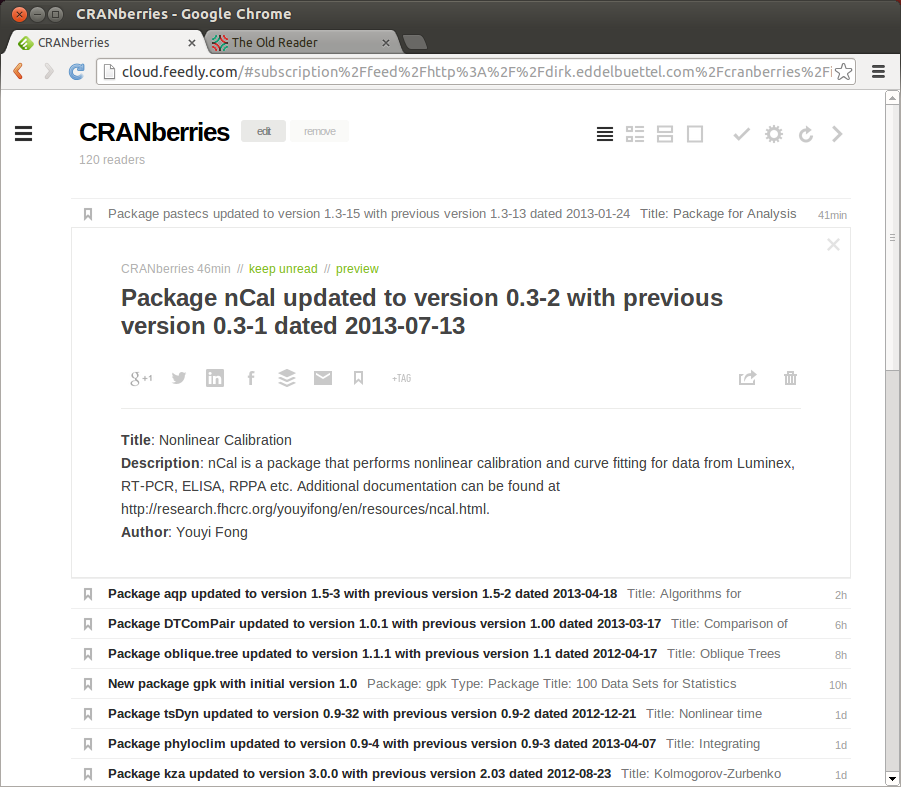
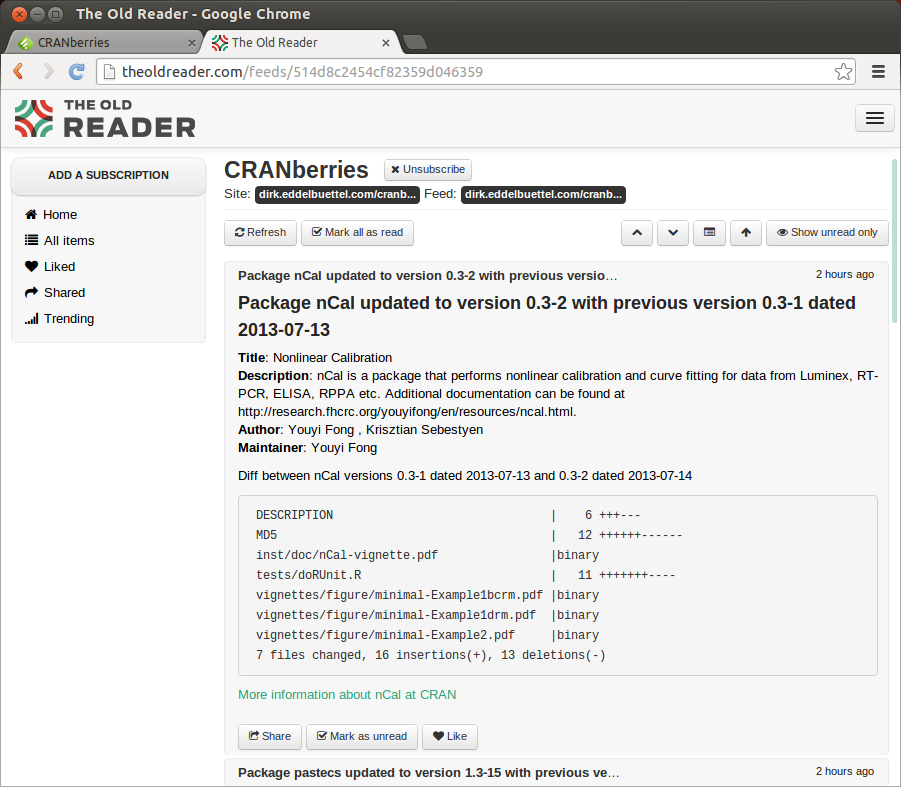
With the demise of Google Reader, many of us have scrambled to find alternatives which cover many/most of the features we were used to. For me, synchronised access from web and mobile counts quite high, and I want the (Android) mobile experience to be pretty pleasant too. So with that, and like many other folks, I had shifted over to Feedly. And before I carry on, let me say that Feedly actually does pretty well. They handled the onslaught of new users; they also listened and changed their UI a little to be more compact and Reader-alike And most importantly, it mostly just works. Until it doesn't. Around the time Feedly shifted folks to their own cloud-based backend, posts from my very own CRANberries aggregator of CRAN package changes for R started to show only truncated posts. See this screenshot from reading Feedly: Feedly truncates the CRANberries post and compare it with this one from TheOldReader: OldReader shows the full CRANberries post which contains the diffstat output, nicely marked up and all. Now, it so happens that I am the creator of the very RSS feed I am consuming here, and I wrote it so that I could read the very diffstat output that is now missing. And I know full well that neither the code, nor the hosting (on my own box), nor any other aspect changed. Before confirming this via TheOldReader, I looked at the RSS output, and I tried other frontend and apps --- and it became clear that the bug seems to be at the Feedly cloud storage level. And trying to be a good sport, I submitted a bug report / suggestion, but to no avail (apart from two other chiming in that they see this elsewhere too). Given that I am the coder behind the feed that is displayed in a truncated manner, I am aware that I am using a code stack that is stale (the original Blosxom static web generator) yet which has not posed another problem anywhere in the decade I used it. Nor does the CRANberries feed pose a problem when aggregated and viewed via the TheOldReader code path, or for that matter via Planet R which also carries (parts of) CRANberries. So for now, I have to either pivot out of the CRANberries RSS reading in Feedly and go directly to the webpage (fine, but cumbersome and in need of a working connection) or use a second subscription mechanism. I appreciate what the TheOldReader folks are doing---presumably with a minor fraction of the resources available to Feedly---and may hang with them for now. But it would be awfully nice if Feedly could sleep off its hangover and fix this. In which case I'd be much happier recommending its service.

Next.

Previous.