Search Results: "ag"

28 April 2021

Jonathan McDowell: DeskPi Pro update

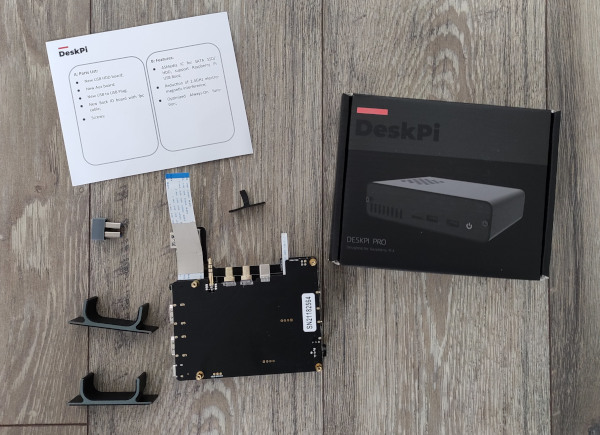
I wrote previously about my DeskPi Pro + 8GB Pi 4 setup. My main complaint at the time was the fact one of the forward facing USB ports broke off early on in my testing. For day to day use that hasn t been a problem, but it did mar the whole experience. Last week I received an unexpected email telling me The new updated PCB Board for your DeskPi order was shipped. . Apparently this was due to problems with identifying SSDs and WiFi/HDMI issues. I wasn t quite sure how much of the internals they d be replacing, so I was pleasantly surprised when it turned out to be most of them; including the PCB with the broken USB port on my device. DeskPi Pro replacement PCB They also provided a set of feet allowing for vertical mounting of the device, which was a nice touch. The USB/SATA bridge chip in use has changed; the original was:
usb 2-1: New USB device found, idVendor=152d, idProduct=0562, bcdDevice= 1.09
usb 2-1: New USB device strings: Mfr=1, Product=2, SerialNumber=3
usb 2-1: Product: RPi_SSD
usb 2-1: Manufacturer: 52Pi
usb 2-1: SerialNumber: DD5641988389F
and the new one is:
usb 2-1: New USB device found, idVendor=174c, idProduct=1153, bcdDevice= 0.01
usb 2-1: New USB device strings: Mfr=2, Product=3, SerialNumber=1
usb 2-1: Product: AS2115
usb 2-1: Manufacturer: ASMedia
usb 2-1: SerialNumber: 00000000000000000000
That s a move from a JMicron 6Gb/s bridge to an ASMedia 3Gb/s bridge. It seems there are compatibility issues with the JMicron that mean the downgrade is the preferred choice. I haven t retried the original SSD I wanted to use (that wasn t detected), but I did wonder if this might have resolved that issue too. Replacing the PCB was easier than the original install; everything was provided pre-assembled and I just had to unscrew the Pi4 and slot it out, then screw it into the new PCB assembly. Everything booted fine without the need for any configuration tweaks. Nice and dull. I ve tried plugging things into the new USB ports and they seem ok so far as well. However I also then ended up pulling in a new backports kernel from Debian (upgrading from 5.9 to 5.10) which resulted in a failure to boot. The kernel and initramfs were loaded fine, but no login prompt ever appeared. Some digging led to the discovery that a change in boot ordering meant USB was not being enabled. The solution is to add reset_raspberrypi to the /etc/initramfs-tools/modules file - that way this module is available in the initramfs, the appropriate pre-USB reset can happen and everything works just fine again. The other niggle with the new kernel was a regular set of errors in the kernel log:
mmc1: Timeout waiting for hardware cmd interrupt.
mmc1: sdhci: ============ SDHCI REGISTER DUMP ===========
and a set of registers afterwards, roughly every 10s or so. This seems to be fallout from an increase in the core clock due to the VC4 driver now being enabled, the fact I have no SD card in the device and a lack of working card-detect line for the MicroSD slot. There s a GitHub issue but I solved it by removing the sdhci_iproc for now - I m not using the wifi so loss of MMC isn t a problem. Credit to DeskPi for how they handled this. I didn t have to do anything and didn t even realise anything was happening until I got the email with my tracking number and a description of what they were sending out in it. Delivery took less than a week. This is a great example of how to handle a product issue - no effort required on the part of the customer.

Russell Coker: Links April 2021

Dr Justin Lehmiller s blog post comparing his official (academic style) and real biographies is interesting [1]. Also the rest of his blog is interesting too, he works at the Kinsey Institute so you know he s good. Media Matters has an interesting article on the spread of vaccine misinformation on Instagram [2]. John Goerzen wrote a long post summarising some of the many ways of having a decentralised Internet [3]. One problem he didn t address is how to choose between them, I could spend months of work to setup a fraction of those services. Erasmo Acosta wrote an interesting medium article Could Something as Pedestrian as the Mitochondria Unlock the Mystery of the Great Silence? [4]. I don t know enough about biology to determine how plausible this is. But it is a worry, I hope that humans will meet extra-terrestrial intelligences at some future time. Meredith Haggerty wrote an insightful Medium article about the love vs money aspects of romantic comedies [5]. Changes in viewer demographics would be one factor that makes lead actors in romantic movies significantly less wealthy in recent times. Informative article about ZIP compression and the history of compression in general [6]. Vice has an insightful article about one way of taking over SMS access of phones without affecting voice call or data access [7]. With this method the victom won t notice that they are having their sservice interfered with until it s way too late. They also explain the chain of problems in the US telecommunications industry that led to this. I wonder what s happening in this regard in other parts of the world. The clown code of ethics (8 Commandments) is interesting [8]. Sam Hartman wrote an insightful blog post about the problems with RMS and how to deal with him [9]. Also Sam Whitton has an interesting take on this [10]. Another insightful post is by Selam G about RMS long history of bad behavior and the way universities are run [11]. Cory Doctorow wrote an insightful article for Locus about free markets with a focus on DRM on audio books [12]. We need legislative changes to fix this!

Junichi Uekawa: Swapping caps and control in X11.

Swapping caps and control in X11. The configuration is at /etc/default/keyboard, and both virtual console and X11 use that configuration in Debian. For systemd users, systemd-localed.service can be used to configure using localectl(1) command, and Debian systemd has been patched to update /etc/default/keyboard (managed by keyboard-configuration package). Not sure where I find a documentation for this. systemd for Debian is patched with debian/patches/debian/Use-Debian-specific-config-files.patch to change /etc/X11/xorg.conf.d/00-keyboard.conf to /etc/default/keyboard.

Russ Allbery: Review: Beyond Shame

Review: Beyond Shame, by Kit Rocha
Series: Beyond #1
Publisher: Kit Rocha
Copyright: December 2013
ASIN: B00GIA4GN8
Format: Kindle
Pages: 270
I read this book as part of the Beyond Series Bundle (Books 1-3), which is what the sidebar information is for. Noelle is a child of Eden, the rich and technologically powerful city of a post-apocalyptic world. As the daughter of a councilman, she had everything she wanted except the opportunity to feel. Eden's religious elite embrace a doctrine of strict Puritanism: Even hugging one's children was frowned upon, let alone anything related to sex. Noelle was too rebellious to settle for that, which is why this book opens with her banished from Eden, ejected into Sector Four. The sectors are the city slums, full of gangs and degenerates and violence, only a slight step up from the horrific farming communes. Luckily for her, she literally stumbles into one of the lieutenants of the O'Kane gang, who are just as violent as their reputations but who have surprising sympathy for a helpless city girl. My shorthand distinction between romance and erotica is that romance mixes some sex into the plot and erotica mixes some plot into the sex. Beyond Shame is erotica, specifically BDSM erotica. The forbidden sensations that Noelle got kicked out of Eden for pursuing run strongly towards humiliation, which is tangled up in the shame she was taught to feel about anything sexual. There is a bit of a plot surrounding the O'Kanes who take her in, their leader, some political skulduggery that eventually involves people she knows, and some inter-sector gang warfare, but it's quite forgettable (and indeed I've already forgotten most of it). The point of the story is Noelle navigating a relationship with Jasper (among others) that involves a lot of very graphic sex. I was of two minds about reviewing this. Erotica is tricky to review, since to an extent it's not trying to do what most books are doing. The point is less to tell a coherent story (although that can be a bonus) than it is to turn the reader on, and what turns the reader on is absurdly personal and unpredictable. Erotica is arguably more usefully marked with story codes (which in this case would be something like MF, MMFF, FF, Mdom, Fdom, bd, ds, rom, cons, exhib, humil, tattoos) so that the reader has an idea whether the scenarios in the story are the sort of thing they find hot. This is particularly true of BDSM erotica, since the point is arousal from situations that wouldn't work or might be downright horrifying in a different sort of book. Often the forbidden or taboo nature of the scene is why it's erotic. For example, in another genre I would complain about the exaggerated and quite sexist gender roles, where all the men are hulking cage fighters who want to control the women, but in male-dominant BDSM erotica that's literally the point. As you can tell, I wrote a review anyway, primarily because of how I came to read this book. Kit Rocha (which is a pseudonym for the writing team of Donna Herren and Bree Bridges) recently published Deal with the Devil, a book about mercenary librarians in a post-apocalyptic future. Like every right-thinking person, I immediately wanted to read a book about mercenary librarians, but discovered that it was set in an existing universe. I hate not starting at the beginning of things, so even though there was probably no need to read the earlier books first, I figured out Beyond Shame was the first in this universe and the bundle of the first three books was only $2. If any of you are immediately hooked by mercenary librarians but are back-story completionists, now you know what you'll be getting into. That said, there are a few notable things about this book other than it has a lot of sex. The pivot of the romantic relationship was more interesting and subtle than most erotica. Noelle desperately wants a man to do all sorts of forbidden things to her, but she starts the book unable to explain or analyze why she wants what she wants, and both Jasper and the story are uncomfortable with that and unwilling to leave it alone. Noelle builds up a more coherent theory of herself over the course of the book, and while it's one that's obviously designed to enable lots of erotic scenes, it's not a bad bit of character development. Even better is Lex, the partner (sort of) of the leader of the O'Kane gang and by far the best character in the book. She takes Noelle under her wing from the start, and while that relationship is sexualized like nearly everything in this book, it also turns into an interesting female friendship that I would have also enjoyed in a different genre. I liked Lex a lot, and the fact she's the protagonist of the next book might keep me reading. Beyond Shame also has a lot more female gaze descriptions of the men than is often the case in male-dominant BDSM. The eye candy is fairly evenly distributed, although the gender roles are very much not. It even passes the Bechdel test, although it is still erotica and nearly all the conversations end up being about sex partners or sex eventually. I was less fond of the fact that the men are all dangerous and violent and the O'Kane leader frequently acts like a controlling, abusive psychopath. A lot of that was probably the BDSM setup, but it was not my thing. Be warned that this is the sort of book in which one of the (arguably) good guys tortures someone to death (albeit off camera). Recommendations are next to impossible for erotica, so I won't try to give one. If you want to read the mercenary librarian novel and are dubious about this one, it sounds like (although I can't confirm) that it's a bit more on the romance end of things and involves a lot fewer group orgies. Having read this book, I suspect it was entirely unnecessary to have done so for back-story. If you are looking for male-dominant BDSM, Beyond Shame is competently written, has a more thoughtful story than most, and has a female friendship that I fully enjoyed, which may raise it above the pack. Rating: 6 out of 10

26 April 2021

Steve Kemp: Writing a text-based adventure game for CP/M

In my previous post I wrote about how I'd been running CP/M on a Z80-based single-board computer. I've been slowly working my way through a bunch of text-based adventure games: Along the way I remembered how much fun I used to have doing this in my early teens, and decided to write my own text-based adventure. Since I'm not a masochist I figured I'd write something with only three or four locations, and solicited facebook for ideas. Shortly afterwards a "plot" was created and I started work. I figured that the very last thing I wanted to be doing was to be parsing text-input with Z80 assembly language, so I hacked up a simple adventure game in C. I figured if I could get the design right that would ease the eventual port to assembly. I had the realization pretty early that using a table-driven approach would be the best way - using structures to contain the name, description, and function-pointers appropriate to each object for example. In my C implementation I have things that look like this:
 name: "generator",
 desc: "A small generator.",
 use: use_generator,
 use_carried: use_generator_carried,
 get_fn: get_generator,
 drop_fn: drop_generator ,
A bit noisy, but simple enough. If an object cannot be picked up, or dropped, the corresponding entries are blank:
 name: "desk",
 desc: "",
 edesc: "The desk looks solid, but old." ,
Here we see something that is special, there's no description so the item isn't displayed when you enter a room, or LOOK. Instead the edesc (extended description) is available when you type EXAMINE DESK. Anyway over a couple of days I hacked up the C-game, then I started work porting it to Z80 assembly. The implementation changed, the easter-eggs were different, but on the whole the two things are the same. Certainly 99% of the text was recycled across the two implementations. Anyway in the unlikely event you've got a craving for a text-based adventure game I present to you:

Vishal Gupta: Ramblings // On Sikkim and Backpacking

What I loved the most about Sikkim can t be captured on cameras. It can t be taped since it would be intrusive and it can t be replicated because it s unique and impromptu. It could be described, as I attempt to, but more importantly, it s something that you simply have to experience to know. Now I first heard about this from a friend who claimed he d been offered free rides and Tropicanas by locals after finishing the Ladakh Marathon. And then I found Ronnie s song, whose chorus goes : Dil hai pahadi, thoda anadi. Par duniya ke maya mein phasta nahi (My heart belongs to the mountains. Although a little childish, it doesn t get hindered by materialism). While the song refers his life in Manali, I think this holds true for most Himalayan states. Maybe it s the pleasant weather, the proximity to nature, the sense of safety from Indian Army being round the corner, independence from material pleasures that aren t available in remote areas or the absence of the pollution, commercialisation, & cutthroat-ness of cities, I don t know, there s just something that makes people in the mountains a lot kinder, more generous, more open and just more alive. Sikkimese people, are honestly some of the nicest people I ve ever met. The blend of Lepchas, Bhutias and the humility and the truthfulness Buddhism ingrains in its disciples is one that ll make you fall in love with Sikkim (assuming the views, the snow, the fab weather and food, leave you pining for more). As a product of Indian parenting, I ve always been taught to be wary of the unknown and to stick to the safer, more-travelled path but to be honest, I enjoy bonding with strangers. To me, each person is a storybook waiting to be flipped open with the right questions and the further I get from home, the wilder the stories get. Besides there s something oddly magical about two arbitrary curvilinear lines briefly running parallel until they diverge to move on to their respective paths. And I think our society has been so busy drawing lines and spreading hate that we forget that in the end, we re all just lines on the universe s infinite canvas. So the next time you travel, and you re in a taxi, a hostel, a bar, a supermarket, or on a long walk to a monastery (that you re secretly wishing is open despite a lockdown), strike up a conversation with a stranger. Small-talk can go a long way.
Header icon made by Freepik from www.flaticon.com

25 April 2021

Junichi Uekawa: Got a new machine Lenovo ThinkCenter M75s gen2, and installed Debian on it.

Got a new machine Lenovo ThinkCenter M75s gen2, and installed Debian on it. I wanted to try out the ryzen CPU. I haven't used a physical x86-64 Debian desktop machine since I threw away my Athlon 64 machine (dx5150), so that's like 15 years? Since then my main devices were macbooks and virtual machines (on GCE and Sakura) and raspberry pi. I got buster installed just fine. Finding the right keystrokes after boot was challenging because the graphical UI doesn't say anything. For BIOS set up to disable secure boot (F1 to enter set up: I wanted to play with kernel) and finding the keystroke to choose the boot disk (F10 to enter the dialog; I needed to choose the one labeled USB CD drive although I put in a USB SD card reader with installer image). The installation went fine for console, but getting X up was tricky, the support for the graphics (Renoir) part of the chip was added in kernel 5.5. Bullseye was 4.19 and I wasn't too comfortable with just updating the kernel. I ended up going for dist-upgrade to Bullseye. With Bullseye default kernel 5.10, X started without problems. So far I only tried out Emacs.

Dominique Dumont: An improved GUI for cme and Config::Model

I ve finally found the time to improve the GUI of my pet project: cme (aka Config::Model). Several years ago, I stumbled on a usability problem on the GUI. Some configuration (like OpenSsh or Systemd) feature a lot of configuration parameters. Which means that the GUI displays all these parameters, so finding a specfic parameter might be challenging:
To workaround this problem, I ve added a Filter widget in 2018 which did more or less the job, but it suffered from several bugs which made its behavior confusing. This is now fixed. The Filter widget is now working in a more consistent way. In the example below, I ve typed IdentityFile (1) in the Filter widget to show the identityFile used for various hosts (2):
Which is quite good, but some hosts use the default identity file so no value show up in the GUI. You can then click on hide empty value checkbox to show only the hosts that use a specific identity file:
I hope that this new behavior of the Filter box will make this project more useful. The improved GUI was released with Config::Model::TkUI 1.374. This new version is available on CPAN and on Debian/experimental). It will be released on Debian/unstable once the next Debian version is out. All the best

Russell Coker: Scanning with a MFC-9120CN on Bullseye

I previously wrote about getting a Brother MFC-9120CN multifunction printer/scanner to print on Linux [1]. I had also got it scanning which I didn t blog about.
found USB scanner (vendor=0x04f9, product=0x021d) at libusb:003:002
I recently upgraded that Linux system to Debian/Testing (which will soon be released as Debian/Bullseye) and scanning broke. The command sane-find-scanner would find the USB connected scanner (with the above output), but scanimage -L didn t. It turned out that I had to edit /etc/sane.d/dll.d/hplip which had a single uncommented line of hpaio and replace that with brother3 to make SANE load the driver /usr/lib64/sane/libsane-brother3.so from the brscan3 package (which Brother provided from their web site years ago). I have the following script to do the scanning (which can run as non-root):
#!/bin/bash
set -e
if [ "$1" == "" ]; then
  echo "specify output filename"
  exit 1
fi
TMP=$(mktemp)
scanimage > $TMP
convert $TMP $1
rm $TMP
Final Note This blog post doesn t describe everything that needs to be done to setup a scanner, I already had part of it setup from 10 years ago. But for anyone who finds this after having trouble, /etc/sane.d/dll.d is one place you should look for important configuration (especially if sane-find-scanner works and scanimage -L fails). Also the Brother drivers are handy to have although I apparently had it working in the past with the hpaio driver from HP (the Brother device emulates a HP device).

Russ Allbery: Review: Learning React

Review: Learning React, by Alex Banks & Eve Porcello
Publisher: O'Reilly
Copyright: June 2020
ISBN: 1-4920-5172-1
Format: Trade paperback
Pages: 287
My first JavaScript project was a React frontend to a REST service. As part of that project, I read two books: JavaScript: The Definitive Guide to learn the language foundation and this book to learn the framework on top of it. This was an unintentional experiment in the ways programming books can approach the topic. I commented in my review of JavaScript: the Definitive Guide that it takes the reference manual approach to the language. Learning React is the exact opposite. It's goal-driven, example-heavy, and has a problem and solution structure. The authors present a sample application, describe some desired new feature or deficiency in it, and then introduce the specific React technique that solves that problem. There is some rewriting of previous examples using more sophisticated techniques, but most chapters introduce new toy applications along with new parts of the React framework. The best part of this book is its narrative momentum, so I think the authors were successful at their primary goal. The first eight chapters of the book (more on the rest of the book in a moment) feel like a whirlwind tour where one concept flows naturally into the next and one's questions while reading about one technique are often answered in the next section. I thought the authors tried too hard in places and overdid the enthusiasm, but it's very readable in a way that I think may appeal to people who normally find programming books dry. Learning React is also firm and definitive about the correct way to use React, which may appeal to readers who only want to learn the preferred way of using the framework. (For example, React class components are mentioned briefly, mostly to tell the reader not to use them, and the rest of the book only uses functional components.) I had two major problems with this book, however. The first is that this breezy, narrative style turns out to be awful when one tries to use it as a reference. I read through most of this book with both enjoyment and curiosity, sat down to write a React component, and immediately struggled to locate the information I needed. Everything felt logically connected when I was focusing on the problems the authors introduced, but as soon as I started from my own problem, the structure of the book fell apart. I had to page through chapters to locate some nugget buried in the text, or re-read sections of the book to piece together which motivating problem my code was most similar to. It was a frustrating experience. This may be a matter of learning style, since this is why I prefer programming books with a reference structure. But be warned that I can't recommend this book as a reference while you're programming, nor does it prepare you to use the official React documentation as a reference. The second problem is less explicable and less defensible. I don't know what happened with O'Reilly's copy-editing for this book, but the code snippets are a train wreck. The Amazon reviews are full of people complaining about typos, syntax errors, omitted code, and glaring logical flaws, and they are entirely correct. It's so bad that I was left wondering if a very early, untested draft of the examples was somehow substituted into the book at the last minute by mistake. I'm not the sort of person who normally types code in from a book, so I don't care about a few typos or obvious misprints as long as the general shape is correct. The general shape was not correct. In a few places, the code is so completely wrong and incomplete that even combined with the surrounding text I was unable to figure out what it was supposed to be. It's possible this is fixed in a later printing (I read the June 2020 printing of the second edition), but otherwise beware. The authors do include a link to a GitHub repository of the code samples, which are significantly different than what's printed in the book, but that repository is incomplete; many of the later chapter examples are only links to JavaScript web sandboxes, which bodes poorly for the longevity of the example code. And then there's chapter nine of this book, which I found entirely baffling. This is a direct quote from the start of the chapter:
This is the least important chapter in this book. At least, that's what we've been told by the React team. They didn't specifically say, "this is the least important chapter, don't write it." They've only issued a series of tweets warning educators and evangelists that much of their work in this area will very soon be outdated. All of this will change.
This chapter is on suspense and error boundaries, with a brief mention of Fiber. I have no idea what I'm supposed to do with this material as a reader who is new to React (and thus presumably the target audience). Should I use this feature? When? Why is this material in the book at all when it's so laden with weird stream-of-consciousness disclaimers? It's a thoroughly odd editorial choice. The testing chapter was similarly disappointing in that it didn't answer any of my concrete questions about testing. My instinct with testing UIs is to break out Selenium and do integration testing with its backend, but the authors are huge fans of unit testing of React applications. Great, I thought, this should be interesting; unit testing seems like a poor fit for UI code because of how artificial the test construction is, but maybe I'm missing some subtlety. Convince me! And then the authors... didn't even attempt to convince me. They just asserted unit testing is great and explained how to write trivial unit tests that serve no useful purpose in a real application. End of chapter. Sigh. I'm not sure what to say about this book. I feel like it has so many serious problems that I should warn everyone away from it, and yet the narrative introduction to React was truly fun to read and got me excited about writing React code. Even though the book largely fell apart as a reference, I still managed to write a working application using it as my primary reference, so it's not all bad. If you like the problem and solution style and want a highly conversational and informal tone (that errs on the side of weird breeziness), this may still be the book for you. Just be aware that the code examples are a trash fire, so if you learn from examples, you're going to have to chase them down via the GitHub repository and hope that they still exist (or get a later edition of the book where this problem has hopefully been corrected). Rating: 6 out of 10

Antoine Beaupr : Lost article ideas

I wrote for LWN for about two years. During that time, I wrote (what seems to me an impressive) 34 articles, but I always had a pile of ideas in the back of my mind. Those are ideas, notes, and scribbles lying around. Some were just completely abandoned because they didn't seem a good fit for LWN. Concretely, I stored those in branches in a git repository, and used the branch name (and, naively, the last commit log) as indicators of the topic. This was the state of affairs when I left:
remotes/private/attic/novena                    822ca2bb add letter i sent to novena, never published
remotes/private/attic/secureboot                de09d82b quick review, add note and graph
remotes/private/attic/wireguard                 5c5340d1 wireguard review, tutorial and comparison with alternatives
remotes/private/backlog/dat                     914c5edf Merge branch 'master' into backlog/dat
remotes/private/backlog/packet                  9b2c6d1a ham radio packet innovations and primer
remotes/private/backlog/performance-tweaks      dcf02676 config notes for http2
remotes/private/backlog/serverless              9fce6484 postponed until kubecon europe
remotes/private/fin/cost-of-hosting             00d8e499 cost-of-hosting article online
remotes/private/fin/kubecon                     f4fd7df2 remove published or spun off articles
remotes/private/fin/kubecon-overview            21fae984 publish kubecon overview article
remotes/private/fin/kubecon2018                 1edc5ec8 add series
remotes/private/fin/netconf                     3f4b7ece publish the netconf articles
remotes/private/fin/netdev                      6ee66559 publish articles from netdev 2.2
remotes/private/fin/pgp-offline                 f841deed pgp offline branch ready for publication
remotes/private/fin/primes                      c7e5b912 publish the ROCA paper
remotes/private/fin/runtimes                    4bee1d70 prepare publication of runtimes articles
remotes/private/fin/token-benchmarks            5a363992 regenerate timestamp automatically
remotes/private/ideas/astropy                   95d53152 astropy or python in astronomy
remotes/private/ideas/avaneya                   20a6d149 crowdfunded blade-runner-themed GPLv3 simcity-like simulator
remotes/private/ideas/backups-benchmarks        fe2f1f13 review of backup software through performance and features
remotes/private/ideas/cumin                     7bed3945 review of the cumin automation tool from WM foundation
remotes/private/ideas/future-of-distros         d086ca0d modern packaging problems and complex apps
remotes/private/ideas/on-dying                  a92ad23f another dying thing
remotes/private/ideas/openpgp-discovery         8f2782f0 openpgp discovery mechanisms (WKD, etc), thanks to jonas meurer
remotes/private/ideas/password-bench            451602c0 bruteforce estimates for various password patterns compared with RSA key sizes
remotes/private/ideas/prometheus-openmetrics    2568dbd6 openmetrics standardizing prom metrics enpoints
remotes/private/ideas/telling-time              f3c24a53 another way of telling time
remotes/private/ideas/wallabako                 4f44c5da talk about wallabako, read-it-later + kobo hacking
remotes/private/stalled/bench-bench-bench       8cef0504 benchmarking http benchmarking tools
remotes/private/stalled/debian-survey-democracy 909bdc98 free software surveys and debian democracy, volunteer vs paid work
Wow, what a mess! Let's see if I can make sense of this:

Attic Those are articles that I thought about, then finally rejected, either because it didn't seem worth it, or my editors rejected it, or I just moved on:
  • novena: the project is ooold now, didn't seem to fit a LWN article. it was basically "how can i build my novena now" and "you guys rock!" it seems like the MNT Reform is the brain child of the Novena now, and I dare say it's even cooler!
  • secureboot: my LWN editors were critical of my approach, and probably rightly so - it's a really complex subject and I was probably out of my depth... it's also out of date now, we did manage secureboot in Debian
  • wireguard: LWN ended up writing extensive coverage, and I was biased against Donenfeld because of conflicts in a previous project

Backlog Those were articles I was planning to write about next.
  • dat: I already had written Sharing and archiving data sets with Dat, but it seems I had more to say... mostly performance issues, beaker, no streaming, limited adoption... to be investigated, I guess?
  • packet: a primer on data communications over ham radio, and the cool new tech that has emerged in the free software world. those are mainly notes about Pat, Direwolf, APRS and so on... just never got around to making sense of it or really using the tech...
  • performance-tweaks: "optimizing websites at the age of http2", the unwritten story of the optimization of this website with HTTP/2 and friends
  • serverless: god. one of the leftover topics at Kubecon, my notes on this were thin, and the actual subject, possibly even thinner... the only lie worse than the cloud is that there's no server at all! concretely, that's a pile of notes about Kubecon which I wanted to sort through. Probably belongs in the attic now.

Fin Those are finished articles, they were published on my website and LWN, but the branches were kept because previous drafts had private notes that should not be published.

Ideas A lot of those branches were actually just an empty commit, with the commitlog being the "pitch", more or less. I'd send that list to my editors, sometimes with a few more links (basically the above), and they would nudge me one way or the other. Sometimes they would actively discourage me to write about something, and I would do it anyways, send them a draft, and they would patiently make me rewrite it until it was a decent article. This was especially hard with the terminal emulator series, which took forever to write and even got my editors upset when they realized I had never installed Fedora (I ended up installing it, and I was proven wrong!)

Stalled Oh, and then there's those: those are either "ideas" or "backlog" that got so far behind that I just moved them out of the way because I was tired of seeing them in my list.
  • stalled/bench-bench-bench benchmarking http benchmarking tools, a horrible mess of links, copy-paste from terminals, and ideas about benchmarking... some of this trickled out into this benchmarking guide at Tor, but not much more than the list of tools
  • stalled/debian-survey-democracy: "free software surveys and Debian democracy, volunteer vs paid work"... A long standing concern of mine is that all Debian work is supposed to be volunteer, and paying explicitly for work inside Debian has traditionally been frowned upon, even leading to serious drama and dissent (remember Dunc-Tank)? back when I was writing for LWN, I was also doing paid work for Debian LTS. I also learned that a lot (most?) Debian Developers were actually being paid by their job to work on Debian. So I was confused by this apparent contradiction, especially given how the LTS project has been mostly accepted, while Dunc-Tank was not... See also this talk at Debconf 16. I had hopes that this study would show the "hunch" people have offered (that most DDs are paid to work on Debian) but it seems to show the reverse (only 36% of DDs, and 18% of all respondents paid). So I am still confused and worried about the sustainability of Debian.

What do you think? So that's all I got. As people might have noticed here, I have much less time to write these days, but if there's any subject in there I should pick, what is the one that you would find most interesting? Oh! and I should mention that you can write to LWN! If you think people should know more about some Linux thing, you can get paid to write for it! Pitch it to the editors, they won't bite. The worst that can happen is that they say "yes" and there goes two years of your life learning to write. Because no, you don't know how to write, no one does. You need an editor to write. That's why this article looks like crap and has a smiley. :)

24 April 2021

Gunnar Wolf: FLISOL Talking about Jitsi

Every year since 2005 there is a very good, big and interesting Latin American gathering of free-software-minded people. Of course, Latin America is a big, big, big place, and it s not like we are the most economically buoyant region to meet in something equiparable to FOSDEM. What we have is a distributed free software conference originally, a distributed Linux install-fest (which I never liked, I am against install-fests), but gradually it morphed into a proper conference: Festival Latinoamericano de Instalaci n de Software Libre (Latin American Free Software Installation Festival) This FLISOL was hosted by the always great and always interesting Rancho Electr nico, our favorite local hacklab, and has many other interesting talks. I like talking about projects where I am involved as a developer but this time I decided to do otherwise: I presented a talk on the Jitsi videoconferencing server. Why? Because of the relevance videoconferences have had over the last year. So, without further ado Here is a video I recorded locally from the talk I gave (MKV), as well as the slides (PDF).

Antoine Beaupr : A dead game clock

Time flies. Back in 2008, I wrote a game clock. Since then, what was first called "chess clock" was renamed to pychessclock and then Gameclock (2008). It shipped with Debian 6 squeeze (2011), 7 wheezy (4.0, 2013, with a new UI), 8 jessie (5.0, 2015, with a code cleanup, translation, go timers), 9 stretch (2017), and 10 buster (2019), phew! Eight years in Debian over 4 releases, not bad! But alas, Debian 11 bullseye (2021) won't ship with Gameclock because both Python 2 and GTK 2 were removed from Debian. I lack the time, interest, and energy to port this program. Even if I could find the time, everyone is on their phone nowadays. So finding the right toolkit would require some serious thinking about how to make a portable program that can run on Linux and Android. I care less about Mac, iOS, and Windows, but, interestingly, it feels it wouldn't be much harder to cover those as well if I hit both Linux and Android (which is already hard enough, paradoxically). (And before you ask, no, Java is not an option for me thanks. If I switch to anything else than Python, it would be Golang or Rust. And I did look at some toolkit options a few years ago, was excited by none.) So there you have it: that is how software dies, I guess. Alternatives include: PS: Monkeysign also suffered the same fate, for what that's worth. Alternatives include caff, GNOME Keysign, and pius. Note that this does not affect the larger Monkeysphere project, which will ship with Debian bullseye.

Joey Hess: here's your shot

The nurse releases my shoulder and drops the needle in a sharps bin, slaps on a smiley bandaid. "And we're done!" Her cheeryness seems genuine but a little strained. There was a long line. "You're all boosted, and here's your vaccine card." Waiting out the 15 minutes in observation, I look at the card.
Moderna COVID-19/22 vaccine booster
3/21/2025              lot #5829126
    NOT A VACCINE PASSPORT  
(Tear at perforated line.)
- - - - - - - - - - - - - - - - - -
Here's your shot at
$$ ONE HUNDRED MILLION $$
       Scratch
       and win
I bite my nails, when I'm not wearing this mask. So I scrub inneffectively at the grainy silver box. Not like the woman across from me, three kids in tow, who's zipping through her sheaf of scratchers. The message on mine becomes clear: 1 month free Amazon Prime Ah well.

23 April 2021

Thomas Goirand: Puppet and OS detection

As you may know, Puppet uses facter to get facts about the machine it is about to configure. That s fine, and a nice concept. One can later use variables in a puppet manifest to do different things depending on what facter tells. For example, the operating system name oh no! This thing is really stupid Here s the code one has to do to be compatible with puppet from version 3 up to 5: if $::lsbdistcodename == undef
# This works around differences between facter versions
if $facts['os']['lsb'] != undef
$distro_codename = $facts['os']['lsb']['distcodename']
else
$distro_codename = $facts['os']['distro']['codename']

else
$distro_codename = downcase($::lsbdistcodename)
Indeed, the global variable $::lsbdistcodename still existed up to Stretch (and is gone in Buster). The global $::facts wasn t an array before (but a hash), so in Jessie, it breaks with the error message facts is not a hash or array when accessing it with os . So, one need the full code above to make this work. It s ok to improve things. It is NOT OK to break os detection. To me it is a very bad practice from upstream Puppet authors. I m publishing this in the hope to avoid others to fall in the same trap as I did.

Matthew Garrett: An accidental bootsplash

Back in 2005 we had Debconf in Helsinki. Earlier in the year I'd ended up invited to Canonical's Ubuntu Down Under event in Sydney, and one of the things we'd tried to design was a reasonable graphical boot environment that could also display status messages. The design constraints were awkward - we wanted it to be entirely in userland (so we didn't need to carry kernel patches), and we didn't want to rely on vesafb[1] (because at the time we needed to reinitialise graphics hardware from userland on suspend/resume[2], and vesa was not super compatible with that). Nothing currently met our requirements, but by the time we'd got to Helsinki there was a general understanding that Paul Sladen was going to implement this.

The Helsinki Debconf ended being an extremely strange event, involving me having to explain to Mark Shuttleworth what the physics of a bomb exploding on a bus were, many people being traumatised by the whole sauna situation, and the whole unfortunate water balloon incident, but it also involved Sladen spending a bunch of time trying to produce an SVG of a London bus as a D-Bus logo and not really writing our hypothetical userland bootsplash program, so on the last night, fueled by Koff that we'd bought by just collecting all the discarded empty bottles and returning them for the deposits, I started writing one.

I knew that Debian was already using graphics mode for installation despite having a textual installer, because they needed to deal with more complex fonts than VGA could manage. Digging into the code, I found that it used BOGL - a graphics library that made use of the VGA framebuffer to draw things. VGA had a pre-allocated memory range for the framebuffer[3], which meant the firmware probably wouldn't map anything else there any hitting those addresses probably wouldn't break anything. This seemed safe.

A few hours later, I had some code that could use BOGL to print status messages to the screen of a machine booted with vga16fb. I woke up some time later, somehow found myself in an airport, and while sitting at the departure gate[4] I spent a while staring at VGA documentation and worked out which magical calls I needed to make to have it behave roughly like a linear framebuffer. Shortly before I got on my flight back to the UK, I had something that could also draw a graphical picture.

Usplash shipped shortly afterwards. We hit various issues - vga16fb produced a 640x480 mode, and some laptops were not inclined to do that without a BIOS call first. 640x400 worked basically everywhere, but meant we had to redraw the art because circles don't work the same way if you change the resolution. My brief "UBUNTU BETA" artwork that was me literally writing "UBUNTU BETA" on an HP TC1100 shortly after I'd got the Wacom screen working did not go down well, and thankfully we had better artwork before release.

But 16 colours is somewhat limiting. SVGALib offered a way to get more colours and better resolution in userland, retaining our prerequisites. Unfortunately it relied on VM86, which doesn't exist in 64-bit mode on Intel systems. I ended up hacking the X.org x86emu into a thunk library that exposed the same API as LRMI, so we could run it without needing VM86. Shockingly, it worked - we had support for 256 colour bootsplashes in any supported resolution on 64 bit systems as well as 32 bit ones.

But by now it was obvious that the future was having the kernel manage graphics support, both in terms of native programming and in supporting suspend/resume. Plymouth is much more fully featured than Usplash ever was, but relies on functionality that simply didn't exist when we started this adventure. There's certainly an argument that we'd have been better off making reasonable kernel modesetting support happen faster, but at this point I had literally no idea how to write decent kernel code and everyone should be happy I kept this to userland.

Anyway. The moral of all of this is that sometimes history works out such that you write some software that a huge number of people run without any idea of who you are, and also that this can happen without you having any fucking idea what you're doing.

Write code. Do crimes.

[1] vesafb relied on either the bootloader or the early stage kernel performing a VBE call to set a mode, and then just drawing directly into that framebuffer. When we were doing GPU reinitialisation in userland we couldn't guarantee that we'd run before the kernel tried to draw stuff into that framebuffer, and there was a risk that that was mapped to something dangerous if the GPU hadn't been reprogrammed into the same state. It turns out that having GPU modesetting in the kernel is a Good Thing.

[2] ACPI didn't guarantee that the firmware would reinitialise the graphics hardware, and as a result most machines didn't. At this point Linux didn't have native support for initialising most graphics hardware, so we fell back to doing it from userland. VBEtool was a terrible hack I wrote to try to re-execute the system's graphics hardware through a range of mechanisms, and it worked in a surprising number of cases.

[3] As long as you were willing to deal with 640x480 in 16 colours

[4] Helsinki-Vantaan had astonishingly comfortable seating for time

comment count unavailable comments

22 April 2021

Dirk Eddelbuettel: drat 0.2.0: Now with docs/

drat user A new release of drat arrived on CRAN today. This is the first release in a few months (with the last release in July of last year) and it (finally) makes the leap to supporting docs/ in the main branch as we are all so tired of the gh-pages branch. We also have new vignettes, new (and very shiny) documentation and refreshed vignettes! drat stands for drat R Archive Template, and helps with easy-to-create and easy-to-use repositories for R packages. Since its inception in early 2015 it has found reasonably widespread adoption among R users because repositories with marked releases is the better way to distribute code. See below for a few custom reference examples. Because for once it really is as your mother told you: Friends don t let friends install random git commit snapshots. Or as we may now add: stay away from semi-random universes snapshots too. Properly rolled-up releases it is. Just how CRAN shows us: a model that has demonstrated for two-plus decades how to do this. And you can too: drat is easy to use, documented by (now) six vignettes and just works. The NEWS file summarises the release as follows:

Changes in drat version 0.2.0 (2021-04-21)
  • A documentation website for the package was added at https://eddelbuettel.github.io/drat/ (Dirk)
  • The continuous integration was switched to using r-ci (Dirk)
  • The docs/ directory of the main repository branch can now be used instead of gh-pages branch (Dirk in #112)
  • A new repository https://github.com/drat-base/drat can now be used to fork an initial drat repository (Dirk)
  • A new vignette Drat Step-by-Step was added (Roman Hornung and Dirk in #117 fixing #115 and #113)
  • The test suite was refactored for docs/ use (Felix Ernst in #118)
  • The minimum R version is now R (>= 3.6) (Dirk fixing #119)
  • The vignettes were switched to minidown (Dirk fixing #116)
  • A new test file was added to ensure NEWS.Rd is always at the current release version.

Courtesy of my CRANberries, there is a comparison to the previous release. More detailed information is on the drat page. If you like this or other open-source work I do, you can now sponsor me at GitHub.

This post by Dirk Eddelbuettel originated on his Thinking inside the box blog. Please report excessive re-aggregation in third-party for-profit settings.

Russell Coker: HP ML350P Gen8

I m playing with a HP Proliant ML350P Gen8 server (part num 646676-011). For HP servers ML means tower (see the ProLiant Wikipedia page for more details [1]). For HP servers the generation indicates how old the server is, Gen8 was announced in 2012 and Gen10 seems to be the current generation. Debian Packages from HP
wget -O /usr/local/hpePublicKey2048_key1.pub https://downloads.linux.hpe.com/SDR/hpePublicKey2048_key1.pub
echo "# HP RAID" >> /etc/apt/sources.list
echo "deb [signed-by=/usr/local/hpePublicKey2048_key1.pub] http://downloads.linux.hpe.com/SDR/downloads/MCP/Debian/ buster/current non-free" >> /etc/apt/sources.list
The above commands will setup the APT repository for Debian/Buster. See the HP Downloads FAQ [2] for more information about their repositories. hponcfg This package contains the hponcfg program that configures ILO (the HP remote management system) from Linux. One noteworthy command is hponcfg -r to reset the ILO, something you should do before selling an old system. ssacli This package contains the ssacli program to configure storage arrays, here are some examples of how to use it:
# list controllers and show slot numbers
ssacli controller all show
# list arrays on controller identified by slot and give array IDs
ssacli controller slot=0 array all show
# show details of one array
ssacli controller slot=0 array A show
# show all disks on one controller
ssacli controller slot=0 physicaldrive all show
# show config of a controller, this gives RAID level etc
ssacli controller slot=0 show config
# delete array B (you can immediately pull the disks from it)
ssacli controller slot=0 array B delete
# create an array type RAID0 with specified drives, do this with one drive per array for BTRFS/ZFS
ssacli controller slot=0 create type=arrayr0 drives=1I:1:1
When a disk is used in JBOD mode just under 33MB will be used at the end of the disk for the RAID metadata. If you have existing disks with a DOS partition table you can put it in a HP array as a JBOD and it will work with all data intact (GPT partition table is more complicated). When all disks are removed from the server the cooling fans run at high speed, this would be annoying if you wanted to have a diskless workstation or server using only external storage. ssaducli This package contains the ssaducli diagnostic utility for storage arrays. The SSD wear gauge report doesn t work for the 2 SSDs I tested it on, maybe it only supports SAS SSDs not SATA SSDs. It doesn t seem to do anything that I need. storcli This package contains both 32bit and 64bit versions of the MegaRAID utility and deletes whichever one doesn t match the installation in the package postinst, so it fails debsums checks etc. The MegaRAID utility is for a different type of RAID controller to the Smart Storage Array (AKA SSA) that the other utilities work with. As an aside it seems that there are multiple types of MegaRAID controller, the management program from the storcli package doesn t work on a Dell server with MegaRAID. They should have made separate 32bit and 64bit versions of this package. Recommendations Here is HP page for downloading firmware updates (including security updates) [3], you have to login first and have a warranty. This is legal but poor service. Dell servers have comparable prices (on the second hand marker) and comparable features but give free firmware updates to everyone. Dell have overall lower quality of Debian packages for supporting utilities, but a wider range of support so generally Dell support seems better in every way. Dell and HP hardware seems of equal quality so overall I think it s best to buy Dell. Suggestions for HP Finding which of the signing keys to use is unreasonably difficult. You should get some HP employees to sign the HP keys used for repositories with their personal keys and then go to LUG meetings and get their personal keys well connected to the web of trust. Then upload the HP keys to the public key repositories. You should also use the same keys for signing all versions of the repositories. Having different keys for the different versions of Debian wastes people s time. Please provide firmware for all users, even if they buy systems second hand. It is in your best interests to have systems used long-term and have them run securely. It is not in your best interests to have older HP servers perform badly. Having all the fans run at maximum speed when power is turned on is a standard server feature. Some servers can throttle the fan when the BIOS is running, it would be nice if HP servers did that. Having ridiculously loud fans until just before GRUB starts is annoying.

Shirish Agarwal: The Great Train Robbery

I had a twitter fight few days back with a gentleman and the article is a result of that fight. Sadly, I do not know the name of the gentleman as he goes via a psuedo name and then again I ve not taken permission from him to quote him in either way. So I will just state the observations I was able to make from the conversations we had. As people who read this blog regularly would know, I am and have been against Railway Privatization which is happening in India. And will be sharing some of the case studies from other countries as to how it panned out for them.

UK Railways
How Privatization Fails : Railways
The Above video is by a gentleman called Shaun who basically shared that privatization as far as UK is concerned is nothing but monopolies and while there are complex reasons for the same, the design of the Railways is such that it will always be a monopoly structure. At the most what you can do is have several monopolies but that is all that can happen. The idea of competition just cannot happen. Even the idea that subsidies will be less or/and trains will run on time is far from fact. Both of these facts have been checked and found to be truthful by fullfact.org. It is and argued that UK is small and perhaps it doesn t have the right conditions. It is probably true but still we do deserve to have a glance at the UK railway map.
UK railway map with operatorsUK railway map with operators
The above map is copyrighted to Map Marketing where you could see it today . As can be seen above most companies had their own specified areas. Now if you had looked at the facts then you would have seen that UK fares have been higher. In fact, an oldish article from Metro (a UK publication) shares the same. In fact, UK nationalized its railways effectively as many large rail operators were running in red. Even Scotland is set to nationalised back in March 2022. Remember this is a country which hasn t seen inflation go upwards of 5% in nearly a decade. The only outlier was 2011 where they indeed breached the 5% mark. So from this, what we see is Private Gains and Private Gains Public Losses perhaps seem fit. But then maybe we didn t use the right example. Perhaps Japan would be better. They have bullet trains while UK is still thinking about it. (HS2).

Japanese Railway Below is the map of Japanese Railway
Railway map of Japan with private ownership courtesy Wikimedia commons
Japan started privatizing its railway in 1987 and to date it has not been fully privatized. And on top of it, amount as much as 24 trillion of the long-term JNR debt was shouldered by the government at the expense of taxpayers of Japan while also reducing almost 1/4th of it employees. To add to it, while some parts of Japanese Railways did make profits, many of them made profits by doing large-scale non-railway business mostly real estate of land adjacent to railway stations. In many cases, it seems this went all the way up to 60% of the revenue. The most profitable has been the Shinkansen though. And while it has been profitable, it has not been without safety scandals over the years, the biggest in recent years was the 2005 Amagasaki derailment. What was interesting to me was the Aftermath, while the Wikipedia page doesn t share much, I had read at the time and probably could be found how a lot of ordinary people stood up to the companies in a country where it is a known fact that most companies are owned by the Yakuza. And this is a country where people are loyal to their corporation or company no matter what. It is a strange culture to west and also here in India where people change jobs on drop of hat, although nowadays we have record unemployment. So perhaps Japan too does not meet our standard as it doesn t do competition with each other but each is a set monopoly in those regions. Also how much subsidy is there or not is not really transparent.

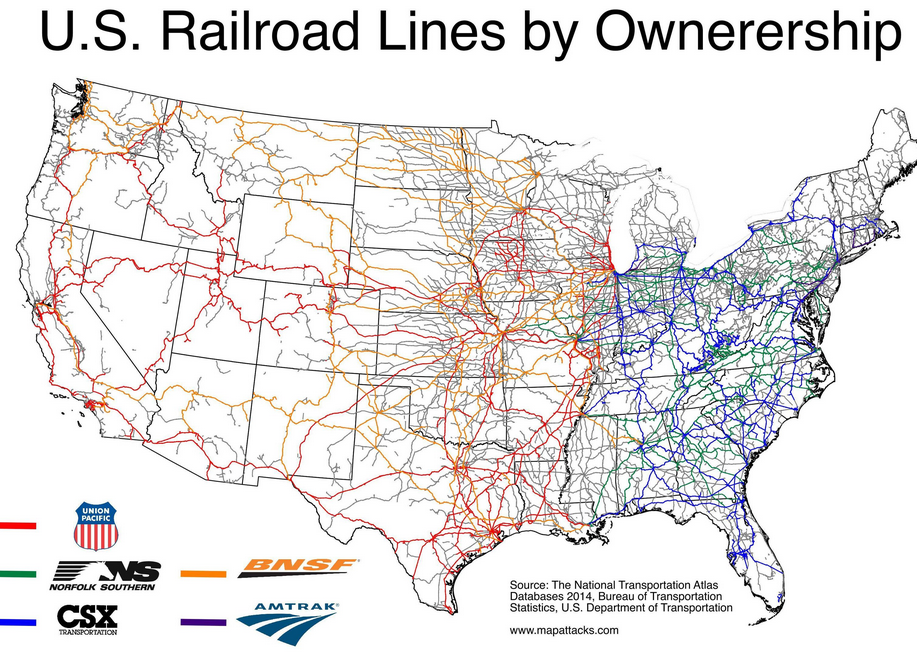
U.S. Railways Last, but not the least I share the U.S. Railway map. This is provided by A Mr. Tom Alison on reddit on channel maporn. As the thread itself is archived and I do not know the gentleman concerned, nor have taken permission for the map, hence sharing the compressed version


U.S. Railway lines with the different owners
Now the U.S. Railways is and has always been peculiar as unlike the above two the U.S. has always been more of a freight network. Probably, much of it has to do that in the 1960 s when oil was cheap, the U.S. made zillions of roadways and romanticized the road trip and has been doing it ever since. Also the creation of low-cost airlines definitely didn t help the railways to have more passenger services, in fact the opposite. There are and have been smaller services and attempts of privatization in both New Zealand and Australia and both have been failures. Please see papers in that regard. My simple point is this, as can be seen above, there have been various attempts at privatization of railways and most of them have been a mixed bag. The only one which comes close to what we think as good is Japanese but that also used a lot of public debt which we don t know what will happen on next. Also for higher-speed train services like a bullet train or whatever, you need to direct, no hair pen bends. In fact, a good talk on the topic is the TBD podcast which while it talks about hyperloop, the same questions is and would be asked if were to do in India. Another thing to be kept in mind is that the Japanese have been exceptional builders and this is because they have been forced to. They live in a seismically active zone which made Fukushima disaster a reality but at the same time, their buildings are earthquake-resistant. Standard Disclaimer The above is a simplified version of things. I could have added in financial accounts but that again has no set pattern. For e.g. some Railways use accrual, some use cash and some use hybrid. I could have also shared in either the guage or electrification but all have slightly different standards, although uniguage is something that all Railways aspire for and electrification is again something that all Railways want although in many cases it just isn t economically feasible.

Indian Railways Indian Railways itself recently made the move from Cash to Accrual couple of years back. In-between for a couple of years, it was hybrid. The sad part is and was you can now never measure against past performance in the old way because it is so different. Hence, whether the Railways will be making a loss or a profit, we would come to know only much later. Also, most accountants don t know the new system well, so it is gonna take more time, how much unknown. Sadly, what GOI did a few years back is merge the Railway budget into the Union Budget. Of course, the excuse they gave is too many pressures of new trains, while the truth is, by doing this, they decreased transparency about the whole thing. For e.g. for the last few years, the only state which had significant work being done is in U.P. (Uttar Pradesh) and a bit in Goa, although that is has been protested time and again. I being from the neighborly state of Maharashtra , and have been there several times. Now it does feels all like a dream, going to Goa :(.

Covid news Now before I jump on the news, I should share the movie Virus (2019) which was made by the talented Aashiq Abu. Even though, am not a Malayalee, I still have enjoyed many of his movies simply because he is a terrific director and Malayalam movies, at least most of them have English subtitles and lot of original content.. Interestingly, unlike the first couple of times when I saw it a couple of years back. The first time I saw it, I couldn t sleep a wink for a week. Even the next time, it was heavy. I had shared the movie with mum, and even she couldn t see it in one go. It is and was that powerful Now maybe because we are headlong in the pandemic, and the madness is all around us. There are two terms that helped me though understand a great deal of what is happening in the movie, the first term was altered sensorium which has been defined here. The other is saturation or to be more precise oxygen saturation . This term has also entered the Indian twitter lexicon quite a bit as India has started running out of oxygen. Just today Delhi High Court did an emergency hearing on the subject late at night. Although there is much to share about the mismanagement of the center, the best piece on the subject has been by Miss Priya Ramani. Yup, the same lady who has won against M.J. Akbar and this is when Mr. Akbar had 100 lawyers for this specific case. It would be interesting to see what happens ahead. There are however few things even she forgot in her piece, For e.g. reverse migration i.e. from urban to rural migration started again. Two articles from different entities sharing a similar outlook.Sadly, the right have no empathy or feeling for either the poor or the sick. Even the labor minister Santosh Gangwar s statement that around 1.04 crores were the only people who walked back home. While there is not much data, however some work/research has been done on migration to cites that the number could be easily 10 times as much. And this was in the lockdown of last year. This year, again the same issue has re-surfaced and migrants learning lessons started leaving cities. And I m ashamed to say I think they are doing the right thing. Most State Governments have not learned lessons nor have they done any work to earn the trust of migrants. This is true of almost all state Governments. Last year, just before the lockdown was announced, me and my friend spent almost 30k getting a cab all the way from Chennai to Pune, how much we paid for the cab, how much we bribed the various people just so we could cross the state borders to return home to our anxious families. Thankfully, unlike the migrants, we were better off although we did make a loss. I probably wouldn t be alive if I were in their situation as many didn t. That number is still in the air undocumented deaths  Vaccine issues Currently, though the issue has been the Vaccine and the pricing of the same. A good article to get a summation of the issues outlined has been shared on Economist. Another article that goes to the heart of the issue is at scroll. To buttress the argument, the SII chairman had shared this few weeks back
Adar Poonawala talking to Vishnu Som on Left, right center, 7th April 2021.
So, a licensee manufacturer wants to make super-profits during the pandemic. And now, as shared above they can very easily do it. Even the quotes given to nearby countries is smaller than the quotes given to Indian states

Prices of AstraZeneca among various states and countries.
The situation around beds, vaccines, oxygen, anything is so dire that people could go to any lengths to save their loved ones. Even if they know if a certain medicine doesn t work. For e.g. Remdesivir, 5 WHO trials have concluded that it doesn t increase mortality. Heck, even AIIMS chief said the same. But both doctors and relatives desperation to cling on hope has made Remdesivir as a black market drug with unoffical prices hovering anywhere between INR 14k/- to INR30k/- per vial. One of the executives of a top firm was also arrested in Gujarat. In Maharashtra, the opposition M.P. came to the rescue of the officials of Bruick pharms in Mumbai. Sadly, this strange affliction to the party in the center is also there in my extended family. At one end, they will heap praise on Mr. Modi, at the same time they can t get wait to get fast out of India. Many of them have settled in horrors of horror Dubai, as it is the best place to do business, get international schools for the young ones at decent prices, cheaper or maybe a tad more than what they paid in Delhi or elsewhere. Being an Agarwal or a Gupta makes it easier to compartmentalize both things. Ease of doing business, 5 days flat to get a business registered, up and running. And the paranoia is still there. They won t talk on the phone about him because they are afraid they may say something which comes back to bite them. As far as their decision to migrate, can t really blame them. If I were 20-25 yeas younger and my mum were in a better shape than she is, we probably would have migrated as well, although would have preferred Europe than anywhere else.

Internet Freedom and Aarogya Setu App.


Internet Freedom had shared the chilling effects of the Aarogya Setu App. This had also been shared by FSCI in the past, and recently had their handle being banned on Twitter. This was also apparent in a legal bail order which the high court judge gave. While I won t go into the merits and demerits of the bail order, it is astounding for the judge to say that the accused, even though he would be on bail install an app. so he can be surveilled. And this is a high court judge, such a sad state of affairs. We seem to be putting up new lows every day when it comes to judicial jurisprudence. One interesting aspect of the whole case was shared by Aishwarya Iyer. She shared a story that she and her team worked on quint which raises questions on the quality of the work done by Delhi Police. This is of course, up to Delhi Police to ascertain the truth of the matter because unless and until they are able to tie in the PMO s office in for a leak or POTUS s office it hardly seems possible. For e.g. the dates when two heads of state can meet each other would be decided by the secretaries of the two. Once the date is known, it would be shared with the press while at the same time some sort of security apparatus would kick in place. It is incumbent, especially on the host to take as much care as he can of the guest. We all remember that World War 1 (the war to end all wars) started due to the murder of Archduke Ferdinand.

As nobody wants that, the best way is to make sure that a political murder doesn t happen on your watch. Now while I won t comment on what it would be, it would be safe to assume that it would be z+ security along with higher readiness. Especially if it as somebody as important as POTUS. Now, it would be quite a reach for Delhi Police to connect the two dates. They either will have to get creative with the dates or some other way. Otherwise, with practically no knowledge in the public domain, they can t work in limbo. In either case, I do hope the case comes up for hearing soon and we see what the Delhi Police says and contends in the High Court about the same. At the very least, it would be irritating for them to talk of the dates unless they can contend some mass conspiracy which involves the PMO (and would bring into question the constant vetting done by the Intelligence dept. of all those who work in PMO). And this whole case is to kind of shelter to the Delhi riots which happened in which majorly the Muslims died but their deaths lay unaccounted till date

Conclusion In Conclusion, I would like to share a bit of humor because right now the atmosphere is humorless, both with authoritarian tendencies of the Central Govt. and the mass mismanagement of public health which they now have left to the state to do as they fit. The peice I am sharing is from arre, one of my goto sites whenever I feel low.

21 April 2021

Enrico Zini: Python output buffering

Here's a little toy program that displays a message like a split-flap display:
#!/usr/bin/python3
import sys
import time
def display(line: str):
    cur = '0' * len(line)
    while True:
        print(cur, end="\r")
        if cur == line:
            break
        time.sleep(0.09)
        cur = "".join(chr(min(ord(c) + 1, ord(oc))) for c, oc in zip(cur, line))
    print()
message = " ".join(sys.argv[1:])
display(message.upper())
This only works if the script's stdout is unbuffered. Pipe the output through cat, and you get a long wait, and then the final string, without the animation. What is happening is that since the output is not going to a terminal, optimizations kick in that buffer the output and send it in bigger chunks, to make processing bulk I/O more efficient. I haven't found a good introductory explanation of buffering in Python's documentation. The details seem to be scattered in the io module documentation and they mostly assume that one is already familiar with concepts like unbuffered, line-buffered or block-buffered. The libc documentation has a good quick introduction that one can read to get up to speed. Controlling buffering in Python In Python, one can force a buffer flush with the flush() method of the output file descriptor, like sys.stdout.flush(), to make sure pending buffered output gets sent. Python's print() function also supports flush=True as an optional argument:
    print(cur, end="\r", flush=True)
If one wants to change the default buffering for a file descriptor, since Python 3.7 there's a convenient reconfigure() method, which can reconfigure line buffering only:
sys.stdout.reconfigure(line_buffering=True)
Otherwise, the technique is to reassign sys.stdout to something that has the behaviour one wants (code from this StackOverflow thread):
import io
# Python 3, open as binary, then wrap in a TextIOWrapper with write-through.
sys.stdout = io.TextIOWrapper(open(sys.stdout.fileno(), 'wb', 0), write_through=True)
If one needs all this to implement a progressbar, one should make sure to have a look at the progressbar module first.

Next.

Previous.