Search Results: "xam"

27 December 2010

Michal Čihař: Automatic configuring of Gammu

I bear in my mind idea for automatically configuring Gammu for some time. It should not be that hard using udev, Bluez and other tools which we already have available on average Linux system. Today afternoon I've finally found some time to play with that and it's almost done. Well it's not fully automatic right now, it will just generate configuration file with possible choices, but at least some help. For now only udev and Bluez is supported, but I will add support for libusb soon as well. The new tool is called gammu-detect and looks at devices available in the system and outputs something, what can be used as configuration file (you can find example in the documentation). Once it will make reasonable guesses what user actually wants, it might get integrated into libGammu so that other applications like Wammu can benefit from it as well.

Filed under: Gammu 0 comments Flattr this!

25 December 2010

Dirk Eddelbuettel: Rcpp 0.9.0 announcement

The text below went out as a post to the r-packages list a few days ago, but I thought it would make sense to post it on the blog too. So with a little html markup... Summary Version 0.9.0 of the Rcpp package is now on CRAN and its mirrors. This release marks another step in the development of the package, and a few key points are highlighted below. More details are in the NEWS and ChangeLog files included in the package. Overview Rcpp is an R package and associated C++ library that facilitates integration of C++ code in R packages. The package features a complete set of C++ classes (Rcpp::IntegerVector, Rcpp:NumericVector, Rcpp::Function, Rcpp::Environment, ...) that makes it easier to manipulate R objects of matching types (integer vectors, functions, environments, etc ...). Rcpp takes advantage of C++ language features such as the explicit constructor / destructor lifecycle of objects to manage garbage collection automatically and transparently. We believe this is a major improvement over use of PROTECT / UNPROTECT. When an Rcpp object is created, it protects the underlying SEXP so that the garbage collector does not attempt to reclaim the memory. This protection is withdrawn when the object goes out of scope. Moreover, users generally do not need to manage memory directly (via calls to new / delete or malloc / free) as this is done by the Rcpp classes or the corresponding STL containers. A few key points about Rcpp:

Several key features were added during the 0.8.* cycles and are described below. Rcpp sugar Rcpp now provides syntactic sugar: vectorised expressions at the C++ level which are motivated by the corresponding R expressions. This covers operators (binary arithmetic, binary logical, unary), functions (producing single logical results, mathematical functions and d/p/q/r statistical functions). Examples comprises anything from ifelse() to pmin()/pmax() or A really simply example is a function
    SEXP foo( SEXP xx, SEXP yy) 
        NumericVector x(xx), y(yy) ;
        return ifelse( x < y, x*x, -(y*y) ) ;
     
which deploys the sugar 'ifelse' function modeled after the corresponding R function. Another simple example is
    double square( double x) 
        return x*x ;
     
    SEXP foo( SEXP xx ) 
        NumericVector x(xx) ;
        return sapply( x, square ) ;
     
where use the sugar function 'sapply' to sweep a simple C++ function which operates elementwise across the supplied vector. The Rcpp-sugar vignette describes sugar in more detail. Rcpp modules Rcpp modules are inspired by Boost.Python and make exposing C++ functions or classes to R even easier. A first illustration is provided by this simple C++ code snippet
    const char* hello( const std::string& who ) 
        std::string result( "hello " ) ;
        result += who ;
        return result.c_str() ;
     
    RCPP_MODULE(yada) 
        using namespace Rcpp ;
        function( "hello", &hello ) ;
     
which (after compiling and loading) we can access in R as
    yada <- Module( "yada" )
    yada$hello( "world" )
In a similar way, C++ classes can be exposed very easily. Rcpp modules are also described in more detail in their own vignette. Reference Classes R release 2.12.0 introduced Reference Classes. These are formal S4 classes with the corresponding dispatch method, but passed by reference and easy to use. Reference Classes can also be exposed to R by using Rcpp modules. Extension packackages The RcppArmadillo package permits use of the advanced C++ library 'Armadillo, a C++ linear algebra library aiming towards a good balance between speed and ease of use, providing integer, floating point and complex matrices and vectors with lapack / blas support via R. Armadillo uses templates for a delayed evaluation approach is employed (during compile time) to combine several operations into one and reduce (or eliminate) the need for temporaries. Armadillo is useful if C++ has been decided as the language of choice, rather than another language like Matlab or Octave, and aims to be as expressive as the former. Via Rcpp and RcppArmadillo, R users now have easy access to this functionality. Examples are provided in the RcppArmadillo package. The RcppGSL package permits easy use of the GNU Scientific Library (GSL), a collection of numerical routines for scientifc computing. It is particularly useful for C and C++ programs as it provides a standard C interface to a wide range of mathematical routines such as special functions, permutations, combinations, fast fourier transforms, eigensystems, random numbers, quadrature, random distributions, quasi-random sequences, Monte Carlo integration, N-tuples, differential equations, simulated annealing, numerical differentiation, interpolation, series acceleration, Chebyshev approximations, root-finding, discrete Hankel transforms physical constants, basis splines and wavelets. There are over 1000 functions in total with an extensive test suite. The RcppGSL package provides an easy-to-use interface between GSL data structures and R using concepts from Rcpp. The RcppGSL package also contains a vignette with more documentation. Legacy 'classic' API Packages still using code interfacing the initial 'classic' Rcpp API are encouraged to migrate to the new API. Should a code transition not be possible, backwards compatibility is provided by the RcppClassic package released alongside Rcpp 0.9.0. By including RcppClassic.h and building against the RcppClassic package and library, vintage code can remain operational using the classic API. The short vignette in the RcppClassic package has more details. Documentation The package contains a total of eight vignettes the first of which provides a short and succinct introduction to the Rcpp package along with several motivating examples. Links Support Questions about Rcpp should be directed to the Rcpp-devel mailing list https://lists.r-forge.r-project.org/cgi-bin/mailman/listinfo/rcpp-devel
Dirk Eddelbuettel, Romain Francois, Doug Bates and John Chambers
December 2010

Petter Reinholdtsen: The reply from Edgar Villanueva to Microsoft in Peru

A few days ago an article in the Norwegian Computerworld magazine about how version 2.0 of European Interoperability Framework has been successfully lobbied by the proprietary software industry to remove the focus on free software. Nothing very surprising there, given earlier reports on how Microsoft and others have stacked the committees in this work. But I find this very sad. The definition of an open standard from version 1 was very good, and something I believe should be used also in the future, alongside the definition from Digistan. Version 2 have removed the open standard definition from its content. Anyway, the news reminded me of the great reply sent by Dr. Edgar Villanueva, congressman in Peru at the time, to Microsoft as a reply to Microsofts attack on his proposal regarding the use of free software in the public sector in Peru. As the text was not available from a few of the URLs where it used to be available, I copy it here from my source to ensure it is available also in the future. Some background information about that story is available in an article from Linux Journal in 2002.
Lima, 8th of April, 2002
To: Se or JUAN ALBERTO GONZ LEZ
General Manager of Microsoft Per Dear Sir: First of all, I thank you for your letter of March 25, 2002 in which you state the official position of Microsoft relative to Bill Number 1609, Free Software in Public Administration, which is indubitably inspired by the desire for Peru to find a suitable place in the global technological context. In the same spirit, and convinced that we will find the best solutions through an exchange of clear and open ideas, I will take this opportunity to reply to the commentaries included in your letter. While acknowledging that opinions such as yours constitute a significant contribution, it would have been even more worthwhile for me if, rather than formulating objections of a general nature (which we will analyze in detail later) you had gathered solid arguments for the advantages that proprietary software could bring to the Peruvian State, and to its citizens in general, since this would have allowed a more enlightening exchange in respect of each of our positions. With the aim of creating an orderly debate, we will assume that what you call "open source software" is what the Bill defines as "free software", since there exists software for which the source code is distributed together with the program, but which does not fall within the definition established by the Bill; and that what you call "commercial software" is what the Bill defines as "proprietary" or "unfree", given that there exists free software which is sold in the market for a price like any other good or service. It is also necessary to make it clear that the aim of the Bill we are discussing is not directly related to the amount of direct savings that can by made by using free software in state institutions. That is in any case a marginal aggregate value, but in no way is it the chief focus of the Bill. The basic principles which inspire the Bill are linked to the basic guarantees of a state of law, such as:
  • Free access to public information by the citizen.
  • Permanence of public data.
  • Security of the State and citizens.
To guarantee the free access of citizens to public information, it is indispensable that the encoding of data is not tied to a single provider. The use of standard and open formats gives a guarantee of this free access, if necessary through the creation of compatible free software. To guarantee the permanence of public data, it is necessary that the usability and maintenance of the software does not depend on the goodwill of the suppliers, or on the monopoly conditions imposed by them. For this reason the State needs systems the development of which can be guaranteed due to the availability of the source code. To guarantee national security or the security of the State, it is indispensable to be able to rely on systems without elements which allow control from a distance or the undesired transmission of information to third parties. Systems with source code freely accessible to the public are required to allow their inspection by the State itself, by the citizens, and by a large number of independent experts throughout the world. Our proposal brings further security, since the knowledge of the source code will eliminate the growing number of programs with *spy code*. In the same way, our proposal strengthens the security of the citizens, both in their role as legitimate owners of information managed by the state, and in their role as consumers. In this second case, by allowing the growth of a widespread availability of free software not containing *spy code* able to put at risk privacy and individual freedoms. In this sense, the Bill is limited to establishing the conditions under which the state bodies will obtain software in the future, that is, in a way compatible with these basic principles. From reading the Bill it will be clear that once passed:
  • the law does not forbid the production of proprietary software
  • the law does not forbid the sale of proprietary software
  • the law does not specify which concrete software to use
  • the law does not dictate the supplier from whom software will be bought
  • the law does not limit the terms under which a software product can be licensed.
  • What the Bill does express clearly, is that, for software to be acceptable for the state it is not enough that it is technically capable of fulfilling a task, but that further the contractual conditions must satisfy a series of requirements regarding the license, without which the State cannot guarantee the citizen adequate processing of his data, watching over its integrity, confidentiality, and accessibility throughout time, as these are very critical aspects for its normal functioning. We agree, Mr. Gonzalez, that information and communication technology have a significant impact on the quality of life of the citizens (whether it be positive or negative). We surely also agree that the basic values I have pointed out above are fundamental in a democratic state like Peru. So we are very interested to know of any other way of guaranteeing these principles, other than through the use of free software in the terms defined by the Bill. As for the observations you have made, we will now go on to analyze them in detail: Firstly, you point out that: "1. The bill makes it compulsory for all public bodies to use only free software, that is to say open source software, which breaches the principles of equality before the law, that of non-discrimination and the right of free private enterprise, freedom of industry and of contract, protected by the constitution." This understanding is in error. The Bill in no way affects the rights you list; it limits itself entirely to establishing conditions for the use of software on the part of state institutions, without in any way meddling in private sector transactions. It is a well established principle that the State does not enjoy the wide spectrum of contractual freedom of the private sector, as it is limited in its actions precisely by the requirement for transparency of public acts; and in this sense, the preservation of the greater common interest must prevail when legislating on the matter. The Bill protects equality under the law, since no natural or legal person is excluded from the right of offering these goods to the State under the conditions defined in the Bill and without more limitations than those established by the Law of State Contracts and Purchasing (T.U.O. by Supreme Decree No. 012-2001-PCM). The Bill does not introduce any discrimination whatever, since it only establishes *how* the goods have to be provided (which is a state power) and not *who* has to provide them (which would effectively be discriminatory, if restrictions based on national origin, race religion, ideology, sexual preference etc. were imposed). On the contrary, the Bill is decidedly antidiscriminatory. This is so because by defining with no room for doubt the conditions for the provision of software, it prevents state bodies from using software which has a license including discriminatory conditions. It should be obvious from the preceding two paragraphs that the Bill does not harm free private enterprise, since the latter can always choose under what conditions it will produce software; some of these will be acceptable to the State, and others will not be since they contradict the guarantee of the basic principles listed above. This free initiative is of course compatible with the freedom of industry and freedom of contract (in the limited form in which the State can exercise the latter). Any private subject can produce software under the conditions which the State requires, or can refrain from doing so. Nobody is forced to adopt a model of production, but if they wish to provide software to the State, they must provide the mechanisms which guarantee the basic principles, and which are those described in the Bill. By way of an example: nothing in the text of the Bill would prevent your company offering the State bodies an office "suite", under the conditions defined in the Bill and setting the price that you consider satisfactory. If you did not, it would not be due to restrictions imposed by the law, but to business decisions relative to the method of commercializing your products, decisions with which the State is not involved. To continue; you note that:" 2. The bill, by making the use of open source software compulsory, would establish discriminatory and non competitive practices in the contracting and purchasing by public bodies..." This statement is just a reiteration of the previous one, and so the response can be found above. However, let us concern ourselves for a moment with your comment regarding "non-competitive ... practices." Of course, in defining any kind of purchase, the buyer sets conditions which relate to the proposed use of the good or service. From the start, this excludes certain manufacturers from the possibility of competing, but does not exclude them "a priori", but rather based on a series of principles determined by the autonomous will of the purchaser, and so the process takes place in conformance with the law. And in the Bill it is established that *no one* is excluded from competing as far as he guarantees the fulfillment of the basic principles. Furthermore, the Bill *stimulates* competition, since it tends to generate a supply of software with better conditions of usability, and to better existing work, in a model of continuous improvement. On the other hand, the central aspect of competivity is the chance to provide better choices to the consumer. Now, it is impossible to ignore the fact that marketing does not play a neutral role when the product is offered on the market (since accepting the opposite would lead one to suppose that firms' expenses in marketing lack any sense), and that therefore a significant expense under this heading can influence the decisions of the purchaser. This influence of marketing is in large measure reduced by the bill that we are backing, since the choice within the framework proposed is based on the *technical merits* of the product and not on the effort put into commercialization by the producer; in this sense, competitiveness is increased, since the smallest software producer can compete on equal terms with the most powerful corporations. It is necessary to stress that there is no position more anti-competitive than that of the big software producers, which frequently abuse their dominant position, since in innumerable cases they propose as a solution to problems raised by users: "update your software to the new version" (at the user's expense, naturally); furthermore, it is common to find arbitrary cessation of technical help for products, which, in the provider's judgment alone, are "old"; and so, to receive any kind of technical assistance, the user finds himself forced to migrate to new versions (with non-trivial costs, especially as changes in hardware platform are often involved). And as the whole infrastructure is based on proprietary data formats, the user stays "trapped" in the need to continue using products from the same supplier, or to make the huge effort to change to another environment (probably also proprietary). You add: "3. So, by compelling the State to favor a business model based entirely on open source, the bill would only discourage the local and international manufacturing companies, which are the ones which really undertake important expenditures, create a significant number of direct and indirect jobs, as well as contributing to the GNP, as opposed to a model of open source software which tends to have an ever weaker economic impact, since it mainly creates jobs in the service sector." I do not agree with your statement. Partly because of what you yourself point out in paragraph 6 of your letter, regarding the relative weight of services in the context of software use. This contradiction alone would invalidate your position. The service model, adopted by a large number of companies in the software industry, is much larger in economic terms, and with a tendency to increase, than the licensing of programs. On the other hand, the private sector of the economy has the widest possible freedom to choose the economic model which best suits its interests, even if this freedom of choice is often obscured subliminally by the disproportionate expenditure on marketing by the producers of proprietary software. In addition, a reading of your opinion would lead to the conclusion that the State market is crucial and essential for the proprietary software industry, to such a point that the choice made by the State in this bill would completely eliminate the market for these firms. If that is true, we can deduce that the State must be subsidizing the proprietary software industry. In the unlikely event that this were true, the State would have the right to apply the subsidies in the area it considered of greatest social value; it is undeniable, in this improbable hypothesis, that if the State decided to subsidize software, it would have to do so choosing the free over the proprietary, considering its social effect and the rational use of taxpayers money. In respect of the jobs generated by proprietary software in countries like ours, these mainly concern technical tasks of little aggregate value; at the local level, the technicians who provide support for proprietary software produced by transnational companies do not have the possibility of fixing bugs, not necessarily for lack of technical capability or of talent, but because they do not have access to the source code to fix it. With free software one creates more technically qualified employment and a framework of free competence where success is only tied to the ability to offer good technical support and quality of service, one stimulates the market, and one increases the shared fund of knowledge, opening up alternatives to generate services of greater total value and a higher quality level, to the benefit of all involved: producers, service organizations, and consumers. It is a common phenomenon in developing countries that local software industries obtain the majority of their takings in the service sector, or in the creation of "ad hoc" software. Therefore, any negative impact that the application of the Bill might have in this sector will be more than compensated by a growth in demand for services (as long as these are carried out to high quality standards). If the transnational software companies decide not to compete under these new rules of the game, it is likely that they will undergo some decrease in takings in terms of payment for licenses; however, considering that these firms continue to allege that much of the software used by the State has been illegally copied, one can see that the impact will not be very serious. Certainly, in any case their fortune will be determined by market laws, changes in which cannot be avoided; many firms traditionally associated with proprietary software have already set out on the road (supported by copious expense) of providing services associated with free software, which shows that the models are not mutually exclusive. With this bill the State is deciding that it needs to preserve certain fundamental values. And it is deciding this based on its sovereign power, without affecting any of the constitutional guarantees. If these values could be guaranteed without having to choose a particular economic model, the effects of the law would be even more beneficial. In any case, it should be clear that the State does not choose an economic model; if it happens that there only exists one economic model capable of providing software which provides the basic guarantee of these principles, this is because of historical circumstances, not because of an arbitrary choice of a given model. Your letter continues: "4. The bill imposes the use of open source software without considering the dangers that this can bring from the point of view of security, guarantee, and possible violation of the intellectual property rights of third parties." Alluding in an abstract way to "the dangers this can bring", without specifically mentioning a single one of these supposed dangers, shows at the least some lack of knowledge of the topic. So, allow me to enlighten you on these points. On security: National security has already been mentioned in general terms in the initial discussion of the basic principles of the bill. In more specific terms, relative to the security of the software itself, it is well known that all software (whether proprietary or free) contains errors or "bugs" (in programmers' slang). But it is also well known that the bugs in free software are fewer, and are fixed much more quickly, than in proprietary software. It is not in vain that numerous public bodies responsible for the IT security of state systems in developed countries require the use of free software for the same conditions of security and efficiency. What is impossible to prove is that proprietary software is more secure than free, without the public and open inspection of the scientific community and users in general. This demonstration is impossible because the model of proprietary software itself prevents this analysis, so that any guarantee of security is based only on promises of good intentions (biased, by any reckoning) made by the producer itself, or its contractors. It should be remembered that in many cases, the licensing conditions include Non-Disclosure clauses which prevent the user from publicly revealing security flaws found in the licensed proprietary product. In respect of the guarantee: As you know perfectly well, or could find out by reading the "End User License Agreement" of the products you license, in the great majority of cases the guarantees are limited to replacement of the storage medium in case of defects, but in no case is compensation given for direct or indirect damages, loss of profits, etc... If as a result of a security bug in one of your products, not fixed in time by yourselves, an attacker managed to compromise crucial State systems, what guarantees, reparations and compensation would your company make in accordance with your licensing conditions? The guarantees of proprietary software, inasmuch as programs are delivered AS IS'', that is, in the state in which they are, with no additional responsibility of the provider in respect of function, in no way differ from those normal with free software. On Intellectual Property: Questions of intellectual property fall outside the scope of this bill, since they are covered by specific other laws. The model of free software in no way implies ignorance of these laws, and in fact the great majority of free software is covered by copyright. In reality, the inclusion of this question in your observations shows your confusion in respect of the legal framework in which free software is developed. The inclusion of the intellectual property of others in works claimed as one's own is not a practice that has been noted in the free software community; whereas, unfortunately, it has been in the area of proprietary software. As an example, the condemnation by the Commercial Court of Nanterre, France, on 27th September 2001 of Microsoft Corp. to a penalty of 3 million francs in damages and interest, for violation of intellectual property (piracy, to use the unfortunate term that your firm commonly uses in its publicity). You go on to say that: "The bill uses the concept of open source software incorrectly, since it does not necessarily imply that the software is free or of zero cost, and so arrives at mistaken conclusions regarding State savings, with no cost-benefit analysis to validate its position." This observation is wrong; in principle, freedom and lack of cost are orthogonal concepts: there is software which is proprietary and charged for (for example, MS Office), software which is proprietary and free of charge (MS Internet Explorer), software which is free and charged for (Red Hat, SuSE etc GNU/Linux distributions), software which is free and not charged for (Apache, Open Office, Mozilla), and even software which can be licensed in a range of combinations (MySQL). Certainly free software is not necessarily free of charge. And the text of the bill does not state that it has to be so, as you will have noted after reading it. The definitions included in the Bill state clearly *what* should be considered free software, at no point referring to freedom from charges. Although the possibility of savings in payments for proprietary software licenses are mentioned, the foundations of the bill clearly refer to the fundamental guarantees to be preserved and to the stimulus to local technological development. Given that a democratic State must support these principles, it has no other choice than to use software with publicly available source code, and to exchange information only in standard formats. If the State does not use software with these characteristics, it will be weakening basic republican principles. Luckily, free software also implies lower total costs; however, even given the hypothesis (easily disproved) that it was more expensive than proprietary software, the simple existence of an effective free software tool for a particular IT function would oblige the State to use it; not by command of this Bill, but because of the basic principles we enumerated at the start, and which arise from the very essence of the lawful democratic State. You continue: "6. It is wrong to think that Open Source Software is free of charge. Research by the Gartner Group (an important investigator of the technological market recognized at world level) has shown that the cost of purchase of software (operating system and applications) is only 8% of the total cost which firms and institutions take on for a rational and truly beneficial use of the technology. The other 92% consists of: installation costs, enabling, support, maintenance, administration, and down-time." This argument repeats that already given in paragraph 5 and partly contradicts paragraph 3. For the sake of brevity we refer to the comments on those paragraphs. However, allow me to point out that your conclusion is logically false: even if according to Gartner Group the cost of software is on average only 8% of the total cost of use, this does not in any way deny the existence of software which is free of charge, that is, with a licensing cost of zero. In addition, in this paragraph you correctly point out that the service components and losses due to down-time make up the largest part of the total cost of software use, which, as you will note, contradicts your statement regarding the small value of services suggested in paragraph 3. Now the use of free software contributes significantly to reduce the remaining life-cycle costs. This reduction in the costs of installation, support etc. can be noted in several areas: in the first place, the competitive service model of free software, support and maintenance for which can be freely contracted out to a range of suppliers competing on the grounds of quality and low cost. This is true for installation, enabling, and support, and in large part for maintenance. In the second place, due to the reproductive characteristics of the model, maintenance carried out for an application is easily replicable, without incurring large costs (that is, without paying more than once for the same thing) since modifications, if one wishes, can be incorporated in the common fund of knowledge. Thirdly, the huge costs caused by non-functioning software ("blue screens of death", malicious code such as virus, worms, and trojans, exceptions, general protection faults and other well-known problems) are reduced considerably by using more stable software; and it is well known that one of the most notable virtues of free software is its stability. You further state that: "7. One of the arguments behind the bill is the supposed freedom from costs of open-source software, compared with the costs of commercial software, without taking into account the fact that there exist types of volume licensing which can be highly advantageous for the State, as has happened in other countries." I have already pointed out that what is in question is not the cost of the software but the principles of freedom of information, accessibility, and security. These arguments have been covered extensively in the preceding paragraphs to which I would refer you. On the other hand, there certainly exist types of volume licensing (although unfortunately proprietary software does not satisfy the basic principles). But as you correctly pointed out in the immediately preceding paragraph of your letter, they only manage to reduce the impact of a component which makes up no more than 8% of the total. You continue: "8. In addition, the alternative adopted by the bill (I) is clearly more expensive, due to the high costs of software migration, and (II) puts at risk compatibility and interoperability of the IT platforms within the State, and between the State and the private sector, given the hundreds of versions of open source software on the market." Let us analyze your statement in two parts. Your first argument, that migration implies high costs, is in reality an argument in favor of the Bill. Because the more time goes by, the more difficult migration to another technology will become; and at the same time, the security risks associated with proprietary software will continue to increase. In this way, the use of proprietary systems and formats will make the State ever more dependent on specific suppliers. Once a policy of using free software has been established (which certainly, does imply some cost) then on the contrary migration from one system to another becomes very simple, since all data is stored in open formats. On the other hand, migration to an open software context implies no more costs than migration between two different proprietary software contexts, which invalidates your argument completely. The second argument refers to "problems in interoperability of the IT platforms within the State, and between the State and the private sector" This statement implies a certain lack of knowledge of the way in which free software is built, which does not maximize the dependence of the user on a particular platform, as normally happens in the realm of proprietary software. Even when there are multiple free software distributions, and numerous programs which can be used for the same function, interoperability is guaranteed as much by the use of standard formats, as required by the bill, as by the possibility of creating interoperable software given the availability of the source code. You then say that: "9. The majority of open source code does not offer adequate levels of service nor the guarantee from recognized manufacturers of high productivity on the part of the users, which has led various public organizations to retract their decision to go with an open source software solution and to use commercial software in its place." This observation is without foundation. In respect of the guarantee, your argument was rebutted in the response to paragraph 4. In respect of support services, it is possible to use free software without them (just as also happens with proprietary software), but anyone who does need them can obtain support separately, whether from local firms or from international corporations, again just as in the case of proprietary software. On the other hand, it would contribute greatly to our analysis if you could inform us about free software projects *established* in public bodies which have already been abandoned in favor of proprietary software. We know of a good number of cases where the opposite has taken place, but not know of any where what you describe has taken place. You continue by observing that: "10. The bill discourages the creativity of the Peruvian software industry, which invoices 40 million US$/year, exports 4 million US$ (10th in ranking among non-traditional exports, more than handicrafts) and is a source of highly qualified employment. With a law that encourages the use of open source, software programmers lose their intellectual property rights and their main source of payment." It is clear enough that nobody is forced to commercialize their code as free software. The only thing to take into account is that if it is not free software, it cannot be sold to the public sector. This is not in any case the main market for the national software industry. We covered some questions referring to the influence of the Bill on the generation of employment which would be both highly technically qualified and in better conditions for competition above, so it seems unnecessary to insist on this point. What follows in your statement is incorrect. On the one hand, no author of free software loses his intellectual property rights, unless he expressly wishes to place his work in the public domain. The free software movement has always been very respectful of intellectual property, and has generated widespread public recognition of its authors. Names like those of Richard Stallman, Linus Torvalds, Guido van Rossum, Larry Wall, Miguel de Icaza, Andrew Tridgell, Theo de Raadt, Andrea Arcangeli, Bruce Perens, Darren Reed, Alan Cox, Eric Raymond, and many others, are recognized world-wide for their contributions to the development of software that is used today by millions of people throughout the world. On the other hand, to say that the rewards for authors rights make up the main source of payment of Peruvian programmers is in any case a guess, in particular since there is no proof to this effect, nor a demonstration of how the use of free software by the State would influence these payments. You go on to say that: "11. Open source software, since it can be distributed without charge, does not allow the generation of income for its developers through exports. In this way, the multiplier effect of the sale of software to other countries is weakened, and so in turn is the growth of the industry, while Government rules ought on the contrary to stimulate local industry." This statement shows once again complete ignorance of the mechanisms of and market for free software. It tries to claim that the market of sale of non- exclusive rights for use (sale of licenses) is the only possible one for the software industry, when you yourself pointed out several paragraphs above that it is not even the most important one. The incentives that the bill offers for the growth of a supply of better qualified professionals, together with the increase in experience that working on a large scale with free software within the State will bring for Peruvian technicians, will place them in a highly competitive position to offer their services abroad. You then state that: "12. In the Forum, the use of open source software in education was discussed, without mentioning the complete collapse of this initiative in a country like Mexico, where precisely the State employees who founded the project now state that open source software did not make it possible to offer a learning experience to pupils in the schools, did not take into account the capability at a national level to give adequate support to the platform, and that the software did not and does not allow for the levels of platform integration that now exist in schools." In fact Mexico has gone into reverse with the Red Escolar (Schools Network) project. This is due precisely to the fact that the driving forces behind the Mexican project used license costs as their main argument, instead of the other reasons specified in our project, which are far more essential. Because of this conceptual mistake, and as a result of the lack of effective support from the SEP (Secretary of State for Public Education), the assumption was made that to implant free software in schools it would be enough to drop their software budget and send them a CD ROM with Gnu/Linux instead. Of course this failed, and it couldn't have been otherwise, just as school laboratories fail when they use proprietary software and have no budget for implementation and maintenance. That's exactly why our bill is not limited to making the use of free software mandatory, but recognizes the need to create a viable migration plan, in which the State undertakes the technical transition in an orderly way in order to then enjoy the advantages of free software. You end with a rhetorical question: "13. If open source software satisfies all the requirements of State bodies, why do you need a law to adopt it? Shouldn't it be the market which decides freely which products give most benefits or value?" We agree that in the private sector of the economy, it must be the market that decides which products to use, and no state interference is permissible there. However, in the case of the public sector, the reasoning is not the same: as we have already established, the state archives, handles, and transmits information which does not belong to it, but which is entrusted to it by citizens, who have no alternative under the rule of law. As a counterpart to this legal requirement, the State must take extreme measures to safeguard the integrity, confidentiality, and accessibility of this information. The use of proprietary software raises serious doubts as to whether these requirements can be fulfilled, lacks conclusive evidence in this respect, and so is not suitable for use in the public sector. The need for a law is based, firstly, on the realization of the fundamental principles listed above in the specific area of software; secondly, on the fact that the State is not an ideal homogeneous entity, but made up of multiple bodies with varying degrees of autonomy in decision making. Given that it is inappropriate to use proprietary software, the fact of establishing these rules in law will prevent the personal discretion of any state employee from putting at risk the information which belongs to citizens. And above all, because it constitutes an up-to-date reaffirmation in relation to the means of management and communication of information used today, it is based on the republican principle of openness to the public. In conformance with this universally accepted principle, the citizen has the right to know all information held by the State and not covered by well- founded declarations of secrecy based on law. Now, software deals with information and is itself information. Information in a special form, capable of being interpreted by a machine in order to execute actions, but crucial information all the same because the citizen has a legitimate right to know, for example, how his vote is computed or his taxes calculated. And for that he must have free access to the source code and be able to prove to his satisfaction the programs used for electoral computations or calculation of his taxes. I wish you the greatest respect, and would like to repeat that my office will always be open for you to expound your point of view to whatever level of detail you consider suitable. Cordially,
    DR. EDGAR DAVID VILLANUEVA NU EZ
    Congressman of the Republic of Per .

    23 December 2010

    Rapha&#235;l Hertzog: People behind Debian: Mehdi Dogguy, release assistant

    Mehdi Dogguy

    Picture of Mehdi taken by Antoine Madet

    Mehdi is a Debian developer for a bit more than a year, and he s already part of the Debian Release Team. His story is quite typical in that he started there by trying to help while observing the team do its work. That s a recurrent pattern for people who get co-opted in free software teams. Read on for more info about the release team, and Mehdi s opinion on many topics. My questions are in bold, the rest is by Mehdi (except for the additional information that I inserted in italics). Who are you? I m 27 years old. I grew up in Ariana in northern Tunisia, but have been living in Paris, France, since 2002. I m a PhD Student at the PPS laboratory where I study synchronous concurrent process calculi. I became interested in Debian when I saw one of my colleagues, Samuel Mimram (first sponsor and advocate) trying to resolve #440469, which is a bug reported against a program I wrote. We have never been able to resolve it but my intent to contribute was born there. Since then, I started to maintain some packages and help where I can. What s your biggest achievement within Debian? I don t think I had time to accomplish a lot yet :) I ve been mostly active in the OCaml team where we designed a tool to compute automatically the dependencies between OCaml packages, called dh-ocaml. This was a joint work with St phane Glondu, Sylvain Le Gall and Stefano Zacchiroli. I really appreciated the time spent with them while developing dh-ocaml. Some of the bits included in dh-ocaml have been included upstream in their latest release. I ve also tried to give a second life to the Buildd Status Pages because they were (kind of) abandoned. I intend to keep them alive and add new features to them. If you had a wand and could change one thing in Debian, what would that be? Make OCaml part of a default Debian installation :D But, since I m not a magician yet, I d stick to more realistic plans:
    1. A lot of desktop users fear Debian. I think that the Desktop installation offered by Debian today is very user-friendly and we should be able to attract more and more desktop users. Still, there is some work to be done in various places to make it even more attractive. The idea is trying to enhance the usability and integration of various tools together. Each fix could be easy or trivial but the final result would be an improved Desktop experience for our users. Our packaged software run well. So, each person can participate since the most difficult part is to find the broken scenarios. Fixes could be found together with maintainers, upstream or other interested people.

      I ll try to come up with a plan, a list of things that need polishing or fixes and gather a group of people to work on it. I d definitely be interested in participating in such a project and I hope that I ll find other people to help. If the plan is clear enough and has well described objectives and criteria, it could be proposed to the Release Team to consider it as a Release Goal for Wheezy.

    2. NMUs are a great way to make things move forward. But, sometimes, an NMU could break things or have some undesirable effects. For now, NMUers have to manually track the package s status for some time to be sure that everything is alright. It could be a good idea to be auto-subscribed to the bugs notifications of NMUed packages for some period of time (let s say for a month) to be aware of any new issues and try to fix them. NMUing a package is not just applying a patch and hitting enter after dput. It s also about making sure that the changes are correct and that no regressions have been introduced, etc

    3. Orphaned packages: It could be considered as too strict and not desired, but what about not keeping orphaned and buggy packages in Testing? What about removing them from the archive if they are buggy and still unmaintained for some period? Our ftp archive is growing. It could make sense to do some (more strict) housekeeping. I believe that this question can be raised during the next QA meeting. We should think about what we want to do with those packages before they rot in the archive.
    [Raphael Hertzog: I would like to point out that pts-subscribe provided by devscripts makes it easy to temporarily subscribe to bug notifications after an Non-Maintainer Upload (NMU).] You re a Debian developer since August 2009 and you re already an assistant within the Release Management team. How did that happen and what is this about? In the OCaml team, we have to start a transition each time we upload a new version of the OCaml compiler (actually, for each package). So, some coordination with the Release Team is needed to make the transition happen. When we are ready to upload a new version of the compiler, we ask the Release Team for permission and wait for their ack. Sometimes, their reply is fast (e.g. if their is no conflicting transition running), but it s not always the case. While waiting for an ack, I used to check what was happening on debian-release@l.d.o. It made me more and more interested in the activities of the Release Team. Then (before getting my Debian account), I had the chance to participate in DebConf9 where I met Luk and Phil. It was a good occasion to see more about the tools used by the Release Team. During April 2010, I had some spare time and was able to implement a little tool called Jamie to inspect the relations between transitions. It helps us to quickly see which transitions can run in parallel, or what should wait. And one day (in May 2010, IIRC), I got offered by Adam to join the team. As members of the Release Team, we have multiple areas to work on:
    1. Taking care of transitions during the development cycle, which means making sure that some set of packages are correctly (re-)built or fixed against a specific (to each transition) set of packages, and finding a way to tell Britney that those packages can migrate and it would be great if she also shared the same opinion. [Raphael Hertzog: britney is the name of the software that controls the content of the Testing distribution.]
    2. Paying attention to what is happening in the archive (uploads, reported RC bugs, etc ). The idea is to try to detect unexpected transitions, blocked packages, make sure that RC bug fixes reach Testing in a reasonable period of time, etc
    3. During a freeze, making sure that unblock requests and freeze exceptions are not forgotten and try to make the RC bug count decrease.
    There are other tasks that I ll let you discover by joining the game. Deciding what goes (or not) in the next stable release is a big responsibility and can be incredibly difficult at times. You have to make judgement calls all the time. What are your own criteria? That s a very hard to answer question (at least, for me). It really depends on the case . I try to follow the criteria that we publish in each release update. Sometimes, an unblock request doesn t match those criteria and we have to decide what to accept from the set of proposed changes. Generally, new features and non-fixes (read new upstream versions) changes are not the kind of changes that we would accept during the freeze. Some of them could be accepted if they are not intrusive, easy and well defended. When, I m not sure I try to ask other members of the Release Team to see if they share my opinion or if I missed something important during the review. The key point is to have a clear idea on what s the benefit of the proposed update, and compare it to the current situation. For example, accepting a new upstream release (even if it fixes some critical bugs) is taking a risk to break other features and that s why we (usually) ask for a backported fix. It s also worth noticing that (most of the time) we don t decide what goes in, but (more specifically) what version of a given package goes in and try to give to the contributors an idea on what kind of changes are acceptable during the freeze. There are some exceptions though. Most of them are to fix a critical package or feature. Do you have plans to improve the release process for Debian Wheezy? We do have plans to improve every bit in Debian. Wheezy will be the best release ever. We just don t know the details yet :) During our last meeting in Paris last October, the Release Team agreed to organize a meeting after Squeeze s release to discuss (among other questions) Wheezy s cycle. But the details of the meeting are not fixed yet (we still have plenty of time to organize it and other more important tasks to care about). We would like to be able to announce a clear roadmap for Wheezy and enhance our communication with the rest of the project. We certainly want to avoid what happened for Squeeze. Making things a bit more predictable for developers is one of our goals. Do you think the Constantly Usable Testing project will help? The original idea by Joey Hess is great because it allows d-i developers to work with a stable version of the archive. It allows them to focus on the new features they want to implement or the parts they want to fix (AIUI). It also allows to have constantly available and working installation images. Then, there is the idea of having a constantly usable Testing for users. The idea seems nice. People tend to like the idea behind CUT because they miss some software disappearing from Testing and because of the long delays for security fixes to reach Testing. If the Release Team has decided to remove a package from Testing, I think that there must be a reason for that. It either means that the software is broken, has unfixed security holes or was asked for the removal by its maintainer. I think that we should better try to spend some time to fix those packages, instead of throwing a broken version in a new suite. It could be argued that one could add experimental s version in CUT (or sid s) but every user is free to cherry-pick packages from the relevant suite when needed while still following Testing as a default branch. Besides, it s quite easy to see what was removed recently by checking the archive of debian-testing-changes or by querying UDD. IMO, It would be more useful to provide a better interface of that archive for our users. We could even imagine a program that alerts the user about installed software that got recently removed from Testing, to keep the user constantly aware any issue that could affect his machine. About the security or important updates, one has to recall the existence of Testing-security and testing-proposed-updates that are used specifically to let fixes reach Testing as soon as possible when it s not possible to go through Unstable. I m sure that the security team would appreciate some help to deal with security updates for Testing. We also have ways to speed migrate packages from Unstable to Testing. I have to admit that I m not convinced yet by the benefits brought by CUT for our users.
    Thank you to Mehdi for the time spent answering my questions. I hope you enjoyed reading his answers as I did. Subscribe to my newsletter to get my monthly summary of the Debian/Ubuntu news and to not miss further interviews. You can also follow along on Identi.ca, Twitter and Facebook.

    2 comments Liked this article? Click here. My blog is Flattr-enabled.

    22 December 2010

    Dirk Eddelbuettel: RcppExamples 0.1.2

    A new version of our RcppExamples, package is now on CRAN. RcppExamples contains a few illustrations of how to use Rcpp. It grew out of documentation for the classic API (now in its own package RcppClassic) and we added more functions documenting how to do the same with the new API we have been focusing on for the last year or so. One of the things I added in the last few days was the example below showing how to use Rcpp::List with lookups to replace use of the old and deprecated RcppParams. It also show how to return values to R rather easily <quote>
    #include <Rcpp.h>
    RcppExport SEXP newRcppParamsExample(SEXP params)  
        try                                         // or use BEGIN_RCPP macro
            Rcpp::List rparam(params);              // Get parameters in params.
            std::string method   = Rcpp::as<std::string>(rparam["method"]);
            double tolerance     = Rcpp::as<double>(rparam["tolerance"]);
            int    maxIter       = Rcpp::as<int>(rparam["maxIter"]);
            Rcpp::Date startDate = Rcpp::Date(Rcpp::as<int>(rparam["startDate"])); // ctor from int
            
            Rprintf("\nIn C++, seeing the following value\n");
            Rprintf("Method argument    : %s\n", method.c_str());
            Rprintf("Tolerance argument : %f\n", tolerance);
            Rprintf("MaxIter argument   : %d\n", maxIter);
            Rprintf("Start date argument: %04d-%02d-%02d\n", 
                    startDate.getYear(), startDate.getMonth(), startDate.getDay());
            return Rcpp::List::create(Rcpp::Named("method", method),
                                      Rcpp::Named("tolerance", tolerance),
                                      Rcpp::Named("maxIter", maxIter),
                                      Rcpp::Named("startDate", startDate),
                                      Rcpp::Named("params", params));  // or use rparam
          catch( std::exception &ex )               // or use END_RCPP macro
            forward_exception_to_r( ex );
          catch(...)   
            ::Rf_error( "c++ exception (unknown reason)" ); 
         
        return R_NilValue; // -Wall
     
    
    </quote> The package is work-in-progress and needs way more general usage examples for Rcpp and particularly the new API. But it's a start. A few more details on the page are on the RcppExamples page.

    21 December 2010

    Martin Meredith: Why Google Apps might not be right for your Enterprise

    A few months ago, my company made the decision to switch from our previous mail provider, to use Google Apps. It was a no-brainer really, most of the company were using it already, for the calendars, and Documents, and well we were a bit fed up with our previous mail provider. So we made the move. As an online retailer, we obviously get a lot of Financial related emails, and our Accountancy Department has an email address setup as a group, where the group sends to all the members in the Accounts Team. A pretty simple setup. However, for the last 2 months, I ve been fighting an uphill battle to get this to work properly. When an email gets delivered to a Google Group, it stops there, and then Google re-sends the email to the people in the group. Somehow, this triggers the receiving account to believe that it s originated from the Google Groups servers, rather than the actual originating server. Google Apps emails have a pretty nifty spam filtering service. For those well-known services on the web, it ll check whether it actually came from them (I think through some combination of DKIM and SPF), and bounce it if not. Can you see where I m going yet? Google Groups has a nifty feature to stop it attempting to send emails to addresses that don t exist. If an email address bounces at a certain rate, it ll flag it as undeliverable. If all the emails in a group are flagged as undeliverable, it ll bounce that email to the original party, so that they know no-one received it. The Accounts team are setup to receive information regarding Paypal Payments, Disputes, etc etc. A couple of days in, I had our Financial controller tell us that the Accounts team had stopped receiving emails. Well, being who I am I sent a test email out guess what I got back? Hello <redacted>, Your message could not be delivered because of previous failures during delivery attempts to this mailing list. Please update the list with valid addresses. This is an example of some of the bounces we received: ----------------------------------------------
    Recipient: pa.......@mobilefun.co.uk 550 550 5.7.1 Unauthenticated email is not accepted from this domain. u22si29486554yba.55 (state 18).
    Message-Id: <redacted> ----------------------------------------------
    Recipient: ni........@mobilefun.co.uk 550 550 5.7.1 Unauthenticated email is not accepted from this domain. u22si29486554yba.55 (state 18).
    Message-Id: <redacted> ----------------------------------------------
    Recipient: lu..........@mobilefun.co.uk 550 550 5.7.1 Unauthenticated email is not accepted from this domain. u22si29486554yba.55 (state 18).
    Message-Id: <redacted>
    *sigh* time to play with the group. I change the members of the group to use one of our alias domains instead of the @mobilefun.co.uk this gets emails working again. 2 days later . our Financial Controller comes to me and complains that clients are complaining that they re receiving bounce emails when sending to his team I check, and once again, get the same message. Time to open a support ticket. That was in October since then we ve tried everything Changing to user-defined groups and switching off the spam filters, whitelisting the groups, setting up DKIM on our domain, changing the spam levels, clearing bounce statuses all to no avail I ve been back and forthing with Google Enterprise Support for 2 months and have still not found a suitable solution *sigh*. I must say however, that the person dealing with the case at Google (Josephine H) has been professional and helpful all the way along, even with my rising frustration at the issue. Today I ended up calling their service unusable number, after having tried a couple of times to change the groups so that the Accounts Team could receive emails again and finding that none of my previous tricks worked. While on hold, I found that I could use a local part extension to an email address, and the group would recognise it as a new email address and therefore have no bounce status. I ve now made a script using the Provisioning APIs, and a bit of python-fu that will generate a local part extension based on the current date/time, and replace the users in the group for the Accounts team with those. Say for example, the primary email address for a user was test@example.com it d add a user of test+20101221235641@example.com. This is set to run each day so it s pretty much the same as resetting the bounce status (which fixes things for a short while) on a daily basis. According to my latest email from Google Enterprise support:-
    At the moment there is an incentive going on to fix this outright as messages from Paypal etc have been causing bounce s for other domains. This fix is supposedly due very early in the New Year and will solve this problem indefinitely.
    I wait with baited breath but for now, I m happy with my hack. flattr this!

    Lars Wirzenius: On PDF restrictions and software freedom

    Recently on IRC the issue of PDF's usage restrictions flags came up again. Should free software implement them? Here's my take on this. It is unethical for software to restrict what I can do with a PDF file that I have. The PDF format allows, for example, the creator to set a flag that prevents the user from saving a copy of the file. That is not a power that the creator should have, and it is wrong for software to implement the feature. Now, I'm fine with software implementing it as a suggestion: "the creator of the document would prefer it if you didn't save a copy of this file". Preventing the user from saving a copy, however, is not acceptable. I would welcome a Debian policy change to make software that implements these PDF features, or any other form of DRM, in a manner that makes them more than suggestions, unsuitable for the main part of the archive. Such software should go into non-free. Software that is used to directly undermine people's freedom should not be considered pro-freedom, even if it licensed using a DFSG-free license.

    20 December 2010

    Craig Small: ncurses into experimental

    Sven has been very busy getting a new Debian ncurses packages into order. With the multiple changes made and the fact that so many things depend on the shared libraries, we decided that it is best to put the first cut of these packages into experimental.

    We're now using the Quilt 3.0 source format for our packages, which means that we should have a better handle on the patches, especially as they all now have Dep-3 patch tags .

    So what has changed, why should you go over and try the experimental packages?

    19 December 2010

    Jonathan Wiltshire: The perfect gpg-agent setup

    When I first started using Debian properly, I played with gpg-agent and pinentry but I didn t really understand the various bash initialisation scripts, and my botched setup annoyed me so much I disabled it again quite quickly (for example, if I left the machine logged in to GDM at home then logged in through SSH, pinentry dialogs stayed in GDM and had to be killed). Now I ve finally had time to get it sorted out, and this is part aide-memoire and part idiot check (hello, lazyweb). The brief: I assume appropriate packages are already installed at a minimum, gpg-agent and whichever pinentry you prefer. Installing gpg-agent drops a hook into /etc/X11/Xsession.d, but now there are both gpg-agent and ssh-agent running. Disable ssh-agent because we re going to let gpg-agent take care of everything: in /etc/X11/Xsession.options, comment out the line use-ssh-agent. In /etc/X11/Xsession.d/90gpg-agent, add the enable-ssh-support parameter so the STARTUP variable looks something like:
    STARTUP="$GPGAGENT --daemon --sh --enable-ssh-support --write-env-file=$PID_FILE $STARTUP"
    and also disable ssh in gnome-keyring:
    $ gconftool-2 --set -t bool /apps/gnome-keyring/daemon-components/ssh false
    Now (after restarting your X session) you can use ssh-add to import a key into gpg-agent, and you should see a pinentry dialog asking for a password. That takes care of X sessions, but it won t work for SSH. This is where the different bash login scripts matter: ~/.bashrc is run for all non-login shells (that is, ones spawned from e.g. gnome-terminal) but ~/.profile is only run for login shells (that is, ones where you have to authenticate, such as SSH connections). So, at the bottom of ~/.profile, we just start another gpg-agent who doesn t know about X:
    eval $(gpg-agent --enable-ssh-support --daemon)
    After restarting your SSH session and triggering a key operation, like signing a document, pinentry-curses should ask for your passphrase at the SSH shell and not leave dialogs stranded in the X session. Finally, that second agent shouldn t be left hanging around after we ve finished, or there ll be hundreds of them soon. Fortunately, the PID is recorded in the environment variable GPG_AGENT_INFO, but parsing that is a bit awkward when it s also recorded alone in SSH_AGENT_PID. So in ~/.bash_logout, we just
    kill $SSH_AGENT_PID
    (Most of the pointers for this setup came from http://wiki.kumina.nl/index.php/Managing_ssh_keys_with_gpg-agent and http://stefaanlippens.net/bashrc_and_others)
    Comments flattr this!

    Francois Marier: Peer-to-peer video-conferencing using free software

    I was looking for a simple free software solution which would allow me to have a video call with someone else (I don't care about sound since I've already got that working through Asterisk) and I ended up writing a Gstreamer-based poor man's videoconf solution because I wasn't satisfied with the other options I considered.

    EmpathyEmpathy was my first choice since it seems to be the preferred GNOME communication software nowadays.

    While the quality of the video was excellent, the latency between New Zealand and Canada was unbearable: a full 6 seconds. I suspect that this is due to the fact that it runs everything through the Google Talk STUN server and I couldn't find how to force it to go directly from one host to the other.

    EkigaEkiga was my second choice since I had used it succesfully in the past.

    It was not too bad latency-wise, but the quality of the video was not as good as Empathy (it was smaller and choppier). Also, given that it was running over SIP, it was interfering with my VoIP phone.

    Direct peer-to-peer streamingGiven that I wasn't gonna use the voice features of these video-conference tools, I figured that there must be an easy way to just stream video from one peer to the other. That's when I thought of looking into Gstreamer (apt-get install gstreamer0.10-tools on Debian/Ubuntu).

    To stream video from my webcam onto port 5000, I ran:

    gst-launch v4l2src device=/dev/video0 ! videorate ! video/x-raw-yuv,width=640,height=480,framerate=6/1 ! jpegenc quality=30 ! multipartmux ! tcpserversink port=5000

    which is the best I could do within 85 kbps (100-120 kbps is about the maximum reliable synchronous bandwidth I get between New Zealand and Canada):On the other computer, I simply ran this to connect and display the remote stream:

    gst-launch tcpclientsrc host=stream.example.com port=5000 ! multipartdemux ! jpegdec ! autovideosink

    Then I swapped the roles around to also stream video the other way around. That's it: two-way peer-to-peer video link!

    Small tweaks to the Gstreamer pipelineThere are quite a few plugins that can be used within Gstreamer pipelines.

    If you have problems with autovideosink refusing to load (I did on one of the two computers), you can also install the gstreamer0.10-sdl package and replace autovideosink with sdlvideosink:

    gst-launch tcpclientsrc host=example.com port=5000 ! multipartdemux ! jpegdec ! sdlvideosink

    Another change I had to make on one of the machines was to flip the image coming out of the webcam (which insists on giving me a mirror image instead of acting like a real camera):

    gst-launch v4l2src device=/dev/video0 ! videorate ! video/x-raw-yuv,width=640,height=480,framerate=6/1 ! videoflip method=horizontal-flip ! jpegenc quality=30 ! multipartmux ! tcpserversink port=5000

    Possible improvementsI got down to about 1-2 seconds of latency, which isn't bad considering the processing to be done and the distance bits have to travel, but I would love to further reduce this.

    Using jpegenc was a lot better than theoraenc which added an extra 3-4 seconds of latency. Is there a better codec I should be using?

    Another thing I thought of trying was to switch from TCP to UDP. I'm currently using tcpserversink and tcpclientsrc but since I don't care about having a few dropped frames, maybe I should look into the udp and rtp plugins. It seems like it might help but it also seems to be quite a bit more complicated and I have yet to find an easy way to make use of the RTP stack in Gstreamer.

    Please feel free leave a comment if you can suggest ways of improving my quick 'n dirty solution.

    18 December 2010

    Christoph Berg: Using multiple IMAP accounts with Mutt

    Mutt's configuration is sometime more a toolbox than something offering ready solutions, and "how to I use multiple accounts?" is one of the most FAQs. Here's a condensed version of my setup. In the most simple solution, just 'c'hange folders to the IMAP server:
    c imaps://imap.example.com <enter>
    c imaps://imap.otherdomain.tld <enter>
    
    That's cumbersome to type, so let's automate it:
    # .mutt/muttrc
    macro index <f2> '<change-folder>imaps://imap.example.com<enter>'
    macro index <f3> '<change-folder>imaps://imap.otherdomain.tld<enter>'
    
    That would be the basic setup. The two accounts have settings associated with them, we put them in two files:
    # .mutt/account.example
    set from=me@example.com
    set hostname="example.com"
    set folder="imaps://imap.example.com/"
    set postponed="=Drafts"
    set spoolfile="imaps://imap.example.com/INBOX"
    set signature="~/.mutt/signature.example"
    # .mutt/account.otherdomain
    set from=myself@otherdomain.tld
    set hostname="otherdomain.tld"
    set folder="imaps://imap.otherdomain.tld/"
    set postponed="=Drafts"
    set spoolfile="imaps://imap.otherdomain.tld/INBOX"
    set signature="~/.mutt/signature.otherdomain"
    
    Now all that's left to do is two folder-hooks to load the files:
    # .mutt/muttrc
    folder-hook 'example.com' 'source ~/.mutt/account.example'
    folder-hook 'otherdomain.tld' 'source ~/.mutt/account.otherdomain'
    # switch to default account on startup
    source ~/.mutt/account.example
    
    A slight variation of the macros also uses the account files:
    macro index <f2> '<sync-mailbox><enter-command>source ~/.mutt/account.example<enter><change-folder>!<enter>'
    macro index <f3> '<sync-mailbox><enter-command>source ~/.mutt/account.otherdomain<enter><change-folder>!<enter>'
    
    To save entering the password all the time, we use account-hooks:
    account-hook example.org 'set imap_user=me imap_pass=pw1'
    account-hook otherdomain.tld 'set imap_user=myself imap_pass=pw2'
    
    Putting passwords in configs isn't something I like, so I pull them from the Gnome keyring:
    set my_pw_example= gnome-keyring-query get mutt_example 
    set my_pw_otherdomain= gnome-keyring-query get mutt_otherdomain 
    account-hook example.org 'set imap_user=me imap_pass=$my_pw_example'
    account-hook otherdomain.tld 'set imap_user=myself imap_pass=$my_pw_otherdomain'
    
    (I found gnome-keyring-query in the Gentoo Wiki.) Martti Rahkila has more verbose article with similar ideas.

    Joey Hess: dadagoogoo

    The Google books ngram datasets are a nice resource for playing with text generation. I've created a program that will, given a starting phrase, blather on by connecting phrases from the datasets. The results are much more varied, and seem to more often make sense than most Markov text generators I've seen before, such as dadadodo. It had better be -- it's working with data derived from 4% of all books ever written! Some examples. Do they tell a story? (The starting phrase I entered is in italics.) I have cheated slightly by picking where to stop quoting the blather each time. It tends to go on for quite a while otherwise. Although it often does manage some kind of sense at length too:
    This was accomplished using only 99 lines of code. I imported the datasets into Xapian databases using this program. And this program is the text generator. I threw out the metadata, to keep the Xapian databases of reasonable size. By which I mean, only a dozen gigabytes. It might be interesting to include the publication year data in Xapian, so that it could prefer ngrams that were published around the same time as the input text. I'm still importing data. I may put up a web interface later if there's interest. PS: PPS:

    Guido G nther: git-buildpackage tip #1: using gbp-clone to clone a remote repo

    Let's say you want to clone a git repository that has the debian packaging on master and the upstream source is kept on upstream/master (since it tracks upstream's master branch). You can simply use git clone or you can do a
    gbp-clone --upstream-branch=upstream/master --pristine-tar git://git.debian.org/git/pkg-lvm/multipath-tools.git
    
    This will additionally set up master, upstream/master and pristine-tar to track the corresponding remote branches. There's no --debian-branch option in the above example since master is the default. If you want to safely update these branches at a later point invoke
    gbp-pull --upstream-branch=upstream/master --pristine-tar
    
    from inside the repository. This will only update the branches if they can be fast-forwarded. If the repository has a debian/gbp.conf describing the branch layout a call to
    gbp-pull
    
    is enough.

    Felipe Sateler: CDBS -- An introduction

    It seems the current trend is to use short-form dh. Some people have even thought that dh has superseded CDBS. Since I prefer CDBS for my own packaging, I will say that no, CDBS is not being deprecated and in fact has been active. Packaging with CDBS is very simple. I'll try to explain how it works, and how to package with it. This may turn into a blog post series, but I won't promise anything.

    CDBS is a set of makefiles that do several tasks that are common while packaging software, so that you don't have to repeat them over and over on each package. The makefiles are classified into 2 groups: classes and rules. Classes implement the rules required for building and installing software. These are classes because they can and do inherit from others. For example, there is the makefile class, and the autotools, qmake and cmake classes inherit from it, and the gnome and kde (which is for kde 3) classes inherits from the autotools class. Rules implement several other general purpose rules that don't depend on the toolchain used to build the package. For example, there is the debhelper rules file, which takes care of creating the debian package using the usual dh_* commands. There are several rules files which do all sorts of useful stuff, from running license checks to downloading new upstream releases. If this post transforms into a series, we may look into some of them. For now, I'll demonstrate how to use CDBS to package some simple software (only the debian/rules file, of course).

    The first task while running creating debian/rules is determining which build system the software uses. I will use qutecsound package as a guide. So, first things first, we start using CDBS!
    #!/usr/bin/make -f

    # Uncomment this to turn on verbose mode.
    #export DH_VERBOSE=1

    include /usr/share/cdbs/1/rules/debhelper.mk
    include /usr/share/cdbs/1/class/qmake.mk


    Now this would be all that is required if qutecsound where a standard qmake package where nothing needs to be customized. Alas, this is not the case. First, there are some variables that need to be passed to qmake to appropriately configure the build. Also, the projects .pro file is not standard-named. How do we fix this? The CDBS way of overriding this kind of behavior is through the use of variables. Since we are using the qmake class, we will be overriding variables named DEB_QMAKE_*:
    DEB_QMAKE_CONFIG_VAL += build64
    DEB_QMAKE_ARGS = qcs.pro


    We add a configuration value (because CDBS is setting other config values), and we set the extra arguments to qmake.

    Now, there is a problem: the resulting binary is not created with the name we want. How do we change that? We could patch the source to avoid that, but it is far easier to add a rule to the makefile to do that. We will modify the build to rename the file at the end (and then clean it up on clean because the upstream makefile will not spot it):
    build/qutecsound::
    [ -f bin/qutecsound ] mv bin/qutecsound-d bin/qutecsound

    clean::
    rm -f bin/qutecsound


    So what did we just do? We extended the build and clean rules with extra stuff to do. In CDBS each package listed in debian/control gets a build/package rule (and several others at different stages of the build) so that one can add stuff specific to each package (this will be much more useful when dpkg finally learns about build-arch and build-indep).

    For the final touch, we want to do a few more things. First, we want to ensure that we are using QT4's qmake, because the build will fail if QT3's is used. Second, since I created a manpage for the command, I want to install it. Finally, we want to use parallel building when the user has specified it, to build the project faster. How to do that? Again, via variables:
    QMAKE = qmake-qt4
    DEB_BUILD_PARALLEL = 1
    DEB_INSTALL_MANPAGES_qutecsound = debian/qutecsound.1


    CDBS creates several variables for each of the packages listed in debian/control, so we can customize each package build. In our case, this variable is passed to dh_installman from the debhelper rules file (CDBS will invoke the debhelper tools once for each binary package).

    After all this we now have the complete debian/rules of a relatively simple package. How does it look like? Like this:
    #!/usr/bin/make -f

    # Uncomment this to turn on verbose mode.
    #export DH_VERBOSE=1

    include /usr/share/cdbs/1/rules/debhelper.mk
    include /usr/share/cdbs/1/class/qmake.mk

    QMAKE = qmake-qt4
    DEB_QMAKE_CONFIG_VAL += build64
    DEB_QMAKE_ARGS = qcs.pro
    DEB_BUILD_PARALLEL = 1

    DEB_INSTALL_MANPAGES_qutecsound = debian/qutecsound.1

    build/qutecsound::
    [ -f bin/qutecsound ] mv bin/qutecsound-d bin/qutecsound

    clean::
    rm -f bin/qutecsound

    Tags: cdbs, packaging

    David Welton: Do More Faster: TechStars Lessons to Accelerate Your Startup

    <iframe frameborder="0" marginheight="0" marginwidth="0" scrolling="no" src="http://rcm.amazon.com/e/cm?lt1=_blank&amp;bc1=000000&amp;IS2=1&amp;bg1=FFFFFF&amp;fc1=000000&amp;lc1=0000FF&amp;t=dedasys-20&amp;o=1&amp;p=8&amp;l=as1&amp;m=amazon&amp;f=ifr&amp;md=10FE9736YVPPT7A0FBG2&amp;asins=0470929839" style="width: 120px; height: 240px;"></iframe> I got this to read on my trip to Oregon. Initially I was a bit dubious, after reading the chapter headings on Amazon. Indeed, if you read a lot of articles about tech startups, a lot of the material is not particularly novel, and are things that you've already read elsewhere. If, on the other hand, you're looking for a quick introduction to some of the common ideas behind web/tech startups, it's a pretty good list, written by a variety of people, with a lot of practical advice. The list of concepts includes "execution, not ideas", "fail fast", get feedback early", "get a co-founder", and a lot of similar advice that permeates discussions of early stage internet companies. Other people have different tastes, but for me, this passage was a strikingly effective advertisement for living in Boulder, Colorado:

    With this as the backdrop, it was natural to make cycling a central part of my work with Everlater's founders, Nate Abbott and Natty Zola. Nate, Natty, and I scheduled regular weekly rides (sometimes several times a week) and while we didn't keep a formal agenda, each ride had a number of topics planned out for us to cover. In this way, we worked through many of the early challenges the business faced as it moved from idea to reality in the course of the summer of 2009. Our typical rides lasted from 60 to 90 minutes during which time we were able to focus on the business without interruption. And while getting some fresh air helps bring perspective, it's hard to avoid thinking about problems in a new way when you're out of the office, surrounded by the beauty of the Boulder foothills while your mind is completely clear. Startups, cycling, mountains... sign me up! Another tidbit I found interesting:

    We often talk about the Number One startup killer at TechStars making a product for which there is no interesting market. TechStars accepts just 10 of more than 600 startups that apply and presumably they are among the best. But still, we find that at least one-third of those startups are attempting to build a product that they want, or that no one wants, instead of what the market wants But wait, I thought "execution is everything", and "ideas are worthless". It seems like avoiding bad ideas is potentially worth a whole lot of money in wasted time and energy though, no? The bit about ideas being worthless is a load of crap. The reason there is no market for ideas is that they are not "excludable". There was never a market for lighthouses either, the classic example in economics of a public good. So the government built them, and they were valuable to people operating ships. Ideas for startups may not have a lot of value compared to people executing them well, but to say they are worthless is hyperbole. In any case, though, if you're interested in startups, or especially if you happen to be interested in the TechStars program, it's book full of good advice, even if none of it will come as a revalation to anyone who follows that sort of thing regularly.

    17 December 2010

    John Goerzen: KR0L: Amateur Radio, Wikis, and Linux

    Since I got my amateur radio license back in July, I ve had a lot of fun with it. It s a great hobby for anyone technically-inclined or anyone socially-inclined, and between those categories that includes a lot of people. I ve learned quite a bit over the last few months and really enjoyed it all. I passed my extra class exam back this fall, and thus got my new callsign, KR0L. So long, KD0MJT. I ve enjoyed some contesting, as well as general conversations on the system. I ve also done some work with the keyboard-to-keyboard digital modes on HF. Debian includes a very nice program called fldigi for this. Of late, I have developed an interest in packet radio. Packet radio uses a networking protocol called AX.25 over RF links. AX.25 bears a familial resemblance to TCP/IP, and in fact, you can run TCP/IP over AX.25 and AX.25 over TCP/IP. My learning curve on packet was somewhat steep. It has declined in popularity significantly since the growth of generally-available Internet access, though seems to be once again growing now. So a lot of information about it is 10 years old. As I was learning about packet, I of course was using my Debian system. The Linux kernel has long had AX.25 support integrated as a first-class networking protocol. You can open AX.25 sockets, monitor AX.25 traffic, etc. from the Linux kernel. You can use soundmodem to make a software-defined packet modem (called a TNC), or you can use kissattach to hook up to a traditional TNC via a serial port and a protocol strongly similar to SLIP (which, for those of you with shorter memories, is a predecessor to PPP). Linux can do what you d expect out of a modern networking system: multiplexing with AX.25, handling lots of simultaneous users, etc. So I was a bit surprised and baffled to keep running into systems that only supported 1 user at a time, couldn t easily do some things I was taking for granted, etc. Until I realized that Linux is the only major operating system with integrated AX.25 support in the kernel. Things started to make a bit more sense. I hadn t realized just how awesome a setup I had until I started learning about the hoops some other people went through. It is pretty easy to run a basic client on Windows, but to run the server side of things as I am doing well some of the features just aren t there or are really kludgy. Anyhow, I have decided to start documenting things I learn as I go. Beyond amateur radio, I also have sometimes wanted places to stick bits of information. Things that other people might benefit from if they Google, but that maybe aren t the best blog fodder or website material. So I have set up a wiki, openly editable of course, at http://wiki.complete.org/. To date, only the amateur radio section has much content in it. I m also sending in patches and bug reports to the various projects involved in amateur radio in Linux, and am glad to see development has resumed on several of those.

    Pietro Abate: debian git packaging with git upstream

    Update There is an easier method to do all this using gbp-clone as described here. Ah ! Then to build the package, you just need to suggest git-buildpackage where to find the pristin-tar :
    git-buildpackage --git-upstream-branch=upstream/master
    or you could simply describe (as suggested) the layout in debian/gbp.conf. Easy !!!
    I've found a lot of different recipes and howtos about git debian packaging, but I failed to find one simple recipe to create a debian package from scratch when upstream is using git. Of course the following is a big patchwork from many different sources. First we need to do a bit of administrative work to setup the repository :
    mkdir yourpackage
    cd yourpackage
    git init --shared
    Then, since I'm interested in tracking upstream development branch I'm going to add a remote branch to my repo:
    git remote add upstream git://the.url/here.git
    at this point I need to fetch upstream and create a branch for it.
    git fetch upstream
    git checkout -b upstream upstream/master
    Now in my repo I have a master branch and an upstream branch. So far, so good. Let's add the debian branch based on master:
    git checkout master
    git checkout -b debian master
    It's in the debian branch where I'm going to keep the debian related files. I'm finally read for hacking git add / git commit / git remove ... When I'm done, I can switch to master, merge the debian branch into it and use git-buildpackage to build the package.
    git checkout master
    git branch
    debian
    * master
    upstream

    git merge debian
    git-buildpackage
    Suppose I want to put everything on gitourious for example. I'll create an acocunt, set up my ssh pub key and then I've to add an origin ref in my .git/config . Something like :
    [remote "origin"]
    url = git@gitorious.org:debian-stuff/yourpackage.git
    fetch = +refs/heads/*:refs/remotes/origin/*
    [branch "master"]
    remote = origin
    merge = refs/heads/master
    The only thing left to do is to push everything on gitourious. the --all is important.
    git push --all
    People willing to pull your work from girourious have to follow the following script :
    $git clone git@gitorious.org:debian-stuff/yourpackage.git
    $cd yourpackage
    $git branch -a
    * master
    remotes/origin/HEAD -> origin/master
    remotes/origin/debian
    remotes/origin/master
    remotes/origin/upstream
    $git checkout -t origin/debian
    $git checkout -t origin/upstream
    $git branch -a
    debian
    master
    * upstream
    remotes/origin/HEAD -> origin/master
    remotes/origin/debian
    remotes/origin/master
    remotes/origin/upstream
    $git checkout master
    $git-buildpackage
    Maybe there is an easier way to pull all remote branches at once, but I'm not aware of it. Any better way ?

    Bernhard R. Link: C Code to avoid

    One of the bad aspects of the the C Programing language is that it silently allows many bad C programs. Together with the widespread use of an architecture that is very bad at catching errors (i386), this sometimes leads to common ideoms that are only working accidentially. This is bad as they often break on other architectures and can break with every new optimisations or new feature the compiler adds. Take for example a look at the code there (I tried to leave a comment there but did not succeed): If you see something like this:
         char buffer[1000];
         struct thingy *header;
         header = (struct thingy *)buffer;
    
    then it is time to run. I hope you do not depend on this software, because it is a pure accident if this is doing anything at all. While you can cast a char * to a struct, that is only allowed if that memory actually was this struct (or one compatible, like a struct with the same initial part and you are only accessing that part). In this case it is obviously not (it's just an array of char), so you might see bus errors or random values if the compiler does no optimisations and you are on a architecture where alignment matters. Or the compiler might optimize it to whatever it wants to, because the C compiler is allowed to do everything with code like that. The next problem is the one that post was about: You are not allowed to access an array after its end. Something like
     struct thingy  
         int magic;
         char data[4];
      
    
    means you may only access the first 4 bytes of data. If you access more than that it may work now on your machine, but it can stop tomorrow with the next revision of the compiler or on another machine. If you have a struct with a variable length data block, then you can use the new C99 feature of char data[] or the old gcc extension of char data[0]. Or you can use unions. (Or in some case use the behaviour of structs with the same initial parts). If you use C code with undefined semantics then every new compiler might break it with some optimisation. There is often the tempting option of just using a slightly different code that currently works. But in the not too distant future the compiler (or even some processor) might again get some new optimisations and the code will break again. Fixing it properly might be harder but it's less likely it will fail to compile again and it also reduces the chances that it will not fail to compile but simply do something you did not expect.

    Rapha&#235;l Hertzog: Avoid a newbie packager mistake: don t build your Debian packages with dpkg -b

    In the last years, I have seen many people try to use dpkg --build to create Debian packages. Indeed, if you look up dpkg s and dpkg-deb s manual pages, this option seems to be what you have to use:
    -b, --build directory [archive directory] Creates a debian archive from the filesystem tree stored in directory. directory must have a DEBIAN subdirectory, which contains the control information files such as the control file itself. This directory will not appear in the binary package s filesystem archive, but instead the files in it will be put in the binary package s control information area.
    And indeed, dpkg-deb is what ultimately creates the .deb files (aka binary packages). But it s a low-level tool that you should not call yourself. If you want to properly package a new software, you should rather create a Debian source package that will transform upstream source code into policy-compliant binary packages. Creating a source package also involves preparing a directory tree (but with a debian sub-directory), it s probably more complicated than calling dpkg -b on a manually crafted directory. But the result is much more versatile: the tools used bring value by dynamically analyzing/modifying the files within your package (for example, the dependencies on C libraries that your package needs are automatically inserted). If this is news to you, you might want to check out the New Maintainers Guide and the Debian Policy.
    Found it useful? Be sure to not miss other packaging tips (or lessons), click here to subscribe to my free newsletter and get new articles by email.

    10 comments Liked this article? Click here. My blog is Flattr-enabled.

    16 December 2010

    Raphael Geissert: Introducing the "Debian's Automated Code Analysis" (DACA) project

    It's been a while since I started working on this project and even longer
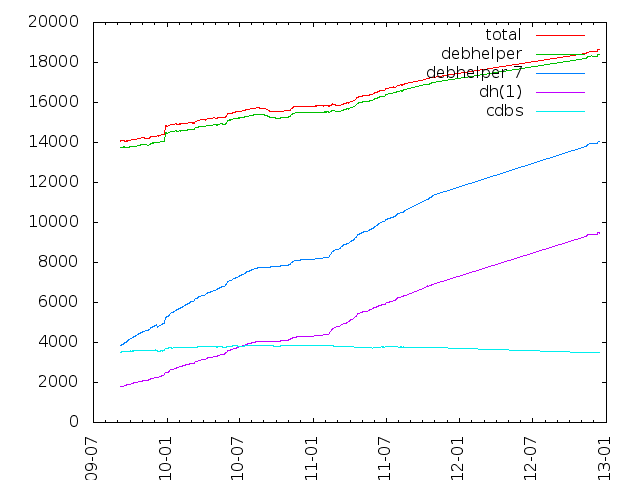
    since I had the idea. It's therefore a pleasure to finally announce the DACA project.


    What is DACA?

    Automated Code Analysis helps detect and fix bugs and other issues in source
    code. The project aims to give users easy access to a wide variety of tools to
    improve quality of software distributed by Debian, while giving the tool's
    developers a test bed, more visibility, and more feedback.
    This is achieved by running those tools on the complete Debian archive.

    http://qa.debian.org/daca/

    What is there for everyone?

    At the moment there are only partial reports from two tools, but the list of
    tools to be evaluated and possibly included goes over twenty.

    Current tools: cppcheck, and checkbashisms (at the source package level.)

    Limitations

    Most of the tools are CPU-bound, limiting considerably the number of tools and
    time it takes to check the whole Debian archive. For example, with the typical
    sid repository update (i.e. not during the freeze and with a working ftp-
    master) it is impossible for the server running cppcheck to keep up with all
    the changes.

    How can you help?

    * First of all you can go and squash bugs!
    Please keep in mind what's in the notices at the bottom of the pages. They are
    rather static now, but they may change later.

    * Second, report false positives, fix bugs, improve the tools
    Every report page (at the footer) should mention the version of the tool used
    to generate it. They are usually the latest.

    * Third, join the DACA project
    More hands are needed to evaluate other tools, setup an infrastructure for
    running them, and finally generating the web reports.
    Discussing tools already available at DACA is also welcome.

    There's a project request at Alioth pending its approval, but once accepted
    access to the repository and mailing lists will be found at:

    http://alioth.debian.org/projects/daca

    (the contact email address at the DACA website will be updated accordingly)

    * Fourth, donate hardware

    If you have equipment with very powerful CPUs or other hardware you (or your
    company) can donate, please take a look at the following page:

    http://www.debian.org/donations#equipment_donations

    Note that this may be handled by people unrelated to the DACA project, and as
    such you should mention what you would prefer your hardware to be used for.

    * And finally, figure out what I missed, provide feedback, and go back to step
    one.


    Thanks!

    By the way, thanks to the DSA team for tolerating a few hiccups on the host running
    cppcheck, and to those who previewed the website and provided feedback.

    Next.

    Previous.