Search Results: "tb"

9 May 2009

Biella Coleman: Fresh

If you are into sustainable farming this movie will likely catch your fancy.There is a screening here in NYC at the end of May. Supposedly they are going to stream the movie online, which I certainly hope to be the case. A political documentary that is behind bars is really not so useful and is a contradictory project as well. If you are into the idea of farming but live in the city, and New York City in specific, you can attend a Htink workshop on May 17th and start urban farming.

8 May 2009

David Welton: Ruby, Soap4R, WSSE Authentication

I've been doing some work for a client, where we have to interact with a web service front end for Oracle (which also means that everything reflects Oracle's "delightful" shortened table names, like UsrAddrsPhn...). I didn't find a lot out there to do this in Ruby, except this helpful post: http://willcannings.wordpress.com/2008/07/06/wsse-authentication-in-ruby-soap4r/ However, it wasn't quite enough for what we're doing, as we have to deal with a nonce parameter as well. Here's the snippet of code I created:
require 'rubygems'
gem 'soap4r'
require 'base64'
require 'soap/rpc/driver'
require 'soap/wsdlDriver'
wsdl_url = ARGV.shift
proxy    = SOAP::WSDLDriverFactory.new(wsdl_url).create_rpc_driver
# run ruby with -d to see SOAP wiredumps.
proxy.wiredump_dev = STDERR if $DEBUG
require 'soap/header/simplehandler'
require 'soap/element'
require 'xsd/datatypes'
class WsseAuthHeader < SOAP::Header::Handler
  NAMESPACE= 'http://docs.oasis-open.org/wss/2004/01/oasis-200401-wss-wssecurity-secext-1.0.xsd'
  USERNAME  = 'Not really the username'
  PASSWORD  = 'Put your own password here'
  def initialize()
    super(XSD::QName.new(NAMESPACE, 'Security'))
  end
  def on_outbound
    security = SOAP::SOAPElement.new('wsse:Security')
    security.extraattr['xmlns:wsse'] =
      'http://docs.oasis-open.org/wss/2004/01/oasis-200401-wss-wssecurity-secext-1.0.xsd'
    unt = SOAP::SOAPElement.new('wsse:UsernameToken')
    unt.extraattr['xmlns:wsu'] =
      'http://docs.oasis-open.org/wss/2004/01/oasis-200401-wss-wssecurity-utility-1.0.xsd'
    un = SOAP::SOAPElement.new('wsse:Username', USERNAME)
    unt.add(un)
    pw = SOAP::SOAPElement.new('wsse:Password', PASSWORD)
    pw.extraattr['Type'] =
      'http://docs.oasis-open.org/wss/2004/01/oasis-200401-wss-username-token-profile-1.0#PasswordText'
    unt.add(pw)
    # Create a nonce...
    nonce = SOAP::SOAPElement.new('wsse:Nonce', Base64.encode64((rand() * 1000000000).to_i.to_s))
    nonce.extraattr['EncodingType'] =
      'http://docs.oasis-open.org/wss/2004/01/oasis-200401-wss-soap-message-security-1.0#Base64Binary'
    unt.add(nonce)
    # The time format returned by XSDDateTime isn't quite right, so we
    # fiddle with it a bit.
    unt.add(SOAP::SOAPElement.new('wsu:Created',
                                  XSD::XSDDateTime.new(Time.now.utc - 30).to_s.gsub(/..*/, "") + "Z"))
    security.add(unt)
    return SOAP::SOAPHeaderItem.new(security, true)
  end
end
proxy.headerhandler << WsseAuthHeader.new()
... call proxy methods to interact with web service ...
The key thing is to dress up the outgoing header with all the right XML, including Nonce and Created parameters. This code was created by matching the XML generated by the Java code used to interact with this "JAX-WS" web service. All in all, it's a bit of a mess compared to a nice REST style web service. Hopefully the above code will be useful to others who are in a similar situation.

7 May 2009

Jan Hauke Rahm: Drawing in LaTeX

Just recently I convinced a friend of mine to use LaTeX for her papers. A huge step for her and a small one for me as I just had to copy my templates and show her a few hints about LaTeX. Well, that s what I thought. It was actually even the very same day when she asked me for help: she needed an image in there. That was of course easy but when I saw it I felt like I needed to replace it (it was seriously awfull). So, drawing She needed three rectangles connected with arrows. Easy thing with pstricks one might think but then pstricks is a PITA when you need a pdf document. So I tried tikz (of course, Debian delivers it right away). And see how easy that looks like:
\begin figure [htbp]
    \centering
    \begin tikzpicture 
    [<->, auto,
    block/.style =  rectangle, draw=blue, thick, fill=blue!20,
                    text width=3.5cm, text centered, rounded corners,
                    minimum height=2cm, font=\sffamily ,
    line/.style  =  draw, thick ]
    \matrix [column sep=5mm, row sep=2cm]
     
        % row 1
        & \node [block] (top)  Rectangle A ; \\
        % row 2
        \node [block] (left)  Rectangle B ; &
        & \node [block] (right)  Rectangle C ; & \\
     ;
    \begin scope [every path/.style=line]
        \path   (left) -- node [midway,font=\sffamily\footnotesize]  Arrow desc 1  (top);
        \path   (left) -- node [midway,font=\sffamily\footnotesize]  Arrow desc 2  (right);
        \path   (top)  -- node [midway,font=\sffamily\footnotesize]  Arrow desc 3  (right);
    \end scope 
    \end tikzpicture 
 
    \caption My fancy image 
    \label fancyimage 
\end figure 
Don t you like it that way?

5 May 2009

Biella Coleman: David Bollier at NYU

TIME: Monday, May 18, 7:00pm VENUE: Courant Institute
251 Mercer Street (Warren Weaver Hall)
Room 109 TITLE: The Struggle to Build a Digital Republic ABSTRACT: David Bollier will speak about the themes of his new book, Viral
Spiral: How the Commoners Built a Digital Republic of Their Own (New
Press). The book is the first comprehensive history of the free
culture movement and sharing economy that is empowering ordinary
people, disrupting markets and changing politics and culture. Bollier
will talk about the rise of free and open source software, Creative
Commons licenses, the new forms of non-market creativity (Wikipedia,
blogs, remix music, videos) as well as fascinating innovations in open
science, open education and open business models. More about the
book can be found at the website www.viralspiral.cc. More about
Bollier can be found at www.bollier.org. Bio
David Bollier is a leading American activist, author, blogger and
proponent of free culture on the Internet and the commons. He is an
editor of Onthecommons.org and Senior Fellow at the USC Annenberg
School for Communication. Bollier is also co-founder of Public
Knowledge, a Washington, D.C., organization that advocates for the
public s stake in the Internet and copyright law, and the author of
Silent Theft, Brand Name Bullies, and four other books. He lives in
Amherst, Massachusetts. VENUE: Courant Institute
251 Mercer Street (Warren Weaver Hall)
Room 109

4 May 2009

Martin Michlmayr: Debian 5.0 (lenny) tar ball for the SheevaPlug

It took me a while because of travel and other projects, but I finally released a tar ball containing Debian lenny for the SheevaPlug along with some installation instructions. It should be really easy to install Debian this way, but I'll also make sure that SheevaPlug support will be in the Debian installer for the next release of Debian. For now, check out the tar ball I prepared!

2 May 2009

Joey Hess: "I didn't know it went down so far!"

Sinking Creek passes by my sister's place and then does something strange: It disappears under ground, passes beneath both a hill and the Clinch River, to emerge on the other side as a spring and finally flow into the river. I've always wanted to find where it does this, and today we set out to do that. So for an hour or so we waded and scrambled down the soft-bottomed creek, through water that was often waist deep, with sometimes deeper suprises, past stands of cane, watching the banks rise up higher and higher, until we were in a 50+ foot deep gully. There were many signs of flooding and erosion from when the underground outlet gets plugged. Lots of interesting trees suspended on their roots. The sinkhole itself was not very impressive, and is less so here, but the landscape around it was breathtaking. These photos can't really show the scale of the place.
the sinkhole
On the way back we got to play hide-n-seek from a farmer on his tractor, which added a nice adrenalin rush. He was scarier than this creek doll. (Photos courtesy Anna Hess; her blog about it.)

Andrew Pollock: [life] In Vancouver

It's time for the obligatory two-year E-3 visa renewal (well reapplication, technically), and this time we thought we'd stay local and do it in Vancouver. We flew up this morning, and we're going to get a ferry to Victoria and stay the night with my cousin and meet his wife and kids, then take a seaplane back to Vancouver on Sunday night. We've got an appointment at the US Embassy on Monday morning. If everything goes to plan, we'll fly back on Thursday evening. I'm looking forward to a bit of down time. The timing is unfortunate, given this H1N1 flu outbreak, but our visas expire at the end of the month, and consular appointments aren't particularly easy to come by (or flexible).

Russell Coker: CPL

I ve just bught an NVidia video card from Computers and Parts Land (CPL) [1]. I asked for a PCIe*8 card but was assured that a PCIe*16 card would work. However when I got it home I discovered that it would not fit, the size difference was obvious enough that I didn t even need to unwrap the new card. According to the Wikipedia page for PCIe (PCI Express) [2] it is quite legal to have a motherboard implement a slower version of PCIe but have the full slot width, so a motherboard could have PCIe*1 implemented but have a socket that will fit a PCIe*16 card. The motherboard and the card will negotiate the capabilities that they both support. But there is no requirement to have a larger socket than required to use the capabilities of the motherboard. The CPL salesman assured me that any PCIe*16 card will fit into any PCIe*8 socket. I presume that he is used to white-box gear manufactured by companies that can save a few cents on the sockets if they make them all the same size. The Dell PowerEdge T105 that I own has PCIe*8 sockets that do not fit PCIe*16 cards. So now I have to return the card, and the CPL web site doesn t even give the hours that the store is open, so I have to call them. Sigh. Update: I returned the video card, first I had a debate with the CPL guy who had sold it to me regarding whether such PCIe sockets exist. He suggested that I had mistaken a PCI slot for a PCIe slot and was not convinced until I showed him a picture I had on my phone. He then claimed that Dell made sub-standard machines for not using a PCIe*16 socket for PCIe*8 connectors - so it was Dell s fault not his fault for delivering me a PCIe*16 board when I asked for a PCIe*8. He told me that no-one had ever made a PCIe*8 video card. Then he told me that I was lucky to not have a re-stocking fee (they sold me a device that was not what I asked for, I returned it in perfect condition on the same day and I was lucky to not pay them for the privilege). They gave me a credit note for the value of it (not a refund). I recommend never doing business with CPL if you can avoid it. I will make exactly one more purchase from them, that will be to use the credit note.

Russell Coker: Too Stupid to be a Judge

Bruce Schneier has written about the foolish actions of Justice Antonin Scalia [1]. Antonin made some comments opposing the need for greater privacy protection, most people could get away with doing that, but when a Supreme Court Justice does so it gets some attention. In response to this Fordham University law professor Joel Reidenberg assigned his class a project to discover private information on Antonin using public sources. The class produced a dossier of such information which was then offered to Antonin [2], but which was not published. Now anyone who knows anything about how the world works would just accept this. Among other things Antonin now knows what is publicly available and can take steps to remove some public data according to his own desires. But being apparently unaware of the Streisand effect [3] Antonin went on to say the following: It is not a rare phenomenon that what is legal may also be quite irresponsible. That appears in the First Amendment context all the time. What can be said often should not be said. Prof. Reidenberg s exercise is an example of perfectly legal, abominably poor judgment. Since he was not teaching a course in judgment, I presume he felt no responsibility to display any. This is of course essentially issuing a challenge to the entire Internet to discover the information that the Fordham students discovered. Of course doing so would not be fun unless it was published. The meme of 2009 has yet to be defined, it might be discovering and widely publishing personal information about Antonin. Already one of the comments in Bruce Schneier s blog suggests that activists should do such research on all senior figures in the US government to encourage them to take privacy more seriously. I expect that the first reaction of the legislative branch to such practices would be to enact special laws to protect their own privacy while still allowing large corporations (the organisations that pay for the election campaigns) to do whatever they want to ordinary people. It s an interesting situation, I predict that Antonin will regard this as one of the biggest mistakes he s ever made. I m sure that there are many more LULZ to come from this.

1 May 2009

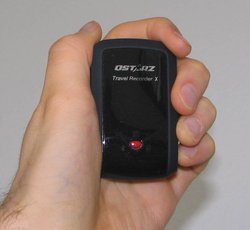
Martin Michlmayr: Adventures with the Qstarz BT-Q1000X GPS logger and receiver

Qstarz BT-Q1000X GPS in my hand Spring has arrived in Europe and I'm looking forward to spending more time outdoors. While I was pondering some plans, I thought it would be nice to have a GPS. I've never used a GPS before but it seems it will allow me to combine outdoors activities such as walking and hiking with geek things. In particular, I'm interested in tracking where I'm going (what route, what distance, what speed, etc), geotagging photos and possibly contributing to OpenStreetMap. Since last week, I have a Qstarz BT-Q1000X (Travel Recorder X), a GPS logger and receiver, and I've been playing around with it a bit. This device uses the new MTK II chip, which gives good accuracy and long battery time. I've created a new gps category in which I'll share my experience using a GPS in general and specifically the Qstarz BT-Q1000X. I've also created a Qstarz BT-Q1000X and Debian page to describe how to use this GPS device on Linux and I'll add more information to the page as I try out different applications.

Obey Arthur Liu: Z rich, Switzerland for the summer (housing? DebConf?)

Z rich Google Earth I got a summer internship at Google in Z rich, Switzerland, so I ll be moving there this summer. Any DD working there ? I already went to Z rich once last year and it was quite a cool place. I briefly met Cate and I know that there are other DDs there (hi Madduck!). I look forward to meeting more of you. Now there are two issues I d like help with, dear Z richer Lazyweb, housing and flight to DebConf. Can I haz apartment Looking for an apartment in Z rich seems very very very hard.. So far I only found a few apartment/hotel geared towards rich expats staying for few months (the kind like Citadines). It s ungodly expensive (like 2200+ CHF a month for one room), but sure available and well placed.. Here s what I need:

I don t have much more criterias, as long as I can find something. We re about a few dozens Google interns all (desperately) looking for accomodation in Z rich. We re all good neighbours, don t party all night and all have very good references. Please contact me if you \<know someone who\>* know something, I d be very grateful. Can I haz DebConf I m going to DebConf this year in Spain, along with all the Google Summer of Code students who can make it. I m going to reserve my flight in the next few days. I think I ll only go to DebConf proper, arriving on the 23rd and leaving on the 31st of July. I m not decided yet on the last point. So, any of you coming to DebConf from Z rich ?

Kartik Mistry: 1st May


* My state, Gujarat is celebrating on its birthday today and entering in 50th year. Jay Jay Garavi Gujarat, !

29 April 2009

Clint Adams: Here she comes, big as life

What seems like eons ago, I ordered one of those SheevaPlug Development Kits. After about six weeks, they got around to shipping it, and then, yesterday, after I assume a tortoise had piloted it across the country on broken tricycle, it was finally delivered to me. I booted it up, observed that there was some kind of Ubuntu thing on it, and set myself to correct that problem. Within an hour I had managed to lock myself out. Here is something I should have read beforehand. Thanks to Martin Michlmayr, it is now running Debian and allowing me to log in. Here are some steps to follow if you would like to boot Debian off of a USB stick plugged into your Sheevaplug: That should be all there is to it. Next I'm wondering if SDIO wireless cards work.

Biella Coleman: The Politics of Open Source

Call for papers: JITP-2010
The Politics of Open Source
May 6-7, 2010 - Amherst, Massachusetts Full Paper Submission Due Date: January 10, 2010 Approach
Free/Libre and Open Source Software (FOSS) has made significant advances, both technically and organizationally, since its emergence in the mid-1980s. Over the last decade, it has moved from a software development approach involving mostly volunteers to a more complex ecology where firms, nonprofit organizations, government agencies and volunteers may be involved. Moreover, the production paradigm continues to expand to other areas of digital content (e.g., Creative Commons, Wikipedia, Connexions, etc.). In this conference we use the phrase open source to capture this broader phenomenon. The Program Committee encourages disciplinary and interdisciplinary approaches to the study of open source, broadly defined. Politics in the conference title, can have many interpretations. Political issues closely tied to the free and open source software movement(s) include: national government policies related to the adoption of open source technologies or questions related to interoperability and open standards, software patents, vendor lock-in, and copyright. These are central themes we expect may be discussed in this forum. In this context, we welcome international submissions since differences in the political perspective appear in international contexts. However, topics related to how the concept of openness has led to various interpretations, adaptations, and applications of open source in other domains, and political issues that surround these broader innovations, are also welcome. Specific topics might include, but are not limited to: General topics related to the politics of open source:
+ How open source software or its principles are changing politics
+ Emerging transparencies in software, systems and society
+ Open source in the developing world and other international contexts
+ The political economy of open source
+ Digital divides and open source Open source and the public sector:
+ Open source software and transparency in government
+ Government policies toward open source and open standards
+ Regulation and open source Open source and democracy:
+ Open source and democratic engagement
+ Open source voting systems
+ Activism, political mobilization and open source The expansion of open source into other domains:
+ Understanding how open source collaboration works and how it can be extended into other areas of collective action
+ Policy areas, such as the effects of free textbooks on education policy or the politics of One Laptop Per Child
+ The political implications of open source in other cultural domains Keynote Speakers
We are pleased to confirm Eric von Hippel (MIT) and Clay Johnson (Sunlight Labs) as the daily keynote speakers for JITP-2010. Paper Submissions
Authors are invited to prepare and submit to JITP a manuscript following one of the six submission formats by January 10, 2010. These formats include research papers, policy viewpoints, workbench notes, review essays, book reviews, and papers on teaching innovation. The goal is to produce a special issue, or double issue, of JITP with a wide variety of approaches to the broad theme of The Politics of Open Source.

How to Submit
Everything you need to know about how to prepare and submit a strong JITP paper is documented at http://www.jitp.net/. Papers will be put through an expedited blind peer review process by the Program Committee, and authors will be notified about a decision by March 10, 2010. A small number of papers will be accepted for presentation at the conference. Other paper authors will be invited to present a poster during the Friday evening reception. All posters must include a YouTube version of their research findings. Best Paper and Poster Cash Prizes
The author (or authors) of the best research paper will receive a single $1,000 prize. The creator (or creators) of the best poster/research presentation will also receive a single prize of $1,000. Program Committee
M.V. Lee Badgett, University of Massachusetts Amherst
Paul M.A. Baker, Georgia Institute of Technology
Deborah Bryant, Oregon State University Open Source Lab
Andrea Calderaro, European University Institute
Mark Cassell, Kent State University
Edward Cherlin, Earth Treasury
Gabriella Coleman, New York University
Doug Downham, University of Massachusetts Amherst
Robert English, Daystar Computing & University of Massachusetts Amherst
Joseph Feller, University College Cork
Jelena Karanovic, Rutgers University
Dave Karpf, University of Pennsylvania/Miller Center for Public Affairs
Jeremy Hunsinger, Virginia Tech
Andrea Kavanaugh, Virginia Tech
Jose Marichal, California Lutheran University
Jens Hardings Perl, Pontificia Universidad Cat lica de Chile
Charlie Schweik, University of Massachusetts Amherst, co-chair
Stuart Shulman, University of Massachusetts Amherst, co-chair
Megan Squire, Elon University
Krishna Ravi Srinivas, Research Information System For Developing Nations
Louis Suarez-Potts, Sun Microsystems, Inc. & OpenOffice.org
Anas Tawileh, Cardiff University & Meedan.net

28 April 2009

Russell Coker: Redundancy in Network Infrastructure

It s generally accepted that certain things need redundancy. RAID is generally regarded as essential for every server except for the corner case of compute clusters where a few nodes can go offline without affecting the results (EG the Google servers). Having redundant network cables with some sort of failover system between big switches is regarded as a good idea, and multiple links to the Internet is regarded as essential for every serious data-center and is gaining increasing acceptance in major corporate offices. Determining whether you need redundancy for a particular part of the infrastructure is done on the basis of the cost of the redundant device (in terms of hardware and staff costs related to installing it), the cost of not having it available, and the extent to which the expected down-time will be reduced by having some redundancy. It s also regarded as a good idea to have more than one person with the knowledge of how to run the servers, jokes are often made about what might happen if a critical person fell under a bus , but more mundane things such as the desire to take an occasional holiday or a broken mobile phone can require a backup person. One thing that doesn t seem to get any attention is redundancy in the machine used for system administration. I ve been using an EeePC [1] for supporting my clients, and it s been working really well for me. Unfortunately I have misplaced the power supply. So I need to replace the machine (if only for the time taken to find the PSU). I have some old Toshiba Satellite laptops, they are quite light by laptop standards (but still heavier than the EeePC) and they only have 64M of RAM. But as a mobile SSH client they will do well. So my next task is to set up a Satellite as a backup machine for my network support work. It seems that this problem is fairly widespread. I ve worked in a few companies with reasonably large sysadmin teams. The best managed one had a support laptop that was assigned to the person who was on-call outside business hours. That laptop was not backed up (to the best of my knowledge, it was never connected to the corporate LAN so it seems that no-one had an opportunity to do so) and there was no second machine. One thing I have been wondering is what happens to laptops with broken screens when the repair price exceeds the replacement cost. I wouldn t mind buying an EeePC with a broken screen if it comes with a functional PSU, I could use it as a portable server.

27 April 2009

Biella Coleman: Free as in Beer?

Who sent me beer?

Russell Coker: Email Passwords

I was doing some routing sysadmin work for a client when I had to read mail in the system administration mailbox. This mailbox is used for cron job email, communication with ISPs that run servers for the company, and other important things. I noticed that the account was subscribed to some mailing lists related to system administration, the following is from one of the monthly messages from a list server: Passwords for sysadmin@example.com: List Password // URL
-
whatever-users@example.org victoria3 That doesn t seem terribly exciting, unless you know that the password used for the list server happens to be the same as the one used for POP and IMAP access to the account in question, and that it is available as webmail Of course I didn t put the real password in my blog post, I replaced it with something conceptually similar and equally difficult to guess (naturally I ve changed the password). The fact that the password wasn t a string of 8 semi-random letters and digits is not a good thing, but not really bad on it s own. It s only when the password gets used for 3rd party servers that you have a real problem. I wonder how many list servers are run by unethical people who use the passwords to gain access to email accounts, and how many hostile parties use such lists of email addresses and passwords when they compromise servers that run mailing lists. Now there would be an obvious security benefit to not having the list server store the password in clear-text or at least not send it out every month. Of course the down-side to doing that is that it doesn t give someone like me the opportunity to discover the problem and change the password.

25 April 2009

Kartik Mistry: Where to Vote?


* We know that its time of election going in world s biggest democratic country, India. Last and third phase will be on 30th. I am not sure I will go to my dear Palanpur and vote. Oh, I may go and vote! and will wait for sane result this time.

Ingo Juergensmann: Cleaning and modding of an A3000

Finally I was able to clean up one of my m68k buildds: Spice. Actually I regularly clean up all of my machines so they continue to work properly. Usually I do this maintenance work every year around christmas, but this time was different. Anyway. I took some pictures:


In fact I assumed more dust inside after 512 days of uptime, but I was suprised that the dust was moderate. So the cleaning was easy and fast. This is the result:


Next and final step was to enable the Laptop mode. Sadly there was no /proc/sys/vm/laptop_mode, but the final solution wasn't that difficult either to have a portable Amiga 3000:

Amiga 3000 in Laptop mode


Well, the reason for that Laptop mode is quite simply: although the A3000 is quite silent with its Papst fan, its SCSI/SCA disks aren't. To safe some noise I plan to move the A3000/autobuilder to the guestroom, but when there's some visitors, I want to be able to relocate the machine without interrupting the build. So attaching a UPS and a wireless bridge is the way to go for this purpose.

Next.

Previous.