Search Results: "agi"

2 February 2010

Marco Túlio Gontijo e Silva: Hi Debian Planet!


Hi Debian Planet! Finally I became a Debian Developer on saturday. Some time after that I sent my first e-mail @debian.org, and today I uploaded my first package: haskell-qio, a sponsored upload for Iain Lane. I d like to thanks everyone that have helped me in the process:
  • Joachim Breitner: for being my sponsor, telling me to look into NM, advocating me in NM and DM, helping me with packaging and other things.
  • Gustavo Noronha: for advocating me in DM, helping me with packaging and agreeing that packaging is not an easy to learn task.
  • Enrico Zini: for being a very nice to work with and helpful AM.
  • Marcelo Vieira: for the chats about the process, which made it pass faster.
  • Ian Costa de Andrade: for not complaining too much about me spending the whole day in the computer, and for all support and encouragement.
  • Marina Gontijo Andrade: for existing.
  • Wagner Meira and Fernando Pereira: for allowing me to work on Debian and giving me a scholarship for it.
  • Thadeu Cascardo and Samuel Vale: for giving me a Debian-related job which made me study about the system.
I m absolutely sure I m forgetting about someone, but I m also sure I ll never remember everyone and I ll always have this sensation. Being a Debian Developer is something I wanted for a long time, and I m very happy to have made it now. Currently I m working mostly in the Debian Haskell Group. These days I m checking if it s possible to make ghci be built in all architectures, and trying to make the newer versions of ghc6, from sid (6.10.4-1) and experimental (6.12.1-4), build in ia64, hurd-i386 and m68k. Any help is welcome. By the way, while I was reading the instructions to migrate some things to the new account, I ve not paid very much attention that I should only change the submitter of the unarchived e-mail, and I made a script, which I posted on the wiki, to change it for all the bugs. Neil Williams commented that this was not necessary, and Sandro Tosi pointed that I could have done this using only one mail to do all commands. Yves-Alexis Perez said that even with the unarchived bug this may not be a good idea, because of the generated noise. So I update the script in the wiki, following these tips, thanks for them. Special thanks for Jimmy Klapowitz, who was nice and supportive in a moment people were not being very nice to me. Sorry for the maintainers that received a lot of e-mails because of this, specially to the people who sign the pkg-haskell-maintainers mailling list, which received the biggest ammount of mail.

1 February 2010

Erich Schubert: Maps-Calendar Mashup

Well, I'd not call it a Mashup - it's actually backed by a custom database, a Xapian index for full text search and so on. To me, a true mashup would work without own server side code.Anyway, what it does is this: It's using the Maps V3 API, currently in public testing, which seems to give quite some extra speed compared to earlier versions. I've also added two extra controls, a search box at the top center, and a "Go to" menu on the left, which uses the visitor position from Google.The data is coming from swing dancing calendars, so it's real world data, and you should get different results every day. Most of the data is from Germany, so that is where you can see the marker aggregation and these things in effect.Here's the prototype.There is still lots of things to do, but this is just my free time project, when I'm not at work, dancing or with my friends. I don't know yet if this will remain online, it's more of a toy project for me. Still it's cool to see where there are swing dancing events, and it's cool to be able to just zoom to another city and see where you could "hop by" for a dancing event while you're there. But there are just a lot of UI issues to solve to get this really usable, and I'm not much of an UI guy...P.S. if it doesn't work, that probably means I'm currently working on it. There is no staging, and no "production system".

31 January 2010

Gregor Herrmann: RC bugs 2010/04

again, I focussed on the RC bugs in the perl group. & again, carnil++ was very active both in finding & in fixing them :)

Axel Beckert: abe@debian.org

On Wednesday I got DAM approval and since Saturday late evening I m officially a Debian Developer. Yay! :-) My thanks go to As Bernd cited in his AM report, my earliest activity within the Debian community I can remember was organising the Debian booth at LinuxDay.lu 2003, where I installed Debian 3.0 Woody on my Hamilton Hamstation hy (a Sun SparcStation 4 clone). I wrote my first bugreport in November 2004 (#283365), probably during the Sarge BSP in Frankfurt. And my first Debian package was wikipedia2text, starting to package it August 2005 (ITP #325417). My only earlier documented interest in the Debian community is subscribing to the lists debian-apache@l.d.o and debian-emacsen@l.d.o in June 2002. I though remember that I started playing around with Debian 2.0 Hamm, skipping 2.1 (for whatever reasons, I can t remember), using 2.2 quite regularily and started to dive into with Woody which also ran on my first ThinkPad bijou . I installed it over WLAN with just a boot floppy at the Chemnitzer Linux-Tage. :-) Anyway, this has led to what it had to lead to a new Debian Developer. :-) The first package I uploaded with my newly granted rights was a new conkeror snapshot. This version should work out of the box on Ubuntu again, so that conkeror in Ubuntu should not lag that much behind Debian Sid anymore. In other News Since Wednesday I own a Nokia N900 and use it as my primary mobile phone now. Although it s not as free as the OpenMoko (see two other recent posts by Lucas Nussbaum and by Tollef Fog Heen on Planet Debian) it s definitely what I hoped the OpenMoko will once become. And even if I can t run Debian natively on the N900 (yet), it at least has a Debian chroot on it. :-) I'm going to FOSDEM, the Free and Open Source Software Developers' European Meeting A few weeks ago, I took over the organisation of this year s Debian booth at FOSDEM from Wouter Verhelst who s busy enough with FOSDEM organisation itself. Last Monday the organiser of the BSD DevRoom at FOSDEM asked on #mirbsd for talk suggestions and they somehow talked me into giving a talk about Debian GNU/kFreeBSD. The slides should show up during the next days on my Debian GNU/kFreeBSD talks page. I hope, I ll survive that talk despite giving more or less a talk saying Jehova! . ;-) What a week.

Russell Coker: Choosing an Australian Mobile Telco for use with Android

Since playing with the IBM Seer augmented reality software [1] I ve been lusting after a new mobile phone which can do such things. While the implementation of Seer that I tried was not of great practical use to me (not being a tennis fan I was only there to learn about computers) it was a demonstration of an exciting concept. It will surely be implemented by IBM in other venues that are of more immediate interest, and we can probably expect other vendors to write similar systems to compete with IBM. So the question is how to get a phone that will run such things well. The answer is probably not to rely on a contract plan for this, currently Vodaphone [2] is currently the only Australian telco that sells a phone that can run Seer, it is offering a HTC Magic (which was released in April 2009) on a $29 per month plan. A phone that is 9 months old isn t necessarily a bad thing, but the has been out for more than 6 months and has some significant benefits (such as a 5MP camera). So it seems that Three (my current provider) is probably the best option at this time. Virgin would save my $4 per month, but would only give me 300M of Internet data per month, and the Virgin limit of $60 per month of calls might not be enough for me. Vodaphone offers a deal for $25 that only includes 200MB of data, that might be enough for just phone use, but wouldn t be enough for tethering for laptop net access. I wonder how well tethering works on an Android phone, can you make a phone call while transmitting data from a tethered laptop? I find that with my Viewty when I receive an SMS or phone call it stops the net access. That makes a tethered Viewty impractical for some support tasks as it s fairly common that I need to talk to someone while logging in to their server I m sure that most people who use mobile Internet services regularly need to phone someone while using them. My current Three bill is $29 per month for the phone plan and $15 per month for Internet access. If I m going to buy phones outright instead of getting them with the plan then I want to reduce the overall amount of money I spend on phone plans and using tethering instead of a 3G USB dongle would allow this. I think that I can get something that comes close to my ideal mobile phone [8] (apart from being able to connect a keyboard, mouse, and monitor) if I import it from overseas. We really need more competition in the Australian mobile phone market. We have only two phone companies offering Android phones, Three is sold out of the obsolete model that they offer while Vodaphone has stock of an obsolete model.

30 January 2010

Josselin Mouette: Please save the graphical installer

The current state of g-i, the graphical version of the Debian installer is very concerning. Currently, the GTK+ version in squeeze (2.18 and soon 2.20) has very serious bugs in the DirectFB backend, which make it unusable for g-i. Because of that, the first alpha version of d-i will ship without graphical installer support. Unless someone steps up and does something, this will be the end of the graphical installer. Among other things, it means the end of support for several languages: Indic scripts, Thai, Amharic, and all RTL languages. Option 1: fix GTK+ DirectFB support Until now, we always found some good wills who volunteered to fix GTK+ so that g-i worked again. I d like to thank Attilio Fiandrotti and Sven Neumann for their past work, but unfortunately it seems they have better things to do now. If someone takes over their work and hacks on GTK+ to get it to work correctly again on DirectFB, we will be able to go on this way at least for the squeeze release. This requires someone with serious DirectFB knowledge who will not be afraid to dig into the GDK internals. Option 2: switch to X11 If GTK+ doesn t work on DirectFB, there is another plan, but it needs to happen fast. It should be possible to make the installer work on X11. This has the advantage that we know X11 works fine and is maintained in the long term, and so does the X11 GTK+ backend. This has also the drawback to make the installation media slightly larger. This requires quite some work on udebs: It looks like a lot, but there s nothing complicated in it. Anyone familiar enough with Debian can do this, with a little support from the maintainers of said packages. So this could well be you. Assuming you re interested in keeping g-i alive. Alternatives Other possibilities to support complex languages include:

29 January 2010

Joey Hess: xmonad layouts for netbooks

How a window manager with tiling layouts makes a 1024x600 resolution livable. I spend a lot of time in front of a screen, and for the past year I have used only my netbook. No desktops, no laptops. Just a cheap $200 computer that is nearly a kid's toy. The most challenging thing about this is dealing with the 1024x600 screen resolution. When I moved to this screen from something with many more pixels, it at first seemed very cramped. After a year, I think that the most important part of coping with the small screen is the flexability and customizability of layouts provided by the Xmonad window manager. In this post I will explain a few layouts I have developed for fitting specific tasks onto the netbook screen. (I assume that you know maybe 0.1% of Haskell (about what I do), and can read Haskell code without having a brain aneurysm.) web browsing
It's important that the web browser have as few toolbars and other cruft as possible, as horizontal space is especially at a premium. I've configured both Epiphany and Firefox to put everything in one tool bar. But now I use Chromium, which comes pre-configured that way.
What the netbook is designed for. You just want a web browser, taking up the full screen, and with its own tabs. So far, so easy: that's Xmonad's Full layout. But, you sometimes want to see two websites side-by-side. This layout accomplishes that, allowing the sizes to be adjusted as needed. It also uses Xmonad's Magnifier to zoom the smaller window when it's focused, which is useful if you briefly need to see more of a web site.
mySplit = magnifiercz' 1.4 $ Tall nmaster delta ratio
    where
        -- The default number of windows in the master pane
        nmaster = 1
        -- Percent of screen to increment by when resizing panes
        delta   = 3/100
        -- Default proportion of screen occupied by master pane
        ratio   = 60/100
screenshot screenshot web development If you're doing web development, you'll want probably one big web browser window, but also with a nice wide terminal on the same screen, in order to see web server logs. A simple way to do this is to mirror Xmonad's Tall layout by 90 degrees.
myWide = Mirror $ Tall nmaster delta ratio
    where
        -- The default number of windows in the master pane
        nmaster = 1
        -- Percent of screen to increment by when resizing panes
        delta   = 3/100
        -- Default proportion of screen occupied by master pane
        ratio   = 80/100
The myWide layout uses the full screen width for a single terminal, and splits the width when there are more. This is sufficient for viewing logs and doing minor things at the shell prompt, in between testing the result in the web browser. Of course a terminal can be temporarily moved to the master area by pressing mod-return, if you need it to be larger. screenshot screenshot chat
Tips on configuring Pidgin for a netbook: Set it up to use vertical tabs to save horizontal space. Configure the input area to only 1 line tall, and turn off as much other cruft as you can. The menu bars, sadly, cannot be disabled, nor can the excessively large borders. In my screenshots, you can see that stuff wasting space that could be used to show four more lines of text.
For chat, you want to put the buddy list on the side of the screen, and use the rest for conversation windows. Xmonad's IM module takes care of allocating a sidebar on the screen for the buddy window. The rest of the screen can be occupied by any layout you choose. I like to have the conversation windows be as wide as possible, and typically only want to see two conversations at a time. But sometimes I might have a dozen visible. A good layout to cope with those needs is Grid.
myChat' l = withIM size roster l
    where
        -- Ratio of screen roster will occupy
        size = 1%5
        -- Match roster window
        roster = Title "Buddy List"
myChat = myChat' Grid
The withIM layout puts the buddy list on the left; I prefer it on the right for some reason, so I tweaked my layout to do that. All it took was using the reflectHoriz layout modifier to get a mirror image of the layout. Then I reflect the inner layout back to its normal orientation. Being able to throw in a few function calls and mutate a layout like that is where Xmonad shines.
myChat' l = reflectHoriz $ withIM size roster $
            reflectHoriz $ l
screenshot screenshot logs
Ever notice that tail -f wastes the last line of the terminal? On a netbook this matters. shorttail lets the last line be used.
I have a dedidated workspace that I use to tail logs, and as a place to send long-running tasks (such as compiles). The layout for this needs to keep windows wide, to see whole logged lines, but they need only be five or so lines tall. And it's convenient to have one bigger window with the small ones below. Xmonad has a perfect layout for this, called Dishes, because it's sorta like a stack of plates.
myDish = limitWindows 5 $ Dishes nmaster ratio
    where
        -- The default number of windows in the master pane
        nmaster = 1
        -- Default proportion of screen occupied by other panes
        ratio = 1/5
screenshot screenshot
In the second screenshot above, I have 6 windows open, but only 5 are visible. The limitWindows 5 accomplishes this. It's handy mostly because gnome-terminal has a bad habit of crashing when resized to 0x0. (That's gotta be a bug in something!)
Notice that the screenshots above also have Procmeter in a sidebar on the right. I (ab)used the withIM layout to do that:
myLogs' l = reflectHoriz $ withIM procmeterSize procmeter $
              reflectHoriz $ l
    where
        -- Ratio of screen procmeter will occupy
        procmeterSize = 1%7
        -- Match procmeter
        procmeter = ClassName "ProcMeter3"
myLogs = myLogs' myDish
coding Everything above was easy. Doing coding (or writing) on a small screen is where it gets hard. When I'm coding I want to have one window that is exactly 80 columns wide, and as tall as possible, where I do the main development. Then I need a minimum of two other windows also visible: one action window for running tests and the like, and one to view references (emails, man pages, other files, etc). I may need to view any of these windows fullscreen at any time, of course.
As an example of the three window rule: While I'm writing this post, I have a reference window open with my .xmonad/xmonad.hs, and an action window open where I am managing screenshots.
Often, deep into something, I will accumulate many other reference and action windows. But three seems to be the magic, minimum number for me; use of screen or anything else doesn't reduce it; if I can't see all three at once, I will waste time and concentration flipping back and forth. The Xmonad layout I've developed to handle this is based on the handy FixedColumn layout, which automatically keeps the master window 80 columns wide. I modify this by adding the Magnifier, so that my action and reference windows "pop out" over the master window when focused.
myCode = limitWindows 3 $ magnifiercz' 1.4 $ FixedColumn 1 20 80 10
The 1.4 was carefully tuned, to magnify a window to be big enough to be usable for editing, reading, or command-line, while not obscuring too much of the other two windows. And again I use limitWindows, to only show three windows, in order to keep them all as big as possible. Other windows are hidden offscreen, but I can rotate to them with alt-tab as needed. screenshot screenshot reading ebooks When I'm reading an ebook, I want to have the reader in the middle of the screen. But a widescreen netbook like mine is too wide to comfortably read text all the way across, so it's nice to have margins. (In the margins, I put terminals, or notes.) The ThreeColumns module has a layout that does just that.
myBook = ThreeColMid nmaster delta ratio
    where
        nmaster = 1
        -- Percent of screen to increment by when resizing panes
        delta   = 3/100
        -- Default proportion of screen occupied by master pane
        ratio   = 2/3
screenshot putting it all together I join all my layouts together, so Xmonad will allow switching between them. These three combinations all have the same layouts, only ordered differently, so that different workspaces can have different default layouts.
codeFirst  = myCode    myWide    myGrid    myDish
dishFirst  = myDish    myCode    myWide    myGrid
gridFirst  = myGrid    myDish    myCode    myWide
Xmonad layouts can be decorated with things like title bars. To save horizontal space, I leave off the title bars on layouts where they are not needed to disambiguate windows. Two helper functions can be applied to add or remove titles (and also cause the layout to avoid the Gnome panel.)
withTitles l = noFrillsDeco shrinkText myTheme (desktopLayoutModifiers l)
noTitles l = desktopLayoutModifiers l
I have semi-dedicated workspaces; one for each of the above activities. To assign a layout to a workspace, I use the PerWorkspace module.
Notice that the "web" workspace has only two available layouts. Meanwhile, the "book" workspace always uses the specialized myBook layout; I don't use that layout elsewhere.
perWS = onWorkspace "logs" (withTitles $ myLogs' dishFirst) $
        onWorkspace "web"  (noTitles   $ (mySplit   myWide)) $
        onWorkspace "chat" (noTitles   $ myChat' gridFirst) $
        onWorkspace "book" (noTitles   $ myBook) $
                           (withTitles $ codeFirst)
Finally, I allow toggling between the currently selected layout and fullscreen mode, and use smartBorders to avoid displaying borders when there is only one window onscreen.
myLayout = smartBorders $ toggleLayouts Full perWS
Xmonad layout optimised for the small screen of a netbook: Done! (For now...)
screenshots screenshots screenshots screenshots screenshots
PS: Thanks to #xmonad regulars for always having the answer I need up their sleeves.

28 January 2010

Martin F. Krafft: Adopted passwdqc

Tollef forced me to take over libpam-passwdqc after I had reported bug #517967. passwdqc is a toolset that can be used to enforce password strength policies at exactly the right place: there s a PAM module, and with the next version, you can also use a library and command-line tools read on below. The toolset gives administrators flexibility in defining the minimum password length based on the number of character classes a user tries to use. It also includes libpam-cracklib functionality and prevents the use of trivial passwords. I appreciate this functionality, so I had little choice but to make the best out of it: Debhelper 7 is really nice. Thanks, Joey.

Martin F. Krafft: DistroSummit 2010

Linux.conf.au 2010 has come to an end and I am looking back at an intense week of conferencing. A big shout out to the organisers for their excellent work. I think LCA (as well as DebConf) just keeps getting better every year. This does not at all discredit previous organisers, because they were the best at their times and then passed on the wisdom and experience to help make it even better in the following year. The week started off with the DistroSummit, which Fabio and I organised. Slides are forthcoming, as I failed to get them off the speakers right after their talks it s interesting how stress levels and adrenaline can cause one to forget the most obvious things. This is where experience comes in. I ll be there again next year, I hope, to do things better. The theme of the day was cross-distro collaboration, and we started the day a little bit on the Debian-side with Lucas Nussbaum telling us about quality assurance in Debian, alongside an overview of available resources. We hoped to give people from other distros pointers, and solicit feedback that would enable us to tie quality assurance closer together. Next up was Bdale Garbee who talked about the status of the Linux Standard Base. While I am really interested in such standardisation efforts, I realised during his talks that I had considerable difficulties paying attention because as organiser of the conference, I had all sorts of other things occupying my thoughts. I proceeded to tell the audience the room was mostly filled throughout the day with an estimated 40 50 folks, and I d say about half of them stayed throughout, while the other half came in and left the room between talks. I could not get the projector to work with my laptop after the upgrade to Kernel Mode Setting, and thus used the whiteboard to give a brief introduction to vcs-pkg.org, talk about the current state of affairs, summarise the trends in discussions around patch management and collaboration, give an outlook of what s up next, and solicit some discussion. Sadly, just like during Bdale s talk, I found myself worrying over the organisation of the day, rather than actually taking in most of the discussion. Fortunately, others have written about the most important points, so I defer to them. Michael Homer then told us about GoboLinux s Aliens system, which is a way to integrate domain-specific packages with distro-specific package maintenance e.g. how to get APT to handle CPAN directly, or how to let YUM manage Python packages. The ensuing discussion was interesting, and we carried it over to the next slot, because Scott, the next speaker, was stuck in traffic. To summarise briefly: scripting languages have a lot of NIH-style solutions because it works for them, but these are a nightmare to distro packagers. One symptom of the status quo is that complex software packages like Zimbra are forced to distribute all required components in their installation packages, which make distro packaging, quality assurance, and security support even harder. I don t think we found a solution, other than the need for further standardisation (like the LSB), but the road seems to be a long and windy one. Laszlo Peter introduced the audience to SourceJuicer, a new build system used by OpenSolaris. The idea is that contributors submit packages via a web interface, kicking off a workflow incorporating discussion and vetting, and only after changes have been signed-off are packages forwarded to auto-builders and eventually end up in the package repository. This is very similar to upload ideas I ve had a while ago, which I ve started to (finally) implement. Unfortunately, SourceJuicer seems very specific to OpenSolaris, as well as non-modular, so that I probably won t be able to reuse e.g. the web interface on top of a Debian-specific package builder. After the break, Dustin Kirkland stepped up to tell us about his user experience of Launchpad. Unfortunately, I found his talk a bit too enthusiastic. Launchpad undoubtedly has some very cool features and ideas, but it s just one of the available solutions. The dicussion of Launchpad also dominated the next talk, in which Lucas Nussbaum told us about the Debian-Ubuntu relationship. While his presentation showed that the relationship was improving (Matt Zimmerman made the point that there are rather many relationships, rather than one relationship), I was a bit disturbed by the comments of Launchpad developers in the room, ranging from Debian is declining anyway to Just use Launchpad if you want to collaborate with others and not go down . There was a slight aura of arrogance in their comments which tainted my experience of the otherwise constructive discussions of the day. Overall I had a great time. Debian and Ubuntu made up the vast majority of attendants, with only a handful of representatives from other distros present. I wonder why that would be. One reason might be that around 70% of LCA attendants declared themselves Debian or Ubuntu users, and so there weren t many other distros around. Another might be that I still haven t spread the word enough. Let s hope to do better next year! Thanks to all the speakers. We may have organised the day, but you made it happen and interesting! Slides and recordings of the talks will be linked from the archived website when they become available (yes, the archive page does not exist yet either).

27 January 2010

Joerg Jaspert: HP Mini 5101, gobi_loader problem

A short while ago I bought a new device, a HP Mini 5101. Basically a slightly oversized pocket calculator, but exactly what I wanted: It is painful to do anything real on it, but it can be used if there is really no better way. And this is exactly what I want to take with me on the vacation starting soon. A device that ensures I will not use it for more than the emergency case and as backup storage for pictures I take. This little thing has a tiny 10.1 (non-glare, I want it painful but even there is a limit. Idiot mirrors, brrr) TFT (1366x768), an Atom N280 with 1.66GHz, 2G RAM, a 160Gb disc, 3 usb ports, wifi, gigabit lan, bluetooth and a 3G module. It ships with one of those pain adventures with which the seller shows you how much they hate you (Windows XP), but that did only boot twice yet. Once to check everything works, for the second read on. It weights 1.3kg and HP imagines some 8 and a half hour runtime with the 6-cell battery. ACPI and powertop predict between 7 and 14hours, depending on my workload and probably the phase of the moon. But 7 will do nicely. Of course I put a Debian on this device. It runs all well. As it has no optical drive its either usbboot or netboot and off it goes. Easy install, only need to remember installing the broadcom-sta packages and building the module for the kernel to get wifi. Otherwise its a simple install and the stuff works out of the box. Except for one thing. I can not get this goddamn 3G module to work. It works fine in Windows, confirming this was the second time I did boot this abomination of a bad joke. When using that HP manager thingie for 3G, its all fine and works. When you then reboot into Linux - it also works. Annoying. It is one of those Qualcomm Gobi USB chipsets and to function it needs it firmware transferred over. Fine. Using google one can easily find gobiloader, which is meant to do that. Just get the firmware from Windows and let gobiloader do the rest. Except - it does not work. Everything I can find tells me it should, ie. various posts on various places on the net, the usbids the device has when without firmware and after this windows crap put firmware into it, everything looks exactly like it should. Yet, gobi_loader simply hangs itself right in the first while (1) loop, where it wants to send the first real data after the set of 3 magics it send before. The write never times out, the firmware never gets into the device, its not usable. Argh. Dear lazyweb, anyone out there with an idea? I tested various firmwares (the one I found in Windows, the one you can find at vendors download page, various of the 10 different you find in each), even let it run for some while before interrupting. Unfortunately I do not have enough clue in this area to debug what is happening here, nor to fix this up myself.

Gunnar Wolf: Packaging PKP OJS (Open Journals System)

New guidelines for periodic publications' websites at my University favor the different journals we have to use a standardized system And it makes quite a bit of sense. It is quite hard to explain to the people I work with that the content is not only meant to be consumed by humans, but also by other systems; the reasons behind rich content tagging and deep hierarchies for what they would just see as a list of words (think list of authors for an article, list of keywords, and so on). After all, aggregator databases such as Latindex and SciELO have achieved getting this understanding through. And I must be quite grateful, as the University's guidelines point to what appears to be a very well-thought and thorough system, the Open Journal Systems by the Public Knowledge Project, co-funded by several well-regarded universities. OJS is a GPL-2-covered PHP bundle. Anyway I am very glad at least one of my Institute's journal accepted the challenge and decided to go OJS. I know I will quite probably be administering this system long-term. And, being as snobbish as I am, I know I loathe anything installed in my machines that is not either developed by myself or comes in a Debian package. So, as it was not packaged, I made the package Note that I am still not filing an ITP (which means, I have not yet decided whether I will upload this to Debian) because I want first to make sure I do have the needed long-term commitment Besides, I am by far not a PHP person, and being responsible for a package Carries a nontrivial weight. Still, you might be interested in getting it. If you are interested, you can either download the .deb package or add it to your apt repositories (and stay updated with any new releases), by adding this to your /etc/apt/sources.list: deb http://www.iiec.unam.mx/apt/ lenny misc
deb-src http://www.iiec.unam.mx/apt/ lenny misc
Note: My packaging has still a small bug: The installer fails to create the PostgreSQL database. The MySQL database works fine. I will look into it soon So far, I am quite impressed with this program's functionality and the depth/quality of its (online) documentation. Besides, its usage statistics speak for themselves: So, it is quite possible I will be uploading this into Debian in a couple of weeks (hopefully in time to be considered for Squeeze). The reasons I am making it available in my personal repository now is:
Russell Coker: The Australian Open and Android Phones (Seer)

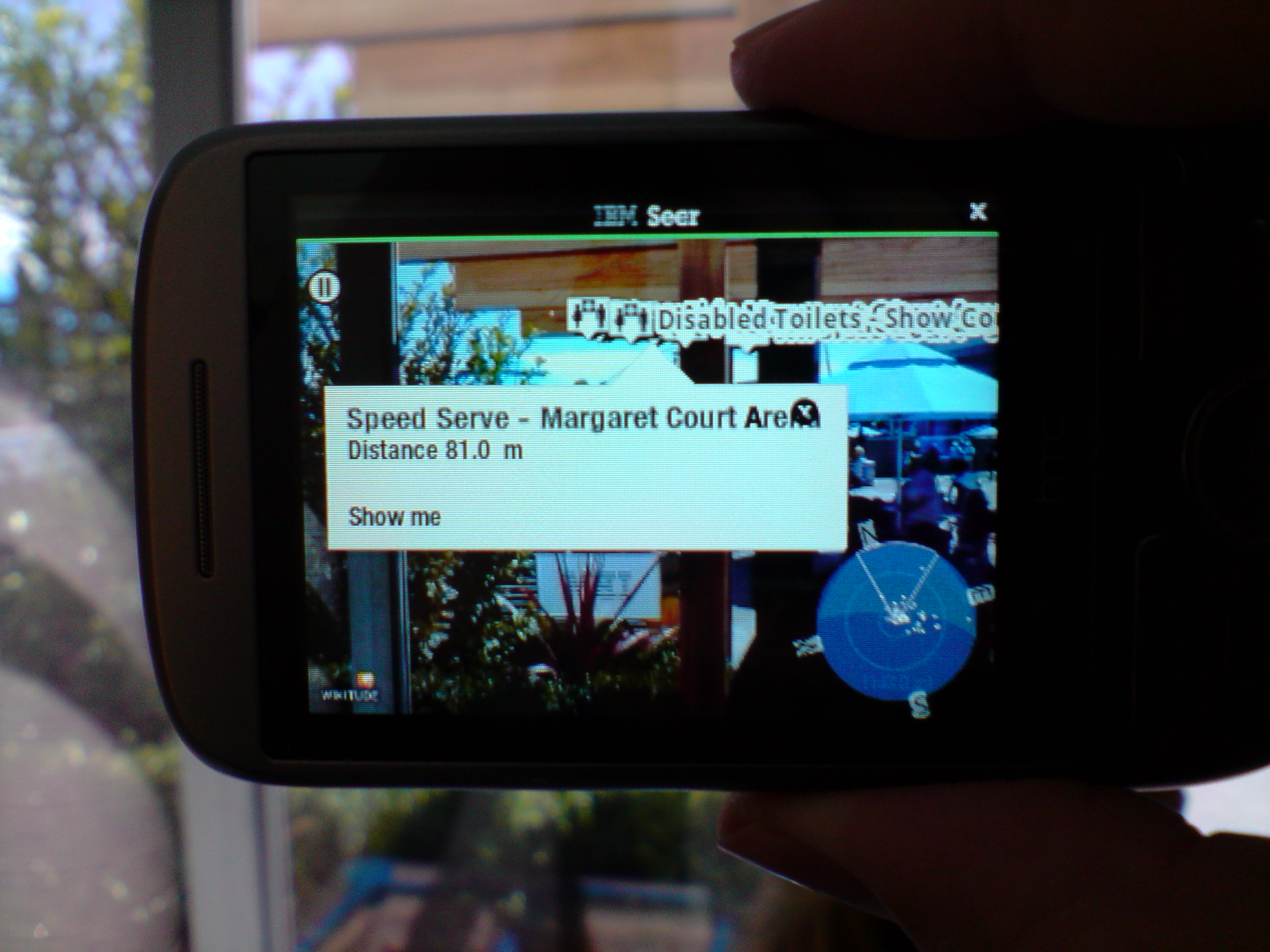
On Monday I visited the Australian Open [1] it s one of the world s greatest tennis championships and it s on in Melbourne right now. IBM sponsored my visit to show me the computer technology that they use to run the event and display the results to the world via their web site and to various media outlets. picture of IBM Seer software running on HTC Hero The first thing that they showed me was the IBM Seer software on the HTC Hero phone (which runs the Google Android OS). Seer can be freely downloaded from the Android store. The most noteworthy feature is that it uses the camera in the Android phone to display a picture of whatever you are looking at with points of interest superimposed (such as the above picture where I asked for locations of events and toilets). But it also displays a map view and has some other features I didn t get a chance to test such as viewing twitter data relevant to the event. We really need this augmented reality feature enabled with tourist data for major cities. I m sure that there s lots of interesting things I haven t seen in my own home city, if I could just pull out a phone and see a map of what s around me whenever I m bored I could see some of them. I think that this has the potential to change the way we use phones, in theory this was available as soon as Google Maps was released, but Seer seems to be the start of a whole new range of developments. One of the uses of this will be for identifying the background in tourist photos, no more of the me in front of old building descriptions. Here is a Youtube Video of the Seer software in action [BMLgHGV4zWM]. The tour guide explained that to get the software to work on an iPhone would require the 3GS for navigation as the earlier iPhones don t have a compass. The Seer software was initially developed for The Championships, Wimbledon 2009 which happened at about the same time as the iPhone 3GS release. I expect that there will be enough iPhone 3GS units sold before Wimbledon 2010 to give IBM a good incentive to port Seer to the iPhone. Three (my phone company at the moment) has just sold out of the HTC Magic which has a digital compass. They are selling the HTC Touch Pro and HTC Touch Diamond that appear to lack a digital compass. Vodaphone is offering a HTC Magic free on the $29 contract right now. The other Australian mobile phone companies don t seem to offer any Android phones. So it seems that the only option right now if I wanted to purchase a phone in Australia that can run Seer is the Vodaphone HTC Magic, and that s a phone that was released almost a year ago (a long time with recent progress in phone development it s the modem before the HTC Hero I tested) and which has only a 3.2MP camera (the LG U990 Viewty I used to take the picture for this post has a 5MP camera and is older than that). So I expect that there aren t many people using Seer in Australia. If you happen to be in Melbourne and have an Android phone with a digital compass then you may want to visit the Australian open to try the Seer software. It should work equally well from outside the security fence I ll write about the other things I saw over the next few days.

Michal Čihař: Gammu is being used in vendor software

I always thought Gammu to be workaround for phones whose vendors do not provide software for your favorite operating system. We try to do our best job to work with variety of phones, even though this is hard and never finished job. However today I was really surprised to find out that some phone vendor built their official application for managing phone on Gammu. The application is of course closed source and available only for Windows, but this does not change anything on the fact they use it. They seem to have modified code slightly, adding some new functions and removing others, separated the code to several DLLs, however I'm 100% sure it is Gammu as they use some unique (read awful) things we have in our code. I'm not going to disclose their name right now as I want to give them fair amount of time for reaction on my asking for sources. But you will for sure find more information later in my blog. PS: Gammu is of course not the only free software used inside this application, you can find more there (and you will find there more than I did if you will look longer than few minutes I spent on examining rest of code).

26 January 2010

Guido G nther: Git-buildpackage and 3.0 source format

Here's a short overview of 3.0 source format support in git-buildpackage 0.4.64: One loose end is the handling of multiple upstream tarballs (#561071, #561072). I'd be great to hear from people already using this feature how this can best be added into the gbp workflow. The newer kids in town gbp-clone, gbp-pull (for keeping the repo up to date when using team maintenance) and gbp-pq (for managing the quilt patch-queue) don't care about the underlying source package format. These three are a bit underdocumented in the manual but information about the workflow is in the wiki.

25 January 2010

Joachim Breitner: Serna XML editor uploaded to Debian

The XML-Editor Serna by Syntext has been published as Free Software a few months ago. This was very good news, because there was a lack of a good free XML editors with a good graphical view on DocBook documents, which I needed to recommend to users of zpub. Therefore, I investigated packaging Serna for Debian. I had to patch a few things to make it compile on and64 and to use components shipped by Debian where possible. Today, I could finally close the RFP bug filed by W. Martin Borgert, as the serna package was accepted by the ftp-masters. The first bug (SEGFAULT on startup on lenny) is already filed. I hope this is a good sign, as it shows that there is interest in the package. For my packaging workflow, I used git-svn to import the upstream SVN branch into a git repository. I then use git-dpm by Bernhard R. Link to manage my changes as patches in the new 3.0 (quilt) debian source package. I must say that I prefer this approach to git-buildpackage, as there is only one git branch to publish. I hope that Bernhard uploads git-dpm to Debian soon. Serna is quite a big software project and uses stuff that I know little about (Qt, C++ with python interaction etc.). Also, the package currently bundles the DITA-OT package, which should rather be packaged separately. Therefore, I d be glad if co-maintainers would join the effort.

Martin F. Krafft: Vodafone intransparency

Coming to New Zealand for an extended period of time, I figured it would make sense to purchase a prepay mobile plan to make it easier to mix with locals. Not knowing better, I went with Vodafone, which I whole-heartedly regret: their website is a massive pain in the ass, their price plans completely over the top, and their customer service representative incompetent and unfriendly. My latest experience eclipsed all previous encounters, and makes me want to tell you about it: Between all the obscure add-ons Vodafone threw at me when I bought this SIM card, two weeks ago I couldn t figure out how my balance had decreased from $30 to $0 when I rarely ever made calls. I wrote an e-mail to their customer service hotline, and it took them a week to get back to me, with the following text:
Due to being a Prepay Customer, unfortunately usage details are not available as per terms and conditions. I have although checked your usage and can confirm that all charges are correct.
Obviously, I wasn t going to accept this claim of omniscience, so when last weekend, $20 disappeared over the course of a day, that was the catalyst for me to reopen the ticket and reply along the lines of:
Only I know when I used my phone and thus only I can determine whether the charges are correct. Please show the full records to me, or else
This seemed to convince the representative, and 8 messages and 11 days after my initial request, I was told I could request the records at $5/30 records. Yes, you read that right: they wanted to charge me to view the records. I thus replied:
I am NOT willing to pay for that. If you are unable to comply with my desire for transparency, then I shall terminate the contract and make sure to inform the media as well as the consumer institute of this conduct. As stated previously, I shall also consult with a lawyer. Charging consumers to view data that is obviously available is a strong indication that you do not want me to see it. I can t imaging why this would be the case other than the data being inconsistent with reality.
That worked, and I finally got an Excel sheet with my usage data, which allowed me to track down the depletion of my account: to lure customers in, they promise free calls to other Vodafone numbers for the first four weekends. There are three problems with that though:
  1. Having purchased my card on Saturday afternoon, I was annoyed to find out that the remaining 34 hours of that weekend would be counted as a whole weekend.
  2. They don t provide a way by which to find out whether a given number actually belongs to Vodafone or not. The 021 prefix is not enough of an indication.
  3. They don t actually tell you anywhere but the aforementioned horrific website that the addon has expired.
So thanks, Vodafone. You ve lost a customer, who should have gone with 2degrees in the first place, who have much lower rates, even though their data coverage doesn t seem as good. I don t need data anyway. I ll still insist on Vodafone providing the data in a Free format. You can find more information about NZ mobile phone providers on the LCA2010 wiki page. NP: Age Pryor: Shank s Pony

24 January 2010

Steve Kemp: What the hell are you laughing at?

Slaughter
I received my first patch to slaughter today, which made me happy. (I've made a new release including it, and updated the list of primitives to actually document the file-deletion facilities which previously I'd omitted to avoid encouraging mass-breakage.)
Signing Binaries
Andrew Pollock mentions that the days of elfsign might be numbered. This is a shame because I've always liked the idea of signing binaries. Once upon a time, in the 2.4.x days, I wrote a kernel patch which would refuse to execute non-signed binaries. (This was mostly a waste of time; since it denied the execution of shell scripts. Which meant that the system init scripts mostly failed. My solution in the end was to only modprobe my module once the system was up and running, and hope for the best ...) Right now, having performed only a quick search, I don't see anything like that at the moment.
  • elfsign will let you store a binaries MD5 hash.
  • bsign will let you sign a binary with a GPG key.
But where is the kernel patch to only execute such hashed/signed binaries, preventing the execution of random shell scripts and potentially trojaned binaries? Without that I think signing binaries is a crazyish thing to do. Sure you can test that a file hasn't been modified, but even without those tools you can do the same thing via md5sums. (ObRandom: Clearly if you mass-modify all your binaries the system md5sums database will be trashed.)
Perl UTF
I've received a bug report against chronicle, my blog compiler. It seems that some versions of perl fail to run this:
     #
     #  Run the command, reading stdout.
     #
    open( FILTER, "$cmd ;utf8" ) or
       die "Failed to run filter: $!";
Removing the ;utf8 filter allows things to work, but will trash any UTF-8 characters from the output - so that's a nasty solution. I'm not sure what the sane solution is here, so I'm going to sit on it for a few days and continue to write test scripts.
ObSubject: 300

Russell Coker: Preventing Children from Accessing Porn

The following was written by Stefano Cosentino in regard to the ongoing efforts of the Australian government to censor the Internet with protecting the children as an excuse. All these Internet filtering ideas that have been in the news lately has made me voice my own opinion on the matter as a non-expert. I m an IT advisor. I take someone s problem and help them fix it. I have a few clients who provide laptops to their students, everything is done with these laptops. The students have no books. The school provides laptops to their primary school students as well as their high school students. They have done this long before the public system started to hand out laptops to a select number of high school students. When you provide a child with anything, there are always areas where a child will find that you may have overlooked. In fact, a young kid will probably find a host of things that you might have totally missed or didn t ever know about. One of these things is the inappropriate nature of information you may find that are associated with computers. This can be anything. But specifically, what the filtering argument has been about has been leaning towards Internet pornography and I would imagine, more specifically content of a pedophiliac nature. I m not against child pornography being banned or filtered. I personally think this is one of the most cruel, inconsiderate, disrespectful and self centered behaviors a person could display. Their psychological makeup isn t the scope of this article. However these ideas must be conveyed when discussing the Internet as a modern technological device that can be used for both good and bad. The primary school students that I attend to aren t very interested in this stuff and as it has been mentioned long ago by others who have joined this argument, are more interested in online flash games that include characters such as Ben 10, Pokemon and Yu-Gi-Oh. When I m called in to scan these computers during the school holidays and hand the laptops back to the kids or when they get handed back after 3 years for new ones, I find that the older primary school kids computers are usually more prone to the adult orientated content. To me this is the first sign of a filter s failure. This customer of mine spends more money on the filtering devices they use on campus than I charge them for a few days of work. Does it work? Sadly, I hate to report that no, it does not. It s completely useless. The kids still have files and traces of files on their computers that isn t suitable for young children. Not only pornography but also content of a violent or morbid nature. As young and impressionable people, everything they read, see and hear is absorbed. This shapes the way society will become in years to come. Since no one can realistically tell the future, wouldn t it be nice if we could make sure that the people looking after us and our lives forty or fifty years from now have a sane mind free of blemish? It s a different story for the high school children. While scanning their laptops I have to contact the police on a daily basis because of the nature of the content I find during my day. Some things you can let slip, today s version of a pinup girl, or a provocative pic of whatever skimpy clad girl the record companies are flogging off these days as musicians. But sadly that s rare. I won t go into detail of what I find on these laptops of 14 year old boys, but it ranges from some innocent growing up curiosity right to perverted, sick and most if not all of the time, illegal content. The filters fail again. The kids find a way around it. And they find it easily. I ve seen filters work and not work at all with young kids right through to young adults. All the filters do is either hinder the poor kids actually trying to do research of scholastic nature or prolong the inevitable and temporarily block a determined child s interest in the search for some adult related material. The filter might prevent accidental viewing but it doesn t stop the deliberate finding of pornography and other illegal content. How does a filter stop this from happening? How does a filter stop a child taking their parents adult videos and copying them to their laptop or finding dad s stash of Penthouse? How does it stop a school mate bringing this stuff to school to show everyone at lunch time or to trade for other content they found by other means. Remember back to when you were their age and caught a glimpse of your big brother s room wall. How many times did you try and catch a peak at that Samantha Fox poster hanging off the wall? Where s the filter now? Here s some thing to think about. The filter shouldn t be a thing, it should be a person. They re called responsible . They re called parents. What priorities do parents have if their child feels that what they look at online that is of an adult nature is acceptable? Or maybe the kid knows better, knows it isn t acceptable but still goes out of their way to get the stuff on their computer? Sneaker Net still exists, USB memory sticks are cheap and can now have two or three straight DVD rips on them, or perhaps five or six encoded films on there. Hundreds and thousands of images and so on. Filter failure again. When the kids go online, they know of the technology used to block them from gaining access to what they want to see. Chances are, they ll know what a proxy server is and does. Then they ll figure out what they need to do to get around the filter. I, myself did this back in high school and TAFE when I couldn t find photographs of a particular device I was researching. Turns out the name is also a form of sexual activity, in another language, but still. The filter stopped me from not only looking the offending content but also to look at the legitimate data that I needed to complete an assignment. I got around the problem by researching some more information and the following day I was breaking through firewalls and proxy servers with easy. Filter failure. How do I get around this issue when speaking to younger kids that need guidance and knowledge on how to deal with this situation? I hold talks at the school I provide my services to. I talk to the parents, no kids. The talk costs less than a broken filter they keep throwing money at keep up-to-date. The school puts these filters in place to appear responsible, because while the kids are attending their school, the school is in fact responsible. In fact, there is nothing more the school can do. They could educate the children, but you can tell someone what to do, and the chances of them doing it are pretty dismal. Music is not allowed on their computers either. Yet we constantly find iTunes on there and a host of music that traces to certain peer to peer applications where they acquired the stolen music. If a kid can learn how to do that, imagine what sort of influence can be placed on them from a more positive angle. Like maybe parents providing an explanation for starters of what it is they re looking at. What it is they ll find online. What material is inappropriate. What material should you tell an adult about. Why do I get stupid emails with Russian girls wanting to marry me. Kids absorb everything. Parents have relegated responsibility but not delegated it. This filter idea might help slow down a child s enthusiasm to learn about everything, both good and bad. But educating the kids from an early stage in life about morals and the modern world where lets think about it, we have absolutely everything we need and want at our finger tips will be more valuable than any filter. But the fact that we have so much available makes it difficult to say what is and isn t appropriate for a child to see. It is up to us to inform the children of what s out there is the world. It may or may not stop them from seeing the adult related content, but it will help them respond to it in a mature and adult manner. We all know, kids aren t stupid. So, if the filters worked, why am I called in once a year, every year to give my talk to parents?

23 January 2010

Guido G nther: Iceowl extensions 1.0b1 in experimental

Release 1.0beta1 of Iceowl-extension (also known as Lightning), the calendaring extensions for Icedove, is now available in experimental. This version works with Icedove 3.0.1 which also lives in experimental at the moment. Open TODOs for Iceowl: Iceowl's current packaging git is here:
http://git.debian.org/?p=users/agx/iceowl.git
Any help on the above issues is greatly appreciated. Other open tasks that need fixing in order to get things in shape for Squeeze:

Jan Wagner: new nagios-plugins (1.4.14-1), now also installable on kfreebsd and hurd

Last night here at BSP I released nagios-plugins (1.4.14-1), which has a couple of fixes and enhancements. For more information, see the changelog.
The main change may, that with this version, the package should be installable on non-linux archs, where iputils-ping is not available. The downside of using inetutils-ping is, that its behavior is different from iputils-ping. As result of this, check_ping will timeout much often, even if there isn t any problem and you will have false positives. As suggested long ago, at least on this archs, you should consider to replace the use of check_ping with check_icmp.

Next.

Previous.




