Search Results: "tb"

21 May 2009

Josselin Mouette: Reporting useful bugs

Here are a few hints if you want your reports to be treated more promptly. When testing fails, try unstable If you are running testing, not all bug reports are interesting. More specifically, the relevant ones are about insufficient dependencies that let slip into testing a non-working combination of packages. Think of the I upgraded foo, then bar broke category. Otherwise, the reason why reportbug looks for newer versions of a package in unstable is that, in most cases, the bug is fixed in unstable. If you can, always try the unstable version before reporting the bug. Report bugs against the failing package This is related to printing in a GNOME program, so I report this against libgnomeprint. Always file reports against the failing program. If there is a library involved, reportbug will include the necessary information so that the maintainer can easily reassign. If you re not sure of the affected package, use a metapackage (for example, gnome for GNOME-related packages). Do not second-guess the origin of the bug After upgrading libfoo, bar starts crashing, so I m reporting it against libfoo. Unless you can tell which function is at fault and how this is ABI breakage, you should report the bug against the program that crashes. The program s maintainer will reassign if needed, and will hit the library s maintainer with a hammer if needed. Don t forget to explain what s wrong The frobniz in libfrob is broken, you should change /usr/share/libfrob/blah line 13 to something else. I don t know what libfrob is about, but I have some problems that look frobniz-related. Do not second-guess, always start explaining what bug you are seeing first. Your attempts at investigating it can be interesting, but don t forget to explain what bug lead you on investigating. What is the use case we should cover? I m trying to do that with your package and it looks extremely complicated/doesn t work as expected/fails miserably. Your package is clearly broken! If your attempts to do something that should be trivial, given the purpose of the package, fail, then you are probably looking at the problem at the wrong angle. There may be a much simpler, though radically different, way to do what you are trying to achieve. In these situations, always include in your report what you are trying to do and why you want to do it. strace is not a general-purpose debugging tool Whether you observe a crash, a deadlock or a livelock, strace is not the tool that will give us information. The only thing you do by adding a strace log to the bug report is making it unreadable with its thousands of lines of output. For the specific cases that require strace for debugging, these traces are welcome but if you re not sure, don t attach them. The developers will ask them for you. Otherwise, the general-purpose debugging tool is gdb. Use reportbug There is a good reason why some packages include bug control files and scripts. Use a reporting tool that takes them into account. Unless you are requesting an enhancement, always use reportbug. Please avoid reportbug-ng since it only provides parts of the required information.

20 May 2009

Martin F. Krafft: Five days to free Aung San Suu Kyi

In Myanmar, Aung San Suu Kyi and 2 000 monks and activists are being detained, as the miltary junta in the country presses new, ridiculous charges against Suu Kyi a few days before the end of her house arrest. Suu Kyi, recipient of the Nobel Peace Prize and proponent of democracy, is leader of the opposition and the greatest threat to the junta s grasp on power. Given the inhumane conditions imposed upon the Burmese, and the ruthless slaughter of those who do not play by the military s rules, it is not hard to imagine that she would win any fair election, as soon as she would get a chance to run. However, if the junta are successful in pushing charges Suu Kyi is accused of breaching the house arrest after an American man sneaked into her house uninvitedly she could be locked up until after the elections in 2010, effectively disarming the threat she poses to the military regime. She is threatened to be kept in the notorious Insein Prison without medical care. As she is suffering from serious illness, this puts her life at risk. I do not usually campaign for political topics, but I ve been to Myanmar and this issue touches me deeply. The people in Myanmar need our support. Even though the 2007 Burmese anti-government protests seriously weakened the military and brought hope to the lives of millions that have been oppressed for years, the events quickly vanished from the media and allowed the junta to regain control. We must not let that happen again. It is of utmost importance to show our support and not look away. One way of doing so is by increasing visibility. If you care, please write to your newspapers, publish on your blog, and do everything else you can to raise awareness. Another way to help the Burmese people is through signing the avaaz.org petition to UN Secretary General Ban Ki-moon. Best to do all of the above! Unfortunately, avaaz.org force-subscribes everyone who signs a petition to their newsletter, which may well not be what you want. However, please do not let it stop you from signing the petition. You can later unsubscribe from the (infrequent) newsletter. I have informed the staff members of this concern. If you would like to voice your opinion too, write to info t avaaz dot org and encourage them to make the newsletter subscription optional. But make sure to also sign the petition, please.

Martin F. Krafft: Sardines in Zurich's public transport

Yesterday was my first appearance as a sardine in Zurich s public transport vehicles, as part of a campaign by the Swiss group for sustainable mobility, umverkehR, which I support: Martin and Sandro as sardines at Z rich Stadelhofen We handed out flyers and answered questions, and the general reaction was very positive. The fact that we got covered in Switzerland s most popular newspaper, 20 Minuten will add greatly to the reconnaisance factor, so that in the months to come, us sardines will be immediately recognised, hopefully provoking thought and chat over the roots of the campaign. Most of us know the sardine as a dead fish perched into a can with many others in a way to minimise space. Human-sized, walking sardines are a great way to increase awareness of the issue of over-crowded public transport. It was fun to see even the Really Serious Newspaper Readers unable to suppress a smile. Talking to friends about the campaign, I ve often been met with expressions of how absurd such a campaign is in Switzerland, possibly the country with the best public transport system world-wide. I agree, but that doesn t mean that we should not keep working on further improving it. If you ve ever been stuck in a commuter train during rush-hour, standing around in stifling heat and jealously eyed those that managed to grab a seat before you, you ll probably agree that even in Switzerland, we could be doing it better. These days, with the financial crisis weighing heavy on everyone s budgets, and with environmental concerns on the rise, we are witnessing a never-before level of readiness of the public to make sustainable choices. Confronting those people with stuffed trains doesn t reconfirm those decision. Instead, it will make those people crave their air-conditioned cars and possibly switch back to polluting the air with exhaust and noise, because it surely is more comfortable to sit in your own cool car than it is to be perched in public transport like a sardine. Thus, umverkehR s message goes mainly to the politicians: prioritise public transport in your future mobility plans, keep the prices affordable, and help get people off the road in the interest of our environment. You can see more pictures in the gallery and a short film on Youtube. We have a separate sardine blog, a Facebook account and there s even a chance for you to win travel coupons: all you have to do is submit an original photo of anything to do with over-crowded public transport by e-mail or MMS to sardine t umverkehr.ch by October 2009. You can browse all submissions on Flickr. I hope that we can spread the idea as far as New Zealand and the countries between. There are always chances in any crisis. NP: Porcupine Tree: Stupid Dream

19 May 2009

Martin Michlmayr: SheevaPlug lenny tar ball and SD cards

I updated my SheevaPlug installation instructions today to document how to boot from an SD card. The u-boot boot loader shipped with the SheevaPlug doesn't have SD/MMC card support, but PlugComputer forum user kwonsk created one that does (and which works pretty well, except for not working with some SD cards).

Martin Michlmayr: First successful installation on QNAP TS-219

I performed the first successful installation of Debian on the QNAP TS-219 using the Debian installer today. Everything is in place now but the Linux 2.6.29 kernel has to move to testing so installations will work.

Gunnar Wolf: ftp.mx.debian.org back online

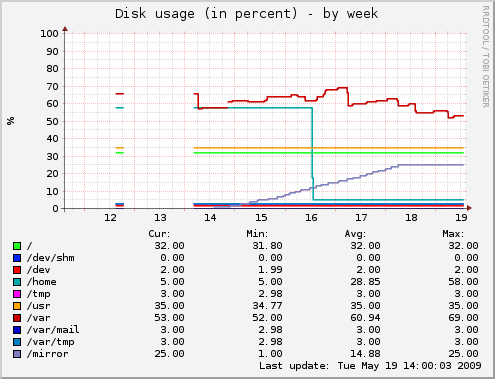
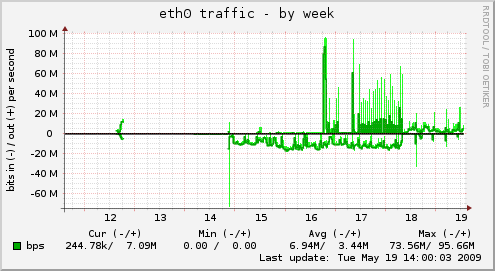
You might have noticed that during last week the Mexican Debian mirror, nisamox.fciencias.unam.mx (a.k.a. ftp.mx.debian.org, a.k.a. debian.unam.mx), went offline. The motherboard died on us, and Facultad de Ciencias was kind enough to give us a brand new one. So, excuse us for the blackout, but we are back Meaner and badder than ever before! Now, Sergio (nisamox's main admin) prefered to rebuild the whole mirror, as there was a shadow of doubt regarding the data integrity. So, rsync was pulling as fast as he could for the whole weekend (leading to some people scratching their heads regarding the 404 for the missing files; sorry, we should have left Apache shut down until the mirror was complete!). After three days of sustaining a 10-20Mbps download from the main mirrors, all 364GB of Debian are finally installed and as you can clearly see we are back to normality, with small, regular mirror pulses and a nice sustained 5-10Mbps (with some up to 40Mbps peaks We have seen up to 100Mbps peaks in the past, and I doubt with the current network infrastructure we won't top that). You can see we have currently plenty of disk space still to fill up. Among our plans is to host the most popular ISOs, which are a common request, and... What else? Well, ask us and we shall do so (quite probably). Ethernet usage over the last week Disk space usage over the last week So, if you switched away from ftp.mx.debian.org due to our downtime, readjust your mirror settings. Nisamox is back!
AttachmentSize
Nisamox Ethernet statistics for the last week23.38 KB
Nisamox disk space statistics for the last week24.29 KB

Obey Arthur Liu: PGP/GPG transition 8CA99047 -> 29C0FFEE *

Here comes the new 4096 bit RSA key, replacing the old (2002) 8CA99047 1024 bit DSA key:
pub  4096R/29C0FFEE 2009-05-18
  Key fingerprint = 9590 8AA6 E4F7 BAA7 8BD6  C148 F1A6 9BE4 29C0 FFEE
uid  Obey Arthur Liu <arthur@milliways.fr>
uid  Obey Arthur Liu <obey.liu@ensimag.imag.fr>
uid  Obey Arthur Liu <graffit@graffit.net>
uid  Obey Arthur Liu <obey.liu@lzb.fr>
uid  Obey Arthur Liu <arthur.randolph@gmail.com>
sub  4096R/15D7FD9B 2009-05-18
In other news, I found a great flatshare on Riedmattstrasse in Kreis 3 in Z rich with a fellow Google summer intern. Thanks to all (Jeroen, Martin, Jaroslavs, Giacomo..) who gave me pointers about finding accomodation in Z rich. I m looking forward to a great summer there. coffee * It did involve generating about 40 millions gpg keys on a few tr s badass computing clusters UPDATE: Come on guys. Of course I followed basic key management rules. The clusters which generated the actual final keys were under my direct control and the particular slice which generated this published key is on my desk.

17 May 2009

Russell Coker: Appropriate Talks about Porn

There is currently some discussion about a talk which used pornographic imagery and jokes to illustrate points about Ruby programming [1]. A similar event happened in 2006 here is the description of the event from the author - which includes an unreserved apology [2]. It seems to me that the current discussion focusing on what is inappropriate for a public lecture is the wrong way to do it as there is a vast range of inappropriate material. I suggest that instead a white-list of appropriate references to porn in lectures will be more effective - if nothing else it makes for a much smaller list. Here is a first draft of such a list:

  1. Pornographic web sites handle a lot of traffic. There are significant technical problems that need to be solved. A lecture from an employee of an Internet porn company which covers the solutions to those technical problems would be of interest to many system administrators. Of course such a lecture should not promote the Internet porn company or show any samples of their products.

  2. Digital processing of images is an interesting topic. Having a digital editor from a magazine such as Vogue describe in detail how they do their job would be really interesting. There is a lot of overlap between the range of pictures displayed in Vogue and those displayed on porn sites. Having an employee of a porn company demonstrate how they touch up the picture of a fully clothed model would be an interesting technical topic, but of course it would be totally inappropriate to make any specific mentions of how the parts of the picture which are not PG-13 rated are edited. Even showing a picture of a porn star might be controversial, but I m sure that the same work could be reproduced with a photo of someone who has a more respectable career. Touching up a picture of RMS to make him look like a politician would make for a challenge for the presenter and an interesting lecture.

  3. The image known as Lenna is a photograph of a Playboy model named Lena that is widely used to test image compression [3]. While the image remains controversial, it seems to me that it would be impossible to give a complete and factual account of the history of image compression without mentioning it.

  4. The police have great discretionary powers to determine which crimes should be actively investigated. Senior police decide how many resources to assign to each case. I believe that in many jurisdictions the police will assign a much lower priority to a hacking case if the victim is running a porn service. Rumor has it that porn sites put a lot more effort into system security than most Internet services, partly due to not having as much protection from the police as other industries and partly because their customers don t want to be identified. I would be very interested in attending a presentation about practical computer security by a system administrator from a porn site. As an aside I m always interested in talking to people who do security work, so I would like to have a chat with someone who does such work for a porn site.

  5. A few years ago I attended a lecture about the security implications of porn surfing. It had some scary statistics on the number of porn sites that try to deploy malware on the computers of the people who view porn, and it made a good business case for banning porn at work without reference to HR issues (which is very relevant for the jurisdictions where viewing porn at work is not considered to be a social problem). I would like to see a new version of that talk with statistics based on more recent research, my theory is that modern porn sites are more toxic than the old ones due to the general increase in criminal activity on the net - but I have no evidence to support it.

Of course in all cases jokes about porn are not acceptable, mentions of porn need to be strictly on the basis of historical analysis or the description of technical and legal issues which are relevant to the audience. Delivering a talk about porn without inappropriate jokes would take a great deal of effort, but it can be done (and I ve seen it done once). For these five cases (and the few others that will probably be suggested in comments) it would probably be best if the conference organisers viewed the talk first to ensure that there was no misunderstanding about what is appropriate. I think that comparing a short list of specific cases where porn can reasonably be mentioned in a public lecture with the vast number of potential inappropriate references illustrates the probability of a random porn reference being acceptable. The probability of making a random porn reference that is appropriate is probably slightly less than that of winning the lottery.

16 May 2009

Martin Michlmayr: Automatic power on QNAP Turbo Station devices

All ARM based QNAP machines can turn on automatically when power is applied if the device was not powered down correctly. This is helpful when your power goes down. Follow the instructions below if you want to turn automatic power on using Debian on a QNAP TS-109, TS-119, TS-209, TS-219, TS-409 or TS-409U. Edit the file /etc/apt/sources.list and add the following line:
deb http://people.debian.org/~tbm/orion lenny main
Now install a new version of qcontrol:
apt-get update
apt-get install qcontrol
Finally, turn the automatic power feature on:
qcontrol -d &
qcontrol autopower on
kill %1
rm /var/run/qcontrol.sock

Kartik Mistry: Indic Developers Meet 2009


* I reach Pune yesterday, had nice dinner with Gora, Ramky, Shantanu, Karaunakar, Both Raviji and Chacha Chaudhari :) Beer before and after dinner gave me awesome feeling during dream too! Met ankit/kushal and l10n folks after long time! Currently enjoying interesting session on Indic OCR using Tesseract by Debayan. Entire schedule is here. * Wiki Updates:
Development Track: http://www.indlinux.org/wiki/index.php/Development_track
Localization Track: http://www.indlinux.org/wiki/index.php/Localisation_track

Marco d'Itri: Installing Debian on the Sheevaplug

This document explains how to use deboostrap --foreign to build from scratch and install a minimal Debian system on the Sheevaplug (but it is equally applicable to many other embedded systems). The only piece missing to be able to install from bare metal is a working kernel and initramfs pair, so this document assumes that you already have a kernel which can mount the root file system from a USB key. For the Sheevaplug, the factory kernel in the internal NAND flash will work fine. The Debian kernel package puts us in a chicken and egg situation: it cannot mount the root without an initramfs (because all drivers are modular), but we cannot build one until we can boot the system. I suppose that, as an exercise of style, somebody could create a minimal initramfs with busybox and the kernel modules needed to mount the root and then mount it manually, but if you really lack a working kernel then it's probably faster to boot the file system image for the first time using qemu and the "versatile" debian-installer target. The first step is to run the first stage of debootstrap on another system (which does not need to be ARM), to build a temporary root file system. I use the --variant and --include options to build the smallest possible system with network support, but they can be omitted.
debootstrap \
         --foreign --arch=armel \
         --variant=minbase \
         --include=linux-image-2.6-kirkwood,module-init-tools,udev,netbase,
                   net-tools,ifupdown,iproute,whiptail,vim-tiny \
         sid ./target/ http://ftp.it.debian.org/debian/
As usual when using debootstrap, some manual configuration is needed:
cd target/
echo bokassa.mi.bofh.it > etc/hostname
vi etc/network/interfaces
vi etc/resolv.conf
echo LANG=C > etc/default/locale
echo '127.0.0.1 localhost' > etc/hosts
cat <<END > etc/fstab
/dev/root / ext3 noatime 0 1
tmpfs /tmp tmpfs defaults 0 0
#/tmp /var/tmp none bind 0 0
END
I took some hints from http://wiki.debian.org/ReadonlyRoot to reduce writes to the flash file system:
# the blkid cache is evil anyway
ln -s /dev/null etc/blkid.tab
# this link will be created anyway by the package
ln -s /var/lib/initscripts/nologin etc/nologin
# it's better to not use a static mtab with modern kernels
ln -s /proc/mounts etc/mtab
# unless you plan to use multiple removable network interfaces, persistent
# interface names are not needed
: > etc/udev/rules.d/75-persistent-net-generator.rules
Two small workarounds are needed:
# if this is not set then the preinst of linux-image-* will die trying
# to ask a debconf question in the debootstrap second stage
echo 'do_initrd = yes' > etc/kernel-img.conf
# a workaround for bug #520742
: > etc/udev/disabled
Now you can format a USB pen drive and copy the root file system on it:
mke2fs /dev/sdb1
tune2fs -i 0 -c 0 /dev/sdb1
mount /dev/sdb1 /mnt/
rsync -aH target/ /mnt/
umount /mnt/
After powering the plug press a key to get to the U-Boot prompt and use the factory kernel to boot from USB:
setenv bootargs console=ttyS0,115200 root=/dev/sda1 rootdelay=10 panic=10 init=/bin/bash
run bootcmd
Then you can run the second stage of debootstrap, finish the bare minimal configuration and start init:
./debootstrap/debootstrap --second-stage
# disable the gettys for /dev/tty[1-6], which do not exist
vi /etc/inittab
# and add one for the serial console
echo 'T0:2345:respawn:/sbin/getty -L ttyS0 115200 linux' >> /etc/inittab
# do not forget to set the root password or you will not be able to login...
vi /etc/shadow
rm /etc/udev/disabled
exec /bin/bash
mount / -o ro,remount
exec /sbin/init
Congratulations, now you can login on the system and start to install the packages you like:
echo 'deb http://ftp.it.debian.org/debian/ unstable main' > /etc/apt/sources.list
echo 'APT   Install-Recommends "false";  ;' > /etc/apt/apt.conf.d/no-recommends
apt-get update
# dash is much faster
apt-get install dash
dpkg-divert --add /bin/sh
ln -sf dash /bin/sh
# I do not like these, YMMV
rm /vmlinuz /initrd.img
rmdir /selinux /srv
# the kernel is able to read the time from the RTC by itself, and this
# will allow using a read only root
echo HWCLOCKACCESS=no >> /etc/default/rcS
# faster boot
echo CONCURRENCY=shell >> /etc/default/rcS
# useless on this platform
mv /etc/rcS.d/S01glibc.sh /etc/rcS.d/K01glibc.sh
dpkg-reconfigure tzdata
apt-get install openssh-server screen iptables wget less
U-Boot requires that the kernel and initramfs have a special header:
apt-get uboot-mkimage
cd /boot/
mkimage -A arm -O linux -T kernel  -C none -a 0x00008000 -e 0x00008000 \
  -n Linux-2.6.29-2 -d vmlinuz-2.6.29-2-kirkwood uImage
mkimage -A arm -O linux -T ramdisk -C gzip -a 0x00000000 -e 0x00000000 \
  -n initramfs -d initrd.img-2.6.29-2-kirkwood uInitrd
Now you can reboot and configure u-boot to boot from the USB device. This is the variables scheme I like and it is not mandatory in any way, so I recommend that you read and understand the existing configuration before modifying it (some lines have been broken for readability):
setenv bootargs_nand $(bootargs)
setenv bootcmd_nand $(bootcmd)
setenv bootargs_root root=/dev/sda1
setenv bootargs_misc 'ro panic=10
  mtdparts=nand_mtd:0x400000@0x100000(uImage),0x1fb00000@0x500000(rootfs)'
setenv bootcmd_usb 'usb start; ext2load usb 0:1 0x00200000 /boot/uImage;
  ext2load usb 0:1 0x01100000 /boot/uInitrd'
setenv bootcmd 'setenv bootargs $(console) $(bootargs_root) $(bootargs_misc)
  $(bootargs_more); run bootcmd_usb; bootm 0x00200000 0x01100000'
Since now you are not using anymore the Marvell kernel tree it is mandatory to set these two variables and reboot:
setenv mainlineLinux yes
setenv arcNumber 2097
saveenv
reset
Installation to SD is identical, but requires an updated version of U-Boot with SD support. Due to a kernel bug which prevents autoloading the driver you will need to add mvsdio and mmc_block to /etc/initramfs-tools/modules and rebuild the initramfs. (Yes, the naming theme I use at home is "african dictators"...)

14 May 2009

Russell Coker: The Main Security Problem

All security problems are to some degree people problems. Code may be buggy, but it was written by people who could have been better trained, had more time to spend on code review, etc. When there are multiple programs, OSs, libraries, etc to choose from then choosing a suitable combination of software is a matter of the skill and background knowledge of the people involved. There are issues of software choice where there is no provable benefit of making one particular choice, EG choosing between a popular product that is OK and for which it is easy to hire skilled people to use it and a less popular product that has better security features but less public knowledge. But this is minor compared to other security problem. I believe that the greatest security problem is stupid people. Stupid people in technical positions write buggy code and configure servers to be insecure. In consulting and analysis roles they develop bad procedures. In management they hire bad people to do technical work. The vast majority of security problems can be fairly directly and immediately traced back to stupidity. In the corporate environment that is stupid programmers, stupid managers who hire people who are obviously stupid, and often stupid executives for mandating that software that everyone knows to be insecure should be used across the entire enterprise. In both the home and corporate environments there are a huge number of people who run machines that they know to be compromised. Apparently using a computer that is known to be under the control of an unknown hostile person is something that they don t consider to be a problem - in spite of the obvious risks of fraud, data destruction, and risk of being implicated in crimes such as the distribution of child porn.

13 May 2009

Jonathan McDowell: Breaking the Web of Trust

With all the discussion about SHA-1 weaknesses and generation of new OpenPGP keys going on there's some concern about how the web of trust will be affected. I'm particularly interested in the impact on Debian; while it's possible to add new keys and keep the old ones around that hasn't worked so well for us with the migration away from PGPv3 keys. We still have 125 v3 keys left, many of them for users who also have a v4 key but haven't asked for the v3 key to be removed or responded to my email prodding them about it. I don't want to repeat that.

So if we're looking at key replacement we need to have some idea about where our Web of Trust currently stands, and what effect various changes might have on it. I managed to find the keyrings Debian shipped all the way back to slink and ran the keyanalyze and cwot stats against them. I then took the current keyring, pull in all the updates for the keys in it (so that any signatures from newly generated keys would be included) and ran the stats again. Finally I took details of 12 key migrations (mostly from Debian Planet but also a couple of others I knew about) and calculated what the effect of removing each key would be. These stats are cumulative and I replaced the most well connected (by centrality) keys first.

The results are below.

TotalSCSReachableMSDCentrality
1999-02-06 (slink)22836(15.78%)50 (21.92%)2.9022
2000-01-03 (potato)375104 (27.73%)180 (48.00%)4.3382
2001-09-22 (woody)948538 (56.75%)704 (74.26%)4.73202008.6249
2005-05-28 (sarge/etch) 1106883 (79.83%)969 (87.61%)3.34852074.6604
2007-12-0411911001 (84.04%)1062 (89.16%)3.11032113.3747
2009-01-18 (lenny)1126947 (84.10%)1010 (89.69%)3.04891941.2594
2009-04-04 (squeeze/sid)1121946 (84.38%)1008 (89.91%)3.04661936.9761
2009-05-06 (current)1067894 (83.78%)958 (89.78%)2.96701759.4363
TotalSCSReachableMSDCentrality
base1067904 (84.72%)959 (89.87%)2.96401776.4389
update-93sam1067902 (84.53%) 958 (89.78%)2.97341780.9874
update-joerg1067900 (84.34%) 958 (89.78%)2.97761780.7578
update-aurel321067898 (84.16%) 957 (89.69%)2.98031779.2497
update-noodles1067896 (83.97%) 956 (89.59%)2.98311777.8326
update-jaldhar1067896 (83.97%) 955 (89.50%)2.98551779.9193
update-srivasta1067896 (83.97%) 955 (89.50%)2.99041784.3382
update-ana1067895 (83.88%) 954 (89.40%)2.99261784.3102
update-nobse1067893 (83.69%) 953 (89.31%)2.99471782.2392
update-neilm1067892 (83.59%) 951 (89.12%)2.99741782.6098
update-reg1067891 (83.50%) 950 (89.03%)2.99771780.8515
update-rmayorga1067890 (83.41%) 949 (88.94%)2.99841779.4910
update-evgeni1067889 (83.31%) 948 (88.84%)2.99741776.6445

This is actually more hopeful than I thought. There's an obvious weakening as a result of the migrations, but the MSD stays under 3 and the centrality stays fairly constant too. The reachable/SCS counts do decrease, but at this point it looks fairly linear rather than an instant partition. Of course the more keys that are removed the more likely this is to drop off suddenly. Counteracting that DebConf9 is coming up which will provide a good opportunity for normally geographically disperse groups to cross sign, reinforcing the WoT for these new keys.

Either way I at least have a better handle on the current state of play, which gives me something to work with when thinking about how to proceed. For now, bed.

Martin Michlmayr: Update on QNAP TS-119/TS-219 kernel support

I mentioned a few weeks ago that initial kernel support for the QNAP TS-119 and TS-219 Turbo NAS got accepted for 2.6.30 but that there were some issues left. Here's an update: The SATA and flash fixes are already in our 2.6.29 kernel.

Jordi Mallach: Spanish Cup final in Val ncia

Val ncia is again taken over by football fans, who have come from all over the Basque Country and Catalunya to watch the Copa de Espa a final in Mestalla stadium. The city is literally tinted in red, white, blue and maroon and thousands of supporters (more than 60.000) have flooded the streets. If you can't beat them, join them, so for a change, I'm going to join the crazyness and will go to the Athletic Hiria to watch the game in the middle of the leonera. I can't wait to see how the Basque and Catalan supporters who have tickets for the game will react when the King of Spain enters the VIP area in Mestalla. Apparently, more powerful loudspeakers have been installed in the stadium in an attempt to mitigate what I expect to be the biggest catcall in a Spanish football stadium since we have a King... Gora Bar a, Visca l'Athletic!

11 May 2009

Sandro Tosi: PyCon3 Italia is over: retrospective and perspective for myself

PyCon3 Italia ended yesterday. It was simply great! great talks, gorgeous speakers and so on.

Sadly, when I left these kind of confs there's always a bad taste in my month... I see so many great people that made it, that are satisfied, brilliant and accomplish great results.

Now I feel like I'm one of many, but I want to be one above many; one of Them. Ok, ok, sounds a little bit presumptuous and we all know I'll never be like them but why not trying? ;)

The same thing happened after PyCon2, and I decided I wanted to do more, to be more.

Since an year passed, I think I've done a bit of my proposal: I started using Python as much as I can, I get involved in some project python-related (to name some: reportbug, bts-link, matplotlib) and I'm about at the half of writing a book on matplotlib (that I was offered to write).

I can be a little satisfied by this, but of course, I want to do more! :)

Once the book will be done, I'll probably still be involved with matplotlib evolution, eventually with more important contributions, but I will also search for new challenges.

It might sound ambitious, but I have a strange feeling that python core "stuff" (being the interpreter, the stdlib or near) could be something I can have a look at ;) It could also come up as a too big project to work on in my spare time, but I'll rebase my plan once I've fight for it and lose, not before.

Russell Coker: Dom0 Memory Allocation and X

I ve previously written about memory squeeze problems in a Xen Dom0 when large amounts of memory were assigned to DomUs [1]. In summary the Dom0 would have problems if started with default options and the majority of the RAM was later assigned to DomUs, but if the memory of the Dom0 was limited by the dom0_mem parameter to the Xen kernel then things would work well. Fatal server error:
xf86MapVidMem: Could not mmap framebuffer (0xfae80000,0 80000) (Invalid argument) I have since found another exciting bug with Xen. I was in the process of upgrading an AMD64 workstation to using Xen so that I could test other versions of some software in the background. The first stage was to install the Xen kernel and the Xen enabled Linux kernel and boot the machine. Unfortunately I then received the above message when trying to start the X server. I discovered the solution to this in the comments section of Different Colours blog post about Virtualisation on Lenny [2]. It seems that there is a problem gaining mmap access to MMIO memory regions in Xen and that restricting the memory of the Dom0 is a work-around. My AMD64 workstation has 3G of RAM because the motherboard can t support more than 3.25G and buying 4G of RAM to have 3.25G usable would be an expensive way of doing it. So I used dom0_mem=1500M and now X works again. I have yet to discover if anything strange and exciting happens when I create DomUs on the machine. I don t have any immediate plans for running Xen on the machine. It s main uses at the moment is torcs (a slightly realistic 3D car racing game), supertuxkart (a cartoon 3D car racing game), and mplayer so it doesn t really need a lot of RAM. I like to keep my options open and have all my machines capable of virtualisation apart from routers.

10 May 2009

Steve Kemp: Did you feel it in your knees

This post is being made from my EEEEEeeee PC, using a 3G modem plugged into the USB port. The fact that I'm sat on my sofa, within easy reach of both a network cable and multiple WiFi access points is irrelevant! I started my adventure yesterday evening, getting pretty annoyed along the way that that it wasn't just plug and go. It turns out I was suffering from two problems: In short from my Lenny installation I had to upgrade to Sid to get a copy of Network Manager with a "Mobile Broadband" section in its preferences. (I looked for backports, to no avail, and I didn't have the patience to make one mysefl). The new connection looks like this:
Number*99#
Username[blank]
Passwordpassword
APNm-bb.o2.co.uk
PIN0000
PUK0000
Once I added the connection discovered the USB modem device (/dev/ttyUSB0) just didn't work - and I learned about the dual-nature of the device. Thankfully switching is nice and easy "apt-get install usb-modeswitch" then:
# disable storage
usb_modeswitch -v 12d1 -p 1003 -d 1
# enable modem
usb_modeswitch -v 12d1 -p 1003 -H 1
Once that was done the connection worked almost immediately. (I just had to upgrade to a 2.6.29 kernel because I got panics on the Lenny kernel; something the upgrade installed but I'd previously ignored. Kernels: Bane of my life.) Update: I do see some kernel weirdness talking about timeouts talking to the USB-serial device. Perhaps something to investigate in the future. Anyway running a 3G O2 PAYG (pay as you go) modem on Debian, on an EEEPC is possible, it is justfiddlier than I had expected, and it required an upgrade to Sid - since Lenny didn't have a network manager with mobile broadband support. For google's benefit the modem is described by O2 as a "mobile broadband USB modem - E160". This appears under lsusb as :
Bus 001 Device 005: ID 12d1:1003 Huawei Technologies Co., Ltd.
E220 HSDPA Modem / E270 HSDPA/HSUPA Modem
Hope that helps somebody else spend less than 5 hours getting it working. I guess the friends who said "It just worked" were running Ubuntu and so had a slightly newer network manager by default - and possibly their modems didn't need to toggle between "dumb storage" and "actual modem" modes. Anyway it works now, and even though it was fiddly the issue wasn't insurmountable. I'm just a little grumpy because I've gotten used to a world in which Debian just works - the last time I struggled to get new hardware toys playing nice was .. a long time ago. ObFilm: Pretty In Pink

9 May 2009

David Paleino: OpenPGP key transition announcement

Because of the recently announced attack against the SHA-1 digest algorithm, I finally decided to move away from my old 1024-bit DSA OpenPGP key, landing to a shiny new 4096-bit RSA one. The old key will continue to be valid for some time, but I prefer all future correspondence to come to the new one. I would also like this new key to be re-integrated into the web of trust. I'm attaching a file with
the complete text of the transition, clearsigned by both keys to certify the transition. You can find the transition statement also on http://www.hanskalabs.net/key-transition_20090509.txt . You can check the validity of the file with something like:
$ gpg --decrypt key-transition_20090509.txt   gpg --decrypt
If you need to transition your key too, and you're one of my signees, then let's please coordinate, so that we have the new keys cross-signed, without spurious signatures fromgoing-to-be-revoked keys Smile Thank you for your help.
AttachmentSize
key-transition_20090509.txt4.03 KB

Biella Coleman: Fresh

If you are into sustainable farming this movie will likely catch your fancy.There is a screening here in NYC at the end of May. Supposedly they are going to stream the movie online, which I certainly hope to be the case. A political documentary that is behind bars is really not so useful and is a contradictory project as well. If you are into the idea of farming but live in the city, and New York City in specific, you can attend a Htink workshop on May 17th and start urban farming.

Next.

Previous.