
Search Results: "sto"

20 October 2015

Dirk Eddelbuettel: Rblpapi 0.3.1

The first update to the Rblpapi package since the initial CRAN upload in August is now available. Rblpapi connects R to the Bloomberg system, giving access to a truly vast array of time series data and custom calculations. This release brings a new beqs() functions to access the results from Bloomberg EQS queries, improves the build system a correct a bug in the retrieval of multiple tick series. The changes are detailed below.
Changes in Rblpapi version 0.3.1 (2015-10-19)
  • Added beqs() to run Bloomberg Equity Screen Search, based on initial PR #79 by Rademeyer Vermaak, reworked in PRs #83 and #84 by Dirk; closes tickets #63 and #80.
  • Bloomberg header and library files are now cached locally instead of being re-downloaded for every build (PR #78 by Dirk addressing issue #65).
  • For multiple ticks, time-stamps are unique-yfied before merging (PR #77 by Dirk addressing issue #76).
  • A compiler warning under new g++ versions is now suppressed (PR #69 by John, fixing #68).
Courtesy of CRANberries, there is also a diffstat report for the this release. As always, more detailed information is on the Rblpapi. Questions, comments etc should go to the issue tickets system at the GitHub repo.

This post by Dirk Eddelbuettel originated on his Thinking inside the box blog. Please report excessive re-aggregation in third-party for-profit settings.

18 October 2015

Lunar: Reproducible builds: week 25 in Stretch cycle

What happened in the reproducible builds effort this week: Toolchain fixes Niko Tyni wrote a new patch adding support for SOURCE_DATE_EPOCH in Pod::Man. This would complement or replace the previously implemented POD_MAN_DATE environment variable in a more generic way. Niko Tyni proposed a fix to prevent mtime variation in directories due to debhelper usage of cp --parents -p. Packages fixed The following 119 packages became reproducible due to changes in their build dependencies: aac-tactics, aafigure, apgdiff, bin-prot, boxbackup, calendar, camlmix, cconv, cdist, cl-asdf, cli-common, cluster-glue, cppo, cvs, esdl, ess, faucc, fauhdlc, fbcat, flex-old, freetennis, ftgl, gap, ghc, git-cola, globus-authz-callout-error, globus-authz, globus-callout, globus-common, globus-ftp-client, globus-ftp-control, globus-gass-cache, globus-gass-copy, globus-gass-transfer, globus-gram-client, globus-gram-job-manager-callout-error, globus-gram-protocol, globus-gridmap-callout-error, globus-gsi-callback, globus-gsi-cert-utils, globus-gsi-credential, globus-gsi-openssl-error, globus-gsi-proxy-core, globus-gsi-proxy-ssl, globus-gsi-sysconfig, globus-gss-assist, globus-gssapi-error, globus-gssapi-gsi, globus-net-manager, globus-openssl-module, globus-rsl, globus-scheduler-event-generator, globus-xio-gridftp-driver, globus-xio-gsi-driver, globus-xio, gnome-control-center, grml2usb, grub, guilt, hgview, htmlcxx, hwloc, imms, kde-l10n, keystone, kimwitu++, kimwitu-doc, kmod, krb5, laby, ledger, libcrypto++, libopendbx, libsyncml, libwps, lprng-doc, madwimax, maria, mediawiki-math, menhir, misery, monotone-viz, morse, mpfr4, obus, ocaml-csv, ocaml-reins, ocamldsort, ocp-indent, openscenegraph, opensp, optcomp, opus, otags, pa-bench, pa-ounit, pa-test, parmap, pcaputils, perl-cross-debian, prooftree, pyfits, pywavelets, pywbem, rpy, signify, siscone, swtchart, tipa, typerep, tyxml, unison2.32.52, unison2.40.102, unison, uuidm, variantslib, zipios++, zlibc, zope-maildrophost. The following packages became reproducible after getting fixed: Packages which could not be tested: Some uploads fixed some reproducibility issues but not all of them: Patches submitted which have not made their way to the archive yet: Lunar reported that test strings depend on default character encoding of the build system in ongl. reproducible.debian.net The 189 packages composing the Arch Linux core repository are now being tested. No packages are currently reproducible, but most of the time the difference is limited to metadata. This has already gained some interest in the Arch Linux community. An explicit log message is now visible when a build has been killed due to the 12 hours timeout. (h01ger) Remote build setup has been made more robust and self maintenance has been further improved. (h01ger) The minimum age for rescheduling of already tested amd64 packages has been lowered from 14 to 7 days, thanks to the increase of hardware resources sponsored by ProfitBricks last week. (h01ger) diffoscope development diffoscope version 37 has been released on October 15th. It adds support for two new file formats (CBFS images and Debian .dsc files). After proposing the required changes to TLSH, fuzzy hashes are now computed incrementally. This will avoid reading entire files in memory which caused problems for large packages. New tests have been added for the command-line interface. More character encoding issues have been fixed. Malformed md5sums will now be compared as binary files instead of making diffoscope crash amongst several other minor fixes. Version 38 was released two days later to fix the versioned dependency on python3-tlsh. strip-nondeterminism development strip-nondeterminism version 0.013-1 has been uploaded to the archive. It fixes an issue with nonconformant PNG files with trailing garbage reported by Roland Rosenfeld. disorderfs development disorderfs version 0.4.1-1 is a stop-gap release that will disable lock propagation, unless --share-locks=yes is specified, as it still is affected by unidentified issues. Documentation update Lunar has been busy creating a proper website for reproducible-builds.org that would be a common location for news, documentation, and tools for all free software projects working on reproducible builds. It's not yet ready to be published, but it's surely getting there. Homepage of the future reproducible-builds.org website  Who's involved?  page of the future reproducible-builds.org website Package reviews 103 reviews have been removed, 394 added and 29 updated this week. 72 FTBFS issues were reported by Chris West and Niko Tyni. New issues: random_order_in_static_libraries, random_order_in_md5sums.

Hideki Yamane: Who freezes my laptop?

After reboot, suddenly my laptop cannot boot :-(
Then, tried to login rescue mode but root account is disabled.

Then, use USBstick to boot Ubuntu and mount encrypted volume, make root enabled.

After checking syslog, libvirt calls dmidecode and it seems that something is wrong with it.

Removed gnome-boxes and libvirt*, reboot my system and I can see login dialog by gdm3.

However, after login, I tried to exec dmidecode but nothing happened.

Also installing gnome-boxes and libvirt* packages and reboot is okay.

Okay, back to nomal. But....hmmm...? Who stole my time??

17 October 2015

Sven Hoexter: TclCurl snapshot uploaded to unstable

While I was pondering if I should drop the tclcurl package and get it removed from Debian Christian Werner from Androwish (a Tcl/Tk port for Android) started to fix the open bugs. Thanks a lot Christian! I've now uploaded a new TclCurl package to unstable based on the code in the new upstream repository plus the patches from Christian. In case you're one of the few TclCurl users out there please try the new package. I'm still pondering if it's worth to keep the package. For the last five years or so I could get along with the Tcl http module just fine and thus no longer use TclCurl myself. In case someone would like to adopt it just write me a mail, I'd be happy to give it away.

Joey Hess: it's a bird, it's a plane, it's a super monoid for propellor

I've been doing a little bit of dynamically typed programming in Haskell, to improve Propellor's Info type. The result is kind of interesting in a scary way. Info started out as a big record type, containing all the different sorts of metadata that Propellor needed to keep track of. Host IP addresses, DNS entries, ssh public keys, docker image configuration parameters... This got quite out of hand. Info needed to have its hands in everything, even types that should have been private to their module. To fix that, recent versions of Propellor let a single Info contain many different types of values. Look at it one way and it contains DNS entries; look at it another way and it contains ssh public keys, etc. As an migr from lands where you can never know what type of value is in a $foo until you look, this was a scary prospect at first, but I found it's possible to have the benefits of dynamic types and the safety of static types too. The key to doing it is Data.Dynamic. Thanks to Joachim Breitner for suggesting I could use it here. What I arrived at is this type (slightly simplified):
newtype Info = Info [Dynamic]
    deriving (Monoid)
So Info is a monoid, and it holds of a bunch of dynamic values, which could each be of any type at all. Eep! So far, this is utterly scary to me. To tame it, the Info constructor is not exported, and so the only way to create an Info is to start with mempty and use this function:
addInfo :: (IsInfo v, Monoid v) => Info -> v -> Info
addInfo (Info l) v = Info (toDyn v : l)
The important part of that is that only allows adding values that are in the IsInfo type class. That prevents the foot shooting associated with dynamic types, by only allowing use of types that make sense as Info. Otherwise arbitrary Strings etc could be passed to addInfo by accident, and all get concated together, and that would be a total dynamic programming mess. Anything you can add into an Info, you can get back out:
getInfo :: (IsInfo v, Monoid v) => Info -> v
getInfo (Info l) = mconcat (mapMaybe fromDynamic (reverse l))
Only monoids can be stored in Info, so if you ask for a type that an Info doesn't contain, you'll get back mempty. Crucially, IsInfo is an open type class. Any module in Propellor can make a new data type and make it an instance of IsInfo, and then that new data type can be stored in the Info of a Property, and any Host that uses the Property will have that added to its Info, available for later introspection.
For example, this weekend I'm extending Propellor to have controllers: Hosts that are responsible for running Propellor on some other hosts. Useful if you want to run propellor once and have it update the configuration of an entire network of hosts. There can be whole chains of controllers controlling other controllers etc. The problem is, what if host foo has the property controllerFor bar and host bar has the property controllerFor foo? I want to avoid a loop of foo running Propellor on bar, running Propellor on foo, ... To detect such loops, each Host's Info should contain a list of the Hosts it's controlling. Which is not hard to accomplish:
newtype Controlling = Controlled [Host]
    deriving (Typeable, Monoid)
isControlledBy :: Host -> Controlling -> Bool
h  isControlledBy  (Controlled hs) = any (== hostName h) (map hostName hs)
instance IsInfo Controlling where
    propigateInfo _ = True
mkControllingInfo :: Host -> Info
mkControllingInfo controlled = addInfo mempty (Controlled [controlled])
getControlledBy :: Host -> Controlling
getControlledBy = getInfo . hostInfo
isControllerLoop :: Host -> Host -> Bool
isControllerLoop controller controlled = go S.empty controlled
  where
    go checked h
          controller  isControlledBy  c = True
        -- avoid checking loops that have been checked before
          hostName h  S.member  checked = False
          otherwise = any (go (S.insert (hostName h) checked)) l
      where
        c@(Controlled l) = getControlledBy h
This is all internal to the module that needs it; the rest of propellor doesn't need to know that the Info is using used for this. And yet, the necessary information about Hosts is gathered as propellor runs.
So, that's a useful technique. I do wonder if I could somehow make addInfo combine together values in the list that have the same type; as it is the list can get long. And, to show Info, the best I could do was this:
 instance Show Info where
            show (Info l) = "Info " ++ show (map dynTypeRep l)
The resulting long list of the types of vales stored in a host's info is not a useful as it could be. Of course, getInfo can be used to get any particular type of value:
*Main> hostInfo kite
Info [InfoVal System,PrivInfo,PrivInfo,Controlling,DnsInfo,DnsInfo,DnsInfo,AliasesInfo, ...
*Main> getInfo (hostInfo kite) :: AliasesInfo
AliasesInfo (fromList ["downloads.kitenet.net","git.joeyh.name","imap.kitenet.net","nntp.olduse.net" ...
And finally, I keep trying to think of a better name than "Info".

Russell Coker: Mail Server Training

Today I ran a hands-on training session on configuring a MTA with Postfix and Dovecot for LUV. I gave each student a virtual machine running Debian/Jessie with full Internet access and instructions on how to configure it as a basic mail server. Here is a slightly modified set of instructions that anyone can do on their own system. Today I learned that documentation that includes passwords on a command-line should have quotes around the password, one student used a semi-colon character in his password which caused some confusion (it s the command separator character in BASH). I also discovered that trying to just tell users which virtual server to login to is prone to errors, in future I ll print out a list of user-names and passwords for virtual servers and tear off one for each student so there s no possibility of 2 users logging in to the same system. I gave each student a sub-domain of unixapropos.com (a zone that I use for various random sysadmin type things). I have changed the instructions to use example.com which is the official address for testing things (or you could use any zone that you use). The test VMs that I setup had a user named auser , the documentation assumes this account name. You could change auser to something else if you wish. Below are all the instructions for anyone who wants to try it at home or setup virtual machines and run their own training session. Basic MTA Configuration
  1. Run apt-get install postfix to install Postfix, select Internet Site for the type of mail configuration and enter the domain name you selected for the mail name.
  2. The main Postfix configuration file is /etc/postfix/main.cf. Change the myhostname setting to the fully qualified name of the system, something like mta.example.com.
    You can edit /etc/postfix/main.cf with vi (or any other editor) or use the postconf command to change it, eg postconf -e myhostname=mta.example.com .
  3. Add home_mailbox=Maildir/ to the Postfix configuration to make it deliver to a Maildir spool in the user s home directory.
  4. Restart Postfix to apply the changes.
  5. Run apt-get install swaks libnet-ssleay-perl to install swaks (a SMTP test tool).
  6. Test delivery by running the command swaks -f auser@example.com -t auser@example.com -s localhost . Note that swaks displays the SMTP data so you can see exactly what happens and if something goes wrong you will see everything about the error.
  7. Inspect /var/log/mail.log to see the messages about the delivery. View the message which is in ~auser/Maildir/new.
  8. When other students get to this stage run the same swaks command but with the -t changed to the address in their domain, check the mail.log to see that the messages were transferred and view the mail with less to see the received lines. If you do this on your own specify a recipient address that s a regular email address of yours (EG a Gmail account).
Basic Pop/IMAP Configuration
  1. Run apt-get install dovecot-pop3d dovecot-imapd to install Dovecot POP and IMAP servers.
    Run netstat -tln to see the ports that have daemons listening on them, observe that ports 110 and 143 are in use.
  2. Edit /etc/dovecot/conf.d/10-mail.conf and change mail_location to maildir:~/Maildir . Then restart Dovecot.
  3. Run the command nc localhost 110 to connect to POP, then run the following commands to get capabilities, login, and retrieve mail:
    user auser
    pass WHATEVERYOUMADEIT
    capa
    list
    retr 1
    quit
  4. Run the command nc localhost 143 to connect to IMAP, then run the following commands to list capabilities, login, and logout:
    a capability
    b login auser WHATEVERYOUMADEIT
    c logout
  5. For the above commands make note of the capabilities, we will refer to that later.
Now you have a basically functional mail server on the Internet! POP/IMAP Over SSL To avoid password sniffing we need to use SSL. To do it properly requires obtaining a signed key for a DNS address but we can do the technical work with the snakeoil certificate that is generated by Debian.
  1. Edit /etc/dovecot/conf.d/10-ssl.conf and change ssl = no to ssl = required . Then add the following 2 lines:
    ssl_cert = </etc/ssl/certs/ssl-cert-snakeoil.pem
    ssl_key = </etc/ssl/private/ssl-cert-snakeoil.key
    1. Run netstat -tln and note that ports 993 and 995 are not in use.
    2. Edit /etc/dovecot/conf.d/10-master.conf and uncomment the following lines:
      port = 993
      ssl = yes
      port = 995
      ssl = yes
    3. Restart Dovecot, run netstat -tln and note that ports 993 and 995 are in use.
  2. Run nc localhost 110 and nc localhost 143 as before, note that the capabilities have changed to include STLS/STARTTLS respectively.
  3. Run gnutls-cli --tofu 127.0.0.1 -p 993 to connect to the server via IMAPS and gnutls-cli --tofu 127.0.0.1 -p 995 to connect via POP3S. The --tofu option means to Trust On First Use , it stores the public key in ~/.gnutls and checks it the next time you connect. This allows you to safely use a snakeoil certificate if all apps can securely get a copy of the key.
Postfix SSL
  1. Edit /etc/postfix/main.cf and add the following 4 lines:
    smtpd_tls_received_header = yes
    smtpd_tls_loglevel = 1
    smtp_tls_loglevel = 1
    smtp_tls_security_level = may
    Then restart Postfix. This makes Postfix log TLS summary messages to syslog and in the Received header. It also permits Postfix to send with TLS.
  2. Run nc localhost 25 to connect to your SMTP port and then enter the following commands:
    ehlo test
    quit
    Note that the response to the EHLO command includes 250-STARTTLS, this is because Postfix was configured with the Snakeoil certificate by default.
  3. Run gnutls-cli --tofu 127.0.0.1 -p 25 -s and enter the following commands:
    ehlo test
    starttls
    ^D
    After the CTRL-D gnutls-cli will establish a SSL connection.
  4. Run swaks -tls -f auser@example.com -t auser@example.com -s localhost to send a message with SSL encryption. Note that swaks doesn t verify the key.
  5. Try using swaks to send messages to other servers with SSL encryption. Gmail is one example of a mail server that supports SSL which can be used, run swaks -tls -f auser@example.com -t YOURADDRESS@gmail.com to send TLS (encapsulated SSL) mail to Gmail via swaks. Also run swaks -tls -f auser@example.com -t YOURADDRESS@gmail.com -s localhost to send via your new mail server (which should log that it was a TLS connection from swaks and a TLS connection to Gmail).
SASL SASL is the system of SMTP authentication for mail relaying. It is needed to permit devices without fixed IP addresses to send mail through a server. The easiest way of configuring Postfix SASL is to have Dovecot provide it s authentication data to Postfix. Among other things if you change Dovecot to authenticate in another way you won t need to make any matching changes to Postfix.
  1. Run mkdir -p /var/spool/postfix/var/spool and ln -s ../.. /var/spool/postfix/var/spool/postfix , this allows parts of Postfix to work with the same configuration regardless of whether they are running in a chroot.
  2. Add the following to /etc/postfix/main.cf and restart Postfix:
    smtpd_sasl_auth_enable = yes
    smtpd_sasl_type = dovecot
    smtpd_sasl_path = /var/spool/postfix/private/auth
    broken_sasl_auth_clients = yes
    smtpd_sasl_authenticated_header = yes
  3. Edit /etc/dovecot/conf.d/10-master.conf, uncomment the following lines, and then restart Dovecot:
    unix_listener /var/spool/postfix/private/auth
    mode = 0666
  4. Edit /etc/postfix/master.cf, uncomment the line for the submission service, and restart Postfix. This makes Postfix listen on port 587 which is allowed through most firewalls.
  5. From another system (IE not the virtual machine you are working on) run swaks -tls -f auser@example.com -t YOURADDRESS@gmail.com -s YOURSERVER and note that the message is rejected with Relay access denied .
  6. Now run swaks -tls --auth-user auser --auth-password WHATEVER -f auser@example.com -t YOURREALADDRESS -s YOURSERVER and observe that the mail is delivered (subject to anti-spam measures at the recipient).
  7. Configuring a MUA If every part of the previous 3 sections is complete then you should be able to setup your favourite MUA. Use auser as the user-name for SMTP and IMAP, mail.example.com for the SMTP/IMAP server and it should just work! Of course you need to use the same DNS server for your MUA to have this just work. But another possibility for testing is to have the MUA talk to the server by IP address not by name.

Francois Marier: Introducing reboot-notifier for jessie and stretch

One of the packages that got lost in the transition from Debian wheezy to jessie was the update-notifier-common package which could be used to receive notifications when a reboot is needed (for example, after installing a kernel update). I decided to wrap this piece of functionality along with a simple cron job and create a new package: reboot-notifier. Because it uses the same file (/var/run/reboot-required) to indicate that a reboot is needed, it should work fine with any custom scripts that admins might have written prior to jessie. If you're running sid or strech, all you need to do is:
apt install reboot-notifier
On jessie, you'll need to add the backports repository to /etc/apt/sources.list:
deb http://httpredir.debian.org/debian jessie-backports main

16 October 2015

Vincent Sanders: Raspberries are not the only fruit

I have worked with ARM based systems for longer than I care to admit to myself. From the Acorn Archimedes 305 in 1987 through to modern 64bit systems I have seen many many changes in the ARM community. One big change has been the rise of the inexpensive single board computer (SBC).

Arguably the Raspberry Pi (RPi) was responsible for starting this trend. Before RPi there were small development boards available, I was even involved in producing some of them, none of these really became a big thing and were principally vehicles for silicon vendors to showcase their SoC in an accessible way. When I say accessible I mean for silicon vendors who were previously used to charging many thousands of pounds for their development boards now only charging hundreds.

Raspberry Pi 2 B+ in my case
In my opinion the RPi was a complete disruption to the SBC market. In early 2012 a complete ARM computer system could now be purchased for $35 ( 25) which was substantially cheaper than the best contemporary competitor the Beaglebone $89 ( 60)

To be clear, the reason the RPi succeeded (millions sold, household name) was not on price alone but also the large amount of good supporting software and how easy it was made for teachers and makers to use.

There were several areas that the RPi managed to change perceived issues into opportunities for using what was already available or third parties to provide. There were also several issues raised about the original RPi:
Some of these have been addressed since release as the foundation now sells cases, hardware revisions with much more powerful processors, pre-configured storage, cameras and displays. The important thing to note here though is the RPi has made the bare SBC a much more widely accepted product where all the non critical parts are considered "extras" and a lot is forgiven because of the price.

With that acceptance there have been many, many new SBC coming to market with better peripherals and increasingly competitive pricing. These are technically not clones as none of them use the Broadcom processor of the RPi but they often share many features and possibly even a compatible expansion header.

Banana pi in my case with a 2.5inch drive bay
The Banana Pi was one of these copycats which I acquired for a similar price as an RPi in 2014. The main processor of this system was a 1Ghz dual core Allwinner A20 processor (a considerable advance on the 700MHz single core of the original RPi) coupled to a gigabyte of memory. Additionally the board benefited from having SATA and gigabit Ethernet MAC which made for a much more versatile system. Various third parties filled in the missing peripherals including my own attempt at a case.

I acquired a cubietruck for the NetSurf project to use as a build node in their CI system this is again based on the A20 but with more memory and somewhat better peripheral support but at a substantial cost over the Banana Pi.

The most recent addition to this form factor is the introduction by Xunlong Software of the Orange Pi PC. This little board is the same footprint as the RPi2 B+ design but with differing connector placement. The processor is a quad core 1.6GHz Allwinner H3 with a gigabyte of memory and has has Ethernet and USB but no SATA.

Pile of Orange Pi PC in my cases
The big news about this board though is the price, at $15 ( 10) it resets the price expectations just as the RPi did before it. I was initially sceptical of the quality of the product (or if it would arrive at all) but I have acquired five of these boards and every one of them came well packaged, boxed and in a static bag, just like the RPi does, and they all worked.

I created a case design based on my RPi slimline case so they would be protected when piled up with all the other boards. The use of a DC barrel jack instead of micro USB for power is better in that the connector is more robust and intended for higher current draws but does mean additional leads are needed. There are, however, two flies in the ointment, neither are showstoppers but make the board a little more difficult to use.

Orange Pi in my case with heatsinkOne is a simple necessity of a substantial heatsink on the H3 processor. Initially I used a small 20 x 20mm copper heatsink (around 800mm square surface area) but this was insufficient under full load. I did not want to have to use a fan so I milled some slots into copper round bar, then cut off sections and faced them on a lathe. The completed design had more than 2200 square mm surface area and cost around $2.5 ( 1.5) in material (and a couple of hours in the workshop but that was fun and I made something)

The second issue and arguably much more serious is that of software. Let me be honest, it is dreadful, I mean very bad indeed. The images provided from the Orange Pi website are some of the worst examples of "do something quick" I have experienced.

Fortunately a user on the forums named loboris decided to create scripts that generate a Debian (and Ubuntu and Fedora) distribution images that can be installed from SD card. He relies on a somewhat patched 3.4 kernel full of Allwinner vendor changes and the inevitable binary blobs for the Marli GPU but the result does work.

I have had a few units acting as distcc compiler slaves for two weeks now at 100% CPU loading and they are still running. The processor does not get overly warm with the heatsink installed and Debian behaves just fine. The main caveat being that it is definitely not going to work if you try and update the kernel through packaging.

My ARM build farm as a pile of SBC
The state of software support and Xunlong Software relying on a forum user to complete their product does tarnish an otherwise impressive and possibly market changing SBC.

Perhaps I expect too much for fifteen bucks? I guess when the cost of the case, heatsink, cables and memory storage card is similar to the rest of the computer there is simply no margin left for anything else.

In conclusion hopefully this brief overview has provided some insight into what is available in this market and that the Raspberry Pi is indeed not the only option.

I finish with an image is of my ARM build farm consisting of every SBC I mention here (including a couple of RPi)

Russ Allbery: Review: Ancillary Mercy

Review: Ancillary Mercy, by Ann Leckie
Series: Imperial Radch #3
Publisher: Orbit
Copyright: October 2015
ISBN: 0-316-24668-9
Format: Trade paperback
Pages: 330
This is the third book of the series that starts with Ancillary Justice. Please don't read it out of order. The three books form a rare thing in SF: a trilogy with a clear start and a clear ending. They're ideally read fairly close together so that you can remember the people involved. By the end of Ancillary Sword, Leckie had apparently resolved most of the plot in the Athoek system, although the Ghost Gate and broader imperial turmoil still lurked. I was expecting this novel to be another change of scene, and probably a broadening of the scope into the more sweeping events set off by earlier books. That's not what Ancillary Mercy is at all. Leckie caught me by surprise early, and the book kept not going in the direction I was expecting. And the result is brilliant. It's obviously difficult to talk about this in detail, since there's no way I'm going to spoil this or any of the previous books. This is some of the best SF I've ever read, and I want anyone who's not read the series yet to have the full experience. What I will say is that there was a lot of character growth left, including in some places that I thought would remain setting-mandated blind spots. Leckie tackles some very tricky themes, ones that are hard to do well because of how thoroughly the ground has already been explored, and still manages to find an original take and an even more original tone. And remains true to Breq's characterization throughout, including one critical scene that's masterful in its heart-breaking understatedness. Breq's flat affect is both very difficult and incredibly rewarding as a first-person protagonist. If I had to call out one thing that makes this series so special to me, it's the way that Leckie puts the reader in the middle of a restrained and very careful culture, centers the book on a character with a very unusual relationship to emotion, nearly completely avoids outward displays of feeling, treats emotions primarily as data to be weighed with other information, and yet provides just the right amount of subtle clues and external reflection to show just how central emotion is to everything that happens. This is an incredibly difficult balancing act, much harder than an openly emotional book (let alone the tough-guy cliches that military SF is normally full of), and it makes the occasional pay-offs so rewarding. I think some people might find Ancillary Mercy too understated, but I thought it was note-perfect throughout. And the ending was spectacular. For those who are less enamored of Breq and more interested in the plot, don't worry: we do get some resolution to most of the loose threads. There's clearly potential in this universe for more stories (and apparently more books coming!), but this trilogy comes to a definite end. If I had to quibble, I'd say that a few bits of the plot are too convenient: the resolution would have been impossible without one very critical mistake at the start of the second book, and there's at least one perfectly-timed accident. But Leckie's most critical plot resolution tool was properly hung on the wall in the last book and used perfectly. It's hard to manage a satisfying resolution to a twisty political conflict between very sharp antagonists; for me, at least, Leckie pulls it off. Looking back on the whole series, I find it striking how much more satisfying and believable Leckie's military culture is for her setting than those I normally read. I think we're too often given far-future military stories that are full of impulsive drama, high emotion, and physical feats. But in a world of starships and space stations, advanced computers, careful and systematized roles, and precise engineering, that's not realistic. While there is some physical violence required, problems in that world are more likely to look like operational computer problems than gladiatorial problems. That means the required tools are careful and fast analytical skills, quick iterative decision-making, and precise execution, not physical toughness and grit. In that world, adrenaline is at best useless and often your enemy. Leckie's world of tea sets and emotional control is partly driven by other world-building factors, but, particularly in this book, I was struck by how well-adapted it is to a military where calm decisions and efficient follow-through are far more important than adrenaline-driven courage. The emotion is absolutely there, but the catharsis doesn't come through bloody battles or feats of physicality. Again, so tricky to pull off, since it plays against the expectations we bring as readers to a war story, but I found it so much more satisfying when written well. I also love that this series is not about saving the world, at least in any direct sense. It is about justice, and ethics, and about standing up for what's right, but it's just as much about identity, about how to choose and define one's ethics, and how to make the most of the small number of decisions one gets to make. Everyone in this world is operating under sharp constraints: culture, ability, available alliances, physical limitations, and particularly the role into which they were cast. Huge things happen in this series, but not from the dramatic, order-overturning action of Chosen Ones. Rather, change is created by individuals who find small points of leverage and definition, and who make quiet, critical decisions to become better people than they were. I adore this series, and particularly this conclusion, beyond all rational measure. I'm sure that won't be universal, just as other readers weren't as enamored as I was of the direction Leckie went in Ancillary Sword. But this was a series conclusion that I was not expecting at all, that kept surprising me right up to the climax, and was exactly the conclusion that I wanted. If you liked the previous books, and particularly if you liked Ancillary Sword but thought Breq was a bit too much in control of the plot and a bit too able to make things go her way, I think you'll love Ancillary Mercy. This is simply the best SF series I've read in a long time. Rating: 10 out of 10

15 October 2015

Laura Arjona: Long summer story, Welcome team, and I am a Debian Developer now

Note: 2015/10/16: I need to add some links but I won t delay this more, posting now, will edit later. Summer ended long time ago, but believe me, I m still catching up with all the things that I began in June/July, all the things I left in August when I went holidays, and more things that appeared in August and September. This is a long overdue post, I hope you bear with me for waiting so long, and writing (now) so long too! June In June, I was 100% sure that I would not attend DebConf15 (well, I was 98% sure until then), and when the new Outreach Sponsorship grants were announced, I decided to write some mails to several Debian contributors, so they consider applying for the grant and attend DebConf (and maybe trigger some i18n/l10n meeting ). They kindly declined, and I understood their reasons, but also wondered what would have happened if the proposal would have come from somebody more official instead of a random contributor that they don t know. I also hoped that lots of other Debianites also write to newbies or not-yet-DD-contributors or non-packaging contributors to invite them to DebConf, and I hoped that they had better luck than me in convincing them :) July In July I usually work hard preparing the computer labs for next academic year at my workplace in the University, but I also have more free time in the long afternoons and evenings, since I don t sleep much, and there is not much to do outside with the summer hot. So I used that month to go on contributing to DebConf publicity and think a bit more about Debian and the other free software communities. I didn t put much time in advancing my selfhosting (no SSL yet in *.larjona.net! booooo!) but I decided to deep my toe in Sandstorm.io, and try to selfhost an instance ( http://lacaja.larjona.net ) and try Etherpad inside Sandstorm (since I failed in deploying Etherpad by myself in my jessie+nginx+postgres box). Sandstorm worked, and Etherpad was packaged in Sandstorm so it worked too; and I have my free-software-base pads now for writing and share. So I joined #sandstorm IRC channel since then, and there I learnt that Asheesh Laroia (who works in Sandstorm.io and is also a Debian Developer and was going to give a talk about Sandstorm.io in DebConf15) was offering mentorship for people wanting to learn Sandstorm packaging, and his proposal was to begin packaging Framadate. I also failed in selfhosting Dudle (prepared for Apache + FastCGI, couldn t make it work in my Nginx), so Asheesh s proposal looked suitable for me. We talked and decided to invest the rest of July and first days of August in learning to package Framadate. I learned a lot, but couldn t finish the task. I encountered many issues (setting my dev environment, and later trying to package), and we solved some of them but my time ran out. I posted my work in the list, and I hope that my feedback on the documentation and the issues I encountered helped Asheesh and the Sandstorm community. Framadate is packaged in Sandstorm.io now, Drew Fisher packaged it, not sure if my stuff was useful or not (it s been useful for me, for learning, at least). I ll talk more about Sandstorm.io in a future blog post updating on my selfhosting adventures. What I liked most was the kind of proposal of mentoring that Asheesh made. It was very detailed in every aspect: the task, the things you need to accomplish it, details about his availability for mentorship I try to be welcoming in the teams in which I participate, but the fact is that I fail in actually mentor, maybe because of not making specific proposals to people (until now, I was like Hi, newcomer! Go read this, this and this, and try for yourself any task you feel you like it, and come back if you have issues , la Debian ). This, plus the thoughts about my mails in June for diversity outreach in DebConf, made me feel the need of having a team where people willing to welcome newcomers share tricks and procedures, write together more specific proposals, and follow up the newcomers experiences in a regular way. I talked with Enrico Zini and we wrote down some notes for a Welcome Team in Debian; he said he would spread the word during DebCamp/DebConf and we would see what people thinks about it. August August came, and the day before going on holidays I was really tired: too much luggage to prepare, too many hours in front of the computer, and the usual stress of traveling; and I took the bad decision of signing some GPG keys of several Debianites that I met in July. I say bad decision because the lack of sleep showed its black magic and I accidentally deleted my secring.gpg file. I knew I had a backup but I didn t have too much time to invest and I didn t want to mess it with the backup too, and my laptop was going to stay at home, powered off, during the whole month, so I just went on holidays and left the GPG issue for later. The day after, meanwhile I was waiting in the airport for my boarding time, I received a mail accepting me as Debian Developer. Wow!! Really, I was not expecting that the process was already finished, I had interchanged several mails with my Application Manager (who happens to be the current DPL!) and I thought that his summer could be quite packed of Debian/DebConf work and my process could wait a bit. So it was a very happy news and very motivating after one month (July) full of free software work. On the other side, I was a bit scared: what type of Debian Developer are you, larjona, not capable to sign some GPG keys without breaking your setup?! but I answered myself well, I m the type of Debian Developer that has backups :) and then, with that mixed feelings of excitement and impostor syndrome, I took my plane and went on holidays, not expecting to touch any computer until the end of the month. August is probably the month in the year when I have more free time (holidays), but less time to dedicate to free software. I devote most of the month to visit family and stay with them, with no internet connection available or no free time to look at the mailbox or social networks or IRC But DebCamp and DebConf15 were happening during my holidays. And this DebConf15 was the first one in which I participated in the organization, and the first one in which I felt more than being a consumer of Debian videos . I could not follow the streamings, my only internet-capable device was my Android 2.x phone, but when I had wifi I fetched the mail, and during the nights, while everybody else was sleeping and I was laying on the terrace, below the sky full of stars, I could read batches of hundred of mails from debconf-discuss mailing list. And I could get some feeling from DebConf life, because I learned about the ad-hoc BoFs and discussions, the morning bike rides and swimming proposals, and the dancing classes, the i18m/l10n meeting, and many other things. I could answer some mail from time to time, and I also knew that a fellow Debianite from Madrid was going to bring me some stickers, maybe a t-shirt, and shake hands in my name to some persons. September and October September was about finishing reading all the mails and try to answer the pending ones, and preparing my computer to use my new Debian identity (and stop using larjona-guest). I still have some things to do, pending technical work, and some mails that I should have answered and I ve forgotten, for sure (if you sent me a mail that needs answer or would be fine that I answer (even if it was months ago!), please resend or ping me). I recovered my secring.gpg but and just now I added larjona@debian.org to the ID in my GPG key, but didn t signed the pending keys again (sorry dkg and holger! will catch up there soon). My subkeys expired and I m trying to find out how to proceed (they are in my FSFE SmartCard) :/ About the Debian teams, I ve resumed my work in publicity team (this year I ll try to be more involved, in Debian Project News in particular), partially in the website team, and recently I ve finished catching up with the Spanish translation of the website. I ve also joined the DebConf team again (for DebConf16, no matter I probably won t attend) and documented the Publicity task for DebConf, and I try to engage the mailing list and the IRC meetings. I finally could have time to watch some DebConf15 videos and Andreas Tille s talk ( Creating a more inviting environment for newcomers New experiences from MoM, SoB, Teammetrics ) helped me to step ahead in welcoming people with more useful stuff than Hi, newcomer! Go read this (general URLs), try for yourself whatever you like . I have made specific proposals for two people. In mid September I accepted an interview about Debian for a podcast with quite a lot audience (in Spanish), in which I explained the idea of the Welcome Team and offered myself as first-contact. Since then, two more people have contacted me and I have offered specific tasks I think are suitable for them. I also try to be more available in the IRC and offer some time spans for new contributors to DebConf to explain the git setup, the wiki, and all this stuff that looks more complicated than what it is. And I think that s all. My Debianite friend kindly brought me some stickers and a DebConf t-shirt, plus the organization t-shirt that the team gave me as present for my contributions in DebConf15. Neil McGovern kindly sent me a certificate of my new Debian Developer status (thanks!!), and it s posted in my wall at work. Here you are a photo! larjona_dd.JPG (Note: my wall is full of stickers and pieces of papers with things I need, things I like and things I use to explain my work (sometimes sarcastically/ironically ). Maybe some day I ll make a blog post about that!) I feel very proud and happy. Still, a lot of things to learn and work to do, but my intentions are: to keep on progressing (sometimes fast, sometimes slowly), never give up, and enjoy the multiple flowers I find in my way :) Thanks everybody! October and future Some other ideas/plans for the future (the ones I didn t say yet): Comments? If you want to comment you can use this pump.io thread.
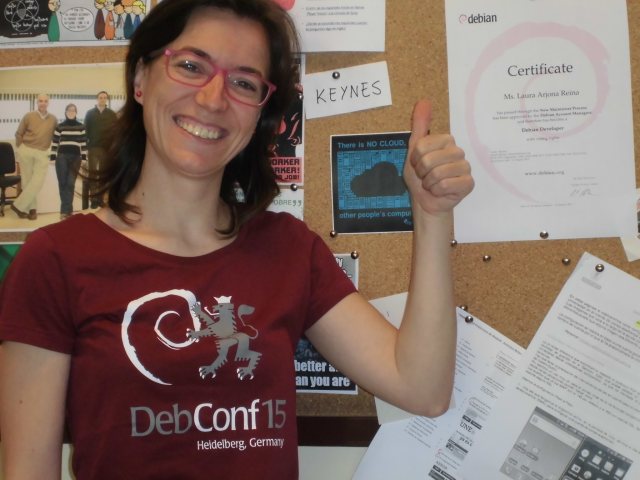
Filed under: My experiences and opinion, News Tagged: Communities, Contributing to libre software, Debian, Developer motivations, encryption, English, Free Software, gpg, libre software

Charles Plessy: The slippery slope.

Step by step, one slips towards the bottom:
  1. One should be blunt with those who are wrong.
  2. One is blunt when one is right.
  3. When one thinks to be right, one is blunt.
  4. One is wrong and blunt.
Let's note anyway that one can slip to the bottom without being vulgar or insulting. In any large project like Debian, one can find people who know how to be very oppressive, while keeping a very correct communication style. Debian is a broad project, and it is easy to avoid them, unless one tries make contributions that can be related to keywords like committee , code , policy , delegation , etc. In that case, it is better to retrieve the good old thick skin from the cupboard where we stored it after our code of conduct was adopted...

14 October 2015

Russ Allbery: Review: Firebird

Review: Firebird, by Jack McDevitt
Series: Alex Benedict #6
Publisher: Ace
Copyright: November 2011
Printing: October 2012
ISBN: 1-937007-80-4
Format: Mass market
Pages: 357
Firebird is the sixth book in the Alex Benedict series about an antique hunter in the far future (albeit a far future that looks exactly like 1960s suburbia, but with spaceships). This is a very episodic series, though, and I don't think it would be hurt much by starting in the middle. There are references to earlier investigations, but they're fleeting, and I often didn't map them to remembered plots even though I've read the whole series to this point. The investigation in this book starts with the heir to an estate coming to Alex to sell some of the possessions of a physicist. Chase (Alex's assistant, and here, as in the last few books, the viewpoint character) doesn't even recognize the name, but Alex does: Christopher Robin disappeared forty-one years earlier, under circumstances that were never fully explained. He was also (and unusually for a physicist) interested in strange and marginal ideas: dark energy, new drive technology, parallel universes one could potentially cross into, and similar fringe concepts. The normal pattern of this series is that Alex will hear about some mystery, be unable to restrain his curiosity, and start poking around, usually turning up things that people would rather he didn't. It takes a while for that to happen here; instead, the story starts with Alex playing up popular interest in Robin's ideas in a rather mercenary attempt to increase the value of the estate. He stumbles into more mystery mostly by accident. Eventually he can't resist the allure of a revealed link between Christopher Robin and sightings of mysterious disappearing starships and the normal pattern kicks in, but he spends rather more of the book than normal being flippant and slightly unethical. I didn't much like the shift in tone. Alex is a lot harder to like this book, and not just for his business practices. His tone towards Chase also moves past the slightly superior smugness that's common to many books of this type (think Nero Wolfe) and well into condescending ass. Some of this may be intentional, as McDevitt uses this book to bring out a bit more of Alex and Chase's past and has some story reasons for making Alex less of a saint. But some of it feels accidental, or unnoticed, and it left a bad taste in my mouth. As with a lot of McDevitt, the actual mystery is slow, a bit scattered, and has a fair number of blind alleys. That property makes these books feel more like real investigations, but it works better when the characters are fully engaged in the investigation and are communicating a bit better than they are here. The plot also gets entangled in a subplot about a planet full of abandoned AIs, and while that was moderately interesting, it felt like an extended digression with dubious relevance to the main plot. McDevitt occasionally has trouble with plot focus, and I think I noticed more this time because the characters weren't as fun to spend time with. The end of Firebird was up to the usual standards of this series, albeit surprisingly traumatic. The rest of the book, though, felt markedly weaker. Alex decided to be obnoxious and play into his (previously mostly inaccurate) public perception as a money and glory hound. Chase seemed too flippant, uninterested, and a bit too much of a foil instead of a partner. And the plot felt like two different story ideas awkwardly smushed together. I think this was the weakest of the series to date. Hopefully the next book, which looks to be more of a direct sequel to this one, will improve. Followed by Coming Home. Rating: 6 out of 10

Rhonda D'Vine: Post DebConf15

There are some things that I didn't mention in my sort-of quickly written entry about DebConf15. So first things first. When I received the mail about the room allocation I was at first confused. I was put into a room with other ladies, which I didn't expect. Granted, two of the other three names were people that knew me since a while, but it still felt like a mistake might have happened. But after a while I realized what has happened: It wasn't a mistake, it was intentional, I was finally recognized as woman for the room allocation too, which made me extremely happy. I was just just concerned about the third person who would be in our room who doesn't know me yet and whether it would make them feel uncomfortable. In the end, that was no trouble at all. I felt so empowered and more accepted than ever in this community. And when finally being on-site there another thing happened with me. I started to use the women's restroom. Up to now I usually had the feeling of "it's fine for me to use the male one, and I don't want other women to feel uncomfortable", but somehow, with a skirt on, it in the end made me feeling uncomfortable. Additionally, there were only three times in total when I used the male toilet (and one was on the boat for the daytrip), and every single time of it I felt extremely uncomfortable with it, like others might think I'm just faking it. It at least in my mind doesn't help with accepting me as female when I go to the male restroom. And it's not a Good choice! as a woman did put it during the conference dinner when there was a longer queue infront of the male restroom. It's not so much of a choice over here. But I give her the doubt of not knowing how important these little steps became to me over time. Totally unrelated to the restroom question but interestingly featuring it a fair bit I was made aware of the Assigned Male cartoon. I instantly fell in love with it, and in case you want to enlighten yourself a bit more about how some things you might say or do get received by trans people, be very much invited to read it. Sophie is currently on European tour with her book, unfortunately Vienna/Austria doesn't seem to be part of europe in that respect so I hope someone will be able to visit one of her stations to pick up a book for me ... And then there was also a small inofficial Nail Polish BoF going on at DebConf. I left it on my fingers for the next two weeks, totally in love with it. Unfortunately the nail polish I got for myself after DebConf had a rather big brush so I wasn't able to work on it, I failed miserably. ... which brings me to the empowerment that DebConf meant for me this year, and the time since. Given that I left the nail polish on I even took the comfort in being myself to go to work in my skirt on a more regular basis. Also, a very nice friend did visit me and we went lipstick shopping. I loved the color she chose, even though in the meantime it isn't visible enough for me and I guess I'll get another one rather sooner than later. Also, about what I mentioned in my last blog post was that my name change within the Debian project was granted. A quick update on that is that also now my GPG key got replaced. I guess it's finally time for me to write a gpg transition statement, even though I don't follow those myself. I still prefer meeting up with people face-to-face for signing their new keys. But given that it's called a transition statement makes it more appealing to me on that grounds. :) And I got invited to a local podcast show. Actually I know the person who does the podcast since several years already, he's also part of the local free software community who attends various events, and he does a podcast since several years now called Biertaucher (named after cooling the beer in a fountain). It is held in German language, so if you don't understand German you might want to skip these links.
In the first episode that I joined in I talked about DebConf. Afterwards we were sitting together and talking about that they would like to have more social topics too, not just technical things. So we took that chance and talked in Biertaucher #221 about Polyamory, which was a quite interesting experience. The host intentionally asked questions coming from a quite ignorant point of view, but it went nice. We were three poly people sharing our views and insight how it works for us.
Then there was Biertaucher #223 where it was just me and one of the hosts. We didn't had much to talk about from the past week, so we agreed to talk about Transgender in the end. Granted, it's mostly my personal story, but I guess I got some important topics addressed in a useful way. And, after getting my name changed in Debian, I thought about what it might take to get my name changed officially, too (as if it could get more official than using it throughout my work environment, both payed and voluntary, but ...). I covered that in the podcast, but mostly it is either quite expensive or requires me to change my gender in the register of births, which require a lot of other hassles that include psychiatry. Or, settle for a so-called "gender neutral" name as first name, which both doesn't sound very convincing somehow ... Only time can tell I guess. Guess that's enough for now, if I forgot something I might come back to it. :) One last note: I consider the Debian project a very welcoming one, and that can only work for a fair amount of people if the tone is right. So yes, I wholeheartly agree with the Code of Conduct. And I'm very disappointed to see that there are still people in the project that are advocating for a freedom of expression, so to say. Respectful communication with each other is a must in a bigger community to make it work, not something that might be a nice to have, and calling someone names and ridiculing them for stating that is absolutely not acceptable. I encourage those people to watch How to Throughly Offend and Insult People in Open Source presentation (or at least read the slides) that Gina Likins gave earlier this year. It might give them an idea why it's important to communicate respectful with each other, and that includes banning degrading terms like "SJW" from your vocabulary because it actually speaks a lot more about your own attitude than about the one of the person you use it for.

/personal permanent link Comments: 8 Flattr this

Joachim Breitner: Constructing a list in a monad revisited

Two years ago, I discussed various ways of constructing a list in a Monad (or, more specifically, in IO) in Haskell, and compared their merits in terms of elegance, stack usage, number of traversals of the list and run-time efficiency. Recently, two blog posts discussed the issue further and proposed new, more daring alternatives. Neil Mitchell breaks through the abstraction provided by IO, duplicates the world and traverses the list twice, and obtains a speed-up for long lists. Twarn van Laarhoven went even further and wrote custom C-- code to destructively update the tail-pointer of the list cell to be able to create the list completely evaluated on the first start. This basically answers my question from two years ago:
I m still wondering: What would be required from Haskell, GHC or the monads in question to have a fully satisfactory solution here, i.e. one that is as fast as the naive recursion, as stack efficient as the difference list solution, and allocates no thunks, only list cells?
He also has a variant with a slightly nicer interface around holes , i.e. explicit objects on the heap that can later be replaced by indirections. Obviously, both approaches are very unsafe. I took this as an opportunity to redo my benchmark measurements, and include their variants (named escapeIO, hackIO and holeIO). The following table omits the variants with quadratic performance, as I ran it on longer lists now:
Variant 10^0 10^1 10^2 10^3 10^4 10^5 10^6
accumReverse 37ns 153ns 1134ns 12 s 208 s 8540 s 97ms
recursion 29ns 139ns 680ns 6790ns 160 s 6441 s 76ms
replicateM 26ns 126ns 677ns 6785ns 168 s 6314 s 78ms
accumDList 35ns 165ns 995ns 10 s 190 s 9706 s 100ms
streams 27ns 136ns 691ns 6788ns 173 s 5771 s 75ms
unsafeInterleave 60ns 329ns 2804ns 28 s 373 s 5605 s 57ms
listFix 51ns 412ns 4109ns 56 s 2761 s 42ms 445ms
escapeIO 41ns 187ns 1808ns 16 s 234 s 4409 s 45ms
hackIO 30ns 152ns 1199ns 11 s 140 s 3701 s 42ms
holeIO 40ns 222ns 1725ns 17 s 218 s 4446 s 53ms
The following graph shows that around 10000, the naive approaches become much slower and the fancy hacks pay of, with Twarn s tail-pointer-updating code performing the best: I would really like to see a package that provides a API like Twarn s holes, either in this raw unsafe variant (but with the garbage collector related code checked), or with a safe API using type hackery similar to the ST monad that ensures that after normal code gets its hands on a term possibly involving holes, the holes may no longer be modified. I have put the code and results on GitHub.

Norbert Preining: On Lars Wirzenius, Mart n Ferrari, and Debian

Now that the tsunami that followed my recent blog post has passed, I can read through all the nice comments and blogs of other people. I didn t expect that just writing up some links to posts on LKML, plus adding my personal opinion on what has happened and about my interpretation concerning Debian could gather so much attention. Anyway, let us look at the blog posts written in the aftermath. debian-newspeak-coc In particular do I want to answer to two blogs: Lars Wirzenius blog and Mart n Ferrari s blog, both of which are excellent examples of insults. I also want to mention that although the previous two are bad examples, there are fortunately also those who are able to resist primitive insults, in particular Gunnar Wolf (direct link to the blog does not work), and Miriam Ruiz blog, which contradict my blog and propose a different view, without pulling the knife. Lars Wirzenius Let us start with Lars (ah sorry, I have to call him Wirzenius here, strange custom has suddenly popped up in Debian!):

I think Preining mis-characterises what happens on the Linux kernel mailing list, and in Debian, in free software development in general, and what Sarah Sharp has said and done. I continue to think he is wrong about everything on this topic.
I am very surprised that Lars^WWirzenius is in possession of a crystal ball that allows him to see and evaluate my attitude towards all these items, considering that I have presented links to posts on the LKML, and yes, my interpretation of the matter. Mind that the whole text amounts to about 130 lines on my screen, while my personal opinion was stated in two paragraphs of total 9 lines plus some interspersed comments. And in these maybe 20 lines I didn t make general statements about open source, kernel development etc etc. Lars, I know you have closed your blog for comments so I couldn t ask you but please, can you send me one of your crystal balls if you have more of them? At least he has managed to keep a bit of proper writing and disagreed with my statement on Debian (whether there is fun or not in Debian). He is of course free to do that, but please, don t rob me the right to state that I think Debian has changed. All this dispute centers around people not being capable to distinguish two things: One, being against the Code of Conduct due to the inclusion of administrative actions without clear definitions, and Two, being pro offensive behavior and and insults. Now, dear Lars^WWirzenius, please listen: I never advocated abusive behavior or insults, nor do I defend it. (Did you hear that!) I simply opposed the Code of Conduct as ruling instrument. And what kind of emails I got due to my opposition was far outside the Code of Conduct you are so strongly defending. So please, stay at the facts, and stop insulting me. Thanks. Mart n Ferrari Concerning Mart n I don t have much to say but please, stop spreading lies. You stated:
Once again, he s complaining about how the fun from Debian has been lost because making sexist jokes, or treating other people like shit is not allowed any more.
Could you please come up with a reference to this? Or are you just interpreting? I am very disappointed about this level of discussion between Debian Developers. You not even cared to answer my comment on your blog. Should I say something clear here you should be happy that this has not been written on a Debian mailing list, otherwise I hope the Code of Conduct hammer would hit you.
So yes, it seems that at least these two blogs underline exactly what my opinion is: Communication culture in Debian has changed to be more company-like. Probably due to the ever increasing amount of developers that are paid for their work on Debian (Ubuntu), the pressure to follow US company codes has taken a firm grip, so firm that even stating my diverging opinion is already enough to get branded. Good Future!

Lunar: Reproducible builds: week 24 in Stretch cycle

What happened in the reproducible builds effort this week: Toolchain fixes Scott Kitterman fixed an issue with non-deterministic Depends generated by dh-python identified by Santiago Vila and Chris Lamb. Lunar updated the patch against dpkg which makes the order of files in control.tar.gz deterministic using the new --sort=name option available in GNU Tar 1.28. josch released sbuild version 0.66.0-1 with several fixes and improvements. The most notable one for reproducible builds is the new --build-path option and $build_path configuration variable added by akira which allows to explicitly chose a given build path. Reiner Herrmann wrote a new patch for dh-systemd to sort the list of unit files in the generated maintainer scripts. Packages fixed The following packages became reproducible due to changes in their build dependencies: aoeui, apron, camlmix, cudf, findlib, glpk-java, hawtjni, haxe, java-atk-wrapper, llvm-py, misery, mtasc, ocamldsort, optcomp, spamoracle. The following packages became reproducible after getting fixed: Some uploads fixed some reproducibility issues but not all of them: Untested Patches submitted which have not made their way to the archive yet: reproducible.debian.net ProfitBricks once again increased their support for reproducible builds in Debian and in other free software projects by adding 58 new cores and 138 GiB of RAM to the already existing setup. Two new amd64 build nodes and 16 new amd64 build jobs have been added which doubles the build capacity per day and allows us to spot many kind of problems earlier. The size of the tmpfs where builds are performed has also been increased from 70 to 200 GiB on all amd64 build nodes. Huge thanks! When examining a package, a link now points to a table listing all previous recorded tests for the same package. (Mattia) The menu on the package pages has also been improved. (h01ger) Packages in the depwait state are now rescheduled automatically after five days. (h01ger) Links to documentation and other projects being tested have been made more visible on the landing page. (h01ger) To reduce noise on the team IRC channel five different types of notifications have been turned into mail notifications. The remaining ones have been shortened and the status changes have been limited to unstable and experimental. (h01ger) Maintainer notifications about status changes in a package will only be sent out once per day, and not on each status change. (h01ger) diffoscope development Some more experiments of concurrent processing have been made. None were good and reliable enough to be shared, though. Package reviews 48 reviews have been removed, 189 added and 23 updated this week. 9 FTBFS bugs were reported by Chris Lamb. Misc. h01ger met with Levente Polyak to discuss testing Arch Linux on Debian continuous test system with an easily extensible framework. The idea is to also allow testing of other distributions, and provide a nice package based view like the one for Debian.

Russ Allbery: Review: Magic's Price

Review: Magic's Price, by Mercedes Lackey
Series: Last Herald Mage #3
Publisher: DAW
Copyright: July 1990
ISBN: 0-88677-426-8
Format: Mass market
Pages: 351
Magic's Price is the conclusion of the Last Herald Mage trilogy (Lackey is from an era of fantasy in which trilogies stopped at three books), but those books are widely spaced and mostly stand alone. You might miss some context around Vanyel's personal life and the politics of the kingdom, but there's a lot of somewhat-awkward in-line summary, so you could read these books out of order if you wanted to. As with the previous two, this is a re-read of a book I've read several times before, but not for more than fifteen years. This is the book that finally introduces Stefan. On this re-read, that surprised me I thought of him as a large part of Vanyel's overall arc but he's only in the third book. He is, of course, key to the grand conclusion of Vanyel's story, beginning as the Bard who has the ability to blunt the pain of the badly-suffering king of Valdemar and then becoming more than that to Van. It's also a book about Vanyel trying desperately to hold things together as the country falls on hard times and far too much weight is put on his shoulders. And a book about a climactic fight against an arch-villain (awkwardly and retroactively inserted). And Vanyel coming to terms with his own foresight. It's a book about rather a lot of things, and therein lies a problem. I thought Magic's Promise had a better story than Magic's Pawn, but both had reasonably coherent stories and some internal flow. Magic's Price has three or four interwoven stories and some odd stops and starts. This is still early in Lackey's writing career (three years after her first novel), and I don't think she was entirely successful in what she was trying to do. The climaxes of the different stories don't quite line up and don't get enough separate attention, leaving a book that lacks clear dramatic shape, an engrossing build-up, or a satisfying climax. The biggest problem I had is that the main threat is not adequately supported. The story is building towards a rather drastic conclusion, one that has been foreshadowed from early in the series, but the threat that creates that conclusion comes out of nowhere. Lackey tries to tie it back to events from earlier in the series, and maybe it was planned all along, but there's little concrete support and no build-up. It feels like a retcon. And the key character in that threat receives almost no characterization whatsoever. I'm a bit grateful for that, since Lackey tends towards total evil in her villains, but to have the cause of all the drama in this story be a complete cipher takes a lot out of the story. (Also, I truly could have done without the rape.) The other irritation is that Vanyel spends quite a lot of the book being a jackass. This is another occasional problem with Lackey's books: her love stories, at least in her early books, involve a bit too much of people being stupid at each other. But I hadn't remembered just how much Van jerked Stef around and treated him miserably, straight to the end of the book. Love is a bit too ordained and imbued with magical powers in Valdemar, which is lucky for Vanyel: extensive plot support is required to explain why Stef didn't find someone else who was less of an ass. In the real world, when someone insists they have no emotional space for you, the correct reaction is "gotcha, have a nice life" and finding someone else to spend time with. This gets partly sorted out in the end, but I didn't find the reconciliation entirely believable, and certainly not fair to Stef. (And the age difference is just a little creepy, although thankfully Lackey doesn't put much focus on that.) On my first read of the Valdemar corpus, this was the book during which I started getting interested in the lore and politics of this universe. There's much more of that to come, thankfully, as I think it's my favorite part of the series. At this point in her writing career, Lackey is getting better at avoiding infodumps and making her magic system interesting. The politics is still a bit black and white, but the Tayledras are a lot of fun (and increasingly less like elves, even if that's the obvious initial inspiration), and the areas beyond Valdemar are developing some more coherence. The conclusion loses a lot from the lack of build-up and emotional support, but it still adds an interesting bit of magical history that will be important later. I wish I'd enjoyed Magic's Price more on re-read, but it was much spottier and more exasperating than I had remembered. That said, it certainly has its moments, particularly around the lore. This is the first book where one starts to realize just how powerful the Companions are, and just how much they're capable of that they're not showing. When I first read it, I loved it. Now, the flaws are too obvious, and Vanyel's behavior is too irritating, for me to unreservedly recommend it, but Magic's Price, and the whole trilogy, is important for building the lore of later books. When I get to Elspeth's part of the series, the politics and magical system will be developed at much greater length. Next, though, my favorite stories in this universe: Tarma and Kethry. Rating: 6 out of 10

13 October 2015

Julien Danjou: Benchmarking Gnocchi for fun & profit

We got pretty good feedback on Gnocchi so far, even if we only had little. Recently, in order to have a better feeling of where we were at, we wanted to know how fast (or slow) Gnocchi was. The early benchmarks that some of the Mirantis engineers ran last year showed pretty good signs. But a year later, it was time to get real numbers and have a good understanding of Gnocchi capacity. Benchmark tools The first thing I realized when starting that process, is that we were lacking of tools to run benchmarks. Therefore I started to write some benchmark tools in python-gnocchiclient, which provides a command line tool to interrogate Gnocchi. I added a few basic commands to measure metric performance, such as:
$ gnocchi benchmark metric create -w 48 -n 10000 -a low
+----------------------+------------------+
Field Value
+----------------------+------------------+
client workers 48
create executed 10000
create failures 0
create failures rate 0.00 %
create runtime 8.80 seconds
create speed 1136.96 create/s
delete executed 10000
delete failures 0
delete failures rate 0.00 %
delete runtime 39.56 seconds
delete speed 252.75 delete/s
+----------------------+------------------+

The command line tool supports the --verbose switch to have detailed progress report on the benchmark progression. So far it supports metric operations only, but that's the most interesting part of Gnocchi. Spinning up some hardware I got a couple of bare metal servers to test Gnocchi on. I dedicated the first one to Gnocchi, and used the second one as the benchmark client, plugged on the same network. Each server is made of 2 Intel Xeon E5-2609 v3 (12 cores in total) and 32 GB of RAM. That provides a lot of CPU to handle requests in parallel. Then I simply performed a basic RHEL 7 installation and ran devstack to spin up an installation of Gnocchi based on the master branch, disabling all of the others OpenStack components. I then tweaked the Apache httpd configuration to use the worker MPM and increased the maximum number of clients that can sent request simultaneously. I configured Gnocchi to use the PostsgreSQL indexer, as it's the recommended one, and the file storage driver, based on Carbonara (Gnocchi own storage engine). That means files were stored locally rather than in Ceph or Swift. Using the file driver is less scalable (you have to run on only one node or uses a technology like NFS to share the files), but it was good enough for this benchmark and to have some numbers and profiling the beast. The OpenStack Keystone authentication middleware was not enabled in this setup, as it would add some delay validating the authentication token. Metric CRUD operations Metric creation is pretty fast. I managed to attain 1500 metric/s created pretty easily. Deletion is now asynchronous, which means it's faster than in Gnocchi 1.2, but it's still slower than creation: 300 metric/s can be deleted. That does not sound like a huge issue since metric deletion is actually barely used in production. Retrieving metric information is also pretty fast and goes up to 800 metric/s. It'd be easy to achieve very higher throughput for this one, as it'd be easy to cache, but we didn't feel the need to implement it so far. Another important thing is that all of these numbers are constant and barely depends on the number of the metric already managed by Gnocchi.
Operation Details Rate
Create metric Created 100k metrics in 77 seconds 1300 metric/s
Delete metric Deleted 100k metrics in 190 seconds 524 metric/s
Show metric Show a metric 100k times in 149 seconds 670 metric/s
Sending and getting measures Pushing measures into metrics is one of the hottest topic. Starting with Gnocchi 1.1, the measures pushed are treated asynchronously, which makes it much faster to push new measures. Getting new numbers on that feature was pretty interesting. The number of metric per second you can push depends on the batch size, meaning the number of actual measurements you send per call. The naive approach is to push 1 measure per call, and in that case, Gnocchi is able to handle around 600 measures/s. With a batch containing 100 measures, the number of calls per second goes down to 450, but since you push 100 measures each time, that means 45k measures per second pushed into Gnocchi! I've pushed the test further, inspired by the recent blog post of InfluxDB claiming to achieve 300k points per second with their new engine. I ran the same benchmark on the hardware I had, which is roughly two times smaller than the one they used. I achieved to push Gnocchi to a little more than 120k measurement per second. If I had same hardware as they used, I could interpolate the results to achieve almost 250k measures/s pushed. Obviously, you can't strictly compare Gnocchi and InfluxDB since they are not doing exactly the same thing, but it still looks way better than what I expected. Using smaller batch sizes of 1k or 2k improve the throughput further to around 125k measures/s.
Operation Details Rate
Push metric 5k Push 5M measures with batch of 5k measures in 40 seconds 122k measures/s
Push metric 4k Push 5M measures with batch of 4k measures in 40 seconds 125k measures/s
Push metric 3k Push 5M measures with batch of 3k measures in 40 seconds 123k measures/s
Push metric 2k Push 5M measures with batch of 2k measures in 41 seconds 121k measures/s
Push metric 1k Push 5M measures with batch of 1k measures in 44 seconds 113k measures/s
Push metric 500 Push 5M measures with batch of 500 measures in 51 seconds 98k measures/s
Push metric 100 Push 5M measures with batch of 100 measures in 112 seconds 45k measures/s
Push metric 10 Push 5M measures with batch of 10 measures in 852 seconds 6k measures/s
Push metric 1 Push 500k measures with batch of 1 measure in 800 seconds 624 measures/s
Get measures Push 43k measures of 1 metric 260k measures/s
What about getting measures? Well, it's actually pretty fast too. Retrieving a metric with 1 month of data with 1 minute interval (that's 43k points) takes less than 2 second. Though it's actually slower than what I expected. The reason seems to be that the JSON is 2 MB big and encoding it takes a lot of time for Python. I'll investigate that. Another point I discovered, is that by default Gnocchi returns all the datapoints for each granularities available for the asked period, which might double the size of the returned data for nothing if you don't need it. It'll be easy to add an option to the API to only retrieve what you need though! Once benchmarked, that meant I was able to retrieve 6 metric/s per second, which translates to around 260k measures/s. Metricd speed New measures that are pushed into Gnocchi are processed asynchronously by the gnocchi-metricd daemon. When doing the benchmarks above, I ran into a very interesting issue: sending 10k measures on a metric would make gnocchi-metricd uses up to 2 GB RAM and 120 % CPU for more than 10 minutes. After further investigation, I found that the naive approach we used to resample datapoints in Carbonara using Pandas was causing that. I reported a bug on Pandas and the upstream author was kind enough to provide a nice workaround, that I sent as a pull request to Pandas documentation. I wrote a fix for Gnocchi based on that, and started using it. Computing the standard aggregation methods set (std, count, 95pct, min, max, sum, median, mean) for 10k batches of 1 measure (worst case scenario) for one metric with 10k measures now takes only 20 seconds and uses 100 MB of RAM 45 faster. That means that in normal operations, where only a few new measures are processed, the operation of updating a metric only takes a few milliseconds. Awesome! Comparison with Ceilometer For comparison sake, I've quickly run some read operations benchmark in Ceilometer. I've fed it with one month of samples for 100 instances polled every minute. That represents roughly 4.3M samples injected, and that took a while almost 1 hour whereas it would have taken less than a minute in Gnocchi. Then I tried to retrieve some statistics in the same way that we provide them in Gnocchi, which mean aggregating them over a period of 60 seconds over a month.
Operation Details Rate
Read metric SQL Read measures for 1 metric 2min 58s
Read metric MongoDB Read measures for 1 metric 28s
Read metric Gnocchi Read measures for 1 metric 2s
Obviously, Ceilometer is very slow. It has to look into 4M of samples to compute and return the result, which takes a lot of time. Whereas Gnocchi just has to fetch a file and pass it over. That also means that the more samples you have (so the more time you collect data and the more resources you have), slower Ceilometer will become. This is not a problem with Gnocchi, as I emphasized when I started designing it. Most Gnocchi operations are O(log R) where R is the number of metrics or resources, whereas most Ceilometer operations are O(log S) where S is the number of samples (measures). Since is R millions of time smaller than S, Gnocchi gets to be much faster. And what's even more interesting, is that Gnocchi is entirely scalable horizontally. Adding more Gnocchi servers (for the API and its background processing worker metricd) will multiply Gnocchi performances by the number of servers added. Improvements There are several things to improve in Gnocchi, such as splitting Carbonara archives to make them more efficient, especially from drivers such as Ceph and Swift. It's already on my plate, and I'm looking forwarding to working on that! And if you have any questions, feel free to shoot them in the comment section.

Norbert Preining: (Kim Doo Soo) ( , Free Spirit)

On the recently reviewed album International Sad Hits Vol 1 I wrote that Kim Doo Soo was the great surprise of the CD for me. So I went ahead and bought (not that easy, import from US!) one of his most recommended album, the Free Spirit. Kim_Doo_Soo-Free_Spirit Sad songs, full of melancholy, speaking of desperation, isolation, destroyed love. The music and singing is simple, mainly based on guitar and voice only, at times harmonica, strings and others are added. In contrast to the Crying Philosopher Tomokawa Kazuki, the songs are all very melodic and easy to listen, but still carrying a strong impact. After listening to these songs, the melodies wander around my brain resonating again and again, like (mis)guiding lights in a dark forest. kim-doo-soo-japanese-textAll the songs are in Korean, but fortunately the accompanying booklet carries a Japanese translation for the Korean incapables like me. In the future I will provide some translations into English, since I believe that this artist should be more known outside this small area. While a friend of mine said I don t like (bimbokusai) music, I have to say I enjoy reading through the sad stories while listening to this special music.
This is the 2002 fourth album by Korea s true cult folk/singer-songwriter hero, Kim Doo Soo. Kim Doo Soo is perhaps the deepest and most introspective of Korea s acid folk singers. Legends surround his songs political oppression, alcoholism, suicide, a 10-year period of mountain seclusion. [ ] On Free Spirit he mines productive veins of profound melancholy, animistic nature, and unfathomable, hermetic affection. These songs are couched in a veil of gorgeous, still melodicism, Kim s quavering vocals and guitar shaded with subtle accordion, cello, organ and harmonica. A reflective and unearthly masterpiece.
Forced Exposure
To this I cannot add anything more eloquent! The songs on this CD are as follows, the English translation is taken from Kim Doo Soo s official web page.
  1. (Wild flower)
  2. (Boat for the shore)
  3. (Butterfly)
  4. (Sweetbrier)
  5. (Bohemian)
  6. (Dawn rain)
  7. 19 Blues (Blues of 19th street)
  8. (Mountain)
  9. (As time goes by)
  10. Romantic Horizon
  11. ( ) (Reminiscence)
  12. (Evening river)
  13. ( ) (Bohemian poetry)
  14. , (Dandelion, dandelion)
My favorites under these songs are Boat for the shore ( You aren t coming any more onto a wild sea I am leaving ), Bohemian ( I m going to the shores of emptiness, my free spirit flows down the river probably his most famous song, assumed to be responsible for his retreat to the mountains), Dawn rain (A lovely song, and the only one without Japanese translation! Very strange.), Mountain ( Mountains Mountains my dream, mountains ). But I can recommend each and every song on this CD. To close this short review, if you are interested in something else but the usual happy-pappy KPop or JPop or USPop, and are searching for inspiring and songs with Tiefgang (deep meaning, as we say it in German), give this special artist a try! Some links concerning Kim Doo Soo that might be useful:

12 October 2015

Joachim Breitner: Incredible Proof Machine put to the test

I m currently on the way home, returning from a four-day workshop for high school students; ages 13 to 20, grade 9 to 13. My goal was to teach them something about proofs and logic, in a ambitiously formal and abstract way. For this workshop, I created a computer program called The Incredible Proof Machine that allows the kids to explore creating a proof, by placing blocks on a canvas and drawing connections between them (see my previous blog post for an introduction). Subtracting time spent on on breaks, organizational stuff, the time the student needed to prepare a final presentation, I think we were working for a total of 14 hours, during which we covered propositional logic. I generally let the students explore and try to solve the tasks of one session mostly on their own, followed by a common discussion of what they have just done, what it means why it makes sense etc. The sessions were: assumptions and conclusions in general, with conjunction; implication; disjunction; falsum and tertium non datur. We also briefly discussed paper proofs with the student: how they look, and how they relate to the Proof Machine proofs. We had some lecture notes that we handed out pice-wise after each session. The sections were mildly1 password-protected to avoid that the quicker students would work ahead, thus keeping the group together. One or two of the 13 students were doing very well and eventually, I gave them the passwords to the predicate logic section and let them work them on them on their own. The quickest managed to solve almost all of these as well, but (as far I as I can tell) without a deeper understanding of the quantifiers, and more a mechanical intuition. As expected, the students were able to solve most of the exercises, even when a proper understanding of the logical semantics was not yet fully developed. This was by design: I believe that this way it was more motivating and encouraging, as they could make it work , compared to a more traditional approach of first throwing a lot of theory at them and then expecting them to apply it. This was confirmed by their feedback after the workshop. I was happy with my implementation. The students immediately could work with it with very few hick-ups, and only one minor bug occurred2, which I could fix on the spot. Having everything run on in the browser was a big plus, given that we had no stable internet connection for everyone: Once the Incredible Proof Machine was loaded, the student could continue to work offline. Personally, I find that the UI is occasionally too sluggish, especially on the weaker laptops, but it seems that the students did not seem to mind. Some students tried to connect outputs with outputs or inputs with inputs and the visualization did make it clearly visible that such a link is not actually connected to the block. The predicate logic part is a bit less convincing, with e.g. scoping of local constants not easily understood. I would say that this part would work better if some explanation is given before the students start working on the more involved rules. Our room was equipped with a smartboard, and I was delighted when I found out, mostly by accident, that I could actually use my finger to drag the blocks of the proof and to draw connections. This not only gave me a Minority Report -like feeling, but also meant that it was much easier for the students to follow my explanations when they could just watch my hand, instead of trying to locate the mouse pointer on a regular projector. I m generally doubtful whether such fancy technological toys are useful in the class room, but in this case at least I liked it. The ability to scribble anywhere on the screen was occasionally a plus as well. All in all I believe the Proof Machine was a useful tool, and I am sure that without it, it would have been tricky to have students voluntarily spend 14 hours on such a relatively dry and abstract topic. Given the amount of work that went into the development, I hope that this will not be the last occasion where it is put to good use. So if you have to teach formal logic and natural deduction-style proofs, you are welcome to use the Incredible Proof Machine to get your students excited. It is purely static, i.e. needs no special server-side infrastructure, and you can define your own logic (i.e. proof rules), sessions and tasks. Also, there are a few interesting way in which the Proof Machine could be extended. In particular, I d like it to be able to generate a normal , natural-language proof from a given proof even if it will sound a bit mechanical and then use hover-highlight effects to relate the formulas and sentences in the text proof to the connections and blocks in the graphical proof. Contributions are welcome!

  1. JavaScript based with no crypto or even obfuscation in the code.
  2. Due to differences between the task specification as given in the code, and the task specification when normalizing the syntax of the terms, the proofs that the students created were lost when they re-loaded the page.

Next.

Previous.
