Search Results: "pm"

1 June 2009

Cyril Brulebois: Early June update

Random bits: Blender 2.49 - splash screen

31 May 2009

Russell Coker: Expectations and Fandom

Russ Allbery has written about the hostile reactions of sci-fi fans toward the delay of a book release [1]. Russ makes some good points regarding the issue of whether paying $100 for some books entitles a reader to have the rest of the series written (in summary - no, the author owes the fans nothing). Russ also notes that when someone makes a public promise to do something (such as writing a book) they will probably be feeling bad about being unable to live up to that, and harassing them about it is not going to make them feel any better - or make them better able to do the work. Charles Stross has written a blog post about this topic, he makes some interesting points and the comments illustrate most of them [2]. One comment claims that the author of the delayed book in question flaunts his NFL watching while the same person also criticises the author for writing a blog. This level of contempt for the author amazes me. In case anyone is interested I watch The Bill and Desperate Housewives every week. Anyone who wishes to criticise me for watching soapies instead of documentaries is welcome to do so. But I will not make any apologies for spending some of my time doing things other than coding. If I watch Desperate Housewives instead of fixing a bug that inconveniences you then you just have to deal with it. I believe that taking a regular break from work is a basic human right, apart from which there is evidence to show that working excessive hours decreases the quality and quantity of work that is completed [3]. It seems to me that members of the free software community are in a better position regarding fans than most creative people, and that this is largely due to how transparent the development process is. The most influential members of the user (fan) base are software developers. While people will be disappointed when software is not released on time or has some bugs many users know what is involved and understand that no testing will find all bugs. Even some basic shell scripting can teach people the difficulties of programming and convince them to have a little more patience than they might otherwise have. So the typical user of free software will have some idea of what is required to write software while the typical reader of a novel has no idea of what is involved in writing a book. Another benefit for the free software community in this regard is the open development process. When users are unhappy about release delays (as some Debian users were before Lenny was released) they can easily look at the bug list. If a user is pushy they can be invited to fix some bugs themselves, if they investigate the matter and discover that the bugs are too difficult for them to fix then they will probably feel compelled to stop hassling the people who can fix the bugs. Complaints from users regarding the release process can be turned around with the software is late because YOU haven t fixed any bugs . Please note that submitting bug reports is NOT criticism, it is in fact helping the development process (particularly when the bug reports contain information on how to fix the problems). This exposes another significant difference between writing software and writing a book. Even if I was a talented author I would not be able to offer any assistance to an author who had trouble completing a work simply because I wouldn t have the same vision for the plot of a book. But it s not uncommon for software development projects to be forked if the users are unhappy with some aspect of how they work, and it s also not uncommon for a programmer to voluntarily give one of their projects to another developer - sometimes developers try and convince other people to take projects from them when they don t have enough time. Even without changing the ownership of a project, anyone can submit a patch. The patches that I have received from users of my software have generally been of a high quality and it has taken little work to merge them. A final difference is that any programmer can produce a private fork of a project. I have lost count of the number of times that I have produced custom versions of free software for my own personal use or for the use of my clients. Sometimes the modifications that I made were unsuitable for wider use (IE they broke things for usage cases that I didn t care about) so I just privately made the software do what I needed. This makes the upstream developer (or team) and other contributors irrelevant to fixing the problem in question. Now this is not to say that the free software community is perfect. But it seems that certain types of bad behavior that we see demonstrated in the sci-fi fandom circles are uncommon and the people who demonstrate them are significantly outnumbered by people who oppose such actions. Publicly criticising a programmer for watching the NFL in their spare time is akin to holding a sign saying kick me . As I am a fan of science fiction (and hope to write some in the near future) I wonder whether the sci-fi community could be changed to have a culture more like that of the free software community. The web site 365tomorrows.com publishes a short sci-fi story every day [4], they have been doing this for a few years now. They started out publishing work by a small team of authors with the aim of writing a story a day for a year. Now they also take submissions from users and they have a forum for budding authors to discuss their work. The site Protagonize.com is based on the idea of collaborative fiction [5]. I wonder whether the increasing number of sci-fi fans who join such forums will change the nature of the community. Maybe when a book is delayed the fans could take comfort in an increasing amount of fan-fiction based on characters from that book, I expect that the fan fiction will probably not impress all authors - and some may be offended by having their characters used in pornographic fan fiction. But that might just lead to a market shift towards authors who are not overly concerned about such things. When attending sci-fi book signings I ve noticed fans who appear to have stalking tendencies. I have been wondering how much of this is another symptom of the same problem and how much of it is due to science fiction attracting some people who don t understand the concept of personal space and who haven t considered the mathematics of interactions between famous people and fans - as one of many fans the famous person will not remember your fan letters or whether they have met you before, it s not possible. I look forward to the day when a well known author can have lunch with some fans after a book signing and not be afraid of weird fans. I wonder if Cory Doctorow [6] already has such cool fans, Cory seems to be one of the leaders in the new open way of writing and releasing sci-fi so it seems likely that he would be among the first to reap the benefits. I m sure that most authors would like to have lunch or dinner with their fans if they could be assured that the probability of getting stuck with a nutty fan was extremely low.

30 May 2009

Dirk Eddelbuettel: JPM Chase Corporate Challenge 2009

The 28th annual JP Morgan Chase Corporate Challenge race took place a couple of days ago May 21. Participation was down from the record of 23,000 runners set last year at around 17,125. With splendid weather, it is always a nice way to start the Memorial day weekend. We fielded a small but spirited team of nine runners. I finished with a decent (hand-stopped) time of 22 minutes and 27.93 seconds for the 3.5 miles -- or a 6:25 min/mile pace. That is among the fasters times but not quite the fastest compared to the other six times I have run this. Most importantly, everybody seems to have had a blast. And we did set a record for longer post-race party which sets a nice precedent for 2010.

Marc 'Zugschlus' Haber: The grub drama

This is a rant. A rant which goes to the grub maintainers, and one that could go nearly identically to many people in the KDE environment or many other open source projects. I really like grub. I really like grub 0.97 despite that it s been unmaintained for years and not booting on two of my important machines. I should like grub 2 because its configuration looks more straightforward and for its better features - direct booting of .iso images, from LVM and RAID. But actually, I have learned to hate grub 2 since it is not finished and badly documented, and that its existence is already being used as an excuse for grub 0 s development having stopped years ago (and it being renamed to grub-legacy to clearly show that it s the unloved child) - and things looks like this is not going to change any time soon. grub 0.97 is the de facto standard in booting Linux, its most prevalent advantages probably being its capability of reading filesystems and its command shell, which allows booting kernels and other software that one wasn t planning to boot when the system was shut down. There is a small fraction of people who still use lilo despite its disadvantages, for example on achitectures that are not supported by grub, if one wants to have the boot FS on LVM, if one just prefers lilo for non-technical reasons or on systems that grub doesn t work on. The last three systems, by the way, that I still run lilo on are Pyramid pizzaboxes with supermicro-made mainboards from 2002, which just refuse to boot if grub is used and the vendor just says that grub 0.97 is still beta and that they do not support grub on their systems: Use Lilo. Grub s last upstream release, 0.97, dates back to 2005, and upstream has stopped developing this grub release years ago. grub 2, the new way to go, had its first release in 2003, and the last stable release that people are supposed to use dates back to februar 2008. grub 2 is clearly a step in the right direction, but there are still bugs, and the most prevalent show stopper against grub 2 is the almost complete absence of any documentation. I have, for example, not yet found good documentation about the new config file format, which is a completely different deal from what we are used to with grub 0. The commands manual pages do little more than list the (obvious!) command line options without giving much more information about what the actually do, let alone usage examples. The documentation (which used to be really excellent for grub 0), has been moved to a wiki, which has some useful content but cannot keep up with the excellent documentation that grub 0 used to have. Additionally, grub2 does not seem to have a grub shell which can be called from within the host system, which makes installing grub 2 in exotic situations much harder than it used to be with grub 0. I am also quite disappointed that despite the grub upstream web pages claiming that grub 2 is under active development, the last release is more than fifteen months in the past while there are still so many shortcomings. The Debian maintainers of grub 2 are regularly packaging grub 2 subversion snapshots, which is a good idea in face of upstream s release policy which is quite different from what s being told in the wiki. I am, however, reluctant to rely on a development snapshot of a software to boot productive systems. Guys, you cannot declare a widely used, well-documented software legacy when the replacement is still in a nearly unuseable shape and the docs are hidden in the helpful files named .c and .h. This is simply unacceptable. It s a drama that the docs are still in such a pitiful shape fifteen months after your last release. But, grub is not the only free software project that so blatantly scores developer fun over the needs of the end user. I know that it is a boring task to fix bugs and to work around design shortcomings in the existing version of software, and that it is much more fun to hack away on new designs and new code, but dropping old versions before the new version is up to par with the old one is annoying the users and driving people away to other software packages. This applies to grub, a quite low-level program, but also to larger and more complex projects like KDE who has recently pulled the same stunt by dropping development and support for KDE 3.5 while KDE 4 is still missing many many features and KDE 3.5 s stablity, thus driving people (back) to GNOME or alternative desktop environments. This we give a damn about people who actually use our software, our compilers run without users as well attitude is a show of disrespect for the user base and makes me very sad as this does indeed show that free software is in no way superior to its commercial counterparts. Sadly, I do not have a solution for this issue since I know that free software developers are usually volunteers who do not have to report to anybody, and that they do not need to care for their user base. But I hope that people begin to reconsider their attitude and think about what kind of horrible damage is being done to the user base and to free software s reputation.

Andrew Pollock: [life] On obtaining an E-3 visa from the US Consulate in Vancouver

I've already had one enquiry, so I guess I'd better get writing. Despite the lawyers being really down on using this Consulate, I have to say that from my experience, it's been the easiest so far. Or I'm just getting used to the rigmarole. The one screw up was I didn't read the instructions thoroughly enough, and we rocked up to the Scotia Bank branch to deposit the visa application fee in their bank account, and I thought the fee was quoted in Canadian dollars. Turns out, it was quoted in US dollars. It wasn't the end of the world that we didn't have cash, they could sell us US dollars on a credit card, except the bank would only accept Visa card, not Mastercard. I haven't had to deal with such bullshit since the great Cabcharge/Visa card war in Australia in the late 90's. Moral of that story: read the instructions multiple times. Carry one of each flavour of credit card when traveling internationally, just in case. That minor transactional hiccup aside, everything went fine. The Consulate itself does all of the pre-interview shenanigans on one floor (the bulk of the waiting around, the fingerprinting and photographing) and then they shoot you up to another floor for the "interview". Annoyingly, they run you through the metal detectors again on the higher floor. The interview was basically "So you work for Google? How about the food?" and then he told us to come back the next day to pick up the passports. I think we were in and out in about three, three and a half hours. I have to say, the ability to collect the passports from the Consulate later is a real boon. When you're in a foreign country, the last thing you want to deal with is any glitches in the postal system, or trying to get mail delivered to a hotel. This alone makes me like the Vancouver Consulate the best. We went back at the 2:15pm allotted "passport pick up time", and they came down to the security checkpoint on the ground floor and you show your receipt and they give you your passports back. They tell you to step outside and check it, and come back if there's any problems, so I presume you can at least talk to a human at that point if there are any problems. This is my third E-3 visa. They did not ask to see any of my supporting paperwork showing ties with Australia or anything else that I had in my giant wad of paperwork, just the approved Labor Condition Application, which they kept and returned with the passport the next day.

29 May 2009

Michal Čihař: Translate over web or not?

Recently we opened up translation of phpMyAdmin documentation over web using Pootle tool. As you can see on summary page, it gained some attention, but not much. You are still invited to translate! However this is not original reason for my post. The reason is that we got question, whether we want to use translatewiki.net for translating phpMyAdmin itself. Currently we use simple PHP files with strings to localize what probably won't change in near future and translatewiki.net seems to already support similar ways of localizing PHP applications. Now the question is whether to invest effort into this direction. Web based interface definitely lowers barrier for translating, but nobody is really responsible there and you may end up with poor quality. What is better, no translation, or not perfect translation? PS: I'd really prefer to migrate to gettext based solution for phpMyAdmin, but this seems unlikely, mostly because gettext as integrated in PHP is quite painful. Once you load translation, it is kept opened and any changes in the file lead to segfault and any replacing of the file is deleted. So the only way to make it see updated translation is to restart PHP (or Apache if you use mod_php).

28 May 2009

Stephan Peijnik: update-manager on alioth

As I noted in this weeks update-manager progress update one of my tasks was to create an alioth.debian.org project and get my branches uploaded to Debian. I did not imagine that alioth admins (hi there, a huge thank you goes to you guys) would be this fast with reviewing and accepting the project and enabling bazaar support for me.
Anyways, the project has been accepted and its new home is on alioth. I have also already uploaded both my update-manager branch and python-apt branch to bzr.debian.org Additionally I have generated the API documentation, which is also hosted on alioth, and created a development disccusion mailing list, update-manager-devel at lists.alioth.debian.org. If you are interested in this project feel free to have a look at what I ve done so far and join the development discussion. Comments, critizism and ideas are always welcome.

27 May 2009

Biella Coleman: Journal of Legal Anthropology

Something I have been thinking a lot about lately is why social science and humanities journals have been slower to move toward the land of open access in comparison to the hard sciences. There are a few obvious reasons but there are others which are still a mystery to me. I understand why existing journals can t easily pry away from established relations and obligations so I am not all that surprised that these journals, whether in the hard sciences or soft , have not gone open access. But perhaps newly minted journals are in better position to start right off the bat with an OA agreement. This is what the International Journal of Communication recently did and I am sure there are other examples. So today I was disappointed to find out that the following new Anthropology journal theJournal of Legal Anthropology has seemingly gone down a traditionalist copyright route. But I don t just want to point fingers here as I know editors are often in a very difficult position when seeking sponsorship and support for a new journal. That is, achieving OA, I understand is no walk in the park. And yet given their mission and given that it is a legal journal, it also makes sense to have some sort of open format:
International in scope, we hope it will be accessible beyond a specialist legal anthropology area and, in practice, both widen what is understood within the discipline of anthropology as legal and position the legal as also socio-cultural in terms of contemporary anthropology. The journal is produced by anthropologists interested in making anthropology accessible (translatable) in other settings and disciplines, and by legal practitioners with support from academics working in human rights, conflict and related areas
A walled garden is not suited for the flowers of access to grow. But perhaps they tried and failed. If this is the case, it would also be good to learn of these experiences, which can be used in future cases to pave the path toward greater access.

Michael Casadevall: UDS Day 3 & KDE involvement

Hola all,
So this is my first blog post since UDS started (although I have been doing some work microblogging this session around (I find that if I treat it like multicast IRC using gwibber, it suddenly makes more sense to me). We're now three days into UDS, and working hard on defining what Ubuntu karmic will be, and I must say I am excited with the way things are shaping up to UNR discussions, to the Android Execution Environment (and if anyone has any questions on it, please direct those emails to Michael Frey and Debbie Beliveau as they are the people behind it, despite Slashdot's reports on the subject).

There are loads going on, including Moblin (which you'll see this afternoon), Android (same), ports kernel handling, and loads of other cool things come up. I'll comment on some of the more interesting things as time goes on.

In other news, as of late last night, I'm officially an upstream KDE developer with SVN commit writes. I've written an email detailing my plans for working on KDE to kde-core-deveonl, where is it is happily stuck in a moderation queue, so hopefully those involved in upstream KDE development will soon learn of my intentions :-).

I'll write more later,
Michael

23 May 2009

Ben Armstrong: Bits from the Eee PC team, Spring 2009

Lenny well supported We re pleased that Lenny released with good support for the Eee PC and are now turning our efforts to make Squeeze even better, while continuing to provide support for our Lenny user base. The standard Lenny installer can install Debian on all models of Eee and our custom installer provides the ability to install over wireless for almost every model (more about this later) from a very small image. The latter continues to be our recommended install method, since in addition to being wireless-ready, the custom installer also handles a few other small eee-specific configuration chores to make as much as possible just work right after the install. Solid mainstream support We ve made good on our promise to make Debian work on the Eee PC, not a derivative, many of which use a custom kernel instead of the stock kernel as we do and use a special desktop instead of our users favourites. While we agree that some intriguing things can be done in these areas, it is no substitute for mainstream support. Our users are better served by a solid foundation than specialised modifications that limit their choices. We want them to be able to enjoy the freedom to mold Debian, the universal OS, into whatever suits them best. Squeeze support started Work is well underway on supporting all Eee models in Squeeze. For months, several team members have been experimenting with new kernels, producing support for them in eeepc-acpi-scripts. The current release of this key package (version 1.1.0) supports Linux 2.6.29 and contains enhancements for wifi, sound hotkeys, bluetooth, external displays and OSD. Squeeze will support wired & wifi on all current models With the appearance of 2.6.29 in Sid, all ethernet and wifi cards used in all models of Eee today are supportable without the need for out-of-kernel or non-free drivers. Madwifi is replaced by the free ath5k driver, the non-free rt2860 package is replaced by mainstream kernel support, (though it still requires non-free firmware provided separately,) rtl8187se is included, making it possible now for us to support the model 701SD, and ath9k is included, making full support for newer models such as the 1000HE possible. Lenny backports and live demo All of these changes can be enjoyed today by Lenny users. Just add Daniel Baumann s Lenny kernel backport repository and then install the 2.6.29 kernel and an updated acpid. See our upgrade howto for details. You can try a small (less than 256M) demo of this configuration by downloading beta 2 of our Live USB image. Accessibility Late last year, we discussed how to make it easier for the blind to install Debian unassisted on their Eee PCs. As it was a simple change, we now include brltty in the custom installer, but we understand that some users also need software synthesized text-to-speech, something for which there is no support yet in the standard Debian-installer. We understand this isn t an easy thing to fix, but hope someone will rise to the challenge. Growing team of developers We welcome Darren Salt and Raphael Geissert to the team this year. Both have been actively making contributions to the eeepc-acpi-scripts package over the past months, fixing some outstanding bugs and readying it to handle changes in more recent kernel releases. Moved eeepc.debian.net to new hosting Nico Golde, who hosted eeepc.debian.net for the first year development, has turned his focus to other areas of Debian. Glenn Saberton has stepped in to provide a new home for it. We thank them both for their efforts and for a smooth, uneventful transition from one host to the other. Size of user community Speaking of the move, earlier this year, Glenn shared with us some interesting archive traffic statistics that give us a rough idea how many users we have. For the months of December and January, after factoring out bot hits, we were seeing about 300,000 hits from 15,000 unique users per month. The site handles roughly 60G of traffic per month, most of that from thousands of downloads of our custom installer image. It s hard to draw any firm conclusions about the size of our user base from these stats, as many users may be on dynamic IP numbers, inflating the numbers, but we can conservatively say we have at least 5000 users. Other interesting statistics are that we have anywhere up to 80 users at any given time on our irc channel and over 250 users on the mailing list. Help wanted The Asus Eee PC line continues to expand, with 24 models listed so far. It is a challenge to keep up support for all of them. We re encouraged to see Asus choose a new b/g/n wifi chipset for their 1002HA that is supported by a DFSG free driver ath9k in this case. It appears that the new Atom N280-based 1000HE uses the same chipset as well (though be careful: I know of at least one user who bought a 1000HE in Argentina expecting it to have this chipset and was disappointed to find it had the Ralink chipset instead, we guess because of availability). If this trend continues, we ll be that much closer to our goal of full support for Squeeze main. As it stands, we re already as close as we can get given the state of rt2860 and no prospect on the horizon for replacing the non-free firmware. If you would like to help us out in any way, whether by testing, debugging, patching, or improving our documentation, get in touch with our team. We rely on your feedback to keep Lenny in good shape and work towards making Squeeze even better for all users of Debian on the Eee PC.

22 May 2009

Martin F. Krafft: Django: a beautiful and truly thin web development framework

Take the following URL:
http://my.server.tld/wow/summary/2009/05/21/?style=boxed

and imagine the following Python function:
def summary(request, year, month, day):
    response = HttpResponse()
    // do something
    return response

If you see a relation between the two, then Django is for you. The missing part is a URL mapping, a list of regular expressions, which transforms a URL into a keyword list, and maps it to a function (a HTTP view, as it s called):
(r'^wow/summary/(?P<year>\d 4 )/(?P<month>\d 2 )/(?P<day>\d 2 )/$',
    mysite.wow.summary,  'additional':'information' )

You do not have to use keyword arguments, positional parameters will work as well, and you can do anything you like within the powers of regular expressions, but the result is always along the same lines: When someone visits the above URL, Django calls the above summary( ) function (defined in the modules mysite/wow.py) and passes an object encapsulating the request, along with the components from the URL as parameters:
summary(request, 2009, 05, 21,  'additional':'information' )

It then renders the return value. The function can also throw an exception if it need to communicate e.g. a 404 error. Very clean, and there are even generic views if your data doesn t need any massaging, of if you just want to do standard things like generate PDFs. This is the core idea of Django, which I ve gathered from one talk and four hours of invested time. It s a truly thin layer, and its elegance made me bouncey. The QUERY STRING of the request will be passed in the request object, along with all the other CGI variables you re familiar with. Django provides a large number of helpers and shortcuts to save you from having to do the ugly work, including topics such as internationalisation, syndication, authentication, file uploads, and caching. In addition, Django gives you an object-relational_mapper to map the data into, and manage the data definition within your favourite RDBMS, a templating language designed to fit in with the whole philosophy, and widgets to work with forms. You do not have to use any of those. You are free to use any other Python module for the task, just as you can use all of the other features of and modules written for Python. This is particularly powerful in the context of the middleware layer. There s also a large number of pluggable applications and snippets for re-use. The only concern I have at this point is whether features like tagging are going to find their way into the framework, because tracking numerous external plugins for a site and keeping them working across versions reminds me of the nightmares I had with Zope and Plone (I stopped working with (and on) those before I had a chance to dive into version 3 of each). The fact that Django leaves data storage to other tools (in fact, it s entirely up to you) makes those nightmares seem further distant. All in all, I am excited to have had a chance to take a brief glance at the software, and I am looking forward to doing more with it. Unfortunately, it looks like it will take quite some time to wade through existing plugins and design the rest of an application that can finally replace the horrific dung-pile that is my homepage.

20 May 2009

Michal &#268;iha&#345;: Translate phpMyAdmin documentation

I've just set up system for translating documentation using gettext, so you have another great opportunity to bring phpMyAdmin closer to non English speaking audience. The translation is done using po4a and gettext, what makes it more standard and probably also easier than translating phpMyAdmin itself. The easiest way to start translating is to go to https://l10n.cihar.com/projects/pmadoc/, login and translate. If you prefer more control, you can get po file (either by svn co https://phpmyadmin.svn.sourceforge.net/svnroot/phpmyadmin/trunk/localized_docs/po or by finding it online using ViewVC) and send us updates. I added all languages which have reasonable amount of translation and/or recent activity in phpMyAdmin. If your language is missing feel free to ask me to add one, but consider first translating phpMyAdmin itself.

19 May 2009

Gunnar Wolf: ftp.mx.debian.org back online

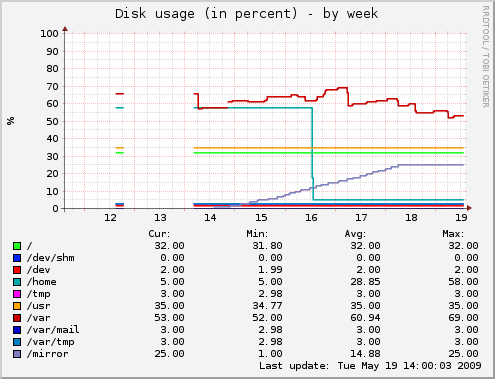
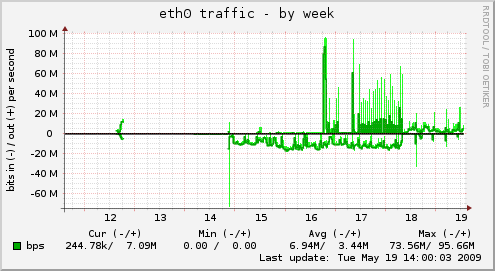
You might have noticed that during last week the Mexican Debian mirror, nisamox.fciencias.unam.mx (a.k.a. ftp.mx.debian.org, a.k.a. debian.unam.mx), went offline. The motherboard died on us, and Facultad de Ciencias was kind enough to give us a brand new one. So, excuse us for the blackout, but we are back Meaner and badder than ever before! Now, Sergio (nisamox's main admin) prefered to rebuild the whole mirror, as there was a shadow of doubt regarding the data integrity. So, rsync was pulling as fast as he could for the whole weekend (leading to some people scratching their heads regarding the 404 for the missing files; sorry, we should have left Apache shut down until the mirror was complete!). After three days of sustaining a 10-20Mbps download from the main mirrors, all 364GB of Debian are finally installed and as you can clearly see we are back to normality, with small, regular mirror pulses and a nice sustained 5-10Mbps (with some up to 40Mbps peaks We have seen up to 100Mbps peaks in the past, and I doubt with the current network infrastructure we won't top that). You can see we have currently plenty of disk space still to fill up. Among our plans is to host the most popular ISOs, which are a common request, and... What else? Well, ask us and we shall do so (quite probably). Ethernet usage over the last week Disk space usage over the last week So, if you switched away from ftp.mx.debian.org due to our downtime, readjust your mirror settings. Nisamox is back!
AttachmentSize
Nisamox Ethernet statistics for the last week23.38 KB
Nisamox disk space statistics for the last week24.29 KB

Neil Williams: libqof2

It's taken a lot longer than I expected (mostly due to getting other things done in Emdebian etc.) but now that Lenny is out, QOF can finally drop all the previously deprecated code and move to libqof2, so the upstream code has now been released via Alioth (0.8.0) and the binaries have been uploaded to Debian and are waiting in NEW.

QOF provides a set of C language utilities for performing generic structured complex queries on a set of data held by a set of C/C++ objects. This framework allows programmers to add query support to their applications without having to hook into a SQL Database. QOF is a large part of my attempts to get some degree of data freedom to complement the source code freedom. This remains a problem with certain applications, especially financial ones, so I've tried to make it easier to both import and export data between programs using QOF and to convert the default QOF data storage formats into other common formats using simple tools and scripts based on XSL or perl. Having a SQL-type query interface accessible via the command line is a huge bonus when dealing with large data sets.

There is a patch for gnotime that makes the final adjustments to handling the removed code. pilot-qof and gpe-expenses already build cleanly without the deprecated code but each of these is also pending a new upstream release, so rather than need a binNMU, I'm simply going to make those releases when QOF clears NEW.

Having said that, pilot-qof and gpe-expenses introduce new binary packages themselves so they will spend time in NEW too. pilot-qof will be the last of the set to be released because the new upstream version can use symbols from the new gpe-expenses release to make it easier to move data between applications. However, that support is optional at build time and could be done via a Debian revision, so I might do it that way.

This also marks the completion of the migration of QOF from SourceForge to Alioth - principally for easier bug tracking and a usable mailing list archive. The QOF VCS is in svn.debian.org.

The mailing list for QOF development is therefore at alioth:
QOF-devel and archives also.

I'm still working on two other QOF-based utilities - one that can handle simple accounts and one to handle simple invoices. The invoice handling is already partially implemented in pilot-qof but I'm looking at a GTK+ frontend with a robust command line interface so that scripts can update the invoice data behind-the-scenes. Hopefully, some form of arbitrary-format parser can be arranged that can handle extracting data from whatever form the client happens to send - typically PDF. It'll need tweaking for each client, but it could work. The objects used by gpe-expenses and pilot-qof (including invoices) are exposed via QOF and can be mixed together in any new QOF application, easily able to read data from multiple sources, merge data sets, query data sets and export into other formats. The core currency and expense types come from pilot-link but are then enhanced to support GnuCash conventions.

For information on another QOF application called "estron" - an idea for a data-driven query interface - see http://estron.alioth.debian.org/. Problem 1 with estron: the examples all rely on postgres and I just can't get that to setup properly as either a test system or as a Debian package. Problem 2: estron was intended to be an interpreter that could be written "in itself" but whilst this is possible for the simpler examples, doing more complicated stuff like calculating values from other values makes the estron XML very obtuse. The current codebase uses GOB2 to

QOF is now stable and I don't expect to need another SONAME bump for quite a while. If anyone is interested in taking on estron or helping with the Cash and/or Invoice frontends, let me know. The problem with estron currently is bitrot - the GTK+ frontend has too many gtk1.2 hangovers which now fail to build.

18 May 2009

Gunnar Wolf: Summertime, summertime!

Summertime, summertime!
Finally, temperatures are back to sanity, and the air is no longer a mass of dust. For us Mexicans (well, for us central-Mexicans), spring is the hot, dry season. In spring, we usually reach up to 30 C... Not too much for many people, but hellish for me. Summer is much more palatable, having decently sunny days, cloudy evenings and a nice shower as it gets dark. Even if it is a bit harder for a cyclist to take the streets, I think this is my favorite season. This year, we had several (and early!) false starts. I have come to hate April/May's heath waves (that means I am usually grumpy for my birthday). But finally, we have had almost a week of cloudy skies, with almost daily rains. That makes me happy. But I am even happier when I come to work to my office, look out the window, and am not greeted anymore with a 5Km visibility range, but with 20Km. Mind you, this photo was taken past 5PM, when the sky turns nice and gray (just as I've proclaimed my life to be). According to the Weather Channel's information on Mexico City, we currently have 16.1Km Which makes sense, as I can no longer see the Chiquihuite mountain marking the Northern part of the city, but I can perfectly see some buildings near Polanco. The view earlier in the day was... Beautiful, partly perhaps because of the contrast just with last week's. Oh, and yes - Once again, thank you very much my dear University. Instead of the closed cubicles many people spend their hours in, this relaxing view was taken from my office's window. I love it!

Biella Coleman: Tonight: Bollier, NYU

Monday, May 18, 7:00pm VENUE: Courant Institute
251 Mercer Street (Warren Weaver Hall)
Room 109 TITLE: The Struggle to Build a Digital Republic ABSTRACT: David Bollier will speak about the themes of his new book, Viral
Spiral: How the Commoners Built a Digital Republic of Their Own (New
Press). The book is the first comprehensive history of the free
culture movement and sharing economy that is empowering ordinary
people, disrupting markets and changing politics and culture. Bollier
will talk about the rise of free and open source software, Creative
Commons licenses, the new forms of non-market creativity (Wikipedia,
blogs, remix music, videos) as well as fascinating innovations in open
science, open education and open business models. More about the
book can be found at the website www.viralspiral.cc. More about
Bollier can be found at www.bollier.org.

Michal &#268;iha&#345;: Community Bonding Period

Dear students, the Community Bonding Period is almost over and I have not seen much activity from most of you. Maybe you really do not have any questions about the project or existing code base, but I really doubt it (well, the code documentation is always the weak point). The summer is not that long as you might think and you will have lot of things to do during it! PS: phpMyAdmin's GSoC 2009 Student Guide is still valid.

16 May 2009

Andrew Pollock: [tech] Deciding between the Lenovo T400 and X301

I'm in the market for a new laptop. I've got almost 4 years out of my Dell D610 (which I've been despising from not long after purchasing) and decided that I'll never buy from Dell again. I used to be very down on ThinkPads because of the placement of the Escape key, but since I've been using one at work for the last 3.5 years, I've gotten used to the Escape key location, and found the laptops themselves to otherwise be very solid and well supported by Linux. So Lenovo it is. Next question: T400 or X301? I've seen both, and the X301 is very sexy in terms of thickness, weight, and having all the latest bells and whistles, but boy, is it expensive. I did a side-by-side comparison between a T400 decked out the way I wanted, and an X301 decked out the best I could choose, and I've opted for the T400. The main problems I had with the X301 were that there was no choice of processor, and the processor available seemed significantly slower than what I could get in the T400, and of course the cost. I seemed to be paying nearly $1000 more for a slower processor, just to get something extra thin and light, with LED backlighting and an SSD disk. What finally swayed me to spending less money and getting an arguably "better" laptop was if I paid less now, I'd be more comfortable possibly getting something in less than 4 years time down the track. So if it came down to the X301 for 4 years or the T400 for 2 years, the T400 seemed like a better deal. What will hopefully end up happening is I'll end up using the T400 for four years and not end up hating it by the end of that time. Here's what I ended up going with: All of that plus a 2 year warranty and an additional 90W AC adapter came out at $1,240 (they have a 15% off discount code thing running until tomorrow, which brought the price down a bit) I'm particularly excited about not having a proprietary graphics chipset. I'm particularly unexcited about it including Windows Vista Home Basic. Drat, enumerating all of the options made me just realise that I seem to have omitted the 5-in-1 media reader from the final order. Oh well. That was largely just a nice-to-have anyway. Sarah tends to do all of the photo management on her laptop. I doubt this will get to me before Thursday, so I should have it waiting for me by the time I get back from Barcelona.

Kartik Mistry: Indic Developers Meet 2009


* I reach Pune yesterday, had nice dinner with Gora, Ramky, Shantanu, Karaunakar, Both Raviji and Chacha Chaudhari :) Beer before and after dinner gave me awesome feeling during dream too! Met ankit/kushal and l10n folks after long time! Currently enjoying interesting session on Indic OCR using Tesseract by Debayan. Entire schedule is here. * Wiki Updates:
Development Track: http://www.indlinux.org/wiki/index.php/Development_track
Localization Track: http://www.indlinux.org/wiki/index.php/Localisation_track

Next.

Previous.