Search Results: "ina"

14 September 2016

Mike Gabriel: [Arctica Project] Release of nx-libs (version 3.5.99.1)

Introduction NX is a software suite which implements very efficient compression of the X11 protocol. This increases performance when using X applications over a network, especially a slow one. NX (v3) has been originally developed by NoMachine and has been Free Software ever since. Since NoMachine obsoleted NX (v3) some time back in 2013/2014, the maintenance has been continued by a versatile group of developers. The work on NX (v3) is being continued under the project name "nx-libs". Release Announcement On Tuesday, Sep 13th, version 3.5.99.1 of nx-libs has been released [1]. This release brings some code cleanups regarding displayed copyright information and an improvement when it comes to reconnecting to an already running session from an X11 server with a color depths setup that is different from the X11 server setup where the NX/X11 session was originally created on. Furthermore, an issue reported to the X2Go developers has been fixed that caused problems on Windows clients on copy+paste actions between the NX/X11 session and the underlying MS Windows system. For details see X2Go BTS, Bug #952 [3]. Change Log A list of recent changes (since 3.5.99.0) can be obtained from here. Binary Builds You can obtain binary builds of nx-libs for Debian (jessie, stretch, unstable) and Ubuntu (trusty, xenial) via these apt-URLs: Our package server's archive key is: 0x98DE3101 (fingerprint: 7A49 CD37 EBAE 2501 B9B4 F7EA A868 0F55 98DE 3101). Use this command to make APT trust our package server:
 wget -qO - http://packages.arctica-project.org/archive.key   sudo apt-key add -
The nx-libs software project brings to you the binary packages nxproxy (client-side component) and nxagent (nx-X11 server, server-side component). References
13 September 2016

John Goerzen: Two Boys, An Airplane, Plus Hundreds of Old Computers

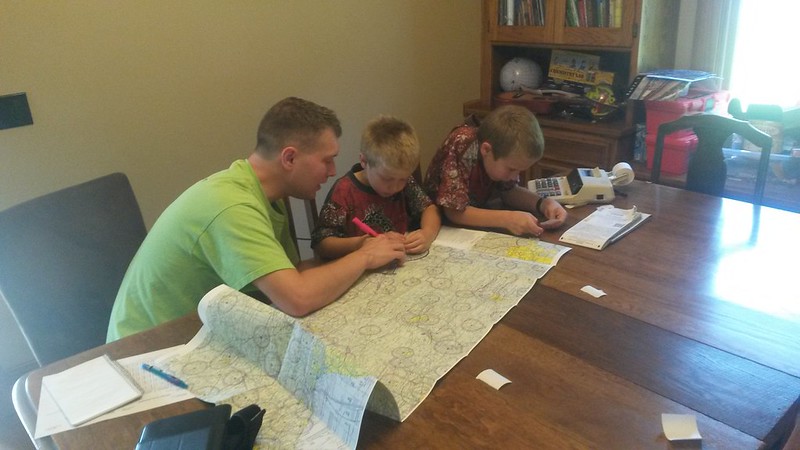
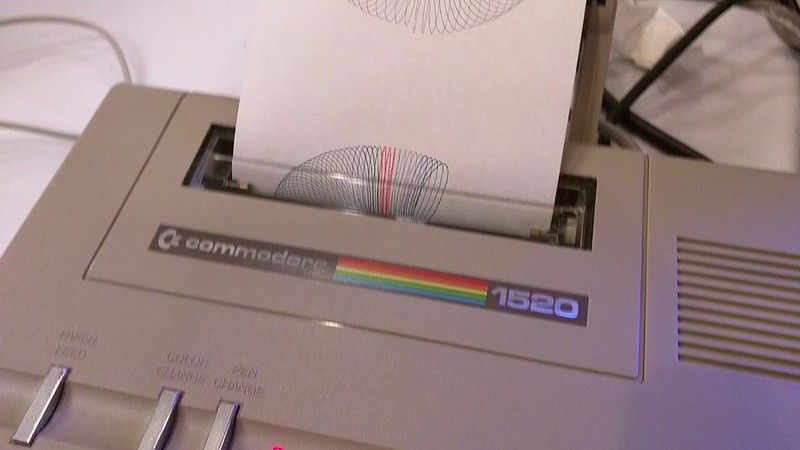
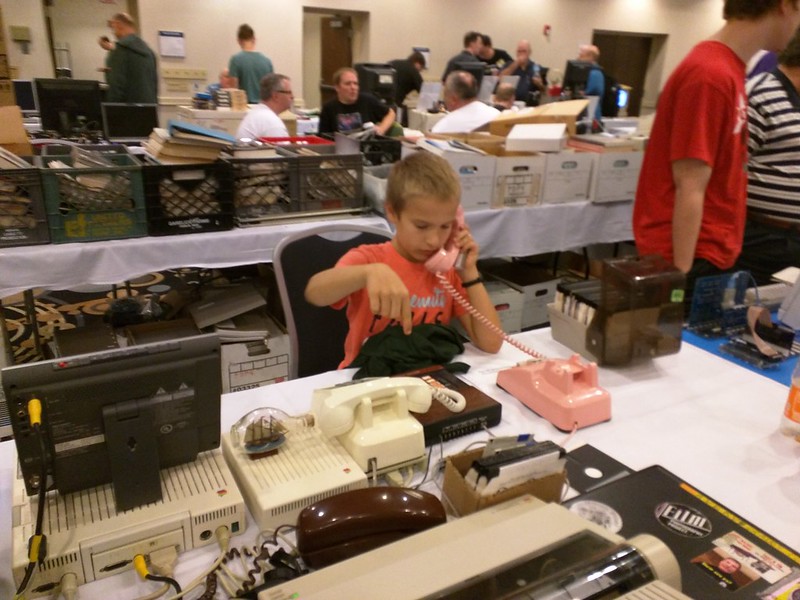
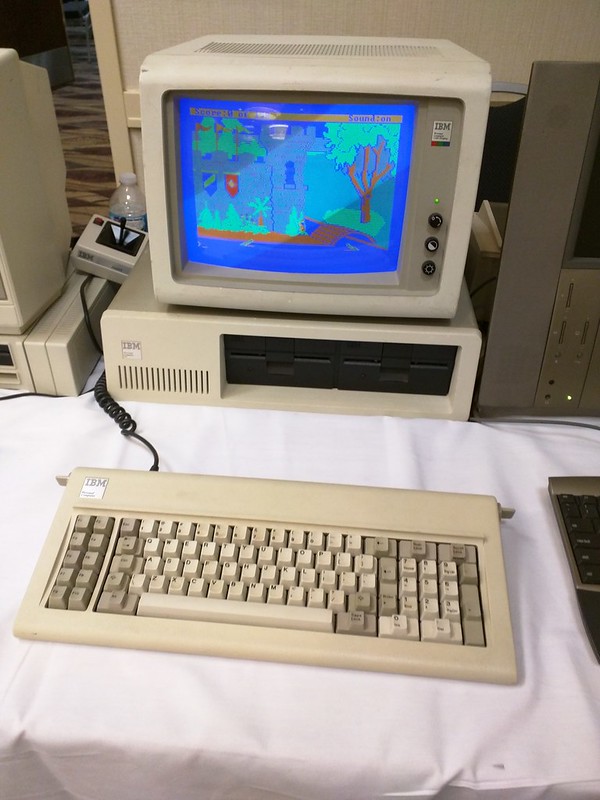
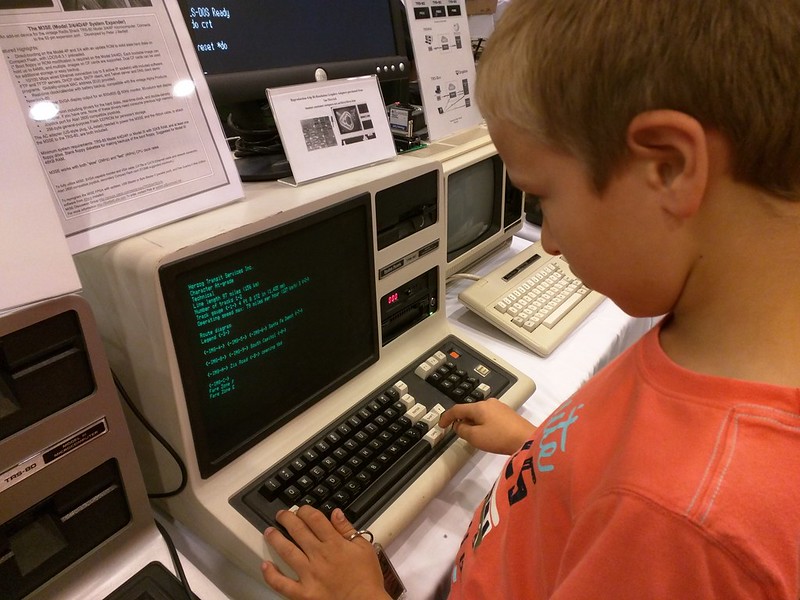
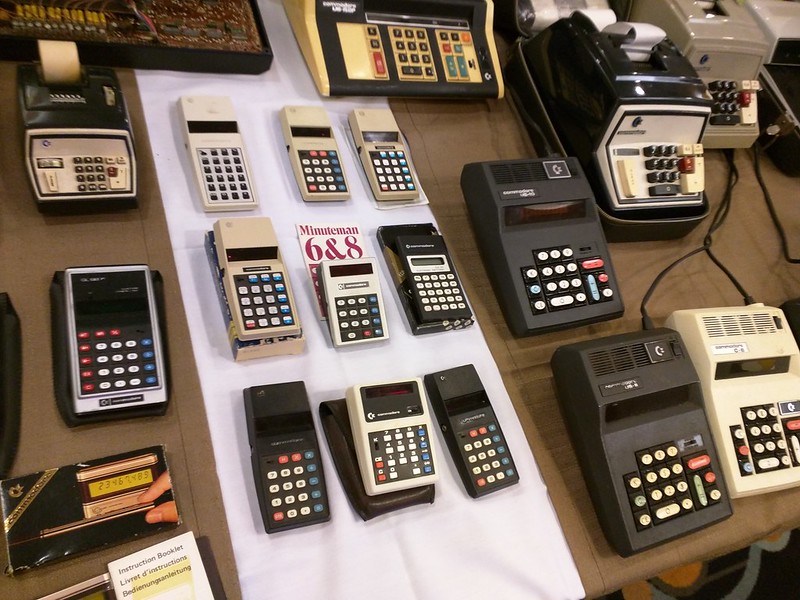
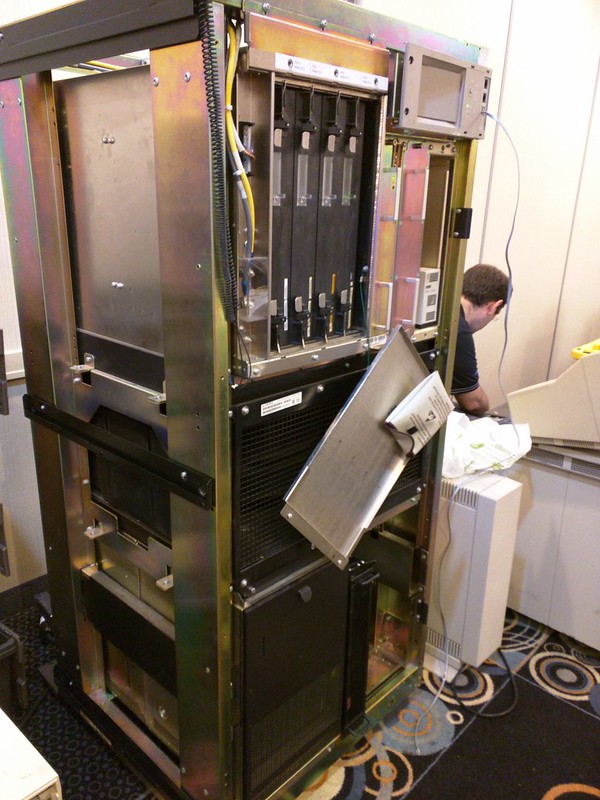
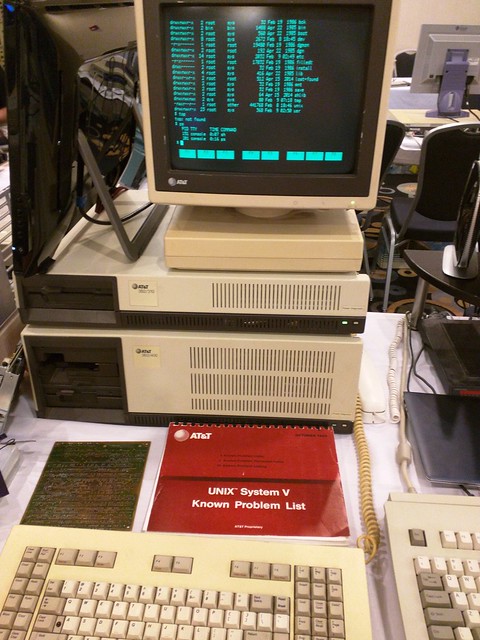
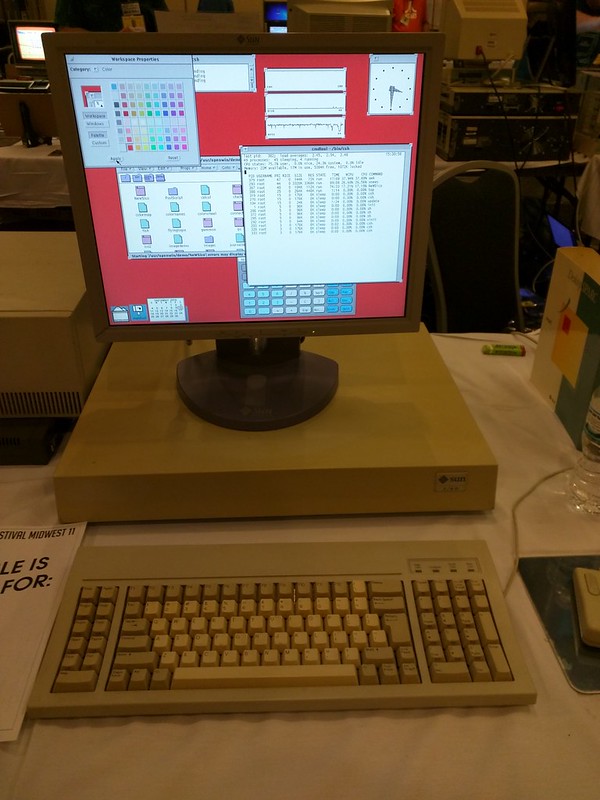
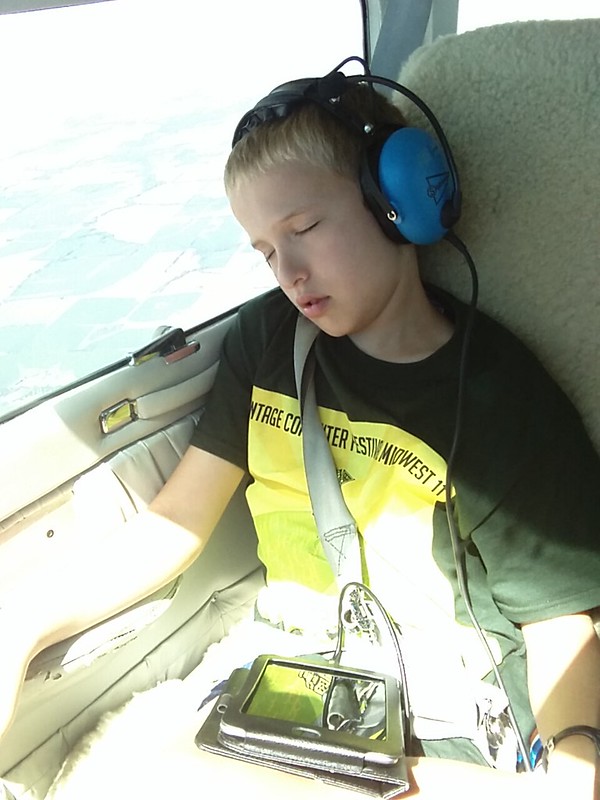
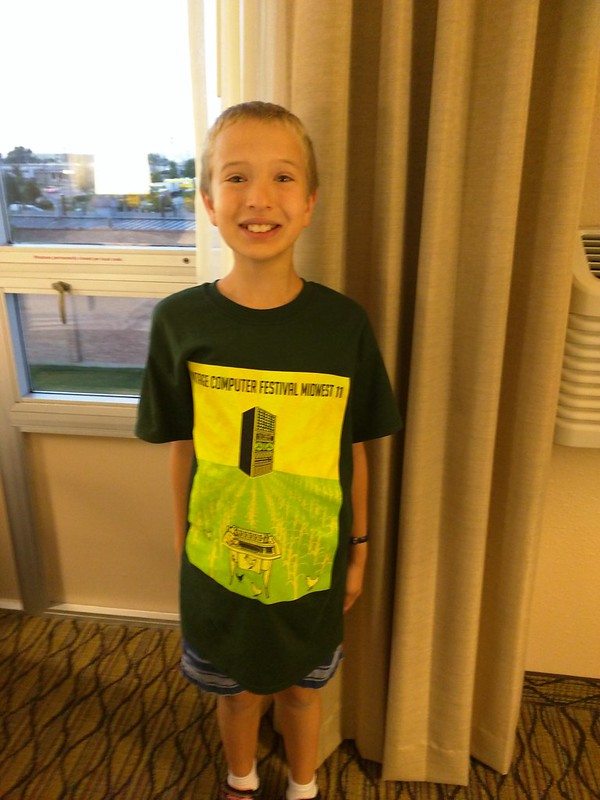
Was there anything you didn t like about our trip? Jacob s answer: That we had to leave so soon! That s always a good sign. When I first heard about the Vintage Computer Festival Midwest, I almost immediately got the notion that I wanted to go. Besides the TRS-80 CoCo II up in my attic, I also have fond memories of an old IBM PC with CGA monitor, a 25MHz 486, an Alpha also in my attic, and a lot of other computers along the way. I didn t really think my boys would be interested. But I mentioned it to them, and they just lit up. They remembered the Youtube videos I d shown them of old line printers and punch card readers, and thought it would be great fun. I thought it could be a great educational experience for them too and it was. It also turned into a trip that combined being a proud dad with so many of my other interests. Quite a fun time. IMG_20160911_061456 (Jacob modeling his new t-shirt) Captain Jacob Chicago being not all that close to Kansas, I planned to fly us there. If you re flying yourself, solid flight planning is always important. I had already planned out my flight using electronic tools, but I always carry paper maps with me in the cockpit for backup. I got them out and the boys and I planned out the flight the old-fashioned way. Here s Oliver using a scale ruler (with markings for miles corresponding to the scale of the map) and Jacob doing calculating for us. We measured the entire route and came to within one mile of the computer s calculation for each segment those boys are precise! 20160904_175519 We figured out how much fuel we d use, where we d make fuel stops, etc. The day of our flight, we made it as far as Davenport, Iowa when a chance of bad weather en route to Chicago convinced me to land there and drive the rest of the way. The boys saw that as part of the exciting adventure! Jacob is always interested in maps, and had kept wanting to use my map whenever we flew. So I dug an old Android tablet out of the attic, put Avare on it (which has aviation maps), and let him use that. He was always checking it while flying, sometimes saying this over his headset: DING. Attention all passengers, this is Captain Jacob speaking. We are now 45 miles from St. Joseph. Our altitude is 6514 feet. Our speed is 115 knots. We will be on the ground shortly. Thank you. DING Here he is at the Davenport airport, still busy looking at his maps: IMG_20160909_183813 Every little airport we stopped at featured adults smiling at the boys. People enjoyed watching a dad and his kids flying somewhere together. Oliver kept busy too. He loves to help me on my pre-flight inspections. He will report every little thing to me a scratch, a fleck of paint missing on a wheel cover, etc. He takes it seriously. Both boys love to help get the plane ready or put it away. The Computers Jacob quickly gravitated towards a few interesting things. He sat for about half an hour watching this old Commodore plotter do its thing (click for video): VID_20160910_142044 His other favorite thing was the phones. Several people had brought complete analog PBXs with them. They used them to demonstrate various old phone-related hardware; one had several BBSs running with actual modems, another had old answering machines and home-security devices. Jacob learned a lot about phones, including how to operate a rotary-dial phone, which he d never used before! IMG_20160910_151431 Oliver was drawn more to the old computers. He was fascinated by the IBM PC XT, which I explained was just about like a model I used to get to use sometimes. They learned about floppy disks and how computers store information. IMG_20160910_195145 He hadn t used joysticks much, and found Pong ( this is a soccer game! ) interesting. Somebody has also replaced the guts of a TRS-80 with a Raspberry Pi running a SNES emulator. This had thoroughly confused me for a little while, and excited Oliver. Jacob enjoyed an old TRS-80, which, through a modern Ethernet interface and a little computation help in AWS, provided an interface to Wikipedia. Jacob figured out the text-mode interface quickly. Here he is reading up on trains. IMG_20160910_140524 I had no idea that Commodore made a lot of adding machines and calculators before they got into the home computer business. There was a vast table with that older Commodore hardware, too much to get on a single photo. But some of the adding machines had their covers off, so the boys got to see all the little gears and wheels and learn how an adding machine can do its printing. IMG_20160910_145911 And then we get to my favorite: the big iron. Here is a VAX a working VAX. When you have a computer that huge, it s easier for the kids to understand just what something is. IMG_20160910_125451 When we encountered the table from the Glenside Color Computer Club, featuring the good old CoCo IIs like what I used as a kid (and have up in my attic), I pointed out to the boys that we have a computer just like this that can do these things and they responded wow! I think they are eager to try out floppy disks and disk BASIC now. Some of my favorites were the old Unix systems, which are a direct ancestor to what I ve been working with for decades now. Here s AT&T System V release 3 running on its original hardware: IMG_20160910_144923 And there were a couple of Sun workstations there, making me nostalgic for my college days. If memory serves, this one is actually running on m68k in the pre-Sparc days: IMG_20160910_153418 Returning home After all the excitement of the weekend, both boys zonked out for awhile on the flight back home. Here s Jacob, sleeping with his maps still up. IMG_20160911_132952 As we were nearly home, we hit a pocket of turbulence, the kind that feels as if the plane is dropping a bit (it s perfectly normal and safe; you ve probably felt that on commercial flights too). I was a bit concerned about Oliver; he is known to get motion sick in cars (and even planes sometimes). But what did I hear from Oliver? Whee! That was fun! It felt like a roller coaster! Do it again, dad!

Dirk Eddelbuettel: anytime 0.0.1: New package for 'anything' to POSIXct (or Date)

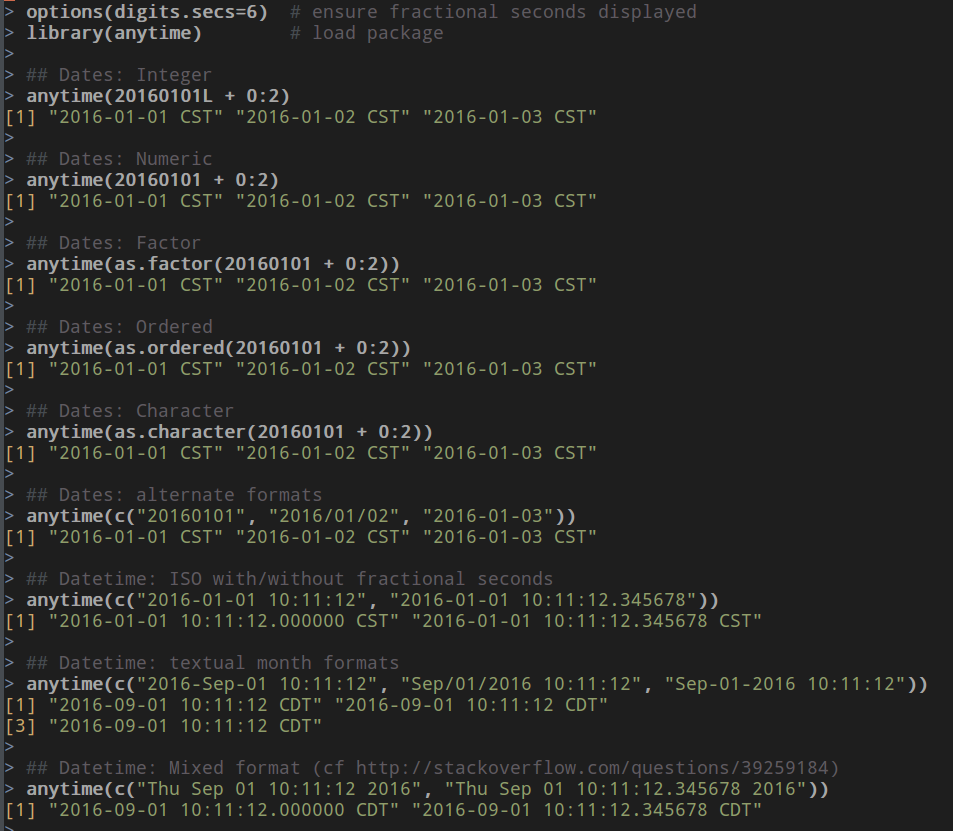
anytime just arrived on CRAN as a very first release 0.0.1. So why (yet another) package dealing with dates and times? R excels at computing with dates, and times. By using typed representation we not only get all that functionality but also of the added safety stemming from proper representation. But there is a small nuisance cost: How often have we each told as.POSIXct() that the origin is epoch '1970-01-01'? Do we have to say it a million more times? Similarly, when parsing dates that are in some recogniseable form of the YYYYMMDD format, do we really have to manually convert from integer or numeric or factor or ordered to character first? Having one of several common separators and/or date / time month forms (YYYY-MM-DD, YYYY/MM/DD, YYYYMMDD, YYYY-mon-DD and so on, with or without times, with or without textual months and so on), do we really need a format string? anytime() aims to help as a small general purpose converter returning a proper POSIXct (or Date) object nomatter the input (provided it was somewhat parseable), relying on Boost date_time for the (efficient, performant) conversion. See some examples on the anytime page or the GitHub README.md, or in the screenshot below. And then just give it try! anytime examples For questions or comments use the issue tracker off the GitHub repo.

This post by Dirk Eddelbuettel originated on his Thinking inside the box blog. Please report excessive re-aggregation in third-party for-profit settings.

12 September 2016

Shirish Agarwal: mtpfs, feh and not being able to share the debconf experience.

I have been sick for about 2 weeks now hence haven t written. I had joint pains and still am weak. There has been lot of reports of malaria, chikungunya and dengue fever around the city. The only thing I came to know is how lucky I am to be able to move around on 2 legs and how powerless and debilitating it feels when you can t move. In the interim I saw Me Before You and after going through my most miniscule experience, I could relate with Will Taylor s character. If I was in his place, I would probably make the same choices. But my issues are and were slightly different. Last month I was supposed to share my debconf experience in the local PLUG meet. For that purpose, I took some pictures from my phone on a pen-drive to share. But when reached the venue, found out that I had forgotten to take the pen-drive. What I had also done is used the mogrify command from the imagemagick stable to lossy compress the images on the pen-drive so it is easier on image viewers. But that was not to be and at the last moment had to use my phone plugged into the USB drive of the lappy and show some pictures. This was not good. I had known that it was mounted somewhere but hadn t looked at where. After coming back home, it took me hardly 10 minutes to find out where it was mounted. It is not mounted under /media/shirish but under /run/user/1000/gvfs . If I do list under it shows mtp:host=%5Busb%3A005%2C007%5D . I didn t need any packages under debian to make it work. Interestingly, the only image viewer which seems to be able to work with all the images is feh which is a command-line image viewer in Debian. [$] aptitude show feh
Package: feh
Version: 2.16.2-1
State: installed
Automatically installed: no
Priority: optional
Section: graphics
Maintainer: Debian PhotoTools Maintainers
Architecture: amd64
Uncompressed Size: 391 k
Depends: libc6 (>= 2.15), libcurl3 (>= 7.16.2), libexif12 (>= 0.6.21-1~), libimlib2 (>= 1.4.5), libpng16-16 (>= 1.6.2-1), libx11-6, libxinerama1
Recommends: libjpeg-progs
Description: imlib2 based image viewer
feh is a fast, lightweight image viewer which uses imlib2. It is commandline-driven and supports multiple images through slideshows, thumbnail
browsing or multiple windows, and montages or index prints (using TrueType fonts to display file info). Advanced features include fast dynamic
zooming, progressive loading, loading via HTTP (with reload support for watching webcams), recursive file opening (slideshow of a directory
hierarchy), and mouse wheel/keyboard control.
Homepage: http://feh.finalrewind.org/
I did try various things to get it to mount under /media/shirish/ but as of date have no luck. Am running Android 6.0 Marshmallow and have enabled USB debugging with help from my friend Akshat . I even changed the /etc/fuse.conf options but even that didn t work. #cat /etc/fuse.conf
[sudo] password for shirish:
# /etc/fuse.conf - Configuration file for Filesystem in Userspace (FUSE)
# Set the maximum number of FUSE mounts allowed to non-root users.
# The default is 1000.
mount_max = 1
# Allow non-root users to specify the allow_other or allow_root mount options.
user_allow_other
One way which I haven t explored is adding/making an entry into /etc/fstab. If anybody knows of a solution which doesn t involve changing content of /etc/fstab. At the same time you are able to get the card and phone directories mounted under /media// , in my case /media/shirish would be interested to know. I would like the /etc/fstab to remain as it is. I am using Samsung J5 (unrooted) Btw I tried all the mtpfs packages in Debian testing but without any meaningful change Look forward to tips.
Filed under: Miscellenous Tagged: #Android, #Debconf16, #debian, #mptfs, feh, FUSE, PLUG

Steve Kemp: If your code accepts URIs as input..

There are many online sites that accept reading input from remote locations. For example a site might try to extract all the text from a webpage, or show you the HTTP-headers a given server sends back in response to a request. If you run such a site you must make sure you validate the schema you're given - also remembering to do that if you're sent any HTTP-redirects.
Really the issue here is a confusion between URL & URI.
The only time I ever communicated with Aaron Swartz was unfortunately after his death, because I didn't make the connection. I randomly stumbled upon the html2text software he put together, which had an online demo containing a form for entering a location. I tried the obvious input:
file:///etc/passwd
The software was vulnerable, read the file, and showed it to me. The site gives errors on all inputs now, so it cannot be used to demonstrate the problem, but on Friday I saw another site on Hacker News with the very same input-issue, and it reminded me that there's a very real class of security problems here. The site in question was http://fuckyeahmarkdown.com/ and allows you to enter a URL to convert to markdown - I found this via the hacker news submission. The following link shows the contents of /etc/hosts, and demonstrates the problem: http://fuckyeahmarkdown.example.com/go/?u=file:///etc/hosts&read=1&preview=1&showframe=0&submit=go The output looked like this:
..
127.0.0.1 localhost
255.255.255.255 broadcasthost
::1 localhost
fe80::1%lo0 localhost
127.0.0.1 stage
127.0.0.1 files
127.0.0.1 brettt..
..
In the actual output of '/etc/passwd' all newlines had been stripped. (Which I now recognize as being an artifact of the markdown processing.) UPDATE: The problem is fixed now.

11 September 2016

Gregor Herrmann: RC bugs 2016/34-36

as before, my work on release-critical bugs was centered around perl issues. here's the list of bugs I worked on:

Niels Thykier: Unseen changes to lintian.d.o

We have been making a lot of minor changes to lintian.d.o and the underlying report framework. Most of them were hardly noticeable to the naked. In fact, I probably would not have spotted any of them, if I had not been involved in writing them. Nonetheless, I felt like sharing them, so here goes. User visible changes: In case you were wondering, the section title is partly a pun as half of these changes were intended to assist visually impaired users. They were triggered by me running into Sam Hartmann at DebConf16, where I asked him about how easy Debian s websites were for blind people. Allegedly, we are generally doing quite good in his opinion (with one exception, for which Sam filed Bug#830213), which was a positive surprise for me. On a related note: Thanks Luke Faraone and Asheesh Laroia for getting helping me started on these changes. Reporting framework / Internal changes: With the last change + the no generate reports option, we were able to schedule lintian more frequently. Originally, lintian only ran once a day. With the no generate reports , we added a second run and with the last changes, we bumped it to 4 times a day. Unsurprisingly, it means that we are now reprocessing the archive a lot faster than previously. All of the above is basically the all the note-worthy changes on the Lintian reporting framework since the Partial rewrite of lintian s reporting setup (~1 years ago).
Filed under: Debian, Lintian

10 September 2016

Dirk Eddelbuettel: New package gettz on CRAN

gettz is now on CRAN in its initial release 0.0.1. It provides a possible fallback in situations where Sys.timezone() fails to determine the system timezone. That can happen when e.g. the file /etc/localtime somehow is not a link into the corresponding file with zoneinfo data in, say, /usr/share/zoneinfo. Duane McCully provided a nice StackOverflow answer with code that offers fallbacks via /etc/timezone (on Debian/Ubuntu) or /etc/sysconfig/clock (on RedHat/CentOS/Fedora, and rumour has it, BSD* systems) or /etc/TIMEZONE (on Solaris). The gettz micro-package essentially encodes that approach so that we have an optional fallback when Sys.timezone() comes up empty. In the previous paragraph, note the stark absense of OS X where there seems nothing to query, and of course Windows. Contributions for either would be welcome. For questions or comments use the issue tracker off the GitHub repo.

This post by Dirk Eddelbuettel originated on his Thinking inside the box blog. Please report excessive re-aggregation in third-party for-profit settings.

9 September 2016

Dirk Eddelbuettel: RProtoBuf 0.4.6: bugfix update

Relatively quickly after version 0.4.5 of RProtoBuf was released, we have a new version 0.4.6 to announce which appeared on CRAN today. RProtoBuf provides R bindings for the Google Protocol Buffers ("Protobuf") data encoding and serialization library used and released by Google, and deployed as a language and operating-system agnostic protocol by numerous projects. This version contains a contributed bug-fix pull request covering conversion of zero-length vectors, and adding native support for S4 objects. At the request / suggestion of the CRAN maintainers, it also uncomments a LaTeX macro in the vignette (corresponding to our recent JSS paper paper) which older R versions do not (yet) have in their jss.cls file.
Changes in RProtoBuf version 0.4.6 (2016-09-08)
  • Support for serializing zero-length objects was added (PR #18 addressing #13)
  • S4 objects are natively encoded (also PR #18)
  • The vignette based on the JSS paper no longer uses a macro available only with the R-devel version of jss.cls, and hence builds on all R versions
CRANberries also provides a diff to the previous release. The RProtoBuf page has an older package vignette, a 'quick' overview vignette, a unit test summary vignette, and the pre-print for the JSS paper. Questions, comments etc should go to the GitHub issue tracker off the GitHub repo.

This post by Dirk Eddelbuettel originated on his Thinking inside the box blog. Please report excessive re-aggregation in third-party for-profit settings.

Jonathan Dowland: Metropolis

Every year since 2010 the Whitley Bay Film Festival has put on a programme of movies in my home town, often with some quirk or gimmick. A few years back we watched "Dawn Of The Dead" in a shopping centre the last act was interrupted by a fake film-reel break, then a load of zombies emerged from the shops. Sometime after that, we saw "The Graduate" within a Church as part of their annual "Secret Cinema" showing. Other famous stunts (which I personally did not witness) include a screening of Jaws on the beach and John Carpenter's "The Fog" in Whitley Bay Lighthouse. This year I only went to one showing, Fritz Lang's Metropolis. Two twists this time: it was being shown in The Rendezvous Cafe, an Art-Deco themed building on the sea front; the whole film was accompanied by a live, improvised synthesizer jam by a group of friends and synth/sound enthusiasts who branded themselves "The Mediators" for the evening. I've been meaning to watch Metropolis for a long time (I've got the Blu-Ray still sat in the shrink-wrap) and it was great to see the newly restored version, but the live synth accompaniment was what really made the night special for me. They used a bunch of equipment, most notably a set of Korg Volcas. The soundtrack varied in style and intensity to suit the scenes, with the various under-city scenes backed by a pumping, industrial-style improvisation which sounded quite excellent. I've had an interest in playing with synthesisers and making music for years, but haven't put the time in to do it properly. I left newly inspired and energised to finally try to make the time to explore it.

8 September 2016

Jamie McClelland: Wait... is that how you are supposed to configure your SSD card?

I bought a laptop with only SSD drives a while ago and based on a limited amount of reading, added the "discard" option to my /etc/fstab file for all partitions and happily went on my way expecting to avoid the performance degradation problems that happen on SSD cards without this setting). Yesterday, after a several month ordeal, I finally installed SSD drives in one of May First/People Link's servers and started doing more research to find the best way to set things up. I was quite surprised to learn that my change in /etc/fstab accomplished nothing. Well, not entirely true, my /boot partition was still getting empty sectors reported to the SSD card. Since my filesystem is on top of LVM and LVM is on top of an encrypted disk, those messages from the files system to the disk were not getting through. I learned that when I tried to run the fstrim command on one of the partitions and received the message that the disk didn't support it. Since my /boot partition is not in LVM or encrypted, it worked on /boot. I then made the necessary changes to /etc/lvm/lvm.conf and /etc/crypttab, restarted and... same result. Then I ran update-initramfs -u and rebooted and now fstrim works. I decided to remove the discard option from /etc/fstab and will set a cron job to run fstrim periodically. Also, I learned of some security implications of using trim on an encrypted disk which don't seem to outweigh the benefits.

Wouter Verhelst: Installing files for other applications with autotools

Let's say you have a configure.ac file which contains this:
PKG_CHECK_VAR([p11_moduledir], "p11-kit-1", "p11_module_path")
AC_SUBST([p11_moduledir])
and that it goes with a Makefile.am which contains this:
dist_p11_module_DATA = foo.module
Then things should work fine, right? When you run make install, your modules install to the right location, and p11-kit will pick up everything the way it should. Well, no. Not exactly. That is, it will work for the common case, but not for some other cases. You see, if you do that, then make distcheck will fail pretty spectacularly. At least if you run that as non-root (which you really really should do). The problem is that by specifying the p11_moduledir variable in that way, you hardcode it; it doesn't honour any $prefix or $DESTDIR variables that way. The result of that is that when a user installs your package by specifying --prefix=/opt/testmeout, it will still overwrite files in the system directory. Obviously, that's not desireable. The $DESTDIR bit is especially troublesome, as it makes packaging your software for the common distributions complicated (most packaging software heavily relies on DESTDIR support to "install" your software in a staging area before turning it into an installable package). So what's the right way then? I've been wondering about that myself, and asked for the right way to do something like that on the automake mailinglist a while back. The answer I got there wasn't entirely satisfying, and at the time I decided to take the easy way out (EXTRA_DIST the file, but don't actually install it). Recently, however, I ran against a similar problem for something else, and decided to try to do it the proper way this time around. p11-kit, like systemd, ships pkg-config files which contain variables for the default locations to install files into. These variables' values are meant to be easy to use from scripts, so that no munging of them is required if you want to directly install to the system-wide default location. The downside of this is that, if you want to install to the system-wide default location by default from an autotools package (but still allow the user to --prefix your installation into some other place, accepting that then things won't work out of the box), you do need to do the aforementioned munging. Luckily, that munging isn't too hard, provided whatever package you're installing for did the right thing:
PKG_CHECK_VAR([p11_moduledir], "p11-kit-1", "p11_module_path")
PKG_CHECK_VAR([p11kit_libdir], "p11-kit-1", "libdir")
if test -z $ac_cv_env_p11_moduledir_set; then
    p11_moduledir=$(echo $p11_moduledir sed -e "s,$p11kit_libdir,\$ libdir ,g")
fi
AC_SUBST([p11_moduledir])
Whoa, what just happened? First, we ask p11-kit-1 where it expects modules to be. After that, we ask p11-kit-1 what was used as "libdir" at installation time. Usually that should be something like /usr/lib or /usr/lib/gnu arch triplet or some such, but it could really be anything. Next, we test to see whether the user set the p11_moduledir variable on the command line. If so, we don't want to munge it. The next line looks for the value of whatever libdir was set to when p11-kit-1 was installed in the value of p11_module_path, and replaces it with the literal string $ libdir . Finally, we exit our if and AC_SUBST our value into the rest of the build system. The resulting package will have the following semantics: I suppose it would've been easier if the PKG_CHECK_VAR macro could (optionally) do that munging by itself, but then, can't have everything.

7 September 2016

Antonio Terceiro: Debian CI updates for September 2016

debci 1.4 was released just a few days ago. Among general improvements, I would like to highlight: ci.debian.net has been upgraded to debci 1.4 just after that. At the same time I have also upgraded autodep8 and autopkgtest to their latest versions, available in jessie-backports. This means that it is now safe for Debian packages to assume the changes in autopkgtest 4.0 are available, in special the $AUTOPKGTEST_* environment variables. In other news, for several weeks there were had issues with tests not being scheduled when they should have. I was just assuming that the issue was due to the existing test scheduler, debci-batch, being broken. Today I was working on a new implementation that is going to be a lot faster, I started to hit a similar issue on my local tests, and finally realized what was wrong. The fact is that debci-batch stores the timestamp of the last time a package has been scheduled to run, and it there are no test result after that timestamp, it assumes the package is still in the queue to be tested, and does not schedule it again. It turns out that a few weeks ago, during maintainance work, I had cleared the queue, discarding all jobs that were there, but forgot to reset those timestamps, so when debci-batch came around again, it checked the timestamp of the last request and did not make new requests because there was no test result after that timestamp! I cleared all those timestamps, and the system should now go back to normal. That is it for now. I you want to contribute to the Debian CI project and want to get in touch, you can pop up on the #debci channel on the OFTC IRC network, or mail the autopkgtest-devel mailing list.

Julian Andres Klode: New software: sicherboot

Fork me on GitHub Today, I wrote sicherboot, a tool to integrate systemd-boot into a Linux distribution in an entirely new way: With secure boot support. To be precise: The use case here is to only run trusted code which then unmounts an otherwise fully encrypted disk, as in my setup: screenshot-from-2016-09-06-04-09-52 If you want, sicherboot automatically creates db, KEK, and PK keys, and puts the public keys on your EFI System Partition (ESP) together with the KeyTool tool, so you can enroll the keys in UEFI. You can of course also use other keys, you just need to drop a db.crt and a db.key file into /etc/sicherboot/keys. It would be nice if sicherboot could enroll the keys directly in Linux, but there seems to be a bug in efitools preventing that at the moment. For some background: The Platform Key (PK) signs the Key Exchange Key (KEK) which signs the database key (db). The db key is the one signing binaries. sicherboot also handles installing new kernels to your ESP. For this, it combines the kernel with its initramfs into one executable UEFI image, and then signs that. Combined with a fully encrypted disk setup, this assures that only you can run UEFI binaries on the system, and attackers cannot boot any other operating system or modify parts of your operating system (except for, well, any block of your encrypted data, as XTS does not authenticate the data; but then you do have to know which blocks are which which is somewhat hard). sicherboot integrates with various parts of Debian: It can work together by dracut via an evil hack (diverting dracut s kernel/postinst.d config file, so we can run sicherboot after running dracut), it should support initramfs-tools (untested), and it also integrates with systemd upgrades via triggers on the /usr/lib/systemd/boot/efi directory. Currently sicherboot only supports Debian-style setups with /boot/vmlinuz-<version> and /boot/initrd.img-<version> files, it cannot automatically create combined boot images from or install boot loader entries for other naming schemes yet. Fixing that should be trivial though, with a configuration setting and some eval magic (or string substitution). Future planned features include: (1) support for multiple ESP partitions, so you can have a fallback partition on a different drive (think RAID type situation, keep one ESP on each drive, so you can remove a failing one); and (2) a tool to create a self-contained rescue disk image from a directory (which will act as initramfs) and a kernel (falling back to a vmlinuz file ) It might also be interesting to add support for other bootloaders and setups, so you could automatically sign a grub cryptodisk image for example. Not sure how much sense that makes. I published the source at https://github.com/julian-klode/sicherboot (MIT licensed) and uploaded the package to Debian, it should enter the NEW queue soon (or be in NEW by the time you read this). Give it a try, and let me know what you think.
Filed under: Debian, sicherboot

Reproducible builds folks: Reproducible Builds: week 71 in Stretch cycle

What happened in the Reproducible Builds effort between Sunday August 28 and Saturday September 3 2016: Media coverage Antonio Terceiro blogged about testing build reprodubility with debrepro . GSoC and Outreachy updates The next round is being planned now: see their page with a timeline and participating organizations listing. Maybe you want to participate this time? Then please reach out to us as soon as possible! Packages reviewed and fixed, and bugs filed The following packages have addressed reproducibility issues in other packages: The following updated packages have become reproducible in our current test setup after being fixed: The following updated packages appear to be reproducible now, for reasons we were not able to figure out yet. (Relevant changelogs did not mention reproducible builds.) The following 4 packages were not changed, but have become reproducible due to changes in their build-dependencies: Some uploads have addressed some reproducibility issues, but not all of them: Patches submitted that have not made their way to the archive yet: Reviews of unreproducible packages 706 package reviews have been added, 22 have been updated and 16 have been removed in this week, adding to our knowledge about identified issues. 5 issue types have been added: 1 issue type has been updated: Weekly QA work FTBFS bugs have been reported by: diffoscope development diffoscope development on the next version (60) continued in git, taking in contributions from: strip-nondeterminism development Mattia Rizzolo uploaded strip-nondeterminism 0.023-2~bpo8+1 to jessie-backports. A new version of strip-nondeterminism 0.024-1 was uploaded to unstable by Chris Lamb. It included contributions from: Holger added jobs on jenkins.debian.net to run testsuites on every commit. There is one job for the master branch and one for the other branches. disorderfs development Holger added jobs on jenkins.debian.net to run testsuites on every commit. There is one job for the master branch and one for the other branches. tests.reproducible-builds.org Debian: We now vary the GECOS records of the two build users. Thanks to Paul Wise for providing the patch. Misc. This week's edition was written by Ximin Luo, Holger Levsen & Chris Lamb and reviewed by a bunch of Reproducible Builds folks on IRC.

6 September 2016

Markus Koschany: My Free Software Activities in August 2016

Welcome to gambaru.de. Here is my monthly report that covers what I have been doing for Debian. If you re interested in Android, Java, Games and LTS topics, this might be interesting for you. Debian Android Debian Games Debian Java Debian LTS This was my seventh month as a paid contributor and I have been paid to work 14,75 hours on Debian LTS, a project started by Rapha l Hertzog. In that time I did the following: Non-maintainer uploads QA

Norbert Preining: Yukio Mishima: Patriotism ( )

A masterpiece by Yukio Mishima Patriotism the story of love and dead. A short story about the double suicide of a Lieutenant and his wife following the Ni Ni Roku Incident where some parts of the military tried to overthrow government and military leaders. Although Lieutenant Takeyama wasn t involved into the coup, because his friends wanted to safeguard him and his new wife, he found himself facing a fight and execution of his friends. Not being able to cope with this situation he commits suicide, followed by his wife.
mishima-patriotism Written in 1960 by one of the most interesting writers of Japanese modern history, Yukio Mishima, this book and the movie made by Mishima himself, are very disturbing images of the relation between human and state. Although the English title says Patriotism, the Japanese one is (Yukoku) which is closer to Concern for one s own country. This concern, and the feeling of devotion to the Imperial system and the country that leads the two into their deed. We are guided through the whole book and movie by a large scroll with (shisei, devotion) written on it. But indeed, Patriotism is a good title I think one of the most dangerous concepts mankind has brought forth. If Patriotism would be only the love for one s own country, all would be fine. But reality shows that patriotism unfailingly brings along xenophobia and the feeling of superiority. For someone coming from a small and unimportant country, I never had even the slightest allure to be patriotic in the bad sense. And looking at the world and people around me, I often have the feeling that mainly big countries produce the biggest and worst style of patriotism. This is obvious in countries like China, but having recently learned that all US pupils have to recite (obviously without understanding) the Pledge of Allegiance, the shock of how bad patriotism can start washing the brains of even the smallest kids in a seemingly free country is still present. But back to the book: Here the patriotism is exhibited by the presence of the Imperial images and shrine in the entrance, in front of which the two pray the last time before executing themselves. patriotism1 Not only the book is a masterpiece by itself, also the movie is a special piece of art: Filmed in silent movie style with text inserts, the whole story takes place on a Noh stage. This is in particular interesting as Mishima was one of the few, if not the only, modern Noh play writer. He has written several Noh plays. Another very impressive scene for me was when, after her husbands suicide, Reiko returns from putting up her final make-up into the central room. Her kimono is already blood soaked and the trailing kimono leaves traces on the Noh stage resembling the strokes of a calligraphy, as if her movement is guided, too, by . The final scene of the movie shows the two of them in a Zen stone garden, forming the stone, the unreachable island of happiness. patriotism2 Very impressive, both the book as well as the movie.

5 September 2016

Chris Lamb: How to write your first Lintian check

Lintian's humble description of "Debian package checker" belies its importance within the Debian GNU/Linux project. An extensive static analysis tool, it's not only used by the vast majority of developers, falling foul of some of its checks even cause uploads to be automatically rejected by the archive maintenance software. As you may have read in my recent monthly report, I've recently been hacking on Lintian itself. In particular:

However, this rest of this post will go through the steps needed to start contributing yourself. To demonstrate this I will be walking through submitting a patch for bug #831864 which warns about Python packages that ship .coverage files generated by Coverage.py.
Getting started First, let's obtain the Lintian sources and create a branch for our work:
$ git clone https://anonscm.debian.org/git/lintian/lintian.git
[ ]
$ cd lintian
$ git checkout -b warn-about-dotcoverage-files
Switched to a new branch 'warn-about-dotcoverage-files'
The most interesting files are under checks/*:
$ ls -l checks/   head -n 9
total 1356
-rw-r--r-- 1 lamby lamby  6393 Jul 29 14:19 apache2.desc
-rw-r--r-- 1 lamby lamby  8619 Jul 29 14:19 apache2.pm
-rw-r--r-- 1 lamby lamby  1956 Jul 29 14:19 application-not-library.desc
-rw-r--r-- 1 lamby lamby  3285 Jul 29 14:19 application-not-library.pm
-rw-r--r-- 1 lamby lamby   544 Jul 29 14:19 automake.desc
-rw-r--r-- 1 lamby lamby  1354 Jul 29 14:19 automake.pm
-rw-r--r-- 1 lamby lamby 19506 Jul 29 14:19 binaries.desc
-rw-r--r-- 1 lamby lamby 25204 Jul 29 14:19 binaries.pm
-rw-r--r-- 1 lamby lamby 15641 Aug 24 21:42 changelog-file.desc
-rw-r--r-- 1 lamby lamby 19606 Jul 29 14:19 changelog-file.pm
Note that the files are in pairs; a foo.desc file that contains description of the tags and a sibling foo.pm Perl module that actually performs the checks.

Let's add our new tag before we go any further. After poking around, it looks like files. pm,desc would be most appropriate, so we'll add our new tag definition to files.desc:
Tag: package-contains-python-coverage-file
Severity: normal
Certainty: certain
Info: The package contains a file that looks like output from the Python
 coverage.py tool.  These are generated by python ,3 -coverage during a test
 run, noting which parts of the code have been executed.  They can then be
 subsequently analyzed to identify code that could have been executed but was
 not.
 .
 As they are are unlikely to be of utility to end-users, these files should
 be removed from the package.
The Severity and Certainty fields are documented in the manual. Note the convention of using double spaces after full stops in the Info section.

Extending the testsuite Lintian has many moving parts based on regular expressions and other subtle logic, so it's especially important to provide tests in order to handle edge cases and to catch any regressions in the future. We create tests by combining a tiny Debian package that will deliberately violate our check, along with some metadata and the expected output of running Lintian against this package. The tests themselves are stored under t/tests. There may be an existing test that it would be more appropriate to extend, but I've gone with creating a new directory called files-python-coverage:
$ mkdir -p t/tests/files-python-coverage
$ cd t/tests/files-python-coverage
First, we create a simple package, installing dummy file to trigger the check:
$ mkdir -p debian/debian
$ touch debian/.coverage
$ echo ".coverage /usr/share/files-python-coverage" > debian/debian/install
Note that we do not need a debian/rules file as long as we do not deviate from a "skeleton" debhelper style. We then add the aforementioned metadata to t/tests/files-python-coverage/desc:
Testname: files-python-coverage
Sequence: 6000
Version: 1.0
Description: Check for Python .coverage files
Test-For:
 package-contains-python-coverage-file
and the expected warning to t/tests/files-python-coverage/tags:
$ echo "W: files-python-coverage: package-contains-python-coverage-file" \
      "usr/share/files-python-coverage/.coverage" > tags

When we run the testsuite, it should fail because we don't emit the check yet:
$ cd $(git rev-parse --show-toplevel)
$ debian/rules runtests onlyrun=tag:package-contains-python-coverage-file
[ ]
--- t/tests/files-python-coverage/tags
+++ debian/test-out/tests/files-python-coverage/tags.files-python-coverage
@@ -1 +0,0 @@
-W: files-python-coverage: package-contains-python-coverage-file usr/share/files-python-coverage/.coverage
fail tests::files-python-coverage: output differs!
Failed tests (1)
    tests::files-python-coverage
debian/rules:48: recipe for target 'runtests' failed
make: *** [runtests] Error 1
$ echo $?
1
Specifying onlyrun= means we only run the tests that are designed to trigger this tag rather than the whole testsuite. This is controlled by the Test-For key in our desc file, not by scanning the tags files. This recipe for creating a testcase could be used when submitting a regular bug against Lintian providing a failing testcase not only clarifies misunderstandings resulting from the use of natural language, it also makes it easier, quicker and safer to correct the offending code itself.

Emitting the tag Now, let's actually implement the check:
             tag 'package-installs-python-egg', $file;
          
+        # ---------------- .coverage (coverage.py output)
+        if ($file->basename eq ".coverage")  
+            tag 'package-contains-python-coverage-file', $file;
+         
         # ---------------- /usr/lib/site-python
Our testsuite now passes:
$ debian/rules runtests onlyrun=tag:package-contains-python-coverage-file
private/generate-profiles.pl
.... running tests ....
mkdir -p "debian/test-out"
t/runtests -k -j 9 t "debian/test-out" tag:package-contains-python-coverage-file
ENV[PATH]=[..]
pass tests::files-python-coverage
if [ "tag:package-contains-python-coverage-file" = "" ]; then touch runtests; fi
$ echo $?
0

Submitting the patch Lastly, we create a patch for submission to the bug tracking system:
$ git commit -a -m "c/files: Warn about Python packages which ship" \
      "coverage.py information. (Closes: #831864)"
$ git format-patch HEAD~
0001-c-files-Warn-about-Python-packages-which-ship-covera.patch
and we finally attach it to the existing bug:
To: 831864@bugs.debian.org
Cc: 831864-submitter@bugs.debian.org
Bcc: control@bugs.debian.org
tags 831864 + patch
thanks
Patch attached.
/lamby

Summary I hope this post will encourage at some extra contributions towards this important tool. (Be aware that I'm not a Lintian maintainer, so not only should you not treat anything here as gospel and expect this post may be edited over time if clarifications arise.)

Rapha&#235;l Hertzog: My Free Software Activities in August 2016

My monthly report covers a large part of what I have been doing in the free software world. I write it for my donators (thanks to them!) but also for the wider Debian community because it can give ideas to newcomers and it s one of the best ways to find volunteers to work with me on projects that matter to me. This months is rather light since I was away in vacation for two weeks. Kali related work The new pkg-security team is working full steam and I reviewed/sponsored many packages during the month: polenum, accheck, braa, t50, ncrack, websploit. I filed bug #834515 against sbuild since sbuild-createchroot was no longer usable for kali-rolling due to the embedded dash. That misfeature has been reverted and implemented through an explicit option. I brought the attention of ftpmasters on #832163 since we had unexpected packages in the standard section (they have been discovered in the Kali live ISO while we did not want them). I uploaded two fontconfig NMU to finally push to Debian a somewhat cleaner fix for the problem of various captions being displayed as squares after a font upgrade (see #828037 and #835142). I tested (twice) a live-build patch from Adrian Gibanel Lopez implementing EFI boot with grub and merged it into the official git repository (see #731709). I filed bug #835983 on python-pypdf2 since it has an invalid dependency forbidding co-installation with python-pypdf. I orphaned splint since its maintainer was missing in action (MIA) and immediately made a QA upload to fix the RC bug which kicked it out of testing (this package is a build dependency of a Kali package). django-jsonfield I wrote a patch to make python-django-jsonfield compatible with Django 1.10 (#828668) and I committed that patch in the upstream repository. Distro Tracker I made some changes to make the codebase compatible with Django 1.10 (and added Django 1.10 to the tox test matrix). I added a Debian Maintainer Dashboard link next to people s name on request of Lucas Nussbaum (#830548). I made a preliminary review of Paul Wise s patch to add multiarch hints (#833623) and improved the handling of the mailbot when it gets MIME Headers referencing an unknown charset (like cp-850 , Python only knows of cp850 ) I also helped Peter Palfrader to enabled a .onion address for tracker.debian.org, see onion.debian.org for the full list of services available over Tor. Misc stuff I updated my letsencrypt.sh salt formula to work with the latest version of letsencrypt.sh (0.2.0) I merged updated translations for the Debian Administrator s Handbook from weblate.org and uploaded a new version to Debian. Thanks See you next month for a new summary of my activities.

No comment Liked this article? Click here. My blog is Flattr-enabled.

Dirk Eddelbuettel: Rcpp 0.12.7: More updates

The seventh update in the 0.12.* series of Rcpp just arrived on the CRAN network for GNU R as well as in Debian. This 0.12.7 release follows the 0.12.0 release from late July, the 0.12.1 release in September, the 0.12.2 release in November, the 0.12.3 release in January, the 0.12.4 release in March, the 0.12.5 release in May, and the 0.12.6 release in July --- making it the eleventh release at the steady bi-montly release frequency. Keeping with the established pattern, this is again more of a maintenance release which addresses small bugs, nuisances or documentation issues without adding any major new features. One issue that got to a few people was our casual use of NORET in the definition of Rcpp::stop(). We had (ahem) overlooked that NORET is only defined by R 3.2.0 or later, and several folks trying to build on older releases of R (why?) got bitten. Well, at least we have a new record for most frequently reported bug ... Kidding aside, this is now fixed. Rcpp has become the most popular way of enhancing GNU R with C or C++ code. As of today, 759 packages on CRAN depend on Rcpp for making analytical code go faster and further. That is up by well over fifty packages since the last release in mid-July! We are once again fortunate to have a number of pull request, from first-timers to regulars. James "coatless" Balamuta in particular relentlessly pushed for better documentation and cleanup of numerous dangling issue tickets. Artem Klevtsov also contributed again. Qiang, Kevin and I also got some changes in for the Rcpp Core team. More details are again below.
Changes in Rcpp version 0.12.7 (2016-09-04)
  • Changes in Rcpp API:
    • The NORET macro is now defined if it was not already defined by R itself (Kevin fixing issue #512).
    • Environment functions get() & find() now accept a Symbol (James Balamuta in #513 addressing issue #326).
    • Several uses of Rf_eval were replaced by the preferred Rcpp::Rcpp_eval (Qiang in PR #523 closing #498).
    • Improved Autogeneration Warning for RcppExports (James Balamuta in #528 addressing issue #526).
    • Fixed invalid C++ prefix identifiers in auto-generated code (James Balamuta in #528 and #531 addressing issue #387; Simon Dirmeier in #548).
    • String constructors now set default UTF-8 encoding (Qiang Kou in #529 fixing #263).
    • Add variadic variants of the RCPP_RETURN_VECTOR and RCPP_RETURN_MATRIX macro when C++11 compiler used (Artem Klevtsov in #537 fixing #38).
  • Changes in Rcpp build system
    • Travis CI is now driven via run.sh from our fork, and deploys all packages as .deb binaries using our PPA where needed (Dirk in #540 addressing issue #517).
  • Changes in Rcpp unit tests
    • New unit tests for random number generators the R namespace which call the standalone Rmath library. (James Balamuta in #514 addressing issue #28).
  • Changes in Rcpp Examples:
    • Examples that used cxxfunction() from the inline package have been rewritten to use either sourceCpp() or cppFunction() (James Balamuta in #541, #535, #534, and #532 addressing issue #56).
Thanks to CRANberries, you can also look at a diff to the previous release. As always, even fuller details are on the Rcpp Changelog page and the Rcpp page which also leads to the downloads page, the browseable doxygen docs and zip files of doxygen output for the standard formats. A local directory has source and documentation too. Questions, comments etc should go to the rcpp-devel mailing list off the R-Forge page.

This post by Dirk Eddelbuettel originated on his Thinking inside the box blog. Please report excessive re-aggregation in third-party for-profit settings.

Next.

Previous.