Search Results: "ed"

3 September 2021

Reproducible Builds (diffoscope): diffoscope 183 released

The diffoscope maintainers are pleased to announce the release of diffoscope version 183. This version includes the following changes:
[ Chris Lamb ]
* Add support for extracting Android signing blocks.
  (Closes: reproducible-builds/diffoscope#246)
* Format debug messages for elf sections using our
  diffoscope.utils.format_class utility.
* Clarify a comment about the HUGE_TOOLS dict in diffoscope.external_tools.
[ Felix C. Stegerman ]
* Clarify output around APK Signing Blocks and remove an accidental duplicate
  "0x" prefix.
You find out more by visiting the project homepage.

2 September 2021

Eddy Petrișor: Stretch to Buster upgrade issues: "Grub error: symbol grub_is_lockdown not found", missing RTL8111/8168/8411 Ethernet driver and RTL8821CE Wireless adapter on Linux Kernel 5.10 (and 4.19)

I have been Debian Stretch running on my HP Pavilion 14-ce0000nq laptop since buying it back in April 2019, just before my presence at Oxidizeconf where I presented "How to Rust When Standards Are Defined in C".Debian Buster (aka Debian 10) was released about 4 months later and I've been postponing the upgrade as my free time isn't what it used to be. I also tend to wait for the first or even second update of the release to avoid any sharp edges.As this laptop has a Realtek 8821CE wireless card that wasn't officially supported in the Linux kernel, I had to use an out-of-tree hacked driver to have the wireless work on Stretch kernels such as 4.19, it didn't even got along with DKMS, so all compilations and installations of it, I did them manually. More reason to wait for a newer release that would contain a driver inside the official kernel.I was waiting for the inevitable and dreading the wireless issues, but since mid-august Bullseye became stable, turning Stretch into oldoldstable, I decided that I had to do the upgrade, at least to buster.The Grub error and the fix
Everything went quite smooth, except that after the reboot, the laptop failed to boot with this Grub error:

error: symbol grub_is_lockdown not found
I looked for a solution and it seemed everyone was stuck or the solution was unclear.There is even a bug report in Debian about this error, bug #984760.
Adding to the pile of confusion my own confused solution: I tried supergrubdisk2/rescatux, it didn't work for me, it might have been a combination of me using LVM and grub-efi-amd64. I also tried to boot in rescue mode the Buster first DVD (to avoid the need for network), I was able to enter the partition, mount the EFI partition, too, but since I didn't want to mess the setup even more or depend on an external USB stick, I didn't know where should I try to write the Grub EFI config - the root partition is on an NVME storage.When buying the laptop it had FreeDOS installed on it and some HP rescue app, which I did not wipe when installing Debian. I even forgot where or how was the EFI installed on the disk and EFI, even if it should be more reliable and simpler, I never got the hang of it.
In the end, I realized that I could via BIOS actually select manually which EFI executable should be booted into, so I was able to boot with some manual intervention during boot into the regular system.I tried regenerating the grub configuration, installing it and also tried restoring the default proper boot sequence (and I even installed refind in the system during my fumbling), but I think somewhere between grub-efi-amd64 reconfiguration and its reinstallation I managed to do the right thing, as the default boot screen is the Grub one now.Hints for anyone reading this in the hope to fix the same issue, hopefully it will make things better, not worse (see the text below):1) regenerate the grub config:
update-grub2
2) reinstall grub-efi-amd64 and make Debian the default
dpkg-reconfigure -plow grub-efi-amd64
When reinstalling grub-efi-amd64 onto the disk, I think the scariest questions were to these:

Force extra installation to the EFI removable media path?

Some EFI-based systems are buggy and do not handle new bootloaders correctly. If you force an extra installation of GRUB to the EFI removable media path, this should ensure that this system will boot Debian correctly despite such a problem. However, it may remove the ability to boot any other operating systems that also depend on this path. If so, you will need to make sure that GRUB is configured successfully to be able to boot any other OS installations correctly.

and
Update NVRAM variables to automatically boot into Debian?

GRUB can configure your platform's NVRAM variables so that it boots into Debian automatically when powered on. However, you may prefer to disable this behavior and avoid changes to your boot configuration. For example, if your NVRAM variables have been set up such that your system contacts a PXE server on every boot, this would preserve that behavior.

I think the first can be safely answered "No" if you don't plan on booting via a removable USB stick, while the second is the one that does the restoring.The second question is probably safe if you don't use PXE boot or other boot method, at least that's what I understand. But if you do, I suspect by installing refind, by playing with the multiple efi* named packages and tools, you can restore that, or it might be that your BIOS allows that directly.
I just did a walk through of these 2 steps again on my laptop and answered "No" to the removable media question as it leads to errors when the media was not inserted (in my case the internal SD card reader), and "Yes" to making Debian the default.It seems that for me this broke the FreeDOS and HP utilities boot entries from Grub, but I still can boot via the BIOS options and my goal was to have Debian boot correctly by default.
Fixing the missing RTL811/8168/8411 Ethernet card issue
As a side note for people with computers having Realtek RTL8111/8168/8411 Gigabit Ethernet Controller and upgrading to Buster or switching to a newer kernel, please note that you might end up having the unpleasant surprise even your Ethernet card to disappear because the r8169 driver is not loader by default.I had to add it to /etc/modules so is loaded by default:
eddy@aptonia:/ $ cat /etc/modules
# /etc/modules: kernel modules to load at boot time.
#
# This file contains the names of kernel modules that should be loaded
# at boot time, one per line. Lines beginning with "#" are ignored.
r8169

The 5.10 compatible driver for RTL8821CE wireless adapterAfter the upgrade to Buster, the oldstable version of the kernel, 4.19, the hacked version of the driver I've been using on Stretch on 4.9 kernels was no longer compatible - failed to compile due to missing symbols.The fix for me was to switch to the DKMS compatible driver from https://github.com/tomaspinho/rtl8821ce, as this seems to work for both 4.19 and 5.10 kernels (installed from backports).
I installed it via a modification of the manual install method only for the 4.19 and 5.10 kernels, leaving the legacy 4.9 kernels working with the hacked driver. You can do the same if instead of running the provided script, you do its steps manually and you install only for the kernel versions you want, instead of the default to install for all:I looked inside the dkms-install.sh script to do the required steps:Copy the driver, add it to the dkms set of known drivers:
DRV_NAME=rtl8821ce
DRV_VERSION=v5.5.2_34066.20200325

cp -r . /usr/src/$ DRV_NAME -$ DRV_VERSION

dkms add -m $ DRV_NAME -v $ DRV_VERSION
But you just build and install them only for the select kernel versions of your choice:
dkms build -m $ DRV_NAME -v $ DRV_VERSION -k 5.10.0-0.bpo.8-amd64
dkms install -m $ DRV_NAME -v $ DRV_VERSION -k 5.10.0-0.bpo.8-amd64
Or, without the variables:
dkms build rtl8821ce/v5.5.2_34066.20200325 -k 4.19.0-17-amd64
dkms install rtl8821ce/v5.5.2_34066.20200325 -k 4.19.0-17-amd64
dkms status should confirm everything is in place and I think you need to update grub2 again after this.
Please note this driver is no longer maintained and the 5.10 tree should support the RTL8821CE wireless card with the rtw88 driver from the kernel, but for me it did not. I'll probably try this at a later time, or after I upgrade to the current Debian stable, Bullseye.

Ian Jackson: partial-borrow: references to restricted views of a Rust struct

tl;dr:
With these two crazy proc-macros you can hand out multipe (perhaps mutable) references to suitable subsets/views of the same struct. Why In Otter I have adopted a style where I try to avoid giving code mutable access that doesn't need it, and try to make mutable access come with some code structures to prevent "oh I forgot a thing" type mistakes. For example, mutable access to a game state is only available in contexts that have to return a value for the updates to send to the players. This makes it harder to forget to send the update. But there is a downside. The game state is inside another struct, an Instance, and much code needs (immutable) access to it. I can't pass both &Instance and &mut GameState because one is inside the other. My workaround involves passing separate references to the other fields of Instance, leading to some functions taking far too many arguments. 14 in one case. (They're all different types so argument ordering mistakes just result in compiler errors talking about arguments 9 and 11 having wrong types, rather than actual bugs.) I felt this problem was purely a restriction arising from limitations of the borrow checker. I thought it might be possible to improve on it. Weeks passed and the question gradually wormed its way into my consciousness. Eventually, I tried some experiments. Encouraged, I persisted. What and how partial-borrow is a Rust library which solves this problem. You sprinkle #[Derive(PartialBorrow)] and partial!(...) and then you can pass a reference which grants mutable access to only some of the fields. You can also pass a reference through which some fields are inaccessible. You can even split a single mut reference into multiple compatible references, for example granting mut access to mutually-nonverlapping subsets. The core type is Struct__Partial (for some Struct). It is a zero-sized type, but we prevent anyone from constructing one. Instead we magic up references to it, always ensuring that they have the same address as some Struct. The fields of Struct__Partial are also ZSTs that exist ony as references, and they Deref to the actual field (subject to compile-type borrow compatibility checking). Soundness and testing partial-borrow is primarily a nontrivial procedural macro which autogenerates reams of unsafe. Of course I think it's sound, but I thought that the last two times before I added a test which demonstrated otherwise. So it might be fairer to say that I have tried to make it sound and that I don't know of any problems... Reasoning about the correctness of macro-generated code is not so easy. One problem is that there is nowhere good to put the kind of soundness arguments you would normally add near uses of unsafe. I decided to solve this by annotating an instance of the macro output. There's a not very complicated script using diff3 to help fold in changes if the macro output changes - merge conflicts there mean a possible re-review of the argument text. Of course I also have test cases that run with miri, and test cases for expected compiler errors for uses that need to be forbidden for soundness. But this is quite hairy and I'm worried that it might be rather "my first insane unsafe contraption". Also the pointer/reference trickery is definitely subtle, and depends heavily on knowing what Rust's aliasing and pointer provenance rules really are. Stacked Borrows is not entirely trivial to reason about in fiddly corner cases. So for now I have only called it 0.1.0 and left a note in the docs. I haven't actually made Otter use it yet but that's the rather more boring software integration part, not the fun "can I do this mad thing" part so I will probably leave that for a rainy day. Possibly a rainy day after someone other than me has looked at partial-borrow (preferably someone who understands Stacked Borrows...). Fun! This was great fun. I even enjoyed writing the docs. The proc-macro programming environment is not entirely straightforward and there are a number of things to watch out for. For my first non-adhoc proc-macro this was, perhaps, ambitious. But you don't learn anything without trying...
edited 2021-09-02 16:28 UTC to fix a typo


comment count unavailable comments

Norbert Preining: Reducing (sparsifying) qcow2 image of Windows10

Since joining Fujitsu I am permanently running a VM (kvm/qemu) with Windows 10 (unfortunately necessary). While the usaged disk space is about 50G, the actual qcow2 file had grown to over 180G, not good. Searching the web the very promising virt-sparsify is mentioned again and again, and the man page gives hope, but as it turns out it is broken and calls qemu-img with incorrect/not-working arguments (see this bug). Another problem seems to be that by default the discard mode seems not to be set to unmap. So here are the stages how I reduced the size of the qcow2 image back down to around 60G.

  1. Turn off the VM
  2. Make sure you are using VirtIO for the disk, select Discard mode: unmap
  3. Boot into Windows, and from an elevated prompt run: Optimize-Volume -DriveLetter C -ReTrim -Verbose
  4. Shut down the VM
  5. Run a dummy conversion which sparsifies the image: qemu-img convert -O qcow2 orig.qcow2 sparse.qcow2
  6. Rename/Backup the images and boot back into Windows.
That helped in my case, without any consequences (till now) for the Windows installation.

1 September 2021

Holger Levsen: 20210901-Debian-Reunion-Hamburg-2021

Debian Reunion Hamburg 2021 Moin! I'm glad to finally be able to send out this invitation for the "Debian Reunion Hamburg 2021" taking place at the venue of the 2018 & 2019 MiniDebConfs! The event will run from Monday, Sep 27 2021 until Friday Oct 1 2021, with Sunday, Sep 26 2021 as arrival day. IOW, Debian people meet again in Hamburg. The exact format is less defined and structured than previous years, probably we will just be hacking from Monday to Wednesday, have talks on Thursday and a nice day trip on Friday. Please read https://wiki.debian.org/DebianEvents/de/2021/DebianReunionHamburg if you intend to attend, especially Probably having some video coverage would be very nice to have, though due to this very late announcement I'm not sure we'll really have talks and the need for video. The event is in 3.5 weeks and will take place, either as a very small hack meeting, or somewhat bigger. We certainly want videoing if we have talks - and if you could help with this that would be very great! Last and definitly not least, financial sponsors for the event would be great. If you can support the "Debian Reunion Hamburg 2021", please contact me directly! Now, late, after weeks of wondering if and how to do this event, I'm finally and very much looking forward to it, to meet some Debian folks at least & for some shared Debian hacking. Definitly not the 2021 event I had in mind after the 2019 one, but something I feel I can responsibly do & enjoy. So, hoping to see some of you soon & most of you later! ;-) Sad but true, and at least something for some people. We should all do more local events. And more online events too, eg I think this is a great idea too: https://wiki.debian.org/DebianEvents/internet/2021/MiniDebConfOnlineBookworm See you!

Utkarsh Gupta: FOSS Activites in August 2021

Here s my (twenty-third) monthly but brief update about the activities I ve done in the F/L/OSS world.

Debian
This was my 32nd month of actively contributing to Debian. I became a DM in late March 2019 and a DD on Christmas 19! \o/ Tough month but I mostly spent on it churning through the immense backlog. But that somewhat backfired and I have even more backlog than ever. :D Anyway, I did the following stuff in Debian:

Uploads and bug fixes:
  • ruby3.0 (3.0.0-2) - Upload to unstable! \o/

Other $things:
  • Mentoring for newcomers.
  • Moderation of -project mailing list.

Ubuntu
This was my 7th month of actively contributing to Ubuntu. Now that I ve joined Canonical to work on Ubuntu full-time, there s a bunch of things I do! \o/ I mostly worked on different things, I guess. But mostly on packaging keylime and some Google Agents upload(s) and SRU(s). Also did a lot of reviewing, et al. I was too lazy to maintain a list of things I worked on so there s no concrete list atm. Maybe I ll get back to this section later or will start to list stuff from next month onward, as I ve been doing before. :D

Debian (E)LTS
Debian Long Term Support (LTS) is a project to extend the lifetime of all Debian stable releases to (at least) 5 years. Debian LTS is not handled by the Debian security team, but by a separate group of volunteers and companies interested in making it a success. And Debian Extended LTS (ELTS) is its sister project, extending support to the Jessie release (+2 years after LTS support). This was my twenty-third month as a Debian LTS and eleventh month as a Debian ELTS paid contributor.
I was assigned 23.75 hours for LTS and 40.00 hours for ELTS and worked on the following things:
(however, I only worked for 23.75h on ELTS work, thereby, carrying the rest to next month)

LTS CVE Fixes and Announcements:

ELTS CVE Fixes and Announcements:

Other (E)LTS Work:
  • Front-desk duty from 26-07 until 01-08 and from 30-08 until 05-09 for both LTS and ELTS.
  • Triaged haproxy, ntfs-3g, and cyrus-imapd, and exiv2, ffmpeg, git, gpac, inetutils, mc, modsecurity-crs, node-object-path, php-pear, systemd-cron, node-tar, ruby2.3, gst-plugins-bad0.10, jsoup, libxstream-java, qemu, tomcat7, ruby2.1, prototypejs, pillow, cpio, and qtbase-opensource-src, and amd64-microcode.
  • Mark CVE-2021-39240/haproxy as not-affected for stretch and jessie.
  • Mark CVE-2021-39241/haproxy as not-affected for stretch and jessie.
  • Mark CVE-2021-39242/haproxy as not-affected for stretch and jessie.
  • Mark CVE-2021-33582/cyrus-imapd as no-dsa for stretch.
  • Mark CVE-2020-18771/exiv2 as no-dsa for exiv2 for stretch.
  • Mark CVE-2020-18899/exiv2 as no-dsa for exiv2 for stretch.
  • Mark CVE-2021-38171/ffmpeg as postponed for stretch.
  • Mark CVE-2021-40330/git as no-dsa for stretch and jessie.
  • Mark CVE-2020-19481/gpac as ignored for stretch.
  • Mark CVE-2021-40491/inetutils as no-dsa for stretch.
  • Mark CVE-2021-36370/mc as no-dsa for stretch and jessie.
  • Mark CVE-2021-35368/modsecurity-crs as no-dsa for stretch.
  • Mark CVE-2021-23434/node-object-path as end-of-life for stretch.
  • Mark CVE-2021-32610/php-pear as no-dsa for stretch.
  • Mark CVE-2017-9525/systemd-cron as no-dsa for stretch.
  • Mark CVE-2021-37701/node-tar as end-of-life for stretch.
  • Mark CVE-2021-37712/node-tar as end-of-life in stretch.
  • Mark CVE-2021-3750/qemu as postponsed for jessie.
  • Mark CVE-2021-27511/prototypejs as postponsed for jessie.
  • Mark CVE-2021-23437/pillow as postponed for stretch and jessie.
  • Auto EOL ed gpac, cacti, openscad, cgal, cyrus-imapd-2.4, libsolv, mosquitto, atomicparsley, gtkpod, node-tar, libapache2-mod-auth-openidc, neutron, inetutils and linux for jessie.
  • Drop cpio from ela-needed; open issues don t warrant an ELA.
  • Attended monthly Debian LTS meeting.
  • Answered questions (& discussions) on IRC (#debian-lts and #debian-elts).
  • General and other discussions on LTS private and public mailing list.

Until next time.
:wq for today.

Paul Wise: FLOSS Activities August 2021

Focus This month I didn't have any particular focus. I just worked on issues in my info bubble.

Changes

Issues

Review

Administration
  • Debian servers: expand LV, fix debbugs config
  • Debian wiki: unblock IP addresses, approve accounts
  • Debian QA services: deploy changes

Communication

Sponsors The pyemd, pytest-rerunfailures, libpst, sptag, librecaptcha work was sponsored by my employer. All other work was done on a volunteer basis.

31 August 2021

Russ Allbery: kstart 4.3

kstart provides the programs k5start and krenew, which are similar to the Kerberos kinit program with some extra support for running programs with separate credentials and running as a daemon. This is the first full release in nearly six years. The major change is new support for the Linux kafs module, which is a native Linux implementation of the AFS protocol that David Howells and others have been working on for years. It has an entirely different way of thinking about tokens and credential isolation built on Linux keyrings rather than the AFS token concept (which sometimes uses keyrings, but in a different way, and sometimes uses other hacks). k5start and krenew, when run with the -t option to get AFS tokens, would fail if AFS was not available. That meant -t would fail with kafs even if the AKLOG environment variable were set properly to aklog-kafs. This release fixes that. The programs also optionally link with libkeyutils and use it when used to run a command to isolate the AFS credentials from the calling process. This is done by creating a new session keyring and linking it to the user keyring before running the aklog program. Thanks to Bill MacAllister, David Howells, and Jeffrey Altman for the help with this feature. I'm not sure that I have it right, so please let me know if it doesn't work for you. Also in this release is a fix from Aasif Versi to use a smarter exit status if k5start or krenew is running another program and that program is killed with a signal. Previously, that would cause k5start or krenew to exit with a status of 0, which was not helpful. Now it exits with a status formed by adding 128 to the signal number, which matches the behavior of bash. Since this is the first release in a while, it also contains some other minor fixes and portability updates. You can get the latest release from the kstart distribution page.

Benjamin Mako Hill: Returning to DebConf

I first started using Debian sometime in the mid 90s and started contributing as a developer and package maintainer more than two decades years ago. My first very first scholarly publication, collaborative work led by Martin Michlmayr that I did when I was still an undergrad at Hampshire College, was about quality and the reliance on individuals in Debian. To this day, many of my closest friends are people I first met through Debian. I met many of them at Debian s annual conference DebConf. Given my strong connections to Debian, I find it somewhat surprising that although all of my academic research has focused on peer production, free culture, and free software, I haven t actually published any Debian related research since that first paper with Martin in 2003! So it felt like coming full circle when, several days ago, I was able to sit in the virtual DebConf audience and watch two of my graduate student advisees Kaylea Champion and Wm Salt Hale present their research about Debian at DebConf21. Salt presented his masters thesis work which tried to understand the social dynamics behind organizational resilience among free software projects. Kaylea presented her work on a new technique she developed to identifying at risk software packages that are lower quality than we might hope given their popularity (you can read more about Kaylea s project in our blog post from earlier this year). If you missed either presentation, check out the blog post my research collective put up or watch the videos below. If you want to hear about new work we re doing including work on Debian you should follow our research group blog, and/or follow or engage with us in the Fediverse (@communitydata@social.coop), or on Twitter (@comdatasci). And if you re interested in joining us perhaps to do more research on FLOSS and/or Debian and/or a graduate degree of your own? please be in touch with me directly!
Wm Salt Hale s presentation plus Q&A. (WebM available)
Kaylea Champion s presentation plus Q&A. (WebM available)

30 August 2021

Joachim Breitner: A Candid explainer: Safe higher-order upgrades

This is the second post in a series about the interface description language Candid.

Safe upgrades A central idea behind Candid is that services evolve over time, and so also their interfaces evolve. As they do, it is desirable to keep the interface usable by clients who have not been updated. In particular on a blockchainy platform like the Internet Computer, where some programs are immutable and cannot be changed to accommodate changes in the interface of the services they use, this is of importance. Therefore, Candid defines which changes to an interface are guaranteed to be backward compatible. Of course it s compatible to add new methods to a service, but some changes to a method signature can also be ok. For example, changing
service A1 :  
  get_value : (variant   current; previous : nat  )
    -> (record   value : int; last_change : nat  )
 
to
service A2 :  
  get_value : (variant   current; previous : nat; default  )
    -> (record   value : int; last_change : nat; committed : bool  )
 
is fine: It doesn t matter that clients that still use the old interface don t know about the new constructor of the argument variant. And the extra field in the result record will silently be ignored by old clients. In the Candid spec, this relation is written as A2 <: A1 (note the order!), and the formal footing this builds on is subtyping. We thus say that it is safe to upgrade a service to a subtype , and that A2 s interface is a subtype of A1 s. In small examples, I often use nat and int, because every nat is also a int, but some int values are not not nat values, namely the negative ones. We say nat is a subtype of int, nat <: int. So a function that in the first returns a int can in the new version return a nat without breaking old clients. But the other direction doesn t work: If the old version s method had a return type of nat, then changing that to int would be a breaking change, as old clients would not be prepared to handle negative numbers. Note that arguments of function types follow different rules. In fact, the rules are simply turned around, and in argument position (also called negative position ), we can evolve the interface to accept supertypes. Concretely, a function that originally expected an nat can be changed to expect an int, but the other direction doesn t work, because there might still be old clients around that send negative numbers. This reversing-of-the-rules is called contravariance. The vision is that the developer s tooling will warn the developer before they upgrade the code of a running service to a type that is not a subtype of the old interface. Let me stress, though, that all this is about not breaking existing clients that use the old interface. It does not mean that a client developer who fetches the new interface for your service won t have to change their code to make his programs compile again.

Higher order composition So far, we considered the simple case of one service with a bunch of clients, i.e. the first order situation. Things get much more interesting if we have multiple services that are composed, and that pass around references to each other, and we still want everything to be nicely typed and never fail even as we upgrade services. Therefore, Candid s type system can express that a service s method expects or a returns a reference to another service or method, and the type that this service or method should have. For example
service B :   add_listener : (text, func (int) -> ()) -> ()  
says that the service with interface B has a method called add_listener which takes two arguments, a plain value of type text and a reference to a function that itself expects a int-typed argument. The contravariance of the subtyping rules explained above also applies to the types of these function reference. And because the int in the above type is on the left of two function arrows, the subtyping rule direction flips twice, and it is therefore safe to upgrade the service to accept the following interface:
service B :   add_listener : (text, func (nat) -> ()) -> ()  

Soundness theorem and Coq proof The combination of these higher order features and the safe upgrade mechanism is maybe the unique selling point of Candid, but also what made its design quite tricky sometimes. And although the conventional subtyping rules work well, we wanted to do some less conventional things (more on that below), and more than once thought we had a good solution, only to notice that it did not hold water in complicated higher-order cases. But what does it mean to hold water? I felt the need to precisely define a soundness criteria for higher order interface description languages, which you can find in the document An IDL Soundness Proposition. This is a general framework which you can instantiate with your concrete IDL language and rules, and then it tells you what you have to prove to consider your language to be sound. Intuitively, it simulates all possible ways in which services can be defined and upgraded, and in which they can pass around references to each other, and the soundness property is that then that for all messages sent between services, they can always be understood. The document also shows, in general, that any system that builds on canonical subtyping in sound, as expected. That is still a generic theorem that you can instantiate with a concrete system, but now there is less to do. Because these proofs can get tricky in corner cases, it is valuable to mechanize them in an interactive theorem prover and have the computer check the proofs. So I have created a Coq formalization that defines the soundness criteria, including the reduction to canonical subtyping. It also defines MiniCandid, a greatly simplified variant of Candid, proves various properties about it (transitivity etc.) and finally instantiates the soundness theorem. I am particularly fond of the use of coinduction to model the equirecursive types, and the use of named cases, as we know them from Isabelle, to make the proofs a bit more readable and maintainable. I am less fond of how much work it seems to be to extend MiniCandid with more of Candid s types. Already adding vec was more work than it s worth it, and I defensively blame Coq s not-so-great support for nested recursion. The soundness relies on subtyping, and that is all fine and well as long as we stick to canonical rules. Unfortunately, practical considerations force us to deviate from these a bit, as we see in the next post of this series.

Andrew Cater: Oh, my goodness, where's the fantastic barbeque [OMGWTFBBQ 2021]

I'm guessing the last glasses will be through the dishwasher (again) and Pepper the dog can settle down without having to cope with so many people.For those who don't know - Steve and his wife Jo (Sledge and Randombird) hold a barbeque in their garden every August Bank Holiday weekend [UK Bank Holiday on the last Monday in August]. The barbeque is not small - it's the dominating feature in the suburban garden, brick built, with a dedication stone, lights, electricity. The garden is small, generally made smaller by forty or so Debian friends and allies standing and sitting around. People are talking, arguing, hugging people they've not seen for (literal) years and putting the world to rights. This is Debian central point - with large quantities of meat and salads, an amount of beer/alcohol and "Cambridge gin" and general goodwill. This year was more than usually atmospheric because for some of us it was the first time with a large group of people in a while. Side conversations abound: for me it was learning something about the high energy particle physics community, how to precision build helicopters, fly quadcopters and precision 3D print anything, the maths of Isy counting crochet stitches to sew together randomly sized squares ... and, of course, obligatory things like how random is random and what's good enough entropy. And a few sessions of the game of our leader.
This is also a place for stuff to get done: I was unashamedly using this to upgrade the storage in my laptop while there were sensible engineers around. A corner of the table, a RattusRattus and it was quickly sorted - then a discussion around the internals of Thinkpads as he took his apart. Then getting a full install - Gb Ethernet to the Debian mirror in the cupboard six feet away is faster bandwidth than a jumbo jet full of tapes. Then getting mail to work again - it's handy when the mailserver owner is next to you, having come in from the garden to help, and finally IRC. And not just me: "You need a GPG key signed - there's three DPLs here, there's a release manager - but you've just missed one of the DAMs." plus an in-depth GPG how-to session on the other side of the table.I was the luckiest one with the most comfortable bed in the house overnight but I couldn't stay for last night. Thanks once again to all involved but especially Steve and Jo who do this for the love of it, and the fun, and the community and the family. Oh, and thanks to Lenovo - not just for being a platinum sponsor of Debconf but also for providing the official laptop of this and most Debian occasions

Thomas Goirand: developers-reference needs love

During Debconf, Holger, who s one of the developers-reference maintainers, made a quick presentation that was explaining the developers-reference needs some love. Indeed, it has gathered dust, and some useful refresh would be very welcome. Holger pointed at the list of bugs:
https://bugs.debian.org/src:developers-reference After having a quick look into that list, after Holger s Debconf presentation, I wrote to him on IRC: <zigo> Many of the bugs you refered are indeed easily actionable, if all of us just try to help for one bug, that d be a huge improvement of that doc. Then, as I was waiting for the closing ceremony of Debconf, I thought I shouldn t just say it, but actually do something about it. I decided to address https://bugs.debian.org/793633 as I thought it was easy. In just a few minutes, I was able to do a first patch, as seen here: https://salsa.debian.org/debian/developers-reference/-/merge_requests/27 I wrote about it on IRC, and a few people helped with rephrasing what was there (thanks to Fil for correcting my English mistakes, and others for the content). Today, which is 2 days after the MR was opened, I have decided it was long enough and actually merged it, as I considered it was enough time to gather comments. So we now have a brand new shiny chapter about Backports and how to handle them. I m sure that new part is perfectible, so do not hesitate, and do patch what I just wrote if you feel like you can do better. If I m writing this blog post, this is not to promote myself. The goal is to promote the developers-reference manual and push others in Debian to do the same. Please do what Holger suggested, and what I just did: contribute to the document by addressing just one of the currently opened bugs. If all DDs do it, we ll get a much nicer document, and help others to contribute to Debian. This is going to take less than 30 minutes of your time, and it is very much ok if you do this only once. It is really easy: just clone https://salsa.debian.org/debian/developers-reference/ and write a patch. If you re a DD, you can even merge your patch yourself once you re satisfied with it.

Russell Coker: Links August 2021

Sciencealert has an interesting article on a game to combat misinformation by microdosing people [1]. The game seemed overly simplistic to me, but I guess I m not the target demographic. Research shows it to work. Vice has an interesting and amusing article about mass walkouts of underpaid staff in the US [2]. The way that corporations are fighting an increase in the minimum wage doesn t seem financially beneficial for them. An increase in the minimum wage means small companies have to increase salaries too and the ratio of revenue to payroll is probably worse for small companies. It seems that companies like McDonalds make oppressing their workers a higher priority than making a profit. Interesting article in Vice about how the company Shot Spotter (which determines the locations of gunshots by sound) forges evidence for US police [3]. All convictions based on Shot Spotter evidence should be declared mistrials. BitsNBites has an interesting article on the fundamental flaws of SIMD (Single Instruction Multiple Data) [4]. The Daily Dot has a disturbing article anbout the possible future of the QAnon movement [5]. Let s hope they become too busy fighting each other to hurt many innocent people. Ben Taylor wrote an interesting blog post suggesting that Web Assembly should be a default binary target [6]. I don t support that idea but I think that considering it is useful. Web assembly could be used more for non-web things and it would be a better option than Node.js for some things. There are also some interesting corner cases like games, Minecraft was written in Java and there s no reason that Web Assembly couldn t do the same things. Vice has an interesting article about the Phantom encrypted phone service that ran on Blackberry handsets [7]. Australia really needs legislation based on the US RICO law! Vice has an interesting article about an encrypted phone company run by drug dealers [8]. Apparently after making an encrypted phone system for their own use they decided to sell it to others and made millions of dollars. They could have run a successful legal business. Salon has an insightful interview with Michael Petersen about his research on fake news and people who share it because they need chaos [9]. Apparently low status people who are status seeking are a main contributor to this, they share fake news knowingly to spread chaos. A society with less inequality would have less problems with fake news. Salon has another insightful interview with Michael Petersen, about is later research on fake news as an evolutionary strategy [10]. People knowingly share fake news to mobilise their supporters and to signal allegiance to their group. The more bizarre the beliefs are the more strongly they signal allegiance. If an opposing group has a belief then they can show support for their group by having the opposite belief (EG by opposing vaccination if the other political side supports doctors). He also suggests that lying can be a way of establishing dominance, the more honest people are opposed by a lie the more dominant the liar may seem. Vice has an amusing article about how police took over the Encrochat encrypted phone network that was mostly used by criminals [11]. It s amusing to read of criminals getting taken down like this. It s also interesting to note that the authorities messed up by breaking the wipe facility which alerted the criminals that their security was compromised. The investigation could have continued for longer if they hadn t changed the functionality of compromised phones. A later vice article mentioned that the malware installed on Encrochat devices recorded MAC addresses of Wifi access points which was used to locate the phones even though they had the GPS hardware removed. Cory Doctorow wrote an insightful article for Locus about the insufficient necessity of interoperability [12]. The problem if monopolies is not just an inability to interoperate with other services or leave it s losing control over your life. A few cartel participants interoperating will be able to do all the bad things to us tha a single monopolist could do.

29 August 2021

Joachim Breitner: A Candid explainer: The rough idea

One of the technologies that was created by DFINITY as we built the Internet Computer is Candid. Candid is In this in-depth blog post series I want to shed some light onto these aspects of Candid. The target audience is mainly anyone who wants to deeply understand Candid, e.g. researchers, implementors of Candid tools, anyone who wants to builds a better alternative, but no particular prior Candid knowledge is expected. Also, much of what is discussed here is independent of the Internet Computer. Some posts may be more theoretical or technical than others; if you are lost in one I hope you ll rejoin for the subsequent post Much in these posts is not relevant for developers who just want to use Candid in their projects, and also much that they want to know is missing. The Internet Computer dev docs will hopefully cater to that audience.

Blog post series overview
  1. The rough idea (this post) Announcing the blog post series, and very briefly outlining what an Interface Description Language even is.
  2. Safe higher-order upgrades Every can do first-order interface description languages. What makes Candid special is its support for higher-order service composition. This post also contains some general meta-theory and a Coq proof!
  3. Opt is special Extending records in argument position is surprisingly tricky. Lean why, and how we solved it.
  4. Language integration The point of Candid is inter-op, so let s look the various patterns of connecting Candid to your favorite programming language.
  5. Quirks The maybe most interesting post in this series: Candid has a bunch of quirks (hashed field names, no tuples but sequnces, references that nobody used, and more). I ll explain some of them, why they are there, and what else we could have done. Beware: This post will be opinionated.

The rough idea The idea of an interface description language is easy to begin with. Something like
service A :  
  add : (int) -> ();
  get : () -> (int);
 
clearly communicates that a service called A provides two methods add and get, that add takes an integer as an argument, and that get returns such a number. Of course, this only captures the outer shape of the service, but not what it actually does we might assume it implements a counter of sorts, but that is not part of the Candid interface description. In order to now use the service, we also need a (low-level) transport mechanism. Candid itself does not specify that, but merely assumes that it exists, and is able to transport the name of the invoked method and a raw sequence of bytes to the service, and a response (again a raw sequence of bytes) back. Already on the Internet Computer we have two distinct transport mechanisms used are external calls via an HTTP-based RPC interface and on-chain inter-canister calls. Both are handled by the service in the same way. Here we can see that Candid succeeds in abstracting over differences in the low-level transport mechanism. Because of this abstraction, it is possible to use Candid over other transportation mechanisms as well (conventional HTTPS, E-Mail, avian carrier). I think Candid has potential there as well, so even if you are not interested in the Internet Computer, this post may be interesting to you. The translation of argument and result values (e.g. numbers of type int) to the raw sequence of bytes is specified by Candid, defining a wire format. For example, the type int denotes whole numbers of arbitrary size, and they are encoded using the LEB128 scheme. The Candid wire format also contains a magic number (DIDL, which is 0x4449444c in hex) and a type description (more on that later). So when passing the value 2342 to the add, the raw bytes transported will be 0x4449444c00017da612. Of course we want to transfer more data than just integers, and thus Candid supports a fairly complete set of common basic types (nat, int, nat8, nat16, nat32, nat64, int8, int16, int32, int64, float32, float64, bool, text, blob) and composite types (vectors, optional values , records and variants). The design goal is to provide a canonical set of types enough to express most data that you might want to pass, but no more than needed, so that different host languages can support these types easily. The Candid type system is structural. This means that two types are the same when they are defined the same way. Imagine two different services defining the same
type User = record   name : text; user_id : nat  
then although User is defined in two places, it s still the same type. In other words, these name type definitions are always just simple aliases, and what matters is their right-hand side. Because Candid types can be recursive (e.g. type Peano = opt Peano), this means we have an equirecursive type system, which makes some things relatively hard. So far, nothing too special about Candid compared to other interface definition languages (although a structural equirecursive type system is already something). In the next post we look at reference types, and how such higher order features make Candid an interesting technology.

Kentaro Hayashi: Latest topics about fabre.debian.net

Aug 28, 2021, I gave a short talk about "Latest topics about fabre.debian.net" at DebConf21. You can see the presentation slide here: slide.rabbit-shocker.org Short talk explanation is here: debconf21.debconf.org In this talk, I've explained mainly 3 topics I've sent a pre-recorded video in advance, it is ok, but there is trouble with the mic during the session. :-( The recorded video will be available on the talk detail page soon.

28 August 2021

Anton Gladky: 2021/08, FLOSS activity

LTS This is my sixth month of working for LTS. I was assigned 12 hrs and worked all of them.

Released DLAs
  1. DLA 2742-1 ffmpeg_7:3.2.15-0+deb9u3
    • CVE-2020-22036: A heap-based Buffer Overflow vulnerability in filter_intra at libavfilter/vf_bwdif.c, which might lead to memory corruption and other potential consequences.
    • CVE-2020-22032: A heap-based Buffer Overflow vulnerability in gaussian_blur, which might lead to memory corruption and other potential consequences.
    • CVE-2020-22031: A Heap-based Buffer Overflow vulnerability in filter16_complex_low, which might lead to memory corruption and other potential consequences.
    • CVE-2020-22028: Buffer Overflow vulnerability in filter_vertically_8 at libavfilter/vf_avgblur.c, which could cause a remote Denial of Service.
    • CVE-2020-22026: Buffer Overflow vulnerability exists in the config_input function at libavfilter/af_tremolo.c, which could let a remote malicious user cause a Denial of Service.
    • CVE-2020-22025: A heap-based Buffer Overflow vulnerability exists in gaussian_blur at libavfilter/vf_edgedetect.c, which might lead to memory corruption and other potential consequences.
    • CVE-2020-22023: A heap-based Buffer Overflow vulnerabililty exists in filter_frame at libavfilter/vf_bitplanenoise.c, which might lead to memory corruption and other potential consequences.
    • CVE-2020-22022: A heap-based Buffer Overflow vulnerability exists in filter_frame at libavfilter/vf_fieldorder.c, which might lead to memory corruption and other potential consequences.
    • CVE-2020-22021: Buffer Overflow vulnerability at filter_edges function in libavfilter/vf_yadif.c, which could let a remote malicious user cause a Denial of Service.
    • CVE-2020-22020: Buffer Overflow vulnerability in the build_diff_map function in libavfilter/vf_fieldmatch.c, which could let a remote malicious user cause a Denial of Service.
    • CVE-2020-22016: A heap-based Buffer Overflow vulnerability at libavcodec/get_bits.h when writing .mov files, which might lead to memory corruption and other potential consequences.
    • CVE-2020-22015: Buffer Overflow vulnerability in mov_write_video_tag due to the out of bounds in libavformat/movenc.c, which could let a remote malicious user obtain sensitive information, cause a Denial of Service, or execute arbitrary code.
    • CVE-2020-21041: Buffer Overflow vulnerability exists via apng_do_inverse_blend in libavcodec/pngenc.c, which could let a remote malicious user cause a Denial of Service
    • CVE-2021-3566: The tty demuxer did not have a read_probe function assigned to it. By crafting a legitimate ffconcat file that references an image, followed by a file the triggers the tty demuxer, the contents of the second file will be copied into the output file verbatim (as long as the -vcodec copy option is passed to ffmpeg).
    • CVE-2021-38114: libavcodec/dnxhddec.c does not check the return value of the init_vlc function. Crafted DNxHD data can cause unspecified impact.
  2. DLA 2742-2 ffmpeg_7:3.2.15-0+deb9u4 During the backporting of one of patches in CVE-2020-22021 one line was wrongly interpreted and it caused the regression during the deinterlacing process. Thanks to Jari Ruusu for the reporting the issue and for the testing of prepared update.

LTS-Meeting
  • I attended the Debian LTS team Jitsi-meeting (though the connection was extremely bad).
  • Partly participated in preparation of Debconf21 BoF Funding Projects to Improve Debian .

Debian Science Team
  • Partly participated in Debconf21 Debian Science BoF.

Other FLOSS activities
  • Reviewed many merge requests in Yade open source project, merge some of them.

Andrew Cater: "If you do it twice, it's tradition" - says nattie

Thanks to all who've made Debconf 21 such a good place to be.

A song for Debconf21 ["What shall we do with the drunken sailor"]


What shall we do with the online Debconf?What shall we do with the online Debconf?What shall we do with the online Debconf?

Earl-y in the morning

Close it up as we agreed it

Save each script in case we need it

Work out how we best live-feed itNext year s Debconf s dawning

Next year s Kosovo and Pristina

This virtual Debconf needs no cleaner

Hope when COVID s gone we re keener

To meet up every morning


Thanks to the Debconf orga team

Thanks to those who Loopy meme

Things are not always as they seeem

In virtual Debconf s morning

Bullseye s out its share is rising

Debconf s fun and quite surprising

Linux 30 :)

Yours and my thing - Debian s 28

Thanks to all who video d sessions

Debconf T-shirts - prized possessions

Debcamp bug-fixed some regressions

Now onto next year!


A closing song for Debconf 21 [Frere Jacques/Brueder Martin]

DebConf21

Virtual DebConf s

Now all through

Closed for you

Kosovo is next year

See you in Pristina!!

DebConf 22

Twenty twenty-two

27 August 2021

Reproducible Builds (diffoscope): diffoscope 182 released

The diffoscope maintainers are pleased to announce the release of diffoscope version 182. This version includes the following changes:
[ Chris Lamb ]
* Also ignore, for example, spurious "fwGCC: (Debian ... )" lines in output
  from strings(1).
* Only use "java -jar /path/to/apksigner.jar" if we have a .jar as newer
  versions of apksigner use a shell wrapper script which will obviously be
  rejected by the JVM. Also mention in the diff if apksigner is missing.
* Pass "-f" to apktool to avoid creating a strangely-named subdirectory and
  to simplify code.
* If we specify a suffix for temporary file or directory, ensure it starts
  with a "_" to make the generated filenames more human-readable.
* Drop an unused File import.
* Update the minimum version of the Black source code formatter.
[ Santiago Torres Arias ]
* Support parsing the return value of squashfs versions which discriminate
  between fatal and non-fatal errors.
You find out more by visiting the project homepage.

25 August 2021

Jelmer Vernooij: Thousands of Debian packages updated from their upstream Git repository

The Debian Janitor is an automated system that commits fixes for (minor) issues in Debian packages that can be fixed by software. It gradually started proposing merges in early December. The first set of changes sent out ran lintian-brush on sid packages maintained in Git. This post is part of a series about the progress of the Janitor. Linux distributions like Debian fulfill an important function in the FOSS ecosystem - they are system integrators that take existing free and open source software projects and adapt them where necessary to work well together. They also make it possible for users to install more software in an easy and consistent way and with some degree of quality control and review. One of the consequences of this model is that the distribution package often lags behind upstream releases. This is especially true for distributions that have tighter integration and standardization (such as Debian), and often new upstream code is only imported irregularly because it is a manual process - both updating the package, but also making sure that it still works together well with the rest of the system. The process of importing a new upstream used to be (well, back when I started working on Debian packages) fairly manual and something like this:

Ecosystem Improvements However, there have been developments over the last decade that make it easier to import new upstream releases into Debian packages.
Uscan and debian QA watch Uscan and debian/watch have been around for a while and make it possible to find upstream tarballs. A debian watch file usually looks something like this:
1
2
version=4
http://somesite.com/dir/filenamewithversion.tar.gz
The QA watch service regularly polls all watch locations in the archive and makes the information available, so it s possible to know which packages have changed without downloading each one of them.
Git Git is fairly ubiquitous nowadays, and most upstream projects and packages in Debian use it. There are still exceptions that do not use any version control system or that use a different control system, but they are becoming increasingly rare. [1]
debian/upstream/metadata DEP-12 specifies a file format with metadata about the upstream project that a package was based on. In particular relevant for our case is the fact it has fields for the location of the upstream version control location. debian/upstream/metadata files look something like this:
1
2
3
---
Repository: https://www.dulwich.io/code/dulwich/
Repository-Browse: https://www.dulwich.io/code/dulwich/
While DEP-12 is still a draft, it has already been widely adopted - there are about 10000 packages in Debian that ship a debian/upstream/metadata file with Repository information.
Autopkgtest The Autopkgtest standard and associated tooling provide a way to run a defined set of tests against an installed package. This makes it possible to verify that a package is working correctly as part of the system as a whole. ci.debian.net regularly runs these tests against Debian packages to detect regressions.
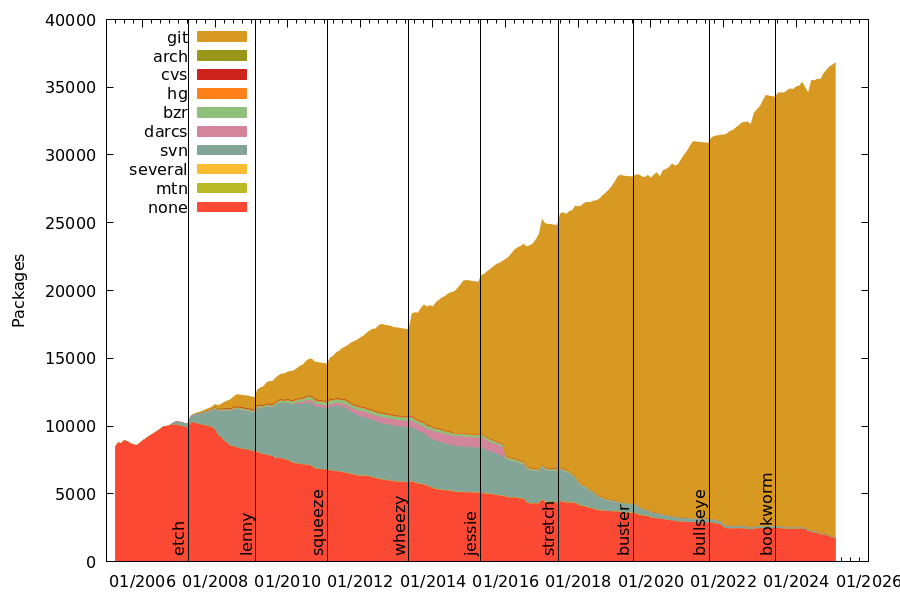
Vcs-Git headers The Vcs-Git headers in debian/control are the equivalent of the Repository field in debian/upstream/metadata, but for the packaging repositories (as opposed to the upstream ones). They ve been around for a while and are widely adopted, as can be seen from zack s stats: The vcswatch service that regularly polls packaging repositories to see whether they have changed makes it a lot easier to consume this information in usable way.
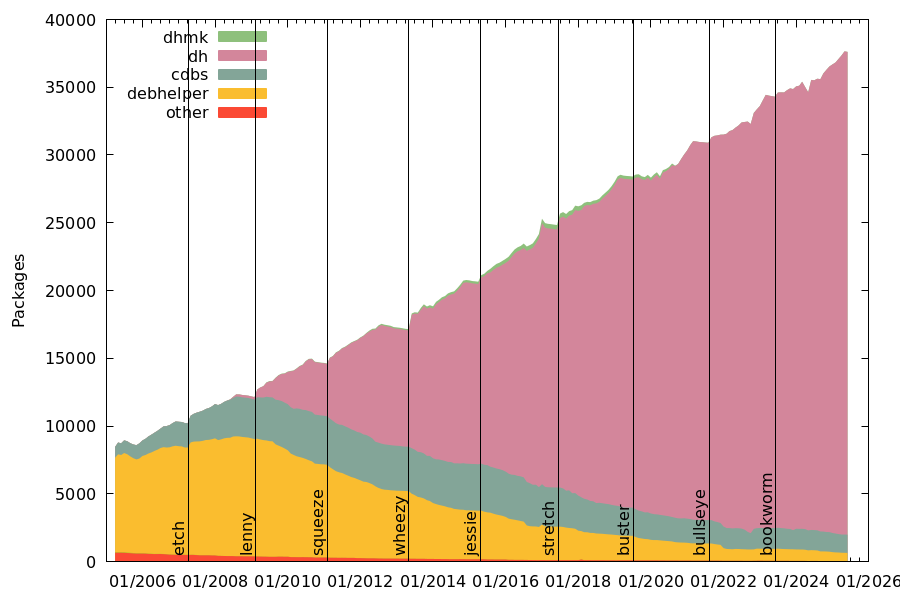
Debhelper adoption Over the last couple of years, Debian has slowly been converging on a single build tool - debhelper s dh interface. Being able to rely on a single build tool makes it easier to write code to update packaging when upstream changes require it.
Debhelper DWIM Debhelper (and its helpers) increasingly can figure out how to do the Right Thing in many cases without being explicitly configured. This makes packaging less effort, but also means that it s less likely that importing a new upstream version will require updates to the packaging. With all of these improvements in place, it actually becomes feasible in a lot of situations to update a Debian package to a new upstream version automatically. Of course, this requires that all of this information is available, so it won t work for all packages. In some cases, the packaging for the older upstream version might not apply to the newer upstream version. The Janitor has attempted to import a new upstream Git snapshot and a new upstream release for every package in the archive where a debian/watch file or debian/upstream/metadata file are present. These are the steps it uses:
  • Find new upstream version
    • If release, use debian/watch - or maybe tagged in upstream repository
    • If snapshot, use debian/upstream/metadata s Repository field
    • If neither is available, use guess-upstream-metadata from upstream-ontologist to guess the upstream Repository
  • Merge upstream version into packaging repository, possibly importing tarballs using pristine-tar
  • Update the changelog file to mention the new upstream version
  • Run some checks to ensure there are no unintentional changes, e.g.:
    • Scan diff between old and new for surprising license changes
      • Today, abort if there are any - in the future, maybe update debian/copyright
    • Check for obvious compatibility breaks - e.g. sonames changing
  • Attempt to update the packaging to reflect upstream changes
    • Refresh patches
  • Attempt to build the package with deb-fix-build, to deal with any missing dependencies
  • Run the autopkgtests with deb-fix-build to deal with missing dependencies, and abort if any tests fail
Results When run over all packages in unstable (sid), this process works for a surprising number of them.
Fresh Releases For fresh-releases (aka imports of upstream releases), processing all packages maintained in Git for which QA watch reports new releases (about 11,000): That means about 2300 packages updated, and about 4000 unchanged.
Fresh Snapshots For fresh-snapshots (aka imports of latest Git commit from upstream), processing all packages maintained in Git (about 26,000): Or 5100 packages updated and 2100 for which there was nothing to do, i.e. no upstream commits since the last Debian upload. As can be seen, this works for a surprising fraction of packages. It s possible to get the numbers up even higher, by both improving the tooling, the autopkgtests and the metadata that is provided by packages.
Using these packages All the packages that have been built can be accessed from the Janitor APT repository. More information can be found at https://janitor.debian.net/fresh, but in short - run:
1
2
3
4
5
6
echo deb "[arch=amd64 signed-by=/usr/share/keyrings/debian-janitor-archive-keyring.gpg]" \
    https://janitor.debian.net/ fresh-snapshots main   sudo tee /etc/apt/sources.list.d/fresh-snapshots.list
echo deb "[arch=amd64 signed-by=/usr/share/keyrings/debian-janitor-archive-keyring.gpg]" \
    https://janitor.debian.net/ fresh-releases main   sudo tee /etc/apt/sources.list.d/fresh-releases.list
sudo curl -o /usr/share/keyrings/debian-janitor-archive-keyring.gpg https://janitor.debian.net/pgp_keys
apt update
And then you can install packages from the fresh-snapshots (upstream git snapshots) or fresh-releases suites on a case-by-case basis by running something like:
1
apt install -t fresh-snapshots r-cran-roxygen2
Most packages are updated based on information provided by vcswatch and qa watch, but it s also possible for upstream repositories to call a web hook to trigger a refresh of a package. These packages were built against unstable, but should in almost all cases also work for testing.
Caveats Of course, since these packages are built automatically without human supervision it s likely that some of them will have bugs in them that would otherwise have been caught by the maintainer.
[1]I m not saying that a monoculture is great here, but it does help distributions.

John Goerzen: Excellent Experience with Debian Bullseye

I ve appreciated the bullseye upgrade, like most Debian upgrades. I m not quite sure how, since I was already running a backports kernel, but somehow the entire system is snappier. Maybe newer X or something? I m really pleased with it. Hardware integration is even nicer now, particularly the automatic driverless support for scanners in addition to the existing support for printers. All in all, a very nice upgrade, and pretty painless. I experienced a few odd situations. For one, I had been using Gnome Flashback. Since xmonad-log-applet didn t compile there (due to bitrot in the log applet, not flashback), and I had been finding Gnome Flashback to be a rather dusty and forgotten corner of Gnome for a long time, I decided to try Mate. Mate just seemed utterly unable to handle a situation with a laptop and an external monitor very well. I want to use only the external monitor with the laptop lid is closed, and it just couldn t remember how to do the right thing external monitor on, laptop monitor off, laptop not put into suspend. gdm3 also didn t seem to be able to put the external monitor to sleep, either, causing a few nights of wasted power. So off I went to XFCE, which I had been using for years on my workstation anyhow. Lots more settings available in XFCE, plus things Just Worked there. Odd that XFCE, the thin and light DE, is now the one that has the most relevant settings. It seems the Gnome let s remove a bunch of features approach has extended to MATE as well. When I switched to XFCE, I also removed gdm3 from my system, leaving lightdm as the only DM on it. That matched what my desktop machine was using, and also what task-xfce-desktop called for. But strangely, the XFCE settings for lightdm were completely different between the laptop and the desktop. It turns out that with lightdm, you can have the lightdm-gtk-greeter and the accompanying lightdm-gtk-greeter-settings, or slick-greeter and the accompanying lightdm-settings. One machine had one greeter and settings, and the other had the other. Why, I don t know. But lightdm-gtk-greeter-settings had the necessary options for putting monitors to sleep on the login screen, so I went with it. This does highlight a bit of a weakness in Debian upgrades. There is SO MUCH choice in Debian, which I highly value. At some point, almost certainly without my conscious choice, one machine got one greeter and another got the other. Despite both having task-xfce-desktop installed, they got different desktop experiences. There isn t a great way to say OK, I know I had a bunch of things installed before, but NOW I want the default bullseye experience . But overall, it is an absolutely fantastic distribution. It is great to see this nonprofit community distribution continue to have such quality on such an immense scale. And hard to believe I ve been a Debian developer for 25 years. That seems almost impossible!

Next.

Previous.