Search Results: "ads"

25 June 2017

Andreas Bombe: PDP-8/e Replicated Introduction

I am creating a replica of the DEC PDP-8/e architecture in an FPGA from schematics of the original hardware. So how did I end up with a project like this? The story begins with me wanting to have a computer with one of those front panels that have many, many lights where you can really see, in real time, what the computer is doing while it is executing code. Not because I am nostalgic for a prior experience with any of those I was born a bit too late for that and my first computer as a kid was a Commodore 64. Now, the front panel era ended around 40 years ago with the advent of microprocessors and computers of that age and older that are complete and working are hard to find and not cheap. And even if you do, there s the issue of weight, size (complete systems with peripherals fill at least a rack) and power consumption. So what to do build myself a small one with modern technology of course. While there s many computer architectures of that era to choose from, the various PDP machines by DEC are significant and well known (and documented) due to their large numbers. The most important are probably the 12 bit PDP-8, the 16 bit PDP-11 and the 36 bit PDP-10. While the PDP-11 is enticing because of the possibility to run UNIX I wanted to start with something simpler, so I chose the PDP-8.
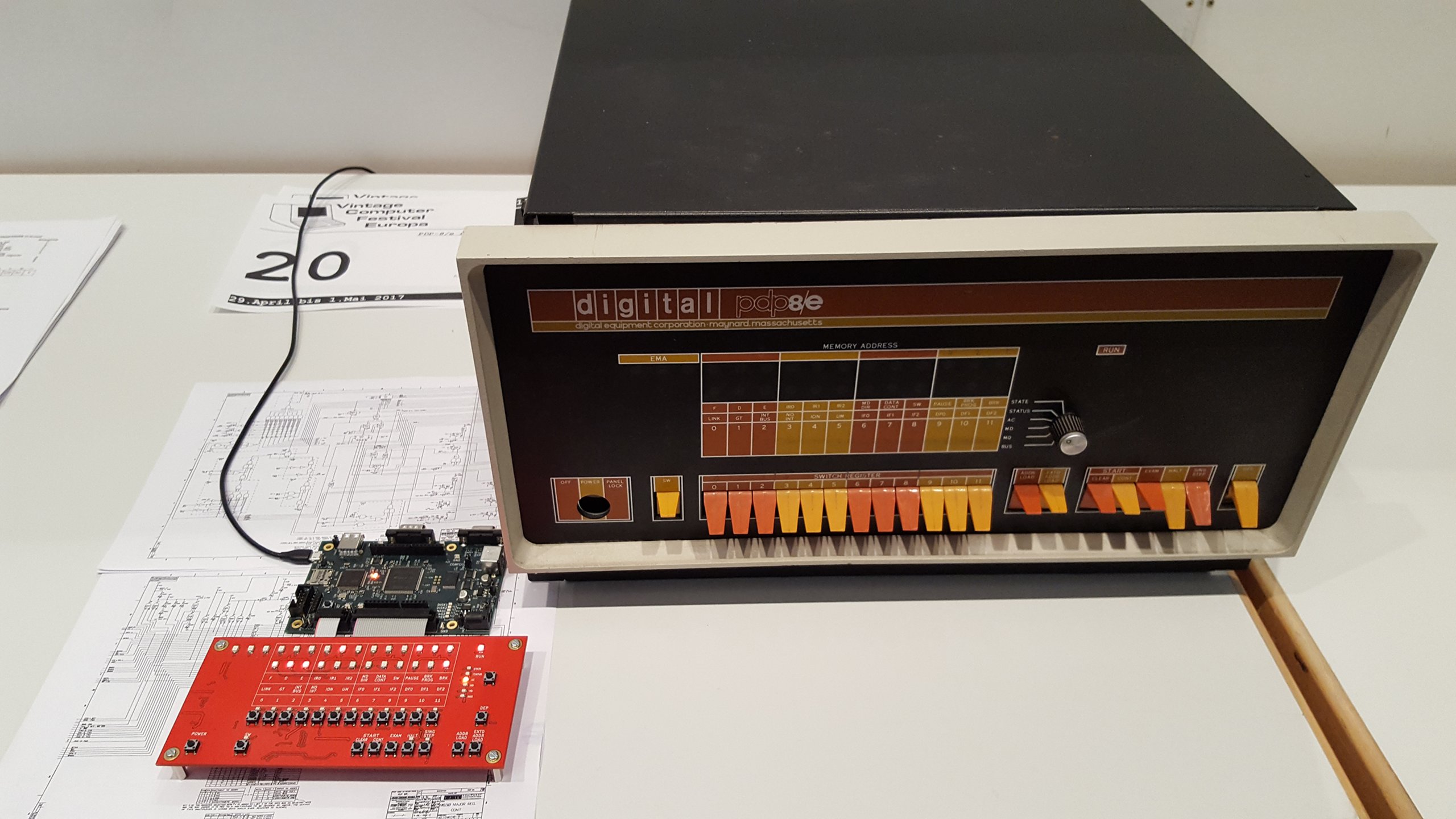
My implementation on display next to a real PDP-8/e at VCFe 18.0

The Original DEC started the PDP-8 line of computers programmed data processors designed as low cost machines in 1965. It is a quite minimalist 12 bit architecture based on the earlier PDP-5, and by minimalist I mean seriously minimal. If you are familiar with early 8 bit microprocessors like the 6502 or 8080 you will find them luxuriously equipped in comparison. The PDP-8 base architecture has a program counter (PC) and an accumulator (AC)1. That s it. There are no pointer or index registers2. There is no stack. It has addition and AND instructions but subtractions and OR operations have to be manually coded. The optional Extended Arithmetic Element adds the MQ register but that s really it for visible registers. The Wikipedia page on the PDP-8 has a good detailed description. Regarding technology, the PDP-8 series has been in production long enough to get the whole range of implementations from discrete transistor logic to microprocessors. The 8/e which I target was right in the middle, implemented in TTL logic where each IC contains multiple logic elements. This allowed the CPU itself (including timing generator) to fit on three large circuit boards plugged into a backplane. Complete systems would have at least another board for the front panel and multiple boards for the core memory, then additional boards for whatever options and peripherals were desired.
Design Choices and Comparisons I m not the only one who had the idea to build something like that, of course. Among the other modern PDP-8 implementations with a front panel, probably the most prominent project is the Spare Time Gizmos SBC6120 which is a PDP-8 single board computer built around the Harris/Intersil HD-6120 microprocessor, which implementes the PDP-8 architecture, combined with a nice front panel. Another is the PiDP-8/I, which is another nice front panel (modeled after the 8/i which has even more lights) driven by the simh simulator running under Linux on a Raspberry Pi. My goal is to get front panel lights that appear exactly like the real ones in operation. This necessitates driving the lights at full speed as they change with every instruction or even within instructions for some display selections. For example, if you run a tight loop that does nothing but increment AC while displaying that register, it would appear that all lights are lit at equal but less than full brightness. The reason is that the loop runs at such a high speed that even the most significant bit, which is blinking the slowest, is too fast to see flicker. Hence they are all effectively 50% on, just at different frequencies, and appear to be constantly light at the same brightness. This is where the other projects lack what I am looking for. The PiDP-8/I is a multiplexed display which updates at something like 30 Hz or 60 Hz, taking whatever value is current in the simulation software at the time. All the states the lights took inbetween are lost and consequently there is flickering where there shouldn t be. On the SBC6120 at least the address lines appear to update at full speed as these are the actual RAM address lines. However the used 6120 microprocessor does not have required data for the indicator display externally available. Instead, the SBC6120 runs an interrupt at 30 Hz to trap into its firmware/monitor program which then reads the current state and writes it to the front panel display, which is essentially just another peripheral. A different considerable problem with the SBC6120 is its use of the 6100 microprocessor family ICs, which are themselves long out of production and not trivial (or cheaply) to come by. Given that the way to go is to drive all lights in step with every cycle3, this can be done by a software running on a dedicated microcontroller which is how I started or by implementing a real CPU with all the needed outputs in an FPGA which is the project I am writing about. In the next post I give an overview of the hardware I built so far and some of the features that are yet to be implemented.

  1. With an associated link bit which is a little different from a carry bit in that it is treated as a thirteenth bit, i.e. it will be flipped rather than set when a carry occurs. [return]
  2. Although there are 8 specially treated memory addresses that will pre-increment when used in indirect addressing. [return]
  3. Basic cycles on the PDP-8/e are 1.4 s for memory modifying cycles and fast cycles of 1.2 s for everything else. Instructions can be one to three cycles long. [return]

Steinar H. Gunderson: Frame queue management in Nageru 1.6.1

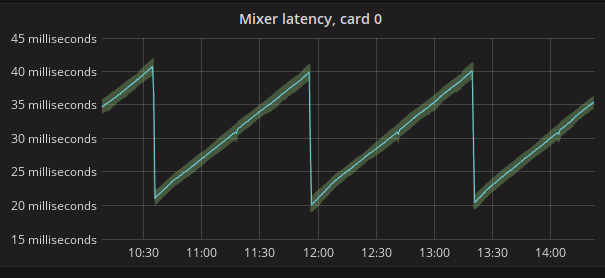
Nageru 1.6.1 is on its way, and what was intended to only be a release centered around monitoring improvements (more specifically a full set of native Prometheus] metrics) actually ended up getting a fairly substantial change to how Nageru manages its frame queues. To understand what's changing and why, it's useful to first understand the history of Nageru's queue management. Nageru 1.0.0 started out with a fairly simple scheme, but with some basics that are still relevant today: One of the input cards was deemed the master card, and whenever it delivers a frame, the master clock ticks and an output frame is produced. (There are some subtleties about dropped frames and/or the master card changing frame rates, but I'm going to ignore them, since they're not important to the discussion.) To this end, every card keeps a preallocated frame queue; when a card delivers a frame, it's put into the queue, and when the master clock ticks, it tries picking out one frame from each of the other card's queues to mix together. Note that mix here could be as simple as picking one input and throwing all the other ones away; the queueing algorithm doesn't care, it just feeds all of them to the theme and lets that run whatever GPU code it needs to match the user's preferences. The only thing that really keeps the queues bounded is that the frames in them are preallocated (in GPU memory), so if one queue gets longer than 16 frames, Nageru starts dropping it. But is 16 the right number? There are two conflicting demands here, ignoring memory usage: The 1.0.0 scheme does about as well as one could possibly hope in never dropping frames, but unfortunately, it can be pretty poor at latency. For instance, if your master card runs at 50 Hz and you have a 60 Hz card, the latter will eventually build up a delay of 16 * 16.7 ms = 266.7 ms clearly unacceptable, and rather unneeded. You could ask the user to specify a queue length, but the user probably doesn't know, and also shouldn't really have to care more knobs to twiddle are a bad thing, and even more so knobs the user is expected to twiddle. Thus, Nageru 1.2.0 introduced queue autotuning; it keeps a running estimate on how big the queue needs to be to avoid underruns, simply based on experience. If we've been dropping frames on a queue and then there's an underrun, the safe queue length is increased by one, and if the queue has been having excess frames for more than a thousand successive master clock ticks, we reduce it by one again. Whenever the queue has more than this safe number, we drop frames. This was simple, effective and largely fixed the problem. However, when adding metrics, I noticed a peculiar effect: Not all of my devices have equally good clocks. In particular, when setting up for 1080p50, my output card's internal clock (which assumes the role of the master clock when using HDMI/SDI output) seems to tick at about 49.9998 Hz, and my simple home camcorder delivers frames at about 49.9995 Hz. Over the course of an hour, this means it produces one more frame than you should have which should of course be dropped. Having an SDI setup with synchronized clocks (blackburst/tri-level) would of course fix this problem, but most people are not so lucky with their cameras, not to mention the price of PC graphics cards with SDI outputs! However, this happens very slowly, which means that for a significant amount of time, the two clocks will very nearly be in sync, and thus racing. Who ticks first is determined largely by luck in the jitter (normal is maybe 1ms, but occasionally, you'll see delayed delivery of as much as 10 ms), and this means that the 1000 frames estimate is likely to be thrown off, and the result is hundreds of dropped frames and underruns in that period. Once the clocks have diverged enough again, you're off the hook, but again, this isn't a good place to be. Thus, Nageru 1.6.1 change the algorithm around yet again, by incorporating more data to build an explicit jitter model. 1.5.0 was already timestamping each frame to be able to measure end-to-end latency precisely (now also exposed in Prometheus metrics), but from 1.6.1, they are actually used in the queueing algorithm. I ran several eight- to twelve-hour tests and simply stored all the event arrivals to a file, and then simulated a few different algorithms (including the old algorithm) to see how they fared in measures such as latency and number of drops/underruns. I won't go into the full details of the new queueing algorithm (see the commit if you're interested), but the gist is: Based on the last 5000 frames, it tries to estimate the maximum possible jitter for each input (ie., how late the frame could possibly be). Based on this as well as clock offsets, it determines whether it's really sure that there will be an input frame available on the next master tick even if it drops the queue, and then trims the queue to fit. The result is pretty satisfying; here's the end-to-end latency of my camera being sent through to the SDI output: As you can see, the latency goes up, up, up until Nageru figures it's now safe to drop a frame, and then does it in one clean drop event; no more hundreds on drops involved. There are very late frame arrivals involved in this run two extra frame drops, to be precise but the algorithm simply determines immediately that they are outliers, and drops them without letting them linger in the queue. (Immediate dropping is usually preferred to sticking around for a bit and then dropping it later, as it means you only get one disturbance event in your stream as opposed to two. Of course, you can only do it if you're reasonably sure it won't lead to more underruns later.) Nageru 1.6.1 will ship before Solskogen, as I intend to run it there :-) And there will probably be lovely premade Grafana dashboards from the Prometheus data. Although it would have been a lot nicer if Grafana were more packaging-friendly, so I could pick it up from stock Debian and run it on armhf. Hrmf. :-)

Lars Wirzenius: Obnam 1.22 released (backup application)

I've just released version 1.22 of Obnam, my backup application. It is the first release for this year. Packages are available on code.liw.fi/debian and in Debian unstable, and source is in git. A summary of the user-visible changes is below. For those interested in living dangerously and accidentally on purpose deleting all their data, the link below shows that status and roadmap for FORMAT GREEN ALBATROSS. http://distix.obnam.org/obnam-dev/182bd772889544d5867e1a0ce4e76652.html Version 1.22, released 2017-06-25

Shirish Agarwal: Dreams don t cost a penny, mumma s boy :)

This one I promise will be short  After the last two updates, I thought it was time for something positive to share. While I m doing the hard work (of physiotherapy which is gruelling), the only luxury I have nowadays is of falling on to dreams which are also rare. The dream I m going to share is totally unrealistic as my mum hates travel but I m sure many sons and daughters would identify with it. Almost all travel outside of relatives is because I dragged her onto it. In the dream, I am going to a Debconf, get bursary and the conference is being held somewhere in Europe, maybe Paris (2019 probably)  . I reach and attend the conference, present and generally have a great time sharing and learning from my peers. As we all do in these uncertain times, I too phone home every couple of days ensuring her that I m well and in best of health. The weather is mild like it was in South Africa and this time I had come packed with woollens so all was well. Just the day before the conference is to end, I call up mum and she tells about a specific hotel/hostel which I should check out. I am somewhat surprised that she knows of a specific hotel/hostel in a specific place but I accede to her request. I go there to find a small, quiet, quaint bed & breakfast place (dunno if Paris has such kind of places), something which my mum would like. Intuitively, I ask at the reception to look in the register. After seeing my passport, he too accedes to my request and shows me the logbook of all visitors registering to come in the last few days (for some reason privacy is not a concern then) . I am surprised to find my mother s name in the register and she had turned up just a day or two before. I again request the reception to be able to go to room abcd without being announced and have some sort of key (like for maintenance or laundry as an excuse) . The reception calls the manager and after looking copy of mother s passport and mine they somehow accede to the request with help located nearby just in case something goes wrong. I disguise my voice and announce as either Room service or Maintenance and we are both surprised and elated to see each other. After talking a while, I go back to the reception and register myself as her guest. The next week is a whirlwind as I come to know of hop-on, hop-off buses similar service in Paris as was in South Africa. I buy a small booklet and we go through all the museums. the vineyards or whatever it is that Paris has to offer. IIRC there is also a lock and key on a famous bridge. We also do that. She is constantly surprised at the different activities the city shows her and the mother-son bond becomes much better. I had shared the same dream with her and she laughed. In reality, she is happy and comfortable in the confines of her home. Still I hope some mother-daughter, son-father, son-mother or any combination of parent, sibling takes this entry and enrich each other by travelling together.
Filed under: Miscellenous Tagged: #dream, #mother, #planet-debian, travel

24 June 2017

Lisandro Dami n Nicanor P rez Meyer: Qt 5.7 submodules that didn't make it to Stretch but will be in testing

There are two Qt 5.7 submodules that we could not package in time for Strech but are/will be available in their 5.7 versions in testing. This are qtdeclarative-render2d-plugin and qtvirtualkeyboard.

declarative-render2d-plugin makes use of the Raster paint engine instead of OpenGL to render the contents of a scene graph, thus making it useful when Qt Quick2 applications are run in a system without OpenGL 2 enabled hardware. Using it might require tweaking Debian's /etc/X11/Xsession.d/90qt5-opengl. On Qt 5.9 and newer this plugin is merged in Qt GUI so there should be no need to perform any action on the user's behalf.

Debian's VirtualKeyboard currently has a gotcha: we are not building it with the embedded code it ships. Upstream ships 3rd party code but lacks a way to detect and use the system versions of them. See QTBUG-59594, patches are welcomed. Please note that we prefer patches sent directly upstream to the current dev revision, we will be happy to backport patches if necessary.
Yes, this means no hunspell, openwnn, pinyin, tcime nor lipi-toolkit/t9write support.


Steve Kemp: Linux security modules, round two.

So recently I wrote a Linux Security Module (LSM) which would deny execution of commands, unless an extended attribute existed upon the filesystem belonging to the executables. The whitelist-LSM worked well, but it soon became apparent that it was a little pointless. Most security changes are pointless unless you define what you're defending against - your "threat model". In my case it was written largely as a learning experience, but also because I figured it seemed like it could be useful. However it wasn't actually as useful because you soon realize that you have to whitelist too much: In short there comes a point where user alice must run executable blah. If alice can run it, then so can mallory. At which point you realize the exercise is not so useful. Taking a step back I realized that what I wanted to to prevent was the execution of unknown/unexpected, and malicious binaries How do you identify known-good binaries? Well hashes & checksums are good. So for my second attempt I figured I'd not look for a mere "flag" on a binary, instead look for a valid hash. Now my second LSM is invoked for every binary that is executed by a user: In practice this is the same behaviour as the previous LSM - a binary is either executable, because there is a good hash, or it is not, because it is missing or bogus. If somebody deploys a binary rootkit this will definitely stop it from executing, but of course there is a huge hole - scripting-languages: Despite that the project was worthwhile, I can clearly describe what it is designed to achieve ("Deny the execution of unknown binaries", and "Deny binaries that have been modified"), and I learned how to hash a file from kernel-space - which was surprisingly simple.
(Yes I know about IMA and EVM - this was a simple project for learning purposes. Public-key signatures will be something I'll look at next/soon/later. :)
Perhaps the only other thing to explore is the complexity in allowing/denying actions based on the user - in a human-readable fashion, not via UIDs. So www-data can execute some programs, alice can run a different set of binaries, and git can only run /usr/bin/git. Of course down that path lies apparmour, selinux, and madness..

Riku Voipio: Cross-compiling with debian stretch

Debian stretch comes with cross-compiler packages for selected architectures:
 $ apt-cache search cross-build-essential
crossbuild-essential-arm64 - Informational list of cross-build-essential packages for
crossbuild-essential-armel - ...
crossbuild-essential-armhf - ...
crossbuild-essential-mipsel - ...
crossbuild-essential-powerpc - ...
crossbuild-essential-ppc64el - ...

Lets have a quick exact steps guide. But first - while you can use do all this in your desktop PC rootfs, it is more wise to contain yourself. Fortunately, Debian comes with a container tool out of box:

sudo debootstrap stretch /var/lib/container/stretch http://deb.debian.org/debian
echo "strech_cross" sudo tee /var/lib/container/stretch/etc/debian_chroot
sudo systemd-nspawn -D /var/lib/container/stretch
Then we set up cross-building enviroment for arm64 inside the container:

# Tell dpkg we can install arm64
dpkg --add-architecture arm64
# Add src line to make "apt-get source" work
echo "deb-src http://deb.debian.org/debian stretch main" >> /etc/apt/sources.list
apt-get update
# Install cross-compiler and other essential build tools
apt install --no-install-recommends build-essential crossbuild-essential-arm64
Now we have a nice build enviroment, lets choose something more complicated than the usual kernel/BusyBox to cross-build, qemu:

# Get qemu sources from debian
apt-get source qemu
cd qemu-*
# New in stretch: build-dep works in unpacked source tree
apt-get build-dep -a arm64 .
# Cross-build Qemu for arm64
dpkg-buildpackage -aarm64 -j6 -b
Now that works perfectly for Qemu. For other packages, challenges may appear. For example you may have to se "nocheck" flag to skip build-time unit tests. Or some of the build-dependencies may not be multiarch-enabled. So work continues :)

Norbert Preining: Calibre 3 for Debian

I have updated my Calibre Debian repository to include packages of the current Calibre 3.1.1. As with the previous packages, I kept RAR support in to allow me to read comic books. I also have forwarded my changes to the maintainer of Calibre in Debian so maybe we will have soon official packages, too.
The repository location hasn t changed, see below.
deb http://www.preining.info/debian/ calibre main
deb-src http://www.preining.info/debian/ calibre main
The releases are signed with my Debian key 0x6CACA448860CDC13 Enjoy

23 June 2017

Joachim Breitner: The perils of live demonstrations

Yesterday, I was giving a talk at the The South SF Bay Haskell User Group about how implementing lock-step simulation is trivial in Haskell and how Chris Smith and me are using this to make CodeWorld even more attractive to students. I gave the talk before, at Compose::Conference in New York City earlier this year, so I felt well prepared. On the flight to the West Coast I slightly extended the slides, and as I was too cheap to buy in-flight WiFi, I tested them only locally. So I arrived at the offices of Target1 in Sunnyvale, got on the WiFi, uploaded my slides, which are in fact one large interactive CodeWorld program, and tried to run it. But I got a type error Turns out that the API of CodeWorld was changed just the day before:
commit 054c811b494746ec7304c3d495675046727ab114
Author: Chris Smith <cdsmith@gmail.com>
Date:   Wed Jun 21 23:53:53 2017 +0000
    Change dilated to take one parameter.
    
    Function is nearly unused, so I'm not concerned about breakage.
    This new version better aligns with standard educational usage,
    in which "dilation" means uniform scaling.  Taken as a separate
    operation, it commutes with rotation, and preserves similarity
    of shapes, neither of which is true of scaling in general.
Ok, that was quick to fix, and the CodeWorld server started to compile my code, and compiled, and aborted. It turned out that my program, presumably the larges CodeWorld interaction out there, hit the time limit of the compiler. Luckily, Chris Smith just arrived at the venue, and he emergency-bumped the compiler time limit. The program compiled and I could start my presentation. Unfortunately, the biggest blunder was still awaiting for me. I came to the slide where two instances of pong are played over a simulated network, and my point was that the two instances are perfectly in sync. Unfortunately, they were not. I guess it did support my point that lock-step simulation can easily go wrong, but it really left me out in the rain there, and I could not explain it I did not modify this code since New York, and there it worked flawless2. In the end, I could save my face a bit by running the real pong game against an attendee over the network, and no desynchronisation could be observed there. Today I dug into it and it took me a while, and it turned out that the problem was not in CodeWorld, or the lock-step simulation code discussed in our paper about it, but in the code in my presentation that simulated the delayed network messages; in some instances it would deliver the UI events in different order to the two simulated players, and hence cause them do something different. Phew.

  1. Yes, the retail giant. Turns out that they have a small but enthusiastic Haskell-using group in their IT department.
  2. I hope the video is going to be online soon, then you can check for yourself.

Joey Hess: PV array is hot

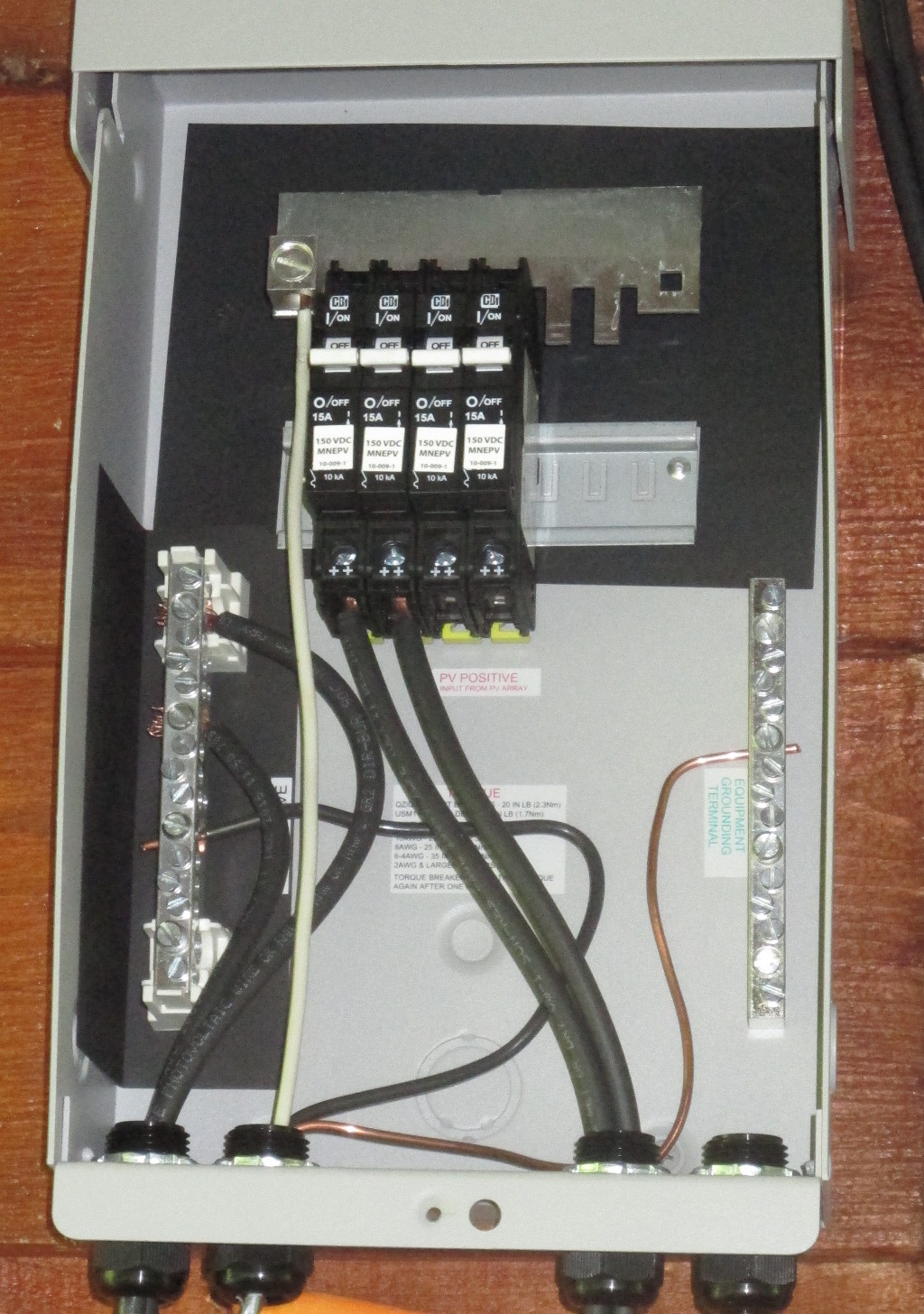
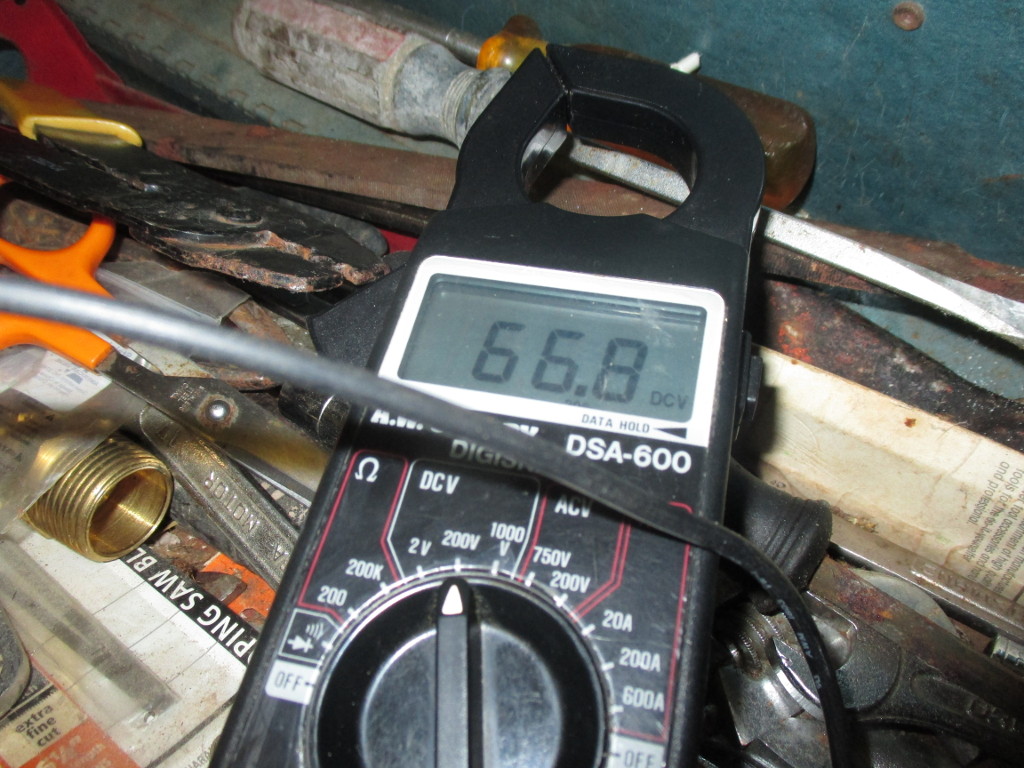
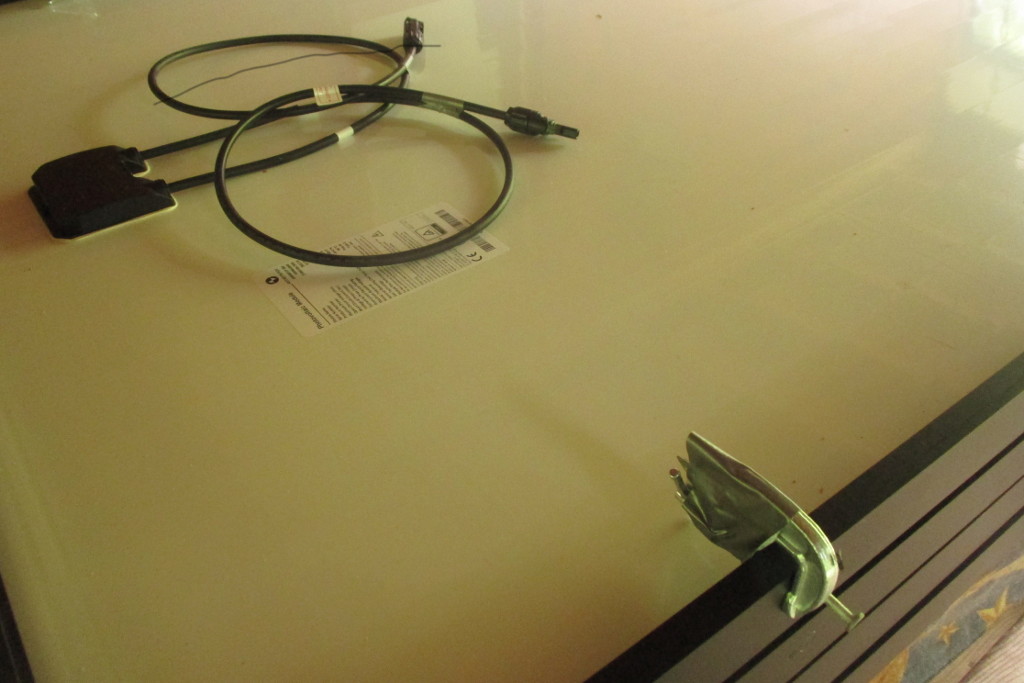
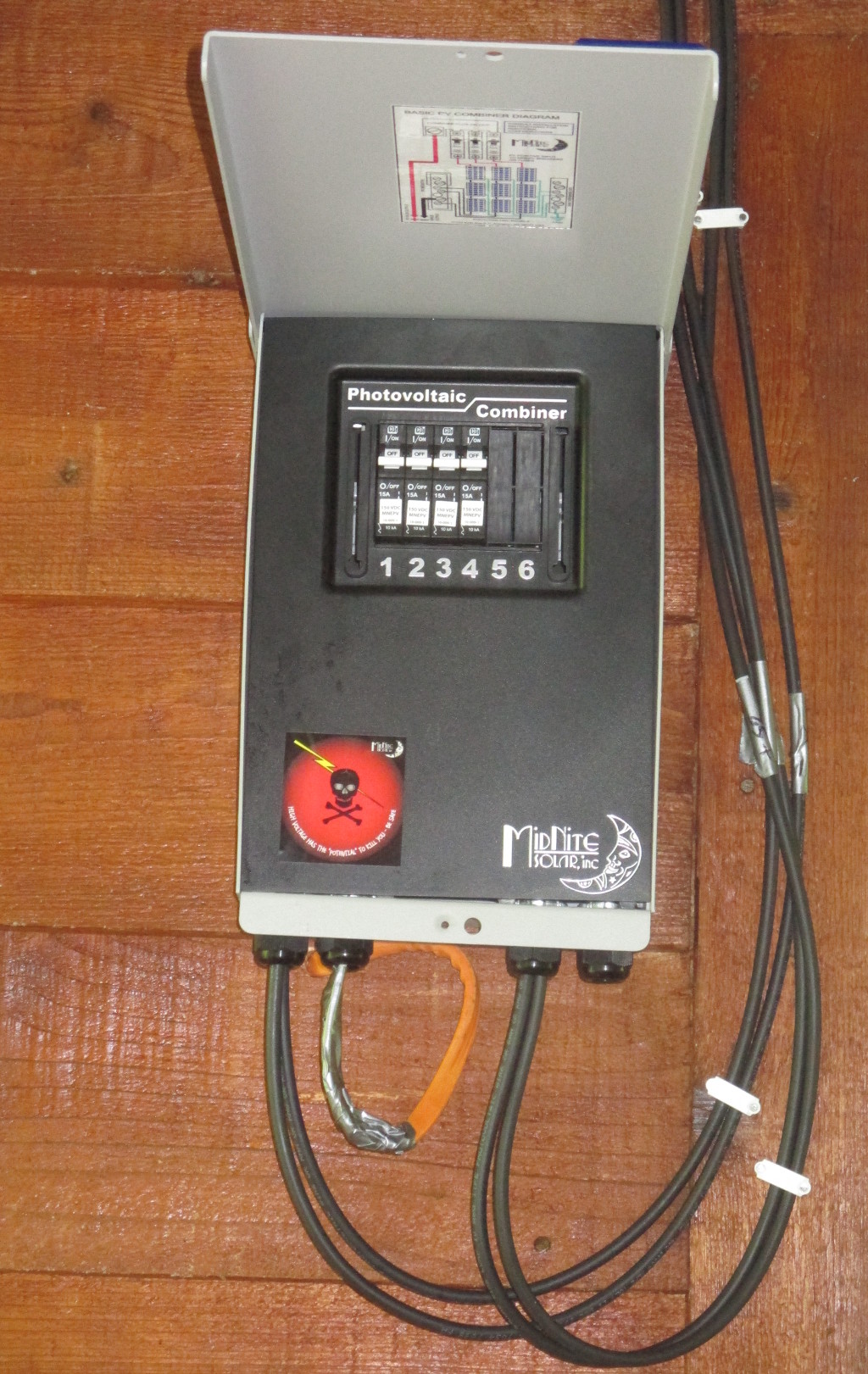
Only took a couple hours to wire up and mount the combiner box. PV combiner box with breakers Something about larger wiring like this is enjoyable. So much less fiddly than what I'm used to. PV combiner box wiring And the new PV array is hot! multimeter reading 66.8 DVC Update: The panels have an open circuit voltage of 35.89 and are in strings of 2, so I'd expect to see 71.78 V with only my multimeter connected. So I'm losing 0.07 volts to wiring, which is less than I designed for.
Jonathan Dowland: WD drive head parking update

An update for my post on Western Digital Hard Drive head parking: disabling the head-parking completely stopped the Load_Cycle_Count S.M.A.R.T. attribute from incrementing. This is probably at the cost of power usage, but I am not able to assess the impact of that as I'm not currently monitoring the power draw of the NAS (Although that's on my TODO list).

22 June 2017

Steve McIntyre: -1, Trolling

Here's a nice comment I received by email this morning. I guess somebody was upset by my last post?
From: Tec Services <tecservices911@gmail.com>
Date: Wed, 21 Jun 2017 22:30:26 -0700
To: steve@einval.com
Subject: its time for you to retire from debian...unbelievable..your
         the quality guy and fucked up the installer!
i cant ever remember in the hostory of computing someone releasing an installer
that does not work!!
wtf!!!
you need to be retired...due to being retarded..
and that this was dedicated to ian...what a
disaster..you should be ashames..he is probably roling in his grave from shame
right now....
It's nice to be appreciated.

Dirk Eddelbuettel: nanotime 0.2.0

A new version of the nanotime package for working with nanosecond timestamps just arrived on CRAN. nanotime uses the RcppCCTZ package for (efficient) high(er) resolution time parsing and formatting up to nanosecond resolution, and the bit64 package for the actual integer64 arithmetic. Thanks to a metric ton of work by Leonardo Silvestri, the package now uses S4 classes internally allowing for greater consistency of operations on nanotime objects.

Changes in version 0.2.0 (2017-06-22)
  • Rewritten in S4 to provide more robust operations (#17 by Leonardo)
  • Ensure tz="" is treated as unset (Leonardo in #20)
  • Added format and tz arguments to nanotime, format, print (#22 by Leonardo and Dirk)
  • Ensure printing respect options()$max.print, ensure names are kept with vector (#23 by Leonardo)
  • Correct summary() by defining names<- (Leonardo in #25 fixing #24)
  • Report error on operations that are meaningful for type; handled NA, NaN, Inf, -Inf correctly (Leonardo in #27 fixing #26)

We also have a diff to the previous version thanks to CRANberries. More details and examples are at the nanotime page; code, issue tickets etc at the GitHub repository.

This post by Dirk Eddelbuettel originated on his Thinking inside the box blog. Please report excessive re-aggregation in third-party for-profit settings.

Norbert Preining: Signal handling in R

Recently I have been programming quite a lot in R, and today stumbled over the problem to implement a kind of monitoring loop in R. Typically that would be a infinite loop with sleep calls, but I wanted to allow for waking up from the sleep via sending UNIX style signals, in particular SIGINT. After some searching I found Beyond Exception Handling: Conditions and Restarts from the Advanced R book. But it didn t really help me a lot to program an interrupt handler.
My requirements were: Unfortunately it seems not to be possible to ignore interrupts at all from with the R code. The best one can do is install interrupt handlers and try to repeat the code which was executed while the interrupt happened. This is what I tried to implement with the following code below. I still have to digest the documentation about conditions and restarts, and play around a lot, but at least this is an initial working version.
workfun <- function()  
  i <- 1
  do_repeat <- FALSE
  while (TRUE)  
    message("begin of the loop")
    withRestarts(
       
        # do all the work here
        cat("Entering work part i =", i, "\n");
        Sys.sleep(10)
        i <- i + 1
        cat("finished work part\n")
       , 
      gotSIG = function()   
        message("interrupted while working, restarting work part")
        do_repeat <<- TRUE
        NULL
       
    )
    if (do_repeat)  
      cat("restarting work loop\n")
      do_repeat <- FALSE
      next
      else  
      cat("between work and sleep part\n")
     
    withRestarts(
       
        # do the sleep part here
        cat("Entering sleep part i =", i, "\n")
        Sys.sleep(10)
        i <- i + 1
        cat("finished sleep part\n")
       , 
      gotSIG = function()  
        message("got work to do, waking up!")
        NULL
       
    )
    message("end of the loop")
   
 
cat("Current process:", Sys.getpid(), "\n");
withCallingHandlers( 
    workfun()
   ,
  interrupt = function(e)  
    invokeRestart("gotSIG")
   )
While not perfect, I guess I have to live with this method for now.

Dirk Eddelbuettel: RcppCCTZ 0.2.3 (and 0.2.2)

A new minor version 0.2.3 of RcppCCTZ is now on CRAN. RcppCCTZ uses Rcpp to bring CCTZ to R. CCTZ is a C++ library for translating between absolute and civil times using the rules of a time zone. In fact, it is two libraries. One for dealing with civil time: human-readable dates and times, and one for converting between between absolute and civil times via time zones. The RcppCCTZ page has a few usage examples and details. This version ensures that we set the TZDIR environment variable correctly on the old dreaded OS that does not come with proper timezone information---an issue which had come up while preparing the next (and awesome, trust me) release of nanotime. It also appears that I failed to blog about 0.2.2, another maintenance release, so changes for both are summarised next.

Changes in version 0.2.3 (2017-06-19)
  • On Windows, the TZDIR environment variable is now set in .onLoad()
  • Replaced init.c with registration code inside of RcppExports.cpp thanks to Rcpp 0.12.11.

Changes in version 0.2.2 (2017-04-20)
  • Synchronized with upstream CCTZ
  • The time_point object is instantiated explicitly for nanosecond use which appears to be required on macOS

We also have a diff to the previous version thanks to CRANberries. More details are at the RcppCCTZ page; code, issue tickets etc at the GitHub repository.

This post by Dirk Eddelbuettel originated on his Thinking inside the box blog. Please report excessive re-aggregation in third-party for-profit settings.

21 June 2017

Joey Hess: DIY professional grade solar panel installation

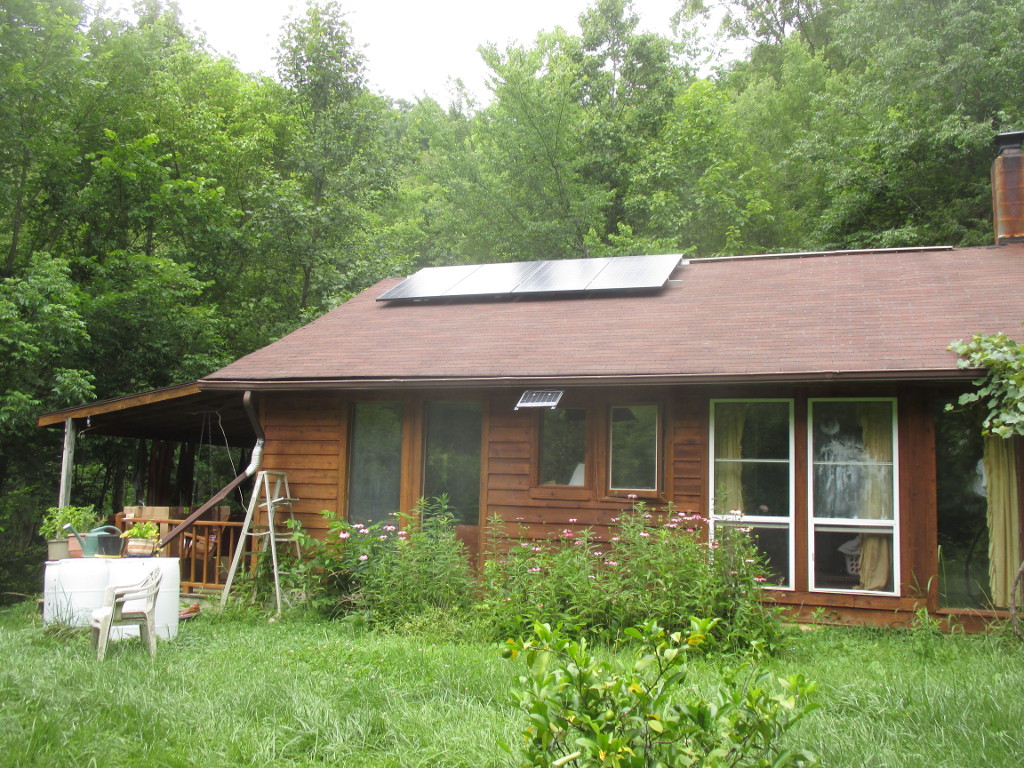
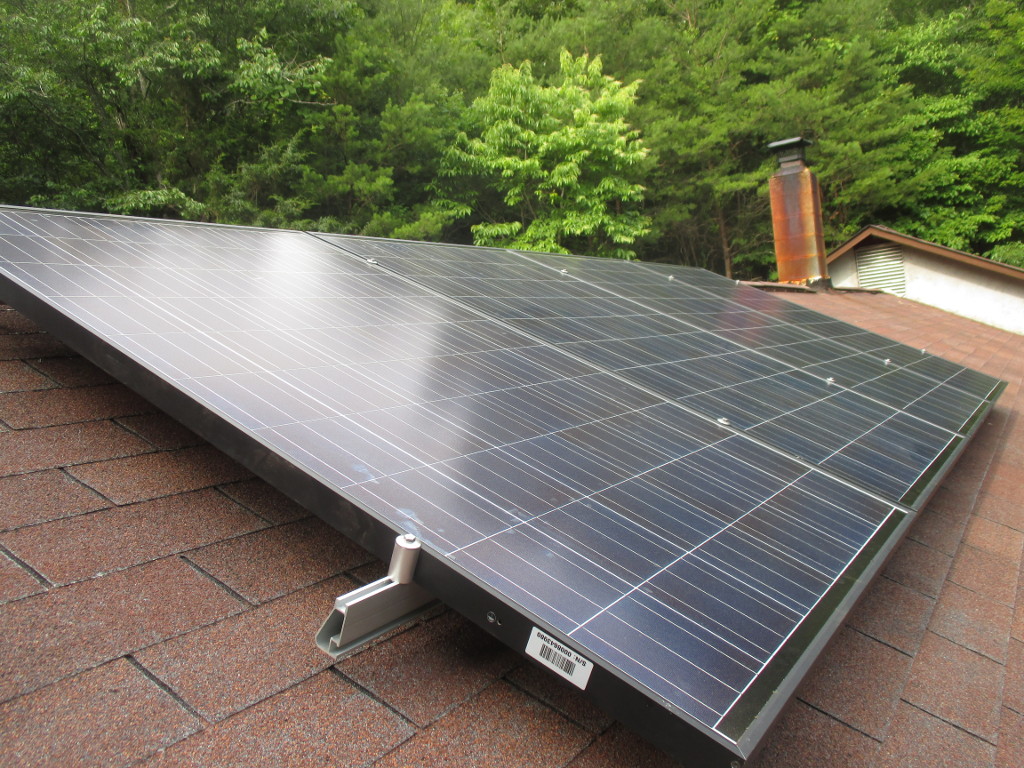
I've installed 1 kilowatt of solar panels on my roof, using professional grade eqipment. The four panels are Astronergy 260 watt panels, and they're mounted on IronRidge XR100 rails. Did it all myself, without help. house with 4 solar panels on roof I had three goals for this install:
  1. Cheap but sturdy. Total cost will be under $2500. It would probably cost at least twice as much to get a professional install, and the pros might not even want to do such a small install.
  2. Learn the roof mount system. I want to be able to add more panels, remove panels when working on the roof, and understand everything.
  3. Make every day a sunny day. With my current solar panels, I get around 10x as much power on a sunny day as a cloudy day, and I have plenty of power on sunny days. So 10x the PV capacity should be a good amount of power all the time.
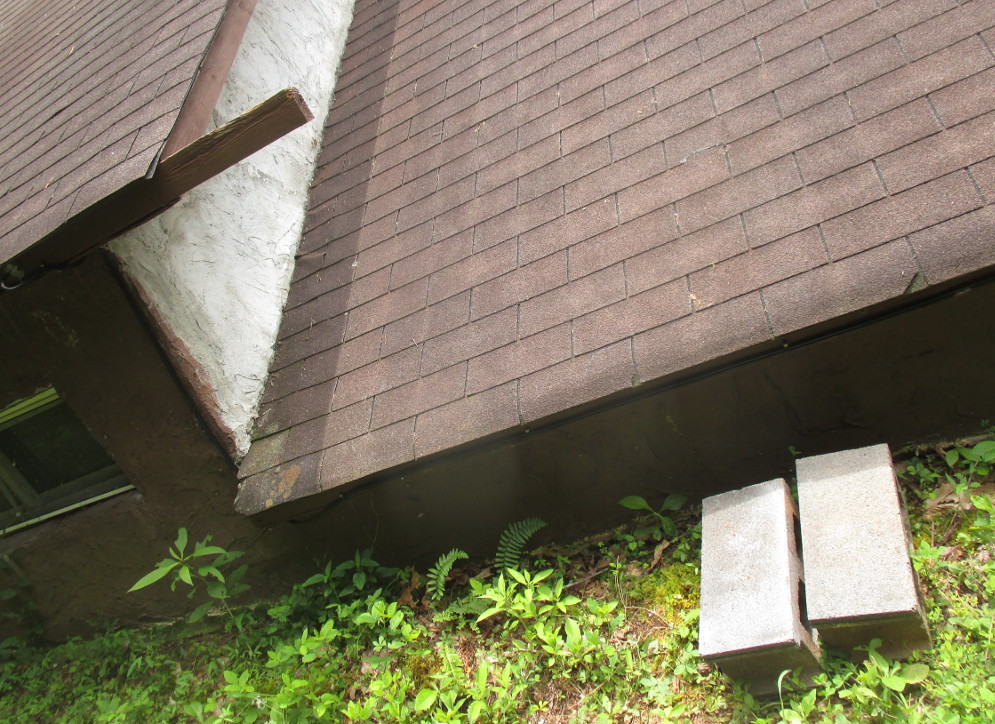
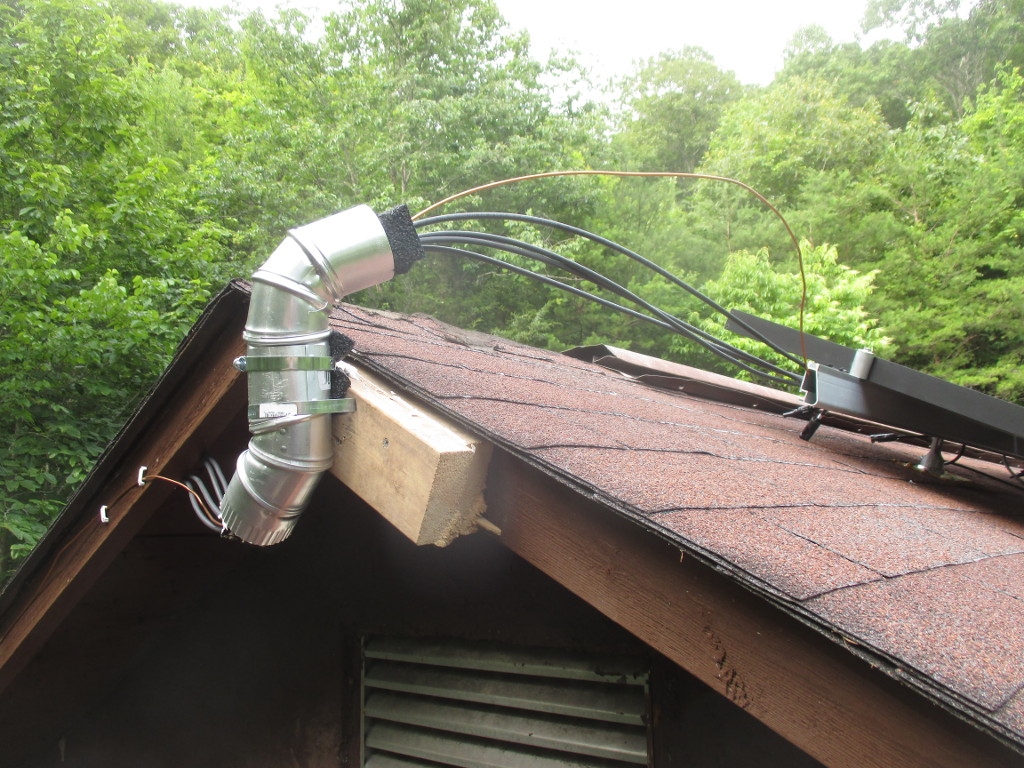
My main concerns were, would I be able to find the rafters when installing the rails, and would the 5x3 foot panels be too unweildly to get up on the roof by myself. I was able to find the rafters, without needing a stud finder, after I removed the roof's vent caps, which exposed the rafters. The shingles were on straight enough that I could follow the lines down and drilled into the rafter on the first try every time. And I got the rails on spaced well and straight, although I could have spaced the FlashFeet out better (oops). My drill ran out of juice half-way, and I had to hack it to recharge on solar power, but that's another story. Between the learning curve, a lot of careful measurement, not the greatest shoes for roofing, and waiting for recharging, it took two days to get the 8 FlashFeet installed and the rails mounted. Taking a break from that and swimming in the river, I realized I should have been wearing my water shoes on the roof all along. Super soft and nubbly, they make me feel like a gecko up there! After recovering from an (unrelated) achilles tendon strain, I got the panels installed today. Turns out they're not hard to handle on the roof by myself. Getting them up a ladder to the roof by yourself would normally be another story, but my house has a 2 foot step up from the back retaining wall to the roof, and even has a handy grip beam as you step up. roof next to the ground with a couple of cinderblock steps The last gotcha, which I luckily anticipated, is that panels will slide down off the rails before you can get them bolted down. This is where a second pair of hands would have been most useful. But, I macguyvered a solution, attaching temporary clamps before bringing a panel up, that stopped it sliding down while I was attaching it. clamp temporarily attached to side of panel I also finished the outside wiring today. Including the one hack of this install so far. Since the local hardware store didn't have a suitable conduit to bring the cables off the roof, I cobbled one together from pipe, with foam inserts to prevent chafing. some pipe with 5 wires running through it, attached to the side of the roof While I have 1 kilowatt of power on my roof now, I won't be able to use it until next week. After ordering the upgrade, I realized that my old PWM charge controller would be able to handle less than half the power, and to get even that I would have needed to mount the fuse box near the top of the roof and run down a large and expensive low-voltage high-amperage cable, around OO AWG size. Instead, I'll be upgrading to a MPPT controller, and running a single 150 volt cable to it. Then, since the MPPT controller can only handle 1 kilowatt when it's converting to 24 volts, not 12 volts, I'm gonna have to convert the entire house over from 12V DC to 24V DC, including changing all the light fixtures and rewiring the battery bank...

Vincent Bernat: IPv4 route lookup on Linux

TL;DR: With its implementation of IPv4 routing tables using LPC-tries, Linux offers good lookup performance (50 ns for a full view) and low memory usage (64 MiB for a full view).
During the lifetime of an IPv4 datagram inside the Linux kernel, one important step is the route lookup for the destination address through the fib_lookup() function. From essential information about the datagram (source and destination IP addresses, interfaces, firewall mark, ), this function should quickly provide a decision. Some possible options are: Since 2.6.39, Linux stores routes into a compressed prefix tree (commit 3630b7c050d9). In the past, a route cache was maintained but it has been removed1 in Linux 3.6.

Route lookup in a trie Looking up a route in a routing table is to find the most specific prefix matching the requested destination. Let s assume the following routing table:
$ ip route show scope global table 100
default via 203.0.113.5 dev out2
192.0.2.0/25
        nexthop via 203.0.113.7  dev out3 weight 1
        nexthop via 203.0.113.9  dev out4 weight 1
192.0.2.47 via 203.0.113.3 dev out1
192.0.2.48 via 203.0.113.3 dev out1
192.0.2.49 via 203.0.113.3 dev out1
192.0.2.50 via 203.0.113.3 dev out1
Here are some examples of lookups and the associated results:
Destination IP Next hop
192.0.2.49 203.0.113.3 via out1
192.0.2.50 203.0.113.3 via out1
192.0.2.51 203.0.113.7 via out3 or 203.0.113.9 via out4 (ECMP)
192.0.2.200 203.0.113.5 via out2
A common structure for route lookup is the trie, a tree structure where each node has its parent as prefix.

Lookup with a simple trie The following trie encodes the previous routing table: Simple routing trie For each node, the prefix is known by its path from the root node and the prefix length is the current depth. A lookup in such a trie is quite simple: at each step, fetch the nth bit of the IP address, where n is the current depth. If it is 0, continue with the first child. Otherwise, continue with the second. If a child is missing, backtrack until a routing entry is found. For example, when looking for 192.0.2.50, we will find the result in the corresponding leaf (at depth 32). However for 192.0.2.51, we will reach 192.0.2.50/31 but there is no second child. Therefore, we backtrack until the 192.0.2.0/25 routing entry. Adding and removing routes is quite easy. From a performance point of view, the lookup is done in constant time relative to the number of routes (due to maximum depth being capped to 32). Quagga is an example of routing software still using this simple approach.

Lookup with a path-compressed trie In the previous example, most nodes only have one child. This leads to a lot of unneeded bitwise comparisons and memory is also wasted on many nodes. To overcome this problem, we can use path compression: each node with only one child is removed (except if it also contains a routing entry). Each remaining node gets a new property telling how many input bits should be skipped. Such a trie is also known as a Patricia trie or a radix tree. Here is the path-compressed version of the previous trie: Patricia trie Since some bits have been ignored, on a match, a final check is executed to ensure all bits from the found entry are matching the input IP address. If not, we must act as if the entry wasn t found (and backtrack to find a matching prefix). The following figure shows two IP addresses matching the same leaf: Lookup in a Patricia trie The reduction on the average depth of the tree compensates the necessity to handle those false positives. The insertion and deletion of a routing entry is still easy enough. Many routing systems are using Patricia trees:

Lookup with a level-compressed trie In addition to path compression, level compression2 detects parts of the trie that are densily populated and replace them with a single node and an associated vector of 2k children. This node will handle k input bits instead of just one. For example, here is a level-compressed version our previous trie: Level-compressed trie Such a trie is called LC-trie or LPC-trie and offers higher lookup performances compared to a radix tree. An heuristic is used to decide how many bits a node should handle. On Linux, if the ratio of non-empty children to all children would be above 50% when the node handles an additional bit, the node gets this additional bit. On the other hand, if the current ratio is below 25%, the node loses the responsibility of one bit. Those values are not tunable. Insertion and deletion becomes more complex but lookup times are also improved.

Implementation in Linux The implementation for IPv4 in Linux exists since 2.6.13 (commit 19baf839ff4a) and is enabled by default since 2.6.39 (commit 3630b7c050d9). Here is the representation of our example routing table in memory3: Memory representation of a trie There are several structures involved: The trie can be retrieved through /proc/net/fib_trie:
$ cat /proc/net/fib_trie
Id 100:
  +-- 0.0.0.0/0 2 0 2
      -- 0.0.0.0
        /0 universe UNICAST
     +-- 192.0.2.0/26 2 0 1
         -- 192.0.2.0
           /25 universe UNICAST
         -- 192.0.2.47
           /32 universe UNICAST
        +-- 192.0.2.48/30 2 0 1
            -- 192.0.2.48
              /32 universe UNICAST
            -- 192.0.2.49
              /32 universe UNICAST
            -- 192.0.2.50
              /32 universe UNICAST
[...]
For internal nodes, the numbers after the prefix are:
  1. the number of bits handled by the node,
  2. the number of full children (they only handle one bit),
  3. the number of empty children.
Moreover, if the kernel was compiled with CONFIG_IP_FIB_TRIE_STATS, some interesting statistics are available in /proc/net/fib_triestat4:
$ cat /proc/net/fib_triestat
Basic info: size of leaf: 48 bytes, size of tnode: 40 bytes.
Id 100:
        Aver depth:     2.33
        Max depth:      3
        Leaves:         6
        Prefixes:       6
        Internal nodes: 3
          2: 3
        Pointers: 12
Null ptrs: 4
Total size: 1  kB
[...]
When a routing table is very dense, a node can handle many bits. For example, a densily populated routing table with 1 million entries packed in a /12 can have one internal node handling 20 bits. In this case, route lookup is essentially reduced to a lookup in a vector. The following graph shows the number of internal nodes used relative to the number of routes for different scenarios (routes extracted from an Internet full view, /32 routes spreaded over 4 different subnets with various densities). When routes are densily packed, the number of internal nodes are quite limited. Internal nodes and null pointers

Performance So how performant is a route lookup? The maximum depth stays low (about 6 for a full view), so a lookup should be quite fast. With the help of a small kernel module, we can accurately benchmark5 the fib_lookup() function: Maximum depth and lookup time The lookup time is loosely tied to the maximum depth. When the routing table is densily populated, the maximum depth is low and the lookup times are fast. When forwarding at 10 Gbps, the time budget for a packet would be about 50 ns. Since this is also the time needed for the route lookup alone in some cases, we wouldn t be able to forward at line rate with only one core. Nonetheless, the results are pretty good and they are expected to scale linearly with the number of cores. The measurements are done with a Linux kernel 4.11 from Debian unstable. I have gathered performance metrics accross kernel versions in Performance progression of IPv4 route lookup on Linux . Another interesting figure is the time it takes to insert all those routes into the kernel. Linux is also quite efficient in this area since you can insert 2 million routes in less than 10 seconds: Insertion time

Memory usage The memory usage is available directly in /proc/net/fib_triestat. The statistic provided doesn t account for the fib_info structures, but you should only have a handful of them (one for each possible next-hop). As you can see on the graph below, the memory use is linear with the number of routes inserted, whatever the shape of the routes is. Memory usage The results are quite good. With only 256 MiB, about 2 million routes can be stored!

Routing rules Unless configured without CONFIG_IP_MULTIPLE_TABLES, Linux supports several routing tables and has a system of configurable rules to select the table to use. These rules can be configured with ip rule. By default, there are three of them:
$ ip rule show
0:      from all lookup local
32766:  from all lookup main
32767:  from all lookup default
Linux will first lookup for a match in the local table. If it doesn t find one, it will lookup in the main table and at last resort, the default table.

Builtin tables The local table contains routes for local delivery:
$ ip route show table local
broadcast 127.0.0.0 dev lo proto kernel scope link src 127.0.0.1
local 127.0.0.0/8 dev lo proto kernel scope host src 127.0.0.1
local 127.0.0.1 dev lo proto kernel scope host src 127.0.0.1
broadcast 127.255.255.255 dev lo proto kernel scope link src 127.0.0.1
broadcast 192.168.117.0 dev eno1 proto kernel scope link src 192.168.117.55
local 192.168.117.55 dev eno1 proto kernel scope host src 192.168.117.55
broadcast 192.168.117.63 dev eno1 proto kernel scope link src 192.168.117.55
This table is populated automatically by the kernel when addresses are configured. Let s look at the three last lines. When the IP address 192.168.117.55 was configured on the eno1 interface, the kernel automatically added the appropriate routes:
  • a route for 192.168.117.55 for local unicast delivery to the IP address,
  • a route for 192.168.117.255 for broadcast delivery to the broadcast address,
  • a route for 192.168.117.0 for broadcast delivery to the network address.
When 127.0.0.1 was configured on the loopback interface, the same kind of routes were added to the local table. However, a loopback address receives a special treatment and the kernel also adds the whole subnet to the local table. As a result, you can ping any IP in 127.0.0.0/8:
$ ping -c1 127.42.42.42
PING 127.42.42.42 (127.42.42.42) 56(84) bytes of data.
64 bytes from 127.42.42.42: icmp_seq=1 ttl=64 time=0.039 ms
--- 127.42.42.42 ping statistics ---
1 packets transmitted, 1 received, 0% packet loss, time 0ms
rtt min/avg/max/mdev = 0.039/0.039/0.039/0.000 ms
The main table usually contains all the other routes:
$ ip route show table main
default via 192.168.117.1 dev eno1 proto static metric 100
192.168.117.0/26 dev eno1 proto kernel scope link src 192.168.117.55 metric 100
The default route has been configured by some DHCP daemon. The connected route (scope link) has been automatically added by the kernel (proto kernel) when configuring an IP address on the eno1 interface. The default table is empty and has little use. It has been kept when the current incarnation of advanced routing has been introduced in Linux 2.1.68 after a first tentative using classes in Linux 2.1.156.

Performance Since Linux 4.1 (commit 0ddcf43d5d4a), when the set of rules is left unmodified, the main and local tables are merged and the lookup is done with this single table (and the default table if not empty). Moreover, since Linux 3.0 (commit f4530fa574df), without specific rules, there is no performance hit when enabling the support for multiple routing tables. However, as soon as you add new rules, some CPU cycles will be spent for each datagram to evaluate them. Here is a couple of graphs demonstrating the impact of routing rules on lookup times: Routing rules impact on performance For some reason, the relation is linear when the number of rules is between 1 and 100 but the slope increases noticeably past this threshold. The second graph highlights the negative impact of the first rule (about 30 ns). A common use of rules is to create virtual routers: interfaces are segregated into domains and when a datagram enters through an interface from domain A, it should use routing table A:

# ip rule add iif vlan457 table 10
# ip rule add iif vlan457 blackhole
# ip rule add iif vlan458 table 20
# ip rule add iif vlan458 blackhole
The blackhole rules may be removed if you are sure there is a default route in each routing table. For example, we add a blackhole default with a high metric to not override a regular default route:
# ip route add blackhole default metric 9999 table 10
# ip route add blackhole default metric 9999 table 20
# ip rule add iif vlan457 table 10
# ip rule add iif vlan458 table 20
To reduce the impact on performance when many interface-specific rules are used, interfaces can be attached to VRF instances and a single rule can be used to select the appropriate table:
# ip link add vrf-A type vrf table 10
# ip link set dev vrf-A up
# ip link add vrf-B type vrf table 20
# ip link set dev vrf-B up
# ip link set dev vlan457 master vrf-A
# ip link set dev vlan458 master vrf-B
# ip rule show
0:      from all lookup local
1000:   from all lookup [l3mdev-table]
32766:  from all lookup main
32767:  from all lookup default
The special l3mdev-table rule was automatically added when configuring the first VRF interface. This rule will select the routing table associated to the VRF owning the input (or output) interface. VRF was introduced in Linux 4.3 (commit 193125dbd8eb), the performance was greatly enhanced in Linux 4.8 (commit 7889681f4a6c) and the special routing rule was also introduced in Linux 4.8 (commit 96c63fa7393d, commit 1aa6c4f6b8cd). You can find more details about it in the kernel documentation.

Conclusion The takeaways from this article are:
  • route lookup times hardly increase with the number of routes,
  • densily packed /32 routes lead to amazingly fast route lookups,
  • memory use is low (128 MiB par million routes),
  • no optimization is done on routing rules.

  1. The routing cache was subject to reasonably easy to launch denial of service attacks. It was also believed to not be efficient for high volume sites like Google but I have first-hand experience it was not the case for moderately high volume sites.
  2. IP-address lookup using LC-tries , IEEE Journal on Selected Areas in Communications, 17(6):1083-1092, June 1999.
  3. For internal nodes, the key_vector structure is embedded into a tnode structure. This structure contains information rarely used during lookup, notably the reference to the parent that is usually not needed for backtracking as Linux keeps the nearest candidate in a variable.
  4. One leaf can contain several routes (struct fib_alias is a list). The number of prefixes can therefore be greater than the number of leaves. The system also keeps statistics about the distribution of the internal nodes relative to the number of bits they handle. In our example, all the three internal nodes are handling 2 bits.
  5. The measurements are done in a virtual machine with one vCPU. The host is an Intel Core i5-4670K running at 3.7 GHz during the experiment (CPU governor was set to performance). The benchmark is single-threaded. It runs a warm-up phase, then executes about 100,000 timed iterations and keeps the median. Timings of individual runs are computed from the TSC.
  6. Fun fact: the documentation of this first tentative of more flexible routing is still available in today s kernel tree and explains the usage of the default class .

20 June 2017

Steve McIntyre: So, Stretch happened...

Things mostly went very well, and we've released Debian 9 this weekend past. Many many people worked together to make this possible, and I'd like to extend my own thanks to all of them. As a project, we decided to dedicate Stretch to our late founder Ian Murdock. He did much of the early work to get Debian going, and inspired many more to help him. I had the good fortune to meet up with Ian years ago at a meetup attached to a Usenix conference, and I remember clearly he was a genuinely nice guy with good ideas. We'll miss him. For my part in the release process, again I was responsible for producing our official installation and live images. Release day itself went OK, but as is typical the process ran late into Saturday night / early Sunday morning. We made and tested lots of different images, although numbers were down from previous releases as we've stopped making the full CD sets now. Sunday was the day for the release party in Cambridge. As is traditional, a group of us met up at a local hostelry for some revelry! We hid inside the pub to escape from the ridiculouly hot weather we're having at the moment. Party Due to a combination of the lack of sleep and the heat, I nearly forgot to even take any photos - apologies to the extra folks who'd been around earlier whom I missed with the camera... :-(

Norbert Preining: TeX Live 2017 hits Debian/unstable

Yesterday I uploaded the first packages of TeX Live 2017 to Debian/unstable, meaning that the new release cycle has started. Debian/stretch was released over the weekend, and this opened up unstable for new developments. The upload comprised the following packages: asymptote, cm-super, context, context-modules, texlive-base, texlive-bin, texlive-extra, texlive-extra, texlive-lang, texworks, xindy.
I mentioned already in a previous post the following changes: The last two changes are described together with other news (easy TEXMF tree management) in the TeX Live release post. These changes more or less sum up the new infra structure developments in TeX Live 2017. Since the last release to unstable (which happened in 2017-01-23) about half a year of package updates have accumulated, below is an approximate list of updates (not split into new/updated, though). Enjoy the brave new world of TeX Live 2017, and please report bugs to the BTS! Updated/new packages:
academicons, achemso, acmart, acro, actuarialangle, actuarialsymbol, adobemapping, alkalami, amiri, animate, aomart, apa6, apxproof, arabluatex, archaeologie, arsclassica, autoaligne, autobreak, autosp, axodraw2, babel, babel-azerbaijani, babel-english, babel-french, babel-indonesian, babel-japanese, babel-malay, babel-ukrainian, bangorexam, baskervaldx, baskervillef, bchart, beamer, beamerswitch, bgteubner, biblatex-abnt, biblatex-anonymous, biblatex-archaeology, biblatex-arthistory-bonn, biblatex-bookinother, biblatex-caspervector, biblatex-cheatsheet, biblatex-chem, biblatex-chicago, biblatex-claves, biblatex-enc, biblatex-fiwi, biblatex-gb7714-2015, biblatex-gost, biblatex-ieee, biblatex-iso690, biblatex-manuscripts-philology, biblatex-morenames, biblatex-nature, biblatex-opcit-booktitle, biblatex-oxref, biblatex-philosophy, biblatex-publist, biblatex-shortfields, biblatex-subseries, bibtexperllibs, bidi, biochemistry-colors, bookcover, boondox, bredzenie, breqn, bxbase, bxcalc, bxdvidriver, bxjalipsum, bxjaprnind, bxjscls, bxnewfont, bxorigcapt, bxpapersize, bxpdfver, cabin, callouts, chemfig, chemformula, chemmacros, chemschemex, childdoc, circuitikz, cje, cjhebrew, cjk-gs-integrate, cmpj, cochineal, combofont, context, conv-xkv, correctmathalign, covington, cquthesis, crimson, crossrefware, csbulletin, csplain, csquotes, css-colors, cstldoc, ctex, currency, cweb, datetime2-french, datetime2-german, datetime2-romanian, datetime2-ukrainian, dehyph-exptl, disser, docsurvey, dox, draftfigure, drawmatrix, dtk, dviinfox, easyformat, ebproof, elements, endheads, enotez, eqnalign, erewhon, eulerpx, expex, exsheets, factura, facture, fancyhdr, fbb, fei, fetamont, fibeamer, fithesis, fixme, fmtcount, fnspe, fontmfizz, fontools, fonts-churchslavonic, fontspec, footnotehyper, forest, gandhi, genealogytree, glossaries, glossaries-extra, gofonts, gotoh, graphics, graphics-def, graphics-pln, grayhints, gregoriotex, gtrlib-largetrees, gzt, halloweenmath, handout, hang, heuristica, hlist, hobby, hvfloat, hyperref, hyperxmp, ifptex, ijsra, japanese-otf-uptex, jlreq, jmlr, jsclasses, jslectureplanner, karnaugh-map, keyfloat, knowledge, komacv, koma-script, kotex-oblivoir, l3, l3build, ladder, langsci, latex, latex2e, latex2man, latex3, latexbug, latexindent, latexmk, latex-mr, leaflet, leipzig, libertine, libertinegc, libertinus, libertinust1math, lion-msc, lni, longdivision, lshort-chinese, ltb2bib, lualatex-math, lualibs, luamesh, luamplib, luaotfload, luapackageloader, luatexja, luatexko, lwarp, make4ht, marginnote, markdown, mathalfa, mathpunctspace, mathtools, mcexam, mcf2graph, media9, minidocument, modular, montserrat, morewrites, mpostinl, mptrees, mucproc, musixtex, mwcls, mweights, nameauth, newpx, newtx, newtxtt, nfssext-cfr, nlctdoc, novel, numspell, nwejm, oberdiek, ocgx2, oplotsymbl, optidef, oscola, overlays, pagecolor, pdflatexpicscale, pdfpages, pdfx, perfectcut, pgfplots, phonenumbers, phonrule, pkuthss, platex, platex-tools, polski, preview, program, proofread, prooftrees, pst-3dplot, pst-barcode, pst-eucl, pst-func, pst-ode, pst-pdf, pst-plot, pstricks, pstricks-add, pst-solides3d, pst-spinner, pst-tools, pst-tree, pst-vehicle, ptex2pdf, ptex-base, ptex-fontmaps, pxbase, pxchfon, pxrubrica, pythonhighlight, quran, ran_toks, reledmac, repere, resphilosophica, revquantum, rputover, rubik, rutitlepage, sansmathfonts, scratch, seealso, sesstime, siunitx, skdoc, songs, spectralsequences, stackengine, stage, sttools, studenthandouts, svg, tcolorbox, tex4ebook, tex4ht, texosquery, texproposal, thaienum, thalie, thesis-ekf, thuthesis, tikz-kalender, tikzmark, tikz-optics, tikz-palattice, tikzpeople, tikzsymbols, titlepic, tl17, tqft, tracklang, tudscr, tugboat-plain, turabian-formatting, txuprcal, typoaid, udesoftec, uhhassignment, ukrainian, ulthese, unamthesis, unfonts-core, unfonts-extra, unicode-math, uplatex, upmethodology, uptex-base, urcls, variablelm, varsfromjobname, visualtikz, xassoccnt, xcharter, xcntperchap, xecjk, xepersian, xetexko, xevlna, xgreek, xsavebox, xsim, ycbook.

19 June 2017

Jeremy Bicha: GNOME Tweak Tool 3.25.3

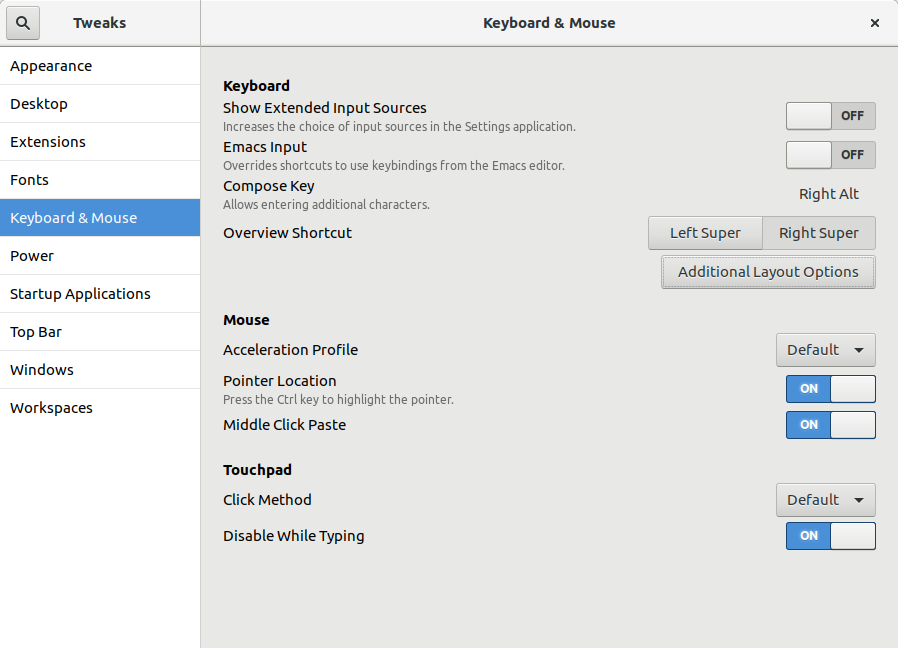
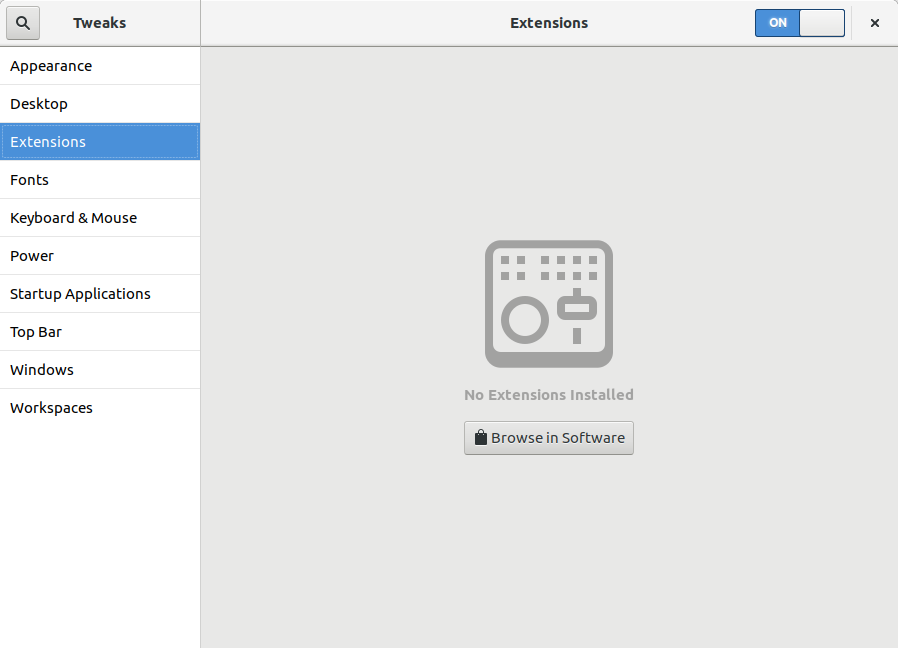
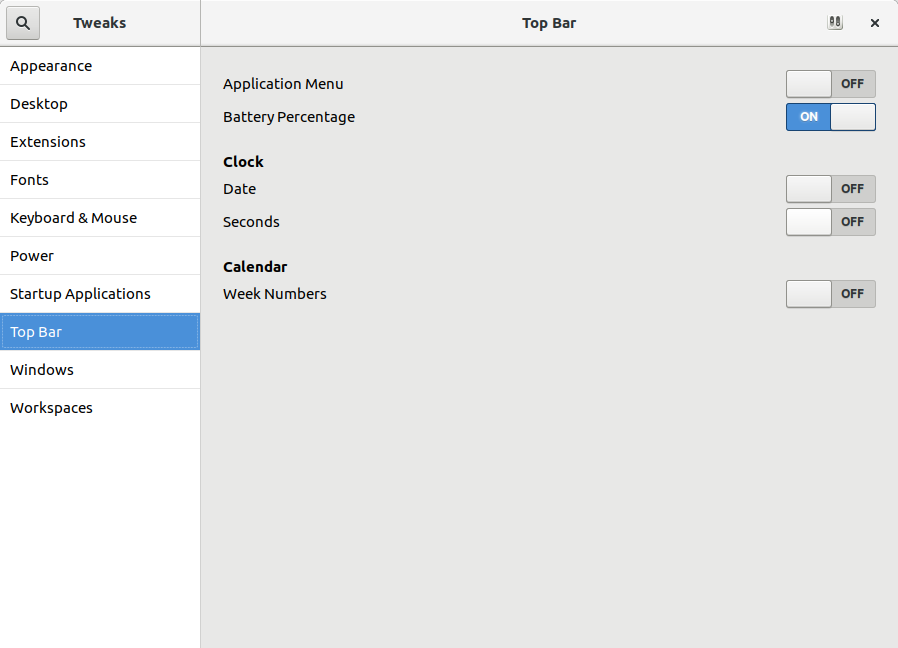
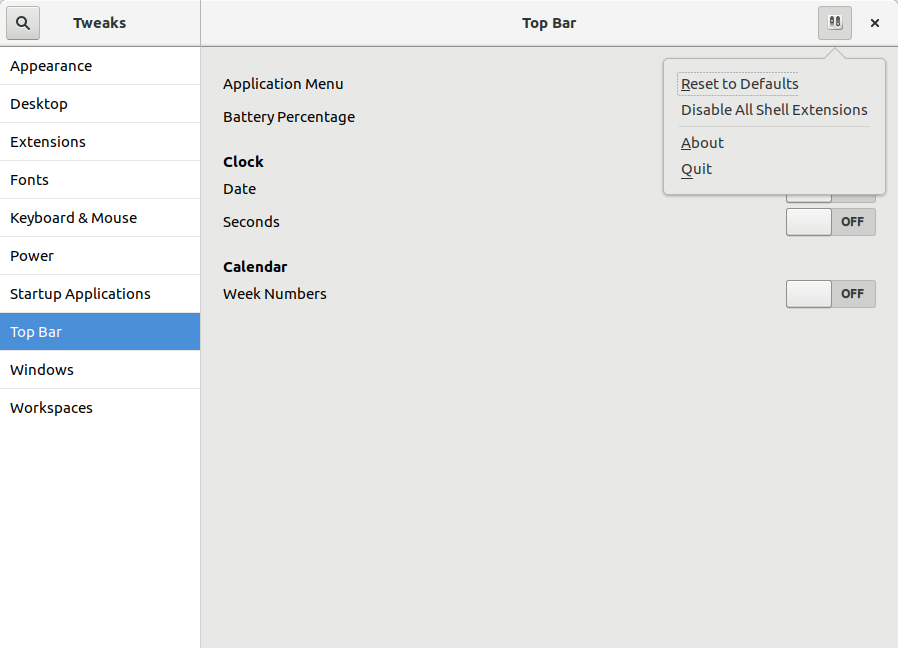
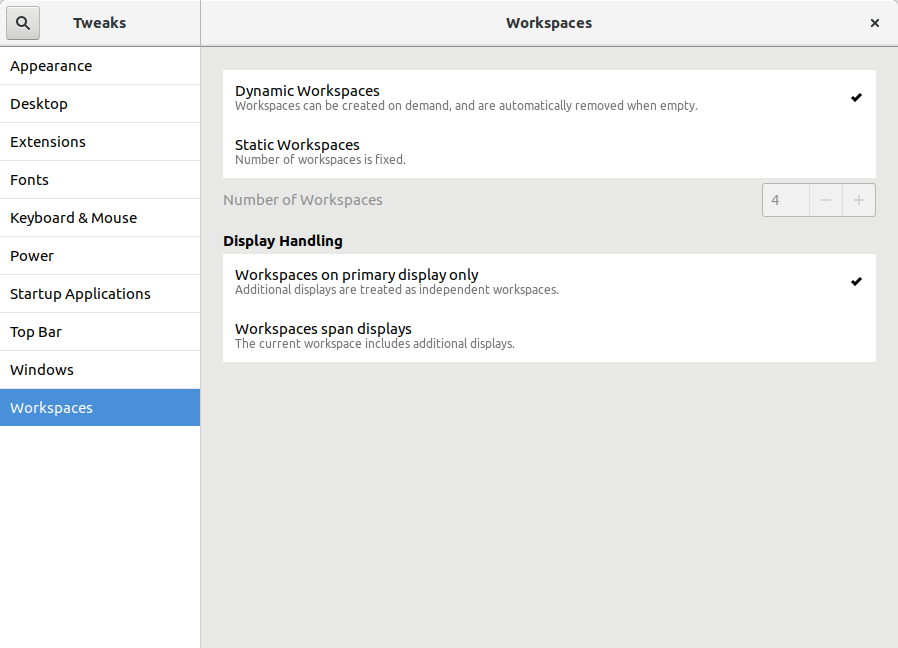
Today I released the second development snapshot (3.25.3) of what will be GNOME Tweak Tool 3.26. I consider the initial User Interface (UI) rework proposed by the GNOME Design Team to be complete now. Every page in Tweak Tool has been updated, either in this snapshot or the previous development snapshot. The hard part still remains: making the UI look as good as the mockups. Tweak Tool s backend makes this a bit more complicated than usual for an app like this. Here are a few visual highlights of this release. The Typing page has been moved into an Additional Layout Options dialog in the Keyboard & Mouse page. Also, the Compose Key option has been given its own dialog box. Florian M llner added content to the Extensions page that is shown if you don t have any GNOME Shell extensions installed yet. A hidden feature that GNOME has had for a long time is the ability to move the Application Menu from the GNOME top bar to a button in the app s title bar. This is easy to enable in Tweak Tool by turning off the Application Menu switch in the Top Bar page. This release improves how well that works, especially for Ubuntu users where the required hidden appmenu window button was probably not pre-configured. Some of the ComboBoxes have been replaced by ListBoxes. One example is on the Workspaces page where the new design allows for more information about the different options. The ListBoxes are also a lot easier to select than the smaller ComboBoxes were. For details of these and other changes, see the commit log or the NEWS file. GNOME Tweak Tool 3.26 will be released alongside GNOME 3.26 in mid-September.

Next.

Previous.