Search Results: "sto"

28 October 2015

John Goerzen: The Train to Galesburg

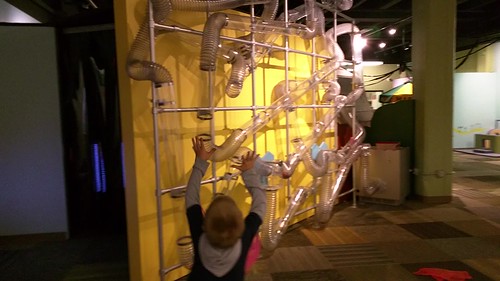
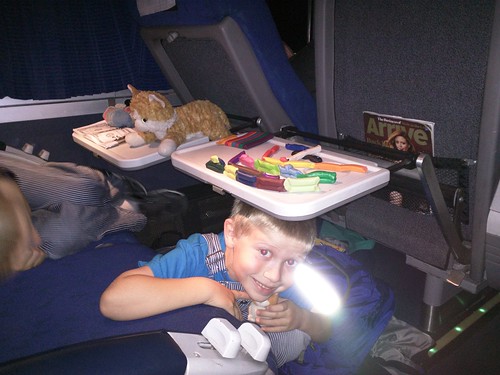
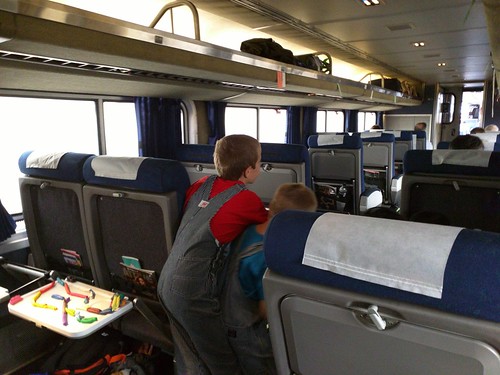
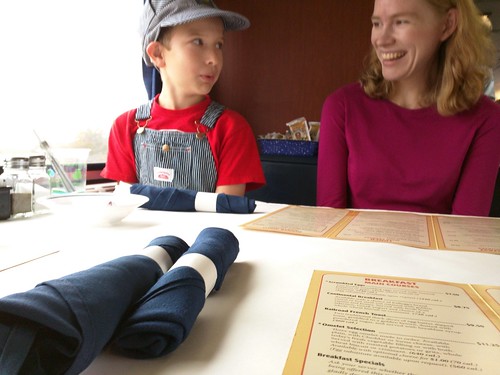
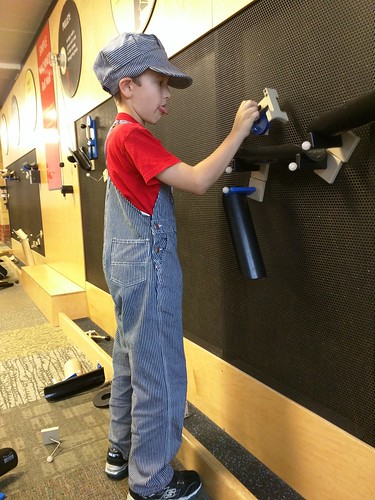
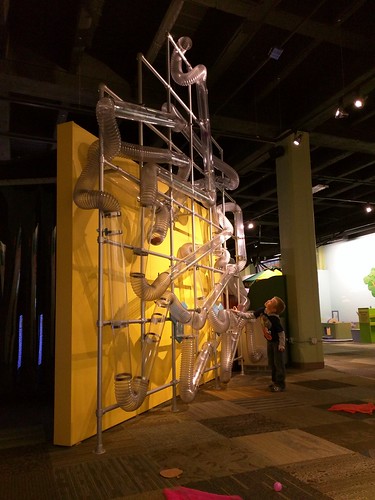
Sometimes, children are so excited you just can t resist. Jacob and Oliver have been begging for a train trip for awhile now, so Laura and I took advantage of a day off school to take them to the little town of Galesburg, IL for a couple days. Galesburg is a special memory for me; nearly 5 years ago, it was the first time Jacob and I took an Amtrak trip somewhere, just the two of us. And, separately, Laura s first-ever train trip had been to Galesburg to visit friends. There was excitement in the air. I was asked to supply a bedtime story about trains I did. On the way to the train station in the middle of the night there was excited jabbering about trains. Even when I woke them up, they lept out of bed and raced downstairs, saying, Dad, why aren t you ready yet? As the train was passing through here at around 4:45AM, and we left home with some time to spare, we did our usual train trip thing of stopping at the one place open at such a time: Druber s Donuts. IMG_20151023_040731 Much as Laura and I might have enjoyed some sleep once we got on the train, Jacob and Oliver weren t having it. Way too much excitement was in the air. Jacob had his face pressed against the window much of the time, while Oliver was busy making snake trains from colored clay complete with eyes. IMG_20151023_062304 The boys were dressed up in their train hats and engineer overalls, and Jacob kept musing about what would happen if somebody got confused and thought that he was the real engineer. When an Amtrak employee played along with that later, he was quite thrilled! We were late enough into Galesburg that we ate lunch in the dining car. A second meal there what fun! Here they are anxiously awaiting the announcement that the noon reservations could make their way to the dining car. Oh, and jockeying for position to see who would be first and get to do the all-important job of pushing the button to open the doors between train cars. IMG_20151023_120143 Even waiting for your food can be fun. IMG_20151023_120728 Upon arriving, we certainly couldn t leave the train station until our train did, even though it was raining. IMG_20151023_145755 Right next to the train station is the Discovery Depot Children s Museum. It was a perfect way to spend a few hours. Jacob really enjoyed the building wall, where you can assemble systems that use gravity (really a kinetic/potential energy experiment wall) to funnel rubber balls all over the place. He sticks out his tongue when he s really thinking. Fun to watch. IMG_20151023_153113 Meanwhile, Oliver had a great time with the air-powered tube system, complete with several valves that can launch things through a complicated maze of transparent tubes. IMG_20151024_150309 VID_20151024_150159 They both enjoyed pretending I was injured and giving me rides in the ambulance. I was diagnosed with all sorts of maladies a broken leg, broken nose. One time Jacob held up the pretend stethoscope to me, and I said ribbit. He said, Dad, you ve got a bad case of frog! You will be in the hospital 190 days! Later I would make up things like I think my gezotnix is all froibled and I was ordered to never leave the ambulance again. He told the story of this several times. After the museum closed, we ate supper. Keep in mind the boys had been up since the middle of the night without sleeping and were still doing quite well! They did start to look a bit drowsy I thought Oliver was about to fall asleep, but then their food came. And at the hotel, they were perfectly happy to invent games involving jumping off the bed. Saturday, we rode over to Peck Park. We had heard about this park from members of our church in Kansas, but oddly even the taxi drivers hadn t ever heard of it. It s well known as a good place to watch trains, as it has two active lines that cross each other at a rail bridge. And sure enough, in only a little while, we took in several trains. IMG_20151024_110035 VID_20151024_110229 The rest of that morning, we explored Galesburg. We visited an antique mall and museum, saw the square downtown, and checked out a few of the shops my favorite was the Stray Cat, featuring sort of a storefront version of Etsy with people selling art from recycled objects. But that wasn t really the boys thing, so we drifted out of there on our way to lunch at Baked, where we had some delicious deep-dish pizza. After that, we still had some time to kill before getting back on the train. We discussed our options. And what do you know we ended up back at the children s museum. We stopped at a bakery to get the fixins for a light supper on the train, and ate a nice meal in the dining car once we got on. Then, this time, they actually slept. Before long, it was 3AM again and time to get back off the train. Oliver was zonked out sleepy. Somehow I managed to get his coat and backpack on him despite him being totally limp, and carried him downstairs to get off the train. Pretty soon we walked to our car and drove home. We tucked them in, and then finally tucked ourselves in. Sometimes being really tired is well worth it.




27 October 2015

Mart n Ferrari: Tales from the SRE trenches: Dev vs Ops

This is the second part in a series of articles about SRE, based on the talk I gave in the Romanian Association for Better Software. On the first part, I introduced briefly what is SRE. Today, I present some concrete ways in which SRE tried to make things better, by stopping the war between developers and SysAdmins.

Dev vs Ops: the eternal battle So, it starts at looking at the problem: how to increase the reliability of the service? It turns out that some of the biggest sources of outages are new launches: a new feature that seemed innocuous somehow managed to bring the whole site down. Devs want to launch, and Ops want to have a quiet weekend, and this is were the struggle begins. When launches are problematic, bureaucracy is put in place to minimise the risks: launch reviews, checklists, long-lived canaries. This is followed by development teams finding ways of side-stepping those hurdles. Nobody is happy. One of the key aspects of SRE is to avoid this conflict completely, by changing the incentives, so these pressures between development and operations disappear. At Google, they achieve this with a few different strategies:

Have an SLA for your service Before any service can be supported by SRE, it has to be determined what is the level of availability that it must achieve to make the users and the company happy: this is called the Service Level Agreement (SLA). The SLA will define how availability is measured (for example, percentage of queries handled successfully in less than 50ms during the last quarter), and what is the minimum acceptable value for it (the Service Level Objective, or SLO). Note that this is a product decision, not a technical one. This number is very important for an SRE team and its relationship with the developers. It is not taken lightly, and it should be measured and enforced rigorously (more on that later). Only a few things on earth really require 100% availability (pacemakers, for example), and achieving really high availability is very costly. Most of us are dealing with more mundane affairs, and in the case of websites, there are many other things that fail pretty often: network glitches, OS freezes, browsers being slow, etc. So an SLO of 100% is almost never a good idea, and in most cases it is impossible to reach. In places like Google an SLO of "five nines" (99.999%) is not uncommon, and this means that the service can't fail completely for more than 5 minutes across a whole year!

Measure and report performance against SLA/SLO Once you have a defined SLA and SLO, it is very important that these are monitored accurately and reported constantly. If you wait for the end of the quarter to produce a hand-made report, the SLA is useless, as you only know you broke it when it is too late. You need automated and accurate monitoring of your service level, and this means that the SLA has to be concrete and actionable. Fuzzy requirements that can't be measured are just a waste of time. This is a very important tool for SRE, as it allows to see the progression of the service over time, detect capacity issues before they become outages, and at the same time show how much downtime can be taken without breaking the SLA. Which brings us to one core aspect of SRE:

Use error budgets and gate launches on them If SLO is the minimum rate of availability, then the result of calculating 1 - SLO is what fraction of the time a service can fail without failing out of the SLA. This is called an error budget, and you get to use it the way you want it. If the service is flaky (e.g. it fails consistently 1 of every 10000 requests), most of that budget is just wasted and you won't have any margin for launching riskier changes. On the other hand, a stable service that does not eat the budget away gives you the chance to bet part of it on releasing more often, and getting your new features quicker to the user. The moment the error budget is spent, no more launches are allowed until the average goes back out of the red. Once everyone can see how the service is performing against this agreed contract, many of the traditional sources of conflict between development and operations just disappear. If the service is working as intended, then SRE does not need to interfere on new feature launches: SRE trusts the developers' judgement. Instead of stopping a launch because it seems risky or under-tested, there are hard numbers that take the decisions for you. Traditionally, Devs get frustrated when they want to release, but Ops won't accept it. Ops thinks there will be problems, but it is difficult to back this feeling with hard data. This fuels resentment and distrust, and management is never pleased. Using error budgets based on already established SLAs means there is nobody to get upset at: SRE does not need to play bad cop, and SWE is free to innovate as much as they want, as long as things don't break. At the same time, this provides a strong incentive for developers to avoid risking their budget in poorly-prepared launches, to perform staged deployments, and to make sure the error budget is not wasted by recurrent issues.
That's all for today. The next article will continue delving into how traditional tensions between Devs and Ops are played in the SRE world. Comment

Dirk Eddelbuettel: Rcpp now used by over 500 CRAN packages

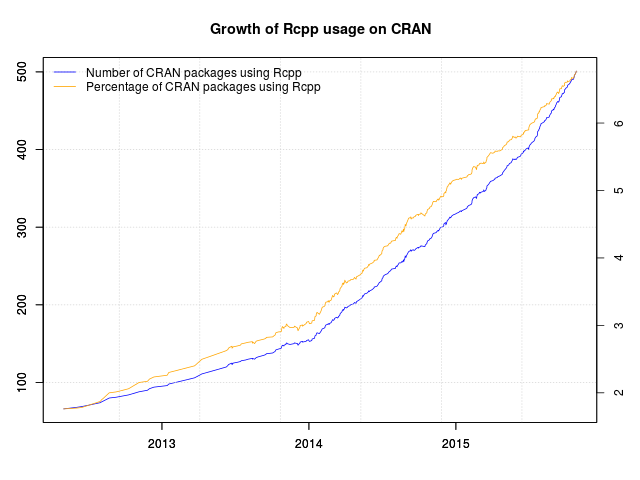
500 Rcpp packages This morning, Rcpp reached another round milestone: 501 packages on CRAN now depend on it (as measured by Depends, Imports and LinkingTo declarations, and even excluding one or two packages with an accidental declaration that do not use it). The graph is on the left depicts the growth of Rcpp usage over time. And there are a full seventy more on BioConductor in its development branch (but BioConductor is not included in the chart). Rcpp cleared 300 packages less than a year ago. It passed 400 packages in June when I only tweeted about it this June (while traveling for Rcpp training at U Zuerich, the R Summit at CBS, and the fabulous useR! 2015 at U Aalborg; so no blog post). The first and less detailed part uses manually saved entries, the second half of the data set was generated semi-automatically via a short script appending updates to a small file-based backend. A list of user package is kept on this page. Also displayed in the graph is the relative proportion of CRAN packages using Rcpp. The four per-cent hurdle was cleared just before useR! 2014 where I showed a similar graph (as two distinct graphs) in my invited talk. We passed five percent in December of last year, six percent this July and now stand at 6.77 percent, or about one in fourteen R packages. 500 user packages is very humbling, a staggering number and a big responsibility. We will out best try to keep Rcpp as performant and reliable as it has been so that the next set of packages can rely on it---just like these 500 do. So with that a very big Thank You! to all users and contributors of Rcpp for help, suggestions, bug reports, documentation or, of course, code.

This post by Dirk Eddelbuettel originated on his Thinking inside the box blog. Please report excessive re-aggregation in third-party for-profit settings.

Wouter Verhelst: Adventures with modern electronics

I got me a new television last wednesday. The previous one was still functional, but with its 20 inch display it was (by today's standards) a very small one. In itself that wasn't an issue, but combined with my rather large movie collection and the 5.1 surround set that I bought a few years ago, my living room was starting to look slightly ridiculous. The new TV is a Panasonic 40" UHD ("4K") 3D-capable so-called smart thing. Unfortunately, all did not go well. When I initially hooked it up, I found it confusingly difficult to figure out how to make it display something useful from the HDMI input rather than from the (not yet connected) broadcast cable. This eventually turned out to be due to the fact that the HDMI input was not selectable by a button marked "AUX" or similar, but by a button marked with some pictogram on a location near the teletext controls, which was pretty much the last place I'd look for such a thing. After crossing that bridge, I popped in the correct film for that particular day and started watching it. The first thing I noticed, however, was that something was odd with the audio. It turned out that the TV as well as the 5.1 amplifier support the CEC protocol, which allows the TV to control some functionality of the A/V receiver. Unfortunately, the defaults were set in the TV to route audio to the TV's speakers, rather than to the 5.1 amp. This was obviously wrong, and it took me well over an hour to figure out why that was happening, and how I could fix it. My first solution at that time was to disable CEC on the amplifier, so that I could override where the audio would go there. Unfortunately, that caused the audio and video to go out of sync; not very pleasant. In addition, the audio would drop out every twenty seconds or so, which if you're trying to watch a movie is horribly annoying, and eventually I popped the DVD into a machine with analog 5.1 audio and component HD video outputs; not the best quality, but at least I could stop getting annoyed about it. Over the next few days, I managed to get the setup working better and better: There's just on thing remaining: when I go into the channel list and try to move some channels around, the TV has the audacity to tell me that it's "not allowed". I mean, I paid for it, so I get to say what's allowed, not you, thankyouverymuch. Anyway, I'm sure I'll figure that out eventually. The TV also has some 3D capability, but unfortunately it's one of those that require active 3D glasses, so the set that I bought at the movie theatre a while ago won't work. So after spending several tens of euros on extra cabling, I'll have to spend even more on a set of 3D glasses. They'll probably be brand-specific, too. Ah well. It's a bit odd, in my opinion, that it takes me almost a week to get all that stuff to properly work. Ten years ago, the old TV had some connections, a remote, and that was it; you hook it up and you're done. Not anymore.

Lunar: Reproducible builds: week 26 in Stretch cycle

What happened in the reproducible builds effort this week: Toolchain fixes Mattia Rizzolo created a bug report to continue the discussion on storing cryptographic checksums of the installed .deb in dpkg database. This follows the discussion that happened in June and is a pre-requisite to add checksums to .buildinfo files. Niko Tyni identified why the Vala compiler would generate code in varying order. A better patch than his initial attempt still needs to be written. Packages fixed The following 15 packages became reproducible due to changes in their build dependencies: alt-ergo, approx, bin-prot, caml2html, coinst, dokujclient, libapreq2, mwparserfromhell, ocsigenserver, python-cryptography, python-watchdog, slurm-llnl, tyxml, unison2.40.102, yojson. The following packages became reproducible after getting fixed: Some uploads fixed some reproducibility issues but not all of them: reproducible.debian.net pbuilder has been updated to version 0.219~bpo8+1 on all eight build nodes. (Mattia Rizzolo, h01ger) Packages that FTBFS but for which no open bugs have been recorded are now tested again after 3 days. Likewise for depwait packages. (h01ger) Out of disk situations will not cause IRC notifications anymore. (h01ger) Documentation update Lunar continued to work on writing documentation for the future reproducible-builds.org website. Package reviews 44 reviews have been removed, 81 added and 48 updated this week. Chris West and Chris Lamb identified 70 fail to build from source issues. Misc. h01ger presented the project in Mexico City at the 3er Congreso de Seguridad de la Informaci n where it became clear that we lack academic papers related to reproducible builds. Bryan has been doing hard work to improve reproducibility for OpenWrt. He wrote a report linking to the patches and test results he published.

Marco d'Itri: Per-process netfilter rules

This article documents how the traffic of specific Linux processes can be subjected to a custom firewall or routing configuration, thanks to the magic of cgroups. We will use the Network classifier cgroup, which allows tagging the packets sent by specific processes. To create the cgroup which will be used to identify the processes I added something like this to /etc/rc.local:
mkdir /sys/fs/cgroup/net_cls/unlocator
/bin/echo 42 > /sys/fs/cgroup/net_cls/unlocator/net_cls.classid
chown md: /sys/fs/cgroup/net_cls/unlocator/tasks
The tasks file, which controls the membership of processes in a cgroup, is made writeable by my user: this way I can add new processes without becoming root. 42 is the arbitrary class identifier that the kernel will associate with the packets generated by the member processes. A command like systemd-cgls /sys/fs/cgroup/net_cls/ can be used to explore which processes are in which cgroup. I use a simple shell wrapper to start a shell or a new program as members of this cgroup:
#!/bin/sh -e
CGROUP_NAME=unlocator
if [ ! -d /sys/fs/cgroup/net_cls/$CGROUP_NAME/ ]; then
  echo "The $CGROUP_NAME net_cls cgroup does not exist!" >&2
  exit 1
fi
/bin/echo $$ > /sys/fs/cgroup/net_cls/$CGROUP_NAME/tasks
if [ $# = 0 ]; then
  exec $ SHELL:-/bin/sh 
fi
exec "$@"
My first goal is to use a special name server for the DNS queries of some processes, thanks to a second dnsmasq process which acts as a caching forwarder. /etc/dnsmasq2.conf:
port=5354
listen-address=127.0.0.1
bind-interfaces
no-dhcp-interface=*
no-hosts
no-resolv
server=185.37.37.37
server=185.37.37.185
/etc/systemd/system/dnsmasq2.service:
[Unit]
Description=dnsmasq - Second instance
Requires=network.target
[Service]
ExecStartPre=/usr/sbin/dnsmasq --test
ExecStart=/usr/sbin/dnsmasq --keep-in-foreground --conf-file=/etc/dnsmasq2.conf
ExecReload=/bin/kill -HUP $MAINPID
PIDFile=/run/dnsmasq/dnsmasq.pid
[Install]
WantedBy=multi-user.target
Do not forget to enable the new service:
systemctl enable dnsmasq2
systemctl start dnsmasq2
Since the cgroup match extension is not yet available in a released version of iptables, you will first need to build and install it manually:
git clone git://git.netfilter.org/iptables.git
cd iptables
./autogen.sh
./configure
make -k
sudo cp extensions/libxt_cgroup.so /lib/xtables/
sudo chmod -x /lib/xtables/libxt_cgroup.so
The netfilter configuration required is very simple: all DNS traffic from the marked processes is redirected to the port of the local dnsmasq2:
iptables -t nat -A OUTPUT -m cgroup --cgroup 42 -p udp --dport 53 -j REDIRECT --to-ports 5354
iptables -t nat -A OUTPUT -m cgroup --cgroup 42 -p tcp --dport 53 -j REDIRECT --to-ports 5354
For related reasons, I also need to disable IPv6 for these processes:
ip6tables -A OUTPUT -m cgroup --cgroup 42 -j REJECT
I use a different cgroup to force some programs to use my office VPN by first setting a netfilter packet mark on their traffic:
iptables -t mangle -A OUTPUT -m cgroup --cgroup 43 -j MARK --set-mark 43
The packet mark is then used to policy-route this traffic using a dedicate VRF, i.e. routing table 43:
ip rule add fwmark 43 table 43
This VPN VRF just contains a default route for the VPN interface:
ip route add default dev tun0 table 43
Depending on your local configuration it may be a good idea to also add to the VPN VRF the routes of your local interfaces:
ip route show scope link proto kernel \
    xargs -I ROUTE ip route add ROUTE table 43
Since the source address selection happens before the traffic is diverted to the VPN, we also need to source-NAT to the VPN address the marked packets:
iptables -t nat -A POSTROUTING -m mark --mark 43 --out-interface tun0 -j MASQUERADE

26 October 2015

Simon Josefsson: Combining Dnsmasq and Unbound

For my home office network I have been using Dnsmasq for some time. Dnsmasq provides me with DNS, DHCP, DHCPv6, and IPv6 Router Advertisement. I run dnsmasq on a Debian Jessie server, but it works similar with OpenWRT if you want to use a smaller device. My entire /etc/dnsmasq.d/local configuration used to look like this:
dhcp-authoritative
interface=eth1
read-ethers
dhcp-range=192.168.1.100,192.168.1.150,12h
dhcp-range=2001:9b0:104:42::100,2001:9b0:104:42::1500
dhcp-option=option6:dns-server,[::]
enable-ra
Here dhcp-authoritative enable DHCP. interface=eth1 says to listen on eth1 only, which is my internal (IPv4 NAT) network. I try to keep track of the MAC address of all my devices in a /etc/ethers file, so I use read-ethers to have dnsmasq give stable IP addresses for them. The dhcp-range is used to enable DHCP and DHCPv6 on my internal network. The dhcp-option=option6:dns-server,[::] statement is needed to inform the DHCP clients of the DNS resolver s IPv6 address, otherwise they would only get the IPv4 DNS server address. The enable-ra parameter enables IPv6 router advertisement on the internal network, thereby removing the need to run radvd too useful since I prefer to use copyleft software. Recently I had a desire to use DNSSEC, and enabled it in Dnsmasq using the following statements:
dnssec
trust-anchor=.,19036,8,2,49AAC11D7B6F6446702E54A1607371607A1A41855200FD2CE1CDDE32F24E8FB5
dnssec-check-unsigned
The dnssec keyword enable DNSSEC validation in dnsmasq, using the indicated trust-anchor (get the root-anchors from IANA). The dnssec-check-unsigned deserves some more discussion. The dnsmasq manpage describes it as follows:
As a default, dnsmasq does not check that unsigned DNS replies are legitimate: they are assumed to be valid and passed on (without the authentic data bit set, of course). This does not protect against an attacker forging unsigned replies for signed DNS zones, but it is fast. If this flag is set, dnsmasq will check the zones of unsigned replies, to ensure that unsigned replies are allowed in those zones. The cost of this is more upstream queries and slower performance.
For example, this means that dnsmasq s DNSSEC functionality is not secure against active man-in-the-middle attacks between dnsmasq and the DNS server it is using. Even if example.org used DNSSEC properly, an attacker could fake that it was unsigned to dnsmasq, and I would get potentially incorrect values in return. We all know that the Internet is not a secure place, and your threat model should include active attackers. I believe this mode should be the default in dnsmasq, and users should have to configure dnsmasq to not be in that mode if they really want to (with the obvious security warning). Running with this enabled for a couple of days resulted in frustration about not being able to reach a couple of domains. The behaviour was that my clients would hang indefinitely or get a SERVFAIL, both resulting in lack of service. You can enable query logging in dnsmasq with log-queries and enabling this I noticed three distinct form of error patterns:
jow13gw dnsmasq 460 - -  forwarded www.fritidsresor.se to 213.80.101.3
jow13gw dnsmasq 460 - -  validation result is BOGUS
jow13gw dnsmasq 547 - -  reply cloudflare-dnssec.net is BOGUS DNSKEY
jow13gw dnsmasq 547 - -  validation result is BOGUS
jow13gw dnsmasq 547 - -  reply linux.conf.au is BOGUS DS
jow13gw dnsmasq 547 - -  validation result is BOGUS
The first only happened intermittently, the second did not cause any noticeable problem, and the final one was reproducible. To be fair, I only found the last example after starting to search for problem reports (see post confirming bug). At this point, I had a confirmed bug in dnsmasq that affect my use-case. I want to use official packages from Debian on this machine, so installing newer versions manually is not an option. So I started to look into alternatives for DNS resolving, and quickly found Unbound. Installing it was easy:
apt-get install unbound
unbound-control-setup 
I created a local configuration file in /etc/unbound/unbound.conf.d/local.conf as follows:
server:
	interface: 127.0.0.1
	interface: ::1
	interface: 192.168.1.2
	interface: 2001:9b0:104:42::2
	access-control: 127.0.0.1 allow
	access-control: ::1 allow
	access-control: 192.168.1.2/24 allow
	access-control: 2001:9b0:104:42::2/64 allow
	outgoing-interface: 155.4.17.2
	outgoing-interface: 2001:9b0:1:1a04::2
#	log-queries: yes
#	verbosity: 2
The interface keyword determine which IP addresses to listen on, here I used the loopback interface and the local address of the physical network interface for my internal network. The access-control allows recursive DNS resolving from those networks. And outgoing-interface specify my external Internet-connected interface. log-queries and/or verbosity are useful for debugging. To make things work, dnsmasq has to stop providing DNS services. This can be achieved with the port=0 keyword, however that will also disable informing DHCP clients about the DNS server to use. So this has to be added in manually. I ended up adding the two following lines to /etc/dnsmasq.d/local:
port=0
dhcp-option=option:dns-server,192.168.1.2
Restarting unbound and dnsmasq now leads to working (and secure) internal DNSSEC-aware name resolution over both IPv4 and IPv6. I can verify that resolution works, and that Unbound verify signatures and reject bad domains properly with dig as below, or use online DNSSEC resolver test page although I m not sure how confident you can be in the result from that page.
$ host linux.conf.au
linux.conf.au has address 192.55.98.190
linux.conf.au mail is handled by 1 linux.org.au.
$ host sigfail.verteiltesysteme.net
;; connection timed out; no servers could be reached
$ 
I use Munin to monitor my services, and I was happy to find a nice Unbound Munin plugin. I installed the file in /usr/share/munin/plugins/ and created a Munin plugin configuration file /etc/munin/plugin-conf.d/unbound as follows:
[unbound*]
user root
env.statefile /var/lib/munin-node/plugin-state/root/unbound.state
env.unbound_conf /etc/unbound/unbound.conf
env.unbound_control /usr/sbin/unbound-control
env.spoof_warn 1000
env.spoof_crit 100000
I run munin-node-configure --shell sh to enable it. To work unbound has to be configured as well, so I create a /etc/unbound/unbound.conf.d/munin.conf as follows.
server:
	extended-statistics: yes
	statistics-cumulative: no
	statistics-interval: 0
remote-control:
	control-enable: yes
The graphs may be viewed at my munin instance.

Russ Allbery: Review: Hawk

Review: Hawk, by Steven Brust
Series: Vlad Taltos #14
Publisher: Tor
Copyright: October 2014
ISBN: 0-7653-2444-X
Format: Hardcover
Pages: 320
This is the fourteenth book in the Vlad Taltos series (not counting the various associated books and other series), builds directly on the long-term plot arc of the series (finally!), and is deeply entangled with Vlad's friends and former life as a Jhereg boss. As you might imagine from that introduction, this is absolutely not the place to start with this series. For the past few books, Brust has been following a pattern of advancing the series plot in one book and then taking the next book to fill in past history or tell some side story. That means, following Tiassa, we were due some series advancement, and that's exactly what we get. We also, finally, get some more details about Lady Teldra. Nothing all that revelatory, but certainly intriguing, and more than just additional questions (at last). When Brust finally takes this gun off the wall and fires it, the resulting bits of world-building might be even better than Issola. At its heart, though, Hawk is a caper novel. If you're like me, you're thinking "it's about time." I think this is the sort of story Brust excels at, particularly with Vlad as his protagonist. Even better, unlike some of the other multi-part novels, this is a book-length caper focused on a very important goal, and with the potential to get rid of some annoyances in Vlad's life that have lingered for rather too long. We see many of Vlad's Dragaeran friends, but (apart from Daymar) mostly in glimpses. This is Vlad's book, with heavy helpings of Loiosh. The caper is also a nicely twisty one, involving everything from different types of magic to the inner workings of the Jhereg organization. As is typical for Vlad's schemes, there are several false fronts and fake goals, numerous unexpected twists, and a rather fun guest appearance. Oh, and lots and lots of snark, of course. I think my favorite part of the book was the interaction between Vlad and Kragar, which added a lot of emotional depth both to this story and to some of the previous stories of Vlad's life as a Jhereg. And I'm hoping that where Brust leaves things at the end of this book implies a Vlad who is more free to act, to see his friends, and to get entangled in Imperial politics, since I think that leads to the best stories. Of course, if Brust holds to pattern, the next book will be backfill or side stories and we'll have to wait longer for a continuation of the main story. As much as I like those side stories, I'm hoping Brust will break pattern. I'm increasingly eager to see where this story will go. The all-too-brief interaction with Sethra in this book promises so much for the future. If you like the Vlad Taltos books overall, you'll probably like this one. It's a return to the old scheming Vlad, but tempered by more experience and different stakes. There's a bit of lore, a bit of world-building, and a lot of Vlad being tricky. This series is still going strong fourteen books in. Rating: 8 out of 10

25 October 2015

Johannes Schauer: unshare without superuser privileges

TLDR: With the help of Helmut Grohne I finally figured out most of the bits necessary to unshare everything without becoming root (though one might say that this is still cheated because the suid root tools newuidmap and newgidmap are used). I wrote a Perl script which documents how this is done in practice. This script is nearly equivalent to using the existing commands lxc-usernsexec [opts] -- unshare [opts] -- COMMAND except that these two together cannot be used to mount a new proc. Apart from this problem, this Perl script might also be useful by itself because it is architecture independent and easily inspectable for the curious mind without resorting to sources.debian.net (it is heavily documented at nearly 2 lines of comments per line of code on average). It can be retrieved here at https://gitlab.mister-muffin.de/josch/user-unshare/blob/master/user-unshare Long story: Nearly two years after my last last rant about everything needing superuser privileges in Linux, I'm still interested in techniques that let me do more things without becoming root. Helmut Grohne had told me for a while about unshare(), or user namespaces as the right way to have things like chroot without root. There are also reports of LXC containers working without root privileges but they are hard to come by. A couple of days ago I had some time again, so Helmut helped me to get through the major blockers that were so far stopping me from using unshare in a meaningful way without executing everything with sudo. My main motivation at that point was to let dpkg-buildpackage when executed by sbuild be run with an unshared network namespace and thus without network access (except for the loopback interface) because like pbuilder I wanted sbuild to enforce the rule not to access any remote resources during the build. After several evenings of investigating and doctoring at the Perl script I mentioned initially, I came to the conclusion that the only place that can unshare the network namespace without disrupting anything is schroot itself. This is because unsharing inside the chroot will fail because dpkg-buildpackage is run with non-root privileges and thus the user namespace has to be unshared. But this then will destroy all ownership information. But even if that wasn't the case, the chroot itself is unlikely to have (and also should not) tools like ip or newuidmap and newgidmap installed. Unsharing the schroot call itself also will not work. Again we first need to unshare the user namespace and then schroot will complain about wrong ownership of its configuration file /etc/schroot/schroot.conf. Luckily, when contacting Roger Leigh about this wishlist feature in bug#802849 I was told that this was already implemented in its git master \o/. So this particular problem seems to be taken care of and once the next schroot release happens, sbuild will make use of it and have unshare --net capabilities just like pbuilder already had since last year. With the sbuild case taken care of, the rest of this post will introduce the Perl script I wrote. The name user-unshare is really arbitrary. I just needed some identifier for the git repository and a filename. The most important discovery I made was, that Debian disables unprivileged user namespaces by default with the patch add-sysctl-to-disallow-unprivileged-CLONE_NEWUSER-by-default.patch to the Linux kernel. To enable it, one has to first either do

echo 1   sudo tee /proc/sys/kernel/unprivileged_userns_clone > /dev/null
or
sudo sysctl -w kernel.unprivileged_userns_clone=1
The tool tries to be like unshare(1) but with the power of lxc-usernsexec(1) to map more than one id into the new user namespace by using the programs newgidmap and newuidmap. Or in other words: This tool tries to be like lxc-usernsexec(1) but with the power of unshare(1) to unshare more than just the user and mount namespaces. It is nearly equal to calling:
lxc-usernsexec [opts] -- unshare [opts] -- COMMAND
Its main reason of existence are: I hoped that systemd-nspawn could do what I wanted but it seems that its requirement for being run as root will not change any time soon Another tool in Debian that offers to do chroot without superuser privileges is linux-user-chroot but that one cheats by being suid root. Had I found lxc-usernsexec earlier I would've probably not written this. But after I found it I happily used it to get an even better understanding of the matter and further improve the comments in my code. I started writing my own tool in Perl because that's the language sbuild was written in and as mentioned initially, I intended to use this script with sbuild. Now that the sbuild problem is taken care of, this is not so important anymore but I like if I can read the code of simple programs I run directly from /usr/bin without having to retrieve the source code first or use sources.debian.net. The only thing I wasn't able to figure out is how to properly mount proc into my new mount namespace. I found a workaround that works by first mounting a new proc to /proc and then bind-mounting /proc to whatever new location for proc is requested. I didn't figure out how to do this without mounting to /proc first partly also because this doesn't work at all when using lxc-usernsexec and unshare together. In this respect, this perl script is a bit more powerful than those two tools together. I suppose that the reason is that unshare wasn't written with having being called without superuser privileges in mind. If you have an idea what could be wrong, the code has a big FIXME about this issue. Finally, here a demonstration of what my script can do. Because of the /proc bug, lxc-usernsexec and unshare together are not able to do this but it might also be that I'm just not using these tools in the right way. The following will give you an interactive shell in an environment created from one of my sbuild chroot tarballs:
$ mkdir -p /tmp/buildroot/proc
$ ./user-unshare --mount-proc=/tmp/buildroot/proc --ipc --pid --net \
    --uts --mount --fork -- sh -c 'ip link set lo up && ip addr && \
    hostname hoothoot-chroot && \
    tar -C /tmp/buildroot -xf /srv/chroot/unstable-amd64.tar.gz; \
    /usr/sbin/chroot /tmp/buildroot /sbin/runuser -s /bin/bash - josch && \
    umount /tmp/buildroot/proc && rm -rf /tmp/buildroot'
(unstable-amd64-sbuild)josch@hoothoot-chroot:/$ whoami
josch
(unstable-amd64-sbuild)josch@hoothoot-chroot:/$ hostname
hoothoot-chroot
(unstable-amd64-sbuild)josch@hoothoot-chroot:/$ ls -lha /proc   head
total 0
dr-xr-xr-x 218 nobody nogroup    0 Oct 25 19:06 .
drwxr-xr-x  22 root   root     440 Oct  1 08:42 ..
dr-xr-xr-x   9 root   root       0 Oct 25 19:06 1
dr-xr-xr-x   9 josch  josch      0 Oct 25 19:06 15
dr-xr-xr-x   9 josch  josch      0 Oct 25 19:06 16
dr-xr-xr-x   9 root   root       0 Oct 25 19:06 7
dr-xr-xr-x   9 josch  josch      0 Oct 25 19:06 8
dr-xr-xr-x   4 nobody nogroup    0 Oct 25 19:06 acpi
dr-xr-xr-x   6 nobody nogroup    0 Oct 25 19:06 asound
Of course instead of running this long command we can also instead write a small shell script and execute that instead. The following does the same things as the long command above but adds some comments for further explanation:
#!/bin/sh

set -exu

# I'm using /tmp because I have it mounted as a tmpfs
rootdir="/tmp/buildroot"

# bring the loopback interface up
ip link set lo up

# show that the loopback interface is really up
ip addr

# make use of the UTS namespace being unshared
hostname hoothoot-chroot

# extract the chroot tarball. This must be done inside the user namespace for
# the file permissions to be correct.
#
# tar will fail to call mknod and to change the permissions of /proc but we are
# ignoring that
tar -C "$rootdir" -xf /srv/chroot/unstable-amd64.tar.gz true

# run chroot and inside, immediately drop permissions to the user "josch" and
# start an interactive shell
/usr/sbin/chroot "$rootdir" /sbin/runuser -s /bin/bash - josch

# unmount /proc and remove the temporary directory
umount "$rootdir/proc"
rm -rf "$rootdir"
and then:
$ mkdir -p /tmp/buildroot/proc
$ ./user-unshare --mount-proc=/tmp/buildroot/proc --ipc --pid --net --uts --mount --fork -- ./chroot.sh
As mentioned in the beginning, the tool is nearly equivalent to calling lxc-usernsexec [opts] -- unshare [opts] -- COMMAND but because of the problem with mounting proc (mentioned earlier), lxc-usernsexec and unshare cannot be used with above example. If one tries anyways one will only get:
$ lxc-usernsexec -m b:0:1000:1 -m b:1:558752:1 -- unshare --mount-proc=/tmp/buildroot/proc --ipc --pid --net --uts --mount --fork -- ./chroot.sh
unshare: mount /tmp/buildroot/proc failed: Invalid argument
I'd be interested in finding out why that is and how to fix it.

B lint R czey: Kernel oops collector is back in Debian!

oops-debian The Linux Kernel Oops website collects kernel errors from all over the World helping kernel developers finding issues occurring in the wild but they cannot help if no one sends reports to them. The Kerneloops client used to be part of Debian releases but it has been removed from the archive due to not working with the new collector site. When I started observing oopses on my machine I first thought of submitting a bug against the linux package in BTS, but looking at the numerous bugs opened already I looked for a more automated solution which would also help others. Reviving the kerneloops package involved switching it to the new submission URL, fixing a few memory allocation bugs in C (this is the first package I found using Valgrind by default for running tests) and ensuring that upstream was still active. The last step took the most of the time but finally Anton Arapov kindly accepted my patches and everything was set for the new upload. The package is now available from unstable and if you feel so (especially if you experience oopses) please give it a try and report any problems you find. I m also happy to receive success stories about oopses fixed after discovering and collecting them with the client. :-)

Russ Allbery: Review: The Thrilling Adventures of Lovelace and Babbage

Review: The Thrilling Adventures of Lovelace and Babbage, by Sydney Padua
Publisher: Pantheon
Copyright: 2015
ISBN: 0-307-90827-5
Format: Hardcover
Pages: 317
I seem to be writing a lot of reviews lately where any reader can easily do their own research and see if this is something they'd like. This is another of those, but perhaps a bit more obscure. As Padua explains in the preface, the first Lovelace and Babbage strip was intended to be a one-off joke. A friend suggested that she draw a comic telling the (short and rather tragic) life of Ada Lovelace, widely considered the first computer programmer even though the computer for which she wrote programs was never built: Charles Babbage's Analytic Engine. Padua found the story of Babbage and Lovelace's collaboration fascinating but too grim, and so wrote an alternate ending involving a pocket universe in which Babbage and Lovelace lived on to fight crime! Or at least fought against street organs and poetry. Padua meant this as a joke. The Internet took it as a teaser. Quite to her surprise, she found herself writing occasional additional episodes and getting lost in fascinating research about Lovelace and Babbage. The result is all at 2dgoggles.com. This book is a curated collection of those comics, including much of their (extensive) footnotes and research notes, in a very attractive and well-constructed book form. The best review, therefore, would be to go read some of the comics yourself, easily accessible via the Comics tab on the web site, and see if this is the sort of thing you'd enjoy. There is some material in the book that isn't on the web site, but most of it is there (including one full story that didn't make it into the book). There are a few reasons to buy a collection like this of material that previously appeared on the Internet. One, of course, is out of gratitude to support the author, which is the main reason I bought it. If you want to do that, though, you probably already know you do. Another reason is for additional unpublished material, but that's not really the case here. But a third is that, despite all the technology of the web, books can sometimes provide a more elegant and beautiful presentation. And that's very much the case for The Thrilling Adventures of Lovelace and Babbage. The hardcover is a beautiful work of art. It has what you would expect from a hardcover graphic novel, of course: sturdy paper, lovely story headings in the form of Victorian-style posters, and very nice artwork beneath the dust jacket. (I've been so happy to see that in the last few hardcovers I've reviewed.) But, best of all, it presents the primary research notes on each page underneath comic panels. Those who have been reading Lovelace and Babbage as it appears on the web know Padua's copious research notes. But they're normally presented at the end of each complete part, and I found myself often not reading them in detail. This might not be the case for everyone, but at least for me this presentation works so much better. Historical notes are at the bottom of (nearly) every page, in context. This might sound like it would distract from and break up the flow of the story, but at least for me it does the opposite. The comics feel so much richer when intermixed with the actual history (which in some cases is surprisingly similar to what seemed to be wild, invented scenarios). The historical notes also have end notes, and quite substantial ones. I found that organization less successful (readers of my reviews will know I have a long-standing antipathy towards end notes for anything other than cross-references), but I have to admit I have no idea how Padua would have fit those on the same page as footnotes. They're also written well enough, and with sufficient detail, that I could usually read a chapter and then read all the end notes and mostly remember what they referred to. Padua also takes advantage of the format to play a few neat games with frame breaks: characters commenting on the notes, stabbing things into them, or otherwise affecting them. I have to admit to some mild frustration where this makes the notes unreadable, since they're nearly as fascinating as the comics, but the overall effect is still worth it. (And, of course, the full notes are available on the web if one wishes to look them up.) Rounding out the book version are a few of the best original source documents that Padua found, thankfully excerpted and well-edited to not outlive their welcome for those of us who don't like poring over Victorian letters. And, finally, some beautiful illustrations of the mechanisms of the Analytic Engine with supporting descriptions of how they were supposed to work. I'm not particularly mechanically inclined, nor that fascinated by steampunk, and I still found these diagrams impressive and fun to look at. Someone more interested in such things will be in for a treat. I've been thoroughly enjoying the (sadly infrequent) installments of Lovelace and Babbage for years now, and am utterly delighted by their hardcover appearance. If you already knew about Padua's work and have any interest in nice hardcovers of such things, I don't think you'll regret the purchase. If you haven't heard of her, or this series, before, some quick reading at the web site should quickly reveal whether this is something you'd enjoy. Rating: 9 out of 10

24 October 2015

Mart n Ferrari: Tales from the SRE trenches - Part 1

A few weeks ago, I was offered the opportunity to give a guest talk in the Romanian Association for Better Software. RABS is a group of people interested in improving the trade, and regularly hold events where invited speakers give presentations on a wide array of topics. The speakers are usually pretty high-profile, so this is quite a responsibility! To make things more interesting, much of the target audience works on enterprise software, under Windows platforms. Definitely outside my comfort zone! Considering all this, we decided the topic was going to be about Site Reliability Engineering (SRE), concentrating on some aspects of it which I believe could be useful independently of the kind of company you are working for. I finally gave the talk last Monday, and the audience seemed to enjoy it, so I am going to post here my notes, hopefully some other people will like it too.

Why should I care? I prepared this thinking of an audience of software engineers, so why would anyone want to hear about this idea that only seems to be about making the life of the operations people better? The thing is, having your work as a development team supported by an SRE team will also benefit you. This is not about empowering Ops to hit you harder when things blow apart, but to have a team that is your partner. A partner that will help you grow, handle the complexities of a production environment so you can concentrate on cool features, and that will get out of the way when things are running fine. A development team may seem to only care about adding features that will drive more and more users to your service. But an unreliable service is a service that loses users, so you should care about reliability. And what better to have a team has Reliability on their name?

What is SRE? SRE means Site Reliability Engineering, Reliability Engineering applied to "sites". Wikipedia defines Reliability Engineering as:
[..] engineering that emphasizes dependability in the life-cycle management of a product.
This is, historically, a branch of engineering that made possible to build devices that will work as expected even when their components were inherently unreliable. It focused on improving component reliability, establishing minimum requirements and expectations, and a heavy usage of statistics to predict failures and understand underlying problems. SRE started as a concept at Google about 12 years ago, when Ben Treynor joined the company and created the SRE team from a group of 7 production engineers. There is no good definition of what Site Reliability Engineering means; while the term and some of its ideas are clearly inspired in the more traditional RE, he defines SRE with these words1:
Fundamentally, it's what happens when you ask a software engineer to design an operations function.

Only hire coders After reading that quote it is not surprising that the first item in the SRE checklist2, is to only hire people who can code properly for SRE roles. Writing software is a key part of being SRE. But this does not mean that there is no separation between development and operations, nor that SRE is a fancy(er) name for DevOps3. It means treating operations as a software engineering problem, using software to solve problems that used to be solved by hand, implementing rigorous testing and code reviewing, and taking decisions based on data, not just hunches. It also implies that SREs can understand the product they are supporting, and that there is a common ground and respect between SREs and software engineers (SWEs). There are many things that make SRE what it is, some of these only make sense within a special kind of company like Google: many different development and operations teams, service growth that can't be matched by hiring, and more importantly, firm commitment from top management to implement these drastic rules. Therefore, my focus here is not to preach on how everybody should adopt SRE, but to extract some of the most useful ideas that can be applied in a wider array of situations. Nevertheless, I will first try to give an overview of how SRE works at Google.
That's it for today. In the next post I will talk about how to end the war between developers and SysAdmins. Stay tuned!

  1. http://www.site-reliability-engineering.info/2014/04/what-is-site-reliability-engineering.html
  2. SRE checklist extracted from Treynor's talk at SREcon14: https://www.usenix.org/conference/srecon14/technical-sessions/presentation/keys-sre
  3. By the way, I am still not sure what DevOps mean, it seems that everyone has a different definition for it.
Comment

Russ Allbery: Review: Oathbreakers

Review: Oathbreakers, by Mercedes Lackey
Series: Vows and Honor #2
Publisher: DAW
Copyright: January 1989
ISBN: 0-88677-454-3
Format: Mass market
Pages: 318
The Tarma and Kethry stories tend to be stand-alone and are readable out of order, and this isn't an exception. But if you want their background, consider reading Oathblood or (less recommended) The Oathbound before reading this book. (Reading Oathblood first may require a bit of finesse, since some of the stories in that book come after this novel. Unfortunately, there is no good ordering or collection of these stories that maintains internal chronological order.) This is more like it. This is the Tarma and Kethry story that I remembered when calling them my favorite characters in the Valdemar universe. Following the short stories merged into The Oathbound fixup novel, Tarma and Kethry are still trying to gather the resources required to start a school and to rebuild Tarma's clan. That's led to them signing with a highly-respected mercenary company: Idra's Sunhawks. Idra renounced her claims to the Rethwellen line of royal succession to lead the Sunhawks, creating a mercenary band that's legendary for their quality and battlefield capabilities. The story opens with a campaign in Jkatha, on one side of a civil war, which is mostly an opportunity to get to know the Sunhawks and to see Tarma and Kethry show their competence. The real story starts later, when Idra is called back to Rethwellen for family business and something goes very wrong. I think Lackey is best at two types of stories: misunderstood young people who grow into themselves and their place in the world, and competent people displaying their competence. The Tarma and Kethry stories, and particularly Oathbreakers, are of the latter type. This is clearly wish fulfillment: Lackey's stories often lack nuance, there's rarely any doubt as to who the good and bad guys are, and, although very bad things can happen, you're probably going to get some sort of happy ending. But if you're in the mood for that sort of story, it's so satisfying. The Tarma and Kethry we see here are a mature, experienced fighter and mage team (plus Warrl, who provides vitally important magical and combat assistance, as well as some pointed advice). They know what they're doing, they care deeply for each other, and both their relationship patterns and their capabilities are well-understood. Both do a bit of growing over the course of this novel, but that's not really the point. The point is seeing them take on unfamiliar challenges and tricky investigations while being very good at what they do. In other words, this isn't bildungsroman or high fantasy; it's sword and sorcery, and an excellent example of the genre. Reading these books as part of the overall Valdemar series provides some enjoyable moments with the first explicit contact between Valdemar and its Heralds and Tarma and Kethry's world. The maps here firmly establish their home regions as well to the south of Valdemar and multiple kingdoms away, but Rethwellen (as previously established in earlier Herald-focused trilogies) is on Valdemar's southern border. Seeing Lackey's very separate magic and divinity systems cross and meet, with a bit of initial mutual suspicion, is a rather fun moment (if, at least, you're in the mood for a story in which the world has a vested interest in making sure all the good people like each other). Although I'm wondering why Kethry didn't get extremely uncomfortable when she crossed the border into Valdemar due to the trick that Vanyel pulled in his trilogy. (I seem to recall this is explained away at some point.) Be warned that this novel does contain other elements typical of early Lackey. There is, for example, the inevitable rape, although thankfully off-camera and not quite as central to the plot. (Although in a way that makes it worse since it felt gratuitous. I'm unconvinced that the rape was at all necessary to the story that Lackey was telling.) Revenge and eye-for-an-eye justice are hotly defended by the protagonists. This isn't a series to look to for subtle and complex solutions to political problems; instead, everything gets better if you just kill all the evil people. There isn't anything quite as egregious as the actions of the supposed good guys in The Oathbound, but you still have to read past a certain bloodthirstiness in the stated good side of a very black-and-white morality. That means this isn't a novel for all people or all moods. But within those genre conventions, which aren't that unusual for sword and sorcery, Oathbreakers is a lot of fun. It's one of the few Valdemar novels I've read during this re-read that lived up to my memory of it. Recommended if you like this sort of thing. Rating: 8 out of 10

23 October 2015

Petter Reinholdtsen: "Free Culture" by @lessig - The background story for Creative Commons - new edition available

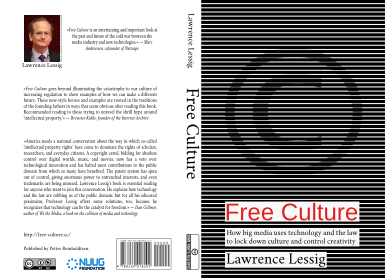
Click here to buy the book. In 2004, as the Creative Commons movement gained momentum, its creator Lawrence Lessig wrote the book Free Culture to explain the problems with increasing copyright regulation and suggest some solutions. I read the book back then and was very moved by it. Reading the book inspired me and changed the way I looked on copyright law, and I would love it if more people would read it too. Because of this, I decided in the summer of 2012 to translate it to Norwegian Bokm l and publish it for those of my friends and family that prefer to read books in Norwegian. I translated the book using docbook and a gettext PO file, and a byproduct of this process is a new edition of the English original. I've been in touch with the author during by work, and he said it was fine with him if I also published an English version. So I decided to do so. Today, I made this edition available for sale on Lulu.com, for those interested in a paper book. This is the cover:

The Norwegian Bokm l version will be available for purchase in a few days. I also plan to publish a French version in a few weeks or months, depending on the amount of people with knowledge of French to join the translation project. So far there is only one active person, but the French book is almost completely translated but need some proof reading. The book is also available in PDF, ePub and MOBI formats from my github project page. Note the ePub and MOBI versions have some formatting problems I believe is due to bugs in the docbook tool dbtoepub (Debian BTS issues #795842 and #796871), but I have not taken the time to investigate. I recommend the PDF and ePub version for now, as they seem to show up fine in the viewers I have available. After the translation to Norwegian Bokm l was complete, I was able to secure some sponsoring from the NUUG Foundation to print the book. This is the reason their logo is located on the back cover. I am very grateful for their contribution, and will use it to give a copy of the Norwegian edition to members of the Norwegian Parliament and other decision makers here in Norway.

Russ Allbery: Review: Watchtower

Review: Watchtower, by Elizabeth A. Lynn
Series: Chronicles of Tornor #1
Publisher: Berkley
Copyright: February 1979
Printing: November 1982
ISBN: 0-425-06195-7
Format: Mass market
Pages: 226
Ryke is a soldier in service to Athor, lord of Tornor Keep. Or, at least, he was. Shortly before the opening lines of this book, Tornor Keep was taken by a southerner named Col Istor, and Athor was killed. Ryke is about to change sides under duress: his service to Col as a watch commander is the price of keeping Errel, Athor's son, alive. Alive does not mean treated with dignity, however; Errel's new place is to become court jester for Col's small domain. At the start of this book, I had no idea who Col Istor was or why he'd want to take over one of the border keeps that guard the country of Arun against its northern neighbor Anhard. At the end of this book, I still had little idea. Watchtower's relationship with world-building is not what you'd normally expect from a fantasy novel. There are only a few locations in this novel, and they're described in close detail but without much historical or strategic context. The narrative, despite being third person, follows Ryke very closely, and Ryke is not interested in thinking much about the history of his world that he knows and the reader doesn't. Or he may not care. Ryke does not come across as a curious or thoughtful person. He's a soldier, he lives to serve his lord, and that service transfers from Athor to Errel and simply stays there, with little discussion or argument. The opening section of this novel shows Ryke trying to take care of Errel while serving Col and listening to his plans to take over the rest of the northern keeps. I found it slow, claustrophobic, and not very interesting. It reads a bit like a day in the life in some grim medieval military, with little world-building or context. Watchtower is technically fantasy, but mostly because the geography and politics are imaginary. Magic is limited to a very tiny bit of (essentially) Tarot card reading and has little impact on the plot. The story does get somewhat more interesting when two green clan messengers enter the story, and Ryke and Errel escape. Lynn introduces another community and another way of life into the story than the one Ryke is used to, one that seemed modeled after monastic orders (but with the religion toned down to nearly nonexistent). I think the intended conflict of the story is between those ways of life, their draws and implications, but even that conflict is never clearly stated. Ryke seems to move from one inevitability to another, and while he does question some of his previous views and seems to open his mind a bit, actual growth is limited in this story. I reached the end of the book feeling the world was largely unchanged from its start. This story won the World Fantasy award for best novel in 1980. I have to admit I'm baffled, although partly that's because this is not really my thing. I prefer my fantasy to have more epic sweep and a lot more world-building. But perhaps the award was for the writing, which is evocative and fills the moments of the story with closely-observed detail. It has a distinctive, choppy feel, full of short declarative sentences:
The wind blew. Like some night creature caught in a trap, Col Istor's banner flapped on its pole. Ryke wondered where his wolfhound was. Sheltering, he hoped, in some warm and windless corner. He thrust his hands beneath his armpits to warm them. He entered the kitchen, nodding at the guard who stood there, and went toward the scullery. The kitchenboys huddled together in sleep like dogs in front of the oven. He stepped over their legs. The iron pots on the walls vibrated softly.
That's a paragraph chosen at random from the start of the book and should give you a good feel for the style. I think I would have liked this novel better if it had followed anyone other than Ryke. Not only did I not care for him and his simplistic loyalties, he's the least interesting character in this story. Everyone else Col, Errel, Sorren, Van, and others is more complex and more thoughtful than he is, and I think many of them would have made a better protagonist. He spends much of the center part of the book being suspicious and closed and incurious, which means the reader can only guess at what's going on between the other characters. I can't really recommend this book, but the writing is solid and it has some interesting properties for late 1970s fantasy, including both a frank look at the role of women in this society and same-sex relationships. If your taste in fantasy leans towards the gritty and realistic, you might like it more than I did. I may try the later books of the series in the hope that they have more interesting protagonists. Followed by Dancers of Arun. Rating: 6 out of 10

22 October 2015

Pau Garcia i Quiles: FOSDEM Desktops DevRoom 2016

It is now official: KDE will be present again at FOSDEM in the 2016 edition, on the 30th and 31st of January, 2016. Talks will take place at the Desktops DevRoom, on Sunday the 31st, but not exclusively: in past years, there were Qt and KDE-related talks at the mobile devroom, lightning talks, distributions, open document editors and more. KDE will be sharing the room with other desktop environments, as usual: Gnome, Unity, Enlightenment, Razor, etc. Representatives from those communities will be helping me in managing and organizing the devroom: Christophe Fergeau, Michael Zanetti, Philippe Caseiro and J rome Leclanche. I would like to extend the invitation to any other free/open source desktop environment and/or related stuff. Check last year s schedule for an example. Closed-source shops (Microsoft, Apple, Oracle, etc) are ALSO invited, provided that you will talk about something related to open source. We will publish the Call for Talks for the Desktops DevRoom 2016 soon. Stay tuned. In the meanwhile, you can subscribe to the Desktops DevRoom mailing list to be informed of important and useful information, and talk about FOSDEM and specific issues of the Desktops DevRoom.

21 October 2015

Russell Coker: LUV Server Upgrade to Jessie

On Sunday night I started the process of upgrading the LUV server to Debian/Jessie from Debian/Wheezy. My initial plan was to just upgrade Apache first but dependencies required upgrading systemd too. One problem I ve encountered in the past is that the Wheezy version of systemd will often hang on an upgrade to a newer version. Generally the solution to this is to run systemctl daemon-reexec from another terminal. The problem in this case was that not all the libraries needed for systemd had been installed, so systemd could re-exec itself but immediately aborted. The kernel really doesn t like it when process 1 aborts repeatedly and apparently immediately hanging is the result. At the time I didn t know this, all I knew was that my session died and the server stopped responding to pings immediately after I requested a reexec. The LUV server is hosted at VPAC for free. As their staff have actual work to do they couldn t spend a lot of time working on the LUV server. They told me that the screen was flickering and suspected a VGA cable. I got to the VPAC server room with the spare LUV server (LUV had been given 3 almost identical Sun servers from Barwon Water) at 16:30. By 17:30 I had fixed the core problem (boot with init=/bin/bash , mount the root filesystem rw, finish the upgrade of systemd and it s dependencies, and then reboot normally). That got it into a stage where the Xen server for Wikimedia Au was working but most LUV functionality wasn t working. By 23:00 on Monday I had the full list server functionality working for users, this is the main feature that users want when it s not near a meeting time. I can t remember whether it was Monday night or Tuesday morning when I got the Drupal site going (the main LUV web site). Last night at midnight I got the last of the Mailman administrative interface going, I admit I could have got it going a bit earlier by putting SE Linux in permissive mode, but I don t think that the members would have benefited from that (I ll upload a SE Linux policy package that gets Mailman working on Jessie soon). Now it s Wednesday and I m still fixing some cron jobs. Along the way I noticed some problems with excessive disk space use that I m fixing now and I ve also removed some Wikimedia related configuration files that were obsolete and would have prevented anyone from using a wikimedia.org.au address to subscribe to the LUV mailing lists. Now I believe that everything is working correctly and generally working better than before. Lessons Learned While Sunday night wasn t a bad time to start the upgrade it wasn t the best. If I had started the upgrade on Monday morning there would have been less down-time. Another possibility might be to do the upgrade while near the VPAC office during business hours, I could have started the upgrade while at a nearby cafe and then visited the server room immediately if something went wrong. Doing an upgrade on a day when there s no meeting within a week was a good choice. It wasn t really a conscious choice as I m usually doing other LUV work near the meeting day which precludes doing other LUV work that doesn t need to be done soon. But in future it would be best to consciously plan upgrades for a date when users aren t going to need the service much. While the Wheezy systemd bug is unlikely to ever be fixed there are work-arounds that shouldn t result in a broken server. At the moment it seems that the best option would be to kill -9 the systemctl processes that hang until the packages that systemd depends on are installed. The problem is that the upgrade hangs while the new systemctl tries to tell the old systemd to restart daemons. If we can get past that to the stage where the shared objects are installed then it should be ok. The Apache upgrade from 2.2.x to 2.4.x changed the operation of some access control directives and it took me some time to work out how to fix that. Doing a Google search on the differences between those would have led me to the Apache document about upgrading from 2.2 to 2.4 [1]. That wouldn t have prevented some down-time of the web sites but would have allowed me to prepare for it and to more quickly fix the problems when they became apparent. Also the rather confusing configuration of the LUV server (supporting many web sites that are no longer used) didn t help things. I think that removing cruft from an installation before an upgrade would be better than waiting until after things break. Next time I do an upgrade of such a server I ll write notes about it while I go. That will give a better blog post about it if it becomes newsworthy enough to be blogged about and also more opportunities to learn better ways of doing it. Sorry for the inconvenience.

Antoine Beaupr : Proprietary VDSL2 Linux routers adventures

I recently bought a wireless / phone adapter / VDSL modem from my Internet Service Provider (ISP) during my last outage. It generally works fine as a VDSL modem, but unfortunately, I can't seem to get used to configuring the device through their clickety web user interface... Furthermore, I am worried that I can't backup the config in a meaningful way, that is: if the device fails, I will probably not find the same model again and because they run a custom Linux distributions, the chances of the backup being possible to restore on another machine are basically zero. No way i will waste my time configuring this black box. So I started looking at running a distribution like OpenWRT on it.
(Unfortunately, I don't even dare hoping to run a decent operating system like Debian on those devices, if only because of the exotic chipsets that require all sorts of nasty hacks to run...)
The machine is a SmartRG SR630n (specs). I am linking to third party site, because the SmartRG site doesn't seem to know about their own product (!). I paid extra for this device to get one that would do both Wifi and VoIP, so i could replace two machines: my current Soekris net5501 router and a Cisco ATA 186 phone adapter that seems to mysteriously defy the challenges of time. (I don't remember when I got that thing, but it's at least from 2006.) Unfortunately, it seems that SmartRG are running a custom, proprietary Linux distribution. According to my ISP, init is a complete rewrite that reads an XML config file (and indeed it's the format of the backup files) and does the configuration through a shared memory scheme (!?). According to DSL reports, the device seems to be running a Broadcom 63168 SOC (system on a chip) that is unsupported in Linux. There are some efforts to write drivers for those from scratch, but they have been basically stalled for years now. Here are more details on the sucker: Now the next step would logically be to "simply" build a new image with OpenWRT and install it in place. Then I would need to figure out a way to load the binary blobs into the OpenWRT kernel and run all the ADSL utilities as well. It's basically impossible: the odds of the binary modules being compatible with another arbitrary release of the Linux kernel are near zero. Furthermore, the userland tool are most likely custom as well. And worse of all: it seems that Bell Canada deployed a custom "Lucent Stinger" DSLAM which requires a custom binary firmware in the modem. This could be why the SmartRG is so bizarre in the first place. As long as the other end is non-standard, we are all screwed. And those Stinger DSLAM will stick around for a long time, thanks to bell.
See this other good explanation of Stinger.
Which means this machine is now yet another closed box sitting on the internet without firmware upgrades, totally handicapped. I will probably end up selling it back for another machine that has OpenWRT support for their VDSL modems. But there are very few such machines, and with a lot of those, VDSL support is often marked as "spotty" or "in progress". Some machines are supported but are basically impossible to find. There's the Draytek modems are also interesting because, apparently, some models run OpenWRT out of the box too, which is a huge benefit. This is because they use the more open Lantiq SOC. Which are probably not going to support Stinger lines. Still, there are some very interesting projects out there... The Omnia is one I am definitely interested in right now. I really like their approach... But then they don't have a VDSL chipset in there (I asked for one, actually). And the connectors are only mini-PCIe, which makes it impossible to connect a VDSL PCI card into it. I could find a single VDSL2 PCI card online, and it could be supported, but only the annex B is available, not the annex A, and it seems the network is using "annex A" according to the ADSL stats i had in 2015-05-28-anarcat-back-again. With such a card, I could use my existing Soekris net5501 router, slam a DSL card into it, and just use the SmartRG as a dumb wifi router/phone adapter. Then it will remain to see how supported are those VDSL cards in FreeBSD (they provide Linux source code, so that's cool). And of course, all this assumes the card works with the "Stinger" mode, which is probably not the case anyways. Besides, I have VDSL2 here, not the lowly ADSL2+. By the way, Soekris keeps on pushing new interesting products out: their net6501, with 2 extra Gig-E cards could be a really interesting high-end switch, all working with free software tools. A friend has a SmartRG 505n modem, which looks quite similar, except without the ATA connectors. And those modems are the ones that Teksavvy recommends ("You may use a Cellpipe 7130 or Sagemcom F@ST 2864 in lieu of our SmartRG SR505N for our DSL 15/10, DSL 25 or DSL 50 services."). Furthermore, Teksavvy provides a firmware update for the 505n - again, no idea if it works with the 630n. Of course, the 505n doesn't run OpenWRT either. So, long story short, again I got screwed by my ISP: I thought i would get a pretty hackable device, "running Linux" that my ISP said over the phone. I got weeks of downtime, no refund, and while i got a better line (more reliable, higher bandwidth), my costs doubled. And I have yet another computing device to worry about: instead of simplifying and reducing waste, I actually just added crap on top of my already cluttered desk. Next time, maybe I'll tell you about how my ISP overbilled me, broke IPv6 and drops large packets to the floor. I haven't had a response from them in months now... hopefully they will either answer and fix all of this (doubtful) or I'll switch to some other provider, probably Teksavvy. Many thanks to the numerous people in the DSL reports Teksavvy forum that have amazing expertise. They are even building a map of Bell COs... Thanks also to Taggart for helping me figure out how the firmware images work and encouraging me to figure out how my machine works overall.
Note: all the information shared here is presented in the spirit of the fair use conditions of copyright law.

20 October 2015

Russ Allbery: Review: The Oathbound

Review: The Oathbound, by Mercedes Lackey
Series: Vows and Honor #1
Publisher: DAW
Copyright: July 1988
ISBN: 0-88677-414-4
Format: Mass market
Pages: 302
This book warrants a bit of explanation. Before Arrows of the Queen, before Valdemar (at least in terms of publication dates), came Tarma and Kethry short stories. I don't know if they were always intended to be set in the same world as Valdemar; if not, they were quickly included. But they came from another part of the world and a slightly different sub-genre. While the first two Valdemar trilogies were largely coming-of-age fantasy, Tarma and Kethry are itinerant sword-and-sorcery adventures featuring two women with a soul bond: the conventionally attractive, aristocratic mage Kethry, and the celibate, goddess-sworn swordswoman Tarma. Their first story was published, appropriately, in Marion Zimmer Bradley's Swords and Sorceress III. This is the first book about Tarma and Kethry. It's a fix-up novel: shorter stories, bridged and re-edited, and glued together with some additional material. And it does not contain the first Tarma and Kethry story. As mentioned in my earlier Valdemar reviews, this is a re-read, but it's been something like twenty years since I previously read the whole Valdemar corpus (as it was at the time; I'll probably re-read everything I have on hand, but it's grown considerably, and I may not chase down the rest of it). One of the things I'd forgotten is how oddly, from a novel reader's perspective, the Tarma and Kethry stories were collected. Knowing what I know now about publishing, I assume Swords and Sorceress III was still in print at the time The Oathbound was published, or the rights weren't available for some other reason, so their first story had to be omitted. Whatever the reason, The Oathbound starts with a jarring gap that's no less irritating in this re-read than it was originally. Also as is becoming typical for this series, I remembered a lot more world-building and character development than is actually present in at least this first book. In this case, I strongly suspect most of that characterization is in Oathbreakers, which I remember as being more of a coherent single story and less of a fix-up of puzzle and adventure stories with scant time for character growth. I'll be able to test my memory shortly. What we do get is Kethry's reconciliation of her past, a brief look at the Shin'a'in and the depth of Tarma and Kethry's mutual oath (unfortunately told more than shown), the introduction of Warrl (again, a relationship that will grow a great deal more depth later), and then some typical sword and sorcery episodes: a locked room mystery, a caravan guard adventure about which I'll have more to say later, and two rather unpleasant encounters with a demon. The material is bridged enough that it has a vague novel-like shape, but the bones of the underlying short stories are pretty obvious. One can tell this isn't really a novel even without the tell of a narrative recap in later chapters of events that you'd just read earlier in the same book. What we also get is rather a lot of rape, and one episode of seriously unpleasant "justice." A drawback of early Lackey is that her villains are pure evil. My not entirely trustworthy memory tells me that this moderates over time, but early stories tend to feature villains completely devoid of redeeming qualities. In this book alone one gets to choose between the rapist pedophile, the rapist lord, the rapist bandit, and the rapist demon who had been doing extensive research in Jack Chalker novels. You'll notice a theme. Most of the rape happens off camera, but I was still thoroughly sick of it by the end of the book. This was already a cliched motivation tactic when these stories were written. Worse, as with the end of Arrow's Flight, the protagonists don't seem to be above a bit of "turnabout is fair play." When you're dealing with rape as a primary plot motivation, that goes about as badly as you might expect. The final episode here involves a confrontation that Tarma and Kethry brought entirely on themselves through some rather despicable actions, and from which they should have taken a lesson about why civilized societies have criminal justice systems. Unfortunately, despite an ethical priest who is mostly played for mild amusement, no one in the book seems to have drawn that rather obvious conclusion. This, too, I recall as getting better as the series goes along and Lackey matures as a writer, but that only helps marginally with the early books. Some time after the publication of The Oathbound and Oathbreakers, something (presumably the rights situation) changed. Oathblood was published in 1998 and includes not only the first Tarma and Kethry story but also several of the short stories that make up this book, in (I assume) something closer to their original form. That makes The Oathbound somewhat pointless and entirely skippable. I re-read it first because that's how I first approached the series many years ago, and (to be honest) because I'd forgotten how much was reprinted in Oathblood. I'd advise a new reader to skip it entirely, start with the short stories in Oathblood, and then read Oathbreakers before reading the final novella. You'd miss the demon stories, but that's probably for the best. I'm complaining a lot about this book, but that's partly from familiarity. If you can stomach the rape and one stunningly unethical protagonist decision, the stories that make it up are solid and enjoyable, and the dynamic between Tarma and Kethry is always a lot of fun (and gets even better when Warrl is added to the mix). I think my favorite was the locked room mystery. It's significantly spoiled by knowing the ending, and it has little deeper significance, but it's a classic sort unembellished, unapologetic sword-and-sorcery tale that's hard to come by in books. But since it too is reprinted (in a better form) in Oathblood, there's no point in reading it here. Followed by Oathbreakers. Rating: 6 out of 10

Ritesh Raj Sarraf: Controlling ill behaving applications with Linux Cgroups

For some time, I have been wanting to read more on Linux Cgroups to explore possibilities of using it to control Ill behaving applications. At this time, while I'm stuck in travel, it has given me some time to look into it. In our Free Software world, most of the things are do-o-cracy, i.e. when your use case is not the common one, it is typically you who has to explore possible solutions. It could be Bugs, Feature Requests or as is in my case, performance issues. But that is not to assume that we do not have better quality software in Free Software world. Infact, in my opinion, some of the tools available are far much more better than the competition in terms of features, and to add a sweetener (or nutritional facts) to it is the fact that Free Software liberates the user. One of my favorite tool, for photo management, is Digikam. Digikam is a big project, very featureful, and has some functionalities that may not be available in the competition. But as is with most Free Software projects, Digikam is a tool which underneath consumes many more subprojects from the Free Software ecosystem. For anyone who has used Digikam, may know some of the bugs that surface on it. Not necessarily a bug in Digikam, but maybe in one of the underneath libraries/tools that it consumes (Exiv, libkface, marble, OpenCV, libPGF etc). But the bottom line is that the overall Digikam experience (and if I may say: the overall GNU/Linux experience) takes a hit. Digikam has pretty powerful features for annotation, tagging, facial recognition. These features, together with Digikam, make it a compelling product. But the problem is that many of these projects are independent. Thus tight integration is a challenge. And at times, bugs can be hard to find, root cause and fix. Let's take a real example here. If you were to use Digikam today (version 4.13.0) with annotation, tagging and facial recognition as some of the core features for your use case, you may run into frustrating overall experience. Not just that, the bugs would also effect your overall GNU/Linux experience. The facial recognition feature, if triggered, will eat up all your memory. Thus leading you to uncover Linux's long old memory bug. The tagging feature, if triggered, again will lead to frequent I/O. Thus again leading to a stalled Linux system because of blocked CPU cycled, for nothing. So one of the items on my TODO list was to explore Linux Cgroups, and see if it was cleanly possible to tame a process to a confinement, so that even if it was ill behaving (for whatever reasons), your machine does not take the beating. And now that the cgroups consumer dust has kinda settled down, systemd was my first obvious choice to look at. systemd provides a helper utility, systemd-run, for similar tasks. With systemd-run, you could apply all the resource controller logic to the given process, typically cpu, memory and blkio. And restrict it to a certain set. You can also define what user to run the service as.
rrs@learner:/var/tmp/Debian-Build/Result$ systemd-run -p BlockIOWeight=10 find /
Running as unit run-23805.service.
2015-10-20 / 21:37:44         
rrs@learner:/var/tmp/Debian-Build/Result$ systemctl status -l run-23805.service
  run-23805.service - /usr/bin/find /
   Loaded: loaded
  Drop-In: /run/systemd/system/run-23805.service.d
            50-BlockIOWeight.conf, 50-Description.conf, 50-ExecStart.conf
   Active: active (running) since Tue 2015-10-20 21:37:44 CEST; 6s ago
 Main PID: 23814 (find)
   Memory: 12.2M
      CPU: 502ms
   CGroup: /system.slice/run-23805.service
            23814 /usr/bin/find /
Oct 20 21:37:45 learner find[23814]: /proc/3/net/raw6
Oct 20 21:37:45 learner find[23814]: /proc/3/net/snmp
Oct 20 21:37:45 learner find[23814]: /proc/3/net/stat
Oct 20 21:37:45 learner find[23814]: /proc/3/net/stat/rt_cache
Oct 20 21:37:45 learner find[23814]: /proc/3/net/stat/arp_cache
Oct 20 21:37:45 learner find[23814]: /proc/3/net/stat/ndisc_cache
Oct 20 21:37:45 learner find[23814]: /proc/3/net/stat/ip_conntrack
Oct 20 21:37:45 learner find[23814]: /proc/3/net/stat/nf_conntrack
Oct 20 21:37:45 learner find[23814]: /proc/3/net/tcp6
Oct 20 21:37:45 learner find[23814]: /proc/3/net/udp6
2015-10-20 / 21:37:51         
But, out of the box, graphical applications do not work. I haven't looked, but it should be doable by giving it the correct environment details.
Underneath, systemd is using the same Linux Control Groups to limit resources for individual applications. So, in cases where you have a requirement and do not have systemd, or you directly want to make use of cgroups, it could be easily done with basic cgroups tools like cgroup-tools.
With cgroup-tools, I now have a simple cgroups hierarchy set for my current use case, i.e. Digikam
rrs@learner:/var/tmp/Debian-Build/Result$ ls /sys/fs/cgroup/memory/rrs_customCG/
cgroup.clone_children           memory.kmem.tcp.limit_in_bytes      memory.numa_stat
cgroup.event_control            memory.kmem.tcp.max_usage_in_bytes  memory.oom_control
cgroup.procs                    memory.kmem.tcp.usage_in_bytes      memory.pressure_level
digikam/                        memory.kmem.usage_in_bytes          memory.soft_limit_in_bytes
memory.failcnt                  memory.limit_in_bytes               memory.stat
memory.force_empty              memory.max_usage_in_bytes           memory.swappiness
memory.kmem.failcnt             memory.memsw.failcnt                memory.usage_in_bytes
memory.kmem.limit_in_bytes      memory.memsw.limit_in_bytes         memory.use_hierarchy
memory.kmem.max_usage_in_bytes  memory.memsw.max_usage_in_bytes     notify_on_release
memory.kmem.slabinfo            memory.memsw.usage_in_bytes         tasks
memory.kmem.tcp.failcnt         memory.move_charge_at_immigrate
2015-10-20 / 21:45:38         
rrs@learner:/var/tmp/Debian-Build/Result$ ls /sys/fs/cgroup/memory/rrs_customCG/digikam/
cgroup.clone_children           memory.kmem.tcp.max_usage_in_bytes  memory.oom_control
cgroup.event_control            memory.kmem.tcp.usage_in_bytes      memory.pressure_level
cgroup.procs                    memory.kmem.usage_in_bytes          memory.soft_limit_in_bytes
memory.failcnt                  memory.limit_in_bytes               memory.stat
memory.force_empty              memory.max_usage_in_bytes           memory.swappiness
memory.kmem.failcnt             memory.memsw.failcnt                memory.usage_in_bytes
memory.kmem.limit_in_bytes      memory.memsw.limit_in_bytes         memory.use_hierarchy
memory.kmem.max_usage_in_bytes  memory.memsw.max_usage_in_bytes     notify_on_release
memory.kmem.slabinfo            memory.memsw.usage_in_bytes         tasks
memory.kmem.tcp.failcnt         memory.move_charge_at_immigrate
memory.kmem.tcp.limit_in_bytes  memory.numa_stat
2015-10-20 / 21:45:53         
rrs@learner:/var/tmp/Debian-Build/Result$ cat /sys/fs/cgroup/cpu/rrs_customCG/cpu.shares 
1024
2015-10-20 / 21:48:44         
rrs@learner:/var/tmp/Debian-Build/Result$ cat /sys/fs/cgroup/cpu/rrs_customCG/digikam/cpu.shares 
512
2015-10-20 / 21:49:05         
rrs@learner:/var/tmp/Debian-Build/Result$ cat /sys/fs/cgroup/memory/rrs_customCG/memory.limit_in_bytes 
9223372036854771712
2015-10-20 / 22:20:14         
rrs@learner:/var/tmp/Debian-Build/Result$ cat /sys/fs/cgroup/memory/rrs_customCG/digikam/memory.limit_in_bytes 
2764369920
2015-10-20 / 22:20:27         
rrs@learner:/var/tmp/Debian-Build/Result$ cat /sys/fs/cgroup/blkio/rrs_customCG/blkio.weight
500
2015-10-20 / 21:51:43         
rrs@learner:/var/tmp/Debian-Build/Result$ cat /sys/fs/cgroup/blkio/rrs_customCG/digikam/blkio.weight
10
2015-10-20 / 21:51:50         
The base group, $USER_customCG needs super admin privileges. Which once set appropriately, allows the user to further self-define sub-groups. And users can then also define separate limits per sub-group.
With the resource limitations set in place, my overall experience on very recent hardware (Intel Haswell Core i7, 8 GiB RAM, 500 GB SSHD, 128 GB SSD) has improved considerably. It still is not perfect, but it definitely is a huge improvement over what I had to go through ealire: A stalled machine for hours.
top - 21:54:38 up 1 day,  6:46,  1 user,  load average: 7.22, 7.51, 7.37
Tasks: 299 total,   1 running, 298 sleeping,   0 stopped,   0 zombie
%Cpu0  :  7.1 us,  3.0 sy,  1.0 ni, 11.1 id, 77.8 wa,  0.0 hi,  0.0 si,  0.0 st
%Cpu1  :  6.0 us,  4.0 sy,  2.0 ni, 49.0 id, 39.0 wa,  0.0 hi,  0.0 si,  0.0 st
%Cpu2  :  5.0 us,  2.0 sy,  0.0 ni, 24.8 id, 68.3 wa,  0.0 hi,  0.0 si,  0.0 st
%Cpu3  :  5.9 us,  5.0 sy,  0.0 ni, 21.8 id, 67.3 wa,  0.0 hi,  0.0 si,  0.0 st
MiB Mem : 7908.926 total,   96.449 free, 4634.922 used, 3177.555 buff/cache
MiB Swap: 8579.996 total, 3454.746 free, 5125.250 used. 2753.324 avail Mem 
PID to signal/kill [default pid = 8879] 
  PID  PPID nTH USER        PR  NI S %CPU %MEM     TIME+ COMMAND                           UID 
 8879  8868  18 rrs         20   0 S  8.2 31.2  37:44.64 digikam                          1000 
10255  9960   4 rrs         39  19 S  1.0  0.8  19:47.73 tracker-miner-f                  1000 
10157  9960   7 rrs         20   0 S  0.5  3.0  32:29.76 gnome-shell                      1000 
    7     2   1 root        20   0 S  0.2        0:53.48 rcu_sched                           0 
  401     1   1 root        20   0 S  0.2  1.3   0:54.93 systemd-journal                     0 
10269  9937   4 rrs         20   0 S  0.2  0.4   2:34.50 gnome-terminal-                  1000 
15316     1  14 rrs         20   0 S  0.2  3.7  30:05.96 evolution                        1000 
23777     2   1 root        20   0 S  0.2        0:05.73 kworker/u16:0                       0 
23814     1   1 root        20   0 D  0.2  0.0   0:02.00 find                                0 
24049     2   1 root        20   0 S  0.2        0:01.29 kworker/u16:3                       0 
24052     2   1 root        20   0 S  0.2        0:02.94 kworker/u16:4                       0 
    1     0   1 root        20   0 S       0.1   0:18.24 systemd                             0 
The reporting tools may not be correct here. Because from what is being reported above, I should be having a machine stalled, and heavily paging, while the kernel scanning its list of processes to find the best process to kill. From this approach of jailing processes, the major side effect I can see is that the process (Digikam) is now starved of resources and will take much much much more time than what it would have been usually. But in the usual cases, it takes up all, and ends up starving (and getting killed) for consuming all available resources. So I guess it is better to be on a balanced resource diet. :-)

Categories:

Keywords:

Like:

Next.

Previous.