Search Results: "nic"

18 June 2014

Keith Packard: TeleGPS-Battery-Life

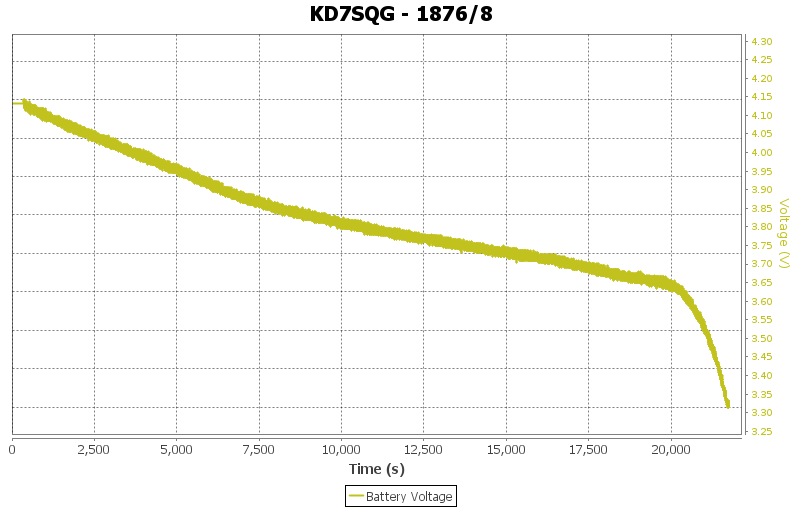
TeleGPS Battery Life I charged up one of the 160mAh batteries that we sell. (The ones we ve got now are labeled 200mAh; the 160mAh rating is something like a minimum that we expect to be able to ever get at that size.) I connected the battery to a TeleGPS board, hooked up a telemetry monitoring setup on my laptop and set the device in the window of my office. This let me watch the battery voltage through the day without interrupting my other work. Of course, because the telemetry was logged to a file, I ve now got a complete plot of the voltage data: It looks like a pretty typical lithium polymer discharge graph; slightly faster drop from the 4.1V full charge voltage down to about 3.9V, then a gradual drop to 3.65 at which point it starts to dive as the battery is nearly discharged. Because we run the electronics at 3.3V, and the LDO has a dropout of about 100mV, it s best if the battery stays above 3.4V. That occurred at around 21500 seconds of run time, or almost exactly six hours. We also have an 850mAh battery in the shop; I d expect that to last a bit more than four times as long, or about a day. Maybe I ll get bored enough at some point to hook one up and verify that guess.

17 June 2014

Petter Reinholdtsen: From English wiki to translated PDF and epub via Docbook

The Debian Edu / Skolelinux project provide an instruction manual for teachers, system administrators and other users that contain useful tips for setting up and maintaining a Debian Edu installation. This text is about how the text processing of this manual is handled in the project. One goal of the project is to provide information in the native language of its users, and for this we need to handle translations. But we also want to make sure each language contain the same information, so for this we need a good way to keep the translations in sync. And we want it to be easy for our users to improve the documentation, avoiding the need to learn special formats or tools to contribute, and the obvious way to do this is to make it possible to edit the documentation using a web browser. We also want it to be easy for translators to keep the translation up to date, and give them help in figuring out what need to be translated. Here is the list of tools and the process we have found trying to reach all these goals. We maintain the authoritative source of our manual in the Debian wiki, as several wiki pages written in English. It consist of one front page with references to the different chapters, several pages for each chapter, and finally one "collection page" gluing all the chapters together into one large web page (aka the AllInOne page). The AllInOne page is the one used for further processing and translations. Thanks to the fact that the MoinMoin installation on wiki.debian.org support exporting pages in the Docbook format, we can fetch the list of pages to export using the raw version of the AllInOne page, loop over each of them to generate a Docbook XML version of the manual. This process also download images and transform image references to use the locally downloaded images. The generated Docbook XML files are slightly broken, so some post-processing is done using the documentation/scripts/get_manual program, and the result is a nice Docbook XML file (debian-edu-wheezy-manual.xml) and a handfull of images. The XML file can now be used to generate PDF, HTML and epub versions of the English manual. This is the basic step of our process, making PDF (using dblatex), HTML (using xsltproc) and epub (using dbtoepub) version from Docbook XML, and the resulting files are placed in the debian-edu-doc-en binary package. But English documentation is not enough for us. We want translated documentation too, and we want to make it easy for translators to track the English original. For this we use the poxml package, which allow us to transform the English Docbook XML file into a translation file (a .pot file), usable with the normal gettext based translation tools used by those translating free software. The pot file is used to create and maintain translation files (several .po files), which the translations update with the native language translations of all titles, paragraphs and blocks of text in the original. The next step is combining the original English Docbook XML and the translation file (say debian-edu-wheezy-manual.nb.po), to create a translated Docbook XML file (in this case debian-edu-wheezy-manual.nb.xml). This translated (or partly translated, if the translation is not complete) Docbook XML file can then be used like the original to create a PDF, HTML and epub version of the documentation. The translators use different tools to edit the .po files. We recommend using lokalize, while some use emacs and vi, others can use web based editors like Poodle or Transifex. All we care about is where the .po file end up, in our git repository. Updated translations can either be committed directly to git, or submitted as bug reports against the debian-edu-doc package. One challenge is images, which both might need to be translated (if they show translated user applications), and are needed in different formats when creating PDF and HTML versions (epub is a HTML version in this regard). For this we transform the original PNG images to the needed density and format during build, and have a way to provide translated images by storing translated versions in images/$LANGUAGECODE/. I am a bit unsure about the details here. The package maintainers know more. If you wonder what the result look like, we provide the content of the documentation packages on the web. See for example the Italian PDF version or the German HTML version. We do not yet build the epub version by default, but perhaps it will be done in the future. To learn more, check out the debian-edu-doc package, the manual on the wiki and the translation instructions in the manual.

Wouter Verhelst: Trying out bash completion

I've never liked the contents of the bash-completion package. I've found its results to be confusing, mildly buggy, and therefore terribly annoying. As such, for the longest time, one of the first things I used to do when installing a new system was to just remove it entirely -- or add "complete -r" or similar to my .bashrc on systems where I did not have sysadmin powers. However, that's not to say that I don't understand the reason for programmable completion. Filename completion is nice, but it's great if one can have things like command option completion, etc. As such, I've resolved to give the bash-completion another shot for, say, a month or so, and to actually file bugs when things happen that I think should not. Of course, it's very well possible that in the time since I last tried it, all those annoyingly small confusing bugs have been fixed. But somehow, I doubt that. I guess we'll find out.
16 June 2014

Keith Packard: Altos1.4

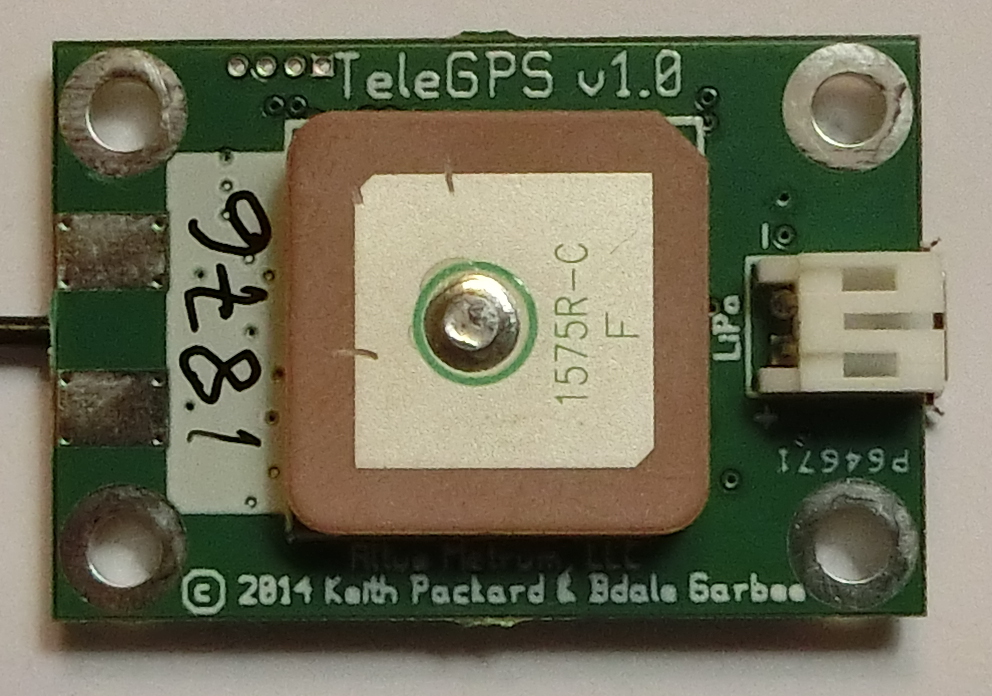
AltOS 1.4 TeleGPS support, features and bug fixes Bdale and I are pleased to announce the release of AltOS version 1.4. AltOS is the core of the software for all of the Altus Metrum products. It consists of firmware for our cc1111, STM32L151, LPC11U14 and ATtiny85 based electronics and Java-based ground station software. This is a major release of AltOS, including support for our new TeleGPS board and a host of new features and bug fixes AltOS Firmware TeleGPS added, new features and fixes Our new tracker, TeleGPS, works quite differently than a flight computer TeleGPS transmits our digital telemetry protocol, APRS and radio direction finding beacons. For TeleMega, we ve made the firing time for the additional pyro channels (A-D) configurable, in case the default (50ms) isn t long enough. AltOS Beeping Changes The three-beep startup tones have been replaced with a report of the current battery voltage. This is nice on all of the board, but particularly useful with EasyMini which doesn t have the benefit of telemetry reporting its state. We also changed the other state tones to Farnsworth spacing. This makes them all faster, and easier to distinguish from the numeric reports of voltage and altitude. Finally, we ve added the ability to change the frequency of the beeper tones. This is nice when you have two Altus Metrum flight computers in the same ebay and want to be able to tell the beeps apart. AltOS Bug Fixes Fixed a bug which prevented you from using TeleMega s extra pyro channel Flight State After configuration value. AltOS 1.3.2 on TeleMetrum v2.0 and TeleMega would reset the flight number to 2 after erasing flights; that s been fixed. AltosUI New Maps, igniter tab and a few fixes With TeleGPS tracks now potentially ranging over a much wider area than a typical rocket flight, the Maps interface has been updated to include zooming and multiple map styles. It also now uses less memory, which should make it work on a wider range of systems. For TeleMega, we ve added an Igniter tab to the flight monitor interface so you can check voltages on the extra pyro channels before pushing the button. We re hoping that the new Maps interface will load and run on machines with limited memory for Java applications; please let us know if this changes anything for you. TeleGPS All new application just for TeleGPS While TeleGPS shares the same telemetry and data logging capabilities as all of the Altus Metrum flight computers, its use as a tracker is expected to be both broader and simpler than the rocketry-specific systems. We ve build a custom TeleGPS application that incorporates the mapping and data visualization aspects of AltosUI, but eliminates all of the rocketry-specific flight state tracking.

14 June 2014

Steve Kemp: So here's a proof of concept

The simplest possible DNS-based service which I could write to explore Amazon's DNS offering has to be dynamic DNS, so I set one up.. The record skx.dhcp.io can be updated to point to your current IP by running:
curl http://dhcp.io/set/efa6961c-f3dd-11e3-955b-00163e0816a2
Or to a fixed IP:
curl http://dhcp.io/set/efa6961c-f3dd-11e3-955b-00163e0816a2/1.2.3.4
The code is modular and pretty nice, and the Amazon integration is simple. (Although I need to write code to allow users to sign-up. I'll do that if it seems useful, I suspect there are already enough free ddns providers out there - though I might be the first to support IPv6 when I commit my next chunk of work!)

13 June 2014

Steve Kemp: Amazon's Route53 API is nice.

It is unfortunate that some of the client libraries are inefficient, but I'm enjoying my exposure to Amazon's Route53 API. (This is unrelated to the previous post(s) about operating a DNS service..) For an idea of scale I host just over 170 zones at the moment. For the first 25 zones Amazon would charge $0.50 a month, then $0.10 after that. Which would mean:
25  * $0.50  +
150 * $0.10
             = $12.50
That seems reasonably .. reasonable.

11 June 2014

Daniel Pocock: Protest or Uber marketing stunt?

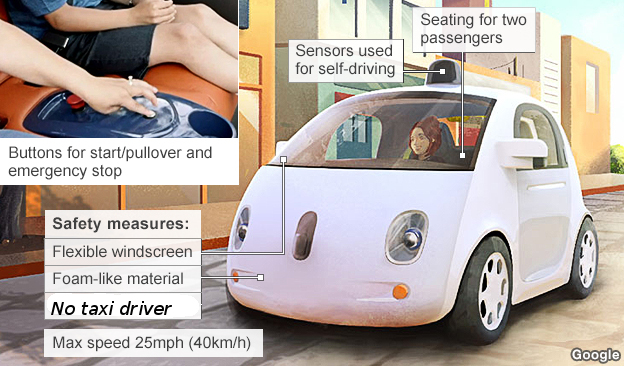
London's taxi "strike" today has been so successful that Uber claims to have had an 850% increase in new customer registrations this week. Well, that is a big success if you believe the strike may have been a guerrilla marketing tactic organised by Uber itself. No sympathy Personally, I have no sympathy for the taxi drivers. There is no city I have ever visited where I haven't encountered at least one taxi driver who tried to overcharge me. Honest drivers who give their customers value for money have less to fear from new technology than those who are unscrupulous. When I broke a leg a few years ago and was getting about on crutches for 6 weeks we decided to go out for dinner one night. This was the first time I went anywhere after having a long stint in hospital followed by a period of time I was confined to the house. The taxi driver deliberately skipped two turns leading directly to the restaurant, went another 1km past it and then followed a small street that winds back and forth and eventually demanded I pay him double what the fare should have been. This is exactly the type of abusive and despicable practice that is being eradicated by Uber's live GPS mapping technology. Although not every driver behaves so shamefully, this type of abuse of the weak or vulnerable is replicated in one way or another the world over. For example, in Melbourne, Australia, wheelchair taxis that have worked out they can make more money collecting families with suitcases at the airport leave genuine wheelchair users without a ride. Will Google be targeted next week? Google has just announced a step-change in plans to build their own self driving cars. Will Google offices around the world, including London be targetted by these crude blockades too? Political protest or anti-competitive mischief? Why were taxi drivers not arrested for their protest today? Given that the roads are the place where taxis and their competitors do business, can this blockade really be considered a political protest or is it an anti-competitive practice in blatant disregard of the law? Weapons of mass destruction Before even having breakfast you could probably find 10,000 cyclists in central London willing to sign a petition declaring taxis are a weapon of mass destruction. Once again, while there are honest drivers, there is a more than trivial number of taxi drivers who are a genuine danger to the lives of cyclists, scooters, motorcycles and occasionally pedestrians. I have personally experienced one of these thugs ramming my bicycle from behind (his hard-nosed insurer eventually paid up but without admitting liability). The police who attended the incident even told me they had seen so many accidents like this they wouldn't dare cycle themselves. The web is full of examples that appear to show malicious and criminal behavior by taxi drivers, thanks to Youtube and helmet cams: Will hotels protest about AirBNB? Now the taxi drivers have had their chance to cause mayhem, will hotel operators be next? What could they do though? Will they seek out AirBNB apartments and try to obstruct them somehow? Making mischief outside somebody's home is not a good way to make a point. Chances are, they would be prosecuted or served with restraining orders. So why do the taxi drivers get to jam up whole cities and get away with it? The Uber taxi meter loophole Will the courts decide that the Uber app is a taxi meter? This is actually a tough question. Even if courts rule against apps that perform live metering, Uber could simply remove all metering functions from the app itself and perform the metering calculations in the cloud. The app would just send start and finish locations to the cloud and the cloud would send a message back to the phone confirming the charge. The phone is then nothing more than a communication and positioning device. Remember the elevator man? When the automobile was first invented, laws were made requiring every car to be accompanied through public streets by a man carrying a flag. That job, like many others, no longer exists. elevator attendant In the good old days, every elevator had a man or woman who would sit on a stool and press buttons to operate the doors and motors. Some up-market department stores and hotels still have an elevator man to add a touch of nostalgia. The vast majority, however, have eliminated these jobs thanks to automatic elevators. Now, even aircraft can land automatically on a ship at sea. Look at all those people manning the deck in the video and contemplate how many of them might potentially be out of a job too in 50 years time as Terminator-style automated battleships patrol the seas. Technology, like the Terminator, is not going to stop.

Jonathan Carter: I m going to Debconf 14!

going-to-debconf14-sm Everything is set! The Debconf committee approved my accommodation sponsorship, my leave is confirmed and my airline tickets are booked, I m going to Debconf 14! It s going to be a 30 hour trip from Cape Town to Portland (I could shave off around 6 hours if I pay 120% more, doesn t seem worth it) and I ll be there for the full 9 days from 23 August to 31 August. I last attended Debconf 12 in Managua, Nicaragua and it was fun, educational and productive. I m really excited to see the Debian folk in person again and it will also be my first time in Portland. See you there!

10 June 2014

Steve Kemp: I did get a job

In my previous blog-post I mentioned, briefly, that I'd posted a couple of adverts on Reddit looking for work. To give more detail I did three things: The advertisement was set to be shown in /r/edinburgh (where I live), and /r/sysadmin (where I thought some people might look if they were struggling for help). The advertising on Reddit was painless to setup, and the traffic stats were interesting, but even though this worked out well I'm a little loathe to repeat the process - since the "non-sterling transaction fee" from my bank effectively doubled my budget. I received a few (private) emails and comments, along with the expected grammar corrections. The end result was that I received contact from an American company founder who seemed interested. He allowed me to write some code to solve a fun problem, appeared to enjoy the code I sent (Ruby code for dealing with (exim) email spam, that's as specific as I will be). The end result was a three month contract, which we obviously hope will lead to more permanent work. Anyway I thought this was an atypical route to find a work, and was about a million times nicer than working with recruiters, so .. consider this documentation! In other news it is now 10pm and I need to go to the gym and pub, in that order.

Steve Kemp: I'm still not a developer, but ..

Some coding updates: My templer static site generator has now been uploaded to CPAN, and is available as App::Templer. I've converted most of my Dockerfiles to work with docker 1.0.0, which is nice. I also hacked up a fun DNS-server for sharing JSON-encoded data, within a LAN or other environment: Finally I updated the blogspam-detecting site a little, on the back-end. The code is now running inside Docker containers which means I can redeploy more easily in the future. My blog post about looking for a job received some attention via a Reddit advert I posted to /r/edinburgh + /r/sysadmin, but thus far has mostly resulted in people wanting me to write code for them .. which is frustrating. For the moment I'm working on a fun challenge involving (email) spam-detection. That takes me back.

Gunnar Wolf: Tor: I'm shutting down my relay only after four days

Some days ago, I bit the bullet and accepted the Tor Challenge. Sadly, after only four days of having a Tor relay node happily sitting at home (and, of course, giving a nice function to this little friend). The inconveniences were too many. I understand anonimity can be used for many nefarious things, but I was surprised and saddened to see the amount of blocking services. Most notorious to me were the Freenode IRC network, friendly home to many free software projects, and the different Wikimedia projects, which ban editting from IP addresses idenitfied as Tor relays. I'm saddened to say that, while I could perfectly survive (and even be a bit proud about supporting a project I believe in) by jumping through some hoops (i.e. by setting up a SOCKS over ssh tunnel to my office to do my Wikipedia edits while at home), after only four days, I decided to shut down my relay. And the main reason... Was something I'm not going to fight against. And it's not even from a nice, friendly free software project. One thing I am not willing to part with is the one tool that keeps my wife well in contact with her friends and family back in Argentina. Yes, I know I could set up one or many different flavors of SIP or Jabber-based VoIP for her But it's also her parents, brother, sisters, and friends who use Skype. So, Skype's banning of Tor relay nodes made me decide to shut down my relay. Sigh... And for somebody obsessed with graphing stuff, this is the graph of the short lifespan of the "Lobazal" Tor node: [update] I will do another blog post. Good news: My Tor node is alive again! Just no longer as an exit relay, as properly pointed out by many, but as a Tor bridge.

AttachmentSize
tor-challenge-1.png23.97 KB
tor1.png27.84 KB
tor2.png18.3 KB

Russell Coker: Google Hardware Support

Ironically just 5 days after writing about how I choose Android devices for a long service life [1] my wife s Nexus 5 (with 32G of RAM (sorry Flash storage) to give it a long useful life) totally died. It reported itself as being fully charged and then 15 minutes later it was off and could not be revived. No combination of pushing the power button and connecting the power cable caused the screen to light up or any sound to be emitted. Google has a nice interactive support site for nexus devices that describes more ways of turning a phone on than any reasonable person could imagine. After trying to turn the phone on in various ways (plugged and unplugged etc) it gave me a link to get phone support. Clicking on that put me in the queue to RECEIVE a phone call and a minute later a lady who spoke English really well (which is unusual for telephone support) called me to talk me through the various options. Receiving a phone call is a much better experience than making a call. It meant that if the queue for phone support was long then I could do other things until the phone rings. It s impossible to be productive at other tasks while listening for hold music to stop and a person to start talking. The cost of doing this would be very tiny, while there would be some cost in hardware and software to have a web site that tells me how long I can expect to wait for a call a more basic implementation where I just submit my number and wait for a call would be very cheap to implement. The costs of calls from the US to Australia (and most places where people can afford a high end Android phone) are quite cheap for home users and are probably cheaper if you run a call center. If the average support call cost Google $1 and 3% of phones have support calls then that would be an extra cost of $0.03 per phone. I expect that almost everyone who buys a $450 phone would be happy to pay a lot more than $0.03 to avoid the possibility of listening to hold music! I received the phone call about a minute after requesting it, this was nice but I wonder how long I would have waited if I hadn t requested a call at 1AM Australian time (presumably during the day in a US call center). In any case getting a 1 minute response is great for any time of the day or night, lots of call centers can t do that. While the phone support is much better than most phone support, it would be nice if they added some extra options. I think it would be good to have webchat and SMS as options for support for the benefit of people who don t want to speak to strangers. This would be useful to a lot of people on the Autism Spectrum and probably others too. The phone call wasn t particularly productive, it merely confirmed that I had followed all the steps on the support website. Then I received an email telling me about the web site which was a waste of time as I d covered that in the phone call. I have just replied to their second email which asked for the IMEI of the phone to start the warranty return process. We could have saved more than 24 hours delay if this had been requested in the first email or the phone call. Google could have even requested the IMEI through the web site before starting the phone call. It would have been even easier if Google had included the device IMEI in the email they sent me to confirm the purchase as searching for old email is a lot easier than searching through my house for an old box. Another option for Google would be to just ask me for the Gmail account used for the purchase, as I only bought one Nexus 5 on that account they then have all the purchase details needed for a warranty claim. While the first call was a great experience the email support following that has been a waste of time. I m now wondering if they aim to delay the warranty process for a few days in the hope that the phone will just start working again.

9 June 2014

Daniel Pocock: reSIProcate v1.9 with WebRTC now available for Fedora 20 users

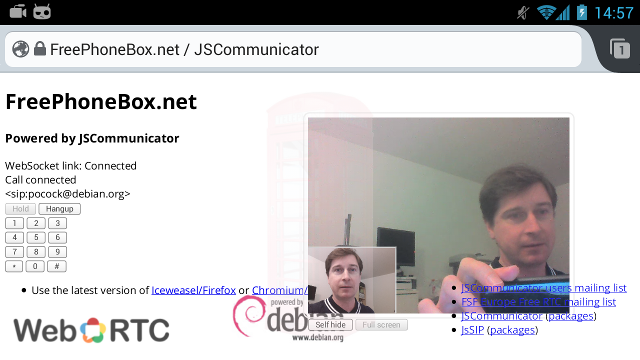
reSIProcate v1.9 has now moved from testing to stable and is available for Fedora 20 users. Version 1.9.7 has also propagated to Debian testing and wheezy-backports, delivering improved stability as discussed in my previous blog. Ready to try WebRTC? The quickest way to set up your own WebRTC trial is to install the repro (reSIProcate SIP proxy) packages for your preferred Linux distribution and then copy JSCommunicator into a directory on your web server. My earlier blog get WebRTC going faster gives specific examples of entries needed in repro.config.. WebRTC Calling from Android I've continued to have success making and receiving calls with both the Firefox and Chrome apps on Android. This is a great way to reach out to friends and family using free software for communication. More details and some screenshots are available in my earlier blog on Android WebRTC.

8 June 2014

Bits from Debian: DebConf14 - Call for talks, BoFs and events

The Debian project is excited to announce that we are now accepting presentations, discussion sessions and tutorials for our DebConf14 conference which will take place in Portland State University, Oregon, USA from 23 to 31 August. Submitting an event To submit an event, first register as an attendee for DebConf14 in the conference management system. If you have any doubts or have problems with the registration process please check the Registration FAQ. After registering, go to the event submission page, or click on the Create an event option from the management system. Describe your submission in the web form. The most common event types are Lecture or Open Discussion (BoF). Please include a short title (to make it easy to produce a compact schedule) and an engaging description of the event. Tracks We will organize some talks into thematic tracks. If you have a proposal for a DebConf track, such as "Debian ARM", "Debian Infrastructure", or "Community Outreach" please contact talks@debconf.org. If you would like to be a track coordinator, please volunteer on the given mail address. Format of the events A regular session will be 45 minutes long, including time for questions. There will be a 15 minute breaks between events. Submissions are not limited to traditional talks: you could propose a performance, art installation, debate, or anything else. If you have any specific requirements for your event, please send an email to talks@debconf.org with the details of your requirements and be sure to mention your event title in the subject. Deadline While we ask speakers to submit their events before the deadline of 7 July 2014, 23:59:59 UTC, late submissions will continue to be accepted for scheduling until the end of DebConf. All attendees will have an opportunity to schedule ad-hoc events during DebConf itself if we have space for them. Very promising late submissions may be considered for inclusion in the main conference. Note that ad-hoc events have a much lower chance of video archiving, and streaming, so if you want these services it's better to get your submissions in early. DebConf official events will be broadcast live on the Internet when possible, and videos of the talks will be published on the web along with the presentation slides and papers. For private communication regarding your talk, or for more general ideas, or questions about the event and talks, please mail us We hope to you see you and share some good times with you this year in Portland during DebConf14!

Joachim Breitner: ZuriHac 2014

I m writing this on the train back from the ZuriHac Haskell Hackathon in Z rich, generously sponsored by Better and Google. My goal for this event was to attract new people to work on GHC, the Haskell compiler, so I announced a GHC bugsquashing project . I collected a few seemingly simple ticket that have a good effort/reward ratio for beginners and encouraged those who showed up to pick one to work on. Roughly six people started, and four actually worked on GHC on all three days. The biggest hurdle for them was to get GHC built for the first time, especially those using a Mac or Windows. They also had to learn to avoid recompilation of the whole compiler, which takes an annoying amount of time (~30 minutes for most people). But once such hurdles weren taken all of them managed to find their way around the source code to the place they need to touch and were able to produce a patch, some of which are already merged into GHC master. When I wasn t giving tips and hints I was working on various small tickets myself, but nothing of great impact. I very much hope that this event will pay off and one or two of the newcomers end up being regular contributors to GHC.

We took breaks from our respective projects to listen to interesting talks by Edward Kmett and Simon Marlow, and on Saturday evening we all went to the shores of the Zurisee and had a nice Barbecue. It was a good opportunity to get into contact with more of the attendees (the hacking itself was separated in multiple smaller office rooms) and I was happy to hear about people having read my recent Call Arity paper, and even found it valuable.

Thanks to the organizers and sponsors for this nice opportunity!

7 June 2014

Craig Small: A python utf gotcha

This one had me stumped for a while:
# -*- coding: utf-7 -*-
import datetime
from sqlalchemy import ForeignKey, Column
from sqlalchemy.types import Integer, Unicode, Boolean, DateTime
 
default_due_date = datetime.datetime.now() + datetime.timedelta(days=30)
Syntax error found on last line. Hmm, bring up a python interpreter and type the last line in with the imports. Works fine. It s the first line that is the problem, I typoed it and made it utf-7 not utf-8. I suppose it means that it is case-insenstive. Still, it wasn t too clear to me at least, what was going on.

6 June 2014

Stefano Zacchiroli: debsources paper at ESEM2014

Debsources: Live and Historical Views on Macro-Level Software Evolution The paper entitled Debsources: Live and Historical Views on Macro-Level Software Evolution, which I've co-authored with Matthieu Caneill, has been accepted at ESEM 2014: the 8th international symposium on Emprical Software Engineering and Measurement. In the paper we have described Debsources as a software platform for monitoring the evolution of Free Software through the lenses of Debian, and used the main Debsources instance (http://sources.debian.net) to replicate and extend a former study on macro-level software evolution. Now we "just" have to integrate all the nice charts and data we have extracted for the paper into Debsources' stats page... /o\

5 June 2014

Johannes Schauer: botch updates

My last update about ongoing development of botch, the bootstrap/build ordering tool chain, was four months ago and about several incremental updates. This post will be of similar nature. The most interesting news is probably the additional data that bootstrap.debian.net now provides. This is listed in the next section. All subsequent sections then list the changes under the hood that made the additions to bootstrap.debian.net possible.

bootstrap.debian.net The bootstrap.debian.net service used to have botch as a git submodule but now runs botch from its Debian package. This at least proves that the botch Debian package is mature enough to do useful stuff with it. In addition to the bootstrapping results by architecture, bootstrap.debian.net now also hosts the following additional services: Further improvements concern how dependency cycles are now presented in the html overviews. While before, vertices in a cycle where separated by commas as if they were simple package lists, vertices are now connected by unicode arrows. Dashed arrows indicate build dependencies while solid arrows indicate builds-from relationships. For what it's worth, installation set vertices now contain their installation set in their title attribute.

Debian package Botch has long depended on features of an unreleased version of dose3 which in turn depended on an unrelease version of libcudf. Both projects have recently made new releases so that I was now able to drop the dose3 git submodule and rely on the host system's dose3 version instead. This also made it possible to create a Debian package of botch which currently sits at Debian mentors. Writing the package also finally made me create a usable install target in the Makefile as well as adding stubs for the manpages of the 44 applications that botch currently ships. The actual content of these manpages still has to be written. The only documentation botch currently ships in the botch-doc package is an offline version of the wiki on gitorious. The new page ExamplesGraphs even includes pictures.

Cross By default, botch analyzes the native bootstrapping phase. That is, assume that the initial set of Essential:yes and build-essential packages magically exists and find out how to bootstrap the rest from there through native compilation. But part of the bootstrapping problem is also to create the set of Essential:yes and build-essential packages from nothing via cross compilation. Botch is unable to analyze the cross phase because too many packages cannot satisfy their crossbuild dependencies due to multiarch conflicts. This problem is only about the dependency metadata and not about whether a given source package actually crosscompiles fine in practice. Helmut Grohne has done great work with rebootstrap which is regularly run by jenkins.debian.net. He convinced me that we need an overview of what packages are blocking the analysis of the cross case and that it was useful to have a crossbuild order even if that was a fake order just to have a rough overview of the current situation in Debian Sid. I wrote a couple of scripts which would run dose-builddebcheck on a repository, analyze which packages fail to satisfy their crossbuild dependencies and why, fix those cases by adjusting package metadata accordingly and repeat until all relevant source packages satisfy their crossbuild dependencies. The result of this can then be used to identify the packages that need to be modified as well as to generate a crossbuild order. The fixes to the metadata are done in an automatic fashion and do not necessarily reflect the real fix that would solve the problem. Nevertheless, I ended up agreeing that it is better to have a slightly wrong overview than no overview at all.

Minimizing the dependency graph size Installation sets in the dependency graph are calculated independent from each other. If two binary packages provide A, then dependencies on A in different installation sets might choose different binary packages as providers of A. The same holds for disjunctive dependencies. If a package depends on A C and another package depends on C A then there is no coordination to choose C so to minimize the overall amount of vertices in the graph. I implemented two methods to minimize the impact of cases where the dependency solver has multiple options to satisfy a dependency through Provides and dependency disjunctions. The first method is inspired by Helmut Grohne. An algorithm goes through all disjunctive binary dependencies and removes all virtual packages, leaving only real packages. Of the remaining real packages, the first one is selected. For build dependencies, the algorithm drops all but the first package in every disjunction. This is also what sbuild does. Unfortunately this solution produces an unsatisfiable dependency situation in most cases. This is because oftentimes it is necessary to select the virtual disjunctive dependency because of a conflict relationship introduced by another package. The second method involves aspcud, a cudf solver which can optimize a solution by a criteria. This solution is based on an idea by Pietro Abate who implemented the basis for this idea back in 2012. In contrast to a usual cudf problem, binary packages now also depend on the source packages they build from. If we now ask aspcud to find an installation set for one of the base source packages (I chose src:build-essential) then it will return an installation set that includes source packages. As an optimization criteria the number of source packages in the installation set is minimized. This solution would be flawless if there were no conflicts between binary packages. Due to conflicts not all binary packages that must be coinstallable for this strategy to work can be coinstalled. The quick and dirty solution is to remove all conflicts before passing the cudf universe to aspcud. But this also means that the solution does sometimes not work in practice.

Test cases Botch now finally has a test target in its Makefile. The test target tests two code paths of the native.sh script and the cross.sh script. Running these two scripts covers testing most parts of botch. Given that I did lots of refactoring in the past weeks, the test cases greatly helped to assure that I didnt break anything in the process. I also added autopkgtests to the Debian packaging which test the same things as the test target but naturally run the installed version of botch instead. The autopkgtests were a great help in weeding out some lasts bugs which made botch depend on being executed from its source directory.

Python 3 Reading the suggestions in the Debian python policy I evaluated the possibility to use Python 3 for the Python scripts in botch. While I was at it I added transparent decompression for gzip, bz2 and xz based on the file magic, replaced python-apt with python-debian because of bug#748922 and added argparse argument parsing to all scripts. Unfortunately I had to find out that Python 3 support does not yet seem to be possible for botch for the following reasons:
  • no soap module for Python 3 in Debian (needed for bts access)
  • hash randomization is turned on by default in Python 3 and therefore the graph output of networkx is not deterministic anymore (bug#749710)
Thus I settled for changing the code such that it would be compatible with Python 2 as well as with Python 3. Because of the changed string handling and sys.stdout properties in Python 3 this proved to be tricky. On the other hand this showed me bugs in my code where I was wrongly relying on deterministic dictionary key traversal.

Dirk Eddelbuettel: RcppArmadillo 0.4.300.8.0

A new minor / bug fix release 4.300.8 of Armadillo, the templated C++ library for linear algebra, was tagged by Conrad in his SVN repo a few days ago, following earlier snapshots in the 4.300.* series. We had prepared two earlier releases for GitHub but not CRAN in order to accomodate the CRAN maintainer's desire of "a release every one to two months" expressed in the CRAN Repo Policy. However, two actual bugs in the interaction between MinGW and C++11 were reported on the rcpp-devel mailing list, and this releases addresses these. Hence time for new release 0.4.300.8.0 of RcppArmadillo which is now on CRAN and in Debian. This release brings a few upstream changes detailed below such as nice new upstream changes such as more robust norm() (and related) functions, and fixes related to matrix and cube interactions. From our end, we added a better detection of Windows via both _WIN32 and WIN32 (as the former apparently gets undefined by MinGW in C++11 mode). We also added the ability to turn on C++11 support from R (possible since R 3.1.0) yet also turn it off for Armadillo. This is needed as the prescribed compiler on Windows is g++ 4.6.2 -- which offers a subset of C++11 which is good enough for a number of things from the C++11 standard, but not advanced enough for everything which Armadillo uses when C++11 support is turned on. As Armadillo continues to offer a choice of C++ standards, we can use the ability to deploy C++11 only outside of its internals. It is worth repeating that this issue should only affect Windows users wishing to use C++11; other platforms are fine as they generally have more modern compilers.
Changes in RcppArmadillo version 0.4.300.8.0 (2014-05-31)
  • Upgraded to Armadillo release Version 4.300.8 (Medieval Cornea Scraper)
    • More robust norm-related functions
    • Fixes between interactions between cube and vector types.
  • Adds a #define ARMA_DONT_USE_CXX11 to provide an option to turn C++11 off for Armadillo (but client packages may still use it)
  • More robust Windows detection by using _WIN32 as well as WIN32 as the latter gets diabled by MinGW with C++11
  • On Windows, C++11 can be turned off as the Armadillo code base uses more features of C++11 than g++ 4.6.2 version in Rtools implements
Changes in RcppArmadillo version 0.4.300.5.0 (2014-05-19)
  • Upgraded to Armadillo release Version 4.300.5 (Medieval Cornea Scraper)
    • Handle possible underflows and overflows in norm(), normalise(), norm_dot()
    • Fix for handling of null vectors by norm_dot()
Changes in RcppArmadillo version 0.4.300.2.0 (2014-05-13)
  • Upgraded to Armadillo release Version 4.300.2 (Medieval Cornea Scraper)
    • faster find()
Courtesy of CRANberries, there is also a diffstat report for the most recent release As always, more detailed information is on the RcppArmadillo page. Questions, comments etc should go to the rcpp-devel mailing list off the R-Forge page.

This post by Dirk Eddelbuettel originated on his Thinking inside the box blog. Please report excessive re-aggregation in third-party for-profit settings.

4 June 2014

Daniel Pocock: Trialing the xTuple/PostBooks next generation web UI

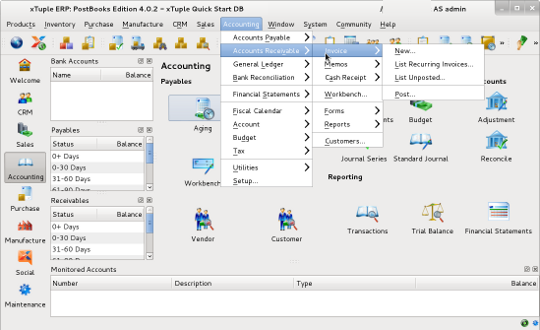
For some time I've been using PostBooks to keep track of finances. The traditional PostBooks system has a powerful Qt GUI. The xTuple team have been hard at work creating a shiny new web-based user interface. The traditional UI has no dedicated server - all users communicate directly with the PostgreSQL database where stored procedures and triggers ensure the correct logic is applied. The new model provides an xTuple application server that can handle requests from web users and potentially other third-party apps too. Who is it for? Some people may feel that the web UI is intended to appeal to mobile users. While it is useful for mobile and tablet devices, this is not strictly the aim, John has discussed this in a blog. One benefit of the web UI is that accountants and book-keepers do not need to have a copy of every exact PostBooks version that every client is using. Given that many people only need their accountant to look at their books for just a few hours at the end of each year, the ease of access with a web UI will make a big difference. Installing it quickly The xTuple Git repository provides a script to install the whole server quickly. Initially it just supported a single Ubuntu release, I just contributed some tweaks to generalize it for Debian wheezy and potentially other releases. It doesn't appear too difficult to generalize it further for Fedora or RHEL users. To get going, I recommend trying it in a fresh virtual machine, either in a server environment or desktop VirtualBox solution. The installation script will install various packages on the machine and mess about with the PostgreSQL setup so you will not want to run the automated setup script on any machine where you have existing databases. Once the virtual machine is setup, make sure sudo is installed and configured:
# apt-get install sudo
# visudo
and then run the install as your normal user:
git clone --recursive git://github.com/xtuple/xtuple.git
cd xtuple
git remote add XTUPLE git://github.com/xtuple/xtuple.git
git fetch XTUPLE
git checkout git describe --abbrev=0
chmod a+x scripts/install_xtuple.sh
scripts/install_xtuple.sh
If all goes well, 5-10 minutes later it is ready to run:
cd node-datasource
node main.js
The port numbers will appear on the screen and you can connect with a web browser. Trying it out Despite my comments above to the effect that this is not primarily aimed at mobile, the first and second device I tested with were both mobile devices, Samsung Galaxy S3 and a Samsung Galaxy Note 3. I feel the Note is far better for this type of application, primarily due to screen size and the fact that most of the forms in the application have fields that launch popup menus. It appears to work in both Chrome and Firefox on these devices. One handy feature is that the mobile device can dial numbers directly from the CRM address book, this is facilitated with the tel URI. My impression is that this is still a product that is in the final stages of development, although some people will be able to use it almost immediately. One significant thing to note is that the database schema is very stable due to the long history of the traditional xTuple/PostBooks products.

Next.

Previous.