Search Results: "nate"

15 May 2011

Kai Wasserb ch: LWP::Authen::OAuth in NEW

I've uploaded liblwp-authen-oauth-perl to Debian today, [UPDATE: currently the package is waiting in NEW (please note, that the previous link might not work, in case the package has entered the archive already or the page hasn't been generated yet). and is now in the archive. Thanks a lot to the FTP Masters for the quick processing!] LWP::Authen::OAuth allows to easily integrate OAuth authentication into Perl programs and libraries. Some of you might already guess, why I have an interest in OAuth for Perl: as a user (and maintainer) of Chronicle I'd find it neat, if there could be some Flattr integration (especially a automatic submission of new posts to Flattr). This sent me searching for an Perl implementation of the Flattr API. Unfortunately this turned up nothing, therefore I'm now planning to write some sort of Net::Flattr Perl module, which I can then use in Chronicle for one task or another. Net::Flattr (preliminary name, but probably the final one, as the implementation of the Twitter API is called Net::Twitter) is going to be a library, which should offer the same functionality as Flattr's PHP library. For now there are some scetches to this extent on my hard drive, but nothing showable. I hope I find the time soon to write this but it shouldn't be too difficult. ;-) Apart from my particular use case, you can use LWP::Authen::OAuth for any other OAuth-requiring API. I hope the package helps you to build more cool tools for and on your Debian system!

John Goerzen: Napoleon, Winter in May, and Silly String

This is just a diary of a random day sort of post. Nothing all that particularly unusual, but then perhaps if I only blog about the unusual, the typical gets lost. This week started out with temperatures as high at 99F. Today we didn t even reach 60, and tonight will be cold almost to freezing. It s Kansas, so while we remark on the strange weather, we re not particularly surprised by it. This morning, Jacob and Oliver went over to play across the street. Jacob then went with Terah to a birthday party for one of his classmates, while Oliver helped plant some trees with his grandparents. I was at home this morning, which gave me a small but welcome break from the past week: we had something going on 6 out of the last 7 evenings, and little time to do anything else. So I got out the Kindle and read from War and Peace. I started at the kitchen table while eating some granola, and then sat on the couch. The day was cold, windy, and overcast, and I like to use natural light, so there were only a few places to sit with enough light. I sat there reading the account of Napoleon s capture of Moscow in 1812, the characters lives uprooted by those events, and stories of violent mobs forming. And, of course, Tolstoy s essays on the mistake of overstating the importance of famous figures in history were common. I am now about 3/4 through War and Peace, which means I ve read 1,044 pages and have (only) 348 to go. As I got up to try to find slippers or a blanket for my cold feet at one point, I remembered a conversation I had while eating lunch this week. I was reading on the Kindle while reading, and a person I knew happened to walk past. She asked what I was reading. I said simply, War and Peace. There was this stunned silence, so I added, for fun. It s great! Which is true. She said, Oooookay, John, you just enjoy that then and went on her way. This isn t the first time I ve had a conversation like that about this book. It seems to be held up as some example of long, dry, literature that people are made to read but don t want to. I think that only long is accurate here. Anyhow, pretty soon Oliver arrived and, much to my surprise, said Doh! (meaning no ) when I asked him if he was ready for lunch. Instead he stood there looking at me sweetly. Taking a guess, I said, Oliver, would you like to watch train videos? Yeah yeah yeah yeah! So we did. He particularly enjoyed the steam engines today, and eventually was ready for lunch at 12:30. Jacob and Terah got home just as he was finishing. Oliver got his nap, and I played with Jacob for a bit. Ever since he had heard of the British wedding in preschool, he s been interested in weddings, so I showed him pictures from Terah and me at our wedding. This was a big hit. Then he went with Terah to decorate a Sunday School room at church, so I read a bit more Tolstoy. Tolstoy s characters sometimes are prone to not just changes in mood but changes in outlook and worldview changing from cold, logical, and uncaring to warm and loving, or from despair at the vanity and shallowness of humanity to elation at the simple honesty of a peasant and renewed trust in the human spirit. At first I marveled at this tendency in certain characters, but on reflection, and in consideration of the timeline of the novel, which spans several years, it didn t seem quite so strange. Things can happen to change the mood of individuals, or even a country; I can remember the national mood changing after 9/11, and again after Obama s election, for instance. I also felt a contrast with some of the characters who, due to their decisions or circumstances, lost things that mattered while chasing things that weren t as important. I felt fortunate to be at this place, with Jacob, Oliver, and Terah, and decided that we all ought to do something fun in the evening, but hadn t quite figured out what. And about that, the clouds started to break and Oliver woke up from his nap. I went up to his room, and much to his delight, played peekaboo with him for quite awhile. Eventually he was done with that game, but spotted my phone, so I helped guide his finger to launch Youtube and watch a train video over the wifi. This was certainly a Big Deal to him. After Terah and Jacob got back, I figured it was time figure out something fun to do. And what could be more fun, I decided on the spur of the moment, than a drive into town to pick up some cans of Silly String for the boys, neither of which had ever used it before. So we went to a restaurant, then bought the surprise toy (I hadn t told them what it would be beforehand), then went to an ice cream place, and finally back home. Oliver loved it. He needed my help to press the nozzle to make it come out, but still had a great time and shrieked with delight. Jacob then tried out his can, and stood in one place spraying his bright green strings all over the place. Then he took to running around the yard spraying string randomly in every direction until he finally completely emptied out the can. And after that, he gathered up some of the different colors of string and rolled them up into a ball which he was very proud of. A nice day.

14 May 2011

Vincent Bernat: FVWM configuration

There is actually some buzz around Gnome 3 and the new release of Ubuntu switching to Unity. I thought this was a good occasion to make this small post to tell that I still uses FVWM whose latest version was released a month ago. FVWM is a very old window manager. So old that nobody really knows what the F stands for. It comes with a ugly configuration by default and can be configured to look even uglier. However, FVWM is powerful and highly configurable. Moreover, it is pretty lightweight.

My FVWM configuration My configuration of FVWM is available on GitHub. It requires the use of fvwm-crystal. If you are running Debian or Ubuntu, there is a package for this. This is a set of powerful configuration files for FVWM which add a lot of goodies and themes. Unfortunately, the project site seems to have disappared. You can still grab the sources from your nearest Debian mirror. While those configuration files were great, I did not like to have such a complex desktop with all those icons and menus. However, what is great with fvwm-crystal is you can overlay your own configuration. If a file is present in your home directory, it will take precedence over the one installed on the system. So, I just wrote a new recipe. What you may want to steal from my configuration is the ability to alter the configuration depending on the fact that you are using one or two screens. With one screen, you get:
  • an application panel (a launcher bar) on the upper left corner,
  • an icon manager (which will contained iconified windows) on the upper right corner,
  • a systray on the left of the icon manager
  • a pager (which shows various desktops) just below it,
  • two icon managers (which act as a taskbar) on the bottom, one for regular applications and the other one for terminal windows.
One screen setup of FVWM With two screens, the organization is different. The two icon managers at the bottom are on their own screens. The pager is between the two screens and the other elements are on the upper left of the right screen. Dual screen setup of FVWM If I am using a single screen and I plug another one, I do something like this to get my setup updated:
1
2
$ xrandr --output  VGA-1 --auto --output DVI-I-1 --auto --right-of VGA-1
$ killall trayer ; FvwmCommand Restart
I also uses conky, a light-weight system monitor. It is started in my .xsession, not through FVWM.

Building wallpapers for dual-screen One difficulty with a multi-head setup is how to get the background set properly? . I have made a small script for generating one. Use it like this:
1
$ ./build-wallpaper.py -d ~/.fvwm/wallpapers -c -t ~/tmp/mywallpaper.png
It will randomly select two wallpapers and put them together to look nice on your dual-screen setup. It will also correct the aspect ratio, either by cropping the image or centering the image. You need the following dependencies to make script work: python-xpyb and python-imaging. UPDATE: Thomas Adam pointed to Nitrogen, a graphical wallpaper utility supporting multi-head setups. It is a great tool if you want to set manually your wallpaper but it does not allow to select a random one. Nowadays, I grab most of my wallpapers from InterfaceLIFT.

13 May 2011

Christoph Egger: Thouhts on secure software archives

From the java point of view Recently I had to get some Scala Tool working correctly. Unfortunately there are basically no packages in the Debian Archive at all so I had to use maven to install these (or download + install manually). Being a highly paranoid person downloading and executing code from the internet without any cryptographic verification at all one after the other practically drove me nuts. Looking a bit deeper I noticed that some of the software in maven's repository have some signatures next to them -- signed by the author or release manager of this specific project. Why secure sources matters With my experience in mind I got some Input from other people. One of the things I was told is that some scala tools just aren't security critical -- they're only installed and used as the current user. In my opinion this is, for my desktop system, totally wrong. The important things on my private Computers are my GPG and SSH keys as well as my private data. For messing with these no super user access is needed at all. Comparing to the Common Lisp situation Being a Common Lisp fan of course I noticed basically the same problem for installing Common Lisp libraries. Here the situation in Debian is quite a bit better -- and I'm working in the pkg-common-lisp Team to improve this even more. Common Lisp has some maven-alike tool for downloading and installing dependency trees called quicklisp -- without any cryptographic verification as well. However there's light at the end of this tunnel: There are plans to add GPG verification of the package lists really soon. Comparing the maven and the quicklisp model So there are basically two different approaches to be seen here. In maven the software author confirms with his signature the integrity of his software while in quicklisp the distributor confirms all users get the same software that he downloaded. Now the quicklisp author can't and won't check all the software that is downloadable using quicklisp. This won't be doable anyway as there's way to much software or a single person to check. Now in some kind of perfect World the maven way would be vastly superior as there's a End-To-End verification and verification of the full way the software takes. However there's a big problem: I don't know any of these Authors personally and there's no reason I should just trust any of them. Now comparing this to the Distribution / quicklisp model. Here I would just have to trust one person or group -- here the quicklisp team -- to benefit from the crypto which might be possible based on karma inside the using community. However here I don't gain the possibility that the software is integer. However idealized if some of these pieces of software was forged between upstream and the quicklisp team and attacker would also intercept me downloading the software from the same address so I get the source from upstream matching the checksum from quicklisp -- assuming the quicklisp team does indeed know the correct website. Additionally I get the confirmation that all other quicklisp users get the same source (if the quicklisp guys are fine of course) so no-one inside the community complaining is a good indication the software is fine. For this to work there's of course a relevant user-base of the distributor (quicklisp) necessary. Relevance for Debian So how do conventional Linux Distributions like Debian fit in here. Ideally we would have maintainers understanding and checking the software and confirming the integrity using their private key or at least know their upstreams and having at least a secured way getting the software from upstream and a trust relationship with them. Of course that's just illusionary thinking of complex and important software (think libreoffice, gcc or firefox for example). Maintainers won't fully understand a lot simpler pieces of software. And loads of upstream projects don't provide a verified way of getting the correct source code though that's a bit better on the real high-impact projects where checksums signed by the Release Manager are more common than in small projects. A misguided thought at the end As I'm a heavy emacs user I like to have snapshots from current emacs development available. Fortunately binary packages with this are available from a Debian guy I tend to trust who is also involved upstream so adding the key from his repository to the keyring apt trusts. Now my first thoughts were along the lines "It would be really nice if I could pin that key to only the emacs snapshot packages" so this guy can't just put libc packages in his repository and my apt would trust them. Now thinking of it again a bogus upload of the emacs snapshot package could just as well put some binary or library on the system at some place in front of the real on in the system path which would be rather similar bad. b

Mike Hommey: Debian Squeeze + btrfs = FAIL

Executive summary: Don t use btrfs on Debian Squeeze.
Longer summary: Don t use btrfs RAID with the kernel Debian Squeeze comes with. About six months ago, I set up a new server to handle this web site, mail, and various other things. The system and most services (including web and mail) was set to use an MD RAID 1 array across two small partitions on two separate disks, and the remaining space was setup in three different btrfs file systems: Three days ago, this happened:
May 10 10:18:04 goemon kernel: [3545898.548311] ata4: hard resetting link
May 10 10:18:04 goemon kernel: [3545898.867556] ata4: SATA link up 1.5 Gbps (SStatus 113 SControl 310)
May 10 10:18:04 goemon kernel: [3545898.874973] ata4.00: configured for UDMA/33
followed by other ATA related messages, then, garbage such as:
May 10 10:18:07 goemon kernel: [3545901.28123] sd3000 d]SneKy:AotdCmad[urn][ecitr
May 10 10:18:07 goemon kernel: 4[550.821 ecio es aawt es ecitr i e)
May 10 10:18:07 goemon kernel: 6[550.824     20 00 00 00 00 00 00 00 <>3491225     16 44 <>3491216]s ::::[d]Ad es:N diinlsneifrain<>3491216]s ::::[d]C:Ra(0:2 00 03 80 06 0
3491217]edrqet / ro,dvsb etr2272
May 10 10:18:07 goemon kernel: 3[550.837 ad:sb:rshdln etr2252
May 10 10:18:07 goemon kernel: 6[551214]s ::::[d]Rsl:hsbt=I_Kdiebt=RVRSNE<>3491215]s ::::[d]SneKy:AotdCmad[urn][ecitr
May 10 10:18:07 goemon kernel: 4[550.833 ecitrsnedt ihsnedsrpos(nhx:<>3491216]    7 b0 00 00 c0 a8 00 00 0
Then later on:
May 10 12:01:18 goemon kernel: [3552089.226147] lost page write due to I/O error on sdb4
May 10 12:01:18 goemon kernel: [3552089.226312] lost page write due to I/O error on sdb4
May 10 12:10:14 goemon kernel: [3552624.625669] btrfs no csum found for inode 23642 start 0
May 10 12:10:14 goemon kernel: [3552624.625783] btrfs no csum found for inode 23642 start 4096
May 10 12:10:14 goemon kernel: [3552624.625884] btrfs no csum found for inode 23642 start 8192
etc. and more garbage. At that point, I wanted to shutdown the server, check the hardware, and reboot. Shutdown didn t want to proceed completely. Btrfs just froze on the sync happening during the shutdown phase, so I had to power off violently. Nothing seemed really problematic on the hardware end, and after a reboot, both disks were properly working. The MD RAID would resynchronize, and the btrfs filesystems would be automatically mounted. It would work for a while, until such things could be seen in the logs, with more garbage as above in between:
May 10 14:41:18 goemon kernel: [ 1253.455545] __ratelimit: 35363 callbacks suppressed
May 10 14:45:04 goemon kernel: [ 1478.717749] parent transid verify failed on 358190825472 wanted 42547 found 42525
May 10 14:45:04 goemon kernel: [ 1478.717936] parent transid verify failed on 358316642304 wanted 42547 found 42515
May 10 14:45:04 goemon kernel: [ 1478.717939] parent transid verify failed on 358190825472 wanted 42547 found 42525
May 10 14:45:04 goemon kernel: [ 1478.718128] parent transid verify failed on 358316642304 wanted 42547 found 42515
May 10 14:45:04 goemon kernel: [ 1478.718131] parent transid verify failed on 358190825472 wanted 42547 found 42525
Then there would be kernel btrfs processes going on and on sucking CPU and I/O, doing whatever it was doing. At such moment, most file reading off one of the btrfs volumes would either take very long or freeze, and un-mounting would only freeze. At that point, considering the advantages of btrfs (in my case, mostly, snapshots) were outweighed by such issues (this wasn t my first btrfs fuck up, but by large, the most dreadful) and the fact that btrfs is just so slow compared to other filesystems, I decided I didn t want to care trying to save these filesystems from their agonizing death, and that I d just go with ext4 on MD RAID instead. Also, I didn t want to just try (with the possibility of going through similar pain) again with a more recent kernel. Fortunately, I had backups of most of the data (only problem being the time required to restore that amount of data), but for the few remaining things which, by force of bad timing, I didn t have a backup of, I needed to somehow get them back from these btrfs volumes. So I created new file systems to replace the btrfs volumes I could directly throw away and started recovering data from backups. I also, at the same time, tried to copy a big disk image from the remaining btrfs volume. Somehow, this worked, with the system load varying between 20 and 60 (with a lot of garbage in the logs and other services deeply impacted as well) But when trying to copy the remaining files I wanted to recover, things got worse, so I had to initiate a shutdown, and power cycle again. Since apparently the kernel wasn t going to be very helpful, the next step was to just get other things working, and get the data back some other way. What I did was to use a virtual machine to get the data off the remaining btrfs volume. The kernel could become unusable all it wanted to, I could just hard reboot without impacting the other services. In the virtual machine, things got interesting . I did try various things I ve seen on the linux-btrfs list, but nothing really did anything at all except spew some more parent transid messages. I should mention that the remaining btrfs volume was a RAID 0. To mount those, you d mount one of the constituting disks like this:
$ mount /dev/sdb /mnt
Except that it would complain that it can t find a valid whatever (I don t remember the exact term, and I threw the VM away already) so it wouldn t mount the volume. But when mounting the other constituting disk, it would just work. Well, that s kind of understandable, but what is not is that on the next boot (I had to reboot a lot, see below), it would error out on the disk that worked previously, and work on the disk that was failing before. So, here is how things went: Ain t that fun? The good thing is that in the end, despite the pain, I recovered all that needed to be recovered. I m in the process of recreating my build chroots from scratch, but that s not exactly difficult. It would just have taken a lot more time to recover them the same way, 50 files at a time. Side note: yes, I did try newer versions of btrfsck ; yes I did try newer kernels. No, nothing worked to make these btrfs volumes viable. No, I don t have an image of these completely fucked up volumes.

11 May 2011

Martin Pitt: Packages for PostgreSQL 9.1 Beta 1 now available

Two weeks ago, PostgreSQL announced the first beta version of the new major 9.1 version, with a lot of anticipated new features like synchronous replication or better support for multilingual databases. Please see the release announcement for details. Due to my recent moving and the Ubuntu Developer Summit it took me a bit to package them for Debian and Ubuntu, but here they are at last. I uploaded postgresql-9.1 to Debian experimental; currently they are sitting in the NEW queue, but I m sure our restless Debian archive admins will get to it in a few days. I also provided builds for Ubuntu 10.04 LTS, 10.10. and 11.04 in my PostgreSQL backports for stable Ubuntu releases PPA. I provided full postgresql-common integration, i. e. you can use all the usual tools like pg_createcluster, pg_upgradecluster etc. to install 9.1 side by side with your 8.4/9.0 instances, attempt an upgrade of your existing instances to 9.1 without endangering the running clusters, etc. Fortunately this time there were no deprecated configuration options, so pg_upgradecluster does not actually have to touch your postgresql.conf for the 9.0 9.1 upgrade. They pass upstream s and postgresql-common s integration test suite, so should be reasonably working. But please let me know about everything that doesn t, so that we can get them in perfect shape in time for the final release. I anticipate that 9.1 will be the default (and only supported) version in the next Debian release (wheezy), and will most likely be the one shipped in the next Ubuntu LTS (in 12.04). It might be that the next Ubuntu release 11.10 will still ship with 9.0, but that pretty much depends on how many extensions get ported to 9.1 by feature freeze.

10 May 2011

Daniel Kahn Gillmor: the bleeding edge: btrfs (poor performance, alas)

I'm playing with btrfs to get a feel for what's coming up in linux filesystems. To be daring, i've configured a test machine using only btrfs for its on-disk filesystems. I really like some of the ideas put forward in the btrfs design. (i'm aware that btrfs is considered experimental-only at this point). I'm happy to report that despite several weeks of regular upgrade/churn from unstable and experimental, i have yet to see any data loss or other serious forms of failure. Unfortunately, i'm not impressed with the performance. The machine feels sluggish in this configuratiyon, compared to how i remember it running with previous non-btrfs installations. So i ran some benchmarks. The results don't look good for btrfs in its present incarnation. UPDATE: see the comments section for revised statistics from a quieter system, with the filesystems over the same partition (btrfs is still much slower). The simplified test system i'm running has Linux kernel 2.6.39-rc6-686-pae (from experimental), 1GiB of RAM (no swap), and a single 2GHz P4 CPU. It has one parallel ATA hard disk (WDC WD400EB-00CPF0), with two primary partitions (one btrfs and one ext3). The root filesystem is btrfs. The ext3 filesystem is mounted at /mnt I used bonnie++ to benchmark the ext3 filesystem against the btrfs filesystem as a non-privileged user. Here are the results on the test ext3 filesystem:
consoleuser@loki:~$ cat bonnie-stats.ext3 
Reading a byte at a time...done
Reading intelligently...done
start 'em...done...done...done...done...done...
Create files in sequential order...done.
Stat files in sequential order...done.
Delete files in sequential order...done.
Create files in random order...done.
Stat files in random order...done.
Delete files in random order...done.
Version  1.96       ------Sequential Output------ --Sequential Input- --Random-
Concurrency   1     -Per Chr- --Block-- -Rewrite- -Per Chr- --Block-- --Seeks--
Machine        Size K/sec %CP K/sec %CP K/sec %CP K/sec %CP K/sec %CP  /sec %CP
loki          2264M   331  98 23464  11 10988   4  1174  85 39629   6 130.4   5
Latency             92041us    1128ms    1835ms     166ms     308ms    6549ms
Version  1.96       ------Sequential Create------ --------Random Create--------
loki                -Create-- --Read--- -Delete-- -Create-- --Read--- -Delete--
              files  /sec %CP  /sec %CP  /sec %CP  /sec %CP  /sec %CP  /sec %CP
                 16  9964  26 +++++ +++ 13035  26 11089  27 +++++ +++ 11888  24
Latency             17882us    1418us    1929us     489us      51us     650us
1.96,1.96,loki,1,1305039600,2264M,,331,98,23464,11,10988,4,1174,85,39629,6,130.4,5,16,,,,,9964,26,+++++,+++,13035,26,11089,27,+++++,+++,11888,24,92041us,1128ms,1835ms,166ms,308ms,6549ms,17882us,1418us,1929us,489us,51us,650us
consoleuser@loki:~$ 
And here are the results for btrfs (on the main filesystem):
consoleuser@loki:~$ cat bonnie-stats.btrfs 
Reading a byte at a time...done
Reading intelligently...done
start 'em...done...done...done...done...done...
Create files in sequential order...done.
Stat files in sequential order...done.
Delete files in sequential order...done.
Create files in random order...done.
Stat files in random order...done.
Delete files in random order...done.
Version  1.96       ------Sequential Output------ --Sequential Input- --Random-
Concurrency   1     -Per Chr- --Block-- -Rewrite- -Per Chr- --Block-- --Seeks--
Machine        Size K/sec %CP K/sec %CP K/sec %CP K/sec %CP K/sec %CP  /sec %CP
loki          2264M    43  99 22682  17 10356   6  1038  79 28796   6  86.8  99
Latency               293ms     727ms    1222ms   46541us     504ms   13094ms
Version  1.96       ------Sequential Create------ --------Random Create--------
loki                -Create-- --Read--- -Delete-- -Create-- --Read--- -Delete--
              files  /sec %CP  /sec %CP  /sec %CP  /sec %CP  /sec %CP  /sec %CP
                 16  1623  33 +++++ +++  2182  57  1974  27 +++++ +++  1907  44
Latency             78474us    6839us    8791us    1746us      66us   64034us
1.96,1.96,loki,1,1305040411,2264M,,43,99,22682,17,10356,6,1038,79,28796,6,86.8,99,16,,,,,1623,33,+++++,+++,2182,57,1974,27,+++++,+++,1907,44,293ms,727ms,1222ms,46541us,504ms,13094ms,78474us,6839us,8791us,1746us,66us,64034us
consoleuser@loki:~$ 
As you can see, btrfs is significantly slower in several categories: I'm hoping that i just configured the test wrong somehow, or that i've done something grossly unfair in the system setup and configuration. (or maybe i'm mis-reading the bonnie++ output?) Maybe someone can point out my mistake, or give me pointers for what to do to try to speed up btrfs. I like the sound of the features we will eventually get from btrfs, but these performance figures seem like a pretty rough tradeoff.Tags: benchmarks, bonnie, btrfs, ext3

Steve Kemp: So I put together another picture sharing site

Almost a year ago I put together a simple picture sharing site, which was designed to accept uploaded images via OpenID logins and then share them. It was created because none of the existing image sharing sites allowed OpenID logins - and because frankly I rarely trust sites I don't control. (Especially when they're free sites, with no obvious revenue stream. We can reference recent compromises if we wish to be topical, but even without them it is all about trust.) I opened up the site to allow others to use it, but assumed it would remain Steve-only - After all why would somebody choose to use my site rather than imgur, or similar? Over the year I've spotted several minor problems with the site. The built-in support for comments was never used, primarily because I didn't have any other users, and some of the tagging aspects were hard to use. Since I've started using twitter I again found myself wanting a picture-hosting site, one with "short links". I started using twitpic.com, but wasn't happy with it. So the plan was formed; build another picture sharing site. But this time with short URLS. Sadly my first choice of http://picc.ie was denied to me - I couldn't register it as I don't live in Ireland. But my second choice http://linkti.me was free. As a challenge to myself this site uses Redis for storing all user-details, all image details, and all session data. It hasn't been difficult to implemenet a multi-user site, with logins, file uploads, and tagging. I guess I cheated as a lot of the code is borrowed from the previous site, but this time it looks prettier and there have been many cleanups due to my previous experience. This time round I was more focussed upon short links, so each image is allowed an incrementing number, which is then encoded using base 36 math - which is the alphabet you get if you use [0-9A-Z]. I designed three shareable links for each image to keep it simple: Why "/r" for the thumbnail? Well because it is a random thumbnail. To cope with difference sizes, and allow the recent image display to look regular, I wanted each thumbnail to be 150x150 pixels. My thumbnail generation simply picks a random X,Y co-ordinate from the image and then cuts out a 150x150 square block starting at that offset. The results of a random segment of an uploaded image are sometimes very cool, altough equally often they are misleading. If I upload naked people there is the possability that we'll just get a nipple or a cock - but I'm actually quite smug about the way it turned out. Simpler to code than to resize, scale, or similar and surprisingly random when you see 9x9 random images (as you do on the front page). Anyway that's all for now. I was tempted to talk about implementation or migration, but I've written too much for an early morning already. Some other time? ObQuote: "He's just trying to freak us out. " - 30 Days of Night.

David Welton: Welton's Law of Trite Business Advice

For each and every bit of trite business advice, there is an equal and opposite bit of trite business advice "Fail fast" vs "be persistent" "The first person to mention a number in a negotiation loses" vs "by saying a number, you frame the negotiations" "Ideas don't matter" vs "the Number One startup killer ... making a product for which there is no interesting market" "Do something you're passionate about" vs "where there's muck, there's brass" "Business plans are a waste of time" vs "failure to plan is planning to fail" There's some valuable lesson behind all of these; I'm not saying these are bad advice. What I'm saying is that if it were so easy, more people would be doing it successfully. In reality, it's very difficult. What are some of your favorite equal and opposite bits of business advice?

Ian Wienand: PLT and GOT - the key to code sharing and dynamic libraries

(this post was going to be about something else, but after getting this far, I think it stands on its own as an introduction to dynamic linking) The shared library is an integral part of a modern system, but often the mechanisms behind the implementation are less well understood. There are, of course, many guides to this sort of thing. Hopefully this adds another perspective that resonates with someone. Let's start at the beginning - relocations are entries in binaries that are left to be filled in later -- at link time by the toolchain linker or at runtime by the dynamic linker. A relocation in a binary is a descriptor which essentially says "determine the value of X, and put that value into the binary at offset Y" each relocation has a specific type, defined in the ABI documentation, which describes exactly how "determine the value of" is actually determined. Here's the simplest example:
$ cat a.c
extern int foo;
int function(void)  
    return foo;
 
$ gcc -c a.c 
$ readelf --relocs ./a.o  
Relocation section '.rel.text' at offset 0x2dc contains 1 entries:
 Offset     Info    Type            Sym.Value  Sym. Name
00000004  00000801 R_386_32          00000000   foo
The value of foo is not known at the time you make a.o, so the compiler leaves behind a relocation (of type R_386_32) which is saying "in the final binary, patch the value at offset 0x4 in this object file with the address of symbol foo". If you take a look at the output, you can see at offset 0x4 there are 4-bytes of zeros just waiting for a real address:
$ objdump --disassemble ./a.o
./a.o:     file format elf32-i386
Disassembly of section .text:
00000000 <function>:
   0:	 55			push   %ebp
   1:	 89 e5                	mov    %esp,%ebp
   3:	 a1 00 00 00 00       	mov    0x0,%eax
   8:	 5d                   	pop    %ebp
   9:	 c3                   	ret    
That's link time; if you build another object file with a value of foo and build that into a final executable, the relocation can go away. But there is a whole bunch of stuff for a fully linked executable or shared-library that just can't be resolved until runtime. The major reason, as I shall try to explain, is position-independent code (PIC). When you look at an executable file, you'll notice it has a fixed load address
$ readelf --headers /bin/ls
[...]
ELF Header:
[...]
  Entry point address:               0x8049bb0
Program Headers:
  Type           Offset   VirtAddr   PhysAddr   FileSiz MemSiz  Flg Align
[...]
  LOAD           0x000000 0x08048000 0x08048000 0x16f88 0x16f88 R E 0x1000
  LOAD           0x016f88 0x0805ff88 0x0805ff88 0x01543 0x01543 RW  0x1000
This is not position-independent. The code section (with permissions R E; i.e. read and execute) must be loaded at virtual address 0x08048000, and the data section (RW) must be loaded above that at exactly 0x0805ff88. This is fine for an executable, because each time you start a new process (fork and exec) you have your own fresh address space. Thus it is a considerable time saving to pre-calculate addresses from and have them fixed in the final output (you can make position-independent executables, but that's another story). This is not fine for a shared library (.so). The whole point of a shared library is that applications pick-and-choose random permutations of libraries to achieve what they want. If your shared library is built to only work when loaded at one particular address everything may be fine until another library comes along that was built also using that address. The problem is actually somewhat tractable you can just enumerate every single shared library on the system and assign them all unique address ranges, ensuring that whatever combinations of library are loaded they never overlap. This is essentially what prelinking does (although that is a hint, rather than a fixed, required address base). Apart from being a maintenance nightmare, with 32-bit systems you rapidly start to run out of address-space if you try to give every possible library a unique location. Thus when you examine a shared library, they do not specify a particular base address to be loaded at:
$ readelf --headers /lib/libc.so.6
Program Headers:
  Type           Offset   VirtAddr   PhysAddr   FileSiz MemSiz  Flg Align
[...]
  LOAD           0x000000 0x00000000 0x00000000 0x236ac 0x236ac R E 0x1000
  LOAD           0x023edc 0x00024edc 0x00024edc 0x0015c 0x001a4 RW  0x1000
Shared libraries also have a second goal code sharing. If a hundred processes use a shared library, it makes no sense to have 100 copies of the code in memory taking up space. If the code is completely read-only, and hence never, ever, modified, then every process can share the same code. However, we have the constraint that the shared library must still have a unqiue data instance in each process. While it would be possible to put the library data anywhere we want at runtime, this would require leaving behind relocations to patch the code and inform it where to actually find the data destroying the always read-only property of the code and thus sharability. As you can see from the above headers, the solution is that the read-write data section is always put at a known offset from the code section of the library. This way, via the magic of virtual-memory, every process sees its own data section but can share the unmodified code. All that is needed to access data is some simple maths; address of thing I want = my current address + known fixed offset. Well, simple maths is all relative! "My current address" may or may not be easy to find. Consider the following:
$ cat test.c
static int foo = 100;
int function(void)  
    return foo;
 
$ gcc -fPIC -shared -o libtest.so test.c
So foo will be in data, at a fixed offset from the code in function, and all we need to do is find it! On amd64, this is quite easy, check the disassembly:
000000000000056c <function>:
 56c:		 55			push   %rbp
 56d:		 48 89 e5             	mov    %rsp,%rbp
 570:		 8b 05 b2 02 20 00    	mov    0x2002b2(%rip),%eax        # 200828 <foo>
 576:		 5d                   	pop    %rbp
This says "put the value at offset 0x2002b2 from the current instruction pointer (%rip) into %eax. That's it we know the data is at that fixed offset so we're done. i386, on the other hand, doesn't have the ability to offset from the current instruction pointer. Some trickery is required there:
0000040c <function>:
 40c:	 55			push   %ebp
 40d:	 89 e5                	mov    %esp,%ebp
 40f:	 e8 0e 00 00 00       	call   422 <__i686.get_pc_thunk.cx>
 414:	 81 c1 5c 11 00 00    	add    $0x115c,%ecx
 41a:	 8b 81 18 00 00 00    	mov    0x18(%ecx),%eax
 420:	 5d                   	pop    %ebp
 421:	 c3                   	ret    
00000422 <__i686.get_pc_thunk.cx>:
 422:	 8b 0c 24		mov    (%esp),%ecx
 425:	 c3                   	ret    
The magic here is __i686.get_pc_thunk.cx. The architecture does not let us get the current instruction address, but we can get a known fixed address the value __i686.get_pc_thunk.cx pushes into cx is the return value from the call, i.e in this case 0x414. Then we can do the maths for the add instruction; 0x115c + 0x414 = 0x1570, the final move goes 0x18 bytes past that to 0x1588 ... checking the disassembly
00001588 <global>:
    1588:       64 00 00                add    %al,%fs:(%eax)
i.e., the value 100 in decimal, stored in the data section. We are getting closer, but there are still some issues to deal with. If a shared library can be loaded at any address, then how does an executable, or other shared library, know how to access data or call functions in it? We could, theoretically, load the library and patch up any data references or calls into that library; however as just described this would destroy code-sharability. As we know, all problems can be solved with a layer of indirection, in this case called global offset table or GOT. Consider the following library:
$ cat test.c
extern int foo;
int function(void)  
    return foo;
 
$ gcc -shared -fPIC -o libtest.so test.c
Note this looks exactly like before, but in this case the foo is extern; presumably provided by some other library. Let's take a closer look at how this works, on amd64:
$ objdump --disassemble libtest.so
[...]
00000000000005ac <function>:
 5ac:		 55			push   %rbp
 5ad:		 48 89 e5             	mov    %rsp,%rbp
 5b0:		 48 8b 05 71 02 20 00 	mov    0x200271(%rip),%rax        # 200828 <_DYNAMIC+0x1a0>
 5b7:		 8b 00                	mov    (%rax),%eax
 5b9:		 5d                   	pop    %rbp
 5ba:		 c3                   	retq   
$ readelf --sections libtest.so
Section Headers:
  [Nr] Name              Type             Address           Offset
       Size              EntSize          Flags  Link  Info  Align
[...]
  [20] .got              PROGBITS         0000000000200818  00000818
       0000000000000020  0000000000000008  WA       0     0     8
$ readelf --relocs libtest.so
Relocation section '.rela.dyn' at offset 0x418 contains 5 entries:
  Offset          Info           Type           Sym. Value    Sym. Name + Addend
[...]
000000200828  000400000006 R_X86_64_GLOB_DAT 0000000000000000 foo + 0
The disassembly shows that the value to be returned is loaded from an offset of 0x200271 from the current %rip; i.e. 0x0200828. Looking at the section headers, we see that this is part of the .got section. When we examine the relocations, we see a R_X86_64_GLOB_DAT relocation that says "find the value of symbol foo and put it into address 0x200828. So, when this library is loaded, the dynamic loader will examine the relocation, go and find the value of foo and patch the .got entry as required. When it comes time for the code loads to load that value, it will point to the right place and everything just works; without having to modify any code values and thus destroy code sharability. This handles data, but what about function calls? The indirection used here is called a procedure linkage table or PLT. Code does not call an external function directly, but only via a PLT stub. Let's examine this:
$ cat test.c
int foo(void);
int function(void)  
    return foo();
 
$ gcc -shared -fPIC -o libtest.so test.c
$ objdump --disassemble libtest.so
[...]
00000000000005bc <function>:
 5bc:		 55			push   %rbp
 5bd:		 48 89 e5             	mov    %rsp,%rbp
 5c0:		 e8 0b ff ff ff       	callq  4d0 <foo@plt>
 5c5:		 5d                   	pop    %rbp
$ objdump --disassemble-all libtest.so
00000000000004d0 <foo@plt>:
 4d0:   ff 25 82 03 20 00       jmpq   *0x200382(%rip)        # 200858 <_GLOBAL_OFFSET_TABLE_+0x18>
 4d6:   68 00 00 00 00          pushq  $0x0
 4db:   e9 e0 ff ff ff          jmpq   4c0 <_init+0x18>
$ readelf --relocs libtest.so
Relocation section '.rela.plt' at offset 0x478 contains 2 entries:
  Offset          Info           Type           Sym. Value    Sym. Name + Addend
000000200858  000400000007 R_X86_64_JUMP_SLO 0000000000000000 foo + 0
So, we see that function makes a call to code at 0x4d0. Disassembling this, we see an interesting call, we jump to the value stored in 0x200382 past the current %rip (i.e. 0x200858), which we can then see the relocation for the symbol foo. It is interesting to keep following this through; let's look at the initial value that is jumped to:
$ objdump --disassemble-all libtest.so
Disassembly of section .got.plt:
0000000000200840 <.got.plt>:
  200840:       98                      cwtl   
  200841:       06                      (bad)  
  200842:       20 00                   and    %al,(%rax)
        ...
  200858:       d6                      (bad)  
  200859:       04 00                   add    $0x0,%al
  20085b:       00 00                   add    %al,(%rax)
  20085d:       00 00                   add    %al,(%rax)
  20085f:       00 e6                   add    %ah,%dh
  200861:       04 00                   add    $0x0,%al
  200863:       00 00                   add    %al,(%rax)
  200865:       00 00                   add    %al,(%rax)
        ...
Unscrambling 0x200858 we see its initial value is 0x4d6 i.e. the next instruction! Which then pushes the value 0 and jumps to 0x4c0. Looking at that code we can see it pushes a value from the GOT, and then jumps to a second value in the GOT:
00000000000004c0 <foo@plt-0x10>:
 4c0:   ff 35 82 03 20 00       pushq  0x200382(%rip)        # 200848 <_GLOBAL_OFFSET_TABLE_+0x8>
 4c6:   ff 25 84 03 20 00       jmpq   *0x200384(%rip)        # 200850 <_GLOBAL_OFFSET_TABLE_+0x10>
 4cc:   0f 1f 40 00             nopl   0x0(%rax)
What's going on here? What's actually happening is lazy binding by convention when the dynamic linker loads a library, it will put an identifier and resolution function into known places in the GOT. Therefore, what happens is roughly this: on the first call of a function, it falls through to call the default stub, which loads the identifier and calls into the dynamic linker, which at that point has enough information to figure out "hey, this libtest.so is trying to find the function foo". It will go ahead and find it, and then patch the address into the GOT such that the next time the original PLT entry is called, it will load the actual address of the function, rather than the lookup stub. Ingenious! Out of this indirection falls another handy thing the ability to modify the symbol binding order. LD_PRELOAD, for example, simply tells the dynamic loader it should insert a library as first to be looked-up for symbols; therefore when the above binding happens if the preloaded library declares a foo, it will be chosen over any other one provided. In summary code should be read-only always, and to make it so that you can still access data from other libraries and call external functions these accesses are indirected through a GOT and PLT which live at compile-time known offsets. In a future post I'll discuss some of the security issues around this implementation, but that post won't make sense unless I can refer back to this one :)

8 May 2011

Dominique Dumont: Checking versioned dependencies in Debian packages Take 2

One of my last blog suggested a way to systematically clean up versioned dependencies in packages. Given the comments posted thereafter, it s clear that the one-size-fits-all strategy is ill-advised. Sorry about that. So, should these versioned dependencies be cleaned up or not ? Well It depends. Cleaning up versioned dependencies will hurt people when the package you re working on may be back-ported to old version of Debian. In corporate world, upgrading a machine may cost a lot, so you can still find production machine running etch. I would not be surprised to hear about older systems still used in production. In consumer world (mostly desktop or multimedia), people will mostly run more recent versions of Debian. All in all, the following elements must be considered before removing old versioned dependencies: Unfortunately, there s no universal strategy. In case you want to clean up old dependencies, the latest version of Dpkg::Control model for Config::Model will be helpful. The last version of this models provides a bunch of meta Dpkg parameters. These parameters are used to customize the behavior of the Dpkg editor tool to suit your needs (For more details, see Config::Model::models::Debian::Dpkg::Meta). The dependency meta parameters will enable you to tune the behavior of config-edit to your needs. There are 3 dependency parameters, from the most global to the most specific ones: Before applying a cleanup, config-edit will check the policies in the above order. The most specific one will be applied. Ie. the group policy will supersede your personal policy and the package specific policy will override the group policy. Here s a screenshot of config-edit GUI invoked on a package: config-edit with a view on dpkg meta parameters From the parameters set in the GUI above, you can see that a warning will be raised for : Last but not least, if you want to use config-edit without any dependency filtering, just make sure that all these filter parameters are empty. You will still benefits from other features, like warning if a package dependency is unknown, which is useful to catch typos. All the best

7 May 2011

Jonathan McDowell: Not going to DebConf11

no-debconf11.pngI'm sad to report that I won't be attending DebConf11. I'd have loved to go, but unfortunately I couldn't get the time off work due to various schedule conflicts. I'll have to find another excuse to make it to Bosnia at some point.

6 May 2011

Rapha&#235;l Hertzog: People behind Debian: Steve Langasek, release wizard

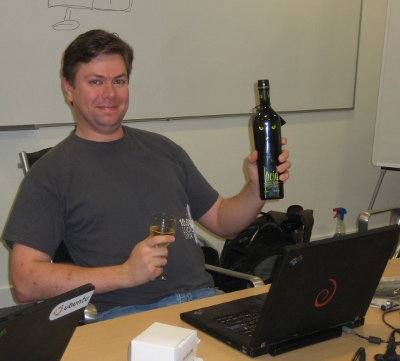
Steve Langasek has been contributing to Debian for more than a decade. He was a release manager for sarge and etch, and like many former release managers, he s still involved in the Debian release team although as a release wizard (i.e. more of an advisory role than a day-to-day contributor). Oh, and he did the same with Ubuntu: on the picture on the left, he just announced the release of Ubuntu 10.04 from his Debian-branded laptop. ;-) He has also been maintaining PAM in Debian for as long as can I remember and does a great job at that. He s very knowledgeable and fully deserves his place within the Debian Technical Committee. I m glad he still has the time to participate on several important Debian mailing lists because his contributions are always very useful. I m sure you ll notice this just by reading his answers below. My questions are in bold, the rest is by Steve. Who are you? I m 32 years old, have been running Linux since my first year in college back in 96, and have been a Debian developer now for ten years. Along the way I ve been involved in maintaining a variety of server packages, worked on the Alpha port for a while, did a stint as a release manager for a couple of years, and serve on the technical committee. This year I m also celebrating my ten year anniversary with my lovely wife Patty, who many know as an erstwhile front-desk volunteer at DebConf. God only knows why she puts up with my late-night hacking! These days in my day job I m a manager on the Ubuntu Platform team at Canonical, working to help make Ubuntu a daughter distribution that the Debian community can be proud of. What s your biggest achievement within Debian or Ubuntu? There s no doubt that my biggest achievement in Debian has been overseeing the release of two Debian releases as release manager. On the other hand, the scope of a release is so huge, and it represents the output of so many developers working together, that it would be arrogant to claim the release itself as an achievement of my own. Also, sarge and etch have long since been rotated off of the mirrors so no one cares about them anymore. ;) For a more personal and lasting contribution in the distro itself, I m very proud of writing pam-auth-update. It s a small piece of code, but one that Debian was missing for a long time it s made a big difference to PAM module integration in packages! What are your plans for Debian Wheezy? My top priority for this cycle is to see multiarch through. We re still not far enough along in Debian for most developers to see any difference and once we are, the first thing people are going to see is a fair bit of breakage when we start breaking a lot of assumptions about paths that have been hard-coded upstream. But I m still excited by the progress that is being made here. We should be able to ship wheezy without any ia32-libs package. We might even be able to get rid of all the biarch library packages, including those used by the toolchain itself. 54 packages in testing build-depend on gcc-multilib right now, in order to build 32-bit code to ship in the amd64 package; a bunch of those should go away with absolutely no reduction in functionality, saving us a bit of space in the archive and saving the maintainers a lot of complexity in their packages, while at the same time giving us much better support for cross-compilation than we ve ever had before. It s a tall order, certainly, but the pieces are falling into place one by one. My second priority is to get a policy in Debian around packages integrating upstart jobs. It would of course benefit Ubuntu to have many packages back in sync with Debian, but if all we wanted was to sync with Debian, we could mostly just make debhelper ignore upstart jobs in Debian, prefer them in Ubuntu, and call it good. I m interested in making sure Debian also gets the benefits of being able to use upstart, because as Linux has become increasingly asynchronous (doing more in parallel at start up), the traditional sysvinit has not been able to keep up. There are all kinds of bugs now related to network startup, for instance, that we don t have a good answer for in a sysvinit model but that we can fix with an event-based system. Upstart has been around for a while now, but we ve been slow to integrate it into Debian because it only works on Linux. It would be a shame if right after the first Debian GNU/kFreeBSD technology preview, packages all stopped working on kFreeBSD because they started to assume the availability of upstart! Unfortunately, having been so cautious we now have systemd on the scene, which not only doesn t support non-Linux but seems to be in the process of trying to gobble up other, non-Linux-specific components of the desktop stack. So I have to wonder what the future holds for the free desktop on non-Linux kernels. If you could spend all your time on Debian, what would you work on? Well, based on my previous experiences when I did spend all my time on Debian, I think the answer here is QA / release work. :) Otherwise, I don t know. My hands are full enough now with multiarch that it s hard for me to see what the Next Thing would be. You re a member of the technical committee. In the interview of Bdale Garbee, I have argued that it s not working well. What s your point of view on this topic? Well, I feel a constant low level guilt about my own poor level of activity in the TC; but that doesn t translate into a belief that the system is broken. This is, after all, the decision making body of last resort for technical disputes in Debian, and as such it should really be used sparingly. And if a reputation for glacial deliberation means more developers work out their disputes on their own rather than asking the TC to step in, I think that s actually a healthy thing! I do still wish we were more effective at resolving those issues that do come our way, but there s no silver bullet for this. Though the funny thing is, I ve noticed that the majority of issues that get referred to the TC nowadays never even need us to make a decision; a short conversation with the disputants is often enough to get them to come to an agreement. What s the biggest problem of Debian? By and large, I think Debian is still doing a great job at what it s best at delivering a rock-solid distribution that users can rely on. If I would highlight one problem in Debian, though, it would be that I think we re becoming less innovative as time goes on. Part of that comes from being such a large project that we re bound to be more conservative as an institution; but even though the three pet Debian projects of mine that I mentioned above are fairly innovative (multiarch, pam-auth-update, upstart), each of these has landed first in Ubuntu rather than in Debian. Always with a clear intent of pushing back up into Debian, of course, but it just wasn t possible to do this work within Debian for the first cut without much longer delays. I worry that if Debian is no longer the place to try new things, that we re going to miss out on attracting contributions from the folks who are inspired to make Free Software better and not simply to make it stable. I m not sure how to address this, though. Maybe improved conversations with derivatives such as (but not limited to) Ubuntu, about what crack of the day is being tried where and how that can be integrated into Debian once it s proven to work? I don t think that team-based maintenance or low-threshold NMUs do anything to address this, though, as the kinds of innovation that matter most are ones that require discussion and consensus-finding not just routing around inactive maintainers. Do you have wishes for Debian Wheezy? Well, I d like to see the armhf port get on its feet and become an official port. Over the lifetime of the arm and armel ports, the state of the art on ARM has changed quite a bit; it would be great to see Debian taking advantage of this richer platform, to let people make better use of their hardware via Debian. As a former release manager, you re now a release wizard . I guess you have seen it on debian-devel, there are proposals to not freeze testing and to use another distribution starting as a snapshot of testing to finalize the new stable release. According to your experience, what needs to happen to make this possible? Frankly, I ve stayed out of that discussion because I don t think what s being asked for is possible. I think proponents of a freezeless release have seriously underestimated the amount of work required on the part of the release team to wrangle testing into a releasable product, and that anything that makes propagation of fixes into the pending release more time consuming will make Debian worse on the whole, not better. If people really want to avoid long freezes for the Debian release, the best way they can help this happen is by making Debian more releasable on an ongoing basis, by helping to hold our packages to our shared standards for quality (i.e., by fixing RC bugs!). The biggest factor in long freezes for Debian is the slow rate at which we bring the RC bug count down during the freeze. Back in the sarge, etch days we used to have really great bug squashing parties that would get people together on weekends to hack through RC bugs by the dozens. I don t see that happening as much anymore. I d really like us to get back to that, but my few attempts at this so far since retiring as release manager have led me to think I m really terrible at organizing parties of any kind. :) On the other side, as seen at http://bugs.debian.org/release-critical/, the RC bug count for testing at the beginning of the release cycle keeps getting higher and higher. I d love to know why that is so we can address it. I know we ve gotten better at detecting some classes of RC bugs; that s part of it, but I don t think it explains the whole trend. Is there someone in Debian that you admire for their contributions? Wow, what kind of arrogant jerk would I be if I didn t admire anyone in Debian for their contributions? Debian is and always has been an amazing community of top-notch developers; there are certainly too many I admire to list them all here. Joey Hess certainly makes the list, for his longstanding example of code speaking louder than words and for his ability to get to the heart of common problems and come up with elegant solutions. So does Russ Allbery, who by all accounts had his ability to feel anger in response to email burned out of him at a young age in a flame-related accident on Usenet. ;-) The list goes on, but here I think I have to follow Joey s example and cut the words short.
Thank you to Steve for the time spent answering my questions. I hope you enjoyed reading his answers as I did. Subscribe to my newsletter to get my monthly summary of the Debian/Ubuntu news and to not miss further interviews. You can also follow along on Identi.ca, Twitter and Facebook.

3 comments Liked this article? Click here. My blog is Flattr-enabled.

Matt Zimmerman: Moving on from Canonical (but not from Ubuntu)

This June, soon after my seventh anniversary with Canonical, I will finish my job as Ubuntu CTO at Canonical. You can read my official announcement on the Canonical blog. It s sometimes hard to believe that it s been that long since we first envisioned a Linux desktop for human beings . When I look at how far we ve come, at the difference we ve made to so many people, it s easy to see how the time passed so quickly. It s been an incredible experience for me to play a part in building Ubuntu and Canonical. Whether building a decentralized company of hundreds of people, to a global community project of tens of thousands of members, I m grateful for all of the learning opportunities along the way. It has been a privilege to work with so many brilliant, passionate and thoughtful people under such auspicious circumstances. There is much I will miss, and I have many memories to enjoy, from all-night global hacking sessions driving toward a ship date, to casual singing and playing music at our many face-to-face events Nonetheless, it is time for me to seek out new challenges and stretch myself in new ways. I ll be moving back to the US, closer to old friends and family, and starting a new job with a different type of company. I am leaving behind a capable and dedicated team at Canonical, who I am confident will achieve even greater things in the years to come. I will remain active in the free software community as a volunteer. I intend to continue to participate in Ubuntu, and to serve on the Technical Board. I will also be continuing my work with Debian and the DEX project. This year, I ve accepted advisory positions with the Ada Initiative and the Freedom Box Foundation, and will continue to support those organizations and their missions. I ll be in Budapest at the Ubuntu Developer Summit for the next week, and look forward to seeing my friends in Canonical and the Ubuntu community. I ll have more to say soon about what I ll be doing next professionally. Watch this space for updates!

5 May 2011

Andrew Pollock: [life] Zoe at 12 months

I got in early this time and started working on this post a day early. Well, we've made it. We've all managed to survive parenting to the 1 year mark. Zoe continues to do fabulously. Today she had her 12 month paediatrician appointment, and weighed in at 19 pounds and 8 ounces (8.8 kg), which has brought her up from the 25th percentile for weight to around the 50th percentile. She's also up from the 25th to the 50th percentile for height. She got four shots today, which she was singularly unimpressed about even before she was jabbed. Somewhat surprisingly (to us) Zoe still isn't walking. She'll stand on her own if you distract her with something, but otherwise she'll fall down and prefers to crawl everywhere. She'll cruise around with the help of furniture, and she'll happily walk while pushing something. Go figure. I really thought she'd be walking into her 12 month appointment at the paediatrician. Developmentally, she's waving and pointing now. I'll usually get a wave goodbye out of her when I head out the door to work in the mornings. She seems to be picking up things pretty quickly now. One of her traits has been she'd always toss her sippy cup on the floor when she was done taking a drink from it. She's been doing this for months. In one sitting, I taught her to hold it out to me and say "ta!" instead, which is great, because now at mealtimes, I'm not picking up the sippy cup off the floor a dozen times. We had another trip back to Australia last month, and this one was purely vacation, so we had a nice couple of weeks of pottering around with family. Zoe again handled the flights very well, although the jet lag upon returning to the US seemed a lot worse than I remembered after our first trip. The pilot was pretty punchy with the seat belt sign on the way to Australia, so we had to keep taking Zoe out of the bassinet while she was asleep. Incredibly we were able to do this about four times before she woke up. She had a bit of a cold before we left for Australia, and that turned into a nasty cough, which was diagnosed as bronchitis the first week we were there. We got some antibiotics for her, and that cleared the cough up. She also had a couple of spontaneous vomiting incidents, which were out of character for her (but Sarah contracted some kind of tummy bug herself, so it wasn't entirely surprising). Despite these health issues, she was still in excellent spirits the whole time, and I think she thoroughly enjoyed herself. We went to Surfers Paradise for a couple of nights in the first week, and rented an apartment on the 23rd floor of the Chevron Renaissance, and pottered around the Gold Coast a little bit. We went down to Palm Beach, where we used to holiday every year when I was a kid, and caught up with my cousin who lives there, and Zoe had fun on the beach. That weekend, we held an early first birthday party for family and friends in a park and had a barbecue lunch. The following week we spent a few days on the Sunshine Coast, with some of Sarah's extended family, and pottered around on the beaches up there. Our flight back ended up being delayed 9 hours, but fortunately we found out before we got to the airport, so we had a nice, unexpected extra day in Brisbane. It also meant that we flew back for Zoe's night time sleeping time, which made for a pretty good flight (but made the jet lag worse for her once we got back). I wonder what the next year will bring us? At a guess, more teeth, talking and walking. Zoe at (almost) 12 months

Russell Coker: Osama bin Laden

After almost 10 years the Americans finally found Osama bin Laden, unfortunately they were unable to take him alive. The Reid Report has a good summary of what happened [1]. Sam Varghese wrote an interesting analysis of the political aspects of this event in Pakistan [2], and he s a lot less positive about it than most people. Later he wrote about the inconsistencies in the reports, it seems that bin Laden was executed while unarmed [3]. When dealing with someone who is no stranger to suicide attacks and who has stated an intention to never be taken alive it s not unreasonable to shoot quickly, it s just a pity that they couldn t have been honest from the start. Dr. Pamela Gerloff wrote an insightful article for Psychology Today titled Why We Should Stop Celebrating Osama Bin Laden s Death [4]. She asks the rhetorical questions What kind of nation and what kind of species do we want to be? Do we want to become a species that honors life? Do we want to become a species that embodies peace? and suggests that we should mourn the series of tragedies that led up to this situation and to feel compassion for anyone who, because of their role in the military or government, American or otherwise, has had to play any role in killing another . Daniel R. Hawes wrote an insightful article for Psychology Today that s quite different from Dr. Gerloff s article [5]. He is quite glad that bin Laden is dead. But he considers how the people who have lost friends and relatives on 9-11 might feel about this and says that the shouts and celebratory chants that rang around America today seemed to me to carry a certain element of irreverence for those affected most deeply by the September 11 attacks and the entire military operations that followed . To represent the people who are partying now there is a post by Jenny Lind Schmitt that is totally unworthy of a site such as Psychology Today [6]. Jenny told her small children about al Quaeda: They hate you because you are American. Their god is destruction, and they would kill you, a little child, if they had the chance, just because you are American. She also describes al Quaeda as lunatics . Describing all your enemies as lunatics is quite common in general conversation, but it s not suitable for a web site that discusses psychology (where some respect for people with mental health issues is expected). Teaching children to be bigoted against Islam is a bad thing too. It seems to me that a factor in the violence that comes from the middle-east is a result of women just like her telling their children similar things but with country names and religions switched. Finally some capacity for empathy is required for someone to have any insight into psychology, someone who can t understand such things can t be competent to discuss psychology. In stark contrast to Jenny (who bears an irrational hatred in spite of apparently not having any close connection to the events in question) there is a TED talk by Phyllis Rodriguez (who s son was killed in the 9-11 attacks) and Aicha el-Wafi (who s son is in jail for being a member of al Quaeda and was accused of being part of the 9-11 plot) [7]. The two women became friends after 9-11 and work together in the cause of peace. From reading some interviews that Google turned up Aicha seems like a very intelligent woman, I think that the TED talk with her section translated from French to English didn t seem to show this. Perhaps people who speak French and English would get more from the TED talk than I did. Also perhaps if she gave a talk to a French audience and it was subtitled then the result would be better. Now of course the less intelligent people on the right-wing are trying to spin this to say that Bush deserves credit for getting bin Laden. The Reid Report has a good analysis of the history of the hunt for bin Laden and it doesn t make Bush look good [8]. Also the Reid Report has an interesting analysis of the operation to get bin Laden and the possibility for peace now that he s gone [9]. LA Times has an article about the use of the name Geronimo as a code-word for bin Laden [10]. But compared to the use of words such as crusade and paladin by the US armed forces this hardly rates a mention.

3 May 2011

MJ Ray: Standing for election, times 2 or 3, plus public access wifi

It s a bit quiet on this blog recently because I m busy with lots of non-software tasks, including:

  1. I am standing for election to the UK Worker Co-operative Council. Thank you to software.coop for the nomination and help. Voters can ask me questions on the uk.coop site.
  2. I was renominated to Kewstoke Parish Council and even though there s no contest (just enough candidates to fill the council), I ve another 16 pages of legally-required forms to complete to take up office. I hate bureaucracy and I think it deters a lot of good people from helping their villages.
  3. I m contemplating standing in the co-operative group area committee elections again.
So, I m far from idle. I m still developing software for clients of our co-op but not finding time to write about it just now. Maybe this would be more interesting to readers: I ve moved my wifi antenna out of the metal box it s been in for a while. Now it covers a half-decent area, I m looking at installing CoovaAP to offer some free public access wifi while trying to limit the risk of illegal activity. Would you do it? Do you run a public wifi point? What should I watch out for?

Josselin Mouette: Rolling release

Since this has been a major request from users for a long time, I can only cool with the idea of seeing the Debian project support a rolling release. However I m not pleased with the proposed ideas, since they don t actually include any serious plan to make this happen. Sorry guys, but a big GR that says We want a pony rolling release to happen doesn t achieve anything. Let me elaborate. First of all, discussions have focused a lot on what to do when we re in a freeze phase. Numerous cool ideas have been proposed, including PPAs (which again, won t happen until someone implements them). This is all good, but this is only the tip of the iceberg. Above all, before wondering what can happen in a freeze that lasts 20% of the time, let s wonder what can happen for the 80% remaining time. Once you have something that works in the regular development phase, you can tune it to make it happen, even if in a less optimal way, when the distribution is frozen. So let s not put the cart before the horse. There are three options if you want to make a rolling release happen.

  1. Make unstable usable. to make it happen, you have to prevent the disasters that rarely but unavoidably happen here. You don t want to make all rolling systems unusable because someone broke grub or uploaded a new version of udev that doesn t work with the kernel.
  2. Make testing usable. This sounds easy since RC-buggy packages are already prevented from migrating, but actually it is not. A large number of RC bugs are discovered at the time of testing migration, when some packages migrate and others don t. Worst of all, they require several days to be fixed, and it is very often that they require several months, when one of the packages gets entangled in a transition.
  3. Create a new suite for rolling usage.
The proponents of the CUT project obviously believe in option 2. Unfortunately, I haven t seen many things that could make it happen. A possible way to fix the situation would be to run large-scale regression testing on several upgrade paths. I don t know if there are volunteers for this, but that won t be me. That would also imply to make a lot of important bugs RC, since they could have a major effect on usability, but the release team will not be keen to make it happen. Because of the testing situation, when someone asks me for a rolling release, I point her to unstable with apt-listbugs. As of today, this is the closest thing we have to a rolling release, so we should probably examine more deeply option 1. Is it that complicated to write a tool to prevent upgrades to broken packages? A 2-day delay in mirror propagation and a simple list of broken packages/versions (like the #debian-devel topic, would be enough. Add an overlay archive, that works like experimental, and you can now handle freezes smoothly. Wait isn t that aptosid? We would probably gain a lot of insight from the people who invented this, instead of trying to reinvent the wheel. Finally, option 3 could open new horizons. There s a risk that it might drive users away from the testing and unstable suites, and this makes us wonder how we could have proper testing for our packages. Still, build a process that would (and that s really only an example) freeze unstable every month, give people 10 days to fix the most blatant issues, add a way to make security updates flow in from unstable, and you have a really nice rolling distribution. So overall, it only requires people to make things happen. You want option 2 to happen? Instead of working on GR drafts, start working with maintainers and release managers on ways to avoid breakage in testing. You want option 3 to happen? Start it as a new .debian.net service and see how it works. Personally, I d be in favor of offering aptosid developers to become DDs and offer their solution as a Debian service. It would bring in new people rather than driving away existing developers from working on our releases.

Rapha&#235;l Hertzog: My Debian activities in April 2011

This is my monthly summary of my Debian related activities. If you re among the people who support my work, then you can learn how I spent your money. Otherwise it s just an interesting status update on my various projects. GNOME 3 packaging Right after the GNOME 3 release, I was eager to try it out so I helped the pkg-gnome team to update some of the packages. I did some uploads of totem, totem-pl-parser, gvfs, mutter, gnome-shell, gnome-screensaver. I also kept people informed via my blog and prepared a pinning file for adventurous users who wanted to try it out from experimental (like me). One month later, I m still using GNOME 3. There are rough edges still, but not so many. And I m starting to get used to it. Debian Rolling planning Debian Rolling is a project on my TODO list for quite some time. I decided it was time to do something about it and started a series of articles to help clarify my ideas while getting some early feedback. My goal was to prepare a somewhat polished proposal before posting it to a Debian mailing list. But as usual with Murphy s law, my plan did not work out as expected. Almost immediately after my first post the discussion started on debian-devel:
At this point it s a discussion thread of several hundreds of messages (there are several screens of messages like the one above). Many of the sub-threads have been interesting, but the general discussions mixed too many different things so that there s no clear outcome yet. Lucas Nussbaum tried to make a summary. Obviously I must adjust my plan, there s lots of feedback to process. I accepted to drive a DEP together with Sean Finney to help structure the part of the discussion that focuses on allowing development to continue during freezes. But I m also eager to fix the marketing problem of testing and have the project recognize that testing is a product in itself and that end-users should be encouraged to use it. Package Tracking System maintenance The Package Tracking System is an important tool for Debian developers, and it has been broken by some change on the Bug Tracking System. I worked around it quite quickly so that few people noticed the problem but Cron kept reminding me that I had to properly fix it. I ended up doing it last week-end. While working on the PTS, I took the opportunity to merge a patch from Jan Dittberner to enhance the news RSS feed that the PTS provides. And I also integrated information from backports.debian.org (thanks to Mehdi Dogguy for reminding me #549115). Multiarch update Not much new this month. I fixed two bugs in the multiarch dpkg branch thanks to bug reports from Ubuntu users (LP 767634, LP 756381). I m still waiting on Guillem Jover finishing his review of the multiarch branch. I m pinging him from time to time but it looks like multi-arch is no longer in his short term priority list. :-( I ve been running this code for more than 2 months and it works fine. I want to see it merged. I m ready to update my code should anything need to be changed to please Guillem. But without any feedback we re in a deadlock. Misc dpkg work While fixing a bug in update-alternatives (found in one of the valid reports on launchpad), I noticed that there was room for improvements in the error messages output by update-alternatives. I changed them to reuse the same strings that were already used in other parts of dpkg. The result is that there are a few strings less to translate (always a nice thing for the poor translators who have to deal with the thousands of strings that dpkg contains). I also tried to fix some of the most cryptic error messages in dpkg (see #621763) but that work is stalled at the request of Guillem. Book update We (me and Roland Mas) are almost done with the update of our French book for Debian Squeeze. It will hit the shelves in July or September. I m starting to prepare the fundraising campaign to make an English translation of it. We ll use ulule.com for this. On my blog I have been pleased to interview Meike Reichle, it s the first women that I have interviewed in the series but it s certainly not the last one. I also interviewed Adam D. Barratt, one of our tireless release managers. Thanks Many thanks to the people who gave me 180.35 in March and 235.37 in April. That represents 1.5 and 2 days of work for those months. See you next month for a new summary of my activities.

8 comments Liked this article? Click here. My blog is Flattr-enabled.

2 May 2011

Christian Perrier: 2011 week 17 Debian work

Will I succeed maintaining a weekly log of what I'm doing in Debian? We'll see. At least, let's try. D-I work: After spending most of the end of week 16 uploading D-I components, I completed this during this week. I hunted down the remaining arch:all, arch:i386 and arch:amd64 packages that need an upload because of l10n changes. The main point was bringing published D-I work inline with the work of translators. That was mostly meant to publicly have an image with Uyghur activated (which I blogged about separately). Finally, I ended up doing some changes to the fonts-ukij-uyghur package in order to use the right font to display the language in D-I, as well as improving the readability by increasing the font size just as we're already doing for Arabic and Persian. Samba packaging: I got release managers approval to upload a new release to stable-proposed-updates. It fixes several important bugs in samba 3.5.6, often affecting Win7 clients. I'm always happy to see that we can do that even when issues are ot security or "release critical" issues. I also integrated the newly-published samba 3.6.0-pre3 in the package maintenance SVN. However, we're still having problems with symbols disappearing from libwbclient, that prevent me to upload 3.6.0pre3 in experimental. Steve Langasek's help here will be welcome. Pytrainer and "gant" packaging: I setup a mailing list for the pkg-running maintenance team so that we can move the few packages some of us maintain (pytrainer and garmin-forerunner-tools as of now, and soon "garmin-ant-downloader", the helper tool for 405 watches). I also began looking at pytrainer bugs and forwarding some of them upstream. I also began packaging "gant" (had to rename it as we already have a gant package, totally unrelated). I just got a notice from Klaus Ethgen about improvements he did to the software. We'll try to figure out what to do as this software doesn't really have a clear upstream and published versions. l10n work: a few packages introduced debconf templates and I launched reviews of English for them (while mumbling about uncoordinated work, of course..;-)). I also reviewed about one hundred package description translations in French DDTP (something I recently began to commit to do even though it means onlinen work for me, which I'm not used to). No l10n NMUs this week but a few maintainer uploads after I (gently) kicked their ass..:-)

Next.

Previous.