Search Results: "bod"

14 August 2007

Adrian von Bidder: Why I think (and sometimes say) extremely rude things about Dell.

There was a time that a small-ish (ca. 70 office workplaces) company bought almost all of its IT products from Dell, with 3 year on-site warranty to be on the safe side. There was a time when all was well and, in the rare cases that something needed to be replaced, a gentlemen would arrive and magically fix all that needed fixing. There was also a time, a bit later, when this enterprise wishes it could get rid of all the remaining Dell devices immediately (but of course you don't buy 100-odd desktops, servers and printers just because you no longer like the vendor.) One, if I buy a 4h-reaction-time warranty contract and tell them that I have a problem and that probably a part needs replacing, I don't expect to have to play ticket ping pong for a whole week until they agree that there even is a problem. Two, if there is a problem with a range of computers (leaking condensers) and more than half of our workstations are affected, I'd expect Dell to care about this and be at least ready to discuss mass-replacing the faulty motherboards in one go instead of having to send a tech every three days for yet another case of this problem. I'd think it's cheaper for them as well.... Three, not that I really care, since it's covered under warranty so I don't pay for it, but if I have two defective computers at the same site I'd expect one tech to fix them both, not two techs to come out (missing each other by 5 min) to fix one computer each. Again, you'd think they'd do the maths on how much these techs cost. Four, wouldn't it be nice if you could buy two laser printers and the toner cartridges would even be the same? HP, for example, manages to use the same toner cartridges for a whole range of printer models. Dell apparently can't do this. (Admittedly, I've only seen it in the case of the 5100cn/5110cn printers, and sometimes there are reasons to change the toner cartridges. But then I'd expect the printer model to be significantly different. Those two printers look exactly the same from outside, and the innards also look identical at first glance, including the toner cartridges, except for some coded plastic pieces ensuring that the cartridges don't match.) Five, wouldn't it be nice if toner cartridges could be bought at your regular office supply store, where we buy every other brand of cartridges? No, of course nobody but Dell themselves sells Dell supplies. Since supplies are not dealt with by IT stuff, this is really annoying. Especially beacuse Dell has repeatedly, for unclear reasons, disabled our login to the Dell online store (and we can't just create a new login as we have special discounts, so our account needs some special handling.) Six, how long is the usual life expectancy of a Laptop battery? For the Inspiron 9300 80Wh and the 53Wh battery, it's apparently 18 months, after which the battery doesn't charge anymore or only holds power for 2 minutes. Dell customer support confirms this is normal behaviour for these batteries and this is not covered under warranty accordingly. What now? Printers: HP. Desktops, Displays and Laptops: Lenovo. Servers: IBM. Network Switches: D-Link. Not sure if these choices are ok, but so far we've had less problems than with Dell. But of course the Dell stuff is older and so more prone to failure, so probably we'll just have to re-evaluate 3 years from now.

12 August 2007

Dirk Eddelbuettel: The amazing Prof. Ripley (cont'ed)

A little mini-meme got started on August 1 when Ben Bolker posted the following code to the r-devel list (and here I substituted the more standard '-' assignment operator for the less standard though-now permitted '='):
x <- readLines("http://developer.r-project.org/R.svnlog.2007")
rx <- x[grep("^r",x)]
who <- gsub(" ","",sapply(strsplit(rx,"\\ "),"[",2))
twho <- table(who)
twho["ripley"]/sum(twho)
In five lines (that could be shortened to three at the expense of some readibility), the SVN log for R is downloaded directly from the website, the revision authors are extraced and then tabulated by submitter. The relative percentage of Brian Ripley is found to be a staggering 74.8% -- or about three times as much as the other fifteen committers combined. Smokes. [ Oh, and for those who don't know him, he's also got a day job which presumably entails looking after his graduate students at Oxford. Who knows, he may even teach. Kidding aside, he's actually one of the nicest persons you'll ever meet in real life. ] Now yesterday, Simon Jackman who had at first simply repeated Ben's analysis on his own blog followed up with a nice analysis (albeit typeset in a way that rendered the code inoperational, which has now been fixes) that creates both a histogram and a dotplot of commits per hour of the day. Omitting Ben's code which Simon reuses, we have the following for histogram and dotchart:
tod <- unlist(sapply(rx,function(x)strsplit(x,split=" ")[[1]][6]))
tod <- tod[who=="ripley"]
tz <- sub(pattern=".*(-[0-9] 4 ).*",replacement="\\1",x=rx)
tz <- tz[who=="ripley"]
tz <- as.numeric(tz)/100
offset <- 3600*tz
z <- strptime(tod,format="%H:%M:%S")
hist(z,"hours",main="Ripley Commit Times in SVN TZ")
h <- z - offset
h <- format(h,format="%H")
h <- factor(as.numeric(h), levels=0:23)
dotchart(table(h), main="Ripley Commit Times, By Hour in GMT",
         labels=paste(0:23,1:24,sep=":"))
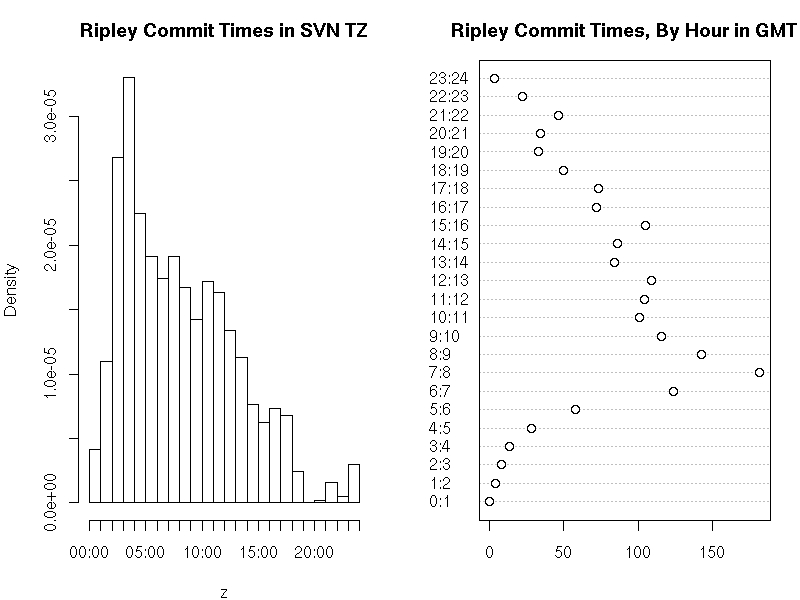
This extracts the commit times, subsets to the ones by Prof. Ripley, extracts the timezones component (as strptime seemingly doesn't do that which is a pain), extracts the tz-less time via strptime into a variable 'z' for which the histogram is drawn. He then corrects the times by the tz offset expressed in seconds, formats is as hour of the day and turns it into a 'factor' (an R data type for qualitative variables which may be ordered as is the case here) and draws a dotplot. This results in the following chart: Simon Jackman's per-hour charts of Brian Ripley's commit patterns Now, nobody has looked at the time series. So we correct this and add the following:
## rather extract both  date and time
dat <- unlist(sapply(rx, function(x)  
  txt <- strsplit(x,split=" ")[[1]]
  paste(txt[5], txt[6])
 ))
## subset on Prof Ripley
dat <- dat[who == "ripley"]
## and convert to POSIXct, correcting by tz as well
datpt <- as.POSIXct(strptime(dat,format="%Y-%m-%d %H:%M:%S")) - offset
## turn into zoo -- we use a constant series of ones as each
## committ is taken as a timestamped event
datzoo <- zoo(1, order.by=datpt)
## and use zoo to aggregate into commits per date
daily <- aggregate(datzoo, as.Date(index(datzoo)), sum)
## now plot as grey bars
plot(daily, col='darkgrey', type='h', lwd=2,
     ylab="Nb of SVN commits, three-week median",
     xlab="R release dates 2.5.0 and 2.5.1 shown in orange",
     main="The amazing Prof. Ripley")
## mark the two R releases of 2007
abline(v=c(as.Date("2007-04-24"),as.Date("2007-06-28")),col='orange',lwd=1.5)
## and do a quick centered rolling median
lines(rollmedian(daily, 21, align="center"), lwd=3)
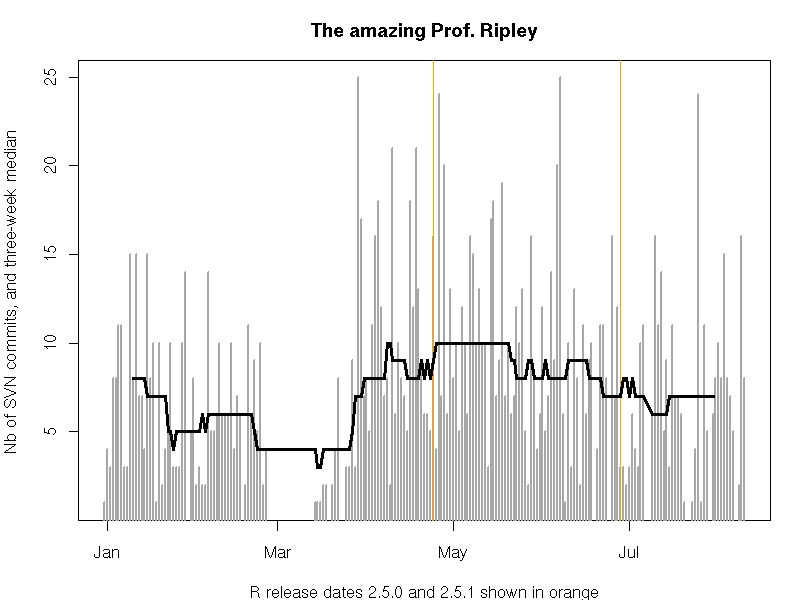
This extracts both date and time, creates a proper R time object (a so-called POSIXct type) from it, fills a zoo ('the' magic class for time series) object with it, uses zoo to aggregate commits per day and plots those in a barchart-alike (I know, I know, ...) plot to which we add the two releases as well as a rolling and centered three-week median (as a real quick hack rather than a proper smooth). Timeseries of Brian Ripley's commit patterns This shows that Prof Ripley averaged about ten commits a day before and after the release of R 2.5.0, and that he has slowed down ever so slightly since then to end up at around a mere seven commits a day. Every day. For the seven-plus months we looked at. So, anyone for analysing his r-help posting frequencies ?

11 August 2007

Alastair McKinstry: Planet 9 from Outer Space

While investigating planet formation (to justify support complement a PhD proposal on ocean planets), I found this discussion over at physicsforums following a blog entry by Dr Steinn Sigursson. (He uses Planet X in his posts but that is too frequently linked with the dwarf planet Xena Eris, and besides, Pluto has been demoted, so its Planet 9 we're looking for :-( ). The question is, how was our solar system created ?
"Looks like the outer solar system, with late heavy bombardment, would have come together nicely if there was another Neptune out there to begin with."
Basically, it appears as though there is a planet or substellar companion star out in the Oort cloud. This is not likely to be the Nemesis object of Hut's/Muller's theory, but would have been responsible for the Kuiper belt. Most of the discussion is about brown dwarfs, but following links leads to a paper by Gomes et al., simulating the possibility of outer Neptunes or Jupiters at 4000 AU or 5000 AU. The thread is all about the dynamics of such bodies, but what would they look like? Now, Hydrogen freezes solid at 14K, Helium is liquid at 4K. So we're talking about a liquid helium ocean on top, with no atmosphere worth speaking of. But Could it sustain life? Not as impossible as it seems. Ehrenreich and Cassan point out that an Ice Giant could host a liquid layer underneath an ice shell surface, heated by radiogenic energy, that could last for billions of years before freezing. So where would it be? This is the time to submit a grant proposal for more envelopes ... Tags , , , ,

10 August 2007

Gunnar Wolf: Choose your pain: Legs or back

So I have an extra chair today at my office. Is that good?
Some weeks ago, I started noticing some stinging and numbness in my legs, specially the left one. I went to the social security, and got a simple prescription: Two weeks having a certain medicine whose name I don't remember by now. But the timing was not the best, as this happened exactly during my vacations - After finishing with this medication, I still had a full week before coming back to work. And when I came back, things seemed to be fine. But still, this does not tell me if my body is at fault, or if it is my chair instead...
At the Institute, we have basically two models of chair: The one I usually have, a bit taller and better suited for my kind of table (as its arms fit nicely just under the table (as they were designed to go together). The other, a bit shorter and rounder, but with higher arms.
The stinging in the left leg is back there - No, it does not (yet) bother me, but I trust it will. So, of course, I tried the other chair. The seat is much more ergonomical, yes, and it feels overall better - But I have to reach over to use my keyboard...
So this means I can either get a different chair by my own means, or choose between back and leg pain.
Sweet.

8 August 2007

Miriam Ruiz: El rei de la casa

The Proof of the PuddingThis is an updated translation into English of the one-question interview with pjorge (based on Darren Rowse’s one-question interviews idea) in which Javier Candeira (Barrapunto co-founder and editor among many other things, and a good, loved friend of mine) comments about an interesting game of his creation that’s being exhibited in Barcelona and that deals with the fears many parents have towards the Internet and the new enterntainment technologies and videogames. The game code will be released as GPL, even though the game data will have a non-free Creative Commons (with a non-commercial clause). The game has a really interesting approach, and mixes the concept of pinball games with that of graphics generated with “paper dolls” techniques, to try to make people think about the ideas mainstream media are pushing, and the way they try to tell everybody how to raise their kids. You might like it or not, but it will probably won’t leave you indifferent. That’s what art is about, in fact, isn’t it? What is ‘El rei de la casa’? ‘El rei de la casa‘ (an expression that in Catalan and Spanish means “the precious child”) is an exhibition and a videogame. The exhibition deals with the cultural construction of the idea of childhood, and can be visited until September 24 in the Palau de la Virreina in Barcelona. From there. Among other works, in the exhibition there are photos by Loretta Lux and Bego a Egurbide, paintings by Marc Ryden, Kiki Smith and James Reilly… it’s really worth a visit. El rei/la reina de la casa. ( The videogame is a commission from Andr s Hispano and Marc Roig, curators of the exhibition. They wanted to portray Internet and videogame arcades (or cybercafes, which are their modern equivalent) as one of the “new forests”, these places where parents don’t dare allow their children go alone for fear of the dangers (real or imagined) that may lie in ambush. The Internet has entered into the collective imagination, and one of the memetic niches that it has crept into is that of the bogeyman, the scapegoat that bears the brunt of all the evil that happens in society. It is enough to look at the news programmes from right-wing TV stations with their adversative Internet coverage: “it’s good, but…”. All over the media you see headlines like “gang of pedophiles arrested who sold child pornography *on the internet*”. They conveniently skip that pedophiles filmed those poor kids *in a flat*, and that they did it *on a bed* and used *videocameras* just like those used by the reporters now sounding the alarm. But no, what’s bad is *the Internet*.
The other theme that we wanted to touch on with the pinball game is how videogames are presumed to corrupt childhood. When pinball games were introduced, the North American authorities laid down the law: it was an infernal machine that incited gambling and even lust. From the religious right to the secular left, every moral guardian has denounced the supposed harmful effects of videogames on childhood: because of them children and teenagers engage in murder, robbery, truancy, bad school grades and even untidy bedrooms and doubtful personal hygiene. For this reason, the “new forest” of the Internet and videogames had to be a videogame, proving once more that games are cultural vectors, a form of artistic, political or commercial expression like any other. It also had to be a videogame about the a triangle: on one side the children, on the second one the children minders (parents and society at large), and finally the Great Scapegoat: the Internet. After many abandoned and reworked proposals we arrived at the present design for the game: an emulated pinball game presented on a panoramic TV screen, and having two levels: one set in the real world and named after the exhibition, and a second one set in a more or less conventional cyberspace. This second level is called “Prey of the Net”, and portrays the vision of the Internet that a Fox viewer may have: you have Spam, game-playing killers, kids making more money than their parents, S&M gear, dildos… in short, everything that is scary and nothing that is comforting, at least to some.  Presa de la red! (All the illustrations for this pinball, both on the gameplay field and on the scoreboard, are by Mauro Entrialgo. For the scoreboard I asked him to prepare a set of drawings similar to KISS dolls (like the cut-up dolls that kids still played with in the last century). Thanks to these dress-up dolls the scoreboard shows more than the score (which grows randomly anyway); it also portrays the state of the boy or girl protagonist of the game. I say “boy” or “girl” because in the game, just like in real life, you have a 50/50 chance of starting the game of life with either sex. The fist level, ‘El rei de la casa’, portrays the stress that families feel when facing children’s media consumption. The targets trigger lines from the parents: “All day in front of the Idiot Box!” when you hit the tv, or “without a degree, you are nothing” when you hit the school. There are four targets on the right, which can be reached shooting the ball with the left flipper (the one representing the parents): school, museum, church and reading. On the left, and reachable from the right flipper, representing the kids’ id, are the TV, the kid’s peers and the videogame console; at the top of the playing field, towering above it, the internet-enabled computer. As the ball hits the different targets, the scoreboard dresses the kids in a housecoat, a leather jacket, and gives them a mortarboard or a saint’s halo. They are the pride of their parents, kids still not perverted by the Internet. It is cheap symbolism, I confess, two-dimensional sociology, but that was also something we aimed for. After all, pinballs have always been complicated allegories rather than complex ones. In a first design I planned to make computer accessible only under certain conditions, but that is not something that would have work in this exhibition: some people just play and play (which gives me an immense joy), but other people can’t or won’t give it much effort. It’s best to make it easier for everyone, so they can send the ball into the next level even without meaning to. The second level, “Prey of the Net”, is accessed when the player puts the ball through the PC’s screen. Here the character on the scoreboard keeps smiling while the game dresses them in a straightjacket, S&M headgear, or leaves them in their underwear, with their hands full of money, playing cards, bloody knives and sex toys… to their parents’ horror. The player has no fixed goal here, only to make the ball go through the pachinko and the spinning spider. These elements work as an atrocity generator and a rebuke distributor. Parents’ voices scold the player, faced with the horrors of the Internet. But the star is the scoreboard. Mauro rocks. Right now the code and content for downloadable game are done, and the people responsible for the ISO are giving it the final touches. It will be a bootable liveCD with some Debian variant that (hopefully) will run on any PC bought in the last two or three years. We will treat the computer as a games console, which may or may not be symbolic (if you want it symbolic, we can make it symbolic!). The game itself is under the GPL license (the pinball part is based on Henrik Enkvist’s Emilia, which is packaged in Debian), and only the graphic resources will be under a non-commercial Creative Commons license. The music is also under a non-free Creative Commons license because of the status of the original samples, but I recommend you download it and play it because its author is none other than man, the Barrapunto founder and sometimes editor.
MJ Ray: SPI Elections: Corrections

Well, yesterday I asked
"WTF? There seem to be some 30 or 40 voters who really dislike me, but didn't tell me that straight, preferring to be silent then vote me down. Are you cowards, or what?"
Not the most polite of questions(!), but it's what I was wondering at the time. I had some good replies in the comments and a reply by Pingback that I didn't like, but it turned out to be a very educational reply in the end. A comment from Filipus Klutiero included:
"Sometimes, it's not really possible to explain a bad opinion of someone, because we forget the reasons for that opinion. However, if you think that voting based on reputation is a bad idea, you probably can't understand these "cowards"."
I've mentioned before that I don't seem to fit the debian developers stereotype, so I guess it's not surprising if I don't understand them sometimes. If reputation is always going to be such a big factor, one problem I need to overcome in debian and SPI is that some other participants do make crap up about me. You can usually spot it by phrases like "seems to think" (there are not that many mind-readers out there), but eventually, mud sticks. How to overcome this? Patiently post corrections, or is that futile? Here are posts from Andrew Pollock and Matt Palmer which I think are wrong on several points:- First off, I haven't decided to call anyone cowards - it was a question, albeit a bit "nasty, british and short". The underlying sentiment was continued disappointment and puzzlement at why voters behave like that in a non-secret vote, not rage. It was not really an "outburst," coming a week after the results. I'm not unhappy with the results - I've congratulated the winners by several methods, including the last post, although I mentioned my mixed feelings. Isn't that usual? I think very few non-elected candidates express unbridled joy about the experience. After all, it's not an easy decision to stand, but I did it for two main reasons: shortage of other candidates I really liked, at the time I chose to stand (as I mentioned in my platform); and for practical experience of how Condorcet behaves. I'm not rabid - I've even written against the Rabid Right recently - and I'm not rabidly anti-Google. I had polite chats with various people from Sun, Microsoft and Google at debconf - I don't like those companies, but I don't feel a need to tell their workers that at every point. I think reasons to like and dislike Sun and Microsoft are old and well-known, but a few years ago, I got so bored of explaining why I don't agree that Google is God's Gift to our communities that I posted a FAQ-ish page about it, which I update as I look at its new developments. Let's politely disagree, until Google fix the bugs which brought me to that view. Andrew Pollock's point about debian-legal is vague and maybe fair comment. It's not often a fun or popular thing. But "precious ego"? Ha! Yes, a guy who humiliates himself with cheap stunts for environmental protests is clearly very precious about his ego(!) (Sorry if that's rude, but I find it hilarious.) I don't mind people having different opinions, but it would be nice if their opinions about me were mostly based on reality, instead of misunderstandings. One fair point from Matt Palmer's post and also, I discovered eventually, from Antti-Juhani Kaijanaho's site, is that SPI's elections apparently are meant to be secret, as far as I can tell from the starts of Article Five and Article Seven of the SPI by-laws. I tend to value practice more than theory and the current voting practice is merely confidential, not secret. I think that's part of why I didn't understand the approach taken by some voters - they were treating it as a secret ballot. That's fine and now that I realise it's meant to be secret, I've suggested making it a secret ballot. (2007-08-08: 1 comment)

Adrian von Bidder: Free Software Contributors

In answer to Russel's recent “tips for new contributors” posting, I give you the answer to the ultimate question about life, the universe and “How can I contribute?”: Find an area that you really care about. Or, rephrased in a less friendly way: “If you have to ask, don't.” And answering Russel's real question (one sentence to give to somebody who wants to contribute): “Know the community. Respect the people who are in the project much longer than you.” Knowing the technology isn't important - it's always possible to learn technology. But not knowing the community leads to frustration very quickly, and the new contributor will possibly not even have the chance of having the technical side of things even seriously looked at. (Of course, you may still come to the conclusion that you know more than “them” and that the people running the project right now are morons. If this sentiment persists, perhaps it's time to fork the project?) Ganneff's reply is also worth thinking on.

Andrew Pollock: [opinion] Everybody hates Mark

So Mark doesn't like the SPI board election results and has decided to call the largish whack of people who didn't vote for him and tell him ahead of time or something "cowards". Personally, I'm of the school of thought that if you haven't got anything nice to say about someone, don't say anything at all, but, well, here we are... I forgot whether I put him last, but he was certainly ranked towards the back of the pack. Why? I don't like rabid people. Rabidly anything shows a lack of balance to me. Mark's rabidly anti-Google (amongst other things) (sure, I work for them, but I liked them before I went to work there, otherwise I wouldn't have gone to work there) and frankly, it irritates me. Almost as much as someone else I know being rabidly anti-Microsoft/pro-Linux irritates me sometimes. Balance is good, and I'd rather have people on the board that I know, and I know in a positive light, over people that I don't know, or known I don't like. So I ranked my ballot in reverse order of people I knew I didn't like, then people I didn't know, then people I knew, then people I knew I liked. Simple as that. Oh, and I'm not a big fan of debian-legal, or anyone who purports to be an armchair lawyer on that list. Sorry if that damages your precious ego, Mark. Now get back to bashing my employer, Debian UK, and pontificating about what's allowed to be in Debian. (Oh, and I don't object to you having your own opinion, I object to you restating it over and over and over again. But it's your blog, and you're free to portray yourself to others however you please, just bear that in mind when you go standing in elections.)

6 August 2007

Uwe Hermann: Rebuilding the whole Debian archive using the Open64 compiler

I got bored recently, so I rebuilt the whole Debian archive on one of my machines. To make this not a completely useless excercise, I used the Open64 compiler instead of gcc and created build logs for your perusal. So what is Open64? From the Wikipedia page:
Open64 is an open source, state-of-art, optimizing compiler for the Intel IA-64 (Itanium), AMD Opteron and Intel IA-32e architecture. It derives from the SGI compilers for the MIPS R10000 processor. It was released under the GPL in 2000, and now mostly serves as a research platform for compiler and computer architecture research groups. Open64 is licensed under the GPL. Open64 supports Fortran 77/95 and C/C++, as well as the shared memory programming model OpenMP. It can conduct high-quality interprocedural analysis, data flow analysis, data dependence analysis and array region analysis.
Open64 installation The installation is pretty easy fortunately:
$ wget http://ovh.dl.sourceforge.net/sourceforge/open64/open64-4.0-src.tar.bz2
$ tar xfvj open64-4.0-src.tar.bz2
$ cd open64-4.0
$ export TOOLROOT=/opt/open64
$ make
$ make install (as root)
I think you need gcc-3.4 (gcc 4.x is not yet supported), and for some odd reason you also need csh as one of the install scripts seems to use it. It would be nice if someone could package Open64 for Debian, I definately don't have the time to maintain such a huge package (a whole maintainer team would probably be good here). Rebuilding the Debian archive There are several possible ways (and tools) to rebuild the Debian archive; I've used pbuilder/cowbuilder with the rebuild scripts from Bastian Venthur, which are now included in pbuilder. First we need to install the required packages, setup a cowbuilder base chroot, and get the list of packages:
$ apt-get install cowdancer grep-dctrl wget devscripts sudo
$ cowbuilder --create --distribution lenny --basepath /var/cache/pbuilder/testing-base.cow
$ cp -r /usr/share/doc/pbuilder/examples/rebuild .
$ cd rebuild
$ ./getlist lenny
Now we add Open64 into the cowbuilder chroot and fix up the chroot by pointing the gcc/g++ symlinks to Open64:
$ cp -a /opt/open64 /var/cache/pbuilder/testing-base.cow/opt
$ chroot /var/cache/pbuilder/testing-base.cow
$ cd /usr/bin
$ mv gcc gcc.orig
$ ln -s /opt/open64/bin/opencc gcc
$ mv g++ g++.orig
$ ln -s /opt/open64/bin/openCC g++
$ exit
In addition, we set the CC and CXX environment variables to Open64, which will make 90% of all (autoconf-using) packages automatically use Open64. We need a small script for that:
$ cat c.cfg:
export CC="/opt/open64/bin/opencc -m32"
export CXX="/opt/open64/bin/openCC -m32"
Now edit the buildall script. Change the Debian mirror used there (optional) and make it use our c.cfg script by adding the --configfile /path/to/rebuild/c.cfg option in the "pdebuild" line. We can now finally start building the archive:
./buildall list.lenny.i386 lenny
You can also run multiple buildall instances at once to speed up the archive rebuild on SMP/multicore machines, and you can even abort the command and simply restart it later. The script will continue where it left off. Results The whole rebuild (with 2 instances of buildall running at the same time) took ca. 9 days on an AMD64 Athlon64 X2 (dual core, 1.8 GHz each) machine with 1 GB of RAM. I really should have used something like apt-proxy to speed up the rebuild and save some bandwidth, but I read about apt-proxy too late... All log files from my rebuild are available for detailed analysis if anybody is interested (you can browse the logfiles online or download all of them as tarball). I didn't perform any detailed analysis, just some rough numbers here: If anybody does some more elaborate analysis, please let me know.

4 August 2007

Stefano Zacchiroli: DD wide commit on alioth

Debian Revolutions ... begin with small steps ... ... let's see if the one I'm seeing right now will be one of those. Since ages the collab-maint project on Alioth has been configured so that all DDs can commit to its SVN repository. I've always thought this is a good idea and I've always wanted that to be true for all Alioth's collaborative maintenance project, rationale being always the same: DDs are lazy, if I have a patch ready there is nothing more valuable than the ability to commit it right now (together with an appropriate changelog entry of course!). At Debconf I chatted a bit about that with Sam and Raphael, and we started thinking about how to make that wish a reality. As a first step the Alioth admins agree on giving DD-wide commit permissions to every alioth project asking so. Let me repeat: you can widen to the whole DD body the commit permissions of your collaborative maintenance project on Alioth just asking the alioth admins. It's quick and easy, and I'm confident Debian as a whole will benefit for mass adoption of this good practice. Raphael has proposed that for adoption to the Python and Perl modules maintenance groups, and it's now implemented for the OCaml maintenance group. Ask that for your beloved collaborative maintenance project! The next step is to patch the GForge running on Alioth so that project admins can enable such a setting by themselves: I volunteered to work on that, but I'm a bit swamped with other Debian-related stuff, help would be much appreciated!

3 August 2007

Uwe Hermann: RAID5 + dm-crypt + LVM + ext3 Debian install and benchmarks

OK, so I've setup a RAID5 at home because I'm getting tired of failed disk drives and data losses. Some notes: Some stats from bonnie++ if anybody cares:
Version  1.03       ------Sequential Output------ --Sequential Input- --Random-
                    -Per Chr- --Block-- -Rewrite- -Per Chr- --Block-- --Seeks--
Machine        Size K/sec %CP K/sec %CP K/sec %CP K/sec %CP K/sec %CP  /sec %CP
bonsai           2G 26727  72 39426  19 16690   7 28725  65 34164   7 215.3   0
                    ------Sequential Create------ --------Random Create--------
                    -Create-- --Read--- -Delete-- -Create-- --Read--- -Delete--
              files  /sec %CP  /sec %CP  /sec %CP  /sec %CP  /sec %CP  /sec %CP
                 16 +++++ +++ +++++ +++ +++++ +++ +++++ +++ +++++ +++ +++++ +++
bonsai,2G,26727,72,39426,19,16690,7,28725,65,34164,7,215.3,0,16,+++++,+++,+++++,+++,+++++,+++,+++++,+++,+++++,+++,+++++,+++
(Now, if I only knew what all those figures mean ;-) No, neither the software RAID5, nor the dm-crypt layer nor LVM cause any measurable performance degradation whatsoever (from my subjective feeling). I don't care enough to measure anything. The CPU is idling all the time. Power consumption is rather high (partly due to the mainboard and CPU, but also because of the disks + fans) and the system is pretty loud, which both sucks on the long run. I plan an ultra-silent, ultra-low-power RAID5 with 2.5" disks attached via USB to a (silent, low-power) NSLU2 for later.

2 August 2007

Steve Kemp: You better stop the things you do

A year ago I setup a xen hosting platform, because I was selfish and wanted a lot more resources than I could otherwise buy within my budget. At that time I managed to setup a system which gave 7 users 256Mb of memory, 10Gb of disk space and 3 IP addresses all for 11.50 a month, or 138 a year. On the first anniversary I've managed to increase those resources such that our users can now have: All for the same price. One user decided to buy two accounts upon the machine, so that he could have a combined 512mb+20Gb account, and as the resources have increased this year this is no longer required - so we have a space free for one more user. Last year several people asked for accounts and I had to reject them - I don't want to be a hosting company I just want to have enough users to fill a machine so that I can be selfish and get a higher spec for myself! So if anybody who asked last year is still looking for cheap hosting there will be one space at the given spec and price available from this coming Friday / Saturday. (Unfortunately I must insist upon a years payment in advance.) Uptime last year was good I can recall two reboots with minimal notice, which is reasonable enough I think. You'll get as much support as I can offer, my mobile number, and a clean install of any Debian derived distribution. (The xen-shell package was developed for this service last year, and allows you to reboot your machine remotely, manage reverse DNS, and connect to the serial console if you break your networking. You'll be able to use that over SSH.) Please comment if you're interested - If there are more people interested I guess I'll work though the list in order of comments until somebody commits to paying.. Questions welcome,. TODO: Update website, get great testimonials about my "service" ;) Update: Space gone.

31 July 2007

Adrian von Bidder: Debian Press Clippings

I am subscribed to the Google news alerts for the keyword Debian, and usually this means that I am notified of every security upgrade at least three or four times (needlessly, since I'm subscribed to Debian's security announcements anyway...) But today, two headlines sparked my interest: One, Carla Schroeder wrote an introductory article into building Custom Linux kernels with Debian and Fedora (though why somebody would want to do this is beyond me...), showing how easy the process is (I may be biased, but I find Debian's way is easier. On the other hand, it within the -- rpm -- package framework instead of a custom command -- make-kpkg in Debian -- feels more consistent and logical. Without reading documentation you won't get anywhere on both systems, so it probably doesn't matter...) One down for Carla, however, for not doing enough basic research: “The new naming convention [linux-* instead of kernel-* packages] opens the door to using other kernels with Debian, which I don't know what those would be, but Debian is ready for them.” Or one down for us, the Debian project, for not making enough noise around the various non-Linux ports. Though that will come when GNU/kFreeBSD is released with lenny... Two, Debian derivative SimplyMEPIS, which switched to Ubuntu as a base operating system a year ago, is now returning to Debian GNU/Linux as its base system. The main reason seems to be long term stability and upgradeability - which is a key strength of Debian for many other users as well (me, for one.) The reason for switching to Ubuntu in the first place has been newer application versions and predictable upgrade schedules (and that Warren Woodford misunderstood how Ubuntu LTS was to be maintained, apparently) -- both issues are being addressed within Debian as we get better release management and faster integration of new application versions (the big pieces of software I use regularly are the Linux kernel, X.org, KDE and OpenOffice.org, all of which I find are integrated in unstable fast enough, and much faster than 2 years ago. That the testing migration sometimes takes time is not a problem since mixing etch, lenny and sid is usually possible without problems even in a production (desktop) environment.) So, if we take a step back from the day-to-day squabbling between developers working at cross purposes and look at the output we produce, I believe we're still doing some things right.

Gunnar Wolf: Hot water and long pipes

Every now and then, I see somebody who -just as Russell did today- talks about the advantages of water heating systems not being tank-based, but tankless! Sounds kewl, hah? Shiny, new?
Well... I live at a house that is slowly but steadily started to show its age. Built in 1955 and owned for almost two decades by the very renowned phycisist (of course, my father's mentor and teacher) Marcos Moshinsky, my parents bought it in 1974, and it has been my home since 1976. And, at least since 1980 (I cannot be sure about earlier events for reasons that might be obvious to the casual reader), we have always had an Calentador Ascot de paso. Ascot (and further companies that have bought their name) have manufacutred this kind of water heaters for at least 60 years in Mexico. Yes, they are gas-based and not electricals like the ones Rusell links to, but that might just be because in Mexico gas has always been incredibly cheaper than electricity. And yes, the heater is godsent for ecolocigally conscious people - No more storing 20 to 40 lt (the sizes of the usual storage-based tanks around here) of hot water all day around just because you might want to take a shower, no more waiting for 20 minutes after you turn it on until you start having your morning shower (and more important, no more taking your morning shower ice-cold just because you overslept!)
Yes, it seems like life is perfect with our tankless (de paso) system... Almost.
As I said, our house was built over 50 years ago. It was built on what intended by then to be a middle-upper class suburb, on a very modern house with fancy stuff and all. And of course, the heater was not planned for the most visible or hearable areas of the house - specifically, nowhere close the living room - or the bedrooms. Silly details, the bathrooms are close to those areas. So, what's the answer? Want to take a shower? Ok, open the water...
And wait.
For around 3-5 minutes, until the hot water finishes the looong ride from the opposite corner of the house.
Of course, it takes a path that's not easy to intercept in order to move the heater to a saner place: The hot water pipe goes right under the middle of the living room, yay.
So we use our fancy de paso system whenever we are too lazy. Nadezhda and I prefer to fill one hot water bucket (~20lt) for each in the washing room, just by the kitchen (and the heater, of course!) and throw hot water over us to get a nice bath. Or, in case we are too lazy for that, collect as much as possible from the otherwise-wasted hot water in another bucket (we usually get ~10lt - but I fear another such amount just falls around it) and use it later for our various household duties.

30 July 2007

Steve Kemp: That I can't show you how

Russell Coker has recently started posting random tech-tips and recipes in his blog :
To improve things in this regard I plan to increase the number of posts I write with solutions to random technical problems that I encounter with the aim of providing a resource for google searches and to randomly inform people who read my blog.
This is nice to see on Planet Debian - although I hope we continue to see the personal entries. For anybody else who is considering posting things like this I would be delighted if you'd copy them to the Debian Administration website. There have been numerous times when I've been just about to write something on a topic, seen it posted elsewhere and figured I shouldn't do so: (Notable examples off the top of my head: Introduction to OpenVZ, Introduction to GIT, several Xen pieces.) I don't get many submissions, which I'm getting resigned to, but it is easy and people really really are greatful for new posts. In other news linuxlinks.com are a bunch of spammers and will be reported as such. I utterly fail to care that they've added "my software" to their list; if I cared I'd join their site and agree to receive emails from them..

29 July 2007

Erinn Clark: web 2.0 is full of scary clowns

Because of the social networking and needing-to-be-registered of it all, I had to sign up for another website to keep track of one of my friends' goingses-onses. The sign-up process reminded me of a circus freakshow of the "Step on inside -- if you dare! And buy a bottle of our snake oil!" (insert knowing, taunting laugh) variety. Tell me how PUMPED you feel after reading the comments they added after I filled in the various fields:

Email address: Nicely put!
First name: So that's what they call you!
Last name: Classy last name, I have to admit!
Username: Creative!
I agree to the Terms of Service: ...I dare you to un-click that!
End of registration: To make sure you're as awesome as you claim, please visit your email's inbox for our verification email (I'm positive that more exclamation points were ejaculated all over my screen at this point but I closed the window too quickly to be sure.)
Activation confirmation emancipation proclamation: Wonderful, the hardest part is now over! Time to Enjoy! (With a capital E!!!!)
It might as well have been written by Dr. Bronner himself:

Email address: Godliness!
First name: If I'm not for me, who am I? Nobody!
Last name: Enlarge the positive!
Username: WE'RE ONE! ALL-ONE! EXCEPTIONS ETERNALLY? NONE! ABSOLUTE NONE!
I agree to the Terms of Service: Warning! Keep Out of Eyes! Wash Out with Water! Don't Drink Soap! Dilute! Dilute! or Wet Skin Well!
End of registration: Whatever unites mankind is better than whatever divides us!
Activation confirmation ALL-ONE! clean sensation: WELCOME TO SPACESHIP EARTH!!

28 July 2007

Christian Perrier: Bhutan: another step towards democracy

Some people reading this blog know that I'm growing a special link with the isolated kingdom of Bhutan in the Himalayas. This link is born with the DzongkhaLinux lanuch back in 2006 and the connections that were established then with the people working over there on their national Linux distribution at the Department of Information Technology. And more particularly with their lead developer in this, Pema Geyleg. In parallel to this, I developed a good "vibration" with that country and I realy plan to come back there in the future and visit it more deeply, including all friends I made there in very few days. The country is currently not what we, in the so-called western world, would call democratic. This is a monarchy and not, yet, a constitutional one. However, the former king, Jigme Singye Wangchuck, (who has been ranked among the 100 people who have more influence in the world, last year, by Time magazine) decided long ago that he would bring the country to democracy by following a long but probably needed process. He first resigned last year, surprising everybody in the country, in the favor of his son, Jigme Khesar Namgyel Wangchuck, who is currently the youngest head of state in the world. Democratic parliament elections are programmed for 2008. And, yesterday, as another step in this democratic process, the Prime Minister resigned along with 6 other ministers, to "enter politics" in preparation of these national elections in February/March 2008. Again, it's very interesting to watch this process from far and see whether the country will succeed in achieving this transition (Pema told me several times that, indeed, the majority of people in Bhutan are not particularly eager waiting for this transition, given the very special relation they have with the king (the buddhist religion playing of course a great role there). And, well, let's anyway hope that the future government and parliament will keep the push they're giving to the development of free software, currently.

27 July 2007

Uwe Hermann: Testing stuff with QEMU - Part 3: Debian GNU/kFreeBSD

Debian GNU/kFreeBSD screenshot 1
Note: This article is part of my Testing stuff with QEMU series.
From the Debian GNU/kFreeBSD port page:
Debian GNU/kFreeBSD is a port that consists of GNU userland using the GNU C library on top of FreeBSD's kernel, coupled with the regular Debian package set.
Q: Why would anybody want to do that?
A: Why not? [1] So, after we have talked about that, let's start:
  1. Install QEMU:
    apt-get install qemu
  2. Download the latest Debian GNU/kFreeBSD installer ISO image (either for i386 or amd64):
    wget http://glibc-bsd.alioth.debian.org/install-cd/kfreebsd-i386/20070313/debian-20070313-kfreebsd-i386-install.iso
  3. Create a QEMU image which will hold the Debian GNU/kFreeBSD (i386) installation:
    qemu-img create -f qcow2 qemu_kfreebsd_i386.img 5G
  4. Boot directly from the ISO image and install Debian into the QEMU image:
    qemu -boot d -cdrom debian-20070313-kfreebsd-i386-install.iso -hda qemu_kfreebsd_i386.img
  5. The FreeBSD installer will now start. For more detailed instructions see the Installing Debian GNU/kFreeBSD manual.
    First you can choose between an "Express" or "Custom" install (I used "Express").
  6. Next you end up in the partitioning tool. Type "a" to use the entire (QEMU) disk for the installation (the disk is called "ad0", not "hda" as on Linux). Type "q" to quit the partitioning tool.
  7. You are now asked which boot manager to use. For QEMU you should use "BootMgr", the default FreeBSD boot manager. If you install on real hardware you can also use GRUB; in that case choose "None" here (see the manual for more information), but note that the installer does not install or configure GRUB for you! You should do that beforehand!
  8. Next up: The disklabel editor. Here you'll create a partition ("slice" in FreeBSD-speak) for the root filesystem and a swap partition.
    Press "c" to create a new slice (will be called "ad0s1"), enter "4GB", choose "FS" (filesystem), and enter "/" for the root filesystem. Per default the UFS2 file system will be used. To create the swap partition, press "c" again, enter "1023MB", and select "swap". The new slice is called "ad0s1b". Press "q" to quit.
  9. Choose "minimal" when asked which distribution to install.
  10. Installation media dialog: select "CD/DVD" and "acd0" (for QEMU's ATAPI/IDE CD-ROM drive).
  11. The installation will now begin, and after a while you're asked to switch to console 3 using ALT-F3. Do it.
  12. You'll have to answer a bunch of questions: geographic area + city you're in (for timezone), whether you want to participate in the Debian popularity contest, whether module-init-tools should load additional drivers (no, so press ENTER three times). The installation will soon be finished.
At the end you must select "No" as you're told to do, then reboot via "Exit Install". You can then shutdown QEMU.
  1. Restart QEMU with the newly installed Debian GNU/kFreeBSD:
    qemu -hda qemu_kfreebsd_i386.img
    Debian GNU/kFreeBSD screenshot 2
  2. Press enter at the FreeBSD boot manager prompt, then login as root (there's no password).
  3. First things first: Set up a root password:
    passwd
  4. Now let's fix networking, update the system and install a bunch of packages:
    nano /etc/network/interfaces
    Yes, there's no vi, not even a symlink to nano! Uncomment the two "ed0" lines ("ed0" is the equivalent to "eth0" on Linux, I guess).
    /etc/init.d/networking restart
    apt-get update && apt-get dist-upgrade
    apt-get install vim xorg icewm xterm
  5. You can fix your console keymap using the kbdcontrol package (just select your keymap from the menu):
    apt-get install kbdcontrol
  6. Finally, let's fix X11 and start it. But first we create a new user, as we don't want to run X11 as root:
    adduser uwe
    vi /etc/X11/xorg.conf
    The mouse device is "/dev/psm0", the protocol "PS/2", and the graphics driver should be "vesa":
  Section "InputDevice"
      Option "Device" "/dev/psm0"
      Option "Protocol" "PS/2"
  [...]
  Section "Device"
      Driver "vesa"
    
  • That's about it. Login as "uwe" (or whatever your username is) and start X11:
    startx
  • Wasn't all that hard, eh? Now, if you've got some spare time, head over to the Debian GNU/kFreeBSD wiki page and help improving this port ;-) You should probably start with reading the PORTING guide. Both kfrebsd-i386 and kfreebsd-amd64 seem to be reasonably stable already (and more than 70% of the whole Debian archive builds fine on these architectures, see kfreebsd-i386_stats and kfreebsd-amd64_stats). I'll quite likely install kfreebsd-amd64 on one of my boxes soonish and start using it, maybe I'll even find some time to fix/patch/port some packages... [1] More elaborate answer(s) and reasons are available in the Debian wiki.

    26 July 2007

    Michal &#268;iha&#345;: Debian Maintainers

    It looks like everybody is talking about this, so here are my 2 cents. I remember my NM process still very well (I became DD few months ago) and I know very well how painful is to ask somebody to upload packages for you again and again. On the other side the NM process definitely helped me to produce better packages and I learned some new things. Debian currently has pretty good quality and having such entry barrier helps to this. And I do not thing that the barrier is too high. Maybe I was just lucky, but NM process was not that long and complicated as I heard before than I actually applied. The only thing that took incredibly long was just delay between DAM approval and actual account creation, but AFAIR it was only because responsible people were busy with release. Otherwise I'd go through NM in 3 months and I feel this is perfectly acceptable time for this and there is no need to split it up by introducing some intermediate level.

    John Goerzen: OSCon Thursday

    First off, this guy is walking around handing out free fudge. Neat idea, but I can't quite figure out why!

    Bill Hilf from Microsoft spoke today. He started by saying "I guarantee you won't agree with a lot of things I say today."

    Nat introduced him as "our man on the inside."

    Microsoft is submitting their Shared Source license for OSI approval. I don't know if this means that MS will have to actually make any modifications.

    New website today: http://www.microsoft.com/opensource.

    Bill invited feedback from anyone at billhilf at microsoft dot com.

    He got some fairly pointed questions from Nat about software patents. Bill said two things about that: 1) Microsoft flubbed the communication with the press and that their intent isn't to sue, and 2) Microsoft is learning and he's working to help them learn.

    Rick Falkvinge from the Pirate Party

    Funny and informative talk about why they've started a Pirate Party in Sweden.

    Originally copyright only impacted public places, but now it impacts people's private lives as well.

    Copyright is protecting the entertainment industry -- funded by luxury purchases -- at the expense of privacy and individual freedoms.

    "The Norwegian Liberal Party forked our platform into Norwegian"

    www.piratpartiet.se/donate

    "Political donations in Sweden are not regulated", so you all can contributed

    Steve Yegge (Google)

    "Google will probably fire me for this talk"

    Neither Steve's mic nor his laptop appear to work... after his line about being fired, someone shouted "Google is very powerful!"

    "A brand, in geek terms, is a pointer."

    GTE was, for a time, the most reviled brand in the US. Then they invested in improvements and ran commercials basically saying "we don't suck anymore", but nobody believed it.

    "The single biggest branding problem in Open Source is the name 'Open Source'."

    Next.

    Previous.