Search Results: "ag"

27 May 2021

Wouter Verhelst: Freenode

Bye, Freenode I have been on Freenode for about 20 years, since my earliest involvement with Debian in about 2001. When Debian moved to OFTC for its IRC presence way back in 2006, I hung around on Freenode somewhat since FOSDEM's IRC channels were still there, as well as for a number of other channels that I was on at the time (not anymore though). This is now over and done with. What's happening with Freenode is a shitstorm -- one that could easily have been fixed if one particular person were to step down a few days ago, but by now is a lost cause. At any rate, I'm now lurking, mostly for FOSDEM channels, on libera.chat, under my usual nick, as well as on OFTC.

26 May 2021

Ian Jackson: Disconnecting from Freenode

I have just disconnected from irc.freenode.net for the last time. You should do the same. The awful new de facto operators are using user numbers as a public justification for their behaviour. Specifically, I recommend that you: Note that mentioning libera in the channel topic of your old channels on freenode is likely to get your channel forcibly taken over by the new de facto operators of freenode. They won't tolerate you officially directing people to the competition. I did an investigation and writeup of this situation for the Xen Project. It's a little out of date - it doesn't have the latest horrible behaviours from the new regime - but I think it is worth pasting it here:
Message-ID: <24741.12566.639691.461134@mariner.uk.xensource.com>
From: Ian Jackson <iwj@xenproject.org>
To: xen-devel@lists.xenproject.org
CC: community.manager@xenproject.org
Subject: IRC networks
Date: Wed, 19 May 2021 16:39:02 +0100
Summary:
We have for many years used the Freenode IRC network for real-time
chat about Xen.  Unfortunately, Freenode is undergoing a crisis.
There is a dispute between, on the one hand, Andrew Lee, and on the
other hand, all (or almost all) Freenode volunteer staff.  We must
make a decision.
I have read all the publicly available materials and asked around with
my contacts.  My conclusions:
 * We do not want to continue to use irc.freenode.*.
 * We might want to use libera.chat, but:
 * Our best option is probably to move to OFTC https://www.oftc.net/
Discussion:
Firstly, my starting point.
I have been on IRC since at least 1993.  Currently my main public
networks are OFTC and Freenode.
I do not have any personal involvement with public IRC networks.  Of
the principals in the current Freenode dispute, I have only heard of
one, who is a person I have experience of in a Debian context but have
not worked closely with.
George asked me informally to use my knowledge and contacts to shed
light on the situation.  I decided that, having done my research, I
would report more formally and publicly here rather than just
informally to George.
Historical background:
 * Freenode has had drama before.  In about 2001 OFTC split off from
   Freenode after an argument over governance.  IIRC there was drama
   again in 2006.  Significant proportion of the Free Software world,
   including Debian, now use OFTC.  Debian switched in 2006.
Facts that I'm (now) pretty sure of:
 * Freenode's actual servers run on donated services; that is,
   the hardware is owned by those donating the services, and the
   systems are managed by Freenode volunteers, known as "staff".
 * The freenode domain names are currently registered to a limited
   liability company owned by Andrew Lee (rasengan).
 * At least 10 Freenode staff have quit in protest, writing similar
   resignation letters protesting about Andrew Lee's actions [1].  It
   does not appear that any Andrew Lee has the public support of any
   Freenode staff.
 * Andrew Lee claims that he "owns" Freenode.[2]
 * A large number of channel owners for particular Free Software
   projects who previously used Freenode have said they will switch
   away from Freenode.
Discussion and findings on Freenode:
There is, as might be expected, some murk about who said what to whom
when, what promises were made and/or broken, and so on.  The matter
was also complicated by the leaking earlier this week of draft(s) of
(at least one of) the Freenode staffers' resignation letters.
Andrew Lee has put forward a position statement [2].  A large part of
the thrust of that statement is allegations that the current head of
Freenode staff, tomaw, "forced out" the previous head, christel.  This
allegation is strongly disputed by by all those current (resigning)
Freenode staff I have seen comment.  In any case it does not seem to
be particularly germane; in none of my reading did tomaw seem to be
playing any kind of leading role.  tomaw is not mentioned in the
resignation letters.
Some of the links led to me to logs of discussions on #freenode.  I
read some of these in particular[3].  MB I haven't been able to verify
that these logs have not been tampered with.  Having said that and
taking the logs at face value, I found the rasengan writing there to
be disingenuous and obtuse.
Andrew Lee has been heavily involved in Bitcoin.  Bitcoin is a hive of
scum and villainy, a pyramid scheme, and an environmental disaster,
all rolled into one.  This does not make me think well of Lee.
Additionally, it seems that Andrew Lee has been involved in previous
governance drama involving a different IRC network, Snoonet.
I have come to the very firm conclusion that we should have nothing to
do with Andrew Lee, and avoid using services that he has some
effective control over.
Alternatives:
The departing Freenode staff are setting up a replacement,
"libera.chat".  This is operational but still suffering from teething
problems and of course has a significant load as it deals with an
influx of users on a new setup.
On the staff and trust question: As I say, I haven't heard of any of
the Freenode staff, with one exception.  Unfortunately the one
exception does not inspire confidence in me[4] - although NB that is
only one data point.
On the other hand, Debian has had many many years of drama-free
involvement with OFTC.  OFTC has a formal governance arrangement and
it is associated with Software in the Public Interest.  I notice that
the last few OFTC'[s annual officer elections have been run partly by
Steve McIntyre.  Steve is a friend of mine (and he is a former Debian
Project Leader) and I take his involvement as a good sign.
I recommend that we switch to using OFTC as soon as possible.
Ian.
References:
Starting point for the resigning Freenode staff's side [1]:
  https://gist.github.com/joepie91/df80d8d36cd9d1bde46ba018af497409
Andrew Lee's side [2]:
  https://gist.github.com/realrasengan/88549ec34ee32d01629354e4075d2d48
[3]
https://paste.sr.ht/~ircwright/7e751d2162e4eb27cba25f6f8893c1f38930f7c4
[4] I won't give the name since I don't want to be shitposting.


comment count unavailable comments

25 May 2021

Thomas Lange: Adding a custom postinst script to the FAI image

The FAIme service now supports uploading a custom shell script. This script is added to the installation ISO and gets executed during the first boot on request. You can upload a plain shell script or a compressed version using gzip. Using the postinst script you can adjust the new installed system to your local needs after FAI has done the initial installation. The FAIme service is a web service, that creates customized installation images by just a few clicks. It's also possible to create custom cloud images via the web interface.

Vincent Bernat: Jerikan+Ansible: a configuration management system for network

There are many resources for network automation with Ansible. Most of them only expose the first steps or limit themselves to a narrow scope. They give no clue on how to expand from that. Real network environments may be large, versatile, heterogeneous, and filled with exceptions. The lack of real-world examples for Ansible deployments, unlike Puppet and SaltStack, leads many teams to build brittle and incomplete automation solutions. We have released under an open-source license our attempt to tackle this problem: Here is a quick demo to configure a new peering:
This work is the collective effort of C dric Hasco t, Jean-Christophe Legatte, Lo c Pailhas, S bastien Hurtel, Tchadel Icard, and Vincent Bernat. We are the network team of Blade, a French company operating Shadow, a cloud-computing product. In May 2021, our company was bought by Octave Klaba and the infrastructure is being transferred to OVHcloud, saving Shadow as a product, but making our team redundant. Our network was around 800 devices, spanning over 10 datacenters with more than 2.5 Tbps of available egress bandwidth. The released material is therefore a substantial example of managing a medium-scale network using Ansible. We have left out the handling of our legacy datacenters to make the final result more readable while keeping enough material to not turn it into a trivial example.

Jerikan The first component is Jerikan. As input, it takes a list of devices, configuration data, templates, and validation scripts. It generates a set of configuration files for each device. Ansible could cover this task, but it has the following limitations:
  • it is slow;
  • errors are difficult to debug;1 and
  • the hierarchy to look up a variable is rigid.
Jerikan inputs and outputs
If you want to follow the examples, you only need to have Docker and Docker Compose installed. Clone the repository and you are ready!

Source of truth We use YAML files, versioned with Git, as the single source of truth instead of using a database, like NetBox, or a mix of a database and text files. This provides many advantages:
  • anyone can use their preferred text editor;
  • the team prepares changes in branches;
  • the team reviews changes using merge requests;
  • the merge requests expose the changes to the generated configuration files;
  • rollback to a previous state is easy; and
  • it is fast.
The first file is devices.yaml. It contains the device list. The second file is classifier.yaml. It defines a scope for each device. A scope is a set of keys and values. It is used in templates and to look up data associated with a device.
$ ./run-jerikan scope to1-p1.sk1.blade-group.net
continent: apac
environment: prod
groups:
- tor
- tor-bgp
- tor-bgp-compute
host: to1-p1.sk1
location: sk1
member: '1'
model: dell-s4048
os: cumulus
pod: '1'
shorthost: to1-p1
The device name is matched against a list of regular expressions and the scope is extended by the result of each match. For to1-p1.sk1.blade-group.net, the following subset of classifier.yaml defines its scope:
matchers:
  - '^(([^.]*)\..*)\.blade-group\.net':
      environment: prod
      host: '\1'
      shorthost: '\2'
  - '\.(sk1)\.':
      location: '\1'
      continent: apac
  - '^to([12])-[as]?p(\d+)\.':
      member: '\1'
      pod: '\2'
  - '^to[12]-p\d+\.':
      groups:
        - tor
        - tor-bgp
        - tor-bgp-compute
  - '^to[12]-(p ap)\d+\.sk1\.':
      os: cumulus
      model: dell-s4048
The third file is searchpaths.py. It describes which directories to search for a variable. A Python function provides a list of paths to look up in data/ for a given scope. Here is a simplified version:2
def searchpaths(scope):
    paths = [
        "host/ scope[location] / scope[shorthost] ",
        "location/ scope[location] ",
        "os/ scope[os] - scope[model] ",
        "os/ scope[os] ",
        'common'
    ]
    for idx in range(len(paths)):
        try:
            paths[idx] = paths[idx].format(scope=scope)
        except KeyError:
            paths[idx] = None
    return [path for path in paths if path]
With this definition, the data for to1-p1.sk1.blade-group.net is looked up in the following paths:
$ ./run-jerikan scope to1-p1.sk1.blade-group.net
[ ]
Search paths:
  host/sk1/to1-p1
  location/sk1
  os/cumulus-dell-s4048
  os/cumulus
  common
Variables are scoped using a namespace that should be specified when doing a lookup. We use the following ones:
  • system for accounts, DNS, syslog servers,
  • topology for ports, interfaces, IP addresses, subnets,
  • bgp for BGP configuration
  • build for templates and validation scripts
  • apps for application variables
When looking up for a variable in a given namespace, Jerikan looks for a YAML file named after the namespace in each directory in the search paths. For example, if we look up a variable for to1-p1.sk1.blade-group.net in the bgp namespace, the following YAML files are processed: host/sk1/to1-p1/bgp.yaml, location/sk1/bgp.yaml, os/cumulus-dell-s4048/bgp.yaml, os/cumulus/bgp.yaml, and common/bgp.yaml. The search stops at the first match. The schema.yaml file allows us to override this behavior by asking to merge dictionaries and arrays across all matching files. Here is an excerpt of this file for the topology namespace:
system:
  users:
    merge: hash
  sampling:
    merge: hash
  ansible-vars:
    merge: hash
  netbox:
    merge: hash
The last feature of the source of truth is the ability to use Jinja2 templates for keys and values by prefixing them with ~ :
# In data/os/junos/system.yaml
netbox:
  manufacturer: Juniper
  model: "~  model upper  "
# In data/groups/tor-bgp-compute/system.yaml
netbox:
  role: net_tor_gpu_switch
Looking up for netbox in the system namespace for to1-p2.ussfo03.blade-group.net yields the following result:
$ ./run-jerikan scope to1-p2.ussfo03.blade-group.net
continent: us
environment: prod
groups:
- tor
- tor-bgp
- tor-bgp-compute
host: to1-p2.ussfo03
location: ussfo03
member: '1'
model: qfx5110-48s
os: junos
pod: '2'
shorthost: to1-p2
[ ]
Search paths:
[ ]
  groups/tor-bgp-compute
[ ]
  os/junos
  common
$ ./run-jerikan lookup to1-p2.ussfo03.blade-group.net system netbox
manufacturer: Juniper
model: QFX5110-48S
role: net_tor_gpu_switch
This also works for structured data:
# In groups/adm-gateway/topology.yaml
interface-rescue:
  address: "~  lookup('topology', 'addresses').rescue  "
  up:
    - "~ip route add default via   lookup('topology', 'addresses').rescue ipaddr('first_usable')   table rescue"
    - "~ip rule add from   lookup('topology', 'addresses').rescue ipaddr('address')   table rescue priority 10"
# In groups/adm-gateway-sk1/topology.yaml
interfaces:
  ens1f0: "~  lookup('topology', 'interface-rescue')  "
This yields the following result:
$ ./run-jerikan lookup gateway1.sk1.blade-group.net topology interfaces
[ ]
ens1f0:
  address: 121.78.242.10/29
  up:
  - ip route add default via 121.78.242.9 table rescue
  - ip rule add from 121.78.242.10 table rescue priority 10
When putting data in the source of truth, we use the following rules:
  1. Don t repeat yourself.
  2. Put the data in the most specific place without breaking the first rule.
  3. Use templates with parsimony, mostly to help with the previous rules.
  4. Restrict the data model to what is needed for your use case.
The first rule is important. For example, when specifying IP addresses for a point-to-point link, only specify one side and deduce the other value in the templates. The last rule means you do not need to mimic a BGP YANG model to specify BGP peers and policies:
peers:
  transit:
    cogent:
      asn: 174
      remote:
        - 38.140.30.233
        - 2001:550:2:B::1F9:1
      specific-import:
        - name: ATT-US
          as-path: ".*7018$"
          lp-delta: 50
  ix-sfmix:
    rs-sfmix:
      monitored: true
      asn: 63055
      remote:
        - 206.197.187.253
        - 206.197.187.254
        - 2001:504:30::ba06:3055:1
        - 2001:504:30::ba06:3055:2
    blizzard:
      asn: 57976
      remote:
        - 206.197.187.42
        - 2001:504:30::ba05:7976:1
      irr: AS-BLIZZARD

Templates The list of templates to compile for each device is stored in the source of truth, under the build namespace:
$ ./run-jerikan lookup edge1.ussfo03.blade-group.net build templates
data.yaml: data.j2
config.txt: junos/main.j2
config-base.txt: junos/base.j2
config-irr.txt: junos/irr.j2
$ ./run-jerikan lookup to1-p1.ussfo03.blade-group.net build templates
data.yaml: data.j2
config.txt: cumulus/main.j2
frr.conf: cumulus/frr.j2
interfaces.conf: cumulus/interfaces.j2
ports.conf: cumulus/ports.j2
dhcpd.conf: cumulus/dhcp.j2
default-isc-dhcp: cumulus/default-isc-dhcp.j2
authorized_keys: cumulus/authorized-keys.j2
motd: linux/motd.j2
acl.rules: cumulus/acl.j2
rsyslog.conf: cumulus/rsyslog.conf.j2
Templates are using Jinja2. This is the same engine used in Ansible. Jerikan ships some custom filters but also reuse some of the useful filters from Ansible, notably ipaddr. Here is an excerpt of templates/junos/base.j2 to configure DNS and NTP servers on Juniper devices:
system  
  ntp  
 % for ntp in lookup("system", "ntp") % 
    server   ntp  ;
 % endfor % 
   
  name-server  
 % for dns in lookup("system", "dns") % 
      dns  ;
 % endfor % 
   
 
The equivalent template for Cisco IOS-XR is:
 % for dns in lookup('system', 'dns') % 
domain vrf VRF-MANAGEMENT name-server   dns  
 % endfor % 
!
 % for syslog in lookup('system', 'syslog') % 
logging   syslog   vrf VRF-MANAGEMENT
 % endfor % 
!
There are three helper functions provided:
  • devices() returns the list of devices matching a set of conditions on the scope. For example, devices("location==ussfo03", "groups==tor-bgp") returns the list of devices in San Francisco in the tor-bgp group. You can also omit the operator if you want the specified value to be equal to the one in the local scope. For example, devices("location") returns devices in the current location.
  • lookup() does a key lookup. It takes the namespace, the key, and optionally, a device name. If not provided, the current device is assumed.
  • scope() returns the scope of the provided device.
Here is how you would define iBGP sessions between edge devices in the same location:
 % for neighbor in devices("location", "groups==edge") if neighbor != device % 
   % for address in lookup("topology", "addresses", neighbor).loopback tolist % 
protocols bgp group IPV  address ipv  -EDGES-IBGP  
  neighbor   address    
    description "IPv  address ipv  : iBGP to   neighbor  ";
   
 
   % endfor % 
 % endfor % 
We also have a global key-value store to save information to be reused in another template or device. This is quite useful to automatically build DNS records. First, capture the IP address inserted into a template with store() as a filter:
interface Loopback0
 description 'Loopback:'
  % for address in lookup('topology', 'addresses').loopback tolist % 
 ipv  address ipv   address   address store('addresses', 'Loopback0') ipaddr('cidr')  
  % endfor % 
!
Then, reuse it later to build DNS records by iterating over store():4
 % for device, ip, interface in store('addresses') % 
   % set interface = interface replace('/', '-') replace('.', '-') replace(':', '-') % 
   % set name = ' . '.format(interface lower, device) % 
  name  . IN   'A' if ip ipv4 else 'AAAA'     ip ipaddr('address')  
 % endfor % 
Templates are compiled locally with ./run-jerikan build. The --limit argument restricts the devices to generate configuration files for. Build is not done in parallel because a template may depend on the data collected by another template. Currently, it takes 1 minute to compile around 3000 files spanning over 800 devices.
Jerikan outputs when building templates
Output of Jerikan after building configuration files for six devices
When an error occurs, a detailed traceback is displayed, including the template name, the line number and the value of all visible variables. This is a major time-saver compared to Ansible!
templates/opengear/config.j2:15: in top-level template code
    config.interfaces.  interface  .netmask   adddress   ipaddr("netmask")  
        continent  = 'us'
        device     = 'con1-ag2.ussfo03.blade-group.net'
        environment = 'prod'
        host       = 'con1-ag2.ussfo03'
        infos      =  'address': '172.30.24.19/21' 
        interface  = 'wan'
        location   = 'ussfo03'
        loop       = <LoopContext 1/2>
        member     = '2'
        model      = 'cm7132-2-dac'
        os         = 'opengear'
        shorthost  = 'con1-ag2'
_ _ _ _ _ _ _ _ _ _ _ _ _ _ _ _ _ _ _ _ _ _ _ _ _ _ _ _ _ _ _ _ _ _ _
value = JerkianUndefined, query = 'netmask', version = False, alias = 'ipaddr'
[ ]
        # Check if value is a list and parse each element
        if isinstance(value, (list, tuple, types.GeneratorType)):
            _ret = [ipaddr(element, str(query), version) for element in value]
            return [item for item in _ret if item]
>       elif not value or value is True:
E       jinja2.exceptions.UndefinedError: 'dict object' has no attribute 'adddress'
We don t have general-purpose rules when writing templates. Like for the source of truth, there is no need to create generic templates able to produce any BGP configuration. There is a balance to be found between readability and avoiding duplication. Templates can become scary and complex: sometimes, it s better to write a filter or a function in jerikan/jinja.py. Mastering Jinja2 is a good investment. Take time to browse through our templates as some of them show interesting features.

Checks Optionally, each configuration file can be validated by a script in the checks/ directory. Jerikan looks up the key checks in the build namespace to know which checks to run:
$ ./run-jerikan lookup edge1.ussfo03.blade-group.net build checks
- description: Juniper configuration file syntax check
  script: checks/junoser
  cache:
    input: config.txt
    output: config-set.txt
- description: check YAML data
  script: checks/data.yaml
  cache: data.yaml
In the above example, checks/junoser is executed if there is a change to the generated config.txt file. It also outputs a transformed version of the configuration file which is easier to understand when using diff. Junoser checks a Junos configuration file using Juniper s XML schema definition for Netconf.5 On error, Jerikan displays:
jerikan/build.py:127: RuntimeError
-------------- Captured syntax check with Junoser call --------------
P: checks/junoser edge2.ussfo03.blade-group.net
C: /app/jerikan
O:
E: Invalid syntax:  set system syslog archive size 10m files 10 word-readable
S: 1

Integration into GitLab CI The next step is to compile the templates using a CI. As we are using GitLab, Jerikan ships with a .gitlab-ci.yml file. When we need to make a change, we create a dedicated branch and a merge request. GitLab compiles the templates using the same environment we use on our laptops and store them as an artifact.
Merge requests in GitLab for a change
Merge request to add a new port in USSFO03. The templates were compiled successfully but approval from another team member is still required to merge.
Before approving the merge request, another team member looks at the changes in data and templates but also the differences for the generated configuration files:
Differences for generated configuration files
The change configures a port on the Juniper device, adds records to DNS, and updates NetBox with the new IP addresses (not shown).

Ansible After Jerikan has built the configuration files, Ansible takes over. It is also packaged as a Docker image to avoid the trouble to maintain the right Python virtual environment and ensure everyone is using the same versions.

Inventory Jerikan has generated an inventory file. It contains all the managed devices, the variables defined for each of them and the groups converted to Ansible groups:
ob1-n1.sk1.blade-group.net ansible_host=172.29.15.12 ansible_user=blade ansible_connection=network_cli ansible_network_os=ios
ob2-n1.sk1.blade-group.net ansible_host=172.29.15.13 ansible_user=blade ansible_connection=network_cli ansible_network_os=ios
ob1-n1.ussfo03.blade-group.net ansible_host=172.29.15.12 ansible_user=blade ansible_connection=network_cli ansible_network_os=ios
none ansible_connection=local
[oob]
ob1-n1.sk1.blade-group.net
ob2-n1.sk1.blade-group.net
ob1-n1.ussfo03.blade-group.net
[os-ios]
ob1-n1.sk1.blade-group.net
ob2-n1.sk1.blade-group.net
ob1-n1.ussfo03.blade-group.net
[model-c2960s]
ob1-n1.sk1.blade-group.net
ob2-n1.sk1.blade-group.net
ob1-n1.ussfo03.blade-group.net
[location-sk1]
ob1-n1.sk1.blade-group.net
ob2-n1.sk1.blade-group.net
[location-ussfo03]
ob1-n1.ussfo03.blade-group.net
[in-sync]
ob1-n1.sk1.blade-group.net
ob2-n1.sk1.blade-group.net
ob1-n1.ussfo03.blade-group.net
none
in-sync is a special group for devices which configuration should match the golden configuration. Daily and unattended, Ansible should be able to push configurations to this group. The mid-term goal is to cover all devices. none is a special device for tasks not related to a specific host. This includes synchronizing NetBox, IRR objects, and the DNS, updating the RPKI, and building the geofeed files.

Playbook We use a single playbook for all devices. It is described in the ansible/playbooks/site.yaml file. Here is a shortened version:
- hosts: adm-gateway:!done
  strategy: mitogen_linear
  roles:
    - blade.linux
    - blade.adm-gateway
    - done
- hosts: os-linux:!done
  strategy: mitogen_linear
  roles:
    - blade.linux
    - done
- hosts: os-junos:!done
  gather_facts: false
  roles:
    - blade.junos
    - done
- hosts: os-opengear:!done
  gather_facts: false
  roles:
    - blade.opengear
    - done
- hosts: none:!done
  gather_facts: false
  roles:
    - blade.none
    - done
A host executes only one of the play. For example, a Junos device executes the blade.junos role. Once a play has been executed, the device is added to the done group and the other plays are skipped. The playbook can be executed with the configuration files generated by the GitLab CI using the ./run-ansible-gitlab command. This is a wrapper around Docker and the ansible-playbook command and it accepts the same arguments. To deploy the configuration on the edge devices for the SK1 datacenter in check mode, we use:
$ ./run-ansible-gitlab playbooks/site.yaml --limit='edge:&location-sk1' --diff --check
[ ]
PLAY RECAP *************************************************************
edge1.sk1.blade-group.net  : ok=6    changed=0    unreachable=0    failed=0    skipped=3    rescued=0    ignored=0
edge2.sk1.blade-group.net  : ok=5    changed=0    unreachable=0    failed=0    skipped=1    rescued=0    ignored=0
We have some rules when writing roles:
  • --check must detect if a change is needed;
  • --diff must provide a visualization of the planned changes;
  • --check and --diff must not display anything if there is nothing to change;
  • writing a custom module tailored to our needs is a valid solution;
  • the whole device configuration is managed;6
  • secrets must be stored in Vault;
  • templates should be avoided as we have Jerikan for that; and
  • avoid duplication and reuse tasks.7
We avoid using collections from Ansible Galaxy, the exception being collections to connect and interact with vendor devices, like cisco.iosxr collection. The quality of Ansible Galaxy collections is quite random and it is an additional maintenance burden. It seems better to write roles tailored to our needs. The collections we use are in ci/ansible/ansible-galaxy.yaml. We use Mitogen to get a 10 speedup on Ansible executions on Linux hosts. We also have a few playbooks for operational purpose: upgrading the OS version, isolate an edge router, etc. We were also planning on how to add operational checks in roles: are all the BGP sessions up? They could have been used to validate a deployment and rollback if there is an issue. Currently, our playbooks are run from our laptops. To keep tabs, we are using ARA. A weekly dry-run on devices in the in-sync group also provides a dashboard on which devices we need to run Ansible on.

Configuration data and templates Jerikan ships with pre-populated data and templates matching the configuration of our USSFO03 and SK1 datacenters. They do not exist anymore but, we promise, all this was used in production back in the days!
Network architecture for Blade datacenter
The latest iteration of our network infrastructure for SK1, USSFO03, and future data centers. The production network is using BGPttH using a spine-leaf fabric. The out-of-band network is using a simple L2 design, using the spanning tree protocol, as well as a set of console servers.
Notably, you can find the configuration for:
our edge routers
Some are running on Junos, like edge2.ussfo03, the others on IOS-XR, like edge1.sk1. The implemented functionalities are similar in both cases and we could swap one for the other. It includes the BGP configuration for transits, peerings, and IX as well as the associated BGP policies. PeeringDB is queried to get the maximum number of prefixes to accept for peerings. bgpq3 and a containerized IRRd help to filter received routes. A firewall is added to protect the routing engine. Both IPv4 and IPv6 are configured.
our BGP-based fabric
BGP is used inside the datacenter8 and is extended on bare-metal hosts. The configuration is automatically derived from the device location and the port number.9 Top-of-the-rack devices are using passive BGP sessions for ports towards servers. They are also serving a provisioning network to let them boot using DHCP and PXE. They also act as a DHCP server. The design is multivendor. Some devices are running Cumulus Linux, like to1-p1.ussfo03, while some others are running Junos, like to1-p2.ussfo03.
our out-of-band fabric
We are using Cisco Catalyst 2960 switches to build an L2 out-of-band network. To provide redundancy and saving a few bucks on wiring, we build small loops and run the spanning-tree protocol. See ob1-p1.ussfo03. It is redundantly connected to our gateway servers. We also use OpenGear devices for console access. See con1-n1.ussfo03
our administrative gateways
These Linux servers have multiple purposes: SSH jump boxes, rescue connection, direct access to the out-of-band network, zero-touch provisioning of network devices,10 Internet access for management flows, centralization of the console servers using Conserver, and API for autoconfiguration of BGP sessions for bare-metal servers. They are the first servers installed in a new datacenter and are used to provision everything else. Check both the generated files and the associated Ansible tasks.

  1. Ansible does not even provide a line number when there is an error in a template. You may need to find the problem by bisecting.
    $ ansible --version
    ansible 2.10.8
    [ ]
    $ cat test.j2
    Hello   name  !
    $ ansible all -i localhost, \
    >  --connection=local \
    >  -m template \
    >  -a "src=test.j2 dest=test.txt"
    localhost   FAILED! =>  
        "changed": false,
        "msg": "AnsibleUndefinedVariable: 'name' is undefined"
     
    
  2. You may recognize the same concepts as in Hiera, the hierarchical key-value store from Puppet. At first, we were using Jerakia, a similar independent store exposing an HTTP REST interface. However, the lookup overhead is too large for our use. Jerikan implements the same functionality within a Python function.
  3. The list of available filters is mangled inside jerikan/jinja.py. This is a remain of the fact we do not maintain Jerikan as a standalone software.
  4. This is a bit confusing: we have a store() filter and a store() function. With Jinja2, filters and functions live in two different namespaces.
  5. We are using a fork with some modifications to be able to validate our configurations and exposing an HTTP service to reduce the time spent on each configuration check.
  6. There is a trend in network automation to automate a configuration subset, for example by having a playbook to create a new BGP session. We believe this is wrong: with time, your configuration will get out-of-sync with its expected state, notably hand-made changes will be left undetected.
  7. See ansible/roles/blade.linux/tasks/firewall.yaml and ansible/roles/blade.linux/tasks/interfaces.yaml. They are meant to be called when needed, using import_role.
  8. We also have some datacenters using BGP EVPN VXLAN at medium-scale using Juniper devices. As they are still in production today, we didn t include this feature but we may publish it in the future.
  9. In retrospect, this may not be a good idea unless you are pretty sure everything is uniform (number of switches for each layer, number of ports). This was not our case. We now think it is a better idea to assign a prefix to each device and write it in the source of truth.
  10. Non-linux based devices are upgraded and configured unattended. Cumulus Linux devices are automatically upgraded on install but the final configuration has to be pushed using Ansible: we didn t want to duplicate the configuration process using another tool.

Pavit Kaur: Journey to GSoC

I am really excited that my Google Summer of Code proposal with Debian for the project Debian Continuous Integration improvements has been accepted. Through this blog, I am here to share about my Pre-GSoC journey. alt text I knew about GSoC since my first year of college but had this misconception that only great coders get selected for GSoC which did not let me apply to the program until my 3rd year of engineering. I applied this year not because I thought I have turned into one but because I actually wanted to give a fair try to this before the time I become ineligible to participate.

Finding Project Scrolling through the list of GSoC 2021 organizations, I was checking out projects of organizations I am familiar with. Debian is one of the huge Open Source communities that has always inspired developers around the world to contribute to Open Source. So as I checked through Debian projects, I got excited to find the Debian Continuous Integration improvements project (referred to as debci in this post) related to web development and more concerned with backend work which is something I am very much interested in. I joined the community, and as directed by the application tasks of the project I set up the debci on my machine and started with an issue labeled as a newcomer. Soon I was able to submit my first Merge Request and it was reviewed by Antonio Terceiro, the mentor of my GSoC Project. With his further guidance, I was able to turn MR into an acceptable patch, and voila it got merged! That really did boost my morale to contribute further to the project.

Student Application Period At the suggestion of the mentor, during the Student Application Period, I worked on more open issues which were helping me understand the codebase better and in turn the deliverables of the project for my proposal. For my every doubt, I first tried to tackle it myself, and if still not able to find a solution I turn to mentors who did their best to answer my queries and this is how I completed my proposal and got it reviewed by Antonio before finally submitting it on 13th April. I still cannot express that feeling of satisfaction I achieved on submitting the proposal. I finally successfully applied for GSoC.

After Proposal Submission I did not stop my contribution after the Student Application period ended and kept on working on more issues which helped me stay in touch with the project and also because I was enjoying it a lot. I had already made up my mind to contribute more in Open Source as I learned and enjoyed plenty during this process.

Day of Results On 17th May, I got my acceptance mail at around 11:30 pm at night and I remember screaming and waking everybody up in my home to announce the news to them. It was truly the happiest moment for me.

Moment of Truth I would admit that I got involved with GSoC because of the reputation associated with it but things I learned during this pre GSoC period have made me realize the fun and learning opportunities associated with working opensource and I am here to stay for sure. I plan to write more blogs regarding my project and keep you guys updated about my work. Stay tuned!

Shirish Agarwal: Pandemic, Toolkit and India

Pandemic Situation in India. I don t know from where I should start. This is probably a good start. I actually would recommend Indiacable as they do attempt to share some things happening in India from day to day but still there is a lot thatt they just can t cover, nobody can cover. There were two reports which kind of shook me all inside. One which sadly came from the UK publication Independent, probably as no Indian publication would dare publish it. The other from Rural India. I have been privileged in many ways, including friends who have asked me if I need any financial help. But seeing reports like above, these people need more help, guidance and help than I. While I m never one to say give to Foundations. If some people do want to help people from Maharashtra, then moneylifefoundation could be a good place where they could donate. FWIW, they usually use the foundation to help savers and investors be safe and help in getting money when taken by companies with dubious intentions. That is their drive. Two articles show their bent. The first one is about the Algo scam which I have written previously about the same in this blog. Interestingly, when I talk about this scam, all Modi supporters are silent. The other one does give some idea as to why the Govt. is indifferent. That is going to a heavy cross for all relatives to bear. There has been a lot that has been happening. Now instead of being limited to cities, Covid has now gone hinterland in a big way. One could ask also Praveen as he probably knows what would be good for Kerala and surrounding areas. The biggest change, however, has been that India is now battling not just the pandemic but also Mucormycosis also known as black fungus and its deadlier cousin the white fungus. Mucormycosis came largely due to an ill-advise given that applying cow dung gives protection to Corona. And many applied it due to faith. And people who know science do know that in fact it has that bacteria. Sadly, those of us who are and were more interested in law, computer science etc. has now also have to keep on top of what is happening in the medical field. It isn t that I hate it, but it has a lot of costs. From what I could gather on various social media and elsewhere, a single injection of anti-fungal for the above costs INR 3k/- and that needs to be 5 times in a day and that course has to be for three weeks. So even the relatively wealthy people can and will become poor in no time. No wonder thousands of those went to UK, US, Dubai or wherever they could find safe-harbor from the pandemic with no plans of arriving back soon. There was also the whole bit about FBS or Fetal Bovin Serum. India ordered millions of blood serum products from abroad and continues to. This was quickly shut down as news on Social Media. Apparently, it is only the Indian cow which is worthy of reverence. All other cows and their children are fair game according to those in power. Of course, that discussion was quickly shut down as was the discussion about IGP (Indian Genome Project). People over the years had asked me why India never participated for the HGP (Human Gnome Project). I actually had no answer for that. Then in 2020, there was idea of IGP which was put up and then it was quickly shot down as the results could damage a political party s image. In fact, a note to people who want to join Indian civil services tells the reason exactly. While many countries in the world are hypocrites, including the U.S. none can take the place that India has made for itself in that field.

The Online experience The vaccination process has been made online and has led to severe heartburn and trouble for many including many memes. For e.g.

Daily work, get up, have a bath, see if you got a slot on the app, sleep.
People trying desperately to get a slot, taken from Hindi Movie Dilwale Dulhania Le Jaygenge.
Just to explain what is happening, one has to go to the website of cowin. Sharing a screenshot of the same.
Cowin app. sceeenshot
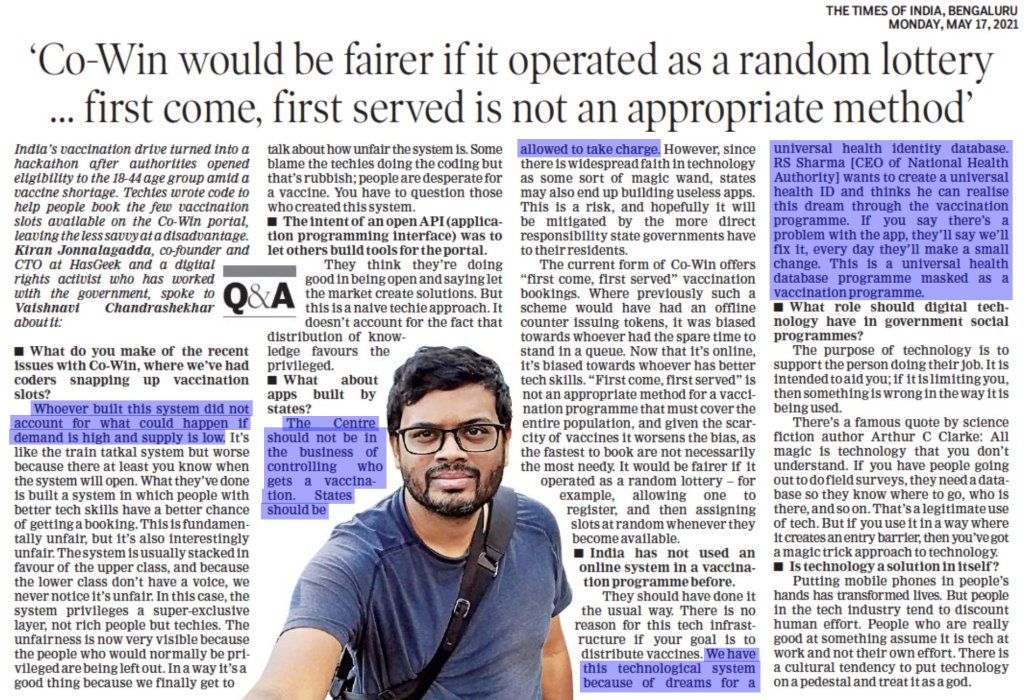
I have deliberately taken a screenshot of the cowin app. in U.P. which is one of the areas where the ruling party, BJP has. I haven t taken my state for the simple reason, even if a slot is open, it is of no use as there are no vaccines. As have been shared in India Cable as well as in many newspapers, it is the Central Govt. which holds the strings for the vaccines. Maharashtra did put up an international tender but to no effect. All vaccine manufacturers want only Central Govt. for purchases for multiple reasons. And GOI is saying it has no money even though recently it got loans as well as a dividend from RBI to the tune of 99k crore. For what all that money is, we have no clue. Coming back though, to the issue at hand. the cowin app. is made an open api. While normally, people like us should and are happy when an API is open, it has made those who understand how to use git, compile, etc. better than others. A copy of the public repo. of how you can do the same can be found on Github. Now, obviously, for people like me and many others it has ethical issues.

Kiran s Interview in Times of India (TOI) There isn t much to say apart from I haven t used it. I just didn t want to. It just is unethical. Hopefully, in the coming days GOI does something better. That is the only thing we are surviving on, hope.

The Toolkit saga A few days before, GOI shared a toolkit apparently made by Congress to defame the party in power. That toolkit was shared before the press and Altnews did the investigation and promptly shredded the claims. Congress promptly made an FIR in Chhattisgarh where it is in power. The gentleman who made the claims Mr. Sambit Patra refused to appear against the police without evidence citing personal reasons and asking 1 week to appear before them. Apart from Altnews which did a great job, sadly many people didn t even know that there is something called WYSIWYG. I had to explain that so many Industries, whether it is politics, creative industries, legal, ad industries, medical transcription, and imaging all use this, and all the participants use the same version of the software. The reason being that in most Industries, there is a huge loss and issue of legal liabilities if something untoward happens. For e.g. if medical transcription is done in India is wrong (although his or her work will be checked by a superior in the West), but for whatever reason is not, and a wrong diagnosis is put (due to wrong color or something) then a patient could die and the firm who does that work could face heavy penalties which could be the death of them. There is another myth that Congress has unlimited wealth or huge wealth. I asked if that was the case, why didn t they shift to Mac. Of course, none have answers on this one. There is another reason why they didn t want to appear. The Rona Wilson investigation by Arsenal Experts also has made them cautious. Previously, they had a free run. Nowadays, software forensic tools are available to one and all. For e.g. Debian itself has a good variety of tools for the same. I remember Vipin s sharing few years back. For those who want to start, just install the apps. and try figuring out. Expertise on using the tools takes years though, as you use the tool day in night. Update 25/05/2021 Apparently because Twitter made and showcased few tweets as Manipulated Media , those in Govt. are and were dead against it. So they conducted a raid against Twitter India headquarters, knowing fully well that there would be nobody except security. The moment I read this, my mind went to the whole Fruit of the poisonous tree legal doctrine. Sadly though, India doesn t recognize it and in fact, still believes in the pre-colonial era that evidence however collected is good. A good explanation of the same can be found here. There are some exceptions to the rule, but they are done so fine that more often than not, they can t be used in the court of law in India. Although a good RTI was shared by Mr. Saket Gokhale on the same issue, which does raise some interesting points
Twitter India Raid, Saket Gokhale RTI 1
Saket Gokhale RTI query , Twitter India Raid 2
FWIW, Saket has been successful in getting his prayers heard either as answers to RTI queries or then following it up in the various High Courts of India. Of course, those who are in the ruling party ridicule him but are unable to find faults in his application of logic. And quite a few times, I have learned from his applications as well as nuances or whatever is there in law, a judgment or a guideline which he invokes in his prayer. For e.g. the Lalitha Kumari Guidelines which the gentleman has shared in his prayer can be found here. Hence now, it would be upto the Delhi Police Cell to prove their case in response to RTI. He has also trapped them as he has shared they can t give excuses/exemptions which they have tried before. As I had shared earlier, High Courts in India have woken up, whether it is Delhi, Mumbai, Aurangabad, Madhya Pradesh, Uttar Pradesh, Odisha or Kerala. Just today i.e. on 25th May 2021, Justices Bela Trivedi and Justice Kalra had asked how come all the hospitals don t have NOC from the Fire De[partment. They also questioned the ASG (Assistant Solicitor General) as how BU (Building Use Certificate) has been granted as almost all the 400 hospitals are in residential area. To which the ASG replies, it is the same state in almost 4000 schools as well as 6000 odd factories in Ahemdabad alone, leave the rest of the district and state alone. And this is when last year strict instuctions were passed. They chose to do nothing sadly. I will share a link on this when bar and bench gives me  The Hindu also shared the whole raid on twitter saga.

Conclusion In conclusion, I sincerely do not where we are headed. The only thing I know is that we cannot expect things to be better before year-end and maybe even after that. It all depends on the vaccines and their availability. After that ruralindia article, I had to see quite a few movies and whatnot just to get that out of my head. And this is apart from the 1600 odd teachers and workers who have died in the U.P. poll duty. Now, what a loss, not just to the family members of the victims, but a whole generation of school children who would not be able to get quality teaching and be deprived of education. What will be their future, God only knows. The only good Bollywood movie which I saw was Ramprasad ki Teravi . The movie was an accurate representation of most families in and around me. There was a movie called Sansar (1987) which showed the breakup of the joint family and into a nuclear family. This movie could very well have been a continuation of the same. Even Marathi movies which at one time were very progressive have gone back to the same boy, girl love story routine. Sameer, though released in late 2020, was able to see it only recently. Vakeel Saab was an ok copy of Pink . I loved Sameer as, unlike Salman Khan films, it showed pretty much an authentic human struggle of a person who goes to the Middle East without any qualifications and works as a laborer and the trials he goes through. Somehow, Malayalam movies have a knack for showing truth without much of budget. Most of the Indian web series didn t make an impact. I think many of them were just going through the motions, it seems as everybody is concerned with the well-being of their near and dear ones. There was also this (Trigger Warning: This story discusses organized campaigns glorifying and advocating sexual violence against Muslim women.) Hoping people somehow make it to the other side of the pandemic.

24 May 2021

Antoine Beaupr : Leaving Freenode

The freenode IRC network has been hijacked. TL;DR: move to libera.chat or OFTC.net, as did countless free software projects including Gentoo, CentOS, KDE, Wikipedia, FOSDEM, and more. Debian and the Tor project were already on OFTC and are not affected by this.

What is freenode and why should I care? freenode is the largest remaining IRC network. Before this incident, it had close to 80,000 users, which is small in terms of modern internet history -- even small social networks are larger by multiple orders of magnitude -- but is large in IRC history. The IRC network is also extensively used by the free software community, being the default IRC network on many programs, and used by hundreds if not thousands of free software projects. I have been using freenode since at least 2006. This matters if you care about IRC, the internet, open protocols, decentralisation, and, to a certain extent, federation as well. It also touches on who has the right on network resources: the people who "own" it (through money) or the people who make it work (through their labor). I am biased towards open protocols, the internet, federation, and worker power, and this might taint this analysis.

What happened? It's a long story, but basically:
  1. back in 2017, the former head of staff sold the freenode.net domain (and its related company) to Andrew Lee, "American entrepreneur, software developer and writer", and, rather weirdly, supposedly "crown prince of Korea" although that part is kind of complex (see House of Yi, Yi Won, and Yi Seok). It should be noted the Korean Empire hasn't existed for over a century at this point (even though its flag, also weirdly, remains)
  2. back then, this was only known to the public as this strange PIA and freenode joining forces gimmick. it was suspicious at first, but since the network kept running, no one paid much attention to it. opers of the network were similarly reassured that Lee would have no say in the management of the network
  3. this all changed recently when Lee asserted ownership of the freenode.net domain and started meddling in the operations of the network, according to this summary. this part is disputed, but it is corroborated by almost a dozen former staff which collectively resigned from the network in protest, after legal threats, when it was obvious freenode was lost.
  4. the departing freenode staff founded a new network, irc.libera.chat, based on the new ircd they were working on with OFTC, solanum
  5. meanwhile, bot armies started attacking all IRC networks: both libera and freenode, but also OFTC and unrelated networks like a small one I help operate. those attacks have mostly stopped as of this writing (2021-05-24 17:30UTC)
  6. on freenode, however, things are going for the worse: Lee has been accused of taking over a channel, in a grotesque abuse of power; then changing freenode policy to not only justify the abuse, but also remove rules against hateful speech, effectively allowing nazis on the network (update: the change was reverted, but not by Lee)
Update: even though the policy change was reverted, the actual conversations allowed on freenode have already degenerated into toxic garbage. There are also massive channel takeovers (presumably over 700), mostly on channels that were redirecting to libera, but also channels that were still live. Channels that were taken over include #fosdem, #wikipedia, #haskell... Instead of working on the network, the new "so-called freenode" staff is spending effort writing bots and patches to basically automate taking over channels. I run an IRC network and this bot is obviously not standard "services" stuff... This is just grotesque. At this point I agree with this HN comment:
We should stop implicitly legitimizing Andrew Lee's power grab by referring to his dominion as "Freenode". Freenode is a quarter-century-old community that has changed its name to libera.chat; the thing being referred to here as "Freenode" is something else that has illegitimately acquired control of Freenode's old servers and user database, causing enormous inconvenience to the real Freenode.
I don't agree with the suggested name there, let's instead call it "so called freenode" as suggested later in the thread.

What now? I recommend people and organisations move away from freenode as soon as possible. This is a major change: documentation needs to be fixed, and the migration needs to be coordinated. But I do not believe we can trust the new freenode "owners" to operate the network reliably and in good faith. It's also important to use the current momentum to build a critical mass elsewhere so that people don't end up on freenode again by default and find an even more toxic community than your typical run-of-the-mill free software project (which is already not a high bar to meet). Update: people are moving to libera in droves. It's now reaching 18,000 users, which is bigger than OFTC and getting close to the largest, traditionnal, IRC networks (EFnet, Undernet, IRCnet are in the 10-20k users range). so-called freenode is still larger, currently clocking 68,000 users, but that's a huge drop from the previous count which was 78,000 before the exodus began. We're even starting to see the effects of the migration on netsplit.de. Update 2: the isfreenodedeadyet.com site is updated more frequently than netsplit and shows tons more information. It shows 25k online users for libera and 61k for so-called freenode (down from ~78k), and the trend doesn't seem to be stopping for so-called freenode. There's also a list of 400+ channels that have moved out. Keep in mind that such migrations take effect over long periods of time.

Where do I move to? The first thing you should do is to figure out which tool to use for interactive user support. There are multiple alternatives, of course -- this is the internet after all -- but here is a short list of suggestions, in preferred priority order:
  1. irc.libera.chat
  2. irc.OFTC.net
  3. Matrix.org, which bridges with OFTC and (hopefully soon) with libera as well, modern IRC alternative
  4. XMPP/Jabber also still exists, if you're into that kind of stuff, but I don't think the "chat room" story is great there, at least not as good as Matrix
Basically, the decision tree is this:
  • if you want to stay on IRC:
    • if you are already on many OFTC channels and few freenode channels: move to OFTC
    • if you are more inclined to support the previous freenode staff: move to libera
    • if you care about matrix users (in the short term): move to OFTC
  • if you are ready to leave IRC:
    • if you want the latest and greatest: move to Matrix
    • if you like XML and already use XMPP: move to XMPP
Frankly, at this point, everyone should seriously consider moving to Matrix. The user story is great, the web is a first class user, it supports E2EE (although XMPP as well), and has a lot of momentum behind it. It even bridges with IRC well (which is not the case for XMPP) so if you're worried about problems like this happening again. (Indeed, I wouldn't be surprised if similar drama happens on OFTC or libera in the future. The history of IRC is full of such epic controversies, takeovers, sabotage, attacks, technical flamewars, and other silly things. I am not sure, but I suspect a federated model like Matrix might be more resilient to conflicts like this one.) Changing protocols might mean losing a bunch of users however: not everyone is ready to move to Matrix, for example. Graybeards like me have been using irssi for years, if not decades, and would take quite a bit of convincing to move elsewhere. I have mostly kept my channels on IRC, and moved either to OFTC or libera. In retrospect, I think I might have moved everything to OFTC if I would have thought about it more, because almost all of my channels are there. But I kind of expect a lot of the freenode community to move to libera, so I am keeping a socket open there anyways.

How do I move? The first thing you should do is to update documentation, websites, and source code to stop pointing at freenode altogether. This is what I did for feed2exec, for example. You need to let people know in the current channel as well, and possibly shutdown the channel on freenode. Since my channels are either small or empty, I took the radical approach of:
  • redirecting the channel to ##unavailable which is historically the way we show channels have moved to another network
  • make the channel invite-only (which effectively enforces the redirection)
  • kicking everyone out of the channel
  • kickban people who rejoin
  • set the topic to announce the change
In IRC speak, the following commands should do all this:
/msg ChanServ set #anarcat mlock +if ##unavailable
/msg ChanServ clear #anarcat users moving to irc.libera.chat
/msg ChanServ set #anarcat restricted on
/topic #anarcat this channel has moved to irc.libera.chat
If the channel is not registered, the following might work
/mode #anarcat +if ##unavailable
Then you can leave freenode altogether:
/disconnect Freenode unacceptable hijack, policy changes and takeovers. so long and thanks for all the fish.
Keep in mind that some people have been unable to setup such redirections, because the new freenode staff have taken over their channel, in which case you're out of luck... Some people have expressed concern about their private data hosted at freenode as well. If you care about this, you can always talk to NickServ and DROP your nick. Be warned, however, that this assumes good faith of the network operators, which, at this point, is kind of futile. I would assume any data you have registered on there (typically: your NickServ password and email address) to be compromised and leaked. If your password is used elsewhere (tsk, tsk), change it everywhere. Update: there's also another procedure, similar to the above, but with a different approach. Keep in mind that so-called freenode staff are actively hijacking channels for the mere act of mentioning libera in the channel topic, so thread carefully there.

Last words This is a sad time for IRC in general, and freenode in particular. It's a real shame that the previous freenode staff have been kicked out, and it's especially horrible that if the new policies of the network are basically making the network open to nazis. I wish things would have gone out differently: now we have yet another fork in the IRC history. While it's not the first time freenode changes name (it was called OPN before), now the old freenode is still around and this will bring much confusion to the world, especially since the new freenode staff is still claiming to support FOSS. I understand there are many sides to this story, and some people were deeply hurt by all this. But for me, it's completely unacceptable to keep pushing your staff so hard that they basically all (except one?) resign in protest. For me, that's leadership failure at the utmost, and a complete disgrace. And of course, I can't in good conscience support or join a network that allows hate speech. Regardless of the fate of whatever we'll call what's left of freenode, maybe it's time for this old IRC thing to die already. It's still a sad day in internet history, but then again, maybe IRC will never die...

Jonathan Dowland: OpenJDK Runtime Containers

The UBI OpenJDK containers are full fat developer containers: they've got the full OpenJDK distribution in them (including javac etc.); they include Maven and there are various quality-of-life additions such as a Prometheus agent for metrics gathering in OpenShift and a run-java script to control launching the eventual application, as well as OpenShift Source-To-Image (S2I) integration. We've had a number of customers request that we produce some runtime-only images. It took a while to properly scope the request, as each person who wanted such a thing wanted a different subset of functionality included from the existing images. One consistent request though related to image size: It became clear that the runtime images should be as minimal as possible. Last week we launched ubi8/openjdk-8-runtime and ubi8/openjdk-11-runtime containers which weight in at 106.M1iB and 119.7 MiB respectively. They are extremely bare-bones, containing just a subset of the OpenJDK distribution (that which is packaged as java-N-openjdk-headless in RHEL) on top of the UBI minimal flavour base images. To explain one way these could be use in an OpenShift environment I wrote a blog post for Red Hat Developer: Build lean Java containers with the new Red Hat Universal Base Images OpenJDK runtime images. We've got a couple of avenues under exploration in this area which should result in even leaner or more tailored images in the future. I'll write more when we have something to show!

Jonathan Dowland: Answering my own Template Haskell question

A couple of weeks ago I stumbled across a Template Haskell question on the Haskell sub-reddit. This was quite exciting because I rarely see TH questions, and this one was by someone working on something which was quite similar to what I had done: they were writing a code generator, and had pure functions of type Exp -> Exp -> Exp, but wanted to leverage TH's quasi-quotation syntax (e.g. [ \p -> p + 1 ]) as a syntactic short-hand. Alas these quasi-quotes are of type Q Exp, so the question becomes, how to escape Q? I had to do exactly this, so I knew an answer: use unsafePerformIO. Another commenter pointed at this Overloaded Quotation Brackets GHC Proposal which I was not aware of and is a much more elegant solution, available since GHC 9.0.1. There was something odd about the question, though. Sometime later on, I checked back to find that the thread had been deleted. It turns out it was one of a set of duplicate posts with exactly the same question. Spammers are copying old questions and reposting them, presumably in an attempt to harvest "Reddit karma". When I learned that, my sense of oddness about the question remained, so I went to find the original thread, to discover I wrote the original question a year ago and had therefore literally answered my own question a year later. Back to the more elegant solution. In GHC versions 9 onwards, quasi-quotation returns a different type that is not bound up in the Q Monad: GHC 8.8.4:
 > :t [  42  ]
[  42  ] :: Language.Haskell.TH.Lib.Internal.ExpQ
 > [  42  ]
<interactive>:5:1: error:
      No instance for (Show Language.Haskell.TH.Lib.Internal.ExpQ)
        arising from a use of  print 
      In a stmt of an interactive GHCi command: print it
GHC 9.0.1:
 > :t [  42  ]
[  42  ]
  :: Language.Haskell.TH.Syntax.Quote m =>
     m Language.Haskell.TH.Syntax.Exp
 > [  42  ]
LitE (IntegerL 42)

Ritesh Raj Sarraf: Kget Goodness

Why is it so hard to have a proper download manager in today s day ? We had it in the previous decade. Or do tech giants self-proclaim that the world lives only in their cloud. At one point, there used to be great download managers for all major web browsers, either in-built, or external. Then came the latest trend with Chrome and Firefox, where they make it difficult to have an external download manager work proper. On either one s extension store, I find it difficult to see a proper download manager. And I wonder what Google was consuming when making Google Takeout. They provide you with a specially crafted link for the downloads, and if for any reason your network gets lost, you are forced to redownload your takeout again. And with the pathetic download manager in Chrome and Firefox, an average Joe user would run in loops. THANK YOU GOOG. While I can understand the reason behind making the links time bound and invalidating them as soon as the time expires. But, enlighten your PMs that the world is not even. Not everyone has the same internet bandwidth. And admit that the download manager in your browser is crap. And then devise a better workflow and a product.
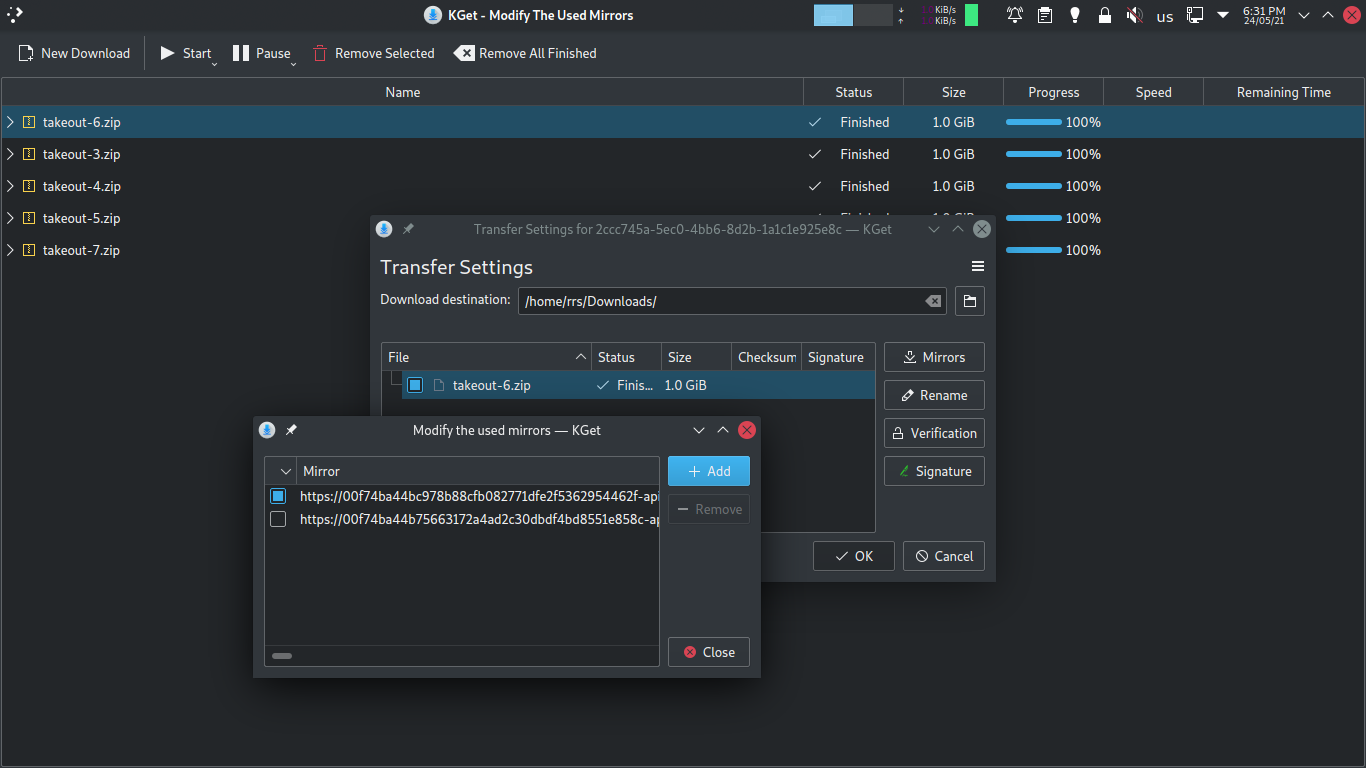
KGET Thankfully, there s Kget in the KDE Suite. While there s insanity elsewhere, luckily the kget tool still can do nice things. nuff said.
KGET to the rescue
KGET to the rescue

Vincent Bernat: Transient prompt with Zsh

Powerlevel10k is a theme for Zsh. It contains some powerful features, is astoundingly fast, and easy to customize. I am quite amazed at the skills of its main author. Be sure to also have a look at Zsh for Humans, a complete Zsh configuration including this theme. One of the nice features of Powerlevel10k is transient prompts: past prompts are reduced to a more minimal configuration to save space by removing unneeded information.
Demonstration of a transient prompt with Zsh: past prompts use a more compact form
My implementation of a transient prompt with Zsh. Past prompts are compact and include the time of the command execution, the hostname, and the status of the previous command while the complete prompt contains more information like the current directory and the Git branch.
When it comes to configuring my shell, I still prefer writing and understanding each line going into it. Therefore, I am still building my Zsh configuration from scratch. Here is how I have integrated the above transient feature into my prompt. The first step is to configure the appearance of the prompt in its compact form. Let s assume we have a variable, $_vbe_prompt_compact set to 1 when we want a compact prompt. We use the following function to define the prompt appearance:
_vbe_prompt ()  
    local retval=$?
    # When compact, just time + prompt sign
    if (( $_vbe_prompt_compact )); then
        # Current time (with timezone for remote hosts)
        _vbe_prompt_segment cyan default "%D %H:%M$ SSH_TTY+ %Z  "
        # Hostname for remote hosts
        [[ $SSH_TTY ]] && \
            _vbe_prompt_segment black magenta "%B%M%b"
        # Status of the last command
        if (( $retval )); then
            _vbe_prompt_segment red default $ PRCH[reta] 
        else
            _vbe_prompt_segment green cyan $ PRCH[ok] 
        fi
        # End of prompt
        _vbe_prompt_end
        return
    fi
    # Regular prompt with many information
    # [ ]
 
setopt prompt_subst
PS1='$(_vbe_prompt) '

Update (2021.05) The following part has been rewritten to be more robust. The code is stolen from Powerlevel10k s issue #888. See the comments for more details.

Our next step is to redraw the prompt after accepting a command. We wrap Zsh line editor into a function:1
_vbe-zle-line-init()  
    [[ $CONTEXT == start ]]   return 0
    # Start regular line editor
    (( $+zle_bracketed_paste )) && print -r -n - $zle_bracketed_paste[1]
    zle .recursive-edit
    local -i ret=$?
    (( $+zle_bracketed_paste )) && print -r -n - $zle_bracketed_paste[2]
    # If we received EOT, we exit the shell
    if [[ $ret == 0 && $KEYS == $'\4' ]]; then
        _vbe_prompt_compact=1
        zle .reset-prompt
        exit
    fi
    # Line edition is over. Shorten the current prompt.
    _vbe_prompt_compact=1
    zle .reset-prompt
    unset _vbe_prompt_compact
    if (( ret )); then
        # Ctrl-C
        zle .send-break
    else
        # Enter
        zle .accept-line
    fi
    return ret
 
zle -N zle-line-init _vbe-zle-line-init
That s all!
One downside of using the powerline fonts is that it messes with copy/paste. As I am using tmux, I use the following snippet to work around this issue and use only standard Unicode characters when copying from the terminal:
bind-key -T copy-mode M-w \
  send -X copy-pipe-and-cancel "sed 's/ .* /%/g'   xclip -i -selection clipboard" \;\
  display-message "Selection saved to clipboard!"
Copying and pasting the text from the screenshot above yields the following text:
14:21 % ssh eizo.luffy.cx
Linux eizo 4.19.0-16-amd64 #1 SMP Debian 4.19.181-1 (2021-03-19) x86_64
Last login: Fri Apr 23 14:20:39 2021 from 2a01:cb00:3f:b02:9db6:efa4:d85:7f9f
14:21 CEST % uname -a
Linux eizo 4.19.0-16-amd64 #1 SMP Debian 4.19.181-1 (2021-03-19) x86_64 GNU/Linux
14:21 CEST %
Connection to eizo.luffy.cx closed.
14:22 % git status
On branch article/zsh-transient
Untracked files:
  (use "git add <file>..." to include in what will be committed)
        ../../media/images/zsh-compact-prompt@2x.jpg
nothing added to commit but untracked files present (use "git add" to track)

  1. We have to manually enable bracketed paste because Zsh does it after zle-line-init.

Charles Plessy: Trying R 4.1

I am trying R 4.1 in a schroot experimental container, while waiting that Bullseye's release will allow the package to be uploaded to Sid and the needed dependencies to be recompiled. The schroot:
sudo debootstrap sid /srv/chroot/r-4.1 http://deb.debian.org/debian
sudo vi /etc/schroot/chroot.d/r-4.1
# Edit it to have something like
    [r-4.1]
    description=R 4.1 (experimental)
    type=directory
    directory=/srv/chroot/r-4.1
    users=  # Here put your username
    root-groups=root
    profile=desktop
    personality=linux
    preserve-environment=true
sudo schroot -c r-4.1
vi /etc/apt/sources.list # To add the experimental distribution
apt update
apt install sudo vim wget
exit
Installation of R:
schroot -c r-4.1
sudo apt install r-base/experimental -texperimental
sudo apt install -texperimental pandoc libxml2-dev libcurl4-openssl-dev git libssl-dev texlive
And RStudio (preview version needed)
wget https://s3.amazonaws.com/rstudio-ide-build/desktop/bionic/amd64/rstudio-1.4.1714-amd64.deb
sudo apt install libnss3 libasound2
sudo dpkg -i rstudio-1.4.1714-amd64.deb 
sudo apt -f install -texperimental

Dirk Eddelbuettel: RcppArmadillo 0.10.5.0.0 on CRAN: New Upstream

armadillo image Armadillo is a powerful and expressive C++ template library for linear algebra aiming towards a good balance between speed and ease of use with a syntax deliberately close to a Matlab. RcppArmadillo integrates this library with the R environment and language and is widely used by (currently) 865 other packages on CRAN. This new release brings Armadillo 10.5.0 which was released early on Friday. We had done one full test in the 10.5 rc1 prerelease one week earlier, and did another test on 10.5.0 and this 0.10.5.0.0 RcppArmadillo release just for added rigour. The package was then uploaded to CRAN late Friday (my timezone). The automated process flagged one NOTE as a false positive (yet another instance of the well-known (yet dreaded) issue of Suggests != Depends by one these 865 packages). This lead to a need of an inspection by one of the CRAN maintainers, and the weekend being the weekend it was only processed just now. Upstream moves at a speed that is a little faster than the cadence CRAN likes. As we had released RcppArmadillo 0.10.4.0.0 on April 13 we did not want to follow-up too soon thereafter with 0.10.4.1.0 which was thusly only a GitHub and drat release (which can always be had easily too via install.packages("RcppArmadillo", repos="https://RcppCore.github.io/drat").) The full set of changes follows. We include the aforementioned interim release as well.

Changes in RcppArmadillo version 0.10.5.0 (2021-05-21)
  • Upgraded to Armadillo release 10.5 (Antipodean Fortress)
    • added .clamp() member function
    • expanded the standalone clamp() function to handle complex values
    • more efficient use of OpenMP
    • vector, matrix and cube constructors now initialise elements to zero by default; use the fill::none specifier, eg. mat X(4,5,fill::none), to disable element initialisation
  • Added codecov.yml to exclude Armadillo from coverage analysis

Changes in RcppArmadillo version 0.10.4.1.0 (2021-04-23)
  • Upgraded to Armadillo release 10.4.1 (Pressure Cooker)
  • GitHub-only release

Courtesy of my CRANberries, there is a diffstat report relative to previous release. More detailed information is on the RcppArmadillo page. Questions, comments etc should go to the rcpp-devel mailing list off the R-Forge page. If you like this or other open-source work I do, you can sponsor me at GitHub.

This post by Dirk Eddelbuettel originated on his Thinking inside the box blog. Please report excessive re-aggregation in third-party for-profit settings.

23 May 2021

Ian Jackson: Otter game server - now with uploadable game bundles

In April I wrote about releasing Otter, which has been one of my main personal projects during the pandemic. Uploadable game materials Otter comes with playing cards and a chess set, and some ancillary bits and bobs. Until now, if you wanted to play with something else, the only way was to read some rather frightening build instructions to add your pieces to Otter itself, or to dump a complicated structure of extra files into the server install. Now that I have released Otter 0.6.0, you can upload a zipfile to the server. The format of the zipfile is even documented! Otter development - I still love Rust Working on Otter has been great fun, partly because it has involved learning lots of new stuff, and partly because it's mosty written in Rust. I love Rust; one of my favourite aspects is the way it's possible to design a program so that most of your mistakes become compile errors. This means you spend more time dealing with compiler errors and less time peering at a debugger trying to figure out why it has gone wrong. Future plans - help wanted! So far, Otter has been mostly a one-person project. I would love to have some help. There are two main areas where I think improvement is very important: If you think you could help with these, and playing around with a game server sounds fun, do get in touch. For now, next on my todo list is to provide a nicely cooked git-forge-style ssh transport facility, so that you don't need a shell account on the server but can run the otter command line client tool locally.

comment count unavailable comments

Junichi Uekawa: Last weekend I had Debian meeting.

Last weekend I had Debian meeting. I presented how Golang packages work. I don't really know how they work and I learnt how they work along with preparation for the material. I noticed that I couldn't present a window from Chrome browser. After playing around a little bit more Filed a bug, seems like unable to capture the display or the wayland window, only X11 windows, but I wonder what will come out of it. I have issues with IME keybindings not reliably working, and this. Wayland is not dependable for me yet.
22 May 2021

Ritesh Raj Sarraf: Setting Up a Secure Webapp

As a person who prefers full access to data in the simplest format, while at the same time having it useful with latest technologies, my quest for trying things out is an ongoing activity. Earlier, I blogged about my needs of collating news feeds in a simple format, readily accessible offline, while still being useful and aligned with the modern paradigm. In today s age, the other common aspect of our life, is digitization of moments. With the advent of great technology and affordable economics, the world now has access to great devices to capture moments in digital form. Most people, these days, are equipped with smart devices, like mobile phones, that come with pretty good image capturing devices. Our lives, our societies, how we interact; a lot of it is now built around the assumption of smart devices and digital services. A lot of good things have happened of it. We are now able to send messages to people, securely, in a matter of seconds. We are now able to capture moments, which otherwise we d often miss; all thanks to devices like smart mobile phones that most of all carry almost all along with us. In this regard, we are quite indebted to the technology revolution that has improved life styles all over. Of course, like every coin has a flip side, thus too, too much of obsession with digital life, also has its drawbacks. A simple reminder to self should always be about what a human life is designed for and try to live by its rules.

Moments Given the tools general availability, we are all more used to capturing moments. Once upon a time, taking a photo meant going to a photo studio. Then came a generation where we d have personal devices with roll films, to which we captured the moments. And then get it processed from a photo developing service provider. And that is when we d know which all moments came out correct and which ones were spoilt. In such cases, there s always the wish I could have that moment again. Thankfully, now, in our current generation, we have the liberty to take pictures and validate them almost immediately. We also have the flexibility to take multiple shots of the moment and do the filtering later. There s also many intelligent and invasive services, all mostly provided free, to help you organize these moments; at a small cost of keeping an eye on your life activity. In a summary, mankind, now, generates lots and lots of data. So much lot that now even mammoths like Google are forced to make a call whether it is more profitable to sniff user activity while providing them a service for free, or ask people to pay otherwise too.

Privacy Many of us are wary of the amount of personal data we generate, which is our asset; and how the big tech giants want a piece of it in the name of free services. And in such quest, free aside, there s always a lookout for privacy savvy tools that can help us draw a bold line in between Public and Private

Google Photos Google Photos has been a great tool. The way it organizes, siphons and present your data is simply amazing. No good would have been the photos taken, if they weren t easily searchable, organized, annotated, and presented. But Google Photos is proprietary and invasive. The amount of information they have access to should be a concern to all people. For services that invade so much, the world needs Free Services.

PhotoPrism I only came across this project around a month ago, while the project has been around since 2019. So far, in my exploration, this is one of the best Free Software tools to manage and organize my digital photos. The other favorite tool that I regularly depend on is Digikam and it still is a gem. In a gist, PhotoPrism aims to be the equivalent of Google Photos, for the privacy savvy people. As of date, it has a decent list of features available. And for some of the missing ones, I ve come up with a fairly okay workflow with other tools, which is one of the reasons of this blog post. PhotoPrism is a web app, written in the Go Programming Language. Its layout and workflow as a Photo Management application is similar to Google Photos. It is very performant compared to other applications. Since it is a Progressive Web App, access through a Laptop, Tablet or Mobile is almost the same. It uses Google TensorFlow for some of its features and thus you feel like using Google Photos in some regard. Some shortcomings and workarounds
  • Facial Recognition: To date, facial recognition is a planned feature. But this was easy to tackle given that Digikam has pretty solid facial recognition. So I use Digikam to detect, recognize and annotate faces. And then PhotoPrism is happy enough to use those annotations and present relevant data.
  • HTTP Web App: The upstream project has done a good job of making use of Docker container technology in presenting this web app solution. A software solution, the equivalent of a Google Photos, does need a heavyweight config. In free software, it is all about reusing available tools. PhotoPrism makes use of tools like MySQL, Vue.js, TensorFlow, GoLang, GoLibs and strives to provide a single package solution, all thanks to Docker containers.
In its current offering, PhotoPrism is run as a HTTP Web App. I wanted to have an added layer of security on top of it. And thus run an nginx reverse proxy on top of it. Along with it, I run the proxy service on HTTPS, thus making all traffic from clients to the proxy encrypted. I also wanted an added layer of HTTP AUTH on top, so I explored some options and finally settled down with http-auth-digest Also, in the current implementation, PhotoPrism doesn t have a strong notion of normal and private photos in its data organization. I wanted normal photos available under a standard auth realm and private photos under a different realm. And along with a different realm, I also wanted some added security directives for it. So far, it looks like I ve put together a decent solution with the help of nginx.
  • First of all, since the port from the host is forwarded to the docker instance, that needed to be controlled. Instead of the default of listening on all interfaces, I changed it to loopback only. Because my primary and only interface is going to be the nginx reverse proxy
  • Setup nginx with a self-signed certificate to have all communication encrypted.
  • Setup nginx as a reverse proxy to talk to PhotoPrism.
    server  
       listen 80;
       listen [::]:80;
       server_name lenovo;
       return 302 https://$host$request_uri;
       rewrite ^ https://$http_host$request_uri? permanent;    # force redirect http to https
        server_tokens off;
     
    server  
    listen 443 ssl http2 default_server;
    listen [::]:443 ssl http2 default_server;
    ssl_certificate_key /etc/ssl/private/ssl-cert-snakeoil.key;
    ssl_certificate /etc/ssl/certs/ssl-cert-snakeoil.pem;
    server_tokens off;
    server_name lenovo;
    client_max_body_size 500M;
        auth_digest_expires 900s;
        auth_digest_evasion_time 5s;
        auth_digest_replays 500;
    location /private  
        auth_digest 'abc';
        auth_digest_user_file /etc/nginx/htdigest;
        auth_digest_expires 900s;
        auth_digest_evasion_time 5s;
        auth_digest_replays 500;
        proxy_pass http://localhost:2342/private;
     
    location /discover  
        auth_digest 'abc';
        auth_digest_user_file /etc/nginx/htdigest;
        auth_digest_expires 900s;
        auth_digest_evasion_time 5s;
        auth_digest_replays 500;
        proxy_pass http://localhost:2342/discover;
     
    location /  
        proxy_set_header X-Forwarded-For $proxy_add_x_forwarded_for;
        proxy_set_header Host $host;
        proxy_buffering off;
        proxy_http_version 1.1;
        proxy_set_header Upgrade $http_upgrade;
        proxy_set_header Connection "upgrade";
        proxy_pass http://localhost:2342;
          
        auth_basic "Priv";
        auth_basic_user_file /etc/nginx/htpasswd;


  • nginx packaging: I was so happy to see the simplicity of the nginx packaging in Debian. Becuase http-auth-digest is not upstream, it needs to be pulled in separately and compiled. I was happy to see how simple the packaging structure of nginx in Debian is. It was just a matter of putting in the module in the right modules location, which as structured such in the packaging falls under the debian/ packaging sub-folder, that any future upgrades will be quite easy to manage.
  • http-auth-digest: I d love to see http-auth-digest module be part of the upstream package. While I m a web n00b, I felt this module perfect for my use case. From what I ve understood, set up and tested so far, this module fills in all my requirements; which is more of like a session management.
With the combined setup in place, https://host is authenticated with a different set of credentials. On the other hand, https://host/discover and /private get covered with a different set of credentials and policies. While, this will continue to be an ongoing effort and audit of the services that I build, so far now, I feel this is in decent shape that I can use it as my daily driver. The end result is:
nginx auth prompt
nginx auth prompt
PhotoPrism Photo List
PhotoPrism Menu
PhotoPrism Menu

Updates
  • Things can really get frustrating at times. These days, it is Google that contributes to it. https://bugs.chromium.org/p/chromium/issues/detail?id=544244
    • It is is now fair to say that Google is big enough to rewrite all the standards. Or at least break them. Or best, their arrogance of it. This bug report is a fine example of what other ways it could have been dealt.

20 May 2021

Jonathan McDowell: Losing control to Kubernetes

GMK NucBox Kubernetes is about giving up control. As someone who likes to understand what s going on that s made it hard for me to embrace it. I ve also mostly been able to ignore it, which has helped. However I m aware it s incredibly popular, and there s some infrastructure at work that uses it. While it s not my responsibility I always find having an actual implementation of something is useful in understanding it generally, so I decided it was time to dig in and learn something new. First up, I should say I understand the trade-off here about handing a bunch of decisions off to Kubernetes about the underlying platform allowing development/deployment to concentrate on a nice consistent environment. I get the analogy with the shipping container model where you can abstract out both sides knowing all you have to do is conform to the TEU API. In terms of the underlying concepts I ve got some virtualisation and container experience, so I m not coming at this as a complete newcomer. And I understand multi-site dynamically routed networks. That said, let s start with a basic goal. I d like to understand k8s (see, I can be cool and use the short name) enough to be comfortable with what s going on under the hood and be able to examine a running instance safely (i.e. enough confidence about pulling logs, probing state etc without fearing I might modify state). That ll mean when I come across such infrastructure I have enough tools to be able to hopefully learn from it. To do this I figure I ll need to build myself a cluster and deploy some things on it, then poke it. I ll start by doing so on bare metal; that removes variables around cloud providers and virtualisation and gives me an environment I know is isolated from everything else. I happen to have a GMK NucBox available, so I ll use that. As a first step I m aiming to get a single node cluster deployed running some sort of web accessible service that is visible from the rest of my network. That should mean I ve covered the basics of a Kubernetes install, a running service and actually making it accessible. Of course I m running Debian. I ve got a Bullseye (Debian 11) install - not yet released as stable, but in freeze and therefore not a moving target. I wanted to use packages from Debian as much as possible but it seems that the bits of Kubernetes available in main are mostly just building blocks and not a great starting point for someone new to Kubernetes. So to do the initial install I did the following:
# Install docker + nftables from Debian
apt install docker.io nftables
# Add the Kubernetes repo and signing key
curl -s https://packages.cloud.google.com/apt/doc/apt-key.gpg > /etc/apt/k8s.gpg
cat > /etc/apt/sources.list.d/kubernetes.list <<EOF
deb [signed-by=/etc/apt/k8s.gpg] https://apt.kubernetes.io/ kubernetes-xenial main
EOF
apt update
apt install kubelet kubeadm kubectl
That resulted in a 1.21.1-00 install, which is current at the time of writing. I then used kubeadm to create the cluster:
kubeadm init --apiserver-advertise-address 192.168.53.147 --apiserver-cert-extra-sans udon.mynetwork
The extra parameters were to make the API server externally accessible from the host. I don t know if that was a good idea or not at this stage kubeadm spat out a bunch of instructions but the key piece was about copying the credentials to my user account. So I did:
mkdir ~noodles/.kube
cp -i /etc/kubernetes/admin.conf ~noodles/.kube/config
chown -R noodles ~noodles/.kube/
I then was able to see my pod:
noodles@udon:~$ kubectl get nodes
NAME   STATUS     ROLES                  AGE     VERSION
udon   NotReady   control-plane,master   4m31s   v1.21.1
Ooooh. But why s it NotReady? Seems like it s a networking issue and I need to install a networking provider. The documentation on this is appalling. Flannel gets recommended as a simple option but then turns out to need a --pod-network-cidr option passed to kubeadm and I didn t feel like cleaning up and running again (I ve omitted all the false starts it took me to get to this point). Another pointer was to Weave so I decided to try that with the following magic runes:
mkdir -p /var/lib/weave
head -c 16 /dev/urandom   shasum -a 256   cut -d " " -f1 > /var/lib/weave/weave-passwd
kubectl create secret -n kube-system generic weave-passwd --from-file=/var/lib/weave/weave-passwd
kubectl apply -f "https://cloud.weave.works/k8s/net?k8s-version=$(kubectl version   base64   tr -d '\n')&password-secret=weave-passwd&env.IPALLOC_RANGE=192.168.0.0/24"
(I believe what that s doing is the first 3 lines create a password and store it into the internal Kubernetes config so the weave pod can retrieve it. The final line then grabs a YAML config from Weaveworks to configure up weave. My intention is to delve deeper into what s going on here later; for now the primary purpose is to get up and running.) As I m running a single node cluster I then had to untaint my control node so I could use it as a worker node too:
kubectl taint nodes --all node-role.kubernetes.io/master-
And then:
noodles@udon:~$ kubectl get nodes
NAME   STATUS   ROLES                  AGE   VERSION
udon   Ready    control-plane,master   15m   v1.21.1
Result. What s actually running? Nothing except the actual system stuff, so we need to ask for all namespaces:
noodles@udon:~$ kubectl get pods --all-namespaces
NAMESPACE     NAME                           READY   STATUS    RESTARTS   AGE
kube-system   coredns-558bd4d5db-4nvrg       1/1     Running   0          18m
kube-system   coredns-558bd4d5db-flrfq       1/1     Running   0          18m
kube-system   etcd-udon                      1/1     Running   0          18m
kube-system   kube-apiserver-udon            1/1     Running   0          18m
kube-system   kube-controller-manager-udon   1/1     Running   0          18m
kube-system   kube-proxy-6d8kg               1/1     Running   0          18m
kube-system   kube-scheduler-udon            1/1     Running   0          18m
kube-system   weave-net-mchmg                2/2     Running   1          3m26s
These are all things I m going to have to learn about, but for now I ll nod and smile and pretend I understand. Now I want to actually deploy something to the cluster. I ended up with a simple HTTP echoserver (though it s not entirely clear that s actually the source for what I ended up pulling):
$ kubectl create deployment hello-node --image=k8s.gcr.io/echoserver:1.10
deployment.apps/hello-node created
$ kubectl get pod
NAME                          READY   STATUS    RESTARTS   AGE
hello-node-59bffcc9fd-8hkgb   1/1     Running   0          36s
$ kubectl expose deployment hello-node --type=NodePort --port=8080
$ kubectl get services
NAME         TYPE        CLUSTER-IP      EXTERNAL-IP   PORT(S)          AGE
hello-node   NodePort    10.107.66.138   <none>        8080:31529/TCP   1m
Looks good. And to test locally:
curl http://10.107.66.138:8080/

Hostname: hello-node-59bffcc9fd-8hkgb
Pod Information:
	-no pod information available-
Server values:
	server_version=nginx: 1.13.3 - lua: 10008
Request Information:
	client_address=192.168.53.147
	method=GET
	real path=/
	query=
	request_version=1.1
	request_scheme=http
	request_uri=http://10.107.66.138:8080/
Request Headers:
	accept=*/*
	host=10.107.66.138:8080
	user-agent=curl/7.74.0
Request Body:
	-no body in request-
Neat. But my external network is 192.168.53.0/24 and that s a 10.* address so how do I actually make it visible to other hosts? What I seem to need is an Ingress Controller which provide some sort of proxy between the outside world and pods within the cluster. Let s pick nginx because at least I have some vague familiarity with that and it seems like it should be able to do a bunch of HTTP redirection to different pods depending on the incoming request.
kubectl apply -f https://raw.githubusercontent.com/kubernetes/ingress-nginx/controller-v0.46.0/deploy/static/provider/cloud/deploy.yaml
I then want to expose the hello-node to the outside world and I finally had to write some YAML:
cat > hello-ingress.yaml <<EOF
apiVersion: networking.k8s.io/v1
kind: Ingress
metadata:
  name: example-ingress
  annotations:
    nginx.ingress.kubernetes.io/rewrite-target: /$1
spec:
  rules:
    - host: udon.mynetwork
      http:
        paths:
          - path: /
            pathType: Prefix
            backend:
              service:
                name: hello-node
                port:
                  number: 8080
EOF
i.e. incoming requests to http://udon.mynetwork/ should go to the hello-node on port 8080. I applied this:
$ kubectl apply -f hello-ingress.yaml
ingress.networking.k8s.io/example-ingress created
$ kubectl get ingress
NAME              CLASS    HOSTS            ADDRESS   PORTS   AGE
example-ingress   <none>   udon.mynetwork             80      3m8s
No address? What have I missed? Let s check the nginx service, which apparently lives in the ingress-nginx namespace:
noodles@udon:~$ kubectl get services -n ingress-nginx
NAME                                 TYPE           CLUSTER-IP      EXTERNAL-IP   PORT(S)                    AGE
ingress-nginx-controller             LoadBalancer   10.96.9.41      <pending>     80:32740/TCP,443:30894/TCP 13h
ingress-nginx-controller-admission   ClusterIP      10.111.16.129   <none>        443/TCP                    13h
<pending> does not seem like something I want. Digging around it seems I need to configure the external IP. So I do:
kubectl patch svc ingress-nginx-controller -n ingress-nginx -p \
	' "spec":  "type": "LoadBalancer", "externalIPs":["192.168.53.147"] '
and things look happier:
noodles@udon:~$ kubectl get services -n ingress-nginx
NAME                                 TYPE           CLUSTER-IP      EXTERNAL-IP      PORT(S)                 AGE
ingress-nginx-controller             LoadBalancer   10.96.9.41      192.168.53.147   80:32740/TCP,443:30894/TCP   14h
ingress-nginx-controller-admission   ClusterIP      10.111.16.129   <none>           443/TCP                 14h
noodles@udon:~$ kubectl get ingress
NAME              CLASS    HOSTS           ADDRESS          PORTS   AGE
example-ingress   <none>   udon.mynetwork  192.168.53.147   80      14h
Let s try a curl from a remote host:
curl http://udon.mynetwork/

Hostname: hello-node-59bffcc9fd-8hkgb
Pod Information:
	-no pod information available-
Server values:
	server_version=nginx: 1.13.3 - lua: 10008
Request Information:
	client_address=192.168.0.5
	method=GET
	real path=/
	query=
	request_version=1.1
	request_scheme=http
	request_uri=http://udon.mynetwork:8080/
Request Headers:
	accept=*/*
	host=udon.mynetwork
	user-agent=curl/7.64.0
	x-forwarded-for=192.168.53.136
	x-forwarded-host=udon.mynetwork
	x-forwarded-port=80
	x-forwarded-proto=http
	x-real-ip=192.168.53.136
	x-request-id=6aaef8feaaa4c7d07c60b2d05c45f75c
	x-scheme=http
Request Body:
	-no body in request-
Ok, so that seems like success. I ve got a single node cluster running a single actual application pod (the echoserver) and exporting it to the outside world. That s enough to start poking under the hood. Which is for another post, as this one is already getting longer than I d like. I ll just leave some final thoughts of things I need to work out:

Taowa: Video calling in Dino in experimental, oh my!

Dino, packaged as dino-im in Debian, is an XMPP chat client. Thanks to the hard work of its developers, Dino has been making progress on supporting video and audio calls. Building on the work of my co-maintainer, I've packaged the latest commits to dino-im in Debian experimental. Adapting to the changes in how Dino is built since the last release took a bit of effort, but I'm glad to say that experimental now has support for video calls in dino-im, and that they work quite well! I was able to test video calling for multiple hours, and while there were clearly still a few issues, the entire experience felt quite... comfortable. I'm confident that video calling will be in great shape for bookworm!

19 May 2021

Dirk Eddelbuettel: RcppDate 0.0.3: New Upstream

RcppDate wraps the featureful date library written by Howard Hinnant for use with R. This header-only modern C++ library has been in pretty wide-spread use for a while now, and adds to C++11/C++14/C++17 what will be (with minor modifications) the date library in C++20. Our previous 0.0.2 release already contained date version 3.0.0 from last year plus some of changes accumulated since then. Now that date 3.0.1 was just released, we are providing a quick sync with this version.

Changes in version 0.0.3 (2021-05-19)
  • Updated to upstream version 3.0.1

If you like this or other open-source work I do, you can now sponsor me at GitHub.

This post by Dirk Eddelbuettel originated on his Thinking inside the box blog. Please report excessive re-aggregation in third-party for-profit settings.

Martin-&#201;ric Racine: WebRTC fails tests on Firefox 78.10.0esr (64-bit)

Having to participate in many online events since the COVID crisis started, I've come to notice that few of the online clients work properly on the current Firefox ESR found in Debian. A quick visit at WebRTC Test confirmed that none of the tests in the Network and Connectivity section pass. Meanwhile, a Windows 10 laptop running Edge via the same network works just fine, so I have to assume that either a Firefox or Debian packaging issue is to blame, but I wouldn't know where to start. Any help? Thanks!

Next.

Previous.