Search Results: "tb"

13 September 2009

Brett Parker: Random Storage Idea...

So, I was reading some random mumblings on the interwebs, and the pigeon with USB stick being a quicker method of data transfer in SA than their intertubes... then there was a thread on a mailing list discussing this, and someone mentioned using stacks of microSD cards... so then my brain decided to launch itself orthogonally, as it often does. What we end up with is wondering just how much storage you could fit in to the space a 3.5" drive would normally take - not taking in to account any method of attaching it at this point. So, a 3.5" drive is approx 102mmx147mmx26mm, a microSD card is 11mmx15mmx1mm, so, assuming that we're just lying them side by side, and not optimising the way they're stored at all, you can fit (with space round the sides) 9*9*26 = 2106 microSD cards in the area of a 3.5" drive. Assuming that each of those is 16G that's just shy of 33.7TB of storage! So, that set me thinking a bit further... I reckon that in that space you could do a 6*6 grid of cards with room for connectors, and just about get it to 10 high...so, that's 360 microSD cards, and probably enough room for some control gear (haven't worked out quite what we'd use for that), I then went in to wondering if we could then create a small embedded system to talk to those 360 microSD cards, if we did that then you could potentially do RAID0 across the "platters" with RAID6 on each platter. Now, to my poor head that meant that there should be 340*16G of available storage, which is 5.44TB... of course, that involves somehow interfacing the 360 microSD cards... I'm thinking that it might be possible with some form of embedded system... Unfortunately, it appears that to actually build this with consumer components... and without including the interface gear which I haven't even begun to work out yet... we're talking around about 26 per microSD card, so, erm, 9360... but I still think it'd be a really neat project... now, if someone can arrange for me to win the lottery, have lots of spare time, and some more brain power... :) Oh dear... my brain appears to have ticked further through, and I've realised that with spacing between each microSD card, you could, in theory, easily fit 400 of them upended in the space available. Erm. Of course, this still doesn't answer the "how the hell do you then get them all to talk in any sane manner" question... but I'm sure that will work out in my head sometime...

Stefano Zacchiroli: RC bugs of the week - week 2

RCBW - week #2 The RC squashing game has apparently worked fine for me also this week, and it has been as fun as the first :-) . This week summary follows. PS the horrible acronym in the title stands for "Release Critical Bugs of the Week"; it is part of my shameless marketing campaign to make the initiative spread.

11 September 2009

Sune Vuorela: Matthew Rosewarne

Over the last months, I have been asking people in KDE irc channels and in Debian KDE channels wether they have heard from Matthew Rosewarne, on irc known as Mukidohime. No one had. Very recently, I uploaded one of his packages with the following changelog entry:
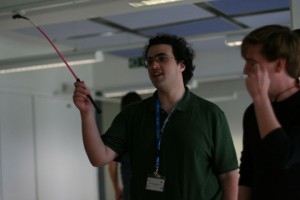
* Switch Maintainer field to krap team and remove Matthew, he seems absent.
We hope he comes back.
Apparantly he was absent. Permanently. Elizabeth Krumbach writes some nice words in his memory. I remember Matthew for his work on several KDE related packages in Debian, always doing a job that was better than I expected. And I especially remember him at Akademy 2008 where he to much joy brought a black horse whip for the chairman of a talkroom. And he even brouht a spare pink horse whip for when the black one broke. Especially Adriaan had a good use of that. And at last, I will bring a image of Matthew showing off his equipment to Aaron Seigo.
Matthew Rosewarne

Matthew Rosewarne

Condolences to his family. Matthew will be missed.

9 September 2009

Matthew Palmer: Quote of the Day

From a post on StorageMojo:
Lustre is not a product I would recommend since it was designed for HPC, a market where PhDs work as sysadmins.
While I've not used Lustre itself, the "market where PhDs work as sysadmins" (and the often less-than-entirely-spectacular results) are something I've dealt with more than once.

Brett Parker: LVM weirdness

I'm having some issues with LVM, basically it appears that I can't assign over a certain amount of my pv, where that certain amount is somewhere around 1.5TB... output from all the relevant chunks are:
ensenada:~# lvdisplay
  --- Logical volume ---
  LV Name                /dev/main/root
  VG Name                main
  LV UUID                ZR33WS-glE2-bUn6-adCX-n50C-37eX-Fc7Pde
  LV Write Access        read/write
  LV Status              available
  # open                 1
  LV Size                7.45 GB
  Current LE             1907
  Segments               1
  Allocation             inherit
  Read ahead sectors     auto
  - currently set to     256
  Block device           254:0
  --- Logical volume ---
  LV Name                /dev/main/voldemort
  VG Name                main
  LV UUID                DrT0co-THRw-6Zcy-Q3PT-OiQj-4KBz-xfV0Un
  LV Write Access        read/write
  LV Status              available
  # open                 1
  LV Size                1.37 TB
  Current LE             358400
  Segments               1
  Allocation             inherit
  Read ahead sectors     auto
  - currently set to     256
  Block device           254:1
ensenada:~# vgdisplay
  --- Volume group ---
  VG Name               main
  System ID
  Format                lvm2
  Metadata Areas        1
  Metadata Sequence No  56
  VG Access             read/write
  VG Status             resizable
  MAX LV                0
  Cur LV                2
  Open LV               2
  Max PV                0
  Cur PV                1
  Act PV                1
  VG Size               5.45 TB
  PE Size               4.00 MB
  Total PE              1428053
  Alloc PE / Size       360307 / 1.37 TB
  Free  PE / Size       1067746 / 4.07 TB
  VG UUID               ddVSIr-W9BU-XOWJ-gdSo-HZ4m-vw3M-S33Q3s
ensenada:~# pvdisplay
  --- Physical volume ---
  PV Name               /dev/sda3
  VG Name               main
  PV Size               5.45 TB / not usable 1.54 MB
  Allocatable           yes
  PE Size (KByte)       4096
  Total PE              1428053
  Free PE               1067746
  Allocated PE          360307
  PV UUID               sFxRYg-Ua60-zpMT-DMqo-tpD5-d24W-qfW31p
ensenada:~# lvcreate -n test -L 74G main
  Logical volume "test" created
ensenada:~# pvs
  PV         VG   Fmt  Attr PSize PFree
  /dev/sda3  main lvm2 a-   5.45T 4.00T
ensenada:~# lvs
  LV        VG   Attr   LSize  Origin Snap%  Move Log Copy%  Convert
  root      main -wi-ao  7.45G
  test      main -wi-a- 74.00G
  voldemort main -wi-ao  1.37T
ensenada:~# lvremove /dev/main/test
Do you really want to remove active logical volume "test"? [y/n]: y
  Logical volume "test" successfully removed
ensenada:~# lvcreate -n test -L 75G main
  device-mapper: reload ioctl failed: Invalid argument
  Aborting. Failed to activate new LV to wipe the start of it.
  LV main/test in use: not deactivating
  Unable to deactivate failed new LV. Manual intervention required.
ensenada:~# lvremove /dev/main/test
Do you really want to remove active logical volume "test"? [y/n]: y
  Logical volume "test" successfully removed
ensenada:~# lvcreate -n test -L 74G main
  Logical volume "test" created
ensenada:~# lvremove /dev/main/test
Do you really want to remove active logical volume "test"? [y/n]: y
  Logical volume "test" successfully removed
ensenada:~#
Please, someone, put me out of my misery - this is driving me nuts! Extra info:
ensenada:~# uname -a
Linux ensenada 2.6.26-2-amd64 #1 SMP Fri Aug 14 07:12:04 UTC 2009 x86_64 GNU/Linux
ensenada:~# dpkg -l lvm2
Desired=Unknown/Install/Remove/Purge/Hold
  Status=Not/Inst/Cfg-files/Unpacked/Failed-cfg/Half-inst/trig-aWait/Trig-pend
 / Err?=(none)/Hold/Reinst-required/X=both-problems (Status,Err: uppercase=bad)
 / Name                  Version               Description
+++-=====================-=====================-==========================================================
ii  lvm2                  2.02.39-7             The Linux Logical Volume Manager
ensenada:~#
ensenada:~# cat /etc/debian_version
5.0.1
(Erm, just remembered that I haven't got comments enabled at the mo, so if you've got fixes, please mail me! iDunno@sommitrealweird.co.uk - thanks!)

7 September 2009

Russell Coker: Gnash and use of Free Software

There is currently a discussion on a private mailing list about whether some money from a community organisation should be used to assist the development of Gnash (the free software Flash player) [1]. The main reason for this is that there are apparently some schools that depend on flash web sites to such a degree that they won t consider using a free OS that lacks Flash support. It has been shown that there are a number of issues related to contributing financially to free projects, the people who advocate financial contributions in this case assure us that such problems have been addressed but it will remain controversial to some extent. One thing that is not controversial is the fact that testing and debugging is universally a good thing. So I advocate doing such testing as a way to contribute to Flash development and therefore free software use in education. The Debian-Edu project has a web page with a link to flash sites that can be used for testing [2]. So I plan to now install Gnash on all Linux desktop systems that I run and get bug reports to help development. I encourage others to do the same. Also there is the Ming library for developing Flash files which could apparently do with some help in the development process [3]. While a non-free format such as Flash is not ideal, it s certainly a lot better than Silverlight! Note that I don t have strong feelings about the issues of financial support for Gnash (which is why I didn t contribute to the private discussion in question). But I am convinced that more people using and testing Gnash is a good thing.

Russell Coker: Bad but Appealing Copyright Arguments

Some people seem to believe that the problem with copyright law is the inability of people on the free culture side of the debate to compete with the large amounts of money that are being spent but the RIAA et al. I think that a significant part of the problem is that many intelligent and well-meaning people are simply unaware of or unconvinced by the arguments. For example the Reid Report post titled Paul Porter speaks truth to Black radio [1] includes the quote Only the United States, North Korea and Iran don t pay royalties for performers on free AM/FM radio . This point actually sounds quite reasonable and will convince many intelligent and well-meaning people who have an interest in politics such as Ms Reid. Cory Doctorow has written an interesting article titled Internet rapshoot: How Internet Gatekeepers Stifle Progress [2]. He describes how the big entertainment companies are failing to properly represent their customers or the artists who produce the content, and in the process creating monopolies out of companies such as Apple and Google. Cory starts by raising the issue of cultural discourse, monopolies in the distribution of popular art will lead to control over the political process. Ironically the article that Ms Reid cited [3] mentions the issue of pay for play which led to a steady diet of misogyny, violence and drug culture on the airwaves. Brendan Scott has written about a similar issue in Australia where the music copyright holders are trying to get massive increases in license fees from restaurants and other small businesses [4]. The expected result of this is greater use of classical music (which is out of copyright) and more interest in purchasing licenses from small musicians who aren t affiliated with the music cartels. One of his main points is that playing music in public places (including public radio frequencies) is the major form of advertising for musicians. Michael Tiemann writes about a Brazilian band that has been quite profitable by skipping the recording industry, providing the fans what they want, and selling CDs direct to fans [5]. This is one of many examples to illustrate the fact that the current music factory system is not required for musicians to make a profit. Amanda Palmer has written an interesting blog post about how the Warner music group wasn t getting as much money from Youtube as they wanted so they demanded that HER music videos be removed [6] (among many others). So we have a music studio that doesn t even pay the artist (below a certain number of sales the artist gets no payment, selling 30,000 albums is not enough to get a cent) demanding that the music videos be made unavailable to fans when the artist wants them published. This is a travesty and if similar licensing schemes are implemented for radio stations then we can expect that some radio stations will be financially discouraged from playing music even when the artist would be happy to have it played for free! In Australia we have an organisation that secretly taxes all viewing of material that they think is under copyright with a suitable license (they give no detailed information on how they determine the copyright and license status they probably violate my license by taxing universities for copying posts from my blog). Educational institutions and other organisations that sign up get to pay them some money based on what they are deemed to have used. The money is then distributed to the creators in proportion to the amount of use their material received. The distribution rules state that any amount less than $50 per year for an Australian resident or $200 per year for a non-resident will be instead redistributed to other people [7]. Usually analysis of The Long Tail [8] comprises the majority of the sales if users are given enough opportunities to search for a product that is a good match for their requirements. This is the entire basis of businesses such as Amazon.com. The Australian Copyright Agency (Copyright Agency Limited CAL) seems to have a business model of taking all the revenue that might be earned by the creative people in the long tail and give it all to the top performers. If a similar system was implemented for the US music industry then it would be great for Michael Jackson s estate, but bad for the vast majority of musicians. It seems likely to me that the current situation with the music industry is fairly optimal for making a few very popular musicians very rich. The proposed changes for the US will make things even better/worse (depending if you are among the rich few or the majority of the population). One thing we need to ask ourselves is whether we want laws that will make a few people rich or laws that will give many people an adequate income for work they enjoy and which also enriches our culture. This correct decision seems obvious to me. Can anyone think of other good points that should be raised when discussing such issues with people who don t consider copyright to be a big issue?

6 September 2009

Russell Coker: Free Books and T-Shirt Sales

Cory Doctorow has written an interesting column for the Locus Magazine about his experience in giving away free copies of his books [1]. Mainly he rants about some of the criticism he has received, initially it was people claiming that giving away books for free only worked because he was not a well known author, now people claim that it only works because he is well known. I d like to see authors publish free work (as Cory does) and then sell print-on-demand t-shirts. Cafepress.com has their cheapest t-shirt at $US16.99, Zazzle.com has a shirt for $US15.95, and SpreadShirt.com has shirts for as little as $US6.40 but their web site is difficult to navigate and gives me a lack of confidence in their operation. In spite of the difficult web site SpreadShirt.com seems to be the best offer at $6.40 for a basic shirt, that means either lower prices for the customer (and more sales) or a higher profit margin. The sale of a t-shirt could give the same revenue to the author as a sale of a book while also costing less than the price of one book in a store. It would be more useful after the book has been read (something you can wear rather than something that takes up space on a shelf), and it would advertise the book. The amount of effort required to create a decent shirt is a small fraction of the effort required to write a book, in many cases the cover artwork could be used with only minor alterations. Cory Doctorow s novels page has images that could make seven different great shirts with a small amount of effort [2]. I m sure that there are also many people who want to buy the book and the shirt, so it should give a general increase in revenue.

4 September 2009

Russell Coker: Ownership of Laptops for Work

Jetstar has announced some new changes to the way they manage their IT infrastructure [1]. Some parts of it are obvious things that people have been doing (or wanting to do) for a long time such as using thin clients with no moving parts (not even cooling fans). But the really interesting part is their plan for managing laptops. They are using a virtual machine image on a flash storage device that can run on any system. So deploying a new system will only require installing the virtual machine software and inserting a storage device. Moving a user s environment to a different system (EG due to hardware failure) will merely require inserting the storage device in a new system. That raises the issue of ownership of the device. It seems that Jetstar are considering using systems that are owned by employees, Stephen Tame said In two years time a laptop should be a condition of employment, and this includes bringing your own laptop . When introducing that I expect there would be some resistance by employees who don t want to spend the money. However
I have previously estimated the costs of running a car [2] which works out to more than $1,650 per year for insurance, registration, basic maintenance, and the interest that would have been received if the car had not been purchased and the money had been invested. Laptops can be purchased for significantly less than $1000 (currently the EeePC 701 is on sale for $219) and can be expected to last for three years or more if you are careful to avoid damage and don t run demanding software. So a job that demands ownership of a laptop is asking for a much smaller financial investment than one which demands ownership of a car. But I expect that many employees won t see it that way. The up-side for employees to bring their own laptops is that they can choose a model that suits their preference. Everyone has preferences regarding the size of keys on a keyboard, the distance that they travel and the pressure required to register a key-press. For desktop machines it s easy to swap keyboards but for laptops there is no such option. Then there s the issue of the trade-off between physical size and weight vs display resolution, personal preferences in this regard will depend to some extent on the body mass and strength of the employee. Now there are a number of security issues related to personal laptop use. Obviously if the laptop has a Trojan-horse program installed then it could sniff any data that goes past on the network. The most trivial case of this could be addressed by running VPN software inside the emulated environment. This would force a Trojan to compromise the virtual environment (EG by modifying the address space) or to compromise the files on disk (insert a Trojan inside the filesystem for the virtual environment). The former would be tricky to get right while the latter would be trivial. Both attack methods have been used in the past and proven to work. This is why many companies prohibit their employees from connecting their own systems to the corporate network. One example of a system that is based around running virtual machines for all desktop operations is the NSA NetTop project [3]. NetTop involves a SE Linux system that runs multiple instances of VMWare for different desktop environments. Each VMWare instance runs at a particular sensitivity level and uses a VPN connection to a back-end network running at the same level. The aim of NetTop is to prevent applications in the different VMWare instances from communicating with each other. The significant difference between a typical NetTop installation and what JetStar might be doing is that NetTop runs on a secure base it s hardware that has been purchased and installed by a military organisation and is run in a secure facility. While personal laptops that are owned by employees can be expected to be infected with viruses and Trojan-horse programs. In the past I have suggested that an employment package for any skilled employee should include some budget for buying things that facilitate the work [4]. It seems to me that a company like JetStar could best achieve their goals by assigning a budget to each new employee to buy a machine for their use. The employee then gets to choose a machine up to that budget which would only be for work purposes. Then when the employee leaves or the machine becomes due for replacement it could be sold at auction. When considering all the costs involved in hiring a new person, spending something less than $1,000 to buy a laptop is nothing. Finally if buying machines for work purposes, you really don t want employees using them for surfing porn. Porn sites tend to be particularly bad for malware distribution. To reduce the incidence of such problems I think that work machines should have their sound hardware disabled and laptops should not be purchased with overly large displays. There is no need to make work machines totally unsuitable for porn surfing (which would also make them less effective for work), but making them less suitable than a $500 budget PC should dramatically reduce the scope of the problem.

3 September 2009

Miriam Ruiz: New cutie in Debian: Zaz

Zaz ( Zaz ain t Z*** ) is nice action puzzle game, similar to Zuma, in which you have to get rid of all the balls that roll around the screen through some given paths by rearranging their order in the chain. The balls explode and dissapear when three or more of the same color get in contact. The whole game is controlled through the mouse device.
Through the game some special balls appear, with a tiny symbol over them, that makes your life easier by doing thinks like make all the balls step back a bit, making them move more slowly, stopping them for a while or giving you a ray to help you point your device and get and drop the balls where you want. You lose a life when the balls reach their destination hole, so be quick! The game currently has 10 different levels, but will probably have more in the future, and needs a 3D accelerator for decent gameplay. Zaz has just entered Debian repositories. If you like arcade puzzles, you should definitely give it a try. If you use Ubuntu Jaunty, you can also find it in my PPA. The original game included CC-by-sa-nc 3.0 music from Nine Inch Nails, which had to be removed for the game to go into Debian Main. The game has already been translated to Polish and Spanish, probably other translations will follow in the future, but it is not really text-based at all, so that shouldn t really be a problem for anyone.

2 September 2009

Gunnar Wolf: Drupal 6 Tour Centroamerica Now in Mexico!

I met my friend Josef Daberning, who did his Austrian Social Service working with Drupal at the Casa de los Tres Mundos NGO, in Granada, Nicaragua, at the Central American Free Software Encounter, last May. He told me that, when going back to Austria, he would spend some days in Mexico, and wanted to give a workshop on Drupal. The course has just started, and will take place today and tomorrow You can follow the live stream at http://www.iiec.unam.mx:18000/drupal.ogg The videos will be uploaded soon as well, I will post them on this same node. This node will be used for whatever is needed to make public for people following the talk. As of right now, you can download his presentation http://gwolf.org/files/gira-drupal.odp and http://gwolf.org/files/gira-drupal.pdf [update](s):
AttachmentSize
Basic introduction to Drupal presentation (ODP format)306.07 KB
Basic introduction to Drupal presentation (PDF format)214.62 KB
Drupal themes presentation1.09 MB

Russell Coker: Healthcare and Free Software

The Washington Monthly has an interesting article about healthcare and Free Software [1]. It seems that a free system named VistA from the US Veterans Affairs department (not to be confused with the unpopular OS Vista that Microsoft released a few years ago) is competing against a range of proprietary software for managing patient data. VistA has apparently performed very well, it s cheap and easy to install, the data can be shared with other programs, and it was largely written by doctors and nurses so it s optimised to their needs. It has been proven that VistA has saved many lives through better management of medicines and through permitting statistical analysis of the results of various treatments. It has also allowed medical staff to work more quickly which reduces waiting times and medical expenses. But as you would expect in the US, whenever there is a way of saving lives while also saving money there are companies lobbying for the opportunity to make money while allowing innocent people to die. Of course there are established medical companies who are doing this now and have been doing so for some time. But the latest news is that Microsoft, Intel, Cisco, and Allscripts, are sponsoring the Electronic Health Record Stimulus Tour an aggressive measure to railroad doctors into buying proprietary software now. MS is known for totally ignoring the law when it gives them an opportunity to gain market share, but this is a new low. What will MS do next? Sell drugs to children?

1 September 2009

Kartik Mistry: Unsubscribe FAILed


MailingListFail :(

Russell Coker: The Streisand Effect and Chinese Barratry

Bruce Everiss has received two threatening letters from a NSW law firm representing the Chinese game company Evony. Here is the latest where they whinge about his publication of their first letter [1] (NB if threaten to sue a blogger you have to expect your letter to be published, it s not discourteous it s just the way things work). Here is the first letter from the law firm [2] Bruce has illustrated the post with one of the advertising pictures that Evony uses (apparently ripped from a lingerie catalog). I ve seen some of the Evony adverts on my blog, the ones with a provocatively dressed woman (lingerie advert?) and the title Come Play, my Lord . Ken has an amusing and insightful post on the issue [3] which also makes some amusing jokes about the Australian legal system. Bruce s blog has some good insights into the gaming industry and culture, I ve added his blog to my feed. It seems that Bruce will gain a lot of readers due to these legal threats, while Evony seems unlikely to gain anything other than bad PR.

31 August 2009

Andrew Cater: Madly dysfunctional family barbeque

At Steve's house in Cambridge. First Debian party I'd been to. House full of people I knew only from email, some very old friends. Wires and leads filling the front room floor - laptops _everywhere_ . [My netbook died with nasty ACPI errors - since fixed/worked around - it was practically the one place in the world where I could yell for an ACPI expert and folk knew what I was talking about :) ]

I wish I'd taken a camera - I was there for 1/2 hour before I realised I was only about three feet from a large TV which then became the focus for competitive Wii Fit archery :) Thirty second rule on sofa space - if you left for more than about 30 seconds you had to sit on the floor when you got back (I jammed myself onto a corner of the sofa once I realised I'd barely get through the crush :) )
[Forget students in a mini / UK telephone box - how many DDs can you fit into a very narrow kitchen :) ]

It's a huge, dysfunctional family with its own rules, geeky humour and in-jokes but it's MINE - it's the people I want to hang out with and, as perverse as it sounds, just being there gave me a whole new reaffirmed sense of identity and a large amount of determination to carry on "wasting my time with Linux" and Debian

Thanks to those who signed my key for me (and Noodles who didn't sign but gave a very intelligent rationale as to why he couldn't at the moment :) )
Thanks to Steve for quintessentially being and being the perfect host - and I hope to be back next year. And the food was excellent - chilli popcorn comes highly recommended :)

John Goerzen: Looking for a Linux-compatible scanner

I own two scanners: a Fujitsu ScanSnap S510 and an Epson Perfection 4180 Photo. The S510 is a sheetfed document scanner, and works great at that. It has perfect SANE support, duplex mode, excellent sheet feeder, and is a generally good document scanner. It s passable for photos, but only that. The color isn t great, and the precision of a sheetfed scanner just isn t up to a flatbed. The Epson has never been supported by SANE directly. There was an epkowa driver, but the 4180 epkowa driver hasn t been updated in ages and isn t compatible with any modern Linux distro. So, I m looking for a flatbed scanner for photos and documents (no need for negatives; that s the THIRD scanner on my desk.) The most important requirement is that it work well with Linux. The next most important requirement is that it have as good scanning quality as possible for an under-$200 scanner. If it s an all-in-one (with a printer), I m fine with that, as long as it meets the above requirements. Any suggestions?

Romain Beauxis: Some quick notes on netboot install

Since I recently got a new laptop, I wanted to install Debian on it, of course :) However, I really didn't feel like buying a new CDR and burning yet another single-use boot CD and did not have a USB key available. Hence, I looked at installing through netboot using the previous one as the boot server and the available documentation. Well it turned out to be much more easy than what I was expecting initially ! The quick notes around this are:
- First you need to setup iptables for ip forwarding and masquerading, in order to be able to connect the new laptop to the internet:
  • ifconfig eth0 192.168.1.1
  • echo 1 > /proc/sys/net/ipv4/ip_forward
  • iptables -t nat -A POSTROUTING -o wlan0 -j MASQUERADE

- Then you need to enable dhcp and bootp. This means simply:
  • apt-get install dhcp3-server
  • Copy configuration example in Section 4.5.2.1 of the documentation
  • Edit with your own values, in particular check the nameserver used by the laptop sharing the connection. Also the tftp server will be your laptop, so set its address to 192.168.1.1 (in our case). Eventually, you need the MAC address of the new laptop (check ifconfig on it for instance)

- Eventually, you have to enable the tftp server, which only means:
  • apt-get install tftpd-hpa
  • The server serves files located in /srv/tftp (check ps -Af). You have to download the netboot tarball and untar its content in this directory.
The only strange thing here is that for some reason, the ethernet card would loose its address when the new laptop was using the DHCP to obtain an address. I didn't check it, but setting it at a regular intervals solved the problem: while true; do sleep 0.1; ifconfig eth0 192.168.1.1; echo "done"; done. Yeah, that's hacky, but I wanted a quick solution :) After all of that, you boot the new laptop, select the network boot and... voila ! In conclusion, since it is not that difficult to setup, it would probably be nice to have some sort of standard script to enable PXE boot on a computer. Then we could claim that the new Debian release is committed to sustainable development and allows to install without wasting a CD :-D

6 June 2009

Martin Michlmayr: Fan control on the D-Link DNS-323

The kernel in Debian doesn't have support for the fan control chip on the D-Link DNS-323. Since some people said that their device runs quite hot after installing Debian, I've prepared a 2.6.29 based kernel that includes the fan driver. If you want to install this kernel, edit the file /etc/apt/sources.list and add the following line:
deb http://people.debian.org/~tbm/orion lenny main
Now you can install the new kernel:
apt-get update
apt-get install linux-image-orion5x
After a reboot, you can control the fan this way:
echo   0 > /sys/class/hwmon/hwmon?/device/pwm1  # turn it off
echo 255 > /sys/class/hwmon/hwmon?/device/pwm1  # turn it to full speed
Any values between 0 and 255 will work. According to Anselmo Luginbuhl, you should also be able to use the lm-sensors package to automatically control the fan: "Execute pwmconfig, it will make some tests and generate the fancontrol config file. At the end of the procedure it will ask you to "Select fan output to configure, or other action:", just be sure to pass through choice "1" or it would not fill in the configuration file, save the configuration and start the daemon /etc/init.d/fancontrol. Probably the only thing that needs some attention to get an optimal result is to choose the right parameters for max and min temperature at which the fan should start or stop to minimize the C and the noise." Finally, this kernel also includes some performance patches from Marvell, so you might see some performance increases too.

Wouter Verhelst: NBD, TRIM, and sparse files

Ever since I read about the ATA TRIM command, I've been thinking that something like that would make a lot of sense for things like NBD. Currently, it's possible to serve a sparse file using NBD. I often do this, for example, testing things like the fix for Bug #513568 (nbd-server choking on a >3 TB RAID device) which would otherwise require me to spend significant amounts of money so that I get enough disks to test. Obviously that's not going to happen. If we're using sparse files, that means we claim to export more than we actually do. This is obviously useful for testing, but there are other cases where this kind of behaviour could be useful; for instance, when exporting swapdevices to several diskless clients, it would be a rare case indeed where all those clients need all of their available swapspace; it might be safe to slightly overcommit the disk space on your hard disk, on the assumption that none of your clients is going to use all that space at the same time. Similarly, when a file is removed on a filesystem on an NBD device, the kernel might use the generic TRIM layer described by Ted in the article above to relay that removal to the nbd-server process, which could then make sure the diskspace is deallocated. However, unfortunately, there currently is no way for an nbd-server to tell the kernel to create a new hole in a sparse file. Creating sparse files is done at file creation time; if you later want to add more holes than you did when creating the file, you need to recreate the whole file from scratch in order to do so. Additionally, when we're talking about a large amount of data that needs to be removed, it's usually much faster to say 'remove this block of data' rather than 'overwrite several megabytes with zeroes here' not just in API, also in kernel-side implementation, provided the filesystem supports extents. I think it might be nice if there were a public (userspace) API to tell the kernel that particular bits of a file or a block device are no longer required, and that they may thus be removed. But then, I'm not very experienced with kernel code, and it might be that I'm just plainly missing something here. Anyone?

Russell Coker: Actually You Do Care

A reasonably common feature in Internet debates is that of one party claiming to not care about the issue. Statements such as I haven t got time to debate this or I m not interested are used to try and disclaim any interest in the topic. Such claims are silly and rather amusing. Outside the Internet it does make sense to say I don t care because interactions are between small numbers of people. Telling a tele-marketer that you don t care about their product is part of the process of getting them to stop calling you. But it doesn t make sense in interactions between large numbers of people. If there are 100 people on a mailing list then there will be a variety of opinions about any issue, but one thing you can count on is that the majority of people on the list are not interested in whether any individual cares about an issue. If there was a general desire to discover how many people cared about a topic of discussion then the way to determine this would be via an online poll. In almost every situation individuals saying I don t care in email just isn t a scalable solution. The only exception is when someone in a leadership position is asked for an opinion, in such a case a response is expected and if the leader actually doesn t care then saying so and letting other methods be used to resolve the dispute makes sense. One common case where an I don t care message is seen is at the end of a long and heated discussion. After a discussion has gone on for a while (well beyond the point where it was obvious that no-one was going to change their position) one party might claim to not care or not have the time to debate the issue. But of course if they didn t care at all or had no time then they wouldn t have written any messages on the topic. If they had a limit to their time or care factor then they would probably have stated their opinion once and maybe written a single follow-up post clarifying the first one. Anyone who has written 6+ messages or a total of 1000+ words on a topic obviously cares and obviously has time. In such cases it seems that claiming to not care or not have time is a final desperate attempt at getting the last post on a topic by someone who subscribes to the last post wins school of online debating. Another common case is when someone makes a point that is decisively refuted. The Internet is filled with people who can t handle criticism and who can never leave any critical email without a reply. In such a situation claiming to not care is a way that such a person can protect their fragile ego even if the point is indefensible. One of the variations on this theme is to claim to be an expert who doesn t care enough to educate people on mailing lists (or even provide a couple of URLs that reference what they need to know). As a hint, if you are going to claim to be an expert while making statements that disagree with notable experts in the field in question (professors at prestigious universities, Nobel laureates, or people who have demonstrated great practical success) then you really need to demonstrate your expertise and cite references. While generally it s the scope of the Internet that makes the I don t care argument silly, it also doesn t make sense in interactions via electronic media such as private email where a sender can be ignored. If you don t care about a private email in reply to one of your messages then what you will do is simply delete it. Replying and saying I don t care merely demonstrates that you do care, invites another reply, and shows that you have a fragile ego to protect. My general practice when dealing with such people is to send one reply to every message that they send me, such people typically demonstrate how much they care by sending me more than a dozen messages explaining in detail how much they don t care. Another variation on the theme of private correspondence is people who write blog comments that are obviously inappropriate and will not pass moderation. Someone who polls my blog to see if their comment has been approved and then writes an abusive comment when they discover that they fell well short of my comment quality standards obviously cares about having their comment published. To then claim to not care about whether their comment was approved is obviously a lie. Google is almost entirely filled with things that I don t care about. I demonstrate the fact that I don t care about them by not commenting.

Next.

Previous.