
Last week I was in Tokyo, Japan for the
OpenStack Summit, discussing
the new Mitaka version that will be released in 6 months.
I've attended the summit mainly to discuss and follow-up new developments on
Ceilometer,
Gnocchi,
Aodh and
Oslo. It has been a pretty good week and we were able to discuss and plan a few
interesting things. Below are what I found remarkable during this summit
concerning those projects.
Distributed lock manager
I did not attend this session, but I need to write something about it.
See, when working in a distributed environment like OpenStack, it's almost
obvious that sooner or later you end up needing a distributed lock mechanism.
It started to be pretty obvious and a serious problem for us 2 years ago in
Ceilometer. Back then, we proposed the
service-sync
blueprint and talked about it during the OpenStack Icehouse Design Summit in
Hong-Kong. The session at that time was a success, and in 20 minutes I
convinced everyone it was the good thing to do. The night following the
session, we picked a named, Tooz, to name this new library. It was the first
time I met Joshua Harlow, which became one of the biggest Tooz contributor
since then.
For the following months, we tried to move the lines in OpenStack. It was very
hard to convince people that it was the solution to their problem. Most of the
time, they did not seem to grasp the entirety of what was at stake.
This time, it seems that we managed to convince everyone that a DLM is indeed
needed. Joshua wrote an extensive specification called
Chronicle of a DLM, which ended up
being discussed and somehow adopted during that session in Tokyo.
So yes, Tooz will be the weapon of choice for OpenStack. It will avoid a hard
requirement on any DLM solution directly. The best driver right now is the
ZooKeeper one, but it'll still be possible for
operators to use e.g. Redis.
This is a great achievement for us, after spending years trying to fix features
such as the
Nova service group subsystem
and seeing our proposals postponed forever.
(If you want to know more,
LWN.net has
a great article about that session.)
Telemetry team name
With the new projects launched this last year, Aodh & Gnocchi, in parallel of
the old Ceilometer, plus the change from programs to Big Tent in OpenSack, the
team is having an identity issue. Being referred to as the "Ceilometer team" is
not really accurate, as some of us only work on Aodh or on Gnocchi. So after
discussing that, I
proposed to rename the team to Telemetry
instead. We'll see how it goes.
Alarms
The first session was about alarms and the Aodh project. It turns out that the
project is in pretty good shape, but probably need some more love, which I hope
I'll be able to provide in the next months.
The need for a new
aodhclient based on the technologies we recently used
building
gnocchiclient has been reasserted, so we might end up working on
that pretty soon. The Tempest support also needs some improvement, and we have
a plan to enhance that.
Data visualisation
We got David Lyle in this session, the Project Technical Leader for
Horizon. It was an interesting discussion. It used
to be technically challenging to draw charts from the data Ceilometer collects,
but it's now very easy with Gnocchi and its API.
While the technical side is resolved, the more political and user experience
side of was to draw and how was discussed at length. We don't want to make
people think that Ceilometer and Gnocchi are a full monitoring solution, so
there's some precaution to take. Other than that, it would be pretty cool to
have view of the data in Horizon.
Rolling upgrade
It turns out that Ceilometer has an architecture that makes it easy to have
rolling upgrade. We just need to write a proper documentation explaining how to
do it and in which order the services should be upgraded.
Ceilometer splitting
The split of the alarm feature of Ceilometer in its own project Aodh in the
last cycle was a great success for the whole team. We want to split other
pieces of Ceilometer, as they make sense on their own, makes it easier to
manage. They are also some projects that want to use them without the whole
stack, so that's a good idea to make it happen.
CloudKitty & Gnocchi
I attended the 2 sessions that were allocated to
CloudKitty. It was pretty
interesting as they want to simplify their architecture and leverage what
Gnocchi provides. I proposed my view of the project architecture and how they
could leverage the more of Gnocchi to retrieve and store data. They want to go
in that direction though it's a large amount of work and refactoring on their
side, so it'll take time.
We also need to enhance the support of extension for new resources in Gnocchi,
and that's something I hope I'll work on in the next months.
Overall, this summit was pretty good and I got a tremendous amount of good
feedback on Gnocchi. I again managed to get enough ideas and tasks to tackle
for the next 6 months. It really looks interesting to see where the whole team
will go from that. Stay tuned!


 FOSDEM is one of the largest gatherings of Free Software contributors in the world and happens each February in Brussels (Belgium, Europe). One of the tracks will be the Desktops DevRoom (formerly known as CrossDesktop DevRoom ), which will host Desktop-related talks.
We are now inviting proposals for talks about Free/Libre/Open-source Software on the topics of Desktop development, Desktop applications and interoperability amongst Desktop Environments. This is a unique opportunity to show novel ideas and developments to a wide technical audience.
Topics accepted include, but are not limited to:
 What happened in the


 Attention: If these
 I know I don't mention a season, and I'm a few hours late for hallowe'en, but
here's a haiku about Haiku:
 Back in March I was given an LG

 A new major release of

 Debian has switched to FFmpeg in testing in July but the work on the package did not stop at that point. After careful testing we can now provide official packages for Jessie users through jessie-backports. See installation instructions
 This is the third part in a series of articles about SRE, based on the talk I gave in the
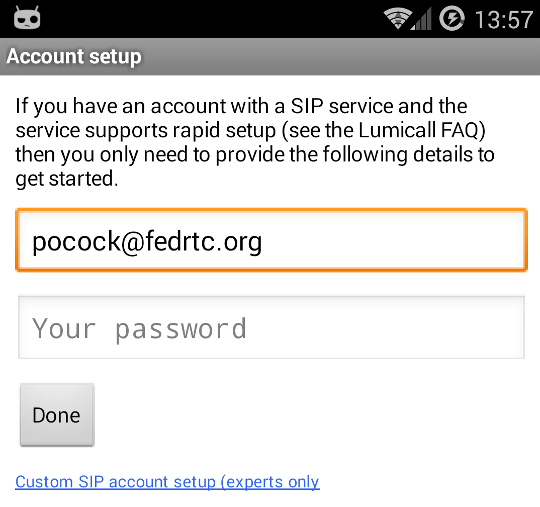 Test calls
If a friend installs Lumicall too and you dial their number, the Lumicall popup should appear and give you the option to make the call over SIP.
You can also make test calls using
 I guess that the time has finally come to admit that, as far as upstream development is concerned, the
