Search Results: "mak"

11 February 2016

Bits from Debian: Tails installer is now in Debian

Tails (The amnesic incognito live system) is a live OS based on Debian GNU/Linux which aims at preserving the user's privacy and anonymity by using the Internet anonymously and circumventing censorship. Installed on a USB device, it is configured to leave no trace on the computer you are using unless asked explicitly. Tails Logo As of today, the people the most needy for digital security are not computer experts. Being able to get started easily with a new tool is critical to its adoption, and even more in high-risk and stressful environments. That's why we wanted to make it faster, simpler, and more secure to install Tails for new users. One of the components of Tails, the Tails Installer is now in Debian thanks to the Debian Privacy Tools Maintainers Team. Tails Installer is a graphical tool to install or upgrade Tails on a USB stick from an ISO image. It aims at making it easier and faster to get Tails up and running. The previous process for getting started with Tails was very complex and was problematic for less tech-savvy users. It required starting Tails three times, and copying the full ISO image onto a USB stick twice before having a fully functional Tails USB stick with persistence enabled. This can now be done simply by installing Tails Installer in your existing Debian system, using sid, stretch or jessie-backports, plugging a USB stick and choosing if one wants to update the USB stick or to install Tails using a previously downloaded ISO image. Tails Installer also helps Tails users to create an encrypted persistent storage for personal files and settings in the rest of the available space.


9 February 2016

Mark Brown: Maintaining your email

One of the difficulties of being a kernel maintainer for a busy subsystem is that you will often end up getting a lot of mail that requires reading and handling which in turn requires sending a lot of mail out in reply. Some of that requires thought and careful consideration but a lot of it is quite routine and (perhaps surprisingly) there is often more challenge in doing a good job of handling these routine messages. For a long time I used to hand write every reply I sent but the problem with doing that is that sending the same message a lot of times tends to result in the messages getting more and more brief as the message becomes routine and practised. Your words become more optimised and if you ve stopped thinking about the message before you ve finished typing it then there s a desire to finish the typing and get on to the next thing. This is I think a lot of the reputation that kernel maintainers have for being terse and unhelpful comes from messages that are very practised for someone sending them all the time aren t always going to be obvious or helpful for someone who s not so intimately familiar with what s going on. The good part of it is that everyone is getting a personalised response and it s easy to insert a comment about that specific situation when you re already replying but it s not clear that the tradeoff is a good one. What I ve started doing instead for most things is keeping a set of pre-written paragraphs for common cases that I can just insert into a mail and edit as needed. Hopefully it s working well for people, it means the replies are that bit more verbose than they might otherwise be (mainly adding an explanation of why a given thing is being asked for) but can easily be adapted as needed. The one exception is the Applied, thanks mails I used to send when I apply a patch (literally just saying that). Those are now automatically generated by the script I use to sync my local git repository with kernel.org and very much more verbose:
From: Mark Brown <broonie@kernel.org>
To: $ CCS 
Cc: $ LIST 
Subject: $ SUBJECT 
In-Reply-To: $ MSGID 
The patch
   $ TITLE 
has been applied to the $ REPO  tree at
   $ URL  $ BRANCH 
All being well this means that it will be integrated into the linux-next
tree (usually sometime in the next 24 hours) and sent to Linus during
the next merge window (or sooner if it is a bug fix), however if
problems are discovered then the patch may be dropped or reverted.
You may get further e-mails resulting from automated or manual testing
and review of the tree, please engage with people reporting problems and
send followup patches addressing any issues that are reported if needed.
(unfortunately this bit seems to be something that it s worth pointing out)
If any updates are required or you are submitting further changes they
should be sent as incremental updates against current git, existing
patches will not be replaced.
Please add any relevant lists and maintainers to the CCs when replying
to this mail.
Thanks,
Mark
(the script does try to CC relevant lists). As well as giving people more information this also means that the mails only get sent out when things actually get published to my public repositories which avoids some confusion that used to happen sometimes with people getting my replies before I d pushed, especially when I d been working with poor connectivity as often happens when travelling. On the down side it s very much an obvious form letter which some people don t like and which can make people glaze over. My hope with this is to make things easier on average for patch submitters and easier for me, feedback on the scripted e-mails appears to be good thus far and the goal with the pasted in content is that it should be less obvious that it s happening so I d expect less feedback there.

Jose M. Calhariz: A Selection of Talks from FOSDEM 2016

It's that time of the year where I go to FOSDEM (Free and Open Source Software Developers' European Meeting). The keynotes and the maintracks are very good, with good presentations and contents. It's very dificult to choose what talks to see, what talks to see later in video and what talks to loose. What I leave here is my selection of talks. This selection is representative of my tastes, not of the quality of the presentations. I will give links for material that is available now. I will do periodic updates when the new material is available: video or slides.

Alessio Treglia: The poetic code

As well as the simple reading of a musical score is sufficient to an experienced musician to recognize the most velvety harmonic variations of an orchestral piece, so the apparent coldness of a fragment of program code can stimulate emotions of ecstatic contemplation in the developer.

Don t be misled by the simplicity of the laconic definition of the code as a sequence of instructions to be given to a computer to solve a specific problem. Generally, a problem has multiple solutions, the most simple and fast to implement, the most economical from the point of view of machine cycles or memory, the elegant solution and the makeshift one.

However, there is always a poetic solution, the one that has a particular and unusual beauty and that is always generated by the inexhaustible forge of the human intuition .

[Read More ]

Michal &#268;iha&#345;: Weekly phpMyAdmin contributions 2016-W05

Last week was really focused on code cleanups. The biggest change was removal of PmaAbsoluteUri configuration directive, which has caused quite some pain in past and is not really needed these days (when browsers support relative paths in the Location HTTP header). This lead to cleanup in other parts as well - support for dead Mozilla Prism is gone, used HTTPS for OpenStreetMap tiles (the map layer now works on HTTPS as well), removed ForceSSL configuration directive as this is something what really needs to be handled at web server level. To improve test coverage, several tests no longer require runkit as the header() call is wrapped within Response class and can be overridden for testing without using runkit. The list of handled issues is not that impressive this week:

Filed under: English phpMyAdmin 0 comments

8 February 2016

Joachim Breitner: Protecting static content with mod_rewrite

Since fourteen years, I have been photographing digitally and putting the pictures on my webpage. Back then, online privacy was not a big deal, but things have changed, and I had to at least mildly protect the innocent. In particular, I wanted to prevent search engines from accessing some of my pictures. As I did not want my friends and family having to create an account and remember a password, I set up an OpenID based scheme five years ago. This way, they could use any of their OpenID enabled account, e.g. their Google Mail account, to log in, without disclosing any data to me. As my photo album consists of just static files, I created two copies on the server: the real one with everything, and a bunch of symbolic links representing the publicly visible parts. I then used mod_auth_openid to prevent access to the protected files, unless the users logged in. I never got around of actually limiting who could log in, so strangers were still able to see all photos, but at least search engine spiders were locked out. But, very unfortunately, OpenID did never really catch on, Google even stopped being a provider, and other promising decentralized authentication schemes like Mozilla Persona are also phased out. So I needed an alternative. A very simply scheme would be a single password that my friends and family can get from me and that unlocks the pictures. I could have done that using HTTP Auth, but that is not very user-friendly, and the login does not persist (at least not without the help of the browser). Instead, I wanted something that involves a simple HTTP form. But I also wanted to avoid server-side programming, for performance and security reasons. I love serving static files whenever it is feasible. Then I found that mod_rewrite, Apache s all-around-tool for URL rewriting and request mangling, supports reading and writing cookies! So I came up with a scheme that implements the whole login logic in the Apache server configuration. I d like to describe this setup here, in case someone finds it inspiring. I created a login.html with a simple HTML form:
<form method="GET" action="/bilder/login.html">
 <div style="text-align:center">
  <input name="password" placeholder="Password" />
  <button type="submit">Sign-In</button>
 </div>
</form>
It sends the user to the same page again, putting the password into the query string, hence the method="GET" mod_rewrite unfortunately cannot read the parameters of a POST request. The Apache configuration is as follows:
RewriteMap public "dbm:/var/www/joachim-breitner.de/bilder/publicfiles.dbm"
<Directory /var/www/joachim-breitner.de/bilder>
 RewriteEngine On
 # This is a GET request, trying to set a password.
 RewriteCond % QUERY_STRING  password=correcthorsebatterystaple
 RewriteRule ^login.html /bilder/loggedin.html [L,R,QSD,CO=bilderhp:correcthorsebatterystaple:www.joachim-breitner.de:2000000:/bilder]
 # This is a GET request, trying to set a wrong password.
 RewriteCond % QUERY_STRING  password=
 RewriteRule ^login.html /bilder/notloggedin.html [L,R,QSD]
 # No point in loggin in if there is already the right password
 RewriteCond % HTTP:Cookie  bilderhp=correcthorsebatterystaple
 RewriteRule ^login.html /bilder/loggedin.html [L,R]
 # If protected file is requested, check for cookie.
 # If no cookie present, redirect pictures to replacement picture
 RewriteCond % HTTP:Cookie  !bilderhp=correcthorsebatterystaple
 RewriteCond $ public:$0 private  private
 RewriteRule ^.*\.(png jpg)$ /bilder/pleaselogin.png [L]
 RewriteCond % HTTP:Cookie  !bilderhp=correcthorsebatterystaple
 RewriteCond $ public:$0 private  private
 RewriteRule ^.+$ /bilder/login.html [L,R]
</Directory>
The publicfiles.dbm file is generated from a text file with lines like
login.html.en 1
login.html.de 1
pleaselogin.png 1
thumbs/20030920165701_thumb.jpg 1
thumbs/20080813225123_thumb.jpg 1
...
using
/usr/sbin/httxt2dbm -i publicfiles.txt -o publicfiles.dbm
and whitelists all files that are visible without login. Make sure it contains the login page, otherwise you ll get a redirect circle. The other directives in the above configure fulfill these tasks: And that s it! No resource-hogging web frameworks, not security-dubious scripting languages, and a dead-simple way to authenticate. Oh, and if you believe you know me well enough to be allowed to see all photos: The real password is not correcthorsebatterystaple; just ask me what it is.

Russ Allbery: Converted personal web sites to TLS

I've been in favor of using TLS and encryption for as much as possible for a while, but I never wanted to pay money to the certificate cartel. I'd been using certificates from CAcert, but they're not recognized by most browsers, so it felt rude to redirect everything to TLS with one of their certificates. Finally, the EFF and others put together Let's Encrypt with free, browser-recognized certificates and even a really solid automatic renewal system. That's perfect, and also eliminated my last excuse to go do the work, so now all of my personal web sites use TLS and HTTPS by default and redirect to the encrypted version of the web site. And better yet, all the certificates should just renew themselves automatically, meaning one less thing I have to keep track of and deal with periodically. Many thanks to Wouter Verhelst for his short summary of how to get the Let's Encrypt client to work properly from the command line without doing all the other stuff it wants to do in order to make things easier for less sophisticated users. Also useful was the SSL Labs server test to make sure I got the modern TLS configuration right. (All my sites should now be an A. I decided to not cut off support for Internet Explorer older than version 11 yet. I imported copies of the Debian packages needed for installation of the Let's Encrypt package on Debian jessie that weren't already in Debian backports into my personal Debian repository for my own convenience, but they're also there for anyone else. Oh, that reminds me: this also affects the archives.eyrie.org APT repository (the one linked above), so if any of you were using that, you'll now need to install apt-transport-https and might want to change the URL to use HTTPS.

7 February 2016

Joey Hess: letsencrypt support in propellor

I've integrated letsencrypt into propellor today. I'm using the reference letsencrypt client. While I've seen complaints that it has a lot of dependencies and is too complicated, it seemed to only need to pull in a few packages, and use only a few megabytes of disk space, and it has fewer options than ls does. So seems fine. (Although it would be nice to have some alternatives packaged in Debian.) I ended up implementing this:

letsEncrypt :: AgreeTOS -> Domain -> WebRoot -> Property NoInfo
This property just makes the certificate available, it does not configure the web server to use it. This avoids relying on the letsencrypt client's apache config munging, which is probably useful for many people, but not those of us using configuration management systems. And so avoids most of the complicated magic that the letsencrypt client has a reputation for. Instead, any property that wants to use the certificate can just use leteencrypt to get it and set up the server when it makes a change to the certificate:
letsEncrypt (LetsEncrypt.AgreeTOS (Just "me@my.domain")) "example.com" "/var/www"
     onChange  setupthewebserver
(Took me a while to notice I could use onChange like that, and so divorce the cert generation/renewal from the server setup. onChange is awesome! This blog post has been updated accordingly.) In practice, the http site has to be brought up first, and then letsencrypt run, and then the cert installed and the https site brought up using it. That dance is automated by this property:
Apache.httpsVirtualHost "example.com" "/var/www"
    (LetsEncrypt.AgreeTOS (Just "me@my.domain"))
That's about as simple a configuration as I can imagine for such a website!
The two parts of letsencrypt that are complicated are not the fault of the client really. Those are renewal and rate limiting. I'm currently rate limited for the next week because I asked letsencrypt for several certificates for a domain, as I was learning how to use it and integrating it into propellor. So I've not quite managed to fully test everything. That's annoying. I also worry that rate limiting could hit at an inopportune time once I'm relying on letsencrypt. It's especially problimatic that it only allows 5 certs for subdomains of a given domain per week. What if I use a lot of subdomains? Renewal is complicated mostly because there's no good way to test it. You set up your cron job, or whatever, and wait three months, and hopefully it worked. Just as likely, you got something wrong, and your website breaks. Maybe letsencrypt could offer certificates that will only last an hour, or a day, for use when testing renewal. Also, what if something goes wrong with renewal? Perhaps letsencrypt.org is not available when your certificate needs to be renewed. What I've done in propellor to handle renewal is, it runs letsencrypt every time, with the --keep-until-expiring option. If this fails, propellor will report a failure. As long as propellor is run periodically by a cron job, this should result in multiple failure reports being sent (for 30 days I think) before a cert expires without getting renewed. But, I have not been able to test this.

Steve Kemp: Redesigning my clustered website

I'm slowly planning the redesign of the cluster which powers the Debian Administration website. Currently the design is simple, and looks like this:
In brief there is a load-balancer that handles SSL-termination and then proxies to one of four Apache servers. These talk back and forth to a MySQL database. Nothing too shocking, or unusual. (In truth there are two database servers, and rather than a single installation of HAProxy it runs upon each of the webservers - One is the master which is handled via ucarp. Logically though traffic routes through HAProxy to a number of Apache instances. I can lose half of the servers and things still keep running.) When I setup the site it all ran on one host, it was simpler, it was less highly available. It also struggled to cope with the load. Half the reason for writing/hosting the site in the first place was to document learning experiences though, so when it came to time to make it scale I figured why not learn something and do it neatly? Having it run on cheap and reliable virtual hosts was a good excuse to bump the server-count and the design has been stable for the past few years. Recently though I've begun planning how it will be deployed in the future and I have a new design:
Rather than having the Apache instances talk to the database I'll indirect through an API-server. The API server will handle requests like these: I expect to have four API handler endpoints: /articles, /comments, /users & /weblogs. Again we'll use a floating IP and a HAProxy instance to route to multiple API-servers. Each of which will use local caching to cache articles, etc. This should turn the middle layer, running on Apache, into simpler things, and increase throughput. I suspect, but haven't confirmed, that making a single HTTP-request to fetch a (formatted) article body will be cheaper than making N-database queries. Anyway that's what I'm slowly pondering and working on at the moment. I wrote a proof of concept API-server based CMS two years ago, and my recollection of that time is that it was fast to develop, and easy to scale.

6 February 2016

Andrew Shadura: Community time at Collabora

I haven t yet blogged about this (as normally I don t blog often), but I joined Collabora in June last year. Since then, I had an opportunity to work with OpenEmbedded again, write a kernel patch, learn lots of things about systemd (in particular, how to stop worrying about it taking over the world and so on), and do lots of other things. As one would expect when working for a free software consultancy, our customers do understand the value of the community and contributing back to it, and so does the customer for the project I m working on. In fact, our customer insists we keep the number of locally applied patches to, for example, Linux kernel, to minimum, submitting as much as possible upstream. However, apart from the upstreaming work which may be done for the customer, Collabora encourages us, the engineers, to spend up to two hours weekly for upstreaming on top of what customers need, and up to five days yearly as paid Community days. These community days may be spent working on the code or doing volunteering at free software events or even speaking at conferences. Even though on this project I have already been paid for contributing to the free software project which I maintained in my free time previously (ifupdown), paid community time is a great opportunity to contribute to the projects I m interested in, and if the projects I m interested in coincide with the projects I m working with, I effectively can spend even more time on them. A bit unfortunately for me, I haven t spent enough time last year to plan my community days, so I used most of them in the last weeks of the calendar year, and I used them (and some of my upstreaming hours) on something that benefitted both free software community and Collabora. I m talking about SparkleShare, a cross-platform Git-based file synchronisation solution written in C#. SparkleShare provides an easy to use interface for Git, or, actually, it makes it possible to not use any Git interface at all, as it monitors the working directory using inotify and commits stuff right after it changes. It automatically handles conflicts even for binary files, even though I have to admit its handling could still be improved. At Collabora, we use SparkleShare to store all sorts of internal documents, and it s being used by users not familiar with command line interfaces too. Unfortunately, the version we recently had in Debian had a couple of very annoying bugs, making it a great pain to use it: it would not notice edits in local files, or not notice new commits being pushed to the server, and that led to individual users edits being lost sometimes. Not cool, especially when the document has to be sent to the customer in a couple of minutes. The new versions, 1.4 (and recently released 1.5) was reported as being much better and also fixing some crashes, but it also used GTK+ 3 and some libraries not yet packaged for Debian. Thanh Tung Nguyen packaged these packages (and a newer SparkleShare) for Ubuntu and published them in his PPA, but they required some work to be fit for Debian. I have never touched Mono packages before in my life, so I had to learn a lot. Some time was spent talking to upstream about fixing their copyright statements (they had none in the code, and only one author was mentioned in configure.ac, and nowhere else in the source), a bit more time went into adjusting and updating the patches to the current source code version. Then, of course, waiting the packages to go through NEW. Fixing parallel build issues, waiting for buildds to all build dependencies for at least one architecture But then, finally, on 19th of January I had the updated SparkleShare in Debian. As you may have already guessed, this blog post has been sponsored by Collabora, the first of my employers to encourage require me to work on free software in my paid time :)

Hideki Yamane: playing to update package (failed)


I thought to build gnome-todo package 3.19 branch.

Once tried to do that, it seems to need gtk+3.0 (>= 3.19.5), however Debian doesn't have it yet (of course, it's development branch). Then tried to build gtk+3, it needs wayland 1.90 1.9.90 that has not been in Debian yet, too. So, update local package to wayland 1.9.91, found tiny bug and sent patch, and build it (package diff was sent to maintainer - and merged), easy task.

Build again, gtk+3.0 needs "wayland-protocols" that has not been packaged in Debian, yet. Okay... (20 min work...) done! Make wayland-protocols package (not ITPed yet since who should be maintainer, under same umbrella as wayland?), not difficult.

Build newest gtk+3.0 source as 3.19.8 with cowbuilder chroot with those package (cowbuilder --login --save-after-exec --inputfile foo.deb --inputfile bar.deb), ...and failed with testsuite ;) I don't have enough knowledge to investigate it.

Back to older gtk+3.0 source, build 3.19.1 is fine (diff), but 3.19.2 was failed to build, 3.19.3 to 3.19.8 were failed with testsuite.


Time is up, "You lose!"... that's one of typical days.

5 February 2016

Daniel Pocock: Giving up democracy to get it back

Do services like Facebook and Twitter really help worthwhile participation in democracy, or are they the most sinister and efficient mechanism ever invented to control people while giving the illusion that they empower us? Over the last few years, groups on the left and right of the political spectrum have spoken more and more loudly about the problems in the European Union. Some advocate breaking up the EU, while behind the scenes milking it for every handout they can get. Others seek to reform it from within. Yanis Varoufakis on motorbike Most recently, former Greek finance minister Yanis Varoufakis has announced plans to found a movement (not a political party) that claims to "democratise" the EU by 2025. Ironically, one of his first steps has been to create a web site directing supporters to Facebook and Twitter. A groundbreaking effort to put citizens back in charge? Or further entangling activism in the false hope of platforms that are run for profit by their Silicon Valley overlords? A Greek tragedy indeed, in the classical sense. Varoufakis rails against authoritarian establishment figures who don't put the citizens' interests first. Ironically, big data and the cloud are a far bigger threat than Brussels. The privacy and independence of each citizen is fundamental to a healthy democracy. Companies like Facebook are obliged - by law and by contract - to service the needs of their shareholders and advertisers paying to study and influence the poor user. If "Facebook privacy" settings were actually credible, who would want to buy their shares any more? Facebook is more akin to an activism placebo: people sitting in their armchair clicking to "Like" whales or trees are having hardly any impact at all. Maintaining democracy requires a sufficient number of people to be actively involved, whether it is raising funds for worthwhile causes, scrutinizing the work of our public institutions or even writing blogs like this. Keeping them busy on Facebook and Twitter renders them impotent in the real world (but please feel free to alert your friends with a tweet) Big data is one of the areas that requires the greatest scrutiny. Many of the professionals working in the field are actually selling out their own friends and neighbours, their own families and even themselves. The general public and the policy makers who claim to represent us are oblivious or reckless about the consequences of this all-you-can-eat feeding frenzy on humanity. Pretending to be democratic is all part of the illusion. Facebook's recent announcement to deviate from their real-name policy is about as effective as using sunscreen to treat HIV. By subjecting themselves to the laws of Facebook, activists have simply given Facebook more status and power. Data means power. Those who are accumulating it from us, collecting billions of tiny details about our behavior, every hour of every day, are fortifying a position of great strength with which they can personalize messages to condition anybody, anywhere, to think the way they want us to. Does that sound like the route to democracy? I would encourage Mr Varoufakis to get up to speed with Free Software and come down to Zurich next week to hear Richard Stallman explain it the day before launching his DiEM25 project in Berlin. Will the DiEM25 movement invite participation from experts on big data and digital freedom and make these issues a core element of their promised manifesto? Is there any credible way they can achieve their goal of democracy by 2025 without addressing such issues head-on? Or put that the other way around: what will be left of democracy in 2025 if big data continues to run rampant? Will it be as distant as the gods of Greek mythology? Still not convinced? Read about Amazon secretly removing George Orwell's 1984 and Animal Farm from Kindles while people were reading them, Apple filtering the availability of apps with a pro-Life bias and Facebook using algorithms to identify homosexual users.

Jose M. Calhariz: Preview of amanda 3.3.8-1

While I sort out a sponsor, my sponsor is very busy, here is a preview of the new packages. So anyone can install and test them on jessie. The source of the packages is in collab-maint.The debs files for jessie are here: amanda-common_3.3.8-1_cal0_i386.deb amanda-server_3.3.8-1_cal0_i386.deb amanda-client_3.3.8-1_cal0_i386.deb Here comes the changelog:
amanda (1:3.3.8-1~cal0) unstable; urgency=low
  * New Upstream version
    * Changes for 3.3.8
      * s3 devices
          New NEARLINE S3-STORAGE-CLASS for Google storage.
          New AWS4 STORAGE-API
      * amcryptsimple
          Works with newer gpg2.
      * amgtar
          Default SPARSE value is NO if tar < 1.28.
          Because a bug in tar with some filesystem.
      * amstar
          support include in backup mode.
      * ampgsql
          Add FULL-WAL property.
      * Many bugs fix.
    * Changes for 3.3.7p1
      * Fix build in 3.3.7
    * Changes for 3.3.7
      * amvault
          new --no-interactivity argument.
          new --src-labelstr argument.
      * amdump
          compute crc32 of the streams and write them to the debug files.
      * chg-robot
          Add a BROKEN-DRIVE-LOADED-SLOT property.
      * Many bugs fix.
  * Refreshed patches.
  * Dropped patches that were applied by the upstream: fix-misc-typos,
    automake-add-missing, fix-amcheck-M.patch,
    fix-device-src_rait-device.c, fix-amreport-perl_Amanda_Report_human.pm
  * Change the email of the maintainer.
  * "wrap-and-sort -at" all control files.
  * swig is a new build depend.
  * Bump standard version to 3.9.6, no changes needed.
  * Replace deprecated dependency perl5 by perl, (Closes: #808209), thank
    you Gregor Herrmann for the NMU.
 -- Jose M Calhariz <jose@calhariz.com>  Tue, 02 Feb 2016 19:56:12 +0000

4 February 2016

Vincent Fourmond: Making oprofile work again with recent kernels

I've been using oprofile for profiling programs for a while now (and especially QSoas, because it doesn't require specific compilation options, and doesn't make your program run much more slowly (like valgrind does, which can also be used to some extent for profiling). It's a pity the Debian package was dropped long ago, but the ubuntu packages work out of the box on Debian. But, today, while trying to see what takes so long in some fits I'm running, here's what I get:
~ operf QSoas
Unexpected error running operf: Permission denied

Looking further using strace, I could see that what was not working was the first call to perf_event_open.
It took me quite a long time to understand why it stopped working and how to get it working again, so here's for those of you who googled the error and couldn't find any answer (including me, who will probably have forgotten the anwser in a couple of months). The reason behing the change is that, for security reason, non-privileged users do not have the necessary privileges since Debian kernel 4.1.3-1; here's the relevant bit from the changelog:

  * security: Apply and enable GRKERNSEC_PERF_HARDEN feature from Grsecurity,
    disabling use of perf_event_open() by unprivileged users by default
    (sysctl: kernel.perf_event_paranoid)

The solution is simple, just run as root:
~ sysctl kernel.perf_event_paranoid=1

(the default value seems to be 3, for now). Hope it helps !

Petter Reinholdtsen: Using appstream in Debian to locate packages with firmware and mime type support

The appstream system is taking shape in Debian, and one provided feature is a very convenient way to tell you which package to install to make a given firmware file available when the kernel is looking for it. This can be done using apt-file too, but that is for someone else to blog about. :) Here is a small recipe to find the package with a given firmware file, in this example I am looking for ctfw-3.2.3.0.bin, randomly picked from the set of firmware announced using appstream in Debian unstable. In general you would be looking for the firmware requested by the kernel during kernel module loading. To find the package providing the example file, do like this:
% apt install appstream
[...]
% apt update
[...]
% appstreamcli what-provides firmware:runtime ctfw-3.2.3.0.bin   \
  awk '/Package:/  print $2 '
firmware-qlogic
%
See the appstream wiki page to learn how to embed the package metadata in a way appstream can use. This same approach can be used to find any package supporting a given MIME type. This is very useful when you get a file you do not know how to handle. First find the mime type using file --mime-type, and next look up the package providing support for it. Lets say you got an SVG file. Its MIME type is image/svg+xml, and you can find all packages handling this type like this:
% apt install appstream
[...]
% apt update
[...]
% appstreamcli what-provides mimetype image/svg+xml   \
  awk '/Package:/  print $2 '
bkchem
phototonic
inkscape
shutter
tetzle
geeqie
xia
pinta
gthumb
karbon
comix
mirage
viewnior
postr
ristretto
kolourpaint4
eog
eom
gimagereader
midori
%
I believe the MIME types are fetched from the desktop file for packages providing appstream metadata.

Martin-&#201;ric Racine: xf86-video-geode 2.11.18

Yesterday, I pushed out version 2.11.18 of the Geode X.Org driver. This is the driver used by the OLPC XO-1 and by a plethora of low-power desktops, micro notebooks and thin clients. This release mostly includes maintenance fixes of all sorts. Of noticeable interest is a fix for the long-standing issue that switching between X and a VT would result in a blank screen (this should probably be cherry-picked for distributions running earlier releases of this driver). Many thanks to Connor Behan for the fix!
Unfortunately, this driver still doesn't work with GNOME. On my testing host, launching GDM produces a blank screen. 'ps' and other tools show that GDM is running but there's no screen content; the screen remains pitch black. This issue doesn't happen with other display managers e.g. LightDM. Bug reports have been filed, additional information was provided, but the issue still hasn't been resolved.
Additionally, X server flat out crashes on Geode hosts running Linux kernels 4.2 or newer. 'xkbcomp' repeatedly fails to launch and X exits with a fatal error. Bug reports have been filed, but not reacted to. However, interestingly enough, X launches fine if my testing host is booted with earliers kernels, which might suggest what the actual cause of this particular bug might be:
Since kernel 4.2 entered Debian, the base level i386 kernel on Debian is now compiled for i686 (without PAE). Until now, the base level was i586. This essentially makes it pointless to build the Geode driver with GX2 support. It also means that older GX1 hardware won't be able to run Debian either, starting with the next stable release.

Russell Coker: Unikernels

At LCA I attended a talk about Unikernels. Here are the reasons why I think that they are a bad idea: Single Address Space According to the Unikernel Wikipedia page [1] a significant criteria for a Unikernel system is that it has a single address space. This gives performance benefits as there is no need to change CPU memory mappings when making system calls. But the disadvantage is that any code in the application/kernel can access any other code directly. In a typical modern OS (Linux, BSD, Windows, etc) every application has a separate address space and there are separate memory regions for code and data. While an application can request the ability to modify it s own executable code in some situations (if the OS is configured to allow that) it won t happen by default. In MS-DOS and in a Unikernel system all code has read/write/execute access to all memory. MS-DOS was the least reliable OS that I ever used. It was unreliable because it performed tasks that were more complex than CP/M but had no memory protection so any bug in any code was likely to cause a system crash. The crash could be delayed by some time (EG corrupting data structures that are only rarely accessed) which would make it very difficult to fix. It would be possible to have a Unikernel system with non-modifyable executable areas and non-executable data areas and it is conceivable that a virtual machine system like Xen could enforce that. But that still wouldn t solve the problem of all code being able to write to all data. On a Linux system when an application writes to the wrong address there is a reasonable probability that it will not have write access and you will immediately get a SEGV which is logged and informs the sysadmin of the address of the crash. When Linux applications have bugs that are difficult to diagnose (EG buffer overruns that happen in production and can t be reproduced in a test environment) there are a variety of ways of debugging them. Tools such as Valgrind can analyse memory access and tell the developers which code had a bug and what the bug does. It s theoretically possible to link something like Valgrind into a Unikernel, but the lack of multiple processes would make it difficult to manage. Debugging A full Unix environment has a rich array of debugging tools, strace, ltrace, gdb, valgrind and more. If there are performance problems then tools like sysstat, sar, iostat, top, iotop, and more. I don t know which of those tools I might need to debug problems at some future time. I don t think that any Internet facing service can be expected to be reliable enough that it will never need any sort of debugging. Service Complexity It s very rare for a server to have only a single process performing the essential tasks. It s not uncommon to have a web server running CGI-BIN scripts or calling shell scripts from PHP code as part of the essential service. Also many Unix daemons are not written to run as a single process, at least threading is required and many daemons require multiple processes. It s also very common for the design of a daemon to rely on a cron job to clean up temporary files etc. It is possible to build the functionality of cron into a Unikernel, but that means more potential bugs and more time spent not actually developing the core application. One could argue that there are design benefits to writing simple servers that don t require multiple programs. But most programmers aren t used to doing that and in many cases it would result in a less efficient result. One can also argue that a Finite State Machine design is the best way to deal with many problems that are usually solved by multi-threading or multiple processes. But most programmers are better at writing threaded code so forcing programmers to use a FSM design doesn t seem like a good idea for security. Management The typical server programs rely on cron jobs to rotate log files and monitoring software to inspect the state of the system for the purposes of graphing performance and flagging potential problems. It would be possible to compile the functionality of something like the Nagios NRPE into a Unikernel if you want to have your monitoring code running in the kernel. I ve seen something very similar implemented in the past, the CA Unicenter monitoring system on Solaris used to have a kernel module for monitoring (I don t know why). My experience was that Unicenter caused many kernel panics and more downtime than all other problems combined. It would not be difficult to write better code than the typical CA employee, but writing code that is good enough to have a monitoring system running in the kernel on a single-threaded system is asking a lot. One of the claimed benefits of a Unikernel was that it s supposedly risky to allow ssh access. The recent ssh security issue was an attack against the ssh client if it connected to a hostile server. If you had a ssh server only accepting connections from management workstations (a reasonably common configuration for running servers) and only allowed the ssh clients to connect to servers related to work (an uncommon configuration that s not difficult to implement) then there wouldn t be any problems in this regard. I think that I m a good programmer, but I don t think that I can write server code that s likely to be more secure than sshd. On Designing It Yourself One thing that everyone who has any experience in security has witnessed is that people who design their own encryption inevitably do it badly. The people who are experts in cryptology don t design their own custom algorithm because they know that encryption algorithms need significant review before they can be trusted. The people who know how to do it well know that they can t do it well on their own. The people who know little just go ahead and do it. I think that the same thing applies to operating systems. I ve contributed a few patches to the Linux kernel and spent a lot of time working on SE Linux (including maintaining out of tree kernel patches) and know how hard it is to do it properly. Even though I m a good programmer I know better than to think I could just build my own kernel and expect it to be secure. I think that the Unikernel people haven t learned this.

Iustin Pop: X cursor theme

There's not much to talk about X cursor themes, except when they change behind your back :) A while back, after a firefox upgrade, it and only it showed a different cursor theme: basically double the size, and (IMHO) uglier. Searched for a while, but couldn't figure what makes firefox special, except that it is a GTK application. After another round of dist-upgrades, now everything except xterms were showing the big cursors. This annoyed me to no end as I don't use a high-DPI display, the new cursors are just too damn big. Only to find out two things: Sigh, Gnome.

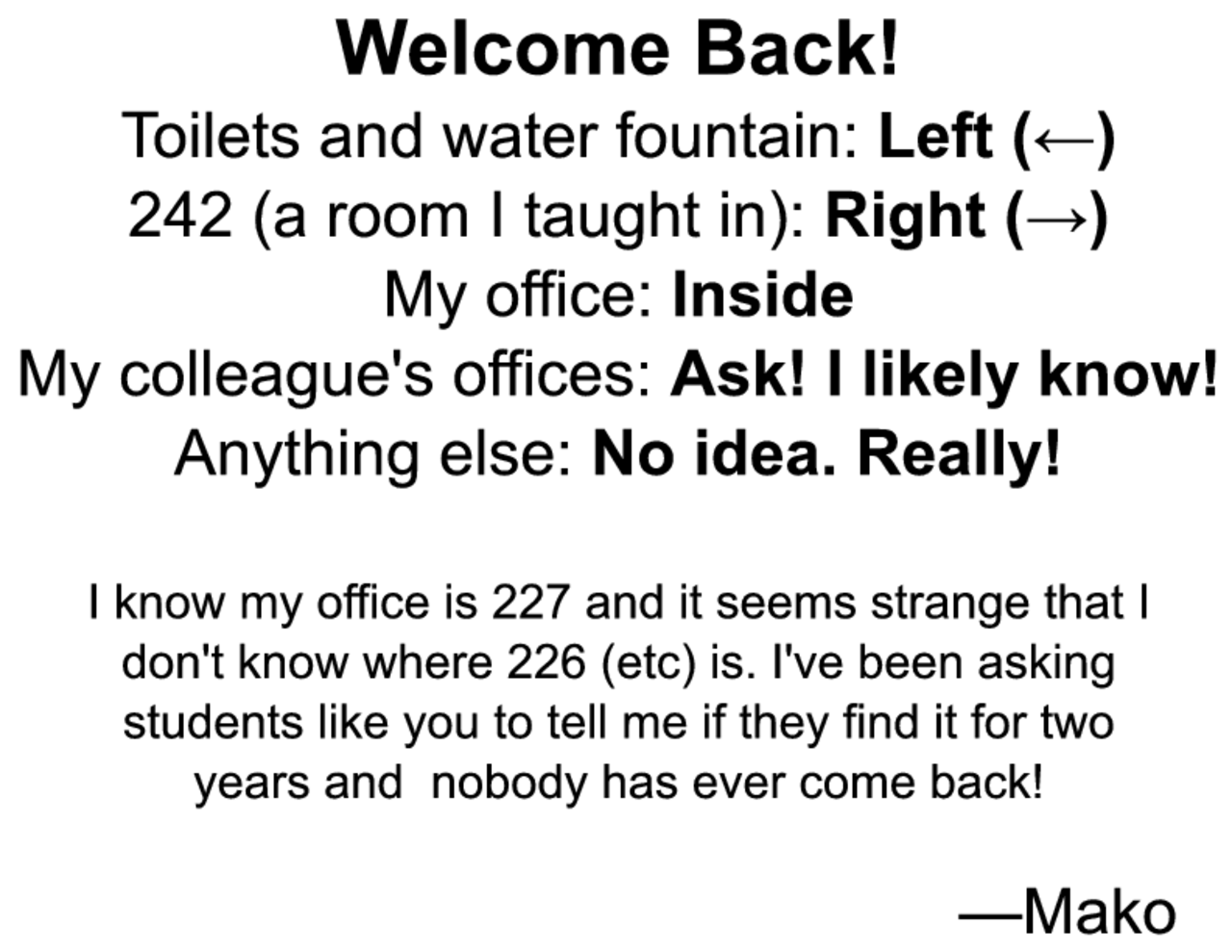
Benjamin Mako Hill: Welcome Back Poster

My office door is on the second floor in front the major staircase in my building. I work with my door open so that my colleagues and my students know when I m in. The only time I consider deviating from this policy is the first week of the quarter when I m faced with a stream of students, usually lost on their way to class and that, embarrassingly, I am usually unable to help. I made this poster so that these conversations can, in a way, continue even when I am not in the office. early_quarter_doors_sign
3 February 2016

Jonathan Dowland: Comparing Docker images

I haven't written much yet about what I've been up to at work. Right now, I'm making changes to the sources of a set of Docker images. The changes I'm making should not result in any changes to the actual images: it's just a re-organisation of the way in which they are built. I've been using the btrfs storage driver for Docker which makes comparing image filesystems very easy from the host machine, as all the image filesystems are subvolumes. I use a bash script like the following to make sure I haven't broken anything:
oldid="$1"; newid="$2";
id_in_canonical_form()  
    echo "$1"   grep -qE '^[a-f0-9] 64 $'
 
canonicalize_id()  
    docker inspect --format '  .Id  ' "$1"
 
id_in_canonical_form "$oldid"   oldid="$(canonicalize_id "$oldid")"
id_in_canonical_form "$newid"   newid="$(canonicalize_id "$newid")"
cd "/var/lib/docker/btrfs/subvolumes"
sumpath()  
    cd "$1" && find . -printf "%M %4U %4G %16s %h/%f\n"   sort
 
diff -ruN "$oldid" "newid"
diff -u <(sumpath "$oldid") <(sumpath "$newid")
Using -printf means I can ignore changes in the timestamps on files which is something I am not interested in. If it is available in your environment, Lars Wirzenius' tool Summain generates manifests that include a file checksum and could be very useful for this use-case.

Next.

Previous.