Search Results: "ean"

18 February 2014

Margarita Manterola: MiniDebConf 2014 Barcelona

Debian Women is proud to announce that it will hold a MiniDebConf in Barcelona on 15-16 March 2014, where Debian enthusiasts from far and wide will gather to talk about the latest Debian changes and the Debian community, as well as to meet new and old friends. The MiniDebConf is fast approaching, be sure to make your travel arrangements! It is going to be an exciting event, in a beautiful venue, in one of the most famous European cities! Schedule A draft schedule (still subject to some last minute changes) is already available. The list of talks promises two days packed with great talks! If you have an exciting idea for a talk, but missed the deadline, please get in touch with us, we might still have a slot for you. Crowd-funding We are still raising funds to cover the costs of running the conference and to offer travel sponsorship to people who can't pay for it. Please, consider donating any amount you can, everything helps! Sponsorship If you want to attend the conference, but are unable to cover the costs. Please contact us! We don't have a big budget, but we will make our best to help. Naturally, priority will be given to participants who have an accepted talk. About this MiniDebConf We want to have a MiniDebConf with both talks and social events, to which everyone in Debian is invited but where the speakers in the talks are all people who identify themselves as female. We consider this important to The idea behind the conference is not to talk about women in free software, or women in Debian, but rather to make discussion about Debian subjects more inclusive for women. If you agree with this goal, spread the word. Forward this announcement and help us make this event a great success! About our sponsors This event is possible thanks to the help provided by our generous sponsors. In particular, we'd like to thank our platinum sponsor, Google. We hope to see you in Barcelona! For more information, visit http://bcn2014.mini.debconf.org

Mario Lang: Conntributing on GitHub

I really like to read code written by different people. I've always been the type of learner that can cover a lot of ground by looking at examples. A few of the programming tricks I acquired over time have definitely been learnt by reading programs written by other people. There are of course cases of disagrement with coding style (lets put that very mildly), so not every project is fun to read. But I tend to find projects I like enough to actually look at their source code. Now, if you get into this habit, there is also the occasional spotting of a bug. Many are really cosmetic, like typos in comments or documentation. Others are maybe more serious, who knows what can happen if you read a few lines of code written by someone you have never met in person. This is one of the original arguments of open source and free software. It basically goes like: "People will read your code and report problems." I know that happens, but I also know that there are cases of people finding relatively minor things during a small code review, which they don't report, or which get lost in some developers INBOX. I remember waiting months to see memory corruption fixes for a particular project I submitted by email to actually appear in the development repository. In some cases you really need to track your patches and prod someone to remind them about your contribution if need be. True, some of these issues are probably minor enough to not really hurt if they get lost, but I have a feel that a lot of minor things also sort of add up. This is where GitHub comes into play. We have had project hosting services since at least a decade now, but none of them (to my experience) have ever made it so easy for all involved parties to submit and merge changes into projects. Pull requests are just amazing. Well, at least for me, they are since a few months. I have a sort of mixed hate-love relationship with GitHub when it comes to a topic that is very important to me, Accessibility. The last project hosting site I really liked for their simple web interface (read, still usable with Lynx) was Google Code. That was in the days when Google still seemed to care about such things. These days, their newer services are next to unusable to me (with the tools I prefer). SourceForge was always a catastrophy. Many things were cumbersome to do, because the site is so loaded with links to all sorts of things I never need. However, at the time I was using it, all the things I really needed did work. GitHub is a different beast, in a different era of the internet. While I can read project pages and a few basic things perfectly fine, some parts of the GitHub site are simply unusable for no particular reason. For instance, I can edit (some of my) preferences and even save them. But I can not star a project, nor can I follow other developers. Invoking these links gives me a 404, which seems to indicate that some JavaScript (read, client side code execution) is required which my browser does not perform. However, I really wonder why. Because something like "I want to star this project" will eventually have to end up as a request on the server anyway, so it seems technically unnecessary to rely on Javascript for such an operation to succeed. Luckily, these days, hip projects do have an API. An GitHub is no exception. I want to emphasis that an API alone is not an accessibility fix, since you rarely have the time to implement a clinet for a random API, just to get access to a service you want to use. Sometimes you do, and an API is a great enabler in such situations, but a reference client with a rich feature-set is much better. I have to admit that I haven't evaluated any of the possible alternatives, but one client I found for GitHub's API did really boost my productivity in the last year. I am talking about Hub. It is a simple wrapper around Git that adds a few and enhances some other git commands. Most importantly, hub fork will fork the current checkout on GitHub, and hub pull-request allows you to quickly (and I really mean quickly!) open a pull request for some commits you've just done to your fork of some project. This is very helpful, and very accessible. While it does not solve all my accessibility problems with GitHub, it at least enables me to take part in the GitHub workflow. I can easily fork projects and submit pull reuqests for changes I did. And that is what I did, at least a bit, in roughly the past year. I am not sure exactly, but I think it was spring when someone made me aware of Hub. One approach would be to check my GitHub activity graph, but I probably don't have to mention that it is not accessible. Here is a list of some of my contributions to open source projects on GitHub since I discovered a good client for the GitHub API: To summarize: I love GitHub for what it does to the free software community. I think the simplicity (and transparency) of contributions is to the benefit of free and open source software. However, I also hate GitHub sometimes when I need to ask a friend to do relatively trivial changes for me. What I actually want, is a command-line client like Hub that makes most or even all functionality provided on the website available. True, some things like graphs are not immediately easy to adapt. But I really shouldn't need to use a modern full-fledged web browser to tell GitHub that I am interested in the activities of a certain user. Or delete a fork. Yes, thats right. I can use Hub to fork a project, but there is no way to delete it again. Sort of strange for casual small-scale contributions. I guess the workflow there is: fork, commit, pull-request, wait for merge, delete. I don't want to have all sorts of forks on GitHub that I actually don't actively use/maintain. So once a pull request was merged, and I don't have any other things I am working on right now, I actually want to get rid of the fork again. It is easy enough to do a fork should I ever need it again.

Mario Lang: Contributing on GitHub

I really like to read code written by different people. I've always been the type of learner that can cover a lot of ground by looking at examples. A few of the programming tricks I acquired over time have definitely been learnt by reading programs written by other people. There are of course cases of disagrement with coding style (lets put that very mildly), so not every project is fun to read. But I tend to find projects I like enough to actually look at their source code. Now, if you get into this habit, there is also the occasional spotting of a bug. Many are really cosmetic, like typos in comments or documentation. Others are maybe more serious, who knows what can happen if you read a few lines of code written by someone you have never met in person. This is one of the original arguments of open source and free software. It basically goes like: "People will read your code and report problems." I know that happens, but I also know that there are cases of people finding relatively minor things during a small code review, which they don't report, or which get lost in some developers INBOX. I remember waiting months to see memory corruption fixes for a particular project I submitted by email to actually appear in the development repository. In some cases you really need to track your patches and prod someone to remind them about your contribution if need be. True, some of these issues are probably minor enough to not really hurt if they get lost, but I have a feel that a lot of minor things also sort of add up. This is where GitHub comes into play. We have had project hosting services since at least a decade now, but none of them (to my experience) have ever made it so easy for all involved parties to submit and merge changes into projects. Pull requests are just amazing. Well, at least for me, they are since a few months. I have a sort of mixed hate-love relationship with GitHub when it comes to a topic that is very important to me, Accessibility. The last project hosting site I really liked for their simple web interface (read, still usable with Lynx) was Google Code. That was in the days when Google still seemed to care about such things. These days, their newer services are next to unusable to me (with the tools I prefer). SourceForge was always a catastrophy. Many things were cumbersome to do, because the site is so loaded with links to all sorts of things I never need. However, at the time I was using it, all the things I really needed did work. GitHub is a different beast, in a different era of the internet. While I can read project pages and a few basic things perfectly fine, some parts of the GitHub site are simply unusable for no particular reason. For instance, I can edit (some of my) preferences and even save them. But I can not star a project, nor can I follow other developers. Invoking these links gives me a 404, which seems to indicate that some JavaScript (read, client side code execution) is required which my browser does not perform. However, I really wonder why. Because something like "I want to star this project" will eventually have to end up as a request on the server anyway, so it seems technically unnecessary to rely on Javascript for such an operation to succeed. Luckily, these days, hip projects do have an API. An GitHub is no exception. I want to emphasis that an API alone is not an accessibility fix, since you rarely have the time to implement a clinet for a random API, just to get access to a service you want to use. Sometimes you do, and an API is a great enabler in such situations, but a reference client with a rich feature-set is much better. I have to admit that I haven't evaluated any of the possible alternatives, but one client I found for GitHub's API did really boost my productivity in the last year. I am talking about Hub. It is a simple wrapper around Git that adds a few and enhances some other git commands. Most importantly, hub fork will fork the current checkout on GitHub, and hub pull-request allows you to quickly (and I really mean quickly!) open a pull request for some commits you've just done to your fork of some project. This is very helpful, and very accessible. While it does not solve all my accessibility problems with GitHub, it at least enables me to take part in the GitHub workflow. I can easily fork projects and submit pull reuqests for changes I did. And that is what I did, at least a bit, in roughly the past year. I am not sure exactly, but I think it was spring when someone made me aware of Hub. One approach would be to check my GitHub activity graph, but I probably don't have to mention that it is not accessible. Here is a list of some of my contributions to open source projects on GitHub since I discovered a good client for the GitHub API: To summarize: I love GitHub for what it does to the free software community. I think the simplicity (and transparency) of contributions is to the benefit of free and open source software. However, I also hate GitHub sometimes when I need to ask a friend to do relatively trivial changes for me. What I actually want, is a command-line client like Hub that makes most or even all functionality provided on the website available. True, some things like graphs are not immediately easy to adapt. But I really shouldn't need to use a modern full-fledged web browser to tell GitHub that I am interested in the activities of a certain user. Or delete a fork. Yes, thats right. I can use Hub to fork a project, but there is no way to delete it again. Sort of strange for casual small-scale contributions. I guess the workflow there is: fork, commit, pull-request, wait for merge, delete. I don't want to have all sorts of forks on GitHub that I actually don't actively use/maintain. So once a pull request was merged, and I don't have any other things I am working on right now, I actually want to get rid of the fork again. It is easy enough to do a fork should I ever need it again.

17 February 2014

Chris Lamb: The effect of pedestaling on TT bike position

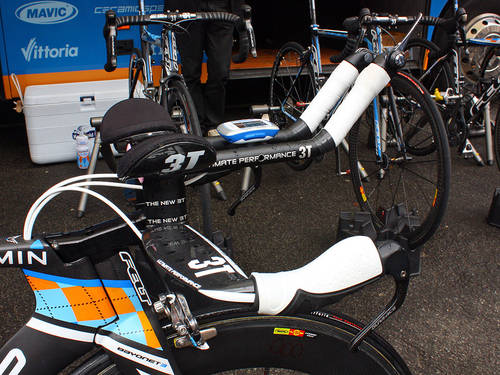
To "pedestal" an aerobar means to elevate the bars above the basebar using risers instead of using headset spacers:
https://chris-lamb.co.uk/wp-content/2014/pedestal1.jpg

David Millar, 2010 Giro d'Italia.

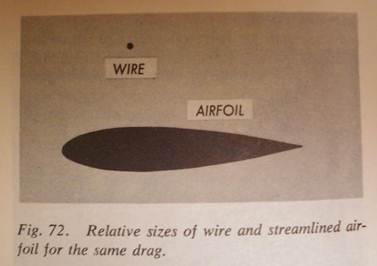
You might do this for a few reasons: https://chris-lamb.co.uk/wp-content/2014/teardrop_vs_cylinder.jpg So, assuming you currently have a bike that uses headset spacers, what would be the effect on your position if you were to replace, say, a 10mm headset spacer with a 10mm armrest riser? First, let us consider the effect of removing the headset spacer. The crucial insight is that removing a 10mm spacer will not lower the stack height ie. the vertical distance relative to the bottom bracket by 10mm. This is because spacers are not oriented perpendicular to the ground; they are stacked along the steerer tube at the head tube angle of the frame. We will assume a head tube angle of 72.5 degrees. We can calculate that removing a 10mm spacer will reduce the stack height by:
sin(72.5 )   10mm = 9.54mm
... and by the same argument it will also increase the effective reach ie. the horizontal distance relative to the bottom bracket by:
cos(72.5 )   10mm = 3.01mm
Next, let us consider the impact of adding the riser. These are oriented perpendicular to the ground, so its addition makes no further change to the reach. However, we can now calculate the overall change in stack height:
  stack = -(sin(72.5 )   10mm) + 10mm = 0.46mm
We can then repeat the calculation for any length of replacement:
Replacement (mm) stack (mm) reach (mm)
10 +0.46 +3.01
20 +0.93 +6.01
30 +1.39 +9.02
40 +1.85 +12.0
50 +2.31 +15.0
60 +2.78 +18.0
From this table, I can discover that if I were to replace 30mm of headset spacers with 30mm of risers it would:
  1. Increase my effective stack height by 1.39mm (likely neglible).
  2. Increase my reach by 9.02mm. This might require me to use a shorter stem to get the same position. If that was undesirable for example, if was already using an extremely short stem I might be forced to abandon the idea altogether.
Three further considerations must be noted:
  1. The resultant low height of the base bar could be quite drastic and prevent you breathing properly whilst climbing.
  2. Having the steerer tube cut down after to removing headset spacers will reduce the resale value of your bike.
  3. You might need to re-cable your brakes as you may have changed the distance the cables must span.
(It may seem odd to provide results for up to 60mm of headset spacers when such a large number of spacers would at the very least void one's warranty. However, I suspect such setups are transiently common within the confines of a fitting studio.)

Rog rio Brito: Some new Youtube-dl functionality

I wrote in a previous post that Youtube changed their way of delivering videos, with the use of Dynamic Adaptive Streaming over HTTP. On top of that, they started serving both the audio and the video in separate streams, which meant trouble for downloader tools like youtube-dl. As I mentioned in that previous post:
What does this mean in practical terms for users of youtube-dl? Well, if you wanted to download videos in resolutions like the 480p (format 35) that I mentioned, then you will probably have to change your way of doing things, until a more automated solution is in place. You will have to download both the audio and the video and, then, "combine" them (that is, multiplex them) to create one "normal" video file with both the audio and the video.
And latter, I wrote:
Otherwise, to download 480p videos (which I do for lectures and so on with other projects of mine, like edx-dl) I have to call youtube-dl twice: once for format 135 and another for format 140, since the old (?) format 35 files are much smaller than the lower resolution 360p files (due to the former being encoded in High profile vs. the latter being encoded in Constrained Baseline profile).
(...) Well, now, we don't have this problem anymore: The new release of youtube-dl brings us many goodies, including that it is possible to automatically combine/merge/multiplex audio and video formats that Youtube now offers separately (See the previous comments about separate audio and video). Now, if you want a 480p video in H.264 format, High profile, with 128kbps AAC audio (this used to be Youtube's format 35), you can specify format -f 135+140 on the command-line and it will download both the audio, the video and multiplex it with ffmpeg (or avconv, depending on what you have installed). Besides being convenient, this automatic downloading and merging makes it unnecessary to write scripts to, say, retrieve all the videos in a playlist that contains a lot of lectures (see one example here, taught by Benedict Gross). Version 2014.02.17 of youtube-dl will be soon in your favorite mirror of the Debian archives.

Steve Kemp: My pastebin will now run under docker.

I've updated my markdown-pastebin site, to be a little cleaner, and to avoid spidering issues. Previously every piece of uploaded text received an incrementing integer to describe it - which meant it was trivially easy for others to see how many pieces of text had been uploaded, and to spider all past uploads (unless the user deleted them). Now each fresh paste receives a random UUID to describe it, and this means spidering is no longer feasible. I've also posted the source code to Gitub so folk can report bugs, fork, etc: That source code now includes a Dockerfile which allows you to quickly and easily build your own container running this wonderful service, and launch it without worrying about trashing your server ;) Anyway other than the user-interface overhaul it is still as functional, or not, as it used to be!

16 February 2014

Mark Brown: Human factors

An issue which I always find depressing but sadly unsurprising in discussions of process with software is the frequent disregard for human elements; indeed often the goal people have in creating process is to try to control and eliminate human elements. Little thought is given to what is going to motivate people to do what s asked and if they are going to follow it at all, or in the spirit it was intended. One example I ve seen several times is the idea that some engineers work on irrelevant things and that this can be fixed by requiring every commit to be tied to the project plan or a bug so off project work is obvious. This isn t really attacking the problem so much as putting a roadblock in place to try to avert it; the real problem is normally people not communicating about what they re doing and what s important but those problems are really hard to address. Sadly what tends to happen is that people work around the roadblock and cause some collateral damage; for example devaluing the bug tracker by referencing irrelevant bugs or creating meaningless bugs solely to allow commits, while continuing to behave like they did originally. This is often worse than the original situation. This sort of issue is one of the things I appreciate most about working on Linux there s quite a bit of process but because of the way it has been evolved the incentives are usually right to make sure they are followed in the spirit in which they were intended. For example the patch submission process is essentially just best practices for making sure changes go to people who care in a form which makes it easy for them to work with it; there is a bunch of tooling around it which built on those practices (and in turn influenced the practices) but it all comes back to that basic thing of getting attention for changes and making them easy to work with. As a result people mostly do the right thing (or close enough) so everything runs smoothly. The trick is to remember to standardize and write things down when it s needed notice the good practice and spread its adoption. The key difference here seems to be if process is viewed as something to solve problems for people or if it is viewed as a way to solve problems with people. If the problem is with the people then the view starts off negative and it s perhaps unsurprising that there is little consideration of how they will react. Sometimes it s not so much that a problem is seen with people as that the people doing don t have any real interest in the process (write only timesheets often bear no relation to reality for example) but there is an assumption that they are going to just do what they re asked (but instead they for example don t fill in their time sheets or don t provide accurate information). The end result is the same, their needs don t get considered and their actions end up being counterproductive. Starting to avoid these problems is fairly straightforward take a step back and consider why the people expected to carry out the process are going to want to do so. How does it help them? How will they see it helping others? Generally what s in it for them? If these are difficult questions to answer then there may be a problem it is likely people will ignore the process or do it badly without a lot of active enforcement, but perhaps that s OK for the situation. Beware of using metrics to provide incentives, metrics are gameable and that game can cause problems without care. But do think about people; making software is all about people.

15 February 2014

Rog rio Brito: Miscellanea

Init system I am happy that Debian's Technical Committee was able to reach a very good decision with the choice of systemd as the default init system for the Linux ports. In particular, I was very pleasantly surprised by the lucidity of Russ Allbery's analyses and, above all, his patience even with people that, in my understanding, were just being trolls or trying to cause confusion and disrupt a process that was already chaotic. Russ, thank you for your exemplary role. (Also, you type fast or what? You fill whole e-mails seemingly faster than I can read!)

Unexpected union of forces It seems to me that Mark Shutterworth's decision of (perhaps?) embracing Debian's decision in the init system is a good thing. I think that one way where Ubuntu did a great thing with respect to Debian was their initial attitude towards cherry-picking the best of breed of Free Software from Debian's archive and polishing that to create a really "for human beings" operating system. I hope that this means that, at least in part, money (Mark's?) can be channeled in the best of the interests so that we all gain from it. (And, to be honest, I see no problem in making money with Free Software and I welcome a well done integration job).

More polarizing things I feel that, now, I may even have some hope of sending another potentially polarizing bug to the Tech Ctte (that is ffmpeg vs. libav) and have faith that some rational decision would be made. I was not even aware of it, but the ffmpeg folks even featured a news item in their page of me having filed the RFP bug mentioned above.

DebConf 14 If everything goes as expected, I hope to attend this year's DebConf. In fact, I am anticipating this, since I would love to, e.g., talk with Joey Hess and discuss a better way of having GNU parallel and the parallel program in moreutils have amicable co-installability among many, many other things with respect to my packages. And, quite probably, work on packaging ffmpeg with other interested people (which seem to be numerous).
Edit: Fix markdown link pointing twice to the ffmpeg site. Thanks Marius Gedminas for pointing this out.

13 February 2014

John Goerzen: Backing up every few minutes with simplesnap

I ve written a lot lately about ZFS, and one of its very nice features is the ability to make snapshots that are lightweight, space-efficient, and don t hurt performance (unlike, say, LVM snapshots). ZFS also has zfs send and zfs receive commands that can send the content of the snapshot, or a delta between two snapshots, as a data stream similar in concept to an amped-up tar file. These can be used to, for instance, very efficiently send backups to another machine. Rather than having to stat() every single file on a filesystem as rsync has to, it sends effectively an intelligent binary delta which is also intelligent about operations such as renames. Since my last search for backup tools, I d been using BackupPC for my personal systems. But since I switched them to ZFS on Linux, I ve been wanting to try something better. There are a lot of tools out there to take ZFS snapshots and send them to another machine, and I summarized them on my wiki. I found zfSnap to work well for taking and rotating snapshots, but I didn t find anything that matched my criteria for sending them across the network. It seemed par for the course for these tools to think nothing of opening up full root access to a machine from others, whereas I would much rather lock it down with command= in authorized_keys. So I wrote my own, called simplesnap. As usual, I wrote extensive documentation for it as well, even though it is very simple to set up and use. So, with BackupPC, a backup of my workstation took almost 8 hours. (Its incremental might take as few as 3 hours) With ZFS snapshots and simplesnap, it takes 25 seconds. 25 seconds! So right now, instead of backing up once a day, I back up once an hour. There s no reason I couldn t back up every 5 minutes, in fact. The data consumes less space, is far faster to manage, and doesn t require a nightly hours-long cleanup process like BackupPC does zfs destroy on a snapshot just takes a few seconds. I use a pair of USB disks for backups, and rotate them to offsite storage periodically. They simply run ZFS atop dm-crypt (for security) and it works quite well even on those slow devices. Although ZFS doesn t do file-level dedup like BackupPC does, and the lz4 compression I ve set ZFS to use is less efficient than the gzip-like compression BackupPC uses, still the backups are more space-efficient. I am not quite sure why, but I suspect it s because there is a lot less metadata to keep track of, and perhaps also because BackupPC has to store a new copy of a file if even a byte changes, whereas ZFS can store just the changed blocks. Incidentally, I ve packaged both zfSnap and simplesnap for Debian and both are waiting in NEW.

Craig Small: Google doesn t get SPF

Someone has decided to use my email address for a spam source. They have even used google to relay it which, given Googles current policies seems like a winning idea. I keep getting emails from Google s servers with header lines like this:
X-Original-Authentication-Results: mx.google.com; spf=hardfail (google.com: domain of csmall@small.dropbear.id.au does not designate 66.80.26.66 as permitted sender)
You don t say? You mean even though my SPF records do not include some dodgy server in California, even though Google knows I don t include this in my SPF records well we will let the email go through anyhow. SPF records mean that s where my email comes from. If the record has a -all at the end of it, like mine do, then it means don t accept it from anywhere else. The hardfail means Google sees the -all and still does nothing about it.

12 February 2014

Andrew Pollock: [life] Day 16, BJJ, wood working and kinetic sand

It's been quite a busy, varied day today. Lot's of fun as usual. Zoe has a dentist appointment tomorrow morning, so we went to the Thursday offering of her Brazilian Jiu-Jitsu class instead, and skipped Playgroup. We biked over extra early this morning, to make sure we were on time. There were two other kids in the class today, a 3 year old boy and a 2 and a half year old girl. The class went really well. We biked home the scenic way again, and grabbed a BBQ chicken for lunch along the way. The box of kinetic sand that I'd ordered was sitting on the doorstep. That still left us with about 45 minutes to kill before lunch, so I thought I'd start on making a second miniature clothes line with Zoe. Bunnings were selling these little kids safety sets at half price because they were a deleted product, and the set came with proper fitting eye protection, hearing protection and some gloves. The gloves are currently too big, but the glasses and hearing protection is great. I introduced her to the power drill and the hand saw. She liked drilling, and marking, but mostly was happy just watching. We managed to make most of the top of the clothes line before lunch, and then I whipped up some chicken quesadillas for lunch. We had a few disruptions during quiet time, so Zoe didn't nap. After quiet time, we did a mix of cleaning up the house a bit, some more wood working, and some self-directed play. After that, Zoe's friend Mackensie and her little sister came over for a play date after her Kindergarten class. She goes to the same Kindergarten as Zoe, but in the second half of the week. Mackensie's mum brought me a coffee, and we had some afternoon tea, and then I busted out the kinetic sand. It was a real hit with all the girls, as well as the adults. A very good product. That kept them occupied for a while. Zoe had found a Wallace and Gromit DVD while we were cleaning up, and she hasn't watched it for a while, so she was very keen to watch it. I told her she could watch it after Mackensie went home, and so we've kicked back on the couch to watch that while we wait for Sarah to arrive.

11 February 2014

Jonathan McDowell: Choosing a new laptop

Recently I've been thinking about getting a new laptop. I have this rule that a laptop should last me at least 3 years (ideally more) and my old laptop was bought in September 2010. So for the past few months I've been trying to work out if there's something suitable on the market that is a good replacement (last time I didn't manage to find something that ticked all the boxes, but did pretty well for the price I paid). To start with I decided to track my laptops over time - largely because one of my concerns was about the size of a replacement, because I have a significant leaning towards subnotebooks. In the end the reason I decided to upgrade was for some extra CPU grunt; my old machine had a tendency to get pretty hot under any sort of load.
DateModelCPUScreenRAMStorageW (mm)H (mm)D (mm)WeightCost
1991Amstrad PPC 640DNEC V30 8MHz9" 640x200 non-backlit green LCD640k2 x 3.5" FDD45023010010kg???
August 1997Compaq Aero 4/33c486sx337.8" 640x480 CSTN LCD4MB80MB260190431.6kg???
July 2002Compaq Evo N200P-III 700MHz10.4" 1024x768 TFT192MB20GB251198201.1kg 939.99
August 2005Toshiba Portege R200Pentium M 753 1.2GHz12.1" 1024x768 TFT1280MB60GB286229201.29kg 1313.58
September 2008Asus EEE 901Atom N270 1.6GHz8.9" 1024x600 TFT2GB4GB + 16GB SSD248175231.1kg 299.99
September 2010Acer Aspire 1830TCore-i5 470UM 1.33GHz11.6" 1366x768 TFT8GB500GB284203281.4kg$699.99 (~ 480)
The EEE didn't actually replace the Toshiba, but I mention it for completeness. It was actually the only machine I moved to the US with, but after about a month of it as my primary machine I realized it wasn't an option for day to day use - though it was fantastic as a machine to throw in an overnight bag, especially when coupled with a 3G dongle. I wasn't keen on significantly increasing the size of my laptop. There are a number of decent 13" Ultrabook options out there, and I looked at a few of them, but nothing grabbed me as being worth the increase in size. Also I wanted something better than the Acer - one of the major problems was finding something smaller than 13" that had 8G RAM, let alone more. There's a significant trend towards everything soldered in for the smaller/slimmer notebooks, which makes some sense but means that the base spec had better be right. Much to my surprise the Microsoft Surface Pro 2 looked like an option. It comes with an i5-4300U processor (at least since around Christmas 2013), and the 256/512G SSD models have 8G RAM. Screen resolution is an attractive true HD (1920x1080) and the 10" display means it's smaller than the Aspire. Unfortunately the keyboard lets it down. It's fine given a flat surface, but not great if you want to support the whole thing on your lap. Which is something I tend to do with my laptop, whether that's on the sofa, or in bed, or on a bus/train. Another option was the Sony Vaio Pro 11. This is a pretty sweet laptop (I managed to get to play with one at a Sony store in the US). Super slim and light. 8GB RAM. True HD screen. However I have bad memories of the build quality of the older Vaios and the fact that there was /no/ user replaceable parts put me off - it's a safe bet that a laptop battery is going to need replaced in a 3 year lifespan. What I managed to find, and purchase, was a Dell Latitude E7240. I admit that the Dell brand made me wary - while I've not had any issue with their desktops I didn't associated their laptops as being particularly high quality. Mind you, I could say the same for Acer and I've been very pleased with the Aspire (if they'd had a more up to date model I'd have bought it). I bought the E7240 with the Core-i5 4300U (so the same as the Surface Pro 2) and True HD touch screen. It has a replaceable battery, expandable RAM (up to 16G) and the storage is an mSATA SSD. It also came with a built in 3G card. At 12.5" it's a little bigger than my old machine, but I decided that was a reasonable idea given the higher resolution. I'm typing this article on it now, having finally completed the setup and migration of the data from the old laptop to it this evening. More details once I've been using it for a little bit I think.

Andrew Pollock: [life] Day 14, Kindergarten and a make up swim class

Zoe woke up pretty early today, at around 5:30am. I also officially became a Xoogler at some point overnight. I used this transition as the opportunity to move from my Nexus 4 to my Nexus 5, so I could have a clean start on a phone that had never had work credentials on it. I started that process before breakfast, and mostly had a usable phone by the time we biked to Kindergarten. Zoe was a bit more like her usual clingy self at drop off today, so I spent a bit longer getting her settled. I got home and pretty much spent the rest of the day sorting out my phone. I can say many good things about Android, but seamless device migration isn't one of them. I'll probably factory reset my Nexus 4 tomorrow. I biked back to Kindergarten to pick up Zoe, and sure enough, she was fast asleep again. It turned out that she'd gone down about 30 minutes later today, so she was deeply asleep, and didn't take too kindly to being woken up. She was very sad, and it took forever just to leave the Kindergarten. We were well and truly the last ones out. Then she saw Megan having a trial tennis lesson at the tennis courts on the way to the bike, and wanted to do that too, and we burned some more time, while I tried to talk her out of that. Zoe had a make up swim class today to cover the one she'd missed on Saturday when she went down to Canberra with Sarah. That was at 3:15pm. We were a tad late for it. Weekday swim classes are much quieter than the weekend ones, so I used the opportunity to talk to one of the swim school staff about progressing Zoe to the next level. They conducted an assessment on the spot, and graduated her! She's moving from "Platypus" to "Octopus", starting next week. The class time options were pretty crappy though, something like 11:45am on Saturday, or a late afternoon weekday. We've opted for a weekday class after Kindergarten for the rest of this quarter and will try and get an earlier Saturday class next quarter. There's a reasonable gap between the end of Kindergarten and the start of swim class, so I'll have to figure out how best to use that time. I might make our library visit in between, even though it means a bit of back and forth. The upside is Saturday mornings are now wide open. We had a celebratory ice cream when we got home from swim class, and went out for a babyccino after dinner. I think it's important to celebrate achievements. I managed to get Zoe to bed slightly early tonight in light of her reduced nap time, but she just woke up briefly at 10:30pm. She seems to be particularly sensitive to mosquitoes, and has a bite on her forehead, right at the hairline, and it was giving her some grief. I gave her some antihistamine and she's gone back to bed fairly easily. Fingers crossed she sleeps okay for the rest of the night.

10 February 2014

Bits from Debian: skyrocketing how-can-i-help popcon count

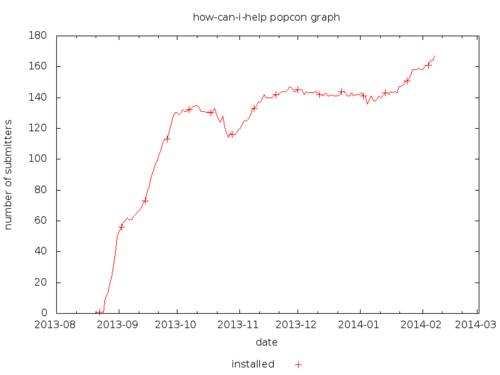
This is a repost from Stefano Zacchiroli's post how-can-i-help by Lucas Nussbaum is one of the best things that happened in the area of attracting contributions to Debian in quite a while. It can be used both as a standalone tool to list opportunities for contributing to Debian which are related to your installed packages, and as an APT hook (which is also the default configuration) that at each upgrade will inform you of new contribution opportunities. how-can-i-help is great for newbies who are looking for ways to give back to Debian which are a good match for their skills: among other things, how-can-i-help shows bugs tagged "gift" related to packages you use. how-can-i-help is also great for experienced developers, as it allows them to find out, in a timely manner, that packages they use are in dire need of help: RC bugs, pending removals, adoptions needed, requests for sponsor, etc. (As highly unscientific evidence: I've noticed a rather quick turnover of RFA/O/ITA bugs on packages installed on my machine. I suspect how-can-i-help is somehow responsible for that, due to the fact that it increases awareness of ongoing package issues directly with the people using them.) So, if you haven't yet, please apt-get install how-can-i-help RIGHT NOW. I daresay that we should aim at installing how-can-i-help by default on all Debian machines, but that might be an ambitious initial goal. In the meantime I'll settle for making how-can-i-help's popcon count skyrocket. As of today, it looks like this: Alt how-can-i-help popularity contest graph 10/02/2014 which is definitely too low for my taste. Please spread the word about how-can-i-help. And let's see what we can collectively do to that graph. how-can-i-help is just a tiny teeny helper, but I'm convinced it can do wonders in liberating dormant contributions to the Debian Project.

Matthew Garrett: IBM's remote firmware configuration protocol

I spent last week looking into the firmware configuration protocol used on current IBM system X servers. IBM provide a tool called ASU for configuring firmware settings, either in-band (ie, running on the machine you want to reconfigure) or out of band (ie, running on a remote computer and communicating with the baseboard management controller - IMM in IBM-speak). I'm not a fan of using vendor binaries for this kind of thing. They tend to be large (ASU is a 20MB executable) and difficult to script, so I'm gradually reimplementing them in Python. Doing that was fairly straightforward for Dell and Cisco, both of whom document their configuration protocol. IBM, on the other hand, don't. My first plan was to just look at the wire protocol, but it turns out that it's using IPMI 2.0 to communicate and that means that the traffic is encrypted. So, obviously, time to spend a while in gdb.

The most important lesson I learned last time I did this was "Check whether the vendor tool has a debug option". ASU didn't mention one in its help text and there was no sign of a getopt string, so this took a little longer - but nm helpfully showed a function called DebugLog and setting a breakpoint on that in gdb showed it being called a bunch of the time, so woo. Stepping through the function revealed that it was checking the value of a variable, and looking for other references to that variable in objdump revealed a -l argument. Setting that to 255 gave me rather a lot of output. Nearby was a reference to --showsptraffic, and passing that as well gave me output like:

BMC Sent: 2e 90 4d 4f 00 06 63 6f 6e 66 69 67 2e 65 66 69
BMC Recv: 00 4d 4f 00 21 9e 00 00

which was extremely promising. 2e is IPMI-speak for an OEM specific command, which seemed pretty plausible. 4d 4f 00 is 20301 in decimal, which is the IANA enterprise number for IBM's system X division (this is required by the IPMI spec, it wasn't an inspired piece of deduction on my behalf). 63 6f 6e 66 69 67 2e 65 66 69 is ASCII for config.xml. That left 90 and 06 to figure out. 90 appeared in all of the traces, so it appears to be the command to indicate that the remaining data is destined for the IMM. The prior debug output indicated that we were in the QuerySize function, so 06 presumably means query the size. And this is supported by the response - 00 (a status code), 4d 4f 00 (the IANA enterprise number again, to indicate that the responding device is speaking the same protocol as you) and 21 9e 00 00 - or, in rational endianness, 40481, an entirely plausible size.

Once I'd got that far the rest started falling into place fairly quickly. 01 rather than 06 indicated a file open request, returning a four byte file handle of some description. 02 was read, 03 was write and 05 was close. Hacking this together with pyghmi meant I could open a file and read it. Success!

Well, kind of. I was getting back a large blob of binary. The debug trace showed calls to an EfiDecompress function, so on a whim I tried just decompressing it using the standard UEFI compression format. Shockingly, it worked and now I had a 345K XML blob and presumably many more problems than I'd previously had. Parsing the XML was fairly straightforward, and now I could retrieve the full set of config options, along with the default, current and possible values for them.

Making changes was pretty much just the reverse of this. A small XML blob containing the new values is compressed and written to asu_update.efi. One of the elements is a random identifier, which will then appear in another file called config_log along with a status. Just keep re-reading this until the value changes to CM_DONE and we're good.

The in-band configuration appears to be identical, but rather than sending commands over the wire they're send through the system's IPMI controller directly. Yes, this does mean that it's sending compressed XML through a single io port. Yes, I'd rather be drinking.

I've documented the protocol here and hope to be able to release this code before too long - right now I'm trying to nail down the interface a little, but it's broadly working.

comment count unavailable comments

Mario Lang: Neurofunkcasts

I have always loved Drum and Bass. In 2013 I rediscovered my love for Darkstep and Neurofunk, and found that these genres have developed quite a lot in the recent years. Some labels like Black Sun Empire and Evol Intent produce mixes/sets on a regular basis as podcasts these days. This article aggregates some neurofunk podcasts I like a lot, most recent first. Enjoy 33 hours and 57 minutes of fun with dark and energizing beats. Thanks to BSE Contrax and Evol Intent for providing such high quality sets. You can also see the Python source for the program that was used to generate this page.

Stefano Zacchiroli: apt-get install how-can-i-help

skyrocketing how-can-i-help popcon count how-can-i-help by Lucas Nussbaum is one of the best things that happened in the area of attracting contributions to Debian in quite a while. It can be used both as a standalone tool to list opportunities for contributing to Debian which are related to your installed packages, and as an APT hook (which is also the default configuration) that at each upgrade will inform you of new contribution opportunities. how-can-i-help is great for newbies who are looking for ways to give back to Debian which are a good match for their skills: among other things, how-can-i-help shows bugs tagged "gift" related to packages you use. how-can-i-help is also great for experienced developers, as it allows them to find out, in a timely manner, that packages they use are in dire need of help: RC bugs, pending removals, adoptions needed, requests for sponsor, etc. (As highly unscientific evidence: I've noticed a rather quick turnover of RFA/O/ITA bugs on packages installed on my machine. I suspect how-can-i-help is somehow responsible for that, due to the fact that it increases awareness of ongoing package issues directly with the people using them.) So, if you haven't yet, please apt-get install how-can-i-help RIGHT NOW. I daresay that we should aim at installing how-can-i-help by default on all Debian machines, but that might be an ambitious initial goal. In the meantime I'll settle for making how-can-i-help's popcon count skyrocket. As of today, it looks like this:
how-can-i-help popularity contest graph, 10/02/2014
which is definitely too low for my taste. Please spread the word about how-can-i-help. And let's see what we can collectively do to that graph. how-can-i-help is just a tiny teeny helper, but I'm convinced it can do wonders in liberating dormant contributions to the Debian Project.

Andrew Pollock: [life] Day 13, early start, Kindergarten and messing around with a hot glue gun

I had an early start today. I set my alarm for 5:30am, and finally got going a bit after 6am, and knocked out a 10km run. It was my first 10km in about a month. It wasn't pretty, but I was looking for accomplishment, not achievement. Sarah's doing a work training course that had an early start, so she asked me if she could drop Zoe to me early and have me take care of Kindergarten drop off for her. Zoe arrived at around 8am, and I put some sunscreen on her and we jumped on the bike. I had one of the smoothest drop offs I've had since we've been back in Australia. Megan was already there, and after we got settled, the two girls started building with some large wooden blocks, and Zoe pretty much gave me a hug and a kiss and sent me on my way. She didn't require any handing off to a teacher, wasn't clingy or anything. It was wonderful to see. Today was supposed to be my Debian day, but I've got something like 3 tax returns to do for two different countries, so I got stuck into collating records instead. After lunch I allowed myself to get sidetracked with trying to figure out the Google Drive API, because I'm trying to directly scan documents to Google Drive. Then it was time to do the Kindergarten pick up. Both girls were fast asleep when I got there. I tried rousing Zoe without much success, so I went to try and wake up Megan. She was also pretty heavily sleeping, so I left her with one of the teachers to try and wake her up and returned to Zoe. She took a lot of work to wake up, but woke up happy. I was expecting a couple of packages today, and the first one was being delivered by Australia Post as we got home, so that was pretty good timing. The second one was delivered while we were home, so that worked out pretty well. For this afternoon's activity with the girls, I thought we'd make peg dolls. I've been stockpiling craft materials for almost as long as I've been back in Australia. I bought the big IKEA EXPEDIT 5 x 5 shelf, and have the bottom two rows set up as Zoe-accessible craft materials, reminiscent of the "bin wall" that the TechShop had. I've been getting stuff from Riot!, but I've also found that there's lots of good stuff to be had for cheap from Overflow. So today's activity I think came from Riot! It was your bog standard wooden clothes pin, but the kit included a conical wooden "sleeve" that I guess was supposed to be a "dress". I thought I'd take things to the next level by hot-gluing a styrofoam ball on the top of the peg, and then hot-gluing eyes and a pom-pom nose on. The girls decided on their own to glue orange cellophane for hair, and got me to draw on eyebrows and a mouth. I had a couple of sheets of felt, so I cut holes in the middle of them and used the conical wooden sleeve to hold the felt dress in place. Pipe cleaners made the arms and they were finished. The girls seemed to enjoy making and playing with them. It was the first time I've used the hot glue gun, and I wasn't sure how it was going to go. I explained to the girls that the tip was hot and to stay away from it, and let them use it under close supervision. Unfortunately Zoe learned the hard way that the glue is also very hot after it's been applied to the surface that it's going to be used on. Hot glue was definitely the way to go for a quick project where we didn't want to be sitting around waiting for PVA glue to dry. After that, the girls watched a DVD for a little while and then Megan's Dad arrived to pick her up. I started dinner a bit late, I should have started it while the girls were watching TV, so we didn't sit down to eat until later than usual. Bedtime went pretty smoothly, but also ran a bit late. Here's hoping Zoe sleeps well tonight.

9 February 2014

Erich Schubert: Minimizing usage of debian-multimedia packages

How to reduce your usage of debian-multimedia packages: As you might be aware, the "deb-multimedia" packages have seen their share of chaos. Originally, they were named "debian-multimedia", but it was then decided that they should better be called "deb-multimedia" as they are not an official part of Debian. The old domain was then grabbed by cybersquatters when it expired. While a number of packages remain indistributable for Debian due to legal issues - such as decrypting DVDs - and thus "DMO" remains useful to many desktop users, please note that for many of the packages, a reasonable version exists within Debian "main". So here is a way to prevent automatically upgrading to DMO versions of packages that also exist in Debian main: We will use a configuration option known as apt pinning. We will modify the priority of DMO package to below 100, which means they will not be automatically upgraded to; but they can be installed when e.g. no version of this package exists within Debian main. I.e. the packages can be easily installed, but it will prefer using the official versions. For this we need to create a file I named /etc/apt/preferences.d/unprefer-dmo with the contents:
Package: *
Pin: release o=Unofficial Multimedia Packages
Pin-Priority: 123
As long as the DMO archive doesn't rename itself, this pin will work; it will continue to work if you use a mirror of the archive, as it is not tied to the URL. It will not downgrade packages for you. If you want to downgrade, this will be a trickier process. You can use aptitude for this, and start with a filter (l key, as in "limit") of ?narrow(~i,~Vdmo). This will only show packages installed where the version number contains dmo. You can now patrol this list, enter the detail view of each package, and check the version list at the end for a non-dmo version. I cannot claim this will be an easy process. You'll probably have a lot of conflicts to clear up, due to different libavcodec* API versions. If I recall correctly, I opted to uninstall some dmo packages such as ffmpeg that I do not really need. In other cases, the naming is slightly different: Debian main has handbrake, while dmo has handbrake-gtk. A simple approach is to consider uninstalling all of these packages. Then reinstall as needed; since installing Debian packages is trivial, it does not hurt to deinstall something, does it? When reinstalling, Debian packages will be preferred over DMO packages. I prefer to use DFSG-free software wherever possible. And as long as I can watch my favorite series (Tatort, started in 1970 and airing episode 900 this month) and the occasional DVD movie, I have all I need. An even more powerful aptitude filter to review installed non-Debian software is ?narrow(~i,!~ODebian), or equivalently ?narrow(?installed,?not(?origin(Debian))). This will list all package versions, which cannot be installed from Debian sources. In particular, this includes versions that are no longer available (they may have been removed because of security issues!), software that has been installed manually from .deb files, or any other non-Debian source such as Google or DMO. (You should check the output of aptitude policy that no source claims to be o=Debian that isn't Debian though). This filter is a good health check for your system. Debian packages receive a good amount of attention with respect to packaging quality, maintainability, security and all of these aspects. Third party packages usually failed the Debian quality check in at least one respect. For example, Sage isn't in Debian yet; mostly because it has so many dependencies, that making a reliable and upgradeable installation is a pain. Similarly, there is no Hadoop in Debian yet. If you look at Hadoop packaging efforts such as Apache Bigtop, they do not live up to Debian quality yet. In particular, the packages have high redundancy, and re-include various .jar copies instead of sharing access to an independently packaged dependency. If a security issue arises with any of these jars, all the Hadoop packages will need to be rebuilt. As you can see, it is usually not because of Debian being too strict or too conservative about free software when software is not packaged. More often than not, it's because the software in question itself currently does not live up to Debian packaging quality requirements. And of course sometimes because there is too little community backing the software in question, that would improve the packaging. If you want your software to be included in Debian, try to make it packaging friendly. Don't force-include copies of other software, for example. Allow the use of system-installed libraries where possible, and provide upgrade paths and backwards compatibility. Make dependencies optional, so that your software can be pacakged even if a dependency is not yet available - and does not have to be removed if the dependency becomes a security risk. Maybe learn how to package yourself, too. This will make it easier for you to push new features and bug fixes to your userbase: instead of requiring your users to manually upgrade, make your software packaging friendly. Then your users will be auto-upgraded by their operating system to the latest version. Update: If you are using APT::Default-Release or other pins, these may override above pin. You may need to use apt-cache policy to find out if the pins are in effect, and rewrite your default-release pin into e.g.
Package: *
Pin: release a=testing,o=Debian
Pin-Priority: 912
for debugging, use a different priority for each pin, so you can see which one is in effect. Notice the o=Debian in this pin, which makes it apply only to Debian repositories.

Neil Williams: Debian ARMMP in LAVA using iMX53

The home lab is my LAVA development environment and I ve recently got two iMX53 Quick Start Boards working with a typical LAVA master image based on a Linaro build of Linux 3.1.0 for mx5 with a Ubuntu Oneiric Ocelot 11.10 rootfs:
 3.1.0-1002-linaro-lt-mx5 (buildd@hubbard) (gcc version 4.6.1 (Ubuntu/Linaro 4.6.1-9ubuntu3) ) #13-Ubuntu PREEMPT Fri Dec 16 01:21:07 UTC 2011
As part of my Debian work, it was clearly time to look at a current, Debian, kernel and rootfs and as I m developing and testing on Debian unstable, this would necessarily mean testing the Debian ARMMP (multi-platform) kernel which replaces the mx5 build used in Wheezy.
Linux version 3.12-1-armmp (debian-kernel@lists.debian.org) (gcc version 4.8.2 (Debian 4.8.2-10) ) #1 SMP Debian 3.12.9-1 (2014-02-01)
I will be scripting the creation of a suitable image for these tests and there are other changes planned in LAVA to make it easier to build suitable images, but it is useful to document just how I worked out how to build the first image. Manual build steps First, I ve already discovered that the u-boot on the iMX53 doesn t like ext4, so the first step was to prepare an ext3 filesystem for the image. With a SATA drive attached, it was also much better to use that than the SD card, at least for generating the image. I m also doing this natively, so I am working inside the booted master image. This is fine as the master is designed to manipulate test images, so the only package I needed to install on the LAVA master image was debootstrap. I had an empty SATA drive to play with for these tests, so first prepare an ext3 filesystem:
# mkfs.ext3 /dev/sda1
# mkdir /mnt/sata
# mount /dev/sda1 /mnt/sata
# mkdir /mnt/sata/chroots/
Start the debootstrap:
# apt-get update
# apt-get install debootstrap
# debootstrap --arch=armhf --include=linux-image-armmp \
 --verbose unstable \
 /mnt/sata/chroots/unstable-armhf http://ftp.uk.debian.org/debian
Various actions in this chroot will need proc, so mount it here:
# chroot /mnt/sata/chroots/unstable-armhf
# mount proc -t proc /proc
# mount devpts -t devpts /dev/pts
# exit
You may also have to edit the apt sources the LAVA master image doesn t have editors installed, so either use echo or download an edited file. I m using:
deb http://ftp.uk.debian.org/debian sid main
flash-kernel needs changes For the initial tests, I ve got to get this image to boot directly from u-boot, so flash-kernel is going to be needed inside the chroot and to get the iMX53 to work with the ARMMP kernel and Device Tree, flash-kernel will need an update which will mean a patch:
# chroot /mnt/sata/chroots/unstable-armhf
# apt-get update
# apt-get install patch flash-kernel
# cp /usr/share/flash-kernel/db/all.db /home
# cd /home
# patch -p2
The patch itself goes through a couple of iterations. Initially, it is enough to use:
 Machine: Freescale MX53 LOCO Board
-Kernel-Flavors: mx5
+Kernel-Flavors: armmp
+DTB-Id: imx53-qsb.dtb
+DTB-Append: yes
Later, once the device has booted with the ARMMP kernel, the Machine Id can be updated to distinguish it from the mx5 flavour (from /proc/cpuinfo) and use the model name from the Device Tree (/proc/device-tree/model):
diff --git a/db/all.db b/db/all.db
index fab3407..41f6c78 100644
--- a/db/all.db
+++ b/db/all.db
@@ -62,6 +62,18 @@ U-Boot-Initrd-Address: 0x00800000
 Required-Packages: u-boot-tools
 Bootloader-Sets-Incorrect-Root: yes
 
+Machine: Freescale i.MX53 Quick Start Board
+Kernel-Flavors: armmp
+DTB-Id: imx53-qsb.dtb
+DTB-Append-From: 3.12
+Boot-DTB-Path: /boot/dtb
+U-Boot-Kernel-Address: 0x70008000
+U-Boot-Initrd-Address: 0x0
+Boot-Kernel-Path: /boot/uImage
+Boot-Initrd-Path: /boot/uInitrd
+Required-Packages: u-boot-tools
+Bootloader-Sets-Incorrect-Root: no
+
 Machine: Freescale MX53 LOCO Board
 Kernel-Flavors: mx5
 U-Boot-Kernel-Address: 0x70008000
(I will be filing this patch in a bug report against flash-kernel soon.) With that patched, update and run flash-kernel:
# mv all.db /usr/share/flash-kernel/db/all.db
# flash-kernel
flash-kernel: installing version 3.12-1-armmp
Generating kernel u-boot image... done.
Taking backup of uImage.
Installing new uImage.
Generating initramfs u-boot image... done.
Taking backup of uInitrd.
Installing new uInitrd.
Installing new dtb.
# exit
LAVA overlays This will be a LAVA test image and it needs an overlay if you want a vanilla image, set up a passwd inside the chroot instead.
# cd /mnt/sata/chroots/unstable-armhf/
# wget --no-check-certificate https://launchpad.net/~linaro-maintainers/+archive/overlay/+files/linaro-overlay-minimal_1112.2_all.deb
# wget --no-check-certificate https://launchpad.net/~linaro-maintainers/+archive/overlay/+files/linaro-overlay_1112.2_all.deb
# chroot /mnt/sata/chroots/unstable-armhf/
# dpkg -i linaro-overlay-minimal_1112.2_all.deb linaro-overlay_1112.2_all.deb
# rm linaro-overlay-minimal_1112.2_all.deb linaro-overlay_1112.2_all.deb
# exit
Changes to allow the chroot to boot Now the chroot needs setting up as a boot image:
# chroot /mnt/sata/chroots/unstable-armhf/
# echo T0:23:respawn:/sbin/getty -L ttymxc0 115200 vt102 >> ./etc/inittab
# echo auto lo eth0 > ./etc/network/interfaces.d/mx53loco
# echo iface lo inet loopback >> ./etc/network/interfaces.d/mx53loco
# echo iface eth0 inet dhcp >> ./etc/network/interfaces.d/mx53loco
# apt-get clean
# umount /dev/pts
# umount /proc
# exit
Partitioning as a LAVA test image This would be enough as a single partition test image but, currently, LAVA expects a much more hard-wired image. Depending on the history of the device and the need for LAVA to be able to put fresh kernel builds together with a known rootfs, LAVA has used a separate /boot and / partition in the test image for nearly all boards. Standard LAVA test images for many boards (like the iMX53) also have a small unallocated space at the start of the SD card, so until I can get LAVA upstream to handle test images of arbitrary design, I m adapting the image to suit the expectations inside LAVA. Yes, I know but it s better to get something working before spending time fixing things to make it work better. It will be fixed, in time. So I needed to separate out the /boot contents from the rest of the rootfs whilst keeping the chroot itself in a state which I can easily update and use to create other images.
# cd /mnt/sata/chroots/unstable-armhf/boot/
# tar -czf ../../boot.tar.gz ./*
# cd ..
# tar -czf ../root.tar.gz ./*
Now the test image file and its partitions:
# dd if=/dev/zero of=/mnt/sata/images/empty/debian.img bs=1M count=1024
# cp /mnt/sata/images/empty/debian.img /mnt/sata/images/debian-unstable-armhf-armmp.img
# losetup /dev/loop0 /mnt/sata/images/debian-unstable-armhf-armmp.img
# parted /dev/loop0 -s unit mb mktable msdos
# parted /dev/loop0 -s unit mb mkpart primary 1 10
# parted /dev/loop0 -s unit mb mkpart primary 11 110
# parted /dev/loop0 -s unit mb mkpart primary 111 1024
I did make the mistake of using kpartx at this stage but there are many areas of confusion when translating the kpartx output to offsets for mount when parted is easier:
# parted /dev/loop0 unit B -s print
Model:  (file)
Disk /dev/loop0: 1073741824B
Sector size (logical/physical): 512B/512B
Partition Table: msdos
Number  Start       End          Size        Type     File system  Flags
 1      1048576B    10485759B    9437184B    primary
 2      10485760B   110100479B   99614720B   primary
 3      110100480B  1024458751B  914358272B  primary
Use the Start numbers and use losetup to create the loop devices for each
partition
# losetup -o 10485760 /dev/loop1 /dev/loop0
# losetup -o 110100480 /dev/loop2 /dev/loop0
# mkfs.vfat /dev/loop1
# mkfs.ext3 /dev/loop2
Now clean up the loop mountpoints:
# losetup -d /dev/loop2
# losetup -d /dev/loop1
# losetup -d /dev/loop0
# losetup -a
losetup -a should return nothing. If it doesn t, investigate the contents of /dev/mapper and use dmsetup remove until losetup -a does report empty. Otherwise the subsequent stages will fail. Now deploy the /boot contents into the empty image:
# mount -oloop,offset=10485760 /mnt/sata/images/debian-unstable-armhf-armmp.img /mnt/boot/
# pushd /mnt/boot/
# tar -xzf /mnt/sata/chroots/boot.tar.gz
# popd
# sync
# umount /mnt/boot/
and the / contents (removing the duplicate ./boot contents)
# mount -oloop,offset=110100480 /mnt/sata/images/debian-unstable-armhf-armmp.img /mnt/root/
# pushd /mnt/root
# tar -xzf /mnt/sata/chroots/root.tar.gz
# rm ./boot/*
# popd
# sync
# umount /mnt/root
Check the image
# mount -oloop,offset=10485760 debian-unstable-armhf-armmp.img /mnt/boot
# ls /mnt/boot
config-3.12-1-armmp  initrd.img-3.12-1-armmp  System.map-3.12-1-armmp  uImage  uInitrd  vmlinuz-3.12-1-armmp
# umount /mnt/boot
# mount -oloop,offset=110100480 debian-unstable-armhf-armmp.img /mnt/root
# ls /mnt/root
bin  boot  dev  etc  home  initrd.img  lib  lost+found  media  mnt  opt  proc  root  run  sbin  srv  sys  tmp  usr  var  vmlinuz
# ls /mnt/root/bin/auto-serial-console
/mnt/root/bin/auto-serial-console
# umount /mnt/root
# md5sum debian-unstable-armhf-armmp.img
Downloads Yes, I have put that file online, if you are interested. Do read the readme first though. Getting the image off the device
# ip a
# python -m SimpleHTTPServer 80 2>/dev/null
then wget (just http://, IP address / and the filename), md5sum , finish with Ctrl-C. Depending on setup, it may be quicker to transfer the uncompressed
file over a LAN than to let the device compress it. Your main machine
will do the compression much faster, even with a larger download. (It also helps to not compress the image on the device, you can
test the mount offsets more easily and do check that the image
can be mounted with the offsets from parted.) Results
# cat /proc/cpuinfo
processor	: 0
model name	: ARMv7 Processor rev 5 (v7l)
Features	: swp half thumb fastmult vfp edsp thumbee neon vfpv3 tls vfpd32 
CPU implementer	: 0x41
CPU architecture: 7
CPU variant	: 0x2
CPU part	: 0xc08
CPU revision	: 5
Hardware	: Freescale i.MX53 (Device Tree Support)
Revision	: 0000
Serial		: 0000000000000000
# uname -a
Linux imx53-02 3.12-1-armmp #1 SMP Debian 3.12.9-1 (2014-02-01) armv7l GNU/Linux
# lsb_release -a
No LSB modules are available.
Distributor ID:	Debian
Description:	Debian GNU/Linux unstable (sid)
Release:	unstable
Codename:	sid
Next! Yes, there is a lot to do from here on. Then there is the whole issue of actually making this multi-platform. After all, it is far from ideal that a multi-platform kernel package has to have platform-specific operations using flash-kernel at each update. So Grub on ARM is going to be on the list of things to investigate .

Next.

Previous.