Search Results: "dom"

11 June 2008

Obey Arthur Liu: debian.org domainsquatted ? (1)

debian.org domain squatted I was like “wtf?!”. Debian.org replaced by a link farm ? debian.org being actually domainsquatted is highly unlikely, so I started searching how this could happen. First, a little explanation of the setup : Now there are some peculiarities to the situation : Some hints : Now for the challenge : how could this happen ?

10 June 2008

Gunnar Wolf: Nekkid city - yet again!

After thinking it over a couple of times, I did it. I told you here about the World Naked Bike Ride. Thousands of bikers, in over 130 cities around the world, voiced their concerns about the lack of caution drivers have towards us, about the abuse of fossil fuels for urban transportation, about the easy we are not to be seen. Many among us have been run over by careless drivers (in my case, no consequences except a broken helmet - And yes, MJ: although the impact was on the flat surface of the road and not on the kerb, the strength of the impact still amazes me). We feel naked against the motorized traffic. So, the WNBR decides to show it by taking the streets of our many cities - Naked.
It was a completely different experience of the massive naked Spencer Tunick photo, as we were there not just to show our freedom and enjoy, but to get the people to look at us. There were some of the same elements of comradeship and trust we had there (and, of course, that many of us learnt in Finland when we became GNUdists at DebConf 5's unforgettable saunas).
Anyway... I did not make the full route (I rode Chapultepec-Z calo-Diana, ~15Km, but missed the Diana-Gandhi-Cibeles part, maybe some 5Km) as I had an appointment I was already late for. But it was a unique, great experience. If you are interested, we got a fair share of press coverage. Oh, and I must say: I am famous now. And in my favorite newspaper, nothing less :).

Benjamin Mako Hill: Area Coding

My mobile phone has a 206 area code (Seattle). People sometimes ask me why I don't have a 617 number (Boston/Cambridge). In fact, I had a Massachusetts number in college but switched to a 206 several years ago on a trip back home in order to get a "permanent" Seattle number. With a move to mobiles phones, the idiosyncratic fact that US mobiles remain tied to geographic area codes, and the effective elimination of domestic roaming and long-distance, an area code in the United States is increasingly not about where you are but about where you are from. Or, perhaps more accurately, about where you want people to think you are from.

MJ Ray: Online shopping

I maintain a number of web shops for our webmaster cooperative and one of our main challenges is to encourage people who put things into their basket/cart to actually buy them. How to avoid shopping cart abandonment by Graham Jones makes some points that I've identified as possible reasons for people not buying in the past: comparisons, robots and not trusting the site enough to give payment details. There's not much we can do about robots or people comparison-shopping at a technical level, but we try to build some trust by publishing the shop owner's geographic address and telephone number (which I think is required by law in England for most web shops now), making sure the SSL certificate and domain registration details are correct, using reputable payment providers and being clear about delivery charges and terms. The point about the slickness of the checkout process is a good one and one that we've only recently started to work on. We've had pretty good results from making the checkout slicker on one site. It looks like two-thirds of people who click the checkout button now continue to buy, putting it comfortably ahead of current UK averages but I need to tweak our stats calculator to make the report directly comparable. Nevertheless, I think those improvements will be added to our other shops as soon as possible. I share Graham's low opinion of the oft-quoted Amazon. We've also been looking at other web shop software besides OSCommerce for a new project, so now would be a good time to change to something new if it improves the checkout a lot. We've made OSCommerce's checkout a lot smoother, but it's still essentially OSC. Is there a good checkout which you'd want to use as an example? The other challenge is getting visitors onto the site in the first place. How To Build Links By Patrick Altoft explains the basics as well as I've seen recently.

9 June 2008

Christian Perrier: Samba 4 in experimental

The (still alpha) 4.0.0 release of Samba is now in experimental. Both Samba 3 and Samba 4 packages are likely to coexist in the archive as Samba 3 is still for a while the production code for File and Print services while Samba 4 is the development branch of the Samba team to implement Active Directory domain control (among other things). Samba4 packages also bring a big bunch of libraries, most of which being used to related development such as Openchange. Expect some neat new packages in experimental, then unstable, pretty soon now. Please do NOT replace production servers running samba 3.0.* or samba 3.2.* by samba4....not yet..:-) The samba4 packages are maintained by Jelmer Vernooij, one of the two main developers for Samba 4 in the Samba Team (the other being Andrew Bartlett). Jelmer is someone we should stuck out from the NM queue as soon as possible..:-) Anyway, this is again another success of that small team we built around Samba and samba-related packaging. Thanks to all involved people (Steve Langasek, No l K the, Jelmer Vernooij, Peter Eisentraut, etc.).

David Welton: Startups: government help and hindrance

Aaron Swartz writes about what government might do to encourage entrepreneurship: http://www.aaronsw.com/weblog/prostartup As an American who has lived in Europe for a while, I've seen both sides of the coin (or pond, as it were), and feel qualified to add a few things to the conversation, even if many of these points merit a discussion of their own. And here are some thoughts of my own: I think it's best to focus on the startup "curve", and costs associated with various points on it: when people are just getting started, keep state-imposed costs low. If someone makes a lot of money, worry about taxing it then. This is quite different than what has previously been the norm in many places in Europe, which have policies akin to slaughtering the goose before it lays any eggs, let alone golden ones. Italy is a particularly bad example, but it's the place I know best, and not too far off what happens elsewhere in terms of policy: fixed, sunk, startup costs are in the order of 10,000 Euro, which for most people is a lot of money. This creates a bias towards people who already have a lot of money, and away from random people who happen to have good ideas and a strong desire to execute on them. This is something that the US more or less gets right: it cost me $55 in state fees to start DedaSys LLC as a limited liability company (even throwing in money for lawyers and the like, you're still far under the thousands it costs in many European countries). Incidentally, it looks like Germany may be on the right track, if you look at the "Mini-GmbH" mentioned in the article. It's progress, if nothing else. Beyond that, there is a lot more red tape in Europe, and that, I think, rather than a bit higher taxes for companies that are profitable, is the thing that, outside of culture, probably weighs most heavily on European startups. Culture, however, is also a very key factor, and not something that will change soon or easily. In Italy, there's a lot of pressure to land a permanent job, from which you can basically never be fired. The idea of striking out on your own is probably simply not on most people's radar screens. I think culture is what means that Europe produces tons of great open source software, for example, but relatively fewer startups (if you're just counting open source startups though, Europe does ok). Perhaps this is slowly changing, but it will take a while, and without some policy changes, the incentives won't even materialize. Returning to things that government can do, something critical that many people don't get is that government funded startups are usually big failures (see the French "Google competitor") and a big waste of money that would probably simply be better to spend in lowering taxes, improving education, or other "level playing field" initiatives, rather than having government employees attempting to "pick winners". This is a common problem in Europe, but also in many areas of the US that want to replicate Silicon Valley's success. Going back to the US, which was Aaron's original point of focus, beyond health care, what could the US improve? At the moment, immigration seems to be the big problem: people from all over the world want to go to the US to work and start companies, but look at what kinds of hoops someone (who is coming to spend money and create jobs!) has to jump through to do so: http://www.techcrunch.com/2008/05/02/coming-to-america-getting-visas-to-do-business-in-silicon-valley/ Embarrassing and shameful. In conclusion, I think the common theme is that the government can't really do much to actively promote startups, but can certainly hinder them by setting too high a bar in terms of bureaucracy and fixed costs. Lowering those fixed costs for new companies, be it through at least basic health care for everyone, or lower taxes and less paperwork should be what governments aim for. Given the right conditions and incentives, bright, hard workers will do the rest.

Y Giridhar Appaji Nag: It had to be a UFO

I just got back from Indiana Jones and the Kingdom of the Crystal Skull, a movie in which Steven Spielberg takes his obsession with the extra terrestrial to the next level.

Please watch it if you feel that times goes too fast, the two hours that you are watching the movie will seem like two years.

And it had to be a UFO in the end :)

Update: I should have kept the spoiler under lj-cut, but now that I think of it, that wouldn't help people aggregating the posts. I suppose I will avoid posting spoilers.

8 June 2008

Robert McQueen: Xen virtual interfaces with more than one IP

I’ve got a load of boxes running Debian etch with Xen 3.0.3 with routed networking (rather than bridged, so I can do iptables and reverse path filtering etc in dom0). Since upgrading from Xen 2.x many moons ago, I’ve not known how to configure one virtual interface to have more than one IP. In the meantime, I’ve ended up doing nonsense like providing a VM with two interfaces just to give it two IPs. However, this interacts really badly with reverse path filtering unless you do a bunch of source-routing rocket science in the domU to send out through the right vif. So, I looked at the vif-route script and it seems to support iterating through a space-separated list of IPs, but I was totally unable to find any documentation or mailing list posts explaining how to format the IPs within the formerly-Python key/value Xen domain config file syntax. After a while playing with the parser and various levels of quoting, I found that actually, the correct amount of quoting is none at all, and also uncovered a bug in another script which prevents it from working correctly. In the hope that this might help others using Google and trying to achieve the same as me, here is my recipe for configuring Xen vif devices to have multiple IPs (note that I think this might be specific to Xen 3.0.x, as I believe 3.2.x introduces config files in the S-expression format which is what xenstore uses internally):
  1. Configure your VM using this surprisingly obvious, but somewhat dubious syntax (including a second argument just to prove that yes, it really does work like that):

    vif=['ip=1.2.3.4 5.6.7.8, mac=00:16:3e:01:23:45']

    When parsed into SXP by xm create, this sets the ip value correctly as a space separated list as the scripts expect:

    (device (vif (ip '1.2.3.4 5.6.7.8') (mac 00:16:3e:01:23:45)))
  2. Fix the bug in /etc/xen/scripts/vif-common.sh:

    --- /etc/xen/scripts/vif-common.sh~ 2008-06-09 01:14:23.065065119 +0100
    +++ /etc/xen/scripts/vif-common.sh 2008-06-09 01:11:06.599986274 +0100
    @@ -103,7 +103,7 @@
    if [ "$ip" != "" ]
    then
    local addr
    - for addr in “$ip”
    + for addr in $ip
    do
    frob_iptable -s “$addr”
    done
  3. Set up multi-homed or aliased interfaces as normal in the domU (depending if you’re a ip or an ifconfig kinda guy).
  4. Profit!

Axel Beckert: Bath Tub, Rubber Keyboard, Ratpoison and Opera

I recently noticed that a very good way to safely read webcomics in the bath tub is an old laptop with a big screen (e.g. a IBM ThinkPad A-series like my 15” A31 which has a nice 1400×1050 resolution), a water proof keyboard, the screen-alike, keyboard only driven (hence the name) window manager ratpoison (other keyboard driven window managers like wmii or awesome probably will do as well as ratpoison) and a good keyboard driven web browser which can bind or by default has bound a key to follow <link rel="next" ... /> tags. Like Opera. Opera has bound the space bar to scroll one page down and if you reach the bottom of the page to go to the next page as labeled in the link tag. Additionally the full screen mode is helpful, too. Or the dream browser of all Emacs addicts, Conkeror, which has bound the function browser-follow-next to ]]. (Conkeror packages will hit Debian Experimental quite soon.) Or the GNOME feed reader Liferea which has bound Ctrl-Space by default to scroll down the content by one page and if you reach the bottom of the content go to the next unread item. With that equipment I can read my favourite web comics like Questionable Content (whose content seldomly is questionable :-) or Ozy and Millie (Think of a mixture of Calvin & Hobbes, Peanuts and Kevin & Kell) in the bath tub without drying my hands before reading the next comic or fearing water or health damage by the combination of water and computer. I just press one or two keys on the keyboard floating over my lap and have a good time.
a keyboard floatiing in the bath tub close up of the floatiing keyboard
BTW: I’ve got a blue, non-branded one (packaging reveals it as “AirTouch Keyboard”, probably manufactured by SanChuan Electronics, China) with swiss-german layout from ARP Datacom (whose website offers no permanent links and insists on session cookies *puke*), but those from Keysonic or from ROCK seem to be very similar — nowadays they are also available in illuminated, miscellaneous colors and wireless, but only IP65, probably because of the necessarily accessible battery compartment. But this kind of having fun still has optimisation potential: non-flexibel water-proof keyboard (IP67 recommended, so those IP66 keyboards and mice recently posted at UF LOTD are probably not tight enough), flat screen mounted above the bath tub, etc. ;-) Or maybe a completely water proof laptop if such thing exists — Does it? One more note: In Debian Sid and Lenny recently a new tool called keynav has been added, which allows you to control the mouse quickly using the keyboard only. So with Sid or Lenny, I don’t even need an waterproof mouse or trackball if an application insists on mouse usage. ;-)

Mike Hommey: ADSL woes

For 10 days now, I’ve had ADSL problems. Basically, there is something fishy somewhere between my end and the DSLAM. That can be anything, and for the moment, all I can do is wait for either my ADSL provider or France Telecom, whichever is responsible for the problem, to fix this. Anyways, my network connectivity is sometimes working (though quite slowly, especially on uploads), but more often not, with sometimes connectivity for a few seconds (enough to download small files or pop mail). The glandium.org server being behind this ADSL line, it means that you’re probably not able to see this post. Or maybe a feed-reader/planet/whatever got it while the line was somehow working. Note I’ve been able to setup another MX server, so that mail sent to my domain go somewhere I can fetch them. Don’t worry about sending me messages, they will reach me. Just that it may take time for me to be able to see and/or answer them. Anyways, the main downside is that it makes it harder to handle the upcoming xulrunner transition. On the other hand, the upside is that I finally could take some time to work on ext3rminator again, basically rewriting the code from scratch for reasons I’ll explain when it will be ready for a release. It’s good to see that some new APIs in libext2fs, added since 2002~2003, when I first wrote ext3rminator, make some of the work easier. It’s still sad there is nothing to handle reading the journal. Not that it’s difficult (though not documented much), but that would downsize my code some more ;). Update: It seems to be back to normal.

Biella Coleman: Silent Revolutions: The Ironic Rise of Free and Open Source Software and the Making of a Hacker Legal Consciousness

So I am giving a talk this Friday at the University and here is the English introduction to my talk/paper and below is the Portuguese one. It starts at 9 am in Porto Alegre, Brazil and is being streamed.
*O Departamento de P s-Gradua o da Antropologia e a Associa o Software
Livre.org convidam:
*_*
Palestra com a antrop loga Gabriella Coleman*_
professora da New York University (NYU) *Quando:* Sexta-feira, dia 13 de junho, s 9h
*Onde:* Audit rio do ILEA, Campus do Vale - UFRGS
*Entrada:* Gratuita
*Transmiss o web: *tv.softwarelivre.org *
_Revolu es Silenciosas:_*
*O Ir nico Surgimento do Software Livre e de C digo Aberto
**e a Constru o de uma Consci ncia Legal Hacker* A palestra oferece uma an lise antropol gica e hist rica do
surgimento da comunidade de software livre e de c digo aberto,
procurando mostrar como, ao longo de duas d cadas, hackers e
entusiastas do software livre garantiram para si um dom nio de
autonomia legal para a produ o de software. Em uma poca
marcada por profundas transforma es no regime de Propriedade
Intelectual, a comunidade de software e de c digo aberto se
organiza cultivando uma acentuada consci ncia das transforma es
no mbito legal. O objetivo da palestra o de demonstrar como e
quando se cruzaram as trajet rias parcialmente independentes das
transforma es nas leis de propriedade intelectual com a
consolida o do “movimento” de software livre, para se tornarem
hist rias insepar veis voltadas disputa pelo futuro das
tecnologias - especialmente o computador pessoal e a Internet.
Com este foco, ser discutida uma nova pr tica social de
produ o de tecnologia que fornece uma nova vis o de mundo
insurgente e que desafia as justificativas neoliberais que
animam a expans o das leis de propriedade intelectual. Nesta
discuss o, ao inv s de oferecer hist rico abrangente, ser o
apresentados exemplos selecionados da hist ria do movimento de
software livre e da globaliza o das leis de propriedade
intelectual, com vistas caracteriza o da pr tica de produ o,
distribui o e utiliza o de Software Livre e de C digo aberto
nos Estados Unidos.

7 June 2008

MJ Ray: Bridgwater College Computing Advisory Panel

Probably due to some mistake or just an excess of randomness in the world, our webmaster cooperative has been invited to Bridgwater College's Computing Advisory Panel meeting next week and it looks like I'm going. The interesting agenda items are:- 5. Current Curriculum offer 6. Computing and ICT Sector Developments - Education and Training - ICT Diplomas - Distance Learning - Specialist training / apprenticeships 7. Meeting Employer Needs I've asked some nearby cooperatives and social enterprises for comments and I'll probably highlight things like Linux opens London's Oyster and Specsavers sees clear benefits in open source when arguing for more free software use and emphasising "worker needs" rather than "employer needs", but please send me any other suggestions in a comment on this blog post or an email.

6 June 2008

Benjamin Mako Hill: Stumping for Revealing Errors

Over the past couple months, I gave a couple talks on Revealing Errors -- my project to try and use errors to teach non-technical people about technology, the effects it has on our lives, and the ways in which we (as users) might want to control it. The first version was at LUG Radio Live USA and went off reasonably well. A couple weeks later, I gave a version of the talk again at PenguiCon which went great. Unfortunately, neither recording seems to have worked out. I'll be giving talks on the subject at least twice more this summer. The first will be on June 18th at Boston Linux Unix at 19:00 at MIT in E51-315. It will be my first talk to BLU in something like three years. I'm also currently scheduled to give an abbreviated version of the talk as a keynote at OSCON under the title Advocating Software Freedom by Revealing Errors. In addition to all that, I'm having a whole lot of fun updating the Revealing Errors blog (although not as often as I'd like) and am currently in discussions about publishing a longer version of the Revealing Errors article as a book chapter at some point in the next year. Thanks to everybody who has been supportive of the project and read the blog, has told their friends, and who has told me about telling technological errors they've seen around. Please keep it up!

5 June 2008

Russell Coker: SE Linux Support in GPG

In May 2002 I had an idea for securing access to GNUPG [1]. What I did was to write SE Linux policy to only permit the gpg program to access the secret key (and other files in ~/.gnupg). This meant that the most trivial ways of stealing the secret key would be prevented. However an attacker could still use gpg to encrypt it’s secret key and write the data to some place that is accessible, for example the command “gpg -c --output /tmp/foo.gpg ~/.gnupg/secring.gpg“. So what we needed was for gpg to either refuse to encrypt such files, or to spawn a child process for accessing such files (which could be granted different access to the filesystem). I filed the Debian bug report 146345 [2] requesting this feature. In March upstream added this feature, the Debian package is currently not built with --enable-selinux-support so this feature isn’t enabled yet, but hopefully it will be soon. Incidentally the feature as currently implemented is not really SE Linux specific, it seems to me that there are many potential situations where it could be useful without SE Linux. For example if you were using one of the path-name based MAC systems (which I dislike - see what my friend Joshua Brindle wrote about them for an explanation [3]) then you could gain some benefits from this. A situation where there is even smaller potential for benefit is in the case of an automated system which runs gpg which could allow an attacker to pass bogus commands to it. When exploiting a shell script it might be easier to specify the wrong file to encrypt than to perform more sophisticated attacks. When the feature in question is enabled the command “gpg -c --output /tmp/foo.gpg ~/.gnupg/secring.gpg” will abort with the following error:
gpg: can’t open /root/.gnupg/secring.gpg’: Operation not permitted
gpg: symmetric encryption of /root/.gnupg/secring.gpg’ failed: file open error Of course the command “gpg --export-secret-keys” will abort with the following error:
gpg: exporting secret keys not allowed
gpg: WARNING: nothing exported Now we need to determine the correct way of exporting secret keys and modifying the GPG configuration. It might be best to allow exporting the secret keys when not running SE Linux (or other supported MAC systems), or when running in permissive mode (as in those situations merely copying the files will work). Although we could have an option in gpg.conf for this for the case where we want to prevent shell-script quoting hacks. For editing the gpg.conf file and exporting the secret keys we could have a program similar in concept to crontab(1) which has PAM support to determine when it should perform it’s actions. Also it seems to me that crontab(1) could do with PAM support (I’ve filed Debian bug report 484743 [4] requesting this). Finally one thing that should be noted is that the targeted policy for SE Linux does not restrict GPG (which runs in the unconfined_t domain). Thus most people who use SE Linux at the moment aren’t getting any benefits from such things. This will change eventually.

Amaya Rodrigo: Email zen

You know you have reached email zen when your domain is down for a week, maybe because your dns is down, you don t give a flying fuck, and are in no hurry to fix it. Bonus points if you don t get automatically unsubscribed from any mailing lists.

3 June 2008

Marc 'Zugschlus' Haber: Serial Console Server for the Poor I

The serial port is still the way to access network components out of band. It is slow, but reliable, and remarkably well standardized. It does not have technical whiz-bangs that can fail when one needs things to just work. That makes it the natural way to access critical infrastructure and still being sure that this access vector still works when most other things are down. Every communication link has two sides, so there is a market for devices with a network link and a bigger number of serial ports to connect the actual devices to. Commercial vendors have a broad choice of serial console servers. Most of them, especially the small products with five to ten ports, are quite expensive, so I have been investigating how do build a serial console server with el cheapo hardware. USB comes to mind here, of course.
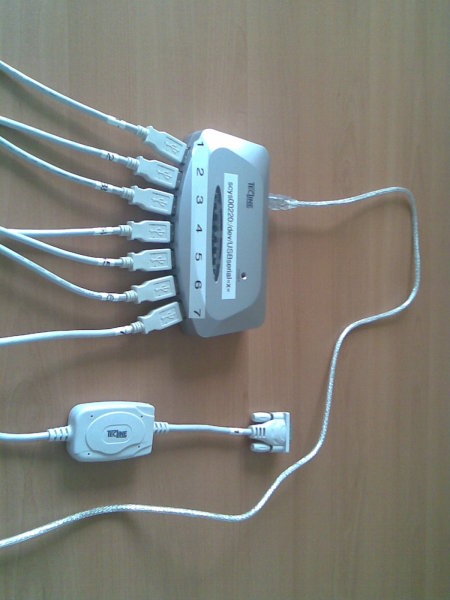
Picture of the fully equipped USB hub
The hardware side is actually quite easy: A seven-port USB hub, and seven USB-to-serial adaptors (using the widely-deployed Prolific PL2303) are easily purchased for well below a hundred Euros, and naively connected. In my test setup, connected to the hp compaq nc8000 that my blog readers should know only too well by now, the hub does not even need to have its power supply connected. The notebook can power the hub and the seven adaptors just fine. When the UMTS card is plugged in, the ttyUSBx device nodes appear in the order of plugging in the devices. When the system is booted, the order is not very predictable, so one needs - again - udev to give predictable device node names. udevinfo is an important tool to obtain the data set of an USB device which is available to match a device and to act appropriately when it is connected. udevinfo sorts the devices into a tree and shows the relationship of the devices, which device is “behind” which other device from the system’s point of view. udevinfo’s output starts at the leaf of the device tree and shows the information for each node up the tree until its root is reached. One pitfall is that one can only match against the leaf and _one_ other node more up the tree. So you cannot do matches like “the pl2303-based device connected to port 3 on hub 2-3 will be designated USBserial3”. If you try this, your rule will silently be ignored. This is a major turn-off in udev’s implementation. I didn’t try it on sid, but etch definetely shows this behavior. So one can only match like “the tty on the USB subsystem connected to port 3 on hub 2-3 will be designated USBserial3”, but that’s probably as good as it’ll get. The cause for my hub having only seven ports clearly shows itself when one looks at the udevinfo outputs of the fully equipped USB hub: The adapters are connected to ports 1, 2, 3, 4.1, 4.2, 4.3 and 4.4. The seven-port hub is actually two four-port hubs in a single case, with the second one connected to the first one’s port 4. This reflects itself, of course, in the udev rules necessary to address the adapters by the hub port they’re plugged in:
SUBSYSTEM==“tty”, SUBSYSTEMS==“usb”, DRIVERS==“usb”, \
   KERNELS==“*-*.1”, \
   SYMLINK=“USBserial1”
SUBSYSTEM==“tty”, SUBSYSTEMS==“usb”, DRIVERS==“usb”, \
   KERNELS==“*-*.2”, \
   SYMLINK=“USBserial2”
SUBSYSTEM==“tty”, SUBSYSTEMS==“usb”, DRIVERS==“usb”, \
   KERNELS==“*-*.3”, \
   SYMLINK=“USBserial3”
SUBSYSTEM==“tty”, SUBSYSTEMS==“usb”, DRIVERS==“usb”, \
   KERNELS==“*-*.4.1”, \
   SYMLINK=“USBserial4”
SUBSYSTEM==“tty”, SUBSYSTEMS==“usb”, DRIVERS==“usb”, \
   KERNELS==“*-*.4.2”, \
   SYMLINK=“USBserial5”
SUBSYSTEM==“tty”, SUBSYSTEMS==“usb”, DRIVERS==“usb”, \
   KERNELS==“*-*.4.3”, \
   SYMLINK=“USBserial6”
SUBSYSTEM==“tty”, SUBSYSTEMS==“usb”, DRIVERS==“usb”, \
   KERNELS==“*-*.4.4”, \
   SYMLINK=“USBserial7”
These rules will only work for a similary structured hub that is directly connected to the notebook. If there are more hubs in between the “final” hub and the host, the address matched against in the KERNELS matches are going to have a different structure. In the test setup, the first two parts of the address needed to be wildcarded since these addresses keep changing when the host is booted or the hub plugged out and in. So I guess that these udev rules are probably going to fail miserably when more hubs and/or USB-to-serial adaptors are connected. But if one does not do too many changes, things are just fine, and it is possible to put numbers on the USB hub ports and be sure that the USB-to-serial adaptor connected to port 4 is going to be /dev/USBserial4 in the host system. I tried plugging in and out the adaptors in random order, unplugged and plugged the hub itself, booted the host, and the relationship between the port and the device node was stable. In the test environment, I only tested one adapter at a time, but all these tests were successful as well. I guess that many more of these adaptors will eventually need a powered USB hub, but with seven adaptors on a single hub, the power from the USB host is sufficient to live without extra power on the hub. And, I guess, there is some hard limit for the number of USB adapters being used, and some soft limit when managing the ports and adapters is going to get harder. But, I think that a site in need of more than, say, sixteen serial ports on the console server can afford a “real” console server from one of the major vendors, which can be accessed via ethernet, UMTS, ISDN and whatever you can think of. This concludes the hardware part of my serial console server for the poor. Tomorrow, I’ll blog about the software side needed on the host to allow the serial ports to be accessed from the network while still being reasonably secure. The next article will involve ssh, /etc/passwd shells, /etc/shells, a small perl script, ser2net and telnet. And, shell escape is the cue word for grey hairs sprouting on my head.

1 June 2008

Axel Beckert: Debian and GPRS with the Nokia E51

A while ago I wanted to have internet over GPRS (either EDGE or UMTS) via my Nokia E51 working before I leave for the weekend. But whatever I tried, I always got an ERROR if I sent any AT command. Even ATZ and ATH resulted in errors. So started googling for all components: I found AT commands which are said to work with the Nokia E51, I found AT commands which are said to work with Swisscom GPRS and I found many sites describing how to setup a bluetooth modem. But since the even those AT commands which should work with both, Swisscom GPRS and Nokia E51 didn’t work at all, I noticed that all the Nokia E51 howtos were using the USB cable. So I tried that, too, and it worked immediately. It looks very strange to me that the set of AT commands is dependend on which way you connect to the phone. :-/ So here’s my working PPP config:
hide-password
noauth
connect "/usr/sbin/chat -e -f /etc/chatscripts/swisscom-gprs"
/dev/ttyACM0
460800
defaultroute
crtscts
user "guest"
usepeerdns
noccp
bsdcomp 0,0
lcp-echo-failure 10000
lcp-echo-interval 1000
asyncmap 0
novj
nomagic
and the chat script (/etc/chatscripts/swisscom-gprs):
TIMEOUT 5
ABORT BUSY
ABORT 'NO CARRIER'
ABORT VOICE
ABORT 'NO DIALTONE'
ABORT 'NO ANSWER'
ABORT DELAYED
ABORT ERROR
'' \nAT
TIMEOUT 12
OK ATH
OK ATE1
OK 'AT+CGDCONT=1,"IP","gprs.swisscom.ch"'
OK ATD*99#
CONNECT ""
So I have now four levels of mobile computing available: Fixing servers while sitting on a park bench at Schanzengraben Should suffice in nearly all situations. ;-)

Axel Beckert: One month with Debian Lenny on the EeePC

I ogled with an ASUS EeePC since it was announced, but didn’t want to order one abroad. So I waited until they became available in Switzerland. Digitec is the official EeePC importer for Switzerland and seeems also to be the moving power for yet to come the Swiss localisation of the EeePC. But initially they only offered imported EeePCs with German keyboard layout, but since I really got used to the US layout, I didn’t want to buy ay new laptops or keyboards with German layout. When asking them about US layouts they told me they won’t import from the US and that their competitor Steg Computer is importing US models. But I wasn’t comfortable with Steg and EeePCs also were more expensive there, so I hesitated ordering at Steg. So it was quite unexpected for me when US models showed up on digitec’s website. (Interestingly I never received any mail from their advertised EeePC newsletter, not even when they added 2G models t their repertoire.) So at the end of March (and therefore later as most other geeks ;-) I ordered an ASUS EeePC at digitec. For me, white laptops look like Macs (and Macs are for sissies or masochists ;-) — so I had no problems to decide that I want a black EeePC with US keyboard layout. 2G was to small for my purposes (and also not that much cheaper) and 8G not available. So I went with the 4G, since Debian doesn’t need so much space if you choose the right packages (i.e. neither or at least not that much of GNOME or KDE ;-). I preferred the 4G over the 4G Surf because of the bigger battery capacity (and not because of the webcam which I consider funny but useless:-). Initially the delivery date was set the 28th of March. Then it was subsequently set to “beginning of April”, “mid of April”, “end of April” and “beginning of May”. It finally arrived on 8th of May. In the meanwhile there were reports that even the 4G has been equipped with the smaller battery of the 4G Surf because of some battery shortage after some battery plant burnt down. But fortunately the delivery problems with black 4G US models doesn’t seem to have its reason there and my 4G has a 5200 mAh battery (at least according to its label and ACPI). I also ordered a 2 GB bar of Corsair ValueSelect RAM so that I can pump up the RAM of my EeePC by factor four (for about 10% of the price of the EeePC itself) resulting in having half as much RAM as disk space. Well, I guess, I won’t do suspend to disk in that configuration… ;-) The original Xandros based Linux only noticed 1 GB of the installed 2 GB as already noted on many other places in the web. But that doesn’t really matter, since it only lasted until I found out how to restore it from DVD in case I want to sell the EeePC later (e.g. for getting the successor). It’s fine for novices, but Linuxes feel strange if you can’t even get a console or a terminal with a command line. ;-) The Debian EeePC installer worked fine except that it argued over a checksum error on our mirror which wasn’t reproducable after the installation anymore. I’ve chosen the EeePC to be my first (nearly) pure Lenny installation — compared to the three machines running Sid (i386, amd64 and kfreebsd-i386). It though has a few packages from experimental (mostly xulrunner-1.9) installed. As window managers I have installed ratpoison, FLWM and FVWM. ratpoison — best described as screen for X (although you can’t detach and reattach) since it’s my personal preferences for being productive without big screen resolutions and flwm for a low-resource window manager which can be used intuitivly by both, geeks and non-geeks (and still doesn’t look like Windows at all ;-). And FVWM is installed because it’s my default window manager on all machines with bigger or multiple screens – to be able to compare it with my usual environment. As web browser I’ve got Opera as primary browser (as everywhere else, too) and Conkeror (the EeePC is the test-case for upcoming Debian package of Conkeror) as well as links2 and lynx on the (nearly) text-only side on it, although I need them seldomly. As office programs (as I would ever need some ;-) I’ve got AbiWord and Gnumeric installed since I already use a few GNOME applications (e.g. Network Manager, Twitux, etc.) and OpenOffice.org would take up 170 MB more disk space (then including OOo Draw and OOo Impress) and Siag Office is no more in Debian since years. (Initially I had OpenOffice.org installed instead of AbiWord and Gnumeric until I noticed that I need some of the GNOME libraries anyway.) I also decided that I will need LaTeX then and when so TeX Live also got its chunk of the 4 GB of disk space. I also have a bunch of games on the EeePC. Unfortunately there are a few games which don’t work well on the EeePC due to it’s resolution being smaller than 800x600, so I deinstalled them already again, e.g. I can’t play Cuyo on the EeePC but flobopuyo. Sauerbraten segfaults, but Doom (prboom with freedoom WADs) works fine. Further non-working games unfortunately include Battle of Wesnoth and XFrisk. Still, although quite some parts of GNOME and GNOME Office, TeX Live, ScummVM with Flight of the Amazon Queen and Beneath a Steel Sky, GNU Emacs 22, Iceweasel 3 (aka Mozilla Firefox 3), Icedove (aka Mozilla Thunderbird) and the Iceowl (aka Mozilla Sunbird) are installed, only 2.3 GB of the available hard disk space are used by the installation (i.e. without my home directory). Oh, and btw: Although except the very compact and a little bit wobbly keyboard the EeePC doesn’t feel really small to me (I’ve got quite small hands), but when I sat down in front of my 14” ThinkPad T61 after a day or two with EeePC, the T61, — especially screen and keyboard — felt huge as if it would be some 17” or even bigger notebook. ;-)
ThinkPad vs EeePC ThinkPad vs EeePC ThinkPad vs EeePC ThinkPad vs EeePC
OTOH I still think that a 1920×1200 (which means nearly four xterms in a row) resolution on a 14” notebook would be a good idea, especially compared to the 1440×900 (which means nearly three xterms in a row) my T61 has. ;-) Personal Resumée after one month Pro EeePCContra EeePCPro ThinkPad (in direct comparision)Pro Lenny on the EeePCCon Lenny on the EeePCSummary I’m very happy with the EeePC and I didn’t expect that it would replace my 14” ThinkPad in so many (but still not all) situations. :-)

31 May 2008

Matthew Garrett: Personality modification through perl

One of the downsides of writing my thesis last year was that focusing on a technical subject for approximately 16 hours a day left me almost entirely unable to relate to people. The irony in this is that losing the ability to socially relate tends to result in you assuming that you're fine and everyone else is just behaving bizarrely, which makes rectifying the situation rather difficult. In an attempt to avoid this I have written some software, because dealing with the symptoms of a problem is always better than dealing with the root cause and technology is always the appropriate solution to social issues.

The aim was to send myself an email once a week that I'd actually have to read. This is achieved by running the script with the generate argument. This sends an email with an appropriate reminder message (something along the lines of "Are you sucking? Really? Are you sure? Is everyone around you suddenly getting annoyed at you for no obvious reason?", and so on) and a bunch of embedded characters randomly spread throughout it. Running the script with the check argument will send the email again if a valid response hasn't been received. Those can be stuck in cron. The final part is to add a procmail or whatever rule that passes replies back to the script with the validate argument. These replies should include a line containing all the embedded characters (order doesn't matter, but if there are multiple occurances of a character than the reply must include that number of occurances). If a valid reply is received then no further emails will be sent until the script is run with the generate argument again.

Also: My perl sucks.

30 May 2008

Y Giridhar Appaji Nag: Alumni mail service moves to Hotmail

I knew better when I neither advertised nor used my IITG Alumni forwarding email address, and I suppose I'll not do that, ever.

For one, the ID given was ridiculous, connected to my name in a rather weird fashion with a number thrown into it and nobody bothered to reply when I asked if I could change it. And now the domain-name part of the email ID has been changed forcing people to tell all their contacts about the change, but this takes the cake -- the service has been moved to Hotmail with 2GB free space.

Huh! Thanks but no thanks.

I really disapprove of such widespread services (which should really not have a commercial angle to them) being taken over by the Googles, Ciscos and the Microsofts of the world.

Next.

Previous.