Search Results: "bod"

3 September 2007

Wouter Verhelst: Recent movies

I like seeing movies. I don't always blog about them, but sometimes they're just too good to ignore them in the long run. Here's a recap of some of the movies I saw recently: That's it for now.

2 September 2007

Christian Perrier: ISO-3166-2: the world is complicated

Today, I spent the entire morning working on the iso-codes package. This package features, among others, the giant ISO-3166-2 list, with all subdivisions of all countries of the world, thus about 4000names. Alastair McKinstry built this list long time ago, from various sources, as the ISO-3166 maintenance agency, does not provide the official list freely. Therefore, the work we (Alastair, Tobias Toedter, Li Daobing and myself) are doing on iso-codes is of some importance as this is the only freely available list of ISO-639 (language names), ISO-3166 (country names and subdivisions) and ISO-4217 (currency names) available in a machine parseable format, along with translations in a lot of languages. We are indeed upstream for that list which is used in many Linux distributions. So, today, I went on the ISO-3166 maintenance agency newsletters (*these* are freely available) and used them to update the subdivision list for as many countries as possible. That involved *copy and pasting* from PDF files to text files so that names are preserved along with the correct various funky characters used in many languages. You can help this work. Just install the "iso-codes" package, then check /usr/share/xml/iso-codes/iso_3166_2.xml for your country and report anythink you consider being a problem as a bug against the iso-codes package. Please note that the ISO-3166 MA only uses official references from the national standard bodies of all countries, so please use official sources as your reference. Of course, patches are very welcomed because dealing with all these names without messing with the "funky characters" is not easy. Please also note that the ISO-3166-2 standard uses "romanized" names, so only Latin characters should be used (all variants of such characters are accepted, though). My conclusion of the day: the world is bloody complicated. There are even subdivisions (named "castles") for....San Marino, one of the smallest states in the world. Luckily, the Holy See (the reall smallest state in the world), doesn't seem to have subdivisions...so far. And the country with the highest number of official subdivisions is....Slovenia (184!).

Bernd Zeimetz: debconf7 flashback

debconf7 flashback Somehow I didn't find the time to blog during the last weeks, so there's a lot of stuff on my blog todo list. But let's start with a little flashback , back to Debconf7 in Edinburgh. Yesterday I got a film back from the lab with photos I've taken during the daytrip-day. As a few of you probably realized I was not on the train/boat to the island in the west, mainly because Andreas (afit), Julian (codemonk) and me decided to spend the day in Ediburgh, not only for some geocaching fun but also to see a bit more of this beautiful town and area. We've also been up on Arthur's Seat, Edinburgh, where I took this panorama: Creative Commons License It will be published on placesofinterest.info, which is currently in public beta state, but definitely worth a look (just don't use IE, but I doubt you use non-free software, right?). I'll blog more about placesofinterest.info as soon as the page is finished. As usual, the pano was created with the help of The Gimp, hugin and enblend. The only commercial software involved was the software for the Imacon scanner at university. Original resolution: 24044×2551 pixel, stitched from 14 slides. If anybody is interested - large format prints for Debconf participants are available for the cost of paper and ink.

31 August 2007

John Goerzen: The Story of One Barn

img_2575

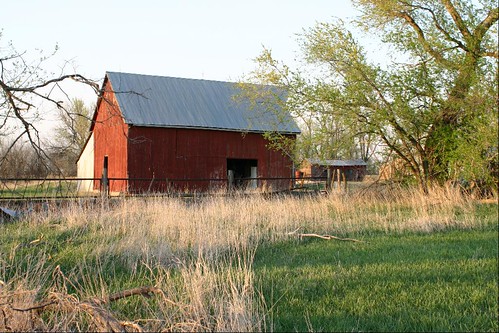
About 80 years ago, a Kansas family -- the Janzens -- built this barn.

About 60 years ago, my grandparents moved onto the farm. Their cattle were kept right here. I remember Grandpa's red tractor being parked in the barn.

So many memories have this barn in the background. We had a visit from one of the Janzens that lived here as a child. He had fond memories of this building. My dad and his siblings once played in the deep snow in front of this barn.

Here's one memory from those times:

078.jpg

That's my grandma and grandpa on their 25th anniversary in 1970. It was a working barn back then, so they probably weren't standing right next to it for this picture, if you get my drift. But they were on the yard.

About 25 years ago, Grandma lost her battle with cancer. At some point or another, Grandpa had eased out of farming, so the barn had a lot less activity. I remember exploring his outbuildings when I got bored at family gatherings. And I used to mow the lawn next to it every summer when Grandpa went off to be a cook at a camp. I didn't mind mowing next to the barn. But I always tried to go past one corner of the house as fast as I could, because there were wasp and hornet nests right there.

About 7 years ago, it was time for Grandpa to move off the farm. It was getting to be too much to keep up the old house, the barn, the yard, and deal with things like freezing water pipes and water getting in through the windows. He moved to an independent-living duplex in town. He was always worried about what would happen to the farm. Over the next few years, the farm would sometimes be vacant, sometimes have renters. Some renters did some work on the house, but the barn sat. Grandpa would eventually move into the nursing home because of his Parkinson's.

Two and a half years ago, Grandpa passed away. I shared some memories from Grandpa's place at the funeral.

But what of the house, the farm now? Renters went, and it sat empty. Nothing was in great shape, and the house needed a lot of work. Perhaps the whole place would be leveled and turned back into the prairie that it once was, or used as farmland. Perhaps someone would have an interest someday.

A year and a half ago, Jacob was on the way. Terah and I had occasionally thought of buying Grandpa's place, but we never talked about it seriously. We figured that we better finally decide what we're doing, before we have a baby around, or a child in school. So in April 2006, we went out to the farm and checked it out. The picture at the top of this post is from that visit. Terah and I checked out the house, the barns, the granary, the pasture, and the creek. As we walked past one of the barns, a pigeon flew out. Terah jumped with a shout. I grew up around barns and didn't really notice it. In the big red barn, besides Grandpa's tractor, we found some remnants from years ago: some old bales, corn cobs that raccoons had found long ago, several generations of electric fencers, old appliances.

And we decided to go for it and buy the farm. This was right at a year after Grandpa died.

The family always liked to get together for Easter. What would happen for 2006? Well, they decided to have a picnic out at the farm. It was vacant, and a bit eerie. Yet they knew that we were working on buying the place and moving in. All but one took a last look through the house before our renovations began. The one person who didn't was my great aunt, Grandma's sister. She said, "I haven't been in this house for years. I remember how it looked back then. I don't want to remember how it looks now, run down like this. So I'm not going in. But once you have it all fixed up, THEN I'll go in!"

In June of 2006, we bought the farm.

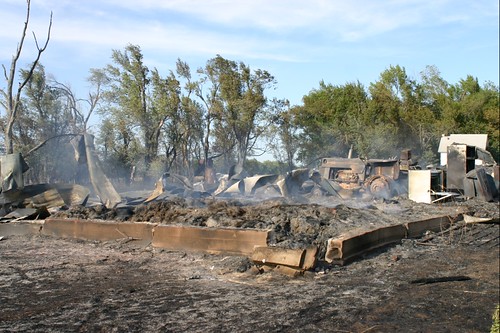
One month later, we lost this barn, and two other buildings, to a fire at our yard. This is what the beautiful red barn looked like that sad afternoon last year:
IMG_3630.JPG

As I wrote back then, nobody got hurt, the barn was insured, but "somehow, despite all these things, it still feels like we lost a little bit of Grandpa today."

2006 was a hot, dry summer. We had a patch of debris, then a patch of dirt, where the barn once stood.

7 months ago, Terah, Jacob, and I moved out to the farm. For the first time in 80 years, someone could stand in the farmhouse in the evening, look to the west, and see the colorful Kansas sunset over the pasture; the trees down by the creek; and even the neighbor's barn off in the distance. It was a beautiful sight, but it was also sad; that's not the view we had expected.

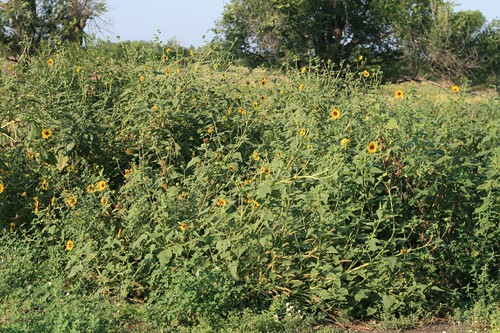
But then a surprise. This spring and summer, plants started coming up where none had grown for 80 years. But only where this barn stood -- not where the other two buildings were.

We watched as they grew tall. I'm sure decades of animals hanging out there were well appreciated by the plants.

As they grew, it looked like we might be seeing Terah's favorite flower: wild Kansas sunflowers.

And sure enough, they were.

Last weekend, Terah, Jacob, and I went out to the old barn. I took some pictures of its new appearance.

img_3429.jpg

This one stands where Grandpa's tractor used to be parked.

img_3401.jpg

And here we see a lifetime of flowers, from the old and withering, to the young just about ready to bloom.

img_3462.jpg

At the edge of the sunflowers, there's an old plow next to them. Though you might think it's barn-colored.

img_3411.jpg

Animals continue to be attracted to the area. Here's one of the smaller visitors.
img_3447.jpg

And here's a picture of almost the whole patch, right where the barn used to stand. I still mow right up to it.

I still miss the old barn. But somehow it still seems to be full of surprises and worth exploring. I wonder what next year will bring.

And I wonder if, a few years from now, Jacob will tell his friends about mowing right up to the sunflower patch, going fast to try to avoid any trouble with the bees.

30 August 2007

Steve Kemp: I gotta be cool relax, get hip

Fighting Spam Lots of people get spam and don't want to fight it themselves. Many of those people elect to use a service such as Google Mail, which does an adequate job of filtering most of the time. For people who wish to host their own mailservers, and off-load their anti-spam support to another entity, there are big companies such as MessageLabs. But if you can't/won't pay for somebody else how would you handle it? Right now I run my own mailserver and mostly it rocks. However I also manage a couple of servers for other people, and this mostly means that I have identical configuration(s) scattered across other machines. (Or as I recently discovered "mostly identical" setups scattered across N hosts.) After viewing a recent thread upon the forums of my employers I'm wondering how hard it would be to setup an anti-spam mail host. The idea being that users of domain example.org would continue to run their own mailserver (+optional POP/IMAP server). However this server wouldn't be listed in an MX record. Instead the MX record would point at the antispam server, which would then process and forward the mail on. (I'm assuming that the mailserver at example.org would be firewalled such that it would only accept SMTP connections from the anti-spam host). The only challenges I see would be: The last one is the killer point which makes me wonder if I'm wasting my time on the general case; I don't believe I could persuade people to pay for such a service (on the grounds that I wouldn't!) and if ever a mail were dropped I'd be the first person who would be blamed. And probably rightly so. The simple solution would be to always accept mail - but just tag it. Then you still have the same issue, but you have the excuse that "I still delivered your mail; just tagged wrongly". The downside of that is that the recipient still has to filter the mail; and still eats the bandwidth cost. The main gain is the lack of spam-processing CPU that is eaten locally. Anti-spam, and to a lesser extent anti-virus, topics are very interesting to me, and I'd love to hear any thoughts - or even what you use for yourself. Right now I'm 50/50 on setting up my main mailserver as the proxy for a few domains I have to manage (family, friends) to see how it works, but I'm not quite convinced yet. (Single point of failure == bad. Though centralised configuration == good.)

John Goerzen: Technology

Two days ago, I was out by the road digging a hole for our mailbox.

Along comes a guy on a tractor. The tractor was built in maybe the 1960s. It had no cab, and was loud, as tractors are. Attached to the back was a mower. It had long since lost any part of paint that was on it, and appeared to be made of rust.

The farmer driving this tractor was wearing a bluetooth earpiece for his cellphone.

(I don't think there would be any way to use a phone while driving that tractor due to the noise, but hey.)

Now, the rest of the story...

This being rural Kansas, the farmer saw me and stopped to chat, turning off the tractor first, of course. He introduced himself as "that crazy guy from south of town", and of course had a pretty good idea of who I was. After all, he's lived around here for decades and knew my grandpa.

I told him why I was digging the hole for the mailbox. There's going to be a second house down our mile, so now the post office will actually deliver to a mailbox at our driveway, rather than one almost a mile away. I thought he looked confused, so I pointed down the road and said that's our mailbox on the corner.

"Oh, I know. I probably shouldn't say this, but I knew when you moved in because I checked your mailbox one day and it didn't have 40-year-old ads piling up anymore."

We chatted a few more minutes, about the neighbor's goats, how annoying it is that he can't get DSL, why he wishes he could still use DOS instead of Windows. Then he went off towards home.

He had stopped his tractor in the middle of the road. But it wasn't a problem. Nobody drove by that whole time anyway.

Nacho Barrientos Arias: Example: How to statically and dynamically link your executables

People usually uses Google, among other things, to look for hints about how to do small tasks. Hopefully, you will find the hint you were looking for in somebody’s blog, because he or she had the same problem time ago and decided to talk about it. Last night, I was a bit bored and started writing a dumb set of files to introduce people how static and dynamic linking work, so trying to put my two cents and add a new hint to the wild wild web, I’m sharing it. The C source files are practically useless, therefore pay attention to the Makefile, the magic is in there. If you’re downloading it only to compile, execute and see what happens forget about it, the program is completely silly. Otherwise, probably the Makefile is buggy somewhere so bug reports are welcome. For teaching purposes, try, for example, breaking the ABI and see what happens. Google, index this post please! Update: This example does not cover autotools/libtool

29 August 2007

Gunnar Wolf: Gl cklich in sterreich!

Good comrades, great chat, greater motivation.
Some good Scotch whisky, a good friend who was lumped along with me in .br by mere chance. A very good time.
A strong whisky aftertaste and numbness in the mouth. My first couple of pages of Terry Pratchet - Thanks a bunch!
My mind wanders, I go over all the nice and dear things and people
Maybe tomorrow I should restart my reading? I know Pratchett is not supposed to make much (rational) sense, but still... Although I've enjoyed this couple of pages, I'd rather let the whisky wear out before continuing with the gollem owner's life and tribulations, with his friendly treatment for his plausible but honorable assassin...
Today I saw quantum superpositions mixed with special relativity in a small (less than 200 lines) Perl module. Positronic variables go back in time, yay! Damian Conway rules.
Time to sleep, yes, if tomorrow you want to be in time for the lightning talks. Oh, BTW: great honor, great honor: One of the lightning talkers requested /me to sit on the front row "to have a friendly face to look at". Have to comply, have to do.
But... Last reflection before going away: What a better way to describe bliss in Vienna (oder auf Deutstch, ich glaube - gl cklich in sterreich;) than to go to sleep while listening to the neighbour's fucking-loud music? Of course, his fucking-loud-music is just the-Balkan-music-you-seem-to-love, so everything's berfine!
Thanks to everybody who made this possible. Specially to the Austrian friends.

Pierre Habouzit: postfix and SRS

Peter, it's fun you ask right now, because I happen to just be writing a SRS daemon for postfix, to be used as a tcp_table(5) canonical lookup table. It's part of my soon to be pfixtools (Postfix Tools), that you can grab on my git repositories. I should package them as soon as the srs daemon is ready (and it's almost ready, it just needs the pidfile and fork-in-the-baground thingies). And as a matter of a fact, yes, if you're a forwarder you have (because of things like SPF, but not only) to use a Sender Rewriting thing, and SRS is somehow elegant in the sense that if many people use it in the forwarding chain, the sending address won't bloat. But even if nobody else uses it, then well, it works, and serves its purpose really well. As of performance: on my laptop, it's able to deal with 100k SRS rewrites in less than 0.72seconds, so it's as fast as it can be, only postfix supporting SRS natively can beat that I'd say.

John Goerzen: Desktop Linux: Gnome

I had been intending to write an entire series of posts about our corporate switch to Linux on the Desktop. To date, I wrote only one introducing the project and our reasons for switching from Windows. That was back in April.

Today I'd like to start talking about it all some more.

We have standardized on Gnome for our desktops. Given the Windows background of our user base, it was pretty much a given that we would have to use either Gnome or KDE. Something like fvwm or a non-integrated environment just wouldn't be a good option.

We evaluated both Gnome and KDE. The very "clean" appearance of Gnome was a nice thing for us. KDE seemed to be to "chatty", talked about entering in audiocd:/ when it shouldn't have needed to, and generally violated the KISS and principle of least surprise too often. That said, I continue to run KDE for my personal desktop because Gnome just doesn't have the flexibility that KDE does. It is too bad that Gnome has gone on this remove functionality kick, and KDE hasn't gotten the KISS religion yet.

Anyway, Gnome worked well for the most part. We have set some defaults in gconf for things like panel icons. We also set a few mandatory defaults. I fixed a couple of bugs in the vfs system related to nfs4 support, which manifested themselves as icons for files newly saved to the desktop never showing up.

We wanted to present a customized menu to people based on what their job function is. That is, we are using a single system image, so all apps will be installed on all machines. But we didn't want people to have to see a ton of software that they don't use. That was easily enough accomplished for custom apps by creating desktop files with mode 0640 and setting the group to the set of people that should see the program on their menu. We removed a few stock programs (such as the terminal) from the menu as well, using dpkg-statoverride. That was also quite easily done. However, I will say that the entire Gnome XDG menu thing is woefully under-documented.

We use Firefox for the standard web browser. It is integrated well enough with Gnome and we have no problems there, aside from sites that are IE-only. We solve that with a Windows terminal server, which I'll discuss later.

Our network printing was already based on Cups. The individual machines are set up as Cups clients only, which works fine. We did find, however, that gnome-cups-manager automatically installs a tray monitor for cups. This monitor puts little printer icons on the tray when printers are in use. Unfortunately, it figures out which printers are in use by polling the server, and it is turned on by default out of the box, with no good way to disable it short of dpkg-statoverriding it to 0000. You can imagine that hundreds of users times dozens of printers times numerous polls per minute created quite the load on the server. This was a really braindead design and the people that wrote it should have known better. It is also quite useless to have icons coming on for all the printers on the network, which on some networks could be thousands, and not even on the same continent as the user.

Printing is generally a bit iffy in Gnome. They seem to be transitioning between about 3 different printing toolkits, all of which have different print dialog boxes with different supported features and different ways of selecting printers. One chief annoyance is that the print box in evince (the document/PDF viewer) does not let people access printer-specific features such as hole punching and stapling. So we installed gtklp and xpdf for people. The people that print heavy PDFs are huge fans of gtklp these days; it's a nicer solution than we had in Windows. Nobody really likes evince. We also have had some trouble with evince generating PostScript output that some printers can't grok. It sounds like all this should be much better in newer versions of Gnome, which if true, would be welcome news.

The Gnome screenshot tool makes it easy to save off a screenshot to a file, or to drag it into an email, but it is difficult to print it (you have to save it first). That was a common complaint around here, so I wrote a little wrapper around xwd and gtklp for printing screenshots. People really like that because gtklp gives them lots of options about orientation and size of the image if they want it, or a simple "Print" button to click if they don't care. We set a gconf default to bind this to Ctrl-PrintScr and it works well. KDE's screenshot tool is much more capable, and if we were using KDE, we wouldn't have had any problem with screenshots.

The bottom line on Gnome is that we, and are users, are happy with it after we've made these customizations. But we have had to do more customization that we should have. I still think that Gnome has been better for our users than KDE, but I do wonder how long we'll be able to survive with our "no KDE libraries" policy, as people want ksnapshot, kolour, etc.

26 August 2007

Cameron Dale: DebTorrent Usage: details of a successful dist-upgrade

I just completed a very successful and long overdue dist-upgrade of my unstable machine, using mainly DebTorrent for downloading the packages, so I thought I'd post some of my thoughts and experiences. The download consisted of 1294 packages to upgrade, totalling 1350 MB and taking 2h12m to download. Here are some of the good and bad things I observed. Good things There was a single other peer with me in the same torrent, and I managed to download 182 MB from him, which is about 13.5% of the total download. This is the first time I have noticed this downloading from peers occurring, as usually there are too few peers, too many torrents and too many possible packages to download for any sharing to occur. This will hopefully change in the future when more people start using DebTorrent, and when unique piece numbers are introduced to make the torrents last longer. However, it does show how the use of the backup HTTP downloader can seamlessly integrate with downloading from peers to provide a good user experience, even for early adopters. The CPU time used was only 10m46s, which translates to an average CPU usage of 8%, which is very reasonable. The average download speed was 174 KB/s, which is 58% of my maximum download speed. Though this may seem like a bad thing, my goal all along has been to make sure that the download time would not be more than twice as long as using HTTP. Of course, using DebTorrent may never be as fast as a straight HTTP download from a well-provisioned server, but that it not the point. The idea is to reduce the bandwidth needs of hosting a debian archive. But in the future, when there are many peers in a single torrent the download speed may be even faster than using HTTP, especially for peers with very high download rates that could not be matched by a single server. Things that need improvement The completion percentage reported by APT during the download was fairly inaccurate. Here are some sample readings I noted, compared with the actual completion percentage from the DebTorrent status page:
APT Reports Actual Completion
10% 40%
20% 70%
30% 85%
40% 90%
50% 93%
60% 96%
70% 97.5%
80% 98%
90% 99%
The discrepancy occurs because larger packages are broken up into pieces, so they can be partially downloaded without APT knowing about it (since only fully downloaded packages are passed to APT). Clearly this situation is far from ideal, and can lead to the user feeling that the download is progressing very slowly, or not at all. There are some plans to add status updates to the communication between APT and the DebTorrent client, but they require changes to the APT code to support them, so it may take some time to implement. Another problem is the memory usage I saw during the download, which was approximately 213 MB. This is obviously unnecessarily large, though the metainfo that DebTorrent needs to be aware of is quite large (stored in a text file it is about 3 MB). There does seem to be a memory allocation bug in Python 2.4 which causes increased memory usage, so moving to python 2.5 might help. However, my preliminary tests show this only saves you about 20% for DebTorrent. I think I will have to delve deeper into which parts are using all this memory, and unfortunately python doesn't seem to have a good memory profiler to help with this. I will be looking at both PySizer and Guppy/Heapy to start, but if anyone knows of a better solution, please let me know.

24 August 2007

Gunnar Wolf: Have a very, <em>very</em> nice day!

And no, I don't mean Mao.
How was Thursday 23 for me?
6:30 Wake up, knowing it will be a long day. No, don't get those delicious extra 15 minutes of sleep.
8:00 Arrive to work, ~90min earlier than usual, to finish the Rails app you have to demo at 10:00
10:00 Meeting with the Institute's Director, Academic Secretary and Technic Secretary to show them the system for following the internal inter-tematic colloquium information workflow. Thankfully, they were happy with it.
11:20 (20 minutes after scheduled): As several academics have said they are interested in getting to know Linux, I'm giving a series of introductory sessions on Debian to them. So, I went with some of them through the Etch installation. Of course, mostly everything was fine. What was not? Resizing a Windows partition is still a step that requires several jumps through hoops (i.e. booting Debian LiveCDs, some console-based interactivity which I wanted to avoid...), and... Well, d-i does not time out if the selected mirror is not responding. Will file a bug, yes. Anyway...
14:30 Managed to leave the lab working, with no damages. Went to the bank to check some data and to have a quick lunch.
16:00 Get back to the institute. Jos Luis, from Difusi n y extensi n was already waiting for me to show a set of components for the Comas-based system we use for tracking attendance to the Institute's activities
16:45 The people from AMECIDER arrived so I could show them my proposal for their new website. Can you believe most of the websites I host are still completely static HTML, and, what's even worse, generated by the $ despiseful_adjective Dreamweaver? Yes, I am proposing them to move over to Drupal
17:30 I finally received another person, one of the people that's attending my Thursday lessons, wanting me to help with some Linux questions. What's Linux's killer app for my Institute's researchers? Believe it or not, a not-brain-dead PDF reader. They are amazed that, using Gnome's Evince, they can just copy-paste bits of PDFs into their documents (and the fact that pasting tabular data into OpenOffice's Calc allows for an easy import feature - Yesterday I spent ~1hr with this researcher importing data generated by the International Monetary Fund into his work), and they are even more amazed with the gnome-screenshot they can directly include graphics from such documents without redrawing them.
19:45 (45 minutes behind schedule): Went to the Astronomy Research Institute, to meet with Sergio, H ctor and Eric, to decide on bits of the implementation of the new gear we will be putting in nisamox, our dear and faithful ftp.mx.debian.org mirror. Thanks to everybody! We will soon tell you what we got and what we did with it, it's mostly settled by now.
20:30 Had the first of some... Four calls regarding yet another system I have been working with for the ICME conference, to be held in Mexico in 2008. Several pushing details that need my attention and work, bah :-/ Have to work on them...
21:00 Got home. Did a couple housekeeping activities (i.e. take out the trash, buy some food...). I was too burnt out to start making my bags for going to Vienna (I'm leaving tonight!), work on the pending systems I have to work on, or even stay awake.
Leaving work for a week to go a conference is always fun and great... But man, it's stressing!

23 August 2007

Adrian von Bidder: Debian and Linux Torvalds

Somebody should convince Linus that he should give Debian a try. His implicit claim that Debian is hard to install might have been true up to potato or woody, but I've always found sarge and certainly etch a pleasant experience to install, in some aspects even much better than the leading commercial distributions (not loading X and a huge graphical installer from a slow CD drive speeds up installation enormously!) Reader Comment: Chris Camacho says: “I read that too, and worse still it probably means he's disregarded Ubuntu as being just a debian off shoot and therefore not worth looking at. I've turned a number of ex-windows on to using Ubuntu and they all claim to a (wo)man that its easier than windows to use. go figure...”

Adrian von Bidder: Zombies

Joey's fortunes collection brought me a Linux Torvalds quote today:
I'd almost prefer to just put the zombie children on a separate list. I wonder how painful that would be...
What kind of horror movie torture master would keep lists of zombie children? Anybody bored and skilled with The Gimp?

21 August 2007

Peter Makholm: On handling email

Watching the popular Inbox Zero video would probally improve my email handling skills better. But this took less time and I wanted to play around with Net::XMPP;

#!/usr/bin/perl -l
use warnings;
use strict;
use Config::Simple;
use Linux::Inotify2;
use Email::Abstract;
use Net::XMPP; # aka Jabber and Gtalk
use POSIX;
my $DEBUG = 0;
our %config;
Config::Simple->import_from("$ENV HOME /.mailnotifyrc", %config);
deamonize() unless $DEBUG;
my $inotify = new Linux::Inotify2
     or die "Unable to create new inotify object: $!";
# Different Maildir implementations triggers different events"
#   IN_MOVED_TO: rename("tmp/file","new/file")
#   IN_CREATE:   link("tmp/file", "new/file") && unlink("tmp/file")
#
# At this point the file should be written and closed.
$inotify->watch("$config Maildir /new", IN_MOVED_TO IN_CREATE, sub  
        my $e = shift;
        my ($fh, $xmpp, $email, $message);
        debug('Got event for ' . $e->fullname);
        open $fh, "<", $e->fullname;
        $email = new Email::Abstract join("", <$fh>);
        close $fh;
        $message = 'Mail from ' . $email->get_header('From') .
                   ' concerning "' . $email->get_header('Subject') .'"';
        debug("Getting ready to send [$message]");
        my $sender   = new Net::XMPP::JID ($config Sender );
        my $receiver = new Net::XMPP::JID ($config Receiver );
        $xmpp = new Net::XMPP::Client();
        $xmpp->Connect( hostname => $sender->GetServer,
                        port     => $config port    5222,
                        tls      => $config usetls    0,
                      );
        $xmpp->AuthSend( username => $sender->GetUserID,
                         password => $config password ,
                         resource => $sender->GetResource   'mailnotify',
                       );
        $xmpp->MessageSend( to   => $receiver,
                            type => $config MessageType    'chat',
                            body => $message,
                          );
        $xmpp->Process(1);
        $xmpp->Disconnect;
        debug("Event done");
 );
1 while $inotify->poll;
sub deamonize  
        my $pid = fork();
        if ($pid)  
                exit 0;
         
        ### close all input/output and separate
        ### from the parent process group
        open STDIN,  '</dev/null' or die "Can't open STDIN from /dev/null: [$!]n";
        open STDOUT, '>/dev/null' or die "Can't open STDOUT to /dev/null: [$!]n";
        open STDERR, '>&STDOUT'   or die "Can't open STDERR to STDOUT: [$!]n";
        ### Change to root dir to avoid locking a mounted file system
        ### does this mean to be chroot ?
        chdir '/'                 or die "Can't chdir to \"/\": [$!]";
        ### Turn process into session leader, and ensure no controlling terminal
        POSIX::setsid();
 
sub debug   return unless $DEBUG; print STDERR for @_;  
__END__

17 August 2007

Gunnar Wolf: Aggressive bug reports leading to a good answer (or so I hope)

Joey complains about users filing aggressive or otherwise inappropriate bug reports. Well, in this case I must say I bit the bullet.
Yesterday, somebody complained about the maintenance statuse of libapache2-mod-perl2. Usually, I would have sadly nodded and said that, yes, since the API change between mod_perl for Apache 1.x and mod_perl2 for Apache 2.x (which was a long time ago - with perfect timing not to be accepted in the last weeks of Sarge's hard-freeze period, causing many of us to have to maintain two or even three versions of our code depending on the API used - But that's a different story I won't go into details now). But this time, the bug report was sent with Severity: critical.
I replied to this report, intending just to lower its priority and get the attention of the maintainers by sending it to a couple of Debian lists - But soon afterwards, it became obvious that I was probably the person most interested in this package in Debian - At least, me and some other pkg-perl fellows who -as foolishly as myself- volunteered to step forward when needed.
Well, in short: I am now the proud owner of one of the packages most vital for many of the systems I've written for my work. It's also more complex than most of the other packages I maintain. From an undermaintained and quite full of warnings build process and resulting package set, I managed to make it linda- and lintian- clean, and... Well, now we have to dig through its open bugs. Its build system is far from orthodox from a Perl point of view, and that took me most of the day, but hey - TIMTOWTDI, right? :)

Eddy Petri&#537;or: 2 of the cross compiling issues...

... I found when trying to cross compile rrdtool already have a fix.
I have these patches myself and they work. There shouldn't be any reason for the native build to fail.

The rrdtool issues [1] were not reported since:
  1. I am not sure if is really a bug (IEEE math test bug) and
  2. I don't have a clean fix (link-with-build's-library issue).


[1] look for 'xmerging rrdtool, the bugs don't stop'

Bastian Venthur: Howto setup a print server for Windows (and others) using CUPS and zeroconf

Now that CUPS 1.3 has built in zeroconf support, it is easier than ever to provide print service to Windows machines. You don’t even need Samba anymore. Here’s a quick way to setup a CUPS print server and a Windows client: On the server side First you need to install CUPS 1.3 or higher on your print server and setup the printer (the web interface makes this task dead easy). Zeroconf isn’t enabled by default so you have to browse the CUPS admin page (http://localhost:631/admin if you’re running it on localhost) and enable the “Share published printers connected to this system” option. “Change Settings” will restart CUPS and your printer should be instantly visible to zeroconf-aware applications in the local network. If you can’t or don’t want to use the web interface (which is the easiest way though), you can edit /etc/cups/cupsd.conf and replace the line Listen localhost:631 with Port 631 and add the line BrowseAddress @LOCAL Now save the changes and restart CUPS and you’re done. On the client side Since most Linux distributions and MacOS support zeroconf out of the box, I’ll just explain how to setup the Windows client. On the Windows side you’ll need to install Bonjour for Windows which is freely available on apple.com. Bonjour for Windows will enable Multicast DNS (mDNS) and DNS based Service Discovery (DNS-SD) on your Windows machine. Once it is installed, you can start the printer helper application provided by bonjour which will guide you through the process of installing the network printer. The only problem here was that although it correctly identified my printer, it only let me chose between a generic postscript and a PCL driver. Both were not working correctly so I had to manually change the driver for this printer to HP LaserJet 4 Plus (which is my printer) after the setup via the printer properties, where all other printer drivers where available again. That’s it! Now you should be able to print on every zeroconf aware operating system connected to your network. Oh, one final warning: With this setup, everybody in the LAN will be able to print without prior authentication. This should be what you want in most cases when running a home LAN or a small business LAN anyways, but it’s certainly not so cool when strangers have access to your network. The whole setup process took like 15 minutes today. I remember me a few years ago, not being very experienced with Samba and CUPS wasting a whole weekend to achieve the same result. Thanks apple for making life a bit easier again!

Erich Schubert: Skype taking down your network

Side note: According to the Skype RSS data feed, right now 174086 user are online. That less than 10% of the usual numbers, isn't it? To me, that's more than a few users.Skype is harmful. Here's the explantaion why:Skype uses P2P technology where it is not needed. There are parts of VoIP where it does make sense (when a direct connection is possible, transfer the data directly between clients), but pretty much any VoIP software does that.And there are parts, where it doesn't make sense. This includes not accessing the login servers directly, but trying to use other Skype users as proxies.Now what I've seen happening in some networks is the following: Skype fails to login directly, so it starts connecting random peers it has seen before. It keeps a list of 200 peers for that in the registry. So when it fails to connect, it will try contacting these 200 peers instead. Now if you have multiple users sharing your connection, let's say 10 and a cheap router with limited memory, 2000 connections is a lot to keep track of. It might start losing other connections. Such as your mail an web connections.This is exactly what I've seen today: the internet connection becoming pretty much unuseable (single packets would work fine, but not TCP/IP transfers of more than a few kb). When we found out it might be due to Skype malfunctioning, and gave the order for everyone to shut down Skype (which didn't work anyway, so people quickly complied), Internet became useable again. Let me emphasize that: it wasn't a bandwidth issue, but it was just the sheer number of connections opened by Skype that caused more important connections to be dropped by the routers.So why is Skype not using proper servers, like MSN, AIM and ICQ do? Because they're cheapskates. It's cheaper for them to let others use your bandwidth instead of having to provide enough to handle all the data. The other reason is that it's harder for system administrators to deny access to Skype, if any other Skype user can proxy your access to the actual login server. But if you want/need a central user registry, you can't rely on a true P2P system. It's bound to get disconnected at some point.And yes, this especially means that Skype is not a good idea in a corporate environment with a large number of users. The skype approach works well for a single user at home, but the Skype networking behaviour can take down your routers if you have too many users running Skype at the same time. Other software choices, such as the standardized, vendor independant SIP protocol for VoIP, however would even allow you to setup a proper VoIP telephone system, with conference rooms, complex call routing, dictionaries, callback, routing to ATM or mobiles, complex voice mail systems, you name it. Skype is designed for single home users, not for company use.P.S. Am I the only one who thinks the Skype UI is crap? No groups (at least not in my version, which is the latest there is for Linux), and totally idiotic button placement (like this ugly 'add' button I'm pretty much never ever, and a floding-up button next to it with the options, quit and recent chats (do they have anything in common?) hidden in there. How about using a menu bar like everybody else? How about organizing functionality in a human-comprehendable way?P.P.S. What I guess has happened: somehow, most nodes (especially super nodes) got convined that the actual login servers are bad. As long, as some still had the connection, login still worked. At least sometimes (many probably experienced an unstable Skype connection before they could no longer login). But at a certain point, a large part of the network got separated from the login nodes and started routing requests around chaotically, trying to find the actual login server. The only way they have for fixing it, is slowly convincing and nodes on the perimeter of the P2P network about the proper location for the login servers, and that way spreading the correct information around again. Or shipping a new version which will re-inject this information in clients again. Just my guesses.P.P.P.S. It would be interesting to know what had caused this. If it was some kind of subtle attack on the network. Like someone trying to convince supernodes that the login servers are bad and untrustworthy or something. Maybe just by sending spoofed bad data packets from the login servers IP or so.P^4.S. Interesting graph on the number of Skype users logged in. Still going down.

14 August 2007

Antti-Juhani Kaijanaho: Local is global

The world has many wonders. Therefore, to read a newspiece of a man who had his thumbs surgically altered to suit the iPhone better is to think, this guy is crazy. But the story in itself is plausible. Generally, stories published in a straight news category are intended to be taken seriously. There is one exception: any story published on the 1st of April may be a jest, and everybody knows it. But it is not enough, generally, that people know that the day is a jest day: a serious paper litters the April’s Fool story with blatant clues. For example, a Finnish story last April said that the principals of the story enjoyed their traditional herring in muddy water – referring to the traditional Finnish April’s Fool refrain: “April’s Fool, April’s Fool, eat herring and wash it down with muddy water!” (”Aprillia aprillia, sy silli , juo kuravett p lle!”) Perhaps the original story, published by a community newspaper, contains clues that are visible to the local readers. Perhaps there is something about the locale of the story that tells the locals that this is a false story. Or perhaps the names are ridiculous to native speakers of the American language. Certainly, the paper seems to think that the story contains sufficient clues: Careful reading of the piece makes it clear to any critical consumer of information that the piece is pure humor and not news or reported as fact, the editor claims. The original story is in the “news” category. It is written in a flip style, but then again, many “the world is crazy” style stories are. I have now read the story twice, and I find in it no clue that the story is a hoax (or satire, as the newspaper in question likes to style it). The paper made an error in judgment, that the story would only be read in the community where the story is published. They forgot that we all like to read stories of crazy people who live far away. The editor ridicules us for not noticing the satire, but the real joke is on them: they did not have the balls to acknowledge their mistake. I acknowledge mine. I was fooled. Anybody got some muddy water to spice up the herring I’m having for dinner this evening?

Next.

Previous.