Search Results: "ana"

5 December 2013

Daniel Kahn Gillmor: The legal utility of deniability in secure chat

This Monday, I attended a workshop on Multi-party Off the Record Messaging and Deniability hosted by the Calyx Institute. The discussion was a combination of legal and technical people, looking at how the characteristics of this particular technology affect (or do not affect) the law. This is a report-back, since I know other people wanted to attend. I'm not a lawyer, but I develop software to improve communications security, I care about these questions, and I want other people to be aware of the discussion. I hope I did not misrepresent anything below. I'd be happy if anyone wants to offer corrections. BackgroundOff the Record Messaging (OTR) is a way to secure instant messaging (e.g. jabber/XMPP, gChat, AIM). The two most common characteristics people want from a secure instant messaging program are:
Authentication
Each participant should be able to know specifically who the other parties are on the chat.
Confidentiality
The content of the messages should only be intelligible to the parties involved with the chat; it should appear opaque or encrypted to anyone else listening in. Note that confidentiality effectively depends on authentication -- if you don't know who you're talking to, you can't make sensible assertions about confidentiality.
As with many other modern networked encryption schemes, OTR relies on each user maintaining a long-lived "secret key", and publishing a corresponding "public key" for their peers to examine. These keys are critical for providing authentication (and by extension, for confidentiality). But OTR offers several interesting characteristics beyond the common two. Its most commonly cited characteristics are "forward secrecy" and "deniability".
Forward secrecy
Assuming the parties communicating are operating in good faith, forward secrecy offers protection against a special kind of adversary: one who logs the encrypted chat, and subsequently steals either party's long-term secret key. Without forward secrecy, such an adversary would be able to discover the content of the messages, violating the confidentiality characteristic. With forward secrecy, this adversary is be stymied and the messages remain confidential.
Deniability
Deniability only comes into play when one of the parties is no longer operating in good faith (e.g. their computer is compromised, or they are collaborating with an adversary). In this context, if Alice is chatting with Bob, she does not want Bob to be able to cryptographically prove to anyone else that she made any of the specific statements in the conversation. This is the focus of Monday's discussion. To be clear, this kind of deniability means Alice can correctly say "you have no cryptographic proof I said X", but it does not let her assert "here is cryptographic proof that I did not say X" (I can't think of any protocol that offers the latter assertion). The opposite of deniability is a cryptographic proof of origin, which usually runs something like "only someone with access to Alice's secret key could have said X."
The traditional two-party OTR protocol has offered both forward secrecy and deniability for years. But deniability in particular is a challenging characteristic to provide for group chat which is the domain of Multi-Party OTR (mpOTR). You can read some past discussion about the challenges of deniability in mpOTR (and why it's harder when there are more than two people chatting) from the otr-users mailing list. If you're not doing anything wrong... The discussion was well-anchored by a comment from another participant who cheekily asked "If you're not doing anything wrong, why do you need to hide your chat at all, let alone be able to deny it?" The general sense of the room was that we'd all heard this question many times, from many people. There are lots of problems with the ideas behind the question from many perspectives. But just from a legal perspective, there are at least two problems with the way this question is posed: In these situations, people confront real risk from the law. If we care about these people, we need to figure out if we can build systems to help them reduce that legal risk (of course we also need to fix broken laws, and the legal environment in general, but those approaches were out of scope for this discussion). The Legal Utility of Deniability Monday's meeting was called specifically because it wasn't clear how much real-world usefulness there is in the "deniability" characteristic, and whether this feature is worth the development effort and implementation tradeoffs required. In particular, the group was interested in deniability's utility in legal contexts; many (most?) people in the room were lawyers, and it's also not clear that deniability has much utility outside of a formal legal setting. If your adversary isn't constrained by some rule of law, they probably won't care at all whether there is a cryptographic proof or not that you wrote a particular message (In retrospect, one possible exception is exposure in the media, but we did not discuss that scenario). Places of possible usefulness So where might deniability come in handy during civil litigation or a criminal trial? Presumably the circumstance is that a piece of a chat log is offered as incriminating evidence, and the defendant is trying to deny something that they appear to have said in the log. This denial could take place in two rather different contexts: during rules over admissibility of evidence, or (once admitted) in front of a jury. In legal wrangling over admissibility, apparently a lot of horse-trading can go on -- each side concedes some things in exchange for the other side conceding other things. It appears that cryptographic proof of origin (that is, a lack of deniability) on the chat logs themselves might reduce the amount of leverage a defense lawyer can get from conceding or arguing strongly over that piece of evidence. For example, if the chain of custody of a chat transcript is fuzzy (i.e. the transcript could have been mishandled or modified somehow before reaching trial), then a cryptographic proof of origin would make it much harder for the defense to contest the chat transcript on the grounds of tampering. Deniability would give the defense more bargaining power. In arguing about already-admitted evidence before a jury, deniability in this sense seems like a job for expert witnesses, who would need to convince the jury of their interpretation of the data. There was a lot of skepticism in the room over this, both around the possibility of most jurors really understanding what OTR's claim of deniability actually means, and on jurors' ability to distinguish this argument from a bogus argument presented by an opposing expert witness who is willing to lie about the nature of the protocol (or who misunderstands it and passes on their misunderstanding to the jury). The complexity of the tech systems involved in a data-heavy prosecution or civil litigation are themselves opportunities for lawyers to argue (and experts to weigh in) on the general reliability of these systems. Sifting through the quantities of data available and ensuring that the appropriate evidence is actually findable, relevant, and suitably preserved for the jury's inspection is a hard and complicated job, with room for error. OTR's deniability might be one more element in a multi-pronged attack on these data systems. These are the most compelling arguments for the legal utility of deniability that I took away from the discussion. I confess that they don't seem particularly strong to me, though some level of "avoiding a weaker position when horse-trading" resonates with me. What about the arguments against its utility? Limitations The most basic argument against OTR's deniability is that courts don't care about cryptographic proof for digital evidence. People are convicted or lose civil cases based on unsigned electronic communications (e.g. normal e-mail, plain chat logs) all the time. OTR's deniability doesn't provide any legal cover stronger than trying to claim you didn't write a given e-mail that appears to have originated from your account. As someone who understands the forgeability of e-mail, i find this overall situation troubling, but it seems to be where we are. Worse, OTR's deniability doesn't cover whether you had a conversation, just what you said in that conversation. That is, Bob can still cryptographically prove to an adversary (or before a judge or jury) that he had a communication with someone controlling Alice's secret key (which is probably Alice); he just can't prove that Alice herself said any particular part of the conversation he produces. Additionally, there are runtime tradeoffs depending on how the protocol manages to achieve these features. For example, forward secrecy itself requires an additional round trip or two when compared to authenticated, encrypted communications without forward secrecy (a "round trip" is a message from Alice to Bob followed by a message back from Bob to Alice). Getting proper deniability into the mpOTR spec might incur extra latency (imagine having to wait 60 seconds after everyone joins before starting a group chat, or a pause in the chat of 15 seconds when a new member joins) or extra computational power (meaning that they might not work well on slower/older devices) or an order of magnitude more bandwidth (meaning that chat might not work at all on a weak connection). There could also simply be complexity that makes it harder to correctly implement a protocol with deniability than an alternate protocol without deniability. Incorrectly-implemented software can put its users at risk. I don't know enough about the current state of mpOTR to know what the specific tradeoffs are for the deniability feature, but it's clear there will be some. Who decides whether the tradeoffs are worth the feature? Other kinds of deniability Further weakening the case for the legal utility of OTR's deniability, there seem to be other ways to get deniability in a legal context over a chat transcript. There are deniability arguments that can be made from outside the protocol. For example, you can always claim someone else took control of your computer while you were asleep or using the bathroom or eating dinner, or you can claim that your computer had a virus that exported your secret key and it must have been used by someone else. If you're desperate enough to sacrifice your digital identity, you could arrange to have your secret key published, at which point anyone can make signed statements with it. Having forward secrecy makes it possible to expose your secret key without exposing the content of your past communications to any listener who happened to log them. Conclusion My takeaway from the discussion is that the legal utility of OTR's deniability is non-zero, but quite low; and that development energy focused on deniability is probably only justified if there are very few costs associated with it. Several folks pointed out that most communications-security tools are too complicated or inconvenient to use for normal people. If we have limited development energy to spend on securing instant messaging, usability and ubiquity would be a better focus than this form of deniability. Secure chat systems that take too long to make, that are too complex, or that are too cumbersome are not going to be adopted. But this doesn't mean people won't chat at all -- they'll just use cleartext chat, or maybe they'll use supposedly "secure" protocols with even worse properties: for example, without proper end-to-end authentication (permitting spoofing or impersonation by the server operator or potentially by anyone else); with encryption that is reversible by the chatroom operator or flawed enough to be reversed by any listener with a powerful computer; without forward secrecy; or so on. As a demonstration of this, we heard some lawyers in the room admit to using Skype to talk with their clients even though they know it's not a safe communications channel because their clients' adversaries might have access to the skype messaging system itself. My conclusion from the meeting is that there are a few particular situations where deniability could be useful legally, but that overall, it is not where we as a community should be spending our development energy. Perhaps in some future world where all communications are already authenticated, encrypted, and forward-secret by default, we can look into improving our protocols to provide this characteristic, but for now, we really need to work on usability, popularization, and wide deployment. Thanks Many thanks to Nick Merrill for organizing the discussion, to Shayana Kadidal and Stanley Cohen for providing a wealth of legal insight and legal experience, to Tom Ritter for an excellent presentation of the technical details, and to everyone in the group who participated in the interesting and lively discussion. Tags: chat, deniability, otr, security

4 December 2013

Aigars Mahinovs: Translation management workflows

Whatever you do with translations, consider translation management issues. For example, you are developing a multilingual web site. All kinds of labels and buttons and form fields are nicely translatable with trans template tag and ugettext. You have po files that follow your code from dev to stage to production environment.
Now you add a CMS into the mix. And suddenly - you translations are in more than one place, in more than one format and follow different routes to production.
Now imagine that you need to add Chinese language to your entire site. The translator is an off-site contractor. What files would you send to him to translate? How would you generate them? How will you integrate them?
If someone adds or changes a page on production in English: how will your developers see that change? how will you know that an updated translation for Chinese is needed? how will you manage the update of the translation?
If you make a CMS and don't have at least the export_po_file and import_po_file management commands, then you are not really multilingual. It is either that or figuring out your own answer for the above questions.
I have finally found a Django-based CMS that has those - http://pythonhosted.org/django-page-cms/ . Have not really tried it yet, but I am hopeful.

3 December 2013

Matthew Garrett: Subverting security with kexec

(Discussion of a presentation I gave at Kiwicon last month)

Kexec is a Linux kernel feature intended to allow the booting of a replacement kernel at runtime. There's a few reasons you might want to do that, such as using Linux as a bootloader[1], rebooting without having to wait for the firmware to reinitialise or booting into a minimal kernel and userspace that can be booted on crash in order to save system state for later analysis.

But kexec's significantly more flexible than this. The kexec system call interface takes a list of segments (ie, pointers to a userspace buffer and the desired target destination) and an entry point. The kernel relocates those segments and jumps to the entry point. That entry point is typically code referred to as purgatory, due to the fact that it lives between the world of the first kernel and the world of the second kernel. The purgatory code sets up the environment for the second kernel and then jumps to it. The first kernel doesn't need to know anything about what the second kernel is or does. While it's conventional to load Linux, you can load just about anything.

The most important thing to note here is that none of this is signed. In other words, despite us having a robust in-kernel mechanism for ensuring that only signed modules can be inserted into the kernel, root can still load arbitrary code via kexec and execute it. This seems like a somewhat irritating way to patch the running kernel, so thankfully there's a much more straightforward approach.

I modified kexec to add an additional loader and uploaded the code here. Build and install it. Make sure that /sys/module/module/parameters/sig_enforce on your system is "Y". Then, as root, do something like:
kexec --type="dummy" --address= printf "0x%x" $(( $(grep "B sig_enforce" /proc/kallsyms awk ' print "0x"$1 ') & 0x7fffffff)) --value=0 --load-preserve-context --mem-max=0x10000 /bin/true
to load it[2]. Now do kexec -e and watch colours flash and check /sys/module/module/parameters/sig_enforce again.

The beauty of this approach is that it doesn't rely on any kernel bugs - it's using kernel functionality that was explicitly designed to let you do this kind of thing (ie, run arbitrary code in ring 0). There's not really any way to fix it beyond adding a new system call that has rather tighter restrictions on the binaries that can be loaded. If you're using signed modules but still permit kexec, you're not really adding any additional security.

But that's not the most interesting way to use kexec. If you can load arbitrary code into the kernel, you can load anything. Including, say, the Windows kernel. ReactOS provides a bootloader that's able to boot the Windows 2003 kernel, and it shouldn't be too difficult for a sufficiently enterprising individual to work out how to get Windows 8 booting. Things are a little trickier on UEFI - you need to tell the firmware which virtual physical map to use, and you can only do it once. If Linux has already done that, it's going to be difficult to set up a different map for Windows. Thankfully, there's an easy workaround. Just boot with the "noefi" kernel argument and the kernel will skip UEFI setup, letting you set up your own map.

Why would you want to do this? The most obvious reason is avoiding Secure Boot restrictions. Secure Boot, if enabled, is explicitly designed to stop you booting modified kernels unless you've added your own keys. But if you boot a signed Linux distribution with kexec enabled (like, say, Ubuntu) then you're able to boot a modified Windows kernel that will still believe it was booted securely. That means you can disable stuff like the Early Launch Anti-Malware feature or driver signing, or just stick whatever code you want directly into the kernel. In most cases all you'd need for this would be a bootloader, kernel and an initrd containing support for the main storage, an ntfs driver and a copy of kexec-tools. That should be well under 10MB, so it'll easily fit on the EFI system partition. Copy it over the Windows bootloader and you should be able to boot a modified Windows kernel without any terribly obvious graphical glitches in the process.

And that's the story of why kexec is disabled on Fedora when Secure Boot is enabled.

[1] That way you only have to write most drivers once
[2] The address section finds the address of the sig_enforce symbol in the kernel, and the value argument tells the dummy code what value to set that address to. --load-preserve-context informs the kernel that it should save hardware state in order to permit returning to the original kernel. --mem-max indicates the highest address that the kernel needs to back up. /bin/true is just there to satisfy the argument parser.

comment count unavailable comments

Russell Coker: Preferring Not To

I ve just read Bartleby the Scrivener which is a short story about a scrivener who refused to work saying I d prefer not to . It reminded me of some situations in the computer industry. I ve never seen a single case where someone preferred not to work when everyone around them (colleagues and management) wanted them to work. But then the incidence of having an entire team and management wanting to work efficiently isn t nearly as common as one might imagine. In some cases it s desired that someone not work, such as a former colleague who was hired as a sysadmin but did nothing but change backup tapes (a few hours work per week). Not having him login as root improved the general reliability of the servers but it was fortunate that we never needed to restore from backups One time I had a colleague who preferred to spend most of his time in the office searching the Internet for videos of street fights. I have often told colleagues that I would prefer them to work, but in the case of a guy who s only hobby is street-fighting I decided to let it go. Managing people can be difficult, particularly for someone who doesn t like disagreements. Some managers that I ve reported to seemed to prefer not to manage in an apparent attempt to avoid disputes. One time when I complained about a colleague not even having a suitable computer to permit doing any work a manager responded with the rhetorical question what do you expect me to do? . That manager didn t do any annual reviews of staff for over a year, he only eventually did some reviews because he was told that his scheduled promotion was on hold until he got them done. I got the impression that at least two levels of management preferred not to work at that company. Sometimes it just gets weird though, such as the occasion when I was the only member of a team and the manager who was supposedly managing no-one but me never seemed to have time to have a meeting with me. But he didn t want me to bypass him and talk directly to other people in the company, so he preferred not to work and not to have anyone else do his job. Most of the companies that I ve worked for in a full-time capacity didn t seem to have any effective technical interviews (note that I ve mostly worked for financial companies and ISPs not free software companies). So it seems that anyone with minimal computer skills who wants a well paying job could just send out a CV to a bunch of recruiting agencies, get interviewed by enough companies to eventually hit one without a technical interview process and then find a job that doesn t require work. Depression The Wikipedia page about Bartleby the Scrivener [2] suggests that Bartleby was depressed. I wonder how much of the lack of performance I ve witnessed has been due to depression. There appears to be a strong correlation between work environments that cause depression and people preferring not to work. Maybe managers should be considering how to make work less depressing to try and get more effective employees (in terms of quality and quantity of work). One example of this is the sysadmin team death spiral I ve witnessed where no-one can automate solving problems (EG by cron jobs to manage resource usage and analysis tools to find minor problems before they become major problems) because everyone is dedicated to fixing things that break needlessly (EG systems crashing due to lack of disk space). When people start getting control over recurring problems and automating things then the work becomes increasingly about solving problems and less about implementing the same manual processes every day/week and it s more fun and effective for everyone. At the BoF on depression at LCA 2013 one delegate stated that many companies have people in HR who can arrange support for depressed employees. Apparently if you are depressed and you work for a company that s large enough to have a HR department then it can be beneficial to talk to HR about it. That probably works well in the case where an employee is depressed but the company is working well. But in the case where the company isn t working well it seems unlikely to help. David Graeber wrote an interesting article about Bullshit Jobs [3]. He goes a bit far, I don t think that late night pizza delivery is a bullshit job and actuaries are useful to society. But his points about the existence of useless jobs are reasonable. Management Levels I sometimes wonder whether there is some benefit in establishing social norms about working and then having management take little interest in how it happens. If a team works well together then management could just set deadlines (which would be negotiated with employees who know what s possible) and let the team work out how to do it. Then instead of having one manager for each team of ~10 people who theoretically tracks what everyone is doing you could have one manager for a dozen teams who just tracks overall team performance essentially remove a layer of management. Valve is famous for having no formal management structure and for getting things done, unfortunately that apparently allows school-style cliques to block actions [4]. But I think that the Valve experiment is useful and provides some ideas that can be used by other companies. Maybe if instead of requiring consensus of the entire company for hiring decisions they only required consensus of the team things would have worked better. Of course another down-side to such things is that hierarchical management can be good for avoiding discrimination and bullying. The article I cited about Valve compares it to high-school. It could be that Valve employees were all nice people who only hired other nice people. But if similar systems were implemented in many companies then some would surely end up being like a typical high school with all the bullying and mistreatment of minority groups that entails. Michael O. Church wrote an interesting article in which he divides employees into four categories, loser , clueless , psychopaths , and technocrats (note that he didn t invent the first three names) [5]. In his model the clueless category includes most middle-management. I think that there are some problems with Michael s model and I m not arguing for a technocracy (which is how this post might be interpreted in terms of his ideas). But I think he demonstrates some of the real problems in the way companies are managed and in his model the losers prefer not to work as long as they can get paid. Conclusion I don t have any good solutions to these problems to offer. It seems that the best we can hope for is incremental change to make work less depressing, to have the minimal amount of management, and to avoid bullshit jobs .

Antoine Beaupr : Announcing a prettier noping

I have implemented really pretty histograms in the venerable ping software, something I never thought could be improved, until I discovered prettyping.sh, something that was just begging for improvements. Which are now done. But first some history... First, in 1983 (!), there was ping and network operators rejoiced, as they could see if a host was down or not, and have all sorts of geeky statistics:
PING koumbit.net (209.44.112.66): 48 data bytes
56 bytes from 209.44.112.66: icmp_seq=0 ttl=52 time=25.076 ms
56 bytes from 209.44.112.66: icmp_seq=1 ttl=52 time=24.006 ms
56 bytes from 209.44.112.66: icmp_seq=2 ttl=52 time=24.106 ms
^C--- koumbit.net ping statistics ---
3 packets transmitted, 3 packets received, 0% packet loss
round-trip min/avg/max/stddev = 24.006/24.396/25.076/0.483 ms
Then, in 2006, there was noping, and things were, well, not much better, but we had colors, and there was some rejoicing. noping before Then, in october 2013, there was prettyping.sh, and things got really flashy and "oh wow, you can do that?" There was much rejoicing. prettyping animation Then, tonight, I learned ncurses and there was much headaches. But then, I reimplemented prettyping in noping, and I am so happy that I wrote this blog post: noping now Unless you haven't figured out how cool this is, let me break it down for you:
  1. it supports IPv4 and IPv6
  2. it allows you to track multiple hosts at the same time, and compare them
  3. this allows you to easily track down failure points in a network, something for which you usually need smokeping (needs a webserver) or mtr (doesn't have colors)
  4. it allows you to track a lot (the last minute at least) of history by default
  5. it is visually easy to track, even from a distance
You may know of that hack that can make "ping" ring a bell when it receives a packet? This is better: you can see the packets latency (or when they are just dropped!) from a distance, using an intuitive color code. The code is up for review here:
git clone -b prettyping git://src.anarc.at/liboping
Thanks to the well architectured noping, the patches were not that complicated to implemented. I have contacted upstream to get those changes merged, and hopefully this will be in your favorite Debian distribution soon. Rejoice!

2 December 2013

Thorsten Glaser: Neo900

I ve did something I surely will (financially) regret, next year, and designated the Neo900 to be the successor to my PocketPC, due to the latter having only 64 MiB RAM and Geocaching applications being quite hungry. It s got a lovely hardware keyboard, a pen display like the PocketPC (as opposed to the wishy-washy displays that Android and iPhone have), not only GPS but also GLONASS, fully free software with mostly free firmware (I m okay with that, mostly), a Ctrl key (useful in ssh and locally and my text editor; ^I is Tab, so it s useful in shell, too), WLAN, UMTS (I don t think I need LTE and would rather it have the more RAM), USB host (OTG), and lots of other nice features. In short, it s a tinkerable device: one I can not only hack at, but also hack on. Since I use a dumbphone for mobile phone anyway (pro: separate battery from the toy PocketPC/Smartphone we re talking two+ weeks of battery time when using it here, and easier use and less bugs, and a reliable fallback when I tinker too much ), this is perfect for me. I m reposting this in the wlog mostly because it s an interesting technical and OSS project, and because if 1000 people want one it will get less expensive for all of us (while here shameless plug any sponsors willing to contribute some EUR so I don t ruin myself with this, in exchange for services of some kind?). I ll probably run Debian on it (unless it goes systemd), maybe in a chroot if the native OS has functionality needed that I can t simply put into packages; they say Maemo has much better power management, but considering most use will have GPS, GLONASS and backlight on, battery isn t going to last long anyway or maybe even native I ve been wanting to know what this freesmartphone stuff my m68k (Atari VM) buildd has been happily compiling, anyway and some sort of Geocaching application (ideally a cross between something online, CacheWolf and an offline OSM (with most of Europe, but uninteresting tags stripped) and possibly access to the GS Live API but nevertheless supporting TC, NC, OC, gpsgames too), and my usual mksh(1), GNU screen, jupp(1), lynx(1), ssh(1) toolchain.) Delivery is expected for mid to end of 2014, but once it s there I ll keep you informed

Dirk Eddelbuettel: Recent Rcpp talks at U Chicago / Booth and U Kansas

In early October, I had an opportunity to talk about Rcpp and RcppArmadillo at the Statistical Computing Seminar at the Booth School of Business at the University of Chicago. And then two weeks ago, I had an invitation to talk at the Center for Research Methods and Data Analysis at the University of Kansas where I covered similar material as well as ongoing work on the RcppZiggurat package (for which I should have an updated version soon). Slides from both talks are now at the top of my talks / presentations page.

This post by Dirk Eddelbuettel originated on his Thinking inside the box blog. Please report excessive re-aggregation in third-party for-profit settings.

30 November 2013

Gunnar Wolf: On errors in exams - Short rant

Blogging from a phone... first time ever. I don't want to forget some specifics for this :) I have just completed an exam to try to enter a postgraduate program (I'll talk more about it once it becomes real ). The exam is administered by CENEVAL, the same evaluation agency Where I presented my graduation equivalency exam some years ago - Only this exam is for all of the postgraduate studies on many national universities and is thus basically just a psychometric test. The exam had 162 questions, all to be filled in a optical reader sheet, on five subjects: mathematical reasoning, Spanish grammar and comprehension, Project management, Computers and technology, And English reading and understanding. It was all in all a fun exam to take, mostly due to the math reasoning part. But... on the Subject I Know I am an expert, I have to complain (and intend to find a easy to do so formally). First, I spotted two absolute mistakes (and answered based on What I knew others would, but knowing the answer is wrong technically). One was a subtlety, on how and why have hard drives should be defragmented (and part of my quip is that it's an obsolete habit, but besides, the answers were all erroneous), but a second one was... just wrong. It asked on what should not be part of an "Internet link" (can only guess they meant An URL). The 4 options were valid parts of a URL - including one very seldom used by most people, but very often by many of us: the @ sign. Anyway, answered it, but my other main gripe is that most of the section was in specific use of Office software. Not only In Office-like, which would be bad enough to begin with, but on specific ways of using Mainly Excel And PowerPoint. Syntax issues, or the name of the menu under which to look for specific functions.
Anyway, I will wait the stipulated 10 days for the exam to be rated, but will anyway look die a way to contact the very opaque and secretive CENEVAL. Not to demand to be better treated, but to try to correct those known mistakes and errors.

Lars Wirzenius: Obnam 1.6.1 (backup software) and larch 1.20131130 (B-tree) releases: serious bug fixes

Backups are fun and exciting! Restores are exciting, in a terrifying and stressful way. Fixing serious bugs is gratifying, in a depressing way. I am glad to announce two software releases: Obnam version 1.6.1 and larch version 1.20131130. Obnam is my backup application, larch is a Python copy-on-write B-tree implementation that Obnam uses. I've uploaded the new versions to Debian unstable and to my own apt repository at [code.liw.fi] (also for wheezy). (I don't have the energy to upload to Debian backports: help is welcome there.) These are mainly bug fix releases, and minor improvements. The larch release fixes serious problems, and everyone should be upgrading. NEWS for larch: NEWS for Obnam (combining versions 1.6 and 1.6.1, both released today): Bug fixes:

Petter Reinholdtsen: Dugnadsnett for alle, a wireless community network in Oslo, take shape

If you want the ability to electronically communicate directly with your neighbors and friends using a network controlled by your peers in stead of centrally controlled by a few corporations, or would like to experiment with interesting network technology, the Dugnasnett for alle i Oslo might be project for you. 39 mesh nodes are currently being planned, in the freshly started initiative from NUUG and Hackeriet to create a wireless community network. The work is inspired by Freifunk, Athens Wireless Metropolitan Network, Roofnet and other successful mesh networks around the globe. Two days ago we held a workshop to try to get people started on setting up their own mesh node, and there we decided to create a new mailing list dugnadsnett (at) nuug.no and IRC channel #dugnadsnett.no to coordinate the work. See also the NUUG blog post announcing the mailing list and IRC channel.

Russell Coker: Links November 2013

Shanley wrote an insightful article about microagressions and management [1]. It s interesting to read that and think of past work experiences, even the best managers do it. Bill Stone gave an inspiring TED talk about exploring huge caves, autonamous probes to explore underground lakes (which can be used on Europa) and building a refuelling station on the Moon [2]. Simon Lewis gave an interesting TED talk about consciousness and the technology needed to help him recover from injuries sustained in a serious car crash [3]. Paul Wayper wrote an interesting article about reforming the patent system [4]. He also notes that the patent system is claimed to be protecting the mythical home inventor when it s really about patent trolls (and ex-inventors who work for them). This is similar to the way that ex-musicians work for organisations that promote extreme copyright legislation. Amanda Palmer gave an interesting TED talk about asking for donations/assistance, and the interactions between musicians and the audience [5]. Some part of this are NSFW. Hans Rakers wrote a useful post about how to solve a Dovecot problem with too many files open [6]. His solution was for a Red Hat based system, for Debian you can do the same but by editing /etc/init.d/dovecot. The use of the /proc/N/limits file was interesting, I ve never had a cause to deliberately use that file before. Krebs on Security has an interesting article about Android malware being used to defeat SMS systems to prevent bank fraud [7]. Apparently an infected PC will instruct the user to install an Android app to complete the process. Rick Falkvinge wrote an interesting article about how to apply basic economics terminology to so-called Intellectual Property [8]. Matthew Garrett wrote an interesting post about the way that Ubuntu gets a better result than Debian and Fedora because it has clear fixed goals [9]. He states that many people regard Fedora as a playground to produce a range of niche derivatives , probably a large portion of the Fedora and Debian developers consider this a feature not a bug. Ming Thein wrote an interesting article about the demise of the DSLR [10]. Bruce Schneier wrote an interesting post on the detention of David Miranda by the British authorities [11]. It s mostly speculation as to why they would do such a thing (which seems to go against their own best interests) and whether the NSA even knows which documents Edward Snowden copied. Jaclyn Friedman wrote an interesting article on Mens Rights Movements (MRAs) and how they are bad for MEN as well as for women [12]. Rodney S. Tucker wrote an insightful article for the IEEE about the NBN [13]. Basically the Liberal party are going to spend most of the tax money needed for a full NBN but get a significantly less than the full benefit. Lauren Drell wrote an interesting article for Mashable about TellSpec, a portable spectrometer that communicates with an Android phone to analyse food for allergens [14]. I guess this will stop schools from banning phones. Katie McDonough wrote an interesting article for Salon about the Pope s statements about the problems with unchecked capitalism [15]. His ideas are really nothing new to anyone who has read the Bible and read the news. It seems to me that the most newsworthy part of this is that most Christian leaders don t make similar statements. Daniel Leidert wrote an interesting post about power saving when running Debian on a HP Microserver [16]. Most of it is relevant to other AMD64 hardware too, I ll have to investigate the PCIE ASPM and spin down options on some of my systems that are mostly idle.

29 November 2013

Steve Kemp: A difficult day

Today was my last day working at Bytemark, and I found it a lot harder than expected. For better or worse I finished earlier than expected; having been gradually removing my accounts and privileges over the past few weeks I'd revoked my OpenVPN key this morning. Mid-afternoon my openvpn connection tried to renegotiate session keys, or similar, and failed. So I stopped work a few hours early. That meant I managed to avoid sending my "goodbye world" email, which is probably for the best - after all a lovely company, lovely people, and a good environment, what can you say besides things that are lovely? I think I largely wrapped things up neatly, and I'm pleased that one of my photos is hanging on the office wall. (I look forward to seeing that actually, I've only rarely made canvas prints.) The only other thing of note this week has been the sharp rise in blogspam I've detected. Black Friday alive and well, on the internets ..

27 November 2013

Steinar H. Gunderson: Stockfish

The open-source chess program Stockfish recently climbed to the top of the TCEC rating lists. Even though it does not seem likely to win the actual TCEC tournament (it is 15.5 11.5 down in the 48-game superfinal against Komodo, a closed-source commercial program, after winning 4, losing 8 and drawing 15), this is a tremendeous achievement. This is not only because it is highly unusual that the strongest chess program is open-source (it's naturally hard to keep a competitive edge when everybody can see your secrets!), but also because it is a mere 9000 lines of C++ code. (This is without a GUI; it interfaces through a standardized protocol known as UCI.) In comparison, Crafty, a far weaker open-source program, is about four times that, GNU Chess is above 40000, and I seem to recall that the Deep Blue program was something like 65000 lines (in addition to, of course, all the code for the ASIC chess chips it contained, and stood for the majority of its chess strength!). So, the development team is really to be commended. It should also be said that TCEC is testing the latest beta versions of most of these engines and while Stockfish is developed in the open, on GitHub, the latest versions of e.g. Komodo and Houdini are private. (This is probably one of the reasons why Stockfish is slightly lower on e.g. the CCRL list, which also computes chess program rating lists by playing games between them.) Now, why does anyone care? Only a very small handful of players would be able to score even a draw against any of these programs in a 10-game match, so does it really matter which one we choose? Or is this some obscure pissing contest? The answer, of course, is that these engines are not primarily useful for competitive play; they are useful for analysis. Almost any player, right down from beginners to the very top players, can benefit from having someone stronger than them look at their games (or others' games!) and say where things went wrong. (Somehow analyzing losses always seem more instructive than analyzing wins. Nobody ever got better by winning, as the saying goes.) And the better a program is at playing chess, the more likely is its analysis to be correct. Of course, for the weaker players, a chess coach is likely to produce much more understandable guidance ( this creates a weak square on c7 is much more palatable than after these 18 moves here, white is 0.48 pawns stronger than you, so this was a bad move , and engines produce the latter sort of output), but they are always available, incredibly strong, and cost much less than a coach. :-) They also add a lot to the otherwise quite hard-to-comprehend activity of watching high-level human players; while the computers do not understand every kind of position equally well, they at least provide some sort of objective verdict on which player has the upper hand, something which can be really hard to discern unless you have very strong players around for commentary. So, in trying to improve my skills a bit, I've been analyzing my games with engines for a while, and recently I've switched from Rybka to Stockfish. (Rybka, a closed-source program, used to be the clear leader of the pack, but after a huge amount of drama involving accusations of who has copied code from who, it seems no longer to be actively developed, and Stockfish is now somewhat stronger.) This, unfortunately, brings me to the things I don't like too much about Stockfish; it seems to behave more erratically than Rybka did in interactive analysis mode. Its score jumps a lot more around when I move something (worse at remember the analysis from the previous position?), and sometimes, it changes its mind a lot when I move back and forth between moves maybe the huge selectivity that makes chess engines so strong these days also make them behave less usefully when only looking at a move for a few seconds. So, even though Stockfish is a fantastic chess engine, and will only get better in the future, maybe I'll go back to Rybka at some point. But then again, maybe I should then check out Komodo or any of the other engines out there or maybe talk to someone who actually knows chess, that would help a lot, too =)

Timo Jyrinki: Workaround for setting Full RGB when Intel driver's Automatic setting does not work

Background I upgraded from Linux 3.8 to 3.11 among with newer Mesa, X.Org and Intel driver recently and I found a small workaround was needed because of upstream changes.

The upstream change was the Add "Automatic" mode for "Broadcast RGB" property, and defaulting to the Automatic. This is a sensible default, since many (most?) TVs default to the more limited 16-235, and continuing to default to Full from the driver side would mean wrong colors on the TV. I've set my screen to support the full 0-255 range available to not cut the amount of available shades of colors down.

Unfortunately it seems the Automatic setting does not work for my HDMI input, ie blacks become grey since the driver still outputs the more limited range. Maybe there could be something to improve on the driver side, but I'd guess it's more about my 2008 Sony TV actually having a mode that the standard suggests limited range for. I remember the TV did default to limited range, so maybe the EDID data from TV does not change when setting the RGB range to Full.

I hope the Automatic setting works to offer full range on newer screens and the modes they have, but that's probably up to the manufacturers and standards.

Below is an illustration of the correct setting on my Haswell CPU. When the Broadcast RGB is left to its default Automatic setting, the above image is displayed. When set to Full, the image below with deeper blacks is seen instead. I used manual settings on my camera so it's the same exposure.


Workaround For me the workaround has evolved to the following so far. Create a /etc/X11/Xsession.d/95fullrgb file:

if [ "$(/usr/bin/xrandr -q --prop   grep 'Broadcast RGB: Full'   wc -l)" = "0" ] ; then
/usr/bin/xrandr --output HDMI3 --set "Broadcast RGB" "Full"
fi
And since I'm using lightdm, adding the following to /etc/lightdm/lightdm.conf means the flicker only happens once during bootup:

display-setup-script=/etc/X11/Xsession.d/95fullrgb

Important: when using the LightDM setting, enable executable bits (chmod +x) to /etc/X11/Xsession.d/95fullrgb for it to work. Obviously also check your output, for me it was HDMI3.

If there is no situation where it'd set back to "Limited 16:235" setting on its own, the display manager script should be enough and having it in /etc/X11/Xsession.d is redundant and slows login time down. I think for me it maybe went from 2 seconds to 3 seconds since executing xrandr query is not cheap.
Misc Note that unrelated to Full range usage, the Limited range at the moment behaves incorrectly on Haswell until the patch in bug #71769 is accepted. That means, the blacks are grey in Limited mode even if the screen is also set to Limited.

I'd prefer there would be a kernel parameter for the Broadcast RGB setting, although my Haswell machine does boot so fast I don't get to see too many seconds of wrong colors...

26 November 2013

Daniel Pocock: Real-time streaming market data with free software

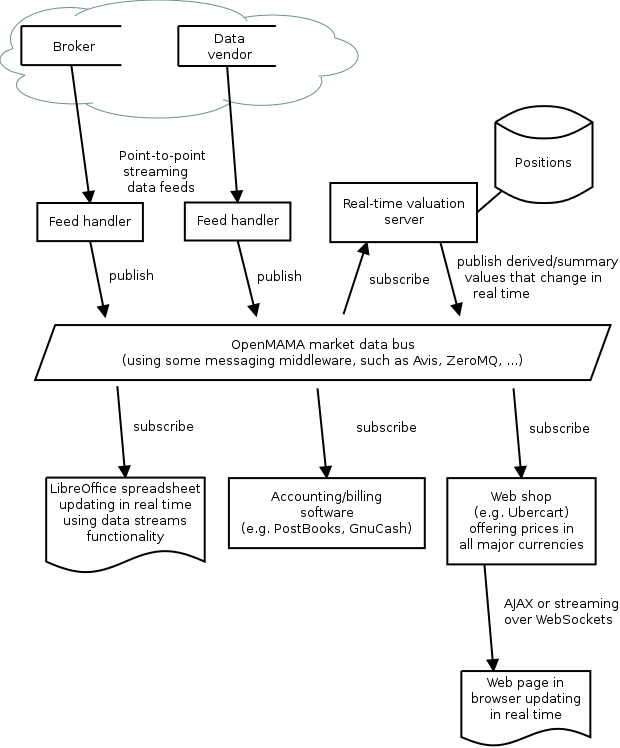
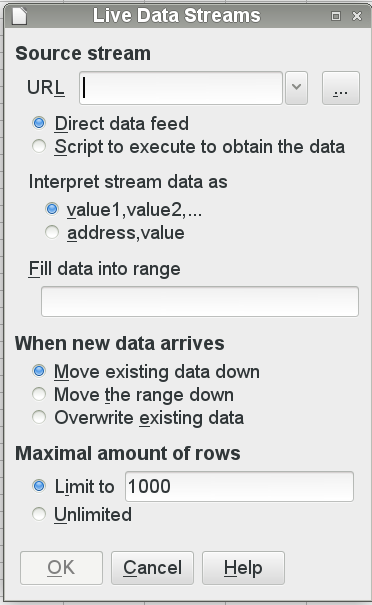
Here is an overview of the real-time market data architecture based on OpenMAMA: All these components may be running on a single host or they may be distributed across different servers and workstations in a LAN. The OpenMAMA market data bus ties them together. External data sources These are external sources of data. These could be currency trading firms, stock brokers, bullion dealers or even Bitcoin exchanges. Some exchanges don't provide data services directly to the general public and they distribute their price data through third-party data vendors such as Reuters and Bloomberg. Feed handlers The feed handlers manage the connections to external data sources. These are typically daemon processes that implement the wire protocols used by the external vendors for transmitting data over the public internet or a leased line. They typically use a point-to-point topology such as TCP connections. The feed handlers publish the data into the market data bus. In practice, the feed handler may be a proprietary application provided by the data vendor or it may simply be a Python script that fetches exchange rates from a URL every five minutes. OpenMAMA The market data bus is a distributed framework that is accessible to all of the local servers and workstations in the LAN. At the lowest level a messaging middleware solution is used to transport the data. The Avis Event Router is a free middleware. There is upcoming support for Apache QPID as well. Some commcercial middleware is supported too - here is the full list OpenMAMA does not provide a daemon or server process of its own. It is a set of libraries that operate on top of the middleware transport. In very general terms, the OpenMAMA libraries let applications publish messages (such as price ticks) or subscribe to receive the messages published by other applications. Spreadsheet application (for example, LibreOffice) LibreOffice is introducing a new data import feature for streaming time series data. This appears to provide a useful integration point for OpenMAMA and discussion is taking place in the development community. The spreadsheet can operate in various ways. A simple application may simply poll the currency prices when the spreadsheet is opened or refreshed. A more demanding application may see the spreadsheet come alive, recalculating all cells on every tick from the data vendor (several times per second). This latter scenario is more common in dealing rooms and hedge funds. Accounting/billing software There are many free accounting applications today, including PostBooks and GnuCash and some more heavyweight solutions like Adempiere and OpenERP. In a world where credit cards and the world wide web have made international trade an everyday activity, many people are using this software to track expenses and accounts in more than one currency. For example, a British business may be paying some suppliers in Euros and a Canadian may be charging some customers in US dollars. A Swiss person may be keeping some of their savings in gold bullion in the vault of one of their world reknowned Swiss banks. A common requirement for all of these users is the balance sheet. Using real-time market data sources, the balance sheet can be refreshed at any time from the live market prices. A home user may just find it convenient that they can open the balance sheet and always see their net worth immediately without having to manually cut and paste the currency prices from a web page. A business user operating in a competitive industry with low margins may be checking the balance sheet several times per day to ensure they remain solvent and profitable. Web shops Many web shops now offer the customers the convenience of viewing prices in their own currency. It is important to make sure these prices are accurate, especially when dealing with volatile currencies or when the products have a low profit margin. The web application server can receive the market data price ticks just like any other application in the network. Using this data, it can insert live prices into the pages as they are generated. If the currencies are particularly volatile, the web application could stream the prices to the browser using WebSockets and a JavaScript client embedded in the page would update the price field in real time. In fact, this web-based streaming price update mechanism is exactly how many online financial trading services offer live market prices to their customers. Real-time valuation server In a large organisation there may be many users looking at the same values. For example, in a trading desk, many users may need to see the desk's overall position in each market. In a busy web shop, many concurrent users may need to see the prices of common products. Rather than recalculating these values for each user in parallel, a common solution involves setting up a server to receive raw values (such as currency prices) from the data feed, calculate values needed by local users and then broadcast those values over the market data bus. How applications can integrate with real-time market data Here are some steps for getting started:

Daniel Pocock: Real-time streaming market data with free software

Here is an overview of the real-time market data architecture based on OpenMAMA: All these components may be running on a single host or they may be distributed across different servers and workstations in a LAN. The OpenMAMA market data bus ties them together. External data sources These are external sources of data. These could be currency trading firms, stock brokers, bullion dealers or even Bitcoin exchanges. Some exchanges don't provide data services directly to the general public and they distribute their price data through third-party data vendors such as Reuters and Bloomberg. Feed handlers The feed handlers manage the connections to external data sources. These are typically daemon processes that implement the wire protocols used by the external vendors for transmitting data over the public internet or a leased line. They typically use a point-to-point topology such as TCP connections. The feed handlers publish the data into the market data bus. In practice, the feed handler may be a proprietary application provided by the data vendor or it may simply be a Python script that fetches exchange rates from a URL every five minutes. OpenMAMA The market data bus is a distributed framework that is accessible to all of the local servers and workstations in the LAN. At the lowest level a messaging middleware solution is used to transport the data. The Avis Event Router is a free middleware. There is upcoming support for Apache QPID as well. Some commcercial middleware is supported too - here is the full list OpenMAMA does not provide a daemon or server process of its own. It is a set of libraries that operate on top of the middleware transport. In very general terms, the OpenMAMA libraries let applications publish messages (such as price ticks) or subscribe to receive the messages published by other applications. Spreadsheet application (for example, LibreOffice) LibreOffice is introducing a new data import feature for streaming time series data. This appears to provide a useful integration point for OpenMAMA and discussion is taking place in the development community. The spreadsheet can operate in various ways. A simple application may simply poll the currency prices when the spreadsheet is opened or refreshed. A more demanding application may see the spreadsheet come alive, recalculating all cells on every tick from the data vendor (several times per second). This latter scenario is more common in dealing rooms and hedge funds. Accounting/billing software There are many free accounting applications today, including PostBooks and GnuCash and some more heavyweight solutions like Adempiere and OpenERP. In a world where credit cards and the world wide web have made international trade an everyday activity, many people are using this software to track expenses and accounts in more than one currency. For example, a British business may be paying some suppliers in Euros and a Canadian may be charging some customers in US dollars. A Swiss person may be keeping some of their savings in gold bullion in the vault of one of their world reknowned Swiss banks. A common requirement for all of these users is the balance sheet. Using real-time market data sources, the balance sheet can be refreshed at any time from the live market prices. A home user may just find it convenient that they can open the balance sheet and always see their net worth immediately without having to manually cut and paste the currency prices from a web page. A business user operating in a competitive industry with low margins may be checking the balance sheet several times per day to ensure they remain solvent and profitable. Web shops Many web shops now offer the customers the convenience of viewing prices in their own currency. It is important to make sure these prices are accurate, especially when dealing with volatile currencies or when the products have a low profit margin. The web application server can receive the market data price ticks just like any other application in the network. Using this data, it can insert live prices into the pages as they are generated. If the currencies are particularly volatile, the web application could stream the prices to the browser using WebSockets and a JavaScript client embedded in the page would update the price field in real time. In fact, this web-based streaming price update mechanism is exactly how many online financial trading services offer live market prices to their customers. Real-time valuation server In a large organisation there may be many users looking at the same values. For example, in a trading desk, many users may need to see the desk's overall position in each market. In a busy web shop, many concurrent users may need to see the prices of common products. Rather than recalculating these values for each user in parallel, a common solution involves setting up a server to receive raw values (such as currency prices) from the data feed, calculate values needed by local users and then broadcast those values over the market data bus. How applications can integrate with real-time market data Here are some steps for getting started:

24 November 2013

Gregor Herrmann: RC bugs 2013/47

no exciting achievements but I still try to keep an eye on RC bugs:

22 November 2013

Vincent Sanders: Error analysis is the sweet spot for improvement

Although Don Norman was discussing designers attitude to user errors I assert the same is true for programmers when we use static program analysis tools.

The errors, or rather defects in the jargon, that a static analysis tools produce can be considered low cost well formed bug reports available very early in the development process.

When I say low cost it is because they can be found by a machine without a user or fellow developer wasting their time finding them. Well formed comes because the machine can describe exactly how it came to the logical deduction leading to the defect.
IntroductionStatic analysis is in general terms using the computer to examine a program for logic errors beyond those of pure syntax before it is executed. Examining a running program for defects is known as dynamic program analysis and while a powerful tool in its own right is not the topic of discussion.

This analysis has historically been confined to compiled languages as their compilers already had the Abstract Syntax Tree (AST) of the code available for analysis. As an example the C language (released in 1972) had the lint tool (released in 1979) based on the PCC compiler.

Practical early compilers (I am generalising here as the 19070s were a time of white hot innovation in computing and examples of just about any innovation in the field could probably be found) were pretty primitive and produced executables which were less good than hand written assembler output. Due to practical constraints the progress of optimising compilers was not as rapid as might be desired so static analysis was largely used as an external process.

Before progressing I ought to explain why I just mixed the concept of an optimising compiler and static analysis. The act of optimisation within those compilers requires program analysis, from which they can generate defect reports which we all know and love as compiler warnings, also explaining why many warnings only appear at higher optimisation levels where deeper analysis is required.

The attentive reader may now enquire as to why we would need external analysis tools when our compilers already perform the task. The answer stems from the issue that a compiler is trying to reconcile many desirable traits including:
The slow progress in creating optimising compilers initially centred around the problem of getting the compiled output in a reasonable time to allow for a practical edit-compile-run-debug cycle although the issues more recently have moved more towards the compiler implementation costs.

Because the output generation time is still a significant factor compilers limit the level of static analysis performed to that strictly required to produce good output. In standard operation optimising compilers do not do the extended analysis necessary to find all the defects that might be detectable.

An example: compiling one 200,000 line C program with the clang (v3.3) compiler producing x86 instruction binaries at optimisation level 2 takes 70 seconds but using the clang based scan-build static analysis tool took 517 seconds or more than seven times as long.
Using static analysis
As already described warnings are a by-product of an optimising compilers analysis and most good programmers will endeavour to remove all warnings from a project. Thus almost all programmers are already using static analysis to some degree.

The external analysis tools available can produce many more defect reports than the compiler alone as long as the developer is prepared to wait for the output. Because of this delay static analysis is often done outside the usual developers cycle and often integrated into a projects Continuous Integration (CI) system.

The resulting defects are usually presented as annotated source code with a numbered list of logical steps which shows how the defect can present. For example the steps might highlight where a line of code allocates memory from the heap and then an exit path where no reference to the allocated memory is kept resulting in a resource leak.

Once the analysis has been performed and a list of defects generated the main problem with this technology rears its ugly head, that of so called "false positives". The analysis is fundamentally an undecidable problem (it is a variation of the halting problem) and relies on algorithms to generate approximate solutions. Because of this some of the identified defects are erroneous.

The level of erroneous defect reports varies depending on the codebase being analysed and how good the analysis tool being used is. It is not uncommon to see false positive rates, even with the best tools, in excess of 10%

Good tools allow for this and provide ways to supply additional context through model files or hints in the source code to suppress the incorrect defect reports. This is analogous to using asserts to explicitly constrain variable values or a type cast to suppress a type warning.

Even once the false positives have been dealt with there comes the problem of defects which while they may be theoretically possible take so many steps to achieve that their probability is remote at best. These defects are often better categorized as a missing constraint and the better analysis tools generate fewer than the more naive implementations.

An issue with some defect reports is that often defects will appear in a small number of modules within programs, generally where the developers already know the code is of poor quality, thus not adding useful knowledge about a project.

As with all code quality tools static analysis can be helpful but is not a panacea code may be completely defect free but still fail to function correctly.
Defect DensityA term that is often used as a metric for code quality is the defect density. This is nothing more than the ratio of defect to thousands of lines of code e.g. a defect density of 0.9 means that there is approximately one defect found in every 1100 lines of code.

The often quoted industry average defect density value is 1, as with all software metrics this can be a useful indicator but should not be used without understanding.

The value will be affected by improvements in the tool as well as how lines of code are counted so is exceptionally susceptible to gaming and long term trends must be treated with scepticism.
Practical examplesI have integrated two distinct static analysis tools into the development workflow for the NetSurf project which I shall present as case studies. These examples show a good open source solution and a commercial offering highlighting the issues with each.

Several other solutions, both open source and commercial, exist many of which have been examined and discarded as either impractical or proving less useful than those selected. However the investigation was not comprehensive and only considered what was practical for the project at the time.
clangThe clang project is a frontend to the LLVM project providing an optimising compiler for the C, C++ and objective C languages. As part of this project the compiler has been enhanced to run a collection of "checkers" which implement various methods of analysis on the code being compiled.

The "scan-build" tool is provided to make the using these features straightforward. This tool generates defect reports as a series of html files which show the analysis results.


NetSurf CI system scan-build overview
Because the scan-build takes in excess of eight minutes on powerful hardware the NetSurf developers are not going to run this tool themselves as a matter of course. To get the useful output without the downsides it was decided to integrate the scan into the CI system code quality checks.

NetSurf CI system scan-build result list
Whenever a git commit happens to the mainline branch and the standard check build completes successfully on all target architectures the scan is performed and the results are published as a list of defects.

The list is accessible directly through the CI interface and also incorporates a trend graph showing how many defects were detected in each build.

A scan-build report showing an extremely unlikely path to a defect
Each defect listed has a detail link which reveals the full analysis and logic necessary to cause the defect to occur.

Unfortunately even NetSurf which is a relatively small piece of software (around 200,000 lines of code at time of writing) causes 107 defects to be emitted by scan-build.

All but 25 of the defects are however "Dead Store" where the code has a value assigned but is never checked. These errors are simply not interesting to the developers and are occurring in code generated by a tool.

Of the remaining defects identified the majority are false positives and several (like the example in the image above) are simply improbable requiring a large number of steps to reach.

This shows up the main problem with the scan-build tool in that there is no way to suppress certain checks, mark defects as erroneous or avoid false positives using a model file. This reduces the usefulness of these builds because the developers all need to remember that this list of defects is not relevant.

Most of the NetSurf developers know that the project currently has 107 outstanding issues and if a code change or tool improvement were to change that value we have to manually work through the defect list one by one to check what had changed.
CoverityThe coverity SAVE tool is a commercial offering from a company founded in the Computer Systems Laboratory at Stanford University in Palo Alto, California. The results of the original novel research has produced a good solution which improved on analysis tools previously available.

Coverity Interface showing summary of NetSurf analysis. Layout issues are a NetSurf bug
The company hosts a gratis service for open source projects, they even provide scans for the Linux kernel so project size does not appear to be an issue.

The challenges faced integrating the coverity tool into the build process differed from clang however the issue of execution time remained and the CI service was used.

The coverity scanning tool is a binary executable which collects data on the build which is then submitted to the coverity service to be analysed. This tool obviously relies upon the developer running the executable to trust coverity to some degree.

A basic examination of the binary was performed and determined the executable was not establishing network connections or performing and observably undesirable behaviour. From this investigation the decision was made that running the tool inside a sandbox environment on a CI build slave was safe. The CI system also submits the collected results in a compressed form directly to the coverity scan service.

Care must be taken to only submit builds according to the services Acceptable Use Policy which limits the submission frequency of NetSurf scans to every other day. To ensure the project stays within the rules the build performed by the CI system is manually controlled and confined to a subset of NetSurf developers.
Coverity connect defect management console for NetSurfThe results are presented using the coverity connect web technology based defect management tool. Access to the coverity connect interface is controlled by a user management system which precludes publicly publishing the results within the CI system.

Unfortunately NetSurf itself does not currently have good enough JavaScript DOM bindings to support this interface so another browser must be used to view it.

Despite the drawbacks the quality of the analysis results is greatly superior to the clang solution. The false positive rate is very low while finding many real issues which had not been previously detected.

The analysis can be enhanced by use of collection configuration and modelling files which remove intended constructions from consideration reducing the false positive rate to very low levels. The ability to easily and persistently suppress false positives through the web interface is also available.

The false positive management capabilities coupled with a user interface that makes understanding the defect path simple make this solution very practical and indeed the NetSurf developers have removed over 50 actual issues within a relatively short period since the introduction of the tool.

Not all of those defects could be considered serious but they had the effect of encouraging deeper inspection of some very dubious smelling source.
ConclusionsThe principle conclusions of implementing and using static analysis have been:

When I started looking at this technology I was somewhat dubious about its usefulness but I have definitely changed my mind. It is a useful addition to any non-trivial project and the return on time and effort should be repaid handsomely in all but already perfect code (if you believe you have such code I have a bridge to sell you).

Russ Allbery: Review: The Pathway to Awesomeness

Review: The Pathway to Awesomeness, by Mark Forster
Publisher: Hyperink
Copyright: October 2013
ASIN: B00FXGXMPQ
Format: Kindle
Pages: 97
Mark Forster is probably my favorite time management (or, if you prefer, attention management) writer. The place to start with Forster if you're not familiar with him is Do It Tomorrow, not here. Unlike the other books by him I've reviewed, this is just an edited collection of blog posts presented in a convenient ebook form, without even an ISBN number. But if you've read his books (at least the ones that aren't out of print and cost a fortune), this is a convenient way to not have to trawl back through his blog and read the articles in a more convenient fashion. For me, it was also an easy way to give him a bit of money for his blog. Unless you have a similar motive, I don't think the content to price ratio is worth it. But I think everything is still up at Get Everything Done in case anything here strikes your fancy. As with most blog compilations, The Pathway to Awesomeness (I really hate that title) is composed of a whole bunch of fairly short articles, rarely more than three pages each, vaguely collected by topic. The first few are rather general and focused on the normal self-help platitudes that try to build up your sense that you're in control of your own life. But Forster doesn't take too long to get to what he's best at: short ideas, mental tools, interesting tricks, and simple techniques. Even more so than his books, due to the nature of this collection, there's a huge variety here, which means you can probably find something that strikes a chord no matter what attention management problem you've been running into. That's one of the main reasons why I prefer his writing: he tries to provide a giant toolbox instead of a single, streamlined System For Everyone. The other thing I like about Forster is that he is much more blunt than many authors about the biggest problem I have with attention management: trying to do more than anyone could possibly do given the available time. There are some more essays here about that, and several of them are quite good. I think my favorite is the short essay in which he points out how often people decide to do some task for a particular reason, and then get so engrossed in the performance of that task that they forget the original reason, risking sinking far more energy into that task than is actually warranted. Like a lot of Forster's observations, it's obvious in retrospect, but he has a way of phrasing those observation so that they shake the right thing loose in my head and let me re-evaluate something I was doing. Regular readers of Forster's blog know that he loves playing around with different simple to-do list management systems. Unfortunately, none of those are here, so don't pick this up expecting a collection of articles about Superfocus, Autofocus, etc. It makes sense given the topic of this collection, which is more general advice rather than systems, but this collection is so short that I wish he'd added a section on system development. I would have enjoyed reading a collection of all of his miniature systems together in one place and showing how he tweaked and changed them over time, particularly if he'd added some discussion of why he made each change and what goals he was trying to meet with each system. Ah well. If you aren't already familiar with Forster, there's no point in this, but if you are, I got a few new tidbits out of it and will probably skim through it a few more times. Buying it is mostly an exercise in putting money in the tip jar, and his writing is much less polished here (and more prone to cliches), but I still enjoyed reading through it. Rating: 7 out of 10

21 November 2013

Gunnar Wolf: Back aches...

This year, I had slowly taken again running. It's an activity I enjoy, even though I'm far from the condition I had when I did it every day My maximum was running about 8Km four days a week (ocassionally up to 15Km, say, on weekends)... But I slowly drifted out of it over the last three years. Yes, I have taken it up now and then, but dropped out again after a few weeks. Well, this year it felt I was getting back in the routine. Not without some gaps, but I had ran most weeks since July at least once, but usually two times. I started slowly, doing about 3Km close to home, but didn't take much to go back to my usual routes inside UNAM, doing a modest average of 4.5-5Km per run, and averaging somewhat over 8Km/h (6.5 min/Km). But... Well, I cannot relate precisely what happened on this Exactly a month ago, after a very average run (even a short one, 3.6Km), I had a lower back ache. Didn't pay too much attention to it, but it was strange since the first day, as I often have upper back aches Never lower. The pain came and went slowly several times. I kept cycling to work, although not every day. On October 27th, I even took the time to do the Ciclot n, a nice 38Km (including the ~5Km distance from home) around central Mexico City. I enjoyed the ride, even though every stop and re-start of the bike was a bit painful what hurts is to get off and on the bike: The posture change. But the pain has been almost constantly there. When I stand up, or when I sit down, it's about five minutes until the body gets used to the new position and stops hurting. Another strange data point: This last weekend (together with a national holiday) we went to a small conference in Guadalajara, and then to visit our friends in Guanajuato. So, we spent 12 hours on the bus there (12 Yes, there was an accident on the road, and we could not pass... So many hours were wasted there, and going back to a junction to take an alternative, longer road), then one night in a hotel bed, and two nights in our friends' guest mattresses which are not precisely luxury-grade. And Sunday night... I had no pain at all! Came back home, and after only one night back in our bed... I just could not move. I had the strongest pain so far. Could not even walk without some help. We went to the orthopedist a friend recommended, and I was seriously bending my posture: While that part of my posture is usually stable, my right hip was about 2cm higher than the left one, and my shoulders were almost 7cm displaced from my hips! So... Well, I'm having a cocktail of painkillers and antiinflamatories. The doctor says next week he wants me to have a tomography taken to better understand the causes for this. And, of course, tomorrow I'm leaving for Festival de Software Libre in Puerto Vallarta. I'm going there by plane, so no big hassle. But the way back, it will be 12 more hours on a bus. I'm... not precisely looking forward to this bus ride :( Anyway... I sorely miss my bike+running :(

Next.

Previous.