Search Results: "will"

18 June 2016

Debian Java Packaging Team: Wheezy LTS and the switch to OpenJDK 7

Wheezy's LTS period started a few weeks ago and the LTS team had to make an early support decision concerning the Java eco-system since Wheezy ships two Java runtime environments OpenJDK 6 and OpenJDK 7. (To be fair, there are actually three but gcj has been superseded by OpenJDK a long time ago and the latter should be preferred whenever possible.) OpenJDK 6 is currently maintained by Red Hat and we mostly rely on their upstream work as well as on package updates from Debian's maintainer Matthias Klose and Tiago St rmer Daitx from Ubuntu. We already knew that both intend to support OpenJDK 6 until April 2017 when Ubuntu 12.04 will reach its end-of-life. Thus we had basically two options, supporting OpenJDK 6 for another twelve months or dropping support right from the start. One of my first steps was to ask for feedback and advice on debian-java since supporting only one JDK seemed to be the more reasonable solution. We agreed on warning users via various channels about the intended change, especially about possible incompatibilities with OpenJDK 7. Even Andrew Haley, OpenJDK 6 project lead, participated in the discussion and confirmed that, while still supported, OpenJDK 6 security releases are "always the last in the queue when there is urgent work to be done". I informed debian-lts about my findings and issued a call for tests later. Eventually we decided to concentrate our efforts on OpenJDK 7 because we are confident that for the majority of our users one Java implementation is sufficient during a stable release cycle. An immediate positive effect in making OpenJDK 7 the default is that resources can be relocated to more pressing issues. On the other hand we were also forced to make compromises. The switch to a newer default implementation usually triggers a major transition with dozens of FTBFS bugs and the OpenJDK 7 transition was no exception. I pondered about the usefulness of fixing all these bugs for Wheezy LTS again and focussing on runtime issues instead and finally decided that the latter was both more reasonable and more economic. Different from regular default Java changes, users will still be able to use OpenJDK 6 to compile their packages and the security impact for development systems is in general neglectable. More important was to avoid runtime installations of OpenJDK 6. I identified eighteen packages that strictly depended on the now obsolete JRE and fixed those issues on 4 May 2016 together with an update of java-common and announced the switch to OpenJDK 7 with a Debian NEWS file. If you are not a regular reader of Debian news and also not subscribed to debian-lts, debian-lts-announce or debian-java, remember 26 June 2016 is the day when OpenJDK 7 will be made the default Java implementation in Wheezy LTS. Of course there is no need to wait. You can switch right now:
sudo update-alternatives --config java

Manuel A. Fernandez Montecelo: More work on aptitude

The last few months have been a bit of a crazy period of ups and downs, with a tempest of events beneath the apparent and deceivingly calm surface waters of being unemployed (still at it). The daily grind Chief activities are, of course, those related to the daily grind of job-hunting, sending applications, and preparing and attending interviews. It is demoralising when one searches for many days or weeks without seeing anything suitable for one's skills or interests, or other more general life expectations. And it takes a lot of time and effort to put one's best in the applications for positions that one is really, really, interested in. And even for the ones which are meh, for a variety of reasons (e.g. one is not very suitable for what the offer demands). After that, not being invited to interviews (or doing very badly at them) is bad, of course, but quick and not very painful. A swift, merciful end to the process. But it's all the more draining when waiting for many weeks when not a few months with the uncertainty of not knowing if one is going to be lucky enough to be summoned for an interview; harbouring some hope one has to appear enthusiastic in the interviews, after all , while trying to keep it contained lest it grows too much ; then in the interview hearing good words and some praises, and feeling the impression that one will fit in, that one did nicely and that chances are good letting the hope grow again ; start to think about life changes that the job will require to make a quick decision should the offer finally arrives ; perhaps make some choices and compromises based on the uncertain result; then wait for a week or two after the interview to know the result... ... only to end up being unsuccessful. All the effort and hopes finally get squashed with a cold, short email or automatic response, or more often than not, complete radio silence from prospective employers, as an end to a multi-month-long process. An emotional roller coaster [1], which happened to me several times in the last few months. All in a day's work The months of preparing and waiting for a new job often imply an impasse that puts many other things that one cares about on hold, and one makes plans that will never come to pass. All in a day's (half-year's?) work of an unemployed poor soul. But not all is bad. This period was also a busy time doing some plans about life, mid- and long-term; the usual and some really unusual! family events; visits to and from friends, old and new; attending nice little local Debian gatherings or the bigger gathering of Debian SunCamp2016, and other work for side projects or for other events that will happen soon... And amidst all that, I managed to get some work done on aptitude. Two pictures worth (less than) a thousand bugs To be precise, worth 709 bugs 488 bugs in the first graph, plus 221 in the second. In 2015-11-15 (link to the post Work on aptitude): aptitude BTS Graph, 2015-11-15 In 2016-06-18: aptitude BTS Graph, 2016-06-18 Numbers The BTS numbers for aptitude right now are: Highlights Beyond graphs and stats, I am specially happy about two achievements in the last year:
  1. To have aptitude working today, first and foremost Apart from the abandon that suffered in previous years, I mean specifically the critical step of getting it through the troubles of the last summer, with the GCC-5/C++11 transition in parallel with a transition of the Boost library (explained in more detail in Work on aptitude). Without that, possibly aptitude would not have survived until today.
  2. Improvements to the suggestions of the resolver In the version 0.8, there were a lot of changes related with improving the order of the suggestions from the resolver, when it finds conflicts or other problems with the planned actions. Historically, but specially in the last few years, there have been many complaints about the nonsensical or dangerous suggestions from the resolver. The first solution offered by the resolver was very often regarded as highly undesirable (for example, removal of many packages), and preferable solutions like upgrades of one or only a handful of packages being offered only after many removals; and keeps only offered as last resort.
Perhaps these changes don't get a lot of attention, given that in the first case it's just to keep working (with few people realising that it could have collapsed on the spot, if left unattended), and the second can probably go unnoticed because it just works or it started to work more smoothly doesn't get as much immediate attention as it suddenly broke! . Still, I wanted to mention them, because I am quite proud of those. Thanks Even if I put a lot of work on aptitude in the last year, the results of the graph and numbers have not been solely achieved by me. Special thanks go to Axel Beckert (abe / XTaran) and the apt team, David Kalnischkies and Julian Andres Klode who, despite the claim in that page, does not mostly work python-apt anymore... but also in the main tools. They help with fixing some of the issues directly, or changing things in apt that benefit aptitude, testing changes, triaging bugs or commenting on them, patiently explaining to me why something in libapt doesn't do what I think it does, and good company in general. Not the least, for holding impromptu BTS group therapy / support meetings, for those cases when prolonged exposure to BTS activity starts to induce very bad feelings. Thanks also to people who sent their translation updates, notified about corrections, sent or tested patches, submitted bugs, or tried to help in other ways. Change logs for details. Notes [1] ^ It's even an example in the Cambridge Dictionaries Online website, for the entry of roller coaster:
He was on an emotional roller coaster for a while when he lost his job.

Sune Vuorela: R is for Randa

This week I have been gathered with 38 KDE people in Randa, Switzerland. Randa is a place in a valley in the middle of the Alps close to various peaks like Matterhorn. It has been a week of intense hacking, bugfixing, brainstorming and a bit of enjoying the nature. R is for Reproducible builds I spent the first couple of days trying to get the Qt Documentation generation tool to reproducible generate documentation. Some of the fixes were of the usual put data in an randomized datastructure, then iterate over it and create output , where the fix is similar well known: Sort the datastructure first. Others were a bit more severe bugs that lead to the documentation to shuffle around the obsolete bit, and the inheritance chains. Most of these fixes have been reviewed and submitted to the Qt 5.6 branch, one is still pending review, but that hopefully gets fixed soon. Then most of Qt (except things containing copies of (parts) of webkit and derivatives) should be reproducible. R is for Roaming around in the mountains Sleeping, hacking and dining in the same building sometimes leads to a enormous desire for fresh air. Luckily in the middle of the alps, it is readily available, and at least once a day many people went for a walk. To say hi to a sheep. Or to just go uphill until tired and then going back down. Or just finding a circle around. For this area, OpenStreetMap seems to have better maps than Google. We also went on a nice group trip to Zermatt and surroundings, sponsored by our friends in Edeltech. R is for Releasing One of the tasks I set myself for was to get my barcode generation library (prison. you know. being behind bars.) ready for release. A bit of api cleanup, including some future proofing, was done, and all users adapted. Hopefully it will be released as part of the next KDE Frameworks release. R is for Reviewing code When signing up for the sprint, one has to declare a couple of tasks to work on. One of the things I put myself up to was reviewing David Faure s code changes. First, he is very productive, and second, he often gets into creating patches in code areas where many other contributors are scared to look. So someone has to do it, and code never scared me. R is for Running I planned on going running along the river monday, wednesday and friday. Fortunately that happened, but due to Switzerland having a bit more ups and downs than flat Denmark, it didn t go that fast. R is for Random bugfixing When in the hacking mood surrounded by great developers, it is very easy to just fix minor bugs when you encounter them. There is likely someone around who knows the code in question. Or you are just in the mood to actually fix it, rather than living with a missing clock applet or a corner case crash. R is for Rubber ducking I am a brilliant person sized rubber duck. And I did get the opportunity to show off my skills a couple of times, as well as using some of the other people for that. R is for Raising money These sprints in Randa is only possible because of all the nice donations from people and companies around the world. The fundraiser is still running, and can be found at

17 June 2016

Matthias Klumpp: A few words about the future of the Limba project

limba-smallI wanted to write this blogpost since April, and even announced it in two previous posts, but never got to actually write it until now. And with the recent events in Snappy and Flatpak land, I can not defer this post any longer (unless I want to answer the same questions over and over on IRC ^^). As you know, I develop the Limba 3rd-party software installer since 2014 (see this LWN article explaining the project better then I could do  ) which is a spiritual successor to the Listaller project which was in development since roughly 2008. Limba got some competition by Flatpak and Snappy, so it s natural to ask what the projects next steps will be. Meeting with the competition At last FOSDEM and at the GNOME Software sprint this year in April, I met with Alexander Larsson and we discussed the rather unfortunate situation we got into, with Flatpak and Limba being in competition. Both Alex and I have been experimenting with 3rd-party app distribution for quite some time, with me working on Listaller and him working on Glick and Glick2. All these projects never went anywhere. Around the time when I started Limba, fixing design mistakes done with Listaller, Alex started a new attempt at software distribution, this time with sandboxing added to the mix and a new OSTree-based design of the software-distribution mechanism. It wasn t at all clear that XdgApp, later to be renamed to Flatpak, would get huge backing by GNOME and later Red Hat, becoming a very promising candidate for a truly cross-distro software distribution system. The main difference between Limba and Flatpak is that Limba allows modular runtimes, with things like the toolkit, helper libraries and programs being separate modules, which can be updated independently. Flatpak on the other hand, allows just one static runtime and enforces everything that is not in the runtime already to be bundled with the actual application. So, while a Limba bundle might depend on multiple individual other bundles, Flatpak bundles only have one fixed dependency on a runtime. Getting a compromise between those two concepts is not possible, and since the modular vs. static approach in Limba and Flatpak where fundamental, conscious design decisions, merging the projects was also not possible. Alex and I had very productive discussions, and except for the modularity issue, we were pretty much on the same page in every other aspect regarding the sandboxing and app-distribution matters. Sometimes stepping out of the way is the best way to achieve progress So, what to do now? Obviously, I can continue to push Limba forward, but given all the other projects I maintain, this seems to be a waste of resources (Limba eats a lot of my spare time). Now with Flatpak and Snappy being available, I am basically competing with Canonical and Red Hat, who can make much more progress faster then I can do as a single developer. Also, Flatpaks bigger base of contributors compared to Limba is a clear sign which project the community favors more. Furthermore, I started the Listaller and Limba projects to scratch an itch. When being new to Linux, it was very annoying to me to see some applications only being made available in compiled form for one distribution, and sometimes one that I didn t use. Getting software was incredibly hard for me as a newbie, and using the package-manager was also unusual back then (no software center apps existed, only package lists). If you wanted to update one app, you usually needed to update your whole distribution, sometimes even to a development version or rolling-release channel, sacrificing stability. So, if now this issue gets solved by someone else in a good way, there is no point in pushing my solution hard. I developed a tool to solve a problem, and it looks like another tool will fix that issue now before mine does, which is fine, because this longstanding problem will finally be solved. And that s the thing I actually care most about. I still think Limba is the superior solution for app distribution, but it is also the one that is most complex and requires additional work by upstream projects to use it properly. Which is something most projects don t want, and that s completely fine.  And that being said: I think Flatpak is a great project. Alex has much experience in this matter, and the design of Flatpak is sound. It solves many issues 3rd-party app development faces in a pretty elegant way, and I like it very much for that. Also the focus on sandboxing is great, although that part will need more time to become really useful. (Aside from that, working with Alexander is a pleasure, and he really cares about making Flatpak a truly cross-distributional, vendor independent project.) Moving forward So, what I will do now is not to stop Limba development completely, but keep it going as a research project. Maybe one can use Limba bundles to create Flatpak packages more easily. We also discussed having Flatpak launch applications installed by Limba, which would allow both systems to coexist and benefit from each other. Since Limba (unlike Listaller) was also explicitly designed for web-applications, and therefore has a slightly wider scope than Flatpak, this could make sense. In any case though, I will invest much less time in the Limba project. This is good news for all the people out there using the Tanglu Linux distribution, AppStream-metadata-consuming services, PackageKit on Debian, etc. those will receive more attention  An integral part of Limba is a web service called LimbaHub to accept new bundles, do QA on them and publish them in a public repository. I will likely rewrite it to be a service using Flatpak bundles, maybe even supporting Flatpak bundles and Limba bundles side-by-side (and if useful, maybe also support AppImageKit and Snappy). But this project is still on the drawing board. Let s see  P.S: If you come to Debconf in Cape Town, make sure to not miss my talks about AppStream and bundling

Shirish Agarwal: Medical awareness, terrorism, racism and Debconf

Hi to all the souls on planet.debian.org:) . I hope to meet many of you in Debconf16 which is being held at UCT (University of Cape Town), Rhondenbosch, South Africa and am excited to be part of it. I pushed a blog post about my journey to debconf till date. I express my sympathy and condolences to all the people who died in the cowardly shooting spree done by a madman in Orlando . I have been upset about this development but as what s done is done, it s best to just keep moving. Closer to my own reality, I was shocked to discover during my whole visa experience that nowhere there is any knowledge about vaccinations that people should have when they are traveling internationally. I was kinda rudely awakened by this mail which prompted me to take Hep A shot and also start a thread on the mailing list. The more comprehensive info. I got was at the CDC site . It seems to be a go-to site to find about what is recommended. While I will not be taking any shots now as it s nearing to the date of travel, if I had known before, it would have been a valuable resource in itself. Definitely something to be bookmarked if you are going overseas and are worried or have health concerns. On another note, About few days back, there was a discussion as recently, travel advisories have been issued about possible terror action in South Africa by various embassies due to the holy month of Ramadan.
And the recent attack just proves that it takes just one twisted personality with a perverse sense of justice or whatever s/he/ thinks as just to do what s/he did and guns and more security and not the answer.
My take on it some would describe as simplistic, there are things which you can control, there are things beyond your control. No security agency, no country can guarantee it. By being either home or away, you can t wish you will not get bitten. Got images of Final Destination invoked when I was sharing that, for as an Indian, do believe a bit on fate and karma. Also, me being single also plays a part, perhaps I would have been more cautious or have different motivations if I had a family so I do understand some of the concerns which have been raised by people in that thread. At the end of it, it really is a non-choice in my book. If you don t take part due to fear,uncertainty of a possible attack, you have already given in to fear and uncertainty and I believe this goes against the very philosophy of what Debian stands for, being bold, taking chances and having trust in your fellow men. If we haven t allowed proprietary, commercial software to win over us, how can we allow less than 0.1% radically motivated people to scare us ? And the recent attack just proves that it takes just one twisted personality with a perverse sense of justice or whatever s/he/ thinks as just to do what s/he did. More guns and more security are certainly not the answer here. A more troubling part is not terrorism but caste-ism and racism which have been also making news (not in a good way) in India. Now while I cannot claim to have any knowledge about Africans apart from 2-3 conversations which didn t go anywhere, two-three preconceived notions about them can easily be countered. As far as drugs are concerned, IF some Africans are doing drugs smuggling, it would be wrong to pin all of it onto them. India has been fighting drugs smuggling from the 70 s itself. From what we know and have learnt over the years from consuming media, India shares porous borders with almost all our neighbors. Of those, Pakistan is supposed to be the largest grower and supplier and then Nepal where young boys are used as Traffickers. The recent film Rocky Handsome and the recent upcoming controversial movie Udta Punjab are trying to explore these issues. As far as drinking in open is concerned, I have seen and been part of Punjabi parties where both men and women drink without abandon in farm parties. Russians, Germans and Israelis can also out-drink a person on their day/mood. As far as sexuality is concerned, we are the second most populous country in the world, so the less said the better:) . I believe though that underneath this racism is money, greed, phobia, language barriers and just maybe some lifestyle choices as well. I have seen North-Eastern, Chinese, Buddhist people being colored with the same brush. The more interesting case is with the Buddhist as can be seen in Himachal Pradesh, where locals feel they are deprived as Europeans come and indulge Buddhists for their monasteries and their way of life while locals don t get much money from them. This is partly true, but also due to our own short-comings in dealing with westerners. I have never seen my own countrymen going out of their way to make westerners or any tourists for that matter feel welcome in a genuine way. More often, the behavior is between hostility, jealousy and a perverted sense of hero-worship due to the color of skin. As far as being racist and bigoted are concerned, it seems we are not alone, just day before came across this news from Malaysia which is interesting in the sense that how people from different communities frame their own history and people around them, forget that is false and misleading to what we in India know to be the truth, it probably is/would be interesting for somebody who does comparative history, myth and folklore analysis. I was actually planning to talk about some of the talks I am looking forward to hearing and seeing on Debconf but guess that will have to wait for few more days. Hope to publish one more before actually flying to Debconf. Till later.
Filed under: Miscellenous Tagged: #Debconf16, #racism, #terrorism, #vaccinations

15 June 2016

Steve Kemp: So I should document the purple server a little more

I should probably document the purple server I hacked together in Perl and mentioned in my last post. In short it allows you to centralise notifications. Send "alerts" to it, and when they are triggered they will be routed from that central location. There is only a primitive notifier included, which sends data to the console, but there are sample stubs for sending by email/pushover, and escalation. In brief you create alerts by sending a JSON object via HTTP-POST. These objects contain a bunch of fields, but the two most important are: When an update is received any existing alert has its values updated, which makes heartbeat alerts trivial. Send a message with: "id": "heartbeat", "raise": "+5m", .. The existing alert will be updated each time such a new event is submitted, which means that the time at which that alert will raise will be pushed back by five minutes. If you send this every 60 seconds then you'll get informed of an outage five minutes after your server explodes (because the "+5m" will have been turned into an absolute time, and that time will eventually become in the past - triggering a notification). Alerts are keyed on the source IP which sent the submission and the id field, meaning you can send the same update from multiple hosts without causing any problems. Notifications can be viewed in a reasonably pretty Web UI, so you can clear raised-alerts, see the pending ones, and suppress further notifications on something that has been raised. (By default notifications are issued every sixty seconds, until the alert is cleared. There is support for only raising an alert once, which is useful for services you might deliver events via, such as pushover which will repeat themselves.) Anyway this is a fun project, which is a significantly simplified and less scalable version of a project which is open-sourced already and used at Bytemark.

Enrico Zini: On discomfort and new groups

I recenyly wrote:
When you get involved in a new community, such as Debian, find out early where, if that happens, you can find support, understanding, and help to make it stop.
Last night I asked a group of friends what do they do if they start feeling uncomfortable when they are alone in a group of people they don't know. Here are the replies: I think a lot of these point are good food for thought about barriers of entry, and about safety nets that a group has or might want to have.

Russ Allbery: Review: Matter

Review: Matter, by Iain M. Banks
Publisher: Orbit
Copyright: February 2008
ISBN: 0-316-00536-3
Format: Hardcover
Pages: 593
Sursamen is an Arithmetic, Mottled, Disputed, Multiply Inhabited, Multi-million Year Safe, and Godded Shellworld. It's a constructed world with multiple inhabitable levels, each lit by thermonuclear "suns" on tracks, each level supported above the last by giant pillars. Before the recorded history of the current Involved Species, a culture called the Veil created the shellworlds with still-obscure technology for some unknown purpose, and then disappeared. Now, they're inhabited by various transplants and watched over by a hierarchy of mentor and client species. In the case of Sursamen, both the Aultridia and the Oct claim jurisdiction (hence "Disputed"), and are forced into an uneasy truce by the Nariscene, a more sophisticated species that oversees them both. On Sursamen, on level eight to be precise, are the Sarl, a culture with an early industrial level of technology in the middle of a war of conquest to unite their level (and, they hope, the next level down). Their mentors are the Oct, who claim descendance from the mysterious Veil. The Deldeyn, the next level down, are mentored by the Aultridia, a species that evolved from a parasite on Xinthian Tensile Aranothaurs. Since a Xinthian, treated by the Sarl as a god, lives in the heart of Sursamen (hence "Godded"), tensions between the Sarl and the Aultridians run understandably high. The ruler of the Sarl had three sons and a daughter. The oldest was killed by the people he is conquering as Matter starts. The middle son is a womanizer and a fop who, as the book opens, watches a betrayal that he's entirely unprepared to deal with. The youngest is a thoughtful, bookish youth pressed into a position that he also is not well-prepared for. His daughter left the Sarl, and Sursamen itself, fifteen years previously. Now, she's a Special Circumstances agent for the Culture. Matter is the eighth Culture novel, although (like most of the series) there's little need to read the books in any particular order. The introduction to the Culture here is a bit scanty, so you'll have more background and understanding if you've read the previous novels, but it doesn't matter a great deal for the story. Sharp differences in technology levels have turned up in previous Culture novels (although the most notable example is a minor spoiler), but this is the first Culture novel I recall where those technological differences were given a structure. Usually, Culture novels have Special Circumstances meddling in, from their perspective, "inferior" cultures. But Sursamen is not in Culture space or directly the Culture's business. The Involved Species that governs Sursamen space is the Morthanveld: an aquatic species roughly on a technology level with the Culture themselves. The Nariscene are their client species; the Oct and Aultridia are, in turn, client species (well, mostly) of the Nariscene, while meddling with the Sarl and Deldeyn. That part of this book reminded me of Brin's Uplift universe. Banks's Involved Species aren't the obnoxious tyrants of Brin's universe, and mentoring doesn't involve the slavery of the Uplift universe. But some of the politics are a bit similar. And, as with Uplift, all the characters are aware, at least vaguely, of the larger shape of galactic politics. Even the Sarl, who themselves have no more than early industrial technology. When Ferbin flees the betrayal to try to get help, he ascends out of the shellworld to try to get assistance from an Involved species, or perhaps his sister (which turns out to be the same thing). Banks spends some time here, mostly through Ferbin and his servant (who is one of the better characters in this book), trying to imagine what it would be like to live in a society that just invented railroads while being aware of interstellar powers that can do practically anything. The plot, like the world on which it's set, proceeds on multiple levels. There is court intrigue within the Sarl, war on their level and the level below, and Ferbin's search for support and then justice. But the Sarl live in an artifact with some very mysterious places, including the best set piece in the book: an enormous waterfall that's gradually uncovering a lost city on the level below the Sarl, and an archaeological dig that proceeds under the Deldeyn and Sarl alike. Djan Seriy decides to return home when she learns of events in Sarl, originally for reasons of family loyalty and obligation, but she's a bit more in touch with the broader affairs of the galaxy, including the fact that the Oct are acting very strangely. There's something much greater at stake on Sursamen than tedious infighting between non-Involved cultures. As always with Banks, the set pieces and world building are amazing, the scenery is jaw-dropping, and I have some trouble warming to the characters. Dramatic flights across tower-studded landscapes seeking access to forbidden world-spanning towers largely, but don't entirely, make up for not caring about most of the characters for most of the book. This did change, though: although I never particularly warmed to Ferbin, I started to like his younger brother, and I really liked his sister and his servant by the end of the book. Unfortunately, the end of Matter is, if not awful, at least exceedingly abrupt. As is typical of Banks, we get a lot of sense of wonder but not much actual explanation, and the denouement is essentially nonexistent. (There is a coy epilogue hiding after the appendices, but it mostly annoyed me and provides only material for extrapolation about the characters.) Another SF author would have written a book about the Xinthian, the Veil, the purpose of the shellworlds, and the deep history of the galaxy. I should have known going in that Banks isn't that sort of SF author, but it was still frustrating. Still, Banks is an excellent writer and this is a meaty, complex, enjoyable story with some amazing moments of wonder and awe. If you like Culture novels in general, you will like this. If you like set-piece-heavy SF on a grand scale, such as Alastair Reynolds or Kim Stanley Robinson, you probably like this. Recommended. Rating: 8 out of 10

14 June 2016

Joey Hess: second system

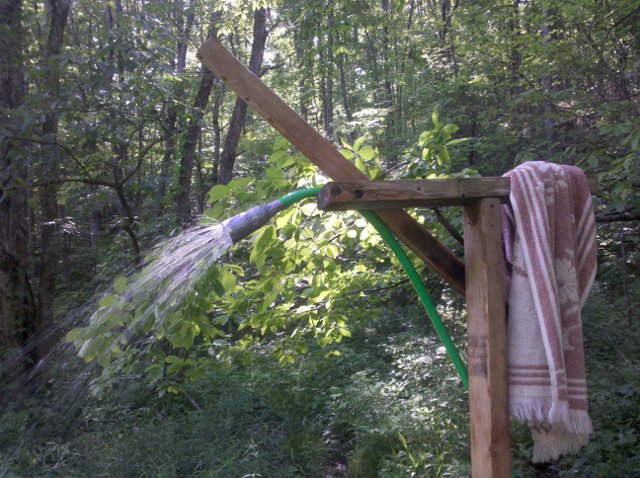
Five years ago I built this, and it's worked well, but is old and falling down now.
mark I outdoor shower
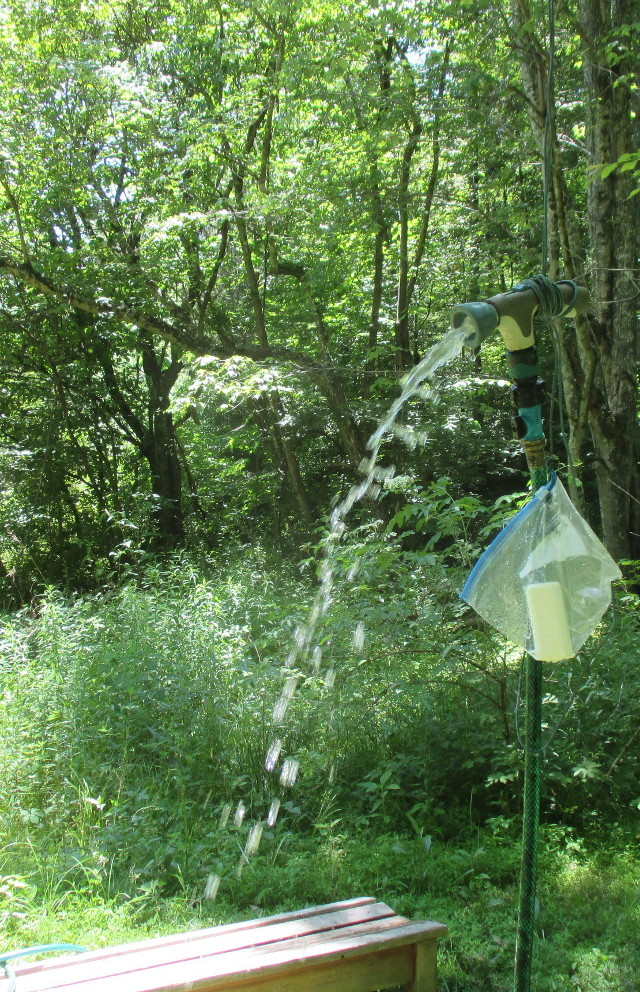
The replacement is more minimalist and like any second system tries to improve on the design of the first. No wood to rot away, fully adjustable height. It's basically a shower swing, suspended from a tree branch.
mark II outdoor shower
Probably will turn out to have its own new problems, as second systems do.

Simon McVittie: GTK versioning and distributions

Allison Lortie has provoked a lot of comment with her blog post on a new proposal for how GTK is versioned. Here's some more context from the discussion at the GTK hackfest that prompted that proposal: there's actually quite a close analogy in how new Debian versions are developed. The problem we're trying to address here is the two sides of a trade-off: Historically, GTK has aimed to keep compatible within a major version, where major versions are rather far apart (GTK 1 in 1998, GTK 2 in 2002, GTK 3 in 2011, GTK 4 somewhere in the future). Meanwhile, fixing bugs, improving performance and introducing new features sometimes results in major changes behind the scenes. In an ideal world, these behind-the-scenes changes would never break applications; however, the world isn't ideal. (The Debian analogy here is that as much as we aspire to having the upgrade from one stable release to the next not break anything at all, I don't think we've ever achieved that in practice - we still ask users to read the release notes, even though ideally that wouldn't be necessary.) In particular, the perceived cost of doing a proper ABI break (a fully parallel-installable GTK 4) means there's a strong temptation to make changes that don't actually remove or change C symbols, but are clearly an ABI break, in the sense that an application that previously worked and was considered correct no longer works. A prominent recent example is the theming changes in GTK 3.20: the ABI in terms of functions available didn't change, but what happens when you call those functions changed in an incompatible way. This makes GTK hard to rely on for applications outside the GNOME release cycle, which is a problem that needs to be fixed (without stopping development from continuing). The goal of the plan we discussed today is to decouple the latest branch of development, which moves fast and sometimes breaks API, from the API-stable branches, which only get bug fixes. This model should look quite familiar to Debian contributors, because it's a lot like the way we release Debian and Ubuntu. In Debian, at any given time we have a development branch (testing/unstable) - currently "stretch", the future Debian 9. We also have some stable branches, of which the most recent are Debian 8 "jessie" and Debian 7 "wheezy". Different users of Debian have different trade-offs that lead them to choose one or the other of these. Users who value stability and want to avoid unexpected changes, even at a cost in terms of features and fixes for non-critical bugs, choose to use a stable release, preferably the most recent; they only need to change what they run on top of Debian for OS API changes (for instance webapps, local scripts, or the way they interact with the GUI) approximately every 2 years, or perhaps less often than that with the Debian-LTS project supporting non-current stable releases. Meanwhile, users who value the latest versions and are willing to work with a "moving target" as a result choose to use testing/unstable. The GTK analogy here is really quite close. In the new versioning model, library users who value stability over new things would prefer to use a stable-branch, ideally the latest; library users who want the latest features, the latest bug-fixes and the latest new bugs would use the branch that's the current focus of development. In practice we expect that the latter would be mostly GNOME projects. There's been some discussion at the hackfest about how often we'd have a new stable-branch: the fastest rate that's been considered is a stable-branch every 2 years, similar to Ubuntu LTS and Debian, but there's no consensus yet on whether they will be that frequent in practice. How many stable versions of GTK would end up shipped in Debian depends on how rapidly projects move from "old-stable" to "new-stable" upstream, how much those projects' Debian maintainers are willing to patch them to move between branches, and how many versions the release team will tolerate. Once we reach a steady state, I'd hope that we might have 1 or 2 stable-branched versions active at a time, packaged as separate parallel-installable source packages (a lot like how we handle Qt). GTK 2 might well stay around as an additional active version just from historical inertia. The stable versions are intended to be fully parallel-installable, just like the situation with GTK 1.2, GTK 2 and GTK 3 or with the major versions of Qt. For the "current development" version, I'd anticipate that we'd probably only ship one source package, and do ABI transitions for one version active at a time, a lot like how we deal with libgnome-desktop and the evolution-data-server family of libraries. Those versions would have parallel-installable runtime libraries but non-parallel-installable development files, again similar to libgnome-desktop. At the risk of stretching the Debian/Ubuntu analogy too far, the intermediate "current development" GTK releases that would accompany a GNOME release are like Ubuntu's non-LTS suites: they're more up to date than the fully stable releases (Ubuntu LTS, which has a release schedule similar to Debian stable), but less stable and not supported for as long. Hopefully this plan can meet both of its goals: minimize breakage for applications, while not holding back the development of new APIs.

13 June 2016

Reproducible builds folks: First alpha release of reprotest

Author: ceridwen The first, very-alpha release of reprotest is now out at PyPi. It should hit Debian experimental later this week. While it only builds on an existing system (as I'm still working on support for virtualization), it can now check its own reproducibility, which it does in its own tests, both using setuptools and debuild. Unfortunately, setuptools seems to generate file-order-dependent binaries, meaning python setup.py bdist creates unreproducible binaries. With debuild, reprotest probably would be reproducible with the modified packages from the Reproducible Builds project, though I haven't tested that yet. It tests 'captures_environment', 'fileordering' (renamed from 'filesystem'), 'home', 'kernel', 'locales', 'path', 'time', 'timezone', and 'umask'. The other variations require superuser privileges and modifications that would be unsafe to make to a running system, so they will only be enabled in the containers. The next major part of the project is integrating autopkgtests's container management system into reprotest. For the curious, autopkgtest is composed of a main program, adt-run, which then calls other command-line programs, adt-virt-chroot, adt-virt-lxd, adt-virt-schroot, adt-virt-null, adt-virt-schroot, and adt-virt-qemu, that communicate with the containers. (The autopkgtest maintainer has since renamed the programs, but the underlying structure remains the same.) I think this is a bit of an odd design but it works well for my purposes since the container programs already have existing CLIs that reprotest can use.

Satyam Zode: GSoC 2016 Week 2 and 3: Reproducible Builds in Debian

This is report on my previous week activities with Debian Reproducible-Builds. In last 10 days, I had build different Debain packages at my own using prebuilder to experience the reproducibility issues. I am thankful to deki and Lunar for suggesting me to do that task. Based on this experience, I managed to find more use cases for hide=profiles specification. I also researched differences of different unreproducible Debian packages on http://tests.reproducible-builds.org . There are many packages available for examination. In brief I did following tasks: Upcoming week will be an important as well as fun week because I will be implementing the use cases. Right now, I am currently looking at different softwares which ignores stuff and taking notes of it. So that, it will help me during implementing solution of use cases. I am also looking forward to feedback from community on use cases and CLI interfaces. Have a great week :)

Kevin Avignon: GSOC 2016 : The end

Hi guys, Well because of health problems, I won t be able to meet the expectation for the midterm evaluation coming next week and I will have to step down from the program. It pains me to do so since the project was taking me out of my comfort zone and forcing to adapt to a Continue reading GSOC 2016 : The end

Scarlett Clark: Debian: KDE: Reproducible Builds week 3, Randa Platforms Equals Busy times!

Debian: I am a smidgen late on post due to travel, sorry! choqok:
https://bugs.debian.org/cgi-bin/bugreport.cgi?bug=825322
For this I was able to come up with a patch for kconfig_compiler to encode generated files to utf-8.
Review request is here:
https://git.reviewboard.kde.org/r/128102/
This has been approved and I will be pushing it as soon as I patch the qt5 frameworks version. kxmlgui:
WIP this has been a steep learning curve, according to the notes it was an easy embedded kernel version, that was not the case! After grueling hours of
trying to sort out randomness in debug output I finally narrowed it down to cases where QStringLiteral was used and there were non letter characters eg. ( <") These were causing debug symbols to generate with ( lambda() ) which caused unreproducible symbol/debug files. It is now a case of fixing all of these in the code to use QString::fromUtf8 seems to fix this. I am working on a mega patch for upstream and it should be ready early in the week.
This last week I spent a large portion making my through a mega patch for kxmlgui, when it was suggested to me to write a small qt app
to test QStringLiteral isolated and sure enough two build were byte for byte identical. So this means that QStringLiteral may not be the issue at all. With some
more assistance I am to expand my test app with several QStringLiterals of varying lengths, we have suspicion it is a padding issue, which complicates things. KDE:
On the KDE front, I have arrived safe and sound in Randa and aside from some major jetlag, reproducible builds, I have been quite busy with the KDE CI. I am reworking
my DSL to use friendly yaml files to generate jobs for all platforms ( linux, android, osx, windows, snappy, flatpak ) and can easily be extended later.
Major workpoints so far for Randa: TODO: Have a great day.

Rapha&#235;l Hertzog: Freexian s report about Debian Long Term Support, May 2016

A Debian LTS logoLike each month, here comes a report about the work of paid contributors to Debian LTS. Individual reports In May, 166 work hours have been dispatched among 9 paid contributors. Their reports are available: Evolution of the situation The number of sponsored hours stayed the same over May but will likely increase a little bit the next month as we have two new Bronze sponsors being processed. The security tracker currently lists 36 packages with a known CVE and the dla-needed.txt file lists 36 packages awaiting an update. Despite the higher than usual number of work hours dispatched in May, we still have more open CVE than we used to have at the end of the squeeze LTS period. So more support is always needed Thanks to our sponsors New sponsors are in bold.

No comment Liked this article? Click here. My blog is Flattr-enabled.

Keerthana Krishnan: A beginner s guide to Debian Source Packages

Source packages have a very different process of installation and handling while compared to the traditional executable packages which are handled by the sudo apt-get install command. Source packages provide source for a software. These are used to build other packages. Source code can be studied or errors can be fixed in this by downloading these to your system. To access these you have to add deb-src lines sources.list in /etc/apt/sources.list If you had followed my earlier article on setting up Jessie, this means you have to remove the # in front of the deb-src lines. First, find the required source package online in the debian packages list here. Be sure to select the Source Package Names option while searching. When you find a package it will have a list of binary packages that are built from this source package. Make sure you have all the dependencies to build the package by running:
     $ apt-get build-dep packagename
Then, download the source package, using the following command:
     $ apt-get source packagename
This will download three files: a .orig.tar.gz, a .dsc and a .diff.gz. In the case of packages made specifically for Debian, the last of these is not downloaded and the first usually won t have orig in the name. The .dsc file is used by dpkg-source for unpacking the source package into the directory packagename-version. Within each downloaded source package there is a debian/ directory that contains the files needed for creating the .deb package. To auto-build the package when it s been downloaded, just add -b to the command line, like this:
     $ apt-get -b source packagename
If you decide not to create the .deb at the time of the download, you can create it later by running:
     $ dpkg-buildpackage -rfakeroot -uc -b
from within the directory that was created for the package after downloading. To install the package built by the commands above one must use the package manager directly, like this:
     # dpkg -i file.deb
There s a difference between apt-get s source method and its other methods. The source method can be used by normal users, without needing special root powers. The files are downloaded to the directory from which the apt-get source package command was called. Tip : If you are a developer testing software, you may need to run the make command after this. Be sure to run make check as well later to make sure there are no errors and everything is alright. Most of the commands I ve used here was by following the APT How To documentation which is marked as obsolete for some reason but turned out to be pretty useful. Hope it works for you too!

12 June 2016

Iustin Pop: Elsa Bike Trophy 2016 my first bike race!

Elsa Bike Trophy 2016 my first bike race! So today, after two months of intermittent training using Zwift and some actual outside rides, I did my first bike race. Not of 2016, not of 2000+, but like ever. Which is strange, as I learned biking very young, and I did like to bike. But as it turned out, even though I didn't like running as a child, I did participate in a number of running events over the years, but no biking ones. The event Elsa Bike Trophy is a mountain bike event cross-country, not downhill or anything crazy; it takes part in Estavayer-le-Lac, and has two courses - one 60Km with 1'791m altitude gain, and a smaller one of 30Km with 845m altitude gain. I went, of course, for the latter. 845m is more than I ever did in a single ride, so it was good enough for a first try. The web page says that this smaller course est nerveux, technique et ne laisse que peu de r pit . I choose to think that's a bit of an exaggeration, and that it will be relatively easy (as I'm not too skilled technically). The atmosphere there was like for the running races, with the exception of bike stuff being sold, and people on very noisy rollers. I'm glad for my trainer which sounds many decibels quieter The long race started at 12:00, and the shorter one at 12:20. While waiting for the start I had to concerns in mind: whether I'm able to do the whole course (endurance), and whether it will be too cold (the weather kept moving towards rain). I had a small concern about the state of the course, as it was not very nice weather recently, but a small one. And then, after one hour plus of waiting, go! Racing, with a bit of "swimming" At first thing went as expected. Starting on paved roads, moving towards the small town exit, a couple of 14% climbs, then more flat roads, then a nice and hard 18% short climb (I'll never again complain about < 10%!), then entering the woods. It became quickly apparent that the ground in the forest was in much worse state than I feared. Much worse as in a few orders of magnitude. In about 5 minutes after entering the tree cover, my reasonably clean, reasonably light bike became a muddy, heavy monster. And the pace that until then went quite OK became walking pace, as the first rider that didn't manage to keep going up because the wheel turned out of the track blocked the one behind him, which had to stop, and repeat until we were one line (or two, depending on how wide the trail was) of riders walking their bikes up. While on dry ground walking your bike up is no problem, or hiking through mud with good hiking shoes is also no problem, walking up with biking shoes is a pain. Your foot slides and you waste half of your energy "swimming" in the mud. Once the climb is over, you get on the bike, and of course the pedals and cleats are full of heavy mud, so it takes a while until you can actually clip in. Here the trail version of SPD was really useful, as I could pedal reasonably well without being clipped-in, just had to be careful and push too hard. Then maybe you exit the trail and get on paved road, but the wheels are so full of mud that you still are very slow (and accelerate very slowly), until the shed enough of the mud to become somewhat more "normal". After a bit of this "up through mud, flat and shedding mud", I came upon the first real downhill section. I would have been somewhat confident in dry ground, but I got scared and got off my bike. Better safe than sorry was the thing for now. And after this is was a repetition of the above: climb, sometimes (rarely) on the bike, most times pushing the bike, fast flat sections through muddy terrain where any mistake of controlling the bike can send the front wheel flying due to the mud being highly viscous, slow flat sections through very liquid mud where it definitely felt like swimming, or any dry sections. My biggest fear, uphill/endurance, was unfounded. The most gains I made were on the dry uphills, where I had enough stamina to overtake. On flat ground I mostly kept order (i.e. neither being overtaken nor overtaking), but on downhill sections, I lost lots of time, and was overtaken a lot. Still, it was a good run. And then, after about 20 kilometres out of the 30, I got tired enough of getting off the bike, on the bike, and also tired mentally and not being careful enough, that I stopped getting off the bike on downhills. And the feeling was awesome! It was actually much much easier to flow through the mud and rocks and roots on downhill, even when it was difficult (for me) like 40cm drops (estimated), than doing it on foot, where you slide without control and the bike can come crashing down on you. It was a liberating feel, like finally having overcome the mud. I was soo glad to have done a one-day training course with Swiss Alpine Adventure, as it really helped. Thanks Dave! Of course, people were still overtaking me, but I also overtook some people (who were on foot; he he, I wasn't the only one it seems). And being easier, I had some more energy so I was able to push a bit harder on the flats and dry uphill sections. And then the remaining distance started shrinking, and the last downhill was over, I entered through familiar roads the small town, a passer-by cries "one kilometre left", I push hard (I mean, hard as I could after all the effort), and I reach the finish. Oh, and my other concern, the rain? Yes it did rain somewhat, and I was glad for it (I keep overheating); there was a single moment I felt cold, when exiting a nice cosy forest into a field where the wind was very strong headwind, of course. Lessons learned I did learn a lot in this first event. Results So, how did I do after all? As soon as I reached the finish and recovered my items, among which the phone, I checked the datasport page: I was rank 59/68 in my category. Damn, I hoped (and thought) I would do better. Similar % in the overall ranking for this distance. That aside, it was mighty fun. So much fun I'd do it again tomorrow! I forgot the awesome atmosphere of such events, even in the back of the rankings. And then, after I reach drive home and open on my workstation the datasport page, I get very confused: the overall number of participants was different. And the I realised: not everybody finished the race when I first checked (d'oh)! Final ranking: 59 out of 84 in my category, and 247/364 in the overall 30km rankings. That makes it 70% and 67% respectively, which matches somewhat with my usual running results a few years back (but a bit worse). It is in any case better than what I thought originally, yay! Also, Strava activity for some more statistics (note that my Garmin says it was not 800+ meters of altitude ): I'd embed a Veloviewer nice 3D-map but I can't seem to get the embed option, hmm TODO: train more endurance, train more technique, train in more various conditions!

Sune Vuorela: Randa day 0

Sitting on Lake Zurich and reflecting over things was a great way to get started. http://manifesta.org/2015/11/pavillon-of-reflections-for-zurich-in-2016/ After spending a bit of time in a train, I climbed part of a mountain together with Adriaan up to the snow where I could throw a snowball at him. We also designed a couple of new frameworks on our climbing trip. Maybe they will be presented later.

Mario Lang: A Raspberry Pi Zero in a Handy Tech Active Star 40 Braille Display

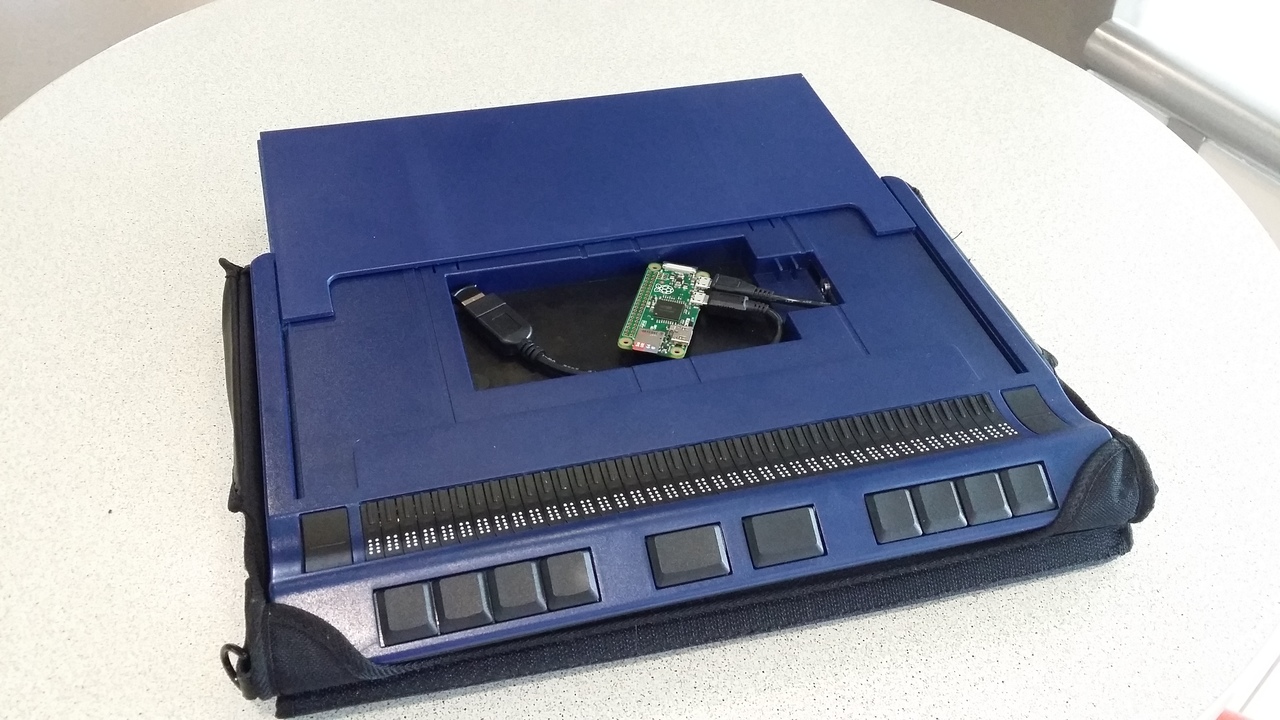
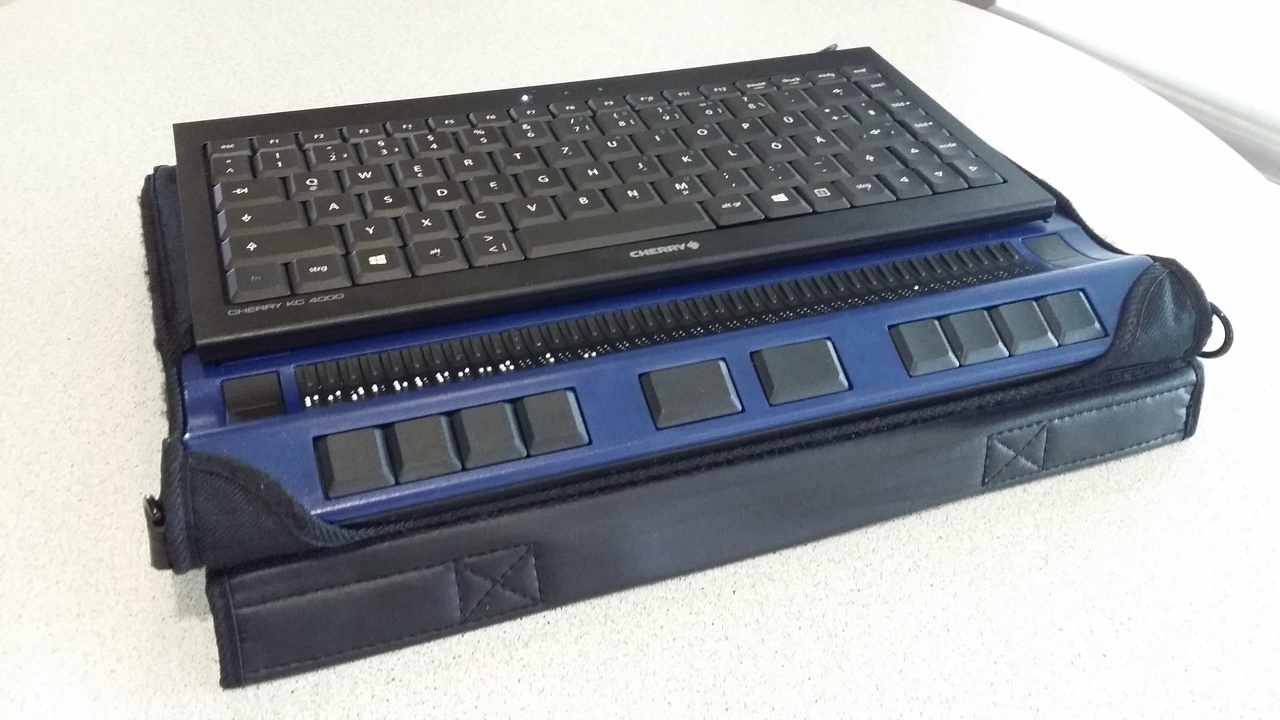
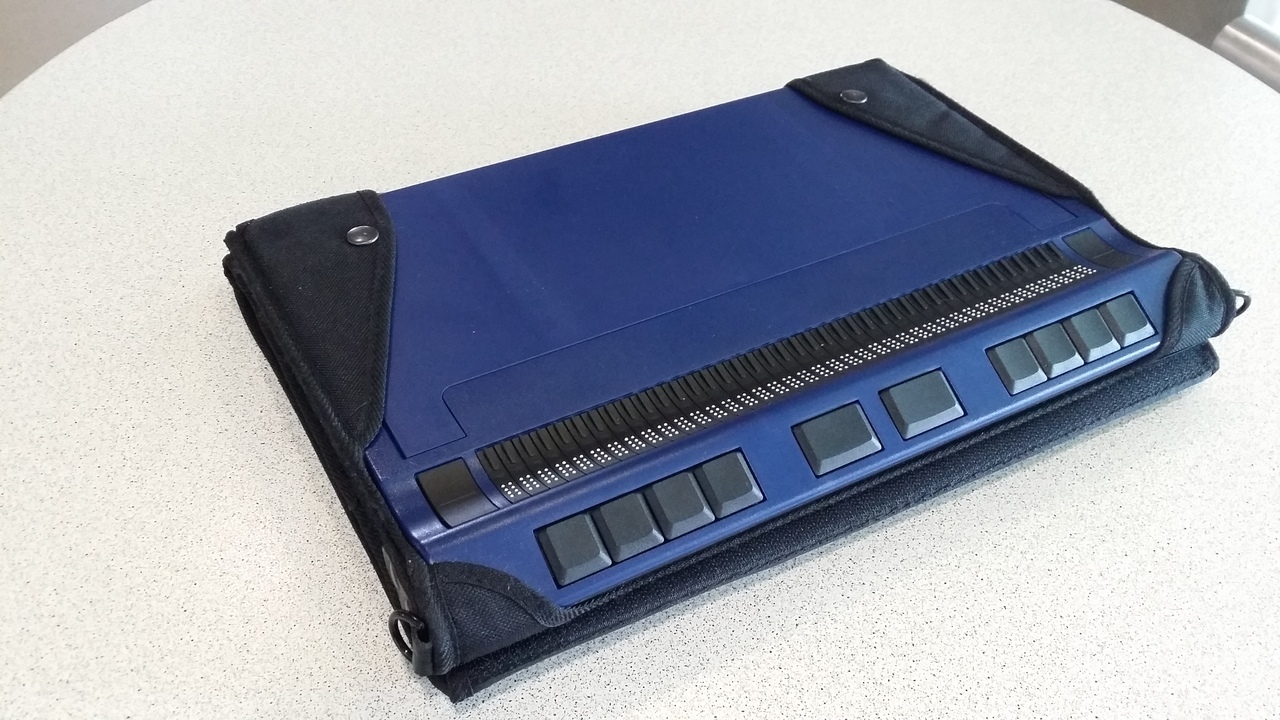
TL;DR: I put a $5 Raspberry Pi Zero, a Bluetooth USB dongle, and the required adapter cable into my new Handy Tech Active Star 40 braille display. An internal USB port provides the power. This has transformed my braille display into an ARM-based, monitorless, Linux laptop that has a keyboard and a braille display. It can be charged/powered via USB so it can also be run from a power bank or a solar charger, thus potentially being able to run for days, rather than just hours, without needing a standard wall-jack. [picture: a Raspberry Pi Zero embedded within an Active Star 40] [picture: a braille display with a keyboard on top and a Raspberry Pi Zero inside]
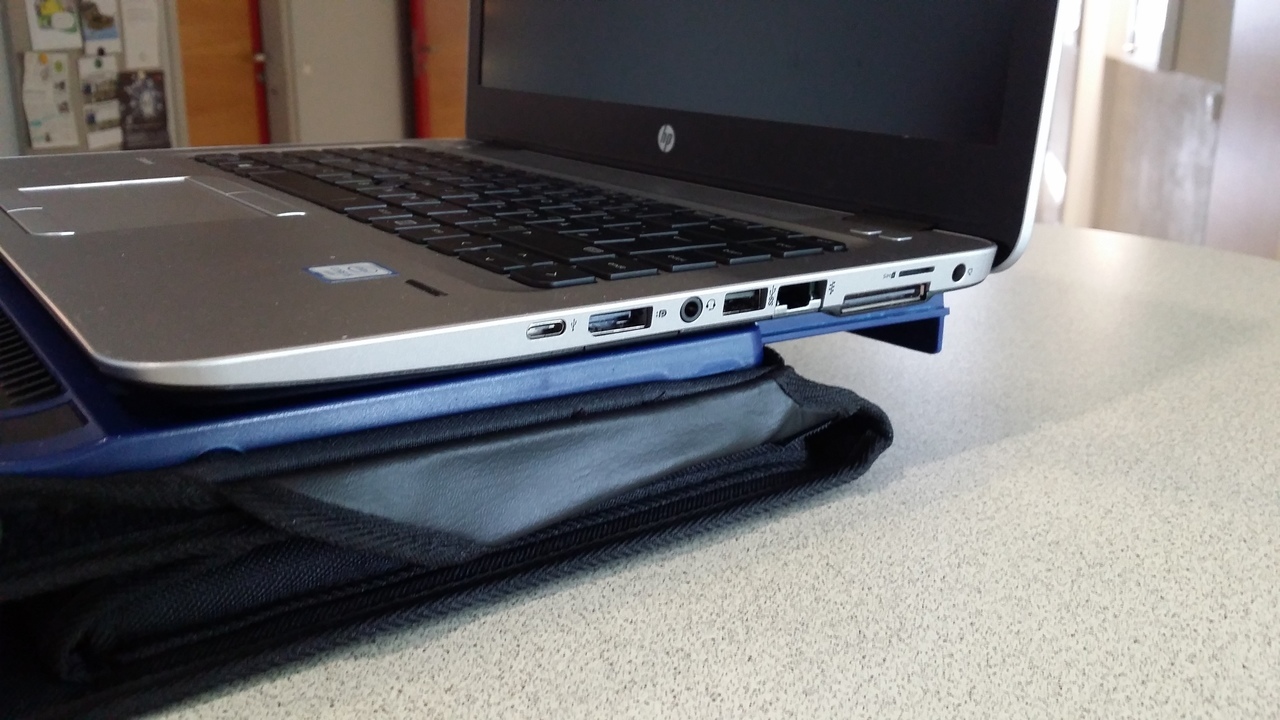
Some Background on Braille Display Form Factors Braille displays come in various sizes. There are models tailored for desktop use (with 60 cells or more), models tailored for portable use with a laptop (usually with 40 cells), and, nowadays, there are even models tailored for on-the-go use with a smartphone or similar (with something like 14 or 18 cells). Back in the old days, braille displays were rather massive. A 40-cell braille display was typically about the size of a 13" laptop. In modern times, manufacturers have managed to reduce the size of the internals such that a 40-cell display can be placed in front of a laptop or keyboard instead of placing the laptop on top of the braille display. While this is a nice achievement, I personally haven't found it to be very convenient because you now have to place two physically separate devices on your lap. It's OK if you have a real desk, but, at least in my opinion, if you try to use your laptop as its name suggests, it's actually inconvenient to use a small form factor, 40-cell display. For this reason, I've been waiting for a long-promised new model in the Handy Tech Star series. In 2002, they released the Handy Tech Braille Star 40, which is a 40-cell braille display with enough space to put a laptop directly on top of it. To accommodate larger laptop models, they even built in a little platform at the back that can be pulled out to effectively enlarge the top surface. Handy Tech has now released a new model, the Active Star 40, that has essentially the same layout but modernized internals. [picture: a plain Active Star 40] You can still pull out the little platform to increase the space that can be used to put something on top. [picture: an Active Star 40 with extended platform and a laptop on top] But, most conveniently, they've designed in an empty compartment, roughly the size of a modern smartphone, beneath the platform. The original idea was to actually put a smartphone inside, but this has turned out (at least to me) to not be very feasible. Fortunately, they thought about the need for electricity and added a Micro USB cable terminating within the newly created, empty compartment. My first idea was to put a conventional Raspberry Pi inside. When I received the braille display, however, we immediately noticed that a standard-sized rpi is roughly 3mm too high to fit into the empty compartment. Fortunately, though, a co-worker noticed that the Raspberry Pi Zero was available for order. The Raspberry Pi Zero is a lot thinner, and fits perfectly inside (actually, I think there's enough space for two, or even three, of them). So we ordered one, along with some accessories like a 64GB SDHC card, a Bluetooth dongle, and a Micro USB adapter cable. The hardware arrived a few days later, and was immediately bootstrapped with the assistance of very helpful friends. It works like a charm!
Technical Details The backside of the Handy Tech Active Star 40 features two USB host ports that can be used to connect devices such as a keyboard. A small form-factor, USB keyboard with a magnetic clip-on is included. When a USB keyboard is connected, and when the display is used via Bluetooth, the braille display firmware additionally offers the Bluetooth HID profile, and key press/release events received via the USB port are passed through to it. I use the Bluetooth dongle for all my communication needs. Most importantly, BRLTTY is used as a console screen reader. It talks to the braille display via Bluetooth (more precisely, via an RFCOMM channel). The keyboard connects through to Linux via the Bluetooth HID profile. Now, all that is left is network connectivity. To keep the energy consumption as low as possible, I decided to go for Bluetooth PAN. It appears that the tethering mode of my mobile phone works (albeit with a quirk), so I can actually access the internet as long as I have cell phone reception. Additionally, I configured a Bluetooth PAN access point on my desktop machines at home and at work, so I can easily (and somewhat more reliably) get IP connectivity for the rpi when I'm near one of these machines. I plan to configure a classic Raspberry Pi as a mobile Bluetooth access point. It would essentially function as a Bluetooth to ethernet adapter, and should allow me to have network connectivity in places where I don't want to use my phone.
BlueZ 5 and PAN It was a bit challenging to figure out how to actually configure Bluetooth PAN with BlueZ 5. I found the bt-pan python script (see below) to be the only way so far to configure PAN without a GUI. It handles both ends of a PAN network, configuring a server and a client. Once instructed to do so (via D-Bus) in client mode, BlueZ will create a new network device - bnep0 - once a connection to a server has been established. Typically, DHCP is used to assign IP addresses for these interfaces. In server mode, BlueZ needs to know the name of a bridge device to which it can add a slave device for each incoming client connection. Configuring an address for the bridge device, as well as running a DHCP server + IP Masquerading on the bridge, is usually all you need to do.
A Bluetooth PAN Access Point with Systemd I'm using systemd-networkd to configure the bridge device. /etc/systemd/network/pan.netdev:
[NetDev]
Name=pan
Kind=bridge
ForwardDelaySec=0
/etc/systemd/network/pan.network:
[Match]
Name=pan
[Network]
Address=0.0.0.0/24
DHCPServer=yes
IPMasquerade=yes
Now, BlueZ needs to be told to configure a NAP profile. To my surprise, there seems to be no way to do this with stock BlueZ 5.36 utilities. Please correct me if I'm wrong. Luckily, I found a very nice blog post, as well as an accommodating Python script that performs the required D-Bus calls. For convenience, I use a Systemd service to invoke the script and to ensure that its dependencies are met. /etc/systemd/system/pan.service:
[Unit]
Description=Bluetooth Personal Area Network
After=bluetooth.service systemd-networkd.service
Requires=systemd-networkd.service
PartOf=bluetooth.service
[Service]
Type=notify
ExecStart=/usr/local/sbin/pan
[Install]
WantedBy=bluetooth.target
/usr/local/sbin/pan:
#!/bin/sh
# Ugly hack to work around #787480
iptables -F
iptables -t nat -F
iptables -t mangle -F
iptables -t nat -A POSTROUTING -o eth0 -j MASQUERADE
exec /usr/local/sbin/bt-pan --systemd --debug server pan
This last file wouldn't be necessary if IPMasquerade= were supported in Debian right now (see #787480). After the obligatory systemctl daemon-reload and systemctl restart systemd-networkd, you can start your Bluetooth Personal Area Network with systemctl start pan.
Bluetooth PAN Client with Systemd Configuring the client is also quite easy to do with Systemd. /etc/systemd/network/pan-client.network:
[Match]
Name=bnep*
[Network]
DHCP=yes
/etc/systemd/system/pan@.service:
[Unit]
Description=Bluetooth Personal Area Network client
[Service]
Type=notify
ExecStart=/usr/local/sbin/bt-pan --debug --systemd client %I --wait
Now, after the usual configuration reloading, you should be able to connect to a specific Bluetooth access point with:
systemctl start pan@00:11:22:33:44:55
Pairing via the Command Line Of course, the server and client-side service configuration require a pre-existing pairing between the server and each of its clients. On the server, start bluetoothctl and issue the following commands:
power on
agent on
default-agent
scan on
scan off
pair XX:XX:XX:XX:XX:XX
trust XX:XX:XX:XX:XX:XX
Once you've set scan mode to on, wait a few seconds until you see the device you're looking for scroll by. Note its device address, and use it for the pair and (optional) trust commands. On the client, the sequence is essentially the same except that you don't need to issue the trust command. The server needs to trust a client in order to accept NAP profile connections from it without waiting for manual confirmation by the user. I'm actually not sure if this is the optimal sequence of commands. It might be enough to just pair the client with the server and issue the trust command on the server, but I haven't tried this yet.
Enabling Use of the Bluetooth HID Profile Essentially the same as above also needs to be done in order to use the Bluetooth HID profile of the Active Star 40 on Linux. However, instead of agent on, you need to issue the command agent KeyboardOnly. This explicitly tells bluetoothctl that you're specifically looking for a HID profile.
Configuring Bluetooth via the Command Line Feels Vague While I'm very happy that I actually managed to set all of this up, I must admit that the command-line interface to BlueZ feels a bit incomplete and confusing. I initially thought that agents were only for PIN code entry. Now that I've discovered that "agent KeyboardOnly" is used to enable the HID profile, I'm not sure anymore. I'm surprised that I needed to grab a script from a random git repository in order to be able to set up PAN. I remember, with earlier version of BlueZ, that there was a tool called pand that you could use to do all of this from the command-line. I don't seem to see anything like that for BlueZ 5 anymore. Maybe I'm missing something obvious?
Performance The data rate is roughly 120kB/s, which I consider acceptable for such a low power solution. The 1GHz ARM CPU actually feels sufficiently fast for a console/text-mode person like me. I'll rarely be using much more than ssh and emacs on it anyway.
Console fonts and screen dimensions The default dimensions of the framebuffer on the Raspberry Pi Zero are a bit unexpectedly strange. fbset reports that the screen dimension is 656x416 pixels (of course, no monitor connected). With a typical console font of 8x16, I got 82 columns and 26 lines. With a 40 cell braille display, the 82 columns are very inconvenient. Additionally, as a braille user, I would like to be able to view Unicode braille characters in addition to the normal charset on the console. Fortunately, Linux supports 512 glyphs, while most console fonts do only provide 256. console-setup can load and combine two 256-glyph fonts at once. So I added the following to /etc/default/console-setup to make the text console a lot more friendly to braille users:
SCREEN_WIDTH=80
SCREEN_HEIGHT=25
FONT="Lat15-Terminus16.psf.gz brl-16x8.psf"

Note

You need console-braille installed for brl-16x8.psf to be available.

Further Projects There's a 3.5mm audio jack inside the braille display as well. Unfortunately, there are no converters from Mini-HDMI to 3.5mm audio that I know of. It would be very nice to be able to use the sound card that is already built into the Raspberry Pi Zero, but, unfortunately, this doesn't seem possible at the moment. Alternatively, I'm looking at using a Micro USB OTG hub and an additional USB audio adapter to get sound from the Raspberry Pi Zero to the braille display's speakers. Unfortunately, the two USB audio adapters I've tried so far have run hot for some unknown reason. So I have to find some other chipset to see if the problem goes away. A little nuisance, currently, is that you need to manually power off the Raspberry, wait a few seconds, and then power down the braille display. Turning the braille display off cuts power delivery via the internal USB port. If this is accidentally done too soon then the Raspberry Pi Zero is shut down ungracefully (which is probably not the best way to do it). We're looking into connecting a small, buffering battery to the GPIO pins of the rpi, and into notifying the rpi when external power has dropped. A graceful, software-initiated shutdown can then be performed. You can think of it as being like a mini UPS for Micro USB.
The image If you are a happy owner of a Handy Tech Active Star 40 and would like to do something similar, I am happy to share my current (Raspbian Stretch based) image. In fact, if there is enough interest by other blind users, we might even consider putting a kit together that makes it as easy as possible for you to get started. Let me know if this could be of interest to you.
Thanks Thanks to Dave Mielke for reviewing the text of this posting. Thanks to Simon Kainz for making the photos for this article. And I owe a big thank you to my co-workers at Graz University of Technology who have helped me a lot to bootstrap really quickly into the rpi world.
P.S. My first tweet about this topic is just five days ago, and apart from the soundcard not working yet, I feel like the project is already almost complete! By the way, I am editing the final version of this blog posting from my newly created monitorless ARM-based Linux laptop via an ssh connection to my home machine.

11 June 2016

Simon D saulniers: [GSOC] Week 1 - Report

I have been working on writing serializable structure for remote filtering of values on the distributed hash table OpenDHT. This structure is called Query.

What s done The implementation of the base design with other changes have been made. You can see evolution on the matter here; Changes allow to create a Query with a SQL-ish statement like the following
Query q("SELECT * WHERE id=5");
You can then use this query like so
get(hash, getcb, donecb, filter, "SELECT * WHERE id=5");
I verified the working state of the code with the dhtnode. I have also done some tests using our python benchmark scripts.

What s next
  • Value pagination;
  • Optimization of put operations with query for ids before put, hence avoiding potential useless traffic.

Thoughts The Query is the key part for optimizing my initial work on data persistence on the DHT. It will enhance the DHT on more than one aspects. I have to point out it would not have been possible to do that before our major refactoring we introduced in 0.6.0.

Next.

Previous.