Search Results: "nic"

16 July 2014

Matthias Klumpp: AppStream 0.7 specification and library released

appstream-logoToday I am very happy to announce the release of AppStream 0.7, the second-largest release (judging by commit number) after 0.6. AppStream 0.7 brings many new features for the specification, adds lots of good stuff to libappstream, introduces a new libappstream-qt library for Qt developers and, as always, fixes some bugs. Unfortunately we broke the API/ABI of libappstream, so please adjust your code accordingly. Apart from that, any other changes are backwards-compatible. So, here is an overview of what s new in AppStream 0.7: Specification changes Distributors may now specify a new <languages/> tag in their distribution XML, providing information about the languages a component supports and the completion-percentage for the language. This allows software-centers to apply smart filtering on applications to highlight the ones which are available in the users native language. A new addon component type was added to represent software which is designed to be used together with a specific other application (think of a Firefox addon or GNOME-Shell extension). Software-center applications can group the addons together with their main application to provide an easy way for users to install additional functionality for existing applications. The <provides/> tag gained a new dbus item-type to expose D-Bus interface names the component provides to the outside world. This means in future it will be possible to search for components providing a specific dbus service:
$ appstream-index what-provides dbus org.freedesktop.PackageKit.desktop system
(if you are using the cli tool) A <developer_name/> tag was added to the generic component definition to define the name of the component developer in a human-readable form. Possible values are, for example The KDE Community , GNOME Developers or even the developer s full name. This value can be (optionally) translated and will be displayed in software-centers. An <update_contact/> tag was added to the specification, to provide a convenient way for distributors to reach upstream to talk about changes made to their metadata or issues with the latest software update. This tag was already used by some projects before, and has now been added to the official specification. Timestamps in <release/> tags must now be UNIX epochs, YYYYMMDD is no longer valid (fortunately, everyone is already using UNIX epochs). Last but not least, the <pkgname/> tag is now allowed multiple times per component. We still recommend to create metapackages according to the contents the upstream metadata describes and place the file there. However, in some cases defining one component to be in multiple packages is a short way to make metadata available correctly without excessive package-tuning (which can become difficult if a <provides/> tag needs to be satisfied). As small sidenote: The multiarch path in /usr/share/appdata is now deprecated, because we think that we can live without it (by shipping -data packages per library and using smarter AppStream metadata generators which take advantage of the ability to define multiple <pkgname/> tags) Documentation updates In general, the documentation of the specification has been reworked to be easier to understand and to include less duplication of information. We now use excessive crosslinking to show you the information you need in order to write metadata for your upstream project, or to implement a metadata generator for your distribution. Because the specification needs to define the allowed tags completely and contain as much information as possible, it is not very easy to digest for upstream authors who just want some metadata shipped quickly. In order to help them, we now have Quickstart pages in the documentation, which are rich of examples and contain the most important subset of information you need to write a good metadata file. These quickstart guides already exist for desktop-applications and addons, more will follow in future. We also have an explicit section dealing with the question How do I translate upstream metadata? now. More changes to the docs are planned for the next point releases. You can find the full project documentation at Freedesktop. AppStream GObject library and tools The libappstream library also received lots of changes. The most important one: We switched from using LGPL-3+ to LGPL-2.1+. People who know me know that I love the v3 license family of GPL licenses I like it for tivoization protection, it s explicit compatibility with some important other licenses and cosmetic details, like entities not loosing their right to use the software forever after a license violation. However, a LGPL-3+ library does not mix well with projects licensed under other open source licenses, mainly GPL-2-only projects. I want libappstream to be used by anyone without forcing the project to change its license. For some reason, using the library from proprietary code is easier than using it from a GPL-2-only open source project. The license change was also a popular request of people wanting to use the library, so I made the switch with 0.7. If you want to know more about the LGPL-3 issues, I recommend reading this blogpost by Nikos (GnuTLS). On the code-side, libappstream received a large pile of bugfixes and some internal restructuring. This makes the cache builder about 5% faster (depending on your system and the amount of metadata which needs to be processed) and prepares for future changes (e.g. I plan to obsolete PackageKit s desktop-file-database in the long term). The library also brings back support for legacy AppData files, which it can now read. However, appstream-validate will not validate these files (and kindly ask you to migrate to the new format). The appstream-index tool received some changes, making it s command-line interface a bit more modern. It is also possible now to place the Xapian cache at arbitrary locations, which is a nice feature for developers. Additionally, the testsuite got improved and should now work on systems which do not have metadata installed. Of course, libappstream also implements all features of the new 0.7 specification. With the 0.7 release, some symbols were removed which have been deprecated for a few releases, most notably as_component_get/set_idname, as_database_find_components_by_str, as_component_get/set_homepage and the pkgname property of AsComponent (which is now a string array and called pkgnames ). API level was bumped to 1. Appstream-Qt A Qt library to access AppStream data has been added. So if you want to use AppStream metadata in your Qt application, you can easily do that now without touching any GLib/GObject based code! Special thanks to Sune Vuorela for his nice rework of the Qt library! And that s it with the changes for now! Thanks to everyone who helped making 0.7 ready, being it feedback, contributions to the documentation, translation or coding. You can get the release tarballs at Freedesktop. Have fun!

Juliana Louback: Become an Open-source Contributor Video Conference

A couple weeks ago I was contacted by Yehuda Korotkin through one of the Debian mailing lists. Yehuda is a tech professor at one of Israel s leading colleges for women. He proposed a video conference to present the open source community to his class and explain how they can contribute to open source projects. I volunteered to participate and last Monday (July 14th 2014) we had our virtual meeting, which I hope was the first of many. Shauna G. also participated from Boston, making it a Israel - USA - Brazil meetup. Pretty impressive, eh? The conference was hosted on Google Hangouts, the video is available for viewing here. Run time is around 2.5 hours so to save you time I ve kindly posted a summary of the conference! To be frank, I look ghastly half the time so I d much prefer that you read this post. First there was a Q&A period which was more of a discussion panel, followed by a hands-on session where the girls made their first contribution to an open source project. Here s the gist of it: Q&A Hands on For the practical part of our conference, Yehuda s students contributed to Jscommunicator s Issue #5 which requests i18n support for major languages. JSCommunicator is a SIP communication tool developed in HTML and JavaScript, currently supporting audio/video calls and SIP SIMPLE instant messaging. First we set up Github in their local machines and forked the Jscommunicator repo. We learned the basic git commands needed to push changes to their remote repositories and to create a pull requests. This is explained in further detail here. At the end of the conference with nearly an hour overtime due to my tendency to be overly verbose, Yehuda s class made their first contribution with a Hebrew translation for Jscommunicator! All in all, it was great to virtually meet Yehuda and his epic students who all seemed very clever engineers. I m looking forward to our next meetup once I gain some time-management skills.

13 July 2014

Laura Arjona: New GPG Key!

Achievement unlocked: I have a new GPG key:

0xF22674467E4AF4A3

pub 4096R/7E4AF4A3 2014-07-13 [caduca: 2016-07-12]
Fingerprint = 445E 3AD0 3690 3F47 E19B 37B2 F226 7446 7E4A F4A3
uid Laura Arjona Reina <laura.arjona@upm.es>
uid Laura Arjona Reina <larjona@fsfe.org>
uid Laura Arjona Reina <larjona99@gmail.com>
sub 3072R/CC706B74 2014-07-13 [expires: 2016-07-12]
sub 3072R/7E51465F 2014-07-13 [expires: 2016-07-12]
sub 4096R/74C23D6E 2014-07-13 [expires: 2016-07-12]

The master key is 4096 bit, stored in a safe place, and 2 subkeys 3072 bit, stored in an FSFE Smartcard (I cannot store 4096 keys there).

I have carefully used the FSFE SmartCard Howto and Creating the perfect GPG keypair by Alex Cabal for strenghtening hash preferences and creating revocation certificate.

It seems everything works as intended. Passphrase is strong and this time I will not forget it. As first celebration, 1/2 lt icecream is waiting for me after dinner :)

People knowing me and around Madrid, please send me an encrypted mail as test or normal communication, and ping me to meet and sign keys :) One more step towards involvement in Debian and free software, controlling my digital life and communications, and becoming familiar with these technologies so I can teach them to my son as the natural way . Yay!
Filed under: My experiences and opinion, Tools Tagged: Contributing to libre software, Debian, encryption, English, Free Software, gpg, libre software, Moving into free software, mswl-cases

Russ Allbery: Review: Neptune's Brood

Review: Neptune's Brood, by Charles Stross
Series: Freyaverse #2
Publisher: Ace
Copyright: July 2013
ISBN: 1-101-62453-1
Format: Kindle
Pages: 325
Neptune's Brood is set in the same universe as Saturn's Children, but I wouldn't call it a sequel. It takes place considerably later, after substantial expansion of the robot civilization to the stars, and features entirely different characters (or, if there was overlap, I didn't notice). It also represents a significant shift in tone: while Saturn's Children is clearly a Heinlein pastiche and parody, Neptune's Brood takes its space opera more seriously. There is some situational humor assault auditors, for example but this book is played mostly straight, and I detected little or no Heinlein. This is Stross fleshing out his own space opera concept. This being Stross, that concept is not exactly conventional. This is a space opera about economics. Specifically, it's a space opera about interstellar economics, a debt pyramid, and a very interesting remapping of the continual growth requirements of capitalism to the outward expansion of colonization. The first-person protagonist comes from a "family" (as in Saturn's Children, the concept exists but involves rather more aggressive control of the instantiated "children") of bankers, but she is a forensic accountant and historian who specializes in analysis of financial scams. As you might expect, this is a significant clue about the plot. Neptune's Brood opens with Krina in search of her sister. She is supposed to be an itinerant scholar, moving throughout colonized space to spend some time with various scattered sisters, spreading knowledge and expanding her own. But it's clear from the start of the book that something else is going on, even before an assassin with Krina's face appears on her trail. Unfortunately, it takes roughly a third of the book to learn just what is happening beneath the surface, and most of that time is spent in a pointless interlude on a flying cathedral run by religious fanatics. The religion is a callback to Saturn's Children: robots who are trying to spread original humanity (the Fragiles) to the stars. This mostly doesn't go well, and is going particularly poorly for the ship that Krina works for passage on. But this is a brief gag that I thought went on much too long. The plot happens to Krina for this first section of the book rather than the other way around, little of lasting significance other than some character introductions occurs, and the Church itself, while playing a minor role in the later plot, is not worth the amount of attention that it gets. The best parts of the early book are the interludes in which Krina explains major world concepts to the reader. These are absolutely blatant infodumping, and I'm not sure how Stross gets away with them, but somehow he does, at least for me. They remind me of some of his blog posts, except tighter and fit into an interesting larger structure. Thankfully, once Krina finally arrives on Shin-Tethys, the plot improves considerably. There was a specific moment for me when the book became interesting: when Krina finds her sib's quarters in Shin-Tethys and analyzes what she finds there. It's the first significant thing in the book that she does rather than have done to her or thrust upon her, and she's a much better character when she's making decisions. This is also about the point where Stross starts fully explaining slow money, which is key to both the economics and the plot, and the plot starts to unwind its various mysteries and identify the motives of the players. Even then, Krina suffers from a lack of agency. Only at rare intervals does she get a chance to affect the story. Most of what she did of relevance to this book she did in the past, and while those descriptions of the backstory are interesting, they don't entirely make up for a passive protagonist. Thankfully, the other characters are varied and interesting enough, and the political machinations and cascading revelations captivating enough, that the last part of the book was very satisfying even with Krina on for the ride. This is a Stross novel, so it's full of two-dollar technical words mixed with technobabble. However, it shares with Saturn's Children the recasting of robots as the norm and fleshy humans as the exception, which means much of the technobabble is a straight substitution for our normal babble about meaty bodies and often works as an alienation technique. That makes it a bit more tolerable for me, although I still wished Stross would turn down the manic vocabulary in places. This bothers some people more than others; if you had no trouble with Accelerando, Neptune's Brood will pose no problems. I don't think the first section of this book was successful, but I liked the rest well enough to recommend it. If you like your space opera with a heavy dose of economics, a realistic attitude towards deep space exploration without faster-than-light technology, and a realistic perspective on the hostility of alien planets to Earth life, Neptune's Brood is a good choice. And any book that quotes David Graeber's Debt, and whose author has clearly paid attention to its contents, wins bonus points from me. Rating: 8 out of 10

10 July 2014

Russell Coker: Taxing Inferior Products

I recently had a medical appointment cancelled due to a computer crash . Apparently the reception computer crashed and lost all bookings for a day and they just made new bookings for whoever called and anyone who had a previous booking just missed out. I ll probably never know whether they really had a computer problem or just used computer problems as an excuse when they made a mistake. But even if it wasn t a real computer problem the fact that computers are so unreliable overall that computer crash is an acceptable excuse indicates a problem with the industry. The problem of unreliable computers is a cost to everyone, it s effectively a tax on all business and social interactions that involve computers. While I spent the extra money on a server with ECC RAM for my home file storage I have no control over the computers purchased by all the companies I deal with which are mostly the cheapest available computers. I also have no option to buy a laptop with ECC RAM because companies like Lenovo have decided not to manufacture them. It seems to me that the easiest way of increasing overall reliability of computers would be to use ECC RAM everywhere. In the early 90 s all IBM compatible PCs had parity RAM, that meant that for each byte there was one extra bit which would report 100% of single-bit errors and 50% of errors that involved random memory corruption. Then manufacturers decided to save a tiny amount of money on memory by using 8/9 the number of chips for desktop/laptop systems and probably make more money on selling servers with ECC RAM. If the government was to impose a 20% tax on computers that lack ECC RAM then manufacturers would immediately start using it everywhere and the end result would be no price increase overall as it s cheaper to design desktop systems and servers with the same motherboards apparently some desktop systems have motherboard support for ECC RAM but don t ship with suitable RAM or advertise the support for such RAM. This principle applies to many other products too. One obvious example is cars, a car manufacturer can sell cheap cars with few safety features and then when occupants of those cars and other road users are injured the government ends up paying for medical expenses and disability pensions. If there was a tax for every car that has a poor crash test rating and a tax for every car company that performs badly in real world use then it would give car companies some incentive to manufacture safer vehicles. Now there are situations where design considerations preclude such features. For example implementing ECC RAM in mobile phones might involve technical difficulties (particularly for 32bit phones) and making some trucks and farm equipment safer might be difficult. But when a company produces multiple similar products that differ significantly in quality such as PCs with and without ECC RAM or cars with and without air-bags there would be no difficulty in making them all of them higher quality. I don t think that we will have a government that implements such ideas any time soon, it seems that our government is more interested in giving money to corporations than taxing them. But one thing that could be done is to adopt a policy of only giving money to companies if they produce high quality products. If a car company is to be given hundreds of millions of dollars for not closing a factory then that factory should produce cars with all possible safety features. If a computer company is going to be given significant tax breaks for doing R&D then they should be developing products that won t crash.

9 July 2014

Mike Gabriel: Cooperation between X2Go and TheQVD

I recently got in contact with Nicolas Arenas Alonso and Nito Martinez from the Quindel group (located in Spain) [1]. Those guys bring forth a software product called TheQVD (The Quality Virtual Desktop) [2]. The project does similar things that X2Go does. In fact, they use NX 3.5 from NoMachine internally like we do in X2Go. Already a year ago, I noticed their activity on TheQVD and thought.. "Ahaaa!?!". Now, a couple of weeks back we received a patch for libxcomp3 that fixes an FTBFS (fails to build from source) for nx-libs-lite against Android [3]. read more

Christoph Berg: New urxvt tab in current directory

Following Enrico's terminal-emulators comparison, I wanted to implement "start a new terminal tab in my current working directory" for rxvt-unicode aka urxvt. As Enrico notes, this functionality is something between "rather fragile" and non-existing, so I went to implement it myself. Martin Pohlack had the right hint, so here's the patch:
--- /usr/lib/urxvt/perl/tabbed  2014-05-03 21:37:37.000000000 +0200
+++ ./tabbed    2014-07-09 18:50:26.000000000 +0200
@@ -97,6 +97,16 @@
       $term->resource (perl_ext_2 => $term->resource ("perl_ext_2") . ",-tabbed");
     ;
 
+   if (@  $self-> tabs   )  
+      # Get the working directory of the current tab and append a -cd to the command line
+      my $pid = $self-> cur pid ;
+      my $pwd = readlink "/proc/$pid/cwd";
+      #print "pid $pid pwd $pwd\n";
+      if ($pwd)  
+         push @argv, "-cd", $pwd;
+       
+    
+
    push @urxvt::TERM_EXT, urxvt::ext::tabbed::tab::;
 
    my $term = new urxvt::term
@@ -312,6 +322,12 @@
    1
  
 
+sub tab_child_start  
+   my ($self, $term, $pid) = @_;
+   $term-> pid  = $pid;
+   1;
+ 
+
 sub tab_start  
    my ($self, $tab) = @_;
 
@@ -402,7 +418,7 @@
 # simply proxies all interesting calls back to the tabbed class.
 
  
-   for my $hook (qw(start destroy key_press property_notify))  
+   for my $hook (qw(start destroy key_press property_notify child_start))  
       eval qq 
          sub on_$hook  
             my \$parent = \$_[0] term parent 

Sune Vuorela: CMake and library properties

When writing libraries with CMake, you need to set a couple of properties, especially the VERSION and SOVERSION properties. For library libbar, it could look like:
set_property(TARGET bar PROPERTY VERSION 0.0.0 )
set_property(TARGET bar PROPERTY SOVERSION 0 )
This will give you a libbar.so => libbar.so.0 => libbar.so.0.0.0 symlink chain with a SONAME of libbar.so.0 encoded into the library. The SOVERSION target property controls the number in the middle part of the symlink chain as well as the numeric part of the SONAME encoded into the library. The VERSION target property controls the last part of the last element of the symlink chain This also means that the first part of VERSION should match what you put in SOVERSION to avoid surprises for others and for the future you. Both these properties control Technical parts and should be looked at from a technical perspective. They should not be used for the version of the software , but purely for the technical versioning of the library. In the kdeexamples git repository, it is handled like this:
set(BAR_VERSION_MAJOR 1)
set(BAR_VERSION_MINOR 2)
set(BAR_VERSION_PATCH 3)
set(BAR_VERSION $ BAR_VERSION_MAJOR .$ BAR_VERSION_MINOR .$ BAR_VERSION_PATCH )
And a bit later:
set_target_properties(bar PROPERTIES VERSION $ BAR_VERSION
SOVERSION $ BAR_VERSION_MAJOR )
which is a fine way to ensure that things actually matches. Oh. And these components is not something that should be inherited from other external projects. So people, please be careful to use these correct.

Junichi Uekawa: Having fun with lisp.

Having fun with lisp. I was writing lisp interpreter in C++ using boost::spirit. I am happy that my eval can do lambda. Took me a long time to figure out what was wrong with the different types. The data structure was recursive, and I needed to make a recursive type. make_recursive_variant works but it's not obvious when it doesn't.

7 July 2014

Jonathan McDowell: 2014 SPI Board election nominations open

I put out the call for nominations for the 2014 Software in the Public Interest (SPI) Board election last week. At this point I haven't yet received any nominations, so I'm mentioning it here in the hope of a slightly wider audience. Possibly not the most helpful as I would hope readers who are interested in SPI are already reading spi-announce. There are 3 positions open this election and it would be good to see a bit more diversity in candidates this year. Nominations are open until the end of Tuesday July 13th. The primary hard and fast time commitment a board member needs to make is to attend the monthly IRC board meetings, which are conducted publicly via IRC (#spi on the OFTC network). These take place at 20:00 UTC on the second Thursday of every month. More details, including all past agendas and minutes, can be found at http://spi-inc.org/meetings/. Most of the rest of the board communication is carried out via various mailing lists. The ideal candidate will have an existing involvement in the Free and Open Source community, though this need not be with a project affiliated with SPI. Software in the Public Interest (SPI, http://www.spi-inc.org/) is a non-profit organization which was founded to help organizations develop and distribute open hardware and software. We see it as our role to handle things like holding domain names and/or trademarks, and processing donations for free and open source projects, allowing them to concentrate on actual development. Examples of projects that SPI helps includes Debian, LibreOffice, OFTC and PostgreSQL. A full list can be found at http://www.spi-inc.org/projects/.

6 July 2014

Russell Coker: Desktop Publishing is Wrong

When I first started using computers a word processor was a program that edited text. The most common and affordable printers were dot-matrix and people who wanted good quality printing used daisy wheel printers. Text from a word processor was sent to a printer a letter at a time. The options for fancy printing were bold and italic (for dot-matrix), underlines, and the use of spaces to justify text. It really wasn t much good if you wanted to include pictures, graphs, or tables. But if you just wanted to write some text it worked really well. When you were editing text it was typical that the entire screen (25 rows of 80 columns) would be filled with the text you were writing. Some word processors used 2 or 3 lines at the top or bottom of the screen to display status information. Some time after that desktop publishing (DTP) programs became available. Initially most people had no interest in them because of the lack of suitable printers, the early LASER printers were very expensive and the graphics mode of dot matrix printers was slow to print and gave fairly low quality. Printing graphics on a cheap dot matrix printer using the thin continuous paper usually resulted in damaging the paper a bad result that wasn t worth the effort. When LASER and Inkjet printers started to become common word processing programs started getting many more features and basically took over from desktop publishing programs. This made them slower and more cumbersome to use. For example Star Office/OpenOffice/LibreOffice has distinguished itself by remaining equally slow as it transitioned from running on an OS/2 system with 16M of RAM in the early 90 s to a Linux system with 256M of RAM in the late 90 s to a Linux system with 1G of RAM in more recent times. It s nice that with the development of PCs that have AMD64 CPUs and 4G+ of RAM we have finally managed to increase PC power faster than LibreOffice can consume it. But it would be nicer if they could optimise for the common cases. LibreOffice isn t the only culprit, it seems that every word processor that has been in continual development for that period of time has had the same feature bloat. The DTP features that made word processing programs so much slower also required more menus to control them. So instead of just having text on the screen with maybe a couple of lines for status we have a menu bar at the top followed by a couple of lines of toolbars , then a line showing how much width of the screen is used for margins. At the bottom of the screen there s a search bar and a status bar. Screen Layout By definition the operation of a DTP program will be based around the size of the paper to be used. The default for this is A4 (or Letter in the US) in a portrait layout (higher than it is wide). The cheapest (and therefore most common) monitors in use are designed for displaying wide-screen 16:9 ratio movies. So we have images of A4 paper with a width:height ratio of 0.707:1 displayed on a wide-screen monitor with a 1.777:1 ratio. This means that only about 40% of the screen space would be used if you don t zoom in (but if you zoom in then you can t see many rows of text on the screen). One of the stupid ways this is used is by companies that send around word processing documents when plain text files would do, so everyone who reads the document uses a small portion of the screen space and a large portion of the email bandwidth. Note that this problem of wasted screen space isn t specific to DTP programs. When I use the Google Keep website [1] to edit notes on my PC they take up a small fraction of the screen space (about 1/3 screen width and 80% screen height) for no good reason. Keep displays about 70 characters per line and 36 lines per page. Really every program that allows editing moderate amounts of text should allow more than 80 characters per line if the screen is large enough and as many lines as fit on the screen. One way to alleviate the screen waste on DTP programs is to use a landscape layout for the paper. This is something that all modern printers support (AFAIK the only printers you can buy nowadays are LASER and ink-jet and it s just a big image that gets sent to the printer). I tried to do this with LibreOffice but couldn t figure out how. I m sure that someone will comment and tell me I m stupid for missing it, but I think that when someone with my experience of computers can t easily figure out how to perform what should be a simple task then it s unreasonably difficult for the vast majority of computer users who just want to print a document. When trying to work out how to use landscape layout in LibreOffice I discovered the Web Layout option in the View menu which allows all the screen space to be used for text (apart from the menu bar, tool bars, etc). That also means that there are no page breaks! That means I can use LibreOffice to just write text, take advantage of the spelling and grammar correcting features, and only have screen space wasted by the tool bars and menus etc. I never worked out how to get Google Docs to use a landscape document or a single webpage view. That s especially disappointing given that the proportion of documents that are printed from Google Docs is probably much lower than most word processing or DTP programs. What I Want What I d like to have is a word processing program that s suitable for writing draft blog posts and magazine articles. For blog posts most of the formatting is done by the blog software and for magazine articles the editorial policy demands plain text in most situations, so there s no possible benefit of DTP features. The ability to edit a document on an Android phone and on a Linux PC is a good feature. While the size of a phone screen limits what can be done it does allow jotting down ideas and correcting mistakes. I previously wrote about using Google Keep on a phone for lecture notes [2]. It seems that the practical ability of Keep to edit notes on a PC is about limited to the notes for a 45 minute lecture. So while Keep works well for that task it won t do well for anything bigger unless Google make some changes. Google Docs is quite good for editing medium size documents on a phone if you use the Android app. Given the limitations of the device size and input capabilities it works really well. But it s not much good for use on a PC. I ve seen a positive review of One Note from Microsoft [3]. But apart from the fact that it s from Microsoft (with all the issues that involves) there s the issue of requiring another account. Using an Android phone requires a Gmail account (in practice for almost all possible uses if not in theory) so there s no need to get an extra account for Google Keep or Docs. What would be ideal is an Android editor that could talk to a cloud service that I run (maybe using WebDAV) and which could use the same data as a Linux-X11 application. Any suggestions?

Matthew Palmer: Witness the security of this fully DNSSEC-enabled zone!

After dealing with the client side of the DNSSEC puzzle last week, I thought it behooved me to also go about getting DNSSEC going on the domains I run DNS for. Like the resolver configuration, the server side work is straightforward enough once you know how, but boy howdy are there some landmines to be aware of. One thing that made my job a little less ordinary is that I use and love tinydns. It s an amazingly small and simple authoritative DNS server, strong in the Unix tradition of do one thing and do it well . Unfortunately, DNSSEC is anything but small and simple and so tinydns doesn t support DNSSEC out of the box. However, Peter Conrad has produced a patch for tinydns to do DNSSEC, and that does the trick very nicely. A brief aside about tinydns and DNSSEC, if I may Poor key security is probably the single biggest compromise vector for crypto. So you want to keep your keys secure. A great way to keep keys secure is to not put them on machines that run public-facing network services (like DNS servers). So, you want to keep your keys away from your public DNS servers. A really great way of doing that would be to have all of your DNS records somewhere out of the way, and when they change regenerate the zone file, re-sign it, and push it out to all your DNS servers. That happens to be exactly how tinydns works. I happen to think that tinydns fits very nicely into a DNSSEC-enabled world. Anyway, back to the story. Once I d patched the tinydns source and built updated packages, it was time to start DNSSEC-enabling zones. This breaks down into a few simple steps:
  1. Generate a key for each zone. This will produce a private key (which, as the name suggests, you should keep to yourself), a public key in a DNSKEY DNS record, and a DS DNS record. More on those in a minute. One thing to be wary of, if you re like me and don t want or need separate Key Signing and Zone Signing keys. You must generate a Key Signing key this is a key with a flags value of 257. Doing this wrong will result in all sorts of odd-ball problems. I wanted to just sign zones, so I generated a Zone Signing key, which has a flags value of 256. Big mistake. Also, the DS record is a hash of everything in the DNSKEY record, so don t just think you can change the 256 to a 257 and everything will still work. It won t.
  2. Add the key records to the zone data. For tinydns, this is just a matter of copying the zone records from the generated key into the zone file itself, and adding an extra pseudo record (it s all covered in the tinydnssec howto).
  3. Publish the zone data. Reload your BIND config, run tinydns-sign and tinydns-data then rsync, or do whatever it is PowerDNS people do (kick the database until replication starts working again?).
  4. Test everything. I found the Verisign Labs DNSSEC Debugger to be very helpful. You want ticks everywhere except for where it s looking for DS records for your zone in the higher-level zone. If there are any other freak-outs, you ll want to fix those because broken DNSSEC will take your domain off the Internet in no time.
  5. Tell the world about your DNSSEC keys. This is simply a matter of giving your DS record to your domain registrar, for them to add it to the zone data for your domain s parent. Wherever you d normally go to edit the nameservers or contact details for your domain, you probably want to do to the same place and look for something about DS or Domain Signer records. Copy and paste the details from the DS record in your zone into there, submit, and wait a minute or two for the records to get published.
  6. Test again. Before you pat yourself on the back, make sure you ve got a full board of green ticks in the DNSSEC Debugger. if anything s wrong, you want to rollback immediately, because broken DNSSEC means that anyone using a DNSSEC-enabled resolver just lost the ability to see your domain.
That s it! There s a lot of complicated crypto going on behind the scenes, and DNSSEC seems to revel in the number of acronyms and concepts that it introduces, but the actual execution of DNSSEC-enabling your domains is quite straightforward.

5 July 2014

Mario Lang: I love my MacBookAir with Debian

In short: I love my MacBook Air. It is the best (laptop) hardware I ever owned. I have seen hardware which was much more flaky in the past. I can set the display backlight to zero via software, which saves me a lot of battery life and also offers a bit of anti-spy-acroos-my-shoulder support. WLAN and bluetooth work nicely. And I just love the form-factor and the touch-feeling of the hardware. I even had the bag I use to carry my braille display modified so that the Air just fits in. I can't say how it behaves with X11. Given how flaky accessibility with graphical desktops on Linux is, I have still not made the switch. My MacBookAir is my perfect mobile terminal, I LOVE it. I am sort of surprised about the recent rant of Paul about MacBook Hardware. It is rather funny that we perceive the same technology so radically different. And after reading the second part of his rant I am wondering if I am no longer allowed to consider myself part of the "hardcore F/OSS world", because I don't consider Apple as evil as apparently most others. Why? Well, first of all, I actually like the hardware. Secondly, you have to show me a vendor first that builds usable accessibility into their products, and I mean all their products, without any extra price-tag attached. Once the others start to consider people with disabilities, we can talk about apple-bashing again. But until then, sorry, you don't see the picture as I do. Apple was the first big company on the market to take accessibility seriously. And they are still unbeaten, at least when it comes to bells and whistles included. I can unbox and configure any Apple product sold currently completely without assisstance. With some products, you just need to know a signle keypress (tripple-press the home button for touch devices and Cmd+F5 for Mac OS/X), and with others, during initial bootup, a speech synthesizer even tells you how to enable accessibility in case you need it. And after that is enabled, I can perform the setup of the device completely on my own. I don't need help from anyone else. And after the setup is complete, I can use 95% of the functionality provided by the operating system. And I am blind, part of a very small margin group so to speak. In Debian circles, I have even heard the sentiment that we supposedly have to accept that small margin groups are ignored sometimes. Well, as long as we think that way, as long as we strictly think economically, we will never be able to go there, fully. And we will never be the universal operating system, actually. Sorry to say that, but I think there is some truth to it. So, who is evil? Scratch your own itch doesn't always work to cover everything. How do we motivate contributors to work on things they don't personally need (yet)? How can we ensure that complicated but seldomly used features stay stable and do not fall to dust just because some upstream decides to rewrite an essential subcomponent of the dependency tree? I don't know. All I know is that these issues need to be solved in an universal operating system.

John Goerzen: The Heights of Coronado

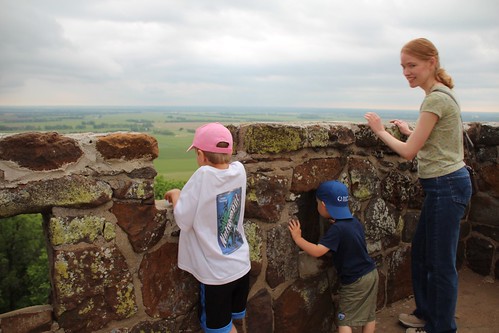
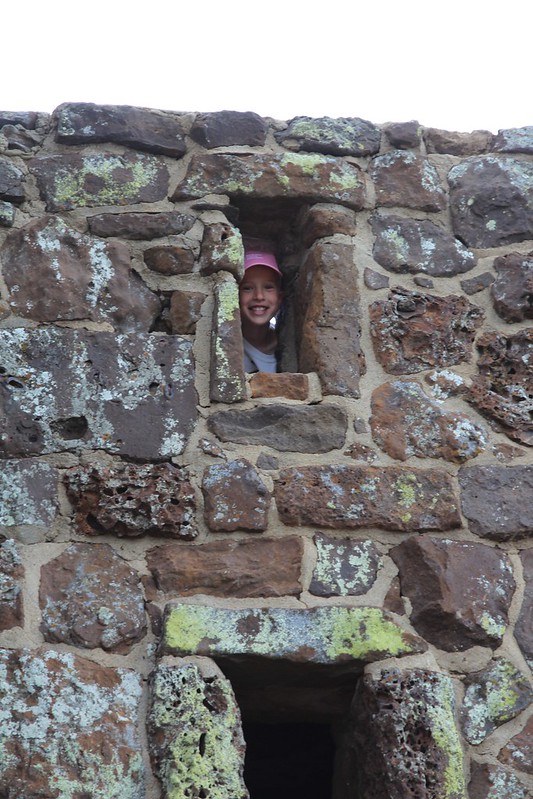
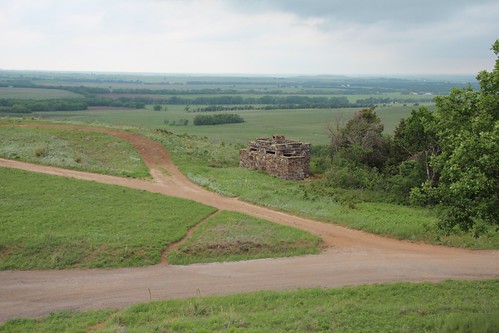
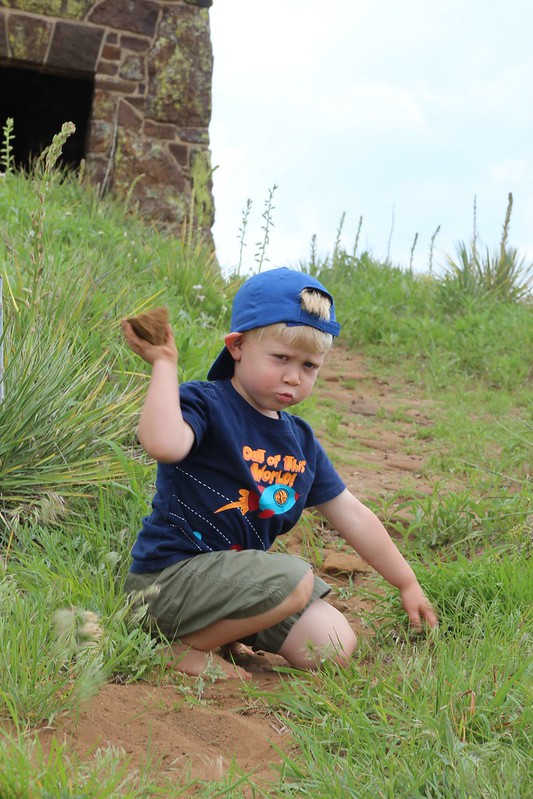
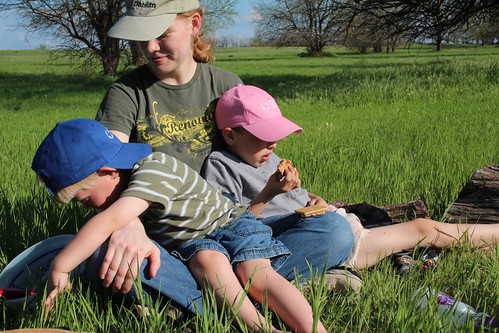
Near the beautiful Swedish town of Lindsborg, Kansas, there stands a hill known as Coronado Heights. It lies in the midst of the Smoky Hills, named for the smoke-like mist that sometimes hangs in them. We Kansans smile our usual smile when we tell the story of how Francisco V squez de Coronado famously gave up his search for gold after reaching this point in Kansas. Anyhow, it was just over a year ago that Laura, Jacob, Oliver, and I went to Coronado Heights at the start of summer, 2013 our first full day together as a family. Atop Coronado Heights sits a castle , an old WPA project from the 1930s: IMG_9803 IMG_9824 The view from up there is pretty nice: IMG_9806 And, of course, Jacob and Oliver wanted to explore the grounds. IMG_9813 As exciting as the castle was, simple rocks and sand seemed to be just as entertaining. IMG_9835 After Coronado Heights, we went to a nearby lake for a picnic. After that, Jacob and Oliver wanted to play at the edge of the water. They loved to throw rocks in and observe the splash. Of course, it pretty soon descended (or, if you are a boy, ascended ) into a game of splash your brother. And then to splash Dad and Laura . 2013-05-27 15 Fun was had by all. What a wonderful day! Writing the story reminds me of a little while before that the first time all four of us enjoyed dinner and smores at a fire by our creek. IMG_9756 Jacob and Oliver insisted on sitting or, well, flopping on Laura s lap to eat. It made me smile. (And yes, she is wearing a Debian hat.)

3 July 2014

DebConf team: Second set of talks accepted; 3 days left to submit yours (Posted by Ana Guerrero Lopez)

There are only left 3 days to submit your talk. Submit yours before it s too late. From the submissions from the last week, we have accepted a second batch of talks: If your talk is not on the list, it doesn t mean that it is not accepted. The talks team will go through the list of talks again, and will publish the final list of talks towards the end of the month. We ll keep the submission of talks open after the deadline. Talks submitted after the deadline still have the possibility of being scheduled as ad-hoc talks. We ll publish more information about this closer to the conference.

2 July 2014

Hideki Yamane: fancy screenshot with screenfetch

matoken (Ken'ichiro Matohara) found interesting tool and told it through G+, named "screenfetch". What's that? yes, look below screenshot.


You can get your running host information with fancy Ascii Art :)

Now it's waiting in NEW queue by me, you can also get it from alioth git repo and build it with git-buildpackage

$ sudo apt-get install packaging-dev
$ git clone git://anonscm.debian.org/collab-maint/screenfetch.git
$ cd screenfetch
$ git checkout pristine-tar; git checkout master
$ gbp buildpackage
...
$ sudo dpkg -i ../screenfetch*.deb
Have fun! :-)

(update: now it's in unstable, thanks to ftpmasters :-)

Russ Allbery: Review: Lockstep

Review: Lockstep, by Karl Schroeder
Publisher: Tor
Copyright: March 2014
ISBN: 0-7653-3726-6
Format: Hardcover
Pages: 351
Toby McGonigal's family fled an Earth dominated by trillionaires and vicious class conflict, and attempt, instead, a very risky and precarious settlement on a trans-Neptunian object. It's the last unclaimed but marginally habitable space left in the solar system, and securing their claim requires constant bureaucratic hoop-jumping. That's what sent Toby on a solo mission to a distant moon of their home to claim it and solidify their title. But, while in cold sleep, his craft hits a small chunk of rock, and he wakes up near another world: cold, silent, dead... but apparently with lifeless cities. Another trip through suspended animation in a desperate attempt to conserve resources against the distant hope of rescue has him awakening in a society both utterly foreign and yet strangely familiar. Schroeder is one of the better big idea writers in science fiction, but I found Lockstep to be a mixed bag. He does a surprisingly good job with the core conceit of the novel (more on that in a moment), even though it's a tricky one to make believable. Surrounding that, though, are a lot of less convincing bits that I kept having to not think about too hard, such as Toby crossing the path of another trans-Neptunian object after the accident (space is really, really big and really, really empty), or the implications of later revelations about the time scales involved in parts of the plot. Some parts of the world building, even if scientifically plausible, struck me as sloppy; for example, a religion plays a prominent role in the plot, but the nature of that religion was not particularly believable, nor was its interaction with the plot climax. I won't go into details about the religion, since it's a major plot point, but the short version is that religions tend to mature from the concrete to the abstract, not the other way around. That said, the core conceit is both surprising and considerably better-defended in the book than I thought it could be. The world into which Toby awakes is the world of the locksteps: a society that uses suspended animation in a universal and coordinated way to build a functional society on the far outskirts of the solar system. Humans emerge for some short period of time, like a month, and build, trade, interact, and consume. They welcome ships traveling from other trans-Neptunian worlds and prepare for their own journeys. And then they go into suspended animation for an extended period 15 years and 30 years are common choices while robots slowly gather more resources and energy, and repair and replace what's consumed in the month of active life. Ships travel with passengers in suspended animation, allowing the vast distances between these cold worlds to be reached during the sleep period. And, since all members of the lockstep sleep and wake on the same schedule, there is no wrenching desynchronization with the surrounding society during travel. One may spend thirty years in transit, but no time passes for anyone else in the lockstep while you're traveling either. A world can effectively trade with all other worlds within a thirty year travel radius without noticing the elapsed time. This is a technological system that at first doesn't sound like it would work, but Schroeder does a great job defending it and chasing down implications. The lockstep civilization serves as a sort of anchor and time capsule separate from the more frantic pace of the so-called fast worlds. The trans-Neptunian lockstep worlds are remote enough and poor enough to not attract too much unwanted attention, and are thus tolerated by fast societies that may have more available resources. (Although, to be sure, automated robot defenses have to carry a lot of weight here given how helpless the locksteps are during a sleep cycle.) I'm not sure I completely bought the sociology, but it works well enough to carry the weight of the story, and I've never seen a science fiction construction that uses the common technology of suspended animation in quite this way before. Schroeder sets up some nice stabilizing tensions between resources and time, adds some believable political reasons for this fragile society to survive, and uses some of its obvious political vulnerabilities as story drivers. The plot, unfortunately, isn't as good as the big idea, and particularly suffers at the start of the book. Toby is a teenager without much experience (Lockstep is marketed as young adult), and is immediately thrown into a strange and quickly hostile environment. This means that he spends the first half of the book reacting to a blizzard of new information, and the plot tends to revert to a tour of Schroeder's constructed world. Toby is also a bit of a cipher and a bit of an everyman, without many feelings or opinions beyond the obvious feelings that any teenage boy would go through in this situation. That makes the sense of a world tour even stronger. This flaw does not persist through the whole book. Toby does eventually start making decisions and doing things, some of the supporting characters add additional depth, and I found the unwinding of the plot surprisingly satisfying. The nature of time in this world lets Schroeder have both epic sweep and personal connection at the same time, which lets him pull off some neat contrasts between the personal and the political. I also liked Toby's gradual piecing together of what actually happened while he was asleep, both in the construction of society as a whole and in the personal conflicts between people he knew well. Some of the ease of grand manipulation seemed dubious to me, but, in Schroeder's defense, people do develop a reverence for and stories about things that have lasted a very long time, and Schroeder's setup gives him quite a lot to work with in that department. So, a mixed bag. The core concept is thought-provoking and up to Schroeder's usual standards. The surrounding world-building isn't as much, and I think Schroeder reaches for some too-easy explanations and still underplays just how many disruptive things can happen over the span of time that this book covers. The characterization I found weak and unsatisfying for much of the book, but it gets moderately better in the end. There's a bit too much tour, and a bit too much world exploration instead of plot, but it's a fascinating world and I still enjoyed the tour. With stronger characters and a few fewer dubious supporting pillars in the world background, I think this would have been an excellent book. As is, it's an enjoyable novel set firmly in the big idea and deep future end of science fiction, and I'm always happy to see more stories like that. It's not the best that Schroeder has done, but I still recommend it. Rating: 7 out of 10

1 July 2014

Martin Pitt: deb, click, schroot, LXC, QEMU, phone, cloud: One autopkgtest to Rule Them All!

We currently use completely different methods and tools of building test beds and running tests for Debian vs. Click packages, for normal uploads vs. CI airline landings vs. upstream project merge proposal testing, and keep lots of knowledge about Click package test metadata external and not easily accessible/discoverable. Today I released autopkgtest 3.0 (and 3.0.1 with a few minor updates) which is a major milestone in unifying how we run package tests both locally and in production CI. The goals of this are: So, let s dive into the new features! New runner: adt-virt-ssh We want to run tests on real hardware such as a laptop of a particular brand with a particular graphics card, or an Ubuntu phone. We also want to restructure our current CI machinery to run tests on a real OpenStack cloud and gradually get rid of our hand-maintained QA lab with its test machines. While these use cases seem rather different, they both have in common that there is an already existing machine which is pretty much only accessible with ssh. Once you have an ssh connection, they look pretty much the same, you just need different initial setup (like fiddling with adb, calling nova boot, etc.) to prepare them. So the new adt-virt-ssh runner factorizes all the common bits such as communicating with adt-run, auto-detecting sudo availability, doing SSH connection sharing etc., and delegates the target specific bits to a setup script . E. g. we could specify --setup-script ssh-setup-nova or --setup-script ssh-setup-adb which would then get called with open at the appropriate time by adt-run; it calls the nova commands to create a VM, or run a few adb commands to install/start ssh and install the public key. Then autopkgtest does its thing, and eventually calls the script with cleanup again. The actual protocol is a bit more involved (see manpage), but that s the general idea. autopkgtest now ships readymade scripts for these two use cases. So you could e. g. run the libpng tests in a temporary cloud VM:
# if you don't have one, create it with "nova keypair-create"
$ nova keypair-list
[...]
  pitti   9f:31:cf:78:50:4f:42:04:7a:87:d7:2a:75:5e:46:56  
# find a suitable image
$ nova image-list 
[...]
  ca2e362c-62c9-4c0d-82a6-5d6a37fcb251   Ubuntu Server 14.04 LTS (amd64 20140607.1) - Partner Image                           ACTIVE    
$ nova flavor-list 
[...]
  100   standard.xsmall    1024        10     10                 1       1.0           N/A        
# now run the tests: please be patient, this takes a few mins!
$ adt-run libpng --setup-commands="apt-get update" --- ssh -s /usr/share/autopkgtest/ssh-setup/nova -- \
   -f standard.xsmall -i ca2e362c-62c9-4c0d-82a6-5d6a37fcb251 -k pitti
[...]
adt-run [16:23:16]: test build:  - - - - - - - - - - results - - - - - - - - - -
build                PASS
adt-run: @@@@@@@@@@@@@@@@@@@@@@@@@@@@@@@@@@@@@@@@ tests done.
Please see man adt-virt-ssh for details how to use it and how to write setup scripts. There is also a commented /usr/share/autopkgtest/ssh-setup/SKELETON template for writing your own for your use cases. You can also not use any setup script and just specify user and host name as options, but please remember that the ssh runner cannot clean up after itself, so never use this on important machines which you can t reset/reinstall! Test dependency installation without apt/root Ubuntu phones with system images have a read-only file system where you can t install test dependencies with apt. A similar case is using the null runner without root. When apt-get install is not available, autopkgtest now has a reduced fallback mode: it downloads the required test dependencies, unpacks them into a temporary directory, and runs the tests with $PATH, $PYTHONPATH, $GI_TYPELIB_PATH, etc. pointing to the unpacked temp dir. Of course this only works for packages which are relocatable in that way, i. e. libraries, Python modules, or command line tools; it will totally fail for things which look for config files, plugins etc. in hardcoded directory paths. But it s good enough for the purposes of Click package testing such as installing autopilot, libautopilot-qt etc. Click package support autopkgtest now recognizes click source directories and *.click package arguments, and introduces a new test metadata specification syntax in a click package manifest. This is similar in spirit and capabilities to DEP-8 debian/tests/control, except that it s using JSON:
    "x-test":  
        "unit": "tests/unittests",
        "smoke":  
            "path": "tests/smoketest",
            "depends": ["shunit2", "moreutils"],
            "restrictions": ["allow-stderr"]
         ,
        "another":  
            "command": "echo hello > /tmp/world.txt"
         
     
For convenience, there is also some magic to make running autopilot tests particularly simple. E. g. our existing click packages usually specify something like
    "x-test":  
        "autopilot": "ubuntu_calculator_app"
     
which is enough to do what I mean , i. e. implicitly add the autopilot test depends and run autopilot with the specified test module name. You can specify your own dependencies and/or commands, and restrictions etc., of course. So with this, and the previous support for non-apt test dependencies and the ssh runner, we can put all this together to run the tests for e. g. the Ubuntu calculator app on the phone:
$ bzr branch lp:ubuntu-calculator-app
# built straight from that branch; TODO: where is the official" download URL?
$ wget http://people.canonical.com/~pitti/tmp/com.ubuntu.calculator_1.3.283_all.click
$ adt-run ubuntu-calculator-app/ com.ubuntu.calculator_1.3.283_all.click --- \
      ssh -s /usr/share/autopkgtest/ssh-setup/adb
[..]
Traceback (most recent call last):
  File "/tmp/adt-run.KfY5bG/tree/tests/autopilot/ubuntu_calculator_app/tests/test_simple_page.py", line 93, in test_divide_with_infinity_length_result_number
    self._assert_result("0.33333333")
  File "/tmp/adt-run.KfY5bG/tree/tests/autopilot/ubuntu_calculator_app/tests/test_simple_page.py", line 63, in _assert_result
    self.main_view.get_result, Eventually(Equals(expected_result)))
  File "/usr/lib/python3/dist-packages/testtools/testcase.py", line 406, in assertThat
    raise mismatch_error
testtools.matchers._impl.MismatchError: After 10.0 seconds test failed: '0.33333333' != '0.3'
Ran 33 tests in 295.586s
FAILED (failures=1)
Note that the current adb ssh setup script deals with some things like applying the autopilot click AppArmor hooks and disabling screen dimming, but it does not do the first-time setup (connecting to network, doing the gesture intro) and unlocking the screen. These are still on the TODO list, but I need to find out how to do these properly. Help appreciated! Click app tests in schroot/containers But, that s not the only thing you can do! autopkgtest has all these other runners, so why not try and run them in a schroot or container? To emulate the environment of an Ubuntu Touch session I wrote a --setup-commands script:
adt-run --setup-commands /usr/share/autopkgtest/setup-commands/ubuntu-touch-session \
    ubuntu-calculator-app/ com.ubuntu.calculator_1.3.283_all.click --- schroot utopic
This will actually work in the sense of running (and succeeding) the autopilot tests, but it will fail due to a lot of libust[11345/11358]: Error: Error opening shm /lttng-ust-wait... warnings on stderr. I don t know what these mean, just that I also see them on the phone itself occasionally. I also wrote another setup-commands script which emulates read-only apt , so that you can test the unpack only fallback. So you could prepare a container with click and the App framework preinstalled (so that it doesn t always take ages to install them), starting from a standard adt-build-lxc container:
$ sudo lxc-clone -o adt-utopic -n click
$ sudo lxc-start -n click
  # run "sudo apt-get install click ubuntu-sdk-libs ubuntu-app-launch-tools" there
  # then "sudo powerdown"
# current apparmor profile doesn't allow remounting something read-only
$ echo "lxc.aa_profile = unconfined"   sudo tee -a /var/lib/lxc/click/config
Now that container has enough stuff preinstalled to be reasonably fast to set up, and the remaining test dependencies (mostly autopilot) work fine with the unpack/$*_PATH fallback:
$ adt-run --setup-commands /usr/share/autopkgtest/setup-commands/ubuntu-touch-session \
          --setup-commands /usr/share/autopkgtest/setup-commands/ro-apt \
          ubuntu-calculator-app/ com.ubuntu.calculator_1.3.283_all.click \
          --- lxc -es click
This will successfully run all the tests, and provided you have apt-cacher-ng installed, it only takes a few seconds to set up. This might be a nice thing to do on merge proposals, if you don t have an actual phone at hand, or don t want to clutter it up. autopkgtest 3.0.1 will be available in Utopic tomorrow (through autosyncs). If you can t wait to try it out, download it from my people.c.c page . Feedback appreciated!

Neil Williams: LAVA in Debian unstable

LAVA has arrived in Debian unstable. No need for third party repositories (unless you want to), a simple apt install lava-server. What happens from that point isn t so simple. I ve made the single instance installation as straightforward as I could but there is a lot more to do to get LAVA working in a useful manner. First, a little history to explain some of the hysterical raisins which may appear later. Validation So, you ve made a change to the code, good. It compiles, yay! Before you ship it, does it pass the unit tests? Right, now you have an improved patch which does what you want and keeps the unit tests running. Validation is all about asking that awkward question: does your change work? Does it introduce side effects on other systems / services in the same code? Does it break programs which use services exported by the code? LAVA is one step along the road to system testing, starting at the bottom. Automation Well you could do all that yourself. Write the image to the device yourself, apply power yourself, connect to serial, copy test scripts to the booted image and pull the results off, somehow. Much better if this is automated maybe every commit or every push or as often as the tests can be run on the number of devices available. LAVA Linaro Automated Validation Architecture. Linaro is a not-for-profit building the future of the Linux kernel on ARM devices. Lava was built for and by Linaro, so the initial focus is clearly on validating the Linux kernel on ARM devices. There are likely to be gotchas in the code for those wanting to use LAVA for other kernels Linaro can t support lots of different kernels, but if there are changes which make it easier to use other kernels without impacting on validation of Linux, those would likely be accepted. The experience with using LAVA is all with ARM but if there is interest in extending LAVA to work with devices of other architectures, again, patches would be welcome. The development of the packaging to make LAVA suitable for Debian has also meant that LAVA will run on hardware other than x86. e.g. armv7.com. I m running a mini lab at home based around an arndale board, I ve also got a mini lab at work based on a cubie2. Requirements for such setups are described in the documentation and in previous entries on this blog (principally you will need SATA, lots of RAM and as many CPU cores as you can find. If you want to run LAVA on other architectures, go ahead and let us know if there are issues. Available versions The versions uploaded to Debian will (from now on) be production releases. The same code as is running on http://validation.linaro.org/ development builds and test builds are supported using helpers in the lava-dev package. Releases to unstable will automatically migrate into Ubuntu Unicorn. I ll continue building interim versions at the former locations on http://people.linaro.org/~neil.williams/, including builds for Ubuntu Trusty 14.04LTS as well as providing packages for Jessie until the uwsgi package can migrate. LAVA is looking to work with anyone who can prepare and maintain packages for other distributions like Fedora. Bugs LAVA is migrating from Launchpad bugs to http://bugs.linaro.org which is a bugzilla interface. Now that LAVA is also in Debian, anyone is welcome to use the Debian BTS which does not require any login or account setup. The maintainers (including me) will then forward those bugs as appropriate. Documentation The immediate task is to update the documentation in the lava-server-doc package (and the Debian wiki) to reflect the availability of LAVA from Debian unstable and how to choose which release of LAVA to use in your systems. However, there is a large amount of documentation already available click the Help link in the menu bar of any current LAVA instance. As with many projects, the docs have been written by the development team. If there are things which are unclear or if sections need to be moved around to make it easier for people new to LAVA to pick it up, please file bugs. Hardware It isn t easy to run a LAVA lab, there is a lot more to it than simply installing lava-server. LAVA would not be possible without the lab team and any other LAVA instance is going to need the same level of excellence in system administration, device support and cooperation. I ve covered a little bit of that in previous entries on this blog about my home lab but that is nothing compared to the work required to provide a working lab like the one in Cambridge. Access to that lab is restricted to people within Linaro but LAVA is also reaching out to the community and if there are tests or hardware you want to see within a LAVA instance, not necessarily in the main lab, then talk to us. Contact Bug reports are preferable but you can also find LAVA people on #linaro-lava on OFTC or contact us on the linaro-validation mailing list. Future There is a lot more work to do on LAVA yet. There are assumptions about partition layout within images (hysterical raisins) and issues with unused software being required for remote worker installations. Both are now part of the next major development work within LAVA. DebConf14 There is lot more to talk about with LAVA if you are attending DebConf14 then there will be talks on LAVA and plenty of time to answer questions.

Russ Allbery: Review: Ancillary Justice

Review: Ancillary Justice, by Ann Leckie
Series: Imperial Radch #1
Publisher: Orbit
Copyright: 2013
ISBN: 0-316-24662-X
Format: Trade paperback
Pages: 416
As Ancillary Justice opens, Breq is on an icy planet trying to track down a person who has gone rather thoroughly to ground. As her search continues, the reader slowly learns the context of that search, which is only the latest step of a long and quixotic exercise in private determination. She was set on her path by events twenty years previous, told in interleaved flashbacks, that have left her greatly diminished and thrust outside of any of the context of her over thousand years of life. Breq was Justice of Toren, a starship and AI that possessed thousands of ancillaries, human bodies slaved to her mind. Now only this one remains, and nothing exists of her former life other than this goal. It's always hard to write a review of a book that I loved this much. I want to find some way to grab the reader and shake them and say "you have to read this!" without giving away any of the delicious details. That's particularly difficult with Ancillary Justice, since one of the delights of this book is the slow unfolding of not only the plot but the background and motivations behind the plot. There is so much beneath the surface of Breq's methodical intent, and discovering all the nuances is utterly delightful. This is also a book that is very deeply concerned with identity, and which does one of the best jobs I've seen in science fiction of showing a non-human first-person protagonist: close enough to human to permit identification and comprehension, but far enough away for delightful sparks of unexpected insight or thought-provoking difference. Breq is a ship, and AIs are central to this story, so the comparison that comes immediately to mind is with Iain M. Banks. Leckie's role for ship AIs is much different than the structure of Banks's Culture, but I think this is still an apt comparison. Like Banks, Leckie is writing large-scale space opera dominated by a meddling empire that follows some familiar human patterns but not others. Banks's Culture takes a less direct approach with its meddling; the Radch has a more Roman attitude towards preventative conquest and citizenship. But both deal with large-scale issues of politics, culture, and conquest. Both also write excellent AIs, but I think Leckie is more successful than Banks at giving her AIs inhuman properties and creating a sense of eerie alienness that sometimes fades almost entirely and sometimes comes sharply to the surface. The first-person perspective helps considerably there. But where Ancillary Justice truly shined for me is in the interpersonal relationships, and in the insight they provided into character and motive. At the start of the book, Breq finds a drug addict dying in the cold and rescues her, bringing her along on her search for lack of a better option. Breq's relationship with Seivarden is complex, difficult for both of them, badly asymmetric at the start, and develops into something brilliant. At the start of the book, Seivarden is easy to dislike, and Breq's tone is refreshingly bracing and forthright. But through the course of the book Seivarden grows into something much more, in a way that I found both believable and incredibly compelling. And Leckie does this without falling into any of the typical relationship patterns, without introducing artificial romance (or, indeed, any romance at all, which is an excellent choice here), and without compromising the personalities of either character. It's masterfully done. One of the most amazing things about this book to me is that it's a first novel. I never would have guessed that from reading it. It's beautifully paced, the characterization is deep and compelling, and Leckie avoids any sign of the typical first-novel problem of stuffing the book with too much Stuff. Ancillary Justice is a capable and confident novel that builds a compelling world and even more compelling characters. I liked it more than I like most of the Culture novels, which is saying quite a lot, but Leckie offers much of the same scope with deeper and more personal characterization and a tighter plot. I haven't yet remarked on one aspect of this book that every other review seems to remark on: its treatment of gender. The Radch do not recognize or care about gender distinctions, and therefore Breq struggles throughout the book with proper gender labeling in much the same way that a native English speaker tends to struggle with grammatical gender when learning a Romance language, except with more social consequences. Leckie has chosen to represent this in the novel by having Breq refer to everyone uniformly as "she." This has its pluses and minuses: it still supports a binary gender concept where a gender-neutral pronoun might not, but given all the negative reaction this book got just for using "she," a gender-neutral pronoun might be a bridge too far for a lot of readers. I thought it created a nice bit of alienation, a way of forcing the reader to look at gender markers from the outside and a way to point out how arbitrary many of them are. It was also interesting to see how surprised I was at various points in the book when it became obvious that some person Breq had been calling "she" in the first-person narration turned out, from story context, to probably be male. That said, I think this part of the book is overblown in reviews. It's often the first thing people mention, but while it was a nice side bit of world-building, I don't think it's that central to the story. I'm particularly baffled by the handful of people who complained about it, since it's not intrusive and it quickly fades into the background apart from occasional necessary shifts of mental image. (It does create the impression of a world containing only women, but I found that a nice change from the more common impression in space opera of a world containing only men.) Ancillary Justice has already won the Nebula and Arthur C. Clarke awards and tied for the BSFA award for best novel, and I'm happy to report that it deserves all of those. I haven't yet read all of the other Hugo nominees, but it's hard to imagine a world in which it won't top my ballot. This is a fantastic novel, by far the best thing I've read so far this year. I'm delighted that it's the first book of a trilogy, since I'm not done with either the world or the characters yet, but it stands well on its own and reaches a satisfying conclusion. I recommend it to everyone, but particularly to anyone who likes Banks, intelligent ships, or who is looking for thoughtful and complex space opera. Followed by Ancillary Sword. Rating: 10 out of 10

Next.

Previous.