Search Results: "ina"

11 October 2016

Michal Čihař: stardicter 0.10

Stardicter 0.10, the set of scripts to convert some freely available dictionaries to StarDict format, has been released today. There are mostly minor changes and it's time to push them out in official release. There is one change worth mentioning though - the original site for English - Czech dictionary (http://slovnik.zcu.cz/) has stopped to work and has been moved to https://www.svobodneslovniky.cz/. Hopefully this new location will live at least as long as the original one and will bring back new contributors (honestly the original dictionary gained mostly spam entries in last months). The dictionary data are now hosted in Git repository on GitHub.

Filed under: Debian English StarDict 0 comments

Vincent Sanders: The pine stays green in winter... wisdom in hardship.

In December 2015 I saw the kickstarter for the Pine64. The project seemed to have a viable hardware design and after my experience with the hikey I decided it could not be a great deal worse.

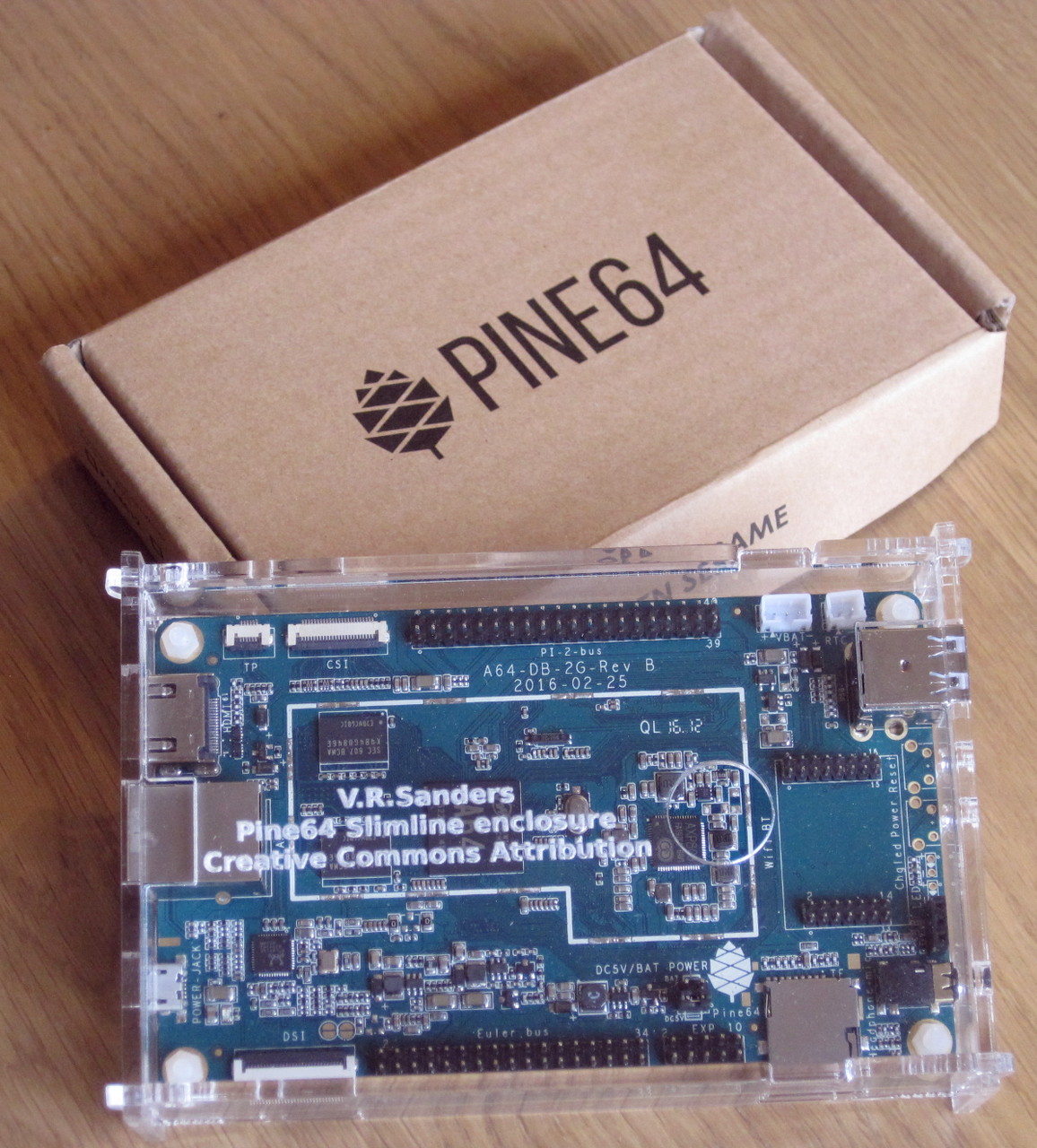
Pine64 board in my case design
The system I acquired comprises of:
Hardware based kickstarter projects are susceptible to several issues and the usual suspects occurred causing delays:
My personal view is that PINE 64 inc. handled it pretty well, much better than several other projects I have backed and as my Norman Douglas quotation suggests I think they have gained some wisdom from this.

I received my hardware at the beginning of April only a couple of months after their initial estimated shipping date which as these things go is not a huge delay. I understand some people who had slightly more complex orders were just receiving their orders in late June which is perhaps unfortunate but still well within kickstarter project norms.

As an aside: I fear that many people simply misunderstand the crowdfunding model for hardware projects and fail to understand that they are not buying a finished product, on the other side of the debate I think many projects need to learn expectation management much better than they do. Hyping the product to get interest is obviously the point of the crowdfunding platform, but over promising and under delivering always causes unhappy customers.

Pine64 board dimensions
Despite the delays in production and shipping the information available for the board was (and sadly remains) inadequate. As usual I wanted to case my board and there were no useful dimension drawings so I had to make my own from direct measurements together with a STL 3D model.

Also a mental sigh for "yet another poor form factor decision" so another special case size and design. After putting together a design and fabricating with the laser cutter I moved on to the software.

Once more this is where, once again, the story turns bleak. We find a very pretty website but no obvious link to the software (hint scroll to the bottom and find the "support" wiki link) once you find the wiki you will eventually discover that the provided software is either an Android 5.1.1 image (which failed to start on my board) or relies on some random guy from the forums who has put together his own OS images using a hacked up Allwinner Board Support Package (BSP) kernel.

Now please do not misunderstand me, I think the work by Simon Eisenmann (longsleep) to get a working kernel and Lenny Raposo to get viable OS images is outstanding and useful. I just feel that Allwinner and vendors like Pine64 Inc. should have provided something much, much better than they have. Even the efforts to get mainline support for this hardware are all completely volunteer community efforts and are are making slow progress as a result.

Assuming I wanted to run a useful OS on this hardware and not just use it as a modern work of art I installed a basic Debian arm64 using Lenny Raposo's pine64 pro site downloads. I was going to use the system for compiling and builds so used the "Debian Base" image to get a minimal setup. After generating unique ssh keys, renaming the default user and checking all the passwords and permissions I convinced myself the system was reasonably trustworthy.

The standard Debian Jessie OS runs as expected with few surprises. The main concern I have is that there are a number of unpackaged scripts installed (prefixed with pine64_) which perform several operations from reporting system health (using sysfs entries) to upgrading the kernel and bootloader.

While I understand these scripts have been provided for the novice users to reduce support burden, doing even more of the vendors job, I would much rather have had proper packages for these scripts, kernel and bootloader which apt could manage. This would have reduced image creation to a simple debootstrap giving much greater confidence in the images provenance.

The 3.10 based kernel is three years old at the time of writing and lacks a great number of features for the aarch64 ARM processors introduced since release. However I was pleasantly surprised at kvm apparently being available.

# dmesg grep -i kvm
[ 7.592896] kvm [1]: Using HYP init bounce page @b87c4000
[ 7.593361] kvm [1]: interrupt-controller@1c84000 IRQ25
[ 7.593778] kvm [1]: timer IRQ27
[ 7.593801] kvm [1]: Hyp mode initialized successfully

I installed the libvirt packages (and hence all their dependencies like qemu) and created a bridge ready for the virtual machines.

I needed access to storage for the host disc images and while I could have gone the route of using USB attached SATA as with the hikey I decided to try and use network attached storage instead. Initially I investigated iSCSI but it seems the Linux target (iSCSI uses initiator for client and target for server) support is either old, broken or unpackaged.

I turned to network block device (nbd) which is packaged and seems to have reasonable stability out of the box on modern distributions. This appeared to work well, indeed over the gigabit Ethernet interface I managed to get a sustained 40 megabytes a second read and write rate in basic testing. This is better performance than a USB 2.0 attached SSD on the hikey

I fired up the guest and perhaps I should have known better than to expect a 3.10 vendor kernel to cope. The immediate hard crashes despite tuning many variables convinced me that virtualisation was not viable with this kernel.

So abandoning that approach I attempted to run the CI workload directly on the system. To my dismay this also proved problematic. The processor has the bad habit of throttling due to thermal issues (despite a substantial heatsink) and because the storage is network attached throttling the CPU also massively impacts I/O.

The limitations meant that the workload caused the system to move between high performance and almost no progress on a roughly ten second cycle. This caused a simple NetSurf recompile CI job to take over fifteen minutes. For comparison the same task takes the armhf builder (CubieTruck) four minutes and a 64 bit x86 build which takes around a minute.

If the workload is tuned to a single core which does not trip thermal throttling the build took seven minutes. which is almost identical to the existing single core virtual machine instance running on the hikey.

In conclusion the Pine64 is an interesting bit of hardware with fatally flawed software offering. Without Simon and Lenny providing their builds to the community the device would be practically useless rather than just performing poorly. There appears to have been no progress whatsoever on the software offering from Pine64 in the six months since I received the device and no prospect of mainline Allwinner support for the SoC either.

Effectively I have spent around 50usd (40 for the board and 10 for the enclosure) on a failed experiment. Perhaps in the future the software will improve sufficiently for it to become useful but I do not hold out much hope that this will come from Pine64 themselves.

Russ Allbery: remctl 3.13

remctl is a client and server that forms a very simple remote RPC system, normally authenticated with Kerberos, although including a remctl-shell variant that works over ssh. This release adds forced-command support for remctl-shell, which allows it to work without enabling setting environment variables in authorized_keys. This may be a preferrable configuration to using it as an actual shell. Also in this release, the summary configuration option is allowed for commands with subcommands other than ALL, which allows proper generation of command summaries even for users who only have access to a few subcommands of a command. It also adds some build system support for building binaries with -fPIE. You can get the latest release from the remctl distribution page.

10 October 2016

Reproducible builds folks: Reproducible Builds: week 76 in Stretch cycle

What happened in the Reproducible Builds effort between Sunday October 2 and Saturday October 8 2016: Media coverage Events Packages reviewed and fixed, and bugs filed Reviews of unreproducible packages 31 package reviews have been added, 27 have been updated and over 20 have been removed in this week, adding to our knowledge about identified issues. 3 issue types have been addded: 1 issue type has been updated: Weekly QA work During of reproducibility testing, some FTBFS bugs have been detected and reported by: tests.reproducible-builds.org Debian: Misc. This week's edition was written by Chris Lamb, Holger Levsen & Vagrant Cascadian and reviewed by a bunch of Reproducible Builds folks on IRC.

Petter Reinholdtsen: Experience and updated recipe for using the Signal app without a mobile phone

In July I wrote how to get the Signal Chrome/Chromium app working without the ability to receive SMS messages (aka without a cell phone). It is time to share some experiences and provide an updated setup. The Signal app have worked fine for several months now, and I use it regularly to chat with my loved ones. I had a major snag at the end of my summer vacation, when the the app completely forgot my setup, identity and keys. The reason behind this major mess was running out of disk space. To avoid that ever happening again I have started storing everything in userdata/ in git, to be able to roll back to an earlier version if the files are wiped by mistake. I had to use it once after introducing the git backup. When rolling back to an earlier version, one need to use the 'reset session' option in Signal to get going, and notify the people you talk with about the problem. I assume there is some sequence number tracking in the protocol to detect rollback attacks. The git repository is rather big (674 MiB so far), but I have not tried to figure out if some of the content can be added to a .gitignore file due to lack of spare time. I've also hit the 90 days timeout blocking, and noticed that this make it impossible to send messages using Signal. I could still receive them, but had to patch the code with a new timestamp to send. I believe the timeout is added by the developers to force people to upgrade to the latest version of the app, even when there is no protocol changes, to reduce the version skew among the user base and thus try to keep the number of support requests down. Since my original recipe, the Signal source code changed slightly, making the old patch fail to apply cleanly. Below is an updated patch, including the shell wrapper I use to start Signal. The original version required a new user to locate the JavaScript console and call a function from there. I got help from a friend with more JavaScript knowledge than me to modify the code to provide a GUI button instead. This mean that to get started you just need to run the wrapper and click the 'Register without mobile phone' to get going now. I've also modified the timeout code to always set it to 90 days in the future, to avoid having to patch the code regularly. So, the updated recipe for Debian Jessie:
  1. First, install required packages to get the source code and the browser you need. Signal only work with Chrome/Chromium, as far as I know, so you need to install it.
    apt install git tor chromium
    git clone https://github.com/WhisperSystems/Signal-Desktop.git
    
  2. Modify the source code using command listed in the the patch block below.
  3. Start Signal using the run-signal-app wrapper (for example using pwd /run-signal-app).
  4. Click on the 'Register without mobile phone', will in a phone number you can receive calls to the next minute, receive the verification code and enter it into the form field and press 'Register'. Note, the phone number you use will be user Signal username, ie the way others can find you on Signal.
  5. You can now use Signal to contact others. Note, new contacts do not show up in the contact list until you restart Signal, and there is no way to assign names to Contacts. There is also no way to create or update chat groups. I suspect this is because the web app do not have a associated contact database.
I am still a bit uneasy about using Signal, because of the way its main author moxie0 reject federation and accept dependencies to major corporations like Google (part of the code is fetched from Google) and Amazon (the central coordination point is owned by Amazon). See for example the LibreSignal issue tracker for a thread documenting the authors view on these issues. But the network effect is strong in this case, and several of the people I want to communicate with already use Signal. Perhaps we can all move to Ring once it work on my laptop? It already work on Windows and Android, and is included in Debian and Ubuntu, but not working on Debian Stable. Anyway, this is the patch I apply to the Signal code to get it working. It switch to the production servers, disable to timeout, make registration easier and add the shell wrapper:
cd Signal-Desktop; cat <<EOF   patch -p1
diff --git a/js/background.js b/js/background.js
index 24b4c1d..579345f 100644
--- a/js/background.js
+++ b/js/background.js
@@ -33,9 +33,9 @@
          );
      );
 
-    var SERVER_URL = 'https://textsecure-service-staging.whispersystems.org';
+    var SERVER_URL = 'https://textsecure-service-ca.whispersystems.org';
     var SERVER_PORTS = [80, 4433, 8443];
-    var ATTACHMENT_SERVER_URL = 'https://whispersystems-textsecure-attachments-staging.s3.amazonaws.com';
+    var ATTACHMENT_SERVER_URL = 'https://whispersystems-textsecure-attachments.s3.amazonaws.com';
     var messageReceiver;
     window.getSocketStatus = function()  
         if (messageReceiver)  
diff --git a/js/expire.js b/js/expire.js
index 639aeae..beb91c3 100644
--- a/js/expire.js
+++ b/js/expire.js
@@ -1,6 +1,6 @@
 ;(function()  
     'use strict';
-    var BUILD_EXPIRATION = 0;
+    var BUILD_EXPIRATION = Date.now() + (90 * 24 * 60 * 60 * 1000);
 
     window.extension = window.extension    ;
 
diff --git a/js/views/install_view.js b/js/views/install_view.js
index 7816f4f..1d6233b 100644
--- a/js/views/install_view.js
+++ b/js/views/install_view.js
@@ -38,7 +38,8 @@
             return  
                 'click .step1': this.selectStep.bind(this, 1),
                 'click .step2': this.selectStep.bind(this, 2),
-                'click .step3': this.selectStep.bind(this, 3)
+                'click .step3': this.selectStep.bind(this, 3),
+                'click .callreg': function()   extension.install('standalone')  ,
              ;
          ,
         clearQR: function()  
diff --git a/options.html b/options.html
index dc0f28e..8d709f6 100644
--- a/options.html
+++ b/options.html
@@ -14,7 +14,10 @@
         <div class='nav'>
           <h1>  installWelcome  </h1>
           <p>  installTagline  </p>
-          <div> <a class='button step2'>  installGetStartedButton  </a> </div>
+          <div> <a class='button step2'>  installGetStartedButton  </a>
+	    <br> <a class="button callreg">Register without mobile phone</a>
+
+	  </div>
           <span class='dot step1 selected'></span>
           <span class='dot step2'></span>
           <span class='dot step3'></span>
--- /dev/null   2016-10-07 09:55:13.730181472 +0200
+++ b/run-signal-app   2016-10-10 08:54:09.434172391 +0200
@@ -0,0 +1,12 @@
+#!/bin/sh
+set -e
+cd $(dirname $0)
+mkdir -p userdata
+userdata=" pwd /userdata"
+if [ -d "$userdata" ] && [ ! -d "$userdata/.git" ] ; then
+    (cd $userdata && git init)
+fi
+(cd $userdata && git add . && git commit -m "Current status."   true)
+exec chromium \
+  --proxy-server="socks://localhost:9050" \
+  --user-data-dir=$userdata --load-and-launch-app= pwd 
EOF
chmod a+rx run-signal-app
As usual, if you use Bitcoin and want to show your support of my activities, please send Bitcoin donations to my address 15oWEoG9dUPovwmUL9KWAnYRtNJEkP1u1b.

Arturo Borrero Gonz lez: The day I became Debian Developer

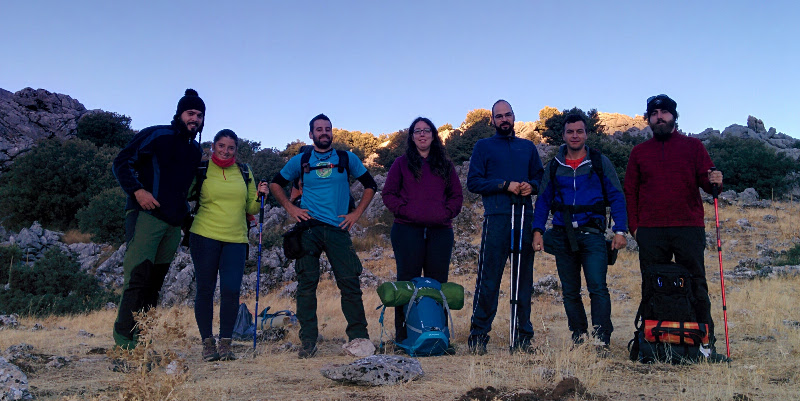
Debian The moment has come. You may contact me now at arturo@debian.org :-) After almost 6 months of tough NM process, the waiting is over. I have achieved the goal I set to myself back in 2011: become Debian Developer. This is a professional and personal victory. I would like to mention many people who have been important for this to happen. But they all know, no need to create a list here. Thanks! This weekend I was doing some hiking in the mountains and had no internet conection at all. When I arrived back home, I discovered an email from Debian System Administrators on behalf of The Debian New Maintainer Team, in which they let me know that my official DD account had been created. During the last 6 month I have been trying to imagine the moment in which the process is finally completed (yes, I have been a bit impatient). At the end, the magical moment in the mountains was followed by the joy of the DD account. Curious how things happen sometimes. Here is a pic of this mountain day, with my adventure friends. I am the first from the left. pic

9 October 2016

Bits from Debian: Debian is participating in the next round of Outreachy!

Following the success of the last round of Outreachy, we are glad to announce that Debian will take part in the program for the next round, with internships lasting from the 6th of December 2016 to the 6th of March 2017. From the official website: Outreachy helps people from groups underrepresented in free and open source software get involved. We provide a supportive community for beginning to contribute any time throughout the year and offer focused internship opportunities twice a year with a number of free software organizations. Currently, internships are open internationally to women (cis and trans), trans men, and genderqueer people. Additionally, they are open to residents and nationals of the United States of any gender who are Black/African American, Hispanic/Latin@, American Indian, Alaska Native, Native Hawaiian, or Pacific Islander. If you want to apply to an internship in Debian, you should take a look at the wiki page, and contact the mentors for the projects listed, or seek more information on the (public) debian-outreach mailing-list. You can also contact the Outreach Team directly. If you have a project idea and are willing to mentor an intern, you can submit a project idea on the Outreachy wiki page. Here's a few words on what the interns for the last round achieved within Outreachy: Debian would not be able to participate in Outreachy without the help of the Software Freedom Conservancy, who provides administrative support for Outreachy, as well as the continued support of Debian's donors, who provide funding for the internships. If you want to donate, please get in touch with one of our trusted organizations. Debian is looking forward to welcoming new interns for the next few months, come join us!

Norbert Preining: Reload: Android 7.0 Nougat Root Pokemon Go

Ok, it turned out that a combinations of updates has broken my previous guide on playing Pokemon GO on a rooted Android device. What has happened that the October security update of the Android Nougat has changed the SecurityNet that is used for checking for rooted devices, and at the same time the Magisk rooting system as catapulted itself (hopefully temporarily) into the complete irrelevance by removing the working version and providing an improved version that does neither have SuperSU installed, nor the ability to hide root well done, congratulations. android-nougat-root-poke But there is a way around, and I am now back at the latest security patch level, rooted, and playing Pokemon GO (not very often, no time, though!). My previous guide used Magisk Version 6 to root and hide root. But the recent security updated of Andorid Nougat (October 2016) has rendered Magisk-v6 non-working. I first thought that Magisk-v7 could solve the problem, but I was badly disappointed: After reflashing my device to pristine state, installing Magisk-v7, I suddenly was left with: no SuperSU (that means, X-plore, Titanium Backup etc do not work anymore), nor the ability to hide root for Pokemon Go or banking apps. Great update. Thus, I have decided to remove Magisk completely and make a clean start with SuperSU and suhide (and a GUI for suhide). And it turned out to be more convenient and more standard than Magisk, may it rest in peace (until they fix their stuff together). In the following I assume you have a clean slate Android Nougat device, if not, please see one of the previous guides for hints how to flash back without loosing your user data. Ingredients One need the following few items: Rooting Unzip the CF-Auto-Root-angler-angler-nexus6p.zip and either use the included programs (root-linux.sh, root-mac.sh, root-windows.bat) to root your device, or simply connect your device to your computer, and run (assuming you have adb and fastboot installed):
adb reboot bootloader
sleep 10
fastboot boot image/CF-Auto-Root-angler-angler-nexus6p.img
After that your device will reboot a few times, and you will finally land in your normal Android screen and a new program SuperSU will be available. At this stage you will not be able to play Pokemon GO anymore. Updating SuperSU The version of SuperSU packaged with the CF-AutoRoot is unfortunately too old, so one needs to update using the zip file SR1-SuperSU-v2.78-SR1-20160915123031.zip (or later). Here are two options: Either you use TWRP recovery system, or you install FlashFire (main page, app store page) which allows you to flash zip/ota directly from your Android screen. This time I used for the first time the FlashFire method, and it worked without any problem. Just press the + button in FlashFire, than the Flash zip/ota button, select the SR1-SuperSU-v2.78-SR1-20160915123031.zip, click two times yes, and then wait a bit and a few black screens (don t do anything!) later you will be back in your Nougat environment. Opening the SuperSU app should show you on the Settings tag that the version has been updated to 2.78-SR1. Installing suhide As with the update of SuperSU, install the suhide zip file, smae procedure, nothing special. After this you will be able to add an application (like Pokemon GO) from the command line (shell), but this is not very convenient. Better is to install the suhide GUI from the app store, start it, scroll for Pokemnon GO, add a tick, and you are settled. After that you are free to play Pokemon GO again. At least until the next security update brings again problems. In the long run this is a loosing game, anyway. Enjoy it while you can.

Laura Arjona Reina: New phone: Samsung Galaxy S III phone with Replicant

Thanks to the Bazaar effort of The Guardian Project, I ve been offered a phone to test F-Droid and other free software apps for Android. I accepted the offer, and chose a Samsung Galaxy S III phone with Replicant 4.2.2, installed and shipped by Tehnoetic.
I m using it now as my main phone, and since it uses Android 4.x I m able to install more modern apps than in my old Galaxy Ace (which remains usable with CyanongenMod 7.2 (Android 2.3.7)).
My plans with this new phone are:
  • Test Replicant and free software for Android on it
  • Get more involved in translations of Android apps
  • Get more involved in the F-Droid community
  • Keep an eye on Android tools in Debian
  • Post here in my blog articles about what I ve been doing (and of course report issues and contributions upstream)
Migration to the new phone
I ve migrated my stuff from the old phone to this one. Some notes:
  • Wrote down my list of apps
  • Used Slight Backup for contacts, call logs and messages
  • Periodical has its own backup tool
  • Whatsapp has its own backup tool
  • Exported settings in K-9 Mail
  • Exported Kontalk GPG key
  • Simply Do has its own backup tool
  • I don t use calendars in the phone so I didn t migrate any events (I have Offline Calendar to ad temporary notes/reminders, but that s all)
I moved the SIM card and the SD Card to the new phone and tried the restore tool for each app.
I found out that several apps could not find the backups because they were not looking at the SD Card for the files (seems that they were using internal memory locations). So for recovering my backups, I made new backups in the new phone with the empty apps, then found out where those backups were created (in the internal memory, /storage/emulated/0), and then copied the authentic backup files there (overwriting teh dummy ones), and then used the app to restore the backup.
For some apps (K-9) I had to set again the folder for attachments, since the SD was not anymore in /media/sdcard, now it was in /storage/sdcard1.
Apart from that, everything went well.
I was a bit upset that I could not migrate Kontalk conversations (there is no backup/export tool, and I am not sure where are the files/database stored).
I noticed that although Kontalk is registered using the phone number, and it uses the phone numbers for contacts, it kept working in the old phone (Whatsapp detects when you change to a new phone and kind of deactivates itself in the old one, but that s not the case for Kontalk: it works as any XMPP client (if it s open, it can send/receive messages)).
Replicant 4.2 in a Galaxy S III (i9300)
Here I write some particularities that I found in the phone, mostly bugs or problems. But don t get me wrong: overall I m very happy with it!
I experienced a problem when using the phone to make/receive calls, it seemed that the proximity sensor was not working well. I thought it was a Replicant issue, but later I realized that there was a Tehnoetic sticker that was partially covering the sensor. I removed the sticker and everything worked well.
The phone came with F-Droid installed which is nice. I upgraded to the latest alpha and I m testing the alpha releases since then
I found that I cannot choose where to install apps nor move apps from internal memory to the SD Card: there is no such option in Settings > Apps > Manage Apps (there is such setting in my CyanogenMod 7.2 phone, though). Since my phone is rooted and I have full access to both internal memory and SDCard, and I have plenty of room in the internal memory, I didn t bother too much. I m not sure if this is a bug, a feature, something related to Android 4 or specific to Replicant, o specific to this phone model. Pending to investigate, but low priority.
Replicant is almost fully translated to Spanish, yay!. I only found one untranslated string: You go to Settings > Wireless > Cell Broadcasts, and in the settings page, Cell Broadcasts is untranslated (but the settings themselves are). I still need to find where/how to send a patch for this (not sure if it comes from Android, CyanogenMod, or it s something specific for Replicant. Also, being Android 4.x, I m not sure about the usefulness of reporting such a minimal and unimportant patch upstream ).
When I turn on the phone, I get the Samsung S III splash screen, later the Replicant Splash screen, later the numeric pad to unlock the SIM card. After that, I see the screen lock but when I press the lock to enter the pattern, the screen turns off and on, screen lock appearing again (and I have to press the lock again to enter the pattern). If after unlocking the SIM card I wait a bit, I see the screen lock and again black screen and screen lock, so it s not my tap causing it. Doing like this (waiting a bit for the phone to show the screen lock for 2nd time) is less annoying, but I wonder why this happen and I cannot unlock the screen directly in the first attempt. This is also pending for research, but low priority.
When the phone boots, I find the splash screens too bright (the Samsung Galaxy S III splash, and later the red Replicant one). I don t know if I can change that. I know that other people have created different Replicant splash screens, so maybe I can create one almost black and only the Replicant text in very dark grey. But this is obviously a workaround, not a fix. OTOH, it s an annoying thing just some seconds: when the unlock screen is shown, the phone shows the brightness level that I ve set (usually, the lowest one).
From time to time, I suffer soft reboots:
  1. the phone hangs for 2-3 seconds
  2. then the red Replicant splash screen is shown (the phone is not totally rebooted, because I don t see the Samsung Galaxy S III splash screen and and the SIM card unlock PIN is not requested)
  3. after unlocking the screen, I see a normal desktop (similar to what I see after rebooting the phone: no apps running, and no last used apps history. Time and date are ok, wireless or 3G starts correctly etc).
I ve tried to track the causes of these soft reboots, but I couldn t find anything specific. They are not frequent at all, and when I decide to launch CatLog to try to catch any hint, the phone works perfectly for hours or days :s
Replicant is currently using the fallback Android EGL implementation, which is incomplete. The missing features of this implementation cause multiple issues, which are described in #705. These are the ones that I experience (or I miss):
  • The phone comes with a video editor preinstalled: Movie Studio. I got excited about it, because I was jealous of the small built-in video editor that comes with Whatsapp, but I became sad because Movie Studio does not work
  • The camera does not record video.
  • When I long-press the central button of my phone to see the list of recent apps, I don t see their thumbnails (only the name, and their icons). This is quite unimportant for me, names and icons are enough.
  • The stock Gallery app does not work well: I cannot see thumbnails of the albums. This is not very important, because I installed Gallery.
  • I cannot use Firefox, Orfox and other derivative web browsers (I usually use the stock browser, and I installed Lightning too).
  • I cannot use barcode or QR scanners.
  • My son cannot play Shattered Pixel Dungeon (nor Pixel Dungeon). Fortunately he uses now my old Android 2.x devide for that.
I installed the non-free firmware to be able to use Wifi and tethering, GPS and some other things. This does not fix the graphics problems listed above.
New apps, and translations
Note: when I write about Android apps, I usually link to their pages in the F-Droid website. Here I talk about translations (contributions), so I ll link to their original website or souce code repos. But you can find all those apps in F-Droid too.
As I told before, I installed another gallery app called Gallery and submitted an update to it Spanish translation.
I installed Red Moon to reduce (even more) the screen brightness. At night it s a relieve. Maybe the brightness of the splash screen is not so much, and I perceive them annoying because I got accostumed to Red Moon! I contributed some strings to the Spanish translation.
I liked RadioDroid very much, and I translated the app to Spanish.
I translated Wifi Privacy Police, and I used for some time, but I became tired that it keeps asking all the time that I walk across my workplace (multiple buildings within the same Wifi network, but quite a lot access points ).
I keep on contributing to K-9 Mail to make it 100% translated to Spanish. Now with a modern Android I can move to the development branch (5.1xx releases), and just did it.
I submitted a Spanish translation to DAVDroid, although I m not using it yet (I have to see if my University s Owncloud instance allows to sync contacts and calendar).
I updated the Spanish translation of PassAndroid, although I don t use it yet (I tend to print my train/airplane tickets ). I keep it installed in my phone, just in case.
Other apps that I use
I m testing OwnCloud, NextCloud and NexCloud Beta clients with my University s Owncloud and with Davros in my Sandstorm box (with Davros, I could only make it work installing an old version of Owncloud/Nexcloud client, and then upgrading. See #65).
I didn t get accostumed to Conversations. Not sure why, though. Maybe it s just that I got accostumed to Xabber-Classic, so I upgraded to Xabber. It works like a charm, dark theme, and I can close it easily when I don t want to chat.
I got in love with KDE Connect. Later I realized that I could have been using it in my Android 2.x phone since long
Sometimes I have fun activating Voice Notification and entering the redeslibres XMPP multi user chat at salas.mijabber.es, for example while I m cooking in the kitchen (in that room people talk in Spanish and make many wordplays, mixing Spanish and English, and use tech slang, etc so it s really fun to hear the Spanish-TTS deal with the conversation there!).
More to come
As I told at the beginning of this long post, my plan is to keep on tinkering with the phone, testing and translating apps, and becoming more involved. So expect some more posts about Android in this blog, in the future.
For now, some big things in my TODO:
  • Watching again some videos: DebConf16 videos about Android tools in Debian, FOSDEM talks about Replicant, and some other talks about free software in Android.
  • I track the #fdroid and #fdroid-dev channels in IRC, but I m not very talkative there. I guess I could do more user support.
  • Participate more in the F-Droid (client, server, data) issue trackers (I send reports when the alpha version crashes, and comment on few issues, but I don t triage the issue tracker to find issues that I could reproduce or help to diagnose or contribute to fix).
  • Long time ago I learned to setup an Android development environment and build apps. I would like to re-learn and maybe do some small fixes in unmaintained or near unmaintained apps, and maybe adopt them or join their development teams (I m thinking, for example, in Puma, an Android client for pump.io network, the MediaGoblin app, or the DebianDroid app). And ship new versions of unmaintained apss, including Spanish translations.
We ll see how far I can go!
Comments?
You can comment about this post in this pump.io thread.

Filed under: My experiences and opinion, Tools Tagged: Android, Debian, English, F-Droid

Nathan Handler: Ohio Linux Fest

This weekend, I traveled to Columbus, Ohio to attend Ohio Linux Fest. I departed San Francisco early on Thursday. It was interesting getting to experience the luxurious side of flying as I enjoyed a mimosa in the American Express Centurion lounge for the first time. I even happend to cross paths with Corey Quinn, who was on his way to [DevOpsDays Boise]. While connecting in Houston, I met up with the always awesome Jos Antonio Rey, who was to be my travel companion for this trip. The long day of travel took its toll on us, so we had a lazy Friday morning before checking in for the conference around lunch time. I was not that interested in the afternoon sessions, so I spent the majority of the first day helping out at the Ubuntu booth and catching up with friends and colleagues. The day ended with a nice Happy Hour sponsored by Oracle. Saturday was the main day for the conference. Ethan Galstad, Founder and CEO of Nagios, started the day with a Keynote about Becoming the Next Tech Entrepreneur. Next up was Elizabeth K. Joseph with A Tour of OpenStack Deployment Scenarios. While I ve read plenty about OpenStack, I ve never actually used it before. As a result, this demo and introduction was great to watch. It was entertaining to watch her login to CirrOS with the default password of cubswin:), as the Chicago Cubs are currently playing the San Francisco Giants in the National League Divisional Series (and winning). Unfortunately, I was not able to win a copy of her new Common OpenStack Deployments book, but it was great getting to watch her signing copies for other attendees after all of the hard work that went into writing the book. For lunch, Jos , Elizabeth, and Svetlana Belkin all gathered together for an informal Ubuntu lunch. Finally, it was time for me to give my talk. This was the same talk I gave at FOSSCON, but this time, I had a significantly larger audience. Practice definitely makes perfect, as my delivery was a lot better the second time giving this talk. Afterwards, I had a number of people come up to me to let me know that they really enjoyed the presentation. Pro Tip: If you ever attend a talk, the speaker will really appreciate any feedback you send their way. Even if it is a simple, Thank You , it really means a lot. One of the people who came up to me after the talk was Unit193. We have known each other through Ubuntu for years, but there has never been an opportunity to meet in person. I am proud to be able to say with 99% confidence that he is not a robot, and is in fact a real person. Next up was a lesson about the /proc filesystem. While I ve explored it a bit on my own before, I still learned a few tips and tricks about information that can be gained from the files in this magical directory. Following this was a talk about Leading When You re Not the Boss. It was even partially taught by a dummy (the speaker was a ventriloquist). The last regular talk of the day was one of the more interesting ones I attended. It was a talk by Patrick Shuff from Facebook about how they have built a load balancer than can handle a billion users. The slide deck was well-made with very clear diagrams. The speaker was also very knowledgeable and dealt with the plethora of questions he received. Prior to the closing keynote was a series of lightning talks. These served as a great means to get people laughing after a long day of talks. The closing keynote was given by father and daughter Joe and Lilly Born about The Democratization of Invention. Both of them had very interesting stories, and Lily was quite impressive given her age. We skipped the Nagios After Party in favor of a more casual pizza dinner. Overall, it was a great conference, and I am very glad to have had the opportunity to attend. A big thanks to Canonical and the Ubuntu Community for fudning my travel through the Ubuntu Community Fund and to the Ohio Linux Fest staff for allowing me the opportunity to speak at such a great conference.

8 October 2016

Joachim Breitner: T430s T460s

Earlier this week, I finally got my new machine that came with my new position at the University of Pennsylvania: A shiny Thinkpad T460s that now replaces my T430s. (Yes, there is a pattern. It continues with T400 and T41p.) I decided to re-install my Debian system from scratch and copy over only the home directory a bit of purification does not hurt. This blog post contains some random notes that might be useful to someone or alternative where I hope someone can tell me how to fix and improve things.

Installation The installation (using debian-installer from a USB drive) went mostly smooth, including LVM on an encrypted partition. Unfortunately, it did not set up grub correctly for the UEFI system to boot, so I had to jump through some hoops (using the grub on the USB drive to manually boot into the installed system, and installing grub-efi from there) until the system actually came up.

High-resolution display This laptop has a 2560 1440 high resolution display. Modern desktop environments like GNOME supposedly handle that quite nicely, but for reasons explained in an earlier post, I do not use a desktop envrionment but have a minimalistic setup based on Xmonad. I managed to get a decent setup now, by turning lots of manual knobs:
  • For the linux console, setting
    FONTFACE="Terminus"
    FONTSIZE="12x24"
    in /etc/default/console-setup yielded good results.
  • For the few GTK-2 applications that I am still running, I set
    gtk-font-name="Sans 16"
    in ~/.gtkrc-2.0. Similarly, for GTK-3 I have
    [Settings]
    gtk-font-name = Sans 16
    in ~/.config/gtk-3.0/settings.ini.
  • Programs like gnome-terminal, Evolution and hexchat refer to the System default document font and System default monospace font . I remember that it was possible to configure these in the GNOME control center, but I could not find any way of configuring these using command line tools, so I resorted to manually setting the font for these. With the help from Alexandre Franke I figured out that the magic incarnation here is:
    gsettings set org.gnome.desktop.interface monospace-font-name 'Monospace 16'
    gsettings set org.gnome.desktop.interface document-font-name 'Serif 16'
    gsettings set org.gnome.desktop.interface font-name 'Sans 16'
  • Firefox seemed to have picked up these settings for the UI, so that was good. To make web pages readable, I set layout.css.devPixelsPerPx to 1.5 in about:config.
  • GVim has set guifont=Monospace\ 16 in ~/.vimrc. The toolbar is tiny, but I hardly use it anyways.
  • Setting the font of Xmonad prompts requires the sytax
    , font = "xft:Sans:size=16"
    Speaking about Xmonad prompts: Check out the XMonad.Prompt.Unicode module that I have been using for years and recently submitted upstream.
  • I launch Chromium (or rather the desktop applications that I use that happen to be Chrome apps) with the parameter --force-device-scale-factor=1.5.
  • Libreoffice seems to be best configured by running xrandr --dpi 194 before hand. This seems also to be read by Firefox, doubling the effect of the font size in the gtk settings, which is annoying. Luckily I do not work with Libreoffice often, so for now I ll just set that manually when needed.
I am not quite satisfied. I have the impression that the 16 point size font, e.g. in Evolution, is not really pretty, so I am happy to take suggestions here. I found the ArchWiki page on HiDPI very useful here.

Trackpoint and Touchpad One reason for me to sticking with Thinkpads is their trackpoint, which I use exclusively. In previous models, I disabled the touchpad in the BIOS, but this did not seem to have an effect here, so I added the following section to /etc/X11/xorg.conf.d/30-touchpad.conf
Section "InputClass"
        Identifier "SynPS/2 Synaptics TouchPad"
        MatchProduct "SynPS/2 Synaptics TouchPad"
        Option "ignore" "on"
EndSection
At one point I left out the MatchProduct line, disabling all input in the X server. Had to boot into recovery mode to fix that. Unfortunately, there is something wrong with the trackpoint and the buttons: When I am moving the trackpoint (and maybe if there is actual load on the machine), mouse button press and release events sometimes get lost. This is quite annoying I try to open a folder in Evolution and accidentially move it. I installed the latest Kernel from Debian experimental (4.8.0-rc8), but it did not help. I filed a bug report against libinput although I am not fully sure that that s the culprit. Update: According to Benjamin Tissoires it is a known firmware bug and the appropriate people are working on a work-around. Until then I am advised to keep my palm of the touchpad. Also, I found the trackpoint too slow. I am not sure if it is simply because of the large resolution of the screen, or because some movement events are also swallowed. For now, I simply changed the speed by writing
SUBSYSTEM=="serio", DRIVERS=="psmouse", ATTRS speed ="120"
to /etc/udev/rules.d/10-trackpoint.rules.

Brightness control The system would not automatically react to pressing Fn-F5 and Fn-F6, which are the keys to adjust the brightness. I am unsure about how and by what software component it should be handled, but the solution that I found was to set
Section "Device"
        Identifier  "card0"
        Driver      "intel"
        Option      "Backlight"  "intel_backlight"
        BusID       "PCI:0:2:0"
EndSection
so that the command line tool xbacklight would work, and then use Xmonad keybinds to perform the action, just as I already do for sound control:
    , ((0, xF86XK_Sleep),       spawn "dbus-send --system --print-reply --dest=org.freedesktop.UPower /org/freedesktop/UPower org.freedesktop.UPower.Suspend")
    , ((0, xF86XK_AudioMute), spawn "ponymix toggle")
    , ((0, 0x1008ffb2  - xF86XK_AudioMicMute - ), spawn "ponymix --source toggle")
    , ((0, xF86XK_AudioRaiseVolume), spawn "ponymix increase 5")
    , ((0, xF86XK_AudioLowerVolume), spawn "ponymix decrease 5")
    , ((shiftMask, xF86XK_AudioRaiseVolume), spawn "ponymix increase 5 --max-volume 200")
    , ((shiftMask, xF86XK_AudioLowerVolume), spawn "ponymix decrease 5")
    , ((0, xF86XK_MonBrightnessUp), spawn "xbacklight +10")
    , ((0, xF86XK_MonBrightnessDown), spawn "xbacklight -10")
The T460s does not actually have a sleep button, that line is a reminiscence from my T430s. I suspend the machine by pressing the power button now, thanks to HandlePowerKey=suspend in /etc/systemd/logind.conf.

Profile Weirdness Something strange happend to my environment variables after the move. It is clearly not hardware related, but I simply cannot explain what has changed: All relevant files in /etc look similar enough. I use ~/.profile to extend the PATH and set some other variables. Previously, these settings were in effect in my whole X session, which is started by lightdm with auto-login, followed by xmonad-session. I could find no better way to fix that than stating . ~/.profile early in my ~/.xmonad/xmonad-session-rc. Very strange.

Charles Plessy: I just finished to read the Imperial Radch trilogy.

I liked it a lot. There are already many comments on Internet (thanks Russ for making me discover these novels), so I will not go into details. And it is hard to summarise without spoiling. In brief: The first tome, Ancillary Justice, makes us visit various worlds and cultures, and give us an impression of what it feels to be a demigod. The main culture does not make a difference between the two sexes, and the grammar of its language does not have genders. This gives an original taste to the story, for instance when the hero speaks a foreign language, he has difficulties to correctly address people without risking to frown them. Unfortunately the English language itself does not use gender very much, so the literary effect is a bit weakened. Perhaps the French translation (which I have not read) could be more interesting in that respect? The second tome, Ancillary Sword, shows us how one can communicate things in a surveillance society without privacy, by subtle variations on how to serve tea. Gallons of tea are drunk in this tome, of which the main interest is the relation between the characters and heir conversations. In the third tome, Ancillary Mercy, asks the question of what makes us human. Among the most interesting characters, there is a kind of synthetic human, who acts as ambassador for an alien race. At first, he indeed behaves completely alien, but in the end, he is not very different from a newborn who would happen by miracle to know how to speak: in the beginning the World makes no sense, but step by step and by experimenting, he deduces how it works. This is how this character ends up understanding that what is called "war" is a complex phenomenon where one of the consequences is a shortage of fish sauce. I was a bit surprised that no book lead us at the heart of the Radch empire, but I just see on Wikipedia that one more novel is in preparation... One can speculate that central Radch resembles to a future dystopian West, in which surveillance of everybody is total and constant, but where people think they are happy, and peace and well-being inside are kept possible thanks to military operations outside, mostly performed by killer robots controlled by artificial intelligences. A not so distant future ? It is a matter of course that there does not seem to by any Free software in the Radch empire. That reminds me that I did not contribute much to Debian while I was reading...

Norbert Preining: Debian/TeX update October 2016: all of TeX Live and Biber 2.6

Finally a new update of many TeX related packages: all the texlive-* including the binary packages, and biber have been updated to the latest release. This upload was delayed by my travels around the world, as well as the necessity to package a new Perl module (libdatetime-calendar-julian-perl) as required by new Biber. Also, my new job leaves me only the weekends for packaging. Anyway, the packages are now uploaded and should appear soon on your friendly local server. texlive2016-debian There are several highlights: The binaries have been patched with several upstream fixes (tex4ht and XeTeX compatibility, as well as various Japanese TeX engine fixes), updated biber and biblatex, and as usual loads of new and updated packages. Last but not least I want to thank one particular author: His package was removed from TeX Live due to the addition of a rather unusual clause in the license. Instead of simply uploading new packages to Debian with the rather important removed, I contacted the author and asked for clarification. And to my great pleasure he immediately answered with an update of the package with fixed license. All of us user of these many packages should be grateful to the authors of the packages who invest loads of their free time into supporting our community. Thanks! Enough now, here as usual the list of new and updated packages with links to their respective CTAN pages. Enjoy. New packages addfont, apalike-german, autoaligne, baekmuk, beamerswitch, beamertheme-cuerna, beuron, biblatex-claves, biolett-bst, cooking-units, cstypo, emf, eulerpx, filecontentsdef, frederika2016, grant, latexgit, listofitems, overlays, phonenumbers, pst-arrow, quicktype, revquantum, richtext, semantic-markup, spalign, texproposal, tikz-page, unfonts-core, unfonts-extra, uspace. Updated packages achemso, acmart, acro, adobemapping, alegreya, allrunes, animate, arabluatex, archaeologie, asymptote, attachfile, babel-greek, bangorcsthesis, beebe, biblatex, biblatex-anonymous, biblatex-apa, biblatex-bookinother, biblatex-chem, biblatex-fiwi, biblatex-gost, biblatex-ieee, biblatex-manuscripts-philology, biblatex-morenames, biblatex-nature, biblatex-opcit-booktitle, biblatex-phys, biblatex-realauthor, biblatex-science, biblatex-true-citepages-omit, bibleref, bidi, chemformula, circuitikz, cochineal, colorspace, comment, covington, cquthesis, ctex, drawmatrix, ejpecp, erewhon, etoc, exsheets, fancyhdr, fei, fithesis, footnotehyper, fvextra, geschichtsfrkl, gnuplottex, gost, gregoriotex, hausarbeit-jura, ijsra, ipaex, jfontmaps, jsclasses, jslectureplanner, latexdiff, leadsheets, libertinust1math, luatexja, markdown, mcf2graph, minutes, multirow, mynsfc, nameauth, newpx, newtxsf, notespages, optidef, pas-cours, platex, prftree, pst-bezier, pst-circ, pst-eucl, pst-optic, pstricks, pstricks-add, refenums, reledmac, rsc, shdoc, siunitx, stackengine, tabstackengine, tagpair, tetex, texlive-es, texlive-scripts, ticket, translation-biblatex-de, tudscr, turabian-formatting, updmap-map, uplatex, xebaposter, xecjk, xepersian, xpinyin. Enjoy.

7 October 2016

Dirk Eddelbuettel: tint 0.0.2: Tint Is Not Tufte

The tint package is now on CRAN. Its name stands for Tint Is Not Tufte and it offers a fresh take on the excellent Tufte-style html (and now also pdf) presentations. As a little teaser, here is what the html variant looks like:
and the full underlying document is available too. For questions or comments use the issue tracker off the GitHub repo.

This post by Dirk Eddelbuettel originated on his Thinking inside the box blog. Please report excessive re-aggregation in third-party for-profit settings.

6 October 2016

Nathan Handler: FOSSCON

This post is long past due, but I figured it is better late than never. At the start of the year, I set a goal to get more involved with attending and speaking at conferences. Through work, I was able to attend the Southern California Linux Expo (SCALE) in Pasadena, CA in January. I also got to give a talk at O'Relly's Open Source Convention (OSCON) in Austin, TX in May. However, I really wanted to give a talk about my experience contributing in the Ubuntu community. Jos Antonio Rey encouraged me to submit the talk to FOSSCON. While I've been aware of FOSSCON for years thanks to my involvement with the freenode IRC network (which has had a reference to FOSSCON in the /motd for years), I had never actually attended it before. I also wasn't quite sure how I would handle traveling from San Francisco, CA to Philadelphia, PA. Regardless, I decided to go ahead and apply. Fast forward a few weeks, and imagine my surprise when I woke up to an email saying that my talk proposal was accepted. People were actually interested in me and what I had to say. I immediately began researching flights. While they weren't crazy expensive, they were still more money than I was comfortable spending. Luckily, Jos had a solution to this problem as well; he suggested applying for funding through the Ubuntu Community Donations fund. While I've been an Ubuntu Member for over 8 years, I've never used this resource before. However, I was happy when I received a very quick approval. The conference itself was smaller than I was expecting. However, it was packed with lots of friendly and familiar faces of people I've interacted with online and in person over the years at various Open Source events. I started off the day by learning from Jos how to use Juju to quickly setup applications in the cloud. While Juju has definitely come a long way over the last couple of years, and it appears t be quite easy to learn and use, it still appears to be lacking some of the features needed to take full control over how the underlying applications interact with each other. However, I look forward to continuing to watch it grow and mature. Net up, we had a lunch break. There was no catered lunch at this conference, so we decided to get some cheesesteak at Abner's (is any trip to Philadelphia complete without cheesesteak?). Following lunch, I took some time to make a few last minute changes to my presentation and rehearse a bit. Finally, it was time. I got up in front of the audience and gave my presentation. Overall, I was quite pleased. It was not perfect, but for the first time giving the talk, I thought it went pretty well. I will work hard to make it even better for next tme. Following my talk was a series of brief lightning talks prior to the closing keynote. Another long time friend of mine, Elizabeth Krumbach Joseph, was giving the keynote about listening to the needs of your global open source community. While I have seen her speak on several other occassions, I really enjoyed this particular talk. It was full of great examples and anecdotes that were easy for the audience to relate to and start applying to their own communities. After the conference, a few of us went off and played tourist, paying the Liberty Bell a visit before concluding our trip in Philadelpha. Overall, I had a great time as FOSSCON. It was great being re-united with so many friends. A big thank you to Jos for his constant support and encouragement and to Canonical and the Ubuntu Community for helping to make it possible for me to attend this conference. Finally, thanks to the terrific FOSSCON staff for volunteering so much time to put on this great event.

Reproducible builds folks: Reproducible Builds: week 75 in Stretch cycle

What happened in the Reproducible Builds effort between Sunday September 25 and Saturday October 1 2016: Statistics For the first time, we reached 91% reproducible packages in our testing framework on testing/amd64 using a determistic build path. (This is what we recommend to make packages in Stretch reproducible.) For unstable/amd64, where we additionally test for reproducibility across different build paths we are at almost 76% again. IRC meetings We have a poll to set a time for a new regular IRC meeting. If you would like to attend, please input your available times and we will try to accommodate for you. There was a trial IRC meeting on Friday, 2016-09-31 1800 UTC. Unfortunately, we did not activate meetbot. Despite this participants consider the meeting a success as several topics where discussed (eg changes to IRC notifications of tests.r-b.o) and the meeting stayed within one our length. Upcoming events Reproduce and Verify Filesystems - Vincent Batts, Red Hat - Berlin (Germany), 5th October, 14:30 - 15:20 @ LinuxCon + ContainerCon Europe 2016. From Reproducible Debian builds to Reproducible OpenWrt, LEDE & coreboot - Holger "h01ger" Levsen and Alexander "lynxis" Couzens - Berlin (Germany), 13th October, 11:00 - 11:25 @ OpenWrt Summit 2016. Introduction to Reproducible Builds - Vagrant Cascadian will be presenting at the SeaGL.org Conference In Seattle (USA), November 11th-12th, 2016. Previous events GHC Determinism - Bartosz Nitka, Facebook - Nara (Japan), 24th September, ICPF 2016. Toolchain development and fixes Michael Meskes uploaded bsdmainutils/9.0.11 to unstable with a fix for #830259 based on Reiner Herrmann's patch. This fixed locale_dependent_symbol_order_by_lorder issue in the affected packages (freebsd-libs, mmh). devscripts/2.16.8 was uploaded to unstable. It includes a debrepro script by Antonio Terceiro which is similar in purpose to reprotest but more lightweight; specific to Debian packages and without support for virtual servers or configurable variations. Packages reviewed and fixed, and bugs filed The following updated packages have become reproducible in our testing framework after being fixed: The following updated packages appear to be reproducible now for reasons we were not able to figure out. (Relevant changelogs did not mention reproducible builds.) Some uploads have addressed some reproducibility issues, but not all of them: Patches submitted that have not made their way to the archive yet: Reviews of unreproducible packages 77 package reviews have been added, 178 have been updated and 80 have been removed in this week, adding to our knowledge about identified issues. 6 issue types have been updated: Weekly QA work As part of reproducibility testing, FTBFS bugs have been detected and reported by: diffoscope development A new version of diffoscope 61 was uploaded to unstable by Chris Lamb. It included contributions from: Post-release there were further contributions from: reprotest development A new version of reprotest 0.3.2 was uploaded to unstable by Ximin Luo. It included contributions from: Post-release there were further contributions from: tests.reproducible-builds.org Misc. This week's edition was written by Ximin Luo, Holger Levsen & Chris Lamb and reviewed by a bunch of Reproducible Builds folks on IRC.

5 October 2016

Gustavo Noronha Silva: Web Engines Hackfest 2016!

I had a great time last week and the web engines hackfest! It was the 7th web hackfest hosted by Igalia and the 7th hackfest I attended. I m almost a local Galician already. Brazilian Portuguese being so close to Galician certainly helps! Collabora co-sponsored the event and it was great that two colleagues of mine managed to join me in attendance. It had great talks that will eventually end up in videos uploaded to the web site. We were amazed at the progress being made to Servo, including some performance results that blew our minds. We also discussed the next steps for WebKitGTK+, WebKit for Wayland (or WPE), our own Clutter wrapper to WebKitGTK+ which is used for the Apertis project, and much more.
Zan giving his talk on WPE (former WebKitForWayland)Zan giving his talk on WPE (former WebKitForWayland)
One thing that drew my attention was how many Dell laptops there were. Many collaborans (myself included) and igalians are now using Dells, it seems. Sure, there were thinkpads and macbooks, but there was plenty of inspirons and xpses as well. It s interesting how the brand make up shifted over the years since 2009, when the hackfest could easily be mistaken with a thinkpad shop. Back to the actual hackfest: with the recent release of Gnome 3.22 (and Fedora 25 nearing release), my main focus was on dealing with some regressions suffered by users experienced after a change that made putting the final rendering composited by the nested Wayland compositor we have inside WebKitGTK+ to the GTK+ widget so it is shown on the screen. One of the main problems people reported was applications that use WebKitGTK+ not showing anything where the content was supposed to appear. It turns out the problem was caused by GTK+ not being able to create a GL context. If the system was simply not able to use GL there would be no problem: WebKit would then just disable accelerated compositing and things would work, albeit slower. The problem was WebKit being able to use an older GL version than the minimum required by GTK+. We fixed it by testing that GTK+ is able to create GL contexts before using the fast path, falling back to the slow glReadPixels codepath if not. This way we keep accelerated compositing working inside WebKit, which gives us nice 3D transforms and less repainting, but take the performance hit in the final blit .
Introducing "WebKitClutterGTK+"Introducing WebKitClutterGTK+
Another issue we hit was GTK+ not properly updating its knowledge of the window s opaque region when painting a frame with GL, which led to some really interesting issues like a shadow appearing when you tried to shrink the window. There was also an issue where the window would not use all of the screen when fullscreen which was likely related. Both were fixed. Andr Magalh es also worked on a couple of patches we wrote for customer projects and are now pushing upstream. One enables the use of more than one frontend to connect to a remote web inspector server at once. This can be used to, for instance, show the regular web inspector on a browser window and also use IDE integration for setting breakpoints and so on. The other patch was cooked by Philip Withnall and helped us deal with some performance bottlenecks we were hitting. It improves the performance of painting scroll bars. WebKitGTK+ does its own painting of scrollbars (we do not use the GTK+ widgets for various reasons). It turns out painting scrollbars can be quite a hit when the page is being scrolled fast, if not done efficiently. Emanuele Aina had a great time learning more about meson to figure out a build issue we had when a more recent GStreamer was added to our jhbuild environment. He came out of the experience rather sane, which makes me think meson might indeed be much better than autotools.
Igalia 15 years cakeIgalia 15 years cake
It was a great hackfest, great seeing everyone face to face. We were happy to celebrate Igalia s 15 years with them. Hope to see everyone again next year =)

Dirk Eddelbuettel: RcppGSL 0.3.1

A new version of RcppGSL in now on CRAN and in Debian. The RcppGSL package provides an interface from R to the GNU GSL using our Rcpp package. This release is one that entirely focused on maintenance. CRAN asked us to change on aspect relative to vignettes, and we added a few more small updates related entirely to packaging. In other words, no user-facing changes. The NEWS file entries follows below:

Changes in version 0.3.1 (2016-10-02)
  • The unit test driver was updated and simplified, (by request of CRAN) no longer leaves files in '/tmp', and removes two unexported (and unused) test helper functions (PR #10)
  • Switched to run.sh for Travis (PR #11)
  • Use canonical CRAN URLs in README.md
  • Restored 'boxed' display of code in vignette (PR #12)

Courtesy of CRANberries, a summary of changes to the most recent release is available. More information is on the RcppGSL page. Questions, comments etc should go to the issue tickets at the GitHub repo.

This post by Dirk Eddelbuettel originated on his Thinking inside the box blog. Please report excessive re-aggregation in third-party for-profit settings.

Kees Cook: security things in Linux v4.8

Previously: v4.7. Here are a bunch of security things I m excited about in Linux v4.8: SLUB freelist ASLR Thomas Garnier continued his freelist randomization work by adding SLUB support. x86_64 KASLR text base offset physical/virtual decoupling On x86_64, to implement the KASLR text base offset, the physical memory location of the kernel was randomized, which resulted in the virtual address being offset as well. Due to how the kernel s -2GB addressing works (gcc s -mcmodel=kernel ), it wasn t possible to randomize the physical location beyond the 2GB limit, leaving any additional physical memory unused as a randomization target. In order to decouple the physical and virtual location of the kernel (to make physical address exposures less valuable to attackers), the physical location of the kernel needed to be randomized separately from the virtual location. This required a lot of work for handling very large addresses spanning terabytes of address space. Yinghai Lu, Baoquan He, and I landed a series of patches that ultimately did this (and in the process fixed some other bugs too). This expands the physical offset entropy to roughly $physical_memory_size_of_system / 2MB bits. x86_64 KASLR memory base offset Thomas Garnier rolled out KASLR to the kernel s various statically located memory ranges, randomizing their locations with CONFIG_RANDOMIZE_MEMORY. One of the more notable things randomized is the physical memory mapping, which is a known target for attacks. Also randomized is the vmalloc area, which makes attacks against targets vmalloced during boot (which tend to always end up in the same location on a given system) are now harder to locate. (The vmemmap region randomization accidentally missed the v4.8 window and will appear in v4.9.) x86_64 KASLR with hibernation Rafael Wysocki (with Thomas Garnier, Borislav Petkov, Yinghai Lu, Logan Gunthorpe, and myself) worked on a number of fixes to hibernation code that, even without KASLR, were coincidentally exposed by the earlier W^X fix. With that original problem fixed, then memory KASLR exposed more problems. I m very grateful everyone was able to help out fixing these, especially Rafael and Thomas. It s a hard place to debug. The bottom line, now, is that hibernation and KASLR are no longer mutually exclusive. gcc plugin infrastructure Emese Revfy ported the PaX/Grsecurity gcc plugin infrastructure to upstream. If you want to perform compiler-based magic on kernel builds, now it s much easier with CONFIG_GCC_PLUGINS! The plugins live in scripts/gcc-plugins/. Current plugins are a short example called Cyclic Complexity which just emits the complexity of functions as they re compiled, and Sanitizer Coverage which provides the same functionality as gcc s recent -fsanitize-coverage=trace-pc but back through gcc 4.5. Another notable detail about this work is that it was the first Linux kernel security work funded by Linux Foundation s Core Infrastructure Initiative. I m looking forward to more plugins! If you re on Debian or Ubuntu, the required gcc plugin headers are available via the gcc-$N-plugin-dev package (and similarly for all cross-compiler packages). hardened usercopy Along with work from Rik van Riel, Laura Abbott, Casey Schaufler, and many other folks doing testing on the KSPP mailing list, I ported part of PAX_USERCOPY (the basic runtime bounds checking) to upstream as CONFIG_HARDENED_USERCOPY. One of the interface boundaries between the kernel and user-space are the copy_to_user()/copy_from_user() family of functions. Frequently, the size of a copy is known at compile-time ( built-in constant ), so there s not much benefit in checking those sizes (hardened usercopy avoids these cases). In the case of dynamic sizes, hardened usercopy checks for 3 areas of memory: slab allocations, stack allocations, and kernel text. Direct kernel text copying is simply disallowed. Stack copying is allowed as long as it is entirely contained by the current stack memory range (and on x86, only if it does not include the saved stack frame and instruction pointers). For slab allocations (e.g. those allocated through kmem_cache_alloc() and the kmalloc()-family of functions), the copy size is compared against the size of the object being copied. For example, if copy_from_user() is writing to a structure that was allocated as size 64, but the copy gets tricked into trying to write 65 bytes, hardened usercopy will catch it and kill the process. For testing hardened usercopy, lkdtm gained several new tests: USERCOPY_HEAP_SIZE_TO, USERCOPY_HEAP_SIZE_FROM, USERCOPY_STACK_FRAME_TO,
USERCOPY_STACK_FRAME_FROM, USERCOPY_STACK_BEYOND, and USERCOPY_KERNEL. Additionally, USERCOPY_HEAP_FLAG_TO and USERCOPY_HEAP_FLAG_FROM were added to test what will be coming next for hardened usercopy: flagging slab memory as safe for copy to/from user-space , effectively whitelisting certainly slab caches, as done by PAX_USERCOPY. This further reduces the scope of what s allowed to be copied to/from, since most kernel memory is not intended to ever be exposed to user-space. Adding this logic will require some reorganization of usercopy code to add some new APIs, as PAX_USERCOPY s approach to handling special-cases is to add bounce-copies (copy from slab to stack, then copy to userspace) as needed, which is unlikely to be acceptable upstream. seccomp reordered after ptrace By its original design, seccomp filtering happened before ptrace so that seccomp-based ptracers (i.e. SECCOMP_RET_TRACE) could explicitly bypass seccomp filtering and force a desired syscall. Nothing actually used this feature, and as it turns out, it s not compatible with process launchers that install seccomp filters (e.g. systemd, lxc) since as long as the ptrace and fork syscalls are allowed (and fork is needed for any sensible container environment), a process could spawn a tracer to help bypass a filter by injecting syscalls. After Andy Lutomirski convinced me that ordering ptrace first does not change the attack surface of a running process (unless all syscalls are blacklisted, the entire ptrace attack surface will always be exposed), I rearranged things. Now there is no (expected) way to bypass seccomp filters, and containers with seccomp filters can allow ptrace again. That s it for v4.8! The merge window is open for v4.9

2016, Kees Cook. This work is licensed under a Creative Commons Attribution-ShareAlike 3.0 License.
Creative Commons License

4 October 2016

Iain R. Learmonth: Decentralise (in a kind of centralised way)

Once a month I am involved in running an informal session, loosely affiliated with Open Rights Group and FSFE, called Cryptonoise. Cryptonoise explores methods for protecting your digital rights, with a leaning towards focusing on privacy, and provides a venue for like minded people to meet up and discuss the state of the digital landscape and those that may try to infringe on the rights of digital citizens. We ve all made it easy for large enterprises and governments to collect masses of data about our online activities because we perform most of those activities in the same place. Facebook, Google and Twitter spring to mind as examples of companies that have grown to dangerous sizes with little competition. This is not paranoia. This is real. We make it a lot more difficult when we spread out. Our meetups are held at 57North Hacklab and at the last meetup on the 29th September I set up a GNU Social instance for the members of 57North. GNU Social provides the same functionality as Twitter but as a decentralised federated network. Federation is a feature that is found in protocols like E-Mail, XMPP and SIP. It doesn t matter which server you re using, you can still talk to all the other users on all the other servers. While I m using social.57north.org.uk I can still follow FSF on status.fsf.org, for example, with no prior coordination with system administrators or anything complicated. It all just works. People have pointed out that I ve just introduced another point of centralisation but I don t see it necessarily as a bad thing. I think too many users in a single service starts to look dangerous but as long as user counts don t go too high I believe that the benefits of sharing the administrative workload (performing updates, monitoring, keeping the TLS cert current, etc.) far outweigh the effects of having a few extra users. I think 100 is probably about the maximum number I would be comfortable with, although I ll admit I ve not based this on anything and it s chosen arbitrarily. The jabber.ccc.de server is an example of a service that grew too large. It was set up by members of CCC and made available to all, but ended up becoming the de facto service for hackers. The jabber.ccc.de team have made appeals for others to set up their own servers, and you should. For a great overview and guide for setting up your own real-time commmunication servers, check out the RTC Quick Start Guide. This work was enabled by Shell who had previously set up a Central Authentication Service, which GNU Social already had a plugin to use as the authentication backend. No one likes to have a whole load of different passwords for different services and integration with this allows for identities to be consistent across the 57North services. She has also setup a Matrix homeserver, another step towards decentralisation and an end of reliance on centralised giants. If you have an account on a GNU Social instance, you can follow me here.

Next.

Previous.