Antoine Beaupr : The last syncmaildir crash
My syncmaildir (SMD) setup failed
me one too many times
(previously,
previously). In an attempt to migrate
to an alternative mail synchronization tool, I looked into using my
IMAP server again, and found out my mail spool was in a pretty bad
shape. I'm comparing mbsync and offlineimap in the next
post but this post talks about how
I recovered the mail spool so that tools like those could correctly
synchronise the mail spool again.
The latest crash
On Monday, SMD just started failing with this error:
The latest crash
On Monday, SMD just started failing with this error:
nov 15 16:12:19 angela systemd[2305]: Starting pull emails with syncmaildir...
nov 15 16:12:22 angela systemd[2305]: smd-pull.service: Succeeded.
nov 15 16:12:22 angela systemd[2305]: Finished pull emails with syncmaildir.
nov 15 16:14:08 angela systemd[2305]: Starting pull emails with syncmaildir...
nov 15 16:14:11 angela systemd[2305]: smd-pull.service: Main process exited, code=exited, status=1/FAILURE
nov 15 16:14:11 angela systemd[2305]: smd-pull.service: Failed with result 'exit-code'.
nov 15 16:14:11 angela systemd[2305]: Failed to start pull emails with syncmaildir.
nov 15 16:16:14 angela systemd[2305]: Starting pull emails with syncmaildir...
nov 15 16:16:17 angela smd-pull[27178]: smd-client: ERROR: Network error.
nov 15 16:16:17 angela smd-pull[27178]: smd-client: ERROR: Unable to get any data from the other endpoint.
nov 15 16:16:17 angela smd-pull[27178]: smd-client: ERROR: This problem may be transient, please retry.
nov 15 16:16:17 angela smd-pull[27178]: smd-client: ERROR: Hint: did you correctly setup the SERVERNAME variable
nov 15 16:16:17 angela smd-pull[27178]: smd-client: ERROR: on your client? Did you add an entry for it in your ssh
nov 15 16:16:17 angela smd-pull[27178]: smd-client: ERROR: configuration file?
nov 15 16:16:17 angela smd-pull[27178]: smd-client: ERROR: Network error
nov 15 16:16:17 angela smd-pull[27188]: register: smd-client@localhost: TAGS: error::context(handshake) probable-cause(network) human-intervention(avoidable) suggested-actions(retry)
nov 15 16:16:17 angela systemd[2305]: smd-pull.service: Main process exited, code=exited, status=1/FAILURE
nov 15 16:16:17 angela systemd[2305]: smd-pull.service: Failed with result 'exit-code'.
nov 15 16:16:17 angela systemd[2305]: Failed to start pull emails with syncmaildir.
What is frustrating is that there's actually no network error
here. Running the command by hand I did see a different message, but
now I have lost it in my backlog. It had something to do with a
filename being too long, and I gave up debugging after a while. This
happened suddenly too, which added to the confusion.
In a fit of rage I started this blog post and experimenting with
alternatives, which led me down a lot of rabbit holes.
Reviewing my previous mail crash
documentation, it seems most
solutions involve talking to an IMAP server, so I figured I would just
do that. Wanting to try something new, i gave isync (AKA
mbsync) a try. Oh dear, I did not expect how much trouble just
talking to my IMAP server would be, which wasn't not isync's fault,
for what that's worth. It was the primary tool I used to debug things,
and served me well in that regard.
Mailbox corruption
The first thing I found out is that certain messages in the IMAP spool
were corrupted. mbsync would stop on a FETCH command and Dovecot
would give me those errors on the server side.
"wrong W value"
nov 16 15:31:27 marcos dovecot[3621800]: imap(anarcat)<3630489><wAmSzO3QZtfAqAB1>: Error: Mailbox junk: Maildir filename has wrong W value, renamed the file from /home/anarcat/Maildir/.junk/cur/1454623938.M101164P22216.marcos,S=2495,W=2578:2,S to /home/anarcat/Maildir/.junk/cur/1454623938.M101164P22216.marcos,S=2495:2,S
nov 16 15:31:27 marcos dovecot[3621800]: imap(anarcat)<3630489><wAmSzO3QZtfAqAB1>: Error: Mailbox junk: Deleting corrupted cache record uid=1582: UID 1582: Broken virtual size in mailbox junk: read(/home/anarcat/Maildir/.junk/cur/1454623938.M101164P22216.marcos,S=2495,W=2578:2,S): FETCH BODY[] got too little data: 2540 vs 2578
At least this first error was automatically healed by Dovecot (by
renaming the file without the W= flag). The problem is that the
FETCH command fails and mbsync exits noisily. So you need to
constantly restart mbsync with a silly command like:
while ! mbsync -a; do sleep 1; done
"cached message size larger than expected"
nov 16 13:53:08 marcos dovecot[3520770]: imap(anarcat)<3594402><M5JHb+zQ3NLAqAB1>: Error: Mailbox Sent: UID=19288: read(/home/anarcat/Maildir/.Sent/cur/1224790447.M898726P9811V000000000000FE06I00794FB1_0.marvin,S=2588:2,S) failed: Cached message size larger than expected (2588 > 2482, box=Sent, UID=19288) (read reason=mail stream)
nov 16 13:53:08 marcos dovecot[3520770]: imap(anarcat)<3594402><M5JHb+zQ3NLAqAB1>: Error: Mailbox Sent: Deleting corrupted cache record uid=19288: UID 19288: Broken physical size in mailbox Sent: read(/home/anarcat/Maildir/.Sent/cur/1224790447.M898726P9811V000000000000FE06I00794FB1_0.marvin,S=2588:2,S) failed: Cached message size larger than expected (2588 > 2482, box=Sent, UID=19288)
nov 16 13:53:08 marcos dovecot[3520770]: imap(anarcat)<3594402><M5JHb+zQ3NLAqAB1>: Error: Mailbox Sent: UID=19288: read(/home/anarcat/Maildir/.Sent/cur/1224790447.M898726P9811V000000000000FE06I00794FB1_0.marvin,S=2588:2,S) failed: Cached message size larger than expected (2588 > 2482, box=Sent, UID=19288) (read reason=)
nov 16 13:53:08 marcos dovecot[3520770]: imap-login: Panic: epoll_ctl(del, 7) failed: Bad file descriptor
This second problem is much harder to fix, because dovecot does not
recover automatically. This is Dovecot complaining that the cached
size (the S= field, but also present in Dovecot's metadata files)
doesn't match the file size.
I wonder if at least some of those messages were corrupted in the
OfflineIMAP to syncmaildir migration
because part of that procedure is to run the strip_header script
to remove content from the emails. That could easily have broken
things since the files do not also get renamed.
Workaround
So I read a lot of the Dovecot documentation on the maildir
format, and wrote an extensive fix script for those two
errors. The script worked and mbsync was able to sync the entire mail
spool.
And no, rebuilding the index files didn't work. Also tried
doveadm force-resync -u anarcat which didn't do anything.
In the end I also had to do this, because the wrong cache values were
also stored elsewhere.
service dovecot stop ; find -name 'dovecot*' -delete; service dovecot start
This would have totally broken any existing clients, but thankfully
I'm starting from scratch (except maybe webmail, but I'm hoping it
will self-heal as well, assuming it only has a cache and not a full
replica of the mail spool).
Incoherence between Maildir and IMAP
Unfortunately, the first mbsync was incomplete as it was missing about
15,000 mails:
anarcat@angela:~(main)$ find Maildir -type f -type f -a \! -name '.*'   wc -l
384836
anarcat@angela:~(main)$ find Maildir-mbsync/ -type f -a \! -name '.*'   wc -l
369221
As it turns out, mbsync was not at fault here either: this was yet
more mail spool corruption.
It's actually 26 folders (out of 205) with inconsistent sizes, which can
be found with:
for folder in * .[^.]* ; do
  printf "%s\t%d\n" $folder $(find "$folder" -type f -a \! -name '.*'   wc -l );
done
The special \! -name '.*' bit is to ignore the mbsync metadata,
which creates .uidvalidity and .mbsyncstate in every folder. That
ignores about 200 files but since they are spread around all folders,
which was making it impossible to review where the problem was.
Here is what the diff looks like:
--- Maildir-list    2021-11-17 20:42:36.504246752 -0500
+++ Maildir-mbsync-list 2021-11-17 20:18:07.731806601 -0500
@@ -6,16 +6,15 @@
[...]
 .Archives  1
 .Archives.2010 3553
-.Archives.2011 3583
-.Archives.2012 12593
+.Archives.2011 3582
+.Archives.2012 620
 .Archives.2013 8576
 .Archives.2014 11057
-.Archives.2015 8173
+.Archives.2015 8165
 .Archives.2016 54
 .band  34
 .bitbuck   1
@@ -38,13 +37,12 @@
 .couchsurfers  2
-cur    11285
+cur    11280
 .current   130
 .cv    2
 .debbug    262
-.debian    37544
-drafts 1
-.Drafts    4
+.debian    37533
+.Drafts    2
 .drone 241
 .drupal    188
 .drupal-devel  303
[...]
Misfiled messages
It's a bit all over the place, but we can already notice some huge
differences between mailboxes, for example in the Archives
folders. As it turns out, at least 12,000 of those missing mails were
actually misfiled: instead of being in the
Maildir/.Archives.2012/cur/ folder, they were directly in
Maildir/.Archives.2012/. This is something that doesn't matter for
SMD (and possibly for notmuch? it does matter, notmuch suddenly
found 12,000 new mails) but that definitely matters to Dovecot and
therefore mbsync...
After moving those files around, we still have 4,000 message missing:
anarcat@angela:~(main)$ find Maildir-mbsync/  -type f -a \! -name '.*'   wc -l
381196
anarcat@angela:~(main)$ find Maildir/  -type f -a \! -name '.*'   wc -l
385053
The problem is that those 4,000 missing mails are harder to
track. Take, for example, .Archives.2011, which has a single message
missing, out of 3,582. And the files are not identical: the checksums
don't match after going through the IMAP transport, so we can't use a
tool like hashdeep to compare the trees and find why any single
file is missing.
"register" folder
One big chunk of the 4,000, however, is a special folder called
register in my spool, which I am syncing separately (see Securing
registration email for details on that setup). That actually
covers 3,700 of those messages, so I actually have a more modest 300
messages to figure out, after (easily!) configuring mbsync to sync
that folder separately:
 @@ -30,9 +33,29 @@ Slave :anarcat-local:
  # Exclude everything under the internal [Gmail] folder, except the interesting folders
  #Patterns * ![Gmail]* "[Gmail]/Sent Mail" "[Gmail]/Starred" "[Gmail]/All Mail"
  # Or include everything
 -Patterns *
 +#Patterns *
 +Patterns * !register  !.register
  # Automatically create missing mailboxes, both locally and on the server
  #Create Both
  Create slave
  # Sync the movement of messages between folders and deletions, add after making sure the sync works
  #Expunge Both
 +
 +IMAPAccount anarcat-register
 +Host imap.anarc.at
 +User register
 +PassCmd "pass imap.anarc.at-register"
 +SSLType IMAPS
 +CertificateFile /etc/ssl/certs/ca-certificates.crt
 +
 +IMAPStore anarcat-register-remote
 +Account anarcat-register
 +
 +MaildirStore anarcat-register-local
 +SubFolders Maildir++
 +Inbox ~/Maildir-mbsync/.register/
 +
 +Channel anarcat-register
 +Master :anarcat-register-remote:
 +Slave :anarcat-register-local:
 +Create slave
"tmp" folders and empty messages
After syncing the "register" messages, I end up with the measly
little 160 emails out of sync:
anarcat@angela:~(main)$ find Maildir-mbsync/  -type f -a \! -name '.*'   wc -l
384900
anarcat@angela:~(main)$ find Maildir/  -type f -a \! -name '.*'   wc -l
385059
Argh. After more digging, I have found 131 mails in the tmp/
directories of the client's mail spool. Mysterious! On the server
side, it's even more files, and not the same ones. Possible that
those were mails that were left there during a failed delivery of some
sort, during a power failure or some sort of crash? Who knows. It
could be another race condition in SMD if it runs while mail is being
delivered in tmp/...
The first thing to do with those is to cleanup a bunch of empty files
(21 on angela):
find .[^.]*/tmp -type f -empty -delete
As it turns out, they are all duplicates, in the sense that
notmuch can easily find a copy of files with the same message ID in
its database. In other words, this hairy command returns nothing
find .[^.]*/tmp -type f   while read path; do
  msgid=$(grep -m 1  -i ^message-id "$path"   sed 's/Message-ID: //i;s/[<>]//g');
  if notmuch count --exclude=false  "id:$msgid"   grep -q 0; then
    echo "$path <$msgid> not in notmuch" ;
  fi;
done
... which is good. Or, to put it another way, this is safe:
find .[^.]*/tmp -type f -delete
Poof! 314 mails cleaned on the server side. Interestingly, SMD doesn't
pick up on those changes at all and still sees files in tmp/
directories on the client side, so we need to operate the same twisted
logic there.
notmuch to the rescue again
After cleaning that on the client, we get:
anarcat@angela:~(main)$ find Maildir/  -type f -a \! -name '.*'   wc -l
384928
anarcat@angela:~(main)$ find Maildir-mbsync/  -type f -a \! -name '.*'   wc -l
384901
Ha! 27 mails difference. Those are the really sticky, unclear ones. I
was hoping a full sync might clear that up, but after deleting the
entire directory and starting from scratch, I end up with:
anarcat@angela:~(main)$ find Maildir -type f -type f -a \! -name '.*'   wc -l
385034
anarcat@angela:~(main)$ find Maildir-mbsync -type f -type f -a \! -name '.*'   wc -l
384993
That is: even more messages missing (now 37). Sigh.
Thankfully, this is something notmuch can help with:
it can index all files by Message-ID (which I learned is
case-insensitive, yay) and tell us which messages don't make it
through.
Considering the corruption I found in the mail spool, I wouldn't be
the least surprised those messages are just skipped by the IMAP
server. Unfortunately, there's nothing on the Dovecot server logs that
would explain the discrepancy.
Here again, notmuch comes to the rescue. We can list all message IDs
to figure out that discrepancy:
notmuch search --exclude=false --output=messages '*'   pv -s 18M   sort > Maildir-msgids
notmuch --config=.notmuch-config-mbsync search --exclude=false --output=messages '*'   pv -s 18M   sort > Maildir-mbsync-msgids
And then we can see how many messages notmuch thinks are missing:
$ wc -l *msgids
372723 Maildir-mbsync-msgids
372752 Maildir-msgids
That's 29 messages. Oddly, it doesn't exactly match the find output:
anarcat@angela:~(main)$ find Maildir-mbsync -type f -type f -a \! -name '.*'   wc -l
385204
anarcat@angela:~(main)$ find Maildir -type f -type f -a \! -name '.*'   wc -l
385241
That is 10 more messages. Ugh. But actually, I know what those are:
more misfiled messages (in a .folder/draft/ directory, bizarrely, so
the totals actually match.
In the notmuch output, there's a lot of stuff like this:
id:notmuch-sha1-fb880d673e24f5dae71b6b4d825d4a0d5d01cde4
Those are messages without a valid Message-ID. Notmuch (presumably)
constructs one based on the file's checksum. Because the files differ
between the IMAP server and the local mail spool (which is
unfortunate, but possibly inevitable), those do not match. There are
exactly the same number of those on both sides, so I'll go ahead and
assume those are all accounted for.
What remains is:
anarcat@angela:~(main)$ diff -u Maildir-mbsync-msgids Maildir-msgids    grep '^\-[^-]'   grep -v sha1   wc -l
2
anarcat@angela:~(main)$ diff -u Maildir-mbsync-msgids Maildir-msgids    grep '^\+[^+]'   grep -v sha1   wc -l
21
anarcat@angela:~(main)$
ie. 21 missing from mbsync, and, surprisingly, 2 missing from the
original mail spool.
Further inspection also showed they were all messages with some sort
of "corruption": no body and only headers. I am not sure that is a
legal email format in the first place. Since they were mostly spam or
administrative emails ("You have been unsubscribed from mailing
list..."), it seems fairly harmless to ignore those.
Conclusion
As we'll see in the next article,
SMD has stellar performance. But that comes at a huge cost: it
accesses the mail storage directly. This can (and has) created
significant problems on the mail server. It's unclear exactly why
those things happen, but Dovecot expects a particular storage format
on its file, and it seems unwise to bypass that.
In the future, I'll try to remember to avoid that, especially since
mechanisms like SMD require special server access (SSH) which, in the
long term, I am not sure I want to maintain or expect.
In other words, just talking with an IMAP server opens up a lot more
possibilities of hosting than setting up a custom synchronisation
protocol over SSH. It's also safer and more reliable, as we have
seen. Thankfully, I've been able to recover from all the errors I
could find, but it could have gone differently and it would have been
possible for SMD to permanently corrupt significant part of my mail
archives.
In the end, however, the last drop was just another weird bug which,
ironically, SMD mysteriously recovered from on its own while I was
writing this documentation and migrating away from it.
In any case, I recommend SMD users start looking for alternatives. The
project has been archived upstream, and the Debian package has
been orphaned. I have seen significant mail box corruption,
including entire mail spool destruction, mostly due to incorrect
locking code. I have filed a release-critical bug in Debian
to make sure it doesn't ship with Debian bookworm.
Alternatives like mbsync provide fast and reliable transport,
including over SSH. See the next
article for further discussion of
the alternatives.
nov 15 16:12:19 angela systemd[2305]: Starting pull emails with syncmaildir...
nov 15 16:12:22 angela systemd[2305]: smd-pull.service: Succeeded.
nov 15 16:12:22 angela systemd[2305]: Finished pull emails with syncmaildir.
nov 15 16:14:08 angela systemd[2305]: Starting pull emails with syncmaildir...
nov 15 16:14:11 angela systemd[2305]: smd-pull.service: Main process exited, code=exited, status=1/FAILURE
nov 15 16:14:11 angela systemd[2305]: smd-pull.service: Failed with result 'exit-code'.
nov 15 16:14:11 angela systemd[2305]: Failed to start pull emails with syncmaildir.
nov 15 16:16:14 angela systemd[2305]: Starting pull emails with syncmaildir...
nov 15 16:16:17 angela smd-pull[27178]: smd-client: ERROR: Network error.
nov 15 16:16:17 angela smd-pull[27178]: smd-client: ERROR: Unable to get any data from the other endpoint.
nov 15 16:16:17 angela smd-pull[27178]: smd-client: ERROR: This problem may be transient, please retry.
nov 15 16:16:17 angela smd-pull[27178]: smd-client: ERROR: Hint: did you correctly setup the SERVERNAME variable
nov 15 16:16:17 angela smd-pull[27178]: smd-client: ERROR: on your client? Did you add an entry for it in your ssh
nov 15 16:16:17 angela smd-pull[27178]: smd-client: ERROR: configuration file?
nov 15 16:16:17 angela smd-pull[27178]: smd-client: ERROR: Network error
nov 15 16:16:17 angela smd-pull[27188]: register: smd-client@localhost: TAGS: error::context(handshake) probable-cause(network) human-intervention(avoidable) suggested-actions(retry)
nov 15 16:16:17 angela systemd[2305]: smd-pull.service: Main process exited, code=exited, status=1/FAILURE
nov 15 16:16:17 angela systemd[2305]: smd-pull.service: Failed with result 'exit-code'.
nov 15 16:16:17 angela systemd[2305]: Failed to start pull emails with syncmaildir.
mbsync would stop on a FETCH command and Dovecot
would give me those errors on the server side.
"wrong W value"
nov 16 15:31:27 marcos dovecot[3621800]: imap(anarcat)<3630489><wAmSzO3QZtfAqAB1>: Error: Mailbox junk: Maildir filename has wrong W value, renamed the file from /home/anarcat/Maildir/.junk/cur/1454623938.M101164P22216.marcos,S=2495,W=2578:2,S to /home/anarcat/Maildir/.junk/cur/1454623938.M101164P22216.marcos,S=2495:2,S
nov 16 15:31:27 marcos dovecot[3621800]: imap(anarcat)<3630489><wAmSzO3QZtfAqAB1>: Error: Mailbox junk: Deleting corrupted cache record uid=1582: UID 1582: Broken virtual size in mailbox junk: read(/home/anarcat/Maildir/.junk/cur/1454623938.M101164P22216.marcos,S=2495,W=2578:2,S): FETCH BODY[] got too little data: 2540 vs 2578
At least this first error was automatically healed by Dovecot (by
renaming the file without the W= flag). The problem is that the
FETCH command fails and mbsync exits noisily. So you need to
constantly restart mbsync with a silly command like:
while ! mbsync -a; do sleep 1; done
"cached message size larger than expected"
nov 16 13:53:08 marcos dovecot[3520770]: imap(anarcat)<3594402><M5JHb+zQ3NLAqAB1>: Error: Mailbox Sent: UID=19288: read(/home/anarcat/Maildir/.Sent/cur/1224790447.M898726P9811V000000000000FE06I00794FB1_0.marvin,S=2588:2,S) failed: Cached message size larger than expected (2588 > 2482, box=Sent, UID=19288) (read reason=mail stream)
nov 16 13:53:08 marcos dovecot[3520770]: imap(anarcat)<3594402><M5JHb+zQ3NLAqAB1>: Error: Mailbox Sent: Deleting corrupted cache record uid=19288: UID 19288: Broken physical size in mailbox Sent: read(/home/anarcat/Maildir/.Sent/cur/1224790447.M898726P9811V000000000000FE06I00794FB1_0.marvin,S=2588:2,S) failed: Cached message size larger than expected (2588 > 2482, box=Sent, UID=19288)
nov 16 13:53:08 marcos dovecot[3520770]: imap(anarcat)<3594402><M5JHb+zQ3NLAqAB1>: Error: Mailbox Sent: UID=19288: read(/home/anarcat/Maildir/.Sent/cur/1224790447.M898726P9811V000000000000FE06I00794FB1_0.marvin,S=2588:2,S) failed: Cached message size larger than expected (2588 > 2482, box=Sent, UID=19288) (read reason=)
nov 16 13:53:08 marcos dovecot[3520770]: imap-login: Panic: epoll_ctl(del, 7) failed: Bad file descriptor
This second problem is much harder to fix, because dovecot does not
recover automatically. This is Dovecot complaining that the cached
size (the S= field, but also present in Dovecot's metadata files)
doesn't match the file size.
I wonder if at least some of those messages were corrupted in the
OfflineIMAP to syncmaildir migration
because part of that procedure is to run the strip_header script
to remove content from the emails. That could easily have broken
things since the files do not also get renamed.
Workaround
So I read a lot of the Dovecot documentation on the maildir
format, and wrote an extensive fix script for those two
errors. The script worked and mbsync was able to sync the entire mail
spool.
And no, rebuilding the index files didn't work. Also tried
doveadm force-resync -u anarcat which didn't do anything.
In the end I also had to do this, because the wrong cache values were
also stored elsewhere.
service dovecot stop ; find -name 'dovecot*' -delete; service dovecot start
This would have totally broken any existing clients, but thankfully
I'm starting from scratch (except maybe webmail, but I'm hoping it
will self-heal as well, assuming it only has a cache and not a full
replica of the mail spool).
Incoherence between Maildir and IMAP
Unfortunately, the first mbsync was incomplete as it was missing about
15,000 mails:
anarcat@angela:~(main)$ find Maildir -type f -type f -a \! -name '.*' wc -l
384836
anarcat@angela:~(main)$ find Maildir-mbsync/ -type f -a \! -name '.*' wc -l
369221
As it turns out, mbsync was not at fault here either: this was yet
more mail spool corruption.
It's actually 26 folders (out of 205) with inconsistent sizes, which can
be found with:
for folder in * .[^.]* ; do
printf "%s\t%d\n" $folder $(find "$folder" -type f -a \! -name '.*' wc -l );
done
The special \! -name '.*' bit is to ignore the mbsync metadata,
which creates .uidvalidity and .mbsyncstate in every folder. That
ignores about 200 files but since they are spread around all folders,
which was making it impossible to review where the problem was.
Here is what the diff looks like:
--- Maildir-list 2021-11-17 20:42:36.504246752 -0500
+++ Maildir-mbsync-list 2021-11-17 20:18:07.731806601 -0500
@@ -6,16 +6,15 @@
[...]
.Archives 1
.Archives.2010 3553
-.Archives.2011 3583
-.Archives.2012 12593
+.Archives.2011 3582
+.Archives.2012 620
.Archives.2013 8576
.Archives.2014 11057
-.Archives.2015 8173
+.Archives.2015 8165
.Archives.2016 54
.band 34
.bitbuck 1
@@ -38,13 +37,12 @@
.couchsurfers 2
-cur 11285
+cur 11280
.current 130
.cv 2
.debbug 262
-.debian 37544
-drafts 1
-.Drafts 4
+.debian 37533
+.Drafts 2
.drone 241
.drupal 188
.drupal-devel 303
[...]
Misfiled messages
It's a bit all over the place, but we can already notice some huge
differences between mailboxes, for example in the Archives
folders. As it turns out, at least 12,000 of those missing mails were
actually misfiled: instead of being in the
Maildir/.Archives.2012/cur/ folder, they were directly in
Maildir/.Archives.2012/. This is something that doesn't matter for
SMD (and possibly for notmuch? it does matter, notmuch suddenly
found 12,000 new mails) but that definitely matters to Dovecot and
therefore mbsync...
After moving those files around, we still have 4,000 message missing:
anarcat@angela:~(main)$ find Maildir-mbsync/ -type f -a \! -name '.*' wc -l
381196
anarcat@angela:~(main)$ find Maildir/ -type f -a \! -name '.*' wc -l
385053
The problem is that those 4,000 missing mails are harder to
track. Take, for example, .Archives.2011, which has a single message
missing, out of 3,582. And the files are not identical: the checksums
don't match after going through the IMAP transport, so we can't use a
tool like hashdeep to compare the trees and find why any single
file is missing.
"register" folder
One big chunk of the 4,000, however, is a special folder called
register in my spool, which I am syncing separately (see Securing
registration email for details on that setup). That actually
covers 3,700 of those messages, so I actually have a more modest 300
messages to figure out, after (easily!) configuring mbsync to sync
that folder separately:
@@ -30,9 +33,29 @@ Slave :anarcat-local:
# Exclude everything under the internal [Gmail] folder, except the interesting folders
#Patterns * ![Gmail]* "[Gmail]/Sent Mail" "[Gmail]/Starred" "[Gmail]/All Mail"
# Or include everything
-Patterns *
+#Patterns *
+Patterns * !register !.register
# Automatically create missing mailboxes, both locally and on the server
#Create Both
Create slave
# Sync the movement of messages between folders and deletions, add after making sure the sync works
#Expunge Both
+
+IMAPAccount anarcat-register
+Host imap.anarc.at
+User register
+PassCmd "pass imap.anarc.at-register"
+SSLType IMAPS
+CertificateFile /etc/ssl/certs/ca-certificates.crt
+
+IMAPStore anarcat-register-remote
+Account anarcat-register
+
+MaildirStore anarcat-register-local
+SubFolders Maildir++
+Inbox ~/Maildir-mbsync/.register/
+
+Channel anarcat-register
+Master :anarcat-register-remote:
+Slave :anarcat-register-local:
+Create slave
"tmp" folders and empty messages
After syncing the "register" messages, I end up with the measly
little 160 emails out of sync:
anarcat@angela:~(main)$ find Maildir-mbsync/ -type f -a \! -name '.*' wc -l
384900
anarcat@angela:~(main)$ find Maildir/ -type f -a \! -name '.*' wc -l
385059
Argh. After more digging, I have found 131 mails in the tmp/
directories of the client's mail spool. Mysterious! On the server
side, it's even more files, and not the same ones. Possible that
those were mails that were left there during a failed delivery of some
sort, during a power failure or some sort of crash? Who knows. It
could be another race condition in SMD if it runs while mail is being
delivered in tmp/...
The first thing to do with those is to cleanup a bunch of empty files
(21 on angela):
find .[^.]*/tmp -type f -empty -delete
As it turns out, they are all duplicates, in the sense that
notmuch can easily find a copy of files with the same message ID in
its database. In other words, this hairy command returns nothing
find .[^.]*/tmp -type f while read path; do
msgid=$(grep -m 1 -i ^message-id "$path" sed 's/Message-ID: //i;s/[<>]//g');
if notmuch count --exclude=false "id:$msgid" grep -q 0; then
echo "$path <$msgid> not in notmuch" ;
fi;
done
... which is good. Or, to put it another way, this is safe:
find .[^.]*/tmp -type f -delete
Poof! 314 mails cleaned on the server side. Interestingly, SMD doesn't
pick up on those changes at all and still sees files in tmp/
directories on the client side, so we need to operate the same twisted
logic there.
notmuch to the rescue again
After cleaning that on the client, we get:
anarcat@angela:~(main)$ find Maildir/ -type f -a \! -name '.*' wc -l
384928
anarcat@angela:~(main)$ find Maildir-mbsync/ -type f -a \! -name '.*' wc -l
384901
Ha! 27 mails difference. Those are the really sticky, unclear ones. I
was hoping a full sync might clear that up, but after deleting the
entire directory and starting from scratch, I end up with:
anarcat@angela:~(main)$ find Maildir -type f -type f -a \! -name '.*' wc -l
385034
anarcat@angela:~(main)$ find Maildir-mbsync -type f -type f -a \! -name '.*' wc -l
384993
That is: even more messages missing (now 37). Sigh.
Thankfully, this is something notmuch can help with:
it can index all files by Message-ID (which I learned is
case-insensitive, yay) and tell us which messages don't make it
through.
Considering the corruption I found in the mail spool, I wouldn't be
the least surprised those messages are just skipped by the IMAP
server. Unfortunately, there's nothing on the Dovecot server logs that
would explain the discrepancy.
Here again, notmuch comes to the rescue. We can list all message IDs
to figure out that discrepancy:
notmuch search --exclude=false --output=messages '*' pv -s 18M sort > Maildir-msgids
notmuch --config=.notmuch-config-mbsync search --exclude=false --output=messages '*' pv -s 18M sort > Maildir-mbsync-msgids
And then we can see how many messages notmuch thinks are missing:
$ wc -l *msgids
372723 Maildir-mbsync-msgids
372752 Maildir-msgids
That's 29 messages. Oddly, it doesn't exactly match the find output:
anarcat@angela:~(main)$ find Maildir-mbsync -type f -type f -a \! -name '.*' wc -l
385204
anarcat@angela:~(main)$ find Maildir -type f -type f -a \! -name '.*' wc -l
385241
That is 10 more messages. Ugh. But actually, I know what those are:
more misfiled messages (in a .folder/draft/ directory, bizarrely, so
the totals actually match.
In the notmuch output, there's a lot of stuff like this:
id:notmuch-sha1-fb880d673e24f5dae71b6b4d825d4a0d5d01cde4
Those are messages without a valid Message-ID. Notmuch (presumably)
constructs one based on the file's checksum. Because the files differ
between the IMAP server and the local mail spool (which is
unfortunate, but possibly inevitable), those do not match. There are
exactly the same number of those on both sides, so I'll go ahead and
assume those are all accounted for.
What remains is:
anarcat@angela:~(main)$ diff -u Maildir-mbsync-msgids Maildir-msgids grep '^\-[^-]' grep -v sha1 wc -l
2
anarcat@angela:~(main)$ diff -u Maildir-mbsync-msgids Maildir-msgids grep '^\+[^+]' grep -v sha1 wc -l
21
anarcat@angela:~(main)$
ie. 21 missing from mbsync, and, surprisingly, 2 missing from the
original mail spool.
Further inspection also showed they were all messages with some sort
of "corruption": no body and only headers. I am not sure that is a
legal email format in the first place. Since they were mostly spam or
administrative emails ("You have been unsubscribed from mailing
list..."), it seems fairly harmless to ignore those.
Conclusion
As we'll see in the next article,
SMD has stellar performance. But that comes at a huge cost: it
accesses the mail storage directly. This can (and has) created
significant problems on the mail server. It's unclear exactly why
those things happen, but Dovecot expects a particular storage format
on its file, and it seems unwise to bypass that.
In the future, I'll try to remember to avoid that, especially since
mechanisms like SMD require special server access (SSH) which, in the
long term, I am not sure I want to maintain or expect.
In other words, just talking with an IMAP server opens up a lot more
possibilities of hosting than setting up a custom synchronisation
protocol over SSH. It's also safer and more reliable, as we have
seen. Thankfully, I've been able to recover from all the errors I
could find, but it could have gone differently and it would have been
possible for SMD to permanently corrupt significant part of my mail
archives.
In the end, however, the last drop was just another weird bug which,
ironically, SMD mysteriously recovered from on its own while I was
writing this documentation and migrating away from it.
In any case, I recommend SMD users start looking for alternatives. The
project has been archived upstream, and the Debian package has
been orphaned. I have seen significant mail box corruption,
including entire mail spool destruction, mostly due to incorrect
locking code. I have filed a release-critical bug in Debian
to make sure it doesn't ship with Debian bookworm.
Alternatives like mbsync provide fast and reliable transport,
including over SSH. See the next
article for further discussion of
the alternatives.
nov 16 15:31:27 marcos dovecot[3621800]: imap(anarcat)<3630489><wAmSzO3QZtfAqAB1>: Error: Mailbox junk: Maildir filename has wrong W value, renamed the file from /home/anarcat/Maildir/.junk/cur/1454623938.M101164P22216.marcos,S=2495,W=2578:2,S to /home/anarcat/Maildir/.junk/cur/1454623938.M101164P22216.marcos,S=2495:2,S
nov 16 15:31:27 marcos dovecot[3621800]: imap(anarcat)<3630489><wAmSzO3QZtfAqAB1>: Error: Mailbox junk: Deleting corrupted cache record uid=1582: UID 1582: Broken virtual size in mailbox junk: read(/home/anarcat/Maildir/.junk/cur/1454623938.M101164P22216.marcos,S=2495,W=2578:2,S): FETCH BODY[] got too little data: 2540 vs 2578
while ! mbsync -a; do sleep 1; done
nov 16 13:53:08 marcos dovecot[3520770]: imap(anarcat)<3594402><M5JHb+zQ3NLAqAB1>: Error: Mailbox Sent: UID=19288: read(/home/anarcat/Maildir/.Sent/cur/1224790447.M898726P9811V000000000000FE06I00794FB1_0.marvin,S=2588:2,S) failed: Cached message size larger than expected (2588 > 2482, box=Sent, UID=19288) (read reason=mail stream)
nov 16 13:53:08 marcos dovecot[3520770]: imap(anarcat)<3594402><M5JHb+zQ3NLAqAB1>: Error: Mailbox Sent: Deleting corrupted cache record uid=19288: UID 19288: Broken physical size in mailbox Sent: read(/home/anarcat/Maildir/.Sent/cur/1224790447.M898726P9811V000000000000FE06I00794FB1_0.marvin,S=2588:2,S) failed: Cached message size larger than expected (2588 > 2482, box=Sent, UID=19288)
nov 16 13:53:08 marcos dovecot[3520770]: imap(anarcat)<3594402><M5JHb+zQ3NLAqAB1>: Error: Mailbox Sent: UID=19288: read(/home/anarcat/Maildir/.Sent/cur/1224790447.M898726P9811V000000000000FE06I00794FB1_0.marvin,S=2588:2,S) failed: Cached message size larger than expected (2588 > 2482, box=Sent, UID=19288) (read reason=)
nov 16 13:53:08 marcos dovecot[3520770]: imap-login: Panic: epoll_ctl(del, 7) failed: Bad file descriptor
S= field, but also present in Dovecot's metadata files)
doesn't match the file size.
I wonder if at least some of those messages were corrupted in the
OfflineIMAP to syncmaildir migration
because part of that procedure is to run the strip_header script
to remove content from the emails. That could easily have broken
things since the files do not also get renamed.
Workaround
So I read a lot of the Dovecot documentation on the maildir
format, and wrote an extensive fix script for those two
errors. The script worked and mbsync was able to sync the entire mail
spool.
And no, rebuilding the index files didn't work. Also tried
doveadm force-resync -u anarcat which didn't do anything.
In the end I also had to do this, because the wrong cache values were
also stored elsewhere.
service dovecot stop ; find -name 'dovecot*' -delete; service dovecot start
This would have totally broken any existing clients, but thankfully
I'm starting from scratch (except maybe webmail, but I'm hoping it
will self-heal as well, assuming it only has a cache and not a full
replica of the mail spool).
Incoherence between Maildir and IMAP
Unfortunately, the first mbsync was incomplete as it was missing about
15,000 mails:
anarcat@angela:~(main)$ find Maildir -type f -type f -a \! -name '.*' wc -l
384836
anarcat@angela:~(main)$ find Maildir-mbsync/ -type f -a \! -name '.*' wc -l
369221
As it turns out, mbsync was not at fault here either: this was yet
more mail spool corruption.
It's actually 26 folders (out of 205) with inconsistent sizes, which can
be found with:
for folder in * .[^.]* ; do
printf "%s\t%d\n" $folder $(find "$folder" -type f -a \! -name '.*' wc -l );
done
The special \! -name '.*' bit is to ignore the mbsync metadata,
which creates .uidvalidity and .mbsyncstate in every folder. That
ignores about 200 files but since they are spread around all folders,
which was making it impossible to review where the problem was.
Here is what the diff looks like:
--- Maildir-list 2021-11-17 20:42:36.504246752 -0500
+++ Maildir-mbsync-list 2021-11-17 20:18:07.731806601 -0500
@@ -6,16 +6,15 @@
[...]
.Archives 1
.Archives.2010 3553
-.Archives.2011 3583
-.Archives.2012 12593
+.Archives.2011 3582
+.Archives.2012 620
.Archives.2013 8576
.Archives.2014 11057
-.Archives.2015 8173
+.Archives.2015 8165
.Archives.2016 54
.band 34
.bitbuck 1
@@ -38,13 +37,12 @@
.couchsurfers 2
-cur 11285
+cur 11280
.current 130
.cv 2
.debbug 262
-.debian 37544
-drafts 1
-.Drafts 4
+.debian 37533
+.Drafts 2
.drone 241
.drupal 188
.drupal-devel 303
[...]
Misfiled messages
It's a bit all over the place, but we can already notice some huge
differences between mailboxes, for example in the Archives
folders. As it turns out, at least 12,000 of those missing mails were
actually misfiled: instead of being in the
Maildir/.Archives.2012/cur/ folder, they were directly in
Maildir/.Archives.2012/. This is something that doesn't matter for
SMD (and possibly for notmuch? it does matter, notmuch suddenly
found 12,000 new mails) but that definitely matters to Dovecot and
therefore mbsync...
After moving those files around, we still have 4,000 message missing:
anarcat@angela:~(main)$ find Maildir-mbsync/ -type f -a \! -name '.*' wc -l
381196
anarcat@angela:~(main)$ find Maildir/ -type f -a \! -name '.*' wc -l
385053
The problem is that those 4,000 missing mails are harder to
track. Take, for example, .Archives.2011, which has a single message
missing, out of 3,582. And the files are not identical: the checksums
don't match after going through the IMAP transport, so we can't use a
tool like hashdeep to compare the trees and find why any single
file is missing.
"register" folder
One big chunk of the 4,000, however, is a special folder called
register in my spool, which I am syncing separately (see Securing
registration email for details on that setup). That actually
covers 3,700 of those messages, so I actually have a more modest 300
messages to figure out, after (easily!) configuring mbsync to sync
that folder separately:
@@ -30,9 +33,29 @@ Slave :anarcat-local:
# Exclude everything under the internal [Gmail] folder, except the interesting folders
#Patterns * ![Gmail]* "[Gmail]/Sent Mail" "[Gmail]/Starred" "[Gmail]/All Mail"
# Or include everything
-Patterns *
+#Patterns *
+Patterns * !register !.register
# Automatically create missing mailboxes, both locally and on the server
#Create Both
Create slave
# Sync the movement of messages between folders and deletions, add after making sure the sync works
#Expunge Both
+
+IMAPAccount anarcat-register
+Host imap.anarc.at
+User register
+PassCmd "pass imap.anarc.at-register"
+SSLType IMAPS
+CertificateFile /etc/ssl/certs/ca-certificates.crt
+
+IMAPStore anarcat-register-remote
+Account anarcat-register
+
+MaildirStore anarcat-register-local
+SubFolders Maildir++
+Inbox ~/Maildir-mbsync/.register/
+
+Channel anarcat-register
+Master :anarcat-register-remote:
+Slave :anarcat-register-local:
+Create slave
"tmp" folders and empty messages
After syncing the "register" messages, I end up with the measly
little 160 emails out of sync:
anarcat@angela:~(main)$ find Maildir-mbsync/ -type f -a \! -name '.*' wc -l
384900
anarcat@angela:~(main)$ find Maildir/ -type f -a \! -name '.*' wc -l
385059
Argh. After more digging, I have found 131 mails in the tmp/
directories of the client's mail spool. Mysterious! On the server
side, it's even more files, and not the same ones. Possible that
those were mails that were left there during a failed delivery of some
sort, during a power failure or some sort of crash? Who knows. It
could be another race condition in SMD if it runs while mail is being
delivered in tmp/...
The first thing to do with those is to cleanup a bunch of empty files
(21 on angela):
find .[^.]*/tmp -type f -empty -delete
As it turns out, they are all duplicates, in the sense that
notmuch can easily find a copy of files with the same message ID in
its database. In other words, this hairy command returns nothing
find .[^.]*/tmp -type f while read path; do
msgid=$(grep -m 1 -i ^message-id "$path" sed 's/Message-ID: //i;s/[<>]//g');
if notmuch count --exclude=false "id:$msgid" grep -q 0; then
echo "$path <$msgid> not in notmuch" ;
fi;
done
... which is good. Or, to put it another way, this is safe:
find .[^.]*/tmp -type f -delete
Poof! 314 mails cleaned on the server side. Interestingly, SMD doesn't
pick up on those changes at all and still sees files in tmp/
directories on the client side, so we need to operate the same twisted
logic there.
notmuch to the rescue again
After cleaning that on the client, we get:
anarcat@angela:~(main)$ find Maildir/ -type f -a \! -name '.*' wc -l
384928
anarcat@angela:~(main)$ find Maildir-mbsync/ -type f -a \! -name '.*' wc -l
384901
Ha! 27 mails difference. Those are the really sticky, unclear ones. I
was hoping a full sync might clear that up, but after deleting the
entire directory and starting from scratch, I end up with:
anarcat@angela:~(main)$ find Maildir -type f -type f -a \! -name '.*' wc -l
385034
anarcat@angela:~(main)$ find Maildir-mbsync -type f -type f -a \! -name '.*' wc -l
384993
That is: even more messages missing (now 37). Sigh.
Thankfully, this is something notmuch can help with:
it can index all files by Message-ID (which I learned is
case-insensitive, yay) and tell us which messages don't make it
through.
Considering the corruption I found in the mail spool, I wouldn't be
the least surprised those messages are just skipped by the IMAP
server. Unfortunately, there's nothing on the Dovecot server logs that
would explain the discrepancy.
Here again, notmuch comes to the rescue. We can list all message IDs
to figure out that discrepancy:
notmuch search --exclude=false --output=messages '*' pv -s 18M sort > Maildir-msgids
notmuch --config=.notmuch-config-mbsync search --exclude=false --output=messages '*' pv -s 18M sort > Maildir-mbsync-msgids
And then we can see how many messages notmuch thinks are missing:
$ wc -l *msgids
372723 Maildir-mbsync-msgids
372752 Maildir-msgids
That's 29 messages. Oddly, it doesn't exactly match the find output:
anarcat@angela:~(main)$ find Maildir-mbsync -type f -type f -a \! -name '.*' wc -l
385204
anarcat@angela:~(main)$ find Maildir -type f -type f -a \! -name '.*' wc -l
385241
That is 10 more messages. Ugh. But actually, I know what those are:
more misfiled messages (in a .folder/draft/ directory, bizarrely, so
the totals actually match.
In the notmuch output, there's a lot of stuff like this:
id:notmuch-sha1-fb880d673e24f5dae71b6b4d825d4a0d5d01cde4
Those are messages without a valid Message-ID. Notmuch (presumably)
constructs one based on the file's checksum. Because the files differ
between the IMAP server and the local mail spool (which is
unfortunate, but possibly inevitable), those do not match. There are
exactly the same number of those on both sides, so I'll go ahead and
assume those are all accounted for.
What remains is:
anarcat@angela:~(main)$ diff -u Maildir-mbsync-msgids Maildir-msgids grep '^\-[^-]' grep -v sha1 wc -l
2
anarcat@angela:~(main)$ diff -u Maildir-mbsync-msgids Maildir-msgids grep '^\+[^+]' grep -v sha1 wc -l
21
anarcat@angela:~(main)$
ie. 21 missing from mbsync, and, surprisingly, 2 missing from the
original mail spool.
Further inspection also showed they were all messages with some sort
of "corruption": no body and only headers. I am not sure that is a
legal email format in the first place. Since they were mostly spam or
administrative emails ("You have been unsubscribed from mailing
list..."), it seems fairly harmless to ignore those.
Conclusion
As we'll see in the next article,
SMD has stellar performance. But that comes at a huge cost: it
accesses the mail storage directly. This can (and has) created
significant problems on the mail server. It's unclear exactly why
those things happen, but Dovecot expects a particular storage format
on its file, and it seems unwise to bypass that.
In the future, I'll try to remember to avoid that, especially since
mechanisms like SMD require special server access (SSH) which, in the
long term, I am not sure I want to maintain or expect.
In other words, just talking with an IMAP server opens up a lot more
possibilities of hosting than setting up a custom synchronisation
protocol over SSH. It's also safer and more reliable, as we have
seen. Thankfully, I've been able to recover from all the errors I
could find, but it could have gone differently and it would have been
possible for SMD to permanently corrupt significant part of my mail
archives.
In the end, however, the last drop was just another weird bug which,
ironically, SMD mysteriously recovered from on its own while I was
writing this documentation and migrating away from it.
In any case, I recommend SMD users start looking for alternatives. The
project has been archived upstream, and the Debian package has
been orphaned. I have seen significant mail box corruption,
including entire mail spool destruction, mostly due to incorrect
locking code. I have filed a release-critical bug in Debian
to make sure it doesn't ship with Debian bookworm.
Alternatives like mbsync provide fast and reliable transport,
including over SSH. See the next
article for further discussion of
the alternatives.
service dovecot stop ; find -name 'dovecot*' -delete; service dovecot start
mbsync was incomplete as it was missing about
15,000 mails:
anarcat@angela:~(main)$ find Maildir -type f -type f -a \! -name '.*' wc -l
384836
anarcat@angela:~(main)$ find Maildir-mbsync/ -type f -a \! -name '.*' wc -l
369221
mbsync was not at fault here either: this was yet
more mail spool corruption.
It's actually 26 folders (out of 205) with inconsistent sizes, which can
be found with:
for folder in * .[^.]* ; do
printf "%s\t%d\n" $folder $(find "$folder" -type f -a \! -name '.*' wc -l );
done
\! -name '.*' bit is to ignore the mbsync metadata,
which creates .uidvalidity and .mbsyncstate in every folder. That
ignores about 200 files but since they are spread around all folders,
which was making it impossible to review where the problem was.
Here is what the diff looks like:
--- Maildir-list 2021-11-17 20:42:36.504246752 -0500
+++ Maildir-mbsync-list 2021-11-17 20:18:07.731806601 -0500
@@ -6,16 +6,15 @@
[...]
.Archives 1
.Archives.2010 3553
-.Archives.2011 3583
-.Archives.2012 12593
+.Archives.2011 3582
+.Archives.2012 620
.Archives.2013 8576
.Archives.2014 11057
-.Archives.2015 8173
+.Archives.2015 8165
.Archives.2016 54
.band 34
.bitbuck 1
@@ -38,13 +37,12 @@
.couchsurfers 2
-cur 11285
+cur 11280
.current 130
.cv 2
.debbug 262
-.debian 37544
-drafts 1
-.Drafts 4
+.debian 37533
+.Drafts 2
.drone 241
.drupal 188
.drupal-devel 303
[...]
Misfiled messages
It's a bit all over the place, but we can already notice some huge
differences between mailboxes, for example in the Archives
folders. As it turns out, at least 12,000 of those missing mails were
actually misfiled: instead of being in the
Maildir/.Archives.2012/cur/ folder, they were directly in
Maildir/.Archives.2012/. This is something that doesn't matter for
SMD (and possibly for notmuch? it does matter, notmuch suddenly
found 12,000 new mails) but that definitely matters to Dovecot and
therefore mbsync...
After moving those files around, we still have 4,000 message missing:
anarcat@angela:~(main)$ find Maildir-mbsync/ -type f -a \! -name '.*' wc -l
381196
anarcat@angela:~(main)$ find Maildir/ -type f -a \! -name '.*' wc -l
385053
The problem is that those 4,000 missing mails are harder to
track. Take, for example, .Archives.2011, which has a single message
missing, out of 3,582. And the files are not identical: the checksums
don't match after going through the IMAP transport, so we can't use a
tool like hashdeep to compare the trees and find why any single
file is missing.
"register" folder
One big chunk of the 4,000, however, is a special folder called
register in my spool, which I am syncing separately (see Securing
registration email for details on that setup). That actually
covers 3,700 of those messages, so I actually have a more modest 300
messages to figure out, after (easily!) configuring mbsync to sync
that folder separately:
@@ -30,9 +33,29 @@ Slave :anarcat-local:
# Exclude everything under the internal [Gmail] folder, except the interesting folders
#Patterns * ![Gmail]* "[Gmail]/Sent Mail" "[Gmail]/Starred" "[Gmail]/All Mail"
# Or include everything
-Patterns *
+#Patterns *
+Patterns * !register !.register
# Automatically create missing mailboxes, both locally and on the server
#Create Both
Create slave
# Sync the movement of messages between folders and deletions, add after making sure the sync works
#Expunge Both
+
+IMAPAccount anarcat-register
+Host imap.anarc.at
+User register
+PassCmd "pass imap.anarc.at-register"
+SSLType IMAPS
+CertificateFile /etc/ssl/certs/ca-certificates.crt
+
+IMAPStore anarcat-register-remote
+Account anarcat-register
+
+MaildirStore anarcat-register-local
+SubFolders Maildir++
+Inbox ~/Maildir-mbsync/.register/
+
+Channel anarcat-register
+Master :anarcat-register-remote:
+Slave :anarcat-register-local:
+Create slave
"tmp" folders and empty messages
After syncing the "register" messages, I end up with the measly
little 160 emails out of sync:
anarcat@angela:~(main)$ find Maildir-mbsync/ -type f -a \! -name '.*' wc -l
384900
anarcat@angela:~(main)$ find Maildir/ -type f -a \! -name '.*' wc -l
385059
Argh. After more digging, I have found 131 mails in the tmp/
directories of the client's mail spool. Mysterious! On the server
side, it's even more files, and not the same ones. Possible that
those were mails that were left there during a failed delivery of some
sort, during a power failure or some sort of crash? Who knows. It
could be another race condition in SMD if it runs while mail is being
delivered in tmp/...
The first thing to do with those is to cleanup a bunch of empty files
(21 on angela):
find .[^.]*/tmp -type f -empty -delete
As it turns out, they are all duplicates, in the sense that
notmuch can easily find a copy of files with the same message ID in
its database. In other words, this hairy command returns nothing
find .[^.]*/tmp -type f while read path; do
msgid=$(grep -m 1 -i ^message-id "$path" sed 's/Message-ID: //i;s/[<>]//g');
if notmuch count --exclude=false "id:$msgid" grep -q 0; then
echo "$path <$msgid> not in notmuch" ;
fi;
done
... which is good. Or, to put it another way, this is safe:
find .[^.]*/tmp -type f -delete
Poof! 314 mails cleaned on the server side. Interestingly, SMD doesn't
pick up on those changes at all and still sees files in tmp/
directories on the client side, so we need to operate the same twisted
logic there.
notmuch to the rescue again
After cleaning that on the client, we get:
anarcat@angela:~(main)$ find Maildir/ -type f -a \! -name '.*' wc -l
384928
anarcat@angela:~(main)$ find Maildir-mbsync/ -type f -a \! -name '.*' wc -l
384901
Ha! 27 mails difference. Those are the really sticky, unclear ones. I
was hoping a full sync might clear that up, but after deleting the
entire directory and starting from scratch, I end up with:
anarcat@angela:~(main)$ find Maildir -type f -type f -a \! -name '.*' wc -l
385034
anarcat@angela:~(main)$ find Maildir-mbsync -type f -type f -a \! -name '.*' wc -l
384993
That is: even more messages missing (now 37). Sigh.
Thankfully, this is something notmuch can help with:
it can index all files by Message-ID (which I learned is
case-insensitive, yay) and tell us which messages don't make it
through.
Considering the corruption I found in the mail spool, I wouldn't be
the least surprised those messages are just skipped by the IMAP
server. Unfortunately, there's nothing on the Dovecot server logs that
would explain the discrepancy.
Here again, notmuch comes to the rescue. We can list all message IDs
to figure out that discrepancy:
notmuch search --exclude=false --output=messages '*' pv -s 18M sort > Maildir-msgids
notmuch --config=.notmuch-config-mbsync search --exclude=false --output=messages '*' pv -s 18M sort > Maildir-mbsync-msgids
And then we can see how many messages notmuch thinks are missing:
$ wc -l *msgids
372723 Maildir-mbsync-msgids
372752 Maildir-msgids
That's 29 messages. Oddly, it doesn't exactly match the find output:
anarcat@angela:~(main)$ find Maildir-mbsync -type f -type f -a \! -name '.*' wc -l
385204
anarcat@angela:~(main)$ find Maildir -type f -type f -a \! -name '.*' wc -l
385241
That is 10 more messages. Ugh. But actually, I know what those are:
more misfiled messages (in a .folder/draft/ directory, bizarrely, so
the totals actually match.
In the notmuch output, there's a lot of stuff like this:
id:notmuch-sha1-fb880d673e24f5dae71b6b4d825d4a0d5d01cde4
Those are messages without a valid Message-ID. Notmuch (presumably)
constructs one based on the file's checksum. Because the files differ
between the IMAP server and the local mail spool (which is
unfortunate, but possibly inevitable), those do not match. There are
exactly the same number of those on both sides, so I'll go ahead and
assume those are all accounted for.
What remains is:
anarcat@angela:~(main)$ diff -u Maildir-mbsync-msgids Maildir-msgids grep '^\-[^-]' grep -v sha1 wc -l
2
anarcat@angela:~(main)$ diff -u Maildir-mbsync-msgids Maildir-msgids grep '^\+[^+]' grep -v sha1 wc -l
21
anarcat@angela:~(main)$
ie. 21 missing from mbsync, and, surprisingly, 2 missing from the
original mail spool.
Further inspection also showed they were all messages with some sort
of "corruption": no body and only headers. I am not sure that is a
legal email format in the first place. Since they were mostly spam or
administrative emails ("You have been unsubscribed from mailing
list..."), it seems fairly harmless to ignore those.
Conclusion
As we'll see in the next article,
SMD has stellar performance. But that comes at a huge cost: it
accesses the mail storage directly. This can (and has) created
significant problems on the mail server. It's unclear exactly why
those things happen, but Dovecot expects a particular storage format
on its file, and it seems unwise to bypass that.
In the future, I'll try to remember to avoid that, especially since
mechanisms like SMD require special server access (SSH) which, in the
long term, I am not sure I want to maintain or expect.
In other words, just talking with an IMAP server opens up a lot more
possibilities of hosting than setting up a custom synchronisation
protocol over SSH. It's also safer and more reliable, as we have
seen. Thankfully, I've been able to recover from all the errors I
could find, but it could have gone differently and it would have been
possible for SMD to permanently corrupt significant part of my mail
archives.
In the end, however, the last drop was just another weird bug which,
ironically, SMD mysteriously recovered from on its own while I was
writing this documentation and migrating away from it.
In any case, I recommend SMD users start looking for alternatives. The
project has been archived upstream, and the Debian package has
been orphaned. I have seen significant mail box corruption,
including entire mail spool destruction, mostly due to incorrect
locking code. I have filed a release-critical bug in Debian
to make sure it doesn't ship with Debian bookworm.
Alternatives like mbsync provide fast and reliable transport,
including over SSH. See the next
article for further discussion of
the alternatives.
anarcat@angela:~(main)$ find Maildir-mbsync/ -type f -a \! -name '.*' wc -l
381196
anarcat@angela:~(main)$ find Maildir/ -type f -a \! -name '.*' wc -l
385053
register in my spool, which I am syncing separately (see Securing
registration email for details on that setup). That actually
covers 3,700 of those messages, so I actually have a more modest 300
messages to figure out, after (easily!) configuring mbsync to sync
that folder separately:
@@ -30,9 +33,29 @@ Slave :anarcat-local:
# Exclude everything under the internal [Gmail] folder, except the interesting folders
#Patterns * ![Gmail]* "[Gmail]/Sent Mail" "[Gmail]/Starred" "[Gmail]/All Mail"
# Or include everything
-Patterns *
+#Patterns *
+Patterns * !register !.register
# Automatically create missing mailboxes, both locally and on the server
#Create Both
Create slave
# Sync the movement of messages between folders and deletions, add after making sure the sync works
#Expunge Both
+
+IMAPAccount anarcat-register
+Host imap.anarc.at
+User register
+PassCmd "pass imap.anarc.at-register"
+SSLType IMAPS
+CertificateFile /etc/ssl/certs/ca-certificates.crt
+
+IMAPStore anarcat-register-remote
+Account anarcat-register
+
+MaildirStore anarcat-register-local
+SubFolders Maildir++
+Inbox ~/Maildir-mbsync/.register/
+
+Channel anarcat-register
+Master :anarcat-register-remote:
+Slave :anarcat-register-local:
+Create slave
"tmp" folders and empty messages
After syncing the "register" messages, I end up with the measly
little 160 emails out of sync:
anarcat@angela:~(main)$ find Maildir-mbsync/ -type f -a \! -name '.*' wc -l
384900
anarcat@angela:~(main)$ find Maildir/ -type f -a \! -name '.*' wc -l
385059
Argh. After more digging, I have found 131 mails in the tmp/
directories of the client's mail spool. Mysterious! On the server
side, it's even more files, and not the same ones. Possible that
those were mails that were left there during a failed delivery of some
sort, during a power failure or some sort of crash? Who knows. It
could be another race condition in SMD if it runs while mail is being
delivered in tmp/...
The first thing to do with those is to cleanup a bunch of empty files
(21 on angela):
find .[^.]*/tmp -type f -empty -delete
As it turns out, they are all duplicates, in the sense that
notmuch can easily find a copy of files with the same message ID in
its database. In other words, this hairy command returns nothing
find .[^.]*/tmp -type f while read path; do
msgid=$(grep -m 1 -i ^message-id "$path" sed 's/Message-ID: //i;s/[<>]//g');
if notmuch count --exclude=false "id:$msgid" grep -q 0; then
echo "$path <$msgid> not in notmuch" ;
fi;
done
... which is good. Or, to put it another way, this is safe:
find .[^.]*/tmp -type f -delete
Poof! 314 mails cleaned on the server side. Interestingly, SMD doesn't
pick up on those changes at all and still sees files in tmp/
directories on the client side, so we need to operate the same twisted
logic there.
notmuch to the rescue again
After cleaning that on the client, we get:
anarcat@angela:~(main)$ find Maildir/ -type f -a \! -name '.*' wc -l
384928
anarcat@angela:~(main)$ find Maildir-mbsync/ -type f -a \! -name '.*' wc -l
384901
Ha! 27 mails difference. Those are the really sticky, unclear ones. I
was hoping a full sync might clear that up, but after deleting the
entire directory and starting from scratch, I end up with:
anarcat@angela:~(main)$ find Maildir -type f -type f -a \! -name '.*' wc -l
385034
anarcat@angela:~(main)$ find Maildir-mbsync -type f -type f -a \! -name '.*' wc -l
384993
That is: even more messages missing (now 37). Sigh.
Thankfully, this is something notmuch can help with:
it can index all files by Message-ID (which I learned is
case-insensitive, yay) and tell us which messages don't make it
through.
Considering the corruption I found in the mail spool, I wouldn't be
the least surprised those messages are just skipped by the IMAP
server. Unfortunately, there's nothing on the Dovecot server logs that
would explain the discrepancy.
Here again, notmuch comes to the rescue. We can list all message IDs
to figure out that discrepancy:
notmuch search --exclude=false --output=messages '*' pv -s 18M sort > Maildir-msgids
notmuch --config=.notmuch-config-mbsync search --exclude=false --output=messages '*' pv -s 18M sort > Maildir-mbsync-msgids
And then we can see how many messages notmuch thinks are missing:
$ wc -l *msgids
372723 Maildir-mbsync-msgids
372752 Maildir-msgids
That's 29 messages. Oddly, it doesn't exactly match the find output:
anarcat@angela:~(main)$ find Maildir-mbsync -type f -type f -a \! -name '.*' wc -l
385204
anarcat@angela:~(main)$ find Maildir -type f -type f -a \! -name '.*' wc -l
385241
That is 10 more messages. Ugh. But actually, I know what those are:
more misfiled messages (in a .folder/draft/ directory, bizarrely, so
the totals actually match.
In the notmuch output, there's a lot of stuff like this:
id:notmuch-sha1-fb880d673e24f5dae71b6b4d825d4a0d5d01cde4
Those are messages without a valid Message-ID. Notmuch (presumably)
constructs one based on the file's checksum. Because the files differ
between the IMAP server and the local mail spool (which is
unfortunate, but possibly inevitable), those do not match. There are
exactly the same number of those on both sides, so I'll go ahead and
assume those are all accounted for.
What remains is:
anarcat@angela:~(main)$ diff -u Maildir-mbsync-msgids Maildir-msgids grep '^\-[^-]' grep -v sha1 wc -l
2
anarcat@angela:~(main)$ diff -u Maildir-mbsync-msgids Maildir-msgids grep '^\+[^+]' grep -v sha1 wc -l
21
anarcat@angela:~(main)$
ie. 21 missing from mbsync, and, surprisingly, 2 missing from the
original mail spool.
Further inspection also showed they were all messages with some sort
of "corruption": no body and only headers. I am not sure that is a
legal email format in the first place. Since they were mostly spam or
administrative emails ("You have been unsubscribed from mailing
list..."), it seems fairly harmless to ignore those.
Conclusion
As we'll see in the next article,
SMD has stellar performance. But that comes at a huge cost: it
accesses the mail storage directly. This can (and has) created
significant problems on the mail server. It's unclear exactly why
those things happen, but Dovecot expects a particular storage format
on its file, and it seems unwise to bypass that.
In the future, I'll try to remember to avoid that, especially since
mechanisms like SMD require special server access (SSH) which, in the
long term, I am not sure I want to maintain or expect.
In other words, just talking with an IMAP server opens up a lot more
possibilities of hosting than setting up a custom synchronisation
protocol over SSH. It's also safer and more reliable, as we have
seen. Thankfully, I've been able to recover from all the errors I
could find, but it could have gone differently and it would have been
possible for SMD to permanently corrupt significant part of my mail
archives.
In the end, however, the last drop was just another weird bug which,
ironically, SMD mysteriously recovered from on its own while I was
writing this documentation and migrating away from it.
In any case, I recommend SMD users start looking for alternatives. The
project has been archived upstream, and the Debian package has
been orphaned. I have seen significant mail box corruption,
including entire mail spool destruction, mostly due to incorrect
locking code. I have filed a release-critical bug in Debian
to make sure it doesn't ship with Debian bookworm.
Alternatives like mbsync provide fast and reliable transport,
including over SSH. See the next
article for further discussion of
the alternatives.
anarcat@angela:~(main)$ find Maildir-mbsync/ -type f -a \! -name '.*' wc -l
384900
anarcat@angela:~(main)$ find Maildir/ -type f -a \! -name '.*' wc -l
385059
find .[^.]*/tmp -type f -empty -delete
find .[^.]*/tmp -type f while read path; do
msgid=$(grep -m 1 -i ^message-id "$path" sed 's/Message-ID: //i;s/[<>]//g');
if notmuch count --exclude=false "id:$msgid" grep -q 0; then
echo "$path <$msgid> not in notmuch" ;
fi;
done
find .[^.]*/tmp -type f -delete
anarcat@angela:~(main)$ find Maildir/ -type f -a \! -name '.*' wc -l
384928
anarcat@angela:~(main)$ find Maildir-mbsync/ -type f -a \! -name '.*' wc -l
384901
anarcat@angela:~(main)$ find Maildir -type f -type f -a \! -name '.*' wc -l
385034
anarcat@angela:~(main)$ find Maildir-mbsync -type f -type f -a \! -name '.*' wc -l
384993
Message-ID (which I learned is
case-insensitive, yay) and tell us which messages don't make it
through.
Considering the corruption I found in the mail spool, I wouldn't be
the least surprised those messages are just skipped by the IMAP
server. Unfortunately, there's nothing on the Dovecot server logs that
would explain the discrepancy.
Here again, notmuch comes to the rescue. We can list all message IDs
to figure out that discrepancy:
notmuch search --exclude=false --output=messages '*' pv -s 18M sort > Maildir-msgids
notmuch --config=.notmuch-config-mbsync search --exclude=false --output=messages '*' pv -s 18M sort > Maildir-mbsync-msgids
$ wc -l *msgids
372723 Maildir-mbsync-msgids
372752 Maildir-msgids
find output:
anarcat@angela:~(main)$ find Maildir-mbsync -type f -type f -a \! -name '.*' wc -l
385204
anarcat@angela:~(main)$ find Maildir -type f -type f -a \! -name '.*' wc -l
385241
.folder/draft/ directory, bizarrely, so
the totals actually match.
In the notmuch output, there's a lot of stuff like this:
id:notmuch-sha1-fb880d673e24f5dae71b6b4d825d4a0d5d01cde4
anarcat@angela:~(main)$ diff -u Maildir-mbsync-msgids Maildir-msgids grep '^\-[^-]' grep -v sha1 wc -l
2
anarcat@angela:~(main)$ diff -u Maildir-mbsync-msgids Maildir-msgids grep '^\+[^+]' grep -v sha1 wc -l
21
anarcat@angela:~(main)$
mbsync, and, surprisingly, 2 missing from the
original mail spool.
Further inspection also showed they were all messages with some sort
of "corruption": no body and only headers. I am not sure that is a
legal email format in the first place. Since they were mostly spam or
administrative emails ("You have been unsubscribed from mailing
list..."), it seems fairly harmless to ignore those.
 Tax related software.
Tax related work in Japan is defined to be exclusive for licensed Tax Accountants. I wondered what it means for Tax related software and I was uncomfortable what it means to make one, or even if was elibible for a fine.
I've looked up and the national tax agency had a FAQ entry.
 I wrote in
 I guess you already heard, right? The Debian Bug Tracking System has
hit a big milestone! We just passed our



 A few scenarios have been problematic with git and I've now discovered
git worktrees which help with each.
 The following contributors got their Debian Developer accounts in the last two months:
 An interesting mindset overcome by reality...
Also, lintian does not differentiate between between 100.000 and 1.000.000.



 pg_dirtyread
Earlier this week, I updated
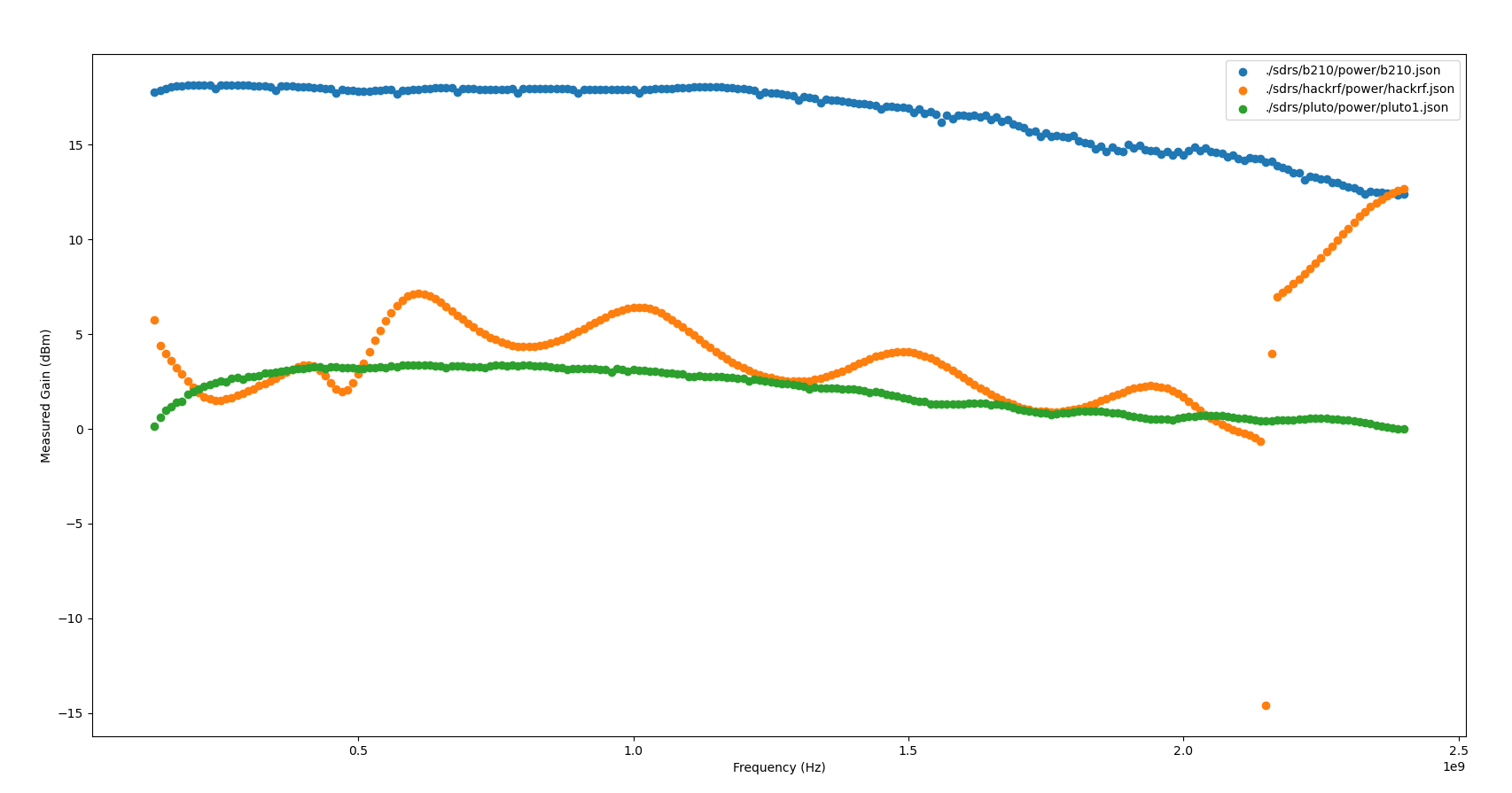
 Over the last few years, I ve often wondered what the true power output of my
SDRs are. It s a question with a shocking amount of complexity in the
response, due to a number of factors (mostly Frequency). The ranges given in
spec sheets are often extremely vague, and if I m being honest with myself,
not incredibly helpful for being able to determine what specific filters and
amplifiers I ll need to get a clean signal transmitted.
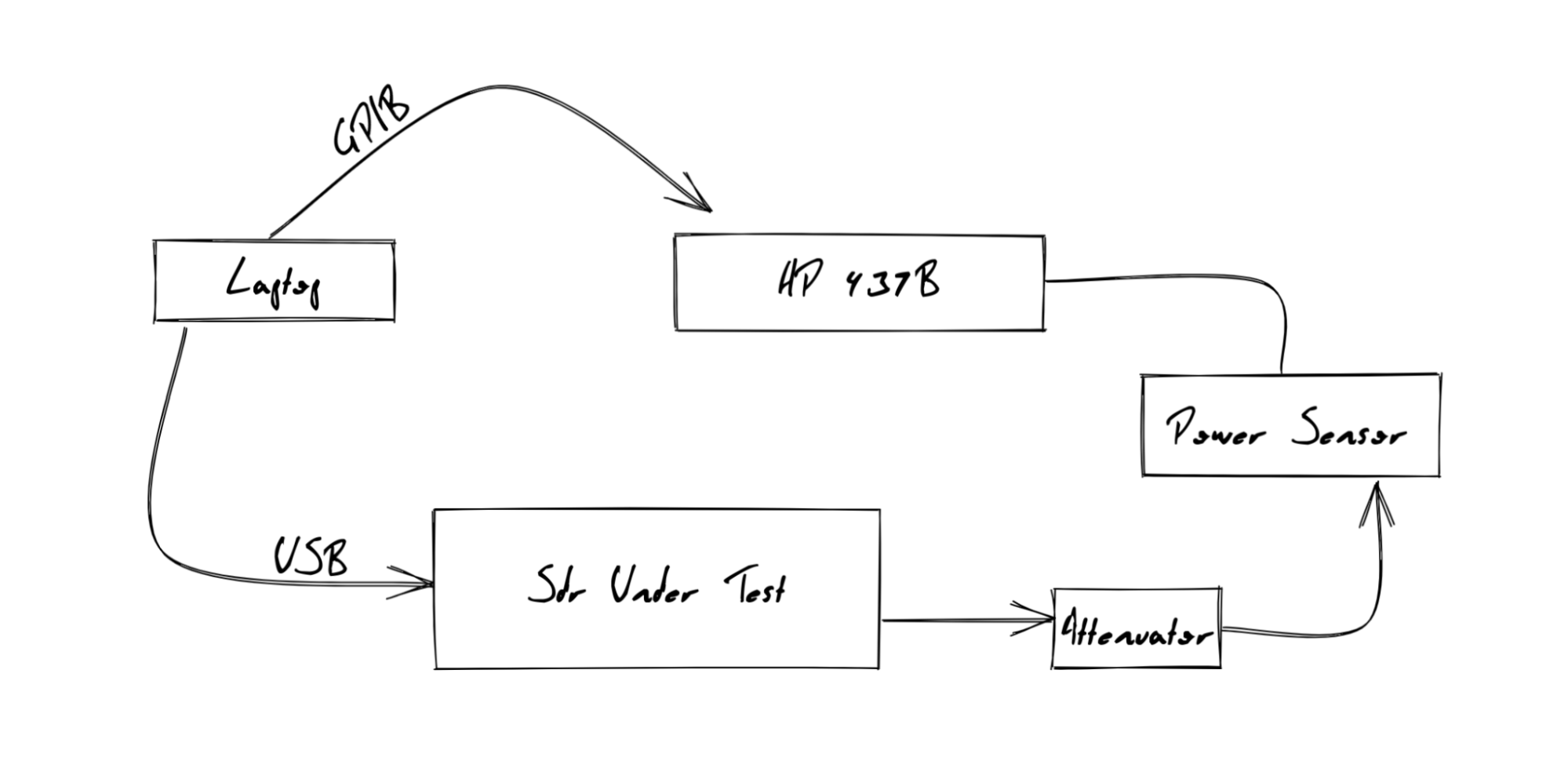
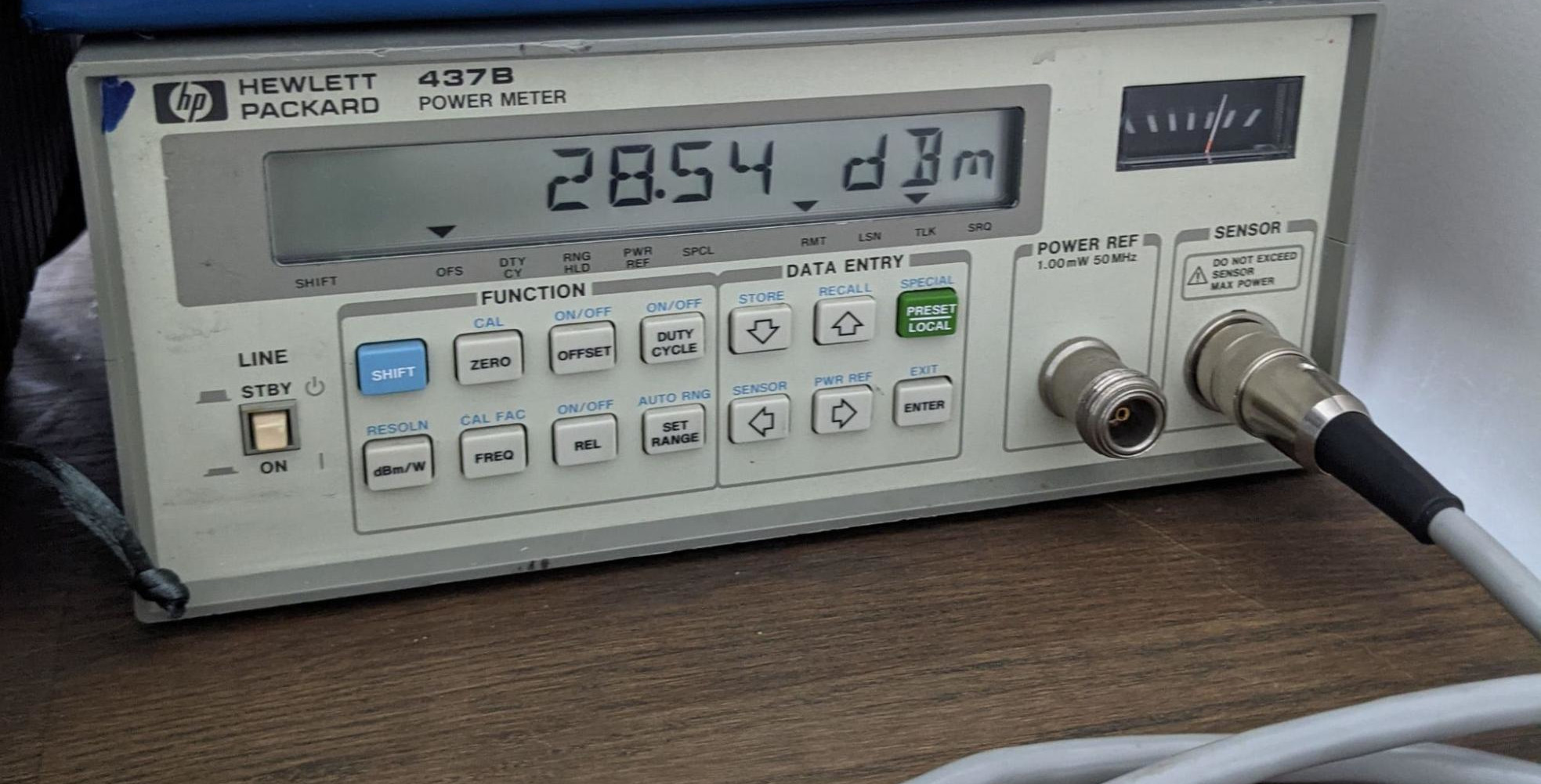 I bought an HP 437B, which is the cutting edge of 30 years ago, but still
accurate to within 0.01dBm. I paired this Power Meter with an Agilent 8481A
Power Sensor (-30 dBm to 20 dBm from 10MHz to 18GHz). For some of my radios, I
was worried about exceeding the 20 dBm mark, so I used a 20db attenuator while
I waited for a higher power power sensor. Finally, I was able to find a GPIB to
USB interface, and get that interface working with the GPIB Kernel driver on my
system.
With all that out of the way, I was able to write
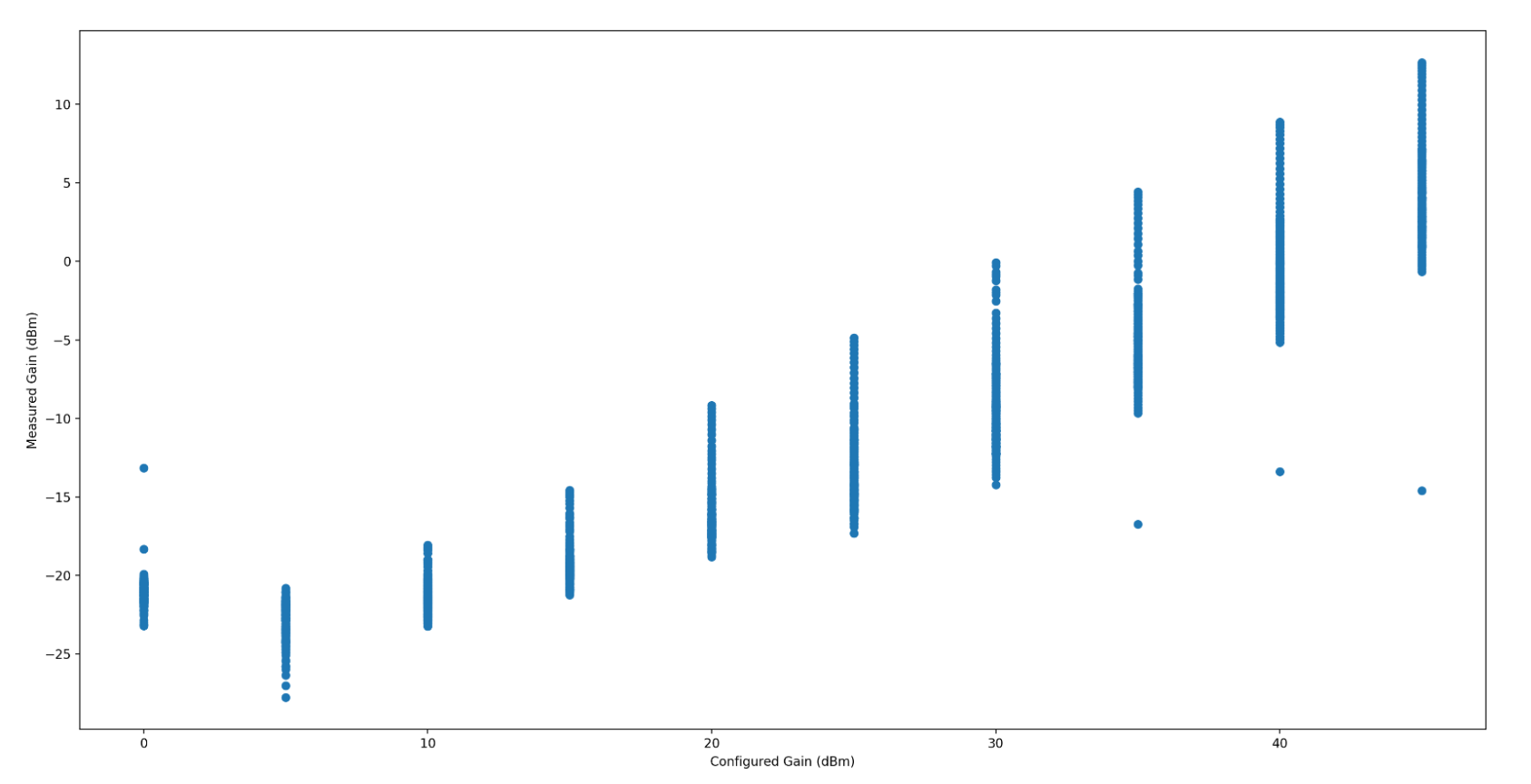 When looking at output power over the frequency range swept, the HackRF
contains a distinctive (and frankly jarring) ripple across the Frequency range,
with a clearly visible jump in gain somewhere around 2.1GHz. I have no idea
what is causing this massive jump in output gain, nor what is causing these
distinctive ripples. I d love to know more if anyone s familiar with HackRF s
RF internals!
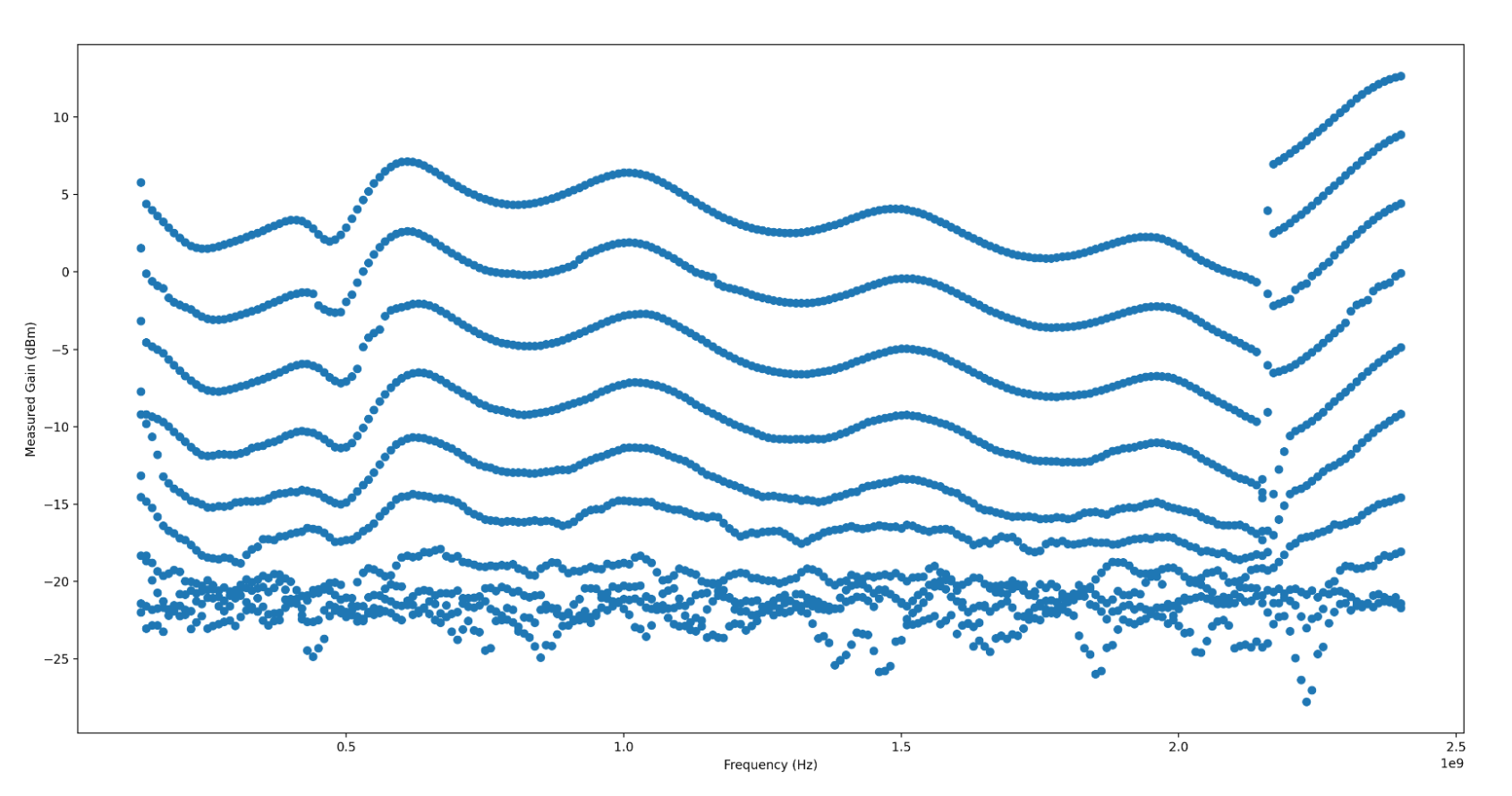
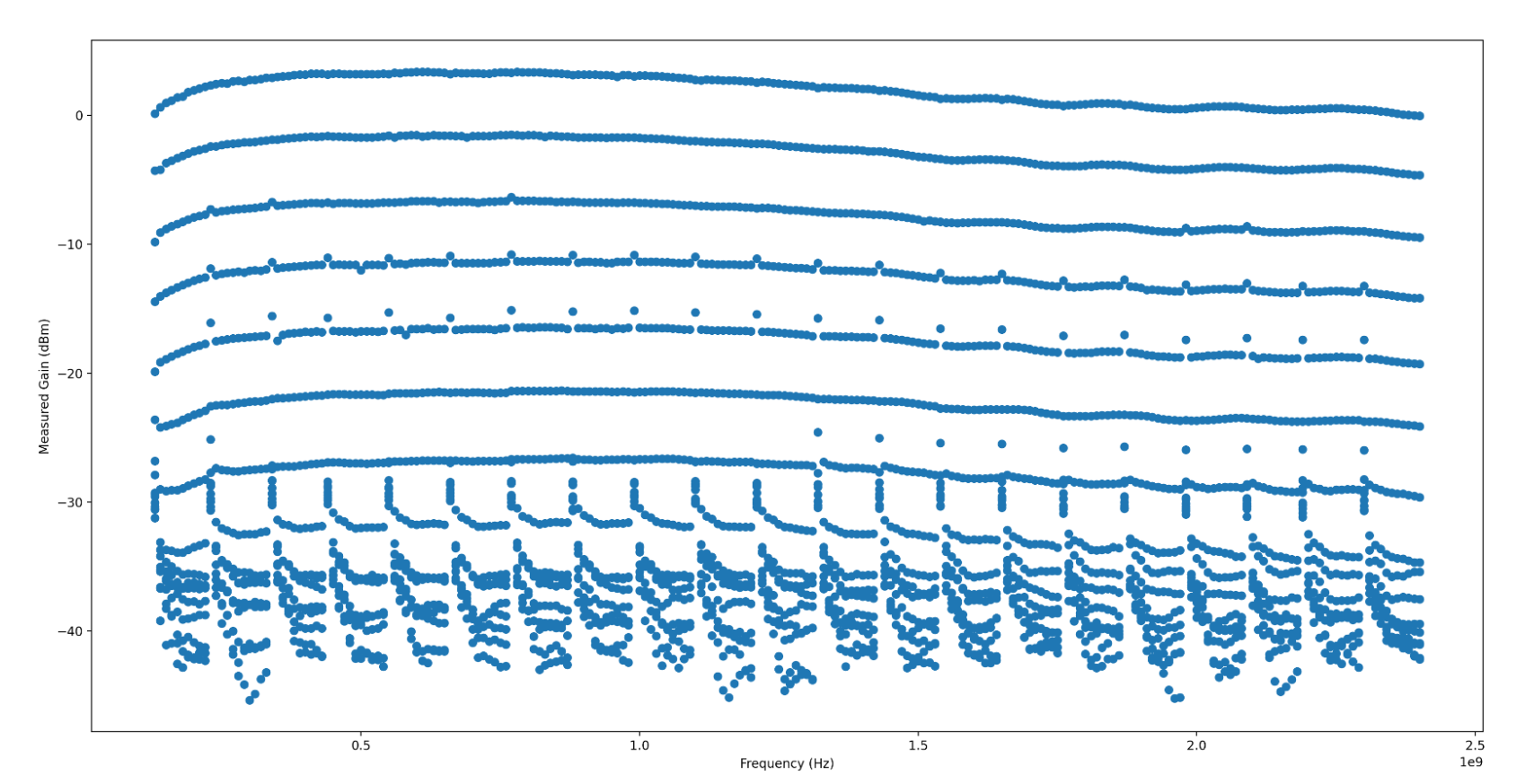
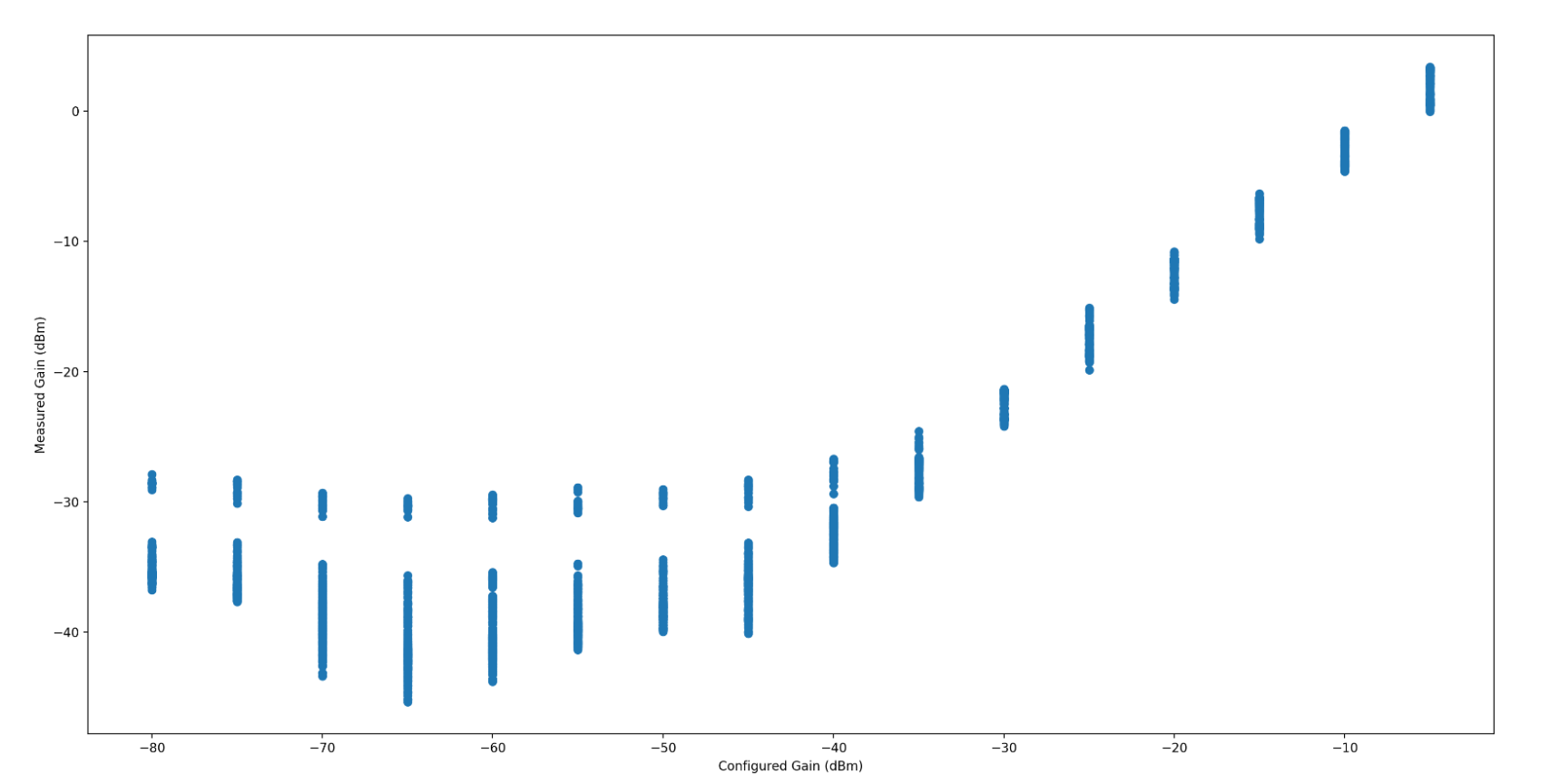 Generally, the power output is quite stable, and looks to have very even and
wideband gain control. There s a few artifacts, which I have not confidently
isolated to the SDR TX gain, noise (transmit artifacts such as intermodulation)
or to my test setup. They appear fairly narrowband, so I m not overly worried
about them yet. If anyone has any ideas what this could be, I d very much
appreciate understanding why they exist!
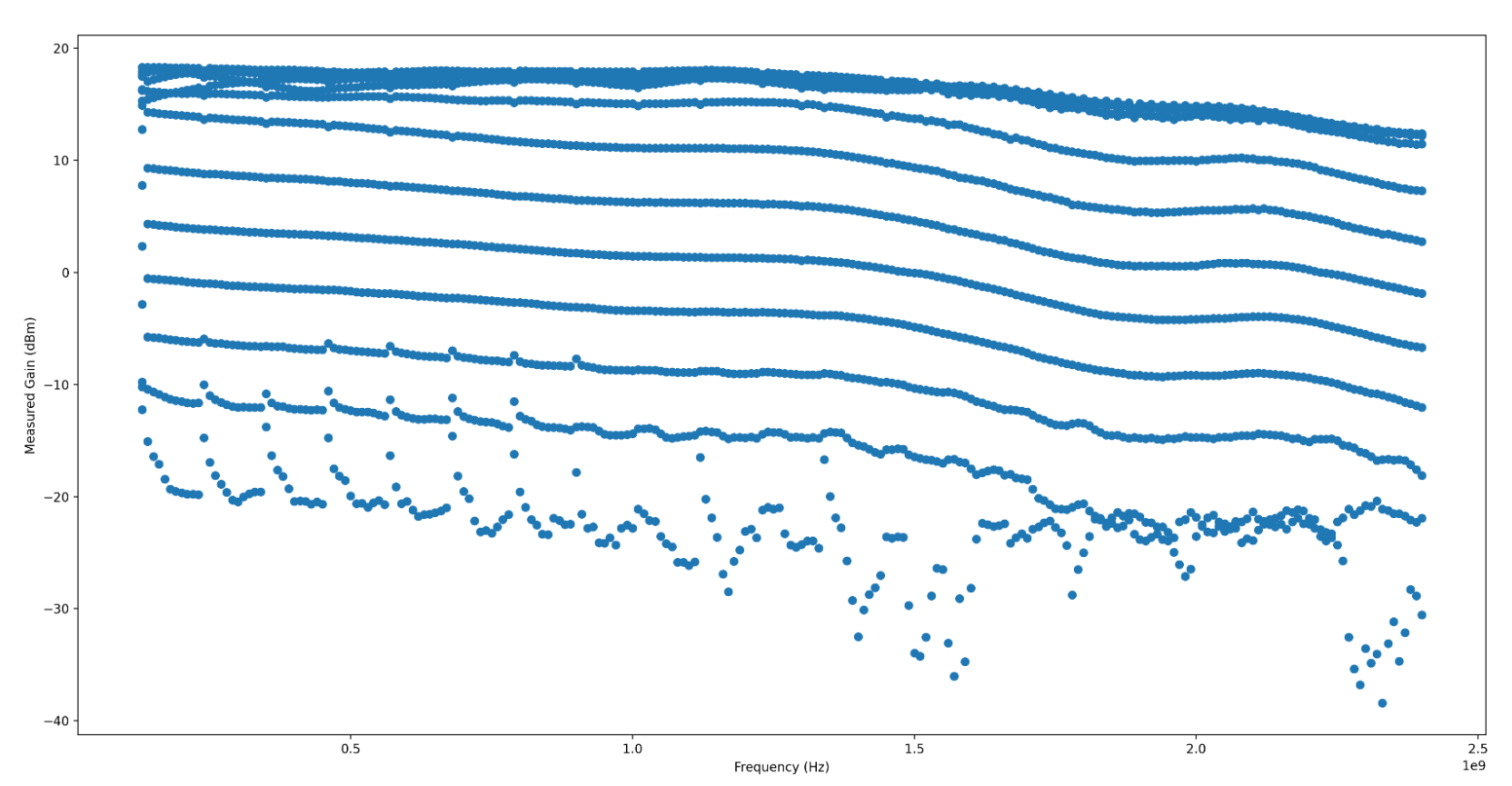
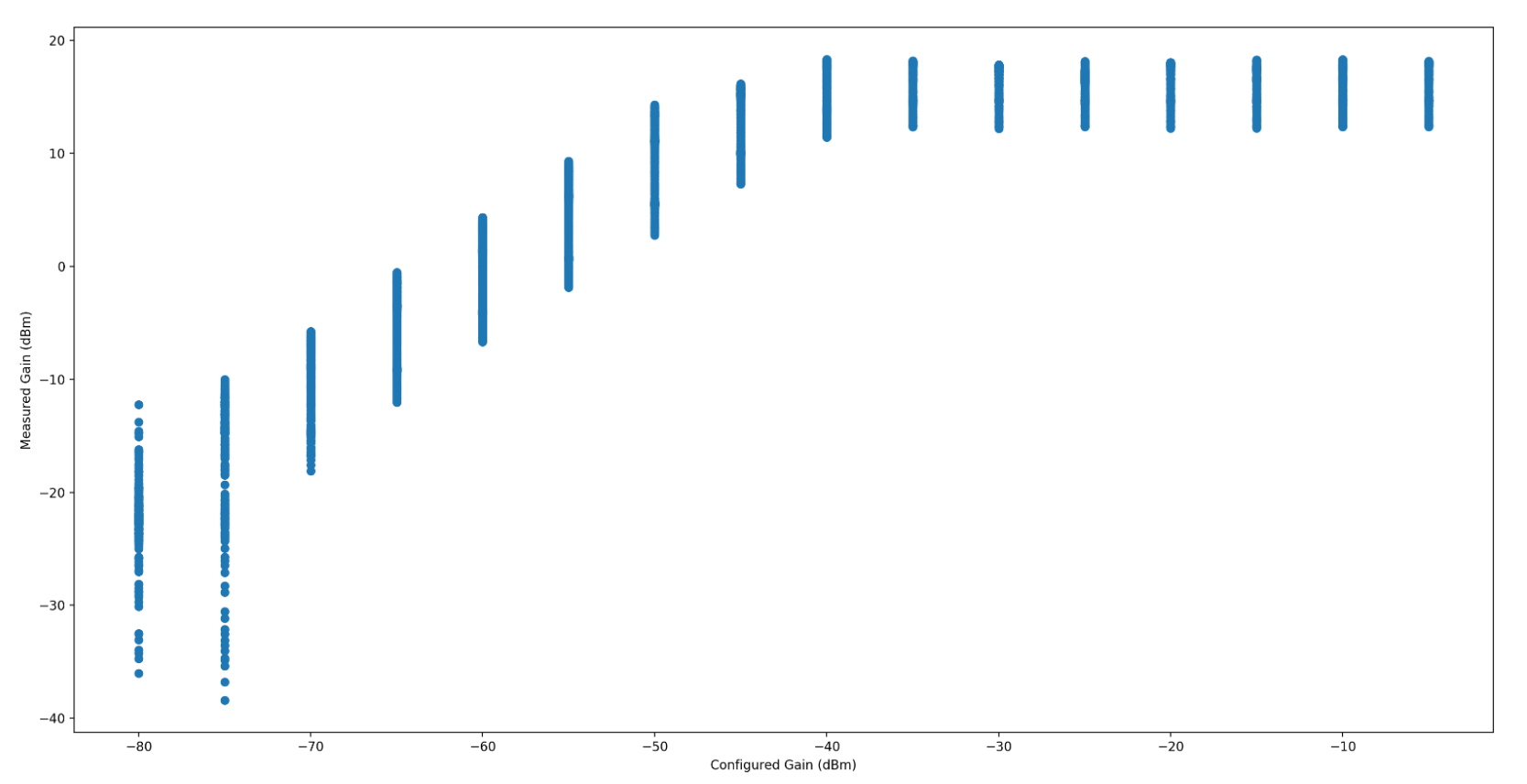 When the Gain is somewhere around the noise floor, the measured gain is
incredibly erratic, which throws the maximum standard deviation significantly.
I haven t isolated that to my test setup or the radio itself. I m inclined to
believe it s my test setup. The radio has a fairly even and wideband gain, and
so long as you re operating between -70dB to -55dB, fairly linear as well.
 Group photo of the Ruby Team in Brewberry Bar (Paris 2020)
