Search Results: "sf"

30 August 2008

Russell Coker: Improving Blog Latency to Benefit Readers

I just read an interesting post about latency and how it affects web sites [1]. The post has some good ideas but unfortunately mixed information on some esoteric technologies such as infiniband that are not generally applicable with material that is of wide use (such as ping times). The post starts by describing the latency requirements of Amazon and stock broking companies. It’s obvious that stock brokers have a great desire to reduce latency, it’s also not surprising that Google and Amazon analyse the statistics of their operations and make changes to increase their results by a few percent. But it seems to be a widely held belief that personal web sites are exempt from such requirements. The purpose of creating content on a web site is to have people read it, if you can get an increase in traffic of a few percent by having a faster site and if those readers refer others then it seems likely to have the potential to significantly improve the result. Note that an increase in readership through a better experience is likely to be exponential, and an exponential increase of a few percent a year will eventually add up (an increase of 4% a year will double the traffic in 18 years). I have been considering hosting my blog somewhere else for a while. My blog is currently doing about 3G of traffic a month which averages out to just over 1KB/s, peaks will of course be a lot greater than that and the 512Kb/s of the Internet connection would probably be a limit even if it wasn’t for the other sites onn the same link. The link in question is being used for serving about 8G of web data per month and there is some mail server use which also takes bandwidth. So performance is often unpleasantly slow. For a small site such as mine the most relevant issues seem to be based around available bandwidth, swap space use (or the lack therof), disk IO (for when things don’t fit in cache) and available CPU power exceeding the requirements. For hosting in Australia (as I do right now) bandwidth is a problem. Internet connectivity is not cheap in any way and bandwidth is always limited. Also the latency of connections from Australia to other parts of the world often is not as good as desired (especially if using cheap hosting as I currently do). According to Webalizer only 3.14% of the people who access my blog are from Australia, they will get better access to my site if hosted in Australia, and maybe the 0.15% of people who access my blog from New Zealand will also benefit from the locality of sites hosted in Australia. But the 37% of readers who are described as “US Commercial” (presumably .com) and the 6% described as “United States” (presumably .us) will benefit from US hosting, as will most of the 30% who are described as “Network” (.net I guess). For getting good network bandwidth it seems that the best option is to choose what seems to be the best ISP in the US that I can afford, where determining what is “best” is largely based on rumour. One of the comments on my post about virtual servers and swap space [2] suggested just not using swap and referenced the Amazon EC2 (Elastic Computing) cloud service and the Gandi.net hosting (which is in limited beta and not generally available). The Amazon EC2 clound service [3] has a minimum offering of 1.7G of RAM, 1EC2 Compute Unit (equivalent to a 1.0-1.2GHz 2007 Opteron or 2007 Xeon processor), 160G of “instance storage” (local disk for an instance) running 32bit software. Currently my server is using 12% of a Celeron 2.4GHz CPU on average (which includes a mail server with lots of anti-spam measures, Venus, and other things). Running just the web sites on 1EC2 Compute Unit should use significantly less than 25% of a 1.0GHz Opteron. I’m currently using 400M of RAM for my DomU (although the MySQL server is in a different DomU). 1.7G of RAM for my web sites is heaps even when including a MySQL server. Currently a MySQL dump of my blog is just under 10M of data, with 1.7G of RAM the database should stay entirely in RAM which will avoid the disk IO issues. I could probably use about 1/3 of that much RAM and still not swap. The cost of EC2 is $US0.10 per hour of uptime (for a small server), so that’s $US74.40 per month. The cost for data transfer is 17 cents a GIG for sending and 10 cents a gig for receiving (bulk discounts are available for multiple terabytes per month). I am not going to pay $74 per month to host my blog. But sharing that cost with other people might be a viable option. An EC2 instance provides up to 5 “Elastic IP addresses” (public addresses that can be mapped to instances) which are free when they are being used (there is a cost of one cent per hour for unused addresses - not a problem for me as I want 24*7 uptime). So it should be relatively easy to divide the costs of an EC2 instance among five people by accounting for data transfer per IP address. Hosting five web sites that use the same software (MySQL and Apache for example) should reduce memory use and allow more effective caching. A small server on EC2 costs about five times more than one of the cheap DomU systems that I have previously investigated [4] but provides ten times the RAM. While the RAM is impressive, I have to wonder about CPU scheduling and disk IO performance. I guess I can avoid disk IO on the critical paths by relying on caching and not doing synchronous writes to log files. That just leaves CPU scheduling as a potential area where it could fall down. Here is an interesting post describing how to use EC2 [5]. Another thing to consider is changing blog software. I currently use Wordpress which is more CPU intensive than some other options (due to being written in PHP), is slightly memory hungry (PHP and MySQL), and doesn’t have the best security history. It seems that an ideal blog design would use a language such as Java or PHP for comments and use static pages for the main article (with the comments in a frame or loaded by JavaScript). Then the main article would load quickly and comments (which probably aren’t read by most users) would get loaded later.

29 August 2008

Wouter Verhelst: Debconf8, and the m68k meeting in Kiel

As I start this blog post, I'm on the train between Amersfoort and Osnabr ck, on my way to Kiel, where there'll be a meeting of the m68k porters, kindly organized by m68k kernel maintainer Christian Steigies. I took the 8:40 train in Mechelen this morning, and if all goes well, I'll be arriving in Kiel at 17:22 tonight. Some train trip... but I certainly prefer that to any flight. Anyway. The days of Debconf were very nice. Debconf is a lot of things to me. Travel. Hacking. Mao, evolving into a drinking game. Beer. Attending talks. Giving talks. Meeting people. Face-to-face non-flaming. Gesturing for an extra knife at luunch. Hangover. Whiskey. Talking to the person next to you—over IRC. Getting killed before knowing what the rules of the assassins game are. Filing bugreports in person. Pictures. Kilts. Streaming video. Not being sick, hopefully. Name badges. Flying. Sleeping. Yes, sleeping. Most of all, though, this year, Debconf was just great. Thanks. You know who you are. After debconf, I flew to Buenos Aires, where I slept for one night in a Youth Hostel somewhere downtown. They were affordable, but the bed wasn't great—the mattress sorely needed replacement. Since I had a day in BA, and since there were apparently not enough people on the schedule, I'd agreed to hold a talk, and came up with the idea of a 'debian secrets' talk—about Debian-specific commands, such as dpkg-divert and update-alternatives etc—so that people could learn how to use their Debian system more efficiently. As I was sitting in Andreas' talk, who was right before me on the schedule, suddenly Dag walked up to me and said hi. This was unexpected; Dag is a fellow Belgian, who's involved with the CentOS project, and who maintains a positively huge RPM repository at his site—if you maintain an RPM-based system somewhere, you'll probably know about that site. So while I recognized him, I immediately wondered what he was doing there. Turned out he was invited to hold a talk at the Free Software event to which Debianday was attached (and which would not start for another day or two), and that when he saw my name on the schedule, he decided to attend. Fun. He learned a thing or two from my talk, and was talking later about writing some tools for RPM-based systems that would perform the same or similar functionality implemented by some of the Debian tools I talked about. Great. We had a picture together (in front of the DebConf banner—hah) that I still should upload, and then went out for lunch together with some other CentOS guys. The talk itself seems to have been well-received, and I'm glad about that; I only gave it because there was a need for more talks, not because I felt confident I was very knowledgeable about that subject. In fact, I did have to ask on the debconf-discuss mailinglist for some input (which I received) so that I could make sure the talk would actually be useful to people. That helped a lot, I guess. After that, we played some mao in the lobby of the DebianDay venue. While doing so, I overheard Dag talking about CentOS, advocating it to some of the people there, which I must say felt pretty weird on a Debian event. Not that there's anything wrong with it, of course. Except that Dag was supposed to be writing his talk slides. How did that work out, Dag? ;-) Eventually, I got in a cab to the EZE airport, and flew home. That wasn't fully without issue, but I did get there. And now, I've been, eh, overloaded. Still have to follow up on a question a customer asked me, but I've barely been home or at the office, just enough to sleep really. Should do something about that, I guess... Two days ago, I also managed to forget my camera somewhere. For 12 hours, I was worried, even though I had a pretty good idea of where it was; but since I'm getting quite good at taking pictures now, and since I really like doing so as well, I really didn't want to lose my camera. Fortunately, when I called this morning to the place where I thought I'd lost it, they told me it'd been found, and where to get it. In other words, it's safe, it's taken care of, Philip went to get it, and I just need to arrange to get it when I get back. Which is a relief. Let's not be so stupid anymore in the future... Finishing up now, a day later, and I'm at Christian's office, playing with his and my coldfire board. As it happens, it appears that Freescale has brought out a new BSP for these boards, so that's nice. Let's see whether we can get those to boot again...

27 August 2008

Pablo Lorenzzoni: Paul Graham and his start-up funding company

I first read about Y Combinator while browsing Paul Graham s website. I am a huge fan of his and have tried many times to bring him to Brazil for FISL (unsuccessfully so far). By that time I was updating a lecture of mine where I quote something from his Hackers and Painters essay and sudenly I noted an YC link on the left, and decided to click to learn what was that. Y Combinator is a venture capital firm to help start-ups. It was built on the concept that not much money is needed for first-stage start-ups ( from idea to company , as they call it). Quite a concept! I lost track of it until yesterday, when I read this blog post summarizing one of its events for start-ups. I found it amazing how far it came in such little time. They ve already funded about 100 start-ups, some of them really interesting. Of those presented in that post, Posterous is one I found most interesting. They create instant blogs just by sending emails to some address. There s no sign-up procedure Just send the email with any attachments and voil . There you have: a new blog. Many others are really interesting (PollEveryWhere, IDidWork, Frogmetrics, just to name a few), so I really suggest reading that post. I think Y Combinator is another great idea from Paul Graham, and I will be following it more closely, as a way to keep myself updated Who knows maybe I can get them to come to FISL to present that! ;-)

26 August 2008

Russell Coker: Killing Servers with Virtualisation and Swap

The Problem: A problem with virtual machines is the fact that one rogue DomU can destroy the performance of all the others by inappropriate resource use. CPU scheduling is designed to allow reasonable sharing of computational resources, it is unfortunately not well documented, the XenSource wiki currently doesn’t document the “credit” scheduler which is used in Debian/Etch and CentOS 5 [1]. One interesting fact is that CPU scheduling in Xen can have a significant effect on IO performance as demonstrated in the paper by Ludmila Cherkasova, Diwaker Gupta and Amin Vahdat [2]. But they only showed a factor of two performance difference (which while bad is not THAT bad). A more significant problem is managing virtual memory, when there is excessive paging performance can drop by a factor of 100 and even the most basic tasks become impossible. The design of Xen is that every DomU is allocated some physical RAM and has it’s own swap space. I have previously written about my experiments to optimise swap usage on Xen systems by using a tmpfs in the Dom0 [3]. The aim was to have every Xen DomU swap data out to a tmpfs so that if one DomU was paging heavily and the other DomUs were not paging then the paging might take place in the Dom0’s RAM and not hit disk. The experiments were not particularly successful but I would be interested in seeing further research in this area as there might be some potential to do some good. I have previously written about the issues related to swap space sizing on Linux [4]. My conclusion is that following the “twice RAM” myth will lead to systems becoming unusable due to excessive swapping in situations where they might otherwise be usable if the kernel killed some processes instead (naturally there are exceptions to my general rule due to different application memory use patterns - but I think that my general rule is a lot better than the “twice RAM” one). One thing that I didn’t consider at the time is the implications of this problem for Xen servers. If you have 10 physical machines and one starts paging excessively then you have one machine to reboot. If you have 10 Xen DomUs on a single host and one starts paging heavily then you end up with one machine that is unusable due to thrashing and nine machines that deliver very poor disk read performance - which might make them unusable too. Read performance can particularly suffer in a situation when one process or VM is writing heavily to disk due to the way that the disk queuing works, it’s not uncommon for an application to read dozens or hundreds of blocks from disk to satisfy a single trivial request from a user, if each of these block read requests has to wait for a large amount of data to be written out from the write-back cache then performance will suck badly (I have seen this in experiments on single disks and on Linux software RAID - but have not had the opportunity to do good tests on a hardware RAID array). Currently for Xen DomUs I am allocating swap spaces no larger than 512M, as anything larger than that is likely to cause excessive performance loss to the rest of the server if it is actually used. A Solution for Similar Problems: A well known optimisation technique of desktop systems is to use a separate disk for swap, in desktop machines people often use the old disk as swap after buying a new larger disk for main storage. The benefit of this is that swap use will not interfere with other disk use, for example the disk reads needed to run the “ps” and “kill” programs won’t be blocked by the memory hog that you want to kill. I believe that similar techniques can be applied to Xen servers and give even greater benefits. When a desktop machine starts paging excessively the user will eventually take a coffee break and let the machine recover, but when an Internet server such as a web server starts paging excessively the requests keep coming in and the number of active processes increases so it seems likely that using a different device for the swap will allow some processes to satisfy requests by reading data from disk while some other processes are waiting to be paged in. Applying it to Xen Servers: The first thing that needs to be considered for such a design is the importance of reliable swap. When it comes to low-end servers there is ongoing discussion about the relative merits of RAID-0 and RAID-1 for swap. The benefit of RAID-0 is performance (at least in perception - I can imagine some OS swapping algorithms that could potentially give better performance on RAID-1 and I am not aware of any research in this area). The benefit of RAID-1 is reliability. Now there are two issues in regard to reliability, one is continuity of service (EG being able to hot-swap a failed disk while the server is running), and the other is the absence of data loss. For some systems it may be acceptable to have a process SEGV (which I presume is the result if a page-in request fails) due to a dead disk (reserving the data loss protection of RAID for files). One issue related to this is the ability to regain control of a server after a problem. For example if the host OS of a machine had non-RAID swap then a disk failure could prevent a page-in of data related to sshd or some similar process and thus make it impossible to recover the machine without hardware access. But if the swap for a virtual machine was on a non-RAID disk and the host had RAID for it’s swap then the sysadmin could login to the host and reboot the DomU after creating a new swap space on a working disk. Now if you have a server with 8 or 12 disks (both of which seem to be reasonably common capacities of modern 2RU servers) and if you decide that RAID is not required for the swap space of DomUs then it would be possible to assign single disks for swap spaces for groups of virtual machines. So if one client had several virtual machines they could have them share the same single disk for the swap, so a thrashing server would only affect the performance of other VMs from the same client. One possible configuration would be a 12 disk server that has a four disk RAID-5 array for main storage and 8 single disks for swap. 8 CPU cores is common for a modern 2RU server, so it would be possible to lock 8 groups of DomUs so that they share CPUs and swap spaces. Another possibility would be to have four groups of DomUs where each group had a RAID-1 array for swap and two CPU cores. I am not sure of the aggregate performance impact of such a configuration, I suspect that a group of single disks would give better performance for swap than a single RAID array and that RAID-1 would outperform RAID-5. For a single DomU it seems most likely that using part of a large RAID array for swap space would give better performance. But the benefit in partitioning the server seems clear. An architecture where each DomU had it’s own dedicated disk for a swap space is something that I would consider a significant benefit if renting a Xen DomU. I would rather have the risk of down-time (which should be short with hot-swap disks and hardware monitoring) in the rare case of a disk failure than have bad performance regularly in the common situation of someone else’s DomU being overloaded. Failing that, having a separate RAID array for swap would be a significant benefit. If every process that isn’t being paged out could deliver full performance while one DomU was thrashing then it would be a significant benefit over the situation where any DomU can thrash and kill the file access performance of all other DomUs. A single RAID-1 array should handle all the swap space requirements for a small or medium size Xen server One thing that I have not tested is the operation of LVM when one disk goes bad. In the case of a disk with bad sectors it’s possible to move the LVs that are not affected to other disks and to remove the LV that was affected and re-create it after removing the bad disk. The case of a disk that is totally dead (IE the PV header can’t be read or written) might cause some additional complications.

MJ Ray: Solved but Why? Belkin F5D7630 to Realtek 8139 Drop-outs

I’d been having problems connecting my laptop to my router to the Phone Coop using a new network cable that I laid under the floor just after the new heating system was installed. It’s a 1970s building - cat-5 wasn’t installed with the original wiring and mains homeplug networking is tricky on this wiring layout. The growing number of people with WiFi and video senders on my hillside (70% of UK users “never or rarely switch off their broadband wireless routers”) seems to be causing more interference and slow-downs, so it seemed worth installing a wired connection while the floors were up. The connection seemed to work fine, but then kept stopping for 20 seconds at a time - that’s just long enough to break network connections, but barely long enough to start up debugging tools, let alone get useful output. I was pretty sure the cable wasn’t at fault - Paul tested it with his fancy test gear when he completed the wiring for me. That left the hardware: my much-hated Belkin F5D7630 and the Realtek 8139 in the bizarre Compaq Evo N1015v. I’ve still not got around to replacing that Belkin and it’s been behaving itself well enough recently, while the Compaq has run smoothly once I actually got Linux onto it. I found the end of this Ubuntu Forums thread which pointed to this archlinux bulletin board thread which suggested pnpbios=off pnpacpi=off in the boot options. After adding that, the 20-second network pauses have stopped. But why? The ACPI and BIOS in this laptop are generally troublesome (and it looks like this also happens on some Presarios), but what in particular is going wrong this time? Will I suffer ill effects from switching off PNP options? Time will tell, I guess.

Neil Williams: Using Zenity to review (RC) bugs

I've written a simple perl script using SOAP to add some useful data to the RC bug list (or any list of bugs). It can easily be extended but right now it supports simple things like the date the bug was filed, short description of the package, the name of the maintainer, the most recent upload data, the debtags for the package, apt-cache policy data and whether the bug is already tagged pending.
Zenity presents this info in a question dialog, clicking OK loads the bug and the PTS in your browser using 'sensible-browser'.
Clicking cancel offers a new zenity dialog asking for the next bug number. (Click Cancel there to end the script.)
Code: http://linux.codehelp.co.uk/rc-zenity.pl (GPLv3 or later)
POD: http://linux.codehelp.co.uk/rc-zenity.html (easily convertible into a manpage using pod2man)
If you like it, use it.
If lots of people like it, maybe it can go into an existing package.
If I've duplicated another script that I just didn't know about, tell me.
:-)
It's not exclusively for RC bugs, it could work with any bug list or be modified to only look for particular severity settings.
Thanks to Don Armstrong for making debbugs so accessible using SOAP. The debbugs SOAP implementation is just so straightforward with a whole load of useful data returned without needing repeated queries, it makes scripts like this really satisfying.

22 August 2008

MJ Ray: Bristol and Bath LUG Meeting 23 August 2008

Apparently the LUG’s website is still off-line and there’s no idea when it will return, so let me use this site to help announce that the LUG’s regular meeting at the Knights Templar public house, near Isambard Walk, Bristol, will happen tomorrow Saturday 23 August from noon-ish until whenever people drift away. Software Freedom Day happens between this meeting and the next one. Is anyone interested in running a Bristol-area event and do you know of a suitable/available venue? I’m finding the SFD official site somewhat dysfunctional (I’m not in the Northern Caucasus, damnit), so I’ve not found a nearby team registered yet…

21 August 2008

Ingo Juergensmann: Adding a RAID under a LVM

Just as a personal reminder for the next time I need that:

If there's a machine, for example a Xen host, with just one harddisk and you want to be somewhat safe in case of a disk failure, you can add a second disk and setup a RAID1 (mirroring). It's most simple to shutdown the machine and setup the RAID1 for the dom0. Afterwards you can start the domU VMs again when you're using LVM for their virtual disks. Following these steps will add RAID1 underneath your LVM setup:

0. /dev/sda5 is your current physical volume for your LVM, on the second (equally partitioned) disk /dev/sdb5 will be your starting point for your RAID1 (/dev/md3)
1. create a degraded RAID1 on /dev/sdb5:
# mdadm --create /dev/md3 --level=1 -f --raid-devices=1 /dev/sdb5
mdadm: array /dev/md3 started.
# cat /proc/mdstat
md3 : active raid1 sdb5[0]
135540288 blocks [1/1] [U]

2. prepare it for LVM and add it to your virtual group:
# pvcreate /dev/md3
# vgextend /dev/vg /dev/md3
Volume group "vg" successfully extended

3. move the extends from one disk to the other and be verbose to watch the progress:
# pvmove -v /dev/sda5
Finding volume group "vg"
Archiving volume group "vg" metadata (seqno 22).
Creating logical volume pvmove0
Moving 192 extents of logical volume vg/ts2-swap
Moving 1536 extents of logical volume vg/ts2-disk
[....]
Found volume group "vg"
Removing temporary pvmove LV
Writing out final volume group after pvmove
Creating volume group backup "/etc/lvm/backup/vg" (seqno 31)

4. remove the old partition from the virtual group:
# vgreduce /dev/vg /dev/sda5
Removed "/dev/sda5" from volume group "vg"

5. add the old partition to your raid and set it active:
# mdadm --add /dev/md3 /dev/sda5
mdadm: added /dev/sda5
# cat /proc/mdstat
md3 : active raid1 sda5[1](S) sdb5[0]
135540288 blocks [1/1] [U]
# mdadm --grow /dev/md3 --raid-devices=2
# cat /proc/mdstat
md3 : active raid1 sda5[2] sdb5[0]
135540288 blocks [2/1] [U_]
[>....................] recovery = 0.2% (284480/135540288) finish=39.6min speed=56896K/sec

6. let the RAID1 doing its sync and you're done.

Just as a small side note:
I don't know why the kernel don't want to boot when it get passed root=/dev/md2 as a kernel parameter. It works with root=/dev/sda3, though...

20 August 2008

Adam Rosi-Kessel: Walter Michalik and the Roslindale Community Center

I’ve had little time in the four years I’ve lived in Roslindale to get involved in community volunteer efforts. My wife Rachele, however, has devoted several years to efforts such as the Roslindale Community Center, Roslindale Village Main Streets, and Roslindale Clean and Green. She has served as chair of both RCC and one of the RVMS committees. Over the past few months, I’ve been disappointed to see the RCC board endure repeated senseless attacks by a perhaps overzealous community member, Walter Michalik, who has effectively paralyzed the organization. I have nothing personal against this guy, but I thought I could do my part here by publishing an example of an email he broadcast to the committee, which I think is embarrassing enough on its own merits to need no editorializing from me, except to say any email that starts with “just so you won’t be surprised when the IRS launches its investigation” can be neither productive nor taken seriously. The context is a response to an announcement sent out pursuant to the Community Centers By-Laws scheduling a special meeting to discuss the recent upheaval on the Council. There’s no reason this should not be in the public record:
Rachele Just so you won’t be surprised when the IRS launches its investigation, be advised that YOU DO NOT HAVE THE AUTHORITY TO CALL FOR A SPECIAL MEETING. The By Laws do not allow the President/Chair to call for a Special meeting - that right is reserved for the MEMBERS to have a power over a hostile or non-performing President/Chair. It was created by a Membership wary of annimosity within its ranks in order to protect itself from falling into a useless dysfunctional body. That’s why our By Laws require the majority of the membership request it through the Chair and not the other way around. So you screwed that up too. Your continuous violation of rules and laws have proven beyond a doubt that this current Roslindale Community Center Council has violated the trust behind its IRS-designated not-for-profit status. The failures are on so many significant levels over 6 months it is readily apparent that the Roslindale Community is better served without a Community Center Council. There is no longer any excuse to allow the residents of Roslindale to be denied the services they deserve that you and the officers have no idea how to deliver. Because that’s what you are supposed to do - serve the residents of Roslindale and not preseide over a self-serving board. You’ve taken us from dysfunctional to non-functional over the past 60 days. You and your officers have already driven away our Archdale partners and now the merger is off. Congratulations. You got what you wanted. You and the officers have withheld information from the Members of the Council imposing gag orders along the way and in more than one instance spreading lies within this community. There are so very many lapses on your part and the rest of the officers that it is very apparent that the Roslindale Community Center exists IN SPITE OF the Roslindale Community Center Council - not because of it. It would be far better indeed, if the Center were run without the Council. What have you done in 6 months? All you do is avoid the work of leadership. Please, just gracefully step aside and let a real leader emerge - or dissolve the Council and let the Center run itself under BCYF before the IRS makes that happen. Of course this is my stated opinion. You can choose not to belive it. You can huddle with a group of self-serving officers and invent excuses or change the agenda away from the message and continue with your ad hominem attacks against the messenger. I’m thick-skinned. Feelings aren’t important to me - services to residents are important to me. While I have, in fact, enjoyed the confidences of others within this community and their true displesure with this Council, I will produce that to the appropriate authorities as I see fit along with the Bill of Particulars I have produced with documentation for all charges. As a founder of the Roslindale Community Center Council I can no longer support you or the officers as any legitimate authority in this community.
Technorati Tags: , ,

John Goerzen: From Dell, a Uniquely Terrible Experience

Ah, Dell. Seeming inventors of the tech support pit of bureaucratic indifferences, inventors of the flamingo pink Inspiron, perpetrators of fraud in New York...

I have, for over a year now, been on a crusade trying to get them to stop sending me their Dell Home and Home Office catalog to my mailbox. It has been a bundle of fun, let me tell you.

They have a nice-sounding privacy policy. It says you can opt out of all their mailings by filling out a form online. Yeah, good luck with that. First of all, there are different forms for different departments at Dell. I've filled out them all, multiple times. They do nothing whatsoever. Perhaps they use them as lists of known-good addresses to send new advertisements to, rather than lists of people to remove. Oh well.

Now, unfortunately I feel compelled to bore you with the saga so far, involving telephone hang-ups, broken privacy policies, and the like. But there is a silver lining at the end, in which I submitted a request to the postal service asking them to block Dell from sending me any more mail, and it appears that they are very likely to violate Federal Law any day now.

I have called them about it. Dealt with the old "let me transfer you to the correct department" then hang up on me ploy. Spoken to people that have promised up and down that I'll be off their list in 30-60 days. It's always 30-60 days, isn't it? Very convenient that I can't tell for 2 months whether or not they've processed my request.

I've tried their online chat. One of my attempts went like this:

Session Started with Agent (Sneha Ranga)

Agent (Sneha Ranga): "Due to circumstances that have affected Dell Communications I am temporarily unable to pull up any information. The down time is temporary. We apologize for the inconvenience, as we value your time as a customer. Please contact us back after an hour."

Session Ended


Ah Dell, only you could reach such a pinnacle of customer service. /kicking someone out of a chat room before they have a chance to say a word.

Finally, last fall, I blogged about the situation (that's the link above). Debbie from Dell red the post and emailed me. Great, I thought. She asked for my address information and catalog information and sent me a removal confirmation:


From: Debbie@Dell.com
Date: Thu, 18 Oct 2007 13:08:18 -0500
To: jgoerzen@complete.org
Subject: RE: Dell mailing list

Thank you, Mr. Goerzen, your request to have the below address
information removed from our marketing lists has been received:

[ my address here ]

We will process your request promptly. However, it may take several
weeks for some changes to take effect. If you are still receiving
catalogs after thirty (30) days feel free to email me. Sorry for any
inconvenience you may have experienced.

Thank you,
Debbie


So that was October. In December, I replied to that message, saying: "I received another mailing today, and it's been nearly 2 months since your initial message. If there's anything further you can do, I'd appreciate it." Debbie said, "I am very sorry Mr. Goerzen, I will resubmit your request." Guess how successful that was.

So in February, I manage to figure out a way to send in a support ticket without having a Dell system serial number. I wrote:

I keep getting your Dell Home and Home Office catalog. I have tried for months to get off your mailing list. I have called in, talked to people in multiple departments, who have promised to remove me from the list. I have contacted you online. NOTHING IS HELPING. This has gone on for MONTHS.

PLEASE NEVER SEND ME MAIL AGAIN, EVER, AND DO NOT RENT OR SHARE MY NAME.

My address is above.

The code on the mailing I received is: [ snipped ]


The form letter I got back said:

If you are currently receiving our catalog or mailings and would like to be removed, please visit the following web page and select the appropriate link under the "Opt-out of direct mail, phone or fax communications" heading: http://www.dell.com/OptOut


I replied, saying that form didn't work. Guess what I got back?

Thank you for signing up for Dell Email Subscriptions. Please save this email for your records.


Yes, that's right. Asking them to take me off their postal mailing lists got them to PUT ME ON their email lists. ARGH.

So they eventually manage to correctly take me off the email list, and of course promise to do the same with the postal list. This back in February.

I contacted them again in March and July, only to have a similar stupidity-laced run-in with clueless form-answer-laden Dell support reps. Each one claimed to have now, finally, and permanently removed me from the list. It never happened, and none of them lifted a finger to find out way, and no amount of begging could make them.

So, here's the good part.

Junkbusters has spent years educating people on how to get rid of unwanted mail, and documents getting a prohibitory order against the sender. It was originally designed for people that didn't want to receive obscene advertising mailings, but thanks to the happy fact that one non-adult-mailer challenged a prohibitory order all the way to the Supreme Court, you can now get prohibitory order against anyone. Yes, even Dell. (The supreme court's ruling even gave an example: you can prohibit a clothing catalog if you want.)

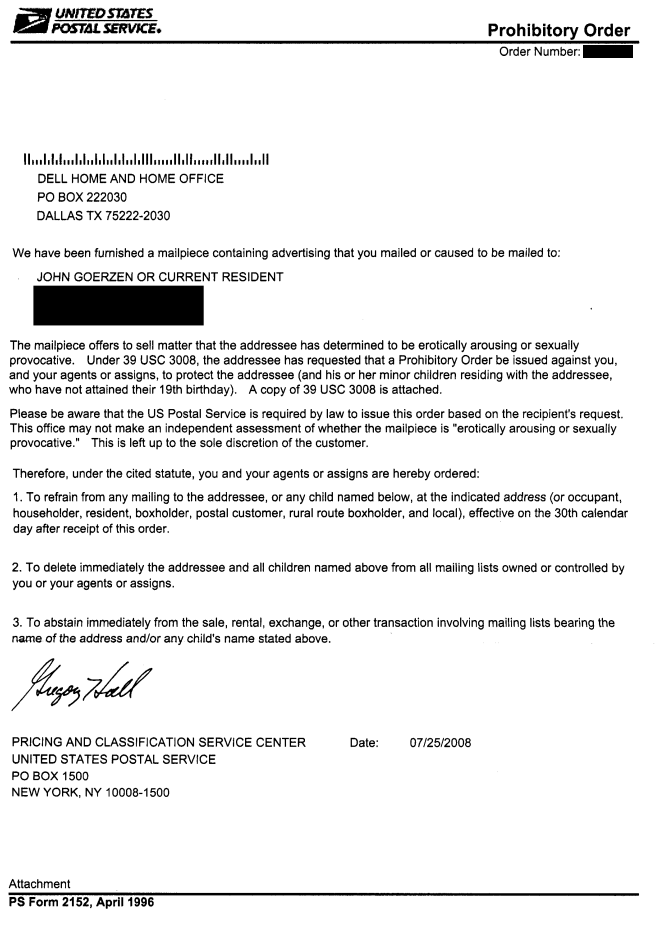
And last month, that's exactly what I did. The USPS sent me back a copy of the letter they sent to Dell, as well as a second page with instructions on reporting violations. Here's the letter they sent to Dell:

dell-usps

Somehow I get a chuckle over some Dell mail clerk trying to figure out how an 11-pound laptop is sexually provocative.

From August 25 on, it is a federal offense for Dell to send me another Home and Home Office catalog. This is a branch of criminal law, not civil law. That is, it's the maybe-go-to-jail branch of law.

How disappointed I was to receive yet another catalog from them today. If only they had waited 5 more days, I could have turned them in now.

Oh well. There's always next month's catalog. Let's just hope the clerk that received the USPS letter removed my name with a better system than everyone else at Dell uses, eh?

MJ Ray: Would a Real Free Software Developer Group Bite Apple Like FSF Did?

I’ve been installing free software for library cataloguing onto Apples recently. It’s not been great (GNU/Linux is still easier and faster, in my opinion) but it has worked much better than older Macs. As well as making servers that are finally getting easier, Apple lead the way in locked-down portable players, with their iPod and iPhone devices and iTunes service. Quite rightly, free software users campaign against Apple’s use of DRM/TPM (Technical Protection Measures). One of the rallying points has been Defective by Design (DbD), an FSF initiative since 2006. Long-time readers may remember that I took part in a DbD protest at an Apple Store in September 2006:-
“I noticed the huge till queue, which was attractive for three reasons: it had no security (I guess shoplifters rarely queue for the till), most of them are standing around waiting for something to read and they are almost certainly Apple customers, so who better to inform? After I rejoined the back of the queue a few times, a security man was watching it, so I moved off and chatted to people waiting to do hands-on tests on the upper floor for a bit [...] then I moved back to leaflet the till queue again. [...] Then, I got a bit bored and started putting the leaflets into Apple’s product leaflet dispensers (in front of Apple’s - no leaflets were removed), which soon got me rumbled.”
To me, that was fine: I dislike that type of store, which tries to look like public space, but is actually privatised and controlled. My resource use was minimal (one security man escorting me out and some Saturday kid probably “cleaned” the leaflet racks) but I passed information to many Apple customers, who are one of only two groups Apple must keep happy, ultimately. Popey is a bit upset by the latest protest idea, which he describes as:-
“urging people to book slots at the Apple in-store “Genius Bar” to ask probing questions which they already know the answer to about their company policy on DRM and Free software. The ‘Genius Bar’ is an official Apple support avenue for their customers, and is a service provided inside many of their stores.”
It’s also been criticised by neuro and Pete along similar lines. I agree. It’s wasting both side’s resources. Apple don’t really need to keep their staff happy (they can hire new staff) and it offends Apple customers and shareholders. It’s not even efficient: each unit of Apple employee time wasted costs a unit of DbyD worker time and who’s got the most resources there? What are FSF thinking? It’s stupid, even without the bad press it’s had. So, this brings me in a roundabout way to answering
“I am aware of the Linux Foundation and the FSF and others, but how does SPI differentiate itself and its goals from those organizations?”
from why people don’t join SPI. In my opinion, a key difference of Software in the Public Interest is that it is managed by free software developers in a more-or-less democratic fashion. Even though I’ve failed in two elections, I still think it’s better than the alternatives. No project as unpopular as wasting Apple Store helpdesk time would ever get backed by SPI, would it?

19 August 2008

Sandro Tosi: Display the progress of long operations in Python

I'm developing a tool that will take a loooong time to complete, so I'd like to know what's the progress of its execution. Basically I'd like something to tell me "Processed: x of y" where x is the current position and y is the total to process.

On Python Cookbook there are three articles about it, but none of them satisfied me.

The I remembered that there's a program, written in Python, that does what I need: dput! So I wrote a simple script (if you want to look at it, use wget, not open with browser) to mimic what dput does.

At the end, I finally find a really nice module: progressbar. I'm preparing a package for Debian for it, since it contains many nice kind of progress bars. Anyhow, I needed to create a patch to add "Processed: 5 of 47"-kinda output, but it's really useful even as it is, even for you.

Roland Mas: Netfilter-based port-knocking

When you have a server on the Internet, you get lots of "brute force" attacks on the SSH daemon, trying plausible logins with a variety of passwords. Even with good passwords, these attacks might eventually succeed (and they're annoying even when they don't), so you want to thwart them. One way is to use fail2ban, a script that monitors the failed connections, and sets up firewall rules (for instance) blocking further connections from the attacking IP addresses. It's good, but it fills your logs with messages about IPs getting banned and unbanned after a while. And you're still at risk that the multiple connections crash the SSH daemon, or trigger a bug in it, or whatever. A second layer of protection can be to block all SSH connection attempts except when they come from known IP addresses, but that doesn't work when you're away from home, and you're locked out. Been there, done that. So, some wise people have devised a trick called "port-knocking". It's similar to only opening the door to people who use a special knock (think "That's all, folks"): the firewall stays closed, but it opens a tiny targeted hole to some IP addresses for a limited length of time, based on a secret handshake. The window for attack is therefore very small, and the SSH daemon stays idle most of the time. And you can still log on your hosted server when you're attending conferences. There are a variety of implementations for this concept. Some could be web-based (you need to submit the right password to a web page), some could use other services or a dedicated daemon. But when I started investigating port-knocking, I wanted something simple, preferably with no dependencies on a daemon that would need to be exposed to the net and potentially crash. I found an article on the Debian Administration website, but I wasn't entirely satisfied with it. The principles appealed to me (netfilter-only, secret handshake in the form of opening connections to secret ports), though, so I evolved it into my own implementation, which I proudly present to you today. The goals of this implementation were: The bulk of the work therefore stays in the kernel's netfilter (that's for robustness and no user-land dependency), but the control interface is integrated with the usual firewalling script. Resistance to replay attacks is achieved by choosing hard-to-predict ports. So if someone snoops the wireless while I'm at a conference and catches my secret handshake, it'll only be valid for a short period of time, hopefully short enough to prevent dictionary attacks. The handshake is therefore calculated as a function of the current date and time, with an added secret seed. The following shell function calculates 5 port numbers within a given range (requires dc to be installed, for big-integer arithmetic):
calc_knock_ports ()  
    secret=$1
    bottomport=$2
    topport=$3
    nbports=$(( $topport - $bottomport + 1 ))
    hash=$(TZ=UTC date +%Y-%m-%d-%H-$secret   md5sum   awk ' print $1 '   tr a-z A-Z)
    num=$(echo 16i $hash f   dc)
    pk_port1=$(echo $num $nbports 0 ^ / $nbports % $bottomport + f   dc)
    pk_port2=$(echo $num $nbports 1 ^ / $nbports % $bottomport + f   dc)
    pk_port3=$(echo $num $nbports 2 ^ / $nbports % $bottomport + f   dc)
    pk_port4=$(echo $num $nbports 3 ^ / $nbports % $bottomport + f   dc)
    pk_port5=$(echo $num $nbports 4 ^ / $nbports % $bottomport + f   dc)
 
Okay. So this function calculates ports, now what? Now we're going to define a few chains by which netfilter will store states of IP addresses as they progress through the handshake:
setup_portknocking_tables ()  
    iptables -N portknock_into_phase1
    iptables -A portknock_into_phase1 -m recent --name PK_PHASE1 --set
    # iptables -A portknock_into_phase1 -j LOG --log-level notice --log-prefix "INTO PK_PHASE1: "
    iptables -N portknock_into_phase2
    iptables -A portknock_into_phase2 -m recent --name PK_PHASE1 --remove
    iptables -A portknock_into_phase2 -m recent --name PK_PHASE2 --set
    # iptables -A portknock_into_phase2 -j LOG --log-level notice --log-prefix "INTO PK_PHASE2: "
    iptables -N portknock_into_phase3
    iptables -A portknock_into_phase3 -m recent --name PK_PHASE2 --remove
    iptables -A portknock_into_phase3 -m recent --name PK_PHASE3 --set
    # iptables -A portknock_into_phase3 -j LOG --log-level notice --log-prefix "INTO PK_PHASE3: "                     
    iptables -N portknock_into_phase4
    iptables -A portknock_into_phase4 -m recent --name PK_PHASE3 --remove
    iptables -A portknock_into_phase4 -m recent --name PK_PHASE4 --set
    # iptables -A portknock_into_phase4 -j LOG --log-level notice --log-prefix "INTO PK_PHASE4: "
    iptables -N portknock_into_phase5
    iptables -A portknock_into_phase5 -m recent --name PK_PHASE4 --remove
    iptables -A portknock_into_phase5 -m recent --name PK_PHASE5 --set
    iptables -A portknock_into_phase5 -m recent --name PK_ESTABLISHED --set
    # iptables -A portknock_into_phase5 -j LOG --log-level notice --log-prefix "INTO PK_PHASE5: "
    iptables -N portknock_accept
    iptables -A portknock_accept -m limit -j LOG --log-level notice --log-prefix "ACCEPTED AFTER PORTKNOCKING: "
    # iptables -A portknock_accept -m recent --name PK_PHASE5 --remove
    iptables -A portknock_accept -j ACCEPT
    iptables -N portknocking
 
These chains use the recent module, which seems to be commonly available in standard kernels. You'll notice how, as one packet goes through these rules, its originating IP address moves from one set of "recent" addresses to the next. But no logic exists yet to make the packet actually go through these rules, so here comes the glue:
refresh_portknocking ()  
    calc_knock_ports f00b4r 10000 10999
    iptables -F portknocking
    iptables -A portknocking -p tcp --dport $pk_port1 -m state --state NEW                                                 -j portknock_into_phase1
    iptables -A portknocking -p tcp --dport $pk_port2 -m state --state NEW -m recent --rcheck --name PK_PHASE1 --seconds 5 -j portknock_into_phase2
    iptables -A portknocking -p tcp --dport $pk_port3 -m state --state NEW -m recent --rcheck --name PK_PHASE2 --seconds 5 -j portknock_into_phase3
    iptables -A portknocking -p tcp --dport $pk_port4 -m state --state NEW -m recent --rcheck --name PK_PHASE3 --seconds 5 -j portknock_into_phase4
    iptables -A portknocking -p tcp --dport $pk_port5 -m state --state NEW -m recent --rcheck --name PK_PHASE4 --seconds 5 -j portknock_into_phase5
    # echo clear > /proc/net/ipt_recent/PK_DONE
    echo clear > /proc/net/ipt_recent/PK_PHASE1
    echo clear > /proc/net/ipt_recent/PK_PHASE2
    echo clear > /proc/net/ipt_recent/PK_PHASE3
    echo clear > /proc/net/ipt_recent/PK_PHASE4
    echo clear > /proc/net/ipt_recent/PK_PHASE5
 
Right. This function adds rules to the portknocking chain. A packet injected into this ruleset will, depending on its destination port and whether its source IP address has already been seen, end up in one of the PK_PHASE* sets. All we have to do now is therefore to send some packets to this portknocking chain, and use the port-knocking sets to decide whether to accept incoming connections or not:
iptables -A INPUT -j portknocking
iptables -A INPUT -m recent --rcheck --seconds 5 --name PK_PHASE5 -m state --state NEW -p tcp --dport ssh -j portknock_accept
This example only mentions accepting incoming SSH connections, but it's in no way a limitation: a server of mine uses similar rules to DNAT certain ports to internal IP addresses. And there we have it for the server part: incoming SSH connections are usually ignored (well, handled by the rest of the firewall script, but let's assume that it drops these packets by default), but if one IP address knows the appropriate ports and sends a connection attempt to them in order, then it'll be able to open SSH connections for a little while after that. Of course, it's going to be boring if one has to send these packets by hand, but it can be easily automated by a script. Here's a ~/bin/portknock.sh I have:
#! /bin/sh
host=$1
port=$2
calc_knock_ports ()  
[...]
 
calc_knock_ports f00b4r 10000 10999
for i in $pk_port1 $pk_port2 $pk_port3 $pk_port4 $pk_port5 ; do
    nc -w 1 $host $i < /dev/null > /dev/null 2>&1
done
nc $host $port
It's designed to be called with two parameters, a host and a port, and it needs netcat in addition to dc. Why the last line, I hear you cry? Because then I can just add the following lines to my ~/.ssh/config:
Host blahblah
  IdentityFile foobar
  ProxyCommand /home/roland/bin/portknock.sh %h %p
...and SSH will automagically tunnel its network socket through the script, which will in turn happily tunnel that through netcat after completing the secret handshake. And when I type ssh myserver on my laptop, interesting stuff happens behind the scenes, and a special, just-for-me hole is opened in the server firewall, just for the few seconds I need to establish the SSH session (packets belonging to established TCP sockets are allowed by the firewall's connection tracking). Note: This article is deliberately short on details and ready-to-run scripts. Firstly because firewall scripts vary wildly so any script would have to be adapted anyway, but mostly because security is best handled with one's brain switched on. Fiddling with a firewall can easily open gaping holes or lock everyone out. So please make sure you understand what goes on before blindly pasting stuff into your own setup. Some of the lines that are commented out may also be of interest, and were left as an exercise for the reader. Other lines were not included, and are also left as a rather important exercise to the reader; note in particular how the netfilter rules as currently established do not mitigate the replay attacks...

17 August 2008

Filip Van Raemdonck: Linde

16 08 2008<br /> <br /> <img src="http://blog.sysfs.net/media/collage.jpg" style="width: 900; height="633" alt="My little baby girl (photo collage)" title="Photo's of Linde" />

15 August 2008

DebConf 8 video: Debian Edu 100% in main

This talk will briefly explain what Debian Edu is, how we develop our distribution, how we differ from Debian, how we work on bridging the gaps that still exist and what our plans for the future are.

In July 2007 the Debian Edu project released its third release, codename "Skolelinux 3.0 Terra". Debian Edu is probably the most widely known and most widely used Custom Debian Distribution - at least if you follow the official criteria for a CDD, which we aim to finally fulfill 100% for Lenny: all packages are taken unmodified from Debian main.

This talk will explain the development process of Debian Edu and the various differences to a default Debian install. An overview of the planned features for Lenny will be given as well as a list of current showstoppers will be presented. To explain to the audience, what challenges have been overcome since Debian Edu was started, the history of how 100% inclusion in Debian was achieved, will also be explained. (Debian Edu used to be a seperate distribution! Now we have become a part of Debian!)

Using wiki.debian.org to write a fine manual will be explained briefly too: our documentation is written in a wiki, then exported as docbook and translated using .po files, then transfered back into docbook, to generate html and PDFs versions, which are made available in the debian-edu-doc package, which is installed on a webserver again.

In the end, releasing with Lenny will not be the end of the process of becoming part of Debian. Currently it looks like we might release with Lenny, but then do point releases on our own. Whether this is a sensible strategy or if there are others, will (hopefully) become clearer in future. Until & after the talk - it's a long and winding road!Full event details

Stefano Zacchiroli: edos-builddebcheck

Statically detecting FTBFS with edos-builddebcheck Here at DebConf8, after my talk about Mancoosi, I got in touch with several people interested in the QA implication of the EDOS/Mancoosi tools. Me and Ralf have for example been contacted by Ubuntu people which are setting up theirs equivalent of http://edos.debian.net. A guy working on a mirroring tool made an interesting hack using edos-debcheck: out of a mirror with broken dependencies he can mirrors a subset of packages which do not suffer of the same problem. But now to the more interesting development, following a bug report by Atomo and discussions with Lucas (the RC-bug-filing-master), me and Ralf implemented edos-builddebcheck. You can invoke it on a pair of Packages/Sources package list, and it will check whether some packages will FTBFS due to unsatisfiable dependencies. The results on Lenny main/amd64 as of today are, ... erm ..., scary : 49 packages will FTBFS. The RC-bug-filing-master and Ralf are working on filing them, "don't worry". You can find edos-builddebcheck in the edos-debcheck package, starting from version 1.0-7 (in incoming at the time of writing). Update yes, ATM edos-builddebcheck does not know anything about P-A-S packages, so there are some false positive. Still, 33 source packages are proper hits.

14 August 2008

Holger Levsen: What has a pirate flag to do with Debian?

Some people asked me during the group photo why I brought a pirate flag to the group picture. One explaination is is pretty simple, but not the real answer: since DebConf5 there always has been a pirate flag at DebConf. The real answer to me is, that if the content mafia wants to label the cultural technique of copying, which is as old as humankind and the base of all our inventions as "pirating", them I'm very proud and happy to be a pirate.

A somewhat longer answer will give you the films "steal this movie", part 1 and 2, which are available (under a CC licence) for direct download on homer at DebConf8 (please use the wired network..) or via torrents on their website.

The first part mostly tells the story of the raid of the piratebay servers in Sweden, while the second part tries (and IMO succeeds very well) to paint the bigger picture. My favorite quote from the movies is "when the winds of change are blowing, some people are building shelters and others are building windmills".

Another insightful (and scary) quote is "you can't stop filesharing without a police state", and if you look around, that's what's being tried. So why is the content mafia afraid of file sharing? It's not really because of us consumers being consumers and "stealing" some content. I'm sure they can live with the "loss", that's not the reason. What they can't stand (nor survive) is millions of consumers becoming producers (and sellers of content). That's the threat they need to prevent.

And that's in very short why I think a pirate flag is appropiate at DebConf. We are producers and if free production of ideas and art is only possible for pirates, I say allrrrrrright ;-)

I very much recommend these two movies to everybody who is slightly interested in this topic and look forward for part 3, which should be in production by now. I hope this blog post made you curious to watch them, even though I feel that I couldn't summarize the movies as good as I would like to. DebConf8 took some tolls on me. I haven't even blogged about this wunderbare conference yet :-)

I also plan to bring a Debian flag to DebConf9 :-) If you happen to be an artist and want to create a design, I'd be very happy. At the moment I'm not fully sure if the flag will be printed or embroidered so the design should probably pretty basic. A red swirl on white (or black?) background, maybe accompanied with the letters "Debian". Other ideas or comments?

Miriam Ruiz: MIME and file type support for desktops

Some time ago, when I packaged treeline, I wanted to make the package configure the environment so that .trl files would be automatically open with the program. That meant that the package had to configure the MIME types in the desktop to handle that, and assign the new MIME type the selected program. I tried a dozen of things at the time, based on a lot of howto’s that I found, without any success, so I decided to forget about it. This week I started packaging a new program: L ve, a 2D game development framework based in Lua and OpenGL. Many of the games developed for this platform are distributed as a zip file with the extension .love, so I decided I wanted to try again the MIME stuff. After many unsuccessful tries, I found a package that gave me some hints on how to do it: chemical-mime-data. After having a look at it, I was able to prepare a proof of concept that did what I wanted. It is supposed to work, at least, in GNOME, KDE and ROX. In case someone else is interested, here is the code:

Biella Coleman: History of Phone Phreaking

I am so happy that someone, Phil Lapsley to be exact, is writing a proper history of phone phreaking. Find out more here. Oh and here is something else you should check out: Project MF: "Project MF is a living, breathing simulation of analog SF/MF telephone signaling just as ...

Filip Van Raemdonck: Perl hash tree helper

Last week I needed a way of converting a two-dimensional array, in perl, into a tree-like datastructure.<br /> While seemingly trivial, the convoluted use of references when passing around arrays and hashes between perl function calls -- recursive calls, in this case -- made this a mind-boggling exercise to me. (the fact that I hadn't seriously used perl in the last eight years might have had part in that, too)<br /> <br /> Below the jump is my implementation, debugging info left in and all. If it's useful for someone, that's great; if not, ... well, except for my mental sanity no harm was done in writing this, either :)
Continue reading "Perl hash tree helper"

Next.

Previous.