Search Results: "tim"

19 January 2026

Dima Kogan: mrcal 2.5 released!

mrcal 2.5 is out: the release notes. Once again, this is mostly a bug-fix release en route to the big new features coming in 3.0. One cool thing is that these tools have now matured enough to no longer be considered experimental. They have been used with great success in lots of contexts across many different projects and organizations. Some highlights: Some of the above is new, and not yet fully polished and documented and tested, but it works. In mrcal 2.5, most of the implementation of some new big features is written and committed, but it's still incomplete. The new stuff is there, but is lightly tested and documented. This will be completed eventually in mrcal 3.0: mrcal is quite good already, and will be even better in the future. Try it today!

17 January 2026

Simon Josefsson: Backup of S3 Objects Using rsnapshot

I ve been using rsnapshot to take backups of around 10 servers and laptops for well over 15 years, and it is a remarkably reliable tool that has proven itself many times. Rsnapshot uses rsync over SSH and maintains a temporal hard-link file pool. Once rsnapshot is configured and running, on the backup server, you get a hardlink farm with directories like this for the remote server:
/backup/serverA.domain/.sync/foo
/backup/serverA.domain/daily.0/foo
/backup/serverA.domain/daily.1/foo
/backup/serverA.domain/daily.2/foo
...
/backup/serverA.domain/daily.6/foo
/backup/serverA.domain/weekly.0/foo
/backup/serverA.domain/weekly.1/foo
...
/backup/serverA.domain/monthly.0/foo
/backup/serverA.domain/monthly.1/foo
...
/backup/serverA.domain/yearly.0/foo
I can browse and rescue files easily, going back in time when needed. The rsnapshot project README explains more, there is a long rsnapshot HOWTO although I usually find the rsnapshot man page the easiest to digest. I have stored multi-TB Git-LFS data on GitLab.com for some time. The yearly renewal is coming up, and the price for Git-LFS storage on GitLab.com is now excessive (~$10.000/year). I have reworked my work-flow and finally migrated debdistget to only store Git-LFS stubs on GitLab.com and push the real files to S3 object storage. The cost for this is barely measurable, I have yet to run into the 25/month warning threshold. But how do you backup stuff stored in S3? For some time, my S3 backup solution has been to run the minio-client mirror command to download all S3 objects to my laptop, and rely on rsnapshot to keep backups of this. While 4TB NVME s are relatively cheap, I ve felt that this disk and network churn on my laptop is unsatisfactory for quite some time. What is a better approach? I find S3 hosting sites fairly unreliable by design. Only a couple of clicks in your web browser and you have dropped 100TB of data. Or by someone else who steal your plaintext-equivalent cookie. Thus, I haven t really felt comfortable using any S3-based backup option. I prefer to self-host, although continously running a mirror job is not sufficient: if I accidentally drop the entire S3 object store, my mirror run will remove all files locally too. The rsnapshot approach that allows going back in time and having data on self-managed servers feels superior to me. What if we could use rsnapshot with a S3 client instead of rsync? Someone else asked about this several years ago, and the suggestion was to use the fuse-based s3fs which sounded unreliable to me. After some experimentation, working around some hard-coded assumption in the rsnapshot implementation, I came up with a small configuration pattern and a wrapper tool to implement what I desired. Here is my configuration snippet:
cmd_rsync    /backup/s3/s3rsync
rsync_short_args    -Q
rsync_long_args    --json --remove
lockfile    /backup/s3/rsnapshot.pid
snapshot_root    /backup/s3
backup    s3:://hetzner/debdistget-gnuinos    ./debdistget-gnuinos
backup    s3:://hetzner/debdistget-tacos  ./debdistget-tacos
backup    s3:://hetzner/debdistget-diffos ./debdistget-diffos
backup    s3:://hetzner/debdistget-pureos ./debdistget-pureos
backup    s3:://hetzner/debdistget-kali   ./debdistget-kali
backup    s3:://hetzner/debdistget-devuan ./debdistget-devuan
backup    s3:://hetzner/debdistget-trisquel   ./debdistget-trisquel
backup    s3:://hetzner/debdistget-debian ./debdistget-debian
The idea is to save a backup of a couple of S3 buckets under /backup/s3/. I have some scripts that take a complete rsnapshot.conf file and append my per-directory configuration so that this becomes a complete configuration. If you are curious how I roll this, backup-all invokes backup-one appending my rsnapshot.conf template with the snippet above. The s3rsync wrapper script is the essential hack to convert rsnapshot s rsync parameters into something that talks S3 and the script is as follows:
#!/bin/sh
set -eu
S3ARG=
for ARG in "$@"; do
    case $ARG in
    s3:://*) S3ARG="$S3ARG "$(echo $ARG   sed -e 's,s3:://,,');;
    -Q*) ;;
    *) S3ARG="$S3ARG $ARG";;
    esac
done
echo /backup/s3/mc mirror $S3ARG
exec /backup/s3/mc mirror $S3ARG
It uses the minio-client tool. I first tried s3cmd but its sync command read all files to compute MD5 checksums every time you invoke it, which is very slow. The mc mirror command is blazingly fast since it only compare mtime s, just like rsync or git. First you need to store credentials for your S3 bucket. These are stored in plaintext in ~/.mc/config.json which I find to be sloppy security practices, but I don t know of any better way to do this. Replace AKEY and SKEY with your access token and secret token from your S3 provider:
/backup/s3/mc alias set hetzner AKEY SKEY
If I invoke a sync job for a fully synced up directory the output looks like this:
root@hamster /backup# /run/current-system/profile/bin/rsnapshot -c /backup/s3/rsnapshot.conf -V sync
Setting locale to POSIX "C"
echo 1443 > /backup/s3/rsnapshot.pid 
/backup/s3/s3rsync -Qv --json --remove s3:://hetzner/debdistget-gnuinos \
    /backup/s3/.sync//debdistget-gnuinos 
/backup/s3/mc mirror --json --remove hetzner/debdistget-gnuinos /backup/s3/.sync//debdistget-gnuinos
 "status":"success","total":0,"transferred":0,"duration":0,"speed":0 
/backup/s3/s3rsync -Qv --json --remove s3:://hetzner/debdistget-tacos \
    /backup/s3/.sync//debdistget-tacos 
/backup/s3/mc mirror --json --remove hetzner/debdistget-tacos /backup/s3/.sync//debdistget-tacos
 "status":"success","total":0,"transferred":0,"duration":0,"speed":0 
/backup/s3/s3rsync -Qv --json --remove s3:://hetzner/debdistget-diffos \
    /backup/s3/.sync//debdistget-diffos 
/backup/s3/mc mirror --json --remove hetzner/debdistget-diffos /backup/s3/.sync//debdistget-diffos
 "status":"success","total":0,"transferred":0,"duration":0,"speed":0 
/backup/s3/s3rsync -Qv --json --remove s3:://hetzner/debdistget-pureos \
    /backup/s3/.sync//debdistget-pureos 
/backup/s3/mc mirror --json --remove hetzner/debdistget-pureos /backup/s3/.sync//debdistget-pureos
 "status":"success","total":0,"transferred":0,"duration":0,"speed":0 
/backup/s3/s3rsync -Qv --json --remove s3:://hetzner/debdistget-kali \
    /backup/s3/.sync//debdistget-kali 
/backup/s3/mc mirror --json --remove hetzner/debdistget-kali /backup/s3/.sync//debdistget-kali
 "status":"success","total":0,"transferred":0,"duration":0,"speed":0 
/backup/s3/s3rsync -Qv --json --remove s3:://hetzner/debdistget-devuan \
    /backup/s3/.sync//debdistget-devuan 
/backup/s3/mc mirror --json --remove hetzner/debdistget-devuan /backup/s3/.sync//debdistget-devuan
 "status":"success","total":0,"transferred":0,"duration":0,"speed":0 
/backup/s3/s3rsync -Qv --json --remove s3:://hetzner/debdistget-trisquel \
    /backup/s3/.sync//debdistget-trisquel 
/backup/s3/mc mirror --json --remove hetzner/debdistget-trisquel /backup/s3/.sync//debdistget-trisquel
 "status":"success","total":0,"transferred":0,"duration":0,"speed":0 
/backup/s3/s3rsync -Qv --json --remove s3:://hetzner/debdistget-debian \
    /backup/s3/.sync//debdistget-debian 
/backup/s3/mc mirror --json --remove hetzner/debdistget-debian /backup/s3/.sync//debdistget-debian
 "status":"success","total":0,"transferred":0,"duration":0,"speed":0 
touch /backup/s3/.sync/ 
rm -f /backup/s3/rsnapshot.pid 
/run/current-system/profile/bin/logger -p user.info -t rsnapshot[1443] \
    /run/current-system/profile/bin/rsnapshot -c /backup/s3/rsnapshot.conf \
    -V sync: completed successfully 
root@hamster /backup# 
You can tell from the paths that this machine runs Guix. This was the first production use of the Guix System for me, and the machine has been running since 2015 (with the occasional new hard drive). Before, I used rsnapshot on Debian, but some stable release of Debian dropped the rsnapshot package, paving the way for me to test Guix in production on a non-Internet exposed machine. Unfortunately, mc is not packaged in Guix, so you will have to install it from the MinIO Client GitHub page manually. Running the daily rotation looks like this:
root@hamster /backup# /run/current-system/profile/bin/rsnapshot -c /backup/s3/rsnapshot.conf -V daily
Setting locale to POSIX "C"
echo 1549 > /backup/s3/rsnapshot.pid 
mv /backup/s3/daily.5/ /backup/s3/daily.6/ 
mv /backup/s3/daily.4/ /backup/s3/daily.5/ 
mv /backup/s3/daily.3/ /backup/s3/daily.4/ 
mv /backup/s3/daily.2/ /backup/s3/daily.3/ 
mv /backup/s3/daily.1/ /backup/s3/daily.2/ 
mv /backup/s3/daily.0/ /backup/s3/daily.1/ 
/run/current-system/profile/bin/cp -al /backup/s3/.sync /backup/s3/daily.0 
rm -f /backup/s3/rsnapshot.pid 
/run/current-system/profile/bin/logger -p user.info -t rsnapshot[1549] \
    /run/current-system/profile/bin/rsnapshot -c /backup/s3/rsnapshot.conf \
    -V daily: completed successfully 
root@hamster /backup# 
Hopefully you will feel inspired to take backups of your S3 buckets now!

Jonathan Dowland: Honest Jon's lightly-used Starships

No man s Sky (or as it s known in our house, "spaceship game") is a space exploration/sandbox game that was originally released 10 years ago. Back then I tried it on my brother s PS4 but I couldn t get into it. In 2022 it launched for the Nintendo Switch1 and the game finally clicked for me. I play it very casually. I mostly don t play at all, except sometimes when there are time-limited expeditions running, which I find refreshing, and usually have some exclusives as a reward for play. One of the many things you can do in the game is collect star ships. I started keeping a list of notable ones I ve found, and I ve decided to occasionally blog about them.
The Horizon Vector NX spaceship
The Horizon Vector NX is a small sporty ship that players on Nintendo Switch could claim within the first month or so after it launched. The colour scheme resembles the original neon switch controllers. Although the ship type occurs naturally in the game in other configurations, I think differently-painted wings are unique to this ship. For most of the last 4 years, my copy of this ship was confined to the Switch, until November 2024, when they added cross-save capability to the game. I was then able to access the ship when playing on Linux (or Mac).

  1. The game runs very well natively on Mac, flawlessly on Steam for Linux, but struggles on the origins switch. It s a marvel it runs there at all.

Ravi Dwivedi: My experiences in Brunei

This post covers my friend Badri and my experiences in Brunei. Brunei officially Brunei Darussalam is a country in Southeast Asia, located on Borneo island. It is one of the few remaining absolute monarchies on Earth. On the morning of the 10th of December 2024, Badri and I reached Brunei International Airport by taking a flight from Kuala Lumpur. Upon arrival at the airport, we had to go through the immigration, of course. However, I forgot to fill my arrival card, which I filled while I was in the queue for my immigration. The immigration officer asked me how much cash I was carrying of each currency. After completing the formalities, the immigration officer stamped my passport and let me in. Take a look at Brunei s entry stamp in my passport.
Brunei entry stamp Brunei entry stamp on my passport. Picture by Ravi Dwivedi, released under CC-BY-SA 4.0.
We exchanged Singapore dollars to get some Brunei dollars at the airport. The Brunei dollar was pegged 1:1 with the Singapore dollar, meaning 1 Singapore dollar equals 1 Brunei dollar. The exchange rate we received at the airport was the same. Our (pre-booked) accommodation was located near Gadong mall. So, we went to the information center at the airport to ask how to get there by public transport. However, the person at the information center told us that they didn t know the public transport routes and suggested we take a taxi instead. We came out of the airport and came across an Indian with a mini bus. He offered to drop us at our accommodation for 10 Brunei dollars ( 630). As we were tired after a sleepless night, we didn t negotiate and took the offer. It felt a bit weird using the minibus as our private taxi. In around half-an-hour, we reach our accommodation. The place was more like a guest house than a hotel. In addition to the rooms, it had common space consisting of a hall, a kitchen and a balcony.
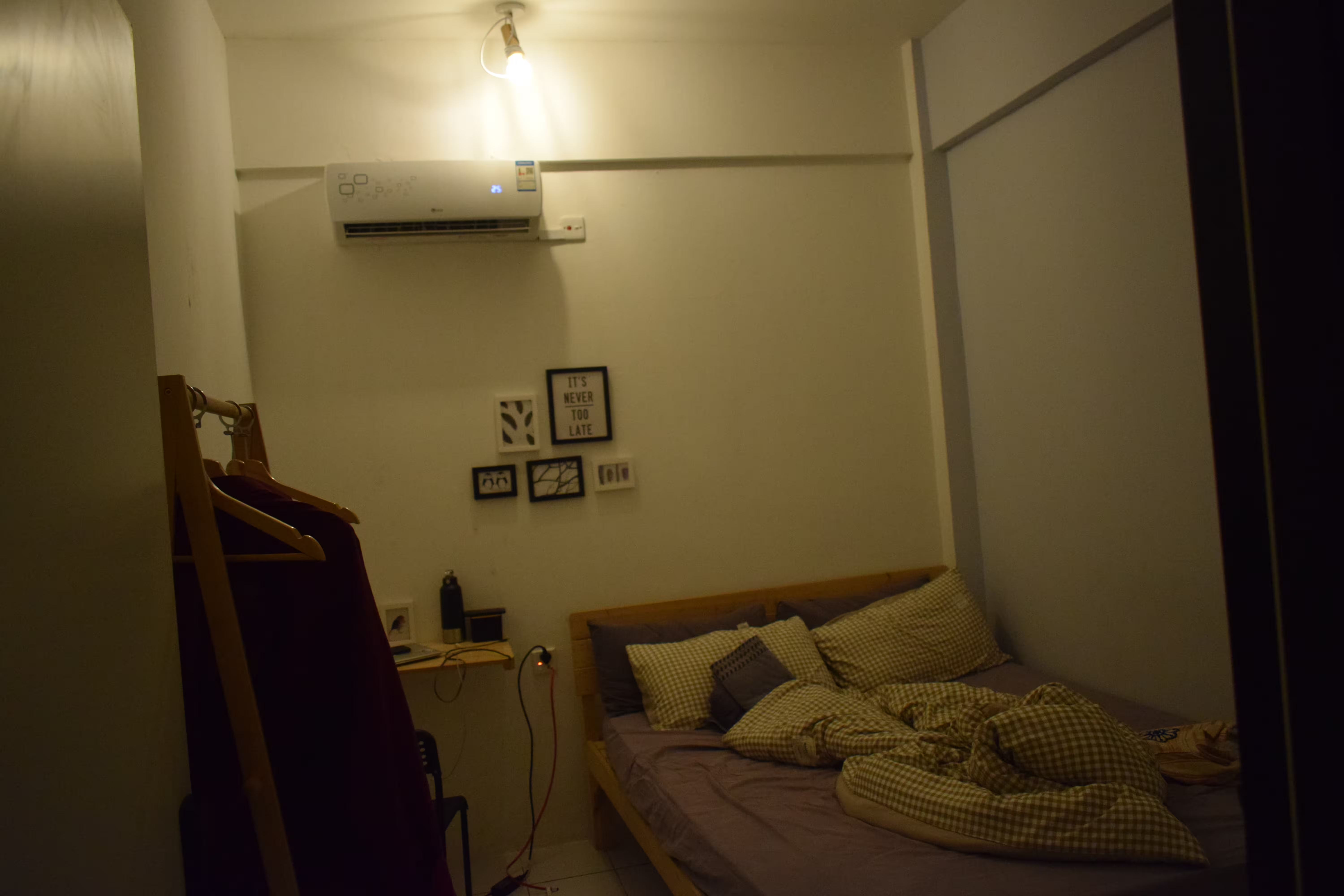
Our room in Brunei Our room in Brunei. Picture by Ravi Dwivedi, released under CC-BY-SA 4.0

Upon reaching the place, we paid for our room in cash, which was 66.70 Singapore dollars (4200 Indian rupees) for two nights. We reached before the check-in time, so we had to wait for our room to get ready before we entered. The room had a double bed and also a place to hang clothes. We slept for a few hours before going out at night. We went into Gadong mall and had coffee at a caf named The Coffee Bean & Tea Leaf. The regular caffe latte I had here been 5.20 Brunei dollars. On another note, the snacks we got us from Kuala Lumpur covered us for the dinner. The next day 11th of December 2024 we went to a nearby restaurant named Nadj for lunch. The owner was from Kerala. Here we ordered: So, our lunch cost a total of 12.80 Brunei dollars (825 rupees). The naan was unusually thick, and didn t like the taste. After the lunch, we planned to visit Brunei s famous Omar Ali Saifuddien Mosque. However, a minibus driver outside of Gadong Mall told us that the mosque would be closed in half-an-hour and suggested we visit the nearby Jame Asr Hassanil Bolkiah Mosque instead.
Jame' Asr Hassanil Bolkiah Mosque Jame Asr Hassanil Bolkiah Mosque. Picture by Ravi Dwivedi, released under CC-BY-SA 4.0

He dropped us there for 1 Brunei dollar per person. The person hailed from Uttar Pradesh and told us about bus routes in Hindi. Buses routes in Brunei were confusing, so the information he gave us was valuable. It was evening, and we had an impression that the mosque and its premises were closed. However, soon enough, we stumbled across an open gate entering the mosque complex. We walked inside for some time, took pictures and exited. Walking in Bandar Seri Begawan wasn t pleasant, though. The pedestrian infrastructure wasn t good. Then we walked back to our place and bought some souvenirs. For dinner and breakfast, we bought bread, fruits and eggs from local shops as we had a kitchen to cook for ourselves. The guest house also had a washing machine (free of charge) which we wanted to use. However, they didn t have detergent. Therefore, we went outside to get some detergent. It was 8 o clock, and most of the shops were closed already. Others had had detergents in large sizes, the ones you would use if you lived there. We ended up getting a small packet at a supermarket. The next day 12th of December we had a flight to Ho Chi Minh City in Vietnam with a long layover in Kuala Lumpur. We had breakfast in the morning and took a bus to Omar Ali Saifuddien Mosque. The mosque was in prayer session, so it was closed for Muslims. Therefore, we just took pictures from the outside and took a bus for the airport.
Omar Ali Saifuddien Mosque Omar Ali Saifuddien Mosque. Picture by Ravi Dwivedi, released under CC-BY-SA 4.0

When the bus reached near the airport, the bus went straight rather than taking a left turn for the airport. Initially, I thought the bus would just take a turn and come back. However, the bus kept going away from the airport. Confused by this, I asked other passengers if the bus was going to the airport. The driver stopped the bus at Muara Town terminal 20 km from the airport. At this point, everyone alighted, except for us. The driver went to a nearby restaurant to have lunch. I felt very uncomfortable stranded in a town which was 20 km from the airport. We had a lot of time, but I was still worried about missing our flight, as I didn t want to get stuck in Brunei. After waiting for 15 minutes, I went inside the restaurant and reminded the driver that we had a flight in a couple of hours and needed to go to the airport. He said he will leave soon. When he was done with his lunch, he drove us to the airport. It was incredibly frustrating. On a positive note, we saw countryside of Brunei that we would have seen otherwise. The bus ride cost us 1 Brunei dollar each.
A couple of houses with trees in the background. A shot of Brunei s countryside. Picture by Ravi Dwivedi, released under CC-BY-SA 4.0.
That s it for this one. Meet you in the next one. Stay tuned for the Vietnam post!

16 January 2026

Jonathan Dowland: Ye Gods

Via (I think) @mcc on the Fediverse, I learned of GetMusic: a sort-of "clearing house" for Free Bandcamp codes. I think the way it works is, some artists release a limited set of download codes for their albums in order to promote them, and GetMusic help them to keep track of that, and helps listeners to discover them. GetMusic mail me occasionally, and once they highlighted an album The Arcane & Paranormal Earth which they described as "Post-Industrial in the vein of Coil and Nurse With Wound with shades of Aphex Twin, Autechre and assorted film music." Well that description hooked me immediately but I missed out on the code. However, I sampled the album on Bandcamp directly a few times as well as a few of his others (Ye Gods is a side-project of Antoni Maiovvi, which itself is a pen-name) and liked them very much. I picked up the full collection of Ye Gods albums in one go for 30% off. Here's a stand-out track: On Earth by Ye Gods So I guess this service works! Although I didn't actually get a free code in this instance, it promoted the artist, introduced me to something I really liked and drove a sale.

14 January 2026

Dirk Eddelbuettel: gunsales 0.1.3 on CRAN: Maintenance

An update to the gunsales package is now on CRAN. As in the last update nine years ago (!!), changes are mostly internal. An upcoming dplyr change requires a switch from the old and soon to-be-removed underscored verb form; that was kindly addressed in an incoming pull request. We also updated the CI scripts a few times during this period as needed, and switched to using Authors@R, and refreshed and updated a number of URL references. Courtesy of my CRANberries, there is also a diffstat report for this release.

This post by Dirk Eddelbuettel originated on his Thinking inside the box blog. If you like this or other open-source work I do, you can sponsor me at GitHub.

13 January 2026

Louis-Philippe V ronneau: Reducing the size of initramfs kernel images

In the past few years, the size of the kernel images in Debian have been steadily growing. I don't see this as a problem per se, but it has been causing me trouble, as my /boot partition has become too small to accommodate two kernel images at the same time. Since I'm running Debian Unstable on my personal systems and keep them updated with unattended-upgrade, this meant each (frequent) kernel upgrade triggered an error like this one:

update-initramfs: failed for /boot/initrd.img-6.17.11+deb14-amd64 with 1.
dpkg: error processing package initramfs-tools (--configure):
 installed initramfs-tools package post-installation script subprocess returned
 error exit status 1
Errors were encountered while processing:
 initramfs-tools
E: Sub-process /usr/bin/dpkg returned an error code (1)
This would in turn break the automated upgrade process and require me to manually delete the currently running kernel (which works, but isn't great) to complete the upgrade. The "obvious" solution would have been to increase the size of my /boot partition to something larger than the default 456M. Since my systems use full-disk encryption and LVM, this isn't trivial and would have required me to play Tetris and swap files back and forth using another drive. Another solution proposed by anarcat was to migrate to systemd-boot (I'm still using grub), use Unified Kernel Images (UKI) and merge the /boot and /boot/efi partitions. Since I already have a bunch of configurations using grub and I am not too keen on systemd taking over all the things on my computer, I was somewhat reluctant. As my computers are all configured by Puppet, I could of course have done a complete system reinstallation, but again, this was somewhat more involved than what I wanted it to be. After looking online for a while, I finally stumbled on this blog post by Neil Brown detailing how to shrink the size of the initramfs images. With MODULES=dep my images shrunk from 188M to 41M, fixing my issue. Thanks Neil! I was somewhat worried removing kernel modules would break something on my systems, but so far, I only had to manually load the i2c_dev module, as I need it to manage my home monitor's brightness using ddcutil.

Freexian Collaborators: Debian Contributions: dh-python development, Python 3.14 and Ruby 3.4 transitions, Surviving scraper traffic in Debian CI and more! (by Anupa Ann Joseph)

Debian Contributions: 2025-12 Contributing to Debian is part of Freexian s mission. This article covers the latest achievements of Freexian and their collaborators. All of this is made possible by organizations subscribing to our Long Term Support contracts and consulting services.

dh-python development, by Stefano Rivera In Debian we build our Python packages with the help of a debhelper-compatible tool, dh-python. Before starting the 3.14 transition (that would rebuild many packages) we landed some updates to dh-python to fix bugs and add features. This started a month of attention on dh-python, iterating through several bug fixes, and a couple of unfortunate regressions. dh-python is used by almost all packages containing Python (over 5000). Most of these are very simple, but some are complex and use dh-python in unexpected ways. It s hard to avoid almost any change (including obvious bug fixes) from causing some unexpected knock-on behaviour. There is a fair amount of complexity in dh-python, and some rather clever code, which can make it tricky to work on. All of this means that good QA is important. Stefano spent some time adding type annotations and specialized types to make it easier to see what the code is doing and catch mistakes. This has already made work on dh-python easier. Now that Debusine has built-in repositories and debdiff support, Stefano could quickly test the effects of changes on many other packages. After each big change, he could upload dh-python to a repository, rebuild e.g. 50 Python packages with it, and see what differences appeared in the output. Reviewing the diffs is still a manual process, but can be improved. Stefano did a small test on what it would take to replace direct setuptools setup.py calls with PEP-517 (pyproject-style) builds. There is more work to do here.

Python 3.14 transition, by Stefano Rivera (et al.) In December the transition to add Python 3.14 as a supported version started in Debian unstable. To do this, we update the list of supported versions in python3-defaults, and then start rebuilding modules with C extensions from the leaves inwards. This had already been tested in a PPA and Ubuntu, so many of the biggest blocking compatibility issues with 3.14 had already been found and fixed. But there are always new issues to discover. Thanks to a number of people in the Debian Python team, we got through the first bit of the transition fairly quickly. There are still a number of open bugs that need attention and many failed tests blocking migration to testing. Python 3.14.1 released just after we started the transition, and very soon after, a follow-up 3.14.2 release came out to address a regression. We ran into another regression in Python 3.14.2.

Ruby 3.4 transition, by Lucas Kanashiro (et al.) The Debian Ruby team just started the preparation to move the default Ruby interpreter version to 3.4. At the moment, ruby3.4 source package is already available in experimental, also ruby-defaults added support to Ruby 3.4. Lucas rebuilt all reverse dependencies against this new version of the interpreter and published the results here. Lucas also reached out to some stakeholders to coordinate the work. Next steps are: 1) announcing the results to the whole team and asking for help to fix packages failing to build against the new interpreter; 2) file bugs against packages FTBFSing against Ruby 3.4 which are not fixed yet; 3) once we have a low number of build failures against Ruby 3.4, ask the Debian Release team to start the transition in unstable.

Surviving scraper traffic in Debian CI, by Antonio Terceiro Like most of the open web, Debian Continuous Integration has been struggling for a while to keep up with the insatiable hunger from data scrapers everywhere. Solving this involved a lot of trial and error; the final result seems to be stable, and consists of two parts. First, all Debian CI data pages, except the direct links to test log files (such as those provided by the Release Team s testing migration excuses), now require users to be authenticated before being accessed. This means that the Debian CI data is no longer publicly browseable, which is a bit sad. However, this is where we are now. Additionally, there is now a fail2ban powered firewall-level access limitation for clients that display an abusive access pattern. This went through several iterations, with some of them unfortunately blocking legitimate Debian contributors, but the current state seems to strike a good balance between blocking scrapers and not blocking real users. Please get in touch with the team on the #debci OFTC channel if you are affected by this.

A hybrid dependency solver for crossqa.debian.net, by Helmut Grohne crossqa.debian.net continuously cross builds packages from the Debian archive. Like Debian s native build infrastructure, it uses dose-builddebcheck to determine whether a package s dependencies can be satisfied before attempting a build. About one third of Debian s packages fail this check, so understanding the reasons is key to improving cross building. Unfortunately, dose-builddebcheck stops after reporting the first problem and does not display additional ones. To address this, a greedy solver implemented in Python now examines each build-dependency individually and can report multiple causes. dose-builddebcheck is still used as a fall-back when the greedy solver does not identify any problems. The report for bazel-bootstrap is a lengthy example.

rebootstrap, by Helmut Grohne Due to the changes suggested by Loongson earlier, rebootstrap now adds debhelper to its final installability test and builds a few more packages required for installing it. It also now uses a variant of build-essential that has been marked Multi-Arch: same (see foundational work from last year). This in turn made the use of a non-default GCC version more difficult and required more work to make it work for gcc-16 from experimental. Ongoing archive changes temporarily regressed building fribidi and dash. libselinux and groff have received patches for architecture specific changes and libverto has been NMUed to remove the glib2.0 dependency.

Miscellaneous contributions
  • Stefano did some administrative work on debian.social and debian.net instances and Debian reimbursements.
  • Stefano did routine updates of python-authlib, python-mitogen, xdot.
  • Stefano spent several hours discussing Debian s Python package layout with the PyPA upstream community. Debian has ended up with a very different on-disk installed Python layout than other distributions, and this continues to cause some frustration in many communities that have to have special workarounds to handle it. This ended up impacting cross builds as Helmut discovered.
  • Rapha l set up Debusine workflows for the various backports repositories on debusine.debian.net.
  • Zulip is not yet in Debian (RFP in #800052), but Rapha l helped on the French translation as he is experimenting with that discussion platform.
  • Antonio performed several routine Salsa maintenance tasks, including fixing salsa-nm-sync, the service that synchronizes project members data from LDAP to Salsa, which had been broken since salsa.debian.org was upgraded to trixie .
  • Antonio deployed a new amd64 worker host for Debian CI.
  • Antonio did several DebConf technical and administrative bits, including but adding support for custom check-in/check-out dates in the MiniDebConf registration module, publishing a call for bids for DebConf27.
  • Carles reviewed and submitted 14 Catalan translations using po-debconf-manager.
  • Carles improved po-debconf-manager: added delete-package command, show-information now uses properly formatted output (YAML), it now attaches the translation on the bug reports for which a merge request has been opened too long.
  • Carles investigated why some packages appeared in po-debconf-manager but not in the Debian l10n list. Turns out that some packages had debian/po/templates.pot (appearing in po-debconf-manager) but not the POTFILES.in file as expected. Created a script to find out which packages were in this or similar situation and reported bugs.
  • Carles tested and documented how to set up voices (mbrola and festival) if using Orca speech synthesizer. Commented a few issues and possible improvements in the debian-accessibility list.
  • Helmut sent patches for 48 cross build failures and initiated discussions on how to deal with two non-trivial matters. Besides Python mentioned above, CMake introduced a cmake_pkg_config builtin which is not aware of the host architecture. He also forwarded a Meson patch upstream.
  • Thorsten uploaded a new upstream version of cups to fix a nasty bug that was introduced by the latest security update.
  • Along with many other Python 3.14 fixes, Colin fixed a tricky segfault in python-confluent-kafka after a helpful debugging hint from upstream.
  • Colin upstreamed an improved version of an OpenSSH patch we ve been carrying since 2008 to fix misleading verbose output from scp.
  • Colin used Debusine to coordinate transitions for astroid and pygments, and wrote up the astroid case on his blog.
  • Emilio helped with various transitions, and provided a build fix for opencv for the ffmpeg 8 transition.
  • Emilio tested the GNOME updates for trixie proposed updates (gnome-shell, mutter, glib2.0).
  • Santiago helped to review the status of how to test different build profiles in parallel on the same pipeline, using the test-build-profiles job. This means, for example, to simultaneously test build profiles such as nocheck and nodoc for the same git tree. Finally, Santiago provided MR !685 to fix the documentation.
  • Anupa prepared a bits post for Outreachy interns announcement along with T ssia Cam es Ara jo and worked on publicity team tasks.

12 January 2026

Daniel Kahn Gillmor: AI as a Compression Problem

A recent article in The Atlantic makes the case that very large language models effectively contain much of the works they're trained on. This article is an attempt to popularize the insights in the recent academic paper Extracting books from production language models from Ahmed et al. The authors of the paper demonstrate convincingly that well-known copyrighted textual material can be extracted from the chatbot interfaces of popular commercial LLM services. The Atlantic article cites a podcast quote about the Stable Diffusion AI image-generator model, saying "We took 100,000 gigabytes of images and compressed it to a two-gigabyte file that can re-create any of those and iterations of those". By analogy, this suggests we might think of LLMs (which work on text, not the images handled by Stable Diffusion) as a form of lossy textual compression. The entire text of Moby Dick, the canonical Big American Novel is merely 1.2MiB uncompressed (and less than 0.4MiB losslessly compressed with bzip2 -9). It's not surprising to imagine that a model with hundreds of billions of parameters might contain copies of these works. Warning: The next paragraph contains fuzzy math with no real concrete engineering practice behind it! Consider a hypothetical model with 100 billion parameters, where each parameter is stored as a 16-bit floating point value. The model weights would take 200 GB of storage. If you were to fill the parameter space only with losslessly compressed copies of books like Moby Dick, you could still fit half a million books, more than anyone can read in a lifetime. And lossy compression is typically orders of magnitude less in size than lossless compression, so we're talking about millions of works effectively encoded, with the acceptance of some artifacts being injected in the output. I first encountered this "compression" view of AI nearly three years ago, in Ted Chiang's insightful ChatGPT is a Blurry JPEG of the Web. I was suprised that The Atlantic article didn't cite Chiang's piece. If you haven't read Ted Chiang, i strongly recommend his work, and this piece is a great place to start. Chiang aside, the more recent writing that focuses on the idea of compressed works being "contained" in the model weights seems to be used by people interested in wielding some sort of copyright claims against the AI companies that maintain or provide access to these models. There are many many problems with AI today, but attacking AI companies based on copyright concerns seems similar to going after Al Capone for tax evasion. We should be much more concerned with the effect these projects have on cultural homogeneity, mental health, labor rights, privacy, and social control than whether they're violating copyright in some specific instance.

11 January 2026

Patryk Cisek: Choosing Secrets Manager for Homelab

Secrets Manager for Homelab For a few years, I ve been managing the configuration of a bunch of self-hosted services using Ansible Playbooks. Each playbook needed at least one secret the sudo password. Many of them needed to manage more (e.g. SMTP credentials for email notifications). Because I ve always been paranoid about security, I stored most of those secrets in Ansible Vault, the password for which is stored in only one location my memory. Therefore, each time I ran any of those playbooks, I d have to enter two passwords interactively: the sudo password and the Ansible Vault password.

Dirk Eddelbuettel: RApiDatetime 0.0.10 on CRAN: Maintenance

A new maintenance release of our RApiDatetime package is now on CRAN, coming just about two years after the previous maintenance release. RApiDatetime provides a number of entry points for C-level functions of the R API for Date and Datetime calculations. The functions asPOSIXlt and asPOSIXct convert between long and compact datetime representation, formatPOSIXlt and Rstrptime convert to and from character strings, and POSIXlt2D and D2POSIXlt convert between Date and POSIXlt datetime. Lastly, asDatePOSIXct converts to a date type. All these functions are rather useful, but were not previously exported by R for C-level use by other packages. Which this package aims to change. This release avoids use of and which are now outlawed under R-devel, and makes a number of other smaller maintenance updates. Just like the previous release, we are at OS_type: unix meaning there will not be any Windows builds at CRAN. If you would like that to change, and ideally can work in the Windows portion, do not hesitate to get in touch. Details of the release follow based on the NEWS file.

Changes in RApiDatetime version 0.0.10 (2026-01-11)
  • Minor maintenance for continuous integration files, README.md
  • Switch to Authors@R in DESCRIPTION
  • Use Rf_setAttrib with R 4.5.0 or later

Courtesy of my CRANberries, there is also a diffstat report for this release.

This post by Dirk Eddelbuettel originated on his Thinking inside the box blog. If you like this or other open-source work I do, you can sponsor me at GitHub.

Russell Coker: Terminal Emulator Security

I just read this informative article on ANSI terminal security [1]. The author has written a tool named vt-houdini for testing for these issues [2]. They used to host an instance on their server but appear to have stopped it. When you run that tool you can ssh to the system in question and without needing a password you are connected and the server probes your terminal emulator for vulnerabilities. The versions of Kitty and Konsole in Debian/Trixie have just passed those tests on my system. This will always be a potential security problem due to the purpose of a terminal emulator. A terminal emulator will often display untrusted data and often data which is known to come from hostile sources (EG logs of attempted attacks). So what could be done in this regard? Memory Protection Due to the complexity of terminal emulation there is the possibility of buffer overflows and other memory management issues that could be used to compromise the emulator. The Fil-C compiler is an interesting project [3], it compiles existing C/C++ code with memory checks. It is reported to have no noticeable impact on the performance of the bash shell which sounds like a useful option to address some of these issues as shell security issues are connected to terminal security issues. The performance impact on a terminal emulator would be likely to be more noticeable. Also note that Fil-C compilation apparently requires compiling all libraries with it, this isn t a problem for bash as the only libraries it uses nowadays are libtinfo and libc. The kitty terminal emulator doesn t have many libraries but libpython is one of them, it s an essential part of Kitty and it is a complex library to compile in a different way. Konsole has about 160 libraries and it isn t plausible to recompile so many libraries at this time. Choosing a terminal emulator that has a simpler design might help in this regard. Emulators that call libraries for 3D effects etc and native support for displaying in-line graphics have a much greater attack surface. Access Control A terminal emulator could be run in a container to prevent it from doing any damage if it is compromised. But the terminal emulator will have full control over the shell it runs and if the shell has access needed to allow commands like scp/rsync to do what is expected of them then that means that no useful level of containment is possible. It would be possible to run a terminal emulator in a container for the purpose of connecting to an insecure or hostile system and not allow scp/rsync to/from any directory other than /tmp (or other directories to use for sharing files). You could run exec ssh $SERVER so the terminal emulator session ends when the ssh connection ends. Conclusion There aren t good solutions to the problems of terminal emulation security. But testing every terminal emulator with vt-houdini and fuzzing the popular ones would be a good start. Qubes level isolation will help things in some situations, but if you need to connect to a server with privileged access to read log files containing potentially hostile data (which is a common sysadmin use case) then there aren t good options.

Otto Kek l inen: Stop using MySQL in 2026, it is not true open source

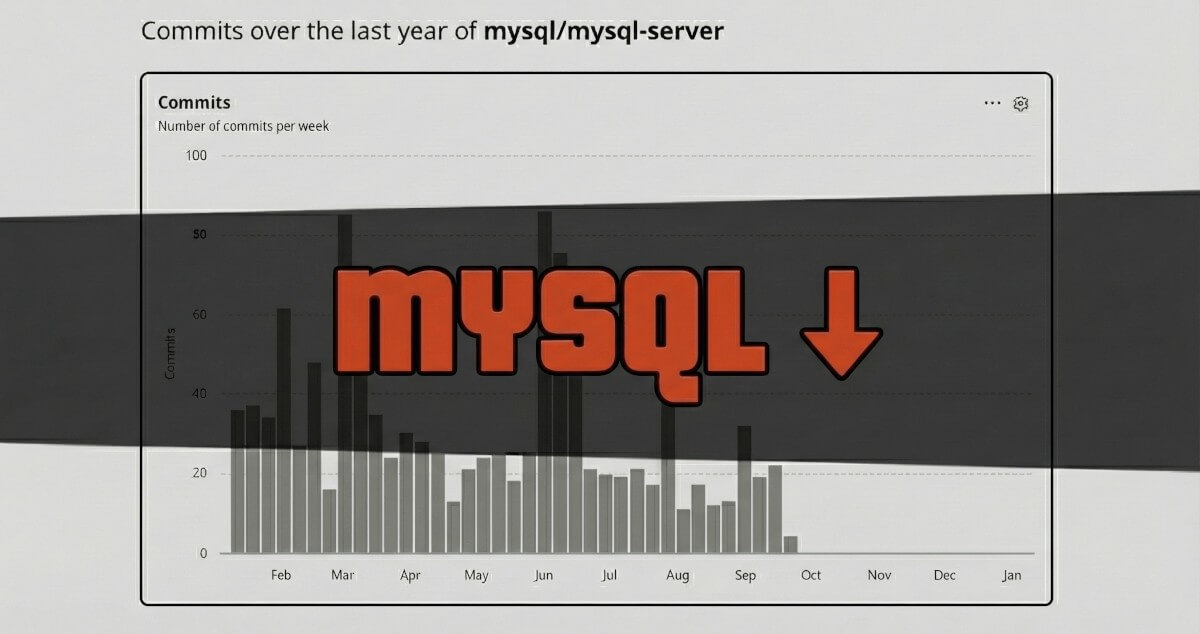
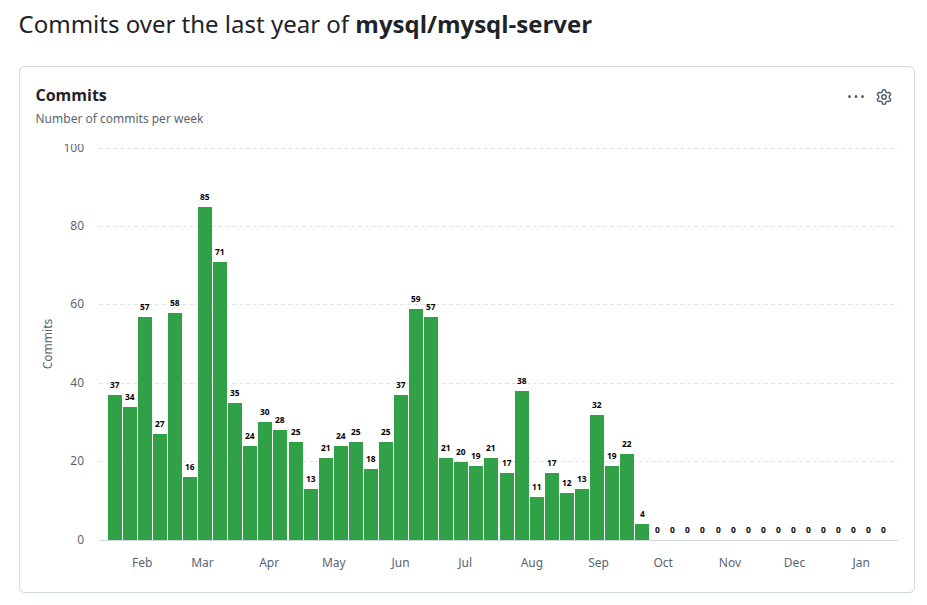
Featured image of post Stop using MySQL in 2026, it is not true open sourceIf you care about supporting open source software, and still use MySQL in 2026, you should switch to MariaDB like so many others have already done. The number of git commits on github.com/mysql/mysql-server has been significantly declining in 2025. The screenshot below shows the state of git commits as of writing this in January 2026, and the picture should be alarming to anyone who cares about software being open source. MySQL GitHub commit activity decreasing drastically
This is not surprising Oracle should not be trusted as the steward for open source projects When Oracle acquired Sun Microsystems and MySQL along with it back in 2009, the European Commission almost blocked the deal due to concerns that Oracle s goal was just to stifle competition. The deal went through as Oracle made a commitment to keep MySQL going and not kill it, but (to nobody s surprise) Oracle has not been a good steward of MySQL as an open source project and the community around it has been withering away for years now. All development is done behind closed doors. The publicly visible bug tracker is not the real one Oracle staff actually uses for MySQL development, and the few people who try to contribute to MySQL just see their Pull Requests and patch submissions marked as received with mostly no feedback and then those changes may or may not be in the next MySQL release, often rewritten, and with only Oracle staff in the git author/committer fields. The real author only gets a small mention in a blog post. When I was the engineering manager for the core team working on RDS MySQL and RDS MariaDB at Amazon Web Services, I oversaw my engineers contributions to both MySQL and MariaDB (the latter being a fork of MySQL by the original MySQL author, Michael Widenius). All the software developers in my org disliked submitting code to MySQL due to how bad the reception by Oracle was to their contributions. MariaDB is the stark opposite with all development taking place in real-time on github.com/mariadb/server, anyone being able to submit a Pull Request and get a review, all bugs being openly discussed at jira.mariadb.org and so forth, just like one would expect from a true open source project. MySQL is open source only by license (GPL v2), but not as a project.

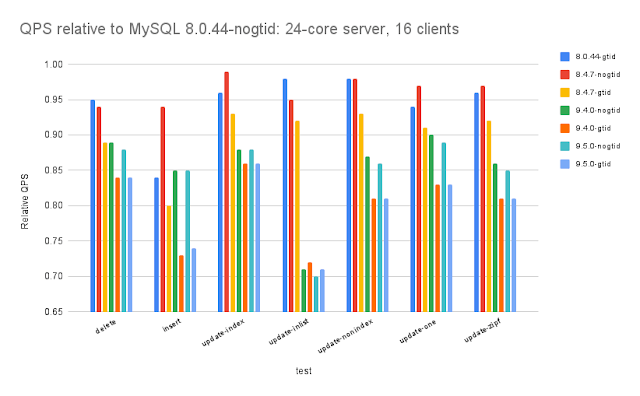
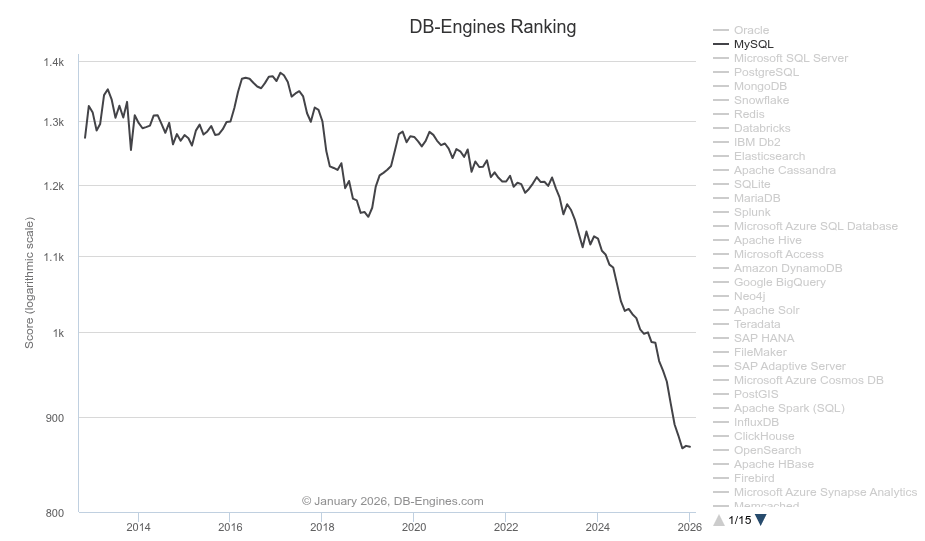
MySQL s technical decline in recent years Despite not being a good open source steward, Oracle should be given credit that it did keep the MySQL organization alive and allowed it to exist fairly independently and continue developing and releasing new MySQL versions well over a decade after the acquisition. I have no insight into how many customers they had, but I assume the MySQL business was fairly profitable and financially useful to Oracle, at least as long as it didn t gain too many features to threaten Oracle s own main database business. I don t know why, perhaps because too many talented people had left the organization, but it seems that from a technical point of view MySQL clearly started to deteriorate from 2022 onward. When MySQL 8.0.29 was released with the default ALTER TABLE method switched to run in-place, it had a lot of corner cases that didn t work, causing the database to crash and data to corrupt for many users. The issue wasn t fully fixed until a year later in MySQL 8.0.32. To many users annoyance Oracle announced the 8.0 series as evergreen and introduced features and changes in the minor releases, instead of just doing bugfixes and security fixes like users historically had learnt to expect from these x.y.Z maintenance releases. There was no new major MySQL version for six years. After MySQL 8.0 in 2018 it wasn t until 2023 when MySQL 8.1 was released, and it was just a short-term preview release. The first actual new major release MySQL 8.4 LTS was released in 2024. Even though it was a new major release, many users got disappointed as it had barely any new features. Many also reported degraded performance with newer MySQL versions, for example the benchmark by famous MySQL performance expert Mark Callaghan below shows that on write-heavy workloads MySQL 9.5 throughput is typically 15% less than in 8.0. Benchmark showing new MySQL versions being slower than the old Due to newer MySQL versions deprecating many features, a lot of users also complained about significant struggles regarding both MySQL 5.7->8.0 and 8.0->8.4 upgrades. With few new features and heavy focus on code base cleanup and feature deprecation, it became obvious to many that Oracle had decided to just keep MySQL barely alive, and put all new relevant features (e.g. vector search) into Heatwave, Oracle s closed-source and cloud-only service for MySQL customers. As it was evident that Oracle isn t investing in MySQL, Percona s Peter Zaitsev wrote Is Oracle Finally Killing MySQL in June 2024. At this time MySQL s popularity as ranked by DB-Engines had also started to tank hard, a trend that likely accelerates in 2026. MySQL dropping significantly in DB-Engines ranking In September 2025 news reported that Oracle was reducing its workforce and that the MySQL staff was getting heavily reduced. Obviously this does not bode well for MySQL s future, and Peter Zaitsev posted already in November stats showing that the latest MySQL maintenance release contained fewer bug fixes than before.
Open source is more than ideology: it has very real effects on software security and sovereignty Some say they don t care if MySQL is truly open source or not, or that they don t care if it has a future in coming years, as long as it still works now. I am afraid people thinking so are taking a huge risk. The database is often the most critical part of a software application stack, and any flaw or problem in operations, let alone a security issue, will have immediate consequences, and not caring will eventually get people fired or sued. In open source problems are discussed openly, and the bigger the problem, the more people and companies will contribute to fixing it. Open source as a development methodology is similar to the scientific method with free flow of ideas that are constantly contested and only the ones with the most compelling evidence win. Not being open means more obscurity, more risk and more just trust us bro attitude. This open vs. closed is very visible for example in how Oracle handles security issues. We can see that in 2025 alone MySQL published 123 CVEs about security issues, while MariaDB had 8. There were 117 CVEs that only affected MySQL and not MariaDB in 2025. I haven t read them all, but typically the CVEs hardly contain any real details. As an example, the most recent one CVE-2025-53067 states Easily exploitable vulnerability allows high privileged attacker with network access via multiple protocols to compromise MySQL Server. There is no information a security researcher or auditor could use to verify if any original issue actually existed, or if it was fixed, or if the fix was sufficient and fully mitigating the issue or not. MySQL users just have to take the word of Oracle that it is all good now. Handling security issues like this is in stark contrast to other open source projects, where all security issues and their code fixes are open for full scrutiny after the initial embargo is over and CVE made public. There is also various forms of enshittification going on one would not see in a true open source project, and everything about MySQL as a software, documentation and website is pushing users to stop using the open source version and move to the closed MySQL versions, and in particular to Heatwave, which is not only closed-source but also results in Oracle fully controlling customer s databases contents. Of course, some could say this is how Oracle makes money and is able to provide a better product. But stories on Reddit and elsewhere suggest that what is going on is more like Oracle milking hard the last remaining MySQL customers who are forced to pay more and more for getting less and less.

There are options and migrating is easy, just do it A large part of MySQL users switched to MariaDB already in the mid-2010s, in particular everyone who had cared deeply about their database software staying truly open source. That included large installations such as Wikipedia, and Linux distributions such as Fedora and Debian. Because it s open source and there is no centralized machine collecting statistics, nobody knows what the exact market shares look like. There are however some application specific stats, such as that 57% of WordPress sites around the world run MariaDB, while the share for MySQL is 42%. For anyone running a classic LAMP stack application such as WordPress, Drupal, Mediawiki, Nextcloud, or Magento, switching the old MySQL database to MariaDB is be straightforward. As MariaDB is a fork of MySQL and mostly backwards compatible with it, swapping out MySQL for MariaDB can be done without changing any of the existing connectors or database clients, as they will continue to work with MariaDB as if it was MySQL. For those running custom applications and who have the freedom to make changes to how and what database is used, there are tens of mature and well-functioning open source databases to choose from, with PostgreSQL being the most popular general database. If your application was built from the start for MySQL, switching to PostgreSQL may however require a lot of work, and the MySQL/MariaDB architecture and storage engine InnoDB may still offer an edge in e.g. online services where high performance, scalability and solid replication features are of highest priority. For a quick and easy migration MariaDB is probably the best option. Switching from MySQL to the Percona Server is also very easy, as it closely tracks all changes in MySQL and deviates from it only by a small number of improvements done by Percona. However, also precisely because of it being basically just a customized version of the MySQL Server, it s not a viable long-term solution for those trying to fully ditch the dependency on Oracle. There are also several open source databases that have no common ancestry with MySQL, but strive to be MySQL-compatible. Thus most apps built for MySQL can simply switch to using them without needing SQL statements to be rewritten. One such database is TiDB, which has been designed from scratch specifically for highly scalable and large systems, and is so good that even Amazon s latest database solution DSQL was built borrowing many ideas from TiDB. However, TiDB only really shines with larger distributed setups, so for the vast majority of regular small- and mid-scale applications currently using MySQL, the most practical solution is probably to just switch to MariaDB, which on most Linux distributions can simply be installed by running apt/dnf/brew install mariadb-server. Whatever you end up choosing, as long as it is not Oracle, you will be better off.

10 January 2026

Dirk Eddelbuettel: Rcpp 1.1.1 on CRAN: Many Improvements in Semi-Annual Update

rcpp logo Team Rcpp is thrilled to share that an exciting new version 1.1.1 of Rcpp is now on CRAN (and also uploaded to Debian and already built for r2u). Having switchted to C++11 as the minimum standard in the previous 1.1.0 release, this version takes full advantage of it and removes a lot of conditional code catering to older standards that no longer need to be supported. Consequently, the source tarball shrinks by 39% from 3.11 mb to 1.88 mb. That is a big deal. (Size peaked with Rcpp 1.0.12 two years ago at 3.43 mb; relative to its size we are down 45% !!) Removing unused code also makes maintenance easier, and quickens both compilation and installation in general. This release continues as usual with the six-months January-July cycle started with release 1.0.5 in July 2020. Interim snapshots are always available via the r-universe page and repo. We continue to strongly encourage the use of these development released and their testing we tend to run our systems with them too. Rcpp has long established itself as the most popular way of enhancing R with C or C++ code. Right now, 3020 packages on CRAN depend on Rcpp for making analytical code go faster and further. On CRAN, 13.1% of all packages depend (directly) on Rcpp, and 60.9% of all compiled packages do. From the cloud mirror of CRAN (which is but a subset of all CRAN downloads), Rcpp has been downloaded 109.8 million times. The two published papers (also included in the package as preprint vignettes) have, respectively, 2151 (JSS, 2011) and 405 (TAS, 2018) citations, while the the book (Springer useR!, 2013) has another 715. This time, I am not attempting to summarize the different changes. The full list follows below and details all these changes, their respective PRs and, if applicable, issue tickets. Big thanks from all of us to all contributors!

Changes in Rcpp release version 1.1.1 (2026-01-08)
  • Changes in Rcpp API:
    • An unused old R function for a compiler version check has been removed after checking no known package uses it (Dirk in #1395)
    • A narrowing warning is avoided via a cast (Dirk in #1398)
    • Demangling checks have been simplified (I aki in #1401 addressing #1400)
    • The treatment of signed zeros is now improved in the Sugar code (I aki in #1404)
    • Preparations for phasing out use of Rf_error have been made (I aki in #1407)
    • The long-deprecated function loadRcppModules() has been removed (Dirk in #1416 closing #1415)
    • Some non-API includes from R were refactored to accommodate R-devel changes (I aki in #1418 addressing #1417)
    • An accessor to Rf_rnbeta has been removed (Dirk in #1419 also addressing #1420)
    • Code accessing non-API Rf_findVarInFrame now uses R_getVarEx (Dirk in #1423 fixing #1421)
    • Code conditional on the R version now expects at least R 3.5.0; older code has been removed (Dirk in #1426 fixing #1425)
    • The non-API ATTRIB entry point to the R API is no longer used (Dirk in #1430 addressing #1429)
    • The unwind-protect mechanism is now used unconditionally (Dirk in #1437 closing #1436)
  • Changes in Rcpp Attributes:
    • The OpenMP plugin has been generalized for different macOS compiler installations (Kevin in #1414)
  • Changes in Rcpp Documentation:
    • Vignettes are now processed via a new "asis" processor adopted from R.rsp (Dirk in #1394 fixing #1393)
    • R is now cited via its DOI (Dirk)
    • A (very) stale help page has been removed (Dirk in #1428 fixing #1427)
    • The main README.md was updated emphasizing r-universe in favor of the local drat repos (Dirk in #1431)
  • Changes in Rcpp Deployment:
    • A temporary change in R-devel concerning NA part in complex variables was accommodated, and then reverted (Dirk in #1399 fixing #1397)
    • The macOS CI runners now use macos-14 (Dirk in #1405)
    • A message is shown if R.h is included before Rcpp headers as this can lead to errors (Dirk in #1411 closing #1410)
    • Old helper functions use message() to signal they are not used, deprecation and removal to follow (Dirk in #1413 closing #1412)
    • Three tests were being silenced following #1413 (Dirk in #1422)
    • The heuristic whether to run all available tests was refined (Dirk in #1434 addressing #1433)
    • Coverage has been tweaked via additional #nocov tags (Dirk in #1435)
  • Non-release Changes:
    • Two interim non-releases 1.1.0.8.1 and .2 were made in order to unblock CRAN due to changes in R-devel rather than Rcpp

Thanks to my CRANberries, you can also look at a diff to the previous interim release along with pre-releaseds 1.1.0.8, 1.1.0.8.1 and 1.1.0.8.2 that were needed because R-devel all of a sudden decided to move fast and break things. Not our doing. Questions, comments etc should go to the GitHub discussion section list]rcppdevellist off the R-Forge page. Bugs reports are welcome at the GitHub issue tracker as well. Both sections can be searched as well.

This post by Dirk Eddelbuettel originated on his Thinking inside the box blog. If you like this or other open-source work I do, you can sponsor me at GitHub.

Scarlett Gately Moore: I love KDE too much to retire! Snap beta releases trickling in. Stay tuned.

A short but sweet note to say I am coming out of my short retirement to help with snaps again. My time is extremely limited, however we are working hard on getting snaps on CI and I have some newer snaps in beta trickling in for testing. You must install kf6-core24 from beta as well to test them ( this will likely break older kde snaps in the process so beware. ) This is slow going as I work on them during my hour lunch at day job and spare stolen moments. KDE is coming up on its 30th birthday!!! How cool is that! I  KDE Like my work? Consider a donation. Thank you! Donate

9 January 2026

Simon Josefsson: Debian Taco Towards a GitSecDevOps Debian

One of my holiday projects was to understand and gain more trust in how Debian binaries are built, and as the holidays are coming to an end, I d like to introduce a new research project called Debian Taco. I apparently need more holidays, because there are still more work to be done here, so at the end I ll summarize some pending work. Debian Taco, or TacOS, is a GitSecDevOps rebuild of Debian GNU/Linux. The Debian Taco project publish rebuilt binary packages, package repository metadata (InRelease, Packages, etc), container images, cloud images and live images. All packages are built from pristine source packages in the Debian archive. Debian Taco does not modify any Debian source code nor add or remove any packages found in Debian. No servers are involved! Everything is built in GitLab pipelines and results are published through modern GitDevOps mechanism like GitLab Pages and S3 object storage. You can fork the individual projects below on GitLab.com and you will have your own Debian-derived OS available for tweaking. (Of course, at some level, servers are always involved, so this claim is a bit of hyperbole.)

Goals The goal of TacOS is to be bit-by-bit identical with official Debian GNU/Linux, and until that has been completed, publish diffoscope output with differences. The idea is to further categorize all artifact differences into one of the following categories: 1) An obvious bug in Debian. For example, if a package does not build reproducible. 2) An obvious bug in TacOS. For example, if our build environment does not manage to build a package. 3) Something else. This would be input for further research and consideration. This category also include things where it isn t obvious if it is a bug in Debian or in TacOS. Known examples: 3A) Packages in TacOS are rebuilt the latest available source code, not the (potentially) older package that were used to build the Debian packages. This could lead to differences in the packages. These differences may be useful to analyze to identify supply-chain attacks. See some discussion about idempotent rebuilds. Our packages are all built from source code, unless we have not yet managed to build something. In the latter situation, Debian Taco falls back and uses the official Debian artifact. This allows an incremental publication of Debian Taco that still is 100% complete without requiring that everything is rebuilt instantly. The goal is that everything should be rebuilt, and until that has been completed, publish a list of artifacts that we use verbatim from Debian.

Debian Taco Archive The Debian Taco Archive project generate and publish the package archive (dists/tacos-trixie/InRelease, dists/tacos-trixie/main/binary-amd64/Packages.gz, pool/* etc), similar to what is published at https://deb.debian.org/debian/. The output of the Debian Taco Archive is available from https://debdistutils.gitlab.io/tacos/archive/.

Debian Taco Container Images The Debian Taco Container Images project provide container images of Debian Taco for trixie, forky and sid on the amd64, arm64, ppc64el and riscv64 architectures. These images allow quick and simple use of Debian Taco interactively, but makes it easy to deploy for container orchestration frameworks.

Debian Taco Cloud Images The Debian Taco Cloud Images project provide cloud images of Debian Taco for trixie, forky and sid on the amd64, arm64, ppc64el and riscv64 architectures. Launch and install Debian Taco for your cloud environment!

Debian Taco Live Images The Debian Taco Live Images project provide live images of Debian Taco for trixie, forky and sid on the amd64 and arm64 architectures. These images allows running Debian Taco on physical hardware (or virtual machines), and even installation for permanent use.

Debian Taco Build Images and Packages Packages are built using debdistbuild, which was introduced in a blog about Build Debian in a GitLab Pipeline. The first step is to prepare build images, which is done by the Debian Taco Build Images project. They are similar to the Debian Taco containers but have build-essential and debdistbuild installed on them. Debdistbuild is launched in a per-architecture per-suite CI/CD project. Currently only trixie-amd64 is available. That project has built some essential early packages like base-files, debian-archive-keyring and hostname. They are stored in Git LFS backed by a S3 object storage. These packages were all built reproducibly. So this means Debian Taco is still 100% bit-by-bit identical to Debian, except for the renaming. I ve yet to launch a more massive wide-scale package rebuild until some outstanding issues have been resolved. I earlier rebuilt around 7000 packages from Trixie on amd64, so I know that the method easily scales.

Remaining work Where is the diffoscope package outputs and list of package differences? For another holiday! Clearly this is an important remaining work item. Another important outstanding issue is how to orchestrate launching the build of all packages. Clearly a list of packages is needed, and some trigger mechanism to understand when new packages are added to Debian. One goal was to build packages from the tag2upload browse.dgit.debian.org archive, before checking the Debian Archive. This ought to be really simple to implement, but other matters came first.

GitLab or Codeberg? Everything is written using basic POSIX /bin/sh shell scripts. Debian Taco uses the GitLab CI/CD Pipeline mechanism together with a Hetzner S3 object storage to serve packages. The scripts have only weak reliance on GitLab-specific principles, and were designed with the intention to support other platforms. I believe reliance on a particular CI/CD platform is a limitation, so I d like to explore shipping Debian Taco through a Forgejo-based architecture, possibly via Codeberg as soon as I manage to deploy reliable Forgejo runners. The important aspects that are required are: 1) Pipelines that can build and publish web sites similar to GitLab Pages. Codeberg has a pipeline mechanism. I ve successfully used Codeberg Pages to publish the OATH Toolkit homepage homepage. Glueing this together seems feasible. 2) Container Registry. It seems Forgejo supports a Container Registry but I ve not worked with it at Codeberg to understand if there are any limitations. 3) Package Registry. The Deban Taco live images are uploaded into a package registry, because they are too big for being served through GitLab Pages. It may be converted to using a Pages mechanism, or possibly through Release Artifacts if multi-GB artifacts are supported on other platforms. I hope to continue this work and explaining more details in a series of posts, stay tuned!

Russell Coker: LEAF ZE1 After 6 Months

About 6 months ago I got a Nissan LEAF ZE1 (2019 model) [1]. Generally it s going well and I m happy with most things about it. One issue is that as there isn t a lot of weight in the front with the batteries in the centre of the car the front wheels slip easily when accelerating. It s a minor thing but a good reason for wanting AWD in an electric car. When I got the car I got two charging devices, the one to charge from a regular 240V 10A power point (often referred to as a granny charger ) and a cable with a special EV charging connector on each end. The cable with an EV connector on each end is designed for charging that s faster than the granny charger but not as fast as the rapid chargers which have the cable connected to the supply so the cable temperature can be monitored and/or controlled. That cable can be used if you get a fast charger setup at your home (which I never plan to do) and apparently at some small hotels and other places with home-style EV charging. I m considering just selling that cable on ebay as I don t think I have any need to personally own a cable other than the granny charger . The key fob for the LEAF has a battery installed, it s either CR2032 or CR2025 mine has CR2025. Some reports on the Internet suggest that you can stuff a CR2032 battery in anyway but that didn t work for me as the thickness of the battery stopped some of the contacts from making a good connection. I think I could have got it going by putting some metal in between but the batteries aren t expensive enough to make it worth the effort and risk. It would be nice if I could use batteries from my stockpile of CR2032 batteries that came from old PCs but I can afford to spend a few dollars on it. My driveway is short and if I left the charger out it would be visible from the street and at risk of being stolen. I m thinking of chaining the charger to a tree and having some sort of waterproof enclosure for it so I don t have to go to the effort of taking it out of the boot every time I use it. Then I could also configure the car to only charge during the peak sunlight hours when the solar power my home feeds into the grid has a negative price (we have so much solar power that it s causing grid problems). The cruise control is a pain to use, so much so that I haven t yet got it to work usefully ever. The features look good in the documentation but in practice it s not as good as the Kia one I ve used previously where I could just press one button to turn it on, another button to set the current speed as the cruise control speed, and then just have it work. The electronic compass built in to the dash turned out to be surprisingly useful. I regret not gluing a compass to the dash of previous cars. One example is when I start google navigation for a journey and it says go South on street X and I need to know which direction is South so I don t start in the wrong direction. Another example is when I know that I m North of a major road that I need to take to get to my destination so I just need to go roughly South and that is enough to get me to a road I recognise. In the past when there is a bird in the way I don t do anything different, I keep driving at the same speed and rely on the bird to see me and move out of the way. Birds have faster reactions than humans and have evolved to move at the speeds cars travel on all roads other than freeways, also birds that are on roads are usually ones that have an eye in each side of their head so they can t not see my car approaching. For decades this has worked, but recently a bird just stood on the road and got squashed. So I guess that I should honk when there s birds on the road. Generally everything about the car is fine and I m happy to keep driving it.

8 January 2026

Reproducible Builds: Reproducible Builds in December 2025

Welcome to the December 2025 from the Reproducible Builds project! Our monthly reports outline what we ve been up to over the past month, highlighting items of news from elsewhere in the increasingly-important area of software supply-chain security. As ever, if you are interested in contributing to the Reproducible Builds project, please see the Contribute page on our website.

  1. New orig-check service to validate Debian upstream tarballs
  2. Distribution work
  3. disorderfs updated to FUSE 3
  4. Mailing list updates
  5. Three new academic papers published
  6. Website updates
  7. Upstream patches

New orig-check service to validate Debian upstream tarballs This month, Debian Developer Lucas Nussbaum announced the orig-check service, which attempts to automatically reproduce the generation upstream tarballs (ie. the original source component of a Debian source package), comparing that to the upstream tarball actually shipped with Debian. As of the time of writing, it is possible for a Debian developer to upload a source archive that does not actually correspond to upstream s version. Whilst this is not inherently malicious (it typically indicates some tooling/process issue), the very possibility that a maintainer s version may differ potentially permits a maintainer to make (malicious) changes that would be misattributed to upstream. This service therefore nicely complements the whatsrc.org service, which was reported in our reports for both April and August. The orig-check is dedicated to Lunar, who sadly passed away a year ago.

Distribution work In Arch Linux this month, Robin Candau and Mark Hegreberg worked at making the Arch Linux WSL image bit-for-bit reproducible. Robin also shared some implementation details and future related work on our mailing list. Continuing a series reported in these reports for March, April and July 2025 (etc.), Simon Josefsson has published another interesting article this month, itself a followup to a post Simon published in December 2024 regarding GNU Guix Container Images that are hosted on GitLab. In Debian this month, Micha Lenk posted to the debian-backports-announce mailing list with the news that the Backports archive will now discard binaries generated and uploaded by maintainers: The benefit is that all binary packages [will] get built by the Debian buildds before we distribute them within the archive. Felix Moessbauer of Siemens then filed a bug in the Debian bug tracker to signal their intention to package debsbom, a software bill of materials (SBOM) generator for distributions based on Debian. This generated a discussion on the bug inquiring about the output format as well as a question about how these SBOMs might be distributed. Holger Levsen merged a number of significant changes written by Alper Nebi Yasak to the Debian Installer in order to improve its reproducibility. As noted in Alper s merge request, These are the reproducibility fixes I looked into before bookworm release, but was a bit afraid to send as it s just before the release, because the things like the xorriso conversion changes the content of the files to try to make them reproducible. In addition, 76 reviews of Debian packages were added, 8 were updated and 27 were removed this month adding to our knowledge about identified issues. A new different_package_content_when_built_with_nocheck issue type was added by Holger Levsen. [ ] Arnout Engelen posted to our mailing list reporting that they successfully reproduced the NixOS minimal installation ISO for the 25.11 release without relying on a pre-compiled package archive, with more details on their blog. Lastly, Bernhard M. Wiedemann posted another openSUSE monthly update for his work there.

disorderfs updated to FUSE 3 disorderfs is our FUSE-based filesystem that deliberately introduces non-determinism into system calls to reliably flush out reproducibility issues. This month, however, Roland Clobus upgraded disorderfs* from FUSE 2 to FUSE 3 after its package automatically got removed from Debian testing. Some tests in Debian currently require disorderfs to make the Debian live images reproducible, although disorderfs is not a Debian-specific tool.

Mailing list updates On our mailing list this month:
  • Luca Di Maio announced stampdalf, a filesystem timestamp preservation tool that wraps arbitrary commands and ensures filesystem timestamp reproducibility :
    stampdalf allows you to run any command that modifies files in a directory tree, then automatically resets all timestamps back to their original values. Any new files created during command execution are set to [the UNIX epoch] or a custom timestamp via SOURCE_DATE_EPOCH.
    The project s GitHub page helpfully reveals that the project is pronounced: stamp-dalf (stamp like time-stamp, dalf like Gandalf the wizard) as it s a wizard of time and stamps .)
  • Lastly, Reproducible Builds developer cen1 posted to our list announcing that early/experimental/alpha support for FreeBSD was added to rebuilderd. In their post, cen1 reports that the initial builds are in progress and look quite decent . cen1 also interestingly notes that since the upstream is currently not technically reproducible I had to relax the bit-for-bit identical requirement of rebuilderd [ ] I consider the pkg to be reproducible if the tar is content-identical (via diffoscope), ignoring timestamps and some of the manifest files. .

Three new academic papers published Yogya Gamage and Benoit Baudry of Universit de Montr al, Canada together with Deepika Tiwari and Martin Monperrus of KTH Royal Institute of Technology, Sweden published a paper on The Design Space of Lockfiles Across Package Managers:
Most package managers also generate a lockfile, which records the exact set of resolved dependency versions. Lockfiles are used to reduce build times; to verify the integrity of resolved packages; and to support build reproducibility across environments and time. Despite these beneficial features, developers often struggle with their maintenance, usage, and interpretation. In this study, we unveil the major challenges related to lockfiles, such that future researchers and engineers can address them. [ ]
A PDF of their paper is available online. Benoit Baudry also posted an announcement to our mailing list, which generated a number of replies.
Betul Gokkaya, Leonardo Aniello and Basel Halak of the University of Southampton then published a paper on the A taxonomy of attacks, mitigations and risk assessment strategies within the software supply chain:
While existing studies primarily focus on software supply chain attacks prevention and detection methods, there is a need for a broad overview of attacks and comprehensive risk assessment for software supply chain security. This study conducts a systematic literature review to fill this gap. By analyzing 96 papers published between 2015-2023, we identified 19 distinct SSC attacks, including 6 novel attacks highlighted in recent studies. Additionally, we developed 25 specific security controls and established a precisely mapped taxonomy that transparently links each control to one or more specific attacks. [ ]
A PDF of the paper is available online via the article s canonical page.
Aman Sharma and Martin Monperrus of the KTH Royal Institute of Technology, Sweden along with Benoit Baudry of Universit de Montr al, Canada published a paper this month on Causes and Canonicalization of Unreproducible Builds in Java. The abstract of the paper is as follows:
[Achieving] reproducibility at scale remains difficult, especially in Java, due to a range of non-deterministic factors and caveats in the build process. In this work, we focus on reproducibility in Java-based software, archetypal of enterprise applications. We introduce a conceptual framework for reproducible builds, we analyze a large dataset from Reproducible Central, and we develop a novel taxonomy of six root causes of unreproducibility. [ ]
A PDF of the paper is available online.

Website updates Once again, there were a number of improvements made to our website this month including:

Upstream patches The Reproducible Builds project detects, dissects and attempts to fix as many currently-unreproducible packages as possible. We endeavour to send all of our patches upstream where appropriate. This month, we wrote a large number of such patches, including:

Finally, if you are interested in contributing to the Reproducible Builds project, please visit our Contribute page on our website. However, you can get in touch with us via:

Dirk Eddelbuettel: RcppCCTZ 0.2.14 on CRAN: New Upstream, Small Edits

A new release 0.2.14 of RcppCCTZ is now on CRAN, in Debian and built for r2u. RcppCCTZ uses Rcpp to bring CCTZ to R. CCTZ is a C++ library for translating between absolute and civil times using the rules of a time zone. In fact, it is two libraries. One for dealing with civil time: human-readable dates and times, and one for converting between between absolute and civil times via time zones. And while CCTZ is made by Google(rs), it is not an official Google product. The RcppCCTZ page has a few usage examples and details. This package was the first CRAN package to use CCTZ; by now several others packages (four the last time we counted) include its sources too. Not ideal, but beyond our control. This version updates to a new upstream release, and brings some small local edits. CRAN and R-devel were stumbled over us still mentioning C++11 in SystemRequirements (yes, this package is old enough for that to have mattered once). As that is a false positive the package compiles well under any recent standard we removed the mention. The key changes since the last CRAN release are summarised below.

Changes in version 0.2.14 (2026-01-08)
  • Synchronized with upstream CCTZ (Dirk in #46).
  • Explicitly enumerate files to be compiled in src/Makevars* (Dirk in #47)

Courtesy of my CRANberries, there is a diffstat report relative to to the previous version. More details are at the RcppCCTZ page; code, issue tickets etc at the GitHub repository.

This post by Dirk Eddelbuettel originated on his Thinking inside the box blog. If you like this or other open-source work I do, you can sponsor me at GitHub.

Sven Hoexter: Moving from hexchat to Halloy

I'm not hanging around on IRC a lot these days, but when I do I used hexchat (and xchat before). Probably a bad habbit of clinging to what I got used to for the past 25 years. But in the light of the planned removal of GTK2, it felt like it was time to look for an alternative. Halloy looked interesting, albeit not packaged for Debian. But upstream references a flatpak (another party I did not join so far), good enough to give it a try.
$ sudo apt install flatpak
$ flatpak remote-add --if-not-exists flathub https://dl.flathub.org/repo/flathub.flatpakrepo
$ flatpak install org.squidowl.halloy
$ flatpak run org.squidowl.halloy
Configuration ends up at ~/.var/app/org.squidowl.halloy/config/halloy/config.toml, which I linked for convenience to ~/.halloy.toml. Since I connect via ZNC in an odd old setup without those virtual networks, but several accounts, and of course never bothered to replace the self signed certificate, it requires some additional configuration to be able to connect. Each account gets its own servers.<foo> block like this:
[servers.bnc-oftc]
nickname = "my-znc-user-for-this-network"
server = "sven.stormbind.net"
dangerously_accept_invalid_certs = true
password = "mypasssowrd"
port = 4711
use_tls = true
Halloy has also a small ZNC guide. I'm growing old, so a bigger font size is useful. Be aware that font changes require an application restart to take effect.
[font]
size = 16
family = "Noto Mono"
I also prefer the single-pane mode which could be copy & pasted as documented. Works good enough for now. hexchat was also the last none wayland application I've been using (xlsclients output is finally empty).

Next.

Previous.