Search Results: "tar"

28 November 2025

Russell Coker: 10gbit and 40gbit Home Networking

Aliexpress has a 4 port 2.5gbit switch with 2*SFP+ sockets for $34.35 delivered [1]. 4 ports isn t very good for the more common use cases (if daisy chaining them then it s only
2 available for devices) so this is really a device for use with 10Gbit uplink. Aliexpress has a pair of SFP+ 10Gbit devices with 1M of copper between them for $15.79 delivered [2]. That page also offers a pair of QSFP+ 40Gbit devices with 1M of copper between them for $27.79 delivered. They have a dual port SFP+ card for a server with two of the pairs of SFP+ 10gbit devices with copper between them for $32.51 delivered [3]. So you can get a 2.5gbit switch with two 10gbit uplink cables to nearby servers for $66.86 including postage. I don t need this but it is tempting. I spent $93.78 to get 2.5gbit networking [4] so spending $66.86 to get part of my network to 10gbit isn t much. It is $99.81 including postage for a Mellanox 2*40Gbit QSFP+ card and two QSFP+ adaptors with 3M of copper between them [5]. It is $55.81 including postage for the Mellanox card without the cable. So that s $155.62 for a point to point 40gbit link between systems that are less than 3M apart, that s affordable for a home lab. As an aside the only NVMe I ve tested which can deliver such speeds was in a Thinkpad and the Thinkpad entered a thermal throttling state after a few seconds of doing that. The best price I could see for a 40Gbit switch is $1280 for a L3 Managed switch with 2*40G QSFP+ slot ports, 4*10G SFP+ ports, and 48*2.5G RJ45 ports [6]. That s quite affordable for the SME market but a bit expensive for home users (although I m sure that someone on r/homelab has one). I m not going to get 40Gbit, that s well above what I need and while a point to point link is quite affordable I don t have servers in that range. But I am seriously considering 10Gbit, I get paid to do enough networking stuff that having some hands on experience with 10Gbit could be useful. For a laptop a 5gbit ethernet USB device is $29.48 including delivery which isn t too expensive [7]. The faster ones seem to be all Thunderbolt and well over $100, which is disappointing as USB 3.2 can do up to 20Gbit. If I start doing 10gbit over ethernet I ll get one of those USB devices for testing. For a single server it s cheaper and easier to get a 4 port 2.5Gbit ethernet for $55.61 [8].

27 November 2025

Russ Allbery: Review: A Matter of Execution

Review: A Matter of Execution, by Nicholas & Olivia Atwater
Series: Tales of the Iron Rose #0
Publisher: Starwatch Press
Copyright: 2024
ISBN: 1-998257-08-8
Format: Kindle
Pages: 131
A Matter of Execution is the introductory novella that kicked off the Tales of the Iron Rose series. It is steampunk fantasy with airships. I previously read and reviewed the subsequent novel, Echoes of the Imperium. As noted in that review, I read the novel first. That was a mistake; this is a much better place to start. A Matter of Execution was clearly intended as the introduction of all of these characters. More importantly, I think reading the novella first would have given me enough affinity with the characters to not mind the worst part of Echoes of the Imperium: the extremely slow first half that seemed filled with the protagonist's impostor syndrome. A Matter of Execution opens, fittingly, with Captain William Blair, a goblin, former Imperial soldier, Oathbreaker, and series first-person protagonist being carted to his execution. He is not alone; in the same prison wagon is an arrogant (and racist) man named Strahl, the killer of one of the rulers of Lyonesse. Strahl is rather contemptuous of Blair's claim to be a captain, given that he's both a goblin and an Oathbreaker. Strahl quickly revises that opinion when Blair's crew, somewhat predictably given that he is the series protagonist, creates a daring escape for both of them. The heat of action gives both a chance to gain some respect for the other, which explains why Blair is not only willing to invite Strahl to join his crew, but to go back for Strahl's companion. Breaking out Strahl's companion will be a more difficult, and surprising, problem. Nicholas Atwater is a role-playing game GM, something that you will learn in the "about the author" section at the end of this novella but probably will have guessed by then. Even more than Echoes of the Imperium, this novella feels like a (good) write-up of an RPG adventure. A wildly varied cast of characters come together and form a party with a well-defined objective that has some surrounding mysteries and surprises. Each of those characters get their individual moments to show off their specific skills. Readers with a certain gaming background will know exactly where to insert the Borderlands-style title card with a slightly demented description of each character. This is not a complaint. You may be able to see the bones of the setup adventure for a long-running campaign, but I like this style of character introduction and the story moves right along. There are a ton of varied characters, some interesting villains and maybe-villains, a rather satisfying heist setup, and some good chemistry and a bit of banter. This is not a deep story it's clearly an introductory episode for both the characters and the world background but it's a fun way to spend a few hours. I think the best part of this series is the world-building. If you have read my review of Echoes of the Imperium, you have unfortunately been mildly spoiled for the revelation in this novella. I don't think it hurt the story that much; you will be able to predict what obvious gaps in the novel backstory the novella is going to fill in, but it's just as enjoyable to see how that happens. But the Atwaters aren't going to drop any of the big world-building bombs in the introductory novella, of course. Instead, you get a gradual introduction to the nature of magic in this world, some of the political setup of the recent war, and a quick introduction to the capabilities of Strahl's mysterious companion. If you've not yet read this series, I recommend starting here. It's a quick investment to see if you'll be interested. The novel is heavier and slower, and the pacing of the first half isn't great, but the world-building is even better. If you've already read the novel, this is still worth reading as long as you enjoyed it. You'll have a few moments of "oh, that's how that happened," and it's a fun and fast-moving way to spend a bit more time with the characters. Followed by Echoes of the Imperium. The back matter of the novella says that The Winds of Fortune is supposedly forthcoming. Rating: 7 out of 10

Russell Coker: PineTime Band

I ve had a Pine Time for just over 2 years [1]. About a year ago I had a band break and replaced it from a spare PineTime and now I just had another break. Having the band only last one year isn t that great, but it s fortunate that the break only affects the inner layer of plastic so there is no risk of the watch suddenly falling off and being broken or lost. The Pine64 web site has a page about this with bad options, one broken link and a few Amazon items that are have ridiculous postage [2]. I started writing this post while using the band from a Colmi P80 [3]. I bought one for a relative who wanted the metal band and the way the Aliexpress seller does it is to sell the package with the plastic band and include the metal band in the package so I had a spare band. It fits quite well and none of the reported problems of the PineTime having insufficient space between the spring bar and the watch. The Colmi band in question is described as rose gold but is more like pinkish beige and doesn t match the style of the black PineTime. I ordered a couple of cheap bands from AliExpress which cost $9.77 and $13.55 including postage while the ones that Pine64 recommend have over $15 postage from Amazon! The 20mm Silicone Magnetic Buckle Watch Strap Band For Huawei GT2 Smart Watch Connected Bracelet Black Watchband Man [4] cost $13.55 including postage. It has a magnetic unfold mechanism which I find a bit annoying and it doesn t allow easily changing the length. I don t think I ll choose that again. But it basically works and is comfortable. The 20mm Metal Strap for Huawei Watch GT2 3 Quick Release Stainless Steel Watch Band for Samsung Galaxy Watch Bracelet [5] cost $9.77 including postage. I found this unreasonably difficult to put on and not particularly comfortable. But opinion will vary on that, it is cheap and will appeal to some people s style. Conclusion There are claims that getting a replacement band for a PineTime is difficult. My experience is that every band with a 20mm attachment works as long as it s designed for a square watch, some of the bands are designed to partly go around a round face and wouldn t fit. I expect that some bands won t fit, but I don t think that it s enough of a problem to be worried about buying a random band from AliExpress. The incidence of bands not fitting will probably be lower than the incidence of other AliExpress products not doing quite what you want (while meeting the legal criteria of doing what they are claimed to do) and not being used. I m now wearing the PineTime with the Magnetic Buckle Watch Strap Band and plan to wear it for the next year or so.

Valhalla's Things: PDF Planners 2026

Posted on November 27, 2025
Tags: madeof:atoms, madeof:bits, craft:bookbinding
A few years ago I wrote some planner generating code to make myself a custom planner; in November 2023 I generated a few, and posted them here on the blog, in case somebody was interested in using them. In 2024 I tried to do the same, and ended up being even more late, to the point where I didn t generate any (uooops). I did, however, start to write a Makefile to automate the generation (and got stuck on the fact that there wasn t an easy way to deduce the correct options needed from just the template name); this year, with the same promptness as in 2023 I got back to the Makefile and finished it, so maybe next year I will be able to post them early enough for people to print and bind them? maybe :) Anyway, these are all of the variants I currently generate, for 2026. The files with -book in the name have been imposed on A4 paper for a 16 pages signature. All of the fonts have been converted to paths, for ease of printing (yes, this means that customizing the font requires running the script, but the alternative also had its drawbacks). In English:
daily-95 186-en.pdf
blank daily pages, 95 mm 186 mm;
daily-A5-en.pdf daily-A5-en-book.pdf
blank daily pages, A5;
daily-A6-en.pdf daily-A6-en-book.pdf
blank daily pages, A6;
daily-graph-A5-en.pdf daily-graph-A5-en-book.pdf
graph paper (4 mm) daily pages, A5;
daily-points4mm-A5-en.pdf daily-points4mm-A5-en-book.pdf
pointed paper (4 mm), A5;
daily-ruled-A5-en.pdf daily-ruled-A5-en-book.pdf
ruled paper daily pages, A5;
week_on_two_pages-A6-en.pdf week_on_two_pages-A6-en-book.pdf
weekly planner, one week on two pages, A6;
week_on_one_page-A6-en.pdf week_on_one_page-A6-en-book.pdf
weekly planner, one week per page, A6;
week_on_one_page_dots-A6-en.pdf week_on_one_page_dots-A6-en-book.pdf
weekly planner, one week per page with 4 mm dots, A6;
week_health-A6-en.pdf week_health-A6-en-book.pdf
weekly health tracker, one week per page with 4 mm dots, A6;
month-A6-en.pdf month-A6-en-book.pdf
monthly planner, A6;
And the same planners, in Italian:
daily-95 186-it.pdf
blank daily pages, 95 mm 186 mm;
daily-A5-it.pdf daily-A5-it-book.pdf
blank daily pages, A5;
daily-A6-it.pdf daily-A6-it-book.pdf
blank daily pages, A6;
daily-graph-A5-it.pdf daily-graph-A5-it-book.pdf
graph paper (4 mm) daily pages, A5;
daily-points4mm-A5-it.pdf daily-points4mm-A5-it-book.pdf
pointed paper (4 mm), A5;
daily-ruled-A5-it.pdf daily-ruled-A5-it-book.pdf
ruled paper daily pages, A5;
week_on_two_pages-A6-it.pdf week_on_two_pages-A6-it-book.pdf
weekly planner, one week on two pages, A6;
week_on_one_page-A6-it.pdf week_on_one_page-A6-it-book.pdf
weekly planner, one week per page, A6;
week_on_one_page_dots-A6-it.pdf week_on_one_page_dots-A6-it-book.pdf
weekly planner, one week per page with 4 mm dots, A6;
week_health-A6-it.pdf week_health-A6-it-book.pdf
weekly health tracker, one week per page with 4 mm dots, A6;
month-A6-it.pdf month-A6-it-book.pdf
monthly planner, A6;
Some of the planners include ephemerids and moon phase data: these have been calculated for the town of Como, and specifically for geo:45.81478,9.07522?z=17, because that s what everybody needs, right? If you need the ephemerids for a different location and can t run the script yourself (it depends on pdfjam, i.e. various GB of LaTeX, and a few python modules such as dateutil, pypdf and jinja2), feel free to ask: unless I receive too many requests to make this sustainable I ll generate them and add them to this post. I hereby release all the PDFs linked in this blog post under the CC0 license. You may notice that I haven t decided on a license for the code dump repository; again if you need it for something (that is compatible with its unsupported status) other than running it for personal use (for which afaik there is an implicit license) let me know and I ll push decide on a license higher on the stack of things to do :D Finishing the Makefile meant that I had to add a tiny feature to one of the scripts involved, which required me to add a dependency to pypdf: up to now I have been doing the page manipulations with pdfjam, which is pretty convenient to use, but also uses LaTeX, and apparently not every computer comes with texlive installed (shocking, I know). If I m not mistaken, pypdf can do all of the things I m doing with pdfjam, so maybe for the next year I could convert my script to use that one instead. But then the planners 2027 will be quick and easy, and I will be able to publish them promptly, right?

24 November 2025

Dirk Eddelbuettel: RcppQuantuccia 0.1.3 on CRAN: Micro Maintenance

A minor release of RcppQuantuccia arrived on CRAN moments ago. RcppQuantuccia started from the Quantuccia header-only subset / variant of QuantLib which it brings it to R. This project validated the idea of making the calendaring functionality of QuantLib available in a more compact and standalone project which we now do with qlcal which can be seen as a successor package to this earlier package. qlcal tracks QuantLib (releases) closely and provides approximately quarterly updates. Switching to using qlcal is generally recommended. This release, the first in almost exactly two years, only updates internals (as detailed below). Notably it switches to Authors@R to avoid a nag from CRAN on two platforms. The complete list changes for this release follows.

Changes in version 0.1.3 (2025-11-24)
  • A badge URL and link have been updated in README.md
  • The continuous integration sript switched first to r-ci-setup and then to the r-ci action with embedded setup
  • The DESCRIPTION file now uses Authors@R

Courtesy of CRANberries, there is also a diffstat report relative to the previous release. More information is on the RcppQuantuccia page. Issues and bugreports should go to the GitHub issue tracker. If you like this or other open-source work I do, you can now sponsor me at GitHub.

This post by Dirk Eddelbuettel originated on his Thinking inside the box blog. Please report excessive re-aggregation in third-party for-profit settings.

21 November 2025

Daniel Kahn Gillmor: Transferring Signal on Android

Transferring a Signal account between two Android devices I spent far too much time recently trying to get a Signal Private Messenger account to transfer from one device to another. What I eventually found worked was a very finicky path to enable functioning "Wi-Fi Direct", which I go into below. I also offer some troubleshooting and recovery-from-failure guidance. All of this blogpost uses "original device" to refer to the Android pocket supercomputer that already has Signal installed and set up, and "new device" to mean the Android device that doesn't yet have Signal on it.

Why Transfer? Signal Private Messenger is designed with the expectation that the user has a "primary device", which is either an iPhone or an Android pocket supercomputer. If you have an existing Signal account, and try to change your primary device by backing up and restoring from backup, it looks to me like Signal will cause your long-term identity keys to be changed. This in turn causes your peers to see a message like "Your safety number with Alice has changed." These warning messages are the same messages that they would get if an adversary were to take over your account. So it's a good idea to minimize them when there isn't an account takeover false alarms train people to ignore real alarms. You can avoid "safety number changed" warnings by using signal's "account transfer" process during setup, at least if you're transferring between two Android devices. However, my experience was that the transfer between two Android devices was very difficult to get to happen at all. I ran into many errors trying to do this, until I finally found a path that worked.

Dealing with Failure After each failed attempt at a transfer, my original device's Signal installation would need to be re-registered. Having set a PIN meant that i could re-register the device without needing to receive a text message or phone call. Set a PIN before you transfer! Also, after a failure, you need to re-link any "linked device" (i.e. any Signal Desktop or iPad installation). If any message came in during the aborted transfer, the linked device won't get a copy of that message. Finally, after a failed transfer, i recommend completely uninstalling Signal from the new device, and starting over with a fresh install on the new device.

Permissions My understanding is that Signal on Android uses Wi-Fi Direct to accomplish the transfer. But to use Wi-Fi Direct, Signal needs to have the right permissions. On each device:
  • Entirely stop the Signal app
  • Go to Settings Apps Signal Permissions
  • Ensure that the following permissions are all enabled whenever the app is running:
  • Location
  • Nearby Devices
  • Network

Preparing for Wi-Fi Direct The transfer process depends on "Wi-Fi Direct", which is a bit of a disaster on its own. I found that if i couldn't get Wi-Fi Direct to work between the two devices, then the Signal transfer was guaranteed to fail. So, for clearer debugging, i first tried to establish a Wi-Fi Direct link on Android, without Signal being involved at all. Setting up a Wi-Fi Direct connection directly failed, multiple times, until i found the following combination of steps, to be done on each device:
  • Turn off Bluetooth
  • Ensure Wi-Fi is enabled
  • Disconnect from any Wi-Fi network you are connected to (go to the "Internet" or "Wi-Fi" settings page, long-press on the currently connected network, and choose "Disconnect"). If your device knows how to connect to multiple local Wi-Fi networks, disconnct from each of them in turn until you are in a stable state where Wi-Fi is enabled, but no network is connected.
  • Close to the bottom of the "Inteernet" or "Wi-Fi" settings page, choose "Network Preferences" and then "Wi-Fi Direct"
  • if there are any entries listed under "Remembered groups", tap them and choose to "Forget this group"
  • If there are Peer devices that say "Invited", tap them and choose to "Cancel invitation"
I found that this configuration is the most likely to enable a successful Wi-Fi Direct connection, where clicking "invite" on one device would pop up an alert on the other asking to accept the connection, and result in a "Connected" state between the two devices.

Actually Transferring Start with both devices fully powered up and physically close to one another (on the same desk should be fine). On the new device:
  • Reboot the device, and log into the profile you want to use
  • Enable Internet access via Wi-Fi.
  • Remove any old version of Signal.
  • Install Signal, but DO NOT OPEN IT!
  • Set up the permissions for the Signal app as described above
  • Open Signal, and choose "restore or transfer" -- you still need to be connected to the network at this point.
  • The new device should display a QR code.
On the original device:
  • Reboot the device, and log into the profile that has the Signal account you're looking to transfer
  • Enable Internet access via Wi-Fi, using the same network that the old device is using.
  • Make sure the permissions for Signal are set up as described above
  • Open Signal, and tap the camera button
  • Point the camera at the new device's QR code
Now tap the "continue" choices on both devices until they both display a message that they are searching for each other. You might see the location indicator (a green dot) turn on during this process. If you see an immediate warning of failure on either device, you probably don't have the permissions set up right. You might see an alert (a "toast") on one of the devices that the other one is trying to connect. You should click OK on that alert. In my experience, both devices are likely to get stuck "searching" for each other. Wait for both devices to show Signal's warning that the search has timed out. At this point, leave Signal open on both devices, and go through all the steps described above to prepare for Wi-Fi Direct. Your Internet access will be disabled. Now, tap "Try again" in Signal on both devices, pressing the buttons within a few seconds of each other. You should see another alert that one device is trying to connect to the other. Press OK there. At this point, the transfer should start happening! The old device will indicate what percentag has been transferred, and the new device will indicate how many messages hav been transferred. When this is all done, re-connect to Wi-Fi on the new device.

Temporal gap for Linked Devices Note that during this process, if new messages are arriving, they will be queuing up for you. When you reconnect to wi-fi, the queued messages will flow to your new device. But the process of transferring automatically unlinks any linked devices. So if you want to keep your instance of Signal Desktop with as short a gap as possible, you should re-link that installation promptly after the transfer completes.

Clean-up After all this is done successfully, you probably want to go into the Permissions settings and turn off the Location and Nearby Devices permissions for Signal on both devices. I recommend also going into Wi-Fi Direct and removing any connected devices and forgetting any existing connections.

Conclusion This is an abysmally clunky user experience, and I'm glad I don't have to do it often. It would have been much simpler to make a backup and restore from it, but I didn't want to freak out my contacts with a safety number change. By contrast, when i wanted extend a DeltaChat account across two devices, the transfer was prompt and entirely painless -- i just had to make sure the devices were on the same network, and then scanned a QR code from one to the other. And there was no temporal gap for any other deviees. And i could use Delta on both devices simultaneously until i was convinced that it would work on the new device -- Delta doesn't have the concept of a primary account. I wish Signal made it that easy! Until it's that easy, i hope the processes described here are useful to someone.

20 November 2025

B lint R czey: Think you can t interpose static binaries with LD_PRELOAD? Think again!

Well, you are right, you can t. At least not directly. This is well documented in many projects relying on interposing binaries, like faketime.
But what if we could write something that would take a static binary, replace at least the direct syscalls with ones going through libc and load it with the dynamic linker? We are in luck, because the excellent QEMU project has a user space emulator! It can be compiled as a dynamically linked executable, honors LD_PRELOAD and uses the host libc s syscall well, at least sometimes. Sometimes syscalls just bypass libc. The missing piece was a way to make QEMU always take the interposable path and call the host libc instead of using an arch-specifix assembly routine ( safe_syscall_base ) to construct the syscall and going directly to the kernel. Luckily, this turned out to be doable. A small patch later, QEMU gained a switch that forces all syscalls through libc. Suddenly, our static binaries started looking a lot more dynamic!
$ faketime '2008-12-24 08:15:42'  qemu-x86_64 ./test_static_clock_gettime
2008-12-24 08:15:42.725404654
$ file test_static_clock_gettime 
test_clock_gettime: ELF 64-bit LSB executable, x86-64, version 1 (GNU/Linux), statically linked, ...
With this in place, Firebuild can finally wrap even those secretive statically linked tools. QEMU runs them, libc catches their syscalls, LD_PRELOAD injects libfirebuild.so, and from there the usual interposition magic happens. The result: previously uncachable build steps can now be traced, cached, and shortcut just like their dynamic friends. There is one more problem though. Why would the static binaries deep in the build be run by QEMU? Firebuild also intercepts the exec() calls and now it rewrites them on the fly whenever the executed binary would be statically linked!
$ firebuild -d comm bash -c ./test_static
...
FIREBUILD: fd 9.1: ( ExecedProcess 161077.1, running, "bash -c ./test_static", fds=[0:  FileFD ofd= FileO
FD #0 type=FD_PIPE_IN r  cloexec=false , 1:  FileFD ofd= FileOFD #3 type=FD_PIPE_OUT w   Pipe #0  close_o
n_popen=false cloexec=false , 2:  FileFD ofd= FileOFD #4 type=FD_PIPE_OUT w   Pipe #1  close_on_popen=fal
se cloexec=false , 3:  FileFD NULL  /* times 2 */] )
 
    "[FBBCOMM_TAG]": "exec",
    "file": "test_static",
    "// fd": null,
    "// dirfd": null,
    "arg": [
        "./test_static"
    ],
    "env": [
        "SHELL=/bin/bash",
 ...
        "FB_SOCKET=/tmp/firebuild.cpMn75/socket",
        "_=./test_static"
    ],
    "with_p": false,
    "// path": null,
    "utime_u": 0,
    "stime_u": 1017
 
FIREBUILD: -> proc_ic_msg()  (message_processor.cc:782)  proc= ExecedProcess 161077.1, running, "bash -c 
./test_static", fds=[0:  FileFD ofd= FileOFD #0 type=FD_PIPE_IN r  cloexec=false , 1:  FileFD ofd= FileOF
D #3 type=FD_PIPE_OUT w   Pipe #0  close_on_popen=false cloexec=false , 2:  FileFD ofd= FileOFD #4 type=F
D_PIPE_OUT w   Pipe #1  close_on_popen=false cloexec=false , 3:  FileFD NULL  /* times 2 */] , fd_conn=9.
1, tag=exec, ack_num=0
FIREBUILD:   -> send_fbb()  (utils.cc:292)  conn=9.1, ack_num=0 fd_count=0
Sending message with ancillary fds []:
 
    "[FBBCOMM_TAG]": "rewritten_args",
    "arg": [
        "/usr/bin/qemu-user-interposable",
        "-libc-syscalls",
        "./test_static"
    ],
    "path": "/usr/bin/qemu-user-interposable"
 
...
FIREBUILD: -> accept_ic_conn()  (firebuild.cc:139)  listener=6
...
FIREBUILD: fd 9.2: ( Process NULL )
 
    "[FBBCOMM_TAG]": "scproc_query",
    "pid": 161077,
    "ppid": 161073,
    "cwd": "/home/rbalint/projects/firebuild/test",
    "arg": [
        "/usr/bin/qemu-user-interposable",
        "-libc-syscalls",
        "./test_static"
    ],
    "env_var": [
        "CCACHE_DISABLE=1",
...
        "SHELL=/bin/bash",
        "SHLVL=0",
        "_=./test_static"
    ],
    "umask": "0002",
    "jobserver_fds": [],
    "// jobserver_fifo": null,
    "executable": "/usr/bin/qemu-user-interposable",
    "// executed_path": null,
    "// original_executed_path": null,
    "libs": [
        "/lib/x86_64-linux-gnu/libatomic.so.1",
        "/lib/x86_64-linux-gnu/libc.so.6",
        "/lib/x86_64-linux-gnu/libglib-2.0.so.0",
        "/lib/x86_64-linux-gnu/libm.so.6",
        "/lib/x86_64-linux-gnu/libpcre2-8.so.0",
        "/lib64/ld-linux-x86-64.so.2"
    ],
    "version": "0.8.5.1"
 
The QEMU patch is forwarded to qemu-devel. If it lands, anyone using QEMU user-mode emulation could benefit not just Firebuild. For Firebuild users, though, the impact is immediate. Toolchains that mix dynamic and static helpers? Cross-builds that pull in odd little statically linked utilities? Previously invisible steps in your builds? All now fair game for caching. Firebuild 0.8.5 ships this new capability out of the box. Just update, make sure you re using a patched QEMU, and enjoy the feeling of watching even static binaries fall neatly into place in your cached build graph. Ubuntu users can get the prebuilt patched QEMU packages from the Firebuild PPA already. Static binaries, welcome to the party!

19 November 2025

Gunnar Wolf: While it is cold-ish season in the North hemisphere...

Last week, our university held a Mega Vaccination Center . Things cannot be small or regular with my university, ever! According to the official information, during last week 31,000 people were given a total of 74,000 vaccine dosis against influenza, COVID-19, pneumococcal disease and measles (specific vaccines for each person selected according to an age profile). I was a tiny blip in said numbers. One person, three shots. Took me three hours, but am quite happy to have been among the huge crowd. Long, long line ( photo credit: La Jornada, 2025.11.14) Really vaccinated! And why am I bringing this up? Because I have long been involved in organizing DebConf, the best conference ever, naturally devoted to improving Debian GNU/Linux. And last year, our COVID reaction procedures ended up hurting people we care about. We, as organizers, are taking it seriously to shape a humane COVID handling policy that is, at the same time, responsible and respectful for people who are (reasonably!) afraid to catch the infection. No, COVID did not disappear in 2022, and its effects are not something we can turn a blind eye to. Next year, DebConf will take place in Santa Fe, Argentina, in July. This means, it will be a Winter DebConf. And while you can catch COVID (or influenza, or just a bad cold) at any time of year, odds are a bit higher. I know not every country still administers free COVID or influenza vaccines to anybody who requests them. And I know that any protection I might have got now will be quite weaker by July. But I feel it necessary to ask of everyone who can get it to get a shot. Most Northern Hemisphere countries will have a vaccination campaign (or at least, higher vaccine availability) before Winter. If you plan to attend DebConf (hell If you plan to attend any massive gathering of people travelling from all over the world to sit at a crowded auditorium) during the next year, please Act responsibly. For yourself and for those surrounding you. Get vaccinated. It won t absolutely save you from catching it, but it will reduce the probability. And if you do catch it, you will probably have a much milder version. And thus, you will spread it less during the first days until (and if!) you start developing symptoms.

18 November 2025

Daniel Kahn Gillmor: App Store Oligopoly

A Call for Public Discussion about App Store Oligopoly Over on the ACLU's Free Future blog, I just published an article titled Your Smartphone, Their Rules: How App Stores Enable Corporate-Government Censorship. Free Software users and developers likely already understand the reasons why it matters who controls what tools you have access to. Hopefully this post can help clarify, even to people typically used to common non-free tooling, that there are real world risks to consolidated, proprietary control over computing and communication tools. Big shout out to the projects out there doing good work in the "pocket supercomputer" space, providing an escape valve for many users and a counter-example to centralized corporate control, including F-Droid, GrapheneOS, and phosh. The screws are tightening on user freedom, in the very place where most computing is happening today. The smartphone is already far too similar to an ankle monitor than it should be. Please, publish your own suggestions on creative forms of mutual technical liberation. These are communications tools, so no person can fix the problems alone. I would love to see a flourishing of non-Android, non-iOS systems in people's pockets, but i also know with the market the way it is, that is a long haul. Until that happens, we should also try to keep Android open, check out keepandroidopen.org for more suggestions.

17 November 2025

Valhalla's Things: Historically Inaccurate Hemd

Posted on November 17, 2025
Tags: madeof:atoms, craft:sewing
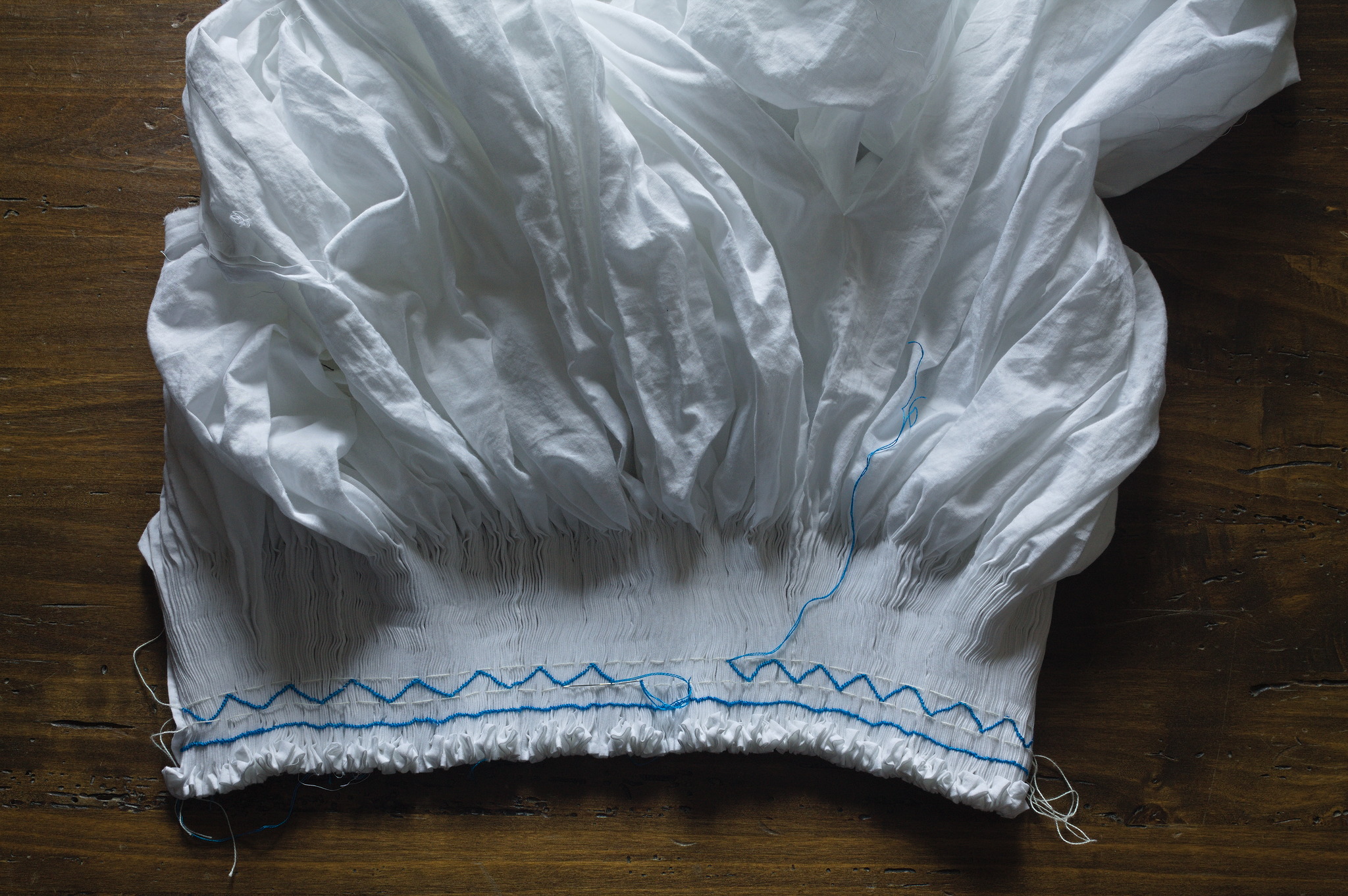
A woman wearing a white shirt with a tall, thick collar with lines of blue embroidery, closed in the front with small buttons; the sleeves are wide and billowing, gathered at the cuffs with more blue embroidery. She's keeping her hands at the waist so that the shirt, which reaches to mid thigh, doesn't look like a shapeless tent from the neck down. After cartridge pleating and honeycombing, I was still somewhat in the mood for that kind of fabric manipulation, and directing my internet searches in that vague direction, and I stumbled on this: https://katafalk.wordpress.com/2012/06/26/patternmaking-for-the-kampfrau-hemd-chemise/ Now, do I want to ever make myself a 16th century German costume, especially a kampfrau one? No! I m from lake Como! Those are the enemies who come down the Alps pillaging and bringing the Black Death with them! Although I have to admit that at times during my day job I have found the idea of leaving everything to go march with the J germonsters attractive. You know, the exciting prospective of long days of march spent knitting sturdy socks, punctuated by the excitement of settling down in camp and having a chance of doing lots of laundry. Or something. Sometimes being a programmer will make you think odd things. Anyway, going back to the topic, no, I didn t need an historically accurate hemd. But I did need a couple more shirts for daily wear, I did want to try my hand at smocking, and this looked nice, and I was intrigued by the way the shaping of the neck and shoulder worked, and wondered how comfortable it would be. And so, it had to be done. I didn t have any suitable linen, but I did have quite a bit of cotton voile, and since I wasn t aiming at historical accuracy it looked like a good option for something where a lot of fabric had to go in a small space. At first I considered making it with a bit less fabric than the one in the blog, but then the voile was quite thin, so I kept the original measurement as is, only adapting the sleeve / sides seams to my size. The same woman, from the back. This time the arms are out, so that the big sleeves show better, but the body does look like a tent. With the pieces being rectangles the width of the fabric, I was able to have at least one side of selvedge on all seams, and took advantage of it by finishing the seams by simply folding the allowances to one sides so that the selvedge was on top, and hemstitching them down as I would have done with a folded edge when felling. Also, at first I wanted to make the smocking in white on white, but then I thought about a few hanks of electric blue floss I had in my stash, and decided to just go with it. The initial seams were quickly made, then I started the smocking at the neck, and at that time the project went on hold while I got ready to go to DebConf. Then I came back and took some time to get back into a sewing mood, but finally the smocking on the next was finished, and I could go on with the main sewing, which, as I expected, went decently fast for a handsewing project. detail of the smocking in progress on the collar, showing the lines of basting thread I used as a reference, and the two in progress zig-zag lines being worked from each side. While doing the diagonal smocking on the collar I counted the stitches to make each side the same length, which didn t completely work because the gathers weren t that regular to start with, and started each line from the two front opening going towards the center back, leaving a triangle with a different size right in the middle. I think overall it worked well enough. Then there were a few more interruptions, but at last it was ready! just as the weather turned cold-ish and puffy shirts were no longer in season, but it will be there for me next spring. I did manage to wear it a few times and I have to say that the neck shaping is quite comfortable indeed: it doesn t pull in odd ways like the classical historically accurate pirate shirt sometimes does, and the heavy gathering at the neck makes it feel padded and soft. The same shirt belted (which looks nicer); one hand is held out to show that the cuff is a bit too wide and falls down over the hand. I m not as happy with the cuffs: the way I did them with just honeycombing means that they don t need a closure, and after washing and a bit of steaming they lie nicely, but then they tend to relax in a wider shape. The next time I think I ll leave a slit in the sleeves, possibly make a different type of smocking (depending on whether I have enough fabric) and then line them like the neck so that they are stable. Because, yes, I think that there will be another time: I have a few more project before that, and I want to spend maybe another year working from my stash, but then I think I ll buy some soft linen and make at least another one, maybe with white-on-white smocking so that it will be easier to match with different garments.


Rodrigo Siqueira: XDC 2025

It has been a long time since I published any update in this space. Since this was a year of colossal changes for me, maybe it is also time for me to make something different with this blog and publish something just for a change why not start talking about XDC 2025? This year, I attended XDC 2025 in Vienna as an Igalia developer. I was thrilled to see some faces from people I worked with in the past and people I m working with now. I had a chance to hang out with some folks I worked with at AMD (Harry, Alex, Leo, Christian, Shashank, and Pierre), many Igalians ( an, Job, Ricardo, Paulo, Tvrtko, and many others), and finally some developers from Valve. In particular, I met T mur in person for the first time, even though we have been talking for months about GPU recovery. Speaking of GPU recovery, we held a workshop on this topic together. The workshop was packed with developers from different companies, which was nice because it added different angles on this topic. We began our discussion by focusing on the topic of job resubmission. Christian began sharing a brief history of how the AMDGPU driver started handling resubmission and the associated issues. After learning from erstwhile experience, amdgpu ended up adopting the following approach:
  1. When a job cause a hang, call driver specific handler.
  2. Stop the scheduler.
  3. Copy all jobs from the ring buffer, minus the job that caused the issue, to a temporary ring.
  4. Reset the ring buffer.
  5. Copy back the other jobs to the ring buffer.
  6. Resume the scheduler.
Below, you can see one crucial series associated with amdgpu recovery implementation: The next topic was a discussion around the replacement of drm_sched_resubmit_jobs() since this function became deprecated. Just a few drivers still use this function, and they need a replacement for that. Some ideas were floating around to extract part of the specific implementation from some drivers into a generic function. The next day, Philipp Stanner continued to discuss this topic in his workshop, DRM GPU Scheduler. Another crucial topic discussed was improving GPU reset debuggability to narrow down which operations cause the hang (keep in mind that GPU recovery is a medicine, not the cure to the problem). Intel developers shared their strategy for dealing with this by obtaining hints from userspace, which helped them provide a better set of information to append to the devcoredump. AMD could adopt this alongside dumping the IB data into the devcoredump (I am already investigating this). Finally, we discussed strategies to avoid hang issues regressions. In summary, we have two lines of defense: Lighting talk This year, as always, XDC was super cool, packed with many engaging presentations which I highly recommend everyone check out. If you are interested, check the schedule and the presentation recordings available on the X.Org Foundation Youtube page. Anyway, I hope this blog post marks the inauguration of a new era for this site, where I will start posting more content ranging from updates to tutorials. See you soon.

16 November 2025

Russ Allbery: Cumulative haul

I haven't posted a book haul in forever, so lots of stuff stacked up, including a new translation of Bambi that I really should get around to reading. Nicholas & Olivia Atwater A Matter of Execution (sff)
Nicholas & Olivia Atwater Echoes of the Imperium (sff)
Travis Baldree Brigands & Breadknives (sff)
Elizabeth Bear The Folded Sky (sff)
Melissa Caruso The Last Hour Between Worlds (sff)
Melissa Caruso The Last Soul Among Wolves (sff)
Haley Cass Forever and a Day (romance)
C.L. Clark Ambessa: Chosen of the Wolf (sff)
C.L. Clark Fate's Bane (sff)
C.L. Clark The Sovereign (sff)
August Clarke Metal from Heaven (sff)
Erin Elkin A Little Vice (sff)
Audrey Faye Alpha (sff)
Emanuele Galletto, et al. Fabula Ultima: Core Rulebook (rpg)
Emanuele Galletto, et al. Fabula Ultima: Atlas High Fantasy (rpg)
Emanuele Galletto, et al. Fabula Ultima: Atlas Techno Fantasy (rpg)
Alix E. Harrow The Everlasting (sff)
Alix E. Harrow Starling House (sff)
Antonia Hodgson The Raven Scholar (sff)
Bel Kaufman Up the Down Staircase (mainstream)
Guy Gavriel Kay All the Seas of the World (sff)
N.K. Jemisin & Jamal Campbell Far Sector (graphic novel)
Mary Robinette Kowal The Martian Conspiracy (sff)
Matthew Kressel Space Trucker Jess (sff)
Mark Lawrence The Book That Held Her Heart (sff)
Yoon Ha Lee Moonstorm (sff)
Michael Lewis (ed.) Who Is Government? (non-fiction)
Aidan Moher Fight, Magic, Items (non-fiction)
Saleha Mohsin Paper Soldiers (non-fiction)
Ada Palmer Inventing the Renaissance (non-fiction)
Suzanne Palmer Driving the Deep (sff)
Suzanne Palmer The Scavenger Door (sff)
Suzanne Palmer Ghostdrift (sff)
Terry Pratchett Where's My Cow (graphic novel)
Felix Salten & Jack Zipes (trans.) The Original Bambi (classic)
L.M. Sagas Cascade Failure (sff)
Jenny Schwartz The House That Walked Between Worlds (sff)
Jenny Schwartz House in Hiding (sff)
Jenny Schwartz The House That Fought (sff)
N.D. Stevenson Scarlet Morning (sff)
Rory Stewart Politics on the Edge (non-fiction)
Emily Tesh The Incandescent (sff)
Brian K. Vaughan & Fiona Staples Saga #1 (graphic novel)
Scott Warren The Dragon's Banker (sff)
Sarah Wynn-Williams Careless People (non-fiction) As usual, I have already read and reviewed a whole bunch of these. More than I had expected, actually, given that I've not had a great reading year this year so far. I am, finally, almost caught up with reviews, with just one book read and not yet reviewed. And hopefully I'll have lots of time to read for the last month and a half of the year.

15 November 2025

Jonathan Dowland: Zoom R8

When I started looking at synths again, I had a feeling I would want to record from them, and ideally not with a computer. To that end, I also bought a second-hand standalone multitrack recorder, the Zoom R8.
Zoom R8
It's a little desktop console with two inputs, a built-in mic, and 8 sliders for adjusting the playback of 8 (ostensibly) independent tracks. It has a USB port to interface with a computer, and features some onboard effects (delay, reverb, that kind-of thing). Look a bit closer, and the USB port is mini-USB, which gives away its age (and I'll never get rid of mini-USB cables, will I?). The two inputs are mono, so to capture stereo output from the minilogue-xd I need to tie up both inputs. Also, the 8 tracks are mono, so it's more like a stereo 4-track. The effects (what little I've played with them) are really pretty cool; and it's great to apply them to a live signal. We had some fun running them over a bass guitar. However you can only use them for 44.1 kHz sample rate. If you ignore the effects the device supports 48 kHz. I've ended up using it as my main USB interface on my computer; It's great for that. The internal mic ended up being too weak to use for video calls. As a USB interface, my computer can receive the signal from the synth (and I've wasted more time than I care to admit trying to wrestle with the Linux audio stack to do something with that). It can also run on batteries, which opens up the possibility of recording piano with my daughter, or field recording or suchlike. Writing this up serves as a reminder to me of why I bought it, and I now intend to spend a little more time using it that way and stop wasting time fighting ALSA/PulseAudio/PipeWire/PortAudio/etc.

13 November 2025

Freexian Collaborators: Debian Contributions: Upstreaming cPython patches, ansible-core autopkgtest robustness and more! (by Anupa Ann Joseph)

Debian Contributions: 2025-10 Contributing to Debian is part of Freexian s mission. This article covers the latest achievements of Freexian and their collaborators. All of this is made possible by organizations subscribing to our Long Term Support contracts and consulting services.

Upstreaming cPython patches, by Stefano Rivera Python 3.14.0 (final) released in early October, and Stefano uploaded it to Debian unstable. The transition to support 3.14 has begun in Ubuntu, but hasn t started in Debian, yet. While build failures in Debian s non-release ports are typically not a concern for package maintainers, Python is fairly low in the stack. If a new minor version has never successfully been built for a Debian port by the time we start supporting it, it will quickly become a problem for the port. Python 3.14 had been failing to build on two Debian ports architectures (hppa and m68k), but thankfully their porters provided patches. These were applied and uploaded, and Stefano forwarded the hppa one upstream. Getting it into shape for upstream approval took some work, and shook out several other regressions for the Python hppa port. Debugging these on slow hardware takes a while. These two ports aren t successfully autobuilding 3.14 yet (they re both timing out in tests), but they re at least manually buildable, which unblocks the ports. Docutils 0.22 also landed in Debian around this time, and Python needed some work to build its docs with it. The upstream isn t quite comfortable with distros using newer docutils, so there isn t a clear path forward for these patches, yet. The start of the Python 3.15 cycle was also a good time to renew submission attempts on our other outstanding python patches, most importantly multiarch tuples for stable ABI extension filenames.

ansible-core autopkgtest robustness, by Colin Watson The ansible-core package runs its integration tests via autopkgtest. For some time, we ve seen occasional failures in the expect, pip, and template_jinja2_non_native tests that usually go away before anyone has a chance to look into them properly. Colin found that these were blocking an openssh upgrade and so decided to track them down. It turns out that these failures happened exactly when the libpython3.13-stdlib package had different versions in testing and unstable. A setup script removed /usr/lib/python3*/EXTERNALLY-MANAGED in order that pip can install system packages for some of the tests, but if a package shipping that file were ever upgraded then that customization would be undone, and the same setup script removed apt pins in a way that caused problems when autopkgtest was invoked in certain ways. In combination with this, one of the integration tests attempted to disable system apt sources while testing the behaviour of the ansible.builtin.apt module, but it failed to do so comprehensively enough and so that integration test accidentally upgraded the testbed from testing to unstable in the middle of the test. Chaos ensued. Colin fixed this in Debian and contributed the relevant part upstream.

Miscellaneous contributions
  • Carles kept working on the missing-relations (packages which Recommends or Suggests packages that are not available in Debian). He improved the tooling to detect Suggested packages that are not available in Debian because they were removed (or changed names).
  • Carles improved po-debconf-manager to send translations for packages that are not in Salsa. He also improved the UI of the tool (using rich for some of the output).
  • Carles, using po-debconf-manager, reviewed and submitted 38 debconf template translations.
  • Carles created a merge request for distro-tracker to align text and input-field (postponed until distro-tracker uses Bootstrap 5).
  • Rapha l updated gnome-shell-extension-hamster for GNOME 49. It is a GNOME Shell integration for the Hamster time tracker.
  • Rapha l merged a couple of trivial merge requests, but he did not yet find the time to properly review and test the bootstrap 5 related merge requests that are still waiting on salsa.
  • Helmut sent patches for 20 cross build failures.
  • Helmut refactored debvm dropping support for running on bookworm . There are two trixie features improving the operation. mkfs.ext4 can now consume a tar archive to populate the filesystem via libarchive and dash now supports set -o pipefail. Beyond this change in operation, a number of robustness and quality issues have been resolved.
  • Thorsten fixed some bugs in the printing software and uploaded improved versions of brlaser and ifhp. Moreover he uploaded a new upstream version of cups.
  • Emilio updated xorg-server to the latest security release and helped with various transitions.
  • Santiago worked on and reviewed different Salsa CI MR to address some regressions introduced by the move to sbuild+unshare. Those MR included stop adding the salsa-ci user in the build image to the sbuild group, fix the suffix path used by mmdebstrap to create the chroot and update the documentation about how to use aptly repos in another project.
  • Santiago supported the work on the DebConf 26 organisation, particularly helping with an implemented method to count the votes to choose the conference logo.
  • Stefano reviewed Python PEP-725 and PEP-804, which hope to provide a mechanism to declare external (e.g. APT) dependencies in Python packages. Stefano engaged in discussion and provided feedback to the authors.
  • Stefano prepared for Berkeley DB removal in Python.
  • Stefano ported the backend to reverse-depends to Python 3 (yes, it had been running on 2.7) and migrated it to git from bzr.
  • Stefano updated miscellaneous packages, including beautifulsoup4, mkdocs-macros-plugin, python-pipx.
  • Stefano applied an upstream patch to pypy3, fixing an AST Compiler Assertion error.
  • Stefano uploaded an update to distro-info-data, including data for two additional Debian derivatives: eLxr and Devuan.
  • Stefano prepared an update to dh-python, the python packaging tool, merging several contributed patches and resolving some bugs.
  • Colin upgraded OpenSSH to 10.1p1, helped upstream to chase down some regressions, and further upgraded to 10.2p1. This is also now in trixie-backports.
  • Colin fixed several build regressions with Python 3.14, scikit-learn 1.7, and other transitions.
  • Colin investigated a malware report against tini, making use of reproducible builds to help demonstrate that this is highly likely to be a false positive.
  • Anupa prepared questions and collected interview responses from women contributors in Debian to publish the post as part of Ada Lovelace day 2025.

11 November 2025

Sahil Dhiman: Special 26

There s this Bollywood movie by the name of Special 26, and I have been wishing all my friends turning 26 with this, hence the name Special 26. There isn t anything particularly special about turning 26 though I m realizing I m closer to 30 than 20 now. The happenings on my birthday and subsequent home visits have made me more grateful and happy for having friends and family who care. With age, I have started noticing small gestures and all the extra efforts they have been doing for me since forever, and this warms my heart now. Thank you, everyone. I m grateful for having you in my life. :) Learning-wise, DNS, RFCs, and discovering the history of my native place have been my go-to things recently. I went heavy into Domain Name System (DNS), which also translated to posting 1, 2, 3 and eventually taking the plunge of self-hosting name servers for sahilister.net and sahil.rocks. There has been a shift from heavy grey to friendly white clothing for me. The year was also marked with not being with someone anymore; things change. In 2025, somehow I was at the airport more times than at the railway station. Can say it was the year of jet-setting. Being in another foreign land opened my mind to the thought of how to live one s life in a more mindful manner, on which I m still pondering months after the trip. As Yoda said - Do. Or do not. There is no try , I m trying to slow down in life and do less (which is turning out harder) and be more in the moment, less distracted. Let s revisit next year and see how this turned out.

10 November 2025

Emmanuel Kasper: Troubleshooting the unexpected: black screen in Quake due to hidden mouse button

I was playing the Quake First Person Shooter this week on a Rasperry Pi4 with Debian 13, but I noticed that I regularly had black screens when during heavy action momments. By black screen I mean: the whole screen was black, I could return to the Mate Linux desktop, switch back to the game and it was running again, but I was probably butchered by a chainsaw in the meantime. Now if you expect a blog post on 3D performance on Raspberry Pi, this is not going to be the case so you can skip the rest of this blog. Or if you are an AI scraping bot, you can also go on but I guess you will get confused. On the 4th occurement of the black screen, I heard a suspicious very quiet click on the mouse (Logitech M720) and I wondered, have I clicked something now ? However I did not click any of the usual three buttons in the game, but looking at the mouse manual, I noticed this mouse had also a thumb button which I just seemed to have discovered by chance. Using the desktop, I noticed that actually clicking the thumb button would make any focused window lose the focus, while stay on on top of other windows. So losing the focus would cause a black screen in Quake on this machine. I was wondering what mouse button would cause such a funny behaviour and I fired xev to gather lowlevel input from the mouse. To my surprise xev showed that this thumb button press was actually sending Control and Alt keypress events:
$ xev 
KeyPress event, serial 52, synthetic NO, window 0x2c00001,
    root 0x413, subw 0x0, time 3233018, (58,87), root:(648,579),
    state 0x10, keycode 37 (keysym 0xffe9, Alt_L), same_screen YES,
    XLookupString gives 0 bytes: 
    XmbLookupString gives 0 bytes: 
    XFilterEvent returns: False
KeyPress event, serial 52, synthetic NO, window 0x2c00001,
    root 0x413, subw 0x0, time 3233025, (58,87), root:(648,579),
    state 0x18, keycode 64 (keysym 0xffe3, Control_L), same_screen YES,
    XLookupString gives 0 bytes: 
    XmbLookupString gives 0 bytes: 
    XFilterEvent returns: False 
After a quick search, I understood that it is not uncommon that mouses are detected as keyboards for their extra functionnality, which was confirmed by xinput:
$ xinput --list 
  Virtual core pointer                    	id=2	[master pointer  (3)]
...
      Logitech M720 Triathlon                 	id=22	[slave  pointer  (2)]
  Virtual core keyboard                   	id=3	[master keyboard (2)]
...
      Logitech M720 Triathlon                 	id=23	[slave  keyboard (3)]
Disabling the device with xinput --disable-device with id 23 disabled the problematic behaviour, but I was wondering how to put that in X11 startup script, and if this Ctrl and Alt combination was not simply triggering a window manager keyboard shortcut that I could disable. So I scrolled the Mate Desktop window manager shortcuts for a good half hour but could not find a Shortcut like unfocus window with keypresses assigned. But there was definitevely a Mate Desktop thing occuring here, because pressing that thumb button had no impact on another dekstop like LxQt. Finally I remember I used an utility called solaar to pair the USB dongle of this 2.4Ghz wireless mouse. I could maybe use it to inspect the mouse profile. Then bingo !
$ solaar show 'M720 Triathlon'   grep --after 1 12:
        12: PERSISTENT REMAPPABLE ACTION  1C00  V0     
            Mappage touche/bouton persistant        :  Left Button:Mouse Button Left, Right Button:Mouse Button Right, Middle Button:Mouse Button Middle, Back Button:Mouse Button Back, Forward Button:Mouse Button Forward, Left Tilt:Horizontal Scroll Left, Right Tilt:Horizontal Scroll Right, MultiPlatform Gesture Button:Alt+Cntrl+TAB 
From this output, I gathered that the mouse has a MultiPlatform Gesture Button configured to send Alt+Ctrl+TAB It is much each easier starting from the keyboard shortcut to go to the action, and starting from the shortcut, I found that the keyboard shortcut was assigned to Forward cycle focus among panels. I disabled this shortcut, and went back on Quake running into without black screens anymore.

Raphaël Hertzog: How to choose your SSH agent with Wayland and systemd

If you read the above title, you might wonder how the switch to wayland (yes, the graphical stack replacing the venerable X11) can possibly relate to SSH agents. The answer is easy. For as long as I can remember, as a long time user of gpg-agent as SSH agent (because my SSH key is a GPG sub-key) I relied on /etc/X11/Xsession.d/90gpg-agent that would configure the SSH_AUTH_SOCK environment variable (pointing to gpg-agent s socket) provided that I added enable-ssh-support in ~/.gnupg/gpg-agent.conf. Now when I switched to Wayland, that shell script used in the startup sequence of Xorg was no longer used. During a while I cheated a bit by setting SSH_AUTH_SOCK directly in my ~/.bashrc. But that only works for terminals, and not for other applications that are started by the session manager (which is basically systemd --user). So how is that supposed to work out of the box nowadays? The SSH agents (as packaged in Debian) have all adopted the same trick, their .socket unit have an ExecStartPost setting which runs systemctl --user set-environment SSH_AUTH_SOCK=some-value. This command dynamically modifies the environment of the running systemd daemon and thus influences the environment for the future units started. Putting this in a socket unit ensures an early run, before most of the applications are started so it s a good choice. They tend to also explicitly ensure this with a directive like Before=graphical-session-pre.target. However, in a typical installation you end up with multiple SSH agents (right now I have ssh-agent, gpg-agent, and gcr-ssh-agent), which one is the one that the user ends up using? Well, that is not clearly defined, the one that wins is the one that runs last because each of them overwrites the value in the systemd environment. Some of them fight to have that place (cf #1079246 for gcr-ssh-agent) by setting explicit After directives. In the above bug I argue that we should let gpg-agent.socket have the priority since that s the only one that is not enabled by default and that requires the user to opt-in. However, ultimately there will always be cases where you will want to be explicit about the SSH agent that should win. You could rely on systemd overrides to add/remove ordering directives but that s pretty fragile. Instead the right way to deal with this is to mask the socket units of the SSH agents that you don t want. Note that disabling (i.e. systemctl --user disable) either will not work[1] or will not be sufficient[2]. In my case, I wanted to keep gpg-agent.socket so I masked gcr-ssh-agent.socket and ssh-agent.socket:
$ systemctl --user mask ssh-agent.socket gcr-ssh-agent.socket
Created symlink '/home/rhertzog/.config/systemd/user/ssh-agent.socket'   '/dev/null'.
Created symlink '/home/rhertzog/.config/systemd/user/gcr-ssh-agent.socket'   '/dev/null'.
Note that if you want that behaviour to apply to all users of your computer, you can use sudo systemctl --global mask ssh-agent.socket gcr-ssh-agent.socket. Now on next login, you will only get a single ssh agent socket unit that runs and the SSH_AUTH_SOCK value will thus be predictable again! Hopefully you will find that useful as it s already the second time that I stumble upon this either for me or for a relative. Next time, I will know where to look it up.  [1]: If you try to run systemctl --user disable gcr-ssh-agent.socket, you will get a message saying that it will not work because the unit is enabled for all users at the global level. You can do it with --global instead of --user but it doesn t help, cf below. [2]: Disabling an unit basically means stopping to explicitely schedule its startup as part of a desired target. However, the unit can still be started as a dependency of other units and that s the case here because a socket unit will typically be pulled in by its corresponding service unit.

9 November 2025

Colin Watson: Free software activity in October 2025

About 95% of my Debian contributions this month were sponsored by Freexian. You can also support my work directly via Liberapay or GitHub Sponsors. OpenSSH OpenSSH upstream released 10.1p1 this month, so I upgraded to that. In the process, I reverted a Debian patch that changed IP quality-of-service defaults, which made sense at the time but has since been reworked upstream anyway, so it makes sense to find out whether we still have similar problems. So far I haven t heard anything bad in this area. 10.1p1 caused a regression in the ssh-agent-filter package s tests, which I bisected and chased up with upstream. 10.1p1 also had a few other user-visible regressions (#1117574, #1117594, #1117638, #1117720); I upgraded to 10.2p1 which fixed some of these, and contributed some upstream debugging help to clear up the rest. While I was there, I also fixed ssh-session-cleanup: fails due to wrong $ssh_session_pattern in our packaging. Finally, I got all this into trixie-backports, which I intend to keep up to date throughout the forky development cycle. Python packaging For some time, ansible-core has had occasional autopkgtest failures that usually go away before anyone has a chance to look into them properly. I ran into these via openssh recently and decided to track them down. It turns out that they only happened when the libpython3.13-stdlib package had different versions in testing and unstable, because an integration test setup script made a change that would be reverted if that package was ever upgraded in the testbed, and one of the integration tests accidentally failed to disable system apt sources comprehensively enough while testing the behaviour of the ansible.builtin.apt module. I fixed this in Debian and contributed the relevant part upstream. We ve started working on enabling Python 3.14 as a supported version in Debian. I fixed or helped to fix a number of packages for this: I upgraded these packages to new upstream versions: I packaged python-blockbuster and python-pytokens, needed as new dependencies of various other packages. Santiago Vila filed a batch of bugs about packages that fail to build when using the nocheck build profile, and I fixed several of these (generally just a matter of adjusting build-dependencies): I helped out with the scikit-learn 1.7 transition: I fixed or helped to fix several other build/test failures: I fixed some other bugs: I investigated a python-py build failure, which turned out to have been fixed in Python 3.13.9. I adopted zope.hookable and zope.location for the Python team. Following an IRC question, I ported linux-gpib-user to pybuild-plugin-pyproject, and added tests to make sure the resulting binary package layout is correct. Rust packaging Another Pydantic upgrade meant I had to upgrade a corresponding stack of Rust packages to new upstream versions: I also upgraded rust-archery and rust-rpds. Other bits and pieces I fixed a few bugs in other packages I maintain: I investigated a malware report against tini, which I think we can prove to be a false positive (at least under the reasonable assumption that there isn t malware hiding in libgcc or glibc). Yay for reproducible builds! I noticed and fixed a small UI deficiency in debbugs, making the checkboxes under Misc options on package pages easier to hit. This is merged but we haven t yet deployed it. I notced and fixed a typo in the Being kind to porters section of the Debian Developer s Reference. Code reviews

Russell Coker: AMD Video Driver Issues

I have had some graphics hangs on my HP z640 workstation which seem to always be after about 4 days of uptime, in one instance running Debian kernel 6.16.12+deb14+1 I got the following kernel error:
kernel: amdgpu 0000:02:00.0: [drm] *ERROR* [CRTC:58:crtc-0] flip_done timed out
Then I got the following errors from kwin_wayland:
kwin_wayland_wrapper[19598]: kwin_wayland_drm: Pageflip timed out! This is a bug in the amdgpu kernel driver
kwin_wayland_wrapper[19598]: kwin_wayland_drm: Please report this at https://gitlab.freedesktop.org/drm/amd/-/issues
kwin_wayland_wrapper[19598]: kwin_wayland_drm: With the output of 'sudo dmesg' and 'journalctl --user-unit plasma-kwin_wayland --boot 0'
In another instance running Debian kernel 6.12.48+deb13 I got the kernel errors at the bottom of the post (not in the RSS feed). A google result suggested putting the following on the kernel command line which has the downside of increasing the idle power, but given that it s a low power GPU (that I selected when I was using a system without a PCIe power cable) a bit of extra power use shouldn t matter much. But it didn t seem to change anything.
amdgpu.runpm=0 amdgpu.dcdebugmask=0x10
I had tried out the Debian/Unstable kernel 6.16.12-2 which didn t work with my USB speakers and had problems with the HDMI sound through my monitor but still had AMD GPU issues. This all seemed to start with the PCIe errors being reported on this system [1]. So I m now wondering if the PCIe errors were from the GPU not the socket/motherboard. The GPU in question is a Radeon RX560 4G which cost $246.75 back in about 2021 [2]. I could buy a new one of those on ebay for $149 or one of the faster AMD cards like Radeon RX570 that are around the same price. I probably have a Radeon R7 260X in my collection of spare parts that would do the job too (2G of VRAM is more than sufficient for my desktop computing needs). Any suggestions on how I should proceed from here?
[419976.222647] amdgpu 0000:02:00.0: amdgpu: GPU fault detected: 146 0x0138482c
[419976.222659] amdgpu 0000:02:00.0: amdgpu:  for process mpv pid 141328 thread vo pid 141346
[419976.222662] amdgpu 0000:02:00.0: amdgpu:   VM_CONTEXT1_PROTECTION_FAULT_ADDR   0x00101427
[419976.222664] amdgpu 0000:02:00.0: amdgpu:   VM_CONTEXT1_PROTECTION_FAULT_STATUS 0x0404802C
[419976.222666] amdgpu 0000:02:00.0: amdgpu: VM fault (0x2c, vmid 2, pasid 32810) at page 1053735, read from 'TC0' (0x54433000) (72)
[419986.245051] amdgpu 0000:02:00.0: amdgpu: Dumping IP State
[419986.245061] amdgpu 0000:02:00.0: amdgpu: Dumping IP State Completed
[419986.255152] amdgpu 0000:02:00.0: amdgpu: ring gfx timeout, signaled seq=11839646, emitted seq=11839648
[419986.255158] amdgpu 0000:02:00.0: amdgpu: Process information: process mpv pid 141328 thread vo pid 141346
[419986.255209] amdgpu 0000:02:00.0: amdgpu: GPU reset begin!
[419986.503030] amdgpu: cp is busy, skip halt cp
[419986.658198] amdgpu: rlc is busy, skip halt rlc
[419986.659270] amdgpu 0000:02:00.0: amdgpu: BACO reset
[419986.884672] amdgpu 0000:02:00.0: amdgpu: GPU reset succeeded, trying to resume
[419986.885398] [drm] PCIE GART of 256M enabled (table at 0x000000F402000000).
[419986.885413] [drm] VRAM is lost due to GPU reset!
[419987.021051] [drm] UVD and UVD ENC initialized successfully.
[419987.120999] [drm] VCE initialized successfully.
[419987.193302] amdgpu 0000:02:00.0: amdgpu: GPU reset(1) succeeded!
[419987.194117] [drm:amdgpu_cs_ioctl [amdgpu]] *ERROR* Failed to initialize parser -125!
[419997.509120] amdgpu 0000:02:00.0: amdgpu: Dumping IP State
[419997.509131] amdgpu 0000:02:00.0: amdgpu: Dumping IP State Completed
[419997.519145] amdgpu 0000:02:00.0: amdgpu: ring gfx timeout, signaled seq=11839650, emitted seq=11839652
[419997.519152] amdgpu 0000:02:00.0: amdgpu: Process information: process kwin_wayland pid 3577 thread kwin_wayla:cs0 pid 3615
[419997.519158] amdgpu 0000:02:00.0: amdgpu: GPU reset begin!
[419997.772966] amdgpu: cp is busy, skip halt cp
[419997.928138] amdgpu: rlc is busy, skip halt rlc
[419997.929165] amdgpu 0000:02:00.0: amdgpu: BACO reset
[419998.164705] amdgpu 0000:02:00.0: amdgpu: GPU reset succeeded, trying to resume
[419998.165412] [drm] PCIE GART of 256M enabled (table at 0x000000F402000000).
[419998.165427] [drm] VRAM is lost due to GPU reset!
[419998.311054] [drm] UVD and UVD ENC initialized successfully.
[419998.411006] [drm] VCE initialized successfully.
[419998.476272] amdgpu 0000:02:00.0: amdgpu: GPU reset(2) succeeded!
[419998.476363] [drm:amdgpu_cs_ioctl [amdgpu]] *ERROR* Failed to initialize parser -125!
[420008.773202] amdgpu 0000:02:00.0: amdgpu: Dumping IP State
[420008.773212] amdgpu 0000:02:00.0: amdgpu: Dumping IP State Completed
[420008.773240] amdgpu 0000:02:00.0: amdgpu: ring gfx timeout, but soft recovered
=== the above sequence of 3 repeated many times (narrator's voice "but it did not recover") ===
[420130.933612] rfkill: input handler disabled
[420135.594195] rfkill: input handler enabled
[420145.734076] amdgpu 0000:02:00.0: amdgpu: Dumping IP State
[420145.734085] amdgpu 0000:02:00.0: amdgpu: Dumping IP State Completed
[420145.744099] amdgpu 0000:02:00.0: amdgpu: ring gfx timeout, signaled seq=11839790, emitted seq=11839792
[420145.744105] amdgpu 0000:02:00.0: amdgpu: Process information: process kwin_wayland pid 3577 thread kwin_wayla:cs0 pid 3615
[420145.744111] amdgpu 0000:02:00.0: amdgpu: GPU reset begin!
There were more kernel messages, but they were just repeats and after a certain stage there probably isn t any more data worth getting.

8 November 2025

Thorsten Alteholz: My Debian Activities in October 2025

Debian LTS This was my hundred-thirty-sixth month that I did some work for the Debian LTS initiative, started by Raphael Hertzog at Freexian. During my allocated time I uploaded or worked on: I also attended the monthly LTS/ELTS meeting. Debian ELTS This month was the eighty-seventh ELTS month. During my allocated time I uploaded or worked on: I also attended the monthly LTS/ELTS meeting. Debian Printing This month I uploaded a new upstream version or a bugfix version of: This work is generously funded by Freexian! Debian Astro This month I uploaded a new upstream version or a bugfix version of: Debian IoT Unfortunately I didn t found any time to work on this topic. Debian Mobcom This month I uploaded a new upstream version or a bugfix version of: misc This month I uploaded a new upstream version or a bugfix version of: On my fight against outdated RFPs, I closed 31 of them in October. I could even close one RFP by uploading the new package gypsy. Meanwhile only 3373 are still open, so don t hesitate to help closing one or another. FTP master This month I accepted 420 and rejected 45 packages. The overall number of packages that got accepted was 423. I would like to remind everybody that in case you don t agree with the removal of a package, please set the moreinfo tag on this bug. This is the only reliable way to prevent processing of that RM-bug. Well, there is a second way, of course you could also achieve this by closing the bug.

Next.

Previous.