Search Results: "stone"

24 December 2012

Julien Danjou: Ceilometer bug squash day #1

In order to start the year in a good mood, what's the best than squashing some bugs on OpenStack? Therefore, the Ceilometer team is pleased to announce that it organizes a bug squashing day on the Friday 4th January 2013. We wrote an extensive page about how you can contribute to Ceilometer, from updating the documentation, to fixing bugs. There's a lot you can do. We've good support for Ceilometer built into Devstack, so installing a development platform is really easy. The main goal on this bug day will be put Ceilometer in the best possible shape before the grizzly-2 milestone arrives (10th January 2013). This version of Ceilometer will aim to keep compatibility with Folsom, so early deployers can enjoy some of our new features before upgrading to Grizzly. After that date, we'll start merging more extensive changes. We'll be hanging out on the #openstack-metering IRC channel on Freenode, as usual, so feel free to come by and join us!

17 December 2012

Lars Wirzenius: Obnam 1.3 (backup software) and other releases

I've just pushed out the release files for Obnam version 1.3, my backup application, as well as Larch, my B-tree library, and cliapp, my Python framework for command line applications. They are available via my home page (http://liw.fi/). Since Debian is frozen, I am not uploading packages to Debian, but .deb files are available from my personal apt repository for the intrepid. (I will be uploading to Debian again after the freeze. I am afraid I'm too lazy to upload to experimental, or do backports. Help is welcome!) From the Obnam NEWS file: Bug fixes for Obnam: NEWS for Larch: NEWS for cliapp:

11 December 2012

Jelmer Vernooij: Samba 4.0.0, finally

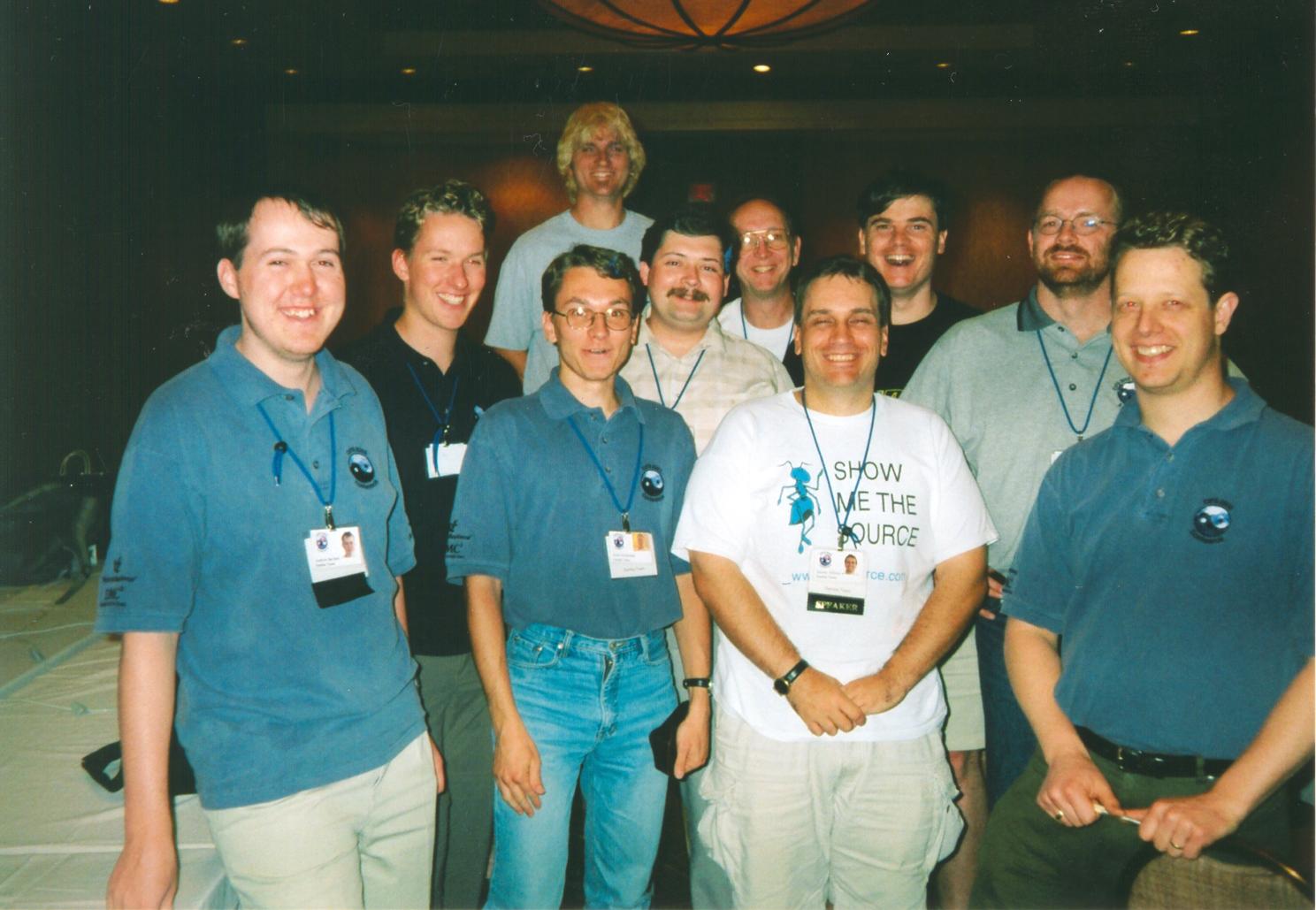
This afternoon we released version 4.0.0 of Samba. This is a significant milestone, and I'm very proud of the result. Samba 4 is the first version that can be a domain controller in an Active Directory domain. We embarked on this journey almost a decade ago - the first commit is from August 2003. It's been a long and bumpy ride. I hardly recognize the people in this team photo from 2003 (I'm second from the left). A lot has happened in that time. We wrote a few million lines of code. We migrated from CVS to Subversion to Git. We've drifted apart and grown back together as a team. In my youthful naivity I predicted a release "within 1 or 2 years" during a talk at the NLUUG in 2004. But Active Directory was a lot harder than we thought, and there were quite a few other distractions as well. I'm glad this release, which is by far the biggest and longest running software project I have ever worked on, has finally happened. Some older RCs of Samba 4 have already been packaged for Debian and Ubuntu, in the samba4 source package. For Debian jessie, these will be integrated into the main samba source package. Please use experimental if you do want to try the existing packages, as it is most up to date.

Rudy Godoy: Puppet weird SSL error: SSL_read:: pkcs1 padding too short

While setting a puppet agent to talk to my puppetmaster I ve got this weird SSL error:

Error: SSL_read:: pkcs1 padding too short
Debugging both on the agent and master sides didn t offered much information. On the master:

puppet master --no-daemonize --debug
On the agent:

puppet agent --test --debug
Although I had my master using 3.0.1 and the tested agent using 2.7, the problem didn t look related to that. People @ #puppet also haven t seen this error before. I figured the problem reduced to an issue with openssl. So, I checked versions and there I got! agent s openssl is using version 1.0.0j-1.43.amzn1 and master s was using openssl-0.9.8b-10.el5_2.1 So I upgraded master s openssl to openssl.i686 0:0.9.8e-22.el5_8.4 and voil , the problem is gone. I learned that there has been a patch in OpenSSL s VCS that is apparently related to the issue. Hope this helps if you got into the described situation.

9 December 2012

Stefano Zacchiroli: bits from the DPL for November 2012

Just posted, bits from the DPL for November 2012.
 ---------------------------------------------------------------------------------
/ Pop-up advertisement. Breaking news. Help the Release Team [0] by reviewing     \
  pending unblock requests. Oh, and by fixing RC bugs too.                         
                                                                                   
  [0]: http://nthykier.wordpress.com/2012/12/09/wheezy-release-progress-december/  
\---------------------------------------------------------------------------------/

Dear Project Members, here is another (delayed) monthly report of DPL activities, this time for November 2012. Highlights Events Assets That's all for now,
let's go back releasing Wheezy,
Cheers.
PS the day-to-day activity log for November 2012 is available at the usual place master:/srv/leader/news/bits-from-the-DPL.txt.201211

25 November 2012

Pietro Abate: Mini Debian Conf 2012 in Paris : Bootstrapping Debian for a new architecture

I just finished to address the awesome debian crowd at the Mini Deb conf in paris. My presentation was about a few challenges we have ahead to bootstrap debian on a new architecture. Johannes Schauer and Wookey did a lot of work in the last few months particularly focusing on Linaro/Ubuntu. After Wheezy I think it is important to catch up with their work and integrate it in debian. The two main take away messages from my presentation : This week we just reached an important milestone toward a fully automatic bootstrap procedure. Hopefully we are going to tell you more about this work during fosdem 2013 My slides are attached.
AttachmentSize
debminiconf2012.pdf271.56 KB

20 November 2012

Jon Dowland: Waterstones

In May this year, in a desperate bid to bail water out of a sinking ship, HMV group sold off the Waterstones chain of bookstores. I'm fond of reading so naturally I visit Waterstones from time to time. (but not exclusively.) For many years, their promotions were unanimously structured as "3 for 2" offers: find three books in the promotion, in-store, and get the cheapest of the three for free. I hated these promotions. I always found it very challenging to find three books in the promotion that I wanted. If I was visiting to buy a specific book and found it in the promotion, on more than one occasion I left the shop empty handed: I wasn't prepared to pay full price for a book in a promotion and not get the benefit of the promotion. Since being sold, Waterstones seem to have made a lot of changes. Many new hardbacks from popular authors have debuted at a discount for a short period (Rowling, Pratchett). I've found many more discounted books not tied to others in 3-for-2-style offers, sometimes window-display stock at half price, a month or so after release. They started a loyalty-card scheme, with a 10 gift card the prize you reach once you've spent 100. (I wonder if such schemes are examples of a token economy?) Finally, they've tentatively started to explore putting cafes in their branches. The one in Newcastle is best described as 'fledgling', but it's nice to have one more place to escape for a cup of tea at lunchtimes. The cafe, as well as a very well stocked collection of magazines, were the two killer features of the sadly- defunct Borders bookseller chain. For years before we got our own Borders in the North East, I used to enjoy the York branch if I was passing. I actually managed to fill a loyalty card this year, so clearly their change in attitude has worked on me! I'm generally not a fan of gift cards, especially in today's climate, so I quickly spent it. I hold an American Express credit card, which earns me cashbask on purchases which I make with it. I think the rate is about 1%. However, I can opt to receive the cashback in the form of gift vouchers. If I do so, I get them to the value of 110% my cashback balance. One of the retailers in on the scheme are Waterstones. I'm tempted

14 November 2012

Rudy Godoy: Function testing using function pointers in C++

I do like the way programmers think in terms of DRY, for instance, among other forms of optimization. A couple of days ago I wanted to test different implementations of the same algorithm in C++. The usual approach would be to implement those algorithms, call them in main() and see the results. A more interesting approach would be to write a validator for each function and print whether the result is correct or not. Since both are boring and break the rule of DRY, I ve decided to go complicated but productive, so I ve implemented a function testing method using function pointers that will allow me to write a single function and use it to test the algorithms using different input and expected results. Let s say I have 3 algorithms that implement Modular Exponentiation.
uint64 modexp1new(const uint64 &a, const uint64 &_p, const uint64 &n)
...


uint64 modexp2(const uint64 &_a, const uint64 &_p, const uint64 &_n)
...


uint64 modexp3(const uint64 &a, const uint64 &p, const uint64 &n)
...

If you are not familiar with the syntax, const means that the parameter is constant, thus it will not be modified inside the function. The & means that the parameter is passed as a reference, read the memory address of the calling variable, so we don t overload RAM with new variables. Now, the testing part. For my very own purposes I just want to test those particular functions and know whether if the result they output conforms what I do expect. Some people call this unit testing.
I do also want to test it in different scenarios, meaning input and output. So, I m creating a function that will get the three parameters required to call the functions, and a fourth parameter that is the value I do expect to be the correct answer. Now, since I don t want to repeat myself writing a call for each case, I m going to create a function pointer that is an array and has the function s address as their value. That way I can call them in a loop, and voila! we are done. Finally, after calling the function I check the result with the expected value and print an OK or FAIL. Tricky part for this could be understanding the function pointer. Two things to consider: the returning value from the referenced functions has to be the same for all. Second: the input definition for each function has to be similar too. This is important because function pointers are just pointers and they need to know the size of the data type in order to navigate the memory. For this sample code the uint64 is a typedef for long long, of course. Full code is below.
void testAlgos(const uint64 &a, const uint64 &e, const uint64 &n, const uint64 &r)
uint64 (*fP[3])(const uint64&, const uint64&, const uint64&) = &modexp1new, &modexp2, &modexp3 ;
uint64 t;
for(int i=0; i<3; i++) t = fP[i](a, e, n); std::cout < < "F(" << i << ") " << t << "\t";
if (t == r)
std::cout << "OK";
else
std::cout << "FAIL";

std::cout << std::endl;

Now that I have this, I can use it in main this way.
int main()
uint64 a = 3740332;
uint64 e = 44383;
uint64 n = 3130164467;
uint64 r = 1976425102; testAlgos(a, e, n, r); a = 404137263;
r = 2520752541; testAlgos(a, e, n, r); a = 21;
e = 3;
n = 1003;
r = 234;
testAlgos(a, e, n, r); return 0;
Resulting in:
F(0) 657519405 FAIL
F(1) 1976425102 OK
F(2) 657519405 FAIL
F(0) -2752082808 FAIL
F(1) 2520752541 OK
F(2) -2752082808 FAIL
F(0) 234 OK
F(1) 234 OK
F(2) 234 OK
I m happy about not having to write tests like this for all use cases:
std::cout < < "f1: " << modexp1new(a, e, n) << std::endl;
std::cout << "f2: " << modexp2(a, e, n) << std::endl;
std::cout << "f3: " << modexp3(a, e, n) << std::endl;
Now, happiness can be more exciting if I do use templates so I can test any function independent of the data type for the returning and input values. You know, more abstraction. Homework if time allows! Have fun!
Related posts:
  1. Compute Clusters Integration for Debian Development and Building Report 4 Hello, this is the fourth report for the project. First,...
  2. Compute Clusters Integration for Debian Development and Testing Report 3 Hello this is the third report regarding my project. As...
  3. Compute clusters for Debian development and building final report Compute clusters for Debian development and building final report...

11 November 2012

Nathan Handler: Debian Developer

Today, I officially got approved by the Debian Account Managers as a Debian Developer (still waiting on keyring-maint and DSA). Over the years, I have seen many people complain about the New Member Process. The most common complaint was with regards to the (usually) long amount of time the process can take to complete. I am writing this blog post to provide one more perspective on this process. Hopefully, it will prove useful to people considering starting the New Member Process. The most difficult part about the New Member Process for me had to do with getting my GPG key signed by Debian Developers. I have not been able to attend any large conferences, which are great places to get your key signed. I also have not been able to meet up with the few Debian Developers living in/around Chicago. As a result, I was forced to patiently wait to start the NM process. This waiting period lasted a couple of years. It wasn't until this October, at the [Association for Computing Machinery at Urbana-Champaign's Reflections Projections Conference], that this changed. Stefano Zacchiroli was present to give a talk about Debian. Asheesh Laroia was also present to lead an OpenHatch Workshop about contributing to open source projects. Both of these Developers were more than willing to sign my key when I asked. If you look at my key, you will see that these signatures were made on October 7 and October 9, 2012. With the signatures out of the way, the next step in the process was to actually apply. Since I did not already have an account in the system, I had to send an email to the Front Desk and have them enter my information into the system. Details on this step, along with a sample email are available here. Once I was in the system, the next step was to get some Debian Developers to serve as my advocates. Advocates should be Debian Developers you have worked closely with, and usually include your sponsor(s). If these people believe you are ready to become a Debian Developer, they write a message describing the work you have been doing with them and why they feel you are ready. Paul Tagliamonte had helped review and sponsor a number of my uploads. I had been working with him for a number of years, and he really helped encourage and help me to reach this milestone. He served as my first advocate. Gregor Herrmann is responsible for getting me started in contributing to Debian. When I first tried to get involved, I had a hard time finding sponsors for my uploads and bugs to work on. Eventually, I discovered the Debian Perl Group. This team collectively maintains most of the Perl modules that are included in the Debian repositories. Gregor and the other Debian Developers on the team were really good about reviewing and sponsoring uploads in a very timely manner. This allowed me to learn quickly and make a number of contributions to Debian. He served as my second advocate. With my advocations taken care of, the next step in the process was for the Front Desk to assign me an Application Manager and for the Application Manager to accept the appointment. Thijs Kinkhorst was appointed as my Application Manager. He also agreed to take on this task. For those of you who might not know, the Application Manager is in charge of asking the applicant questions, collecting information, and ultimately making a recommendation to the Debian Account Managers about whether or not they should accept the applicant as a Developer. They can go about this in a variety of ways, but most choose to utilize a set of template questions that are adjusted slightly on a per-applicant basis. Remember that period of waiting to get my GPG key signed? I had used that time to go through and prepare answers to most of the template questions. This served two purposes. First, it allowed me to prove to myself that I had the knowledge to become a Debian Developer. Second, it helped to greatly speed up the New Member process once I actually applied. There were some questions that were added/removed/modified, but by answering the template questions befrehoand, I had become quite familiar with documents such as the Debian Policy and the Debian Developer's Rerference. These documents are the basis for almost all questions that are asked. After several rounds of questions, testing my knowledge of Debian's philosophy and procedures as well as my technical knowledge and skills, some of my uploads were reviewed. This is a pretty standard step. Be prepared to explain any changes you made (or chose not to make) in your uploads. If you have any outstanding bugs or issues with your packages, you might also be asked to resolve them. Eventually, once your Application Manager has collected enough information to ensure you are capable of becoming a Debian Developer, they will send their recommendation and a brief biography about you to the debian-newmaint mailing list and forward all information and emails from you to the Debian Account Managers (after the Front Desk checks and confirms that all of the important information is present). The Debian Account Managers have the actual authority to approve new Debian Developers. They will review all information sent to them and reach their own decision. If they approve your application, they will submit requests for your GPG key to be added to the Debian Keyring and for an account to be created for you in the Debian systems. At this point, the New Member process is complete. For me, it took exactly 1 month from the time I officially applied to become a Debian Developer until the time of my application being approved by the Debian Account Managers. Hopefully, it will not be long until my GPG key is added to the keyring and my account is created. I feel the entire process went by very quickly and was pain-free. Hopefully, this blog post will help to encourage more people to apply to become Debian Developers.

5 November 2012

Vincent Sanders: Another NetSurf Developer Workshop

The NetSurf Developers - Bringing you alternative internet meme delivery since 2002
The weekend saw some of the NetSurf developers gather once again to do battle against the Red Queen...no, wait. I mean plan and write code.

The successful event was once again kindly hosted by Collabora at their Cambridge office, the facilities remain as good as at the previous event and provided a comfortable environment in which to work.

Four developers managed to attend from around the UK John-Mark Bell, Vincent Sanders, Daniel Silverstone and Rob Kendrick. The turnout was a little lower than previous events, however Michael Drake managed to assist with some bug fixes remotely.

From Friday to Sunday afternoon we each managed to put in 24 hours of work consisting of almost 90 commits changing over 100 files and removing 10,000 lines of code.

Whiteboard with the 3.0 release tasks
The main theme of the event was consolidation ready for the 3.0 release. While not a glamorous target this is a major release for the project which we want to achieve soon, this requires the completion of numerous ongoing tasks (like finally removing the dependency of libxml) and fixing as many reported bugs as possible.

The Major things we achieved were:

Once the final usage of libXML is removed (from the hotlist code) NetSurf will become substantially smaller on several platforms as we will not have two separate parser implementations linked.

One big feature of the 3.0 release which was not originally on the roadmap is that of JavaScript. We initially intend to provide two builds of with and without the JavaScript interpreter compiled into NetSurf. This allows those on very small systems to continue to run NetSurf and those users who want a richer web experience to enjoy it.

Although JavaScript is a major new feature which is frequently requested the initial implementation will be incomplete. To complete the feature several thousand JavaScript to DOM interface binding functions must still be written. In addition it should be noted that we have yet to add dynamic layout or extensions such as Canvas or WebGL

We had a Raspberry Pi which was used to run RISC OS so we could examine the operation on this system.

The 2.9 edition as shipped works OK but is lacking the substantial progress made in the last six months.

The CI system build was run on the system and works well so we are reassured the 3.0 edition will provide an even better browsing experience.

The event was a great success overall and we are now very close to our 3.0 release which we hope to produce before Christmas.

31 October 2012

Mark Brown: ASoC updates in 3.6

Linux v3.6 was another quiet release for ASoC with just a single notable framework feature being merged:

22 October 2012

Julien Danjou: Inside Synaps, a CloudWatch-like implementation for OpenStack

A few days ago, Samsung released the source code of Synaps, an implementation of the Amazon Web Service CloudWatch API for OpenStack. Being a developer on the Ceilometer project, I've been curious to look on this project and how it could overlap with Ceilometer or other projects like Heat. What is CloudWatch? CloudWatch is a monitoring system provided by Amazon on its Web Services platform to monitor services. This allows you get notifications and trigger an action on certain threshold. For example, this can be used to scale your architecture by monitoring the number of requests you get on it and its general load by starting new servers. Synaps Synaps is written in around 7k lines of Python (with 28 % of which are comments), reuses at least one common module of OpenStack (openstack.common.cfg) and copy some modules from Nova. One thing that strikes me, is that there seems to be only a few unit tests compared to most OpenStack projects. Also, many parts of the code and documentation contains text written in korean, which won't be very helpful for most people! :-) It uses some external technologies, like Storm, Cassandra to store its persistent data and Pandas to do data analysis. The API server provides an EC2 compatible API only: no OpenStack specific API. This is probably not a bad thing for now, since I am not aware of any work in this direction. The API access directly the Cassandra back-end for read operation, but relies on RPC to do writes. This way, a set of daemon handles the write using the Storm part of Synaps and do data aggregation. The authentication only supports LDAP, but it should still be possible to add a driver for Keystone. A Java and a Python SDK are provided to record metrics into Synaps, but there's not enough documentation for it to be useful. Overlap with Heat For now, there's not a lot of overlap with Heat, because Heat does not implement completely the CloudWatch API. Heat actually still misses a lot of the CloudWatch functions. But as soon as it will implement the CloudWatch API completely, the overlap will be complete with Synaps in this regard. One divergence point however, is that Heat uses RPC to access data from the storage back-end via its engine (the central daemon), whereas Synaps directly connects to Cassandra. Also, Heat relies on SQLAlchemy, like most OpenStack projects needing a database. Overlap with Ceilometer One of the goal of Ceilometer is to provide data probes and pollsters for all OpenStack components (Nova, Swift, Quantum ) whereas Synaps let the OpenStack users to put any kind of metric inside it, and therefore doesn't provide anything for now. But the storage of metrics is the main common point between Synaps and Ceilometer. Synaps chose only one technology, Cassandra, to store its metrics, whereas Ceilometer took care of building an abstraction layer for the storage engine. Ceilometer currently allows an operator to use SQL or MongoDB, but Cassandra could likely be added. Data metric consolidation is done by Synaps. This makes sense, since Synaps don't need to have the full data history to trigger alarms. On the opposite, Ceilometer needs to have a full history to allow things like billing, and don't do any aggregation on data. Also, in Synaps, the data analysis is done using Pandas. This means the data used are retrieved from the Cassandra back-end, and then transformed by Pandas inside Synaps in something else. It's likely that in such a case, Synaps should use CQL to achieve that. Ceilometer manipulates the data near their storage: it means that the computation are done by back-end to be efficient (SQL, mapreduce ). Conclusion Considering Samsung open-sourced Synaps late in the development process, I don't feel like they aimed to have it becoming a core component. This is always sad, because the effort put into this implementation are big and it would have probably little to add some abstraction layers to follow what other OpenStack projects do. But this takes time and energy, and it's understandable that Samsung didn't want to achieve this in a short time frame. There's a part of the code and architecture that overlaps with Ceilometer and Heat. Ceilometer is becoming a specialized point to store data metrics from any source: so it's sad, but understandable, that Synaps did not tried to reuse it. Fortunately, Heat is working with Ceilometer to achieve exactly that. This means OpenStack would have only one metrics storage point, used for billing, for monitoring and alarming. Therefore, I think Synaps is an implementation of CloudWatch that should be looked at as an inspiration for Heat and Ceilometer to build a better and more integrated solution!

12 October 2012

Julien Danjou: Ceilometer 0.1 released

After 6 months of development, we are proud to release the first release of Ceilometer, the OpenStack Metering project. Ceilometer. This is a first and amazing milestone for us: we follow all other projects by releasing a version for Folsom! Using Ceilometer, you should now be able to meter your OpenStack cloud and retrieve its usage to build statistics or bill your customer! You can read our announcement on the OpenStack mailing list. Architecture We spent a good amount of time defining and refining our architecture. One of its important point, is that it has been designed to work without modifying any of the existing core components. Patching OpenStack components in an intrusive way to meter them was not an option for now, simply because we had no legitimacy to do so. This may change in the future, and this will likely be discussed next week during the OpenStack Summit. Meters Initially, we defined a bunch of meters we'd like to have for a first release, and in the end, most of them are available. Some of them are still missing, like OpenStack Object Storage (Swift) ones, mainly due to lack of interest from the involved parties so far. Anyhow, with this first release, you should be able to meter your instances, their network usage, memory, CPU. Images, networks and volumes and their CRUD operations are metered too. For more detail, you can read the complete list of implemented meters. REST API The HTTP REST API has been partially implemented. The provided methods should allow basic integration with a billing system. DreamHost is using Ceilometer in their deployment architecture and coupling it with their billing system! Towards Grizzly We don't have a clear and established road-map for Grizzly yet. We already have a couple of patches waiting in the queue to be merged, like the use of Keystone to authenticate API request and the removal of Nova DB access. On my side, these last days I've been working on a small debug user interface for the API. Ceilometer API server will return this interface if your do an API request from a browser (i.e. requesting text/html instead of application/json). I hope this will help to discover Ceilometer API more easily for new comers and leverage it to build powerful tools! Anyhow, we have tons of idea and work to do, and I'm sure the upcoming weeks will be very interesting. Also, we hope to be able to become an OpenStack incubated project soon. So stay tuned!

9 October 2012

Christian Perrier: Bug #690000

(doh, I nearly had it. I just got #690019, #690020 and #690022 for l10n stuff) Bartek Krawczyk reported Debian bug #690000 on Monday October 8th, against guake. And my friend Sylvestre Ledru, the package maintainer, now has to fix it instead of trying to promote the use of Scilab over proprietary alternatives in the French aerospace research organizations..:-) Bug #680000 was reported as of July 2nd: 3 months and 8 days for 10,000 bugs. This is a VERY significant drop in the bug reporting rate in Debian. Last time, I wrote: "How will the wheezy freeze affect this? We'll see in two months!". We have the answer: the wheezy freeze triggerred an important drop in bug reporting rate in Debian. My general feeling is somehow different: for whatever reason, I feel like the *overall* activity in the project has dropped significantly. I seem to have less mails to read, less bugs reported against my packages, even less heated discussions here and there, as well as several very quiet channels on IRC. Am I pessimistic when feeling that the overall momentum is sliding out of Debian? Maybe I am, so, folks, please make me optimistic and move you fingers out of the place where they are and help releasing that damn penguin. Apart from that, our next milestone (apart from the wheezy release!) will be bug #700000. Remember the bet?. It looks like the probability of Kartik Mistry winning it is now away (he bet for Now 8th 2012) and the best position is hel by David Pr vot (he bet for December 12th). On the other hand, my own chances are increasing if the bug rate drop is confirmed and if bug #700000 is reported in more than 3 months (I bet for February 14th 2013, guess why?). We'll see that in a few weeks!

8 October 2012

Rudy Godoy: MySQL data enconding conversion latin1 utf8

I was about to post a different story but things turned out differently, for good. Now I ll post tips that may save the day in the event of encoding issues when dealing with MySQL table data. Hopefully you find it useful. Say you have a MySQL table that has collation set to latin1 but you have utf8-encoded data stored. This happened when importing a dump, or because of Murphy s law. When querying the data from your application or from mysql s tools you get awful results for non-ascii characters such tildes. Changing the table s collation definition will only work for new columns and records. Altering the collation for the said column would make things worse. So what to do? Fortunately MySQL offers a nice way to save the day. You can use a transition conversion and then set the table encoding back to utf8, so it pairs accordingly with the encoding type for the data it has stored. ALTER TABLE table_name CHANGE column_name column_name BLOB; Issuing the previous command will make the table change it s type to BLOB. Why? Because by doing it the stored data is kept untouched. This is important. If you use the CONVERT or MODIFY commands the data will be converted by MySQL. We don t want that since the data is already in the encoding type we want. You can note that column_name is repeated twice, this is because the CHANGE command copies the data and we want the resulting column to have the same name. Now, we have to put the data back on the encoding we want, so everything is under control again. This is done by issuing the following command. ALTER TABLE table_name CHANGE column_name column_name COLUMN_TYPE CHARACTER SET utf8; COLUMN_TYPE depends on the content s column type. For instance, for a TEXT column it should be. ALTER TABLE table_name CHANGE column_name column_name TEXT CHARACTER SET utf8; It works for VARCHAR, LONGTEXT and other data types that are used to store characters.

8 September 2012

Andrew Pollock: [life] Everything I know about making pizza I learned from Daniel Kotler

According to my Amazon purchase history, it was Sunday, October 11, 2009, that we were lazing around with our friends Dan and Sue and we decided we'd just hang out and watch the first season of Dollhouse. I bought the whole thing on Amazon's Video on Demand, and we started watching episodes. It got close to dinner time, and Dan was going through a home made pizza phase at the time, and we thought about making some pizzas. I wasn't sure if we had all the ingredients in the house, but it went something like this:
Dan: Got flour? Me: Yes Dan: Yeast? Me: Yes Me: Oh, and we've got a big bag of grated mozzarella from Costco. And we have a pizza stone and a peel, and a bunch of random stuff we can throw on a pizza.
So we totally ninja-ed up some pizzas from stuff we had lying around the house. It was awesome because it was totally spontaneous. You couldn't have planned it better, and we pulled it off brilliantly without having the leave the house. Anyway, Dan had to calculate the ratios of water, flour, salt and sugar, and he wrote them all down on the magnetic whiteboard we kept on our fridge. Fast forward almost 3 years later, and we've moved to our new home, and have a stainless steel fridge that we haven't been able to put this whiteboard on, so it got stashed away in a cupboard. The pizza dough recipe is still written on it, though. So with Sarah away, Bill and Victoria are coming around for dinner tonight to hang out, and I thought trying to make pizza again might be a fun experiment. So I dug out the whiteboard with the trusty recipe, and Zoe and I made some dough this morning, and it's currently proofing in the oven. Unfortunately the whiteboard only had the quantities and not the method on it, and from perusing other recipes on the Internet, I may not have mixed things properly (I just kind of threw things together and made it into a ball), so this first batch might be a total disaster. I might go and make a second batch while Zoe's napping. Here's the contents of the whiteboard, for posterity (I'm hoping it says 10g of salt and not 18g, not that I think it'll affect the outcome too much): Daniel Kotler's pizza dough recipe

7 September 2012

Jonas Smedegaard: Asia 2011 - Khammam

My first morning in India I woke up very late in the house of Pavithrans parents. Pavithran was out organizing events for us, his father was at work, leaving me with his mother. She spoke little english - unsure if it was lack of skills or she was humble, or perhaps she just felt as shy as me in the situation. How to, ahem, do your thing at a restroom when there is no toilet paper but instead a bucket of water? I decided to not yell for help but use my imagination. How to eat breakfast local style? I knew from dinner previous night with Pavithran that local custom was to eat with my hands and that it (lucky for me) was tolerated in India to use left hand, so turned down the kind offer for a spoon. But were I supposed to mix rice with all the curries? Or one at a time? In which order? What if a curry was too hot to dip my fingers into? Was the liquid stuff to drink or to mix with the rice or eat afterwards? I asked for help, and first she just smiled at my alien useless language and then when I persisted, she patiently demonstrated with her hands in my food how to do. The only natural thing to do, really, and I dearly appreciate her help and patiency. But wauw, it was mind-blowing to me! Since early childhood, fingers in food is a forbidden thing: "Don't play with the food!". On top of that, having someone else handle my dish while at the table is something I associate with being very old and needing to be spoon-fed. In the afternoon we went for a small hike to an old stone fortress in the middle of Khammam - with a great view of the sun setting. Next day we went to Sarada Institute of Technology & Science where I gave my first talk to about 100 students. I had intended to provide concrete facts on Debian generally and on my pet project, Debian Pure Blends, but then the night before decided to radically shift focus to their situation in the early twenties - as best as I could imagine it. Pavithran had clearly expected a different style talk, but I liked it and believe it was received well by the audience as well. The teacher responsible for the event, Bhukya Jabber, afterwards asked for hints on running Debian at their computer lab. I suggested to not lock down access but instead make it easy to reinstall, and he explained how he was quite interested in a larger degree of learning-by-doing (which I had also promoted in my talk) but was constrained by curriculum dictated higher up in the educational system. Late that day Pavithrans father introduced me to CPM Khammam - the local offices and community center of the Communist Party - and to a colleague of his at the place, N. N. Rao. I instantly fell in love with the place and its atmosphere, and now have an open invitation to come back to spend 1-2 months to study and to collaborate with other users of the place (including some kids hosted there) on Free Software. Next morning we headed back by train to Hyderabad I am still amazed how radical it feels sticking my fingers into food. Not the physical feeling (I am not that disconnected from my body) but similar to a discovery I had as a teenager: After 7 years of piano lessons (and numerous other instruments less patiently) I gave up because I felt it was too difficult expressing personality through the instrument. After that I exclusively sang - as I had always done, but only now did I recognize my voice as a serious musical instrument. Similarly I now realized that eating with the fingers is not just yet another eating style like fork+knife or sticks - it is the natural one. Obviously, in hinsight. This text is part of my Asia 2011 scriblings.

28 August 2012

Bdale Garbee: FreedomBox 0.1

FreedomBox 0.1 Ian Sullivan posted a release announcement today regarding the first FreedomBox public release, which we're calling 0.1. This release is, frankly, long overdue. Getting here has been harder and taken much longer than any of us intended. Fortunately, now that we've reached this milestone, I believe that making regular progress towards the vision we have for a "1.0" release will get easier. FreedomBox is far from the only thing that I'll be working on after my upcoming early retirement from HP, but hopefully I will succeed in putting far more time towards the project soon than I have been able to in the past.

22 August 2012

Gunnar Wolf: An industry commits suicide and blames us

[ once again, I am translating somebody else's material In this case, my good Costa Rican friend Carolina Flores. Please excuse my stylistic mistakes My English is far from native as you well know. But this material is worth sharing, and worth investing some tens of minutes doing a quick translation. If you can read Spanish, go read Caro's original entry ] Have you been to a music record store lately? I did so last Saturday, as a mere excercise. I was not planning on buying anything but I wanted to monitor things and confirm my suspicions. What was I suspicious of? First, that I would only find old records. And so it was: The only recent record I found was ...little broken hearts by Norah Jones. the second, that I would only find music for over 50 year old people. so it was: Were I there to look for a present for my father, I would have walked out with 10 good records. Third, that in the store nothing worth commenting would happen. About that last point, I should point out it was around 10 AM and the store had just opened its doors. Lets concede the benefit of doubt. I don't think many of you will remember, but in Barrio La California (where there is now a beauty parlour, almost in front of AM.PM) there was Auco Disco. In Auco Disco there was a guy specialized in rock (Mauricio Alice) and another one specialized in jazz (I don't remember his name). In that record you could always find rare records, but if they were not there, at least you were sure to find somebody to say: "No, we don't have that, but that's an excellent record, it's the best that [insert group here] have ever recorded because just afterwards they switched their guitar player, they had gone a bit south but with that record they are flying. But no, we don't have it; I can recommend you this record by [insert another group] because it has a guitar solo in track six that is amazing". It would happen more or less like that, which means, one would arrive to Auco Disco at 10 AM and leave around 5 PM with three new records, after having listened to a spectacular music selection. What happened to those stores? Were they killed by The Pirate Bay? That's the simplistic answer from the recording industry! The answer is that those stores never got anything from the industry but an invoice. The industry specially in prescindible markets such as ours was limited to hiring artists, taking care of them recording a sellable product, producing the object called record, and that's it. The more commercial radio stations were paid to program those songs as it cannot be casual that "Mosa, mosa" is the summer hit in all of Latin America, can it? but, record stores? Nothing. Lets carry on with that idea: Radio stations are paid to program said music. This idea should not lead us to believe that recording companies are to blame for bad taste. I won't reveal my sources, but I know the success of the "Locura autom tica" song by La Secta was a real example. Nobody paid for it. That song got to the number one because of its own merits(?) (you don't know the effort it took to find that thing, I cannot recommend it to you). Same thing happens with other stations that don't program reggaet n, that try to save the species, and where they play what we do like. But the thing is, everything we like is not available in any record store in this country. Then, even if we wanted to buy a record or give it as a gift to somebody, it is plain impossible. And don't tell me it's the same to present as a gift a link or a CD full of downloaded MP3 as it is to give a record with cover and booklet, wrapped in gift paper. I might be old-school, but the fetish object record still exists, not only because of its cover, but because of its sound. A 3MB MP3 is akin to drinking coffee dripping from a bag that has been used eight times with the same coffee beans. That format is the worst that has ever happened to music, and if we had any bit dignity we would never purchase digital files in Amazon or iTunes safe for MP3 with an acceptable compression level. That, if we could buy them, because not only that is allowed to us. As the musical industry has no interest in resolving ITS problem (that is not our problem, it is those companies') it has not even been resolved how to charge for a MP3 download that includes import fees (well, if downloading from here a MP3 from a USA-based file server can be considered importing goods into Costa Rica!!!) so we don't have to get dizzy entering into the nineties to Titi Online to discover there is nothing by Muse, Andrew Bird, The Killers, Death Cab for Cutie, Paramore, Bj rk... (believe me, I looked them all up, even Norah jones and La Secta. They also were not there). This all leads me to the question, which I present with all due respect (NOT): What the fuck do they expect us to do??? It is outrageous; above all because in the best case they will sell us a watery coffee download that won't allow us to get all the details a vinyl or less compression would give us. In the worst case, post-MP3 groups will end up recording music with no harmonics or hidden sounds, because, what for? Nobody will hear it. They even admit it: "Some musicians and audio engineers say the MP3 format is changing the way studios mix their recordings. They say the MP3 format "flattens" dynamics differences in tone and volume in a song. As a result, a great deal of new music sounds very much alike, and there is nothing as focusing to create a dynamic listening experience. Why working so hard in creating complex sound if nobody can detect it?" (Rolling Stone, The Death of High fidelity, December 26 2007, taken from here). That's why I am not surprised by Adri n's post regarding the sales of old records. The price has nothing to do with it. The causes are related to the fetish object record and what it means or does not mean for people that have never purchased one. Adri n also asks if somebody here keeps buying records. I answered that I would if the stores sold anything I like. I do it even after the nausea I feel while reading "This phonogram is an intellectual work protected in favor of its producer COPYING IT IN WHOLE OR PARTIALLY IS FORBIDDEN " (like that, uppercased, yelling to whoever is only guilty of having bought a record and defending the producer, not the artist). But I am sure that almost nobody buys records because doing so is no longer a gratifying experience; because if buying a record is clicking to wait 15 days for it to reach the mailbox, we prefer clicking on the download link. But there is another reason for people not to buy records anymore. In one of my talks regarding the dictatorship of the all rights reserved, I asked the 30 twenty-something-year-old students if any of them had ever bought a record. One answered he had, because he is an author and performer (cantautor in Spanish) and understands the effort that producing a record entails. The rest of them had never done so. Is it possible that said young people have never listened to real music? Is it possible that, were it not for concerts, what they consider music is a set of washed-out MP3 that are about to fill up 1TB of their computer? Does people no longer buy records because they cannot differentiate one sound from the other? It is not very clear for me where do I want to get to. The recording industry is despicable. An industry that instead of innovating sets its energy on suing adolescents for downloading songs, trying to pass laws restricting our freedoms in Internet, putting up DRMs making us hostages to our devices* and forcing us to listen just the aroma of music, deserves my whole contempt. If we add ot this that said industry won't allow us to legally download their breadcrumbs because it has not understood that Internet does not need a van crossing borders, besides my contempt they deserve my pity and my heartfelt condolence. But the condolence is also for music, real music, that which is not compressed under the shoe using a terrible format. It is also for independent musicians that have not realized that begging for a bit of space to that industry they just add to themselves the "despicable" tag, given they deserve the fruits of their work to enter their bank account. However, there are good things that have come out of this absurdity. Be it for those that have joined projects such as Aut mata (even if it is in MP3) and for dreams come true such as Musopen (that have achieved that the music that's in theory Public Domain becomes so in practice as well). Good for the Electronic Frontier Foundation and the list of lawyers willing to defend people accused of ilegally downloading music in the USA. Good for the Creative Commons licenses that allow free sharing. All those are growing solutions, although none of them allows me to buy the Panamanian Carlos M ndez's record. Thankfully, a friend of mine who knows I will never give a dime to Apple, bought the files for me in iTunes. I thank him deeply, although I would have prefered to go to Auco Disco and have Mauricio tell me that the 2007 EP I have from Carlos is better than the record he did on 2009. * My devices don't have DRM because I use free software. I also use the ogg file format. Image by verbeeldingskr8

Thomas Goirand: MiniUPnP now fully in Debian

IT S FINALLY IN! With this last upload of the MiniUPnP daemon 1.7-3, I ve reached a first milestone: all of the MiniUPnP libraries, daemons and clients are finally in Debian, in a shape which I am not ashamed anymore. What is UPnP for? Back in the days (around Linux 2.0.3x), the only way to share a single Internet connection was to run a Linux box as your gateway. These days are far gone, and nearly every home connection is done through a mini home router, which also often provides a small switch and a WiFi access point. Every computer on the LAN gets its connectivity through the router thanks to NAT, and to be more accurate, masquerading. That works very well for outbound connections (browse the web, send a mail, etc.), but it is then a lot harder that something connects to a server located in the LAN. If you run a permanent server with a fixed LAN IP address, that s fine, you just configure your router to do some port forwarding, so that any inbound connection will be forwarded to the computer of your choice in the LAN. But if one application needs to listen on the public IP address just for a while (for example, IRC using DCC connection), so that something can connect to it, it becomes a way more tricky. That s when UPnP comes into play. UPnP stands for Universal Plug and Play. It s a protocol so that any application on the LAN can open ports on the public IP address of the gateway. Note that an UPnP router is also often referenced as UPnP IGD (Internet Gateway Device). Why using MiniUPnP, don t we have already linux-igd? Before my packaging work, the only UPnP server that was available in Debian was linux-igd, which has a dependency on libupnpX. That library is quite big for what it does (about 500KiB, on top of which you have to install the 200KiB daemon itself), while MiniUPnP is designed to be lightweight (only 158K, with dependencies on iptables, iproute, uuid-runtime and libc6 only). That seems ridiculous, but when you have only 8MiB of flash in your old router, saving few hundreds KiB is really important, and here, we re saving more than 500 KiB, with a full implementation of the UPnP protocol, and the Microsoft NATPmP implemented as well (yes, Microsoft decided that one protocol wasn t enough, and that they should implement their own (sic!)). Who is using MiniUPNP? Probably, you already have the libminiupnpc installed in your SID/wheezy desktop, because the transmission bittorent client which is installed with Gnome by default, depends on it, and minissdpd might be in your desktop too, if you installed the Recommends: packages as well. Which is why these are scoring quite high already in popcon. Previously, transmission was embedding its own version of the MiniUPnP client library, so it s nice to have it as a standalone shared library now. Also, because of its very light weight, and the fact that UPnP is often needed for gaming (both XBOX 360 and PSP need, and can use, the MiniUPnP daemon that runs on your IGD), many ISP who ship a router to their customer, install MiniUPnP in it. For example, at least, the 2nd and 3rd largest Internet access provider in France (Free Telecom and SFR) are shipping MiniUPnPd in their box (one of them using OpenWRT on their router). So probably as well, you are also using MiniUPnP daemon without knowing it. But isn t UPnP unsafe? To this question, I d answer that connecting to Internet is unsafe. It isn t less safe than connecting to Internet on a WiFi hotspot for example. So adding UPnP support on your gateway doesn t make it less safe, especially since MiniUPnP has some features to help with security (like an ACL with IP and port lists, or a secure mode were the router will only open ports to the client requesting it). Also, we are running a distribution where dependencies are easy to check, so it s easy for you to check if a client uses UPnP or not, and decide to trust it (or not). I personally have no issue trusting transmission, x-chat or warzone2010 (more exactly: I don t trust that incoming connectivity will make it less safe for these applications, there are so many other things that could go wrong). MiniUPnP consists of what? MiniUPnP is a set of 4 source packages to handle all of your UPnP needs: - The client library, libminiupnpc (and the corresponding -dev package), with its sidekick miniupnpc client program (you can use it to check the public IP of your gateway, or manually open ports). - The UPnP IGD daemon, miniupnpd, which just reached Debian Experimental. The latest version, 1.7-3, also includes debconf configuration so that you can choose the NIC and IP address to bind on. If you installed previous version, I strongly recommend upgrading to fix previous problems. - The libnatpmp client library (and the -dev package) for implementing the Microsoft protocol as a client (it also has a client package binary for your tests). - The minissdpd daemon to keep memory of all UPnP devices that announced themselves, and speed-up using the UPnP protocol (used by the MiniUPnP client library). A long process to have MiniUPnP in Debian All these 4 pieces of the puzzle were not as easy as it seems to be packaged in Debian. Especially, the IGD daemon, MiniUPnPd, used to depend on some header files that were not packaged in Debian. This was a decision of the iptables maintainers, which even after a long discussion, refused to add the necessary headers because it wasn t supposed to be a kernel API. While this might really be truth, the issue was that there was no public API available in the Linux kernel at all, and other distributions (Fedora, Gentoo, etc.) really did supply these needed files. As a consequence, during a very long time (years literally), shamefully, it was impossible to build the MiniUPnP daemon in Debian, while it was no problem on other distributions. Note that I do not want to start a troll discussion here, I m just stating facts, both parties have very strong and respectable arguments. Anyway, this needed API was finally embedded in MiniUPnPd itself thanks to a contributor to the project, and now it builds on both the Squeeze and the Wheezy (that is Linux 3.2) kernel without any issue. Call for testing Unfortunately, I don t have a Linux box as my Internet gateway. So I did the tests that I could: I installed MiniUPnPd on one computer on my LAN, and checked that I could open ports from another computer. So it seems to work, but I had no way to really test it live , with some real clients. So if you have an Debian SID box as your Internet gateway, feedback would be highly appreciated. What is remaining to do? A transition from libminiupnpc5 to libminiupnpc8 has to happen. Of course, this is too late for Wheezy, so this will happen right after the release. There s not so many reverse dependencies, so it should be ok, but I (yet) have zero experience with transitions. BTW, I had hard time to find out what this transition process was, and maybe some more effort for documenting it would help others (I m thinking about adding some text in the Debian wiki for that). Also, I have called for help on debian-devel, because I m currently the only one maintaining all these 4 source packages, and I m trying to have all my packages checked by others, and team maintained. So if you want to give a hand, or just declare yourself as a backup if I m busy, please raise your hand! Upstream is a friend of mine, and is very reactive to any requests (it very rarely took more than 48 hours to get a reply). Enjoy MiniUPnP and report bugs! Again, feedback would be appreciated. :)
Next.

Previous.