Search Results: "spa"

14 July 2025

David Bremner: Hibernate on the pocket reform 6/n

Context

Another kernel patch?
  • Confused about prerequisites, I wrote
  • A reply from Niklas Cassel suggested I look at https://lore.kernel.org/linux-pci/1744940759-23823-1-git-send-email-shawn.lin@rock-chips.com/
  • EDIT It turns out that this patch is already shipped as part of the mnt research kernel. It will need rebasing for 6.16.x.

Applying the prerequisites
  • Niklas also point me to https://lore.kernel.org/linux-pci/20250508-pcie-reset-slot-v4-0-7050093e2b50@linaro.org/
  • Since the new patch doesn't apply to linux master either, I guess I need to apply that series. But part of it is already applied, fun.
  • I'm not claiming this is the best way...
# index 31090770fffcc94e15 from the first patch in the series
$ git log --raw --all --find-object=31090770fffcc94e15
# The applied version of the first patch is  b06d125e6280603a34d9064cd9c12748ca2edb04 
$ git switch -c base b06d125e6280603a34d9064cd9c12748ca2edb04^
$ mbox-extract-patch < ~/Downloads/PATCH-v4-1-5-PCI-ERR-Remove-misleading-TODO-regarding-kernel-panic.mbox   git am
$ git rebase -i master  # two applied patches skipped
$ git switch master && git merge base
  • mbox-extract-patch is from package mailscripts.
  • git am -3 ~/tmp/PATCH-v3-PCI-dw-rockchip-Add-support-for-slot-reset-on-link-down-event.txt
  • Currently can't get the "Add system PM support" patch to apply, will test the others first.
  • Except that a test build tells me I need to rebase all of my patches against 6.15.x, rather the the current 6.16~rcX
previous episode next episode

12 July 2025

Christian Kastner: Easy dynamic dispatch using GLIBC Hardware Capabilities

TL;DR With GLIBC 2.33+, you can build a shared library multiple times targeting various optimization levels, and the dynamic linker/loader will pick the highest version supported by the current CPU. For example, with the layout below, on a Ryzen 9 5900X, x86-64-v3/libfoo0.so would be loaded:
/usr/lib/glibc-hwcaps/x86-64-v4/libfoo0.so
/usr/lib/glibc-hwcaps/x86-64-v3/libfoo0.so
/usr/lib/glibc-hwcaps/x86-64-v2/libfoo0.so
/usr/lib/libfoo0.so
Longer Version GLIBC Hardware Capabilities or "hwcaps" are an easy, almost trivial way to add a simple form of dynamic dispatch to any amd64 or POWER build, provided that either the build target or the compiler's optimizations can make use of certain CPU extensions. Mo Zhou pointed me towards this when I was faced with the challenge of creating a performant Debian package for ggml, the tensor library behind llama.cpp and whisper.cpp.
The Challenge A performant yet universally loadable library needs to make use of some form of dynamic dispatch to leverage the most effective SIMD extensions available on any given CPU it may run on. Last January, when I first started with the packaging of ggml for Debian, ggml did have support for this through its GGML_CPU_ALL_VARIANTS=ON option, but this was limited to amd64. This meant that on all the other architectures that Debian supports, I would need to target some ancient baseline, thus effectively crippling the package there.
Dynamic Dispatch using hwcaps hwcaps were introduced in GLIBC 2.33 and replace the (now) Legacy Hardware Capabilities, which were removed in 2.37. The way hwcaps work is delightfully simple: the dynamic linker/loader will look for a shared library not just in the standard library paths, but also in subdirectories thereof of the form hwcaps/<level>, starting with the highest <level> that the current CPU supports. The levels are predefined. I'm using the amd64 levels below. For ggml, this meant that I simply could build the library in multiple passes, each time targeting a different <level>, and install the result in the corresponding subdirectory, which resulted in the following layout (reduced to libggml.so for brevity):
/usr/lib/x86_64-linux-gnu/ggml/glibc-hwcaps/x86-64-v4/libggml.so
/usr/lib/x86_64-linux-gnu/ggml/glibc-hwcaps/x86-64-v3/libggml.so
/usr/lib/x86_64-linux-gnu/ggml/glibc-hwcaps/x86-64-v2/libggml.so
/usr/lib/x86_64-linux-gnu/ggml/libggml.so
In practice, this means that on a CPU supporting AVX512, the linker/loader would load x86-64-v4/libggml.so if it existed, and otherwise continue to look for the other levels, all the way down to the lowest one. On a CPU which supported only SSE4.2, the lookup process would be the same, ending with picking x86-64-v2/libggml.so. With QEMU, all of this was quickly verified. Note that the lowest-level library, targeting x86-64-v1, is not installed to a subdirectory, but to the path where the library would normally have been installed. This has the nice property that on systems not using GLIBC, and thus not having hwcaps available, package installation will still result in a loadable library, albeit the version with the worst performance. And a careful observer might have noticed that in the example above, the library is installed to a private ggml/ directory, so this mechanism also works when using RUNPATH or LD_LIBRARY_PATH. As mentioned above, Debian's ggml package will soon switch to GGML_CPU_ALL_VARIANTS=ON, but this was still quite the useful feature to discover.

Reproducible Builds: Reproducible Builds in June 2025

Welcome to the 6th report from the Reproducible Builds project in 2025. Our monthly reports outline what we ve been up to over the past month, and highlight items of news from elsewhere in the increasingly-important area of software supply-chain security. If you are interested in contributing to the Reproducible Builds project, please see the Contribute page on our website. In this report:
  1. Reproducible Builds at FOSSY 2025
  2. Distribution work
  3. diffoscope
  4. OSS Rebuild updates
  5. Website updates
  6. Upstream patches
  7. Reproducibility testing framework

Reproducible Builds at FOSSY 2025 On Saturday 2nd August, Vagrant Cascadian and Chris Lamb will be presenting at this year s FOSSY 2025. Their talk, titled Never Mind the Checkboxes, Here s Reproducible Builds!, is being introduced as follows:
There are numerous policy compliance and regulatory processes being developed that target software development but do they solve actual problems? Does it improve the quality of software? Do Software Bill of Materials (SBOMs) actually give you the information necessary to verify how a given software artifact was built? What is the goal of all these compliance checklists anyways or more importantly, what should the goals be? If a software object is signed, who should be trusted to sign it, and can they be trusted forever?
The talk will introduce the audience to Reproducible Builds as a set of best practices which allow users and developers to verify that software artifacts were built from the source code, but also allows auditing for license compliance, providing security benefits, and removes the need to trust arbitrary software vendors. Hosted by the Software Freedom Conservancy and taking place in Portland, Oregon, USA, FOSSY aims to be a community-focused event: Whether you are a long time contributing member of a free software project, a recent graduate of a coding bootcamp or university, or just have an interest in the possibilities that free and open source software bring, FOSSY will have something for you . More information on the event is available on the FOSSY 2025 website, including the full programme schedule. Vagrant and Chris will also be staffing a table this year, where they will be available to answer any questions about Reproducible Builds and discuss collaborations with other projects.

Distribution work In Debian this month:
  • Holger Levsen has discovered that it is now possible to bootstrap a minimal Debian trixie using 100% reproducible packages. This result can itself be reproduced, using the debian-repro-status tool and mmdebstrap s support for hooks:
      $ mmdebstrap --variant=apt --include=debian-repro-status \
           --chrooted-customize-hook=debian-repro-status \
           trixie /dev/null 2>&1   grep "Your system has"
       INFO  debian-repro-status > Your system has 100.00% been reproduced.
    
  • On our mailing list this month, Helmut Grohne wrote an extensive message raising an issue related to Uploads with conflicting buildinfo filenames:
    Having several .buildinfo files for the same architecture is something that we plausibly want to have eventually. Imagine running two sets of buildds and assembling a single upload containing buildinfo files from both buildds in the same upload. In a similar vein, as a developer I may want to supply several .buildinfo files with my source upload (e.g. for multiple architectures). Doing any of this is incompatible with current incoming processing and with reprepro.
  • 5 reviews of Debian packages were added, 4 were updated and 8 were removed this month adding to our ever-growing knowledge about identified issues.

In GNU Guix, Timothee Mathieu reported that a long-standing issue with reproducibility of shell containers across different host operating systems has been solved. In their message, Timothee mentions:
I discovered that pytorch (and maybe other dependencies) has a reproducibility problem of order 1e-5 when on AVX512 compared to AVX2. I first tried to solve the problem by disabling AVX512 at the level of pytorch, but it did not work. The dev of pytorch said that it may be because some components dispatch computation to MKL-DNN, I tried to disable AVX512 on MKL, and still the results were not reproducible, I also tried to deactivate in openmpi without success. I finally concluded that there was a problem with AVX512 somewhere in the dependencies graph but I gave up identifying where, as this seems very complicated.

The IzzyOnDroid Android APK repository made more progress in June. Not only have they just passed 48% reproducibility coverage, Ben started making their reproducible builds more visible, by offering rbtlog shields, a kind of badge that has been quickly picked up by many developers who are proud to present their applications reproducibility status.
Lastly, in openSUSE news, Bernhard M. Wiedemann posted another monthly update for their work there.

diffoscope diffoscope is our in-depth and content-aware diff utility that can locate and diagnose reproducibility issues. This month, Chris Lamb made the following changes, including preparing and uploading versions 298, 299 and 300 to Debian:
  • Add python3-defusedxml to the Build-Depends in order to include it in the Docker image. [ ]
  • Handle the RPM format s HEADERSIGNATURES and HEADERIMMUTABLE as a special-case to avoid unnecessarily large diffs. Thanks to Daniel Duan for the report and suggestion. [ ][ ]
  • Update copyright years. [ ]
In addition, @puer-robustus fixed a regression introduced in an earlier commit which resulted in some differences being lost. [ ][ ] Lastly, Vagrant Cascadian updated diffoscope in GNU Guix to version 299 [ ][ ] and 300 [ ][ ].

OSS Rebuild updates OSS Rebuild has added a new network analyzer that provides transparent HTTP(S) interception during builds, capturing all network traffic to monitor external dependencies and identify suspicious behavior, even in unmodified maintainer-controlled build processes. The text-based user interface now features automated failure clustering that can group similar rebuild failures and provides natural language failure summaries, making it easier to identify and understand patterns across large numbers of build failures. OSS Rebuild has also improved the local development experience with a unified interface for build execution strategies, allowing for more extensible environment setup for build execution. The team also designed a new website and logo.

Website updates Once again, there were a number of improvements made to our website this month including:
  • Arnaud Brousseau added Stage , a new Linux distribution, to our Tools page.
  • Chris Lamb improved the docker instructions on the diffoscope website. [ ]


Upstream patches The Reproducible Builds project detects, dissects and attempts to fix as many currently-unreproducible packages as possible. We endeavour to send all of our patches upstream where appropriate. This month, we wrote a large number of such patches, including:

Reproducibility testing framework The Reproducible Builds project operates a comprehensive testing framework running primarily at tests.reproducible-builds.org in order to check packages and other artifacts for reproducibility. In June, however, a number of changes were made by Holger Levsen, including:
  • reproduce.debian.net-related:
    • Installed and deployed rebuilderd version 0.24 from Debian unstable in order to make use of the new compression feature added by Jarl Gullberg for the database. This resulted in massive decrease of the SQLite databases:
      • 79G 2.8G (all)
      • 84G 3.2G (amd64)
      • 75G 2.9G (arm64)
      • 45G 2.1G (armel)
      • 48G 2.2G (armhf)
      • 73G 2.8G (i386)
      • 72G 2.7G (ppc64el)
      • 45G 2.1G (riscv64)
      for a combined saving from 521G 20.8G. This naturally reduces the requirements to run an independent rebuilderd instance and will permit us to add more Debian suites as well.
    • During migration to the latest version of rebuilderd, make sure several services are not started. [ ]
    • Actually run rebuilderd from /usr/bin. [ ]
    • Raise temperatures for NVME devices on some riscv64 nodes that should be ignored. [ ][ ]
    • Use a 64KB kernel page size on the ppc64el architecture (see #1106757). [ ]
    • Improve ordering of some failed to reproduce statistics. [ ]
    • Detect a number of potential causes of build failures within the statistics. [ ][ ]
    • Add support for manually scheduling for the any architecture. [ ]
  • Misc:
    • Update the Codethink nodes as there are now many kernels installed. [ ][ ]
    • Install linux-sysctl-defaults on Debian trixie systems as we need ping functionality. [ ]
    • Limit the fs.nr_open kernel turnable. [ ]
    • Stop submitting results to deprecated buildinfo.debian.net service. [ ][ ]
In addition, Jochen Sprickerhof greatly improved the statistics and the logging functionality, including adopting to the new database format of rebuilderd version 0.24.0 [ ] and temporarily increasing maximum log size in order to debug a nettlesome build [ ]. Jochen also dropped the CPUSchedulingPolicy=idle systemd flag on the workers. [ ]

Finally, if you are interested in contributing to the Reproducible Builds project, please visit our Contribute page on our website. However, you can get in touch with us via:

Freexian Collaborators: Monthly report about Debian Long Term Support, June 2025 (by Roberto C. S nchez)

Like each month, have a look at the work funded by Freexian s Debian LTS offering.

Debian LTS contributors In June, 20 contributors have been paid to work on Debian LTS, their reports are available:
  • Abhijith PA did 14.0h (out of 14.0h assigned).
  • Adrian Bunk did 23.5h (out of 23.5h assigned).
  • Andreas Henriksson did 3.0h (out of 3.0h assigned and 17.0h from previous period), thus carrying over 17.0h to the next month.
  • Andrej Shadura did 2.0h (out of 3.0h assigned and 7.0h from previous period), thus carrying over 8.0h to the next month.
  • Bastien Roucari s did 20.0h (out of 20.0h assigned).
  • Ben Hutchings did 8.0h (out of 7.5h assigned and 16.0h from previous period), thus carrying over 15.5h to the next month.
  • Carlos Henrique Lima Melara did 12.0h (out of 12.0h assigned).
  • Chris Lamb did 18.0h (out of 18.0h assigned).
  • Daniel Leidert did 22.0h (out of 22.5h assigned and 1.0h from previous period), thus carrying over 1.5h to the next month.
  • Emilio Pozuelo Monfort did 23.5h (out of 16.75h assigned and 6.75h from previous period).
  • Guilhem Moulin did 14.0h (out of 11.5h assigned and 3.5h from previous period), thus carrying over 1.0h to the next month.
  • Jochen Sprickerhof did 21.0h (out of 0.5h assigned and 22.75h from previous period), thus carrying over 2.25h to the next month.
  • Lucas Kanashiro did 20.0h (out of 20.0h assigned).
  • Markus Koschany did 23.25h (out of 17.0h assigned and 6.25h from previous period).
  • Roberto C. S nchez did 21.25h (out of 20.75h assigned and 3.25h from previous period), thus carrying over 2.75h to the next month.
  • Santiago Ruano Rinc n did 12.75h (out of 15.0h assigned), thus carrying over 2.25h to the next month.
  • Sean Whitton did 1.0h (out of 4.25h assigned and 1.75h from previous period), thus carrying over 5.0h to the next month.
  • Sylvain Beucler did 23.5h (out of 23.5h assigned).
  • Thorsten Alteholz did 15.0h (out of 15.0h assigned).
  • Tobias Frost did 2.5h (out of 12.0h assigned), thus carrying over 9.5h to the next month.

Evolution of the situation In June, we released 35 DLAs.
  • Notable security updates:
    • mariadb-10.5, prepared by Otto Kek l inen, fixes vulnerabilities which could result in denial of service, information disclosure, or unauthorized data modification
    • python-django, prepared by Chris Lamb, fixes vulnerabilities which would result in log injection or denial of service
    • webkit2gtk, prepared by Emilio Pozuelo Monfort, fixes many vulnerabilities which could results in a wide range of issues
    • xorg-server, prepared by Emilio Pozuelo Monfort, fixes multiple vulnerabilities which may result in privilege escalation
    • sudo, prepared by Thorsten Alteholz, fixes a vulnerability which could result in privilege escalation
  • Notable non-security updates:
    • debian-security-support, prepared by Santiago Ruano Rinc n, updates status of packages which receive limited security support or which have reached the end of security support
    • dns-root-data, prepared by Sylvain Beucler, updates the DNSSEC trust anchors
This month s contributions from outside the regular team include the mariadb-10.5 update mentioned above, prepared by Otto Kek l inen (the package maintainer); an update to libfile-find-rule-perl, prepared by Salvatore Bonaccorso (a member of the Debian Security Team); an update to activemq, prepared by Emmanuel Arias (a maintainer of the package). Additionally, LTS Team members contributed stable updates of the following packages:
  • curl, prepared by Carlos Henrique Lima Melara
  • python-tornado, prepared by Daniel Leidert
  • python-flask-cors, prepared by Daniel Leidert
  • common-vfs, prepared by Daniel Leidert
  • cjson, prepared by Adrian Bunk
  • icu, prepared by Adrian Bunk
  • node-tar-fs, prepared by Adrian Bunk
  • rar, prepared by Adrian Bunk
Something of particular noteworthiness is that LTS contributor Carlos Henrique Lima Melara discovered a regression in the upstream fix for CVE-2023-2753 in curl. The corrective action which he took included providing a patch to upstream, uploading a stable update of curl, and further updating the version of curl in LTS. DebConf, the annual Debian Conference, is coming up in July and, as is customary each year, the week preceding the conference will feature an event called DebCamp. The DebCamp week provides an opportunity for teams and other interested groups/individuals to meet together in person in the same venue as the conference itself, with the purpose of doing focused work, often called sprints . LTS coordinator Roberto C. S nchez has announced that the LTS Team is planning to hold a sprint primarily focused on the Debian security tracker and the associated tooling used by the LTS Team and the Debian Security Team.

Thanks to our sponsors Sponsors that joined recently are in bold.

Freexian Collaborators: Debian Contributions: unschroot, DebConf 25 preparations and more! (by Anupa Ann Joseph)

Debian Contributions: 2025-06 Contributing to Debian is part of Freexian s mission. This article covers the latest achievements of Freexian and their collaborators. All of this is made possible by organizations subscribing to our Long Term Support contracts and consulting services.

unschroot, by Helmut Grohne Quite a while back, the sbuild maintainers added the unshare backend to enable better isolation of builds, but in doing so sbuild now effectively bundles a container runtime. unschroot is an attempt to separate containment from sbuild by implementing the same features and more in a schroot-compatible way. Last year, vague feature parity was achieved, but going beyond required changing the model from keeping state in the filesystem to keeping Linux namespaces as session state. A proof of concept is now available. While it still has sharp corners, it enables building packages on a squashfs with an overlayfs or id-mapped bind mounting of your ccache neither of which is possible with sbuild s unshare backend. There shall be a DebConf25 presentation about this work.

DebConf 25, by Stefano Rivera, Santiago Ruano Rinc n and Lucas Kanashiro DebConf 25 is now under way in Brest, France. Santiago is part of the local team running the event, and Stefano Rivera is part of the DebConf committee, supporting the event, as well as the video team. Both have spent considerable time in the last month, getting things ready for DebConf. Lucas Kanashiro built the schedule for DebConf 25. Also followed-up on multiple requests from speakers and stakeholders.

Miscellaneous contributions
  • Carles did general maintenance on simplemonitor, qnetload and qdacco packages; provided simplemonitor upstream feedback on new feature.
  • Carles s updates about po-debconf-manager: prepared for DebCamp/DebConf, used it for reviewing and merging different packages. Also fixed multispeech po-debconf templates.
  • Colin Watson found a crash in pterm (PuTTY s terminal emulator) when running in a Wayland session, and backported the resulting upstream fix to trixie.
  • Colin responded to an upstream groff bug report about URLs being dropped from PDF output in some cases on Debian, and backported the fix to trixie.
  • Helmut dealt with issues related to /usr-move. Most prominently Christian Hofstaedler reported an upgrade failure. /usr-move is a contributing factor here as that s what caused systemd to upgrade a number of Breaks and Replaces to Conflicts. dumat needed some help with dropping mips64el from testing and Theodore Ts o forwarded a fuse2fs upgrade failure.
  • Helmut sent patches for 25 cross build failures.
  • Helmut debugged rebootstrap failures and worked around build failures related to gcc-15 when they had patches and sent ones otherwise.
  • Thorsten Alteholz uploaded cups to fix a FTBFS-bug. This bug was introduced by a change in systemd, which bumped the maximum number of open files. This resulted in a longer test duration that triggered a timeout so that the build failed. Thorsten also uploaded mtink and lprng, which got new translation files.
  • Lucas Kanashiro followed-up on multiple unblock requests for ruby packages due to reproducible builds fixes. All of them were accepted into trixie.
  • Lucas Kanashiro discussed license issues with upstream involving Redis 8 new license and the possibility of backporting patches to old versions with a different license. Outcome is that upstream is adding a new paragraph to their license to allow the backport for security fixes.
  • Lucas Kanashiro fixed multiple CVEs reported against valkey in unstable and trixie.
  • Lucas Kanashiro gave a Debian packaging course of 8 hours for students at a free software development course at the University of Sao Paulo.
  • Lucas Kanashiro fixed a couple of cross building issues in the ruby ecosystem with Helmut s help.
  • Lucas Kanashiro is working on a debci fix for #1107645 (ongoing).
  • Stefano Rivera updated python-mitogen to the latest beta releases with upstream support for Ansible 12.
  • Stefano Rivera spent some time winding up DebConf 24 books.
  • Stefano Rivera fixed packages that were blocking cPython 3.13.5 from migrating to trixie, and filed an unblock request.
  • Stefano Rivera investigated a regression in cPython 3.13 that was breaking OpenStack Nova. There is a patch in progress for cPython, but it is not ready for use, yet.
  • Santiago reviewed different MRs in Salsa CI. For example, the MR !605 proposed by Aquila that aims to introduce a new debdiff job, as well as the autopkgtest MR !33 to extend the support to architectures other than amd64. Also reviewed MR !611 by Aayush Raj that fixes the autopkgtest images cleanup. And the MR !614, prepared by Charles, to change the suffix name used to bump the version used in the pipeline.
  • Anupa procured supplies needed for the DebConf ID tag for the DebConf registration team and co-ordinated its transport to the venue.
  • Anupa joined Nattie to complete the registration team tasks.

11 July 2025

Jamie McClelland: Avoiding Apache Max Request Workers Errors

Wow, I hate this error:
AH00484: server reached MaxRequestWorkers setting, consider raising the MaxRequestWorkers setting
For starters, it means I have to relearn how MaxRequestWorkers functions in Apache:
For threaded and hybrid servers (e.g. event or worker), MaxRequestWorkers restricts the total number of threads that will be available to serve clients. For hybrid MPMs, the default value is 16 (ServerLimit) multiplied by the value of 25 (ThreadsPerChild). Therefore, to increase MaxRequestWorkers to a value that requires more than 16 processes, you must also raise ServerLimit.
Ok remind me what ServerLimit refers to?
For the prefork MPM, this directive sets the maximum configured value for MaxRequestWorkers for the lifetime of the Apache httpd process. For the worker and event MPMs, this directive in combination with ThreadLimit sets the maximum configured value for MaxRequestWorkers for the lifetime of the Apache httpd process. For the event MPM, this directive also defines how many old server processes may keep running and finish processing open connections. Any attempts to change this directive during a restart will be ignored, but MaxRequestWorkers can be modified during a restart. Special care must be taken when using this directive. If ServerLimit is set to a value much higher than necessary, extra, unused shared memory will be allocated. If both ServerLimit and MaxRequestWorkers are set to values higher than the system can handle, Apache httpd may not start or the system may become unstable. With the prefork MPM, use this directive only if you need to set MaxRequestWorkers higher than 256 (default). Do not set the value of this directive any higher than what you might want to set MaxRequestWorkers to. With worker, use this directive only if your MaxRequestWorkers and ThreadsPerChild settings require more than 16 server processes (default). Do not set the value of this directive any higher than the number of server processes required by what you may want for MaxRequestWorkers and ThreadsPerChild. With event, increase this directive if the process number defined by your MaxRequestWorkers and ThreadsPerChild settings, plus the number of gracefully shutting down processes, is more than 16 server processes (default).
Got it? In other words, you can consider raising the MaxRequestWorkers setting all you want, but you can t just change that setting, you have to read about several other compliated settings, do some math, and spend a lot of time wondering if you are going to remember what you just did and how to undo it if you blow up your server. On the plus side, typically, nobody should increase this limit - because if the server runs out of connections, it usually means something else is wrong. In our case, on a shared web server running Apache2 and PHP-FPM, it s usually because a single web site has gone out of control. But wait! How can that happen, we are using PHP-FPM s max_children setting to prevent a single PHP web site from taking down the server? After years of struggling with this problem I have finally made some headway. Our PHP pool configuration typically looks like this:
user = site342999writer
group = site342999writer
listen = /run/php/8.1-site342999.sock
listen.owner = www-data
listen.group = www-data
pm = ondemand
pm.max_children = 12
pm.max_requests = 500
php_admin_value[memory_limit] = 256M
And we invoke PHP-FPM via this apache snippet:
<FilesMatch \.php$>
        SetHandler "proxy:unix:/var/run/php/8.1-site342999.sock fcgi://localhost"
</FilesMatch>
With these settings in place, what happens when we use up all 12 max_children? According to the docs:
By default, mod_proxy will allow and retain the maximum number of connections that could be used simultaneously by that web server child process. Use the max parameter to reduce the number from the default. The pool of connections is maintained per web server child process, and max and other settings are not coordinated among all child processes, except when only one child process is allowed by configuration or MPM design.
The max parameter seems to default to the ThreadsPerChild, so it seems that the default here is to allow any web site to consume ThreadsPerChild (25) x ServerLimit (16), which is also the max number of over all connections. Not great. To make matter worse, there is another setting available which is mysteriously called acquire:
If set, this will be the maximum time to wait for a free connection in the connection pool, in milliseconds. If there are no free connections in the pool, the Apache httpd will return SERVER_BUSY status to the client.
By default this is not set which seems to suggest Apache will just hang on to connections forever until a free PHP process becomes available (or some other time out happens). So, let s try something different:
 <Proxy "fcgi://localhost">
    ProxySet acquire=1 max=12
  </proxy>
This snippet is the way you can configure the proxy configuration we setup in the SetHandler statement above. It s documented on the Apache mod_proxy page. Now we limit the maximum pool size per process to half of what is available for the entire server and we tell Apache to immediately throw a 503 error if we have exceeded our maximum number of connecitons. Now, if a site is overwhelmed with traffic, instead of maxing out the available Apache connections while leaving user with constantly spinning browsers, the users will get 503 ed and the server will be able to server other sites.

David Bremner: Hibernate on the pocket reform 5/n

Context

A Kernel Patch
  • The follow patch looks potentially relevant:
https://patchwork.kernel.org/project/linux-rockchip/patch/20250509-b4-pci_dwc_reset_support-v3-1-37e96b4692e7@wdc.com/
  • git clone https://github.com/torvalds/linux.git (Is there a better place? kernel.org is pretty opaque)
  • are the pre-reqs in mnt kernel? The patch header contains
    base-commit: 08733088b566b58283f0f12fb73f5db6a9a9de30
    change-id: 20250430-b4-pci_dwc_reset_support-d720dbafb7ea
    prerequisite-change-id: 20250404-pcie-reset-slot-730bfa71a202:v4
    prerequisite-patch-id: 2dad85eb26838d89569b12c19d70f392fa592667
    prerequisite-patch-id: 6238a682bd8e9476e5911b7a59263c3fc618d63e
    prerequisite-patch-id: 37cab00bc255a62b1e8396a48a3afba5e1751abd
    prerequisite-patch-id: ff711f65cf9926374646b76cd38bdd823d576764
    prerequisite-patch-id: 1654cca919d024b9a9190b28e90f722975c797e8
  • First check and see what is upstream. I had to remember how to use git-patch-id and also how to split a long regex disjunction into multiple lines.
git log --patch --no-merges v6.13..   \
  git patch-id --stable   \
  grep -F -e 2dad85eb26838d89569b12c19d70f392fa592667 \
    -e 6238a682bd8e9476e5911b7a59263c3fc618d63e \
    -e 37cab00bc255a62b1e8396a48a3afba5e1751abd \
    -e ff711f65cf9926374646b76cd38bdd823d576764 \
    -e 1654cca919d024b9a9190b28e90f722975c797e8
yields
37cab00bc255a62b1e8396a48a3afba5e1751abd d1c696dba120624256ab335ab8247f535b872309
2dad85eb26838d89569b12c19d70f392fa592667 b06d125e6280603a34d9064cd9c12748ca2edb04
The two commits that are actually found, are only in tag 'v6.16~rc1'
  • The discussion on LKML mentions pci/slot-reset. Where does that branch live?
git remote add pci https://git.kernel.org/pub/scm/linux/kernel/git/pci/pci.git
git fetch pci
git for-each-ref refs/remotes/pci --format "%(refname)"   \
    while read branch
    do
        echo "checking $branch"
        git log --patch --no-merges --since 2025-01-01 $branch   \
            git patch-id --stable   \
            grep -F -e 2dad85eb26838d89569b12c19d70f392fa592667 \
                 -e 6238a682bd8e9476e5911b7a59263c3fc618d63e \
                 -e 37cab00bc255a62b1e8396a48a3afba5e1751abd \
                 -e ff711f65cf9926374646b76cd38bdd823d576764 \
                 -e 1654cca919d024b9a9190b28e90f722975c797e8
    done
This did not find any more commits, but I did learn how to use git-for-each-ref, so I guess not a total loss. previous episode next episode

10 July 2025

David Bremner: Hibernate on the pocket reform 4/n

Context

Log from (failed) platform test After some fun I got the serial console working and re-ran the platform test. After a bit of reading the serial console, I realized that rmmod dwc3 was causing more problems than it solved, in particularly reliable hard lockup on one of the CPUs. My revised test script is
set -x
echo platform >  /sys/power/pm_test
echo reboot > /sys/power/disk
sleep 2
rmmod mt76x2u
sleep 2
echo disk >  /sys/power/state
sleep 2
modprobe mt76x2u
The current problem seems to be pcie not resuming properly.
[   65.306842] usbcore: deregistering interface driver mt76x2u
[   65.343606] wlx000a5205eb2d: deauthenticating from 20:05:b7:00:2d:89 by local choice (Reason: 3=DEAUTH_LEAVING)
[   67.995239] PM: hibernation: hibernation entry
[   68.048103] Filesystems sync: 0.022 seconds
[   68.049005] Freezing user space processes
[   68.051075] Freezing user space processes completed (elapsed 0.001 seconds)
[   68.051760] OOM killer disabled.
[   68.052597] PM: hibernation: Basic memory bitmaps created
[   68.053108] PM: hibernation: Preallocating image memory
[   69.719040] PM: hibernation: Allocated 366708 pages for snapshot
[   69.719650] PM: hibernation: Allocated 1466832 kbytes in 1.66 seconds (883.63 MB/s)
[   69.720370] Freezing remaining freezable tasks
[   69.723558] Freezing remaining freezable tasks completed (elapsed 0.002 seconds)
[   69.728002] rk_gmac-dwmac fe1b0000.ethernet end0: Link is Down
[   69.992324] rockchip-dw-pcie a40c00000.pcie: Failed to receive PME_TO_Ack
[   69.993405] PM: hibernation: debug: Waiting for 5 seconds.
[   76.059484] rockchip-dw-pcie a40c00000.pcie: Phy link never came up
[   76.060043] rockchip-dw-pcie a40c00000.pcie: fail to resume
[   76.060546] rockchip-dw-pcie a40c00000.pcie: PM: dpm_run_callback(): genpd_restore_noirq returns -110
[   76.061363] rockchip-dw-pcie a40c00000.pcie: PM: failed to restore noirq: error -110
previous episode next episode

Tianon Gravi: Yubi Whati? (YubiKeys, ECDSA, and X.509)

Off-and-on over the last several weeks, I've been spending time trying to learn/understand YubiKeys better, especially from the perspective of ECDSA and signing. I had a good mental model for how "slots" work (canonically referenced by their hexadecimal names such as 9C), but found that it had a gap related to "objects"; while closing that, I was annoyed that the main reference table for this gap lives primarily in either a PDF or inside several implementations, so I figured I should create the reference I want to see in the world, but that it would also be useful to write down some of my understanding for my own (and maybe others') future reference. So, to that end, I'm going to start with a bit ( ) of background information, with the heavy caveat that this only applies to "PIV" ("FIPS 201") usage of YubiKeys, and that I only actually care about ECDSA, although I've been reassured that it's the same for at least RSA (anything outside this is firmly Here Be Not Tianon; "gl hf dd"). (Incidentally, learning all this helped me actually appreciate the simplicity of cloud-based KMS solutions, which was an unexpected side effect. ) At a really high level, ECDSA is like many other (asymmetric) cryptographic solutions you've got a public key and a private key, the private key can be used to "sign" data (tiny amounts of data, in fact, like P-256 can only reasonably sign 256 bits of data, which is where cryptographic hashes like SHA256 come in as secure analogues for larger data in small bit sizes), and the public key can then be used to verify that the data was indeed signed by the private key, and only someone with the private key could've done so. There's some complex math and RNGs involved, but none of that's actually relevant to this post, so find that information elsewhere. Unfortunately, this is where things go off the rails: PIV is X.509 ("x509") heavy, and there's no X.509 in the na ve view of my use case. In a YubiKey (or any other PIV-signing-supporting smart card? do they actually have competitors in this specific niche? ), a given "slot" can hold one single private key. There are ~24 slots which can hold a private key and be used for signing, although "Slot 9c" is officially designated as the "Digital Signature" slot and is encouraged for signing purposes. One of the biggest gotchas is that with pure-PIV (and older YubiKey firmware ) the public key for a given slot is only available at the time the key is generated, and the whole point of the device in the first place is that the private key is never, ever available from it (all cryptographic operations happen inside the device), so if you don't save that public key when you first ask the device to generate a private key in a particular slot, the public key is lost forever (asterisk).
$ # generate a new ECDSA P-256 key in "slot 9c" ("Digital Signature")
$ # WARNING: THIS WILL GLEEFULLY WIPE SLOT 9C WITHOUT PROMPTING
$ yubico-piv-tool --slot 9c --algorithm ECCP256 --action generate
-----BEGIN PUBLIC KEY-----
MFkwEwYHKoZIzj0CAQYIKoZIzj0DAQcDQgAEtGoWRGyjjUlJFXpu8BL6Rnx8jjKR
5+Mzl2Vepgor+k7N9q7ppOtSMWefjFVR0SEPmXqXINNsCi6LpLtNEigIRg==
-----END PUBLIC KEY-----
Successfully generated a new private key.
$ # this is the only time/place we (officially) get this public key
With that background, now let's get to the second aspect of "slots" and how X.509 fits. For every aforementioned slot, there is a corresponding "object" (read: place to store arbitrary data) which is corresponding only by convention. For all these "key" slots the (again, by convention) corresponding "object" is explicitly supposed to be an X.509 certificate (see also the PDF reference linked above). It turns out this is a useful and topical place to store that public key we need to keep handy! It's also an interesting place to shove additional details about what the key in a given slot is being used for, if that's your thing. Converting the raw public key into a (likely self-signed) X.509 certificate is an exercise for the reader, but if you want to follow the conventions, you need some way to convert a given "slot" to the corresponding "object", and that is the lookup table I wish existed in more forms. So, without further ado, here is the anti-climax:
Slot Object Description
0x9A 0x5FC105 X.509 Certificate for PIV Authentication
0x9E 0x5FC101 X.509 Certificate for Card Authentication
0x9C 0x5FC10A X.509 Certificate for Digital Signature
0x9D 0x5FC10B X.509 Certificate for Key Management
0x82 0x5FC10D Retired X.509 Certificate for Key Management 1
0x83 0x5FC10E Retired X.509 Certificate for Key Management 2
0x84 0x5FC10F Retired X.509 Certificate for Key Management 3
0x85 0x5FC110 Retired X.509 Certificate for Key Management 4
0x86 0x5FC111 Retired X.509 Certificate for Key Management 5
0x87 0x5FC112 Retired X.509 Certificate for Key Management 6
0x88 0x5FC113 Retired X.509 Certificate for Key Management 7
0x89 0x5FC114 Retired X.509 Certificate for Key Management 8
0x8A 0x5FC115 Retired X.509 Certificate for Key Management 9
0x8B 0x5FC116 Retired X.509 Certificate for Key Management 10
0x8C 0x5FC117 Retired X.509 Certificate for Key Management 11
0x8D 0x5FC118 Retired X.509 Certificate for Key Management 12
0x8E 0x5FC119 Retired X.509 Certificate for Key Management 13
0x8F 0x5FC11A Retired X.509 Certificate for Key Management 14
0x90 0x5FC11B Retired X.509 Certificate for Key Management 15
0x91 0x5FC11C Retired X.509 Certificate for Key Management 16
0x92 0x5FC11D Retired X.509 Certificate for Key Management 17
0x93 0x5FC11E Retired X.509 Certificate for Key Management 18
0x94 0x5FC11F Retired X.509 Certificate for Key Management 19
0x95 0x5FC120 Retired X.509 Certificate for Key Management 20
See also "piv-objects.json" for a machine-readable copy of this data. (Major thanks to paultag and jon gzip johnson for helping me learn and generally putting up with me, but especially dealing with my live-stream-of-thoughts while I stumble through the dark. )


8 July 2025

David Bremner: Hibernate on the pocket reform 3/n

Context

Serial console hardware
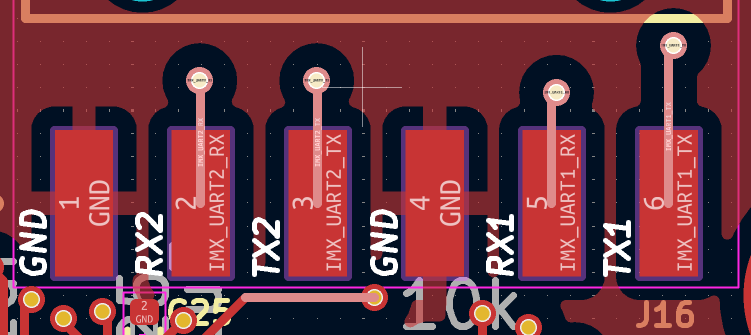
  • Manual is unclear about name of connector (J16 in schematics, J17 in manual).
  • Also numbering of pins is not given afaict.
  • Clone https://source.mnt.re/reform/pocket-reform.git
  • Look at pocket-reform-motherboard.kicad_pcb
  • From the PCB I can confirm J16 and pins numbered left (sysctl) to right.
  • attach "dtech" prolific PL2303 based serial to usb cable per serial console section of PR manual
  • lsusb shows ID 067b:23a3 Prolific Technology, Inc. ATEN Serial Bridge
  • install tio
  • add my user to group dialout
  • newgrp dialout
  • tio /dev/ttyUSB0 -b 1500000
  • A closer look at the PCB in kicad makes me realize the pin labels in the manual are wrong. 4 = GND, 5 = UART1_RX, 6= UART1_TX. With that change I have U-boot output on boot.

Serial console software With some help from minute on ircs://irc.libera.chat:6697/#mnt-reform, I got the kernel boot arguments right to have not just u-boot output but linux kernel output on the serial console. In consfigurator notation
(on-change
      (file:has-content "/etc/flash-kernel/ubootenv.d/00reform2_serial_console"
        "setenv bootargs \"$ bootargs  console=ttyS2,1500000 keep_bootcon\"")
    (cmd:single "flash-kernel"))
The filename should sort before "00reform2_ubootenv" so that the existing "console=tty1" still ends up at the end. previous episode next episode

4 July 2025

Russell Coker: Function Keys

For at least 12 years laptops have been defaulting to not having the traditional PC 101 key keyboard function key functionality and instead have had other functions like controlling the volume and have had a key labelled Fn to toggle the functions. It s been a BIOS option to control whether traditional function keys or controls for volume etc are the default and for at least 12 years I ve configured all my laptops to have the traditional function keys as the default. Recently I ve been working in corporate IT and having exposure to many laptops with the default BIOS settings for those keys to change volume etc and no reasonable option for addressing it. This has made me reconsider the options for configuring these things. Here s a page listing the standard uses of function keys [1]. Here is a summary of the relevant part of that page: The keys F1, F3, F4, F7, F9, F10, and F12 don t get much use for me and for the people I observe. The F2 and F8 keys aren t useful in most programs, F6 is only really used in web browsers but the web browser counts as most programs nowadays. Here s the description of Thinkpad Fn keys [2]. I use Thinkpads for fun and Dell laptops for work, so it would be nice if they both worked in similar ways but of course they don t. Dell doesn t document how their Fn keys are laid out, but the relevant bit is that F1 to F4 are the same as on Thinkpads which is convenient as they are the ones that are likely to be commonly used and needed in a hurry. I have used the KDE settings on my Thinkpad to map the function F1 to F3 keys to the Fn equivalents which are F1 to mute-audio, F2 for vol-down, and F3 for vol-up to allow using them without holding down the Fn key while having other function keys such as F5 and F6 have their usual GUI functionality. Now I have to could train myself to use F8 in situations where I usually use F2, at least when using a laptop. The only other Fn combinations I use are F5 and F6 for controlling screen brightness, but that s not something I use much. It s annoying that the laptop manufacturers forced me to this. Having a Fn key to get extra functions and not need 101+ keys on a laptop size device is a reasonable design choice. But they could have done away with the PrintScreen key to make space for something else. Also for Thinkpads a touch pad is something that could obviously be removed to gain some extra space as the Trackpoint does all that s needed in that regard.

1 July 2025

David Bremner: Hibernate on the pocket reform 2/n

Context

Testing continued
  • following a suggestion of gordon1, unload the mediatek module first. The following seems to work, either from the console or under sway
echo devices >  /sys/power/pm_test
echo reboot > /sys/power/disk
rmmod mt76x2u
echo disk >  /sys/power/state
modprobe mt76x2u
  • It even works via ssh (on wired ethernet) if you are a bit more patient for it to come back.
  • replacing "reboot" with "shutdown" doesn't seem to affect test mode.
  • replacing "devices" with "platform" (or "processors") leads to unhappiness.
    • under sway, the screen goes blank, and it does not resume
    • same on console
previous episode next episode

30 June 2025

Colin Watson: Free software activity in June 2025

My Debian contributions this month were all sponsored by Freexian. This was a very light month; I did a few things that were easy or that seemed urgent for the upcoming trixie release, but otherwise most of my energy went into Debusine. I ll be giving a talk about that at DebConf in a couple of weeks; this is the first DebConf I ll have managed to make it to in over a decade, so I m pretty excited. You can also support my work directly via Liberapay or GitHub Sponsors. PuTTY After reading a bunch of recent discourse about X11 and Wayland, I decided to try switching my laptop (a Framework 13 AMD running Debian trixie with GNOME) over to Wayland. I don t remember why it was running X; I think I must have either inherited some configuration from my previous laptop (in which case it could have been due to anything up to ten years ago or so), or else I had some initial problem while setting up my new laptop and failed to make a note of it. Anyway, the switch was hardly noticeable, which was great. One problem I did notice is that my preferred terminal emulator, pterm, crashed after the upgrade. I run a slightly-modified version from git to make some small terminal emulation changes that I really must either get upstream or work out how to live without one of these days, so it took me a while to notice that it only crashed when running from the packaged version, because the crash was in code that only runs when pterm has a set-id bit. I reported this upstream, they quickly fixed it, and I backported it to the Debian package. groff Upstream bug #67169 reported URLs being dropped from PDF output in some cases. I investigated the history both upstream and in Debian, identified the correct upstream patch to backport, and uploaded a fix. libfido2 I upgraded libfido2 to 1.16.0 in experimental. Python team I upgraded pydantic-extra-types to a new upstream version, and fixed some resulting fallout in pendulum. I updated python-typing-extensions in bookworm-backports, to help fix python3-tango: python3-pytango from bookworm-backports does not work (10.0.2-1~bpo12+1). I upgraded twisted to a new upstream version in experimental. I fixed or helped to fix a few release-critical bugs:

Gunnar Wolf: Get your personalized map of DebConf25 in Brest

As I often do, this year I have also prepared a set of personalized maps for your OpenPGP keysigning in DebConf25, in Brest! What is that, dare you ask? Partial view of my OpenPGP map One of the not-to-be-missed traditions of DebConf is a Key-Signing Party (KSP) that spans the whole conference! Travelling from all the corners of the world to a single, large group gathering, we have the ideal opportunity to spread some communicable diseases trust on your peers identities and strengthen Debian s OpenPGP keyring. But whom should you approach for keysigning? Go find yourself in the nice listing I have prepared. By clicking on your long keyid (in my case, the link labeled 0x2404C9546E145360), anybody can download your certificate (public key + signatures). The SVG and PNG links will yield a graphic version of your position within the DC25 keyring, and the TXT link will give you a textual explanation of it. (of course, your links will differ, yada yada ) Please note this is still a preview of our KSP information: You will notice there are outstanding several things for me to fix before marking the file as final. First, some names have encoding issues I will fix. Second, some keys might be missing if you submitted your key as part of the conference registration form but it is not showing, it must be because my scripts didn t find it in any of the queried keyservers. My scripts are querying the following servers:
hkps://keyring.debian.org/
hkps://keys.openpgp.org/
hkps://keyserver.computer42.org/
hkps://keyserver.ubuntu.com/
hkps://pgp.mit.edu/
hkps://pgp.pm/
hkps://pgp.surf.nl/
hkps://pgpkeys.eu/
hkps://the.earth.li/
Make sure your key is available in at least some of them; I will try to do a further run on Friday, before travelling, or shortly after arriving to France. If you didn t submit your key in time, but you will be at DC25, please mail me stating [DC25 KSP] in your mail title, and I will manually add it to the list. On (hopefully!) Friday, I ll post the final, canonical KSP coordination page which you should download and calculate its SHA256-sum. We will have printed out convenience sheets to help you do your keysigning at the front desk.

Russell Coker: Links June 2025

Jonathan McDowell wrote part 2 of his blog series about setting up a voice assistant on Debian, I look forward to reading further posts [1]. I m working on some related things for Debian that will hopefully work with this. I m testing out OpenSnitch on Trixie inspired by this blog post, it s an interesting package [2]. Valerie wrote an informative article about creating mesh networks using LORA for emergency use [3]. Interesting article about Signal and Windows Recall. That gives us some things to consider regarding ML features on Linux systems [4]. Insightful article about AI and the end of prestige [5]. We should all learn about LLMs. Jonathan Dowland wrote an informative blog post about how to manage namespaces on Linux [6]. The Consumer Rights wiki is a great resource for raising awareness of corporations exploiting their customers for computer related goods and services [7]. Interesting article about Schizophrenia and the cliff-edge function of evolution [8].

24 June 2025

Evgeni Golov: Using LXCFS together with Podman

JP was puzzled that using podman run --memory=2G would not result in the 2G limit being visible inside the container. While we were able to identify this as a visualization problem tools like free(1) only look at /proc/meminfo and that is not virtualized inside a container, you'd have to look at /sys/fs/cgroup/memory.max and friends instead I couldn't leave it at that. And then I remembered there is actually something that can provide a virtual (cgroup-aware) /proc for containers: LXCFS! But does it work with Podman?! I always used it with LXC, but there is technically no reason why it wouldn't work with a different container solution cgroups are cgroups after all. As we all know: there is only one way to find out! Take a fresh Debian 12 VM, install podman and verify things behave as expected:
user@debian12:~$ podman run -ti --rm --memory=2G centos:stream9
bash-5.1# grep MemTotal /proc/meminfo
MemTotal:        6067396 kB
bash-5.1# cat /sys/fs/cgroup/memory.max
2147483648
And after installing (and starting) lxcfs, we can use the virtual /proc/meminfo it generates by bind-mounting it into the container (LXC does that part automatically for us):
user@debian12:~$ podman run -ti --rm --memory=2G --mount=type=bind,source=/var/lib/lxcfs/proc/meminfo,destination=/proc/meminfo centos:stream9
bash-5.1# grep MemTotal /proc/meminfo
MemTotal:        2097152 kB
bash-5.1# cat /sys/fs/cgroup/memory.max
2147483648
The same of course works with all the other proc entries lxcfs provides (cpuinfo, diskstats, loadavg, meminfo, slabinfo, stat, swaps, and uptime here), just bind-mount them. And yes, free(1) now works too!
bash-5.1# free -m
               total        used        free      shared  buff/cache   available
Mem:            2048           3        1976           0          67        2044
Swap:              0           0           0
Just don't blindly mount the whole /var/lib/lxcfs/proc over the container's /proc. It did work (as in: "bash and free didn't crash") for me, but with /proc/$PID etc missing, I bet things will go south pretty quickly.

Uwe Kleine-K nig: Temperature and humitidy sensor on OpenWrt

I have a SHT3x humidity and temperature sensor connected to the i2c bus of my Turris Omnia that runs OpenWrt. To make it produce nice graphs shown in the webif I installed the packages collectd-mod-sensors, luci-app-statistics and kmod-hwmon-sht3x. To make the sht3x driver bind to the device I added
echo 'sht3x 0x44' > /sys/bus/i2c/devices/0-0070/channel-6/new_device
to /etc/rc.local. After that I only had to enable the Sensors plugin below Statistics -> Setup -> General plugins and check 'Monitor all except specified in its "Configure" dialog.

Matthew Garrett: Why is there no consistent single signon API flow?

Single signon is a pretty vital part of modern enterprise security. You have users who need access to a bewildering array of services, and you want to be able to avoid the fallout of one of those services being compromised and your users having to change their passwords everywhere (because they're clearly going to be using the same password everywhere), or you want to be able to enforce some reasonable MFA policy without needing to configure it in 300 different places, or you want to be able to disable all user access in one place when someone leaves the company, or, well, all of the above. There's any number of providers for this, ranging from it being integrated with a more general app service platform (eg, Microsoft or Google) or a third party vendor (Okta, Ping, any number of bizarre companies). And, in general, they'll offer a straightforward mechanism to either issue OIDC tokens or manage SAML login flows, requiring users present whatever set of authentication mechanisms you've configured.

This is largely optimised for web authentication, which doesn't seem like a huge deal - if I'm logging into Workday then being bounced to another site for auth seems entirely reasonable. The problem is when you're trying to gate access to a non-web app, at which point consistency in login flow is usually achieved by spawning a browser and somehow managing submitting the result back to the remote server. And this makes some degree of sense - browsers are where webauthn token support tends to live, and it also ensures the user always has the same experience.

But it works poorly for CLI-based setups. There's basically two options - you can use the device code authorisation flow, where you perform authentication on what is nominally a separate machine to the one requesting it (but in this case is actually the same) and as a result end up with a straightforward mechanism to have your users socially engineered into giving Johnny Badman a valid auth token despite webauthn nominally being unphisable (as described years ago), or you reduce that risk somewhat by spawning a local server and POSTing the token back to it - which works locally but doesn't work well if you're dealing with trying to auth on a remote device. The user experience for both scenarios sucks, and it reduces a bunch of the worthwhile security properties that modern MFA supposedly gives us.

There's a third approach, which is in some ways the obviously good approach and in other ways is obviously a screaming nightmare. All the browser is doing is sending a bunch of requests to a remote service and handling the response locally. Why don't we just do the same? Okta, for instance, has an API for auth. We just need to submit the username and password to that and see what answer comes back. This is great until you enable any kind of MFA, at which point the additional authz step is something that's only supported via the browser. And basically everyone else is the same.

Of course, when we say "That's only supported via the browser", the browser is still just running some code of some form and we can figure out what it's doing and do the same. Which is how you end up scraping constants out of Javascript embedded in the API response in order to submit that data back in the appropriate way. This is all possible but it's incredibly annoying and fragile - the contract with the identity provider is that a browser is pointed at a URL, not that any of the internal implementation remains consistent.

I've done this. I've implemented code to scrape an identity provider's auth responses to extract the webauthn challenges and feed those to a local security token without using a browser. I've also written support for forwarding those challenges over the SSH agent protocol to make this work with remote systems that aren't running a GUI. This week I'm working on doing the same again, because every identity provider does all of this differently.

There's no fundamental reason all of this needs to be custom. It could be a straightforward "POST username and password, receive list of UUIDs describing MFA mechanisms, define how those MFA mechanisms work". That even gives space for custom auth factors (I'm looking at you, Okta Fastpass). But instead I'm left scraping JSON blobs out of Javascript and hoping nobody renames a field, even though I only care about extremely standard MFA mechanisms that shouldn't differ across different identity providers.

Someone, please, write a spec for this. Please don't make it be me.

comment count unavailable comments

20 June 2025

Matthew Garrett: My a11y journey

23 years ago I was in a bad place. I'd quit my first attempt at a PhD for various reasons that were, with hindsight, bad, and I was suddenly entirely aimless. I lucked into picking up a sysadmin role back at TCM where I'd spent a summer a year before, but that's not really what I wanted in my life. And then Hanna mentioned that her PhD supervisor was looking for someone familiar with Linux to work on making Dasher, one of the group's research projects, more usable on Linux. I jumped.

The timing was fortuitous. Sun were pumping money and developer effort into accessibility support, and the Inference Group had just received a grant from the Gatsy Foundation that involved working with the ACE Centre to provide additional accessibility support. And I was suddenly hacking on code that was largely ignored by most developers, supporting use cases that were irrelevant to most developers. Being in a relatively green field space sounds refreshing, until you realise that you're catering to actual humans who are potentially going to rely on your software to be able to communicate. That's somewhat focusing.

This was, uh, something of an on the job learning experience. I had to catch up with a lot of new technologies very quickly, but that wasn't the hard bit - what was difficult was realising I had to cater to people who were dealing with use cases that I had no experience of whatsoever. Dasher was extended to allow text entry into applications without needing to cut and paste. We added support for introspection of the current applications UI so menus could be exposed via the Dasher interface, allowing people to fly through menu hierarchies and pop open file dialogs. Text-to-speech was incorporated so people could rapidly enter sentences and have them spoke out loud.

But what sticks with me isn't the tech, or even the opportunities it gave me to meet other people working on the Linux desktop and forge friendships that still exist. It was the cases where I had the opportunity to work with people who could use Dasher as a tool to increase their ability to communicate with the outside world, whose lives were transformed for the better because of what we'd produced. Watching someone use your code and realising that you could write a three line patch that had a significant impact on the speed they could talk to other people is an incomparable experience. It's been decades and in many ways that was the most impact I've ever had as a developer.

I left after a year to work on fruitflies and get my PhD, and my career since then hasn't involved a lot of accessibility work. But it's stuck with me - every improvement in that space is something that has a direct impact on the quality of life of more people than you expect, but is also something that goes almost unrecognised. The people working on accessibility are heroes. They're making all the technology everyone else produces available to people who would otherwise be blocked from it. They deserve recognition, and they deserve a lot more support than they have.

But when we deal with technology, we deal with transitions. A lot of the Linux accessibility support depended on X11 behaviour that is now widely regarded as a set of misfeatures. It's not actually good to be able to inject arbitrary input into an arbitrary window, and it's not good to be able to arbitrarily scrape out its contents. X11 never had a model to permit this for accessibility tooling while blocking it for other code. Wayland does, but suffers from the surrounding infrastructure not being well developed yet. We're seeing that happen now, though - Gnome has been performing a great deal of work in this respect, and KDE is picking that up as well. There isn't a full correspondence between X11-based Linux accessibility support and Wayland, but for many users the Wayland accessibility infrastructure is already better than with X11.

That's going to continue improving, and it'll improve faster with broader support. We've somehow ended up with the bizarre politicisation of Wayland as being some sort of woke thing while X11 represents the Roman Empire or some such bullshit, but the reality is that there is no story for improving accessibility support under X11 and sticking to X11 is going to end up reducing the accessibility of a platform.

When you read anything about Linux accessibility, ask yourself whether you're reading something written by either a user of the accessibility features, or a developer of them. If they're neither, ask yourself why they actually care and what they're doing to make the future better.

comment count unavailable comments

Russell Coker: The Intel Arc B580 and PCIe Slot Size

A few months ago I bought a Intel Arc B580 for the main purpose of getting 8K video going [1]. I had briefly got it working in a test PC but then I wanted to deploy it on my HP z840 that I use as a build server and for playing with ML stuff [2]. I only did brief tests of it previously and this was my first attempt at installing it in a system I use. My plan was to keep the NVidia RTX A2000 in place and run 2 GPUs, that s not an uncommon desire among people who want to do ML stuff and it s the type of thing that the z840 is designed for, the machine has slots 2, 4, and 6 being PCIe*16 so it should be able to fit 3 cards that each take 2 slots. So having one full size GPU, the half-height A2000, and a NVMe controller that uses *16 to run four NVMe devices should be easy. Intel designed the B580 to use every millimeter of space possible while still being able to claim to be a 2 slot card. On the circuit board side there is a plastic cover over the board that takes all the space before the next slot so a 2 slot card can t go on that side without having it s airflow blocked. On the other side it takes all the available space so that any card that wants to blow air through can t fit and also such that a medium size card (such as the card for 4 NVMe devices) would block it s air flow. So it s impossible to have a computer with 6 PCIe slots run the B580 as well as 2 other full size *16 cards. Support for this type of GPU is something vendors like HP should consider when designing workstation class systems. For HP there is no issue of people installing motherboards in random cases (the HP motherboard in question uses proprietary power connectors and won t even boot with an ATX PSU without significant work). So they could easily design a motherboard and case with a few extra mm of space between pairs of PCIe slots. The cards that are double width are almost always *16 so you could pair up a *16 slot and another slot and have extra space on each side of the pair. I think for most people a system with 6 PCIe slots with a bit of extra space for GPU cooling would be more useful than having 7 PCIe slots. But as HP have full design control they don t even need to reduce the number of PCIe slots, they could just make the case taller. If they added another 4 slots and increased the case size accordingly it still wouldn t be particularly tall by the standards of tower cases from the 90s! The z8 series of workstations are the biggest workstations that HP sells so they should design them to do these things. At the time that the z840 was new there was a lot of ML work being done and HP was selling them as ML workstations, they should have known how people would use them and design them accordingly. So I removed the NVidia card and decided to run the system with just the Arc card, things should have been fine but Intel designed the card to be as high as possible and put the power connector on top. This prevented installing the baffle for directing air flow over the PCIe slots and due to the design of the z840 (which is either ingenious or stupid depending on your point of view) the baffle is needed to secure the PCIe cards in place. So now all the PCIe cards are just secured by friction in the slots, this isn t an unusual situation for machines I assemble but it s not something I desired. This is the first time I ve felt compelled to write a blog post reviewing a product before even getting it working. But the physical design of the B580 is outrageously impractical unless you are designing your entire computer around the GPU. As an aside the B580 does look very nice. The plastic surround is very fancy, it s a pity that it interferes with the operation of the rest of the system.

Next.

Previous.