Search Results: "nion"

31 March 2020

Pau Garcia i Quiles: Uyuni 2020.03 released with enhanced Debian support!

Uyuni is a configuration and infrastructure management tool that saves you time and headaches when you have to manage and update tens, hundreds or even thousands of machines. Uyuni is a fork of Spacewalk that leverages Salt, Cobbler and containers to modernize it. Uyuni is the upstream for SUSE Manager (the main difference is support: with SUSE Manager you get it from SUSE; with Uyuni you get it from the community) and our development and feature discussion is done in the open. Last week we released Uyuni 2020.03, with much improved Debian support, coming from the community: we have got client tools (both the Salt stack and the traditional stack) for Debian 9 and 10, and bootstrapping support! In addition to that, Uyuni 2020.03 brings many other new features: While this version of Uyuni provides a much better experience for Debian sysadmins, we still have a lot of room for improvement: Do you want to help us with development, or just with feedback? Join our community on IRC, Gitter or the mailing lists. And check our user documentation, developer documentation and presentations. We are also participating in Google Summer of Code 2020. Hurry up and submit a proposal to provide Uyuni for Debian, and/or enhance Debian support!

Chris Lamb: Free software activities in March 2020

Here is my monthly update covering what I have been doing in the free software world during March 2020 (previous month): In addition, I did even more hacking on the Lintian static analysis tool for Debian packages, including:
Reproducible builds One of the original promises of open source software is that distributed peer review and transparency of process results in enhanced end-user security. However, whilst anyone may inspect the source code of free and open source software for malicious flaws, almost all software today is distributed as pre-compiled binaries. This allows nefarious third-parties to compromise systems by injecting malicious code into ostensibly secure software during the various compilation and distribution processes. The motivation behind the Reproducible Builds effort is to ensure no flaws have been introduced during this compilation process by promising identical results are always generated from a given source, thus allowing multiple third-parties to come to a consensus on whether a build was compromised. The initiative is proud to be a member project of the Software Freedom Conservancy, a not-for-profit 501(c)(3) charity focused on ethical technology and user freedom. Conservancy acts as a corporate umbrella allowing projects to operate as non-profit initiatives without managing their own corporate structure. If you like the work of the Conservancy or the Reproducible Builds project, please consider becoming an official supporter. This month, I: In our tooling, I also made the following changes to diffoscope, our in-depth and content-aware diff utility that can locate and diagnose reproducibility issues, including preparing and uploading version 138 to Debian: The Reproducible Builds project also operates a fully-featured and comprehensive Jenkins-based testing framework that powers tests.reproducible-builds.org. This month, I reworked the web-based package rescheduling tool to:
Debian LTS This month I have worked 18 hours on Debian Long Term Support (LTS) and 8 hours on its sister Extended LTS project. You can find out more about the Debian LTS project via the following video:
Debian Uploads For the Debian Privacy Maintainers team I requested that the pyptlib package be removed from the archive (#953429) as well as uploading onionbalance (0.1.8-6) to fix test failures under Pytest 3.x (#953535) and a new upstream release of nautilus-wipe. Finally, I sponsored an upload of bilibop (0.6.1) on behalf of Yann Amar.

19 March 2020

John Goerzen: COVID-19 is serious for all ages. Treat it like WWII

Today I d like to post a few updates about COVID-19 which I have gathered from credible sources, as well as some advice also gathered from credible sources. Summary
  1. Coronavirus causes health impacts requiring hospitalization in a significant percentage of all adult age groups.
  2. Coronavirus also can cause no symptoms at all in many, especially children.
  3. Be serious about social distancing.
COVID-19 is serious for young adults too According to this report based on a CDC analysis, between 14% and 20% of people aged 20 to 44 require hospitalization due to COVID-19. That s enough to be taken seriously. See also this CNN story. Act as if you are a carrier because you may be infected and not even know it, even children Information on this is somewhat preliminary, but it is certainly known that a certain set of cases is asymptomatic. This article discusses manifestations in children, while this summary of a summary (note: not original research) suggests that 17.9% of people may not even know they are infected. How serious is this? Serious. This excellent article by Daniel W. Johnson, MD, is a very good read. Among the points it makes: Advice I m going to just copy Dr. Johnson s advice here:
  1. You and your kids should stay home. This includes not going to church, not going to the gym, not going anywhere.
  2. Do not travel for enjoyment until this is done. Do not travel for work unless your work truly requires it.
  3. Avoid groups of people. Not just crowds, groups. Just be around your immediate family. I think kids should just play with siblings at this point no play dates, etc.
  4. When you must leave your home (to get groceries, to go to work), maintain a distance of six feet from people. REALLY stay away from people with a cough or who look sick.
  5. When you do get groceries, etc., buy twice as much as you normally do so that you can go to the store half as often. Use hand sanitizer immediately after your transaction, and immediately after you unload the groceries.
I m not saying people should not go to work. Just don t leave the house for anything unnecessary, and if you can work from home, do it. Everyone on this email, besides Mom and Dad, are at low risk for severe disease if/when they contract COVID-19. While this is great, that is not the main point. When young, well people fail to do social distancing and hygiene, they pick up the virus and transmit it to older people who are at higher risk for critical illness or death. So everyone needs to stay home. Even young people. Tell every person over 60, and every person with significant medical conditions, to avoid being around people. Please do not have your kids visit their grandparents if you can avoid it. FaceTime them. Our nation is the strongest one in the world. We have been through other extreme challenges and succeeded many times before. We WILL return to normal life. Please take these measures now to flatten the curve, so that we can avoid catastrophe.
I d also add that many supermarkets offer delivery or pickup options that allow you to get your groceries without entering the store. Some are also offering to let older people shop an hour before the store opens to the general public. These could help you minimize your exposure. Other helpful links Here is a Reddit megathread with state-specific unemployment resources. Scammers are already trying to prey on people. Here are some important tips to avoid being a victim. Although there are varying opinions, some are recommending avoiding ibuprofen when treating COVID-19. Bill Gates had some useful advice. Here s a summary emphasizing the need for good testing.

11 March 2020

Axel Beckert: Backup over Tor with BackupPC

I have a Raspberry Pi at my parents home. They have internet access via some ISP using Carrier Grade NAT (CGN). Hence their home router is not reachable via IPv4 from the outside, they do have IPv6 and the devices can also be made accessible via IPv6 via the local router. Did that, was able to access my Raspberry Pi over IPv6 and SSH from the outside. So doing backup of that Raspberry Pi with BackupPC from the outside was a walk in the park. Unfortunately the IPv6 prefix seems to change occasionally and the router only allows to configure explicit IPv6 addresses in firewall rules so after a prefix change the configured rules no more match the devices IPv6 addresses. Meh. So there were multiple possibilities to work around these restrictions and access a devices behind the router: Enabling a Tor Hidden Service for port 22 is a no-brainer and was done most quickly (actually it already was in place as I already suspected that an IPv6 prefix change might happen) and I so far was too lazy to replace it with something more proper. But my backup was relying on direct SSH access via IPv6. So I needed to get that working over Tor, too. Here s what was needed for the host named sherpa (named after the Fiberfab Sherpa) to be backed up via Tor: That s it basically. Of course you also need to have the SSH public host key in the .ssh/known_hosts file also for the .onion hostname. And the Tor Hidden Service needs to be configured on the target device. But that s left as exercise for the reader. There s a lot of documentation about that on the internet, including slides and video recordings of talks and live demos I gave about this topic in German. Ah, and in case you might think that s unfair and misuse of the resources of the Tor Project: No, I explicitly asked and they said more or less any additional traffic helps to make it more difficult to analyse Tor traffic or to track Tor users and is hence welcome. Addendum: The last direct full backup of that Raspberry Pi (5.5 GB) took around 32 minutes. The first full backup over Tor (8.7 GB) took 341 minutes. Seems much slower, but there might be other factors as well: Most backups which ran last night were running at only 0.85 MB/s to 1 MB/s, probably because too many backups were running in parallel after a recent backup server downtime with file system check the backup server was probably the bottleneck. The backup of the Raspberry Pi over Tor ran at 0.42 MB/s, so about half the speed of the other backups. (Will probably add some more notes if I have more statistics over time.)

8 March 2020

Ulrike Uhlig: Implementing feedback into our work culture

Everywhere I worked in the past, the only feedback that was asked of employees was during a yearly evaluation meeting. These meetings always felt to me like talking to Santa Claus and his Knecht Ruprecht. I was asked: Were you a good employee last year? If yes, we might give you a raise. If no, admit all your mistakes now, even if we already know everything, ho ho ho. And don't you talk about your feelings, or your well-being, or say anything about the organization's (invisible) hierarchies, otherwise we will put you on the "naughty list", and that's it with candy. The yearly evaluation set aside, there was no other place to give feedback (except by escalating a matter by involving the Labour Court, if you happen to work in France, or going on strike, also mostly part of French culture). Feedback allows to reflect on work processes, to situate oneself, and to get closure. How surprised was I when, some years ago, I received an email from a collaborator asking me: kindly for just few paragraphs (doesn t have to be anything long) to hear from you about the process, your work, challenges you had, or anything else you want to mention there.. Wow!
This simple email allowed me to reflect about: How do we get to a feedback culture? How do we get from German Christmas folklore, protestant work ethics, and the deeply rooted principles of disciplining and punishing to a feedback culture on eye level? It sounds a bit like going from the dark ages to a really cool science fiction utopia with universal peace, telepathy, and magic between all sentient beings on all inhabited planets in the cosmos at least that's how I imagined it as a child, just like some of my heroes did: the cosmonaut girl who saves Earth, the boy who talks to space flowers that give him the capacity to fly, and the little onion who fights for justice (the Italian author was so popular on our side of the iron curtain that a soviet astronomer named a minor planet after him. His wife meanwhile immortalized Karl Marx.) and some romantic part of me hangs on to these ideas. Feedback is not always easy to hear and to give. I-Statements Giving and receiving feedback is hard in a culture where people learnt that when they made a mistake they won't get candy. Or that they have to constantly please other people because they are not worthy by themselves. This can lead to people putting mistakes on one another. Every sentence that starts with You are has the potential of creating a lot of hurt, and anger. Have you heard of I-Statements? They have very powerfully changed my world view, as they shift from accusation to ownership of feelings. So instead of telling someone Your writing style is impossible! You really need to change the way you write., with an I-Statement one could say I have a hard time understanding that part of the text. I-Statements make cooperation possible. Listening actively Feedback is not about being right or wrong, it's first of all about being able to see how another person has experienced a situation. Active listening is a tool that helps with understanding. It might seem easy, but needs quite some practice and a safe space. One part of active listening is to restate what you hear the other person say (by mirroring, or paraphrasing), to make sure you understood, and make sure they know you understood what they were trying to say. You can practise this: in a circle of three people, have one person tell how they experienced a (possibly conflictual) situation, have one person do the active listening, and the third person observing in order to give feedback to the active listener about how they did. Then switch roles, for example clockwise, until everyone has had every role. Encouraging continuous feedback A working feedback culture does not take place only once a year. It needs to be a continuous process and therefore implemented in meetings, teams, eventually on the level of a project. Making clear: Who can I talk to if I experience an issue? is not different than telling developers and users where and how they can report a bug, or request a feature. A safe space to express feedback is key. Encouraging multiple feedback channels Some people might feel less empowered or more vulnerable over a channel than others. Make sure to have different channels for receiving feedback such as email, a point on each meeting agenda, a one-to-one meeting, or a poll. Giving and receiving feedback on eye level In a workplace that does not have a working feedback culture, feedback is easily perceived as policing. If your feedback process consists of asking people to upload a form to a cloud server every 3 months, and you notice that some people don't do it, you could ask yourself if there is an issue with how your colleagues perceive giving feedback in your organization. Do you meet your colleagues on eye level when it comes to feedback? Do you take feedback seriously and act on it? How do you deal with unpleasant feedback? How do you react when colleagues don't meet your expectations? Can people participate in the feedback process within their paid work time? Did everybody understand what the feedback process is about? Don't jump to conclusions Humans are problem solving animals. When someone comes to us with a problem, the first thing we want to do is to solve it, to help them. But sometimes this is uncalled for, it can be disempowering, or prevent people from acquiring competences themselves, and it can even break people's boundaries. So instead of asking What can I do for you?, try asking What do you need right now? People will often reply something that you did not expect at all. Acting on feedback Make sure you have a process to collect feedback (possibly anonymized) and to regularly evaluate if the organization needs to implement changes to thrive. Conclusion I stumbled upon Hans-Christian Dany's critique of feedback again recently, therefore I need to make it clear: I'm not interested in improving capitalist work culture by using cybernetic principles of self-regulation through feedback. Instead, I am interested in improving cooperation between people who work either individually or in organizations on eye level. In this framework, I see feedback processes as profoundly anti-capitalist methods to improve cooperation while working towards common good. Implementing these ideas should be doable: there are organizations who provide feedback training for example. This document, initially aiming at people in cooperatives, gives many insights on communication skills and feedback, the agile and UX worlds do feedback "retrospectives". and otherwise I'll have to go and write science fiction stories for children myself.

3 March 2020

Elana Hashman: Chili

I really like beans. This is one way for me to power through the copious amounts I receive through the beloved Bean of the Month Club. (It took me many months, but I finally got in!) Beef Chili Serves 5-7. Active time: 20m. Total time: 90m. Ingredients: Recipe:
  1. Heat a dutch oven on high.
  2. Small or medium dice (depending on your preference) the celery, pepper, and onion. You should have about four cups total.
  3. Brown the beef in the dutch oven, using a little bit of cooking oil to avoid sticking if desired.
  4. While the meat is browning, mince the garlic, measure the spices, and combine these all together.
  5. Once the meat is brown, add the diced vegetables and cook until tender and the onion is translucent.
  6. Add the spices and garlic, thoroughly combine, and cook until fragrant, about one minute.
  7. Add the tomatoes. Once the mixture comes to a boil, cover and simmer for about an hour, stirring every ~20 minutes or so.
  8. Add the beans and use bean broth or water to adjust consistency.
  9. This is a good time to taste and add salt. I usually use 1 to 1 teaspoons.
  10. Bring to a boil again, cover and simmer for 10-15 more minutes.
  11. Turn off the heat, taste, and adjust seasoning if necessary. Add a squeeze of lime if it needs a little acidity.
  12. Serve with sour cream, grated cheese, sliced green onions, or any of your other favourite garnishes.
  13. Enjoy!
Frequently Asked Questions Q: Why wait until basically the end to add salt?
A: Because canned ingredients will contain salt, and it's hard to predict how much, so you should always salt to taste. Waiting until the end will always ensure you season accurately. Q: Why are so many of these directions so hand-wavey?
A: Cooking is an adventure. Experiment a little! Q: But I have no idea what "to taste" means.
A: Taste it, add the thing, stir, taste it again. Is it salty enough? Sour enough? Sweet enough? You don't know, you say? Keep going. Add a little too much and then you'll find out for next time. Q: Why do you add so many beans and so little meat?
A: I really like beans.

29 February 2020

Chris Lamb: Free software activities in February 2020

Here is my monthly update covering what I have been doing in the free software world during February 2020 (previous month): For the Tails privacy-oriented operating system, I uploaded the following packages to Debian:
Reproducible builds One of the original promises of open source software is that distributed peer review and transparency of process results in enhanced end-user security. However, whilst anyone may inspect the source code of free and open source software for malicious flaws, almost all software today is distributed as pre-compiled binaries. This allows nefarious third-parties to compromise systems by injecting malicious code into ostensibly secure software during the various compilation and distribution processes. The motivation behind the Reproducible Builds effort is to provide the ability to demonstrate these binaries originated from a particular trusted source release: if identical results are generated from a given source in all circumstances, reproducible builds provides the means for multiple third-parties to reach a consensus on whether a build was compromised via distributed checksum validation or some other scheme. The initiative is proud to be a member project of the Software Freedom Conservancy, a not-for-profit 501(c)(3) charity focused on ethical technology and user freedom. Conservancy acts as a corporate umbrella allowing projects to operate as non-profit initiatives without managing their own corporate structure. If you like the work of the Conservancy or the Reproducible Builds project, please consider becoming an official supporter. This month, I: In our tooling, I also made the following changes to diffoscope, our in-depth and content-aware diff utility that can locate and diagnose reproducibility issues, including uploading version 137 to Debian:
Debian I submitted a Request for Package (RFP) bug for hsd, a blockchain-based top-level domain DNS protocol implementation that underpins Handshake and worked on some initial packaging. (#952472)
Debian LTS This month I have worked 18 hours on Debian Long Term Support (LTS) and 12 hours on its sister Extended LTS project. You can find out more about the project via the following video:
Uploads Finally, I made a non-maintainer upload of adminer (4.7.6-1) on behalf of Alexandre Rossi.

16 November 2017

Michal Čihař: New projects on Hosted Weblate

Hosted Weblate provides also free hosting for free software projects. The hosting requests queue has grown too long, so it's time to process it and include new project. This time, the newly hosted projects include: If you want to support this effort, please donate to Weblate, especially recurring donations are welcome to make this service alive. You can do that easily on Liberapay or Bountysource.

Filed under: Debian English SUSE Weblate

15 November 2017

Russ Allbery: Review: The Piper's Son

Review: The Piper's Son, by Melina Marchetta
Series: Francesca #2
Publisher: Candlewick Press
Copyright: 2010
Printing: 2011
ISBN: 0-7636-5458-2
Format: Kindle
Pages: 330
Tom Mackee's family has fallen apart. The impetus was the death of his uncle Joe in the London tube terrorist bombings, but that was only the start. He destroyed his chances with the only woman he really loved. His father's drinking got out of control, his mother left with his younger sister to live in a different city, and he refused to go with them and abandon his father. But then, six months later, his father abandoned him anyway. As this novel opens, Tom collapses while performing a music set, high on drugs and no sleep, and wakes up to discover his roommates have been fired from their jobs for stealing, and in turn have thrown him out of their apartment. He's at rock bottom. The one place he can turn for a place to stay is his aunt Georgie, the second (although less frequent) viewpoint character of this book. She was the one who took the trip to the UK to try to find out what happened and retrieve her brother's body, and the one who had to return to Australia with nothing. Her life isn't in much better shape than Tom's. She's kept her job, but she's pregnant by her ex-boyfriend but barely talking to him, since he now has a son by another woman he met during their separation. And she's not even remotely over her grief. The whole Finch/Mackee family is, in short, a disaster. But they have a few family relationships left that haven't broken, some underlying basic decency, and some patient and determined friends. I should warn up-front, despite having read this book without knowing this, that this is a sequel to Saving Francesca, set five years later and focusing on secondary characters from the original novel. I've subsequently read that book as well, though, and I don't think reading it first is necessary. This is one of the rare books where being a sequel made it a better stand-alone novel. I never felt a gap of missing story, just a rich and deep background of friendships and previous relationships that felt realistic. People are embedded in networks of relationships even when they feel the most alone, and I really enjoyed seeing that surface in this book. All those patterns from Tom's past didn't feel like information I was missing. They felt like glimpses of what you'd see if you looked into any other person's life. The plot summary above might make The Piper's Son sound like a depressing drama fest, but Marchetta made an excellent writing decision: the worst of this has already happened before the start of the book, and the rest is in the first chapter. This is not at all a book about horrible things happening to people. It's a book about healing. An authentic, prickly, angry healing that doesn't forget and doesn't turn into simple happily-ever-after stories, but does involve a lot of recognition that one has been an ass, and that it's possible to be less of an ass in the future, and maybe some things can be fixed. A plot summary might fool you into thinking that this is a book about a boy and his father, or about dealing with a drunk you still love. It's not. The bright current under this whole story is not father-son bonding. It's female friendships. Marchetta pulls off a beautiful double-story, writing a book that's about Tom, and Georgie, and the layered guilt and tragedy of the Finch/Mackee family, but whose emotional heart is their friends. Francesca, Justine, absent Siobhan. Georgie's friend Lucia. Ned, the cook, and his interactions with Tom's friends. And Tara Finke, also mostly absent, but perfectly written into the story in letters and phone calls. Marchetta never calls unnecessary attention to this, keeping the camera on Tom and Georgie, but the process of reading this book is a dawning realization of just how much work friendship is doing under the surface, how much back-channel conversation is happening off the page, and how much careful and thoughtful and determined work went into providing Tom a floor, a place to get his feet under him, and enough of a shove for him to pull himself together. Pulling that off requires a deft and subtle authorial touch, and I'm in awe at how well it worked. This is a beautifully written novel. Marchetta never belabors an emotional point, sticking with a clear and spare description of actions and thoughts, with just the right sentences scattered here and there to expose the character's emotions. Tom's family is awful at communication, which is much of the reason why they start the book in the situation they're in, but Marchetta somehow manages to write that in a way that didn't just frustrate me or make me want to start banging their heads together. She somehow conveys the extent to which they're trying, even when they're failing, and adds just the right descriptions so that the reader can follow the wordless messages they send each other even when they can't manage to talk directly. I usually find it very hard to connect with people who can only communicate by doing things rather than saying them. It's a high compliment to the author that I felt I understood Tom and his family as well as I did. One bit of warning: while this is not a story of a grand reunion with an alcoholic father where all is forgiven because family, thank heavens, there is an occasional wiggle in that direction. There is also a steady background assumption that one should always try to repair family relationships, and a few tangential notes about the Finches and Mackees that made me think there was a bit more abuse here than anyone involved wants to admit. I don't think the book is trying to make apologies for this, and instead is trying to walk the fine line of talking about realistically messed up families, but I also don't have a strong personal reaction to that type of story. If you have an aversion to "we should all get along because faaaaamily" stories, you may want to skip this book, or at least go in pre-warned. That aside, the biggest challenge I had in reading this book was not breaking into tears. The emotional arc is just about perfect. Tom and Georgie never stay stuck in the same emotional cycle for too long, Marchetta does a wonderful job showing irritating characters from a slightly different angle and having them become much less irritating, and the interactions between Tom, Tara, and Francesca are just perfect. I don't remember reading another book that so beautifully captures that sensation of knowing that you've been a total ass, knowing that you need to stop, but realizing just how much work you're going to have to do, and how hard that work will be, once you own up to how much you fucked up. That point where you keep being an ass for a few moments longer, because stopping is going to hurt so much, but end up stopping anyway because you can't stand yourself any more. And stopping and making amends is hard and hurts badly, and yet somehow isn't quite as bad as you thought it was going to be. This is really great stuff. One final complaint, though: what is it with mainstream fiction and the total lack of denouement? I don't read very much mainstream fiction, but this is the second really good mainstream book I've read (after The Death of Bees) that hits its climax and then unceremoniously dumps the reader on the ground and disappears. Come back here! I wasn't done with these people! I don't need a long happily-ever-after story, but give me at least a handful of pages to be happy with the characters after crying with them for hours! ARGH. But, that aside, the reader does get that climax, and it's note-perfect to the rest of the book. Everyone is still themselves, no one gets suddenly transformed, and yet everything is... better. It's the kind of book you can trust. Highly, highly recommended. Rating: 9 out of 10

24 October 2017

Iain R. Learmonth: Security by Obscurity

Today this blog post turned up on Hacker News, titled Obscurity is a Valid Security Layer . It makes some excellent points on the distinction between good and bad obscurity and it gives an example of good obscurity with SSH. From the post:
I configured my SSH daemon to listen on port 24 in addition to its regular port of 22 so I could see the difference in attempts to connect to each (the connections are usually password guessing attempts). My expected result is far fewer attempts to access SSH on port 24 than port 22, which I equate to less risk to my, or any, SSH daemon. I ran with this alternate port configuration for a single weekend, and received over eighteen thousand (18,000) connections to port 22, and five (5) to port 24.
Those of you that know me in the outside world will have probably heard me talk about how it s insane we have all these services running on the public Internet that don t need to be there, just waiting to be attacked. I have previously given a talk at TechMeetup Aberdeen where I talk about my use of Tor s Onion services to have services that only I should ever connect to be hidden from the general Internet. Onion services, especially the client authentication features, can also be useful for IoT dashboards and devices, allowing access from the Internet but via a secure and authenticated channel that is updated even when the IoT devices behind it have long been abandoned. If you re interested to learn more about Onion services, you could watch Roger Dingledine s talk from Def Con 25.

22 October 2017

Iain R. Learmonth: Free Software Efforts (2017W42)

Here s my weekly report for week 42 of 2017. In this week I have replaced my spacebar, failed to replace a HDD and begun the process to replace my YubiKey.

Debian Eariler in the week I blogged about powerline-taskwarrior . There is a new upstream version available that includes the patches I had produced for Python 2 support and I have filed #879225 to remind me to package this. The state of emscripten is still not great, and as I don t have the time to chase this up and I certainly don t have the time to fix it myself, I ve converted the ITP for csdr to an RFP. As I no longer have the time to maintain map.debian.net, I have released this domain name and published the sources behind the service.

Tor Project There was a request to remove the $ from family fingerprint on Atlas. These actually come from Onionoo and we have decided to fix this in Onionoo, but I did push a small fix for Atlas this week that makes sure that Atlas doesn t care if there are $ prefixes or not. I requested that a Trac component be created for metrics-bot. I wrote a seperate post about metrics-bot. I also attended the weekly metrics team meeting.

Sustainability I believe it is important to be clear not only about the work I have already completed but also about the sustainability of this work into the future. I plan to include a short report on the current sustainability of my work in each weekly report. I have not had any free software related expenses this week. The current funds I have available for equipment, travel and other free software expenses remains 60.52. I do not believe that any hardware I rely on is looking at imminent failure. I do not find it likely that I ll be travelling to Cambridge for the miniDebConf as the train alone would be around 350 and hotel accomodation a further 600 (to include both me and Ana).

17 October 2017

Jonathan Dowland: Electric Dreams

No spoilers, for those who have yet to watch it... Channel 4 have been broadcasting a new 10-part series called Electric Dreams, based on some of the short fiction of Philip K Dick. The series was commissioned after Channel 4 lost Black Mirror to Netflix, perhaps to try and find something tonally similar. Electric Dreams is executive-produced by Brian Cranston, who also stars in one of the episodes yet to broadcast. I've read all of PKD's short fiction1 but it was a long time ago so I have mostly forgotten the stories upon which the series is based. I've quite enjoyed going back and re-reading them after watching the corresponding episodes to see what changes they've made. In some cases the changes are subtle or complementary, in other cases they've whittled the original story right out and installed a new one inside the shell. A companion compilation has been published with just the relevant short stories in it, and from what I've seen browsing it in a book shop it also contains short introductions which might be worth a read. Things started strong with The Hood Maker, which my wife also enjoyed, although she was disappointed to realise we wouldn't be revisiting those characters in the future. The world-building was strong enough that it seemed like a waste for a single episode. My favourite episode of those broadcast so far was The Commuter, starring Timothy Spall. The changes made were complementary and immensely expanded the emotional range of the story. In some ways, a key aspect of the original story was completely inverted, which I found quite funny: my original take on Dick's story was Dick implying a particular outcome was horrific, whereas it becomes desirable in the TV episode.
Episode 4, *Crazy Diamond* Episode 4, Crazy Diamond
One of the stories most hollowed-out was Sales Pitch which was the basis for Tony Grisoni s episode Crazy Diamond, starring Steve Buscemi and Sidse Babett Knudsen. Buscemi was good but Knudsen totally stole every frame she was in. Fans of the cancelled Channel 4 show Utopia should enjoy this one: both were directed by Marc Munden and the directing, photography and colour balance really recall it. The last episode broadcast was Real Life directed by Ronald D Moore of Battlestar Galactica reboot fame and starring Anna Paquin. Like Sales Pitch it bears very little resemblance to the original story. It played around with similar ideas explored in a lot of Sci-Fi movies and TV shows but left me a little flat; I didn't think it contributed much that I hadn't seen before. I was disappointed that there was a relatively conclusive ending. There was a subversive humour in the Dick short that was completely lost in the retelling. The world design seemed pretty generic. I'm looking forward to Autofac, which is one of the shorts I can remember particularly enjoying.

  1. as collected in the 5 volumes of The Collected Stories of Philip K Dick, although I don't doubt there are some stragglers that were missed out when that series was compiled.

15 October 2017

Iain R. Learmonth: Free Software Efforts (2017W41)

Here s my weekly report for week 41 of 2017. In this week I have explored some Java 8 features, looked at automatic updates in a few Linux distributions and decided that actually I don t need swap anymore.

Debian The issue that was preventing the migration of the Tasktools Packaging Team s mailing list from Alioth to Savannah has now been resolved. Ana s chkservice package that I sponsored last week has been ACCEPTED into unstable and since MIGRATED to testing.

Tor Project I have produced a patch for the Tor Project website to update links to the Onionoo documentation now this has moved (#23802 ). I ve updated the Debian and Ubuntu relay configuration instructions to use systemctl instead of service where appropriate (#23048 ). When a Tor relay is less than 2 years old, an alert will now appear on Atlas to link to the new relay lifecycle blog post (#23767 ). This should hopefully help new relay operators understand why their relay is not immediately fully loaded but instead it takes some time to ramp up. I have gone through the tickets for Tor Cloud and did not find any tickets that contain any important information that would be useful to someone reviving the project. I have closed out these tickets and the Tor Cloud component no longer has any non-closed tickets (#7763, #8544, #8768, #9064, #9751, #10282, #10637, #11153, #11502, #13391, #14035, #14036, #14073, #15821 ). I ve continued to work on turning the Atlas application into an integrated part of Tor Metrics (#23518 ) and you can see some progress here. Finally, I ve continued hacking on a Twitter bot to tweet factoids about the public Tor network and you can now enjoy some JavaDoc documentation if you d like to learn a little about its internals. I am still waiting for a git repository to be created (#23799 ) but will be publishing the sources shortly after that ticket is actioned.

Sustainability I believe it is important to be clear not only about the work I have already completed but also about the sustainability of this work into the future. I plan to include a short report on the current sustainability of my work in each weekly report. I have not had any free software related expenses this week. The current funds I have available for equipment, travel and other free software expenses remains 60.52. I do not believe that any hardware I rely on is looking at imminent failure. I d like to thank Digital Ocean for providing me with futher credit for their platform to support my open source work. I do not find it likely that I ll be travelling to Cambridge for the miniDebConf as the train alone would be around 350 and hotel accomodation a further 600 (to include both me and Ana).

13 October 2017

Shirish Agarwal: I need to speak up now X Economics

Dear all, This would be a longish blog post (as most of mine are) compiled over days but as there is so short a time and so much to share. I had previously thought to share beautiful photographs of Ganesh mandals taking out the procession at time of immersion of the idol or the last day of Durga Puja recent events around do not make my mood to share photos at this point in time. I may share some of them in a future blog post or two . Before going further, I would like to offer my sympathies and condolences to people hurt and dislocated in Hurricane Irma , the 2017 Central Mexico Earthquake and lastly the most recent Las Vegas shooting as well as Hurricane Maria in Puerto Rico . I am somewhat nonplussed as to why Americans always want to name, especially hurricanes which destroy people s lives and livelihood built over generations and why most of the hurricanes are named after women. A look at weather.com site unveiled the answer to the mystery. Ironically (or not) I saw some of the best science coverage about Earthquakes or anything scientific reporting and analysis after a long time in mainstream newspapers in India. On another note, I don t understand or even expect to understand why the gunman did what he did 2 days back. Country music AFAIK is one of the most chilled-out kind of music, in some ways very similar to classical Indian singing although they are worlds apart in style of singing, renditions, artists, the way they emote etc. I seriously wish that the gunman had not been shot but caught and reasons were sought about what he did, he did. While this is certainly armchair thinking as was not at the scene of crime, but if a Mumbai Police constable could do it around a decade ago armed only with a lathi could do it, why couldn t the American cops who probably are trained in innumerable ways to subdue people without killing them, did. While investigations are on, I suspect if he were caught just like Ajmal Kasab was caught then lot of revelations might have come up. From what is known, the gentleman was upwardly mobile i.e. he was white, rich and apparently had no reason to have beef with anybody especially a crowd swaying to some nice music, all of which makes absolutely no sense. Indian Economy Slowdown Anyways, back to one of the main reasons of writing this blog post. Few days back, an ex-finance Minister of India Yashwant Sinha wrote what was felt by probably millions of Indians, an Indian Express article called I need to speak up now While there have been many, many arguments made since then by various people. A simple search of I need to speak up would lead to lead to many a result besides the one I have shared above. The only exception I have with the article is the line Forty leading companies of the country are already facing bankruptcy proceedings. Many more are likely to follow suit. I would not bore you but you ask any entrepreneur trying to set up shop in India i.e. ones who actually go through the processes of getting all the licenses for setting up even a small businesses as to the numerous hurdles they have to overcome and laid-back corrupt bureaucracy which they have to overcome. I could have interviewed some of my friends who had the conviction and the courage to set up shop and spent more than half a decade getting all the necessary licenses and approval to set up but it probably would be too specific for one industry or the other and would lead to the same result. Co-incidentally, a new restaurant, leaf opened in my vicinity few weeks before. From the looks it looked like a high-brow, high-priced restaurant hence like many others I did not venture in. After a few days, they introduced south-Indian delicacies like Masala Dosa, Uttapam at prices similar to other restaurants around. So I ventured in and bought some south Indian food to consume between mum and me. Few days later, I became friends with the owner/franchisee and I suggested (in a friendly tone) that why he doesn t make it like a CCD play where many people including yours truly use the service to share, strategize and meet with clients. The CCD joints usually serve coffee and snacks (which are over-priced but still run out pretty fast) but people come as they have chilled-out atmosphere and Wi-Fi access which people need for their smartphones, although the Wi-Fi part may soon become redundant With Reliance Jio making a big play. I also shared why he doesn t add more variety and time (the south Indian items are time-limited) as I see/saw many empty chairs there. Anyways, the shop-owner/franchisee shared his gross costs including salary, stocking, electricity, rent and it doesn t pan out to be serving Rs.80/- dish (roughly a 1US dollar and 25 cents) then serving INR Rs. 400/- a dish (around 6 $USD). One round of INR 400/- + dishes make his costs for the day, around 12 tables were there. It s when they have two full rounds of dishes costing INR 400/- or more that he actually has profits and he is predicting loss for at least 6 months to a year before he makes a rebound. He needs steady customers rather than just walk-ins that will make his business work/click. Currently his family is bearing the costs. He didn t mention the taxes although I know apart from GST there are still some local body taxes that they will have to pay and comply with. There are a multitude of problems for shutting a shop legally as well as they have to again renavigate the bureaucracy for the same. I have seen more than a few retailers downing their shutters for 6-8 months and then either sell it to new management, let go of the lease or simply sell the property to a competitor. The Insolvency and Bankruptcy Code is probably the first proper exit policy for large companies. So the 40 odd companies that Mr. Sinha were talking about were probably sick for a long time. In India, there is also an additional shame of being a failed entrepreneur unlike in the west where Entrepreneurs start on their next venture. As seen from Retailing In India only 3.3% of the population or at the most 4% of the population is directly or indirectly linked with the retail trade. Most of the economy still derives its wealth from the agrarian sector which is still reeling under the pressure from demonetization which happened last year. Al jazeera surprisingly portrayed a truer picture of the effects demonetization had on common citizen than many Indian newspapers did at the time. Because of the South African Debconf, I had to resort to debit cards and hence was able to escape standing in long lines in which many an old and women perished. It is only yesterday that the Government has acknowledged which many prominent Indians have been saying for months now, that we are in a slowdown . Be aware of the terms being used for effect by the Prime Minister. There are two articles which outlines the troubles India is in atm. The only bright spot has been e-commerce which so far has eluded GST although the Govt. has claimed regulations to put it in check. Indian Education System Interestingly, Ravish Kumar has started a series on NDTV where he is showcasing how Indian education sector, especially public colleges have been left to teachers on contract basis, see the first four episodes on NDTV channel starting with the first one I have shared as a hyperlink. I apologize as the series is in Hindi as the channel is meant for Indians and is mostly limited to Northern areas of the Country (mostly) although he has been honest that it is because they lack resources to tackle the amount of information flowing to them. Ravish started the series with sharing information about the U.S. where the things are similar with some teachers needing to sleep in cars because of high-cost of living to some needing to turn to sex-work . I was shocked when I read the guardian article, that is no way to treat our teachers.I went on to read How the American University was Killed following the breadcrumbs along the way. Reading that it seems Indians have been following the American system playbook from the 1980 s itself. The article talks about HMO as well and that seems to have followed here as well with my own experience of hospital fees and drugs which I had to entail a few weeks/month ago. Few years ago, when me and some of my friends had the teaching bug and we started teaching in a nearby municipal school, couple of teachers had shared that they were doing 2-3 jobs to make ends meet. I don t know about others in my group, at least I was cynical because I thought all the teachers were permanent and they make good money only to realize now that the person was probably speaking the truth. When you have to do three jobs to make ends meet from where do you bring the passion to teach young people and that too outside the syllabus ? Also, with this new knowledge in hindsight, I take back all my comments I made last year and the year before for the pathetic education being put up by the State. With teachers being paid pathetically/underpaid and almost 60% teachers being ad-hoc/adjunct teachers they have to find ways to have some sense of security. Most teachers are bachelors as they are poor and cannot offer any security (either male or female) and for women, after marriage it actually makes no sense for them to continue in this profession. I salute all the professors who are ad-hoc in nature and probably will never get a permanent position in their life. I think in some way, thanx to him, that the government has chosen to give 7th pay commisson salary to teachers. While the numbers may appear be large, there are a lot of questions as to how many people will actually get paid. There needs to be lot of vacancies which need to be filled quickly but don t see any solution in the next 2-3 years as well. The Government has taken a position to use/re-hire retired teachers rather than have new young teachers as an unwritten policy. In this Digital India context how are retired teachers supposed to understand and then pass on digital concepts is beyond me when at few teacher trainings I have seen they lack even the most basic knowledge that I learnt at least a decade or two ago, the difference is that vast. I just don t know what to say to that. My own experience with my own mother who had pretty good education in her time and probably would have made a fine business-woman if she knew that she will have a child that she would have to raise by herself alone (along with maternal grand-parents) is testimonial to the fact how hard it is for older people to grasp technology and here I m talking just using the interface as a consumer rather than a producer or someone in-between who has the idea of how companies and governments profit from whatever data is shared one way or the other. After watching the series/episodes and discussing the issue with my mother it was revealed that both her and my late maternal grandfather were on casual/ad-hoc basis till 20-25 years in their service in the defense sector. If Ravish were to do a series on the defense sector he probably would find the same thing there. To add to that, the defense sector is a vital component to a country s security. If 60% of the defense staff in all defense establishments have temporary staff how do you ensure the loyalty of the people working therein. That brings to my mind Ignorance is bliss . Software development and deployment There is another worry that all are skirting around, the present dispensation/government s mantra is minimum government-maximum governance with digital technologies having all solutions which is leading to massive unemployment. Also from most of the stories/incidents I read in the newspapers, mainstream media and elsewhere it seems most software deployments done in India are done without having any system of internal checks and balances. There is no lintian for software to be implemented. Contracts seem to be given to big companies and there is no mention of what prerequisites or conditions were laid down by the Government for software development and deployment and if any checks were done to ensure that the software being developed was in according to government specifications or not. Ideally this should all be in public domain so that questions can be asked and responsibility fixed if things go haywire, as currently they do not. Software issues As my health been not that great, I have been taking a bit more time and depth while filing bugs. #877638 is a good example. I suspect though that part of the problem might be that mate has moved to gtk3 while guake still has gtk-2 bindings. I also reported the issue upstream both in mate-panel as well as guake . I haven t received any response from either or/and upstreams . I also have been fiddling around with gdb to better understand the tool so I can exploit/use this tool in a better way. There are some commands within the gdb interface which seem to be interesting and hopefully I ll try how the commands perform over days, weeks to a month. I hope we see more action on the mate-panel/guake bug as well as move of guake to gtk+3 but that what seemingly seemed like wait for eternity seems to have done by somebody in last couple of days. As shared in the ticket there are lots of things still to do but it seems the heavy lifting has been done but seems merging will be tricky as two developers have been trying to update to gtk+3 although aichingm seems to have a leg up with his 3! branch. Another interesting thing I saw is the below picture. Firefox is out of date on wordpress.com The firefox version I was using to test the site/wordpress-wp-admin was Mozilla Firefox 52.4.0 which AFAIK is a pretty recentish one and people using Debian stretch would probably be using the same version (firefox stable/LTS) rather than the more recent versions. I went to the link it linked to and it gave no indication as to why it thought my browser is out-of-date and what functionality was/is missing. I have found that wordpress support has declined quite a bit and people don t seem to use the forums as much as they used to before. I also filed a few bugs for qalculate. #877716 where a supposedly transitional package removes the actual application, #877717 as the software has moved its repo. to github.com as well as tickets and other things in process and lastly #877733. I had been searching for a calculator which can do currency calculations on the fly (say for e.g. doing personal budgeting for Taiwan debconf) without needing to manually enter the conversion rates and losing something in the middle. While the current version has support for some limited currencies, the new versions promise more as other people probably have more diverse needs for currency conversions (people who do long or short on oil, stocks overseas is just one example, I am sure there are many others) than simplistic mine.
Filed under: Miscellenous Tagged: #American Education System, #bug-filing, #Climate change, #Dignity, #e-commerce, #gtk+3, #gtk2, #Indian Economy 'Slowdown', #Indian Education System, #Insolvency and Bankruptcy Code, #Las Vegas shooting, #Modern Retail in India, #planet-debian, #qalculate, Ad-hoc and Adjunct Professors, wordpress.com

10 October 2017

Yves-Alexis Perez: OpenPGP smartcard transition (part 1)

A long time ago, I switched my GnuPG setup to a smartcard based one. I kept using the same master key, but: I've been working with that setup for a few years now and it is working perfectly fine. The signature counter on the OpenPGP basic card is a bit north of 5000 which is large but not that huge, all considered (and not counting authentication and decryption key usage).

One very nice feature of using a smartcard is that my laptop (or other machines I work on) never manipulates the private key directly but only sends request to the card, which is a really huge improvement, in my opinion. But it's also not the perfect solution for me: the OpenPGP card uses a proprietary platform from ZeitControl, named BasicCard. We have very few information on the smartcard, besides the fact that Werner Koch trust ZeistControl to not mess up. One caveat for me is that the card does not use a certified secure microcontroler like you would find in smartcard chips found in debit card or electronic IDs. That means it's not really been audited by a competent hardware lab, and thus can't be considered secure against physical attacks. The cardOS software and the application implementing the OpenPGP specification are not public either and have not been audited either, to the best of my knowledge.

At one point I was interested in the Yubikey Neo, especially since the architecture Yubico used was common: a (supposedly) certified platform (secure microcontroler, card OS) and a GlobalPlatform / JavaCard virtual machine. The applet used in the Yubikey Neo is open-source, too, so you could take a look at it and identify any issue.

Unfortunately, Yubico transitioned to a less common and more proprietary infrastructure for Yubikey 4: it's not longer Javacard based, and they don't provide the applet source anymore. This was not really seen as a good move by a lot of people, including Konstantin Ryabitsev (kernel.org administrator). Also, it wasn't possible even for the Yubico Neo to actually build the applet yourself and inject it on the card: when the Yubikey leaves the facility, the applet is already installed and the smartcard is locked (for obvious security reason). I've tried asking about getting naked/empty Yubikey with developers keys to load the applet myself, but it' was apparently not possible or would have required signing an NDA with NXP (the chip maker), which is not really possible as an individual (not that I really want to anyway).

In the meantime, a coworker actually wrote an OpenPGP javacard applet, with the intention to support latest version of the OpenPGP specification, and especially elliptic curve cryptography. The applet is called SmartPGP and has been released on ANSSI github repository. I investigated a bit, and found a smartcard with correct specification: certified (in France or Germany), and supporting Javacard 3.0.4 (required for ECC). The card can do RSA2048 (unfortunately not RSA4096) and EC with NIST (secp256r1, secp384r1, secp521r1) and Brainpool (P256, P384, P512) curves.

I've ordered some cards, and when they arrived started playing. I've built the SmartPGP applet and pushed it to a smartcard, then generated some keys and tried with GnuPG. I'm right now in the process of migrating to a new smartcard based on that setup, which seems to work just fine after few days.

Part two of this serie will describe how to build the applet and inject it in the smartcard. The process is already documented here and there, but there are few things not to forget, like how to lock the card after provisionning, so I guess having the complete process somewhere might be useful in case some people want to reproduce it.

24 September 2017

Iain R. Learmonth: Onion Services

In the summer 2017 edition of 2600 magazine there is a brilliant article on running onion services as part of a series on censorship resistant services. Onion services provide privacy and security for readers above that which is possible through the use of HTTPS. Since moving my website to Netlify, my onion service died as Netlify doesn t provide automatic onion services (although they do offer automated Let s Encrypt certificate provisioning). If anyone from Netlify is reading this, please consider adding a one-click onion service button next to the Let s Encrypt button.

18 September 2017

Carl Chenet: The Github threat

Many voices arise now and then against risks linked to the Github use by Free Software projects. Yet the infatuation for the collaborative forge of the Octocat Californian start-ups doesn t seem to fade away.

These recent years, Github and its services take an important role in software engineering as they are seen as easy to use, efficient for a daily workload with interesting functions in enterprise collaborative workflow or amid a Free Software project. What are the arguments against using its services and are they valid? We will list them first, then we ll examine their validity.

1. Critical points

1.1 Centralization

The Github application belongs to a single entity, Github Inc, a US company which manage it alone. So, a unique company under US legislation manages the access to most of Free Software application code sources, which may be a problem with groups using it when a code source is no longer available, for political or technical reason.

The Octocat, the Github mascot

This centralization leads to another trouble: as it obtained critical mass, it becomes more and more difficult not having a Github account. People who don t use Github, by choice or not, are becoming a silent minority. It is now fashionable to use Github, and not doing so is seen as out of date . The same phenomenon is a classic, and even the norm, for proprietary social networks (Facebook, Twitter, Instagram).

1.2 A Proprietary Software

When you interact with Github, you are using a proprietary software, with no access to its source code and which may not work the way you think it is. It is a problem at different levels. First, ideologically, but foremost in practice. In the Github case, we send them code we can control outside of their interface. We also send them personal information (profile, Github interactions). And mostly, Github forces any project which goes through the US platform to use a crucial proprietary tools: its bug tracking system.

Windows, the epitome of proprietary software, even if others took the same path

1.3 The Uniformization

Working with Github interface seems easy and intuitive to most. Lots of companies now use it as a source repository, and many developers leaving a company find the same Github working environment in the next one. This pervasive presence of Github in free software development environment is a part of the uniformization of said developers working space.

Uniforms always bring Army in my mind, here the Clone army

2 Critical points cross-examination

2.1 Regarding the centralization

2.1.1 Service availability rate

As said above, nowadays, Github is the main repository of Free Software source code. As such it is a favorite target for cyberattacks. DDOS hit it in March and August 2015. On December 15, 2015, an outage led to the inaccessibility of 5% of the repositories. The same occurred on November 15. And these are only the incident reported by Github itself. One can imagine that the mean outage rate of the platform is underestimated.
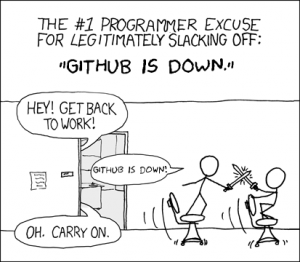
2.1.2 Chain reaction could block Free Software development

Today many dependency maintenance tools, as npm for javascript, Bundler for Ruby or even pip for Python can access an application source code directly from Github. Free Software projects getting more and more linked and codependents, if one component is down, all the developing process stop.

One of the best examples is the npmgate. Any company could legally demand that Github take down some source code from its repository, which could create a chain reaction and blocking the development of many Free Software projects, as suffered the Node.js community from the decisions of Npm, Inc, the company managing npm.

2.2 A historical precedent: SourceForge

Github didn t appear out of the blue. In his time, its predecessor, SourceForge, was also extremely popular.

Heavily centralized, based on strong interaction with the community, SourceForge is now seen as an aging SAAS (Software As A Service) and sees most of its customers fleeing to Github. Which creates lots of hurdles for those who stayed. The Gimp project suffered from spams and terrible advertising, which led to the departure of the VLC project, then from installers corrupted with adwares instead of the official Gimp installer for Windows. And finally, the Project Gimp s SourceForge account was hacked by SourceForge team itself!

These are very recent examples of what can do a commercial entity when it is under its stakeholders pressure. It is vital to really understand what it means to trust them with data and exchange centralization, where it could have tremendous repercussion on the day-to-day life and the habits of the Free Software and open source community.

2.3. Regarding proprietary software

2.3.1 One community, several opinions on proprietary software

Mostly based on ideology, this point deals with the definition every member of the community gives to Free Software and open source. Mostly about one thing: is it viral or not? Or GPL vs MIT/BSD.

Those on the side of the viral Free Software will have trouble to use a proprietary software as this last one shouldn t even exist. It must be assimilated, to quote Star Trek, as it is a connected black box, endangering privacy, corrupting for profit our uses and restrain our freedom to use as we re pleased what we own, etc.

Those on the side of complete freedom have no qualms using proprietary software as their very existence is a consequence of freedom without restriction. They even agree that code they developed may be a part of proprietary software, which is quite a common occurrence. This part of the Free Software community has no qualm using Github, which is well within their ideology parameters. Just take a look at the Janson amphitheater during Fosdem and check how many Apple laptops running on macOS are around.

FreeBSD, the main BSD project under the BSD license

2.3.2 Data loss and data restrictions linked to proprietary software use

Even without ideological consideration, and just focusing on Github infrastructure, the bug tracking system is a major problem by itself.

Bug report builds the memory of Free Software projects. It is the entrance point for new contributors, the place to find bug reporting, requests for new functions, etc. The project history can t be limited only to the code. It s very common to find bug reports when you copy and paste an error message in a search engine. Not their historical importance is precious for the project itself, but also for its present and future users.

Github gives the ability to extract bug reports through its API. What would happen if Github is down or if the platform doesn t support this feature anymore? In my opinion, not that many projects ever thought of this outcome. How could they move all the data generated by Github into a new bug tracking system? One old example now is Astrid, a TODO list bought by Yahoo a few years ago. Very popular, it grew fast until it was closed overnight, with only a few weeks for its users to extract their data. It was only a to-do list. The same situation with Github would be tremendously difficult to manage for several projects if they even have the ability to deal with it. Code would still be available and could still live somewhere else, but the project memory would be lost. A project like Debian has today more than 800,000 bug reports, which are a data treasure trove about problems solved, function requests and where the development stand on each. The developers of the Cpython project have anticipated the problem and decided not to use Github bug tracking systems.

Issues, the Github proprietary bug tracking system

Another thing we could lose if Github suddenly disappear: all the work currently done regarding the push requests (aka PRs). This Github function gives the ability to clone one project s Github repository, to modify it to fit your needs, then to offer your own modification to the original repository. The original repository s owner will then review said modification, and if he or she agrees with them will fuse them into the original repository. As such, it s one of the main advantages of Github, since it can be done easily through its graphic interface.

However reviewing all the PRs may be quite long, and most of the successful projects have several ongoing PRs. And this PRs and/or the proprietary bug tracking system are commonly used as a platform for comment and discussion between developers.

Code itself is not lost if Github is down (except one specific situation as seen below), but the peer review works materialized in the PRs and the bug tracking system is lost. Let s remember than the PR mechanism let you clone and modify projects and then generate PRs directly from its proprietary web interface without downloading a single code line on your computer. In this particular case, if Github is down, all the code and the work in progress is lost. Some also use Github as a bookmark place. They follow their favorite projects activity through the Watch function. This technological watch style of data collection would also be lost if Github is down.

Debian, one of the main Free Software projects with at least a thousand official contributors

2.4 Uniformization

The Free Software community is walking a thigh rope between normalization needed for an easier interoperability between its products and an attraction for novelty led by a strong need for differentiation from what is already there.

Github popularized the use of Git, a great tool now used through various sectors far away from its original programming field. Step by step, Git is now so prominent it s almost impossible to even think to another source control manager, even if awesome alternate solutions, unfortunately not as popular, exist as Mercurial.

A new Free Software project is now a Git repository on Github with README.md added as a quick description. All the other solutions are ostracized? How? None or very few potential contributors would notice said projects. It seems very difficult now to encourage potential contributors into learning a new source control manager AND a new forge for every project they want to contribute. Which was a basic requirement a few years ago. It s quite sad because Github, offering an original experience to its users, cut them out of a whole possibility realm. Maybe Github is one of the best web versioning control systems. But being the main one doesn t let room for a new competitor to grow. And it let Github initiate development newcomers into a narrow function set, totally unrelated to the strength of the Git tool itself.

3. Centralization, uniformization, proprietary software What s next? Laziness?

Fight against centralization is a main part of the Free Software ideology as centralization strengthens the power of those who manage it and who through it control those who are managed by it. Uniformization allergies born against main software companies and their wishes to impose a closed commercial software world was for a long time the main fuel for innovation thirst and intelligent alternative development. As we said above, part of the Free Software community was built as a reaction to proprietary software and their threat. The other part, without hoping for their disappearance, still chose a development model opposite to proprietary software, at least in the beginning, as now there s more and more bridges between the two.

The Github effect is a morbid one because of its consequences: at least centralization, uniformization, proprietary software usage as their bug tracking system. But some years ago the Dear Github buzz showed one more side effect, one I ve never thought about: laziness. For those who don t know what it is about, this letter is a complaint from several spokespersons from several Free Software projects which demand to Github team to finally implement, after years of polite asking, new functions. Since when Free Software project facing a roadblock request for clemency and don t build themselves the path they need? When Torvalds was involved in the Bitkeeper problem and the Linux kernel development team couldn t use anymore their revision control software, he developed Git. The mere fact of not being able to use one tool or functions lacking is the main motivation to seek alternative solutions and, as such, of the Free Software movement. Every Free Software community member able to code should have this reflex. You don t like what Github offers? Switch to Gitlab. You don t like it Gitlab? Improve it or make your own solution.

The Gitlab logo

Let s be crystal clear. I ve never said that every Free Software developers blocked should code his or her own alternative. We all have our own priorities, and some of us even like their beauty sleep, including me. But, to see that this open letter to Github has 1340 names attached to it, among them some spokespersons for major Free Software project showed me that need, willpower and strength to code a replacement are here. Maybe said replacement will be born from this letter, it would be the best outcome of this buzz.

In the end, Github usage is just another example of Internet usage massification. As Internet users are bound to go to massively centralized social network as Facebook or Twitter, developers are following the same path with Github. Even if a large fraction of developers realize the threat linked this centralized and proprietary organization, the whole community is following this centralization and uniformization trend. Github service is useful, free or with a reasonable price (depending on the functions you need) easy to use and up most of the time. Why would we try something else? Maybe because others are using us while we are savoring the convenience? The Free Software community seems to be quite sleepy to me.

The lion enjoying the hearth warm

About Me Carl Chenet, Free Software Indie Hacker, founder of the French-speaking Hacker News-like Journal du hacker. Follow me on social networks Translated from French by St phanie Chaptal. Original article written in 2015.

7 September 2017

Steinar H. Gunderson: Licensing woes

On releasing modified versions of GPLv3 software in binary form only (quote anonymized):
And in my opinion it's perfectly ok to give out a binary release of a project, that is a work in progress, so that people can try it out and coment on it. It's easier for them to have it as binary and not need to compile it themselfs. If then after a (long) while the code is still only released in binary form, then it's ok to start a discussion. But only for a quick test, that is unneccessary. So people, calm down and enjoy life!
I wonder at what point we got here.

8 August 2017

Jonathan Dowland: libraries

Cover for The Rise Of The Meritocracy Cover for The Rise Of The Meritocracy
At some point during my Undergraduate years I lost the habit of using Libraries. On reflection this is probably Amazon's fault. In recent years I've tried to get back into the habit of using them. Using libraries is a great idea if you are trying to lead a more minimalist life. I am registered to use Libraries in two counties: North Tyneside, where I live, and Newcastle, where I work. The union of the two counties' catalogues is pretty extensive. Perhaps surprisingly I have found North Tyneside to offer both better customer service and a more interesting selection of books. Sometimes there are still things that are hard to get ahold of. After listening to BBC Radio 4's documentary The Rise and Fall of Meritocracy, presented by Toby Young, I became interested in reading The Rise of the Meritocracy: an alarmist, speculative essay that coined the term meritocracy, written by Toby's father, Michael Young. The book was not on either catalogue. It is out of print, with the price of second hand copies fluctuating but generally higher than I am prepared to pay. I finally managed to find a copy in Newcastle University's Library. As an associate of the School of Computing I have access to the Library services. It's an interesting read, and I think if it were framed more as a novel than as an essay it might be remembered in the same bracket as Brave New World or 1984.

14 July 2017

Norbert Preining: TeX Live contrib repository (re)new(ed)

It is my pleasure to announce the renewal/rework/restart of the TeX Live contrib repository service. The repository is collecting packages that cannot enter TeX Live directly (mostly due to license reasons), but are free to distribute. The basic idea is to provide a repository mimicking Debian s nonfree branch. The packages on this site are not distributed inside TeX Live proper for one or another of the following reasons: In short, anything related to TeX that can not be on TeX Live but can still legally be distributed over the Internet can hav e a placeon TLContrib. Currently there are 52 packages in the repository, falling roughly into the following categories: The full list of packages can be seen here. The ultimate goal is to provide a companion to the core TeX Live (tlnet) distribution in much the same way as Debian s non-free tree is a companion to the normal distribution. The goal is not to replace TeX Live: packages that could go into TeX Live itself should stay (or be added) there. TLContrib is simply trying to fill in a gap in the current distribution system. Quick Start If you are running the current version of TeX Live, which is 2017 at the moment, the following code will suffice:
  tlmgr repository add http://contrib.texlive.info/current tlcontrib
  tlmgr pinning add tlcontrib '*'
In future there might be releases for certain years. Verification The packages are signed with my GnuPG RSA key: 0x6CACA448860CDC13. tlmgr will automatically verify authenticity if you add my key:
  curl -fsSL https://www.preining.info/rsa.asc   tlmgr key add -
After that tlmgr will tell you about failed authentication of this repository. History Taco Hoekwater started in 2010, but it hasn t seen much activity in recent years. Taco agreed to hand it over to myself, who is currently maintaining the repository. Big thanks to Taco for his long support and cooperation. In contrast to the original tlcontrib page, we don t offer an automatic upload of packages or user registration. If you want to add packages here, see below. Adding packages If you want to see a package included here that cannot enter TeX Live proper, the following ways are possible (from most appreciated to least appreciated): Git repository The packages are kept in a git repository and the tlmgr repo is built from after changes. The location is https://git.texlive.info/tlcontrib. Enjoy.

Next.

Previous.